Main Outcomes of the HEBE Trial: Improving Cardiorespiratory Fitness and Body Composition Through a Tailored Feasible Lifestyle Program
 , , , , , ,
  , , , , , ,
  ,
,  , and
, and
Abstract
1. Introduction
2. Materials and Methods
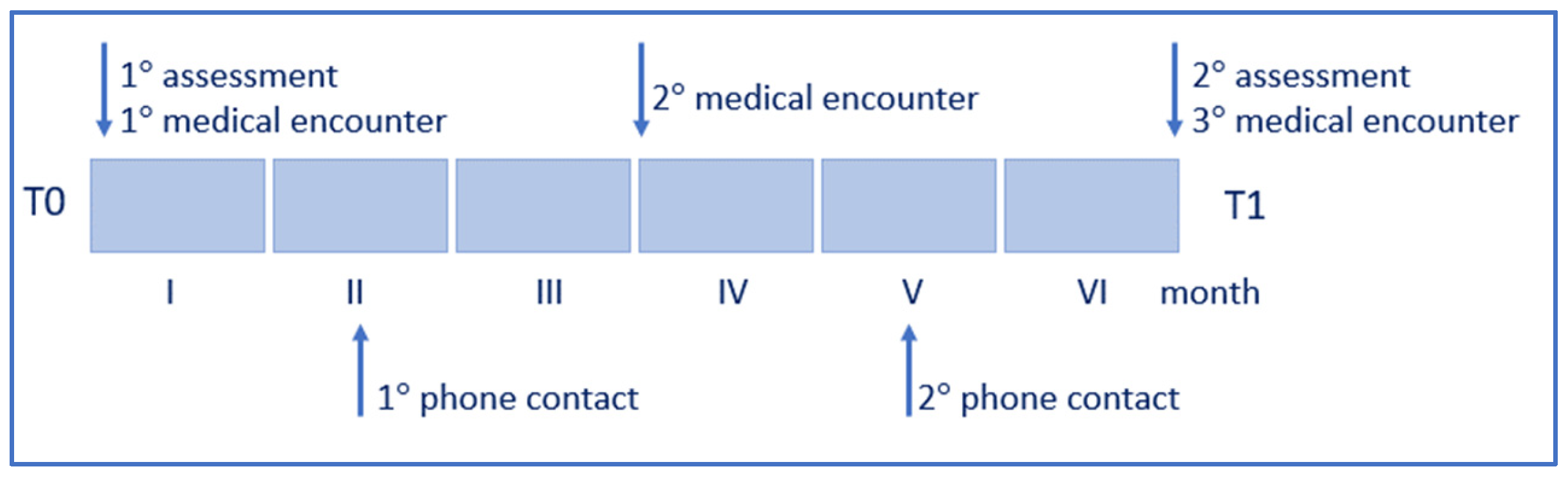
2.1. Study Design
2.2. Assessments
- Medical history and physical examination, including anthropometric measurements (body weight, height, and waist circumference) and hemodynamics (resting systolic and diastolic blood pressure, heart rate). Biological sampling included fasting plasma glucose and lipid profile. Based on clinical and anthropometric measurements, metabolic syndrome was defined according to guidelines [28].
- Body composition was assessed using bioelectrical impedance analysis [29] (BIA, Bodystat Quadscan 4000, BodyStat Ltd., Sulby, Isle of Man, British Isles, UK), providing estimates of fat mass (FM) and fat-free mass (FFM). The Fat Mass Index (FMi) and Fat-Free Mass Index (FFMi) were calculated to normalize FM and FFM values for height, using the following formulas: FMi = FM (kg)/height (m2); FFMi = FFM (kg)/height (m2).
- Lifestyle
- Cardiopulmonary Fitness Testing
2.3. Lifestyle Prescription Program
2.3.1. Exercise Prescription
2.3.2. Nutrition
2.3.3. Other Lifestyles
2.4. Outcomes
2.5. Statistical Analysis
2.5.1. Analysis of the Main Outcome
2.5.2. Analysis of the Secondary Outcomes
3. Results
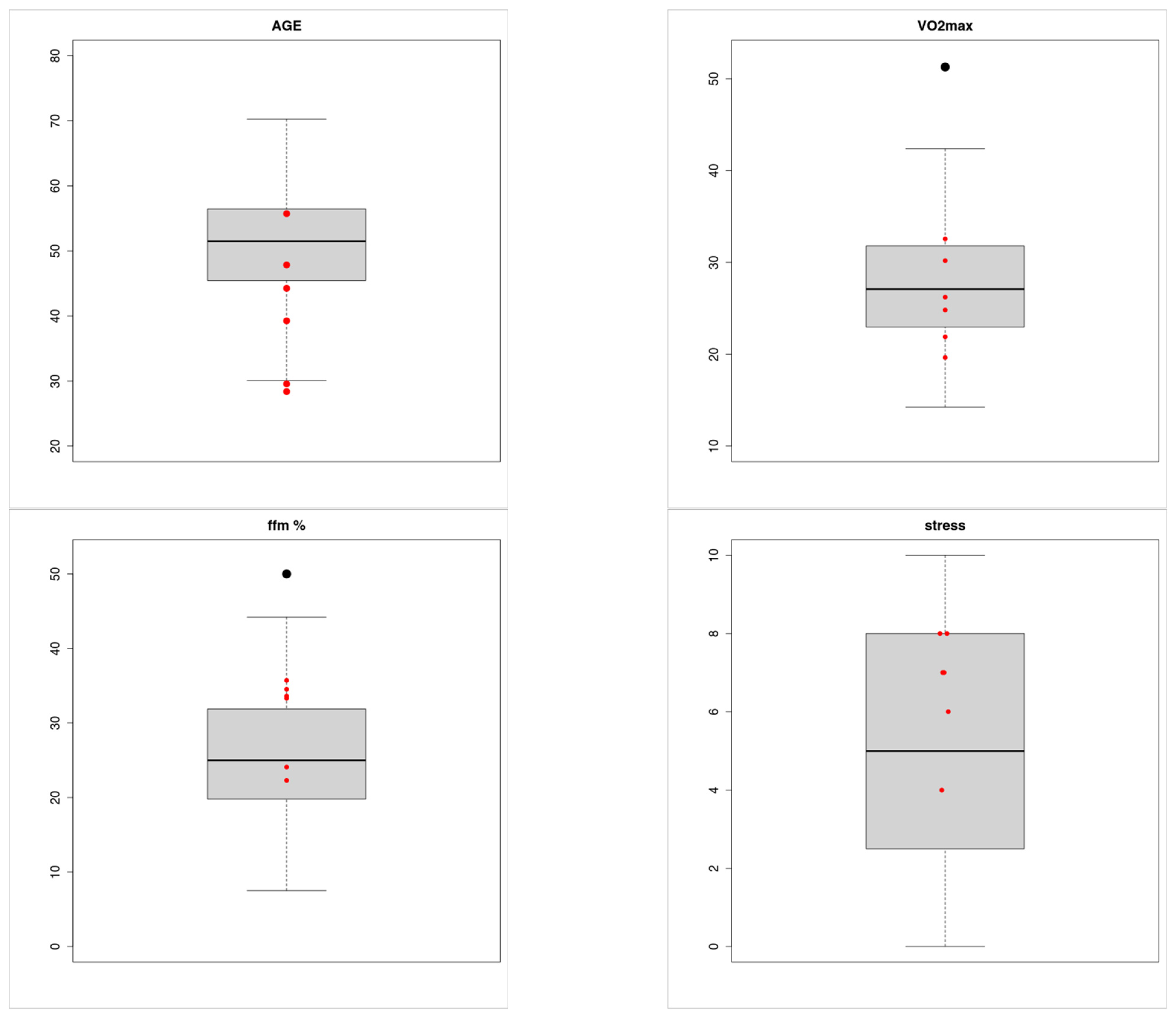
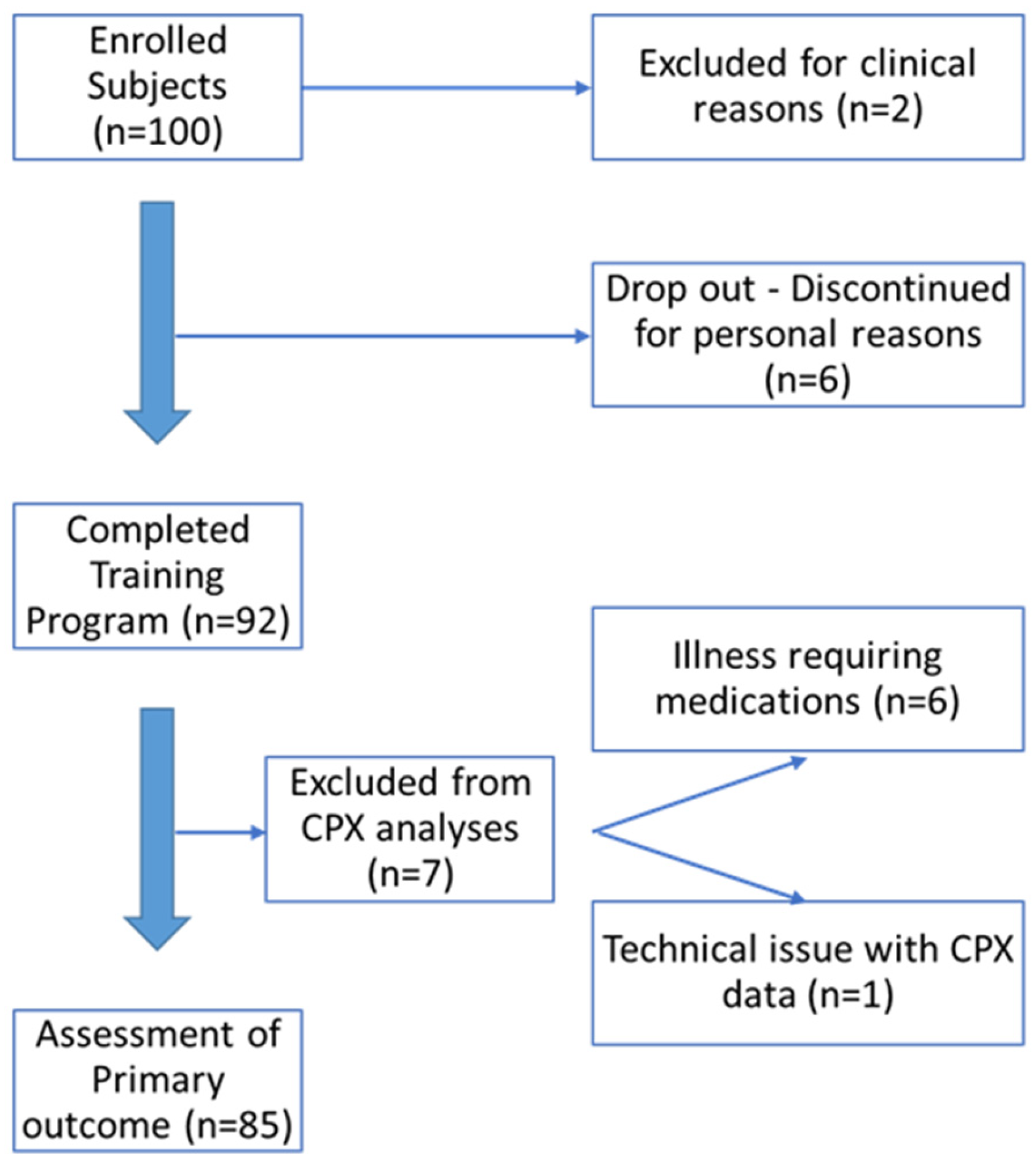
3.1. Population
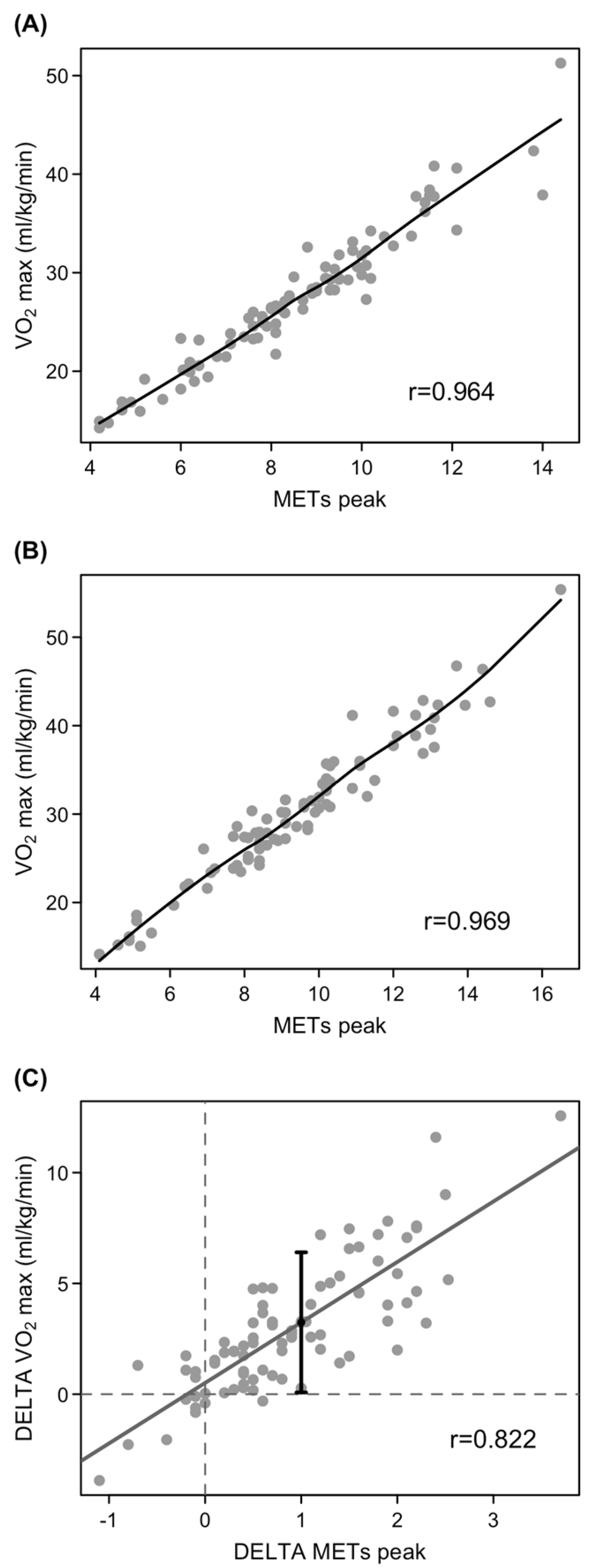
3.2. Main Outcome: Cardiopulmonary Test
3.3. Secondary Outcomes
3.3.1. Functional Parameters
3.3.2. Body Composition Changes
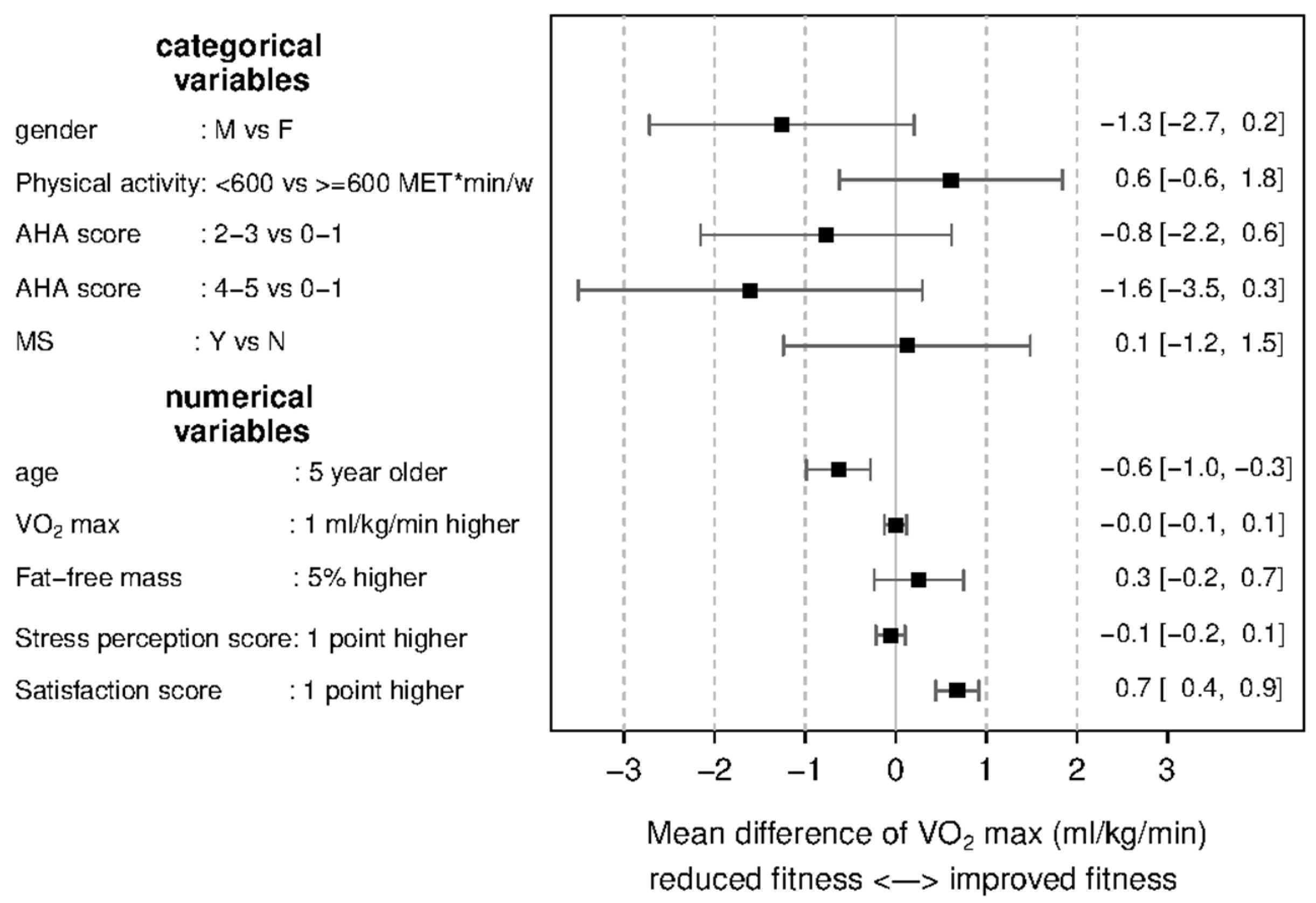
3.3.3. Multivariable Regression Model
3.3.4. Other Lifestyle Components/Parameters
3.3.5. Check of Non-Completers’ Data
4. Discussion
4.1. Cardiorespiratory Fitness to Monitor LMPs
4.2. Body Composition
4.3. LMPs in Clinical Settings
4.4. LMPs and Perceived Well-Being
4.5. Clinical Implications
4.6. Limitations
- -
- It is a single-arm (pre–post) study, a condition which limits the isolation of the effect of the intervention from other experimental variables, unmeasured confounders, and potential observation effects such as the Hawthorne effect. Consequently, the findings should be interpreted with caution, and causal inferences cannot be established. Moreover, we do not have data on long-term follow-up data, and we may not demonstrate the maintenance of behavioural and physiological improvements in the long term.
- -
- The sample size was calculated to detect a clinically relevant increase in VO2max as the primary endpoint, and the follow-up was limited to six months due to funding constraints. In addition to the previous limitations, secondary outcomes were analyzed on a per-protocol basis, which may introduce selection bias and further reduce the effective sample size. Accordingly, inferences for secondary endpoints should be interpreted with caution. The stratified sampling plan ensured adequate representation of key subgroups and improved the precision of estimates within the target population. In addition, a weighted sensitivity analysis was performed to account for potential imbalances across strata, thereby enhancing the robustness of the findings. Nevertheless, the generalizability of the results to a broader population of healthy individuals remains limited, mainly by the study’s eligibility criteria and setting. In particular, the sample consists exclusively of employees of the University of Milan with a very high educational level (59.2% holding a PhD or postgraduate degree), limiting the generalizability of the results to populations with lower health literacy. Moreover, we did not assess the intervention effects after 6 months due to financial restraints.
- -
- This paper focuses primarily on CRF and a subset of clinical variables commonly collected in trials. Other CPX variables were included in the text to provide a clinically meaningful, although not exhaustive, characterization of general cardiopulmonary status, without unnecessarily increasing methodological complexity or overextending the scope of the manuscript. We are planning another manuscript devoted to these data. Moreover, future analyses will explore the multi-omics biomarkers collected during the study to investigate interactions between immunological, metabolic, and autonomic control mechanisms.
- -
- We mainly focused on exercise, which was tailored and prescribed, and it might be most responsible for the observed improvements; however, the counselling given on nutrition and other lifestyle components, albeit limited, might contribute to the observed results. Nevertheless, distinguishing the relative contribution of different lifestyle components may not have significant clinical relevance, considering that the preventive/therapeutic action of lifestyle improvement is more efficacious when all lifestyle components are considered and that improving one lifestyle component (in particular exercise) may also foster improvements in others [82].
- -
- The retrospective registration of the trial may represent a limitation, considering that prospective registration is generally preferred for interventional studies
- -
- We did not report in the present paper the data regarding the assessment of physical activity using a wearable device because we are preparing other papers on these specific (and other) data, considering that the HEBE study was designed to collect many markers and many different papers are planned. Anyway, this specific point was not a main goal of the present study, which focused on cardiorespiratory fitness, the strongest parameter affected by physical training, which may determine health outcomes.
5. Conclusions
Author Contributions
Funding
Institutional Review Board Statement
Informed Consent Statement
Data Availability Statement
Conflicts of Interest
Abbreviations
| AHA score | American Heart Association score |
| AT | Anaerobic threshold |
| BC | Body composition |
| BMI | Body mass index |
| CI | Confidence interval |
| CNCD | Chronic non-communicable disease |
| CPX | Cardiopulmonary exercise test |
| CRF | Cardiorespiratory Fitness |
| DAP | Diastolic arterial pressure |
| DELTA | Pre–post differences |
| F | Female |
| FM | Fat mass |
| FMi | Fat mass index |
| FFM | Fat-free mass |
| FFMi | Fat-free mass index |
| HDL | High-density lipoprotein |
| HG | Handgrip |
| HR | Heart rate |
| IPAQ | International physical activity questionnaire |
| ITT | Intention-to-treat |
| LDL | Low-density lipoprotein |
| LMPs | Lifestyle modification programs |
| M | Male |
| MAR | Missingness at random |
| METs | Metabolic equivalents |
| METSpeak | Metabolic equivalents at exercise peak |
| MICE | Multiple imputation by chain equations |
| MS | Metabolic syndrome |
| O | Oxygen |
| p0 | Pre-treatment outcome proportions |
| p1 | Post-treatment outcome proportions |
| q25 | 25th percentile |
| q75 | 75th percentile |
| RD | Relative difference |
| SAP | Systolic arterial pressure |
| T0 | Baseline |
| T1 | End of the intervention |
| V | Volume |
| VE | Ventilation |
| VO2max | Volume of maximal oxygen |
| W | Watt |
| 4S-Q | Short–subjective stress-related somatic symptoms questionnaire |
| 6MWT | Six-minute walking test |
| Δ | Delta |
Appendix A
Appendix A.1. Lifestyle Assessment
- -
- Physical activity (total activity volume) was assessed by the International Physical Activity Questionnaire (IPAQ) [36], which focuses on intensity (nominally estimated in Metabolic Equivalents (METs) according to the type of activity) and duration (in minutes) of physical activity, considering the following levels: brisk walking (≈3.3 METs), other activities of moderate intensity (≈4.0 METs) and activities of vigorous intensity (≈8.0 METs). We use the following equations to guess weekly physical activity volume: moderate-intensity [MET·minutes/week] = (3.3 × minutes of brisk walking × days of brisk walking) + (4.0 × minutes of other moderate-intensity activity × days of other moderate-intensity activities); vigorous-intensity: [MET·minutes/week] = 8.0 × minutes of vigorous-intensity activity × days of vigorous-intensity activity; and total weekly physical activity volume [MET·minutes/week] = sum of Moderate + Vigorous MET·minutes/week scores.
- -
- We also assessed the frequency of regular strength and flexibility exercises, considering the following scale: never; sometimes; 1 section/week; 2–3 sections/week; more than 3 sections/week.
- -
- Sedentary behaviour was assessed by asking the number of hours spent in sedentary behaviour (for instance, studying, sitting, driving, TV viewing, computer or smart devices usage) during weekly working days or weekend days.
- -
- Nutrition was assessed using the American Heart Association Healthy Diet Score (AHA score) [37], taking into consideration fruits/vegetables, fish, sweetened beverages, whole grains, and sodium consumption.
- -
- Sleep was assessed by inquiring about the number of hours on average slept every night and asking about the perception of sleep quality
- -
- Stress and somatic symptom perception were assessed using a self-administered questionnaire [30,31,32,33,34,35], providing nominal self-rated scales (higher values indicate higher degrees of symptoms) focusing on: (i) the appraisal of the overall stress and fatigue perception by evaluation scales with integer scores from 0 (‘no perception’) to 10 (‘highest perception’) for each measure; (ii) the Short–Subjective Stress-related Somatic Symptoms Questionnaire (4S-Q), inquiring about four somatic symptoms accounting for the majority of somatic complaints. For scoring purposes, each response will be coded from 0 (‘no feeling’) to 10 (‘a strong feeling’); thus, the total score ranges from 0 to 40. Moreover, we also assessed the following:
- -
- Perception of quality of sleep, quality of health, and quality of life were assessed using evaluation scales from 0 (‘worst quality) to 10 (‘best quality’) for each measure.
- -
- Smoke behaviour: We considered non-smokers all subjects who reported having never smoked or having stopped smoking for more than one year.
- -
- We enquired about the usage of alcohol, considering Italian habits, asking about the number of glasses of wine or beer consumed per week and the number of glasses of spirits consumed per week.
- -
- Gum bleeding was evaluated considering the following choices: “yes”, “no”, or “sometimes”.
- -
- Work-related discomfort was evaluated considering the following choices: “no”, “sometimes”, “yes”, or “no response”.
Appendix A.2. Ongoing Multi-Omics Analysis and Study of the Autonomic Nervous System (ANS)

| Variable | |
|---|---|
| Age (years): median (q25–q75) | 51.1 (45.0–56.2) |
| Role: | |
| UNIMI Faculty | 38 (38.8%) |
| Technical and Administrative Staff | 45 (45.9%) |
| Researcher | 15 (15.3%) |
| Gender: Female | 52 (53.1%) |
| Education Level | |
| High School Diploma | 4 (4.1%) |
| Bachelor’s Degree | 26 (26.5%) |
| PhD/Postgraduate Specialization | 68 (59.2%) |
| Frequency of medical consultations for | |
| health status assessment | |
| Never | 1 (1.0%) |
| Once per year | 42 (42.9%) |
| Once every 2 years | 3 (3.1%) |
| Regularly for specific medical issues | 14 (14.3%) |
| Only when experiencing illness | 38 (38.8%) |
| Presence of Chronic Disease | |
| No | 71 (72.4%) |
| Yes | 23 (23.5%) |
| No response | 4 (4.1%) |
| Work-related Discomfort | |
| No | 57 (58.2%) |
| Sometimes | 27 (27.6%) |
| Yes | 13 (13.3%) |
| No response | 1 (1.0%) |
| Lifestyle Goals for Improvement | |
| Eating a healthier diet | 22 (22.4%) |
| Becoming more physically active | 52 (53.1%) |
| Managing stress | 21 (21.4%) |
| Quitting smoking | 3 (3.1%) |
| T0 Median, 25th–75th Percentile Unweighted | T1 Median, 25th–75th Percentile Unweighted | Median Difference Between T1 and T0 | |
|---|---|---|---|
| Fasting Blood Glucose (mg/dL) | 89 (85; 96) | 90 (83; 95) missing: 4 (4.3%) | −2.0 (−7.3, 3.3) missing: 4 (4.3%) |
| Triglycerides (mg/dL) | 82 (62; 118) | 74 (61; 92) missing: 4 (4.3%) | −6.0 (−14.6, 2.6) missing: 4 (4.3%) |
| Total Cholesterol (mg/dL) | 210 (179; 232) | 188 (170; 218) missing: 4 (4.3%) | −8.0 (−16.2, 0.2) missing: 4 (4.3%) |
| HDL Cholesterol (mg/dL) | 60 (50;70) | 55 (50; 71) missing: 4 (4.3%) | −1.0 (−4.4, 2.4) missing: 4 (4.3%) |
| LDL Cholesterol (mg/dL) | 124 (104; 147) | 112 (96; 133) missing: 4 (4.3%) | −7.0 (−15.0, 1.0) missing: 4 (4.3%) |
| Satisfaction with the Program: median (q25; q75) | 8 (8; 10) |
| No response | |
| Perceived Difficulty in Following Program: median (q25; q75) | 7 (3.7 (7.6%)3; 8) |
| No response | 7 (7.6%) |
| Overall Perception of Well-Being | |
| Much Worse | 0 (0.0%) |
| Worse | 1 (1.1%) |
| No Change | 6 (6.5%) |
| Improved | 56 (60.9%) |
| Much Improved | 21 (22.8%) |
| No response | 8 (8.7%) |
| Reasons for Non-Adherence * (N = 63) | |
| Lack of Time | 42 (66.7%) |
| Motivation Issues | 7 (11.1%) |
| Difficulty Following the Program | 4 (6.3%) |
| Health Issues | 16 (25.4%) |
| Other Reasons | 8 (12.7%) |
| T0 N (%) | T1 N (%) | Probability of: | Relative Difference Between T1 and T0 | |
|---|---|---|---|---|
| Smoke Non-smoker/ex-smoker Smokers Missing | 87 (94.6%) 5 (5.4%) - | 84 (91.3%) 4 (4.3%) 4 (4.3%) | Being non-ssmoker OR former smoker: | 0.7% (−1.7, 3.2%) |
| Gum Bleeding No Sometime Yes Missing | 79 (85.9%) 0 (0.0%) 13 (14.1%) - | 79 (85.9%) 5 (5.4%) 4 (4.3%) 4 (4.3%) | No bleeding: | 4.6% (−12.2%, 24.6%) |
| Flexibility exercise (Stretching) No sometimes 1 session/week 2–3 sessions/week More than 3 sessions/week Missing | 49 (53.3%) 24 (26.1%) 8 (8.7%) 8 (8.7%) 3 (3.3%) - | 26 (28.3%) 20 (21.7%) 25 (27.2%) 11 (12.0%) 6 (6.5%) 4 (4.3%) | Doing weekly stretching (any frequency) | 37.2% (−3.4%, 95.0%) |
| Strength Exercises No sometimes 1 session/week 2–3 sessions/week More than 3 sessions/week Missing | 21 (22.8%) 49 (53.3%) 21 (22.8%) 1 (1.1%) 0 (0.0%) - | 21 (22.8%) 41 (44.6%) 26 (28.3%) 0 (0.0%) 0 (0.0%) 4 (4.3%) | Doing weekly exercise (any frequency) | 3.0% (−14.7%, 24.4%) |
| Parameter | T0 Median, 25th–75th Percentile Unweighted | T1 Median, 25th–75th Percentile Unweighted | Median Difference Between T1 and T0 |
|---|---|---|---|
| METs TOT (MET·minutes/week) | 1114 (511; 1760) | 1774 (1094; 2449) | 434 (44, 824) |
| - | 4 (4.4%) | 4 (4.4%) | |
| Sedentary behaviours (hours) * | 55 (48; 65) | 51 (41; 59) | −5 (−8.5, −1.5) |
| missing | 2 (2.2%) | 7 (7.8%) | 9 (9.8%) |
| Wine/beer (glasses/week) | 2 (0; 4) | 1 (0; 3) | 0 (−1.0, 0.0) |
| missing | 1 (1.1%) | 9 (10.0%) | 10 (10.9%) |
| Spirits (glasses/week) | 0 (0; 0) | 0 (0; 0) | 0 ** |
| missing | 1 (1.1%) | 7 (7.8%) | 8 (8.7%) |
| 4SQ score (a.u.) | 6 (2; 15) | 4 (0; 12) | −1.0 (−3.7, 1.7) |
| missing | - | 4 (5.5%) | 5 (5.5%) |
| Stress Perception score (a.u.) | 5.0 (2.8; 8.0) | 4.0 (2.0; 7.0) | −1.0 (−2.6, 0.6) |
| missing | - | 4 (4.4%) | 4 (4.4%) |
| Fatigue Perception score (a.u.) | 7.0 (3.0; 8.0) | 4.0 (3.0; 8.8) | −1.0 (−2.6, 0.6) |
| missing | - | 4 (4.4%) | 4 (4.4%) |
| AHA healthy diet score (a.u.) | 2.5 (2.0; 3.0) | 3.0 (2.0; 4.0) | 0.0 (−0.3, 0.3) |
| missing | - | 4 (4.4%) | 4 (4.4%) |
| Sleep (hours/day) | 7.0 (6.0; 7.0) | 7.0 (6.0; 7.0) | 0 ** |
| missing | - | 4 (4.4%) | 4 (4.4%) |
| Perception of sleep quality (a.u.) | 6.0 (5.0; 8.0) | 7.0 (6.0; 8.0) | 0 (−0.6, 0.6) |
| missing | - | 4 (4.4%) | 4 (4.4%) |
| Perception of health quality (a.u.) | 7.0 (6.0; 8.0) | 8.0 (7.0; 8.0) | 1 (−0.6, 2.6) |
| missing | - | 4 (4.4%) | 4 (4.4%) |
| Perception of job performance (a.u.) | 7.0 (6.0; 8.0) | 8.0 (7.0; 8.0) | 0 (−1.2, 1.2) |
| missing | - | 4 (4.4%) | 4 (4.4%) |
| Parameter | Completers (n = 92) | Non-Completers (n = 6) | Cramer V |
|---|---|---|---|
| Gender | 0.404 | ||
| Female | 51 (55.4%) | 1 (16.7%) | |
| Male | 41 (44.6%) | 5 (83.3%) | |
| Physical activity | 0.082 | ||
| <600 MET minutes/week | 54 (58.7%) | 4 (66.7%) | |
| ≥600 MET minutes/week | 38 (41.3%) | 2 (33.3%) | |
| AHA score | 0.188 | ||
| 0–1 | 16 (17.4%) | 2 (33.3%) | |
| 2–3 | 60 (65.2%) | 3 (50.0%) | |
| 4–5 | 16 (17.4%) | 1 (16.7%) | |
| Metabolic syndrome | 0.093 | ||
| No | 69 (75.8%) | 5 (83.3%) | |
| Yes | 22 (24.2%) | 1 (16.7%) |

References
- Bull, F.C.; Al-Ansari, S.S.; Biddle, S.; Borodulin, K.; Buman, M.P.; Cardon, G.; Carty, C.; Chaput, J.P.; Chastin, S.; Chou, R.; et al. World Health Organization 2020 Guidelines on Physical Activity and Sedentary Behaviour. Br. J. Sports Med. 2020, 54, 1451–1462. [Google Scholar] [CrossRef]
- Sallis, R.E. Exercise Is Medicine and Physicians Need to Prescribe It! Br. J. Sports Med. 2009, 43, 3–4. [Google Scholar] [CrossRef]
- Pelliccia, A.; Sharma, S.; Gati, S.; Bäck, M.; Börjesson, M.; Caselli, S.; Collet, J.P.; Corrado, D.; Drezner, J.A.; Halle, M.; et al. 2020 ESC Guidelines on Sports Cardiology and Exercise in Patients with Cardiovascular Disease. Eur. Heart J. 2021, 42, 17–96. [Google Scholar] [CrossRef]
- Valenzuela, P.L.; Ruilope, L.M.; Santos-Lozano, A.; Wilhelm, M.; Kränkel, N.; Fiuza-Luces, C.; Lucia, A. Exercise Benefits in Cardiovascular Diseases: From Mechanisms to Clinical Implementation. Eur. Heart J. 2023, 44, 1874–1889. [Google Scholar] [CrossRef]
- Oppert, J.M.; Bellicha, A.; Ciangura, C. Physical Activity in Management of Persons with Obesity. Eur. J. Intern. Med. 2021, 93, 8–12. [Google Scholar] [CrossRef] [PubMed]
- Argentieri, M.A.; Amin, N.; Nevado-Holgado, A.J.; Sproviero, W.; Collister, J.A.; Keestra, S.M.; Kuilman, M.M.; Ginos, B.N.R.; Ghanbari, M.; Doherty, A.; et al. Integrating the Environmental and Genetic Architectures of Aging and Mortality. Nat. Med. 2025, 31, 1016–1025. [Google Scholar] [CrossRef]
- Silverman, M.N.; Deuster, P.A. Biological Mechanisms Underlying the Role of Physical Fitness in Health and Resilience. Interface Focus 2014, 4, 20140040. [Google Scholar] [CrossRef]
- Nieman, D.C.; Wentz, L.M. The Compelling Link between Physical Activity and the Body’s Defense System. J. Sport Health Sci. 2019, 8, 201–217. [Google Scholar] [CrossRef] [PubMed]
- Fiuza-Luces, C.; Valenzuela, P.L.; Gálvez, B.G.; Ramírez, M.; López-Soto, A.; Simpson, R.J.; Lucia, A. The Effect of Physical Exercise on Anticancer Immunity. Nat. Rev. Immunol. 2024, 24, 282–293. [Google Scholar] [CrossRef] [PubMed]
- Bishop, V.S. Exercise and the Autonomic Nervous System. In Primer on the Autonomic Nervous System, 2nd ed.; Academic Press: Cambridge, MA, USA, 2004; pp. 183–184. [Google Scholar] [CrossRef]
- Kokkinos, P.; Faselis, C.; Samuel, I.B.H.; Lavie, C.J.; Zhang, J.; Vargas, J.D.; Pittaras, A.; Doumas, M.; Karasik, P.; Moore, H.; et al. Changes in Cardiorespiratory Fitness and Survival in Patients With or Without Cardiovascular Disease. J. Am. Coll. Cardiol. 2023, 81, 1137–1147. [Google Scholar] [CrossRef]
- Kodama, S.; Saito, K.; Tanaka, S.; Maki, M.; Yachi, Y.; Asumi, M.; Sugawara, A.; Totsuka, K.; Shimano, H.; Ohashi, Y.; et al. Cardiorespiratory Fitness as a Quantitative Predictor of All-Cause Mortality and Cardiovascular Events in Healthy Men and Women: A Meta-Analysis. JAMA 2009, 301, 2024–2035. [Google Scholar] [CrossRef]
- Cumming, G.R. Physical Fitness and Cardiovascular Health. Circulation 1968, 37, 4–7. [Google Scholar] [CrossRef]
- Lang, J.J.; Prince, S.A.; Merucci, K.; Cadenas-Sanchez, C.; Chaput, J.P.; Fraser, B.J.; Manyanga, T.; McGrath, R.; Ortega, F.B.; Singh, B.; et al. Cardiorespiratory Fitness Is a Strong and Consistent Predictor of Morbidity and Mortality among Adults: An Overview of Meta-Analyses Representing over 20.9 Million Observations from 199 Unique Cohort Studies. Br. J. Sports Med. 2024, 58, 556–566. [Google Scholar] [CrossRef] [PubMed]
- Nilsson, M.I.; Bourgeois, J.M.; Nederveen, J.P.; Leite, M.R.; Hettinga, B.P.; Bujak, A.L.; May, L.; Lin, E.; Crozier, M.; Rusiecki, D.R.; et al. Lifelong Aerobic Exercise Protects against Inflammaging and Cancer. PLoS ONE 2019, 14, e0210863. [Google Scholar] [CrossRef] [PubMed]
- Woods, J.A.; Wilund, K.R.; Martin, S.A.; Kistler, B.M. Exercise, Inflammation and Aging. Aging Dis. 2011, 3, 130. [Google Scholar]
- Rippe, J.M.; Frates, B. Academic Lifestyle Medicine and Physician Education. Am. J. Lifestyle Med. 2025, 19, 15598276251355164. [Google Scholar] [CrossRef]
- Stead, M.; Craigie, A.M.; Macleod, M.; McKell, J.; Caswell, S.; Steele, R.J.C.; Anderson, A.S. Why Are Some People More Successful at Lifestyle Change than Others? Factors Associated with Successful Weight Loss in the BeWEL Randomised Controlled Trial of Adults at Risk of Colorectal Cancer. Int. J. Behav. Nutr. Phys. Act. 2015, 12, 87. [Google Scholar] [CrossRef] [PubMed]
- Murray, J.; Craigs, C.L.; Hill, K.M.; Honey, S.; House, A. A Systematic Review of Patient Reported Factors Associated with Uptake and Completion of Cardiovascular Lifestyle Behaviour Change. BMC Cardiovasc. Disord. 2012, 12, 120. [Google Scholar] [CrossRef]
- Lucini, D.; Pagani, M. Exercise Prescription to Foster Health and Well-Being: A Behavioral Approach to Transform Barriers into Opportunities. Int. J. Environ. Res. Public Health 2021, 18, 968. [Google Scholar] [CrossRef] [PubMed]
- Friedberg, M.W.; Schneider, E.C.; Rosenthal, M.B.; Volpp, K.G.; Werner, R.M. Association between Participation in a Multipayer Medical Home Intervention and Changes in Quality, Utilization, and Costs of Care. JAMA 2014, 311, 815–825. [Google Scholar] [CrossRef]
- Song, Z.; Baicker, K. Effect of a Workplace Wellness Program on Employee Health and Economic Outcomes: A Randomized Clinical Trial. JAMA 2019, 321, 1491–1501. [Google Scholar] [CrossRef]
- Ross, R.; Blair, S.N.; Arena, R.; Church, T.S.; Després, J.P.; Franklin, B.A.; Haskell, W.L.; Kaminsky, L.A.; Levine, B.D.; Lavie, C.J.; et al. Importance of Assessing Cardiorespiratory Fitness in Clinical Practice: A Case for Fitness as a Clinical Vital Sign: A Scientific Statement from the American Heart Association. Circulation 2016, 134, e653–e699. [Google Scholar] [CrossRef] [PubMed]
- Wasserman, K.; Van Kessel, A.L.; Burton, G.G. Interaction of Physiological Mechanisms during Exercise. J. Appl. Physiol. 1967, 22, 71–85. [Google Scholar] [CrossRef] [PubMed]
- Kokkinos, P.; Faselis, C.; Samuel, I.B.H.; Pittaras, A.; Doumas, M.; Murphy, R.; Heimall, M.S.; Sui, X.; Zhang, J.; Myers, J. Cardiorespiratory Fitness and Mortality Risk Across the Spectra of Age, Race, and Sex. J. Am. Coll. Cardiol. 2022, 80, 598–609. [Google Scholar] [CrossRef]
- Fletcher, G.F.; Ades, P.A.; Kligfield, P.; Arena, R.; Balady, G.J.; Bittner, V.A.; Coke, L.A.; Fleg, J.L.; Forman, D.E.; Gerber, T.C.; et al. Exercise Standards for Testing and Training: A Scientific Statement from the American Heart Association. Circulation 2013, 128, 873–934. [Google Scholar] [CrossRef] [PubMed]
- Bianchi, F.; Biganzoli, E.M.; Bollati, V.; Clerici, M.; Lucini, D.; Mandò, C.; Rota, F. HEBE Project: Healthy Aging versus Inflamm-Aging: The Role of Physical Exercise in Modulating the Biomarkers of Age-Associated and Environmentally Determined Chronic Diseases, Study Protocol. PLoS ONE 2024, 19, e0300011. [Google Scholar] [CrossRef]
- Grundy, S.M.; Hansen, B.; Smith, S.C.; Cleeman, J.I.; Kahn, R.A. Clinical Management of Metabolic Syndrome: Report of the American Heart Association/National Heart, Lung, and Blood Institute/American Diabetes Association Conference on Scientific Issues Related to Management. Arterioscler. Thromb. Vasc. Biol. 2004, 24, e19–e24. [Google Scholar] [CrossRef]
- Benton, M.J.; Swan, P.D.; Schlairet, M.C.; Sanderson, S. Comparison of Body Composition Measurement With Whole Body Multifrequency Bioelectrical Impedance and Air Displacement Plethysmography in Healthy Middle-Aged Women. Health Care Women Int. 2011, 32, 1068–1078. [Google Scholar] [CrossRef]
- Lucini, D.; Riva, S.; Pizzinelli, P.; Pagani, M. Stress Management at the Worksite: Reversal of Symptoms Profile and Cardiovascular Dysregulation. Hypertension 2007, 49, 291–297. [Google Scholar] [CrossRef]
- Lucini, D.; Luconi, E.; Giovanelli, L.; Marano, G.; Bernardelli, G.; Guidetti, R.; Morello, E.; Cribellati, S.; Brambilla, M.M.; Biganzoli, E.M. Assessing Lifestyle in a Large Cohort of Undergraduate Students: Significance of Stress, Exercise and Nutrition. Nutrients 2024, 16, 4339. [Google Scholar] [CrossRef]
- Solaro, N.; Oggionni, G.; Bernardelli, G.; Malacarne, M.; Pagani, E.; Ferrari, M.; Parati, G.; Lucini, D. Lifestyle and Perceived Well-Being in Children and Teens: Importance of Exercise and Sedentary Behavior. Nutrients 2370 17, 2370. [CrossRef]
- Lucini, D.; Malacarne, M.; Gatzemeier, W.; Pagani, E.; Bernardelli, G.; Parati, G.; Pagani, M. Evidence of Better Autonomic, Metabolic and Psychological Profile in Breast Cancer Survivors Meeting Current Physical Activity Recommendations: An Observational Study. J. Pers. Med. 2022, 12, 273. [Google Scholar] [CrossRef]
- Lucini, D.; Malacarne, M.; Gatzemeier, W.; Pagani, M. A Simple Home-Based Lifestyle Intervention Program to Improve Cardiac Autonomic Regulation in Patients with Increased Cardiometabolic Risk. Sustainability 2020, 12, 7671. [Google Scholar] [CrossRef]
- Lucini, D.; Solaro, N.; Lesma, A.; Gillet, V.B.; Pagani, M. Health Promotion in the Workplace: Assessing Stress and Lifestyle with an Intranet Tool. J. Med. Internet Res. 2011, 13, e88. [Google Scholar] [CrossRef] [PubMed]
- Craig, C.L.; Marshall, A.L.; Sjöström, M.; Bauman, A.E.; Booth, M.L.; Ainsworth, B.E.; Pratt, M.; Ekelund, U.; Yngve, A.; Sallis, J.F.; et al. International Physical Activity Questionnaire: 12-Country Reliability and Validity. Med. Sci. Sports Exerc. 2003, 35, 1381–1395. [Google Scholar] [CrossRef] [PubMed]
- Lloyd-Jones, D.M.; Hong, Y.; Labarthe, D.; Mozaffarian, D.; Appel, L.J.; Van Horn, L.; Greenlund, K.; Daniels, S.; Nichol, G.; Tomaselli, G.F.; et al. Defining and Setting National Goals for Cardiovascular Health Promotion and Disease Reduction: The American Heart Association’s Strategic Impact Goal through 2020 and Beyond. Circulation 2010, 121, 586–613. [Google Scholar] [CrossRef]
- Rost, R.; Hollmann, W. Belastungsuntersuchungen in Der Praxis: Grundlagen, Technik Und Interpretation Ergometrischer Untersuchungsverfahren; Thieme: Stuttgart, Germany, 1982. [Google Scholar]
- Agarwala, P.; Salzman, S.H. Six-Minute Walk Test: Clinical Role, Technique, Coding, and Reimbursement. Chest 2020, 157, 603–611. [Google Scholar] [CrossRef]
- Tomkinson, G.R.; Lang, J.J.; Rubín, L.; McGrath, R.; Gower, B.; Boyle, T.; Klug, M.G.; Mayhew, A.J.; Blake, H.T.; Ortega, F.B.; et al. International Norms for Adult Handgrip Strength: A Systematic Review of Data on 2.4 Million Adults Aged 20 to 100+ Years from 69 Countries and Regions. J. Sport Health Sci. 2024, 14, 101014. [Google Scholar] [CrossRef]
- Maslov, P.Z.; Schulman, A.; Lavie, C.J.; Narula, J. Personalized Exercise Dose Prescription. Eur. Heart J. 2018, 39, 2346–2355. [Google Scholar] [CrossRef]
- Mozaffarian, D. Dietary and Policy Priorities for Cardiovascular Disease, Diabetes, and Obesity: A Comprehensive Review. Circulation 2016, 133, 187–225. [Google Scholar] [CrossRef]
- Kurnik Mesarič, K.; Pajek, J.; Logar Zakrajšek, B.; Bogataj, Š.; Kodrič, J. Cognitive Behavioral Therapy for Lifestyle Changes in Patients with Obesity and Type 2 Diabetes: A Systematic Review and Meta-Analysis. Sci. Rep. 2023, 13, 12793. [Google Scholar] [CrossRef]
- Spring, B.; Ockene, J.K.; Gidding, S.S.; Mozaffarian, D.; Moore, S.; Rosal, M.C.; Brown, M.D.; Vafiadis, D.K.; Cohen, D.L.; Burke, L.E.; et al. Better Population Health through Behavior Change in Adults: A Call to Action. Circulation 2013, 128, 2169–2176. [Google Scholar] [CrossRef]
- Friedel, A.L.; Siegel, S.; Kirstein, C.F.; Gerigk, M.; Bingel, U.; Diehl, A.; Steidle, O.; Haupeltshofer, S.; Andermahr, B.; Chmielewski, W.; et al. Measuring Patient Experience and Patient Satisfaction-How Are We Doing It and Why Does It Matter? A Comparison of European and U.S. American Approaches. Healthcare 2023, 11, 797. [Google Scholar] [CrossRef] [PubMed]
- White, I.R.; Horton, N.J.; Carpenter, J.; Pocock, S.J. Strategy for Intention to Treat Analysis in Randomised Trials with Missing Outcome Data. BMJ 2011, 342, 910–912. [Google Scholar] [CrossRef] [PubMed]
- Rubin, D.B. Multiple Imputation for Nonresponse in Surveys; Wiley: Hoboken, NJ, USA, 1987. [Google Scholar] [CrossRef]
- White, I.R.; Royston, P.; Wood, A.M. Multiple Imputation Using Chained Equations: Issues and Guidance for Practice. Stat. Med. 2011, 30, 377–399. [Google Scholar] [CrossRef]
- Fitzmaurice, M.; Laird, N.; Ware, J. Applied Longitudinal Analysis, 2nd ed.; John Wiley & Sons: Hoboken, NJ, USA, 2011. [Google Scholar]
- Heeringa, S.G.; West, B.T.; Berglund, P.A. Applied Survey Data Analysis; Taylor & Francis: London, UK, 2010. [Google Scholar] [CrossRef]
- Des Jarlais, D.C.; Lyles, C.; Crepaz, N. Improving the Reporting Quality of Nonrandomized Evaluations of Behavioral and Public Health Interventions: The TREND Statement. Am. J. Public Health 2004, 94, 361–366. [Google Scholar] [CrossRef] [PubMed]
- Koenker, R. Quantile Regression. In Quantile Regression; Cambridge University Press: Cambridge, UK, 2005; pp. 1–349. [Google Scholar] [CrossRef]
- R Foundation for Statistical Computing, Vienna. R: A Language and Environment for Statistical Computing. Available online: https://www.r-project.org/ (accessed on 1 June 2026).
- Huntington-Klein, N. Variable Table for Variable Documentation • Vtable. Available online: https://nickch-k.github.io/vtable/ (accessed on 31 August 2025).
- van Buuren, S.; Groothuis-Oudshoorn, K. Mice: Multivariate Imputation by Chained Equations in R. J. Stat. Softw. 2011, 45, 1–67. [Google Scholar] [CrossRef]
- Lumley, T. Analysis of Complex Survey Samples. J. Stat. Softw. 2004, 9, 1–19. [Google Scholar] [CrossRef]
- Deslippe, A.L.; Soanes, A.; Bouchaud, C.C.; Beckenstein, H.; Slim, M.; Plourde, H.; Cohen, T.R. Barriers and Facilitators to Diet, Physical Activity and Lifestyle Behavior Intervention Adherence: A Qualitative Systematic Review of the Literature. Int. J. Behav. Nutr. Phys. Act. 2023, 20, 14. [Google Scholar] [CrossRef]
- Kulmala, J.; Rosenberg, A.; Ngandu, T.; Hemiö, K.; Tenkula, T.; Hyytiä, A.; Vienola, M.; Huhtamäki-Kuoppala, M.; Saarinen, A.; Korkki, S.; et al. Facilitators and Barriers to Implementing Lifestyle Intervention Programme to Prevent Cognitive Decline. Eur. J. Public Health 2021, 31, 816–822. [Google Scholar] [CrossRef]
- Narducci, D.M. Black Box Warning: When Exercise Is Not Medicine. Br. J. Sports Med. 2023, 57, 134–136. [Google Scholar] [CrossRef]
- Schumacher, B.T.; Di, C.; Bellettiere, J.; Lamonte, M.J.; Simonsick, E.M.; Parada, H.; Hooker, S.P.; Lacroix, A.Z. Validation, Recalibration, and Predictive Accuracy of Published VO2max Prediction Equations for Adults Ages 50–96 Yr. Med. Sci. Sports Exerc. 2023, 55, 322–332. [Google Scholar] [CrossRef] [PubMed]
- Campodonico, J.; Willixhofer, R.; Salvioni, E.; Rangel, L.G.G.; Benitez-Perez, R.E.; Mapelli, M.; Agostoni, P. Ventilation Efficiency during Exercise: The Delicate Balance behind Carbon Dioxide Removal. Eur. J. Prev. Cardiol. 2025, zwaf678. [Google Scholar] [CrossRef] [PubMed]
- Kowalski, T.; Kasiak, P.; Chomiuk, T.; Mamcarz, A.; Śliż, D. Optimizing the Interpretation of Cardiopulmonary Exercise Testing in Endurance Athletes: Precision Approach for Health and Performance. Transl. Sports Med. 2025, 2025, 5904935. [Google Scholar] [CrossRef]
- Peterman, J.E.; Arena, R.; Myers, J.; Marzolini, S.; Ades, P.A.; Savage, P.D.; Lavie, C.J.; Kaminsky, L.A. Reference Standards for Cardiorespiratory Fitness by Cardiovascular Disease Category and Testing Modality: Data from Friend. J. Am. Heart Assoc. 2021, 10, 22336. [Google Scholar] [CrossRef] [PubMed]
- Zheng, P.; Yan, W.; Ding, Y.; Zhang, Y.; Chen, Z.; Qian, J.; Ge, J. Cardiovascular Ageing: Hallmarks, Signaling Pathways, Diseases and Therapeutic Targets. Signal Transduct. Target. Ther. 2026, 11, 142. [Google Scholar] [CrossRef] [PubMed]
- Ozaki, H.; Loenneke, J.P.; Thiebaud, R.S.; Abe, T. Resistance Training Induced Increase in VO2max in Young and Older Subjects. Eur. Rev. Aging Phys. Act. 2013, 10, 107–116. [Google Scholar] [CrossRef]
- Bacon, A.P.; Carter, R.E.; Ogle, E.A.; Joyner, M.J. VO2max Trainability and High Intensity Interval Training in Humans: A Meta-Analysis. PLoS ONE 2013, 8, e73182. [Google Scholar] [CrossRef]
- Crowley, E.; Powell, C.; Carson, B.P.; Davies, R.W. The Effect of Exercise Training Intensity on VO2max in Healthy Adults: An Overview of Systematic Reviews and Meta-Analyses. Transl. Sports Med. 2022, 2022, 9310710. [Google Scholar] [CrossRef]
- McCarthy, D.; Berg, A. Weight Loss Strategies and the Risk of Skeletal Muscle Mass Loss. Nutrients 2021, 13, 2473. [Google Scholar] [CrossRef]
- Martin, S.S.; Aday, A.W.; Allen, N.B.; Almarzooq, Z.I.; Anderson, C.A.M.; Arora, P.; Avery, C.L.; Baker-Smith, C.M.; Bansal, N.; Beaton, A.Z.; et al. 2025 Heart Disease and Stroke Statistics: A Report of US and Global Data From the American Heart Association. Circulation 2025, 151, e41–e660. [Google Scholar] [CrossRef]
- Varela, A.J.; Gallamore, M.J.; Hansen, N.R.; Martin, D.C. Patient Empowerment: A Critical Evaluation and Prescription for a Foundational Definition. Front. Psychol. 2024, 15, 1473345. [Google Scholar] [CrossRef] [PubMed]
- Laddu, D.; Neeland, I.J.; Carnethon, M.; Stanford, F.C.; Mongraw-Chaffin, M.; Gibbs, B.B.; Ndumele, C.E.; Longenecker, C.T.; Chung, M.L.; Rao, G. Implementation of Obesity Science Into Clinical Practice: A Scientific Statement From the American Heart Association. Circulation 2024, 150, e7–e19. [Google Scholar] [CrossRef] [PubMed]
- Kris-Etherton, P.M.; Petersen, K.S.; Després, J.P.; Anderson, C.A.M.; Deedwania, P.; Furie, K.L.; Lear, S.; Lichtenstein, A.H.; Lobelo, F.; Morris, P.B.; et al. Strategies for Promotion of a Healthy Lifestyle in Clinical Settings: Pillars of Ideal Cardiovascular Health: A Science Advisory from the American Heart Association. Circulation 2021, 144, E495–E514. [Google Scholar] [CrossRef]
- Buja, A.; Rabensteiner, A.; Sperotto, M.; Grotto, G.; Bertoncello, C.; Cocchio, S.; Baldovin, T.; Contu, P.; Lorini, C.; Baldo, V. Health Literacy and Physical Activity: A Systematic Review. J. Phys. Act. Health 2020, 17, 1259–1274. [Google Scholar] [CrossRef]
- Lorig, K.R.; Holman, H.R. Self-Management Education: History, Definition, Outcomes, and Mechanisms. Ann. Behav. Med. 2003, 26, 1–7. [Google Scholar] [CrossRef]
- Unlike Less Educated People, College Grads More Active on Weekends than Weekdays|ScienceDaily. Available online: https://www.sciencedaily.com/releases/2014/08/140819082914.htm#google_vignette (accessed on 4 June 2026).
- Stress Management|American Heart Association. Available online: https://www.heart.org/en/healthy-living/healthy-lifestyle/stress-management (accessed on 17 July 2025).
- Stress. Available online: https://www.who.int/news-room/questions-and-answers/item/stress (accessed on 17 July 2025).
- Park, S.; Jang, M.K. Associations Between Workplace Exercise Interventions and Job Stress Reduction: A Systematic Review. Workplace Health Saf. 2019, 67, 592–601. [Google Scholar] [CrossRef]
- Schuch, F.B.; Stubbs, B.; Meyer, J.; Heissel, A.; Zech, P.; Vancampfort, D.; Rosenbaum, S.; Deenik, J.; Firth, J.; Ward, P.B.; et al. Physical Activity Protects from Incident Anxiety: A Meta-Analysis of Prospective Cohort Studies. Depress. Anxiety 2019, 36, 846–858. [Google Scholar] [CrossRef]
- Zeng, W.; Stason, W.B.; Fournier, S.; Razavi, M.; Ritter, G.; Strickler, G.K.; Bhalotra, S.M.; Shepard, D.S. Benefits and Costs of Intensive Lifestyle Modification Programs for Symptomatic Coronary Disease in Medicare Beneficiaries. Am. Heart J. 2013, 165, 785–792. [Google Scholar] [CrossRef]
- Alencar, M.; Sauls, R.; Whetten, J. Cost-Effectiveness of a Lifestyle and Behavioral Care Model Targeting Cardiometabolic Disease Progression. Int. J. Environ. Res. Public Health 2026, 23, 526. [Google Scholar] [CrossRef] [PubMed]
- Hajat, C.; Kotzen, D.; Stein, E.; Yach, D. Physical Activity Is Associated with Improvements in Other Lifestyle Behaviours. BMJ Open Sport Exerc. Med. 2019, 5, e000500. [Google Scholar] [CrossRef]

| 1° VISIT ACTIONS | AIMS |
|---|---|
| Welcome |
|
| Clinical history and clinical assessment |
|
| Explanation of diagnosis and specific benefits derived from lifestyle change |
|
| Setting specific individual goals |
|
| Education about physical activity/nutrition, tailored exercise prescription, and optimization of nutritional habits |
|
| VO2max (mL/kg/min) | Baseline (T0) Mean, sd | End Treatment (T1) Mean, sd | Pre–Post Difference: Est (95% CI) | Pre–Post Difference: t, df, p |
|---|---|---|---|---|
| Intention-to treat Sensitivity analysis | 27.3, 6.9 26.9, 6.7 | 30.1, 8.0 29.4, 7.6 | 2.86 (2.23, 3.55) 2.45 (1.76, 3.14) | 9.03, 78.3, <0.0001 * 6.95, 60.3, <0.0001 * |
| Per-protocol Sensitivity analysis | 27.4, 7.1 27.0, 6.9 | 30.2, 8.0 29.5, 7.7 | 2.95 (2.32, 3.57) 2.45 (1.85, 3.05) | 9.35, 84, <0.0001 * 8.15, 76, <0.0001 * |
| Parameter | T0 Median, (q25; q75) | T1 Median, (q25; q75) | Difference Between T1 and T0 (est, 95% CI) | Difference Between T1 and T0 (Sensitivity Analysis) |
|---|---|---|---|---|
| Load (Watt) * | 168 (127; 197) | 176 (136; 224) | 14.0 (7.3, 20.7) | 12.0 (5.0, 21.0) |
| FC rest (b/min) | 79 (72; 88) | 79 (72; 87) | 0.0 (−4.5, 4.5) | 0.0 (−3.0, 6.0) |
| FC peak (b/min) | 165 (156; 173) | 167 (157; 176) | 2.0 (−0.6, 4.6) | 0.0 (−2.0, 4.0) |
| SAP rest (mmHg) * | 120 (110;120) | 110 (110; 116) | −10.0 (−18.3, −1.7) | −10.0 (−10.0, 0.0) |
| SAP peak (mmHg) | 160 (150; 180) | 160 (150; 170) | 0.0 (−3.4, 3.4) | 0.0 (0.0, 10.0) |
| DAP rest (mmHg) | 80 (70;80) | 70 (70; 80) | −5.0 (−14.7, 4.7) | −10.0 (−10.0, 0.0) |
| DAP peak (mmHg) | 80 (80;80) | 80 (70; 80) | 0 (−2.5, 2.5) | 0.0 (0.0, 15.0) |
| VE/VCO2 slope | 26 (24; 29) | 26 (24; 29) | −0.03 (−1.4, 1.1) | −0.03 (−1.91, 1.70) |
| VO2/Work(mL/min)/Watt) | 9.7 (9;10) | 9.8 (9.1; 10) | 0.04 (−0.39, 0.43) | −0.14 (−0.73, 0.50) |
| AT % peak VO2 * | 76 (68; 85) | 86 (84; 88) | 9.0 (4.3, 13.7) | 6.0 (2.0, 16.0) |
| AT Load (Watt) * | 123 (98; 147) | 147 (112; 196) | 28.0 (12.7, 43.3) | 21.0 (8.0, 35.0) |
| AT VO2 (mL/min/kg) * | 22 (18;25) | 26 (22; 31) | 4.5 (2.6, 6.4) | 3.3 (1.7, 5.9) |
| METs peak * | 8.5 (7.1; 10.0) | 9.4 (8; 11) | 0.7 (0.3, 1.1) | 0.6 (0.3, 1.3) |
| 6MWT (m) * | 648 (604; 682) | 678 (630; 720) | 27.0 (13.5, 40.5) | 30.0 (9.0, 57.0) |
| HG right arm mean (Kg) | 36 (28; 43) | 35 (27; 43) | 0.2 (−0.8, 1.2) | 0.5 (−0.9, 1.4) |
| HG left arm mean (Kg) | 32 (26; 40) | 31 (27; 40) | 0.6 (−0.2, 1.5) | 0.7 (−0.4, 1.9) |
| Parameter | T0 Median, (q25; q75) | T1 Median, (q25; q75) | Difference Between T1 and T0 (est, 95% CI) | Difference Between T1 and T0 (Sensitivity Analysis) |
|---|---|---|---|---|
| Height (cm) | 172 (166; 177) | - | - | - |
| Weight (Kg) | 74 (67; 90) | 74 (64; 83) | −1.5 (−3.3, 0.3) | −1.0 (−2.0, 1.0) |
| Hydration (%) | 74 (73; 74) | 74 (73; 74) | 0.1 (−0.06, 0.3) | 0.2 (0.1, 0.6) |
| Waist Circumference (cm) * | 92 (83; 100) | 88 (79; 95) | −3.0 (−5.8, −0.2) | −2.0 (−4.0, 0.0) |
| BMI (kg/m2) * | 26 (23; 28) | 24 (23; 27) | −0.5 (−1.0, −0.1) | −0.4 (−0.8, 0.2) |
| Fat-Free Mass (Kg) | 58 (48; 64) | 59 (48; 65) | 0.8 (−0.2, 1.8) | 0.7 (−0.1, 2.2) |
| Fat Mass (Kg) * | 19 (13; 24) | 15 (11; 20) | −3.3 (−5.1, −1.5) | −2.7 (−4.7, −0.6) |
| Total Body Water (L) | 43 (34; 48) | 45 (35; 48) | 0.7 (−0.01, 1.4) | 0.7 (0.0, 1.3) |
| Body Cellular Mass (%) | 30 (24; 35) | 30 (25; 35) | 0.2 (−0.5, 0.9) | 0.3 (−0.6, 1.3) |
| Fat-Free Mass (%) * | 75 (68; 80) | 79 (74; 84) | 3.7 (1.6, 5.8) | 3.7 (1.2, 5.9) |
| Fat Mass (%) * | 25 (20; 32) | 21 (16; 27). | −3.7 (−5.8, −1.6) | −3.7 (−5.4, −0.4) |
| Total Body Water (%) * | 55 (50; 59) | 58 (55; 62) | 2.9 (1.4, 4.4) | 2.9 (0.6, 4.3) |
| Fat Mass Index (FMi) * | 0.00069 (0.00046; 0.00085) | 0.00051 (0.00038; 0.00068) | −0.00011 (−0.00018, −0.00005) | −0.000099 (−0.00017, −0.00002) |
| Fat-Free Mass Index (FFMi) | 19 (18; 22) | 19 (18; 21) | 0.3 (−0.1, 0.6) | 0.3 (−0.1, 0.6) |
Disclaimer/Publisher’s Note: The statements, opinions and data contained in all publications are solely those of the individual author(s) and contributor(s) and not of MDPI and/or the editor(s). MDPI and/or the editor(s) disclaim responsibility for any injury to people or property resulting from any ideas, methods, instructions or products referred to in the content. |
© 2026 by the authors. Licensee MDPI, Basel, Switzerland. This article is an open access article distributed under the terms and conditions of the Creative Commons Attribution (CC BY) license.
Share and Cite
Lucini, D.; Rota, F.; Marano, G.; Oggionni, G.; Luconi, E.; Iodice, S.; Bianchi, F.; Mandò, C.; Bernardelli, G.; Malacarne, M.; et al. Main Outcomes of the HEBE Trial: Improving Cardiorespiratory Fitness and Body Composition Through a Tailored Feasible Lifestyle Program. Nutrients 2026, 18, 1918. https://doi.org/10.3390/nu18121918
Lucini D, Rota F, Marano G, Oggionni G, Luconi E, Iodice S, Bianchi F, Mandò C, Bernardelli G, Malacarne M, et al. Main Outcomes of the HEBE Trial: Improving Cardiorespiratory Fitness and Body Composition Through a Tailored Feasible Lifestyle Program. Nutrients. 2026; 18(12):1918. https://doi.org/10.3390/nu18121918
Chicago/Turabian StyleLucini, Daniela, Federica Rota, Giuseppe Marano, Gianluigi Oggionni, Ester Luconi, Simona Iodice, Francesca Bianchi, Chiara Mandò, Giuseppina Bernardelli, Mara Malacarne, and et al. 2026. "Main Outcomes of the HEBE Trial: Improving Cardiorespiratory Fitness and Body Composition Through a Tailored Feasible Lifestyle Program" Nutrients 18, no. 12: 1918. https://doi.org/10.3390/nu18121918
APA StyleLucini, D., Rota, F., Marano, G., Oggionni, G., Luconi, E., Iodice, S., Bianchi, F., Mandò, C., Bernardelli, G., Malacarne, M., Castaldi, S., Boracchi, P., Bollati, V., Clerici, M., Biganzoli, E. M., & on behalf of the HEBE Consortium. (2026). Main Outcomes of the HEBE Trial: Improving Cardiorespiratory Fitness and Body Composition Through a Tailored Feasible Lifestyle Program. Nutrients, 18(12), 1918. https://doi.org/10.3390/nu18121918