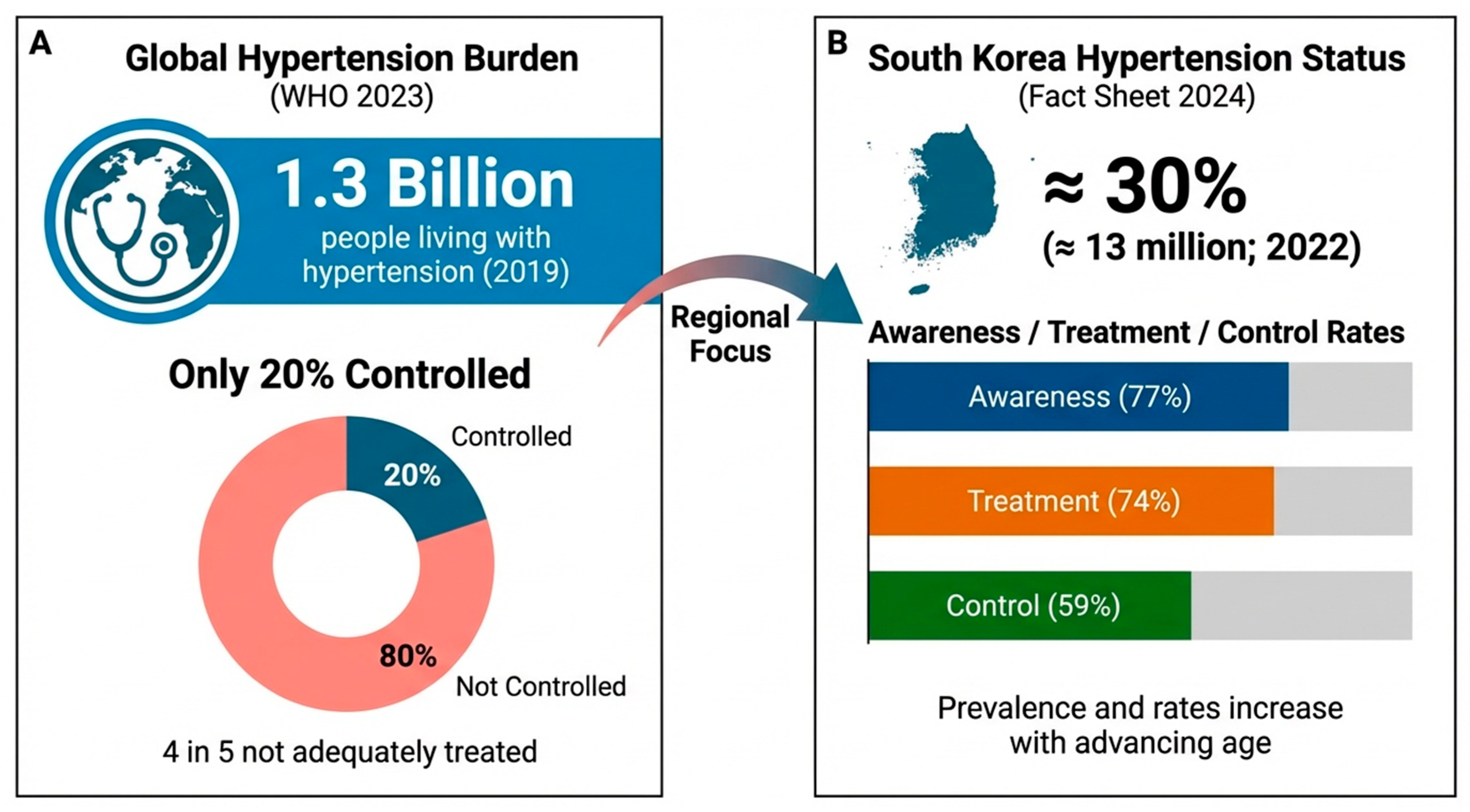
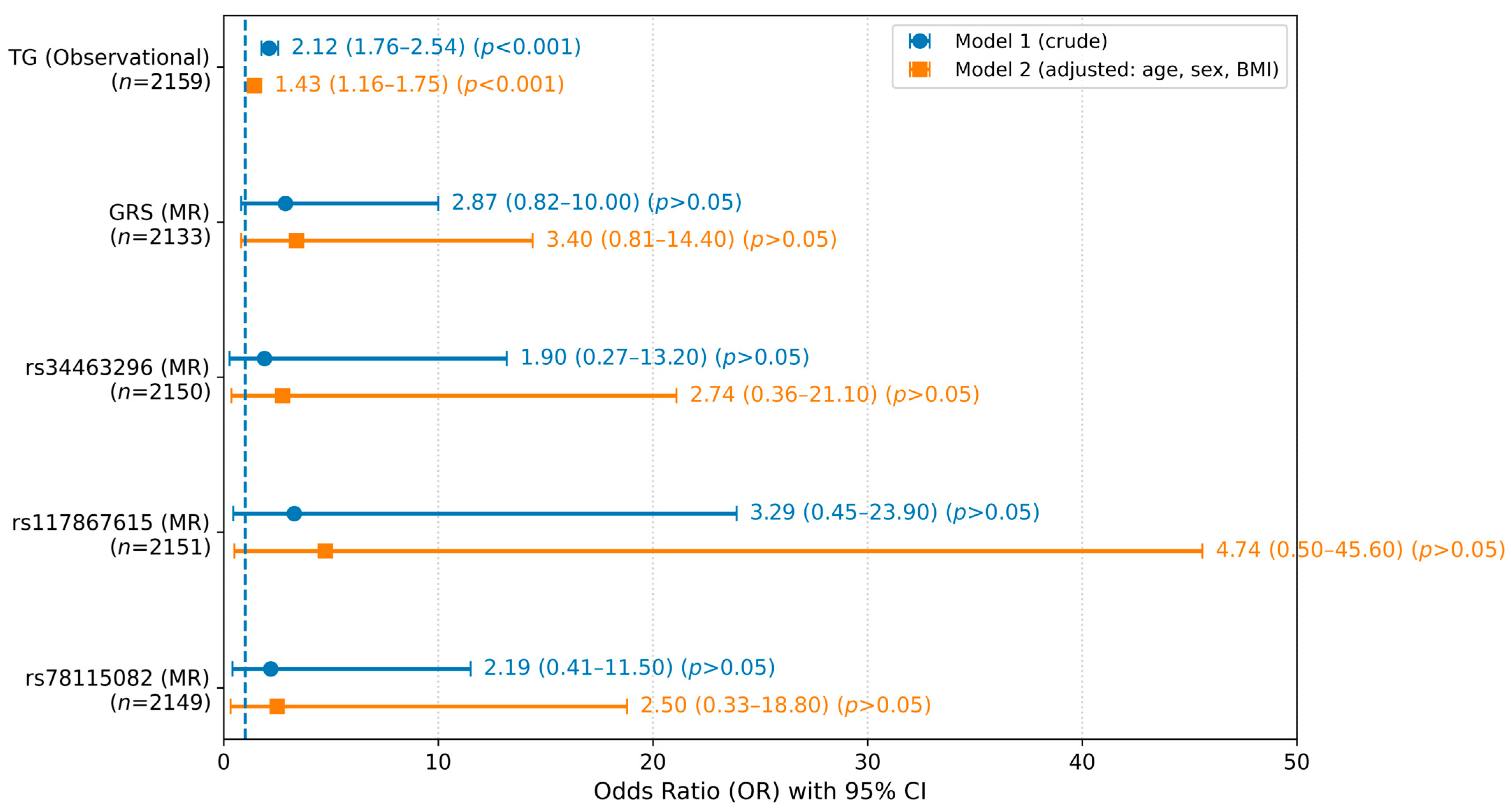
Triglycerides and Hypertension in a Korean Population: An Individual-Level Mendelian Randomization Analysis


Abstract
1. Introduction
2. Materials and Methods
2.1. Study Population
2.2. Clinical and Biochemical Assessments
2.3. Single-Nucleotide Polymorphism (SNP) Genotyping and Quality Control
2.4. Genetic Instrument Selection and Genetic Risk Score (GRS) Construction
2.5. MR Analysis
2.6. Statistical Analysis
3. Results
3.1. Baseline Characteristics of Participants Stratified According to Their Hypertension Status
3.2. Clinical and Biochemical Factors Associated with Hypertension
3.3. Selection of Genetic Instruments for MR
3.4. Associations Between Genetic Instruments and TG Levels
3.5. MR Estimates Compared with Observational Associations
3.6. Sensitivity Analyses
4. Discussion
5. Conclusions
Supplementary Materials
Author Contributions
Funding
Institutional Review Board Statement
Informed Consent Statement
Data Availability Statement
Acknowledgments
Conflicts of Interest
Abbreviations
| 2SLS | Two-stage least squares |
| 2SPS | Two-stage predictor substitution |
| 2SRI | Two-stage residual inclusion |
| 8-epi-PGF2α | 8-epi-prostaglandin F2α |
| Apo | Apolipoprotein |
| BMI | Body mass index |
| BP | Blood pressure |
| CI | Confidence interval |
| GRS | Genetic risk score |
| GWAS | Genome-wide association study |
| HbA1c | Hemoglobin A1c |
| HDL-C | High-density lipoprotein cholesterol |
| HOMA | Homeostasis model assessment |
| hs-CRP | High-sensitivity C-reactive protein |
| IL | Interleukin |
| IR | Insulin resistance |
| IV | Instrumental variable |
| K-CHIP | Korean chip |
| LDL | Low-density lipoprotein |
| MDA | Malondialdehyde |
| MR | Mendelian randomization |
| OR | Odds ratio |
| ox-LDL | Oxidized low-density lipoprotein |
| SNP | Single-nucleotide polymorphism |
| TG | Triglyceride |
| TNF-α | Tumor necrosis factor-alpha |
References
- NCD Risk Factor Collaboration (NCD-RisC). Worldwide trends in hypertension prevalence and progress in treatment and control from 1990 to 2019: A pooled analysis of 1201 population-representative studies with 104 million participants. Lancet 2021, 398, 957–980. [Google Scholar] [CrossRef]
- Kario, K.; Okura, A.; Hoshide, S.; Mogi, M. The WHO Global report 2023 on hypertension warning the emerging hypertension burden in globe and its treatment strategy. Hypertens. Res. 2024, 47, 1099–1102. [Google Scholar] [CrossRef]
- Kim, H.C.; Lee, H.; Lee, H.H.; Ahn, S.V.; Lee, J.M.; Cheon, D.Y.; Jhee, J.H.; Yoon, M.; Shin, M.H.; Heo, J.; et al. Korea Hypertension Fact Sheet 2024: Nationwide population-based analysis with a focus on young adults. Clin. Hypertens. 2025, 31, e11. [Google Scholar] [CrossRef]
- Bhatt, D.L.; Steg, P.G.; Ohman, E.M.; Hirsch, A.T.; Ikeda, Y.; Mas, J.L.; Goto, S.; Liau, C.S.; Richard, A.J.; Röther, J.; et al. International prevalence, recognition, and treatment of cardiovascular risk factors in outpatients with atherothrombosis. JAMA 2006, 295, 180–189. [Google Scholar] [CrossRef]
- Yusuf, S.; Hawken, S.; Ounpuu, S.; Dans, T.; Avezum, A.; Lanas, F.; McQueen, M.; Budaj, A.; Pais, P.; Varigos, J.; et al. Effect of potentially modifiable risk factors associated with myocardial infarction in 52 countries (the INTERHEART study): Case-control study. Lancet 2004, 364, 937–952. [Google Scholar] [CrossRef]
- Dąbrowska, E.; Narkiewicz, K. Hypertension and Dyslipidemia: The Two Partners in Endothelium-Related Crime. Curr. Atheroscler. Rep. 2023, 25, 605–612. [Google Scholar] [CrossRef]
- Wang, X.; He, B. Endothelial dysfunction: Molecular mechanisms and clinical implications. MedComm 2024, 5, e651. [Google Scholar] [CrossRef] [PubMed]
- Liu, L.Y.; Gu, Q.; Hu, X.; Fan, J.; Liu, X.Z. Potential Mediators of Causal Associations of Circulating Triglycerides with Blood Pressure: Evidence from Genetic and Observational Data. Hypertension 2022, 79, 2439–2447. [Google Scholar] [CrossRef] [PubMed]
- Szili-Torok, T.; Xu, Y.; de Borst, M.H.; Bakker, S.J.L.; Tietge, U.J.F. Normal Fasting Triglyceride Levels and Incident Hypertension in Community-Dwelling Individuals without Metabolic Syndrome. J. Am. Heart Assoc. 2023, 12, e028372. [Google Scholar] [CrossRef] [PubMed]
- Ren, Z.; Rao, B.; Xie, S.; Li, A.; Wang, L.; Cui, G.; Li, T.; Yan, H.; Yu, Z.; Ding, S. A novel predicted model for hypertension based on a large cross-sectional study. Sci. Rep. 2020, 10, 10615. [Google Scholar] [CrossRef]
- Skrivankova, V.W.; Richmond, R.C.; Woolf, B.A.R.; Davies, N.M.; Swanson, S.A.; VanderWeele, T.J.; Timpson, N.J.; Higgins, J.P.T.; Dimou, N.; Langenberg, C.; et al. Strengthening the reporting of observational studies in epidemiology using mendelian randomisation (STROBE-MR): Explanation and elaboration. BMJ 2021, 375, n2233. [Google Scholar] [CrossRef] [PubMed]
- Burgess, S.; Scott, R.A.; Timpson, N.J.; Davey Smith, G.; Thompson, S.G. Using published data in Mendelian randomization: A blueprint for efficient identification of causal risk factors. Eur. J. Epidemiol. 2015, 30, 543–552. [Google Scholar] [CrossRef] [PubMed]
- van Oort, S.; Beulens, J.W.J.; van Ballegooijen, A.J.; Grobbee, D.E.; Larsson, S.C. Association of Cardiovascular Risk Factors and Lifestyle Behaviors with Hypertension: A Mendelian Randomization Study. Hypertension 2020, 76, 1971–1979. [Google Scholar] [CrossRef]
- Hemani, G.; Zheng, J.; Elsworth, B.; Wade, K.H.; Haberland, V.; Baird, D.; Laurin, C.; Burgess, S.; Bowden, J.; Langdon, R.; et al. The MR-Base platform supports systematic causal inference across the human phenome. eLife 2018, 7, e34408. [Google Scholar] [CrossRef] [PubMed]
- Spracklen, C.N.; Chen, P.; Kim, Y.J.; Wang, X.; Cai, H.; Li, S.; Long, J.; Wu, Y.; Wang, Y.X.; Takeuchi, F.; et al. Association analyses of East Asian individuals and trans-ancestry analyses with European individuals reveal new loci associated with cholesterol and triglyceride levels. Hum. Mol. Genet. 2017, 26, 1770–1784. [Google Scholar] [CrossRef]
- Willer, C.J.; Schmidt, E.M.; Sengupta, S.; Peloso, G.M.; Gustafsson, S.; Kanoni, S.; Ganna, A.; Chen, J.; Buchkovich, M.L.; Mora, S.; et al. Discovery and refinement of loci associated with lipid levels. Nat. Genet. 2013, 45, 1274–1283. [Google Scholar] [CrossRef]
- Kim, M.; Song, G.; Kang, M.; Yoo, H.J.; Jeong, T.S.; Lee, S.H.; Lee, J.H. Replacing carbohydrate with protein and fat in prediabetes or type-2 diabetes: Greater effect on metabolites in PBMC than plasma. Nutr. Metab. 2016, 13, 3. [Google Scholar] [CrossRef]
- Dong, S.S.; Zhang, K.; Guo, Y.; Ding, J.M.; Rong, Y.; Feng, J.C.; Yao, S.; Hao, R.H.; Jiang, F.; Chen, J.B.; et al. Phenome-wide investigation of the causal associations between childhood BMI and adult trait outcomes: A two-sample Mendelian randomization study. Genome Med. 2021, 13, 48. [Google Scholar] [CrossRef]
- He, D.; Fan, F.; Jia, J.; Jiang, Y.; Sun, P.; Wu, Z.; Li, J.; Huo, Y.; Zhang, Y. Lipid profiles and the risk of new-onset hypertension in a Chinese community-based cohort. Nutr. Metab. Cardiovasc. Dis. 2021, 31, 911–920. [Google Scholar] [CrossRef]
- Choudhury, K.N.; Mainuddin, A.K.; Wahiduzzaman, M.; Islam, S.M. Serum lipid profile and its association with hypertension in Bangladesh. Vasc. Health Risk Manag. 2014, 10, 327–332. [Google Scholar] [CrossRef]
- Landsberg, L.; Aronne, L.J.; Beilin, L.J.; Burke, V.; Igel, L.I.; Lloyd-Jones, D.; Sowers, J. Obesity-related hypertension: Pathogenesis, cardiovascular risk, and treatment: A position paper of The Obesity Society and the American Society of Hypertension. J. Clin. Hypertens. 2013, 15, 14–33. [Google Scholar] [CrossRef] [PubMed]
- Ormazabal, V.; Nair, S.; Elfeky, O.; Aguayo, C.; Salomon, C.; Zuñiga, F.A. Association between insulin resistance and the development of cardiovascular disease. Cardiovasc. Diabetol. 2018, 17, 122. [Google Scholar] [CrossRef] [PubMed]
- Nordestgaard, B.G.; Varbo, A. Triglycerides and cardiovascular disease. Lancet 2014, 384, 626–635. [Google Scholar] [CrossRef] [PubMed]
- Burgess, S.; Thompson, S.G. Avoiding bias from weak instruments in Mendelian randomization studies. Int. J. Epidemiol. 2011, 40, 755–764. [Google Scholar] [CrossRef]
- Pierce, B.L.; Ahsan, H.; Vanderweele, T.J. Power and instrument strength requirements for Mendelian randomization studies using multiple genetic variants. Int. J. Epidemiol. 2011, 40, 740–752. [Google Scholar] [CrossRef]
- Pierce, B.L.; Burgess, S. Efficient design for Mendelian randomization studies: Subsample and 2-sample instrumental variable estimators. Am. J. Epidemiol. 2013, 178, 1177–1184. [Google Scholar] [CrossRef]
- Wan, F.; Small, D.; Bekelman, J.E.; Mitra, N. Bias in estimating the causal hazard ratio when using two-stage instrumental variable methods. Stat. Med. 2015, 34, 2235–2265. [Google Scholar] [CrossRef]
- Verbanck, M.; Chen, C.Y.; Neale, B.; Do, R. Detection of widespread horizontal pleiotropy in causal relationships inferred from Mendelian randomization between complex traits and diseases. Nat. Genet. 2018, 50, 693–698. [Google Scholar] [CrossRef]
- Bowden, J.; Davey Smith, G.; Burgess, S. Mendelian randomization with invalid instruments: Effect estimation and bias detection through Egger regression. Int. J. Epidemiol. 2015, 44, 512–525. [Google Scholar] [CrossRef]
- Chen, C.C.; Hsu, L.W.; Chen, K.D.; Chiu, K.W.; Chen, C.L.; Huang, K.T. Emerging Roles of Calcium Signaling in the Development of Non-Alcoholic Fatty Liver Disease. Int. J. Mol. Sci. 2021, 23, 256. [Google Scholar] [CrossRef]
- Zhang, X.; Trebak, M. Transient receptor potential canonical 7: A diacylglycerol-activated non-selective cation channel. Handb. Exp. Pharmacol. 2014, 222, 189–204. [Google Scholar] [CrossRef] [PubMed]
- Beck, B.; Zholos, A.; Sydorenko, V.; Roudbaraki, M.; Lehen’kyi, V.; Bordat, P.; Prevarskaya, N.; Skryma, R. TRPC7 is a receptor-operated DAG-activated channel in human keratinocytes. J. Investig. Dermatol. 2006, 126, 1982–1993. [Google Scholar] [CrossRef] [PubMed]
- Dhakal, S.; Lee, Y. Transient Receptor Potential Channels and Metabolism. Mol. Cells 2019, 42, 569–578. [Google Scholar] [CrossRef] [PubMed]
- Monesterolo, N.E.; Santander, V.S.; Campetelli, A.N.; Rivelli Antonelli, J.F.; Nigra, A.D.; Balach, M.M.; Muhlberger, T.; Previtali, G.; Casale, C.H. Tubulin Regulates Plasma Membrane Ca(2+)-ATPase Activity in a Lipid Environment-dependent Manner. Cell Biochem. Biophys. 2024, 82, 319–328. [Google Scholar] [CrossRef]
- Lu, Q.; Guo, P.; Liu, A.; Ares, I.; Martínez-Larrañaga, M.R.; Wang, X.; Anadón, A.; Martínez, M.A. The role of long noncoding RNA in lipid, cholesterol, and glucose metabolism and treatment of obesity syndrome. Med. Res. Rev. 2021, 41, 1751–1774. [Google Scholar] [CrossRef]
- Zeng, Y.; Ren, K.; Zhu, X.; Zheng, Z.; Yi, G. Long Noncoding RNAs: Advances in Lipid Metabolism. Adv. Clin. Chem. 2018, 87, 1–36. [Google Scholar] [CrossRef]
- Zhang, T.N.; Wang, W.; Yang, N.; Huang, X.M.; Liu, C.F. Regulation of Glucose and Lipid Metabolism by Long Non-coding RNAs: Facts and Research Progress. Front. Endocrinol. 2020, 11, 457. [Google Scholar] [CrossRef]
- Ference, B.A.; Braunwald, E.; Catapano, A.L. The LDL cumulative exposure hypothesis: Evidence and practical applications. Nat. Rev. Cardiol. 2024, 21, 701–716. [Google Scholar] [CrossRef]
- Kocyigit, D.; Gurses, K.M.; Tokgozoglu, L. Anti-inflammatory therapy in atherosclerosis. Front. Biosci. 2020, 25, 242–269. [Google Scholar] [CrossRef]
- Lu, H.; Cole, S.R.; Howe, C.J.; Westreich, D. Toward a Clearer Definition of Selection Bias When Estimating Causal Effects. Epidemiology 2022, 33, 699–706. [Google Scholar] [CrossRef]
- Schisterman, E.F.; Cole, S.R.; Platt, R.W. Overadjustment bias and unnecessary adjustment in epidemiologic studies. Epidemiology 2009, 20, 488–495. [Google Scholar] [CrossRef] [PubMed]
- Digitale, J.C.; Martin, J.N.; Glidden, D.V.; Glymour, M.M. Key concepts in clinical epidemiology: Collider-conditioning bias. J. Clin. Epidemiol. 2023, 161, 152–156. [Google Scholar] [CrossRef] [PubMed]



| Variables | Normal (n = 1615) | Hypertension (n = 544) | p | p′ |
|---|---|---|---|---|
| Male/Female n, (%) | 585 (36.2)/1030 (63.8) | 283 (52.0)/261 (48.0) | <0.001 | — |
| Age (years) | 48.3 ± 0.27 | 54.4 ± 0.50 | <0.001 | — |
| Weight (kg) | 63.0 ± 0.25 | 68.0 ± 0.51 | <0.001 | 0.083 |
| BMI (kg/m2) | 23.7 ± 0.07 | 25.4 ± 0.14 | <0.001 | — |
| Waist (cm) | 83.5 ± 0.19 | 87.9 ± 0.37 | <0.001 | 0.639 |
| Systolic BP (mmHg) | 116.4 ± 0.29 | 138.5 ± 0.66 | <0.001 | <0.001 |
| Diastolic BP (mmHg) | 72.7 ± 0.22 | 87.4 ± 0.46 | <0.001 | <0.001 |
| Glucose (mg/dL) † | 95.6 ± 0.51 | 103.8 ± 1.11 | <0.001 | 0.002 |
| Insulin (μIU/mL) † | 9.09 ± 0.12 | 9.83 ± 0.25 | 0.026 | 0.600 |
| HOMA-IR † | 2.15 ± 0.03 | 2.55 ± 0.09 | <0.001 | 0.143 |
| HbA1c (%) † | 6.10 ± 0.04 | 6.24 ± 0.06 | 0.029 | 0.865 |
| Free fatty acids (μEq/L) † | 552.4 ± 6.35 | 579.3 ± 11.6 | <0.001 | 0.170 |
| TG (mg/dL) † | 119.6 ± 1.84 | 148.6 ± 3.75 | <0.001 | 0.004 |
| Total cholesterol (mg/dL) † | 198.0 ± 0.90 | 198.3 ± 1.54 | 0.935 | 0.017 |
| HDL-cholesterol (mg/dL) † | 53.9 ± 0.34 | 50.4 ± 0.55 | <0.001 | 0.407 |
| LDL-cholesterol (mg/dL) † | 121.0 ± 0.82 | 119.0 ± 1.42 | 0.194 | <0.001 |
| ApoA-I (mg/dL) † | 156.1 ± 0.91 | 155.4 ± 1.37 | 0.735 | 0.021 |
| ApoB (mg/dL) † | 104.4 ± 0.94 | 103.9 ± 1.36 | 0.994 | 0.058 |
| ApoA-V (ng/mL) † | 284.8 ± 9.17 | 319.7 ± 15.5 | 0.012 | 0.014 |
| MDA (nmol/mL) † | 8.88 ± 0.08 | 9.72 ± 0.26 | 0.069 | 0.382 |
| Oxidized LDL (U/L) † | 46.1 ± 0.53 | 48.3 ± 0.97 | 0.017 | 0.929 |
| 8-epi-PGF2α (pg/mg creatinine) † | 1437.6 ± 18.9 | 1768.5 ± 53.6 | <0.001 | <0.001 |
| hs-CRP (mg/L) † | 1.22 ± 0.07 | 1.48 ± 0.12 | 0.001 | 0.629 |
| TNF-α (pg/mL) † | 10.9 ± 1.01 | 10.7 ± 1.03 | 0.006 | 0.024 |
| IL-1β (pg/mL) † | 0.93 ± 0.10 | 0.78 ± 0.05 | 0.163 | 0.473 |
| IL-6 (pg/mL) † | 3.62 ± 0.11 | 3.98 ± 0.22 | 0.011 | 0.106 |
| Variables | Unadjusted | Adjusted | ||||
|---|---|---|---|---|---|---|
| OR | 95% CI | p | OR | 95% CI | p | |
| Sex (Female vs. Male) | 0.52 | 0.43–0.64 | <0.001 | — | — | — |
| Age (years) | 1.05 | 1.04–1.06 | <0.001 | — | — | — |
| Weight (kg) | 1.05 | 1.03–1.05 | <0.001 | 1.02 | 0.99–1.05 | 0.092 |
| BMI (kg/m2) | 1.19 | 1.15–1.23 | <0.001 | — | — | — |
| Waist (cm) | 1.06 | 1.06–1.08 | <0.001 | 1.00 | 0.98–1.02 | 0.896 |
| Systolic BP (mmHg) | 1.15 | 1.14–1.17 | <0.001 | 1.14 | 1.13–1.16 | <0.001 |
| Diastolic BP (mmHg) | 1.19 | 1.17–1.21 | <0.001 | 1.19 | 1.17–1.21 | <0.001 |
| Glucose (mg/dL) † | 7.27 | 4.40–12.0 | <0.001 | 2.20 | 1.28–3.80 | 0.005 |
| Insulin (μIU/mL) † | 1.31 | 1.05–1.63 | 0.018 | 1.04 | 0.80–1.34 | 0.792 |
| HOMA-IR † | 1.64 | 1.34–2.01 | <0.001 | 1.15 | 0.91–1.45 | 0.245 |
| HbA1c (%) † | 4.95 | 1.16–21.2 | 0.031 | 1.26 | 0.25–6.43 | 0.781 |
| Free fatty acids (μEq/L) † | 1.23 | 0.99–1.53 | 0.060 | 1.18 | 0.92–1.50 | 0.194 |
| TG (mg/dL) † | 2.12 | 1.76–2.54 | <0.001 | 1.43 | 1.16–1.75 | <0.001 |
| Total cholesterol (mg/dL) † | 1.02 | 0.60–1.73 | 0.935 | 0.61 | 0.34–1.09 | 0.094 |
| HDL-cholesterol (mg/dL) † | 0.34 | 0.23–0.51 | <0.001 | 0.79 | 0.51–1.23 | 0.304 |
| LDL-cholesterol (mg/dL) † | 0.80 | 0.57–1.12 | 0.194 | 0.54 | 0.37–0.78 | 0.001 |
| ApoA-I (mg/dL) † | 0.90 | 0.48–1.69 | 0.896 | 2.18 | 1.09–4.38 | 0.028 |
| ApoB (mg/dL) † | 0.99 | 0.67–1.49 | 0.994 | 0.62 | 0.40–0.97 | 0.036 |
| ApoA-V (ng/mL) † | 1.23 | 1.05–1.45 | 0.012 | 1.26 | 1.05–1.51 | 0.012 |
| MDA (nmol/mL) † | 1.43 | 1.04–1.96 | 0.028 | 0.86 | 0.61–1.22 | 0.398 |
| Oxidized LDL (U/L) † | 1.37 | 1.06–1.77 | 0.017 | 1.08 | 0.81–1.44 | 0.601 |
| 8-epi-PGF2α (pg/mg creatinine) † | 1.86 | 1.49–2.32 | <0.001 | 1.90 | 1.50–2.41 | <0.001 |
| hs-CRP (mg/L) † | 1.16 | 1.06–1.26 | 0.001 | 0.99 | 0.90–1.09 | 0.853 |
| TNF-α (pg/mL) † | 1.19 | 1.04–1.36 | 0.011 | 1.19 | 1.03–1.37 | 0.018 |
| IL-1β (pg/mL) † | 0.89 | 0.76–1.05 | 0.163 | 0.94 | 0.79–1.12 | 0.473 |
| IL-6 (pg/mL) † | 1.20 | 1.04–1.38 | 0.011 | 1.13 | 0.97–1.32 | 0.105 |
| SNP | N | Chr a | Gene a | Ref/Alt a | Model 1 | Model 2 | ||||||
|---|---|---|---|---|---|---|---|---|---|---|---|---|
| Beta (SE) | F | R2 | p | Beta (SE) | F | R2 | p | |||||
| rs78115082 | 2149 | 5 | TRPC7 | G/T | 0.164 (0.034) | 23.4 | 0.011 | <0.001 | 0.145 (0.032) | 21.2 | 0.010 | <0.001 |
| rs117867615 | 2151 | 22 | TTLL1 | C/T | 0.073 (0.018) | 17.0 | 0.008 | <0.001 | 0.069 (0.016) | 17.9 | 0.008 | <0.001 |
| rs34463296 | 2150 | 8 | LINC03019 | C/T | 0.071 (0.017) | 18.0 | 0.008 | <0.001 | 0.072 (0.016) | 21.7 | 0.010 | <0.001 |
| GRS | 2133 | — | — | — | 0.610 (0.094) | 42.2 | 0.019 | <0.001 | 0.570 (0.087) | 42.7 | 0.020 | <0.001 |
Disclaimer/Publisher’s Note: The statements, opinions and data contained in all publications are solely those of the individual author(s) and contributor(s) and not of MDPI and/or the editor(s). MDPI and/or the editor(s) disclaim responsibility for any injury to people or property resulting from any ideas, methods, instructions or products referred to in the content. |
© 2026 by the authors. Licensee MDPI, Basel, Switzerland. This article is an open access article distributed under the terms and conditions of the Creative Commons Attribution (CC BY) license.
Share and Cite
Huang, X.; Kim, M. Triglycerides and Hypertension in a Korean Population: An Individual-Level Mendelian Randomization Analysis. Nutrients 2026, 18, 633. https://doi.org/10.3390/nu18040633
Huang X, Kim M. Triglycerides and Hypertension in a Korean Population: An Individual-Level Mendelian Randomization Analysis. Nutrients. 2026; 18(4):633. https://doi.org/10.3390/nu18040633
Chicago/Turabian StyleHuang, Ximei, and Minjoo Kim. 2026. "Triglycerides and Hypertension in a Korean Population: An Individual-Level Mendelian Randomization Analysis" Nutrients 18, no. 4: 633. https://doi.org/10.3390/nu18040633
APA StyleHuang, X., & Kim, M. (2026). Triglycerides and Hypertension in a Korean Population: An Individual-Level Mendelian Randomization Analysis. Nutrients, 18(4), 633. https://doi.org/10.3390/nu18040633