Abstract
As a newly synthesized two-dimensional carbon material, the stability study of monolayer fullerene networks or quasi-hexagonal phase fullerenes (qhp-C60) is timely desirable. We have investigated the stabilities of qhp-C60, including thermal, structural, mechanical, and thermodynamic stabilities, as well as the bonding characteristics, ductility, and mechanical properties, via first-principles calculations. The results show that qhp-C60 is energetically, mechanically, and thermodynamically stable. The thermodynamic stability of qhp-C60 at 300 K and 600 K is verified. The bonding characteristics of qhp-C60 are analyzed from the bond length, and it has sp2 and sp3 hybridization. The Pugh ratio (B/G) and Poisson’s ratio (v) indicate similar ductility with graphite and graphene. We also found that qhp-C60 has the lowest hardness and the anisotropy of the material. In addition, the electronic characteristics, including electron localization function (ELF), crystal orbital Hamiltonian population (COHP), and density of states (DOS) at different temperatures, are analyzed to verify the thermal stability of the material. Our results might be helpful in the material design of qhp-C60-related applications.
1. Introduction
Carbon-based two-dimensional (2D) materials have attracted extensive attention because of their unique and rich properties, functions, and applications. As the paradigm of 2D materials, graphene has a perfect sp2 hybridized carbon structure in a two-dimensional plane. In addition, it has excellent electronic, thermal, optical, and mechanical properties [1,2,3]. Graphene has been successfully used to fabricate field-effect transistors (FETs) [4,5,6], transparent conducting electrodes [7,8,9], supercapacitors [10,11], and lithium-ion batteries [12]. The successful preparation of graphene [13] has shown that it is possible to exfoliate stable, single-atom, or single-polyhedral-thick 2D materials from van der Waals solids. These materials can exhibit unique and fascinating physical properties. Frindt et al. showed that layered van der Waals materials, such as layered metal dichalcogenides, could be mechanically and chemically exfoliated into few and single layers [14,15]. Novoselov et al. isolated individual monolayers from various layered materials, including h-BN and dihydroxides (e.g., MoS2 and NbSe2) [16]. Moreover, fullerenes have interesting electronic and magnetic properties. Superconductivity was also found in fullerene compounds [17,18,19,20]. Thus, scientists want to prepare 2D fullerene, further studying its intrinsic properties. Hou et al. prepared a large-size monocrystalline 2D carbon material, a monolayer of quasi-hexagonal crystalline phase fullerene (C60), by interlayer bonding cleavage [21]. This 2D material has good thermodynamic stability and high crystallinity. In particular, this monolayer polymer C60 has a moderate band gap of about 1.6 eV, solving the problem of zero band gap in graphene.
In practical applications, the stability of materials is an essential factor affecting the reliability and lifetime of devices. The structure and properties of 2D materials are susceptible to environmental conditions [22,23,24,25,26,27,28], so the stability of 2D materials is critical. With the development of computer science, first-principles calculation has shown great advantages in the stability of materials. So far, several studies on the stability of carbon materials have been carried out. Sen et al. studied the thermal stability of sp3-bonded 2D carbon allotropes using ab initio molecular dynamics [29]. This study shows that only low-energy structures can be stable under environmental conditions. Li et al. reported that monolayer h-BN shows strong thermal stability when heated in the air [30]. Wen et al. investigated the mechanical stability of simple cubic carbon [31]. Simple cubic carbon is mechanically stable above 400 GPa. And an excellent mechanical and thermodynamic stability of carbon can be found above 2700 GPa. Lu et al. discovered that metastable carbon allotrope could withstand temperatures up to 1000 K by first-principles study, and its in-plane stiffness is greater than that of graphene [32]. He et al. found that both sp2-diamond and cubic-graphite are dynamically stable by phonon spectroscopy. The band gap of sp2-diamond is 1.66 eV, and it is a semiconductor [33]. Luo et al. found that biphenylene is dynamically stable and has a melting point of up to 4500 K by first-principles calculation [34]. Mortazavi et al. showed that the qhp-C60 has desirable dynamical stability through predicted phonon dispersion [35]. However, they explored the unilateral stability of qhp-C60 only. There is still a lack of systematic research into the stability of qhp-C60. In addition, the analysis of the electronic structure is effective for obtaining the interactions between atoms and the properties of the material. Mei et al. found that octagonal-C is metallic and the C-C bond is predominantly covalent by electronic analysis [36]. Alborznia et al. showed that in the presence of applied pressure, the band gap of T-Carbon becomes smaller, but it is still a semiconductor material [37]. Wang et al. found that sp3 hybridization facilitates the formation of a symmetrical lattice structure to ensure the high hardness of the carbon material [38]. Thus, electronic structure analysis provides insight into the potential applications of the material.
In this paper, we have assessed the stability of the qhp-C60 structure (structural, mechanical, and thermodynamic stability), bonding characteristics, ductility, and mechanical properties using first-principles calculations. The stability and bonding changes of the materials at different temperatures were analyzed by electron localization function (ELF) and crystal orbital Hamiltonian population (COHP). In addition, the contribution of orbitals at different temperatures is analyzed by using density of states (DOS). The result shows that quasi-hexagonal fullerene monolayer offers an interesting platform for potential application in 2D electronic devices.
2. Materials and Methods
Density functional theory (DFT) calculations are carried out using the Vienna ab initio simulation package (VASP) in the study [39]. The electron interaction with ions was replaced by the projector augmented wave (PAW) method, and exchange-correlation potentials between electrons were parameterized by the generalized gradient approximation (GGA) with Perdew–Burke–Ernzerhof (PBE) function [40,41]. The qhp-C60 primitive cell containing 60 carbon atoms was used. The conjugate-gradient algorithm was used to relax all atomic positions and cell size to achieve the minimum total energy of the systems until the average force on each atom is less than 0.01 eV/atom. The plane-wave cutoff energy was specified as 520 eV for all models. The 4 × 4 × 1 k-points mesh obtained by the Monkhorst-Pack method was employed to sample the Brillouin zone. The total energy convergence was set to 10−6 eV/atom. A 15 Å (1 Å = 0.1 nm) vacuum layer was set along the z-axis direction to avoid the influence of the interaction force between atomic layers. The energy-strain relationship was used to calculate elastic constants. For the quadratic symmetry 2D materials, the orthogonal lattice transformed by selecting the [−110] [−1−10] [001] direction to redefine the coordinate axis was selected and the energy–strain method was used to calculate elastic constants. The structure’s stability was ensured by the energy minimization during the structure relaxation via the conjugate gradient method [42]. AIMD simulations were performed to verify the thermodynamic stability of qhp-C60 at finite temperatures. In doing this, a 2 × 2 × 1 supercell of qhp-C60 was simulated within the NVT systems by using the Nose–Hoover thermostat for 10 ps with a time step of 0.0001 ps at 300 K and 600 K, and a 1 × 1 × 1 k-point mesh.
3. Results
3.1. Crystal Structure, Thermal, and Structural Stability
3.1.1. Crystal Structure
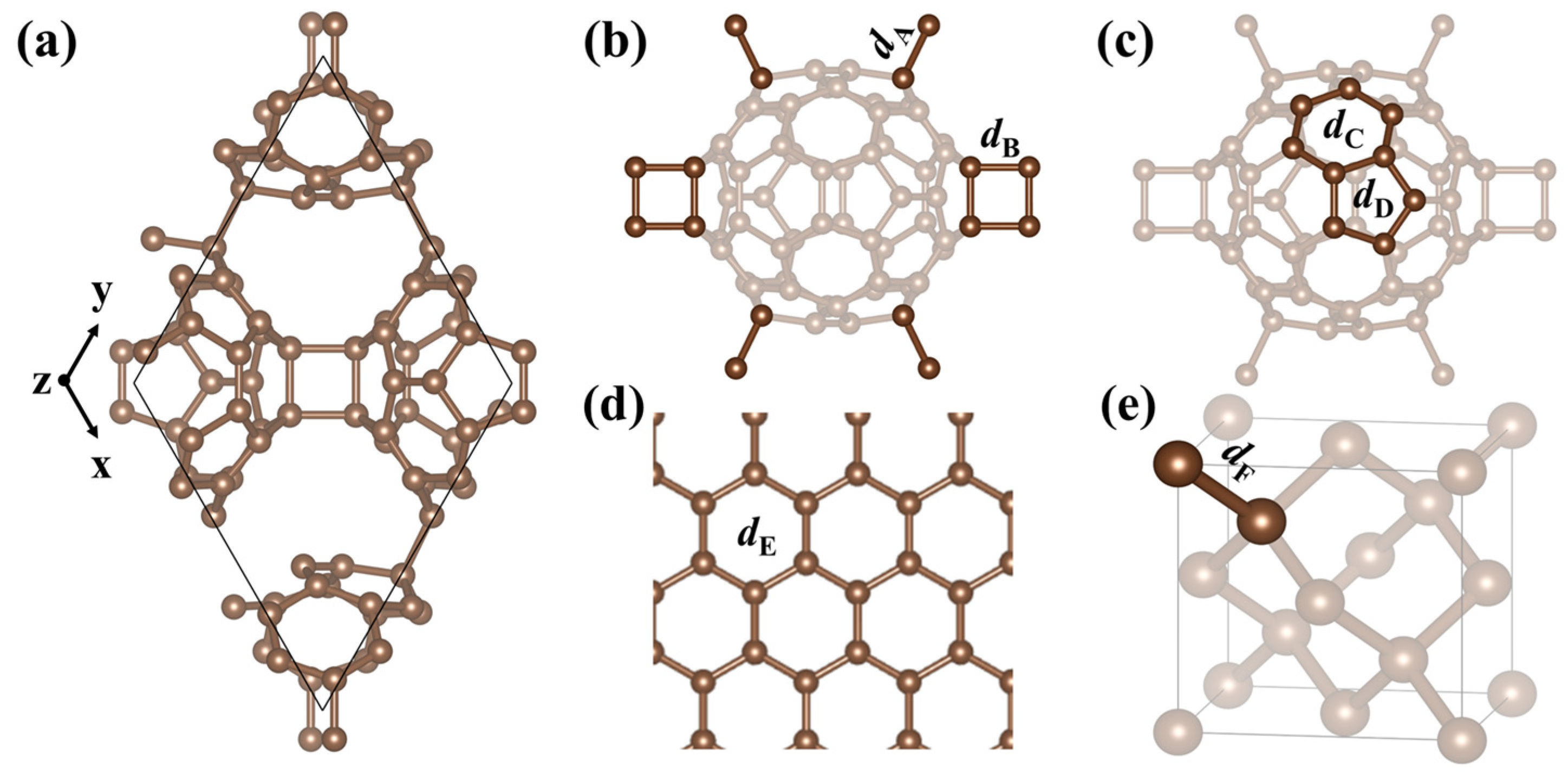
The crystallographic results of qhp-C60 are shown in Figure 1a. The structure parameters after relaxation are listed in Table 1, along with the calculated structures of other carbon materials (graphite, graphene, and diamond). The calculated values of our obtained structure parameters are in agreement with those of the references, demonstrating the accuracy of our calculations.
Figure 1.
Crystal structure (a–c) qhp-C60, (d) graphite, and (e) diamond. Here, dA–dD, dE, and dF are the bond length of qhp-C60, graphite, graphene, and diamond.
Table 1.
Lattice constants (Å), bond lengths (Å), formation, and binding energies (eV/atom) of the four carbon materials.
The results in Figure 1 and Table 1 show dA = 1.64 Å, dB = 1.61 Å, dC = 1.41–1.45 Å, dD = 1.44–1.45 Å, dE = 1.42 Å, and dF = 1.55 Å. Liu et al. showed that the length of CC is the shortest (1.28 Å) and that of C-C is the longest (1.55 Å) under the same system [46]. Therefore, by comparing the bond lengths, we find that qhp-C60 has two different carbon networks with sp2 and sp3 hybridizations. This may lead to qhp-C60 having different properties from other carbon materials.
In the diamond crystal, the four valence electrons of each carbon atom were sp3 hybridized to form four identical atomic orbitals, forming covalent bonds ( bonds) with the four most adjacent carbon atoms [47]. In addition, the carbon atoms of graphene were bonded to each other in sp2 hybridization and formed a sizable π-conjugated system. Kaciulis pointed out that π-type bonds determined the electronic properties, such as electrical conductance and optical gap, whereas the mechanical hardness is defined by the percentage of bonds. Therefore, the determination of the sp2/sp3 ratio is decisive for characterizing all carbon allotropes. The study has shown that an appropriate sp2/sp3 (about 1.0–1.25) ratio will strengthen the field emission properties [48]. Low-dimensional structure materials with excellent field emission have broad application prospects in the vacuum microelectronic device. It is known that carbon-based materials such as diamond, diamond-like carbon, and carbon nanotubes. According to the results of the bond length, the value of sp2/sp3 in the qhp-C60 structure is approximately 1.4, which contributes to its application in electronic devices.
3.1.2. Formation and Binding Energy
To verify the structural stability of qhp-C60, the formation and binding energy of the qhp-C60 are calculated using the following equations.
The enthalpy of formation is defined as the energy released (or absorbed) by the system during the formation of the compound from its elementary substance. The calculation formula is
Binding energy is the energy released by an atom from forming a compound in a free state, and is calculated as:
is the total energy of the qhp-C60, is the energy of each carbon atom in a free state, and is the energy of a single carbon atom in the graphite. For stable structures, both the binding energy and the enthalpy of formation are negative. Generally, the smaller the value is, the more stable the system is. As shown in Table 1, the results show that the formation energy of graphene (0.05 eV/atom), diamond (0.27 eV/atom), and qhp-C60 (0.45 eV/atom) is greater than zero, indicating that graphite is the most stable of the four carbon materials, and the conversion of graphite to other three carbon materials is a heat-absorbing process. The binding energy of qhp-C60 is −8.75 eV/atom, which is close to that of graphite (−9.20 eV/atom), graphene (−9.15 eV/atom) and diamond (−8.93 eV/atom), respectively, indicating that qhp-C60 has excellent structural stability.
3.2. Mechanical Stability
3.2.1. Elasticity Constants
Elastic constants characterize the amount of material elasticity and reflect the ability of a crystal to resist elastic deformation. The energy–strain method is used to find the elastic constants [49]. Elastic constants of diamond are first calculated to verify the feasibility of the method. The elastic constants, bulk modulus, and shear modulus are shown in Table 2 and compared with the values in the literature. The results show that the elastic constants of the diamond obtained by the energy–strain method are consistent with the results reported in the literature, so the calculation method is available.
Table 2.
Elastic constants, bulk modulus, shear modulus, Young’s modulus, and Poisson’s ratio of the four carbon materials.
As shown in Table 2, It is worth noting that our calculation results are consistent with Zhao’s [53]. For two-dimensional materials, we assess their mechanical stability by the Born–Huang criterion. The two-dimensional materials need to satisfy C11 > 0, > 0, and C66 > 0 [54], where Cij is the elastic constants. C11 and C22 are the ability of the crystal to resist axial strain along the [100] and [010], respectively. C66 is the ability to resist shear strain on the (001), and C12 is the modulus along the [110] that resists shear deformation on the (110). As the results in Table 2 show, the elastic parameters of qhp-C60 are C11 = 140.20 N/m, C22 = 192.62 N/m, C12 = 23.91 N/m, and C66 = 63.54 N/m, respectively, which obviously satisfy the Born–Huang criterion for two-dimensional materials. Thus, qhp-C60 has good mechanical stability. Table 2 also shows the bulk modulus, shear modulus, and Poisson’s ratio of the four carbon materials. The results show that qhp-C60 has the lowest bulk modulus, shear modulus, Young’s modulus, and Poisson’s ratio.
3.2.2. Ductility
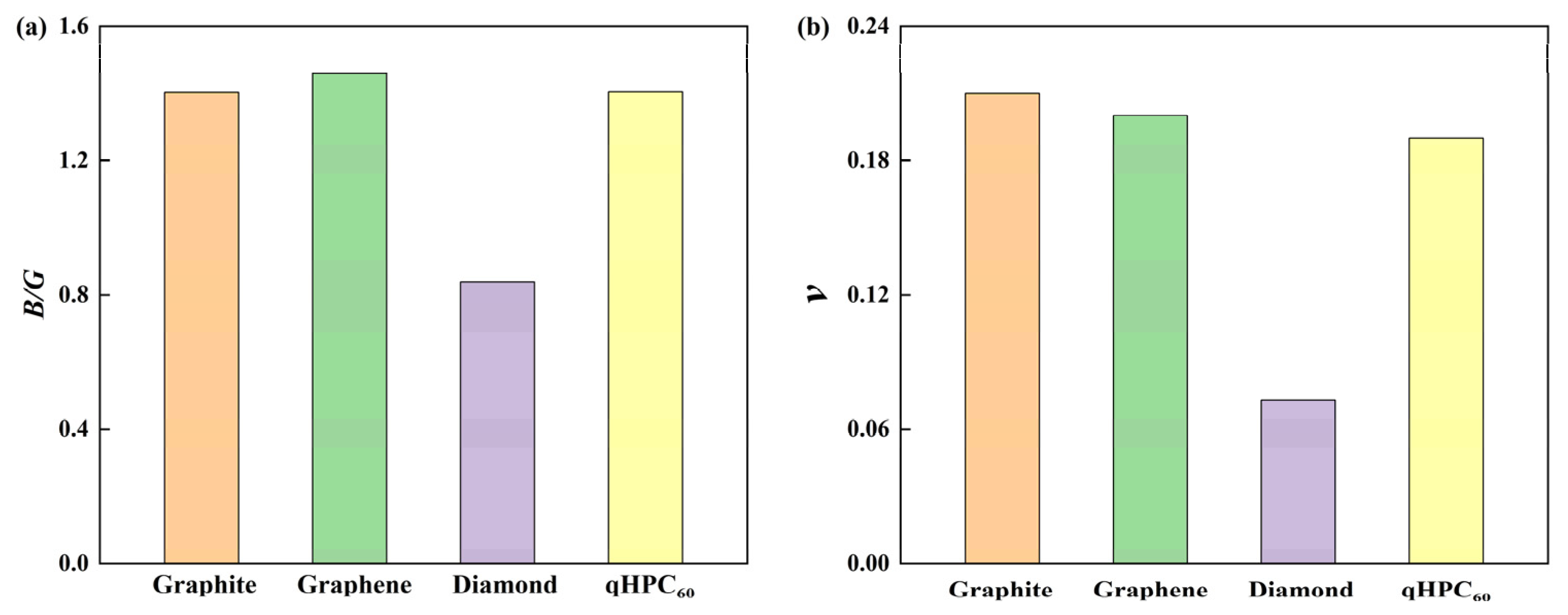
The ductility of a crystalline could be predicted via the Pugh ratio, which is the ratio between the bulk and the shear modulus, B/G [55,56]. Pugh ratio is used empirically to predict brittle or ductile behavior of materials. In general, ductility is positively correlated with the B/G value. A larger value implies a more ductile behavior under mechanical loading. The B/G and v of the four carbon materials are compared in Figure 2. Diamond has great hardness and brittleness, so it has smaller B/G and v than other three carbon materials. The B/G and v of qhp-C60 are very close to those of graphite and graphene, which shows that qhp-C60 has similar ductility with them.
Figure 2.
B/G (a) and Poisson’s ratio (b) for the four carbon materials.
3.2.3. Hardness
Hardness is a crucial mechanical parameter in the mechanical properties of materials [57]. There are many empirical models for calculating the hardness (Hv) of materials. The selection of a suitable hardness model is determined based on the chemical bonding state of the material. Chen proposed a simple prediction model based on the elastic modulus of the material [58]:
where k is the Pratt’s modulus ratio, k = G/B.
An improved model based on the above model was proposed by Tian, as shown in the following equation [59]:
Jiang explained that Young’s modulus (E) could be calculated using E = 15.76 [60]. In addition, we use two other formulas to calculate hardness.
As shown in Table 3, the qhp-C60 has the lowest hardness compared to other carbon materials.
Table 3.
The hardness of the four carbon materials.
3.2.4. Anisotropy of the Material
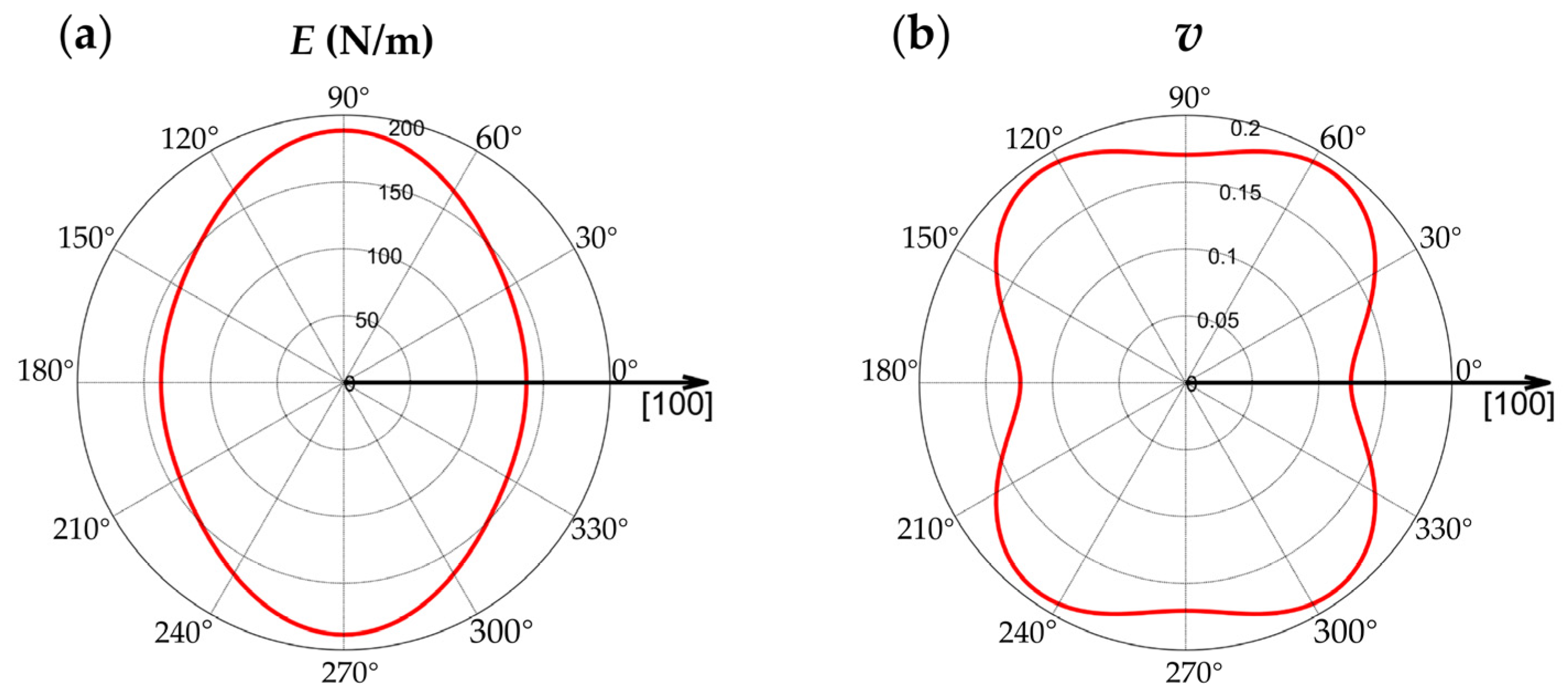
The study of mechanical properties can bring a new understanding of the application of the material. On this basis, mechanical anisotropy is also crucial to the practical use of the material, and the generation of microcracks is closely related to anisotropy [61]. Young’s modulus (E) and Poisson’s ratio (v) can be derived from the elastic constant combinations, as is shown in Figure 3. Young’s modulus of the qhp-C60 increased from a minimum at 0° to a maximum at 90°. Similarly, we note that v exhibits strong anisotropic.
Figure 3.
(a) Young’s modulus and (b) Poisson’s ratio of qhp-C60.
3.3. Thermodynamic Stability
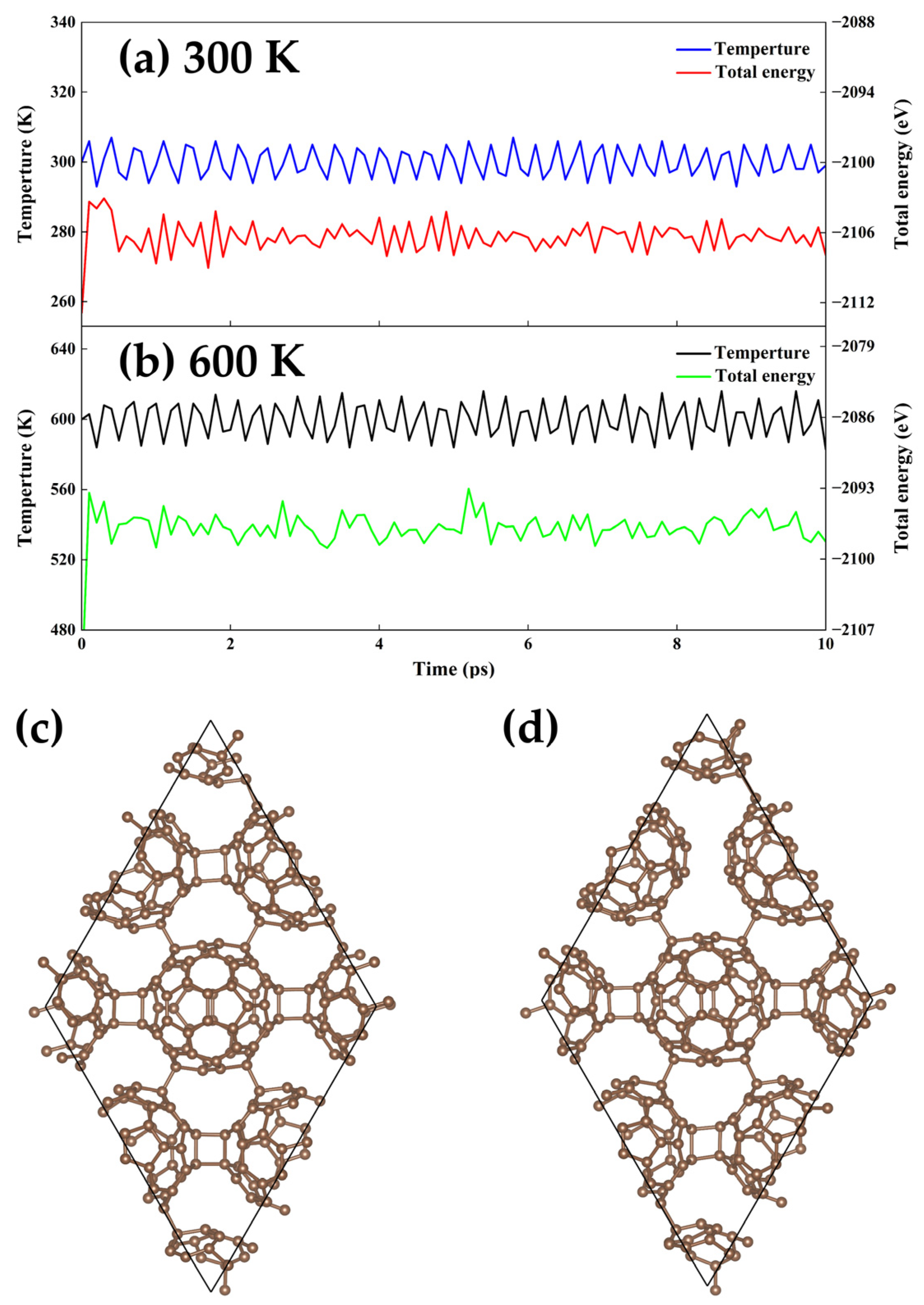
To further validate the thermodynamic stability of qhp-C60 via ab initio molecular dynamics (AIMD) at finite temperatures [62,63]. AIMD simulations were conducted for a 2 × 2 × 1 supercell of qhp-C60 at the temperature of 300 K and 600 K, as shown in Figure 4a,b, which is drawn by taking a point for each 0.1 ps (100 points in total).
Figure 4.
Total energy (left) and temperature (right) of qhp-C60 at (a) 300 K and (b) 600 K. The snapshot of the configuration at time of 10 ps and temperature of 300 K (c) and 600 K (d).
The AIMD results illustrated that the total energy and temperature of the system converge with fluctuations after 2 ps relaxation. The small fluctuation of the temperature and energy after convergence at 300 K reflects that the system is well equilibrated and qhp-C60 is thermodynamically stable at ambient conditions. The thermal dynamic equilibrium at 600 K indicates stability at high temperature.
Moreover, as shown in Figure 4c,d, although the single-layer qhp-C60 structure simulated by AIMD has some special bond breaks and changes, it is almost identical to its initial configuration. Our results display that qhp-C60 is thermodynamically stable at both 300 K and 600 K. It suggests the high-temperature applications of the qhp-C60 monolayer-based materials and devices.
3.4. Electronic Localization Function Analysis
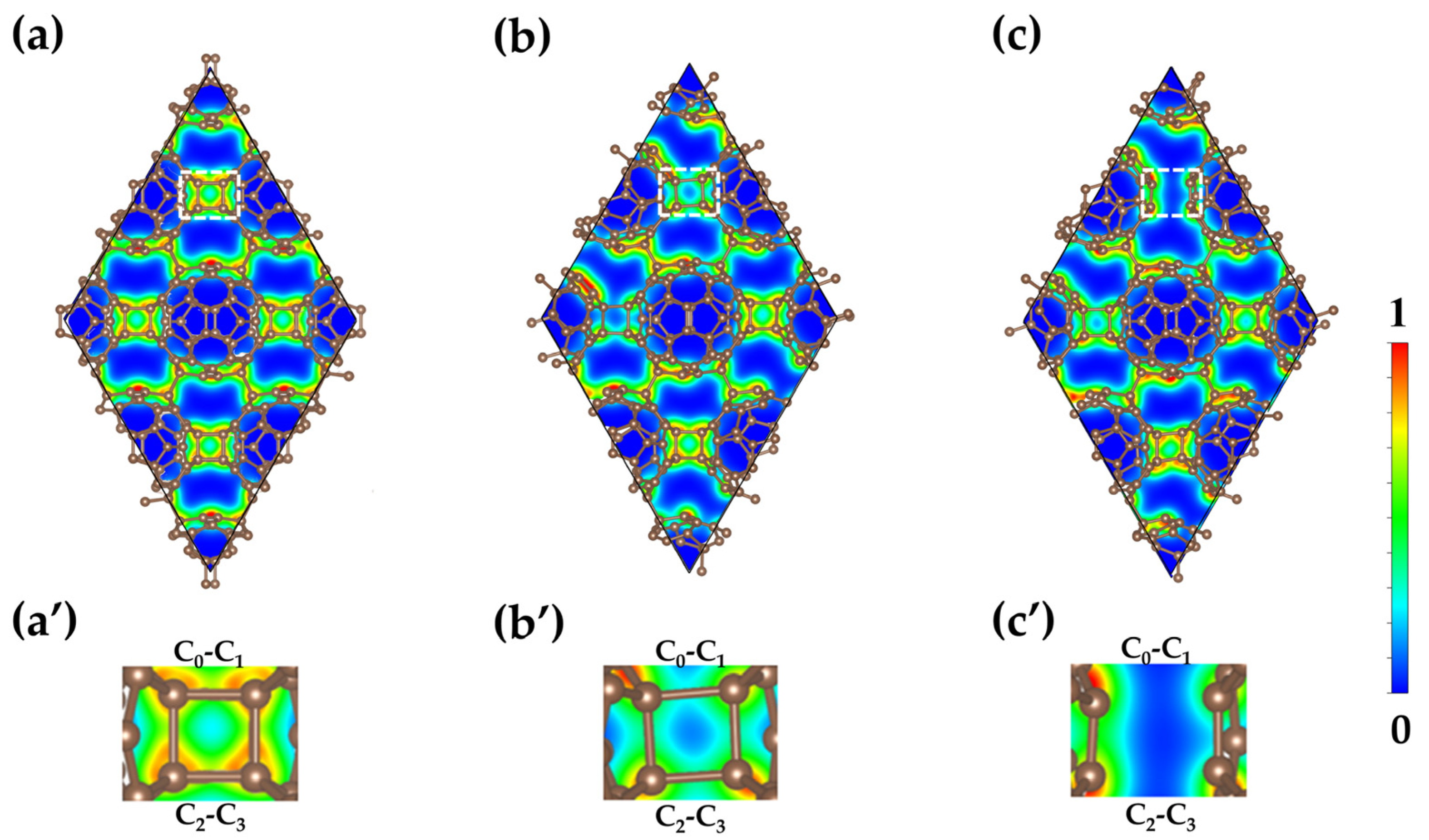
In quantum chemistry, the electron localization function (ELF) is a function of the possibility of finding electrons in the neighborhood space of a given reference electron with the same spin. It is usually used to analyze the spatial localization of electron charge. In order to further investigate the stability of qhp-C60 at room temperature and high temperature. The electron localization function (ELF) of qhp-C60 after the structural optimization at different temperatures is shown in Figure 5. Here, the ELF in the range of 0 to 1 is a space function describing the atomic bonding properties of structures, and the values of 0, 0.5, and 1 correspond to vacuum, homogeneous electron gas, and fully localized states, respectively.
Figure 5.
Electronic localization function (ELF) of qhp-C60 at (a) 0 K, (b) 300 K, and (c) 600 K. Here, (a′), (b′), and (c′) are, respectively, enlarged subgraphs.
As shown in Figure 5a, at a temperature of 0 K, the optimized qhp-C60 was found to have electron localization at the center of the bond, retaining its 2D network structure of covalent bonds, indicating that the covalent bonds between carbon atom pairs dominate. After that, as the temperature rises to room temperature, the ELF changes very little, and the charge localization of C0-C1 and C2-C3 bonds is weakened to a certain extent. At the same time, when the temperature rises to 600 K, the ELF value between C0-C1 and C2-C3 bonds becomes 0. On the other hand, the length of the C0-C1 bond in these three configurations is 1.61 Å, 1.68 Å, and 2.39 Å, while the C2-C3 bond length is 1.61 Å, 1.64 Å, and 2.51 Å, respectively. As the temperature increases, the distance between the C atom and the C atom becomes larger, the bond energy is smaller, and the bond strength also decreases, so the longer the bond, the easier it is to break. It means that the bond is broken at 600 K. However, the structure of qhp-C60 basically remains the original structure.
3.5. COHP and ICOHP Analysis
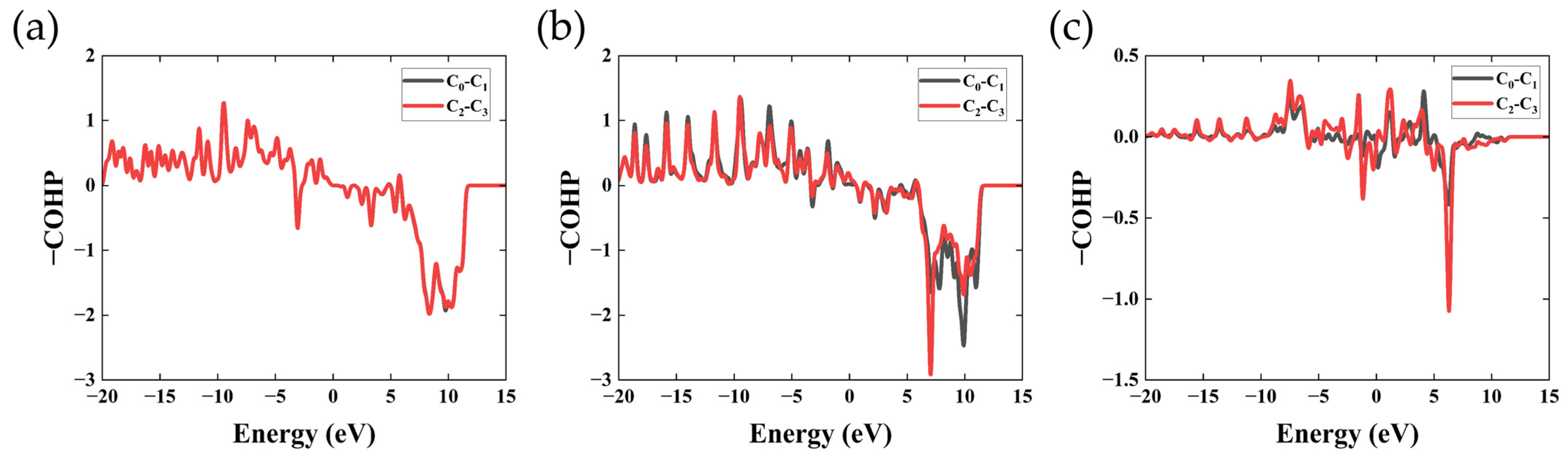
COHP analysis can describe the bonding characteristics between atoms and adjacent atoms, as shown in Figure 6. In general, the positive value of −COHP indicates the bond interaction, and the negative value indicates the anti-bond interaction. As the temperature increases, the interaction of carbon–carbon bonds has been decreasing and is more pronounced at 600 K.
Figure 6.
COHP analysis of C0-C1 and C2-C3 bonds of at (a) 0 K, (b) 300 K, and (c) 600 K.
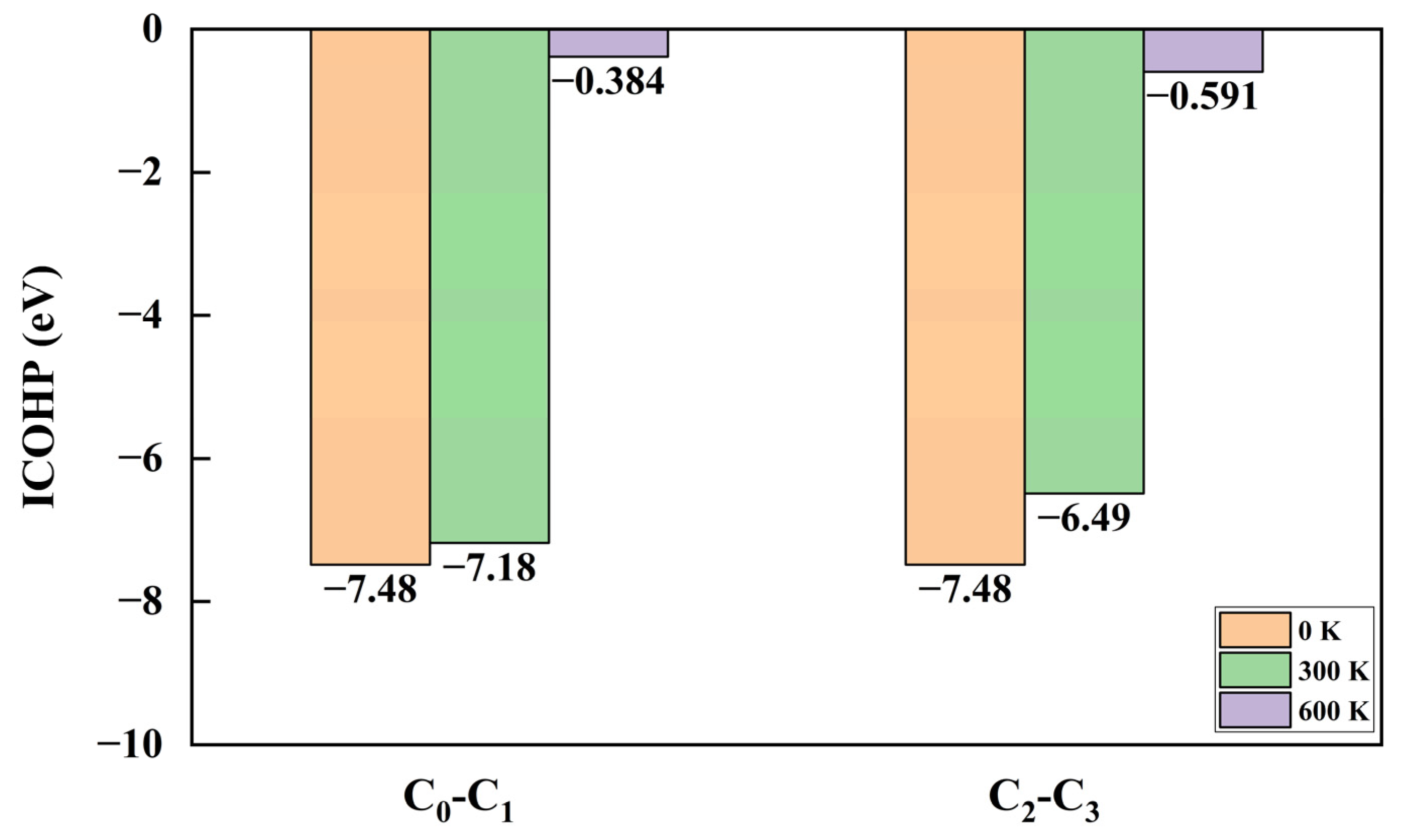
The ICOHP analysis of orbital bonding strength under the configuration at a time of 10 ps and a temperature of 0 K, 300 K, and 600 K is shown in Figure 7. The integral of crystal orbital Hamilton populations (ICOHP) is obtained by integrating the Hamiltonian population below the Fermi level and can be used to measure the strength of covalent bonds in crystals. As a valuable measure of the covalent bond strength, the lower the value, the stronger the chemical bond, and vice versa [64,65]. As shown, we found that the bond lengths of C0-C1 and C2-C3 bonds increased slightly from 0 K to 300 K, and the ICOHP value also increased slightly. Therefore, the bond strength did not change much at room temperature. At this time, no bond breakage and structural changes occurred. As the temperature increases from 300 K to 600 K, the bond length and ICOHP increase dramatically. C0-C1 and C2-C3 are broken. Our first-principles study is self-consistent, which is the same as the ELF analysis.
Figure 7.
The ICOHP value of C0-C1 and C2-C3 bonds of at 0 K, 300 K, and 600 K.
3.6. DOS Analysis
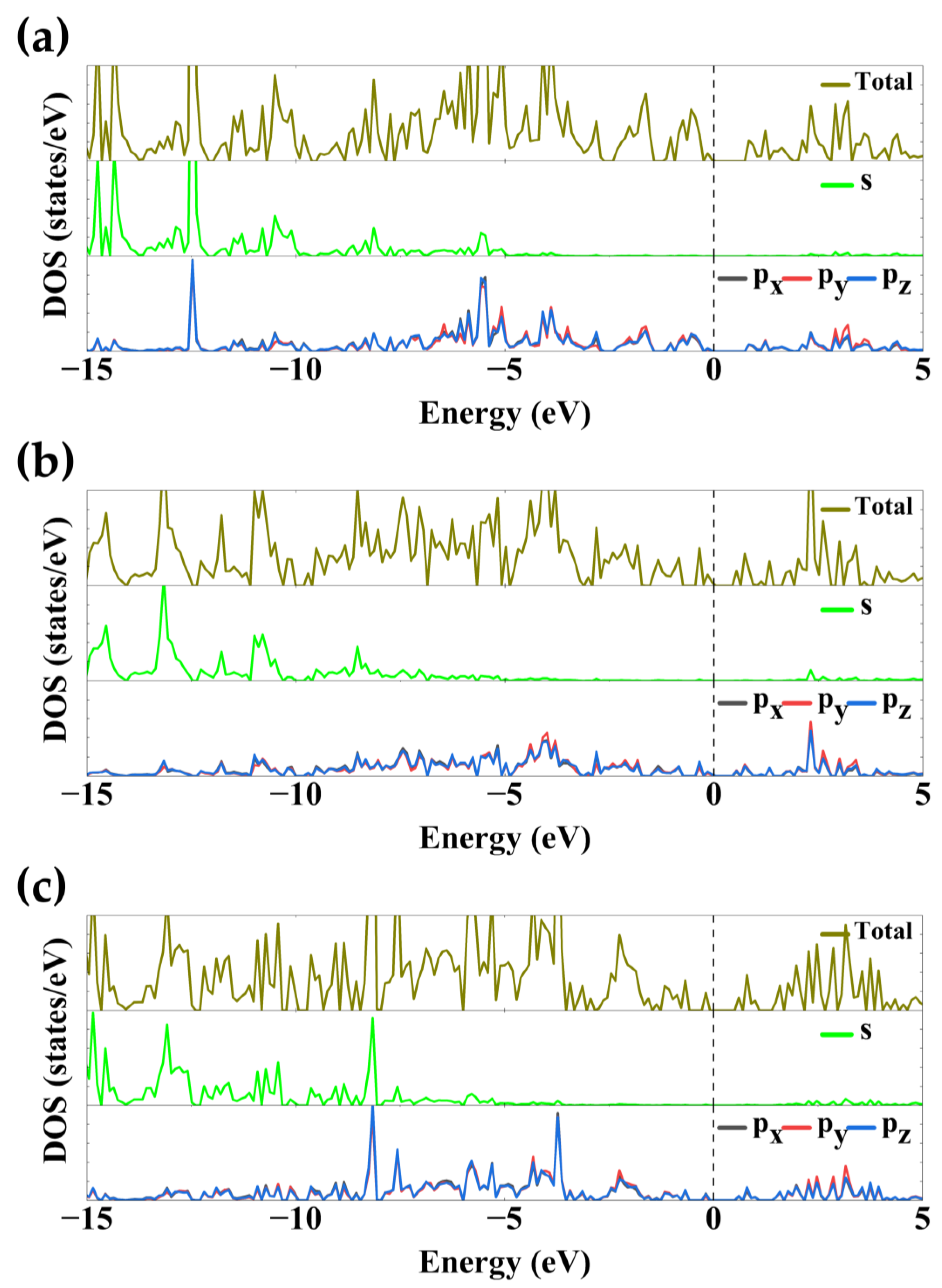
In order to better understand the differences in orbital contributions at different temperatures. We study the projected density of states (DOS) at different temperatures. The results are shown in Figure 8. The lower valence band below the Fermi level and the above part of the conduction band are mainly contributed by the s-orbital. The outermost electron valence layer of the p-orbital is more concentrated at the Fermi level and is also the main contributor to the bonding. The contributions of the three p-orbit components (px, py, pz) are almost the same.
Figure 8.
TDOS and PDOS of qhp-C60 at (a) 0 K, (b) 300 K, and (c) 600 K.
Furthermore, we can see that qhp-C60 has a small bandgap, and its value is approximately 0.7 eV. It is well known that the standard DFT exchange-correlation function greatly underestimates the band gap. For insulators, this is due to the discontinuous existence of energy to electron derivatives. The difference between the calculated and the experimental band gap can reach 0.5 eV [66]. The experimental and calculated values of the band gap of qhp-C60 are 1.6 eV and 1.2 eV. Based on these facts, the calculated band gap of qhp-C60 (0.7 eV) is in good agreement with their results. It is worth noting that the band gap values at 300 K and 600 K are 0.4 eV and 0.5 eV, respectively, with a slight decrease, indicating that the temperature rise does not seriously affect the band gap of the structure. The phenomenon provides guidance for the preparation of devices serving at high-temperature conditions.
4. Conclusions
We have investigated the stability, bonding characteristics, and mechanical properties of qhp-C60 by means of first-principles calculation. The formation and binding energy are calculated to verify the structural stability of qhp-C60. The Born–Huang criterion is satisfied and qhp-C60 has good mechanical stability. The thermodynamics stability is further ensured via ab initio molecular dynamics (AIMD) at 300 K and 600 K. The analysis result of the bond length demonstrates the coexistence of two different carbon networks with sp2 and sp3 hybridization in qhp-C60. The value of sp2/sp3 is approximately 1.4, implying that it can be helpful in electronic devices. Both Pugh ratio and Poisson’s ratio show that qhp-C60 has approximate mechanical properties with graphite and graphene. In addition, qhp-C60 has the lowest hardness, and the values of Young’s modulus and Poisson’s ratio in different directions show that the material has pronounced anisotropy. The results of ELF analysis show that the bond breaks when the temperature rises to 600 K, which is also verified by COHP analysis, but the structure at this temperature still maintains the basic initial structure. The analysis of the electronic density of states shows that the contribution of the orbital does not change with the increase in temperature, but the band gap decreases.
Author Contributions
Conceptualization, S.T., X.-J.C. and Q.P.; data curation, G.S. and L.L.; formal analysis, G.S. and S.T.; methodology, G.S. and L.L.; calculation, G.S. and L.L.; formal analysis, S.T., G.S., J.J. and Q.P.; investigation, G.S. and L.L.; visualization, G.S. and L.L.; writing—original draft preparation, G.S. and L.L.; writing—review and editing, S.T., J.J. and Q.P.; supervision, S.T. and Q.P.; project administration, S.T. and Q.P. All authors have read and agreed to the published version of the manuscript.
Funding
S.T. gratefully acknowledges the financial support of the National Natural Science Foundation of China (Grant Nos. 52175293 and 51774083). Q.P. and X.C. would like to acknowledge the Shenzhen Science and Technology Program (Grant No. KQTD20200820113045081). Q.P. would like to acknowledge the support provided by the National Natural Science Foundation of China (Grant No. 12272378) and the LiYing Program of the Institute of Mechanics, Chinese Academy of Sciences (Grant No. E1Z1011001). J.J. acknowledges the Fundamental Research Funds for the Central Universities (Grant Nos. N2007002 and N2007011), 111 Project (Grant No. B20029).
Data Availability Statement
Data available on reasonable request.
Conflicts of Interest
The authors declare no conflict of interest.
References
- Wu, J.; Pisula, W.; Muellen, K. Graphenes as Potential Material for Electronics. ChemInform 2007, 107, 718–747. [Google Scholar] [CrossRef]
- Geim, A.K. Graphene: Status and Prospects. Science 2009, 324, 1530–1534. [Google Scholar] [CrossRef]
- Ren, S.; Rong, P.; Yu, Q. Preparations, properties and applications of graphene in functional devices: A concise review. Ceram. Int. 2018, 44, 11940–11955. [Google Scholar] [CrossRef]
- Li, X.; Cai, W.; An, J.; Kim, S.; Nah, J.; Yang, D.; Piner, R.; Velamakanni, A.; Jung, I.; Tutuc, E.; et al. Large-Area Synthesis of High-Quality and Uniform Graphene Films on Copper Foils. Science 2009, 324, 1312–1314. [Google Scholar] [CrossRef] [PubMed]
- Chen, J.; Wen, Y.; Guo, Y.; Wu, B.; Huang, L.; Xue, Y.; Geng, D.; Wang, D.; Yu, G.; Liu, Y. Oxygen-Aided Synthesis of Polycrystalline Graphene on Silicon Dioxide Substrates. J. Am. Chem. Soc. 2011, 133, 17548–17551. [Google Scholar] [CrossRef]
- Liu, H.; Liu, Y.; Zhu, D. Chemical doping of graphene. J. Mater. Chem. 2011, 21, 3335–3345. [Google Scholar] [CrossRef]
- Li, X.; Zhu, Y.; Cai, W.; Borysiak, M.; Han, B.; Chen, D.; Piner, R.D.; Colombo, L.; Ruoff, R.S. Transfer of large-area graphene films for high-performance transparent conductive electrodes. Nano Lett. 2009, 9, 4359–4363. [Google Scholar] [CrossRef]
- Bae, S.; Kim, H.; Lee, Y.; Xu, X.; Park, J.; Zheng, Y.; Balakrishnan, J.; Lei, T.; Ri Kim, H.; Song, Y.I.; et al. Roll-to-roll production of 30-inch graphene films for transparent electrodes. Nat. Nanotechnol. 2010, 5, 574–578. [Google Scholar] [CrossRef]
- Zhu, Y.; Murali, S.; Cai, W.; Li, X.; Suk, J.W.; Potts, J.R.; Ruoff, R.S. Graphene and Graphene Oxide: Synthesis, Properties, and Applications. Adv. Mater. 2010, 22, 3906–3924. [Google Scholar] [CrossRef]
- Wang, H.; Cui, L.F.; Yang, Y.; Sanchez, C.H.; Robinson, J.T.; Liang, Y.; Cui, Y.; Dai, H. Mn3O4-graphene hybrid as a high-capacity anode material for lithium ion batteries. J. Am. Chem. Soc. 2010, 132, 13978–13980. [Google Scholar] [CrossRef]
- Zhu, Y.; Murali, S.; Stoller, M.D.; Ganesh, K.J.; Cai, W.; Ferreira, P.J.; Pirkle, A.; Wallace, R.M.; Cychosz, K.A.; Thommes, M.; et al. Carbon-based supercapacitors produced by activation of graphene. Science 2011, 332, 1537–1541. [Google Scholar] [CrossRef] [PubMed]
- Lee, J.K.; Smith, K.B.; Hayner, C.M.; Kung, H.H. Silicon nanoparticles–graphene paper composites for Li ion battery anodes. Chem. Commun. 2010, 46, 2025–2027. [Google Scholar] [CrossRef]
- Novoselov, K.S.; Geim, A.K.; Morozov, S.V.; Jiang, D.; Zhang, Y.; Dubonos, S.V.; Grigorieva, I.V.; Firsov, A.A. Electric Field Effect in Atomically Thin Carbon Films. Science 2004, 306, 666–669. [Google Scholar] [CrossRef]
- Frindt, R.F. Single Crystals of MoS2 Several Molecular Layers Thick. J. Appl. Phys. 1966, 37, 1928–1929. [Google Scholar] [CrossRef]
- Joensen, P.; Frindt, R.F.; Morrison, S.R. Single-layer MoS2. Mater. Res. Bull. 1986, 21, 457–461. [Google Scholar] [CrossRef]
- Novoselov, K.; Jiang, D.; Schedin, F.; Booth, T.; Khotkevich, V.V.; Morozov, S.; Geim, A. Two Dimentional Atomic Crystals. Proc. Natl. Acad. Sci. USA 2005, 102, 10451. [Google Scholar] [CrossRef]
- Wang, R.; Peng, D.; Hu, J.; Zong, L.; Chen, X. Orientational ordering and electron-phonon interaction in K3C60 superconductor. Carbon 2022, 195, 1–8. [Google Scholar] [CrossRef]
- Zong, L.; Wang, R.; Peng, D.; Chen, X. Superconductivity in Nonstoichiometric Rubidium-Doped C60. J. Phys. Chem. C 2022, 126, 2912–2919. [Google Scholar] [CrossRef]
- Wang, R.; Peng, D.; Zong, L.; Chen, L.; Chen, X. Variation of the critical temperature with the lattice parameter in K3C60. Carbon 2022, 199, 181–188. [Google Scholar] [CrossRef]
- Wang, R.; Peng, D.; Zong, L.; Zhu, Z.; Chen, X. Full set of superconducting parameters of K3C60. Carbon 2023, 202, 325–335. [Google Scholar] [CrossRef]
- Hou, L.; Cui, X.; Guan, B.; Wang, S.; Li, R.; Liu, Y.; Zhu, D.; Zheng, J. Synthesis of a monolayer fullerene network. Nature 2022, 606, 507–510. [Google Scholar] [CrossRef] [PubMed]
- Dungey, K.E.; Curtis, M.D.; Hahn, J.E.P. Structural characterization and thermal stability of MoS2 intercalation compounds. Chem. Mater. 1998, 10, 2152–2161. [Google Scholar] [CrossRef]
- Ouyang, T.; Chen, Y.; Xie, Y.; Yang, K.; Bao, Z.; Zhong, J. Thermal transport in hexagonal boron nitride nanoribbons. Nanotechnology 2010, 21, 245701. [Google Scholar] [CrossRef]
- Tang, S.; Lan, H.; Duan, L.; Jin, J.; Li, J.; Liu, Z.; Wang, G. Co-Precipitation Behavior in Ferrite Region During Isothermal Process in Ti-Mo-Cu Microalloyed Steel. Acta Metall. Sin. 2022, 58, 355–364. [Google Scholar] [CrossRef]
- Radisavljevic, B.; Kis, A. Mobility engineering and a metal-insulator transition in monolayer MoS₂. Nat. Mater. 2013, 12, 815–820. [Google Scholar] [CrossRef]
- Kiriya, D.; Tosun, M.; Zhao, P.; Kang, J.S.; Javey, A. Air-Stable Surface Charge Transfer Doping of MoS2 by Benzyl Viologen. J. Am. Chem. Soc. 2014, 136, 7853–7856. [Google Scholar] [CrossRef]
- Yang, S.; Park, S.; Jang, S.; Kim, H.; Kwon, J. Electrical stability of multilayer MoS2 field-effect transistor under negative bias stress at various temperatures. Phys. Status Solidi Rapid Res. Lett. 2014, 8, 714–718. [Google Scholar] [CrossRef]
- Fan, X.; Zheng, W.T.; Kuo, J.L.; Singh, D.J. Structural stability of single-layer MoS2 under large strain. J. Phys. Condens. Matter 2015, 27, 105401. [Google Scholar] [CrossRef]
- Sen, D.; Das, B.K.; Saha, S.; Roy, R.; Mitra, A.; Chattopadhyay, K.K. sp(3) bonded 2-dimensional allotrope of carbon: A first-principles prediction. Carbon 2019, 146, 430–437. [Google Scholar] [CrossRef]
- Li, L.H.; Cervenka, J.; Watanabe, K.; Taniguchi, T.; Chen, Y. Strong oxidation resistance of atomically thin boron nitride nanosheets. ACS Nano 2014, 8, 1457–1462. [Google Scholar] [CrossRef]
- Wen, B.; Takami, S.; Kawazoe, Y.; Adschiri, T. Pressure-dependent mechanical stability of simple cubic carbon. Phys. B Condens. Matter 2011, 406, 2654–2657. [Google Scholar] [CrossRef]
- Lu, Y.; Zhu, X.; Wang, M. Theoretical investigations of a new two-dimensional carbon allotrope: hP-C23-2D. Comput. Mater. Sci. 2019, 167, 8–12. [Google Scholar] [CrossRef]
- He, C.; Sun, L.; Zhang, C.; Zhong, J. Two viable three-dimensional carbon semiconductors with an entirely sp2 configuration. Phys. Chem. Chem. Phys. 2013, 15, 680–684. [Google Scholar] [CrossRef] [PubMed]
- Luo, Y.; Ren, C.; Xu, Y.; Yu, J.; Wang, S.; Sun, M. A first principles investigation on the structural, mechanical, electronic, and catalytic properties of biphenylene. Sci. Rep. 2021, 11, 19008. [Google Scholar] [CrossRef] [PubMed]
- Mortazavi, B.; Zhuang, X. Low and Anisotropic Tensile Strength and Thermal Conductivity in the Single-Layer Fullerene Network Predicted by Machine-Learning Interatomic Potentials. Coatings 2022, 12, 1171. [Google Scholar] [CrossRef]
- Mei, H.; Zhong, Y.; He, D.; Du, X.; Li, C.; Cheng, N. Predicting the structural, elastic and electronic properties of new two-dimensional carbon and silicon monolayers. Results Phys. 2020, 16, 102826. [Google Scholar] [CrossRef]
- Alborznia, H.; Naseri, M.; Fatahi, N. Pressure effects on the optical and electronic aspects of T-Carbon: A first principles calculation. Optik 2019, 180, 125–133. [Google Scholar] [CrossRef]
- Wang, Y.; Zeng, Q.; Du, X.; Gao, Y.; Yin, B. The structural, mechanical and electronic properties of novel superhard carbon allotropes: Ab initio study. Mater. Today Commun. 2021, 29, 102980. [Google Scholar] [CrossRef]
- Kresse, G.; Furthmüller, J. Efficient Iterative Schemes for Ab Initio Total-Energy Calculations Using a Plane-Wave Basis Set. Phys. Rev. B 1996, 54, 11169. [Google Scholar] [CrossRef]
- Blöchl, P.E. Projector augmented-wave method. Phys. Rev. B 1994, 50, 17953–17979. [Google Scholar] [CrossRef]
- Burke, K.; Ernzerhof, M.; Perdew, J.P. Generalized Gradient Approximation Made Simple. Phys. Rev. Lett. 1996, 77, 3865–3868. [Google Scholar] [CrossRef]
- Tang, S.; Li, L.-X.; Peng, Q.; Yan, H.-L.; Cai, M.-H.; Li, J.-P.; Liu, Z.-Y.; Wang, G.-D. First-principles insights into hydrogen trapping in interstitial-vacancy complexes in vanadium carbide. Phys. Chem. Chem. Phys. 2022, 24, 20400–20408. [Google Scholar] [CrossRef] [PubMed]
- Occelli, F.; Loubeyre, P.; LeToullec, R. Properties of diamond under hydrostatic pressures up to 140 GPa. Nat. Mater. 2003, 2, 151–154. [Google Scholar] [CrossRef] [PubMed]
- Gao, Y.; Feng, X.; Gong, B.; Zhong, C.; Yang, S.A.; Liu, K.; Lu, Z. Theoretical design of all-carbon networks with intrinsic magnetism. Carbon 2021, 177, 11–18. [Google Scholar] [CrossRef]
- Wang, J.; Mizuseki, H.; Chen, C.; Li, Z. Computational discovery of a new rhombohedral diamond phase. Phys. Rev. B 2018, 98, 094107. [Google Scholar] [CrossRef]
- Vejpravová, J. Mixed sp2–sp3 Nanocarbon Materials: A Status Quo Review. Nanomaterials 2021, 11, 2469. [Google Scholar] [CrossRef]
- Popov, A.A.; Yang, S.; Dunsch, L. Endohedral fullerenes. Chem. Rev. 2013, 113, 5989–6113. [Google Scholar] [CrossRef]
- Wang, Q.; Jiang, J. An overview on structure and field emission properties of carbon nitride films. J. Nanomater. 2014, 2014, 10. [Google Scholar] [CrossRef]
- Hu, Q.M.; Yang, R. Mechanical properties of structural materials from first-principles. Curr. Opin. Solid State Mater. Sci. 2006, 10, 19–25. [Google Scholar] [CrossRef]
- Michel, K.H.; Verberck, B. Theory of the elastic constants of graphite and graphene. Phys Status Solidi B 2008, 245, 2177–2180. [Google Scholar] [CrossRef]
- Sun, Y.W.; Papageorgiou, D.G.; Humphreys, C.J.; Dunstan, D.J.; Puech, P.; Proctor, J.E.; Bousige, C.; Machon, D.; San-Miguel, A. Mechanical properties of graphene. Appl. Phys. Rev. 2021, 8, 021310. [Google Scholar] [CrossRef]
- Ramdas, A.K.; Grimsditch, M.H. Brillouin scattering in diamond. Phys. Rev. B 1975, 11, 3139–3148. [Google Scholar] [CrossRef]
- Zhao, S.; Zhang, X.; Ni, Y.; Peng, Q.; Wei, Y. Anisotropic mechanical response of a 2D covalently bound fullerene lattice. Carbon 2022, 202, 118–124. [Google Scholar] [CrossRef]
- Fang, W.; Li, P.; Yuan, J.; Xue, K.; Wang, J. Nb2SiTe4 and Nb2GeTe4: Unexplored 2D Ternary Layered Tellurides with High Stability, Narrow Band Gap and High Electron Mobility. J. Electron. Mater. 2020, 49, 959–968. [Google Scholar] [CrossRef]
- Pugh, S.F. XCII. Relations between the elastic moduli and the plastic properties of polycrystalline pure metals. Lond. Edinb. Dublin Philos. Mag. J. Sci. 1954, 45, 823–843. [Google Scholar] [CrossRef]
- Chen, H.; Cao, Y.; Liu, K.; Tao, X.; Zhou, Y.; Ouyang, Y.; Gao, F.; Du, Y.; Peng, Q. Stability and physical properties tuning via interstitials chemical engineering of Zr5Sn3: A first-principles study. J. Mater. Sci. 2019, 54, 10284–10296. [Google Scholar] [CrossRef]
- Mannepalli, S.; Mangalampalli, K. Indentation Plasticity and Fracture Studies of Organic Crystals. Crystals 2017, 7, 324. [Google Scholar] [CrossRef]
- Chen, X.; Niu, H.; Li, D.; Li, Y. Modeling hardness of polycrystalline materials and bulk metallic glasses. Intermetallics 2011, 19, 1275–1281. [Google Scholar] [CrossRef]
- Tian, Y.; Xu, B.; Zhao, Z. Microscopic theory of hardness and design of novel superhard crystals. Int. J. Refract. Hard Met. 2012, 33, 93–106. [Google Scholar] [CrossRef]
- Jiang, X.; Zhao, J.; Aimin, W.; Bai, Y.; Jiang, X. Mechanical and electronic properties of B-12-based ternary crystals of orthorhombic phase. J. Phys. Condens. Matter 2010, 22, 315503. [Google Scholar] [CrossRef]
- Sayers, C.M.; Kachanov, M. Microcrack-induced elastic wave anisotropy of brittle rocks. J. Geophys. Res. Solid Earth 1995, 100, 4149–4156. [Google Scholar] [CrossRef]
- Gorenstein, M.I.; Zozulya, O.S.; Begun, V.V. Fluctuations in the canonical ensemble. Phys. Rev. C 2005, 72, 014902. [Google Scholar] [CrossRef]
- Singh, N.J.; Yi, H.B.; Min, S.K.; Park, M.; Kim, K.S. Dissolution nature of cesium fluoride by water molecules. J. Phys. Chem. B 2006, 110, 3808–3815. [Google Scholar] [CrossRef] [PubMed]
- Dronskowski, R.; Bloechl, P.E. Crystal orbital Hamilton populations (COHP): Energy-resolved visualization of chemical bonding in solids based on density-functional calculations. J. Phys. Chem. A 1993, 97, 8617–8624. [Google Scholar] [CrossRef]
- Gu, X.J.; Poon, S.J.; Shiflet, G.J.; Widom, M. Ductility improvement of amorphous steels: Roles of shear modulus and electronic structure. Acta Mater. 2008, 56, 88–94. [Google Scholar] [CrossRef]
- Xiao, H.; Tahir-Kheli, J.; Goddard, W.A.I. Accurate Band Gaps for Semiconductors from Density Functional Theory. J. Phys. Chem. Lett. 2011, 2, 212–217. [Google Scholar] [CrossRef]
Disclaimer/Publisher’s Note: The statements, opinions and data contained in all publications are solely those of the individual author(s) and contributor(s) and not of MDPI and/or the editor(s). MDPI and/or the editor(s) disclaim responsibility for any injury to people or property resulting from any ideas, methods, instructions or products referred to in the content. |
© 2023 by the authors. Licensee MDPI, Basel, Switzerland. This article is an open access article distributed under the terms and conditions of the Creative Commons Attribution (CC BY) license (https://creativecommons.org/licenses/by/4.0/).