


Abstract
This study investigated the application of pressure on the superconducting properties of a thallium-based cuprate, namely Tl2Ba2Ca2Cu3O9-δ (Tl-2223). The superconducting transition temperature (Tc) and the critical current density (Jc) were studied by applying ~1 GPa of pressure. This hydrostatic pressure was applied in a piston-cylinder-cell (PCC), using Pb as a manometer and Daphne 7373 oil as the pressure transmitting medium. For estimating the Jc, we used Bean’s critical state formula on the magnetic hysteresis curves at 10 K and 20 K. Both the Tc and Jc improved with pressure. The Jc values increased at both temperatures and the Tc value increased by 4 K with a pressure of 0.8 GPa. These results clearly indicate that pressure is another tool to control properties of quantum materials.
1. Introduction
Despite the great progress made in the last years on expanding the fundamental and practical knowledge about superconductors, we are yet to fully understand the underlying microscopic mechanism responsible for high temperature superconductivity. In cuprates, the state of superconductivity emerges through the suppression of magnetism in the undoped materials, which are called “parents”. The superconducting state in a parent is produced predominantly through chemical substitution, but may also be invoked by high pressure. The pressure alters the lattice constants through bond lengths and angles, which inevitably affect the electronic and magnetic correlations. However, the role of pressure may be complicated by the level of hydrostaticity, as uniaxial pressures on non-cubic systems may result in much different properties compared to isotropic pressures [1].
Among all Tl-based cuprate superconductors, Tl2Ba2Ca2Cu3O10+δ (Tl-2223) has the highest transition temperature (Tc ~ 128 K) and a better phase stability during synthesis at ambient pressure, for example compared to TlBa2Ca2Cu3O9-δ (Tl-1223) with a similarly high Tc (~123 K) [2,3]; moreover, it has very efficient flux pinning properties. These features make Tl-2223 one of the preferable candidate superconductors for fundamental and applied research; hence, it is the focus of study here. We applied pressure on an already high- Tc Tl-2223 in the hopes of achieving better superconducting properties. For these polycrystalline samples, we chose to apply an approximately uniform pressure using the piston-cylinder-cell (PCC) technique, while using Daphne 7373 as the pressure-transmitting medium. This PCC was designed solely for use with Quantum Design Magnetic Property Measurement System (MPMS), with the factory specification of a maximum reachable pressure of 1.3 GPa. The pressure applied to the sample was quasi hydrostatic and was applied from all directions, since the sample was fully immersed in the oil. Although the pressure dependence of Tc in Tl-2223 has been investigated in previous works [4,5,6,7], the focus of this study was to add knowledge regarding the effect of pressure on the inductively (magnetically) derived critical current density (Jc). Both works from D. T. Jover et al. [5,6] found an initial increase of 1.75K/GPa yielding a maximum Tc of 133 K at a pressure of 4.2 GPa.
2. Materials and Methods
Crystalline samples were synthesized from a precursor having a composition equivalent to Ba2Ca2Cu3O7, and then, an appropriate molar amount of Tl2O3 was added to complete the formation of the desired compound. (See [8] for more details on the synthesis). Our sample measured 2.67 ± 0.05 mm by 1.28 ± 0.05 mm and was 1.04 ± 0.05 mm thick. The sample (with pure lead as the manometer) was loaded inside the PCC which was then mounted in the MPMS. The PCC was a non-magnetic beryllium copper cylindrical cell with up to a 2.6 mm diameter high pressure region. It used a Teflon sample tube and Teflon caps to form the high pressure seals. This insured that the sample moved relatively easily with little risk of damage to any of the pressure cell components. Pressure was generated in the Teflon tube filled with the Daphne 7373 oil. At low temperatures, the pressure was determined from the superconducting transition temperature of the pure lead. We then used the standard dTc/dP value for pure lead to calculate the corresponding change in sample pressure.
Our magnetometer had a 7 T superconducting magnet. In order to determine the superconducting transition temperature Tc, we collected zero-field-cooled (ZFC) data while increasing the temperature from 5 K to 150 K and the field-cooled-data (FC) while cooling from 150 K in an applied magnetic field of 20 Oe. The Jc values were inductively (magnetically) determined by applying the modified critical state model [9,10] to the magnetic hysteresis produced by a rectangular sample with sides b > a via the relation:
Here, ΔM = M− − M+ is the magnetic hysteresis, where M− (M+) is the magnetization at temperatures T measured in decreasing (increasing) field H history. Fields in the range 0–5.5 T were applied at two different fixed temperatures (10 K and 20 K) and the moment generated by the induced flowing current in the crystal was measured. Before beginning a measurement, the magnet was reset to eliminate any trapped flux and ensure that H was truly zero.
3. Results and Discussions
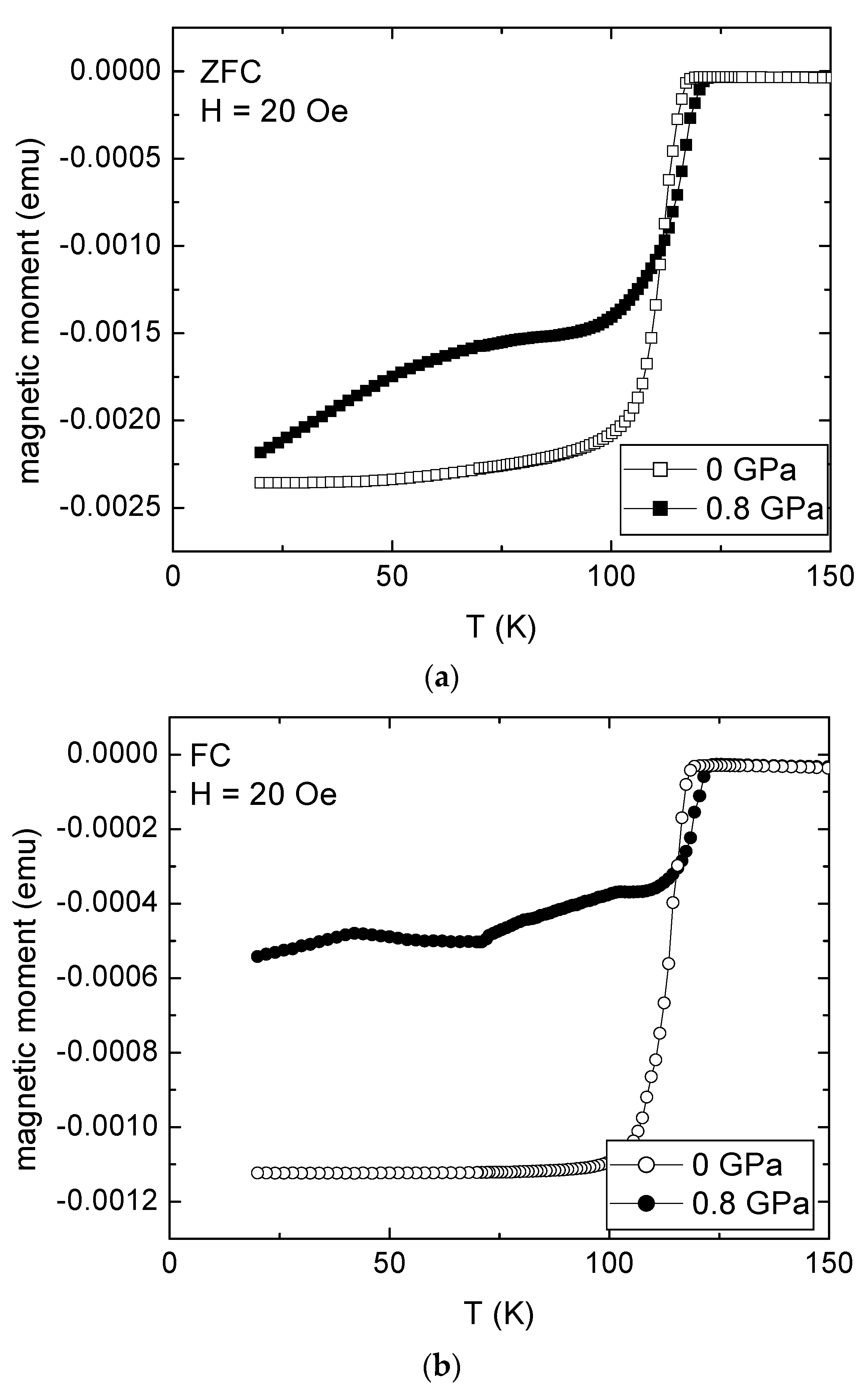
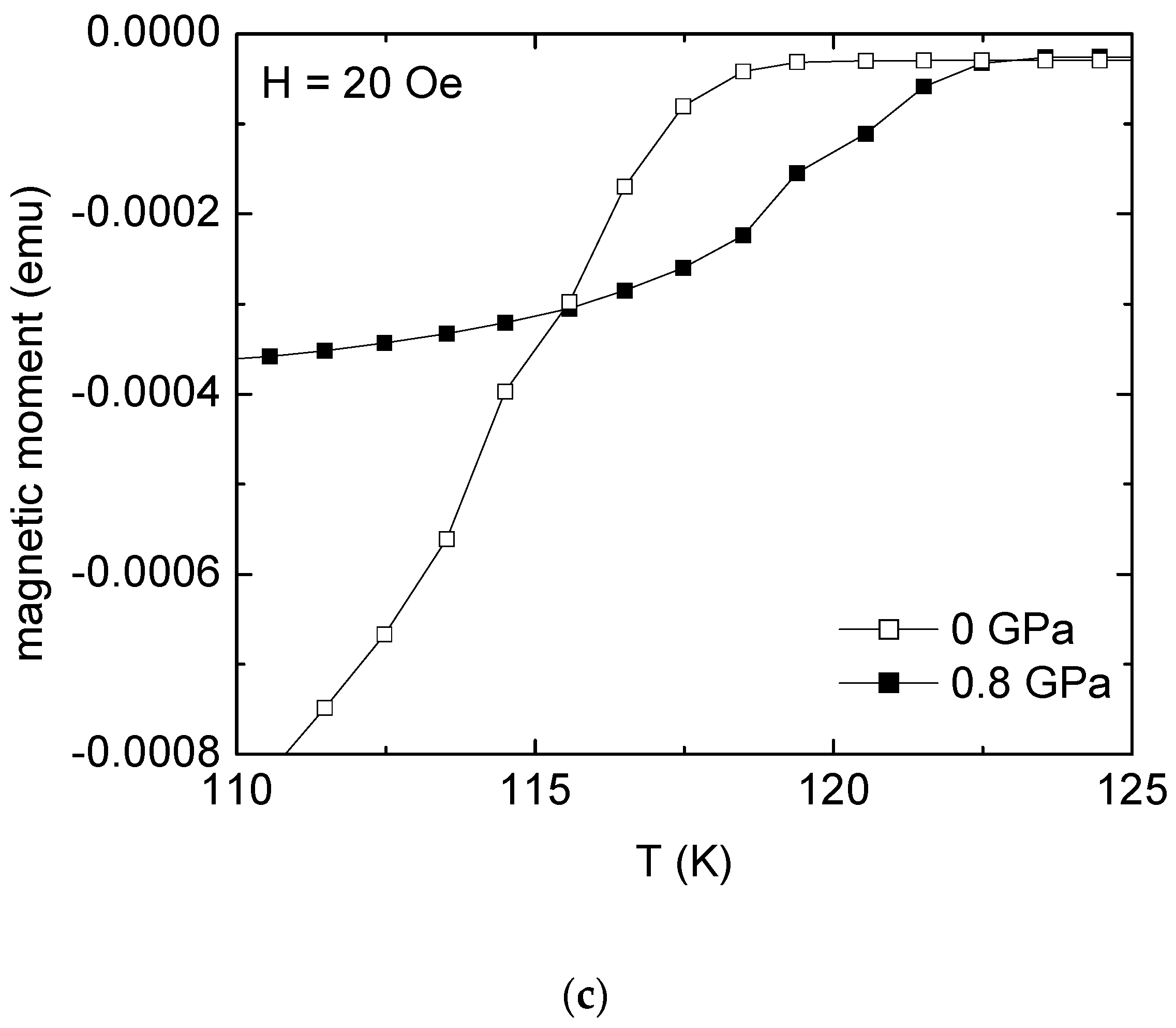
Figure 1a,b are the temperature-dependent magnetic moment of the Tl-2223 sample at ambient pressure (open symbols) and an applied pressure of 0.8 ± 0.01 GPa (closed symbols) at ZFC and FC conditions, respectively. Both plots show an increase in the Tc of the sample. In order to see this change in Tc better, we show the zoomed-in view around the transition temperature of the ZFC curves in Figure 1c. The Tc increased by 4 K (from 117 ± 0.04 K to 121 ± 0.04 K) with the applied pressure. This was in agreement with earlier works [4,5,6], where an increase of only 5 K at an applied pressure of 1.3 GPa was reported. This made us believe that this superconducting property will not have a drastic increase for this material even at high pressure.
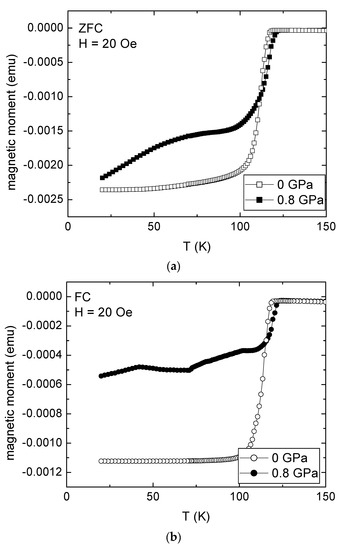
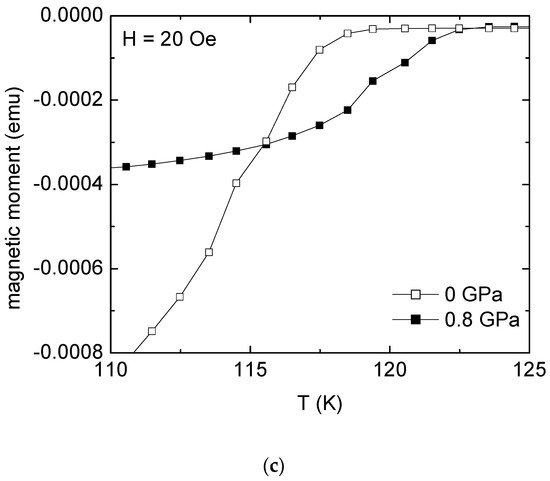
Figure 1.
(a) Temperature-dependent magnetic moment results measured under zero-field-cooled (ZFC) condition and 20 Oe assuming perfect diamagnetism; (b) Temperature-dependent magnetic moment results measured under field-cooled-data (FC) condition and 20 Oe assuming perfect diamagnetism; (c) A zoomed-in view (around the transition temperature) of the ZFC curves of the temperature-dependent magnetic moment.
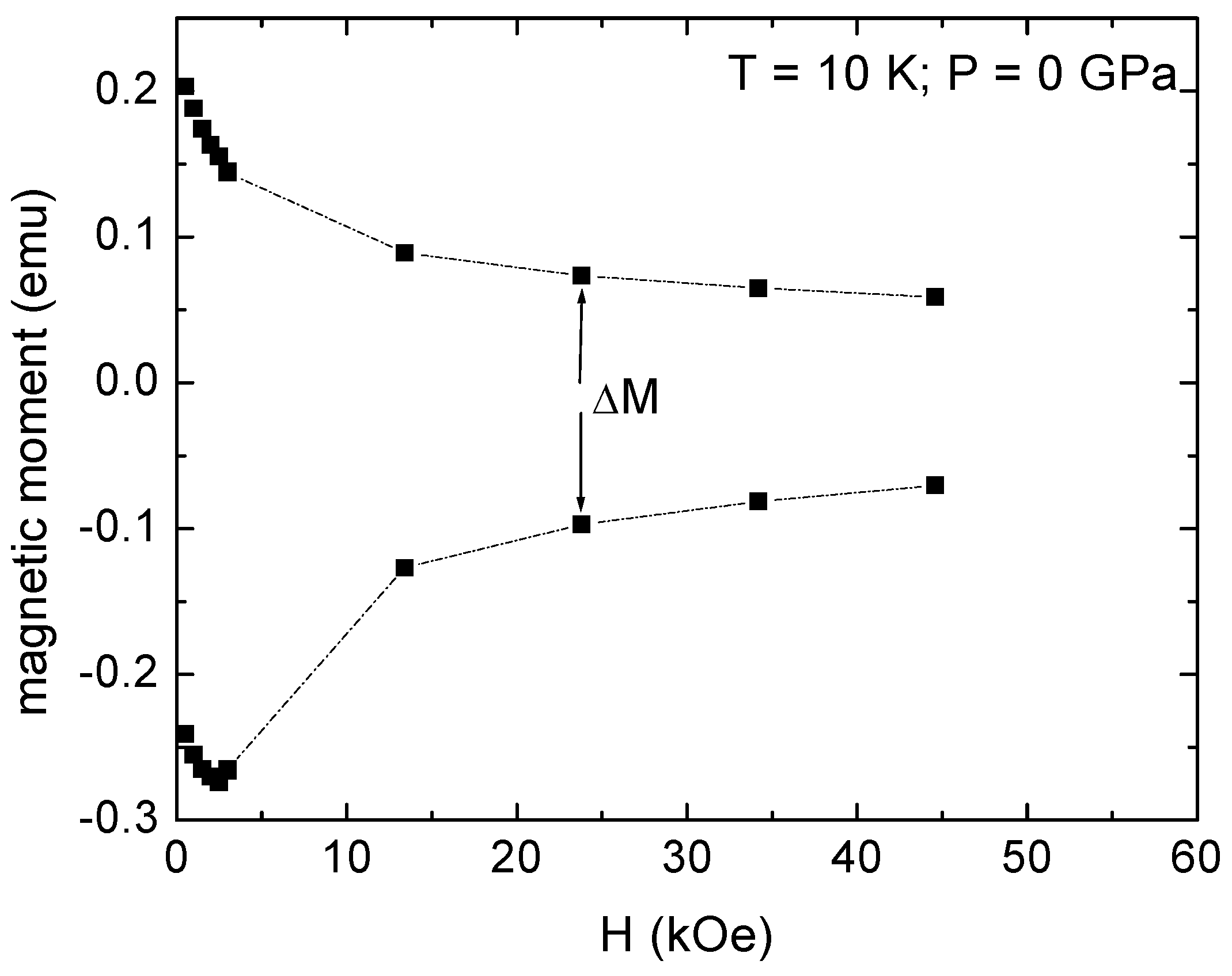
Figure 2 portrays a typical magnetization hysteresis loop (MHL) of the Tl-2223 sample at T = 10 K and zero (ambient) applied pressure with applied magnetic fields up to 4.6 T. The shape of the MLH is highly symmetric as is typical of most cuprates. The magnetic fields are first applied in the increasing direction so as to reduce de-magnetization effects. For clarity purposes, we also show how the ΔM = M− − M+ that is used in the Beans model equation is defined.
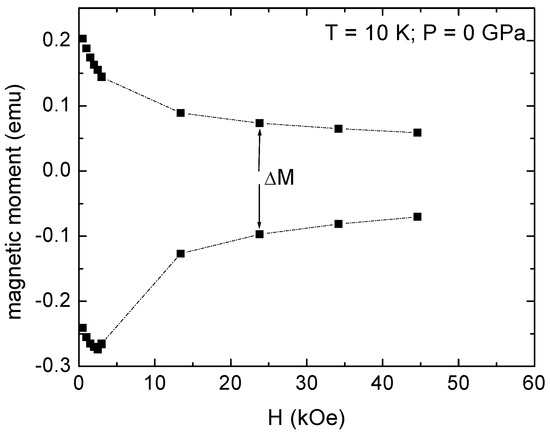
Figure 2.
A typical magnetic hysteresis loop (MHL) of the Tl-2223 sample at T = 10 K and zero applied pressure.
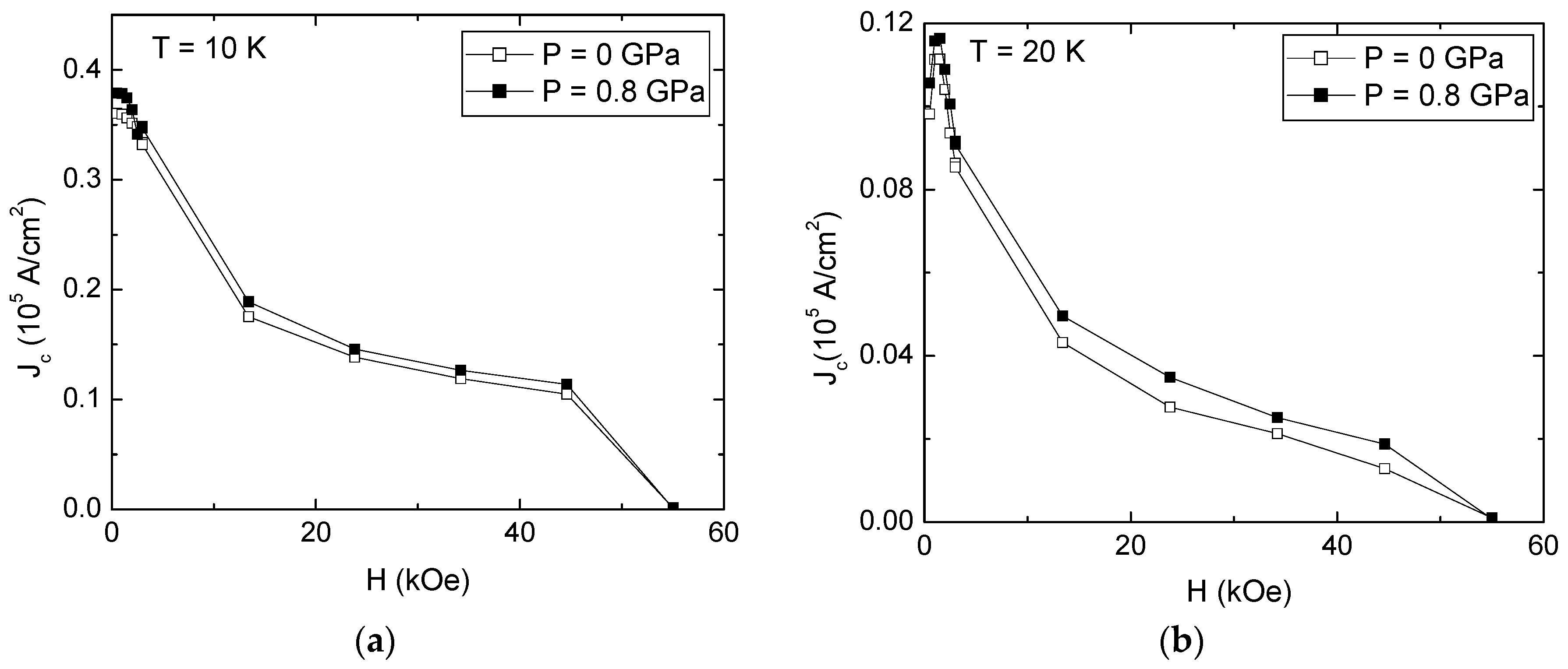
We now consider the effect of pressure on the Jc of the sample. To our knowledge, not much work has been done on the magnetically derived Jc from Tl-2223. This could be attributed to the difficulties in obtaining good crystals and performing pressure measurements in general. We look at Figure 3a,b for quantitative details of the effect of pressure on the Jc values at different applied magnetic fields. The calculated value of Jc at T = 10 K and H = 1.5 kOe were 35,629 A/cm2 and 37,448 A/cm2 at zero and 0.8 GPa pressures, respectively. This signifies an increase of 5.1%. Similarly, the Jc values at H = 3 kOe were 33,356 A/cm2 and 346,689 A/cm2 which is also about a 5% increase. This trend is similar to what we observed at the higher temperature of T = 20 K. Due to the low values of the Jc in the high magnetic field range (from 13.4 kOe to 44.6 kOe), the percentage of increase were very high. For example, the Jc at H = 13.4 kOe and T = 20 K are 4323 A/cm2 and 4957 A/cm2 at 0 and 0.8 GPa pressure, respectively. This is an increase of 14%. This number was even higher at H = 44.6 kOe. Thus, rather than computing the percentage increases, we concluded that there was an increase in the Jc upon application of pressure. Lastly, from H = 50 kOe upwards, the Jc was close to zero; this is the so-called “irreversibility field region” for superconductors, where the two MHLs (obtained in decreasing and increasing field H history respectively) collapse into a single one.
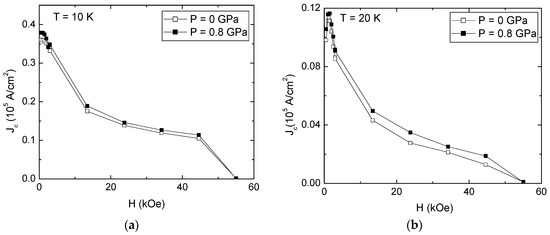
Figure 3.
(a) Field dependence of the critical current density Jc at T = 10 K for the Tl-2223 sample, calculated using the Bean’s model; (b) Field dependence of the critical current density Jc at T = 20 K for the Tl-2223 sample, calculated using the Bean’s model.
4. Summary
We have studied the effect of pressure on the critical temperature Tc and the critical current density Jc of Tl2Ba2Ca2Cu3O9-δ (Tl-2223) crystals. The pressure was applied in a piston-cylinder-cell using Pb as manometer and Daphne 7373 oil as the pressure transmitting medium. With the application of 0.8 ± 0.01 GPa pressure, the Tc increased by 4 K. Additionally, we saw an increase in the Jc, which were measured via magnetic induction at temperatures of 10 K and 20 K. There was a 5% increase at low applied magnetic fields while the increase was about 14% at high applied magnetic fields. This percentage was higher due to the relatively low values of the Jc. These results show that pressure is another parameter that could be used to improve the superconducting properties.
Author Contributions
Conceptualization, A.S.S.; methodology, A.O.I. and A.S.S.; material preparation/resources, R.S.; formal analysis, A.O.I.; investigation, A.O.I. and A.S.S.; data curation, A.O.I.; writing—original draft preparation, A.O.I.; writing—review and editing, A.O.I. and A.S.S.; funding acquisition, A.S.S.
Funding
This research at Oak Ridge National Laboratory was funded by the U.S. Department of Energy, Basic Energy Sciences, Materials Sciences and Engineering Division.
Acknowledgments
This research was supported in part by an appointment to the Higher Education Research Experience for Faculty Program at Oak Ridge National Laboratory.
Conflicts of Interest
The authors declare no conflict of interest.
References
- Sefat, A.S. Pressure effects on two superconducting Iron-based families. Rep. Prog. Phys. 2011, 74, 124502. [Google Scholar] [CrossRef]
- Galez, P.; Hopfinger, T.; Soubeyroux, J.L.; Lomello-Tafin, M.; Opagiste, C. The reaction pathway for the formation of Tl-2223. Phys. C Supercond. 2002, 372–376, 1137–1140. [Google Scholar] [CrossRef]
- Maignan, A.; Martin, C.; Hardy, V.; Simon, C.; Hervieu, N.; Raveau, B. A crystal study of the 128 K superconductor Tl2Ba2Ca2Cu3O10−δ synthesis and anisotropic magnetic properties. Phys. C Supercond. 1994, 219, 407–412. [Google Scholar] [CrossRef]
- Lin, J.G.; Matsuishi, K.; Wang, Y.Q.; Xue, Y.Y.; Hor, P.H.; Chu, C.W. Pressure effects on the superconducting transition temperature of Tl2Can−1Ba2CunO2n+4−δ. Phys. C Supercond. 1991, 175, 627–633. [Google Scholar] [CrossRef]
- Tristan, D.; Wijngaarden, R.J.; Liu, R.S.; Tallon, J.L.; Griessen, R. Superconductivity at 133 K in Tl2Ba2Ca2Cu3O10+x under high pressure. Phys. C Supercond. 1993, 218, 24–28. [Google Scholar]
- Jover, D.T.; Wijngaarden, R.J.; Griessen, R.; Haines, E.M.; Tallon, J.L.; Liu, R.S. Pressure dependence of the superconducting critical temperature of Tl2Ba2Ca2Cu3O10+y and Tl2Ba2Ca3Cu4O12+y up to 21 GPa. Phys. Rev. B 1996, 54, 10175–10185. [Google Scholar] [CrossRef]
- Jover, D.T.; Wijngaarden, R.J.; Wilhelm, H.; Griessen, R.; Loureiro, S.M.; Capponi, J.-J.; Schilling, A.; Ott, H.R. Pressure dependence of the superconducting critical temperature of Hg2Ba2Ca2Cu3O8+y and HgBa2Ca3Cu4O10+y up to 30 GPa. Phys. Rev. B 1996, 54, 4265. [Google Scholar] [CrossRef]
- Shipra, R.; Sefat, A.S. Effect of Li2O on the microstructure, magnetic and transport properties of Tl-2223 superconductor. Phys. C Supercond. 2015, 519, 108–111. [Google Scholar] [CrossRef]
- Bean, C.P. Magnetization of hard superconductors. Phys. Rev. Lett. 1962, 8, 250. [Google Scholar] [CrossRef]
- Bean, C.P. Magnetization of high-field superconductors. Rev. Mod. Phys. 1964, 36, 31. [Google Scholar] [CrossRef]
© 2018 by the authors. Licensee MDPI, Basel, Switzerland. This article is an open access article distributed under the terms and conditions of the Creative Commons Attribution (CC BY) license (http://creativecommons.org/licenses/by/4.0/).