Article

Detection of Phosphorus Deficiency Using Hyperspectral Imaging for Early Characterization of Asymptomatic Growth and Photosynthetic Symptoms in Maize


1
Division of Biological Science, Faculty of Science, Prince of Songkla University, Songkhla 90110, Thailand
2
Division of Physical Science, Faculty of Science, Prince of Songkla University, Songkhla 90110, Thailand
3
National Astronomical Research Institute of Thailand (Public Organization), Mae Rim, Chiang Mai 50180, Thailand
4
Institute of Biological Sciences, Faculty of Science, Universiti Malaya, Kuala Lumpur 50603, Malaysia
*
Author to whom correspondence should be addressed.
Agronomy 2026, 16(8), 772; https://doi.org/10.3390/agronomy16080772
Submission received: 19 March 2026 / Revised: 2 April 2026 / Accepted: 4 April 2026 / Published: 8 April 2026
(This article belongs to the Special Issue Nutrient Enrichment and Crop Quality in Sustainable Agriculture)

Abstract

Phosphorus (P) deficiency severely limits maize growth and yield, yet early detection remains challenging, as visible symptoms appear only after prolonged starvation. This study evaluated the capability of hyperspectral imaging (HSI) combined with machine learning to detect P deficiency in maize seedlings at both symptomatic and pre-symptomatic stages. Two greenhouse experiments were conducted: a long-term pot system under high and low P conditions and a short-term hydroponic experiment with three P concentrations of 500, 100, and 0 μmol/L phosphate (Pi). After long-term P deficiency, significant reductions in shoot biomass and Pi content were observed, while root biomass increased and nutrient profiles were altered. Hyperspectral signatures revealed distinct wavelength-specific differences across visible, red-edge, and near-infrared (NIR) regions, with P-deficient leaves showing lower reflectance in green and NIR regions but higher reflectance in the red band. A multilayer perceptron machine learning model achieved 99.65% accuracy in discriminating between P treatments. In the short-term experiment, P deficiency significantly reduced tissue Pi content within one week without affecting pigment composition or photosynthetic parameters. Despite the absence of visible symptoms, hyperspectral measurements detected subtle spectral changes, particularly in older leaves, enabling classification accuracies of 80.71–84.56% in the first week and 85.88–90.98% in the second week of P treatment. Conventional vegetation indices showed weak correlations with Pi content and failed to detect early P deficiency. These findings demonstrate that HSI combined with machine learning can effectively detect P deficiency before visible symptoms emerge, offering a non-destructive, rapid diagnostic tool for precision nutrient management in maize production systems.

1. Introduction

Phosphorus (P) deficiency severely reduces maize growth and grain yield, with yield losses ranging from 10 to 60% depending on the severity and duration of P deficiency [1,2,3]. In response to P deficiency, maize plants exhibit characteristic morphological adaptations aimed at increasing the efficiency of P acquisition. These adaptations include an increased root-to-shoot biomass ratio, stimulated lateral root and root hair development, increased exudation of organic acids and phosphatases, and the formation of symbiotic associations with mycorrhizal fungi [4,5]. These adaptive responses represent a coordinated developmental reprogramming that prioritizes belowground resource allocation to maximize P uptake capacity. However, despite these adaptive mechanisms, prolonged P deficiency inevitably leads to stunted growth, reduced leaf area, delayed maturity, and substantial yield losses. Therefore, the early detection of P deficiency enables timely corrective interventions, such as targeted fertilizer application, before visible symptoms appear. This proactive approach minimizes physiological damage and prevents yield losses by ensuring plants maintain adequate P levels throughout critical growth stages.
Classical P deficiency symptoms include the development of dark green coloration in leaves, often accompanied by purple or reddish discoloration, particularly along leaf margins and on the underside of leaves. This red or purple coloration results from the accumulation of anthocyanin, which is triggered by the disruption of carbohydrate metabolism and the accumulation of excess sugars under P-limited conditions [6]. In severe P deficiency, leaves develop yellowing, or chlorosis, and exhibit senescence, with older leaves showing chlorosis as P is remobilized to support younger, actively growing tissues [1]. These pigmentation changes directly impact photosynthetic performance. Therefore, P deficiency fundamentally disrupts the photosynthetic apparatus. Moreover, P is an essential component of ATP and NADPH, the energy carriers essential for the light-dependent reactions of photosynthesis [7]. Under P-deficient conditions, the quantum yield of photosystem II (Phi2), which represents the efficiency of light energy conversion in photochemistry, is typically reduced, indicating impaired photosynthetic electron transport. Concurrently, when the photosynthetic machinery can no longer effectively utilize captured light energy, non-photochemical quenching (PhiNPQ) often increases as plants dissipate absorbed light energy as heat to prevent photodamage [7,8,9,10].
Furthermore, P deficiency fundamentally alters the nutrient profile of plant tissues. The most direct change is a substantial reduction in both inorganic phosphate (Pi) content and total P concentration in tissues [10,11]. This P depletion is not uniform across all tissues, as P is preferentially remobilized from older leaves to support younger, actively growing organs, resulting in steep gradients of P concentration related to leaf age and developmental stage [9,10]. Importantly, P deficiency also significantly affects the accumulation and distribution of other mineral nutrients through complex interactions in uptake, translocation, and utilization [12]. P deficiency disrupts mineral homeostasis by triggering increased uptakes of sulfur, iron, and zinc to compensate for metabolic adjustments, including lipid remodeling. However, excessive accumulation of iron and zinc may cause toxicity, affecting overall plant development. These coordinated changes in tissue elemental composition reflect the interconnected nature of plant mineral nutrition and the central regulatory role of P in metabolic homeostasis [13]. The alterations in leaf chemical composition influenced by internal P availability provide a diverse suite of signatures that can potentially be detected and identified through hyperspectral imaging (HSI).
The altered photosynthetic pigment contents and leaf senescence due to P deficiency produce distinct reflectance patterns that enable the discrimination of leaf P status through hyperspectral analysis. Previous studies have demonstrated these spectral changes across different crop species and developmental stages. In hydroponic rice experiments, P deficiency increased leaf senescence in older leaves, with P-deficient leaves exhibiting higher reflectance in the visible region but lower reflectance in the near-infrared (NIR) region compared with P-sufficient leaves [14]. A subsequent investigation, involving both young and old fully expanded rice leaves, revealed that varying P levels resulted in different photosynthetic pigment contents, with corresponding leaf age-dependent differences in reflectance patterns [10]. In maize, P-deficient leaves developed purple discoloration in the leaf margin, accompanied by decreased vegetation metrics, including the normalized difference vegetation index (NDVI), anthocyanin reflective index (ARI), and potential biodiversity index (PBI). Reflectance in both the visible and NIR regions was higher in P-deficient leaves than in P-sufficient leaves. Species-specific reflectance responses to varying P fertilization have been documented in celery, sugar beet and strawberry, where different P levels produced distinct photosynthetic pigment contents and corresponding spectral differences [15]. However, these studies focused on detecting P deficiency when visible symptoms such as leaf senescence and pigment degradation were present. A critical knowledge gap remains regarding the early stages of P deficiency, when soluble Pi and total P in leaves decline without changes in photosynthetic pigments or visible symptoms.
The present study was designed to evaluate the capability of HSI to determine the P status of maize leaves, with particular emphasis on early detection before the appearance of visible symptoms or significant physiological alterations. We hypothesized that the reduction of Pi and total P contents in leaves induced by P deficiency generates distinctive hyperspectral signatures that could be characterized even when the conventional assessment methods of visual inspection and standard vegetation indices fail to identify nutrient stress. Here, we conducted two greenhouse experiments: a long-term pot culture study where maize seedlings were grown in contrasting high P (HP) and low P (LP) conditions for six weeks to establish well-developed P deficiency symptoms and spectral signatures, and a short-term hydroponic study where seedlings were subjected to varying P concentrations for one to two weeks to capture the early progression of P deficiency before visible symptoms emerged. We validated plant responses across multiple scales, from whole-plant growth parameters and leaf-level pigment composition to tissue-specific Pi content and photosynthetic efficiency measurements. Hyperspectral reflectance spectra were acquired from leaves at different developmental stages and analyzed using statistical methods and machine learning classification algorithms to identify discriminatory spectral features and assess classification accuracy.

2. Materials and Methods

2.1. Plant Material and Experimental Designs

2.1.1. Experiment 1: Long-Term Phosphorus Deficiency in Pot System

Maize seeds were germinated on moist tissue paper for five days in darkness and transplanted into 2 L pots containing a mixture of sand, perlite, and peat moss (8:1:1, v/v/v). Each pot contained one seedling (n = 14 biological replicates). The seedlings were irrigated with 100 mL of distilled water twice daily and fertilized with 200 mL of half-strength Hoagland’s solution containing either 0.5 mmol/L NH4H2PO4 (HP) or 0.5 mmol/L NH4Cl (LP) three times weekly for six weeks. The experiment was conducted from May to July 2025. The weather conditions during the experiment were recorded using RK600-07 data logger (Rika Electronic Tech Co., Ltd., Changsha, China). The average temperature and relative humidity were 31.9 ± 1.6 °C and 77.3 ± 10.8% respectively.

2.1.2. Experiment 2: Short-Term Phosphorus Deficiency in Hydroponic System

Maize seeds were germinated for three days on damp tissue paper in dark conditions. A total of 72 maize seedlings were selected for hydroponic cultivation in polystyrene boxes, with six seedlings per box. Each box contained 4 L of 0.5× Hoagland’s solution and was maintained in an open greenhouse for one week. The water level in the hydroponic system was monitored daily, and the hydroponic solutions were completely replaced twice a week. After one week, the plants were treated with three different P concentrations: 0, 100, and 500 µmol/L NH4H2PO4 in 0.5× Hoagland’s solution, with four boxes per P treatment (n = 4 biological replicates). The treatments were labeled NP (no P), LP and HP. Ammonium content in the hydroponic solutions was equalized using NH4Cl. At days 7 and 14 after treatment initiation, two plants (2 technical replicates) per box were harvested for analysis. The weather conditions were recorded during the experiment with an on-site RK600-07 data logger (Rika Electronic Tech Co., Ltd., Changsha, China). The average temperature and relative humidity were 29.5 ± 1.9 °C and 92.2 ± 9.1%, respectively.

2.2. Measurement of Maize Growth Parameters

The leaf number and shoot length of harvested plants were recorded. Shoot and root tissues were then sampled and oven-dried at 70 °C for three days to determine dry weight using an analytical balance (±0.0001 g, ME204T, METTLER TOLEDO, Greifensee, Switzerland). At the top of the plant, the most recently emerged, fully expanded leaf was defined as the first leaf (Leaf 1), representing the young leaf tissue. The third and fourth leaves below Leaf 1 (Leaf 3 and Leaf 4) represented older leaf tissue.

2.3. Measurement of Photosynthetic Pigments

For the measurement of photosynthetic pigments, approximately 20 mg of fresh leaf tissue from the young or old leaf was collected in microcentrifuge tubes. One milliliter of 80% (v/v) acetone was added to each tube, and samples were stored in darkness at 4 °C for one week. The absorbance of the supernatants was measured at 470, 647, and 664 nm using a spectrophotometer (SPECTROstar Nano, BMG LABTECH, Ortenberg, Germany). Concentrations of chlorophyll a, chlorophyll b, and carotenoids were calculated according to [16].

2.4. Measurement of Photosynthetic Parameters

Photosynthetic parameters were measured using the MultispeQ fluorometer (PhotosynQ, East Lansing, MI, USA). Measurements were taken at the mid-leaf area of Leaf 1 and Leaf 4 under ambient light conditions. Parameters measured included the quantum yield of photosystem II (Phi2), the yield of non-photochemical quenching (PhiNPQ), and the yield of non-regulated energy dissipation (PhiNO). Phi2 represents the proportion of absorbed light energy used for photochemistry in PSII, with values ranging from 0 to 1, where higher values indicate more efficient light utilization for photosynthesis. PhiNPQ represents the proportion of absorbed light energy dissipated as heat through regulated photoprotective mechanisms, and PhiNO represents the proportion of light energy lost through non-regulated processes [17].

2.5. Determination of Inorganic Phosphate Contents in Leaf and Root

The molybdenum blue-based quantitative assay was used to determine Pi concentration in plant tissues [18]. Approximately 20 mg of tissue was collected from Leaf 1, Leaf 4, and the roots. The tissue samples were homogenized with a micropestle in 600 µL of 3% (v/v) HClO4 in 1.5 mL microcentrifuge tubes. The homogenate was centrifuged at 12,000× g for 10 min at room temperature. Subsequently, 120 µL of the supernatant was mixed with 80 µL of assay reagent consisting of 1% (w/v) ammonium molybdate containing 50 g/L FeSO4·7H2O. The mixture was incubated at 37 °C for 2 min. Following incubation, absorbance was measured at 720 nm using a microplate reader (SPECTROstar Nano, BMG LABTECH, Ortenberg, Germany). Pi content was determined by comparison with a standard curve prepared using KH2PO4 in the range of 5–600 nmol/mL.

2.6. Determination of Nutrient Concentration and Contents

Dry shoot samples from different P treatments were analyzed for macro- and micronutrient contents (n = 7 biological replicates). Total C and N were determined by dry combustion using a C/N analyzer (CN628, LECO Corporation, St. Joseph, MI, USA) according to [19]. For the determination of other nutrients, 0.5 g of ground dry shoot sample was digested with 2 mL of 65% (v/v) HNO3 and incubated at 95 °C for 1 h. Subsequently, 1 mL of 30% (v/v) H2O2 was added, and the mixture was further incubated at 95 °C for 30 min to ensure complete digestion. The digested sample was filtered through Whatman No. 1 filter paper and diluted to 10 mL with deionized water. Total P, K, Ca, Mg, Cu, Mn, Fe, Mo, B, and Zn were determined using inductively coupled plasma optical emission spectrometry (ICP-OES) following AOAC official methods [20,21]. Total Cl was determined by volumetric titration [22], and total S was measured turbidimetrically using a spectrophotometer (Spectroquant® Prove 300, Merck KGaA, Darmstadt, Germany). Nutrient content was calculated as the product of nutrient concentration in the extract and shoot dry weight.

2.7. Statistical Analysis

Data analysis was performed using the R statistical software version 4.5.1 [23]. Significant differences among treatments were analyzed using one-way ANOVA followed by the LSD post hoc test in the Agricolae package [24]. Principal component analysis (PCA) was performed to compare nutrient accumulation patterns in leaves of maize seedlings between HP and LP treatments. Biplots were generated with 95% confidence ellipses around treatment groups. Data visualization was performed using the ggplot2 package [25].

2.8. Hyperspectral Imaging

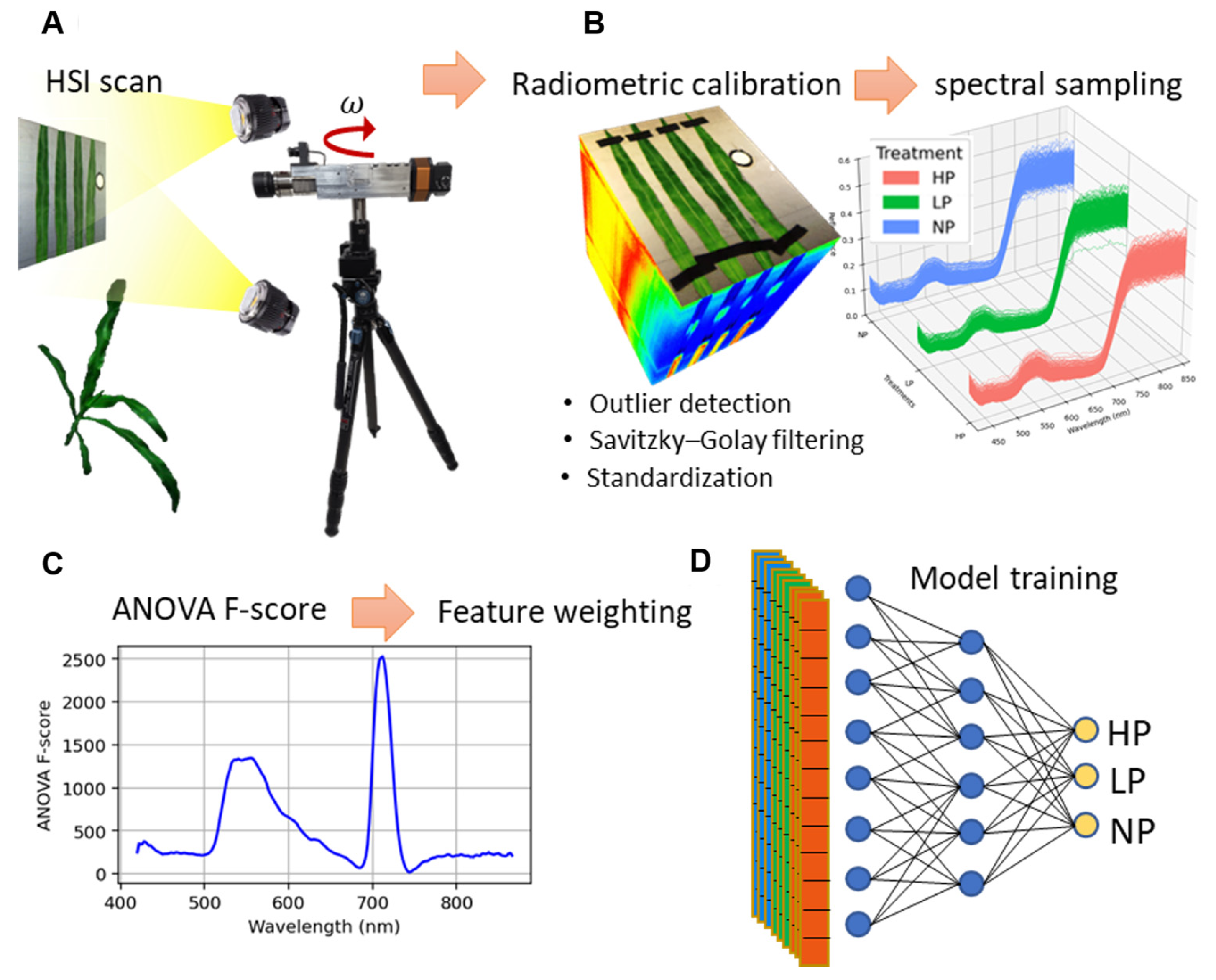
A grism-based HSI system was custom-designed to acquire physicochemical-associated reflectance spectra of maize leaf samples. Detailed descriptions of the HSI instrumentation, together with the associated spectral and spatial calibration procedures conducted prior to data collection, are available in [26]. The system covers a spectral range of 450–850 nm with a spectral resolution of 2 nm, and provides a spatial resolution of approximately 0.5 mm. For the long-term pot experiment, HSI images were acquired from the entire maize shoots. In the short-term hydroponic experiment, maize leaves were placed on black acrylic plates mounted on a rigid sample stage, as shown in Figure 1A. Uniform bilateral illumination was achieved using broadband visible–NIR light sources comprising 100 W, 5000 K LED panels (LCFOCUS, Shenzhen, China) and 400 W, 3300 K halogen lamps (Shenzhen Tezelong Technology, Shenzhen, China), arranged symmetrically to avoid shadowing. The working distance between the sample and the front lens of the system was fixed at 3.2 m to obtain a sufficiently large field of view, allowing multiple leaves to be imaged in a single scan. Hyperspectral data were collected using a pushbroom scanning configuration, implemented through a rotating scanning mechanism operating at an angular speed of 3.5 mrad/s, corresponding to a linear scan speed of approximately 1.12 cm/s at the object plane.

2.8.1. Radiometric Calibration

The HSI scanner exported a raw radiance intensity data cube, I ( x , y , λ ) as shown in Figure 1B. These raw measurements required radiometric calibration to convert the recorded signal into reflectance, a quantity dependent solely on the intrinsic optical properties of the target material. In this study, a Spectralon reflectance standard (model SRS-40-010, Labsphere, Inc., North Sutton, NH, USA) placed in the sample plane was used for calibration, according to the following expression [27]:
R x , y , λ = I x , y , λ I d a r k I r e f ( λ ) I d a r k · R r e f ( λ ) ,
where R x , y , λ and I x , y , λ denote the reflectance and the measured raw spectral intensities of the sample at position ( x , y ) ;   R r e f ( λ ) is the certified spectral reflectance of the Spectralon standard, and I r e f ( λ ) is the corresponding raw intensity recorded from the reference panel, averaged over its illuminated area to reduce spatial non-uniformity. The term I d a r k corresponds to the median dark-signal intensity acquired with the sensor fully occluded.

2.8.2. Spectral Preprocessing and Data Sampling

The region of interest (ROI) in leaves was manually segmented from the background, and the spectra of all ROI pixels were extracted and stored as a two-dimensional array of spectral vectors [ N p i x e l , N b a n d s ], with their associated treatment labels recorded in a one-dimensional array. To produce a clean and balanced dataset for analysis, a multi-stage spectral preprocessing workflow was applied. First, within each P treatment class, anomalous spectra were removed using a z -score-based outlier detection method [28]. For each spectrum R i c ( λ ) in class c the z -score was computed per wavelength, and spectra satisfying m a x λ z i ( λ ) > 5 were excluded to eliminate anomalous measurements caused by noise, segmentation errors, or stray reflections. All remaining spectra were denoised using a Savitzky–Golay filter [29] to preserve narrow absorption features while reducing high-frequency noise. To obtain a uniformly distributed dataset suitable for machine learning, 10,000 spectra were randomly sampled from each treatment class. This resulted in a balanced reflectance dataset R i c λ , i = 1 , , 10,000 , c { H P , L P , N P } .
For each experiment, approximately 75% of biological replicates were assigned to the training set and the remaining 25% to the test set, ensuring that all spectra from a given replicate were exclusively assigned to a single subset. In the long-term phosphorus-deficiency pot experiment (n = 14 biological replicates), plants (pots) were divided into a training set (n = 10) and a test set (n = 4). In the short-term phosphorus-deficiency hydroponic experiment (n = 8 biological replicates), replicates were divided into a training set (n = 6) and a test set (n = 2).
For each treatment class, reflectance spectra were randomly sampled at the pixel level from multiple fully expanded leaves across all biological replicates within each subset. A balanced dataset of 10,000 spectra per class was constructed, with 7500 spectra drawn from the training subset and 2500 spectra drawn independently from the test subset.

2.8.3. Calculations of Vegetation Indices

Vegetation indices were calculated using the mean hyperspectral reflectance spectrum for each sample group. Samples were grouped according to leaf age (Leaf 1 and Leaf 4), measurement time (one and two weeks after treatment), and P treatment (HP, LP and NP). For each group, all spectra belonging to the same combination of leaf age, time and treatment were averaged to obtain a representative mean spectrum. Reflectance values at the required wavelengths were then extracted from this mean spectrum, and vegetation indices were computed using standard formulations (Table 1). The calculated indices covered greenness, chlorophyll absorption, pigment composition, and structural characteristics, enabling the consistent comparison of spectral responses across treatments and leaf developmental stages.

2.8.4. ANOVA F-Score for Feature Analysis

To assess the discriminative contribution of each spectral wavelength in separating P treatment classes, we computed the one-way ANOVA F-score as a function of wavelength. For each wavelength λ , the F-score quantified the ratio between the variance of class-wise mean reflectance and the variance within each class. The F-statistic at wavelength λ was defined as in [48]:
F ( λ ) = c = 1 C n c R ¯ c λ R ¯ λ 2 / ( C 1 ) c = 1 C i = 1 n c R i c λ R ¯ c λ 2 / ( N C ) ,
where R i ( c ) ( λ ) is the reflectance of sample i belonging to class c at wavelength λ ; R ¯ ( c ) ( λ ) is the mean reflectance of class c ; and R ¯ ( λ ) is the global mean across all samples. In this study, C = 3 was the number of treatment classes; n c = 10,000 was the number of spectra per class; and N = 30,000, the total number of spectra across all treatments. An instance of F λ is shown in Figure 1C. Higher values of F ( λ ) indicate wavelengths where the spectral differences between P treatment classes are large relative to the within-class variability, thereby highlighting informative spectral regions for P status discrimination. All F-scores were computed using the f_classif function from the Scikit-Learn Python library version 1.8.0.

2.8.5. MLP Model Training

To classify P treatment levels directly from subtle changes in full-spectrum reflectance measurements, an MLP neural network was trained using the preprocessed and balanced spectral dataset. Prior to model training, an additional feature-weighting step based on the ANOVA F-score was applied to enhance the contribution of spectrally informative bands. The F-scores were normalized to the range [0, 1],
F ~ λ = F λ F m i n F m a x F m i n ,
and the reflectance spectra were transformed by element-wise weighting:
R i c = R i c λ F ~ λ .
All weighted spectra were then standardized using
R i , s c a l e d c = R c ( λ ) μ ( λ ) σ ( λ ) ,
where μ and σ denote the per-wavelength mean and standard deviation computed over the training subset. This weighting scheme retains full spectral dimensionality while functioning as a soft attention mechanism, improving classifier stability and reducing the influence of low-information spectral regions.
Classification was performed using a feed-forward MLP implemented in Scikit-Learn MLP Classifier with an input layer that matched the number of wavelength bands, two hidden layers of 128 and 64 ReLU-activated neurons, and a softmax output layer representing the HP, LP, and NP classes. The model was trained with the Adam optimizer. Overfitting was controlled through a combination of L2 weight regularization ( α = 10 4 ) , early stopping after 20 epochs without validation improvement, and F-score-based feature weighting to suppress contributions from low-information wavelengths. Five-fold stratified cross-validation was used to assess robustness, with average cross-validated accuracy providing an unbiased performance estimate. Final model evaluation was conducted on the hold-out test set using overall accuracy and a row-normalized confusion matrix to assess class-wise predictive performance.

3. Results

3.1. Effect of Long-Term Phosphorus Deficiency on the Growth Phenotype and Hyperspectral Signatures of Maize Seedlings

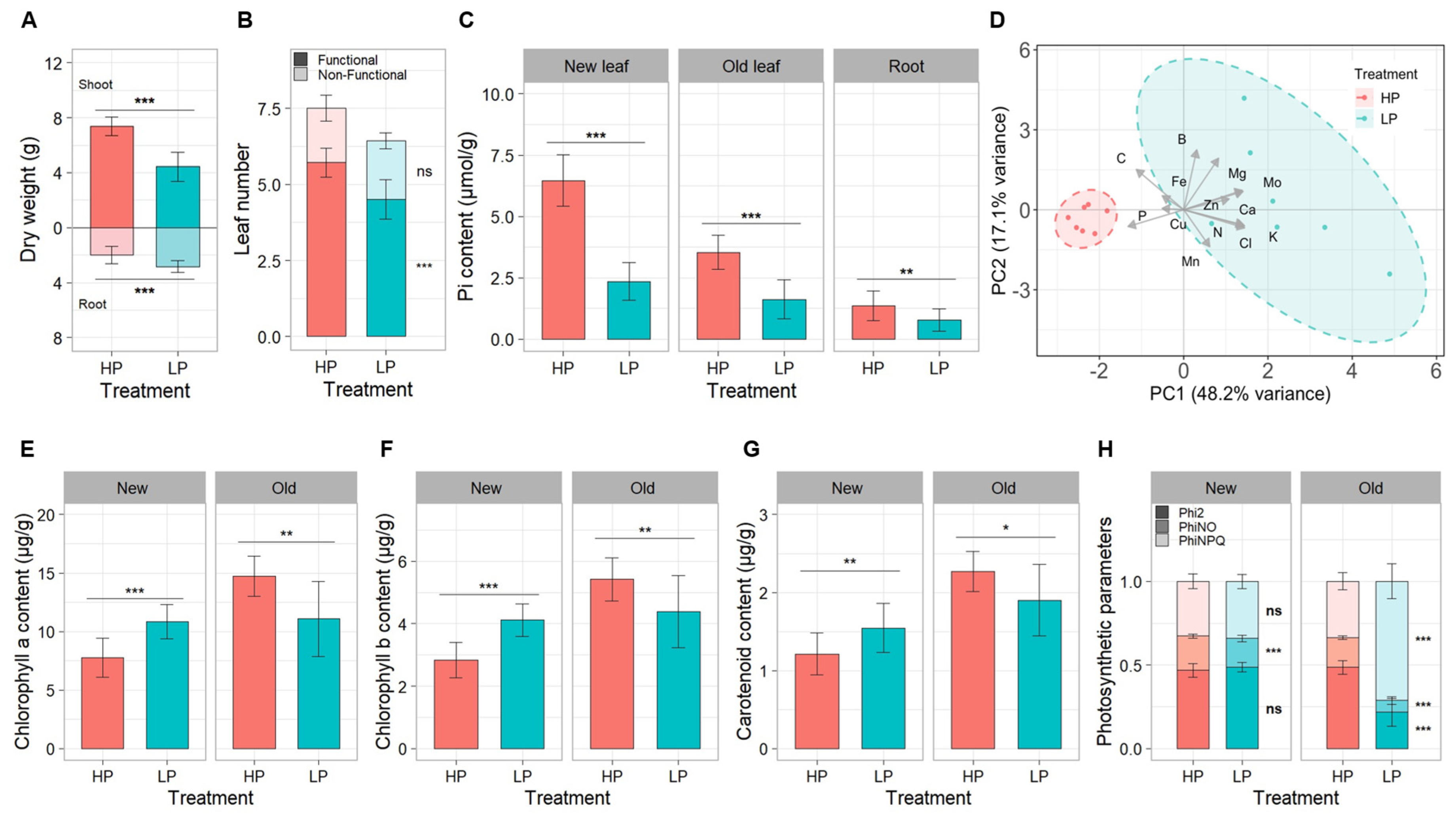
At week 6 in the LP treatment, the shoot biomass of maize seedlings was significantly lower than in the HP treatment, but root biomass was significantly higher (Figure 2A). Shoot dry weight was approximately 40% lower in the LP condition, while root dry weight was 29% higher. The number of functional leaves was also significantly lower in the P-deficient plants (Figure 2B), although the number of non-functional leaves did not differ significantly between the two treatments.
Cytosolic Pi and total P concentrations confirmed the successful establishment of P-deficient conditions. Pi content was significantly lower in the LP plants across all tissues examined (Figure 2C). Leaf 1 showed the most pronounced decrease in Pi concentration, while Leaf 4 and root tissues also exhibited significant reductions in Pi content. Furthermore, the total P content in the shoot biomass of maize seedlings decreased by approximately 55% in the LP condition (Table S1). The PCA of nutrient accumulation in the shoot biomass of maize seedlings revealed distinct clustering between the HP and LP treatments (Figure 2D), with PC1 explaining 48.2% of the variance and PC2 accounting for 17.1% of the variance. The separation pattern indicated that P starvation altered the overall nutrient profile, with significant changes in P, N, K, Ca, Mg, Mo, Zn, and Cl accumulations (Table S1).
Photosynthetic pigment contents were significantly affected in the LP treatment. Chlorophyll a content in Leaf 1 was higher in the LP condition, while chlorophyll a content in Leaf 4 was higher in the P-sufficient plants (Figure 2E). Chlorophyll b and carotenoids exhibited a similar pattern, with pigment concentrations being higher in Leaf 1 in the LP treatment but higher in Leaf 4 in the HP treatment (Figure 2F,G). Photosynthetic efficiency parameters revealed differential responses to P deficiency between leaf developmental stages (Figure 2H). In the LP treatment, Phi2 was significantly reduced in Leaf 4, but PhiNPQ increased. In contrast, these parameters showed no difference among the HP and LP treatments in Leaf 1. These results indicate that P deficiency alters photosynthetic pigment contents and impairs photosynthetic performance in a leaf age-dependent manner.
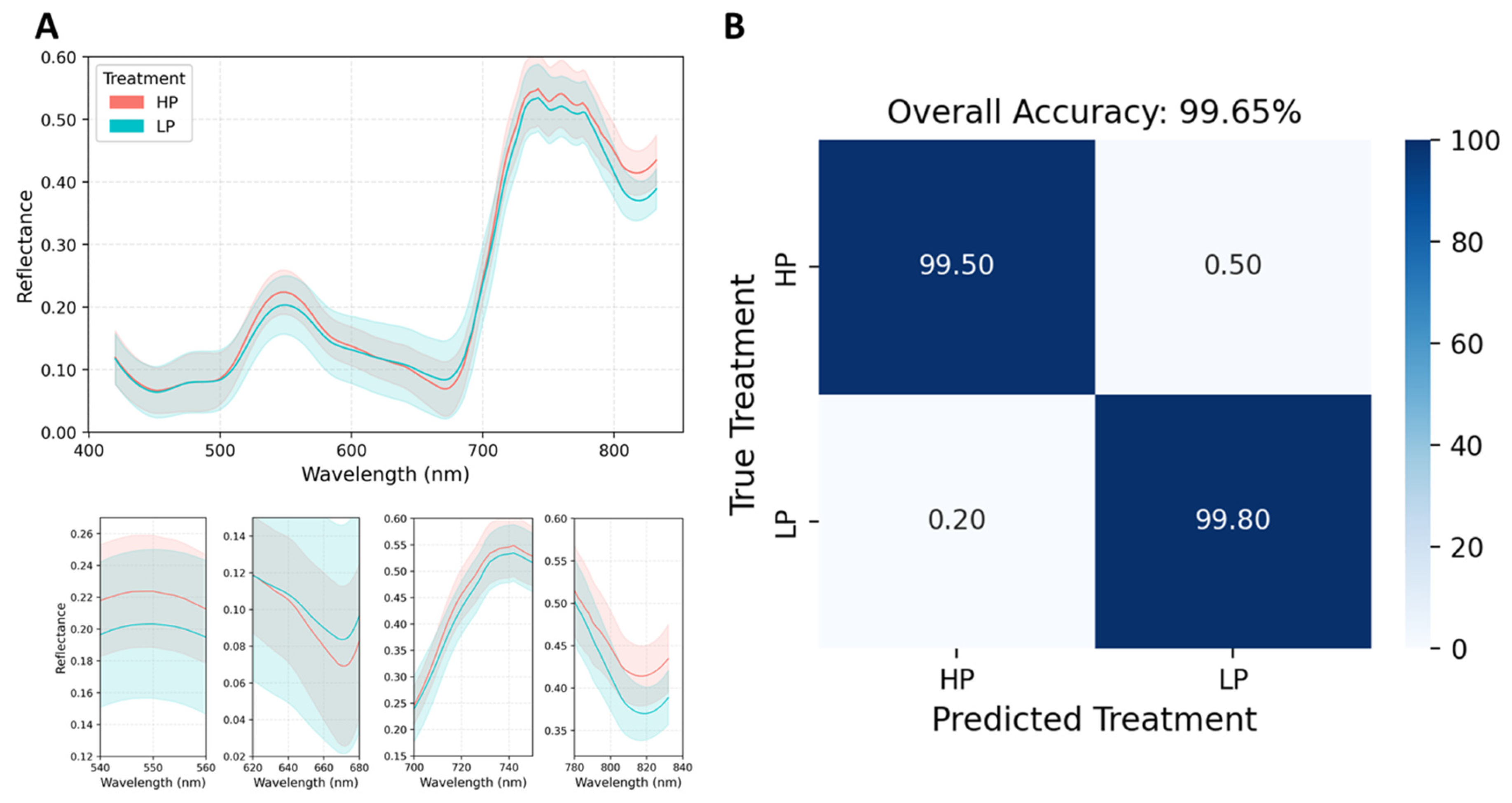
The results of hyperspectral analysis of maize seedling shoots revealed clear wavelength-specific differences between HP and LP treatments. In the green region (~540–560 nm), the P-deficient leaves exhibited slightly lower reflectance than the P-sufficient leaves. In the yellow region (~540–610 nm), LP leaves showed lower reflectance, which aligns with the loss of carotenoids in Leaf 4 (Figure 2G). In contrast, the red band (~620–680 nm) displayed consistently higher reflectance in LP leaves, directly reflecting the significant reductions in chlorophyll a and b quantified in older LP leaves (Figure 2E,F). This shallower red trough is a direct optical consequence of pigment loss. Moving into the red-edge (700–740 nm), LP leaves showed a weaker slope relative to HP leaves, matching the combined effects of reduced chlorophyll and impaired photosynthetic efficiency, as indicated by lower Phi2 and higher PhiNPQ in older LP leaves (Figure 2H). Finally, in the NIR region (~760–850 nm), LP leaves exhibited lower reflectance, consistent with diminished internal scattering caused by reduced mesophyll integrity and lower biomass accumulation.
These distinct spectral differences enabled the highly accurate classification of P treatments by the MLP model. As shown in Figure 3B, the model achieved an overall accuracy of 99.65%, indicating strong separability of spectral features between treatments under controlled conditions. This high performance is primarily due to the long-term phosphorus-deficiency treatment, which induced pronounced physiological and structural changes in leaves, leading to clearly distinguishable spectral signatures, particularly in the shape and slope across the visible, red-edge, and near-infrared regions. However, as spectra were analyzed at the pixel level, this value should be interpreted as an upper-bound estimate of classification performance. This result nevertheless demonstrates the sensitivity of hyperspectral imaging to underlying differences in pigment composition, photosynthetic efficiency, and structural integrity.

3.2. Growth and Hyperspectral Responses of Maize Seedlings to Short-Term Phosphorus Deficiency

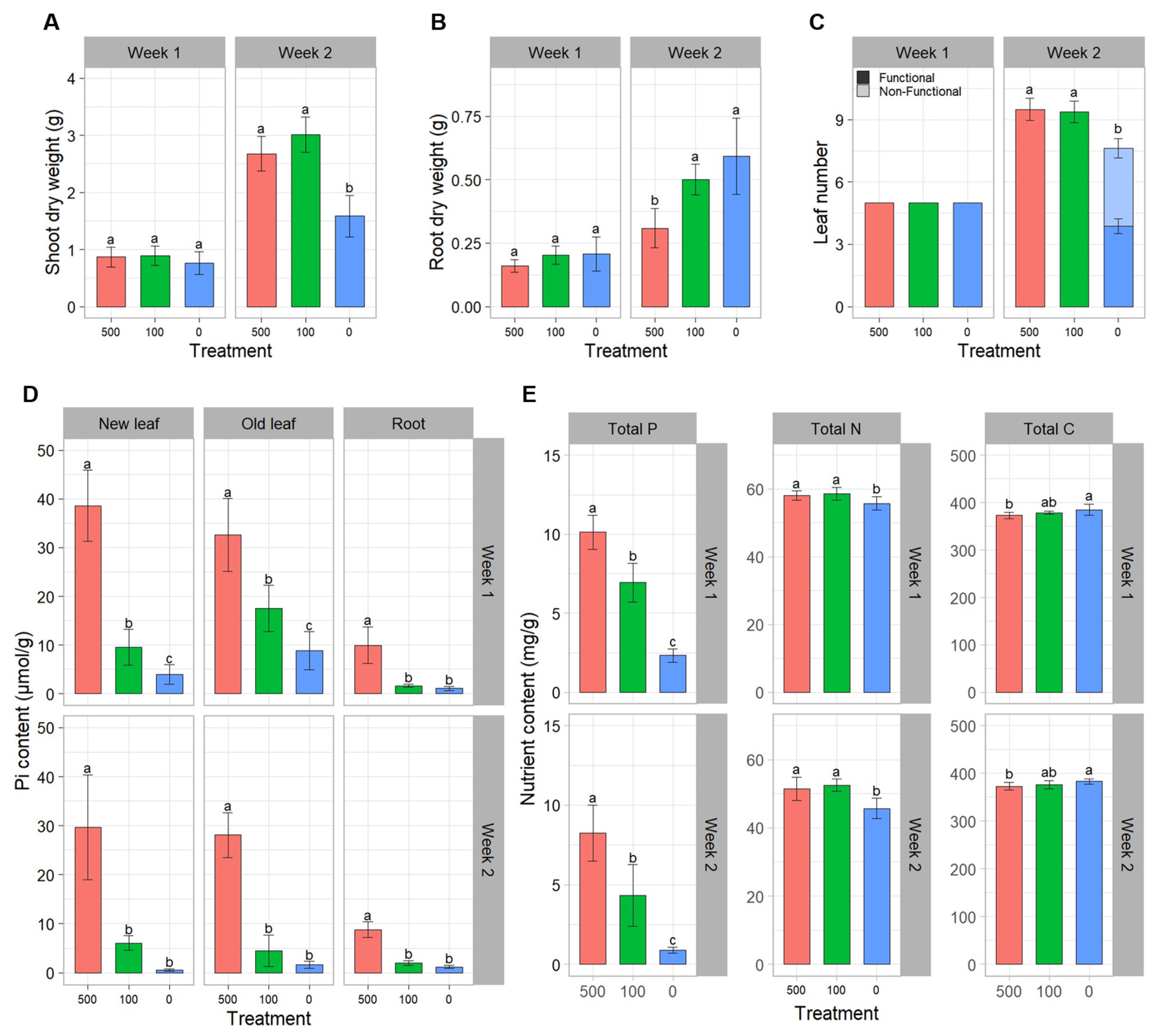
Hydroponic experiments were conducted in 0.5× Hoagland’s solution supplemented with three Pi concentrations: 0, 100, and 500 μmol/L NH4H2PO4. At day 7, no significant differences in shoot dry weight, root dry weight, and leaf number were observed among the treatments, indicating that the effects of P deficiency were not yet manifested in morphological traits (Figure 4A–C). However, at day 14, pronounced differences emerged across all measured parameters. Shoot dry weight was significantly lower in the NP treatment compared with the LP and HP treatments (Figure 4A). In contrast, root dry weight exhibited the opposite pattern. Seedlings in the NP treatment presented significantly greater root biomass—1.93-fold and 1.19-fold the root biomass in the HP and LP treatments, respectively (Figure 4B). Leaf development was also markedly affected by P availability. At day 14, fewer total leaves were present in the NP treatment, with visible senescence of lower leaves. In contrast, seedlings in the HP and LP treatments maintained approximately nine functional leaves with no observable senescence (Figure 4C). These results demonstrate that P deficiency not only suppresses new leaf production but also accelerates the senescence of existing photosynthetic tissues.
To examine whether the amount of available Pi affects Pi distribution across different plant organs and developmental stages, we quantified Pi content in Leaf 1 and Leaf 4. At day 7, all three tissue types exhibited significant treatment-dependent differences in Pi accumulation. In both Leaf 1 and Leaf 4, Pi content matched the external supply gradient, with the highest levels in the HP treatment, intermediate levels in the LP treatment, and the lowest levels in the NP treatment. Root tissue showed substantially lower Pi accumulations than leaves across all treatments (Figure 4D). Total P content in shoots showed significant treatment effects at both harvest times, following the external Pi supply gradient (Figure 4E). Moreover, the total N content in shoots was significantly higher in the HP and LP treatments compared with the NP treatment (Figure 4E). Conversely, the total C content of shoots showed an inverse relationship with P supply. Significantly more carbon was accumulated in the NP treatment than in the LP treatment, while the HP treatment exhibited the lowest C content at both harvest times (Figure 4E).
Furthermore, to evaluate whether Pi availability affects nutrient use efficiency and stoichiometric balance, we calculated phosphorus use efficiency (PUE), the N:P ratio, and the C:P ratio (Figure S2). PUE was significantly higher in the NP treatment at both time points, indicating enhanced biomass production efficiency under limited Pi availability (Figure S2A). Both the N:P and C:P ratios were also markedly higher in the NP treatment, with the highest ratios observed at day 14, while P-sufficient plants maintained significantly lower ratios (Figure S2B,C). These findings demonstrate that external Pi availability regulates not only P accumulation but also fundamentally alters the balance of N and C in maize seedlings, highlighting the central role of P in coordinating whole-plant nutrient homeostasis and metabolic balance.
To assess whether P deficiency alters photosynthetic pigment composition, we quantified chlorophyll a, chlorophyll b, and carotenoid content and measured photosynthetic parameters in the new and old leaves of maize seedlings at days 7 and 14 of P treatment (Figure S3). Chlorophyll a, chlorophyll b, and carotenoid contents remained similar across all Pi treatments in both new and old leaves at both time points (Figure S3A–C). At day 14, there were no differences in Phi2, PhiNO, and PhiNPQ between the new and old leaves (Figure S3D). These results indicate that short-term P deficiency did not cause visible symptoms such as chlorosis or pigment degradation, even if leaf soluble P and total P were significantly reduced. The absence of visual P deficiency symptoms in leaves in the short term underscores the challenge of early nutrient stress detection through conventional visual assessment and highlights the potential value of HSI in the detection of the subtle physiological and biochemical changes that precede the development of visible symptoms.
Subsequently, we hypothesized that certain vegetation indices derived from multispectral analyses could distinguish P status in leaves before visible symptoms or photosynthetic alterations occur. Indices that show sensitivity to subtle biochemical and structural changes were of particular interest. Correlation analysis between vegetation indices and leaf Pi content revealed distinct patterns that were dependent on leaf age and time (Figure S4A). Most vegetation indices showed weak to moderate correlations with Pi content in both young and old leaves of maize seedlings at days 7 and 14 of P treatment. Moreover, the correlations were not consistent across the leaf ages and time points. Among the 24 indices investigated, the photochemical reflectance index (PRI) demonstrated significant treatment effects, with values declining progressively from the HP to LP to NP treatments (Figure S4B). Therefore, vegetation indices derived from multispectral reflectance failed to identify the P status of leaves at the early stage of P deficiency.
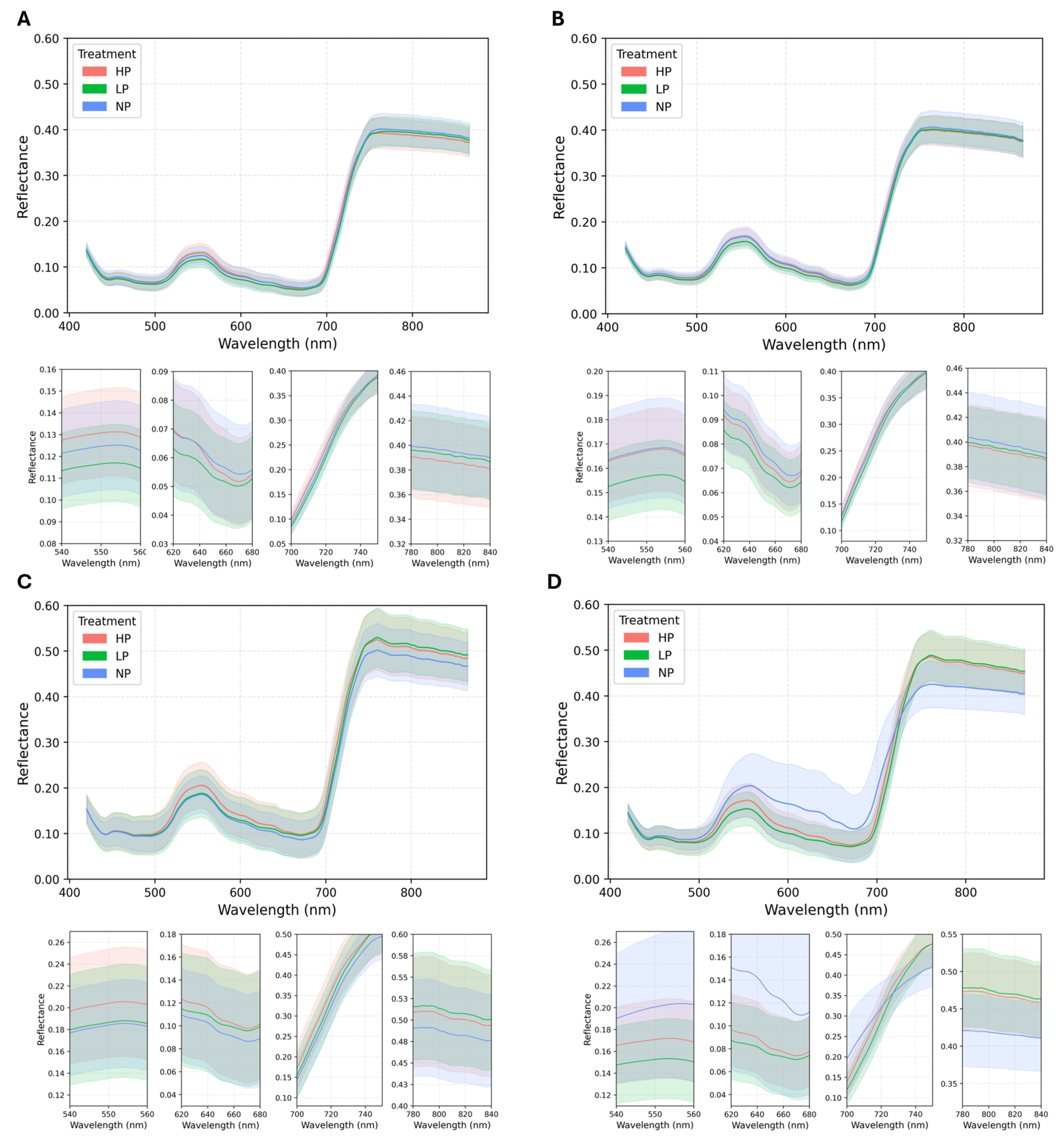
The hyperspectral signatures of new and old leaves were then characterized. Hyperspectral reflectance measurements at day 7 revealed relatively subtle spectral responses to P availability that were leaf-age-dependent (Figure 5A,B). In new leaves, differences among the three P treatments were modest when considering the standard deviation envelopes; however, treatment-specific patterns became discernible in the expanded spectral views. The new leaf of maize seedlings grown in the NP condition produced slightly higher reflectance values in the red (620–680 nm) and NIR (780–840 nm) regions and a mildly flattened red-edge slope (700–740 nm), whereas leaves of the HP treatment maintained the deepest chlorophyll absorption and the steepest red-edge transition (Figure 5A). In contrast, the old leaf displayed more pronounced treatment separation, particularly in the visible range: leaves from NP- and LP-treated seedlings produced greater green reflectance (540–560 nm) and a clearer reduction in red absorption relative to leaves from the HP treatment. Despite these stronger visible-band differences, the NIR (780–840 nm) exhibited a similar magnitude and pattern of treatment separation in both new and old leaves, indicating that reducing or omitting Pi had a minimal effect on NIR structural scattering at this stage (Figure 5B). Overall, these results show that early P-deficiency signatures are detectable in both new and mature leaves, but visible-band and red-edge changes are more strongly expressed in older leaves, consistent with the earlier onset of physiological stress and nutrient remobilization.
At day 14 of P treatment, hyperspectral reflectance revealed substantially stronger treatment-dependent separation than was observed in the first week, reflecting the progression of P deficiency. In Leaf 1, differences among the treatments, which were subtle in the first week, became clearly pronounced across the visible, red-edge, and NIR ranges. Leaves from the NP treatment exhibited shallower red absorption (620–680 nm), a visibly flattened red-edge slope (700–740 nm), and elevated NIR reflectance (780–840 nm), whereas HP leaves retained deeper pigment absorption features (Figure 5C). At this stage, the old leaves showed even greater treatment separation, consistent with the earlier response of older tissues to P deficiency. Moreover, standard deviation envelopes were wider, signaling heterogeneous stress progression and early senescence.
ANOVA F-score distributions identified the wavelengths that best differentiated the HP, LP and NP treatments. At day 7 of P treatment, clear differences were observed between the new and old leaves (Figure S5A,B). In the new leaves, the dominant discrimination peak occurred at the red-edge region near 700 nm, indicating that this wavelength was most sensitive to the subtle early physiological differences among treatments. A secondary peak was present across the green–yellow range (500–600 nm), reflecting mild variation in pigment absorption, whereas the NIR region showed limited discriminatory power. The old leaves exhibited substantially higher F-scores in the visible region, particularly from 500 to 650 nm, consistent with the more pronounced pigment-related spectral changes in older tissues. The red edge remained the strongest single discriminator, while NIR wavelengths again contributed minimally. These patterns confirm that older leaves provide stronger spectral separation during the early phase of P deficiency, with the red edge serving as the primary indicator. At day 14, the ANOVA F-score distributions showed a clear shift in the wavelengths that contributed most to treatment separation (Figure S5C,D).
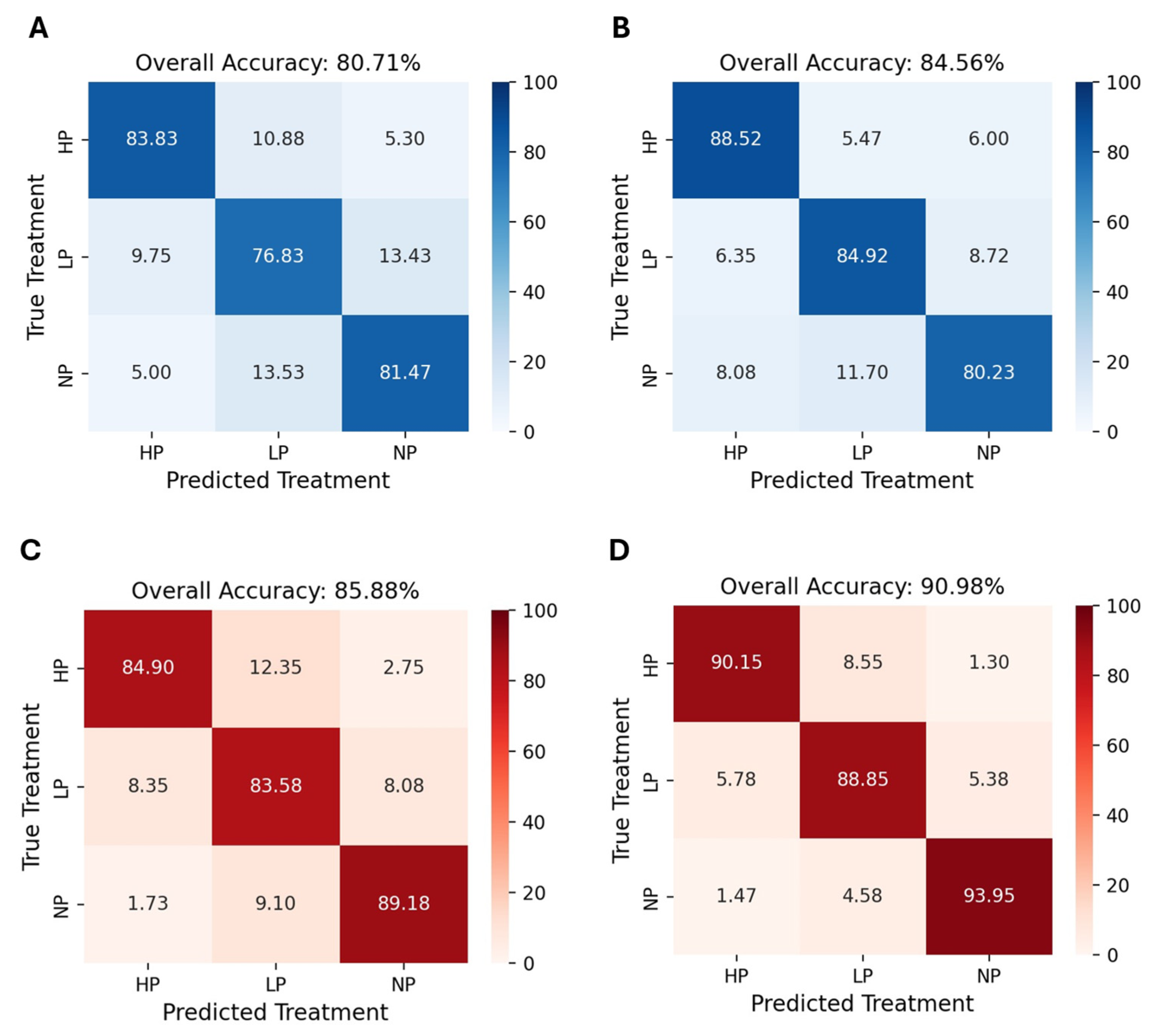
The classification results highlight the capability of HSI combined with machine learning to distinguish foliar P status at an early response to Pi availability (Figure 6). At day 7, the MLP model achieved an overall accuracy of 80.71% for new leaves and 84.56% for old leaves. These results indicate that subtle spectral differences, particularly in older leaves, can already be used to classify nutrient status before any visible symptoms appear. At day 14, classification performance was better, returning an accuracy of 85.88% for new leaves and 90.98% for old leaves. This trend aligns with the intensifying physiological effects of P deficiency and the increasing spectral separation observed in the ANOVA F-scores.

4. Discussion

4.1. Detection of Leaf Symptoms of Long-Term P-Deficient Maize by Hyperspectral Imaging

Our findings demonstrate that HSI is highly effective at detecting symptoms of P deficiency in maize seedlings subjected to long-term P starvation. After six weeks of growth under low P conditions, maize plants exhibited pronounced morphological and physiological alterations that were clearly reflected in their hyperspectral signatures. The 40% reduction in shoot biomass coupled with a 29% increase in root biomass observed under P-deficient conditions (Figure 2A) reflects an adaptive strategy whereby plants prioritize root development to enhance nutrient acquisition when soil P availability is limited. This growth pattern modification has been widely reported in P-deficient crops and represents a fundamental stress response mechanism [9,10,49].
The significant reductions in cytosolic Pi and total P content across all tissues confirmed the complete establishment of P-deficient conditions, with the new fully expanded leaf showing the most pronounced decrease in Pi concentration (Figure 2C). This tissue-specific response highlights the dynamic nature of P redistribution within the plant, with younger tissues potentially maintaining higher P concentrations through remobilization from older leaves [9,50,51]. The PCA of nutrient accumulation revealed that P starvation fundamentally altered the overall nutrient profile, with significant changes not only in P but also in N, K, Ca, Mg, Mo, Zn, and Cl accumulation (Figure 2D and Table S1). These multi-nutrient changes underscore the interconnected nature of plant mineral nutrition and suggest that P deficiency triggers cascading effects on the accumulation of other essential elements in maize, consistent with findings by Schlüter et al. (2013) [12].
The leaf age-dependent responses in photosynthetic pigment contents and photosynthetic efficiency parameters provide important insights into how P deficiency differentially affects leaves at various developmental stages (Figure 2E–H). The increase in chlorophyll a, chlorophyll b, and carotenoids in the new fully expanded leaf under the low P condition, contrasted with decreases in the old leaf, suggests that young leaves maintain or enhance their photosynthetic capacity as a compensatory mechanism, while older leaves experience pigment degradation and senescence [9,10]. The significant reduction in Phi2 and elevated PhiNPQ in older P-deficient leaves indicates impaired photosynthetic performance and increased dissipation of energy as heat, reflecting the detrimental effects of prolonged P deficiency on the photosynthetic apparatus [9,10,12].
The hyperspectral signatures captured these complex physiological changes with remarkable sensitivity. HSI detected lower reflectance in the green region (540–560 nm) in P-deficient leaves (Figure 3A). This spectral change is consistent with the reflectance spectra of banana leaves at the early stage of fungal infection by Pseudocercospora fijiensis, corresponding to disease incidence on the adaxial surface of the leaves [52]. These structural changes are supported by the observed reductions in shoot biomass and functional leaf numbers and nutrient relocation away from older tissues (Figure 2A–C). The consistently higher red-band reflectance (620–680 nm) observed in P-deficient leaves (Figure 3A) directly indicates the significant reductions in chlorophyll a and b quantified in the older leaves, as this shallower red absorption trough is a direct optical consequence of pigment loss [14,53].
The red-edge region (700–740 nm) showed lower reflectance in P-deficient leaves relative to P-sufficient leaves (Figure 3A), matching the combined effects of reduced chlorophyll and impaired photosynthetic efficiency indicated by lower Phi2 and higher PhiNPQ values (Figure 2H). The red-edge position and slope are well-established indicators of vegetation health and chlorophyll content, making this spectral region particularly valuable for nutrient stress detection [54]. The lower reflectance exhibited by P-deficient leaves in the NIR region (780–840 nm) was consistent with diminished internal scattering caused by reduced mesophyll integrity and lower biomass accumulation [14,55]. The NIR plateau is primarily determined by leaf internal structure, and its reduction under P deficiency reflects the cumulative effects of tissue degradation and biomass reduction [56].
The accuracy of 99.65% returned by the MLP model for the classification of high and low P treatments demonstrates the power of combining HSI with machine learning for nutrient status assessment (Figure 3B). This almost perfect performance reflects the sensitivity of hyperspectral features to the underlying changes in pigment composition, photosynthetic efficiency, and structural integrity that accompany long-term P deficiency [10,14,54]. The ability to achieve such accurate discrimination also underscores the potential of HSI as a non-destructive, rapid, and reliable tool for diagnosing P deficiency in maize production systems, offering clear advantages over traditional visual assessment or destructive tissue analysis.

4.2. Characterization of P-Deficient Leaves of Maize at the Early Stage of Deficiency

The early detection of P deficiency represents a critical challenge in precision agriculture, as visible symptoms such as altered leaf pigmentation and leaf senescence typically appear only after a prolonged period of P starvation [9,10]. After one week of P treatment, no significant differences were observed in growth parameters, including shoot dry weight, root dry weight, and leaf number, indicating that the early effects of P deficiency were not yet manifested in growth performance traits (Figure 4A–C). However, tissue Pi content analysis revealed significant treatment-dependent differences across all tissues examined, with both new and old leaves showing Pi levels that followed the external supply gradient (Figure 4D,E).
By the second week, pronounced differences emerged across all measured parameters. A significant reduction in shoot dry weight and an increase in root dry weight were observed in the Pi-free treatment (Figure 4A,B). This growth response demonstrates the adaptive responses to P limitation [10,57]. The accelerated senescence of lower established leaves observed under P deficiency (Figure 4C) represents a nutrient remobilization strategy whereby P is translocated from older to younger tissues to maintain the growth of actively developing organs [14,58]. This programmed leaf senescence is a characteristic response to P starvation as an internal P recycling mechanism conserved across plant species [58,59].
The significant differences in total P, N, and C contents in shoots across treatments provide important insights into how P availability influences whole-plant nutrient balance and carbon metabolism (Figure 4E). The significantly higher N content in P-supplied treatments suggests that P availability positively influences N uptake or assimilation and is consistent with the well-established synergistic relationship between these two macronutrients [6]. Conversely, the inverse relationship between shoot C content and P supply, with the highest C accumulation in P-deficient plants, may reflect reduced growth rates and altered carbon partitioning under P limitation. The elevated PUE in P-deficient plants indicates enhanced biomass production per unit P, a key adaptive response that allows plants to maintain growth under suboptimal P availability [14,60]. The markedly elevated N:P and C:P ratios under P deficiency reflect the fundamental imbalance in macronutrient stoichiometry and highlight the central role of P in coordinating plant metabolism [60].
In this study, we showed that short-term P deficiency did not change chlorophyll a, chlorophyll b, and carotenoid contents and photosynthetic parameters in both new and old leaves during the first two weeks of P treatment (Figure S3). Moreover, the failure of chlorophyll-based indices from spectral data to identify P status in leaves at the early stage of P deficiency highlights the limitations of simplified spectral approaches (Figure S4). This absence of detectable pigment degradation and insensitivity of vegetation indices, even when leaf soluble P and total P were significantly reduced, underscores a critical limitation of conventional visual assessment for early nutrient stress detection. The maintenance of normal pigment levels and photosynthetic function during early P deficiency suggests that plants initially buffer the effects of P limitation on the photosynthetic apparatus, possibly through P remobilization and metabolic adjustments [9,10]. However, this buffering capacity is eventually exhausted under prolonged P starvation, as evidenced by the pigment degradation and photosynthetic impairment observed in the long-term experiment [9,10].
Although PRI values declined progressively with decreasing P supply (Figure S4), vegetation indices showed only weak to moderate correlations with leaf Pi content that varied across leaf ages and time points, indicating that conventional multispectral indices lack sufficient sensitivity for early P deficiency detection. In contrast, hyperspectral reflectance measurements revealed subtle but detectable spectral responses to P availability as early as one week after treatment initiation (Figure 5A,B). During the first week, young leaves of P-deficient maize seedlings exhibited lower reflectance in the visible band (540–740 nm) but higher reflectance in the NIR region (760–840 nm). Older leaves displayed a similar pattern with reduced visible reflectance and showed lower NIR reflectance compared to young leaves, providing evidence that age-related spectral changes strongly indicate plant physiological responses to P limitation. This reflectance pattern is aligned with our previous findings in P-deficient rice leaves [10]. By the second week, spectral differentiation intensified substantially, with older leaves demonstrating pronounced changes across the visible, red-edge, and NIR regions [54]. These stronger spectral signatures in older leaves are consistent with the earlier onset of P-deficient stress and active nutrient remobilization processes in older tissues [10,61]. These distinct spectral responses enabled accurate machine learning classification of P status.
Our findings demonstrate the temporal progression of the effects of P deficiency on hyperspectral signatures and machine learning classification accuracy in maize seedling leaves. During the first week of P deficiency, when visible symptoms were absent, the MLP model achieved accuracies of 80.71% in new leaves and 84.56% in old leaves (Figure 6A,B). At this asymptomatic stage, P deficiency primarily induces biochemical changes, including reduced P content and nutrient rebalancing, along with membrane lipid remodeling characterized by increased non-phosphorus lipids and decreased phospholipids [12,62]. By the second week, as P deficiency intensified and entered the early symptomatic stage, classification accuracy improved substantially to 85.88% and 90.98% in young and old leaves, respectively (Figure 6C,D). This improvement reflects the progression to structural and pigment-related changes, including mesophyll degradation, chlorophyll loss, and tissue senescence, which produce strong spectral signatures across multiple wavelength regions [10]. These results underscore the potential of HSI combined with machine learning for early, non-destructive P status monitoring, while highlighting that detection sensitivity increases as physiological stress progresses from biochemical to structural manifestations.

5. Conclusions

Our study demonstrates that hyperspectral imaging combined with machine learning provides a powerful, non-destructive approach for detecting P deficiency in maize at both symptomatic and pre-symptomatic stages. P deficiency induces distinctive spectral signatures across visible, red-edge, and near-infrared regions, which reflect underlying changes in pigment composition, photosynthetic efficiency, and leaf structural integrity. In long-term P-deficient plants, the multilayer perceptron model achieved exceptional classification accuracy (99.65%), confirming the high sensitivity of hyperspectral features to P-induced stress. More importantly, we demonstrate that hyperspectral imaging can detect early-stage P deficiency in maize before the appearance of visible symptoms or significant changes in photosynthetic pigments. During the first two weeks of P starvation, when tissue Pi and total P contents were significantly reduced, but chlorophyll levels and photosynthetic parameters remained unchanged, hyperspectral measurements captured subtle spectral responses that enabled accurate classification, representing a significant advancement over conventional vegetation indices and visual assessment methods. Older leaves consistently showed stronger spectral signatures due to earlier onset of stress and active nutrient remobilization, and the red-edge region (700–740 nm) served as a particularly sensitive early indicator, while visible and near-infrared regions became increasingly discriminatory as P depletion progressed. Future research should focus on validating this approach under diverse field conditions, extending the methodology to other growth stages and maize genotypes, and developing practical decision support tools to facilitate adoption in commercial maize production.

Supplementary Materials

The following supporting information can be downloaded at https://www.mdpi.com/article/10.3390/agronomy16080772/s1, Figure S1: Experimental design and hydroponic setup for maize seedlings grown under different phosphorus (Pi) levels. The left panel (diagram) illustrates the experimental timeline: after three days of germination, maize seedlings were initially grown in 500 μmol/L Pi for one week (Week 0), followed by transfer to three Pi concentrations (500, 100, and 0 μmol/L in 0.5× Hoagland’s solution) for an additional two weeks. The right panel (photograph) shows the actual hydroponic setup in the greenhouse. Figure S2: Effect of phosphorus availability on phosphate use efficiency (PUE) and nutrient ratios in maize seedlings during early growth stages. Maize was grown hydroponically with three levels of phosphorus supply (500, 100, and 0 μmol/L Pi). (A) Phosphate use efficiency (PUE), (B) Nitrogen-to-phosphorus ratio, and (C) carbon-to-phosphorus ratio were also affected by phosphorus availability at Week 1 and Week 2. Data are means ± SD (n = 8). Different letters above the bars indicate statistically significant differences among treatments within each week (p < 0.05). Figure S3: Effect of phosphorus deficiency on pigment accumulation and photosynthetic parameters in maize seedlings grown under hydroponic conditions. (A–C) Photosynthetic pigments: chlorophyll a, chlorophyll b, and carotenoids in Leaf 1 and Leaf 4 at Week 1 and Week 2. (D) Photosynthetic parameters (Phi2, PhiNPQ, and PhiNO) measured in Leaf 1 and Leaf 4. Data are means ± SD (n = 8). Significant differences between treatments were evaluated using one-way ANOVA followed by an LSD test. Different letters above the bars indicate a significant difference at p < 0.05. Figure S4: Relationships between vegetation indices and leaf phosphate (Pi) content, and treatment effects on photochemical reflectance index (PRI) in maize. Heatmaps display Pearson correlation coefficients between leaf Pi content and vegetation indices in new and old leaves at 1 and 2 weeks after treatment (WAT) (A). Red indicates positive correlations, and blue indicates negative correlations; color intensity reflects correlation strength. Boxplots show PRI values (B) in new and old leaves in the first and second week under three P treatments: high P (HP, 500 μmol/L Pi), low P (LP, 100 μmol/L Pi), and no P (NP, 0 μmol/L Pi). Different letters indicate significant differences among treatments within each leaf age and time point (LSD test, p < 0.05). Figure S5: Wavelength-specific discriminatory power for phosphorus (P) status classification. ANOVA F-score profiles across the visible and near-infrared spectrum show the statistical significance of individual wavelengths in distinguishing among high P (500 μmol/L Pi), low P (100 μmol/L Pi), and no phosphorus (0 μmol/L) treatments from new and old leaves, respectively, in the first (A,B) and second (C,D) week after treatment initiation. Higher F-scores indicate greater discriminatory power at specific wavelengths. Table S1: Nutrient concentrations in maize dry biomass after six weeks of pot culture in high phosphorus (HP) and low phosphorus (LP) treatments. Nutrient analysis was performed using Inductively Coupled Plasma Optical Emission Spectrometry. Data are presented as means ± SD (n = 14). A Student’s t-test was used to compare differences between HP and LP treatments. Asterisks indicate statistically significant differences (* p < 0.05, ** p < 0.01, *** p < 0.001), and “ns” indicates non-significant differences.

Author Contributions

Conceptualization, L.K.; Methodology, S.K., C.D., S.W., J.Y.L. and L.K.; Software, S.K., C.D., S.W. and J.Y.L.; Validation, S.K., C.D., S.W. and J.Y.L.; Formal analysis, S.K., C.D., S.W. and J.Y.L.; Investigation, L.K.; Resources, L.K.; Data curation, S.K., C.D., S.W. and J.Y.L.; Writing—original draft, S.K., C.D. and L.K.; Writing—review and editing, S.K., C.D., A.C. and L.K.; Visualization, S.K., C.D., S.W. and J.Y.L.; Supervision, A.C. and L.K.; Project administration, L.K.; Funding acquisition, L.K. All authors have read and agreed to the published version of the manuscript.

Funding

This research was funded by Prince of Songkla University under the Postdoctoral Fellowship Program (to S.K.) and a Graduate Research Internship Grant 2025–2026 from the Faculty of Science, Prince of Songkla University, Thailand (to J.Y.L.).

Data Availability Statement

The original contributions presented in this study are included in the article/Supplementary Materials. Further inquiries can be directed to the corresponding author.

Acknowledgments

We thank Narakorn Kaewkhao from the Faculty of Science, Prince of Songkla University, for providing the weather data.

Conflicts of Interest

The authors declare no conflicts of interest.

References

  1. Plénet, D.; Mollier, A.; Pellerin, S. Growth Analysis of Maize Field Crops under Phosphorus Deficiency. II. Radiation-Use Efficiency, Biomass Accumulation and Yield Components. Plant Soil 2000, 224, 259–272. [Google Scholar] [CrossRef]
  2. Yan, X.; Chen, X.; Ma, C.; Cai, Y.; Cui, Z.; Chen, X.; Wu, L.; Zhang, F. What are the key factors affecting maize yield response to and agronomic efficiency of phosphorus fertilizer in China? Field Crops Res. 2021, 270, 108221. [Google Scholar] [CrossRef]
  3. Qiao, B.; He, X.; Liu, Y.; Zhang, H.; Zhang, L.; Liu, L.; Reineke, A.-J.; Liu, W.; Müller, J. Maize characteristics estimation and classification by spectral data under two soil phosphorus levels. Remote Sens. 2022, 14, 493. [Google Scholar] [CrossRef]
  4. Liang, L.; Liu, B.; Huang, D.; Kuang, Q.; An, T.; Liu, S.; Liu, R.; Xu, B.; Zhang, S.; Deng, X.; et al. Arbuscular mycorrhizal fungi alleviate low phosphorus stress in maize genotypes with contrasting root systems. Plants 2022, 11, 3105. [Google Scholar] [CrossRef]
  5. Wen, Z.; Li, H.; Shen, Q.; Tang, X.; Xiong, C.; Li, H.; Pang, J.; Ryan, M.H.; Lambers, H.; Shen, J. Tradeoffs among root morphology, exudation and mycorrhizal symbioses for phosphorus-acquisition strategies of 16 crop species. New Phytol. 2019, 223, 882–895. [Google Scholar] [CrossRef]
  6. Tang, W.; Xiao, Z.-D.; Liang, X.-W.; Shen, S.; Liang, X.-G.; Zhou, S.-L. Anthocyanin Synthesis Capability of Maize Cultivars Is Associated with Their Photosynthetic Carbon Partitioning for Growth Adaptability Under Low Phosphorus. Plants 2025, 14, 2690. [Google Scholar] [CrossRef]
  7. Carstensen, A.; Herdean, A.; Schmidt, S.B.; Sharma, A.; Spetea, C.; Pribil, M.; Husted, S. The impacts of phosphorus deficiency on the photosynthetic electron transport chain. Plant Physiol. 2018, 177, 271–284. [Google Scholar] [CrossRef]
  8. Nopphakat, K.; Runsaeng, P.; Klinnawee, L. Acaulospora as the dominant arbuscular mycorrhizal fungi in organic lowland rice paddies improves phosphorus availability in soils. Sustainability 2022, 14, 31. [Google Scholar] [CrossRef]
  9. Saengwilai, P.J.; Bootti, P.; Klinnawee, L. Responses of rubber tree seedlings (Hevea brasiliensis) to phosphorus deficient soils. Soil Sci. Plant Nutr. 2023, 69, 78–87. [Google Scholar] [CrossRef]
  10. Jaisue, P.; Daengngam, C.; Pengphorm, P.; Nutthapornnitchakul, S.; Pinit, S.; Klinnawee, L. Enhanced chlorophyll accumulation Is an early response of rice to phosphorus deficiency. Rice Sci. 2025, 32, 831–844. [Google Scholar] [CrossRef]
  11. Pinit, S.; Chadchawan, S.; Chaiwanon, J. A simple high-throughput protocol for the extraction and quantification of inorganic phosphate in rice leaves. Appl. Plant Sci. 2020, 8, e11395. [Google Scholar] [CrossRef]
  12. Schlüter, U.; Colmsee, C.; Scholz, U.; Bräutigam, A.; Weber, A.P.; Zellerhoff, N.; Bucher, M.; Fahnenstich, H.; Sonnewald, U. Adaptation of maize source leaf metabolism to stress related disturbances in carbon, nitrogen and phosphorus balance. BMC Genom. 2013, 14, 442. [Google Scholar] [CrossRef]
  13. Briat, J.-F.; Rouached, H.; Tissot, N.; Gaymard, F.; Dubos, C. Integration of P, S, Fe, and Zn nutrition signals in Arabidopsis thaliana: Potential involvement of PHOSPHATE STARVATION RESPONSE 1 (PHR1). Front. Plant Sci. 2015, 6, 290. [Google Scholar] [CrossRef]
  14. Pinit, S.; Ruengchaijatuporn, N.; Sriswasdi, S.; Buaboocha, T.; Chadchawan, S.; Chaiwanon, J. Hyperspectral and genome-wide association analyses of leaf phosphorus status in local Thai indica rice. PLoS ONE 2022, 17, e0267304. [Google Scholar] [CrossRef]
  15. Siedliska, A.; Baranowski, P.; Pastuszka-Woźniak, J.; Zubik, M.; Krzyszczak, J. Identification of plant leaf phosphorus content at different growth stages based on hyperspectral reflectance. BMC Plant Biol. 2021, 21, 28. [Google Scholar] [CrossRef]
  16. Lichtenthaler, H.K. Chlorophylls and carotenoids: Pigments of photosynthetic biomembranes. In Methods in Enzymology: Plant Cell Membranes; Academic Press: Orlando, FL, USA, 1987; Volume 148, pp. 350–382. [Google Scholar]
  17. Kuhlgert, S.; Austic, G.; Zegarac, R.; Osei-Bonsu, I.; Hoh, D.; Chilvers, M.I.; Roth, M.G.; Bi, K.; TerAvest, D.; Weebadde, P.; et al. MultispeQ Beta: A tool for large-scale plant phenotyping connected to the open PhotosynQ network. R. Soc. Open Sci. 2016, 3, 160592. [Google Scholar] [CrossRef]
  18. Hurry, V.; Strand, Å.; Furbank, R.; Stitt, M. The role of inorganic phosphate in the development of freezing tolerance and the acclimatization of photosynthesis to low temperature is revealed by the pho mutants of Arabidopsis thaliana. Plant J. 2000, 24, 383–396. [Google Scholar] [CrossRef]
  19. AOAC International. AOAC Official Method 993.13. In Official Methods of Analysis of AOAC International; AOAC International: Washington, DC, USA, 2019; pp. 12–13. [Google Scholar]
  20. AOAC International. AOAC Official Method 953.01. In Official Methods of Analysis of AOAC International; AOAC International: Washington, DC, USA, 2019; p. 2. [Google Scholar]
  21. AOAC International. AOAC Official Method 985.01. In Official Methods of Analysis of AOAC International; AOAC International: Washington, DC, USA, 2019; pp. 6–7. [Google Scholar]
  22. AOAC International. AOAC Official Method 915.01. In Official Methods of Analysis of AOAC International; AOAC International: Washington, DC, USA, 2019; p. 17. [Google Scholar]
  23. R Core Team. R: A Language and Environment for Statistical Computing 2025; Foundation for Statistical Computing: Vienna, Austria, 2025. [Google Scholar]
  24. Mendiburu, F. de Agricolae: Statistical Procedures for Agricultural Research 2023; International Potato Center: Lima, Peru, 2023. [Google Scholar]
  25. Wickham, H. ggplot2: Elegant Graphics for Data Analysis; Springer: New York, NY, USA, 2016. [Google Scholar]
  26. Thongrom, S.; Pengphorm, P.; Wongarrayapanich, S.; Prasit, A.; Kanjanasakul, C.; Rujopakarn, W.; Poshyachinda, S.; Daengngam, C.; Unsuree, N. A comprehensive framework for the development of a compact, cost-effective, and robust hyperspectral camera using COTS components and a VPH grism. Sensors 2025, 25, 3631. [Google Scholar] [CrossRef]
  27. Clark, R.N.; King, T.V.V.; Klejwa, M.; Swayze, G.A.; Vergo, N. High spectral resolution reflectance spectroscopy of minerals. J. Geophys. Res. Solid Earth 1990, 95, 12653–12680. [Google Scholar] [CrossRef]
  28. Guo, Q.; Cen, Y.; Zhang, L.; Zhang, Y.; Huang, Y. Hyperspectral anomaly detection based on spatial–spectral cross-guided mask autoencoder. IEEE J. Sel. Top. Appl. Earth Obs. Remote Sens. 2024, 17, 9876–9889. [Google Scholar] [CrossRef]
  29. Savitzky, A.; Golay, M.J.E. Smoothing and differentiation of data by simplified least squares procedures. Anal. Chem. 1964, 36, 1627–1639. [Google Scholar] [CrossRef]
  30. Rouse, J. Monitoring Vegetation Systems in the Great Plains with ERTS. In Proceedings of the Third NASA Earth Resources Technology Satellite Symposium, Washington, DC, USA, 10–14 December 1973; Volume 1, pp. 309–317. [Google Scholar]
  31. Jordan, C.F. Derivation of leaf-area index from quality of light on the forest floor. Ecology 1969, 50, 663–666. [Google Scholar] [CrossRef]
  32. Haboudane, D.; Miller, J.R.; Pattey, E.; Zarco-Tejada, P.J.; Strachan, I.B. Hyperspectral vegetation indices and novel algorithms for predicting green LAI of crop canopies: Modeling and validation in the context of precision agriculture. Remote Sens. Environ. 2004, 90, 337–352. [Google Scholar] [CrossRef]
  33. Rondeaux, G.; Steven, M.; Baret, F. Optimization of soil-adjusted vegetation indices. Remote Sens. Environ. 1996, 55, 95–107. [Google Scholar] [CrossRef]
  34. Daughtry, C.S.T.; Walthall, C.L.; Kim, M.S.; de Colstoun, E.B.; McMurtrey, J.E. Estimating corn leaf chlorophyll concentration from leaf and canopy reflectance. Remote Sens. Environ. 2000, 74, 229–239. [Google Scholar] [CrossRef]
  35. Haboudane, D.; Miller, J.R.; Tremblay, N.; Zarco-Tejada, P.J.; Dextraze, L. Integrated narrow-band vegetation indices for prediction of crop chlorophyll content for application to precision agriculture. Remote Sens. Environ. 2002, 81, 416–426. [Google Scholar] [CrossRef]
  36. Broge, N.H.; Leblanc, E. Comparing prediction power and stability of broadband and hyperspectral vegetation indices for estimation of green leaf area index and canopy chlorophyll density. Remote Sens. Environ. 2001, 76, 156–172. [Google Scholar] [CrossRef]
  37. Zarco-Tejada, P.J.; Miller, J.R.; Mohammed, G.H.; Noland, T.L. Chlorophyll fluorescence effects on vegetation apparent reflectance: I. Leaf-level measurements and model simulation. Remote Sens. Environ. 2000, 74, 582–595. [Google Scholar] [CrossRef]
  38. Peñuelas, J.; Filella, I.; Gamon, J.A. Assessment of photosynthetic radiation-use efficiency with spectral reflectance. New Phytol. 1995, 131, 291–296. [Google Scholar] [CrossRef]
  39. Barnes, J.D.; Balaguer, L.; Manrique, E.; Elvira, S.; Davison, A.W. A reappraisal of the use of DMSO for the extraction and determination of chlorophylls a and b in lichens and higher plants. Environ. Exp. Bot. 1992, 32, 85–100. [Google Scholar] [CrossRef]
  40. Gamon, J.A.; Peñuelas, J.; Field, C.B. A narrow-waveband spectral index that tracks diurnal changes in photosynthetic efficiency. Remote Sens. Environ. 1992, 41, 35–44. [Google Scholar] [CrossRef]
  41. Carter, G.A. Ratios of leaf reflectances in narrow wavebands as indicators of plant stress. Remote Sens. 1994, 15, 697–703. [Google Scholar] [CrossRef]
  42. Carter, G.A.; Knapp, A.K.; Carter, G.A.; Knapp, A.K. Leaf optical properties in higher plants: Linking spectral characteristics to stress and chlorophyll concentration. Am. J. Bot. 2001, 88, 677–684. [Google Scholar] [CrossRef] [PubMed]
  43. Blackburn, G.A. Quantifying chlorophylls and caroteniods at leaf and canopy scales: An evaluation of some hyperspectral approaches. Remote Sens. Environ. 1998, 66, 273–285. [Google Scholar] [CrossRef]
  44. Gitelson, A.A.; Merzlyak, M.N. Remote estimation of chlorophyll content in higher plant leaves. Int. J. Remote Sens. 1997, 18, 2691–2697. [Google Scholar] [CrossRef]
  45. Gitelson, A.A.; Merzlyak, M.N.; Chivkunova, O.B. Optical properties and nondestructive estimation of anthocyanin content in plant leaves. Photochem. Photobiol. 2001, 74, 38–45. [Google Scholar] [CrossRef]
  46. Gitelson, A.A.; Zur, Y.; Chivkunova, O.B.; Merzlyak, M.N. Assessing carotenoid content in plant leaves with reflectance spectroscopy. Photochem. Photobiol. 2002, 75, 272–281. [Google Scholar] [CrossRef]
  47. Roujean, J.-L.; Breon, F.-M. Estimating PAR absorbed by vegetation from bidirectional reflectance measurements. Remote Sens. Environ. 1995, 51, 375–384. [Google Scholar] [CrossRef]
  48. Fisher, R.A. Statistical Methods for Research Workers. In Breakthroughs in Statistics; Kotz, S., Johnson, N.L., Eds.; Springer Series in Statistics; Springer: New York, NY, USA, 1992; pp. 66–70. [Google Scholar]
  49. Bechtaoui, N.; Rabiu, M.K.; Raklami, A.; Oufdou, K.; Hafidi, M.; Jemo, M. Phosphate-dependent regulation of growth and stresses management in plants. Front. Plant Sci. 2021, 12, 679916. [Google Scholar] [CrossRef]
  50. Abbas, M.; Shah, J.A.; Irfan, M.; Memon, M.Y. Remobilization and utilization of phosphorus in wheat cultivars under induced phosphorus deficiency. J. Plant Nutr. 2018, 41, 1522–1533. [Google Scholar] [CrossRef]
  51. Mimura, T.; Sakano, K.; Shimmen, T. Studies on the distribution, re-translocation and homeostasis of inorganic phosphate in barley leaves. Plant Cell Environ. 1996, 19, 311–320. [Google Scholar] [CrossRef]
  52. Morel, J.; Jay, S.; Féret, J.-B.; Bakache, A.; Bendoula, R.; Carreel, F.; Gorretta, N. Exploring the potential of PROCOSINE and close-range hyperspectral imaging to study the effects of fungal diseases on leaf physiology. Sci. Rep. 2018, 8, 15933. [Google Scholar] [CrossRef] [PubMed]
  53. Blackburn, G.A. Hyperspectral remote sensing of plant pigments. J. Exp. Bot. 2007, 58, 855–867. [Google Scholar] [CrossRef] [PubMed]
  54. Zhang, J.; Wei, X.; Song, Z.; Ampong, K.; Beltrame, A.; Zhao, T.; Penn, C.J.; Jin, J. Hyperspectral image-based leaf-level spatial and spectral feature mining for phosphorus deficiency symptom differentiation in corn plants at early vegetative stage. Comput. Electr. Agric. 2026, 241, 111245. [Google Scholar] [CrossRef]
  55. Zhang, Y.; Wang, T.; Li, Z.; Wang, T.; Cao, N. Based on machine learning algorithms for estimating leaf phosphorus concentration of rice using optimized spectral indices and continuous wavelet transform. Front. Plant Sci. 2023, 14, 1185915. [Google Scholar] [CrossRef]
  56. Wang, J.; Chu, Y.; Chen, G.; Zhao, M.; Wu, J.; Qu, R.; Wang, Z. Characterization and identification of NPK stress in rice using terrestrial hyperspectral images. Plant Phenomics 2024, 6, 0197. [Google Scholar] [CrossRef]
  57. Tang, H.; Chen, X.; Gao, Y.; Hong, L.; Chen, Y. Alteration in root morphological and physiological traits of two maize cultivars in response to phosphorus deficiency. Rhizosphere 2020, 14, 100201. [Google Scholar] [CrossRef]
  58. Yang, B.; Tan, Z.; Yan, J.; Zhang, K.; Ouyang, Z.; Fan, R.; Lu, Y.; Zhang, Y.; Yao, X.; Zhao, H.; et al. Phospholipase-mediated phosphate recycling during plant leaf senescence. Genome Biol. 2024, 25, 199. [Google Scholar] [CrossRef]
  59. Stigter, K.A.; Plaxton, W.C. Molecular mechanisms of phosphorus metabolism and transport during leaf senescence. Plants 2015, 4, 773–798. [Google Scholar] [CrossRef]
  60. Hidaka, A.; Kitayama, K. Relationship between photosynthetic phosphorus-use efficiency and foliar phosphorus fractions in tropical tree species. Ecol. Evol. 2013, 3, 4872–4880. [Google Scholar] [CrossRef]
  61. Tougaard, S.L.; Szameitat, A.; Møs, P.; Husted, S. Leaf age and light stress affect the ability to diagnose P status in field grown potatoes. Front. Plant Sci. 2023, 14, 1100318. [Google Scholar] [CrossRef]
  62. Wang, F.; Ding, D.; Li, J.; He, L.; Xu, X.; Zhao, Y.; Yan, B.; Li, Z.; Xu, J. Characterisation of genes involved in galactolipids and sulfolipids metabolism in maize and Arabidopsis and their differential responses to phosphate deficiency. Funct. Plant Biol. 2020, 47, 279–292. [Google Scholar] [CrossRef]
Figure 1. Workflow of hyperspectral imaging (HSI) analysis for phosphorus status classification in maize leaves. Hyperspectral data was acquired from maize leaves using a grism-based HSI scanning system with pushbroom configuration (A). The data preprocessing pipeline started with radiometric calibration to convert raw intensity to reflectance and proceeded through spectral preprocessing by outlier detection using the z-score threshold, Savitzky–Golay filtering for noise reduction, and data standardization. Sample balancing (n = 10,000 spectra per class) was performed across three treatment classes: HP (500 μmol/L Pi), LP (100 μmol/L Pi), and NP (no phosphorus, 0 μmol/L Pi) (B). ANOVA-based feature analysis, showing F-score distributions across wavelengths to identify discriminatory spectral regions, was followed by feature weighting to enhance informative wavelengths (C). The multilayer perceptron (MLP) neural network architecture for classification consisted of an input layer matching the number of spectral bands, two hidden layers (128 and 64 neurons with ReLU activation), and a softmax output layer for predicting the three phosphorus treatment classes (D).
Agronomy 16 00772 g001
Figure 2. Effects of phosphorus deficiency on biomass, growth parameters, pigment accumulation, and photosynthesis in maize seedlings under pot culture conditions. Maize seedlings were grown for six weeks under high phosphorus (HP) and low phosphorus (LP) conditions. (A) Shoot and root dry weight. (B) Leaf number, including both functional and non-functional leaves. (C) Inorganic phosphate (Pi) concentration in Leaf 1 (new leaf), Leaf 4 (old leaf), and roots. (D) Principal component analysis (PCA) of nutrient accumulation. (EG) Photosynthetic pigments: chlorophyll a, chlorophyll b, and carotenoids. (H) Photosynthetic parameters: Phi2, PhiNPQ, and PhiNO. Data are presented as means ± SD (n = 14). Student’s t-test was used to compare HP and LP treatments (ns = not significant; * p < 0.05; ** p < 0.01; *** p < 0.001).
Agronomy 16 00772 g002
Figure 3. Hyperspectral reflectance signatures and classification performance for phosphorus status discrimination. Hyperspectral reflectance spectra from shoots of maize seedlings under high and low phosphorus (HP and LP) treatments (A). Solid lines represent mean reflectance, and shaded areas indicate the standard deviation (n = 14). The expanded panels below the complete spectra show detailed reflectance patterns in specific wavelength regions. The confusion matrix from multilayer perceptron (MLP) classification shows the accuracy of discrimination between the two P treatments (B). Values represent the percentage of samples from each true treatment (rows) correctly classified into predicted categories (columns).
Agronomy 16 00772 g003
Figure 4. Morphological and physiological responses of maize seedlings to short-term phosphorus deficiency. Maize seedlings were hydroponically grown in 500 µM Pi for 1 week and later in 500, 100 and 0 µM Pi before the determination of growth phenotypes. The measured growth parameters included shoot dry weight (A), root dry weight (B), and leaf number (C). For the leaf number, leaves were visually categorized as functional (dark bars) or non-functional (light bars) based on their greenness. Pi contents (D) were measured in the first and fourth fully expanded leaves and in roots. Total P, N, and C in the shoots of maize seedlings (E) were quantified. Data are presented as means ± SD (n = 8). Different letters indicate statistically significant differences among treatments at p < 0.05, based on a one-way ANOVA followed by the LSD test.
Agronomy 16 00772 g004
Figure 5. Hyperspectral reflectance signatures of new and old maize leaves under different phosphorus treatments. Mean hyperspectral reflectance spectra (400–850 nm) from new (A,C) and old (B,D) leaves of maize seedlings grown under high phosphorus (HP), low phosphorus (LP), and no phosphorus (NP) conditions for 1 week (A,B) and 2 weeks (C,D). The expanded views below the full spectra show the spectra at four key wavelength regions: 540–560 nm, 620–680 nm, 700–740 nm, and 780–840 nm. Shaded regions represent standard deviations (n = 8).
Agronomy 16 00772 g005
Figure 6. Confusion matrices of MLP classification for phosphorus status discrimination in maize seedling leaves. Classification performance for high phosphorus (HP, 500 μmol/L Pi), low phosphorus (LP, 100 μmol/L Pi), and no phosphorus (NP, 0 μmol/L Pi) treatments was based on hyperspectral signatures of new (A) and old leaves (B) of maize seedlings after one week of treatment and new (C) and old leaves (D) after two weeks of treatment. Values in each cell represent the percentage of samples from the true treatment (rows) predicted as each treatment class (columns). Diagonal values indicate correct classification rates.
Agronomy 16 00772 g006
Table 1. List of calculated vegetation indices.
IndexFormulaReference
Normalized Difference Vegetation IndexNDVI = (RNIR − RRED)/(RNIR + RRED)[30]
Simple Ratio IndexSR = RNIR/RRED[30,31]
Modified Chlorophyll Absorption in Reflectance IndexMCARI1 = 1.2 × [2.5 × (R790 − R670) − 1.3 × (R790 − R550)][32]
Optimized Soil-Adjusted Vegetation IndexOSAVI = (1 + 0.16) × (R790 − R670)/
(R790 − R670 + 0.16)
[33]
Greenness IndexG = R554/R677-
Modified Chlorophyll Absorption in Reflectance IndexMCARI = [(R700 − R670) − 0.2 × (R700 − R550)] × (R700/R670)[34]
Transformed CAR IndexTCARI = 3 × [(R700 − R670) − 0.2 × (R700 − R550) × (R700/R670)][35]
Triangular Vegetation IndexTVI = 0.5 × [120 × (R750 − R550) −
200 × (R670 − R550)]
[36]
Zarco-Tejada and Miller IndexZMI = R750/R710[37]
Simple Ratio Pigment IndexSRPI = R430/R680[38]
Normalized Phaeophytinization IndexNPQI = (R415 − R435)/(R415 + R435)[39]
Photochemical Reflectance IndexPRI = (R531 − R570)/(R531 + R570)[40]
Normalized Pigment Chlorophyll IndexNPCI = (R680 − R430)/(R680 + R430)[38]
Carter Index 1Ctr1 = R695/R420[41,42]
Carter Index 2Ctr2 = R695/R760[41,42]
Pigment-specific normalized difference aPSNDa = (R790 − R680)/(R790 + R680)[43]
Structure Insensitive Pigment IndexSIPI = (R790 − R450)/(R790 − R650)[38]
Gitelson and Merzlyak Index 1GM1 = R750/R550; GM2 = R750/R700[44]
Gitelson and Merzlyak Index 2GM2 = R750/R700[44]
Anthocyanin Reflectance Index 1ARI1 = 1/R550 − 1/R700[45]
Anthocyanin Reflectance Index 2ARI2 = R790 × (1/R550 − 1/R700)[45]
Carotenoid Reflectance Index 1CRI1 = 1/R510 − 1/R550[46]
Carotenoid Reflectance Index 2CRI2 = 1/R510 − 1/R700[46]
Renormalized Difference Vegetation IndexRDVI = (R780 − R670)/((R780 + R670)0.5)[47]
Disclaimer/Publisher’s Note: The statements, opinions and data contained in all publications are solely those of the individual author(s) and contributor(s) and not of MDPI and/or the editor(s). MDPI and/or the editor(s) disclaim responsibility for any injury to people or property resulting from any ideas, methods, instructions or products referred to in the content.