A Physics-Based Method for Delineating Homogeneous Channel Units in Debris Flow Channels

Abstract
1. Introduction
2. Methods
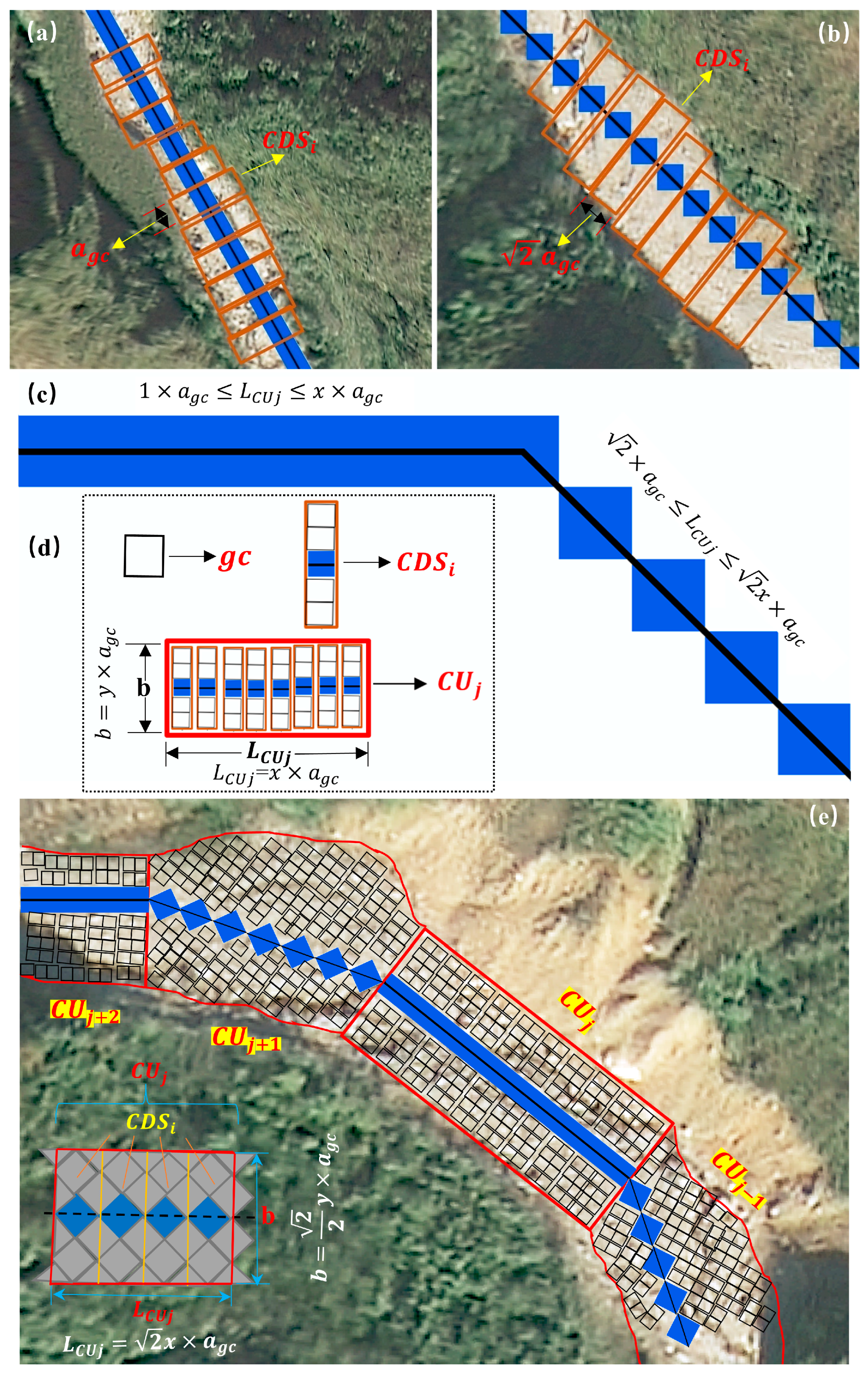
2.1. Definition and Mathematical Description of Channel Units ()
2.2. Physical Identification Model for Delineating
2.2.1. Physical Criterion and Its Computation
2.2.2. Determination of the Critical Threshold for the Physical Criterion
2.2.3. Identification Model for Delineating
2.2.4. Software and Implementation
2.3. Accuracy Evaluation of the Delineation—Identification Model
2.3.1. Practical Application Test
- (i)
- Testing the homogeneity of key geomorphic–geometric parameters (, ) among within a , and the contrasts in and between adjacent and ;
- (ii)
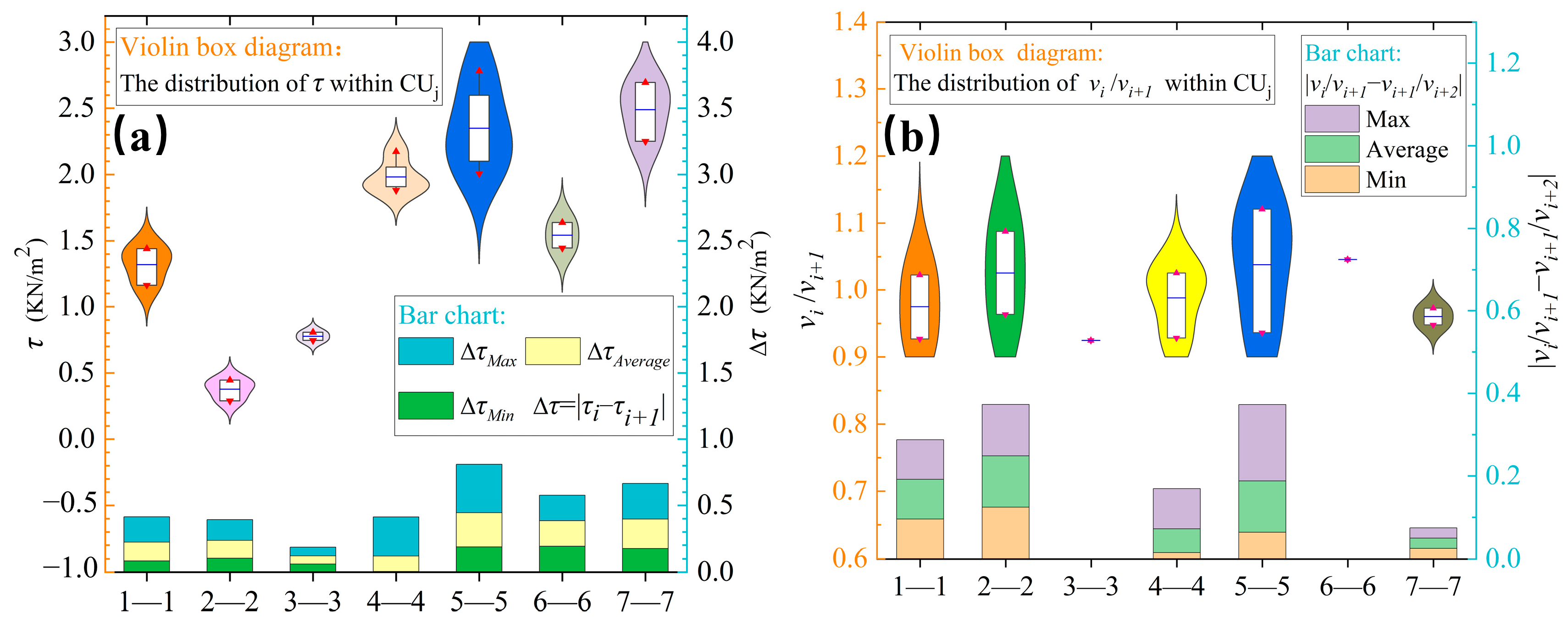
- Testing the homogeneity of key mechanical factors () and the similarity of kinematic trends () among within a , as well as the dissimilarity in and the contrasts in between adjacent and ;
- (iii)
- Preliminarily assessing the ability to identify geomorphic functional units (e.g., large bends, confluences, abrupt width changes, and abrupt changes in longitudinal gradient).Accordingly, we conduct validation at both catchment and tributary channel scales.
2.3.2. Accuracy Assessment at Field-Measured Homogeneous Reaches
3. Study Area and Data Sets
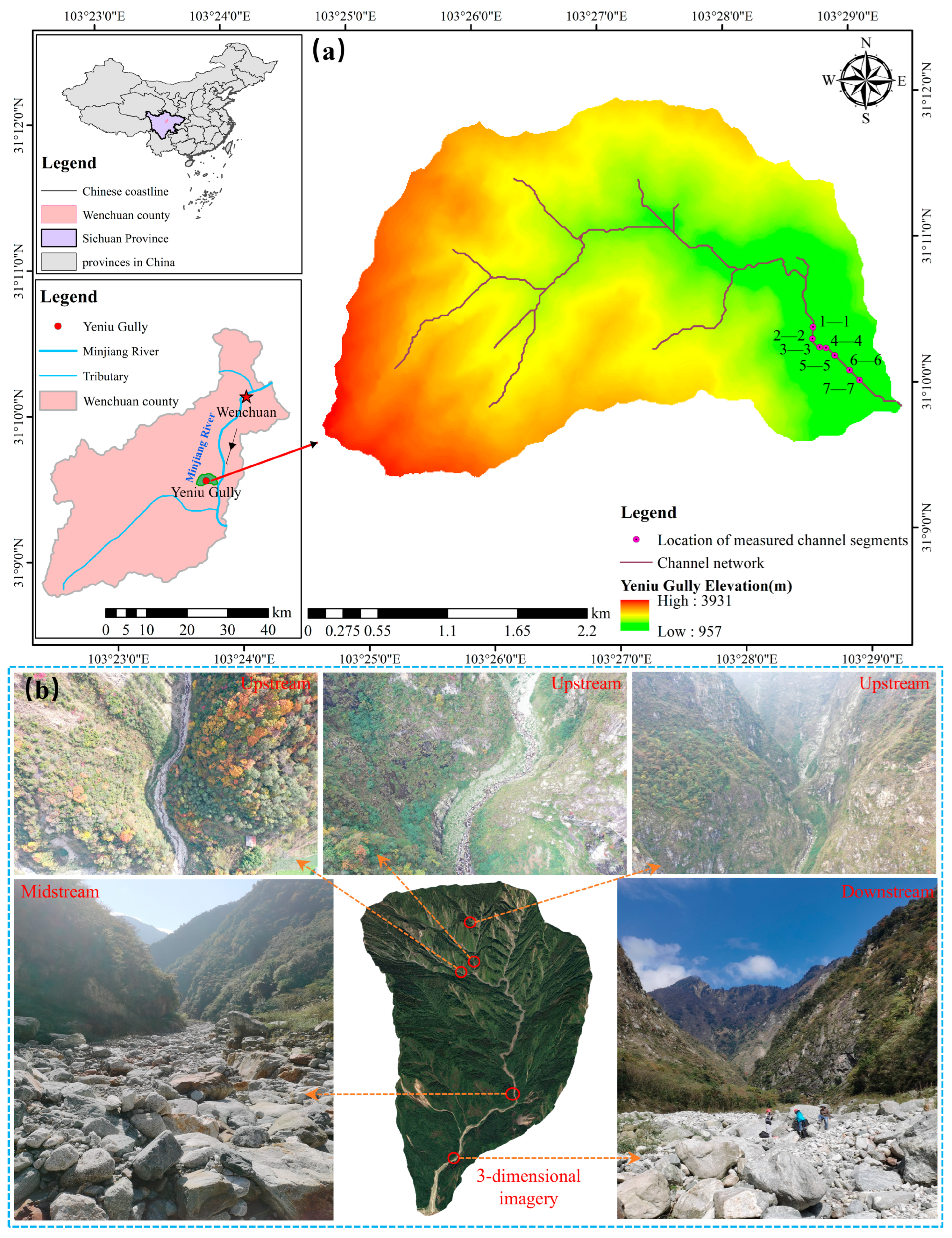
3.1. Study Area
3.2. Data Sets
3.2.1. Data Set for Method Implementation and Testing
3.2.2. Field-Surveyed Reach Evaluation Data Set
4. Results
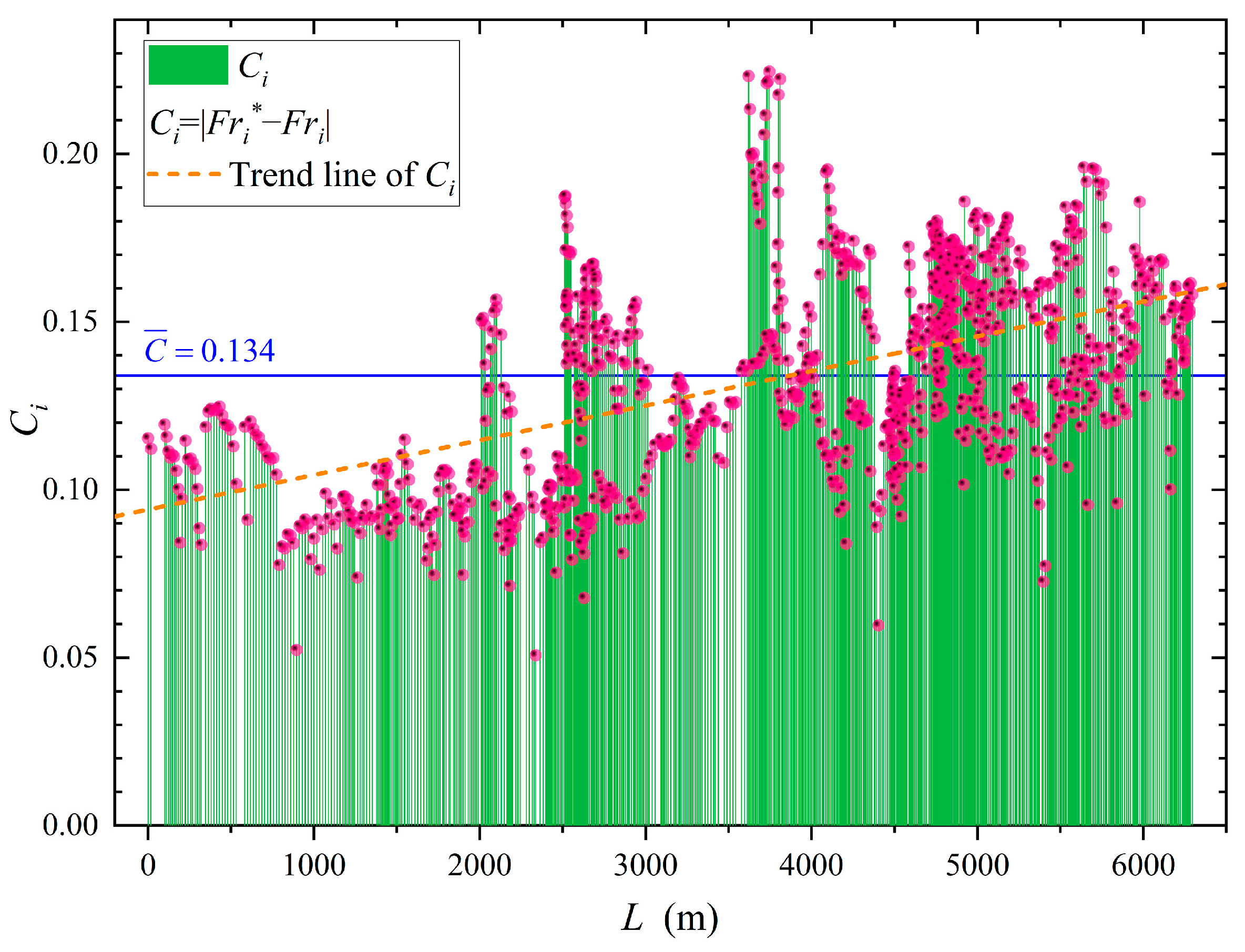
4.1. Threshold of the Physical Criterion ()
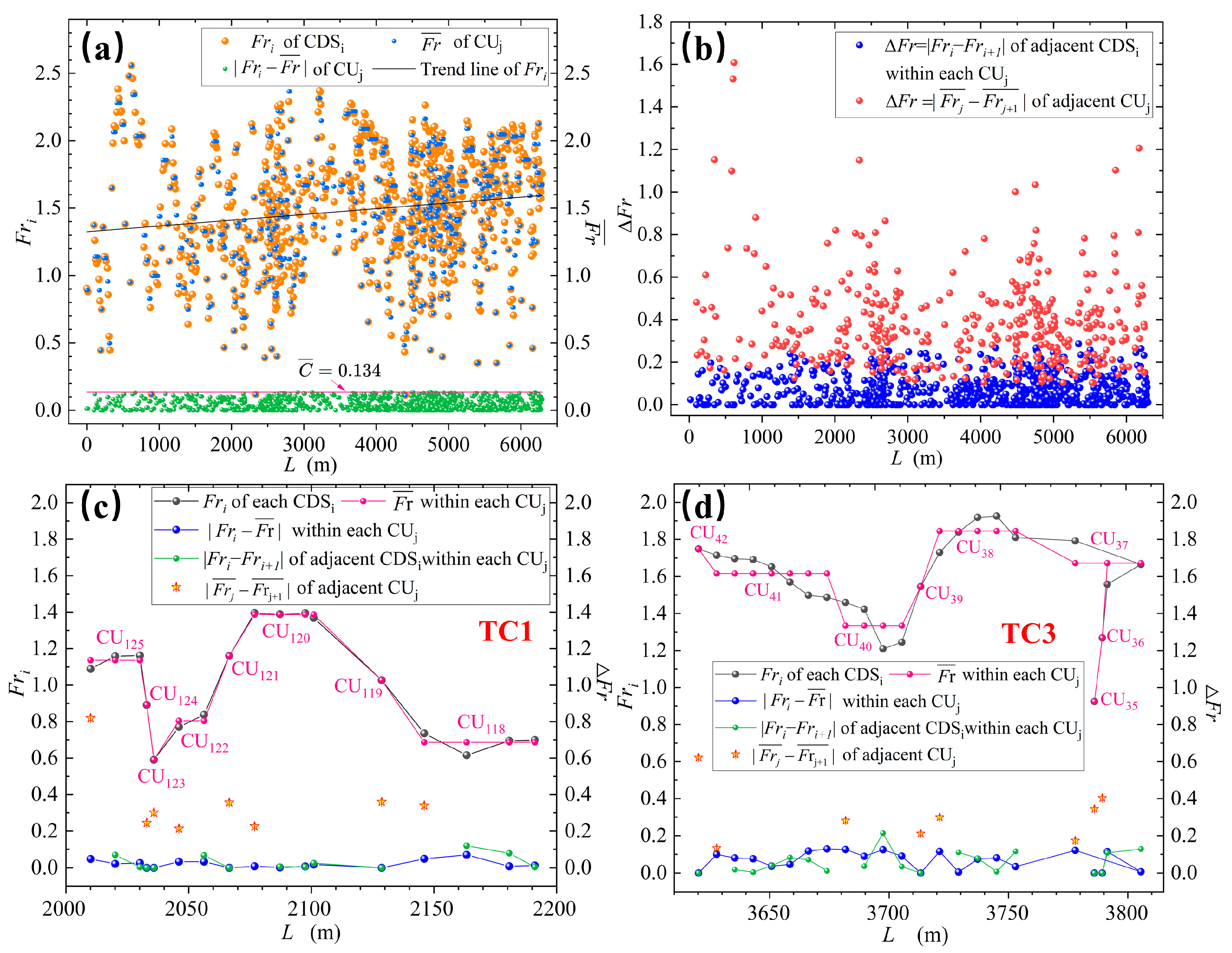
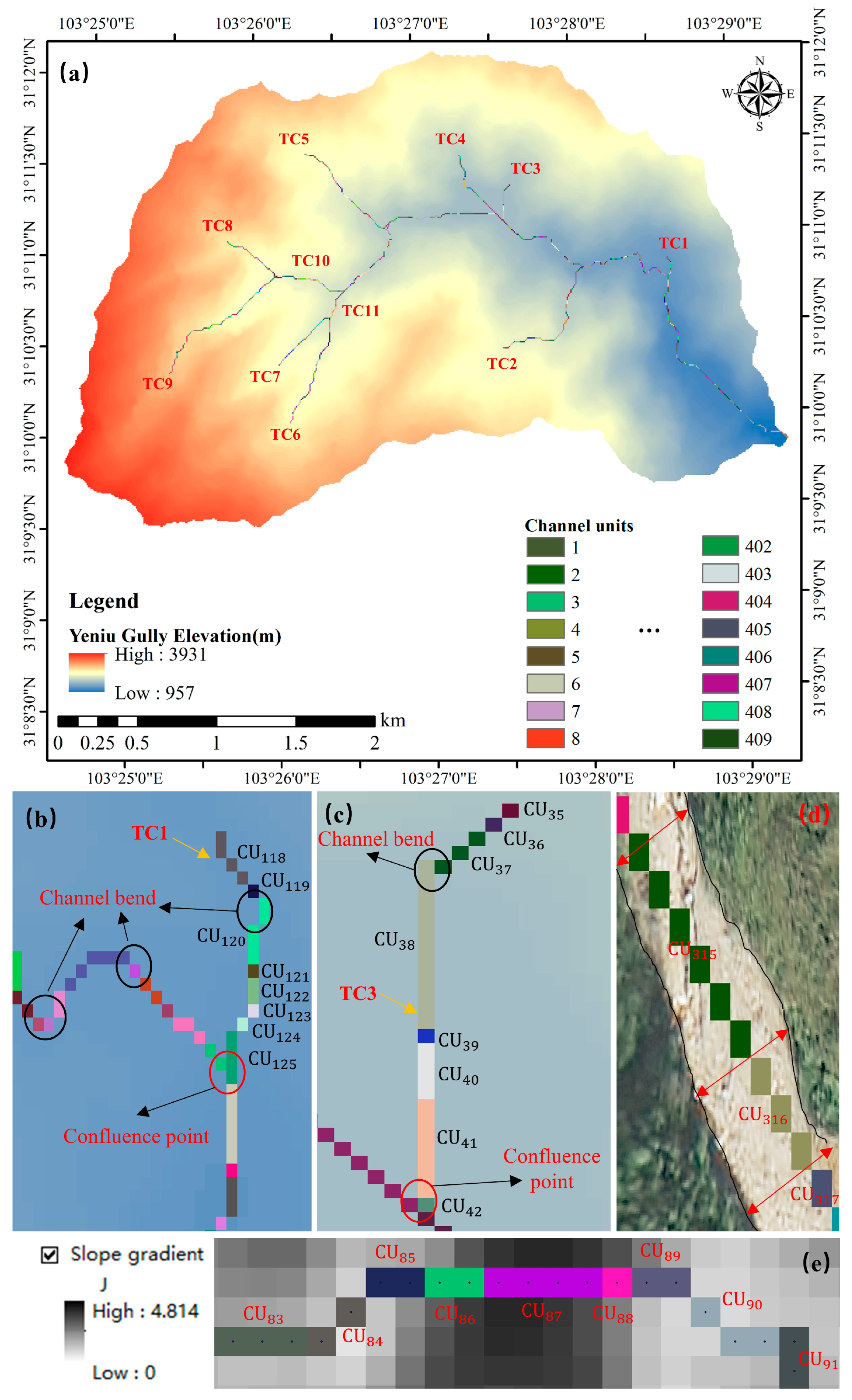
4.2. Delineation for the Yeniu Gully Channel Network
4.2.1. Basin-Wide (“Areal”) Scale
4.2.2. Representative Single Tributaries (“Linear” Scale)
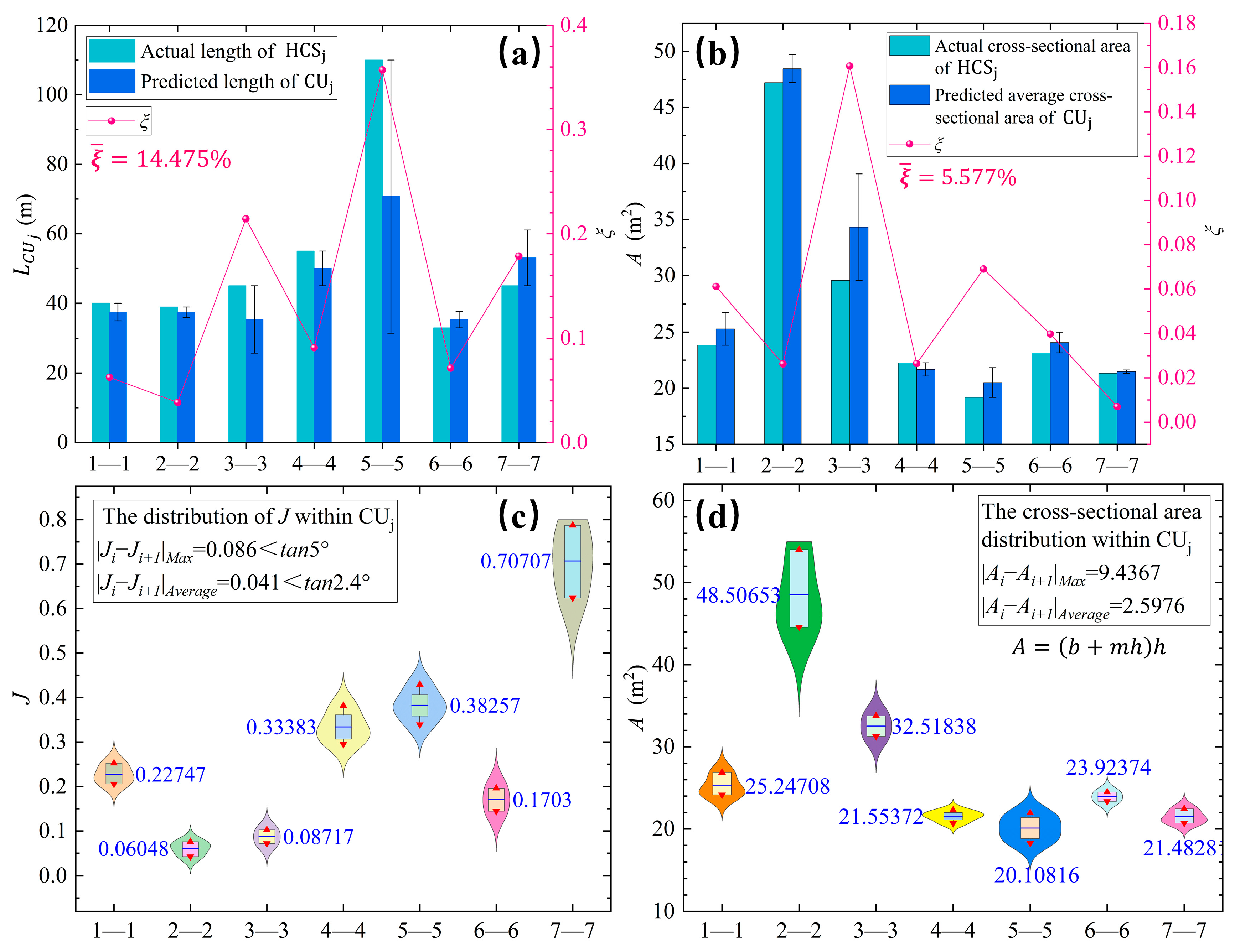
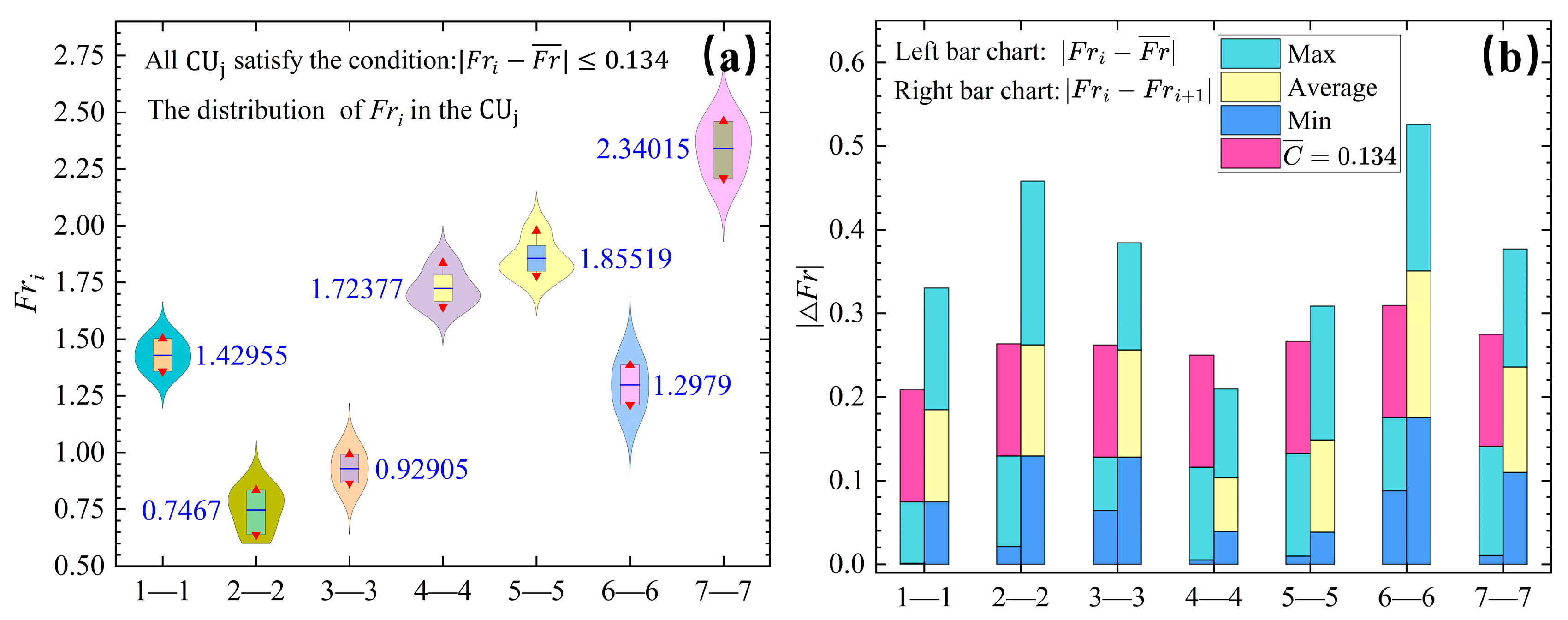
4.3. Independent Validation at Field-Identified Homogeneous Reaches (“Point” Scale)
4.3.1. Fr and Its Dispersion
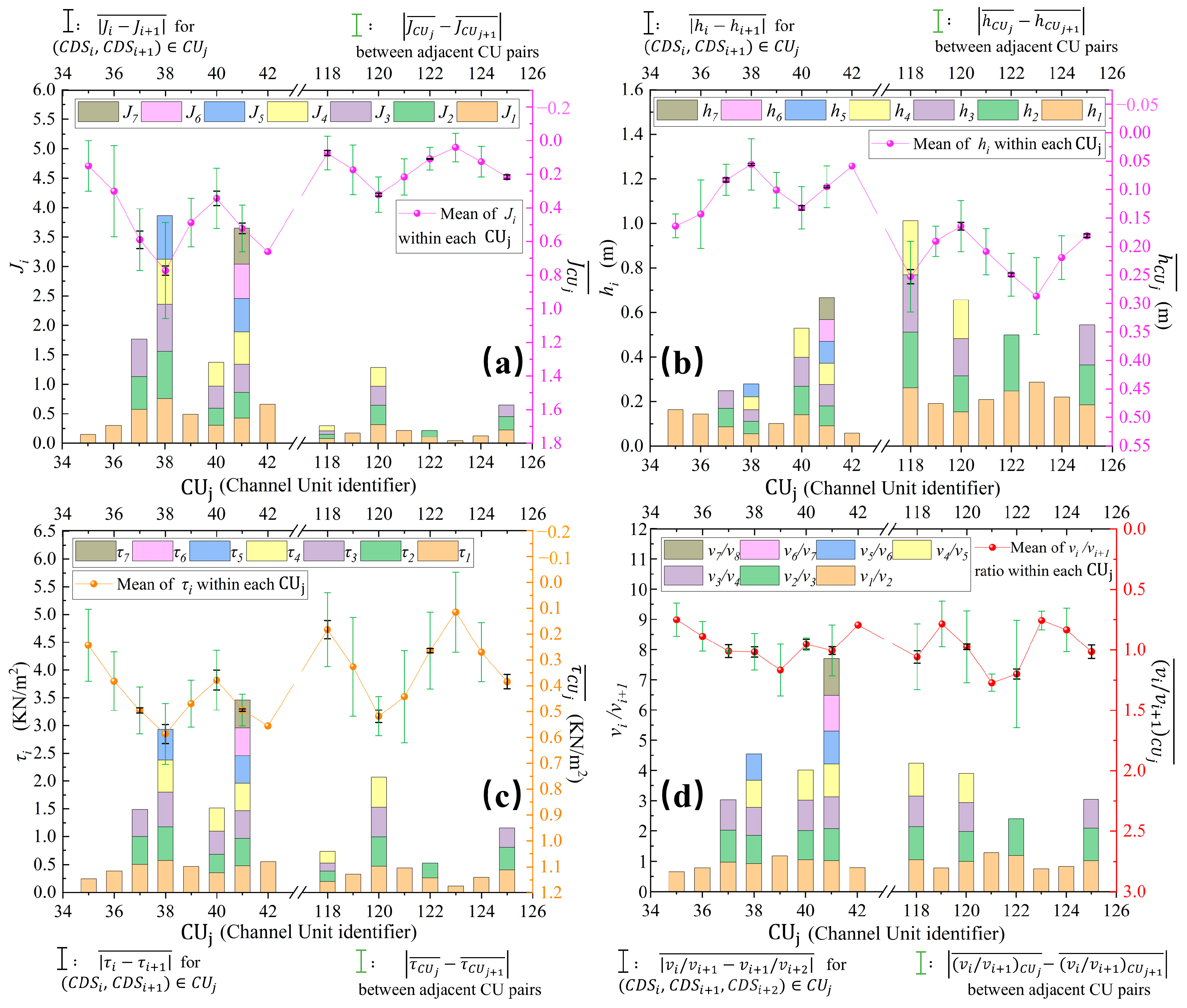
4.3.2. Comparison of Geometric Quantities
4.3.3. Hydraulic and Kinematic Indicators
5. Discussion
5.1. Robustness, Generality, and Advantages of the Delineation
5.1.1. Effect of on , , , and
- (1)
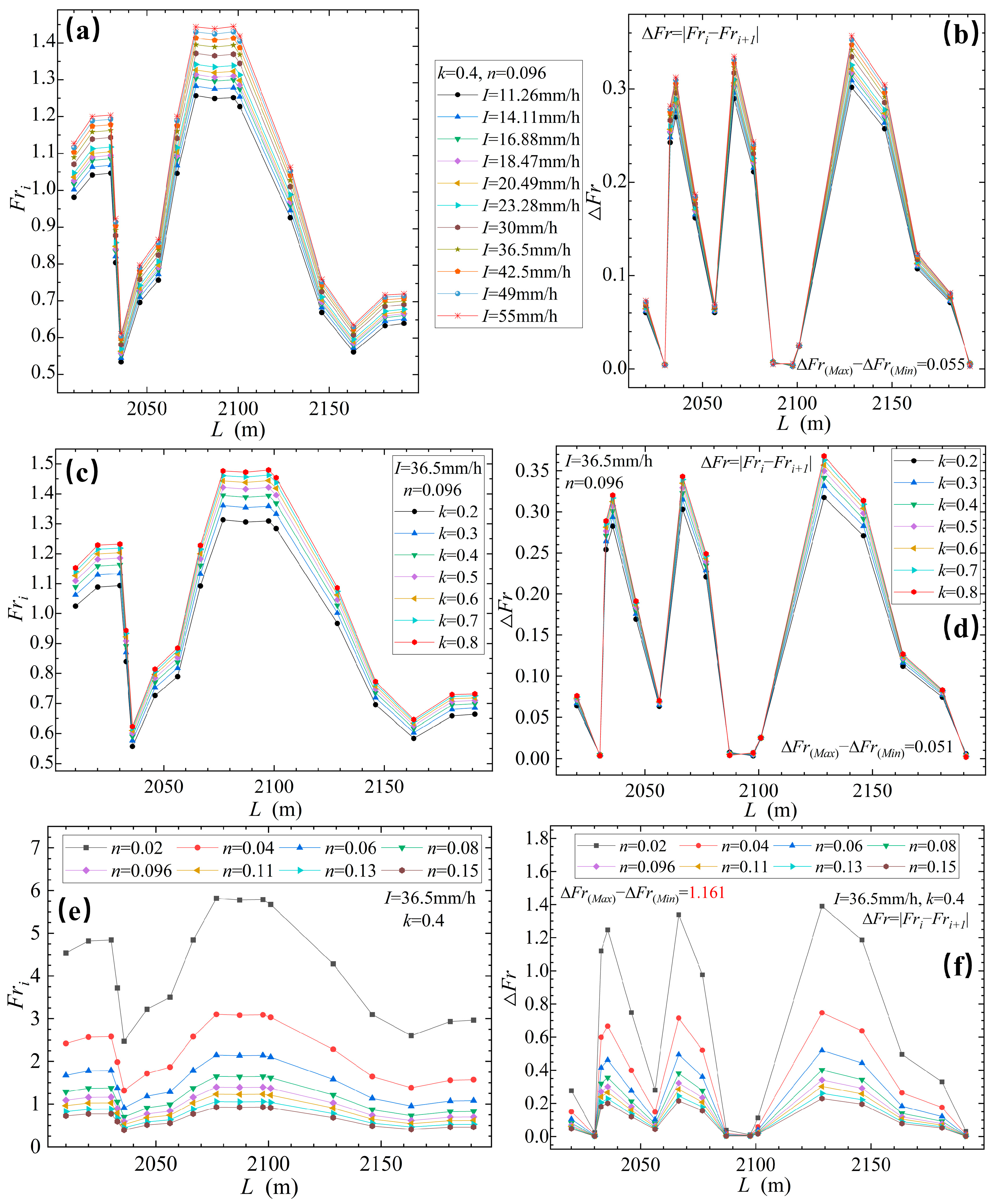
- Increasing markedly elevates (Figure 11a), whereas shows very weak sensitivity to (Figure 11b). At the location with the strongest response ( = 2128 m), the difference between the minimum at = 11.26 and the maximum at = 55 mm/h is only 0.055. Where adjacent have similar geometry (e.g., at = 2030, 2057, 2087, 2098, 2102, and 2191 m), is essentially insensitive to .
- (2)
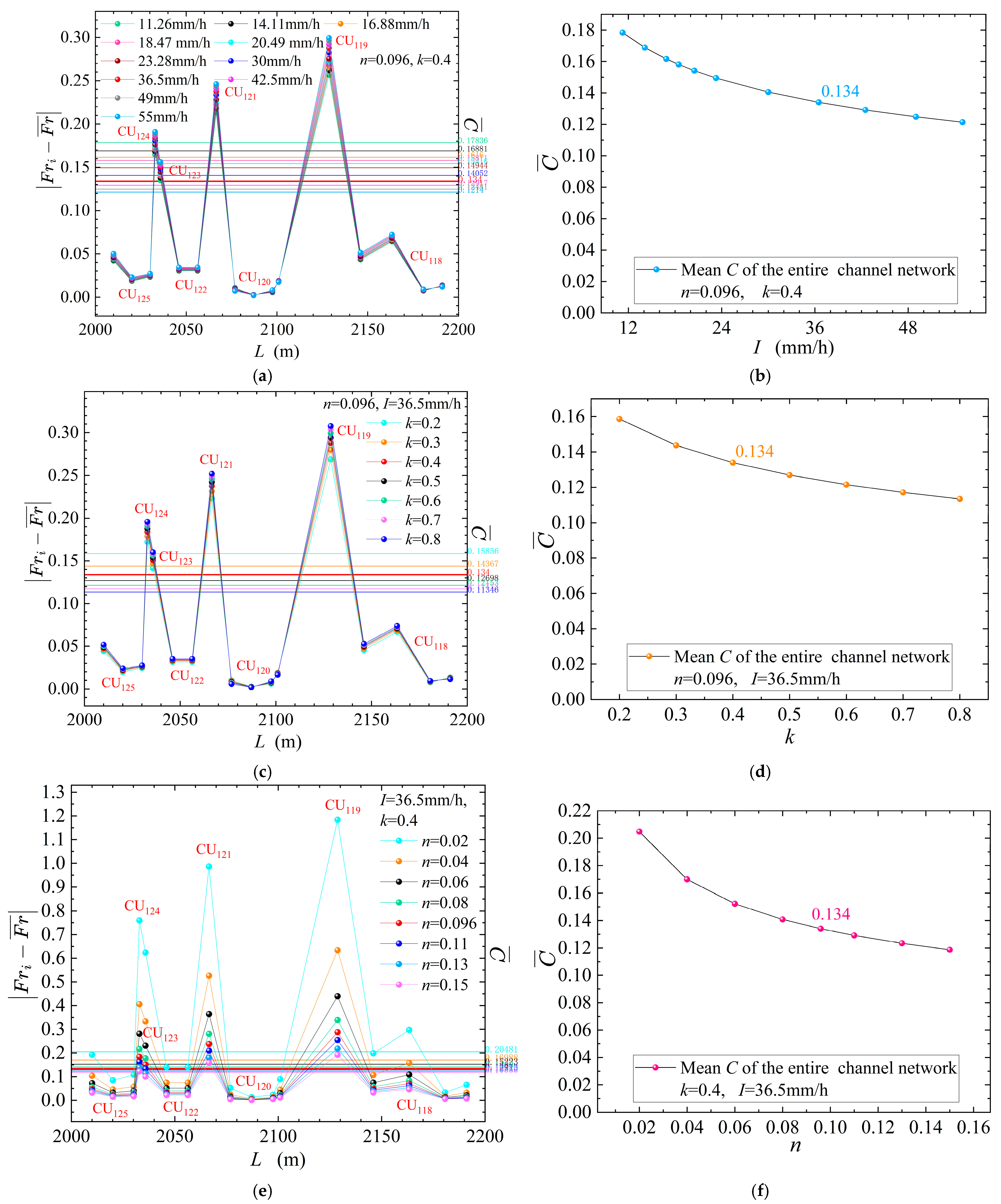
- As increases, the growth rates of both and diminish (convergent behavior), indicating that is not the sole control on these quantities, and supports the need for a multi-parameter model.
5.1.2. Effect of on , , , and
5.1.3. Effect of on , , , and
- (1)
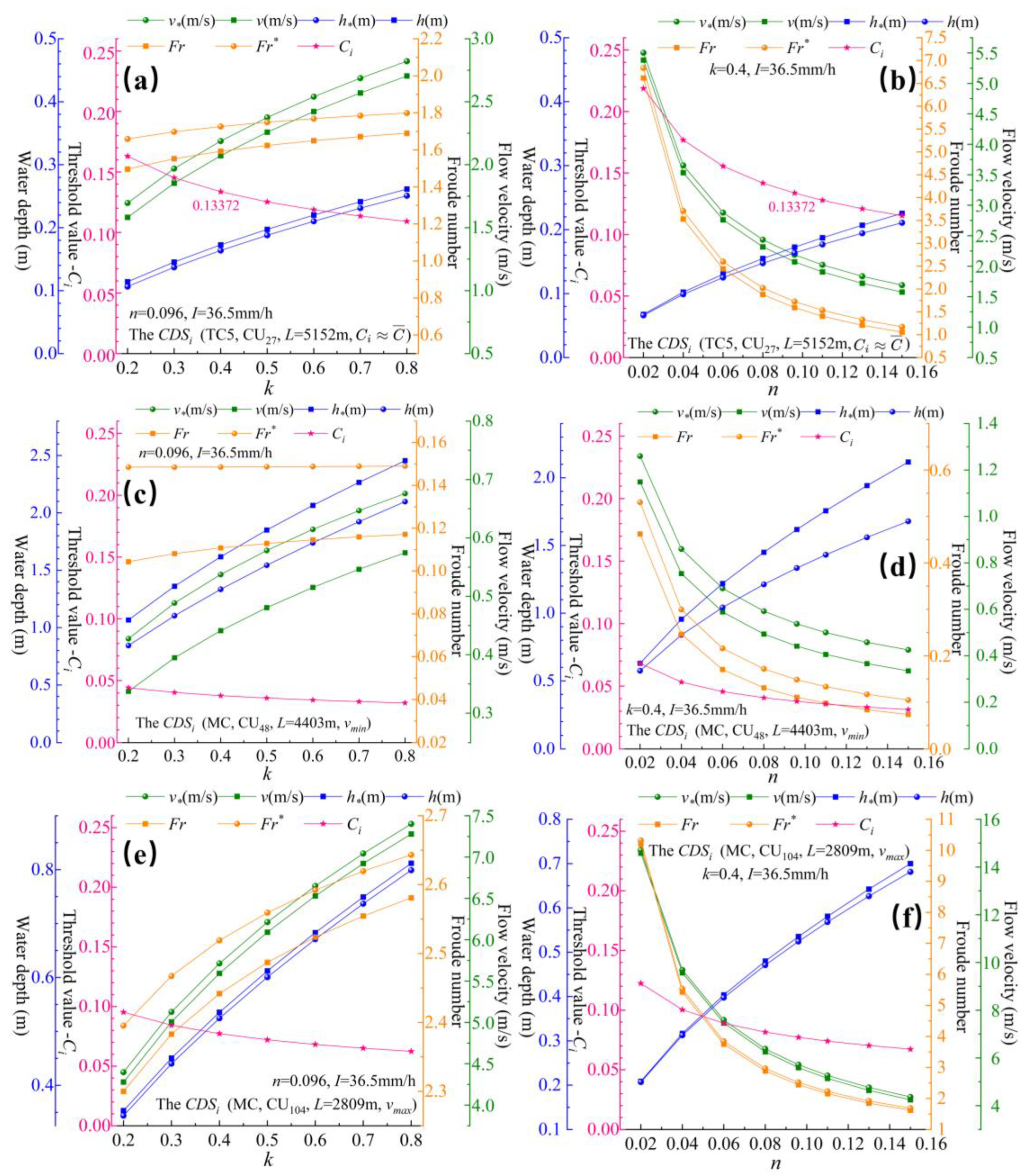
- Increasing (rougher bed) typically decreases and increases , thereby reducing ; this effect is stronger than those of and (Figure 11e).
- (2)
- The impact of on is selective: where adjacent differ strongly in geometry, is more sensitive to . Near 2128 m, the difference between at 0.02 and at 0.15 reaches 1.161. Where adjacent have similar geometry (e.g., 2030, 2087, 2098, 2102, and 2191 m), is barely affected (Figure 11f). Both and show convergent decreases with increasing .
5.1.4. Representativeness of : Consistency Between and
5.1.5. Generality and Methodological Advantages
5.2. Limitations and Future Directions
6. Conclusions
- (1)
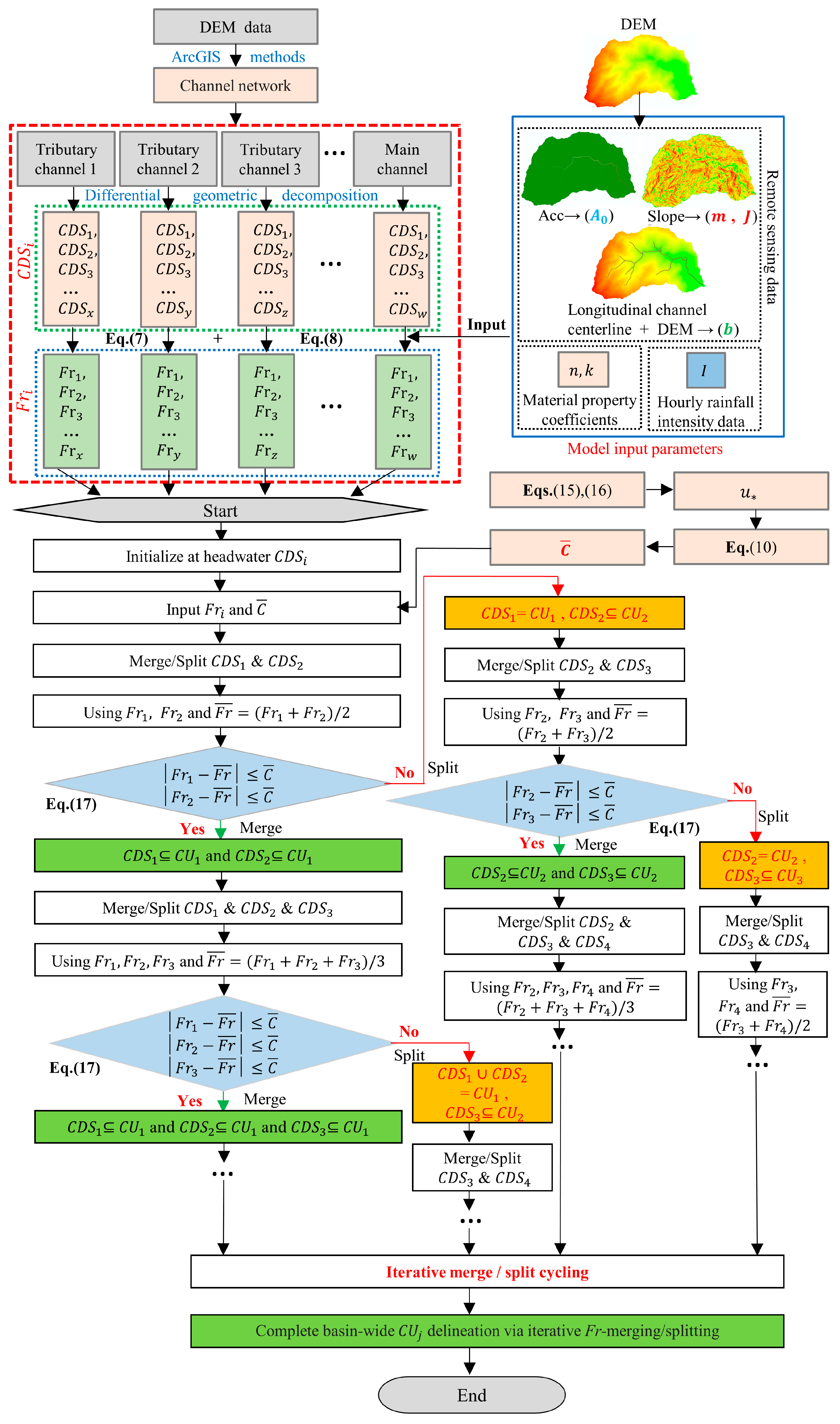
- We construct an computation model constrained by cross-sectional geometry, topographic parameters, and material property coefficients, enabling to jointly characterize the geometric features and hydraulic parameters of channel-discretized segments (). The spatial variability of between adjacent is shown to be controlled primarily by local differences in geometric parameters; statistically, is positively correlated with longitudinal gradient and bed shear stress, and negatively correlated with cross-sectional area. Using the critical bed-shear stress for incipient motion at the solid–liquid cutoff grain size together with a small velocity-perturbation analysis, we determine a physical identification threshold. Constraining the absolute deviation of within each by this threshold yields an automated, physics-based framework for delineating homogeneous , ensuring the physical self-consistency and transferability of the units.
- (2)
- Multi-scale (point–line–areal) validation in the Yeniu Gully catchment demonstrates that the proposed framework produces computational units that are relatively homogeneous within (in longitudinal gradient, cross-sectional area, flow depth, shear stress, etc.) and heterogeneous between , while preserving the morphological continuity of geomorphic functional segments. A total of 409 are delineated across the basin; their spatial pattern accords with terrain complexity—denser in tributaries and sparser in the main channel—consistent with actual geomorphic complexity and along-channel hydraulic attenuation. The stably capture key geomorphic functional units, including bends, confluences, slope and width breaks, erosional reaches, and depositional reaches. Under varying rainfall intensity, runoff coefficient, and Manning roughness scenarios, the overall delineation accuracy remains 94.44–98.21%, and even under the most adverse extreme condition it exceeds 88.64%, indicating strong robustness and generality.
- (3)
- The method requires only three types of input data—DEM, peak hourly rainfall intensity, and material property coefficients—and the DEM+GIS workflow affords strong engineering portability and operational convenience, enabling deployment in diverse debris flow gullies. While the delineation accuracy is constrained by DEM resolution and the inherent behavior of the D8 flow-routing algorithm in ArcGIS 9.3, these limitations are common to the field; anticipated advances in remote sensing and GIS will continuously improve performance. Future work will (i) extrapolate and validate the proposed delineation across basins with different sediment sources and under DEMs of varying resolution; (ii) compare the performance of versus grid cells as computational units in continuum mechanics-based early warning/forecasting of runoff-generated debris flow (hit rate, false-alarm rate, miss rate, and timeliness). We also expect to couple directly with other continuum models (e.g., mobile-bed shallow-water equations or viscoplastic rheologies) for integrated initiation–propagation hazard mapping and reach-scale engineering design.
Author Contributions
Funding
Data Availability Statement
Acknowledgments
Conflicts of Interest
References
- Thiene, M.; Shaw, W.D.; Scarpa, R. Perceived risks of mountain landslides in Italy: Stated choices for subjective risk reductions. Landslides 2017, 14, 1077–1089. [Google Scholar] [CrossRef]
- Zhang, S.J.; Yang, H.J.; Wei, F.Q.; Jiang, Y.H.; Liu, D.L. A Model of Debris Flow Forecast Based on the Water-Soil Coupling Mechanism. J. Earth Sci. 2014, 25, 757–763. [Google Scholar] [CrossRef]
- Zhang, S.J.; Wei, F.Q.; Liu, D.L.; Yang, H.J.; Jiang, Y.H. A Regional-Scale Method of Forecasting Debris Flow Events Based on Water-Soil Coupling Mechanism. J. Mt. Sci. 2014, 11, 1531–1542. [Google Scholar] [CrossRef]
- Jakob, M.; Hungr, O. Debris-Flow Hazards and Related Phenomena—Introduction; Springer: Berlin/Heidelberg, Germany, 2005; pp. 1–7. [Google Scholar]
- Yune, C.Y.; Kim, B.J.; Jun, K.J.; Park, S.D.; Lee, S.W.; Kim, G.H.; Lee, C.W.; Paik, J.C. Real-scale experiment of debris flow in a natural gulley: Key findings and lessons learned. Landslides 2023, 20, 2757–2774. [Google Scholar] [CrossRef]
- Zhao, Y.; Meng, X.; Qi, T.; Qing, F.; Xiong, M.; Li, Y.; Guo, P.; Chen, G. Al-based identification of low-frequency debris flow catchments in the Bailong River basin, China. Geomorphology 2020, 359, 107125. [Google Scholar] [CrossRef]
- Bernard, M.; Gregoretti, C. The Use of Rain Gauge Measurements and Radar Data for the Model-Based Prediction of Runoff-Generated Debris-Flow Occurrence in Early Warning Systems. Water Resour. Res. 2021, 57, e2020WR027893. [Google Scholar] [CrossRef]
- Takahashi, T. Debris Flow: Mechanics, Prediction and Countermeasures; Taylor & Francis: Abingdon, UK, 2007. [Google Scholar] [CrossRef]
- Li, S.; You, Y.; Chen, X.; Liu, J.; Chen, J. Regulation effectiveness of a window-check dam on debris flows. Eng. Geol. 2019, 253, 205–213. [Google Scholar] [CrossRef]
- Piton, G.; Recking, A. Design of sediment traps with open check dams. I: Hydraulic and deposition processes. J. Hydraul. Eng. 2016, 142, 04015045. [Google Scholar] [CrossRef]
- Xiong, M.; Meng, X.; Wang, S.; Guo, P.; Li, Y.; Chen, G.; Qing, F.; Cui, Z.; Zhao, Y. Effectiveness of debris flow mitigation strategies in mountainous regions. Prog. Phys. Geogr. Earth Environ. 2016, 40, 768–793. [Google Scholar] [CrossRef]
- Wei, F.; Gao, K.; Cui, P.; Hu, K.; Xu, J.; Zhang, G.; Bi, B. Method of debris flow prediction based on a numerical weather forecast and its application. In Proceedings of the 1st International Conference on Monitoring, Simulation, Prevention and Remediation of Dense and Debris Flows, Rhodes, Greece, 7–9 June 2006; pp. 37–46. [Google Scholar]
- Wabbels, D.; Bezzola, G.R. Invited Perspectives: “Small country, big challenges—Switzerland’s hazard prevention research”. Nat. Hazards Earth Syst. Sci. 2022, 22, 927–930. [Google Scholar] [CrossRef]
- Schwindt, S.; Franca, M.J.; Reffo, A.; Schleiss, A.J. Sediment traps with guiding channel and hybrid check dams improve controlled sediment retention. Nat. Hazards Earth Syst. Sci. 2018, 18, 647–668. [Google Scholar] [CrossRef]
- Arattano, M.; Marchi, L. Systems and Sensors for Debris-flow Monitoring and Warning. Sensors 2008, 8, 2436–2452. [Google Scholar] [CrossRef]
- Ponziani, M.; Pogliotti, P.; Stevenin, H.; Ratto, S.M. Debris-flow Indicator for an early warning system in the Aosta valley region. Nat. Hazards 2020, 104, 1819–1839. [Google Scholar] [CrossRef]
- Liu, D.L.; Zhang, S.J.; Yang, H.J.; Zhao, L.Q.; Jiang, Y.H.; Tang, D.; Leng, X.P. Application and analysis of debris-flow early warning system in Wenchuan earthquake-affected area. Nat. Hazards Earth Syst. Sci. 2016, 16, 483–496. [Google Scholar] [CrossRef]
- Cai, S.; Zhang, Z.; Yang, X.; Lv, Q.; Liu, X.; Lai, R.; Yu, X.; Hu, Y. The modified theoretical model for debris flows predication with multiple rainfall characteristic parameters. Sci. Rep. 2025, 15, 12402. [Google Scholar] [CrossRef]
- Yang, H.; Zhang, S.; Hu, K.; Wei, F.; Liu, Y. Evaluation of rainfall threshold models for debris flow initiation in the Jiangjia Gully, Yunnan Province, China. J. Mt. Sci. 2024, 21, 1799–1813. [Google Scholar] [CrossRef]
- Wu, M.-H.; Wang, J.P.; Chen, I.C. Optimization approach for determining rainfall duration-intensity thresholds for debris flow forecasting. Bull. Eng. Geol. Environ. 2019, 78, 2495–2501. [Google Scholar] [CrossRef]
- Chen, C.Y.; Chen, T.C.; Yu, F.C.; Yu, W.H.; Tseng, C.C. Rainfall duration and debris-flow initiated studies for real-time monitoring. Environ. Geol. 2005, 47, 715–724. [Google Scholar] [CrossRef]
- Dennis, M.S.; Joseph, E.G.; Jason, W.K. Objective Definition of Rainfall Intensity-Duration Thresholds for Post-fire Flash Floods and Debris Flows in the Area Burned by the Waldo Canyon Fire, Colorado, USA. In Proceedings of the 12th International IAEG Congress, Torino, Italy, 15–19 September 2015; pp. 621–624. [Google Scholar]
- Liu, F.Z.; Xu, Q.; Dong, X.J.; Yu, B.; Frost, J.D.; Li, H.J. Design and performance of a novel multi-function debris flow mitigation system in Wenjia Gully, Sichuan. Landslides 2017, 14, 2089–2104. [Google Scholar] [CrossRef]
- Zhao, Y.; Meng, X.; Qi, T.; Chen, G.; Li, Y.; Yue, D.; Qing, F. Extracting more features from rainfall data to analyze the conditions triggering debris flows. Landslides 2022, 19, 2091–2099. [Google Scholar] [CrossRef]
- Zhao, Y.; Meng, X.; Qi, T.; Li, Y.; Chen, G.; Yue, D.; Qing, F. AI-based rainfall prediction model for debris flows. Eng. Geol. 2022, 296, 106456. [Google Scholar] [CrossRef]
- Qiu, C.; Su, L.; Bian, C.; Zhao, B.; Geng, X. An AI-Based Method for Estimating the Potential Runout Distance of Post-Seismic Debris Flows. Int. J. Disaster Risk Sci. 2024, 15, 608–621. [Google Scholar] [CrossRef]
- Kung, H.-Y.; Chen, C.-H.; Ku, H.-H. Designing intelligent disaster prediction models and systems for debris-flow disasters in Taiwan. Expert Syst. Appl. 2012, 39, 5838–5856. [Google Scholar] [CrossRef]
- Wang, W.; Xu, W.L.; Liu, S.J. Prevention of debris flow disasters on Chengdu-Kunming Railway. J. Environ. Sci. 2001, 13, 333–336. [Google Scholar]
- Takahashi, T. Mechanical Characteristics of Debris Flow. J. Hydraul. Div. -Asce 1978, 104, 1153–1169. [Google Scholar] [CrossRef]
- Shields, A. Anwendung der Ähnlichkeitsmechanik und der Turbulenzforschung auf die Geschiebebewegung: Mitteilungen der Preußischen Versuchsanstalt für Wasserbau und Schiffbau. Heft 1936, 26, 1–36. [Google Scholar]
- Berti, M.; Simoni, A. Experimental evidences and numerical modelling of debris flow initiated by channel runoff. Landslides 2005, 2, 171–182. [Google Scholar] [CrossRef]
- Iverson, R.M. The physics of debris flows. Rev. Geophys. 1997, 35, 245–296. [Google Scholar] [CrossRef]
- Segoni, S.; Piciullo, L.; Gariano, S.L. A review of the recent literature on rainfall thresholds for landslide occurrence. Landslides 2018, 15, 1483–1501. [Google Scholar] [CrossRef]
- Liu, S.; Wang, L.; Zhang, W.; He, Y.; Pijush, S. A comprehensive review of machine learning-based methods in landslide susceptibility mapping. Geol. J. 2023, 58, 2283–2301. [Google Scholar] [CrossRef]
- Long, K.; Zhang, S.; Wei, F.; Hu, K.; Zhang, Q.; Luo, Y. A hydrology-process based method for correlating debris flow density to rainfall parameters and its application on debris flow prediction. J. Hydrol. 2020, 589, 125124. [Google Scholar] [CrossRef]
- Piciullo, L.; Calvello, M.; Cepeda, J.M. Territorial early warning systems for rainfall-induced landslides. Earth-Sci. Rev. 2018, 179, 228–247. [Google Scholar] [CrossRef]
- Zhou, S.Y.; Gao, L.; Zhang, L.M. Predicting debris-flow clusters under extreme rainstorms: A case study on Hong Kong Island. Bull. Eng. Geol. Environ. 2019, 78, 5775–5794. [Google Scholar] [CrossRef]
- Román-Herrera, J.C.; Rodríguez-Peces, M.J.; Garzón-Roca, J. Comparison between Machine Learning and Physical Models Applied to the Evaluation of Co-Seismic Landslide Hazard. Appl. Sci. 2023, 13, 8285. [Google Scholar] [CrossRef]
- Alvioli, M.; Loche, M.; Jacobs, L.; Grohmann, C.H.; Abraham, M.T.; Gupta, K.; Satyam, N.; Scaringi, G.; Bornaetxea, T.; Rossi, M.; et al. A benchmark dataset and workflow for landslide susceptibility zonation. Earth-Sci. Rev. 2024, 258, 104927. [Google Scholar] [CrossRef]
- Pudasaini, S.P.; Hutter, K. Granular Avalanches: Definition, Related Concepts and a Review of Classical Models. In Avalanche Dynamics: Dynamics of Rapid Flows of Dense Granular Avalanches; Springer: Berlin/Heidelberg, Germany, 2007; pp. 47–112. [Google Scholar] [CrossRef]
- Wang, W.; Chen, G.; Han, Z.; Zhou, S.; Zhang, H.; Jing, P. 3D numerical simulation of debris-flow motion using SPH method incorporating non-Newtonian fluid behavior. Nat. Hazards 2016, 81, 1981–1998. [Google Scholar] [CrossRef]
- Cundall, P.; Strack, O. Discrete Numerical-Model for Granular Assemblies. Geotechnique 1979, 29, 47–65. [Google Scholar] [CrossRef]
- Albaba, A.; Schwarz, M.; Wendeler, C.; Loup, B.; Dorren, L. Numerical modeling using an elastoplastic-adhesive discrete element code for simulating hillslope debris flows and calibration against field experiments. Nat. Hazards Earth Syst. Sci. 2019, 19, 2339–2358. [Google Scholar] [CrossRef]
- Shiu, W.-J.; Lee, C.-F.; Chiu, C.-C.; Weng, M.-C.; Yang, C.-M.; Chao, W.-A.; Liu, C.-Y.; Lin, C.-H.; Huang, W.-K.; Geo, P.W.G. Analyzing landslide-induced debris flow and flow-bridge interaction by using a hybrid model of depth-averaged model and discrete element method. Landslides 2023, 20, 331–349. [Google Scholar] [CrossRef]
- Xiong, Y.; Mahaffey, S.; Liang, Q.; Rouainia, M.; Wang, G. A new 1D coupled hydrodynamic discrete element model for floating debris in violent shallow flows. J. Hydraul. Res. 2020, 58, 778–789. [Google Scholar] [CrossRef]
- Kattel, P.; Kafle, J.; Fischer, J.; Mergili, M.; Tuladhar, B.; Pudasaini, S. Interaction of two-phase debris flow with obstacles. Eng. Geol. 2018, 242, 197–217. [Google Scholar] [CrossRef]
- Pudasaini, S.P. A general two-phase debris flow model. J. Geophys. Res.-Earth Surf. 2012, 117, F03010. [Google Scholar] [CrossRef]
- Bouchut, F.; Fernandez-Nieto, E.D.; Mangeney, A.; Narbona-Reina, G. A Two-Phase Shallow Debris Flow Model with Energy Balance. Esaim-Math. Model. Numer. Anal.-Model. Math. Anal. Numer. 2015, 49, 101–140. [Google Scholar] [CrossRef]
- Mergili, M.; Jaboyedoff, M.; Pullarello, J.; Pudasaini, S. Back calculation of the 2017 Piz Cengalo-Bondo landslide cascade with r.avaflow: What we can do and what we can learn. Nat. Hazards Earth Syst. Sci. 2020, 20, 505–520. [Google Scholar] [CrossRef]
- Qiao, Z.; Li, T.; Simoni, A.; Gregoretti, C.; Bernard, M.; Wu, S.; Shen, W.; Berti, M. Numerical modelling of an alpine debris flow by considering bed entrainment. Front. Earth Sci. 2023, 10, 1059525. [Google Scholar] [CrossRef]
- Liao, Z.; Hong, Y.; Kirschbaum, D.; Adler, R.F.; Gourley, J.J.; Wooten, R. Evaluation of TRIGRS (transient rainfall infiltration and grid-based regional slope-stability analysis)’s predictive skill for hurricane-triggered landslides: A case study in Macon County, North Carolina. Nat. Hazards 2011, 58, 325–339. [Google Scholar] [CrossRef]
- Cavagnaro, D.B.; McCoy, S.W.; Kean, J.W.; Thomas, M.A.; Lindsay, D.N.; McArdell, B.W.; Hirschberg, J. A Robust Quantitative Method to Distinguish Runoff-Generated Debris Flows From Floods. Geophys. Res. Lett. 2024, 51, e2024GL109768. [Google Scholar] [CrossRef]
- Kean, J.W.; McCoy, S.W.; Tucker, G.E.; Staley, D.M.; Coe, J.A. Runoff-generated debris flows: Observations and modeling of surge initiation, magnitude, and frequency. J. Geophys. Res.-Earth Surf. 2013, 118, 2190–2207. [Google Scholar] [CrossRef]
- Coe, J.A.; Kinner, D.A.; Godt, J.W. Initiation conditions for debris flows generated by runoff at Chalk Cliffs, central Colorado. Geomorphology 2008, 96, 270–297. [Google Scholar] [CrossRef]
- Gregoretti, C.; Fontana, G.D. The triggering of debris flow due to channel-bed failure in some alpine headwater basins of the Dolomites: Analyses of critical runoff. Hydrol. Process. 2008, 22, 2248–2263. [Google Scholar] [CrossRef]
- Armanini, A.; Gregoretti, C. Incipient sediment motion at high slopes in uniform flow condition. Water Resour. Res. 2005, 41, W12431. [Google Scholar] [CrossRef]
- Pudasaini, S.P.; Hutter, K. Avalanche Dynamics: Dynamics of Rapid Flows of Dense Granular Avalanches; Springer Science & Business Media: Berlin/Heidelberg, Germany, 2007. [Google Scholar]
- Hungr, O.; McDougall, S.; Bovis, M. Entrainment of material by debris flows. In Debris-Flow Hazards and Related Phenomena; Springer Berlin Heidelberg: Berlin/Heidelberg, Germany, 2005; pp. 135–158. [Google Scholar]
- O’Brien, J.S.; Julien, P.Y.; Fullerton, W.T. Two-Dimensional Water Flood and Mudflow Simulation. J. Hydraul. Eng. 1993, 119, 244–261. [Google Scholar] [CrossRef]
- Pitman, E.; Le, L. A two-fluid model for avalanche and debris flows. Philos. Trans. R. Soc. A-Math. Phys. Eng. Sci. 2005, 363, 1573–1601. [Google Scholar] [CrossRef]
- Liu, W.; He, S. Comprehensive modelling of runoff-generated debris flow from formation to propagation in a catchment. Landslides 2020, 17, 1529–1544. [Google Scholar] [CrossRef]
- Tang, H.; McGuire, L.; Rengers, F.; Kean, J.; Staley, D.; Smith, J. Developing and Testing Physically Based Triggering Thresholds for Runoff-Generated Debris Flows. Geophys. Res. Lett. 2019, 46, 8830–8839. [Google Scholar] [CrossRef]
- Xia, X.; Jarsve, K.T.; Dijkstra, T.; Liang, Q.; Meng, X.; Chen, G. An integrated hydrodynamic model for runoff-generated debris flows with novel formulation of bed erosion and deposition. Eng. Geol. 2023, 326, 107310. [Google Scholar] [CrossRef]
- Wang, K.; Zhang, S.; DelgadoTellez, R.; Wei, F. A new slope unit extraction method for regional landslide analysis based on morphological image analysis. Bull. Eng. Geol. Environ. 2019, 78, 4139–4151. [Google Scholar] [CrossRef]
- Wang, K.; Xu, H.; Zhang, S.; Wei, F.; Xie, W. Identification and Extraction of Geomorphological Features of Landslides Using Slope Units for Landslide Analysis. ISPRS Int. J. Geo-Inf. 2020, 9, 274. [Google Scholar] [CrossRef]
- Ba, Q.; Chen, Y.; Deng, S.; Yang, J.; Li, H. A comparison of slope units and grid cells as mapping units for landslide susceptibility assessment. Earth Sci. Inform. 2018, 11, 373–388. [Google Scholar] [CrossRef]
- Benda, L. The Influence of Debris Flows on Channels and Valley Floors in the Oregon Coast Range, USA. Earth Surf. Process. Landf. 1990, 15, 457–466. [Google Scholar] [CrossRef]
- de Haas, T.; Nijland, W.; de Jong, S.M.; McArdell, B.W. How memory effects, check dams, and channel geometry control erosion and deposition by debris flows. Sci. Rep. 2020, 10, 14024. [Google Scholar] [CrossRef] [PubMed]
- Stock, J.D.; Dietrich, W.E. Erosion of steepland valleys by debris flows. Geol. Soc. Am. Bull. 2006, 118, 1125–1148. [Google Scholar] [CrossRef]
- Carrara, A.; Cardinali, M.; Detti, R.; Guzzetti, F.; Pasqui, V.; Reichenbach, P. Gis Techniques and Statistical-Models in Evaluating Landslide Hazard. Earth Surf. Process. Landf. 1991, 16, 427–445. [Google Scholar] [CrossRef]
- Guzzetti, F.; Carrara, A.; Cardinali, M.; Reichenbach, P. Landslide hazard evaluation: A review of current techniques and their application in a multi-scale study, Central Italy. Geomorphology 1999, 31, 181–216. [Google Scholar] [CrossRef]
- Khan, M.A.; Mustaffa, Z.; Harahap, I.S.H. Dynamic response of dilute to viscous channelized debris flow on pipeline crossing. Nat. Hazards 2024, 120, 5141–5161. [Google Scholar] [CrossRef]
- Heller, V. Scale effects in physical hydraulic engineering models. J. Hydraul. Res. 2011, 49, 293–306. [Google Scholar] [CrossRef]
- Coussot, P.; Meunier, M. Recognition, classification and mechanical description of debris flows. Earth-Sci. Rev. 1996, 40, 209–227. [Google Scholar] [CrossRef]
- Hu, F.X.; Matuda, K.; Tokai, T. Effects of drag coefficient of netting for dynamic similarity on model testing of trawl nets. Fish. Sci. 2001, 67, 84–89. [Google Scholar] [CrossRef]
- Huang, W.; Yang, Q.; Xiao, H. CFD modeling of scale effects on turbulence flow and scour around bridge piers. Comput. Fluids 2009, 38, 1050–1058. [Google Scholar] [CrossRef]
- Sadeghi, S.H.; Jafarpoor, A.; Homaee, M.; Darki, B.Z. Changeability of rill erosion properties due to microorganism inoculation. Catena 2023, 223, 106956. [Google Scholar] [CrossRef]
- Follett, E.; Schalko, I.; Nepf, H. Reply to Comment by Poppema and Wüthrich on “Momentum and Energy Predict the Backwater Rise Generated by a Large Wood Jam”. Geophys. Res. Lett. 2024, 51, e2024GL108808. [Google Scholar] [CrossRef]
- Shu, H.P.; Ma, J.Z.; Qi, S.; Chen, P.Y.; Guo, Z.Z.; Zhang, P. Experimental results of the impact pressure of debris flows in loess regions. Nat. Hazards 2020, 103, 3329–3356. [Google Scholar] [CrossRef]
- Qiu, E.; Luo, X.; Xu, D.; Wang, F.; Bai, H.; Liu, J.; Xiong, X.; Peng, Z. Dynamic response characteristics of bridges under the impact of debris flows in mountainous areas. Phys. Fluids 2025, 37, 027172. [Google Scholar] [CrossRef]
- Kemp, J.L.; Harper, D.M.; Crosa, G.A. The habitat-scale ecohydraulics of rivers. Ecol. Eng. 2000, 16, 17–29. [Google Scholar] [CrossRef]
- Jowett, I.G. A Method for Objectively Identifying Pool, Run, and Riffle Habitats from Physical Measurements. N. Z. J. Mar. Freshw. Res. 1993, 27, 241–248. [Google Scholar] [CrossRef]
- Hauer, C.; Mandlburger, G.; Habersack, H. Hydraulically Related Hydro-Morphological Units: Description Based on A New Conceptual Mesohabitat Evaluation Model (Mem) Using Lidar Data as Geometric Input. River Res. Appl. 2009, 25, 29–47. [Google Scholar] [CrossRef]
- Major, J.J.; Pierson, T.C. Debris Flow Rheology—Experimental-Analysis of Fine-Grained Slurries. Water Resour. Res. 1992, 28, 841–857. [Google Scholar] [CrossRef]
- Miao, R.; Howard, A.D.; Dietrich, W.E. The sediment transport mechanics driving lateral accretion in muddy meanders. Proc. Natl. Acad. Sci. 2025, 122, e2506462122. [Google Scholar] [CrossRef]
- Chen, H.X.; Zhang, L.M.; Zhang, S. Evolution of debris flow properties and physical interactions in debris-flow mixtures in the Wenchuan earthquake zone. Eng. Geol. 2014, 182, 136–147. [Google Scholar] [CrossRef]
- McEwan, I.; Sorensen, M.; Heald, J.; Tait, S.; Cunningham, G.; Goring, D.; Willetts, B. Probabilistic modeling of bed-load composition. J. Hydraul. Eng. 2004, 130, 129–139. [Google Scholar] [CrossRef]
- Buffington, J.M.; Montgomery, D.R. A systematic analysis of eight decades of incipient motion studies, with special reference to gravel-bedded rivers. Water Resour. Res. 1997, 33, 1993–2029. [Google Scholar] [CrossRef]
- Rijn, L.C.v. Sediment Transport, Part I: Bed Load Transport. J. Hydraul. Eng. 1984, 110, 1431–1456. [Google Scholar] [CrossRef]
- Schlichting, H.; Gersten, K. Boundary-Layer Theory; Springer: Berlin/Heidelberg, Germany, 2016. [Google Scholar] [CrossRef]
- Chanson, H. Hydraulics of Open Channel Flow; Butterworth-Heinemann: Oxford, UK, 2004. [Google Scholar]
- Fei, X.; Shu, A. Mechanisms of Debris Flow Motion and Disaster Mitigation; Tsinghua University Press: Beijing, China, 2004. (In Chinese) [Google Scholar]
- Cannon, S.; Bigio, E.; Mine, E. A process for fire-related debris flow initiation, Cerro Grande fire, New Mexico. Hydrol. Process. 2001, 15, 3011–3023. [Google Scholar] [CrossRef]
- Wang, Q.; Xie, J.; Yang, J.; Liu, P.; Chang, D.; Xu, W. A hyperspectral detection model for permeability coefficient of debris flow fine-grained sediments, Southwestern China. Int. J. Digit. Earth 2023, 16, 1589–1606. [Google Scholar] [CrossRef]
- Yang, T.; Li, Y.; Guo, X.; Wang, K.; Zhang, J.; Luo, J.; Liu, J. Rheology of debris flows: Insights from experiments with coarse-grained matrix. Earth Surf. Process. Landf. 2025, 50, e6069. [Google Scholar] [CrossRef]
- Wang, Y.; Cui, P.; Wang, Z.; Liang, S. Threshold criterion for debris flow initiation in seasonal gullies. Int. J. Sediment Res. 2017, 32, 231–239. [Google Scholar] [CrossRef]
- Wentworth, C. A scale of grade and class terms for clastic sediments. J. Geol. 1922, 30, 377–392. [Google Scholar] [CrossRef]
- Lei, X.; Zhang, S.; Yang, H.; Wei, F. A sediment influx-outflux-accommodation composite index-based method for estimating sediment storage in debris flow channels. J. Mt. Sci. 2025, 22, 1889–1911. [Google Scholar] [CrossRef]
- Pastorello, R.; D’Agostino, V.; Hurlimann, M. Debris flow triggering characterization through a comparative analysis among different mountain catchments. Catena 2020, 186, 104348. [Google Scholar] [CrossRef]
- D’Agostino, V.; Michelini, T. On kinematics and flow velocity prediction in step-pool channels. Water Resour. Res. 2015, 51, 4650–4667. [Google Scholar] [CrossRef]
- Zhu, X.H.; Liu, B.X.; Liu, Y. New Method for Estimating Roughness Coefficient for Debris Flows. Water 2020, 12, 2341. [Google Scholar] [CrossRef]
- Cui, W.R.; Chen, J.G.; Chen, X.Q.; Tang, J.B.; Jin, K. Debris flow characteristics of the compound channels with vegetated floodplains. Sci. Total Environ. 2023, 868, 161586. [Google Scholar] [CrossRef]
- Chen, L.; Liu, C.; Li, Y.; Wang, G. Impacts of climatic factors on runoff coefficients in source regions of the huanghe river. Chin. Geogr. Sci. 2007, 17, 47–55. [Google Scholar] [CrossRef]
- Zhang, J.H.; Su, Z.A.; Liu, G.C. Effects of terracing and agroforestry on soil and water loss in hilly areas of the Sichuan Basin, China. J. Mt. Sci. 2008, 5, 241–248. [Google Scholar] [CrossRef]
- Dhakal, N.; Fang, X.; Asquith, W.H.; Cleveland, T.G.; Thompson, D.B. Rate-Based Estimation of the Runoff Coefficients for Selected Watersheds in Texas. J. Hydrol. Eng. 2013, 18, 1571–1580. [Google Scholar] [CrossRef]
- Chen, B.; Krajewski, W.F.; Helmers, M.J.; Zhang, Z.D. Spatial Variability and Temporal Persistence of Event Runoff Coefficients for Cropland Hillslopes. Water Resour. Res. 2019, 55, 1583–1597. [Google Scholar] [CrossRef]
- Perry, B. Open-Channel Hydraulics. Ven Te Chow. McGraw-Hill, New York, 1959. xviii + 680 pp. Illus. $17. Science 1960, 131, 1215. [Google Scholar] [CrossRef]






| Parameter | Processing Tools | Processing Methods | Outputs | Data Sources | Sample Size |
|---|---|---|---|---|---|
| ArcGIS 9.3 | Spatial Analyst Tools → Hydrology | = 12.5 m = 17.7 m | DEM-based extraction, DEM data: https://asf.alaska.edu (accessed on 24 November 2025) | N = 1030 | |
| ArcGIS 9.3 | Longitudinal channel centerline +DEM | DEM-based extraction | N = 1030 | ||
| ArcGIS 9.3 | 3D Analyst Tools → Slope | DEM-based extraction | N = 1030 | ||
| ArcGIS 9.3 | 3D Analyst Tools → Slope | DEM-based extraction | N = 1030 | ||
| ArcGIS 9.3 | Spatial Analyst Tools → Flow Accumulation | DEM-based extraction | N = 1030 | ||
| References | Computing the mean | [99,100,101,102] | N = 1 | ||
| References | Computing the mean | 0.4 | [103,104,105,106] | N = 1 | |
| ArcGIS 9.3+ Python 3.11.9 | Multi-year mean of peak hourly rainfall intensity | 36.5 mm/h | Rainfall intensity data: http://data.cma.cn (accessed on 24 November 2025) | N = 1 |
| Parameters (Unit) | Variables | Classified as Unstable | Classified as Stable | Divisions Under the Current Operating Condition | = = = | Under the Current Condition | Divisions Across All Conditions (Excluding Outliers) | Divisions Across All Conditions (Including Outliers) | ||
|---|---|---|---|---|---|---|---|---|---|---|
| = 0.4, = 0.096 | 11.26 | 2 | 17 | 88.24% | 88.24% | 5 | 8 | 37.5% | Outliers | 88.64% |
| 14.11 | 2 | 88.24% | 5 | 37.5% | Outliers | |||||
| 16.88 | 1 | 94.12% | 7 | 12.5% | 94.44% | |||||
| 18.47 | 1 | 94.12% | 7 | 12.5% | ||||||
| 20.49 | 1 | 94.12% | 7 | 12.5% | ||||||
| 23.28 | 1 | 94.12% | 7 | 12.5% | ||||||
| 30 | 0 | 100% | 8 | 0 | ||||||
| 36.5 | 0 | 100% | 8 | 0 | ||||||
| 42.5 | 0 | 100% | 8 | 0 | ||||||
| 49 | 0 | 100% | 8 | 0 | ||||||
| 55 | 0 | 100% | 8 | 0 | ||||||
| = 36.5 = 0.096 | 0.2 | 1 | 17 | 94.12% | 94.12% | 7 | 8 | 12.5% | 98.21% | 98.21% |
| 0.3 | 0 | 100% | 8 | 0 | ||||||
| 0.4 | 0 | 100% | 8 | 0 | ||||||
| 0.5 | 0 | 100% | 8 | 0 | ||||||
| 0.6 | 0 | 100% | 8 | 0 | ||||||
| 0.7 | 0 | 100% | 8 | 0 | ||||||
| 0.8 | 0 | 100% | 8 | 0 | ||||||
| = 36.5 mm/h, = 0.4 | 0.02 | 2 | 17 | 88.24% | 88.24% | 10 | 8 | 25% | Outliers | 94% |
| 0.04 | 0 | 100% | 8 | 0 | 96.4% | |||||
| 0.06 | 0 | 100% | 8 | 0 | ||||||
| 0.08 | 0 | 100% | 8 | 0 | ||||||
| 0.096 | 0 | 100% | 8 | 0 | ||||||
| 0.11 | 0 | 100% | 8 | 0 | ||||||
| 0.13 | 1 | 94.12% | 7 | 12.5% | ||||||
| 0.15 | 1 | 94.12% | 7 | 12.5% |
Disclaimer/Publisher’s Note: The statements, opinions and data contained in all publications are solely those of the individual author(s) and contributor(s) and not of MDPI and/or the editor(s). MDPI and/or the editor(s) disclaim responsibility for any injury to people or property resulting from any ideas, methods, instructions or products referred to in the content. |
© 2025 by the authors. Licensee MDPI, Basel, Switzerland. This article is an open access article distributed under the terms and conditions of the Creative Commons Attribution (CC BY) license (https://creativecommons.org/licenses/by/4.0/).
Share and Cite
Lei, X.; Wei, F.; Yang, H.; Zhang, S. A Physics-Based Method for Delineating Homogeneous Channel Units in Debris Flow Channels. Water 2025, 17, 3444. https://doi.org/10.3390/w17233444
Lei X, Wei F, Yang H, Zhang S. A Physics-Based Method for Delineating Homogeneous Channel Units in Debris Flow Channels. Water. 2025; 17(23):3444. https://doi.org/10.3390/w17233444
Chicago/Turabian StyleLei, Xiaohu, Fangqiang Wei, Hongjuan Yang, and Shaojie Zhang. 2025. "A Physics-Based Method for Delineating Homogeneous Channel Units in Debris Flow Channels" Water 17, no. 23: 3444. https://doi.org/10.3390/w17233444
APA StyleLei, X., Wei, F., Yang, H., & Zhang, S. (2025). A Physics-Based Method for Delineating Homogeneous Channel Units in Debris Flow Channels. Water, 17(23), 3444. https://doi.org/10.3390/w17233444