Article

Study on the Synergistic Relationship Between Water and Sediment and the Response of Erosion and Deposition in the Lower Reaches of the Yellow River

1
School of Surveying and Geoinformatics, Lanzhou Jiaotong University, Lanzhou 730070, China
2
Henan Yugong Engineering Planning and Design Co., Ltd., Zhengzhou 450001, China
3
College of Water Conservancy and Transportation, Zhengzhou University, Science Road 100, Zhengzhou 450001, China
*
Author to whom correspondence should be addressed.
Water 2025, 17(24), 3458; https://doi.org/10.3390/w17243458
Submission received: 25 October 2025 / Revised: 24 November 2025 / Accepted: 2 December 2025 / Published: 5 December 2025
(This article belongs to the Special Issue Advances in Hydraulic and Water Resources Research (3rd Edition))

Abstract

The lower Yellow River, characterized by high sediment concentration and complex channel evolution, faces a persistent challenge of maintaining erosion–deposition balance. Using long-term hydrological and cross-sectional data (1950–2022) from seven key stations (Huayuankou–Lijin), this study established P-III frequency models for annual runoff (Q) and sediment discharge (S), introducing the flow–sediment frequency correlation coefficient (ζ) and the frequency relationship coefficient (λ) to quantify their synergy and erosion–deposition response. Results showed that (1) sediment discharge decreased by 91.4% at Huayuankou since the 1950s, while runoff decreased by 41.5%; (2) the flow–sediment synergy differed with river type—meandering (ζ ≈ 0, 69.23%) > transitional (64.39%) > wandering (59.26%); and (3) the equilibrium threshold of erosion and deposition was P(S) = (0.664–0.779) P(Q), corresponding to an incoming sediment coefficient of ~0.012 kg·s/m6. These findings quantitatively define the frequency-based synergy and threshold mechanism of flow and sediment in the lower Yellow River, providing a scientific basis for sediment regulation and channel stability management.

1. Introduction

The Yellow River is an important river in China’s ecological security and national strategic pattern. It is famous for ‘less water and more sediment, uncoordinated water and sediment’, and frequent floods in history. The lower reaches of the Yellow River form a ‘suspended river on the ground’, which seriously threatens the safety of the coast. It has always been a key area for flood control and management [1,2,3]. Since the beginning of the 21st century, the aggravation of climate change, the sharp decrease in incoming water and sediment, and the superposition of strong human interference have made the lower reaches of the Yellow River face a new imbalance of water and sediment patterns. The trend of ‘dry water and less desertification’ in the process of water and sediment is significant. The sharp decrease in incoming sediment leads to frequent compensatory erosion in the downstream river channel, and the erosion of the local section is intensified, which threatens the safety of the embankment [4,5,6]. The water and sediment regulation project has changed the natural flood process and sediment transport rhythm. The shrinkage of the main channel of the river channel and the stagnation at the end of the flood season are prominent, and the evolution of the river regime presents new instability [7,8,9,10]. Complex water–sediment coupling changes not only affect the sediment transport capacity and evolution model of the river but also pose long-term challenges to flood control safety, ecological health, and estuary stability. Therefore, it has become a major scientific proposition for the current management of the Yellow River and the sustainable development of the basin to systematically reveal the synergistic relationship between water and sediment in the lower reaches of the Yellow River and the mechanism of its response to river erosion and deposition [11,12,13].
In recent years, under the dual influence of climate change and human activities, the water and sediment processes in the Yellow River Basin have undergone structural changes [14,15,16,17]. According to the statistics of Tongguan Station (a water and sediment control station in the middle reaches of the Yellow River) from 1919 to 2020, from 1919 to 1959 (natural base period), the average annual runoff of the station was 426.14 × 10⁸ m3, and the annual sediment discharge was 16 × 108 t. From 1980 to 1998 (the initial stage of human activities), it decreased to 302.5 × 10⁸ m3 and 8.2 × 10⁸ t, with a decrease of 33.7% and 48.8%. From 2000 to 2020 (a strong regulation period), it further decreased to 258.1 × 10⁸ m3 and 2.4 × 10⁸ t, with a decrease of 39.4% and 85.0%. More importantly, the large flow process conducive to sediment transport is significantly reduced. The average daily flow of Tongguan Station in the flood season is more than 2000 m3/s, which is reduced from 57.7 days before 1986 to 20.9 days in 2000–2021, and the corresponding water volume is reduced from 163.2 × 10⁸ m3 to 48.9 × 10⁸ m3. The natural sediment transport mechanism of ‘large water with large sand’ is weakened, which directly leads to the imbalance of erosion and deposition in the downstream river channel.
The change in water–sediment relationship directly changes the water–sediment matching relationship and sediment transport environment in the lower reaches of the Yellow River, which in turn affects the erosion and deposition dynamics of the river channel and the stability of the river regime. A large number of studies have been carried out on the changes in water and sediment in the Yellow River [18,19,20]. In terms of water and sediment driving mechanisms, Han et al. confirmed that the contribution rate of soil and water conservation measures in the middle reaches exceeded 60% by the double cumulative curve method [21]. In terms of scouring and silting mechanisms, Cao Wenhong, Xu Jiongxin, and Zhang Yanyan proposed the critical incoming sediment coefficient without siltation in the flood season based on field flood data [22,23,24]. In terms of frequency analysis, Zhang et al. verified the adaptability of P-III distribution to the sediment sequence of the Yellow River [25,26,27]. However, there are still some deficiencies in the existing research [28,29]: ① At present, the research on water–sediment coordination is mostly based on the point-scale analysis of ‘discharge-sediment concentration’ of field floods and lacks the quantification of ‘frequency-probability’ surface scale, which is difficult to reflect the statistical law of long-sequence water–sediment coordination. The main reason is that although the non-flood season has the characteristics of small discharge and low sediment concentration, it has a cumulative impact on the maintenance of river morphology and the evolution of sediment transport capacity because of its long duration and the concentration of erosion and deposition adjustment in the main channel. ② The river boundary conditions of wandering, transitional, and curved river sections are significantly different, but the existing studies have not systematically evaluated the modulation effect of river type on water–sediment coordination.
To address these research gaps, this study advances previous work [30,31,32]. Instead of relying on event-scale “discharge-sediment concentration” relationships, it establishes a long-term probability-surface framework based on P-III frequency curves to quantify the statistical synergy between runoff and sediment, capturing cumulative effects from both flood and non-flood seasons. It provides the first systematic comparison of water–sediment synergy across wandering, transitional, and meandering river types, revealing how boundary constraints modulate frequency coupling and scour-silting response. It derives a frequency-based erosion–deposition equilibrium threshold, bridging long-series probability laws with point-scale flood thresholds. This study takes the Huayuankou-Lijin section of the lower Yellow River as the research object, coupled with long-sequence water and sediment and full-section erosion and deposition data. Through the technical path of frequency synergy analysis, river type difference comparison, and erosion and deposition threshold derivation, the synergistic evolution law of water and sediment frequency under different river types in the lower Yellow River is revealed, and the erosion and deposition balance threshold based on frequency relationship is determined, aiming to provide scientific support for flood control regulation and river channel management.

2. Research Data and Methods

2.1. Research Areas and Data Sources

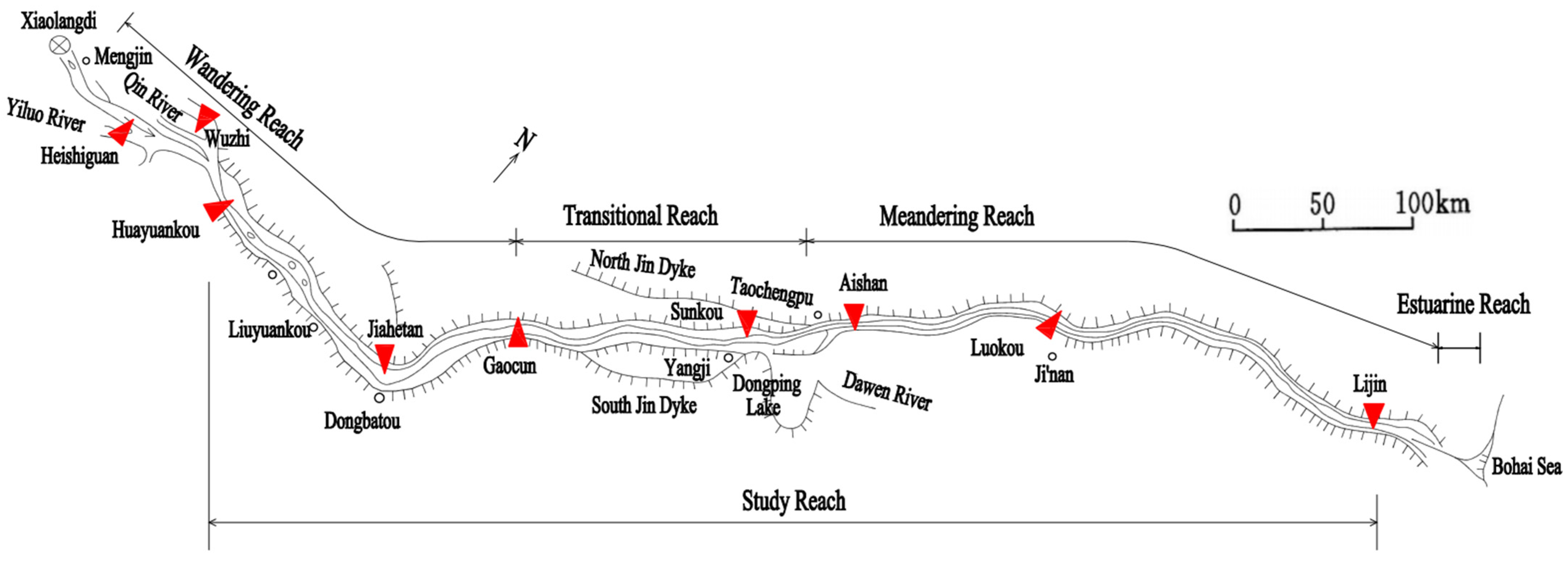
The section from Huayuankou to Lijin in the lower reaches of the Yellow River is 768 km long. According to the morphological characteristics of the river channel, it is divided into three types of river sections: wandering river section (Huayuankou-Gaocun), transitional river section (Gaocun-Aishan), and curved river section (Aishan-Lijin) (Table 1). The boundary conditions of each river type are significantly different, which directly affects the water and sediment transport and erosion and deposition response.
The data of this study cover three categories: water and sediment data, erosion and deposition data, and auxiliary data, which are all from the authoritative literature of the Yellow River Water Conservancy Commission’s “Hydrological data of the Yellow River Basin” and “Basic data compilation of riverbed evolution in the lower reaches of the Yellow River”. The distribution of hydrological stations is shown in Figure 1.
Water and sediment data: The measured data of daily flow (Q, m3/s) and sediment transport rate (Qs, kg/s) of seven key hydrological stations (Huayuankou, Jiahetan, Gaocun, Sunkou, Aishan, Luokou, and Lijin) from 1950 to 2022 were used to calculate the annual runoff (108 m3, annual daily flow accumulation) and annual sediment transport (108 t, annual daily sediment transport accumulation).
Erosion and deposition data: From 1950 to 2022, the amount of erosion and deposition in the whole section (W, 108 m3) was calculated by the ‘section method’ (the area difference in adjacent sections × the accumulation of section spacing). The positive value was deposition, and the negative value was erosion.
Auxiliary data: construction and operation parameters of water conservancy hubs such as Huayuankou and Liujiaxia. The area of soil and water conservation measures in the Loess Plateau in the middle reaches of the Yellow River is derived from the ‘China Soil and Water Conservation Bulletin’ and the water and sediment regulation frequency and parameters of Xiaolangdi Reservoir (1999–2022, discharge, water level, sediment discharge).
Although the hydrological observation period (1950—2022) spans more than seven decades, the measurement methodology for discharge (Q) and sediment transport rate (Qs) in the Yellow River has remained consistent in principle. Before the 1980s, flow and sediment data were mainly obtained through manual current meter measurements and suspended sediment sampling; since the 1990s, these have been gradually replaced by automatic monitoring and digital processing under the unified standards of the Hydrological Observation Specification of the Yellow River Basin issued by the Yellow River Conservancy Commission (YRCC). All historical data used in this study have been reviewed, corrected, and homogenized in the official YRCC archives, ensuring continuity and comparability. The frequency fitting deviation between empirical and theoretical curves (<5%) further verifies that the modernization of measurement techniques has no significant influence on the long-term statistical characteristics of Q and Qs.

2.2. Research Method

2.2.1. Construction of P-III Frequency Curve

Referring to the research results of the adaptability of sediment series to P-III type distribution, the correlation between runoff and annual sediment discharge frequency is better than that of other corresponding series [26,27,33]. Therefore, in this study, the P-III distribution was used to construct the frequency distribution of annual runoff (Q, 108 m3) and sediment transport (S, 108 t). The probability density function is
f ( x ) = β α Γ ( α ) ( x a 0 ) α 1 e β ( x a 0 )
In the formula, Γ ( α ) is the Gamma function of α; the α (shape parameter), β (scale parameter), α 0 (location parameter) are calculated by the mean X ¯ , the Coefficient of Variation CV and the skewness coefficient CS as follows:
α = 4 C s 2 β = 2 x ¯ C v C s a 0 = x ¯ ( 1 2 C v C s )
Based on the empirical frequency, the CS value (usually 2–4 times the CV) is adjusted to minimize the sum of squared deviations between the theoretical frequency curve and the empirical frequency point group, and the optimal parameters are finally determined.
The empirical frequency is calculated by the expected value formula:
P m = m n + 1 × 100 %
In the formula, m is the serial number after the sequence is arranged in descending order, and n is the number of samples. The annual runoff and sediment discharge are arranged in descending order as x 1 x 2 ≧···≧ x m ≧···≧ x n , and the m-th sample corresponds to the empirical frequency Pm.
To evaluate the sensitivity of parameter calibration, the skewness coefficient (Cs) was varied from 1.5 × Cv to 4.5 × Cv with an increment of 0.5 × Cv, and the mean square error (MSE) between the empirical and theoretical frequencies was calculated. The fitting results show that the MSE reaches its minimum when Cs ≈ 3 × Cv, and the variation in the derived λ coefficient remains within ±3.5% under this range. Therefore, adopting Cs = (2~4) × Cv ensures both high fitting accuracy and parameter stability for the runoff-sediment frequency curves.

2.2.2. Synergistic Index of Water and Sediment Frequency

The correlation coefficient ζ of water and sediment frequency is used to quantify the synchronization of water and sediment, reflecting the magnitude matching degree of annual water and sediment frequency in a long sequence:
ζ = 2 [ P ( Q ) P ( S ) ] P ( Q ) + P ( S )
In the formula, P(Q) is the empirical frequency of annual runoff (%), and P(S) is the empirical frequency of annual sediment discharge (%).
Physical meaning of ζ: When ζ tends to 0, it indicates that the magnitudes of water discharge and sediment discharge in this period are similar in the entire sequence, such as “wet year with high sediment” or “dry year with low sediment”. When ζ < 0, it means the frequency of water discharge in this period is lower than that of sediment discharge (e.g., “wet year with low sediment”), and the channel is prone to scouring. When ζ > 0, it shows the frequency of sediment discharge in this period is lower than that of water discharge (e.g., “dry year with high sediment”), and the channel is prone to silting.
The frequency relationship coefficient λ of water and sediment is further defined to characterize the quantitative relationship between P(S) and P(Q), which is used to derive the equilibrium threshold of erosion and deposition:
P ( S ) = λ P ( Q ) λ = 2 + ζ 2 - ζ
According to the research results of Li et al. (2020), the river runoff is divided into five standards (extra-high, partial-high, flat, partial-low, and extra-low) [34]. Because of the close relationship between water and sediment, the abundance of sediment transport rate can also be divided into the same categories. The results of this study are shown in Table 2.

2.2.3. Trend and Mutation Test

Mann–Kendall test was used to analyze the trend and mutation point of water and sediment, and the sliding average method was used to verify the stage characteristics.

3. Result

3.1. Stage Characteristics of Water and Sediment Variation in the Lower Yellow River

Based on the Mann–Kendall trend and mutation analysis combined with major hydrological and engineering events, the period 1950–2022 was divided into three stages reflecting the evolution of natural and human influences. Stage I (1950–1978) represents the natural fluctuation period, during which climate-controlled runoff and sediment variations dominated, and large reservoirs were yet to exert downstream effects (Sanmenxia began operation in 1960 but had limited regulation efficiency). Stage II (1979–1998) marks the initial stage of strong human interventions, corresponding to the rapid expansion of soil and water conservation projects in the Loess Plateau and the operation of the Longyangxia Reservoir in 1986, which notably altered flood and sediment regimes. Stage III (1999–2022) defines the regulation and stabilization period, coinciding with the completion and operation of the Xiaolangdi Reservoir in 2000 and the full implementation of ecological restoration programs (“Grain for Green”) that significantly reduced sediment inflow to the lower reaches.
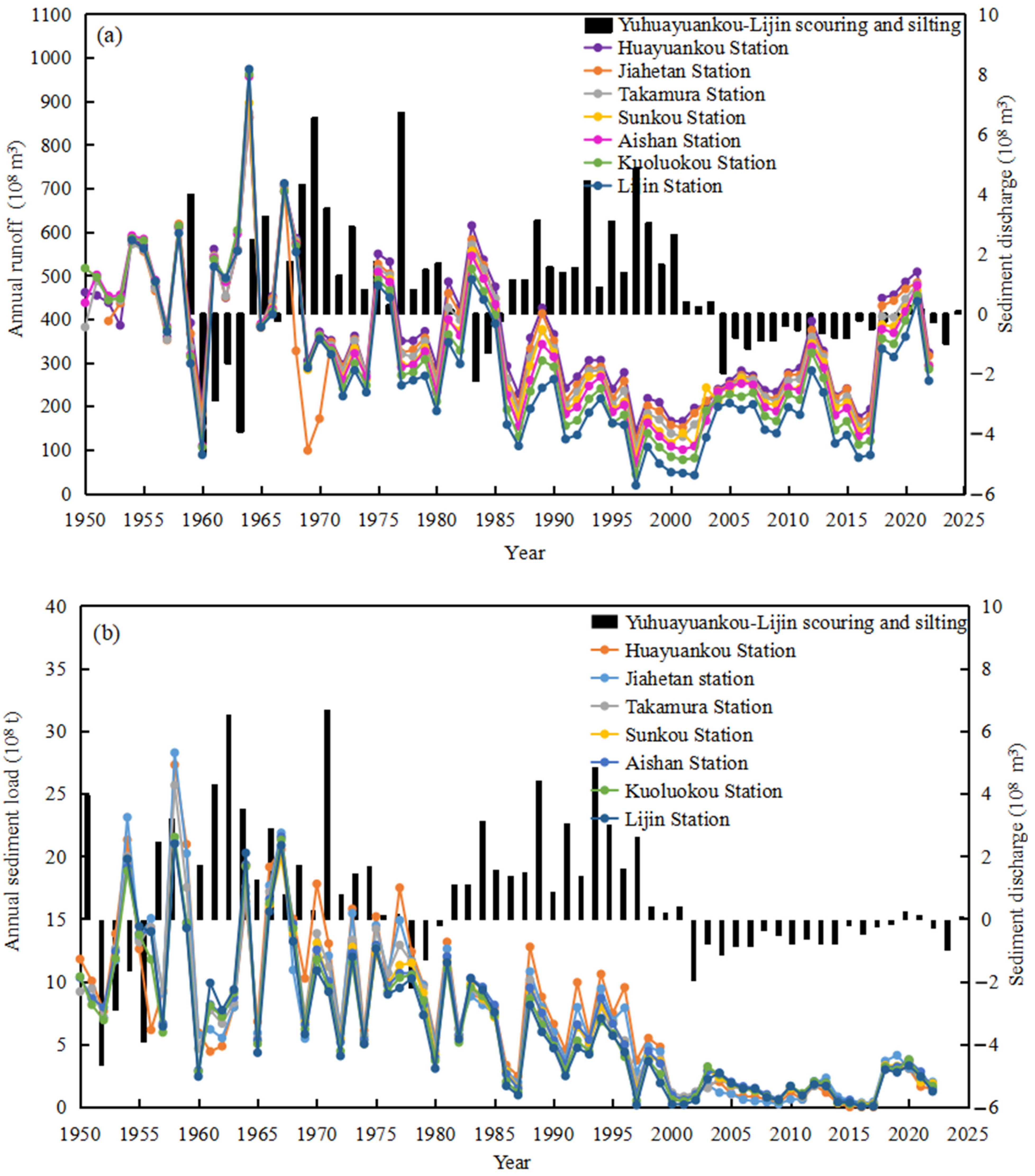
From 1950 to 1978 (a natural dominant period), the average annual runoff of Huayuankou Station was 456 × 108 m3, and the average annual sediment transport was 12.6 × 10⁸ t. The change in water and sediment was controlled by natural climate (such as the flood runoff of 1964 was 861 × 108 m3, and the sediment transport was 16.4 × 10⁸ t). At this stage, the influence of human activities was weak (only the Sanmenxia Reservoir was operated in 1960), and the erosion and deposition of the river channel were naturally balanced (Figure 2).
From 1979 to 1998 (the initial stage of human activities), the annual regulation of Longyangxia Reservoir (operated in 1986) led to a decrease in the amount of water in the downstream flood season. The average annual runoff of Huayuankou Station decreased to 343 × 108 m3 (a decrease of 24.7%), and the average annual sediment transport decreased to 7.6 × 10⁸ t (a decrease of 40.1%). The average annual deposition of the river channel was 1.45 × 10⁸ m3, and the deposition was intensified (Figure 2).
From 1999 to 2022 (a strong regulation period), soil and water conservation measures (such as terraces and small silt dams) in the middle reaches of the Yellow River began to play a role. The water and sediment regulation of Xiaolangdi Reservoir changed the water and sediment process. The proportion of low-sediment floods increased from 44.9% in 1979–1998 to 85.9%, and the process of large flow in the flood season recovered. The average annual sediment discharge at the Huayuankou Station decreased to 1.2 × 10⁸ t (a decrease of 90.0%), but after 2018, due to the optimized sediment discharge (low water level, large flow) of the reservoir, the sediment discharge increased to 2.5 × 10⁸ t/yr. At this stage, the erosion and deposition of the river channel turned into a ‘slight erosion-balance’, and the average annual erosion and deposition decreased by 0.15 × 10⁸ m3 (Figure 2).

3.2. Synergistic Law of Water and Sediment Frequency in the Lower Yellow River

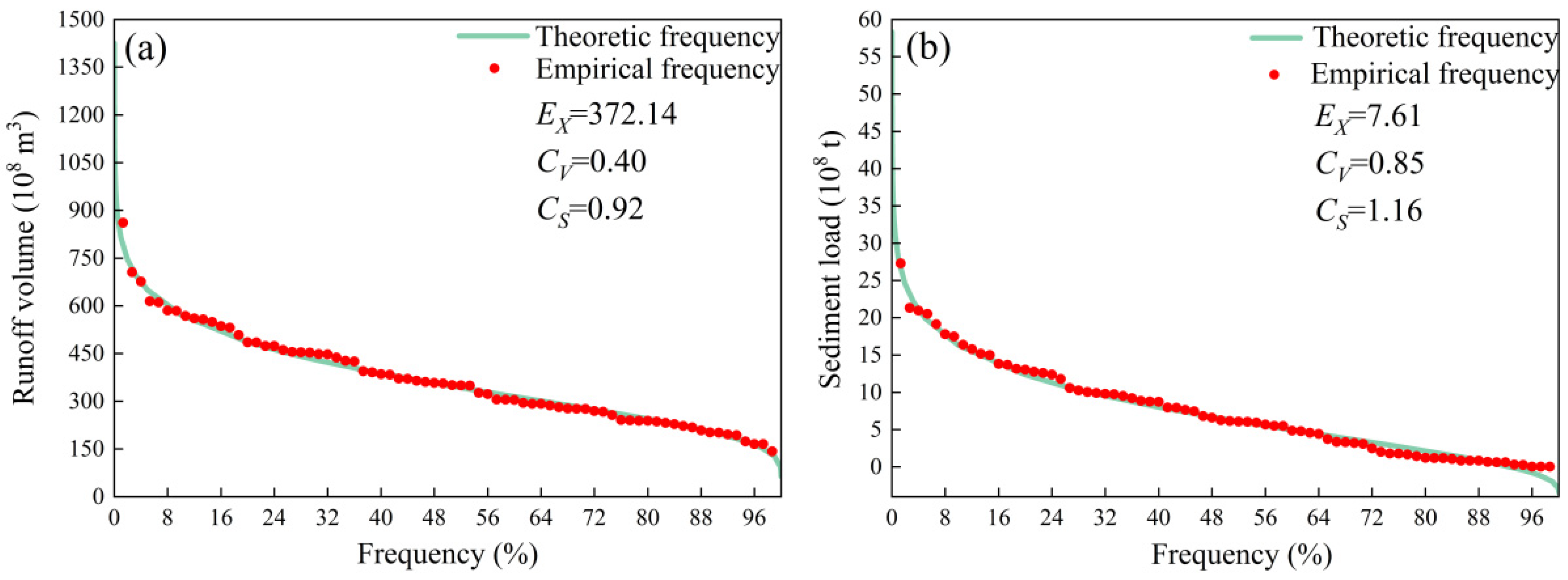
As the first key control station in the lower reaches of the Yellow River, the annual average runoff and sediment discharge of Huayuankou Station are basically consistent with the other six stations in the lower reaches, and the sequence is long and representative. Therefore, Huayuankou Station is taken as the representative station. The P-III frequency curve fitting of the runoff and sediment sequence in Huayuankou Station from 1950 to 2022 has a high goodness of fit. The average annual runoff is 372.14 × 10⁸ m3, and the deviation between empirical frequency and theoretical frequency is less than 4.5%. The average annual sediment load is 7.61 × 10⁸ t, and the deviation between empirical frequency and theoretical frequency is less than 4.8% (Figure 3). Although the relationship between river runoff and sediment discharge is affected by many complicated factors, such as flood magnitude, reservoir operation level, river gradient, sediment grain size, and source, the frequency distribution of long series shows that the frequency distribution of sediment discharge in the lower reaches of the Yellow River is similar to that of runoff. It is feasible to infer the probability distribution of sediment discharge by using the statistical characteristics of runoff.
The sediment discharge CV (0.82–0.92) was significantly greater than the runoff (0.40–0.64), indicating that the inter-annual fluctuation of sediment discharge was more intense, which was consistent with the fact that the sediment discharge of the Yellow River accounted for 60% of the whole year during the rainstorm concentration period (July–August), and the characteristics of ‘rainstorm sediment production’ led to the inter-annual fluctuation of sediment discharge. The skewness coefficient CS along the river shows a trend of ‘low in the wandering section and high in the curved section’, reflecting that the estuary section is affected by tides and seawater backing, and the frequency distribution of runoff and sediment discharge is more asymmetric (Table 3).

3.3. Response of Water and Sediment Abundance to Water and Sediment Frequency Relationship

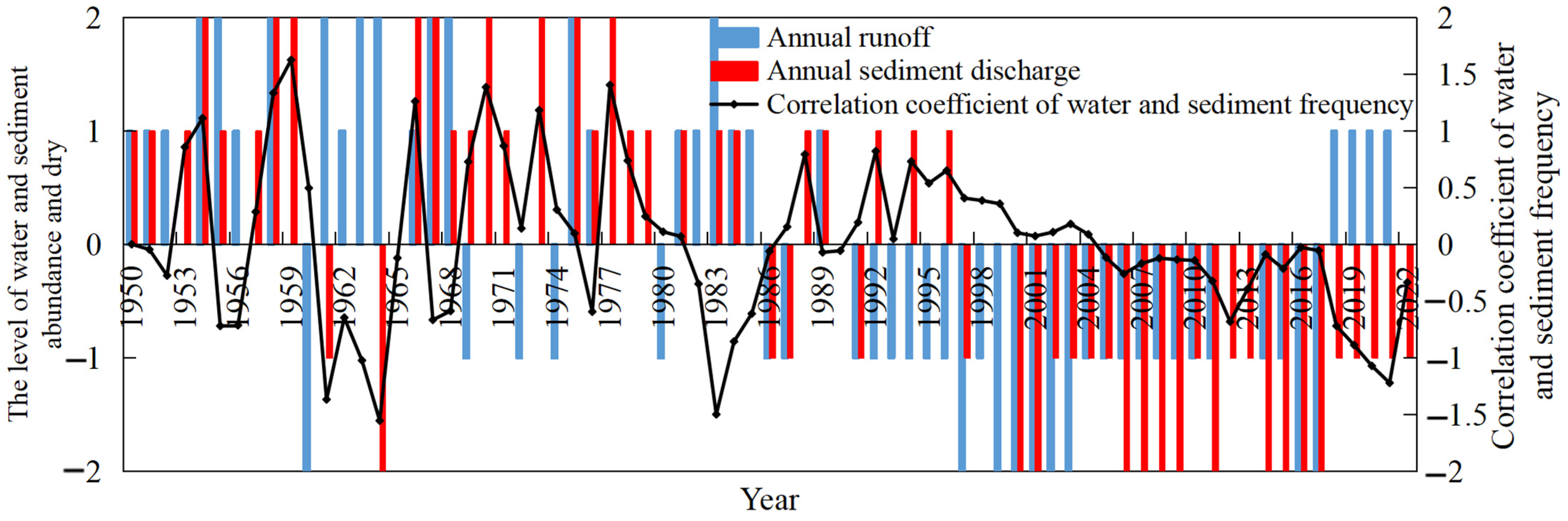
From 1950 to 2022, the flow–sediment frequency correlation coefficient ζ at Huayuankou Station and the flow–sediment series both showed a periodic fluctuation pattern of alternating wet, normal, and dry conditions. Influenced by the natural factor of “different sources of flow and sediment”, the variations in sediment abundance (wet, normal, dry) were not completely synchronized with those of flow. This process can be divided into three stages: 1958–1985 (Discordant Period), ζ fluctuated sharply between −1.56 and 1.63, and the flow–sediment relationship at Huayuankou Station was mostly characterized by the “dry (low-flow) and high (abundant-sediment)” combination. During this period, the “storing clear water and discharging sediment” operation of the Sanmenxia Reservoir reduced the flood season flow, while the sediment discharge remained at a high level, resulting in a discordant flow–sediment relationship. 1999–2017 (High Synergy Period), ζ approached 0 with an average value of −0.05, corresponding to the “low (dry) flow and low (dry) sediment” combination. Under the combined effects of sediment trapping by the Xiaolangdi Reservoir and the “grain for green” program in the middle reaches, the flow–sediment synergy reached its historical peak, and the average annual scour-silting volume in the lower reaches was −0.37 × 10⁸ m3 (minor scouring). 2018-Present (Regulation Adaptation Period), ζ dropped to −1.22 with an average value of −0.85, corresponding to the “high-flow and low-sediment” combination. As the sediment storage capacity of the Xiaolangdi Reservoir decreased, the “low-water level and large-discharge sediment discharge” operation was implemented (with a released discharge of 4000–4500 m3/s), which reduced the sediment discharge efficiency and led to scouring of the lower reaches. It can be concluded that the peak characteristics and variation trend of the flow–sediment frequency correlation coefficient ζ can serve as an effective indicator reflecting the wet-dry combination status of annual runoff and sediment discharge (Figure 4).
According to the operational statistics of the Xiaolangdi Reservoir, the effective sediment storage capacity decreased from 3.55 × 10⁹ m3 in 2000 to less than 0.9 × 10⁹ m3 by 2018, indicating a sediment deposition ratio of over 75%. To maintain sediment continuity, the discharge strategy shifted to a low-water-level and high-discharge mode, with the mean peak flow during regulation events increasing to 4000–4500 m3/s, while the mean sediment concentration declined to 12.4 kg/m3. Consequently, the flood-season flow at Huayuankou Station increased by about 35%, whereas the sediment load decreased by nearly 60%, producing a ζ value of −0.85 and indicating a pronounced “high flow-low sediment” pattern. These data confirm that reservoir capacity attenuation and discharge-mode adjustment are the primary drivers of this phenomenon.

3.4. Response of Erosion and Deposition of Different River Types to the Relationship Between Water and Sediment Frequency

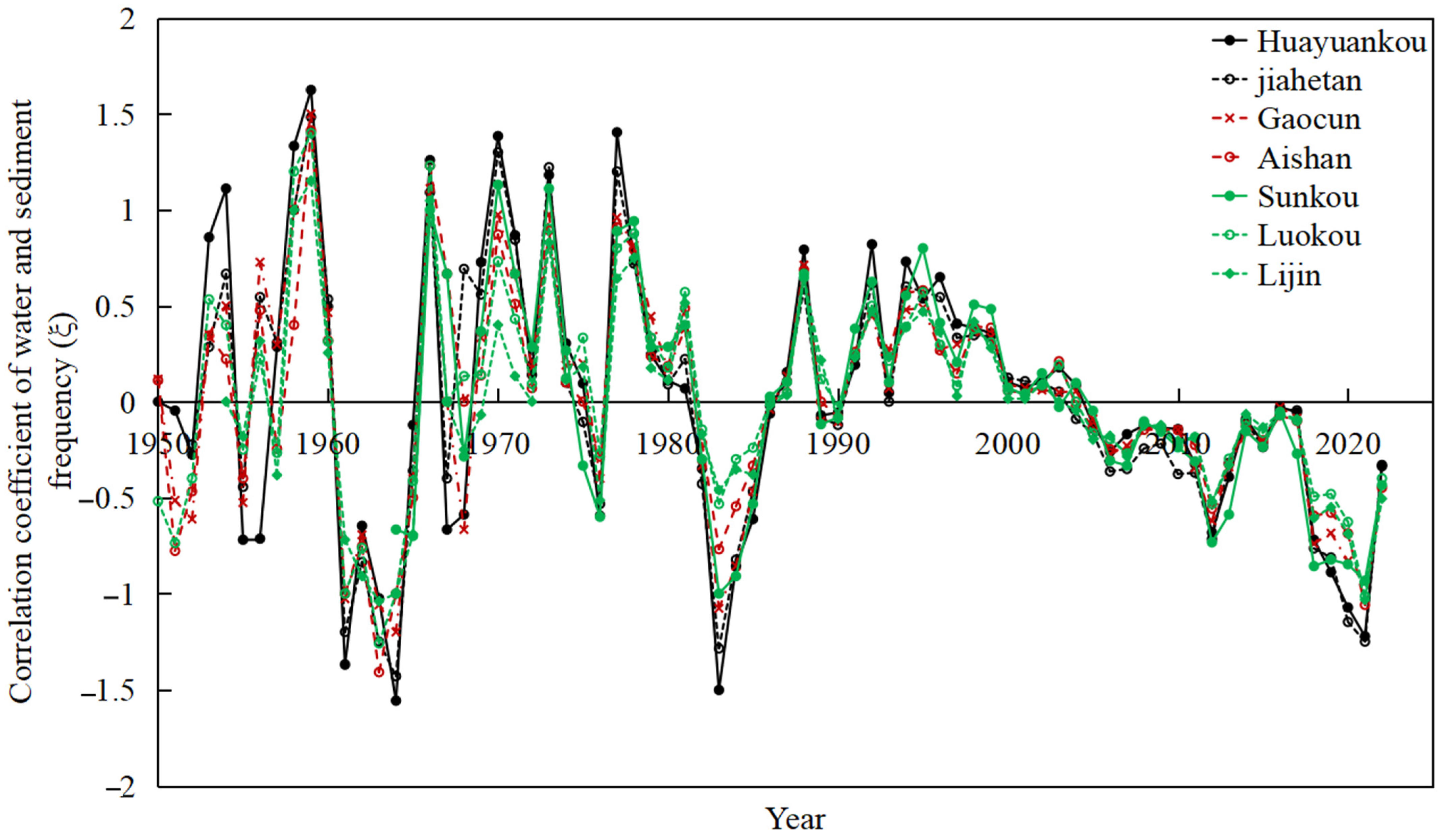
There are significant differences in the frequency synergy of water and sediment in different river types. The water and sediment synergy of the curved channel (Sunkou-Lijin) is the strongest (ζ near zero ratio of 69.23%), followed by the transitional channel (Gaocun-Aishan) (64.39%), and the wandering channel is relatively weak. The possible reason is that the wandering boundary is not fixed, the main channel is wide and shallow, the flow is dispersed, the channel slope is large, the riverbed material is coarse, and the sediment is easy to deposit. The embankments on both sides of the curved channel are strongly constrained, the water flow is concentrated, the channel slope is small, the riverbed material is fine, and the sediment transport efficiency of the channel can quickly respond to the change in water and sediment (Figure 5).
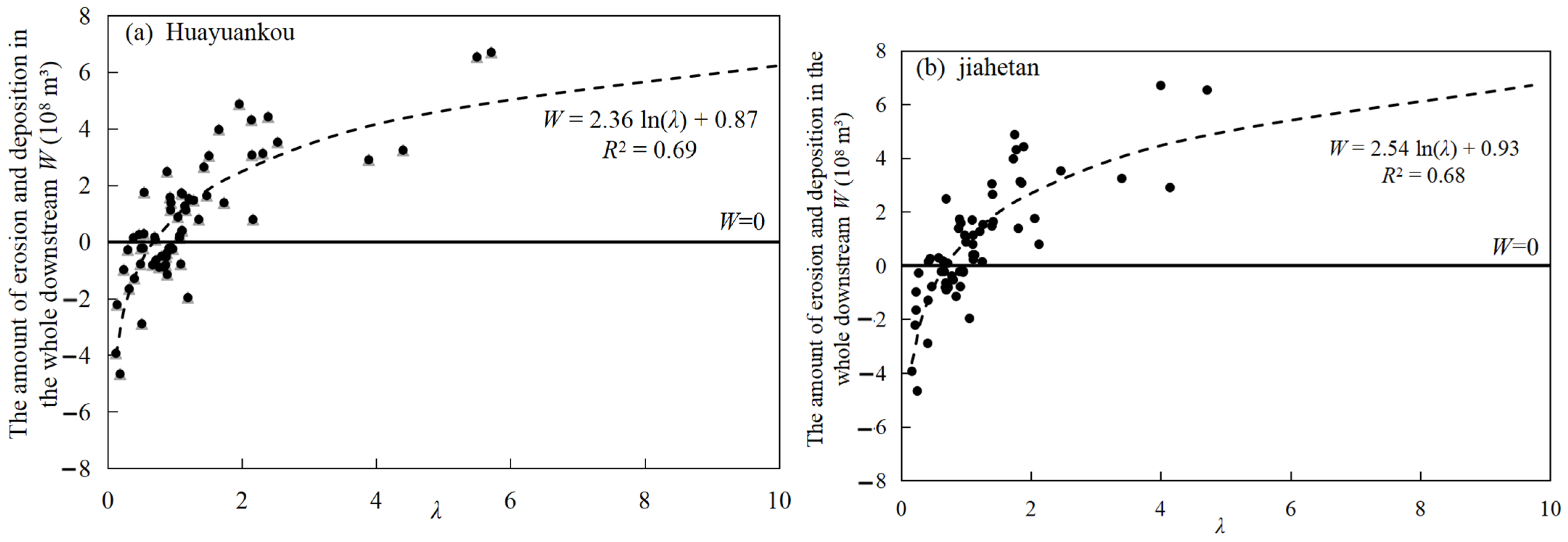
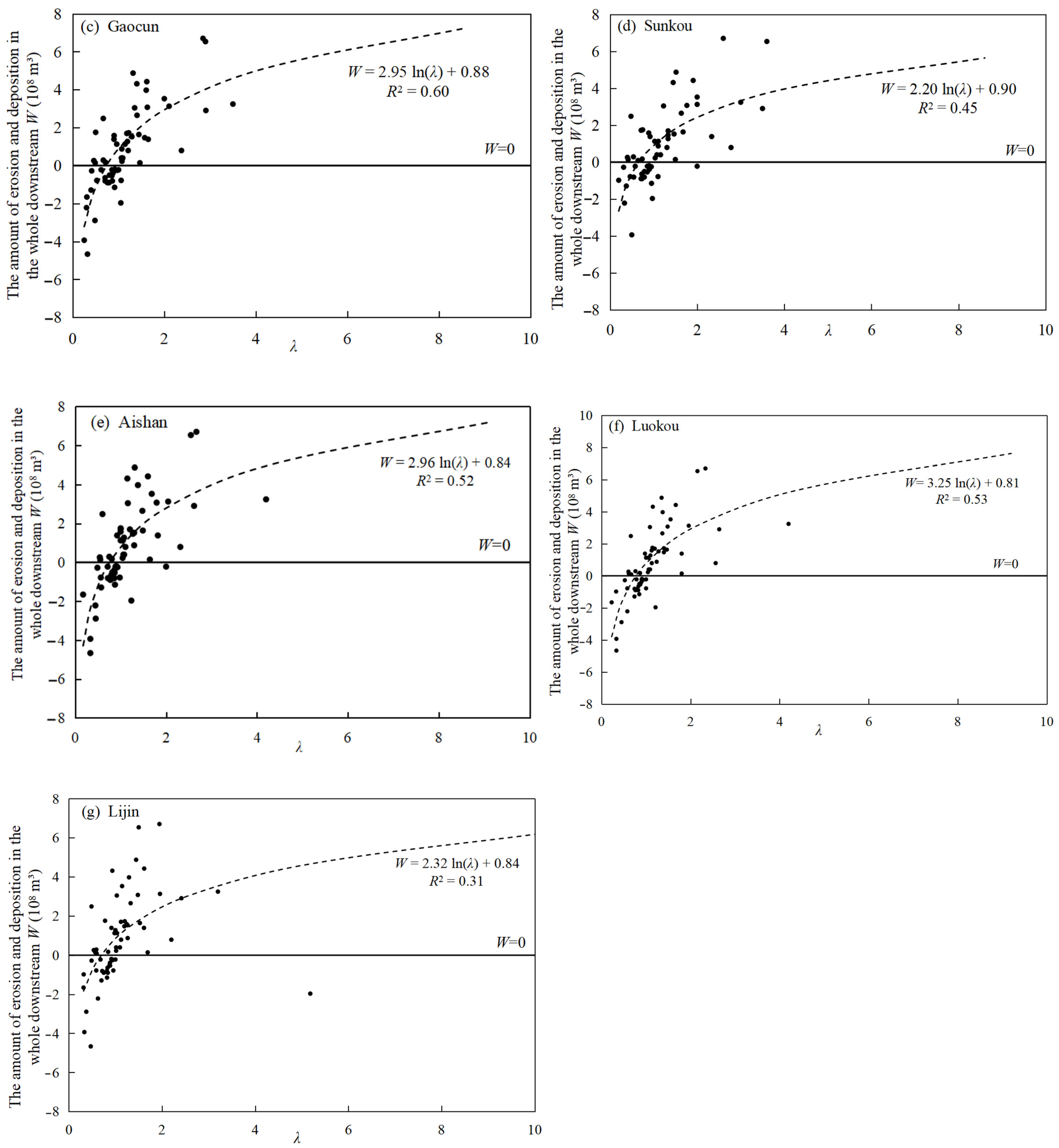
There is a significant linear relationship between the water–sediment frequency relationship coefficient (λ) of the seven hydrological stations and the total cross-section erosion and deposition (W) in the lower reaches of the Yellow River. When the whole downstream erosion and deposition is balanced (W = 0), the range of λ value is 0.664–0.779, and the mean value is 0.72, corresponding to P(S) = (0.664–0.779) P(Q), that is, when the sediment transport frequency P(S) is 72% of the runoff frequency P(Q), the overall erosion and deposition of the downstream is balanced (Figure 6).
The frequency-critical relationship is transformed into the incoming sediment coefficient (ξ = annual sediment discharge/annual runoff, kg·s/m). When P(S) = 0.72 P(Q), the corresponding incoming sediment coefficient is about 0.012 kg·s/m, which is in the range of 0.01–0.02 kg·s/m determined by Rubin et al. (2020) based on 277 flood data. The consistency between the frequency relationship and the point scale parameters is verified [24].
Comparing the ζ value and λ value of the seven stations at the equilibrium point of erosion and deposition, it is found that the river type has a significant effect on the water–sediment coordination. In the wandering section from Huayuankou to Gaocun, the ζ value fluctuates little, the λ value is low (0.692, 0.693), and R2  0.68. Due to the strong sediment transport capacity of the wandering section (the river gradient is 0.25‰), it needs a lower sediment transport frequency to be balanced. In the curved section from Aishan to Lijin, the ζ value fluctuates greatly, the λ value is high and discrete (0.696–0.779), and R2  0.5. Due to the fixed boundary of the curved section (the embankment on both sides), the erosion and deposition lag behind the change in water and sediment, and a higher frequency of sediment transport is needed to reach the balance. The transition section from Gaocun to Sunkou is between the two (R2 = 0.45–0.60), reflecting the characteristics of river type transition (Table 4).

4. Discussion

4.1. Evolution Mechanism and Frequency Synergy Characteristics of Water–Sediment Relationship in the Lower Yellow River

From 1950 to 2022, the process of incoming water and sediment in the lower reaches of the Yellow River experienced a three-stage evolution from natural fluctuation to sudden drop regulation and stability. Human activities gradually replaced climate as the dominant factor [35,36]. From the 1950s to the 1970s, changes in runoff and sediment discharge were mainly controlled by precipitation fluctuations. The flow and sediment showed the characteristic of synchronous response, i.e., “wet year with high sediment, dry year with low sediment”, reflecting a typical naturally dominated flow–sediment synergy mechanism. Since the 1980s, with the operation of reservoirs such as Longyangxia and Sanmenxia and the construction of large-scale soil and water conservation projects in the middle reaches, natural flood processes have been weakened. The flow during the wet season decreased while the sediment concentration remained relatively high, forming a discordant stage characterized by “dry year with high sediment”. Entering the 21st century, the “water-sediment regulation” project of the Xiaolangdi Reservoir and ecological measures such as the “grain for green” program have significantly reduced the sediment yield intensity of the basin. The annual sediment discharge dropped to less than 10% of that in the 1950s, the flow–sediment synergy improved remarkably, and the frequency relationship between runoff and sediment discharge tended to be stable.
Based on the analysis of P-III type frequency distribution, this study reveals that the frequency curves of runoff and sediment discharge in the lower Yellow River have similar shapes, with the deviation between empirical and theoretical values both less than 5%. This indicates that there is statistical synergy between the two under long-term series. The Coefficient of Variation (CV) of sediment discharge (0.82–0.92) is significantly higher than that of runoff (0.40–0.64), reflecting the high volatility characteristic caused by “sediment production from rainstorms”. This difference shows that the runoff process is more controlled by the climatic background, while the sediment discharge process is jointly regulated by local rainstorms and human disturbances. The flow–sediment frequency correlation coefficient ζ reveals the temporal evolution characteristics of the flow–sediment relationship: the 1960s–1980s was a discordant period characterized by “dry year with high sediment”, reflecting the interference of the “storing clear water and discharging sediment” operation on flow–sediment coupling; 1999–2017 was a high synergy period with “low flow and low sediment”, indicating that the regulation system became mature; since 2018, due to the attenuation of reservoir storage capacity and the adjustment of sediment discharge mode, the phenomenon of “high flow and low sediment” has become prominent, and the ζ value has turned negative, showing new structural changes.
In addition to reservoir regulation, land-use transformation across the Yellow River Basin has exerted a profound impact on sediment yield and transport processes during 1950–2022. Large-scale soil and water conservation projects, terrace construction, and afforestation since the late 1970s have substantially altered the underlying surface. The implementation of the Grain for Green program after 1999 accelerated vegetation recovery, increasing soil infiltration and reducing surface erosion intensity in the Loess Plateau—the main sediment source region. The area affected by soil and water conservation in the middle reaches expanded from less than 50,000 km2 in the 1970s to over 300,000 km2 after 2010, leading to a reduction of more than 80% in sediment delivery to the lower Yellow River [19]. These transformations not only explain the sharp decline in sediment discharge observed after 1999 but also underpin the improvement in flow–sediment synergy identified in this study.
Compared with the statistical studies based on sediment series by Zhang et al. (2003), this study further introduces the frequency relationship into the analytical framework of “flow-sediment probability surface”, which addresses the limitations of traditional point-scale studies [25]. The statistical relationship of P(S) = (0.664–0.779) P(Q)reveals that when the sediment discharge frequency is approximately 72% of the runoff frequency, the lower Yellow River as a whole achieves scour-silting balance, corresponding to a sediment incoming coefficient of about 0.012 kg·s/m6. This value falls within the point-scale threshold range (0.01–0.02 kg·s/m6) proposed by Kemper et al. (2024), Mahmood et al. (2022), and Rubin et al. (2020), indicating that the long-series frequency law and the event-scale flood threshold have statistical consistency [22,23,24]. This result indicates that frequency synergy analysis can not only quantify the long-term statistical laws of the flow–sediment relationship but also provide a unified framework for multi-scale threshold research. It has theoretical guiding value for the assessment of sediment transport capacity in the lower reaches and the optimization of water–sediment regulation strategies.
To further quantify the driving mechanisms behind the three-stage evolution, we summarized the contributions of key factors. First, precipitation in the middle-upper Yellow River Basin decreased by approximately 8–12% from the 1950s to the 2010s [27], corresponding to an estimated 15–20% reduction in natural runoff, which accounts for nearly half of the decline observed in Stage II. Second, the trapping efficiency of major reservoirs significantly altered sediment continuity. The cumulative sediment retention ratio exceeded 55% after the operation of Sanmenxia and Longyangxia and reached over 75% after Xiaolangdi, when its effective storage capacity decreased from 3.55 × 10⁹ m3 to <0.9 × 10⁹ m3 (2000–2018). This reservoir-induced retention explains 60–70% of the sediment reduction from Stage II to Stage III. Third, the soil and water conservation area in the Loess Plateau expanded from <50,000 km2 in the 1970s to >300,000 km2 after 2010, resulting in a basin-scale sediment yield reduction exceeding 80%, consistent with the observed 91.4% decrease in sediment load at Huayuankou. These quantitative indicators collectively confirm that the transition from the natural-dominated period to the regulation-dominated period is driven by the combined effects of precipitation decline (runoff reduction), reservoir interception (sediment retention), and ecological restoration (sediment source suppression), with human activities becoming the dominant factor after the late 1990s.
Regarding reservoir sediment management, large-scale mechanical dredging has not been routinely implemented in major reservoirs of the Yellow River Basin. Instead, sediment regulation has primarily relied on hydraulic flushing and scouring operations during the water–sediment regulation periods, particularly after the completion of the Xiaolangdi Reservoir in 2000. These operations are conducted once annually (typically June–July) under high-flow conditions to discharge accumulated sediment downstream. The Sanmenxia and Longyangxia reservoirs, due to their different storage and sedimentation characteristics, perform limited or no dredging activities. Therefore, artificial sediment removal has only a short-term local influence on sediment delivery but does not affect the long-term frequency characteristics of annual runoff and sediment discharge analyzed in this study. The high consistency (<5% deviation) between empirical and theoretical frequency curves further confirms that the results are not biased by episodic dredging events.

4.2. The Modulation Mechanism of River Type Difference on Water–Sediment Coordination and Erosion–Deposition Response

The significant differences in flow–sediment response mechanisms among different river types are important boundary conditions affecting the scour-silting evolution of the lower Yellow River. This study finds that the wandering reach (Huayuankou-Gaocun) has weak flow–sediment synergy but a sensitive response; the meandering reach (Aishan-Lijin) has high synergy but an obvious lag; and the transitional reach (Gaocun-Sunkou) falls between the two. The physical essence lies in the differences in geomorphic constraints and energy conditions of different river types. The wandering reach has a wide and shallow main channel, unstable boundaries, a rough riverbed, high flow energy dissipation, and branched flow, resulting in low sediment transport efficiency under the same discharge. However, due to its relatively large slope (about 0.25‰), the scour-silting adjustment is rapid during flood peaks. In contrast, the meandering reach is strongly constrained by dikes, with a fine riverbed and small slope (about 0.12‰). Its sediment transport capacity is significantly restricted by discharge changes, showing the typical characteristic of “scour-silting hysteresis”.
Quantitative analysis shows that the λ values corresponding to the scour-silting balance point range from 0.692 to 0.693 (R2  0.68) in the wandering reach and from 0.696 to 0.779 (R2  0.5) in the meandering reach, indicating that the sediment discharge frequency required to achieve balance is higher in the meandering reach. This difference reveals the modulating effect of river types on the flow–sediment synergy threshold: in the wide-shallow wandering reach with sufficient energy, a relatively low sediment discharge frequency can maintain channel stability, while in the constrained reach (meandering reach), a higher sediment discharge probability is required to avoid sediment deposition. This law is consistent with the research conclusion of Han Chao (2025) on the Tongguan-Lijin reach, both pointing out that the wandering reach is sensitive to flow–sediment changes and the meandering reach shows significant lag [37].
From the perspective of channel evolution, the coupling of the flow–sediment frequency relationship and river type response constitutes a dynamic system of “external input-internal regulation-morphological feedback”: the external flow–sediment input reflects the comprehensive effects of basin climate and human activities through its frequency distribution; the internal river type structure regulates the scour-silting process by changing the flow velocity field and sediment transport path; and the riverbed morphological changes, in turn, affect the flow–sediment transport in the next stage. This “synergy-feedback-re-regulation” mechanism is the key to maintaining scour-silting balance and river regime stability in the lower Yellow River.
To further enhance the physical credibility of the statistically derived frequency relationships, we conducted an implicit process-based validation by comparing our results with established hydrodynamic and sediment-transport mechanisms. First, the frequency-derived scour-silting equilibrium threshold corresponds to an incoming sediment coefficient of ~0.012 kg·s/m6, which is highly consistent with the critical values obtained from flood-event-based physical models and sediment-transport theory [27,37]. This conformity indicates that the long-term frequency method captures the essential sediment transport dynamics reflected in process-based models. Second, the spatial variation in the λ coefficient among wandering, transitional, and meandering reaches follows classical fluvial geomorphology principles—specifically the effects of channel slope, boundary confinement, and sediment mobility on sediment transport efficiency. Finally, long-term observed erosion–deposition data (1950–2022) demonstrate that variations in λ accurately track real morphological adjustments of the river channel. These comparisons confirm that, despite being statistical in form, the proposed frequency framework is physically grounded and consistent with the observed evolution of the lower Yellow River.
Future efforts should be made to develop differentiated water–sediment regulation schemes by river type based on the “flow-sediment synergy threshold”: for the wandering reach, the focus should be on erosion prevention, and the incoming sediment concentration should be moderately increased to alleviate riverbed incision; for the meandering reach, the priority should be on sedimentation prevention, and the timing of sediment regulation should be optimized to maintain channel capacity; for the transitional reach, both needs should be balanced, and the linkage between flow field regulation and ecological sediment transport should be strengthened. In addition, the results of long-series frequency analysis can also provide a probabilistic framework for the prediction of flow and sediment in the Yellow River under future climate change scenarios, supporting the quantitative prediction of river regime evolution trends.

5. Conclusions

Based on the runoff and sediment series from multiple stations in the lower Yellow River from 1950 to 2022, this study systematically reveals the phased characteristics and frequency–synergy patterns of flow–sediment evolution. The hydrological-sediment regime has undergone three distinct stages—“natural fluctuation-phased sharp decline-regulated stability”—with human activities gradually becoming the dominant driver. Compared with the 1950s, annual runoff has decreased by over 40%, and sediment discharge has declined by more than 90%, reflecting the transition from natural variability to strongly regulated conditions. Both runoff and sediment discharge conform to the P-III type probability distribution, with sediment exhibiting significantly stronger interannual variability than runoff, illustrating the “rainstorm-driven sediment production” characteristic shaped by concentrated rainfall periods.
The wet–normal–dry relationship between flow and sediment is strongly affected by reservoir regulation and ecological management, evolving from “dry year with high sediment” to “dry year with low sediment,” and eventually to the current “high flow with low sediment” pattern. The frequency correlation coefficient ζ effectively captures this transition. River-type differences also exert significant control on flow–sediment synergy: meandering reaches exhibit the highest degree of synergy, followed by transitional reaches, while wandering reaches show the weakest response.
A frequency-based threshold for scour-silting balance was established, indicating that the lower reaches tend to achieve morphological equilibrium when the sediment discharge frequency is approximately 72% of the runoff frequency (P(S) = 0.72 P(Q)), corresponding to an incoming sediment coefficient of ~0.012 kg·s/m6. This range aligns well with the event-scale critical thresholds, supporting the physical rationality and applicability of the frequency relationship.
Despite these findings, this study is limited by its reliance on annual-scale data, which cannot fully capture flood processes, short-term fluctuations, or non-stationary variations in the flow–sediment relationship. Furthermore, the influences of sediment composition, particle-size evolution, and the dynamic operation of cascade reservoirs were not explicitly incorporated. Future research should aim to develop non-stationary frequency models that integrate reservoir group operations, rainstorm-induced sediment production mechanisms, and extreme climate events; incorporate sediment grain-size dynamics and ecological sediment-demand constraints; and construct a watershed-river-estuary coupled flow–sediment evolution simulation framework. It is also necessary to explore the practical application of the P(S)–P(Q) threshold for sediment regulation and channel stability early warning. These efforts will contribute to maintaining long-term scour-silting balance and enhancing ecological security in the lower Yellow River.

Author Contributions

Conceptualization, J.C.; Data curation, S.J.; Funding acquisition, W.N.; Methodology, S.J.; Resources, S.J. and J.C.; Software, W.N. and J.C.; Supervision, S.J.; Validation, J.C.; Writing—original draft, J.C.; Writing—review and editing, S.J. All authors have read and agreed to the published version of the manuscript.

Funding

This research was funded by the National Key Research Priorities Program of China (2023YFC3209303) (Jian Shengqi) and the Henan Outstanding Youth Fund (252300421195) (Jian Shengqi).

Data Availability Statement

The data that support the findings of this study are available from the corresponding author upon reasonable request.

Conflicts of Interest

Author Wenli Niu was employed by the company Henan Yugong Engineering Planning and Design Co., Ltd. The remaining authors declare that the research was conducted in the absence of any commercial or financial relationships that could be construed as a potential conflict of interest.

References

  1. Feng, J.; Qin, T.; Lv, X.; Liu, S.; Wen, J.; Chen, J. Frequent drought and flood events in the Yellow River Basin, increasing future drought trends in the middle and upper reaches. Int. J. Appl. Earth Obs. Geoinf. 2025, 139, 104511. [Google Scholar] [CrossRef]
  2. Geng, N.; Tian, G.; Zhang, H. The spatial–temporal evolution characteristics and influencing factors of coordinated development in the Yellow River Basin: Based on the perspective of flood-sediment transport, eco-environmental, and socio-economic subsystems. Ecol. Indic. 2025, 176, 113673. [Google Scholar] [CrossRef]
  3. Cheng, Y.; Xia, J.; Fang, H.; Zhou, M.; Zhou, Z.; Lu, J.; Li, D.; Falconer, R.A.; Bai, Y. Modelling of Flood Risks to People’s Life and Property in the Lower Yellow River Under Different Floodplain Management Modes. Engineering 2025, 51, 240. [Google Scholar] [CrossRef]
  4. Tu, D.; Wang, H.; Ren, Y.; Lu, T.; Bi, N.; Wu, X.; Wang, A. Modeling of the sediment transport and deposition in the Yellow River Estuary during the water-sediment regulation scheme. Catena 2025, 251, 108806. [Google Scholar] [CrossRef]
  5. Yang, T.; Niu, J.; Fan, D.; Wang, D.; Miao, Y.; Wang, M.; Zheng, J.; Zhang, L.; Chen, X.; Berndtsson, R. Drivers of wind and water erosion for river sediments in a typical coarse sandy area in the middle reaches of the Yellow River. Sci. Total Environ. 2024, 955, 177039. [Google Scholar] [CrossRef] [PubMed]
  6. Wang, S.; Fu, B.; Liang, W.; Liu, Y.; Wang, Y. Driving forces of changes in the water and sediment relationship in the Yellow River. Sci. Total Environ. 2017, 576, 453. [Google Scholar] [CrossRef]
  7. Su, T.; Huang, H.Q.; Carling, P.A.; Nanson, G.C.; Zhang, M. Criticality in the evolution of river meanders in the Lower Yellow River in response to anthropogenic-induced hydrological regime shift. Geomorphology 2025, 488, 109942. [Google Scholar] [CrossRef]
  8. Yang, X.; Hu, Y.; Sun, Z.; Li, Y.; Xiong, H.; Li, D. Human interventions alter morphodynamics of meandering channels: Insights from decadal to pre-industrial observations in the Yangtze River. J. Hydrol. 2024, 634, 131067. [Google Scholar] [CrossRef]
  9. Wu, B.; Wang, G.; Xia, J.; Fu, X.; Zhang, Y. Response of bankfull discharge to discharge and sediment load in the Lower Yellow River. Geomorphology 2008, 100, 366. [Google Scholar] [CrossRef]
  10. Liu, Y.; Xia, J.; Zhou, M.; Cheng, Y.; Deng, S.; Miao, C. Response of braiding intensity in a braided reach of the Lower Yellow River to upstream damming. Glob. Planet. Change 2025, 253, 104911. [Google Scholar] [CrossRef]
  11. Li, J.; Li, H.; Wang, Y.; Liu, G.; Yang, F.; Wang, Q.; Li, D. Multi-objective synergy and competition relationship of water and sediment regulation of the Heishanxia reservoir in upstream of the Yellow River Basin. J. Hydrol. Reg. Stud. 2024, 56, 102045. [Google Scholar] [CrossRef]
  12. Li, W.; Qian, H.; Xu, P.; Hou, K.; Zhang, Q.; Qu, W.; Ren, W.; Chen, Y. Aeolian-fluvial interactions in the Yellow River Basin, China: Insights from sedimentary characteristics and provenance of the sedimentary sequences. J. Hydrol. 2023, 624, 129903. [Google Scholar] [CrossRef]
  13. Yan, Z.; Lei, H.; Gao, H.; Ma, T.; Yang, H.; Yang, D. Simulating the hydrological impacts of intensive soil and water conservation measures in the Yellow River basin using a distributed physically-based model. J. Hydrol. 2023, 625, 129936. [Google Scholar] [CrossRef]
  14. Qiao, S.; Yu, Y.; Wang, L.; Zhu, M.; Yang, Y. Impacts of the water-sediment regulation scheme on nutrient inputs in the Yellow River estuary and assessment of marine purification capacity. Mar. Environ. Res. 2025, 212, 107542. [Google Scholar] [CrossRef] [PubMed]
  15. Li, C.; Lu, Z.; Yan, D.; Zhang, J.; Dong, Z.; Ma, Q. Assessing spatiotemporal dynamics of water and land resources matching under dynamic environmental conditions in the Yellow River basin, China. J. Clean. Prod. 2025, 525, 146498. [Google Scholar] [CrossRef]
  16. Zhao, G.; Tian, S.; Jing, Y.; Liang, S.; Wang, W.; Chen, R.; Zhang, Y. Spatiotemporal variations in runoff and sediment load of the mainstem and major tributaries of the Yellow River Basin from the headwater to the estuary (1960–2023). J. Environ. Manag. 2025, 380, 124723. [Google Scholar] [CrossRef]
  17. Miao, C.; Ni, J.; Borthwick, A.G.L.; Yang, L. A preliminary estimate of human and natural contributions to the changes in water discharge and sediment load in the Yellow River. Glob. Planet. Change 2011, 76, 196. [Google Scholar] [CrossRef]
  18. Jiang, X.; Ming, Y.; Wang, M.; Yao, A.; Wang, X.; Gao, L. Seasonal and decadal variations in nutrients and organic carbon in the lower Huanghe River under drastically changing water-sediment regimes. J. Mar. Syst. 2025, 251, 104111. [Google Scholar] [CrossRef]
  19. Zhao, Y.; Hu, C.; Zhang, X.; Lv, X.; Yin, X.; Wang, Z. Response of sediment discharge to soil erosion control in the middle reaches of the Yellow River. Catena 2021, 203, 105330. [Google Scholar] [CrossRef]
  20. Ma, L.; Ding, D.; Wang, G.; Huang, Y.; Lv, Y.; Li, G. Analysis of the evolution of the current estuarine geomorphology of the Yellow River under 20 years of water and sediment regulation. J. Hydrol. 2025, 646, 132344. [Google Scholar] [CrossRef]
  21. Frihy, O.E.; Stanley, J.D. The Modern Nile Delta Continental Shelf, with an Evolving Recordof Relict Deposits Displaced and Altered by Sediment Dynamics. Geographies 2023, 3, 416–445. [Google Scholar] [CrossRef]
  22. Kemper, J.T.; Knox, R.; Raffae, M.; Schulz, E.; Bailey, R.; Morrison, R.R.; Wohl, E. Estimating catchment-scale sediment storage in a large River Basin, Colorado River, USA. River Res. Appl. 2024, 40, 1379–1392. [Google Scholar] [CrossRef]
  23. Mahmood, A.; Han, J.-C.; Ijaz, M.W.; Siyal, A.A.; Ahmad, M.; Yousaf, M. Impact of Sediment Deposition on Flood Carrying Capacity of an Alluvial Channel: A Case Study of the Lower Indus Basin. Water 2022, 14, 3321. [Google Scholar] [CrossRef]
  24. Rubin, D.M.; Buscombe, D.; Wright, S.A.; Topping, D.J.; Grams, P.E.; Schmidt, J.C.; Hazel, J.E.; Kaplinski, M.A.; Tusso, R. Causes of Variability in Suspended-Sand Concentration Evaluated Using Measurements in the Colorado River in Grand Canyon. J. Geophys. Res. Earth Surf. 2020, 125, e2019JF005226. [Google Scholar] [CrossRef]
  25. Salter, G.; Topping, D.J.; Wang, J.; Schmidt, J.C.; Yackulic, C.B.; Bair, L.S.; Mueller, E.R.; Grams, P.E. Reservoir Operational Strategies for Sustainable Sand Management in the Colorado River. Water Resour. Res. 2025, 61, e2024WR038315. [Google Scholar] [CrossRef]
  26. Sankey, J.B.; Caster, J.; Kasprak, A.; Fairley, H.C. The Influence of Drying on the Aeolian Transport of River-Sourced Sand. J. Geophys. Res. Earth Surf. 2022, 127, e2022JF006816. [Google Scholar] [CrossRef]
  27. Jin, X.; Hao, Z.; Zhang, J. Study on Runoff-Sediment Frequency Relationships in the Middle Yellow River. Int. J. Sediment Res. 2006, 6–13, (In Chinese with English Abstract). [Google Scholar] [CrossRef]
  28. Yan, Z.; Wang, T.; Ma, T.; Yang, D. Water-carbon-sediment synergies and trade-offs: Multi-faceted impacts of large-scale ecological restoration in the Middle Yellow River Basin. J. Hydrol. 2024, 634, 131099. [Google Scholar] [CrossRef]
  29. Liu, R.; Zhang, A.; Wang, Y.; Liu, Y. Driving responses and synergistic-competitive relationships within the complex multi-objective system of the Yellow River Basin. Sci. Total Environ. 2025, 997, 180222. [Google Scholar] [CrossRef] [PubMed]
  30. Wang, L.; Liu, L. Water-sediment synergistic relationship in the flood season in the coarse sand source regions of the loess plateau, China. J. Contam. Hydrol. 2022, 245, 103935. [Google Scholar] [CrossRef] [PubMed]
  31. Guo, W.; Jiao, X.; Huang, L.; Zhou, H.; Wang, B.; He, N.; Wang, H. Mechanism of water-soil-carbon synergistic evolution and its ecological restoration thresholds in watershed. J. Hydrol. Reg. Stud. 2025, 61, 102730. [Google Scholar] [CrossRef]
  32. Zhang, P.; Li, P.; Du, J.; Fan, Y.; Yan, W. Variations of water and sediment flux from the Yellow River estuary over decades and estuarine dynamic erosion and accumulation shifts. Reg. Stud. Mar. Sci. 2024, 77, 103605. [Google Scholar] [CrossRef]
  33. Tunio, I.A.; Kumar, L.; Memon, S.A.; Mahessar, A.A.; Kandhir, A.W. Sediment transport dynamics during a super flood: A case study of the 2010 super flood at the Guddu Barrage on the Indus River. Int. J. Sediment Res. 2024, 39, 683–701. [Google Scholar] [CrossRef]
  34. Li, X.; Gao, G.; Zhu, L.; Wang, X.; Li, H. Study on Frequency and Coordination Degree of Runoff-Sediment Relationship at Tongguan Station of the Yellow River. Yellow River 2020, 42, 47–51. Available online: https://kns.cnki.net/kcms2/article/abstract?v=dzw7IdLhHkGUoP-gAgGIrHNfKBKHlxqGszEy_8SS2ePgbFCrFhD47Wcto8pgtdAuFXl9GbzYoJXqd0DGH4mxVlPaujseGVwH9ta-OmT2AN7Wem0DIQZc5aGrjkxQlgWqEyXrBCdCAIKu_5DQr7587fyrqEJnTFdorFqauNy1ePA=&uniplatform=NZKPT (accessed on 1 December 2025). (In Chinese with English Abstract).
  35. Man, Y.; Yang, M.; Gou, X.; Wan, G.; Li, Y.; Wang, X. The characteristics and changes of the natural social binary water cycle in the Upper Yellow River Basin under the influence of climate change and human activities: A review. J. Hydrol. Reg. Stud. 2024, 56, 102079. [Google Scholar] [CrossRef]
  36. Li, H.; Ping, J.; Liu, C.; Zhang, M.; Liu, J. Changes in sediment load in the Lower Yellow River and its driving factors from 1919 to 2021. Sci. Total Environ. 2024, 946, 174012. [Google Scholar] [CrossRef]
  37. Han, C. Analysis of Water-Sediment Changes and Erosion-Deposition Characteristics in the Tongguan-Lijin Reach of the Yellow River. Yellow River 2025. (In Chinese with English Abstract). [Google Scholar] [CrossRef]
Figure 1. Planform Morphology of the Lower Yellow River Channel and Map of Key Hydrological Stations.
Water 17 03458 g001
Figure 2. (a) Runoff and Scour-Silting Volume at Each Hydrological Station in the Lower Yellow River (1950–2022); (b) Sediment Load and Scour-Silting Volume at Each Hydrological Station in the Lower Yellow River (1950–2022).
Water 17 03458 g002
Figure 3. (a) Runoff Frequency Curve at Huayuankou Station (1950–2022); (b) Sediment Load Frequency Curve at Huayuankou Station (1950–2022).
Water 17 03458 g003
Figure 4. Correlation coefficient diagram of water and sediment abundance level and water and sediment frequency at Huayuankou Station.
Water 17 03458 g004
Figure 5. Long-term variation in the water and sediment frequency correlation coefficient of 7 stations in the downstream.
Water 17 03458 g005
Figure 6. The relationship coefficient of water and sediment frequency at seven stations in the lower Yellow River and the amount of erosion and deposition in the whole lower reaches.
Water 17 03458 g006aWater 17 03458 g006b
Table 1. River pattern division and key parameters of the lower reaches of the Yellow River.
River PatternLength of Start–StopInterval (km)Channel Gradient (‰)Bending CoefficientMain Channel Width (m)Control Station
Wandering typeHuayuankou-Gaocun2060.25–0.181.1–1.31500–3000Huayuankou, Jiahetan, Gaocun
Transitional typeGaocun-Aishan1650.18–0.121.3–1.5800–1500SunKou, AiShan
Bending typeAishan-Lijin3970.12–0.081.5–2.0500–800Luokou, Lijin
Table 2. Division standard of annual water (sediment) in the lower reaches of the Yellow River.
LevelExtremely WetRelatively WetNormalRelatively DryExtremely Dry
Factor of assurance/%P < 12.512.5 < P < 37.537.5 < P < 62.562.5 < P < 87.5P > 87.5
WQ range/108 m3WQ > 545.06545.06 > WQ > 397.41397.41 > WQ > 306.44306.44 > WQ > 214.03WQ < 214.03
WS range/108 tWS > 15.0615.06 > WS > 8.448.44 > WS > 4.594.59 > WS > 0.97WS < 0.97
Table 3. Statistical parameters of P-III distribution of annual runoff and sediment discharge at hydrological stations in the lower Yellow River.
StationHuayuankouJiahetanGaocunSunkouAishanLuokouLijin
Parameter
Annual runoffMean Deviation (108 m3)372.14343.68345.05306.54332.0322.48284.4
Coefficient of Variation (CV)0.40.440.440.470.50.550.64
Coefficient of Skewness (CS)0.920.990.881.340.910.961.18
p values<0.05<0.05<0.01<0.05<0.01<0.05<0.05
R20.940.950.930.960.960.980.96
Annual sediment dischargeMean Deviation (108 t)7.617.147.005.666.796.446.14
Coefficient of Variation (CV)0.850.890.850.90.820.860.92
Coefficient of Skewness (CS)1.161.451.321.531.241.371.49
p values<0.05<0.05<0.05<0.05<0.01<0.01<0.05
R20.940.930.990.970.970.940.96
Table 4. Frequency relationship coefficient of water and sediment, and calculation of erosion and deposition in the lower reaches of the Yellow River.
StationFitting Empirical FormulaR2Balanced Point of Scouring and Silting
HuayuankouW = 2.36 ln(λ) + 0.870.69P(S) = 0.692 P(Q), ζ = −0.21
JiahetanW = 2.54 ln(λ) + 0.930.68P(S) = 0.693 P(Q), ζ = −0.20
GaocunW = 2.95 ln(λ) + 0.880.60P(S) = 0.742 P(Q), ζ = −0.17
SunkouW = 2.20 ln(λ) + 0.900.45P(S) = 0.664 P(Q), ζ = −0.22
AishanW = 2.96 ln(λ) + 0.840.52P(S) = 0.753 P(Q), ζ = −0.16
LuokouW = 3.25 ln(λ) + 0.810.53P(S) = 0.779 P(Q), ζ = −0.14
LijinW = 2.32 ln(λ) + 0.840.31P(S) = 0.696 P(Q), ζ = −0.20
Disclaimer/Publisher’s Note: The statements, opinions and data contained in all publications are solely those of the individual author(s) and contributor(s) and not of MDPI and/or the editor(s). MDPI and/or the editor(s) disclaim responsibility for any injury to people or property resulting from any ideas, methods, instructions or products referred to in the content.