Article

Comparative Screening of the Performance and Selectivity of Biochars and Zeolites as Low-Cost and Eco-Sustainable Materials for the Removal of Organic and Inorganic Contaminants from Landfill Leachate


by
Maria Concetta Bruzzoniti
1,*,
Simona Di Bonito
1,
Mihail Simion Beldean-Galea
2,
Massimo Del Bubba
3,
Vander Tumiatti
4,
Salah Karef
5 and
Luca Rivoira
1,*
1
Department of Chemistry, University of Turin, Via P. Giuria 7, 10125 Turin, Italy
2
Faculty of Environmental Science and Engineering, Babeș-Bolyai University, 30 Fântânele Str., RO-400294 Cluj-Napoca, Romania
3
Department of Chemistry “U. Schiff”, University of Florence, Via U. Schiff 6, Via della Lastruccia 3-13, Sesto Fiorentino, 50019 Florence, Italy
4
Sea Marconi Technologies, Via Ungheria, 20, Collegno, 10093 Turin, Italy
5
Department of Hydraulics, Faculty of Sciences and Technology, University of Djelfa, P.O. Box 3117, Djelfa 17000, Algeria
*
Authors to whom correspondence should be addressed.
Water 2026, 18(5), 544; https://doi.org/10.3390/w18050544
Submission received: 29 January 2026 / Revised: 23 February 2026 / Accepted: 24 February 2026 / Published: 25 February 2026

Abstract

Despite global efforts to reduce landfill use for municipal waste, many sites remain active, and older closed sites still require management, particularly regarding leachate. Landfill leachate contains varying levels of organic and inorganic pollutants, generated through biological and physicochemical processes following water infiltration. Its complex composition—including COD, inorganic macro-components, heavy metals, and xenobiotics—necessitates effective treatment technologies to enable safe discharge into surface waters. This study compares low-cost, eco-sustainable adsorbents for the removal of ammonium, trace elements (Cd, Be, Fe, Cu, Ni, Pb, Cr, As, Sn, Sb, Se), and color (as an indirect measure of organic compounds) from urban landfill leachate. In more detail, six biochars from different biomass feedstocks and pyro-gasification conditions as well as natural chabazite and synthetic zeolite 13X (FAU-type) were investigated. After characterization, biochars were characterized and adsorption performance was assessed. Removal performance was comparatively evaluated after 24 h batch contact under fixed experimental conditions. Results showed that gasified biochars achieved high removal efficiency for metals and color but were ineffective for ammonium. Instead, both zeolites demonstrated efficient ammonium removal (~50%) but were less efficient for metals, reflecting the mechanism-driven selectivity of the adsorbents studied. Finally, a principal component analysis (PCA) revealed correlations between biochar physicochemical properties and contaminant retention, providing insight into key factors governing adsorption and informing the design of sustainable leachate treatment strategies.

1. Introduction

Landfills remain one of the most widely used technologies for municipal solid disposal, although European policies increasingly aim to reduce landfilling rates and promote circular economy strategies. Beyond large-scale environmental impacts such as greenhouse gas emissions, landfills generate leachate, a complex wastewater produced by water infiltration and biological and physicochemical processes occurring within the waste mass. The quantity and composition of leachate depend on several factors, including precipitation, waste characteristics, and landfill age.
As percolating water extracts organic and inorganic contaminants from the waste, leachate discharge may pose risks to the environment (surrounding soils and water bodies) and human health. For this reason, landfill management must comply with stringent European regulations, including the Landfill Directive (1999/31/EC) [1], the Waste Framework Directive (2008/98/EC) [2], and more recent policy instruments such as the Circular Economy Action Plan (2020) [3], and the Zero Pollution Action Plan [4] which collectively aim to minimize environmental impact and protect human health.
Four main categories of pollutants are typically identified in landfill leachate: dissolved organic matter (expressed as COD or TOC), and inorganic macro-components such as ammonium, heavy metals, and organic xenobiotics.
Their concentrations depend on landfill age, waste composition, and degradation stage, with the highest pollutant loads generally observed during the early acid phase. In this phase, BOD and COD may reach extremely high levels (up to 57,000 and 152,000 mg/L, respectively), while ammonium can exceed 2000 mg/L [5].
Regarding inorganic contamination, elements commonly detected in leachate include As, Cd, Cu, Fe, Cr, Ni and Pb with concentrations ranging from µg/L to units-tens of mg/L and even higher for Fe depending on landfill characteristics [6] and rainfall [7]. Several of these elements are recognized for their toxic and carcinogenic potential, while metalloids such as Sb and Se, though less frequently investigated, may also pose environmental and health risks [8,9,10,11,12].
Due to the associated environmental and health risks, national and European legislation require proper management of landfill leachate either on-site or in wastewater treatment plants to ensure compliance with discharge limits. Consequently, various treatment strategies have been developed to reduce both organic and inorganic contaminants. These include biological processes (aerobic and anaerobic degradation) and physicochemical treatments such as oxidation, coagulation–flocculation, adsorption, and membrane technologies [13]. However, the presence of heavy metals and refractory humic substances can inhibit biological treatment efficiency, particularly in plants cotreating leachate with municipal wastewater, highlighting the need for physicochemical pretreatment and polishing steps.
Among physicochemical processes, adsorption, traditionally based on activated carbon, has proven effective for removing color, refractory organic matter, and heavy metals [14]. Advanced oxidation processes and catalyst-based degradation strategies have also been investigated for the degradation of refractory organic contaminants [15,16]. Despite its effectiveness, activated carbon is characterized by relatively high costs and energy demand, prompting the investigation into alternative low-cost materials such as natural zeolites and biochars. Zeolites are particularly effective for ammonium removal, due to their ion-exchange capacity and negatively charged framework [17]. In this context, biochar has emerged as a promising and sustainable adsorbent. Produced from biomass residues via pyrolysis or gasification, biochar exhibits tunable physicochemical properties, including surface functionality and ion-exchange capacity, strongly dependent on feedstock and production conditions [18]. Although its adsorption capacity may be lower than that of activated carbon, biochar has a favorable effectiveness–cost ratio and significantly lower production energy demand (~6 MJ·kg−1, compared to ~100 MJ·kg−1 for activated carbon [18,19].
Despite the growing interest in biochar and zeolites as low-cost adsorbents, only a limited number of studies have addressed their application to real landfill leachate. Most investigations have focused on single contaminant class, such as heavy metals [20] or ammonium alone [21], rather than providing a comprehensive evaluation that also includes organic matter removal.
In this context, the present study aims to comparatively assess six biochars produced from different feedstocks and thermal processes, together with natural and synthetic zeolites. The investigation simultaneously considers ammonium, color, as a proxy for dissolved organic matter [22], and a broad range of trace elements (Cd, Be, Fe, Cu, Ni, Pb, Cr, As, Sn, Sb, and Se) including elements such as Sn, Sb and Se that are rarely considered in this matrix despite their recognized toxicity. Principal component analysis (PCA) was applied to explore correlations between physicochemical properties and contaminant removal, providing insight into mechanism-driven selectivity. Unlike many adsorption studies conducted in simplified synthetic systems, this work evaluates adsorbent performance under realistic conditions using a complex stabilized landfill leachate, thereby offering a more application-oriented perspective on material selection.

2. Materials and Methods

2.1. Reagents and Instruments

The following reagents were used: high-purity water (18.2 MΩ·cm at 25 °C) obtained with a Milli-Q Academic system (Millipore, Billerica, MA, USA); nitric acid 65% w/w (VWR Chemicals, Milan, Italy); hydrogen peroxide 30% w/w, sodium hydroxide, and sodium chloride (Sigma-Aldrich, St. Louis, MO, USA).
For ammonium determination, a 28% ammonium hydroxide solution (VWR Chemicals, Milan, Italy) and an ammonium Test (Photometric Method 0.010–3.00 mg/L NH4-N Spectroquant®, Supelco, Merck, Darmstadt, Germany) were used, measuring the absorbance of the adduct at 690 nm using an Agilent Cary 60 UV-Vis (Agilent Technologies, Santa Clara, CA, USA).
For color determination, a color 500 Pt-Co Total Color Unit (TCU) standard certified reference material was employed for calibration (Hach, Loveland, CO, USA). Spectra were acquired on an Agilent Cary 60 UV-Vis, measuring the absorbance at 455 nm.
For trace elements quantification a rhodium ICP internal standard, 10 mg/kg in HNO3; antimony ICP standard 999 mg/L in HNO3; tin ICP standard 1000 mg/L in HNO3; iron ICP standard 1000 mg/L in HNO3, all from Sigma Aldrich (USA); Whatman No. 5 qualitative filter paper (Sigma-Aldrich, St. Louis, MO, USA); multi-element ICP standard: As, Be, Cd, Cr(VI), Hg, Ni, Pb, Se, 100 mg/L in HNO3 (Merck, Darmstadt, Germany) were used.
A Discover® SP-D system (CEM Corporation, Matthews, NC, USA) was used for the microwave digestion of the landfill leachates, and a PerkinElmer Elan 6100 ICP-MS (PerkinElmer Inc., Waltham, MA, USA)was used for element determination. A Cyberscan pH 2100 (Thermo Fisher Scientific, Waltham, MA, USA) was used for pH measurements.

2.2. Landfill Leachate

Landfill leachate was collected from a closed municipal solid waste landfill in Piedmont, Italy, in October 2020. The waste is classified as “stabilized”, having reached the stable methanogenic phase. The leachate reflects the characteristics of mature landfill effluent, typically exhibiting lower biodegradability but containing residual ammonium, dissolved organic matter, and trace metals. After sampling, the leachate was autoclaved at 120 °C to reduce microbial content, then stored at −5 °C before removal experimental tests. Before treatment with the selected sorbents (i.e., biochars and zeolites), the leachate was filtered with qualitative filter paper and the pH was measured. The content of trace elements, ammonium, and color was preliminarily assessed as described below (see Section Release of Trace Elements).

2.3. Biochars

Six biochars produced from different vegetal feedstocks and by pyrolysis or gasification were provided by local manufacturers. While an extensive structural characterization of selected biochars has been previously reported [23], the present work focuses on functional parameters directly linked to adsorption processes in aqueous systems, allowing consistent comparison among materials produced from different feedstocks and thermal treatments. To properly drive and understand the removal mechanisms, the following parameters were hence determined according to Castiglioni et al. [23]: pH of point zero charge (pHpzc), iodine index, and ash content (Table 1). The pHpzc indicates the surface charge of the sorbent relative to the pH of the contacting solution (here, the leachate): when pHpzc < solution pH the surface is negatively charged; when pHpzc > solution pH it is positively charged. The iodine index expresses the capacity to adsorb micropollutants through micropores and is fundamental for evaluating sorbent performance [24]. Ashes represent the inorganic fraction of the biomass (mainly Si, Al, Fe, Ca and small amounts of Mg, Na, K); high ash content usually reduces adsorption activity [25]. For all biochars, the release of trace elements was also assessed at the three solid-to-liquid ratios used for the removal tests (0.01, 0.03, and 0.07), using the same experimental conditions detailed in the Section 2.5 below.
Before use, all biochars were repeatedly washed with ultrapure water and oven-dried at 60 °C for 24 h.

2.4. Zeolites

For the removal experiments, two zeolites were used: a chabazite (65% purity, powder; containing traces of other minerals such as phillipsite, sandine, augite, illite, mica, biotite) and a zeolite X with average particle size 2 µm (Molecular sieves 13X, Sigma-Aldrich, St. Louis, MO, USA).
Before using, both zeolites were subjected to two activation procedures (i.e., by 0.1 M NaCl and 0.1 M NaOH) to improve removal capacity as described by [26]. The NaCl treatment converts the zeolite to sodium form, favoring exchange of pre-existing cations with Na+. Given zeolites’ low affinity for Na+ in the presence of other metals, cation exchange is promoted. The alkaline treatment adjusts the textural properties (pore size and specific surface area), enhances the adsorption capacity, selectivity and accessibility, produces mesoporosity and enriches the Al content, thus improving the acidic properties of the natural zeolites.
For activation, zeolites were dispersed with NaOH or NaCl solution for 24 h under stirring (300 rpm) and filtered through paper filters Whatman No. 5. Finally, zeolites were oven-dried at 60 °C for 24 h.

2.5. Removal Tests

The present work represents a comparative screening under defined contact time rather than an equilibrium study. Removal tests for the target analytes from filtered leachate were carried out by batch experiments. For both sorbents, 50 mL of leachate were put in contact with the selected amounts for 24 h under constant agitation (300 rpm). The 24 h contact time was selected based on the literature evidence indicating that biochar- [27] and zeolite-based [28] adsorption systems in wastewater matrices typically approach pseudo-equilibrium within 12–24 h under batch conditions.
The experimental design was intended to allow a comparative assessment of adsorbent performance under identical operational conditions in a real and complex leachate matrix, rather than to derive adsorption kinetic or isotherm parameters. Afterward, samples were vacuum-filtered (Whatman No. 5) and stored at 4 °C until analysis by ICP-MS (trace elements), and spectrophotometry (ammonium ion and color). Trace elements released by sorbents were determined by contact with 50 mL of ultrapure water for 24 h at 300 rpm.
Biochars. Adsorption experiments were conducted using three solid-to-liquid (S/L) ratios selected based on current literature [29,30] to maximize the removal of contaminants: 0.01, 0.03, and 0.07 (corresponding to 0.5, 1.5, and 3.5 g).
Zeolites. Adsorption tests were conducted using only the highest S/L ratio (0.07), identified as the optimal condition for achieving highest adsorption observed after 24 h in the biochar experiments.

2.6. Analytical Protocol for Determination of Target Compounds

Trace elements, ammonium and color were determined according to the procedure listed hereafter. Limits of detection (Table S1 of the Supplementary Materials) were calculated via linear regression curve through the following equation:
L O D , L O Q = k × σ y m
where k is the Kaiser constant (3.3 for LOD; 10 for LOQ), σy is the standard error of y (signal intensity in ICP-MS for metals or absorbance in spectrophotometry for ammonium and color), and m is the slope.
Trace elements. Cd, Be, Fe, Cu, Ni, Pb, Cr, As, Sn, Sb, Se in leachate were determined by ICP-MS after acid digestion assisted by microwaves. A 5 g aliquot of leachate was added with 5 mL HNO3 (65% w/w) and 2 mL H2O2 (30% w/w) and digested under the conditions summarized in Table S2 of the Supplementary Materials. Samples were then filtered (Whatman No. 5) and diluted to 50 mL with ultrapure water. Quantification used an internal-standard method (rhodium at 10 µg/L). Ten-level calibration curves were prepared at 0.2, 0.25, 0.3, 0.5, 1.0, 2.5, 5, 10, 15, 20 µg/L.
Ammonium. Initially, leachate samples were diluted 1:1000 with ultrapure water and analyzed for ammonium content under strong alkaline conditions for hypochlorite through commercial kits, in accordance with EPA Method 350.1 [31]. Under these conditions, monochloramine is formed which in turn reacts with tymol to form indophenol blue, that exhibits maximum absorbance at 690 nm. A five-point calibration (0.1, 0.5, 1.0, 2.0, 2.5 mg/L) was prepared from a 28% ammonium stock.
Color. As a proxy for dissolved organic matter, color was determined by the platinum–cobalt standard method (Hazen units; Hach 8025) [32,33] using as the reference a 1 mg/L Pt-Co solution in HCl that corresponds to 1 Total Color Unit (TCU). Before measurement, leachate was diluted 1:50. Spectra (200–600 nm) were acquired on an Agilent Cary 60 UV-Vis; the absorption maximum was at 455 nm. A five-level calibration (25, 50, 100, 200, 500 TCU) was prepared from the 500 TCU standard.

2.7. Determination of Removal Yields

Percentage removal (R%) of metals, ammonium and color by biochars and zeolites was calculated as:
R   % = 1 C T C R   C N T × 100
where CT is the concentration of metals/ammonium/color measured in treated leachate, CR is the concentration released by the material into water (if any), and CNT is the concentration measured in untreated leachate (see Section 3).

2.8. Chemometric Treatment

Principal component analysis (PCA) was used to process (i) percentage removal yields for trace elements, ammonium and color; (ii) the biochar solid/liquid ratio; (iii) production features; and (iv) physicochemical properties (pHpzc, ash content, iodine index). Loadings indicate the contribution of each original variable to the principal components, and the angles between loading vectors describe correlations (~90° = uncorrelated; ~180° = anti-correlated; ~adjacent = strongly correlated). Scores represent objects (biochars), grouped by mass used (0.5, 1.5, 3.5 g). PCA was created using Xlstat software (2019.2.2 version).

3. Results

Before performing the adsorption experiments, the leachate was characterized (Table 2).
The alkaline pH, and indeed high ammoniacal nitrogen observed, are consistent with advanced degradation of readily degradable organic matter (e.g., amino acids) and subsequent fermentation/hydrolysis reactions, confirming that the system has well surpassed the initial acetogenic and methanogenic phases [34].
Trace elements concentrations match the literature values for stabilized leachates [35], except for Cr and Ni, which are above average. The most abundant metals identified here are Fe, Cr, and Ni, which is consistent with inputs from metallic components (e.g., steel and alloyed materials), household and construction debris, pigments, and combustion residues commonly found in municipal-solid-waste streams [36].
Ammonium levels are also consistent with landfills aged 20–50 years (stabilized leachate) [37]. Considering that ammonium is among the most hazardous wastewater pollutants, due to its contribution to eutrophication and ecological degradation [38], its removal is highly desirable. This requirement is further reinforced by current European water-quality policies, e.g., the Directive (EU) 2024/3019, the recast of the Urban Waste Water Treatment Directive and the Nitrates Directive (91/676/EEC), as part of the broader EU regulatory framework aimed at preventing nitrogen-related pollution in both surface and groundwater.
Sampling season contributes to analyte concentration variability. In this case (early autumn), the onset of a rainier season suggests dilution effects due to the fact that October 2020 featured an anomalously high rainfall total (≈202 mm), in the landfill area, due to a major storm event on 2 and 3 October [39]. Notably, even at the methanogenic stage, some analytes in this leachate remain too concentrated for sewer discharge under Italian law: Fe and Se, and ammonium exceed the respective limits (4000 and 30 µg/L for Fe and Se; 30 mg/L for ammonium) [40]. During drier summer periods, concentrations may increase further, potentially pushing more metals over regulatory limits, thus reinforcing the necessity of pretreatment prior to discharge in the environment or before entering the biological treatment in a wastewater treatment plant.
As regards Cd and Be, they were detected at very low levels relative to other elements, making the removal difficult to assess; hence, they were excluded from subsequent yield calculations.

3.1. Leachate Remediation

The performance of biochars and zeolites in the treatment of leachate was compared. For its intrinsic nature, biochar can become a source of metals, hence the concentrations of metals released by biochar (CR in Equation (2)) were preliminarily assessed. These concentrations were subtracted for the subsequent calculation of the percentage removal R according to Equation (2).

3.1.1. Biochar

Release of Trace Elements
The presence of trace elements in biochars depends on the feedstock from which biochars are produced. Biochars derived from wood and pruning residues are generally expected to contain fewer metals than those derived from sludge [41] and, overall, release is hindered by precipitation and vitrification phenomena occurring during pyrolysis [42].
In our tests, all biochars exhibited trace elements release even if they were always below 7% of the content in leachate. In detail, BC2, BC3, BC5, and BC6 showed percentage releases below 5% for all metals. BC1 exhibited a 7% release for As only for the 3.5 g dose; BC4 showed Fe release values of 6% (0.5 g), 7% (1.5 g), and 7% (3.5 g). According to the release data obtained, no apparent correlation could be established between the amount of biochar used and the concentration of metals released.
Removal of Color, Trace Elements and Ammonium
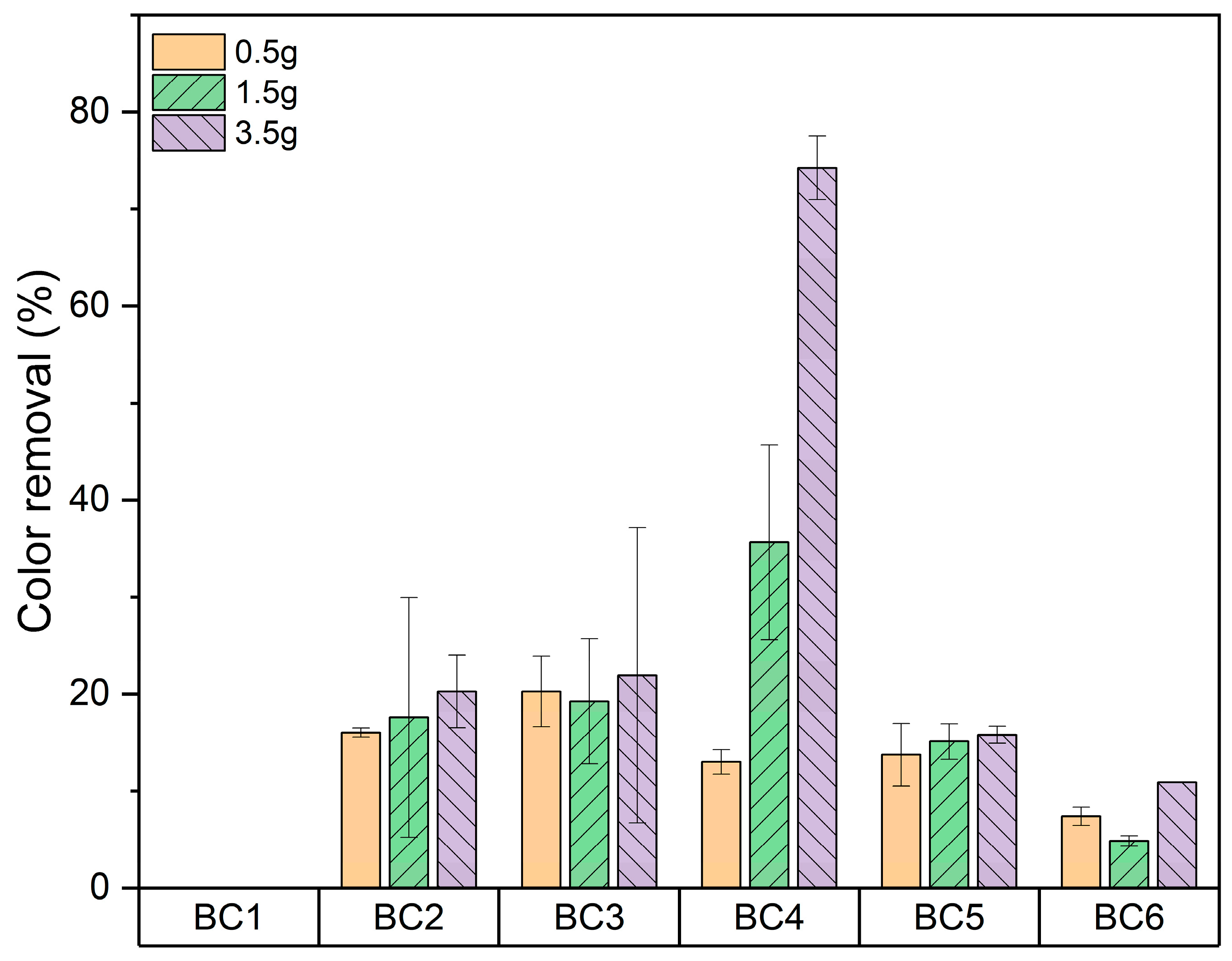
Color. Figure 1 shows the percentage removal yields for color after contact with different amounts of biochar.
Color removal generally increased with increasing adsorbent dosage. Among the three masses tested, 3.5 g resulted in the highest removal observed after 24 h contact under the tested conditions, with color removal reaching up to 73% for BC4. This trend is consistent with previous studies reporting enhanced pollutant removal with increasing biochar dosage, due to the greater availability of adsorption sites [30].
Under the selected experimental conditions and 24 h contact time, BC4 exhibited the best performance at the optimal solid-to-liquid ratio (0.07, corresponding to 3.5 g in 50 mL). In contrast, BC6 showed the poorest performance, under the same conditions. These differences are apparently consistent with their iodine indices, which reflect surface area and microporosity: BC4 showed the highest value (155 mg/g), whereas BC6 had the lowest (68 mg/g). Color, used here as a proxy for organic matter, was most effectively removed by BC4, with removal efficiencies exceeding 75%, followed by BC5 (approximately 60%) at the highest solid-to-liquid ratio. The adsorption of humic substances onto biochar is commonly attributed to π–π interactions. BC4, produced via gasification at higher temperatures, likely underwent surface transformations that increased aromaticity and pore volume, thereby enhancing physical adsorption. This may explain its superior performance compared with pyrolysis-derived biochars. The combined effect of aromatic structures, hydrogen bonding, pore filling, and the high iodine (and methylene blue [23]) index of BC4 likely promoted organic matter adsorption, in agreement with previous findings [18,43].
The interpretation of the better performance of BC5 among the biochars obtained by pyrolysis is not straightforward. In particular, the performance of BC5 and BC6 in color removal differed markedly; BC5 and BC6 exhibited comparable iodine indexes and a surface that is negative for BC5 (enhancing repulsion with deprotonated chromophoric organic matter, via -COOH groups) and almost neutral for BC6.
Temperature and feedstock can better explain the different performances in color removal. In more detail, the higher pyrolysis temperature used for BC6 (550 °C) may have increased carbon aromaticity but reduced oxygen-containing functional groups, weakening hydrogen-bonding interactions that are critical for the adsorption of colored organic compounds. Conversely, BC5 produced at 450 °C likely retained a more heterogeneous surface chemistry, enhancing its affinity for chromophoric molecules via -OH groups not dissociated.
Feedstock-related differences may have also contributed, as corn cob–derived biochar (i.e., BC5) is known to develop more accessible pore structures compared with woody biomass [44]. Finally, the slightly higher ash content of BC6 may have partially blocked pores or competed with organic matter for adsorption sites. Overall, these results highlight that color removal is governed by a combination of surface chemistry, pore accessibility, and solution chemistry, rather than by specific surface area alone.
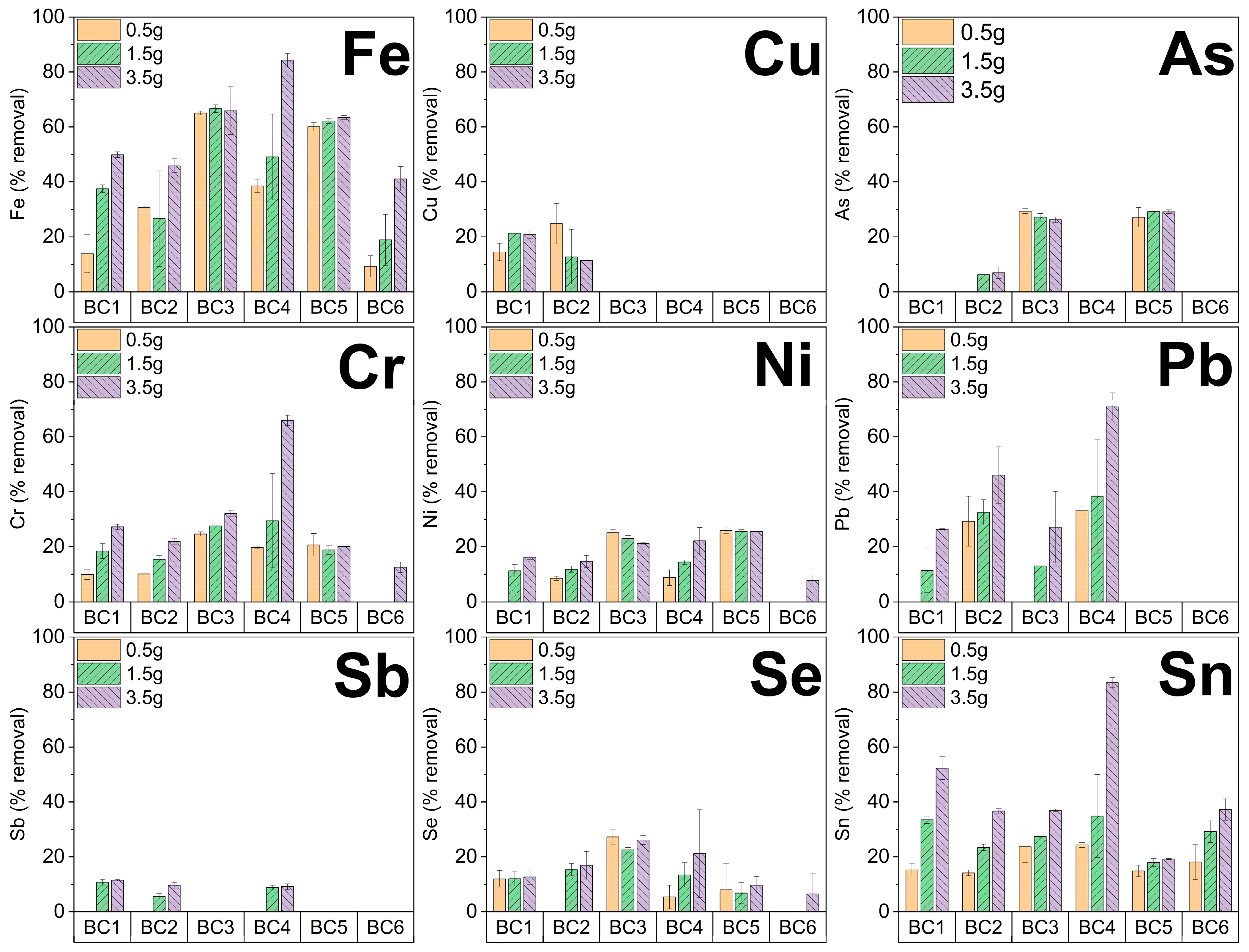
Trace elements. Figure 2 shows the percentage removal yields for trace elements after contact with different amounts of biochar.
To better interpret metal(metalloid)–biochar interactions, speciation in landfill leachate was considered. Trace elements in leachate are typically distributed among colloidal forms, organic and inorganic complexes, and free ions, with the free ionic fraction generally accounting for less than 10% of the total concentration [45]. As a result, purely electrostatic interactions are unlikely to dominate trace element removal, which instead depends on the specific metal, the nature of organic matter, and the inorganic composition of the leachate.
Consistent with this interpretation, no clear correlation was observed between biochar surface charge and trace element removal. For instance, BC3 despite not carrying a surface charge, adsorbed As, which is typically present as negatively charged species, while showing limited affinity for Pb and Ni. This suggests that interactions involving colloids and elements complexes play a major role in adsorption mechanisms.
Iron was the most efficiently removed metal across all biochars, with a maximum removal of 84.26% achieved at 24 h by BC4, followed by BC3 and BC5 (both approximately 65%). Significant removal was also observed for Cr and Sn, again with BC4 showing the highest efficiencies (65.96% for Cr and 83.45% for Sn), while BC3 removed approximately 32% of Cr.
Overall, Fe, Cr, and Sn were the most effectively retained trace elements, particularly by BC4, BC3, and BC5. Given the differences in surface charge among these biochars, again, electrostatic interactions alone cannot explain the observed behavior. Notably, the same biochars also showed higher affinity for organic matter, suggesting that Fe, Cr, and Sn may predominantly occur as colloidal species or organic complexes in leachate. This interpretation is consistent with the literature for Fe [46] and other metals like Cr [45]. As this is the first study to investigate Sn removal from leachate, a similar speciation behavior is hypothesized for tin.
In contrast, Cu, As, and Sb were not significantly removed. The limited removal of Cu contrasts with some literature reports but can be explained by the higher pH of the leachate tested here (9.5), compared with lower pH conditions (≈5.1) reported in studies showing effective Cu adsorption [30]. Speciation studies in leachate indicate that As often occurs in large inorganic colloids, potentially limiting access to biochar pores. Moreover, higher As removal has been reported for biochars produced at lower temperatures [47], consistent with the poor performance of BC4 and the partial removal capabilities observed for BC5 (produced at 450 °C). Sb is known to have low affinity for humic substances in aqueous media, excluding for Sb a key adsorption pathway that appears to be relevant for other metals.
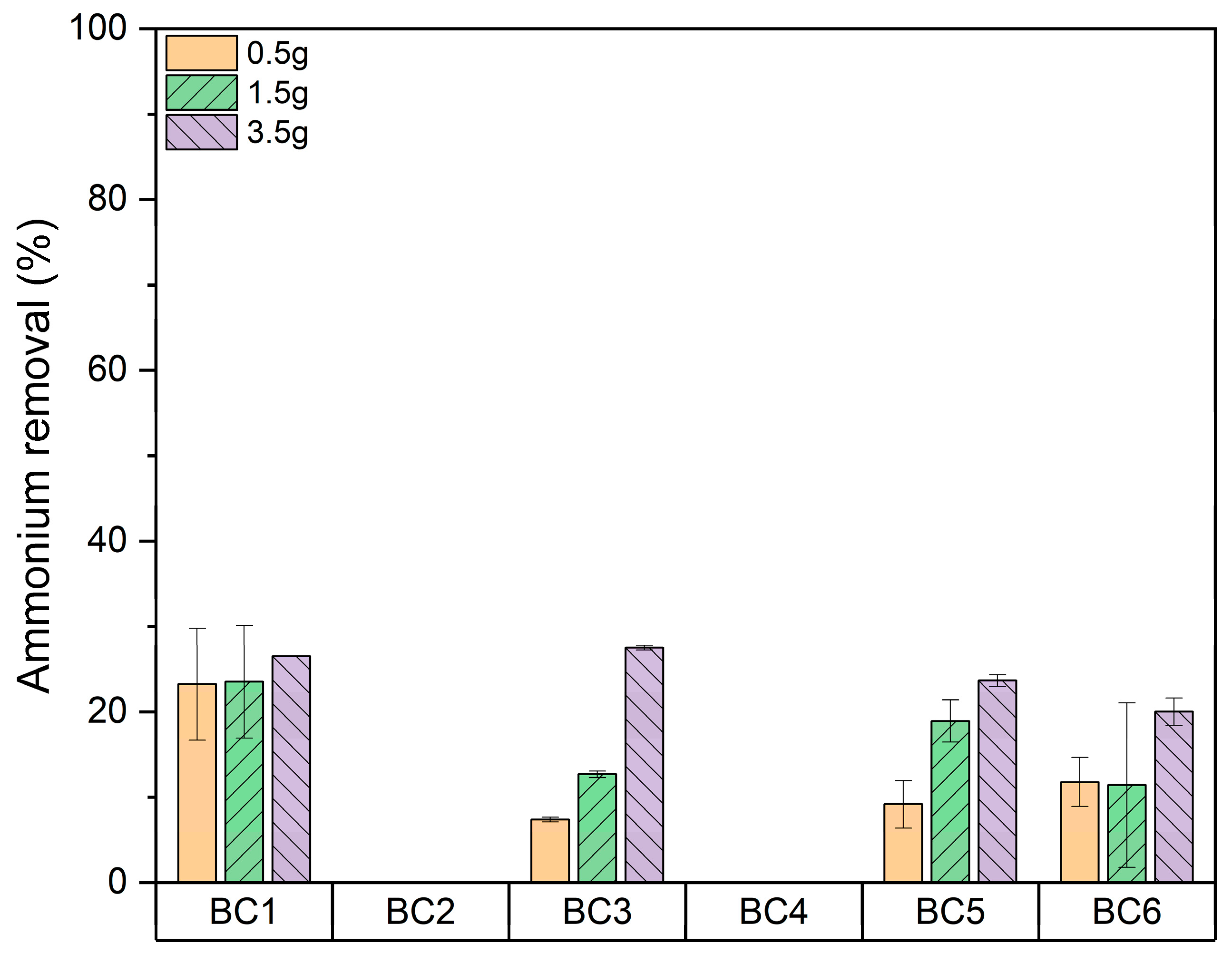
Ammonium. A fair removal of ammonium by the biochars was observed (Figure 3). For this species, pH is a key parameter since it determines both biochar surface charge and ammonium speciation. At the leachate pH value (pH = 9.5), close to the pKa of ammonium, only about half the species is present as the charged NH4+ form, with the neutral NH3 becoming predominant. Given that ammonium adsorption decreases markedly at pH > 8 [48], and that its removal by biochar is mainly governed by ion exchange between NH4+ and surface cations as well as electrostatic interactions with negatively charged functional groups [49], these mechanisms help explain the low yet detectable ammonium removal observed for negatively charged biochars.
BC4, overall the best adsorbent for color and trace element removal (average removal efficiency of 50%), did not perform for ammonium, likely due to electrostatic repulsion and, importantly, to the loss (at high production temperature) of functional groups involved in the interaction with ammonium. Conversely, BC1 (also positively charged) performed better than BC4 for ammonium, plausibly because its lower pyrolysis temperature preserved more functional groups enabling van der Waals interactions or hydrogen bonding with ammonium.

3.1.2. Zeolites

Removal of Color, Trace Elements and Ammonium
Leachate purification was also studied using chabazite and zeolite X which underwent different activation methods (see Section 2). As no significant differences were observed between the two activation methods, only the NaCl-activated results are reported, as NaCl is safer and more sustainable.
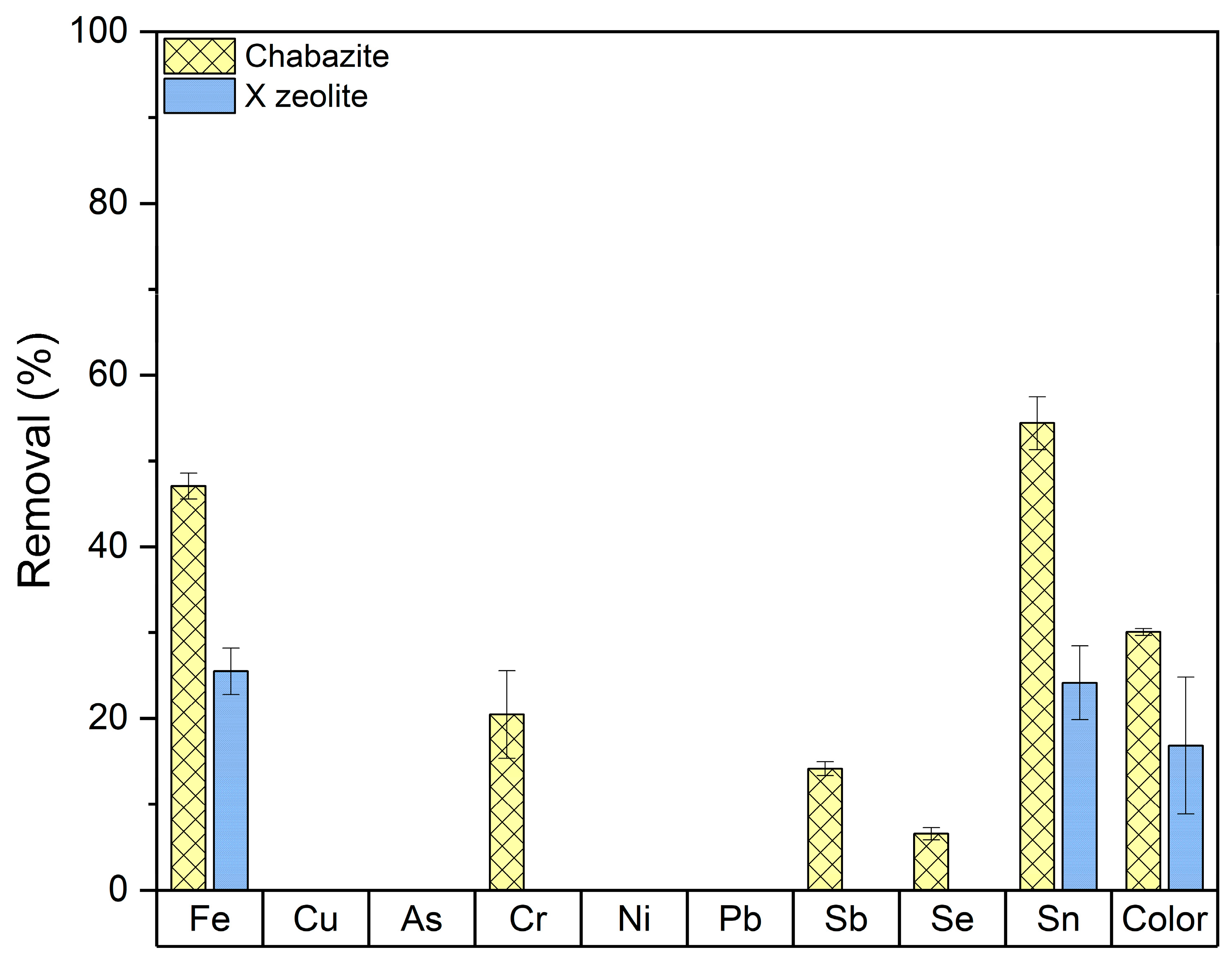
Color and trace elements. The performance of the zeolites for the removal of color and trace elements is shown in Figure 4. Trace element removal by zeolites was clearly lower than by biochars. Notable removals were obtained for Fe and Sn, with chabazite reaching removals of 47% and 54%, respectively, and zeolite X about 25% for both metal ions. Chabazite also showed some affinity for Cr, albeit at low levels. Both zeolites removed color poorly (~30%) with chabazite showing better performance than zeolite X.
Natural zeolites generally exhibit low affinity for dissolved organic matter, as their adsorption is dominated by ion-exchange processes and limited by molecular sieving [17]. Large organic molecules and colloidal species are largely excluded from micropores, and metals associated with organic complexes therefore interact weakly with the zeolite surface, resulting in low removal efficiency for both trace elements and color. Although zeolite X (FAU-type) has larger intrinsic micropores than chabazite (CHA-type), chabazite shows superior performance. This is likely due to more accessible exchangeable sites on the external surface and intercrystalline porosity [50], which enhance interactions with organic matter and associated metals. Additionally, the Ca- and Mg-rich composition of natural chabazite may promote cation bridging with humic substances, further improving retention of metal–organic complexes [51,52,53,54].
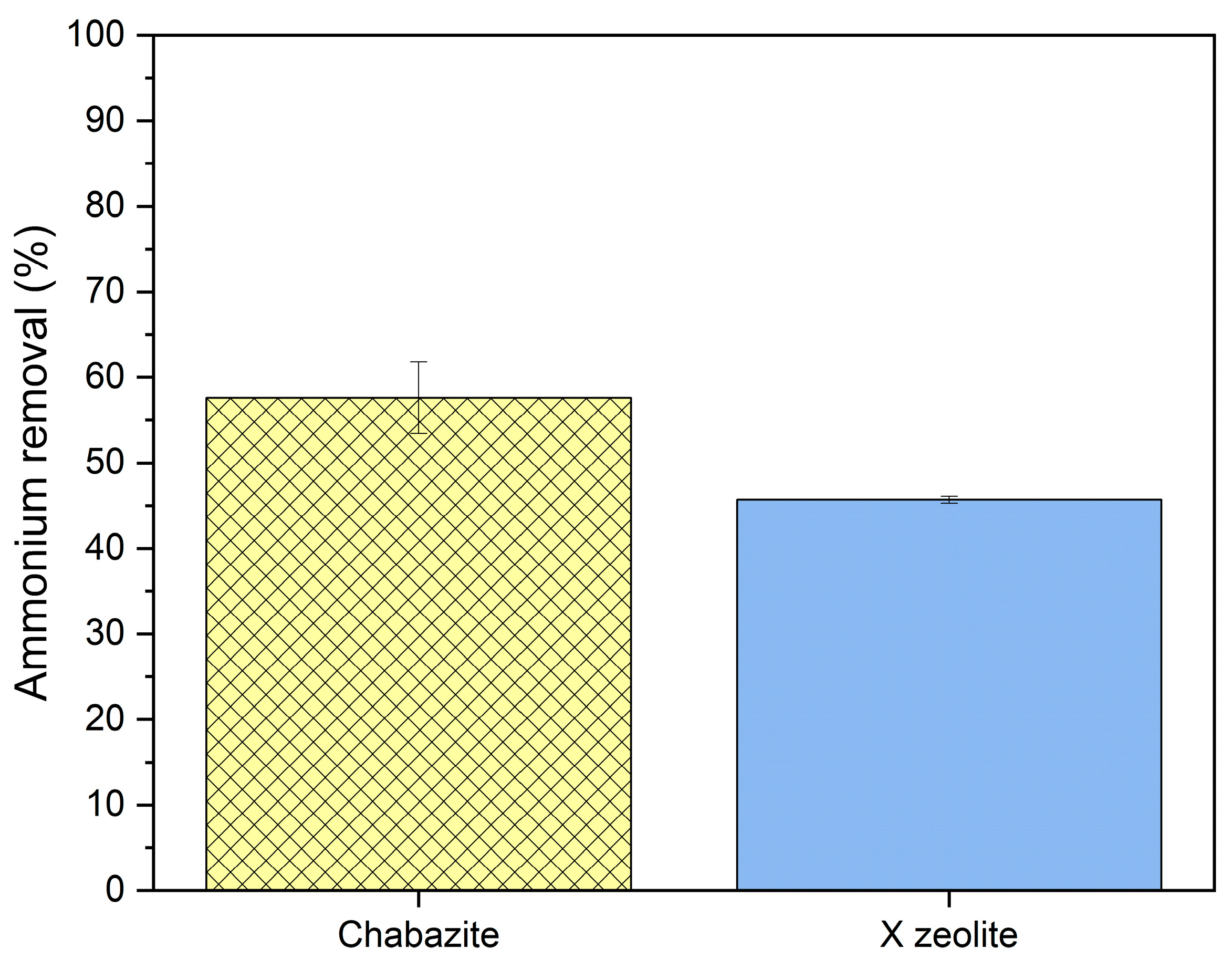
Ammonium. Ammonium removal is shown in Figure 5. It is recognized that removal occurs primarily via ion exchange and is strongly pH-dependent, with optimal performance near neutral pH, since at more alkaline conditions NH4+ is partially converted to NH3, limiting ion exchange efficiency [55]. Chabazite showed slightly higher ammonium retention than zeolite 13X (58% vs. 46%), likely due to more accessible surface exchange sites, intercrystalline porosity, and favorable cation composition. Previous studies have shown that zeolite frameworks can uptake ammonium via ion exchange in synthetic and real wastewater [56], and comparisons with studies at higher solid-to-liquid ratios and pH 7.1 revealed similar removal, despite more favorable exchange conditions [57], highlighting the importance of surface accessibility. Both zeolites exhibited higher retention capabilities for ammonium than the biochars.

3.2. Principal Component Analysis (PCA)

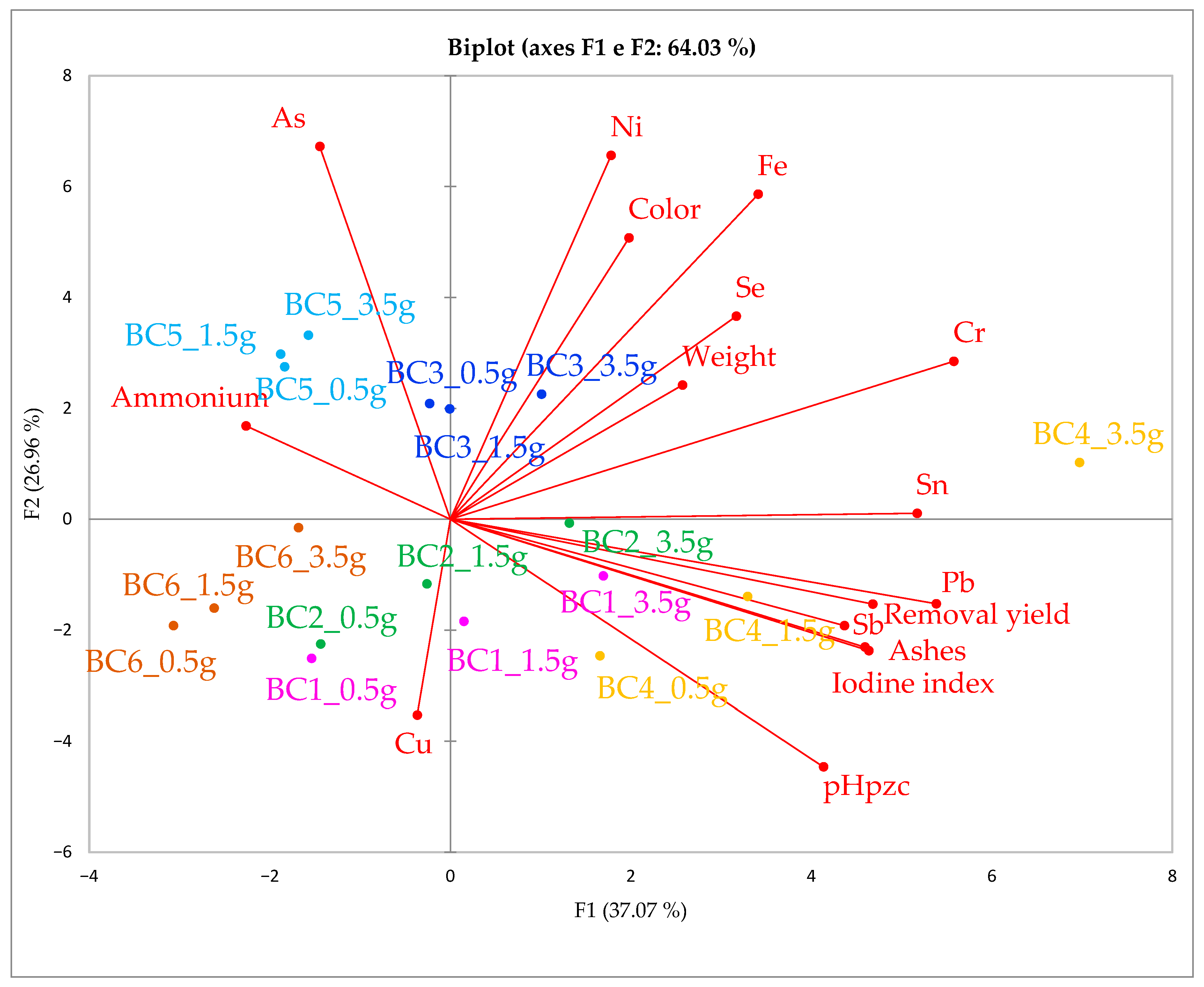
To better understand the relationships between biochar properties and their adsorption performance, a Principal Component Analysis (PCA) was performed (Figure 6). PCA is a multivariate statistical method that reduces complex datasets into a few principal components, highlighting patterns, correlations, and clusters among variables. It was applied to biochars only, as they exhibited higher and more variable removal efficiencies compared with the zeolites. PCA allows identification of which biochar characteristic (variables)—i.e., pHpzc, ash content, production method (pyrolysis or gasification), iodine index and sorbent mass—are most strongly associated with the removal of trace elements, ammonium, or color, and provides insights into the mechanisms governing selectivity of each material. Scores represent each biochar at the three dosages (BCn_0.5g, BCn_1.5g, BCn_3.5g).
The iodine index shows little correlation (≈90° loadings) with color removal. This result is consistent with our previous observation that multiple mechanisms govern adsorption and that iodine index is not the sole controlling parameter, since biochars with lower iodine indices can still remove color efficiently. Color correlates well with Fe, Cr, and Sn removals supporting the hypothesis that these metals are present predominantly as organic complexes or colloids. A good correlation with color is also observed for Ni and Se, despite the absence of an apparent direct relation during the adsorption studies, suggesting that their removal involves interactions with organic matter.
Arsenic behaves differently; no correlation with color is evident, consistent with its occurrence in colloid and inorganic forms [58]. As lies nearly opposite the ‘treatment’ variable, which also proxies temperature (Tgasification > Tpyrolysis), in agreement with a better As removal by biochars produced at low temperature [59].
Trace elements removal shows no meaningful correlation with pHpzc (≈90° loadings), confirming that electrostatic interactions and ion exchange are not the predominant processes for removal from leachate. In contrast, the ‘mass’ loading is strongly correlated with removal efficiency for both trace elements and color, as also evidenced by the rightward shift in scores with increasing sorbent mass, maximized for BC4_3.5, the best performer biochar.
Ammonium exhibits clear anti-correlation with pHpzc, production treatment, and iodine index. As pHpzc increases, biochar surfaces become more positively charged, which hampers ammonium uptake via ion-exchange interactions; higher production temperatures (i.e., gasification vs. pyrolysis) also increase iodine index but reduce H/C and O/C ratios and deplete functional groups that contribute to ammonium chemisorption. Finally, along PC1, trace element removal is maximized on the positive side and ammonium on the negative side, with biochar scores distributed primarily along this axis rather than forming distinct clusters. In conclusion, the PCA highlights a distinct behavior between ammonium and trace element removal, confirming that biochar performance is governed by mechanism-driven selectivity linked to production conditions and surface properties rather than by a single controlling parameter.

4. Conclusions

Progressively stricter emission limit values for wastewater treatment plants pose a considerable challenge to the co-treatment of leachate with municipal wastewater. In this context, the adsorption-based approach developed in this study represents a promising low-cost and sustainable alternative for landfill leachate management.
Overall, the present work represents a comparative screening of biochars and zeolites for landfill leachate purification under defined batch conditions (24 h contact time), highlighting their complementary strengths in removing different contaminant classes. Biochars exhibited superior removal of color and trace elements, likely due to adsorption onto surface functional groups and interactions with organic matter that bind elements, as identified by PCA, whereas zeolites, particularly chabazite, were more effective in ammonium removal, in agreement with their cation-exchange capacity.
These results underscore that no single adsorbent can optimally remove all target contaminants from complex leachates. Consequently, a combined or sequential application of biochars and zeolites could be envisaged to maximize overall treatment efficiency, taking advantage of the mechanism-specific selectivity of each material. From an operational perspective, adsorption treatment could be implemented as (i) a pre-treatment step prior to biological treatment in wastewater treatment plants, reducing metal load and refractory organic matter; (ii) a polishing step for ammonium removal after biological processes; or (iii) a modular on-site treatment system in landfills, reducing reliance on centralized facilities and associated costs. From an economic perspective, both biochars derived from waste biomass and natural zeolites represent cost-effective alternatives to conventionally activated carbon, according to the literature. As regards the management of spent adsorbents, controlled leaching processes could also be envisaged to recover valuable metals from spent biochars, while thermal regeneration could be considered for material regeneration. For ammonium-loaded zeolites, regeneration through saline washing could enable recovery of ammonium in concentrated form, which may subsequently be valorized (e.g., via struvite precipitation), contributing to nutrient recovery within a circular resource framework. Further studies addressing regeneration efficiency and life-cycle assessment would provide additional insight into the long-term sustainability of adsorption-based leachate treatment systems.

Supplementary Materials

The following supporting information can be downloaded at: https://www.mdpi.com/article/10.3390/w18050544/s1, Table S1: LOD and LOQ values for the target compounds in leachate. Table S2: Parameters for microwave digestion of leachate and subsequent metal quantification.

Author Contributions

Conceptualization, M.C.B.; methodology, L.R. and M.C.B.; validation, L.R., and M.C.B.; investigation, S.D.B.; resources, M.D.B.; data curation, L.R.; writing—original draft preparation, M.C.B. and L.R.; writing—review and editing, M.C.B. and L.R.; visualization, M.S.B.-G. and S.K.; funding acquisition, M.C.B., L.R. and V.T. All authors have read and agreed to the published version of the manuscript.

Funding

This research was supported by: REGIONE PIEMONTE, Italy (POR-FESR 2014/2020, BIOEN PRO4TO, 333–148), NODES (Nord Ovest Digitale e Sostenibile, Green technologies and sustainable industries BioEnProH2O); PRIMA EU program for Research and Innovation solutions in the Mediterranean region (ID 1977, CYCLOLIVE project); Water4All 2023 Joint Transnational Call “Aquatic Ecosystem Services” (ID 00071, WATERPATH project); the National Recovery and Resilience Plan (NRRP), Mission 4, Component 2, Investment 1.1, Call for tender No. 1409 published on 14 September 2022 by the Italian Ministry of University and Research (MUR), funded by the European Union—NextGenerationEU—Project Title P2022PZ2MM—ENLIGHTENING (ENgineering LIGHT-activated materials for the abatement of ENvironmentally hazardous and pollutING substances)—CUP D53D23016870001—Grant Assignment Decree No. 1409 adopted on 14 September 2022 by the Italian Ministry of University and Research (MUR); project NODES which has received funding from the MUR–M4C2 1.5 of PNRR funded by the European Union—NextGenerationEU (Grant agreement no. ECS00000036); MINISTERO DELL’UNIVERSITÀ E DELLA RICERCA (MUR, Italy) program “Dipartimenti di Eccellenza 2023 2027” (CUP: D13C22003520001, CH4.0). All the founders are gratefully acknowledged.

Data Availability Statement

The original contributions presented in this study are included in the article/Supplementary Materials. Further inquiries can be directed to the corresponding authors.

Acknowledgments

Authors are grateful to Clara Castiglione Minischetti for her valuable laboratory assistance.

Conflicts of Interest

Author Vander Tumiatti was employed by the company Sea Marconi. The remaining authors declare that the research was conducted in the absence of any commercial or financial relationships that could be construed as a potential conflict of interest.

Abbreviations

The following abbreviations are used in this manuscript:
PCAPrincipal Component Analysis
BCBiochar
FAUFaujasite
CHAChabazite

References

  1. Council of the European Union. Council Directive 1999/31/EC of 26 April 1999 on the Landfill of Waste; Council of the European Union: Brussels, Belgium, 1999. [Google Scholar]
  2. Council of the European Union; European Parliament. Directive 2008/98/EC of the European Parliament and of the Council of 19 November 2008 on Waste and Repealing Certain Directives (Text with EEA Relevance); Council of the European Union: Brussels, Belgium; European Parliament: Bruxelles, Belgium, 2008. [Google Scholar]
  3. European Economic and Social Committee. Opinion of the European Economic and Social Committee on ‘Communication from the Commission to the European Parliament, the Council, the European Economic and Social Committee and the Committee of the Regions “A New Circular Economy Action Plan for a Cleaner and More Competitive Europe”’ (COM(2020) 98 Final); European Economic and Social Committee: Bruxelles, Belgium, 2020. [Google Scholar]
  4. European Economic and Social Committee. Opinion of the European Economic and Social Committee on the Communication from the Commission to the European Parliament, the Council, the European Economic and Social Committee and the Committee of the Regions—Pathway to a Healthy Planet for All—EU Action Plan: ‘Towards Zero Pollution for Air, Water and Soil’ (COM(2021) 400 Final); European Economic and Social Committee: Bruxelles, Belgium, 2022. [Google Scholar]
  5. Kjeldsen, P.; Barlaz, M.A.; Rooker, A.P.; Baun, A.; Ledin, A.; Christensen, T.H. Present and long-term composition of MSW landfill leachate: A review. Crit. Rev. Environ. Sci. Technol. 2002, 32, 297–336. [Google Scholar] [CrossRef]
  6. Essien, J.P.; Ikpe, D.I.; Inam, E.D.; Okon, A.O.; Ebong, G.A.; Benson, N.U. Occurrence and spatial distribution of heavy metals in landfill leachates and impacted freshwater ecosystem: An environmental and human health threat. PLoS ONE 2022, 17, e0263279. [Google Scholar] [CrossRef] [PubMed]
  7. Rodriguez-Cardenas, L.; Choque-Quispe, Y.; Solano-Reynoso, A.M.; Peralta-Guevara, D.E.; Carhuarupay-Molleda, Y.F.; Agreda-Cerna, H.W.; Correa-Cuba, O.; Palomino-Malpartida, Y.G.; Flores-Ccorisapra, Y.; Reynoso-Canicani, D.D. Leachate Pollution Index (LPI) in Sanitary Landfills in the High Andean Zones of Peru. Molecules 2025, 30, 3325. [Google Scholar] [CrossRef]
  8. da Cunha Martins, A., Jr.; Carneiro, M.F.H.; Grotto, D.; Adeyemi, J.A.; Barbosa, F., Jr. Arsenic, cadmium, and mercury-induced hypertension: Mechanisms and epidemiological findings. J. Toxicol. Environ. Health Part B 2018, 21, 61–82. [Google Scholar] [CrossRef] [PubMed]
  9. Hadrup, N.; Ravn-Haren, G. Toxicity of repeated oral intake of organic selenium, inorganic selenium, and selenium nanoparticles: A review. J. Trace Elem. Med. Biol. 2023, 79, 127235. [Google Scholar] [CrossRef]
  10. Khoshakhlagh, A.H.; Mohammadzadeh, M.; Gruszecka-Kosowska, A. The preventive and carcinogenic effect of metals on cancer: A systematic review. BMC Public Health 2024, 24, 2079. [Google Scholar] [CrossRef]
  11. Moody, E.C.; Coca, S.G.; Sanders, A.P. Toxic metals and chronic kidney disease: A systematic review of recent literature. Curr. Environ. Health Rep. 2018, 5, 453–463. [Google Scholar] [CrossRef]
  12. Tyler, C.R.; Allan, A.M. The effects of arsenic exposure on neurological and cognitive dysfunction in human and rodent studies: A review. Curr. Environ. Health Rep. 2014, 1, 132–147. [Google Scholar] [CrossRef]
  13. Renou, S.; Givaudan, J.; Poulain, S.; Dirassouyan, F.; Moulin, P. Landfill leachate treatment: Review and opportunity. J. Hazard. Mater. 2008, 150, 468–493. [Google Scholar] [CrossRef]
  14. Bilardi, S.; Calabrò, P.S.; Greco, R.; Moraci, N. Selective removal of heavy metals from landfill leachate by reactive granular filters. Sci. Total Environ. 2018, 644, 335–341. [Google Scholar] [CrossRef]
  15. Xie, S.; Jiang, L.; Liu, W.; Lu, Q.; Zeng, G.; Wang, H.; Wang, J.; Yuan, X.; Chen, H.; Jiang, H. Network capture effect-driven enhanced activation of peroxymonosulfate by iron-doped carbon quantum dots derived from ferrous gluconate for efficient ciprofloxacin degradation: DFT calculations and mechanism analysis. J. Mater. Chem. A 2025, 13, 20868–20883. [Google Scholar] [CrossRef]
  16. Xiong, R.; Jiang, L.; Li, J.; Chen, H.; Zeng, G.; Yu, H.; Wang, H.; Chen, Y.; Yuan, X. Size regulation strategy of confined catalyst in energy conversion and environmental remediation. Mater. Today 2025, 90, 629–646. [Google Scholar] [CrossRef]
  17. Eberle, S.; Börnick, H.; Stolte, S. Granular natural zeolites: Cost-effective adsorbents for the removal of ammonium from drinking water. Water 2022, 14, 939. [Google Scholar] [CrossRef]
  18. Castiglioni, M.; Rivoira, L.; Ingrando, I.; Del Bubba, M.; Bruzzoniti, M.C. Characterization techniques as supporting tools for the interpretation of biochar adsorption efficiency in water treatment: A critical review. Molecules 2021, 26, 5063. [Google Scholar] [CrossRef]
  19. Alhashimi, H.A.; Aktas, C.B. Life cycle environmental and economic performance of biochar compared with activated carbon: A meta-analysis. Resour. Conserv. Recycl. 2017, 118, 13–26. [Google Scholar] [CrossRef]
  20. Soudani, A.; Youcef, L.; Chebbi, M.; Bulgariu, L.; Patel, N. Agricultural waste–based biochars for sustainable removal of heavy metals from stabilized landfill leachate. Environ. Sci. Pollut. Res. 2024, 31, 57733–57747. [Google Scholar] [CrossRef]
  21. Igwegbe, C.A.; Kozłowski, M.; Wąsowicz, J.; Pęczek, E.; Białowiec, A. Nitrogen removal from landfill leachate using biochar derived from wheat straw. Materials 2024, 17, 928. [Google Scholar] [CrossRef] [PubMed]
  22. Ayadi, M.; Passaseo, D.; Bonaccorso, G.; Fichera, M.; Renai, L.; Venturini, L.; Colzi, I.; Fibbi, D.; Del Bubba, M. Biochar from co-pyrolysis of biological sludge and sawdust in comparison with the conventional filling media of vertical-flow constructed wetlands for the treatment of domestic-textile wastewater. Water Sci. Technol. 2024, 89, 1252–1263. [Google Scholar] [CrossRef]
  23. Castiglioni, M.; Rivoira, L.; Ingrando, I.; Meucci, L.; Binetti, R.; Fungi, M.; El-Ghadraoui, A.; Bakari, Z.; Del Bubba, M.; Bruzzoniti, M.C. Biochars intended for water filtration: A comparative study with activated carbons of their physicochemical properties and removal efficiency towards neutral and anionic organic pollutants. Chemosphere 2022, 288, 132538. [Google Scholar] [CrossRef] [PubMed]
  24. Nunes, C.A.; Guerreiro, M.C. Estimation of surface area and pore volume of activated carbons by methylene blue and iodine numbers. Química Nova 2011, 34, 472–476. [Google Scholar] [CrossRef]
  25. Kabir, E.; Kim, K.-H.; Kwon, E.E. Biochar as a tool for the improvement of soil and environment. Front. Environ. Sci. 2023, 11, 1324533. [Google Scholar] [CrossRef]
  26. Senila, M.; Cadar, O. Modification of natural zeolites and their applications for heavy metal removal from polluted environments: Challenges, recent advances, and perspectives. Heliyon 2024, 10, e25303. [Google Scholar] [CrossRef] [PubMed]
  27. Tong, Y.; Mayer, B.K.; McNamara, P.J. Triclosan adsorption using wastewater biosolids-derived biochar. Environ. Sci. Water Res. Technol. 2016, 2, 761–768. [Google Scholar] [CrossRef]
  28. Yousef, R.I.; El-Eswed, B.; Ala’a, H. Adsorption characteristics of natural zeolites as solid adsorbents for phenol removal from aqueous solutions: Kinetics, mechanism, and thermodynamics studies. Chem. Eng. J. 2011, 171, 1143–1149. [Google Scholar] [CrossRef]
  29. Shehzad, A.; Bashir, M.J.; Sethupathi, S.; Lim, J.-W. An insight into the remediation of highly contaminated landfill leachate using sea mango based activated bio-char: Optimization, isothermal and kinetic studies. Desalination Water Treat. 2016, 57, 22244–22257. [Google Scholar] [CrossRef]
  30. Zand, A.D.; Abyaneh, M.R. Adsorption of Lead, manganese, and copper onto biochar in landfill leachate: Implication of non-linear regression analysis. Sustain. Environ. Res. 2020, 30, 18. [Google Scholar] [CrossRef]
  31. Environmental Protection Agency. Method 350.1 Determination of Ammonia Nitrogen by Semi-Automated Colorimetry; Environmental Protection Agency: Washington, DC, USA, 1993. [Google Scholar]
  32. Hach. Color, True and Apparent. Platinum-Cobalt Standard Method. Method 8025; Hach: Loveland, CO, USA, 2014. [Google Scholar]
  33. Hongve, D.; Åkesson, G. Spectrophotometric determination of water colour in Hazen units. Water Res. 1996, 30, 2771–2775. [Google Scholar] [CrossRef]
  34. Kulikowska, D.; Klimiuk, E. The effect of landfill age on municipal leachate composition. Bioresour. Technol. 2008, 99, 5981–5985. [Google Scholar] [CrossRef]
  35. Carvajal-Flórez, E.; Cardona-Gallo, S.-A. Technologies applicable to the removal of heavy metals from landfill leachate. Environ. Sci. Pollut. Res. 2019, 26, 15725–15753. [Google Scholar] [CrossRef] [PubMed]
  36. Mojiri, A.; Aziz, H.A.; Zaman, N.Q.; Aziz, S.Q.; Zahed, M.A. Metals removal from municipal landfill leachate and wastewater using adsorbents combined with biological method. Desalination Water Treat. 2016, 57, 2819–2833. [Google Scholar] [CrossRef]
  37. Foo, K.; Hameed, B. An overview of landfill leachate treatment via activated carbon adsorption process. J. Hazard. Mater. 2009, 171, 54–60. [Google Scholar] [CrossRef]
  38. Yang, H.; Ye, S.; Zeng, Z.; Zeng, G.; Tan, X.; Xiao, R.; Wang, J.; Song, B.; Du, L.; Qin, M. Utilization of biochar for resource recovery from water: A review. Chem. Eng. J. 2020, 397, 125502. [Google Scholar] [CrossRef]
  39. Agenzia Regionale per la Protezione Ambientale (ARPA). Il Clima in Piemonte. Autunno 2020; Agenzia Regionale per la Protezione Ambientale (ARPA): Florence, Italy, 2020. [Google Scholar]
  40. Repubblica Italiana. D.Lgs 152/06, Norme in Materia Ambientale. 2006. Available online: https://www.bosettiegatti.eu/info/norme/statali/2006_0152.htm (accessed on 6 January 2026).
  41. Bakari, Z.; Fichera, M.; El Ghadraoui, A.; Renai, L.; Giurlani, W.; Santianni, D.; Fibbi, D.; Bruzzoniti, M.C.; Del Bubba, M. Biochar from co-pyrolysis of biological sludge and woody waste followed by chemical and thermal activation: End-of-waste procedure for sludge management and biochar sorption efficiency for anionic and cationic dyes. Environ. Sci. Pollut. Res. 2024, 31, 35249–35265. [Google Scholar] [CrossRef] [PubMed]
  42. Chen, T.; Zhang, Y.; Wang, H.; Lu, W.; Zhou, Z.; Zhang, Y.; Ren, L. Influence of pyrolysis temperature on characteristics and heavy metal adsorptive performance of biochar derived from municipal sewage sludge. Bioresour. Technol. 2014, 164, 47–54. [Google Scholar] [CrossRef]
  43. Fryda, L.; Visser, R. Biochar for soil improvement: Evaluation of biochar from gasification and slow pyrolysis. Agriculture 2015, 5, 1076–1115. [Google Scholar] [CrossRef]
  44. Pipíška, M.; Krajčíková, E.K.; Hvostik, M.; Frišták, V.; Ďuriška, L.; Černičková, I.; Kaňuchová, M.; Conte, P.; Soja, G. Biochar from wood chips and corn cobs for adsorption of thioflavin T and erythrosine B. Materials 2022, 15, 1492. [Google Scholar] [CrossRef]
  45. Baun, D.L.; Christensen, T.H. Speciation of heavy metals in landfill leachate: A review. Waste Manag. Res. 2004, 22, 3–23. [Google Scholar] [CrossRef]
  46. Martin, K.R.; Robey, N.M.; Ma, S.; Powers, L.C.; Heyes, A.; Schmitt-Kopplin, P.; Cooper, W.J.; Townsend, T.G.; Gonsior, M. Characterization of landfill leachate molecular composition using ultrahigh resolution mass spectrometry. Environ. Sci. Water Res. Technol. 2021, 7, 1250–1266. [Google Scholar] [CrossRef]
  47. Ponthieu, M.; Pinel-Raffaitin, P.; Le Hecho, I.; Mazeas, L.; Amouroux, D.; Donard, O.F.; Potin-Gautier, M. Speciation analysis of arsenic in landfill leachate. Water Res. 2007, 41, 3177–3185. [Google Scholar] [CrossRef] [PubMed]
  48. Hu, X.; Zhang, X.; Ngo, H.H.; Guo, W.; Wen, H.; Li, C.; Zhang, Y.; Ma, C. Comparison study on the ammonium adsorption of the biochars derived from different kinds of fruit peel. Sci. Total Environ. 2020, 707, 135544. [Google Scholar] [CrossRef] [PubMed]
  49. Vamvuka, D.; Loupasis, E.; Chamilaki, E.; Sdoukou, E. Adsorption of ammonium from wastewaters by an almond kernel derived biochar modified by potassium hydroxide or dolomite and activated by steam. Environ. Adv. 2024, 15, 100465. [Google Scholar] [CrossRef]
  50. Ancora, G.; Morari, F.; Brito, J.C.F.P.; Marchese, L.; Bisio, C.; Gianotti, E. Insights into the role of hierarchical porosity in zeolite architectures for selective uptake of metal ions in solution. RSC Adv. 2025, 15, 20092–20110. [Google Scholar] [CrossRef]
  51. Dang, L.V.; Nguyen, T.T.M.; Do, D.V.; Le, S.T.; Pham, T.D.; Le, A.T.M. Study on the synthesis of chabazite zeolites via interzeolite conversion of faujasites. J. Anal. Methods Chem. 2021, 2021, 5554568. [Google Scholar] [CrossRef]
  52. Fertu, D.I.T.; Gavrilescu, M. Application of natural zeolites as sorbents in the clean-up of aqueous streams. Environ. Eng. Manag. J. 2012, 11, 867–878. [Google Scholar] [CrossRef]
  53. Kallo, D. Applications of natural zeolites in water and wastewater treatment. Rev. Mineral. Geochem. 2001, 45, 519–550. [Google Scholar] [CrossRef]
  54. Wang, S.; Peng, Y. Natural zeolites as effective adsorbents in water and wastewater treatment. Chem. Eng. J. 2010, 156, 11–24. [Google Scholar] [CrossRef]
  55. Widiastuti, N.; Wu, H.; Ang, H.M.; Zhang, D. Removal of ammonium from greywater using natural zeolite. Desalination 2011, 277, 15–23. [Google Scholar] [CrossRef]
  56. Sarioglu, M. Removal of ammonium from municipal wastewater using natural Turkish (Dogantepe) zeolite. Sep. Purif. Technol. 2005, 41, 1–11. [Google Scholar] [CrossRef]
  57. Ye, Z.; Wang, J.; Sun, L.; Zhang, D.; Zhang, H. Removal of ammonium from municipal landfill leachate using natural zeolites. Environ. Technol. 2015, 36, 2919–2923. [Google Scholar] [CrossRef] [PubMed]
  58. Majumder, S.; Nath, B.; Sarkar, S.; Chatterjee, D.; Roman-Ross, G.; Hidalgo, M. Size-fractionation of groundwater arsenic in alluvial aquifers of West Bengal, India: The role of organic and inorganic colloids. Sci. Total Environ. 2014, 468, 804–812. [Google Scholar] [CrossRef]
  59. Chatzimichailidou, S.; Xanthopoulou, M.; Tolkou, A.K.; Katsoyiannis, I.A. Biochar derived from rice by-products for arsenic and chromium removal by adsorption: A review. J. Compos. Sci. 2023, 7, 59. [Google Scholar] [CrossRef]
Figure 1. Percentage removal of color by the biochars.
Water 18 00544 g001
Figure 2. Percentage removal of trace elements by the biochars.
Water 18 00544 g002
Figure 3. Percentage removal of ammonium by the biochars.
Water 18 00544 g003
Figure 4. Percentage removal of trace elements and color by chabazite and X zeolite.
Water 18 00544 g004
Figure 5. Percentage removal of ammonium by chabazite and X zeolite.
Water 18 00544 g005
Figure 6. Principal Component Analysis for the biochars under study.
Water 18 00544 g006
Table 1. Physicochemical characteristics of the biochars used.
BiocharFeedstockProductionpHpzcAshes (%)Iodine Index (mg/g)Surface Charge
BC1WoodPyrolysis (550 °C)10.5 ± 1.1541.7 ± 8.3129.51 ± 0.90Positive
BC2WoodPyroysis (550 °C)8.65 ± 0.0711.9 ± 2.0144.11 ± 0.99Negative
BC3Pruning residuesPyrolysis (550–600 °C)9.10 ± 0.1429.2 ± 0.2124.08 ± 0.94Almost zero
BC4Pine (60%), Beech (25%), Hazel (15%)Gasification (800–900 °C)12.1 ± 0.2349.45 ± 3.8155.73 ± 1.31Positive
BC5Corn cobsPyrolysis (450 °C)7.05 ± 0.116.2 ± 0.180 ± 0.94Negative
BC6PoplarPyrolysis (550 °C)9.45 ± 0.067.84 ± 0.6368 ± 0.74Almost zero
Table 2. Average concentration values and standard deviations (n = 3) for target parameters in leachate.
ParameterUnitAverage Value
pH-9.51 ± 0.01
Cdµg/L0.6 ± 0.3
Be0.5 ± 0.3
Fe6000 ± 600
Cu58 ± 17
As110 ± 16
Cr710 ± 30
Ni590 ± 40
Pb7.4 ± 1.8
Sb33 ± 1.7
Se65 ± 3
Sn200 ± 40
N-NH3mg/L2600 ± 500
ColorTCU4200 ± 300
Disclaimer/Publisher’s Note: The statements, opinions and data contained in all publications are solely those of the individual author(s) and contributor(s) and not of MDPI and/or the editor(s). MDPI and/or the editor(s) disclaim responsibility for any injury to people or property resulting from any ideas, methods, instructions or products referred to in the content.