
Vacuum Constraints for Realistic Strongly Coupled Heterotic M-Theories

Abstract
1. Introduction
2. The Compactification Vacuum
2.1. The d = 11 → d = 5 Compactification
2.1.1. The Calabi-Yau Threefold
2.1.2. The Observable Sector Gauge Bundle
2.1.3. The Hidden Sector Gauge Bundle
- Hidden Sector Factor
- Hidden Sector Line Bundles
2.1.4. Bulk Space Five-Branes
2.1.5. Anomaly Cancellation
2.2. The d = 5→ d = 4 Compactification
The Linearized Double Domain Wall
3. The d = 4 Effective Theory
3.1. The Lagrangian
- Stability of the Observable Sector Vector Bundle
- Poly-Stability of the Hidden Sector Vector Bundle
- :In this case, since for a single vector bundle slope-stability implies poly-stability, one need only check that is slope-stable. For example, one could choose to be identical to the bundle in the observable sector, , presented above. Note that, since we are restricting all hidden sector non-Abelian bundles to have structure group , it follows that must vanish. As with the observable sector bundle bundle, stability of a generic non-Abelian vector bundle will only occur within a specific region of Kähler moduli space.
- :In this case, one need only check that the line bundle L is slope-stable, which will imply poly-stability. Fortunately, every line bundle is trivially slope-stable, so any line bundle can be used. It is important to note that the slope of a line bundle which appears as a lone factor in the Whitney sum has–a priori–no further constraints. Using (65), (26) and (4), it follows that the slope of an arbitrary line bundle specified by is given byThat is, its value is a highly specific function of the Kähler moduli.
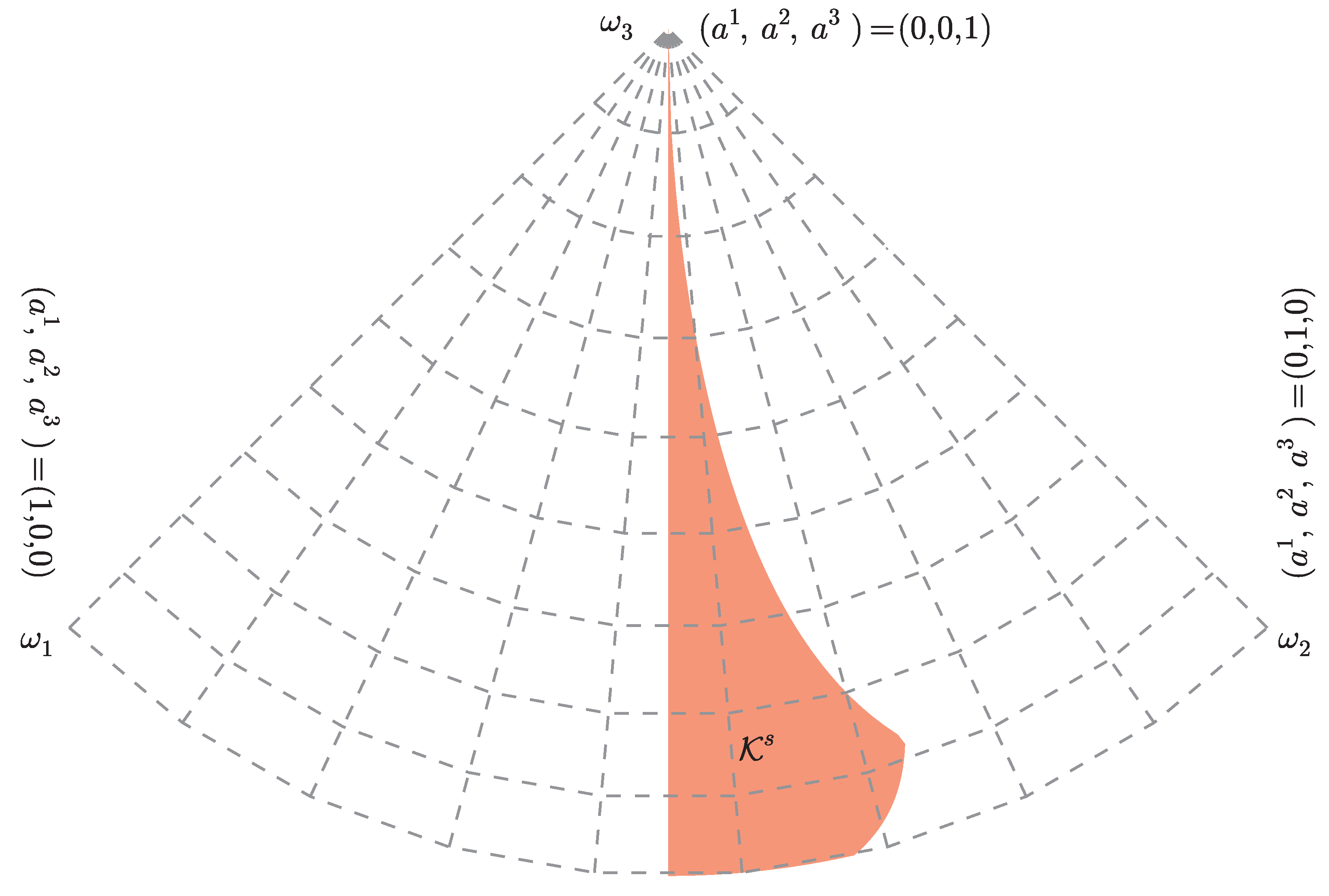
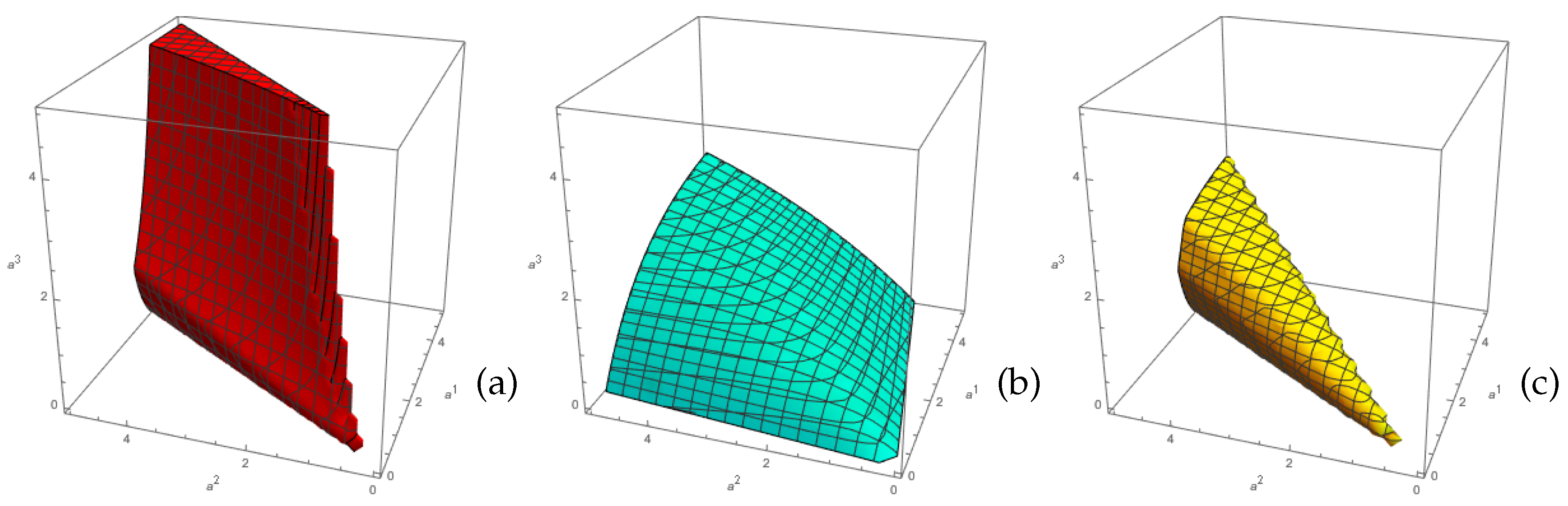
- As specified above, the non-Abelian vector bundle must be slope-stable in a region of Kähler moduli space. Furthermore, since we are restricting the structure group in our discussion to be , it follows that . As we just indicated, any line bundle L will be slope-stable everywhere in Kähler moduli space. However, the full Whitney sum will be poly-stable–and, hence, preserve supersymmetry–if and only if . That is, because of the existence of a non-Abelian factor, the line bundle L now has the additional constraint that its slope vanish identically. It is clear from (67) that this will be the case only in a restricted region of Kähler moduli space. It follows that the full Whitney sum will only be a viable hidden sector bundle if the region of stability of has a non-vanishing intersection with the region where the slope of L vanishes. This is a very non-trivial requirement. To give a concrete example, let us choose , where is the observable sector bundle specified above. Recall that the region of slope-stability of this bundle in Kähler moduli space is delineated by the inequalities in (66) and shown in Figure 1. Plotted in 3-dimensions, this region of slope-stability over a limited region of Kähler moduli space is shown in Figure 2a. Furthermore, let us specify that . Note that L satisfies condition (23), as it must. It follows from (67) that the region of moduli space in which is given by the equationPlotted over a limited region of Kähler moduli space in 3-dimensions, the region where is shown in Figure 2b. Figure 2c then shows that these two regions have a substantial overlap in Kähler moduli space. Furthermore, since was chosen to be , it follows that Figure 2c also represents the overlap with the stability region of the observable sector vector bundle. We conclude that the specific choice of is a suitable choice for a poly-stable hidden sector vector bundle.
3.2. The Lagrangian
3.2.1. Corrections to a Fayet-Iliopoulos Term
3.2.2. Gauge Threshold Corrections
3.3. A Specific Class of Examples
Funding
Acknowledgments
Conflicts of Interest
References
- Gross, D.J.; Harvey, J.A.; Martinec, E.J.; Rohm, R. Heterotic String Theory. 1. The Free Heterotic String. Nucl. Phys. B 1985, 256, 253–284. [Google Scholar] [CrossRef]
- Gross, D.J.; Harvey, J.A.; Martinec, E.J.; Rohm, R. Heterotic String Theory. 2. The Interacting Heterotic String. Nucl. Phys. B 1986, 267, 75–124. [Google Scholar] [CrossRef]
- Witten, E. Strong coupling expansion of Calabi-Yau compactification. Nucl. Phys. B 1996, 471, 135–158. [Google Scholar] [CrossRef]
- Horava, P.; Witten, E. Heterotic and type I string dynamics from eleven dimensions. Nucl. Phys. B 1996, 460, 506–524. [Google Scholar] [CrossRef]
- Horava, P.; Witten, E. Eleven-dimensional supergravity on a manifold with boundary. Nucl. Phys. B 1996, 475, 94–114. [Google Scholar] [CrossRef]
- Greene, B.R.; Kirklin, K.H.; Miron, P.J.; Ross, G.G. A Superstring Inspired Standard Model. Phys. Lett. B 1986, 180, 69–76. [Google Scholar] [CrossRef]
- Greene, B.R.; Kirklin, K.H.; Miron, P.J.; Ross, G.G. A Three Generation Superstring Model. 1. Compactification and Discrete Symmetries. Nucl. Phys. 1986, B278, 667–693. [Google Scholar] [CrossRef]
- Greene, B.R.; Kirklin, K.H.; Miron, P.J.; Ross, G.G. A Three Generation Superstring Model. 2. Symmetry Breaking and the Low-Energy Theory. Nucl. Phys. B 1987, 292, 606–652. [Google Scholar] [CrossRef]
- Matsuoka, T.; Suematsu, D. Realistic Models From The E8 × Superstring Theory. Prog. Theor. Phys. 1986, 76, 886–900. [Google Scholar] [CrossRef]
- Greene, B.R.; Kirklin, K.H.; Miron, P.J.; Ross, G.G. 273 Yukawa Couplings For a Three Generation Superstring Model. Phys. Lett. B 1987, 192, 111. [Google Scholar] [CrossRef]
- Anderson, L.B.; Gray, J.; Lukas, A.; Ovrut, B. Stabilizing All Geometric Moduli in Heterotic Calabi-Yau Vacua. Phys. Rev. D 2011, 83, 106011. [Google Scholar] [CrossRef]
- Braun, V.; He, Y.H.; Ovrut, B.A.; Pantev, T. The Exact MSSM spectrum from string theory. J. High Energy Phys. 2006, 2006, 043. [Google Scholar] [CrossRef]
- Braun, V.; Ovrut, B.A.; Pantev, T.; Reinbacher, R. Elliptic Calabi-Yau threefolds with Z(3) × Z(3) Wilson lines. J. High Energy Phys. 2004, 2004, 062. [Google Scholar] [CrossRef]
- Braun, V.; He, Y.H.; Ovrut, B.A.; Pantev, T. Vector Bundle Extensions, Sheaf Cohomology, and the Heterotic Standard Model. Adv. Theor. Math. Phys. 2006, 10, 525–529. [Google Scholar] [CrossRef]
- Braun, V.; He, Y.H.; Ovrut, B.A. Stability of the minimal heterotic standard model bundle. J. High Energy Phys. 2006, 2006, 032. [Google Scholar] [CrossRef]
- Braun, V.; He, Y.H.; Ovrut, B.A. Yukawa couplings in heterotic standard models. J. High Energy Phys. 2006, 2006, 019. [Google Scholar] [CrossRef]
- Barger, V.; Fileviez Perez, P.; Spinner, S. Minimal gauged U(1)(B-L) model with spontaneous R-parity violation. Phys. Rev. Lett. 2009, 102, 181802. [Google Scholar] [CrossRef]
- Fileviez Perez, P.; Spinner, S. Spontaneous R-Parity Breaking in SUSY Models. Phys. Rev. D 2009, 80, 015004. [Google Scholar] [CrossRef]
- Ambroso, M.; Ovrut, B. The B-L/Electroweak Hierarchy in Heterotic String and M-Theory. J. High Energy Phys. 2009, 2009, 011. [Google Scholar] [CrossRef]
- Ambroso, M.; Ovrut, B.A. The B-L/Electroweak Hierarchy in Smooth Heterotic Compactifications. Int. J. Mod. Phys. A 2010, 25, 2631–2677. [Google Scholar] [CrossRef]
- Ambroso, M.; Ovrut, B.A. The Mass Spectra, Hierarchy and Cosmology of B-L MSSM Heterotic Compactifications. Int. J. Mod. Phys. A 2011, 26, 1569–1627. [Google Scholar] [CrossRef]
- Ovrut, B.A.; Purves, A.; Spinner, S. Wilson Lines and a Canonical Basis of SU(4) Heterotic Standard Models. J. High Energy Phys. 2012, 2012, 026. [Google Scholar] [CrossRef]
- Ovrut, B.A.; Purves, A.; Spinner, S. The minimal SUSY B − L model: From the unification scale to the LHC. J. High Energy Phys. 2015, 2015, 182. [Google Scholar] [CrossRef]
- Fileviez Perez, P.; Spinner, S. TeV Scale Spontaneous R-Parity Violation. AIP Conf. Proc. 2010, 1200, 529–532. [Google Scholar] [CrossRef]
- Fileviez Perez, P.; Spinner, S. The Minimal Theory for R-parity Violation at the LHC. J. High Energy Phys. 2012, 1204, 118. [Google Scholar] [CrossRef]
- Brelidze, T.; Ovrut, B.A. B-L Cosmic Strings in Heterotic Standard Models. J. High Energy Phys. 2010, 2010, 077. [Google Scholar] [CrossRef]
- Battarra, L.; Koehn, M.; Lehners, J.L.; Ovrut, B.A. Cosmological Perturbations Through a Non-Singular Ghost-Condensate/Galileon Bounce. J. Cosmol. Astropart. Phys. 2014, 1407, 007. [Google Scholar] [CrossRef]
- Koehn, M.; Lehners, J.L.; Ovrut, B.A. Cosmological super-bounce. Phys. Rev. D 2014, 90, 025005. [Google Scholar] [CrossRef]
- Koehn, M.; Lehners, J.L.; Ovrut, B.A. Higher-Derivative Chiral Superfield Actions Coupled to N = 1 Supergravity. Phys. Rev. D 2012, 86, 085019. [Google Scholar] [CrossRef]
- Marshall, Z.; Ovrut, B.A.; Purves, A.; Spinner, S. Spontaneous R-Parity Breaking, Stop LSP Decays and the Neutrino Mass Hierarchy. Phys. Lett. B 2014, 732, 325–329. [Google Scholar] [CrossRef]
- Marshall, Z.; Ovrut, B.A.; Purves, A.; Spinner, S. LSP Squark Decays at the LHC and the Neutrino Mass Hierarchy. Phys. Rev. D 2014, 90, 015034. [Google Scholar] [CrossRef]
- Dumitru, S.; Ovrut, B.A.; Purves, A. The R-parity Violating Decays of Charginos and Neutralinos in the B-L MSSM. arXiv, 2018; arXiv:1810.11035. [Google Scholar]
- Dumitru, S.; Ovrut, B.A.; Purves, A. R-parity Violating Decays of Wino Chargino and Wino Neutralino LSPs and NLSPs at the LHC. arXiv, 2018; arXiv:1811.05581. [Google Scholar]
- Candelas, P.; de la Ossa, X.; He, Y.H.; Szendroi, B. Triadophilia: A Special Corner in the Landscape. Adv. Theor. Math. Phys. 2008, 12, 429–473. [Google Scholar] [CrossRef]
- Anderson, L.B.; Gray, J.; Lukas, A.; Palti, E. Two Hundred Heterotic Standard Models on Smooth Calabi-Yau Threefolds. Phys. Rev. D 2011, 84, 106005. [Google Scholar] [CrossRef]
- Anderson, L.B.; Gray, J.; Lukas, A.; Palti, E. Heterotic Line Bundle Standard Models. J. High Energy Phys. 2012, 2012, 113. [Google Scholar] [CrossRef]
- Anderson, L.B.; Gray, J.; Lukas, A.; Palti, E. Heterotic standard models from smooth Calabi-Yau three-folds. PoS 2011, CORFU2011, 096. [Google Scholar]
- Kachru, S.; Kallosh, R.; Linde, A.D.; Trivedi, S.P. De Sitter vacua in string theory. Phys. Rev. D 2003, 68, 046005. [Google Scholar] [CrossRef]
- Gray, J.; Lukas, A.; Ovrut, B. Perturbative anti-brane potentials in heterotic M-theory. Phys. Rev. D 2007, 76, 066007. [Google Scholar] [CrossRef]
- Gray, J.; Lukas, A.; Ovrut, B. Flux, gaugino condensation and anti-branes in heterotic M-theory. Phys. Rev. D 2007, 76, 126012. [Google Scholar] [CrossRef]
- Braun, V.; Ovrut, B.A. Stabilizing moduli with a positive cosmological constant in heterotic M-theory. J. High Energy Phys. 2006, 2006, 035. [Google Scholar] [CrossRef]
- Bogomolov, F.A. Holomorphic tensors and vector bundles on projective manifolds. Izvestiya Rossiiskoi Akademii Nauk Seriya Matematicheskaya 1978, 42, 1227–1287, 1439. [Google Scholar]
- Douglas, M.R.; Reinbacher, R.; Yau, S.T. Branes, bundles and attractors: Bogomolov and beyond. arXiv, 2006; arXiv:math/0604597. [Google Scholar]
- Andreas, B.; Curio, G. Spectral Bundles and the DRY-Conjecture. J. Geom. Phys. 2012, 62, 800–803. [Google Scholar] [CrossRef]
- Andreas, B.; Curio, G. On the Existence of Stable bundles with prescribed Chern classes on Calabi-Yau threefolds. arXiv, 2011; arXiv:1104.3435. [Google Scholar]
- Braun, V.; He, Y.H.; Ovrut, B.A. Supersymmetric Hidden Sectors for Heterotic Standard Models. J. High Energy Phys. 2013, 2013, 008. [Google Scholar] [CrossRef]
- Blumenhagen, R.; Honecker, G.; Weigand, T. Loop-corrected compactifications of the heterotic string with line bundles. J. High Energy Phys. 2005, 2005, 020. [Google Scholar] [CrossRef]
- Blumenhagen, R.; Honecker, G.; Weigand, T. Non-Abelian brane worlds: The Heterotic string story. J. High Energy Phys. 2005, 2005, 086. [Google Scholar] [CrossRef]
- Blumenhagen, R.; Moster, S.; Weigand, T. Heterotic GUT and standard model vacua from simply connected Calabi-Yau manifolds. Nucl. Phys. B 2006, 751, 186–221. [Google Scholar] [CrossRef]
- Weigand, T. Compactifications of the heterotic string with unitary bundles. Fortsch. Phys. 2006, 54, 963–1077. [Google Scholar] [CrossRef]
- Blumenhagen, R.; Moster, S.; Reinbacher, R.; Weigand, T. Massless Spectra of Three Generation U(N) Heterotic String Vacua. J. High Energy Phys. 2007, 2007, 041. [Google Scholar] [CrossRef]
- Blumenhagen, R.; Honecker, G.; Weigand, T. Supersymmetric (non-)Abelian bundles in the Type I and SO(32) heterotic string. J. High Energy Phys. 2005, 2005, 009. [Google Scholar] [CrossRef]
- Lukas, A.; Ovrut, B.A.; Waldram, D. Nonstandard embedding and five-branes in heterotic M theory. Phys. Rev. D 1999, 59, 106005. [Google Scholar] [CrossRef]
- Donagi, R.; Ovrut, B.A.; Waldram, D. Moduli spaces of five-branes on elliptic Calabi-Yau threefolds. J. High Energy Phys. 1999, 1999, 030. [Google Scholar] [CrossRef]
- Lukas, A.; Ovrut, B.A.; Waldram, D. Five-branes and supersymmetry breaking in M theory. J. High Energy Phys. 1999, 1999, 009. [Google Scholar] [CrossRef]
- Lukas, A.; Ovrut, B.A.; Waldram, D. On the four-dimensional effective action of strongly coupled heterotic string theory. Nucl. Phys. B 1998, 532, 43–82. [Google Scholar] [CrossRef]
- Anderson, L.B.; Gray, J.; Lukas, A.; Ovrut, B. Stability Walls in Heterotic Theories. J. High Energy Phys. 2009, 2009, 026. [Google Scholar] [CrossRef]
- Schoen, C. On fiber products of rational elliptic surfaces with section. Math. Z. 1988, 197, 177–199. [Google Scholar] [CrossRef]
- Lukas, A.; Ovrut, B.A.; Stelle, K.; Waldram, D. Heterotic M theory in five-dimensions. Nucl. Phys. B 1999, 552, 246–290. [Google Scholar] [CrossRef]
- Donagi, R.; Lukas, A.; Ovrut, B.A.; Waldram, D. Nonperturbative vacua and particle physics in M theory. J. High Energy Phys. 1999, 1999, 018. [Google Scholar] [CrossRef]
- Lukas, A.; Ovrut, B.A.; Stelle, K.; Waldram, D. The Universe as a domain wall. Phys. Rev. D 1999, 59, 086001. [Google Scholar] [CrossRef]
- Donagi, R.; Lukas, A.; Ovrut, B.A.; Waldram, D. Holomorphic vector bundles and nonperturbative vacua in M theory. J. High Energy Phys. 1999, 1999, 034. [Google Scholar] [CrossRef]
- Uhlenbeck, K.; Yau, S.T. On the existence of hermitian-Yang-Mills connections in stable vector bundles. Commun. Pure Appl. Math. 1986, 39, S257–S293. [Google Scholar] [CrossRef]
- Donaldson, S.K. Anti self-dual Yang-Mills connections over complex algebraic surfaces and stable vector bundles. Proc. Lond. Math. Soc. 1985, 50, 1–26. [Google Scholar] [CrossRef]
- Green, M.B.; Schwarz, J.H.; Witten, E. Superstring Theory. Volume 2: Loop Amplitudes, Anomalies and Phenomenology; Cambridge Monographs on Mathematical Physics; University Press: Cambridge, UK, 1987; 596p. [Google Scholar]

© 2018 by the author. Licensee MDPI, Basel, Switzerland. This article is an open access article distributed under the terms and conditions of the Creative Commons Attribution (CC BY) license (http://creativecommons.org/licenses/by/4.0/).
Share and Cite
Ovrut, B.A. Vacuum Constraints for Realistic Strongly Coupled Heterotic M-Theories. Symmetry 2018, 10, 723. https://doi.org/10.3390/sym10120723
Ovrut BA. Vacuum Constraints for Realistic Strongly Coupled Heterotic M-Theories. Symmetry. 2018; 10(12):723. https://doi.org/10.3390/sym10120723
Chicago/Turabian StyleOvrut, Burt A. 2018. "Vacuum Constraints for Realistic Strongly Coupled Heterotic M-Theories" Symmetry 10, no. 12: 723. https://doi.org/10.3390/sym10120723
APA StyleOvrut, B. A. (2018). Vacuum Constraints for Realistic Strongly Coupled Heterotic M-Theories. Symmetry, 10(12), 723. https://doi.org/10.3390/sym10120723