Abstract
The traveling wave solutions of a generalized HD type equation are investigated in this study. The traveling wave system is a singular system of the first class with given parameter conditions. From the standpoint of dynamical systems, the bifurcations of traveling wave solutions in parameter space are examined. It is demonstrated that solitary wave solutions, periodic peakons, pseudo-peakons, and compacton solutions exist. All conceivable exact explicit parametric representations of various solutions are presented.
1. Introduction
In 1993, Camassa and Holm found that CH-equation [1] has a peakon solution In the past thirty years, for the studies of peakon solutions in nonlinear wave equations, a lot of papers have been published (see [2,3,4] and references therein). Peakon is a special traveling wave solution. In [5], Li and Qiao defined a concept of pseudo-peakon. Li and Chen in [4,6] generally considered a class of singular traveling systems. They demonstrated that periodic peakon is a smooth classical solution of a solitary traveling system with two time-scales. Under two classes of limit senses, a peakon is a limit solution of a family of periodic peakons or a limit solution of a family of pseudo-peakons (see [7]). The compacton family is a singular system solution family in which all solutions have finite sets of support, i.e., the defined region of each solution with respect to the variable is finite and the wave function’s value region is bounded. In [4,6,8], a categorization for different wave profiles of solutions was offered, corresponding to different types of phase orbits.
In 2015, as a nonlinear generalization of the equation with pseudo-peakon solutions, ref. [9] proposed a hierarchy of a generalized Harry Dym type ( type) equations (see [10,11]). A typical member in the hierarchy reads
where is a parameter. Equation (1) is reduced to the equation when . The authors of [9] derived the Lax pair representation and bi-Hamilton structures of this hierarchy. The authors of [9] found both implicit and explicit smooth solitons, peakon, cuspon, periodic solutions, and (anti-) kink solutions of the extended Harry Dym type equation using the travelling wave solution approach.
We noticed that the bifurcations and all conceivable exact solutions for the relevant traveling wave systems of Equation (1) were not studied by these authors. In this study, we look at these issues in terms of solving the relevant traveling wave systems of Equation (1) based on system parameters.
To study the traveling wave solutions of Equation (1), set , where and c is the wave speed. Substituting it into (1), integrating the obtained equations once, we obtain
The prime represents the derivative with regard to , and is an integral constant. The following planar dynamical system is equal to Equation (2):
which has the first integral as follows:
Clearly, on the straight lines, systems (3) are discontinuous. Such systems are called the singular traveling wave systems of the first class defined by [4,6]. It is interesting to find that the singular traveling systems have peakon, pseudo-peakon, periodic peakon, and compacton solution families.
The above-mentioned theory of singular traveling wave systems (3) is employed in this study to examine the wave profiles of the wave function in the system’s solutions. All potential exact explicit parametric representations for the traveling wave solutions of the Equation (1) will be presented under different parameter circumstances by analyzing the dynamics of the traveling wave solutions governed by the traveling wave system.
The main result of this paper is the following conclusion.
Theorem 1.
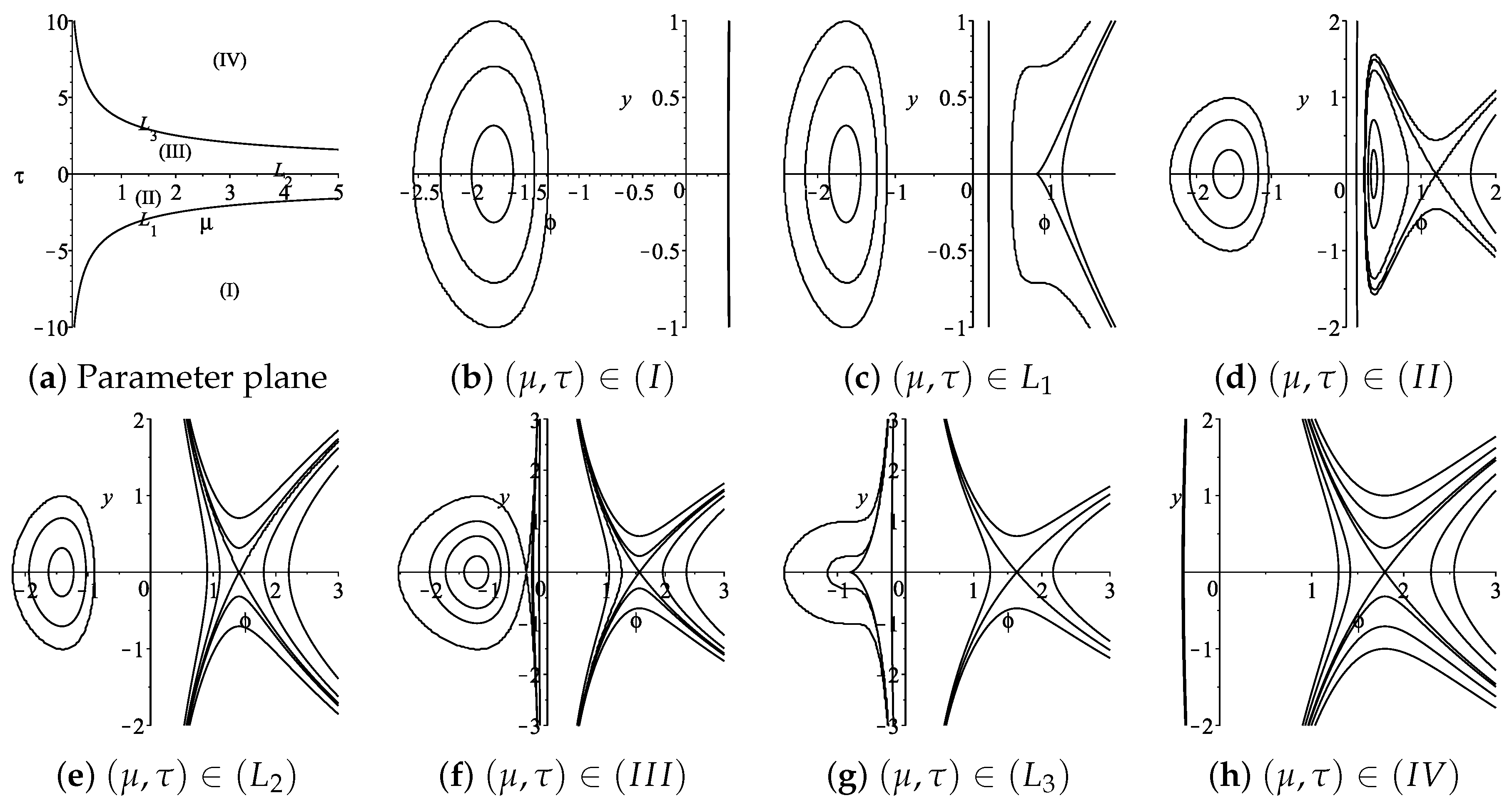
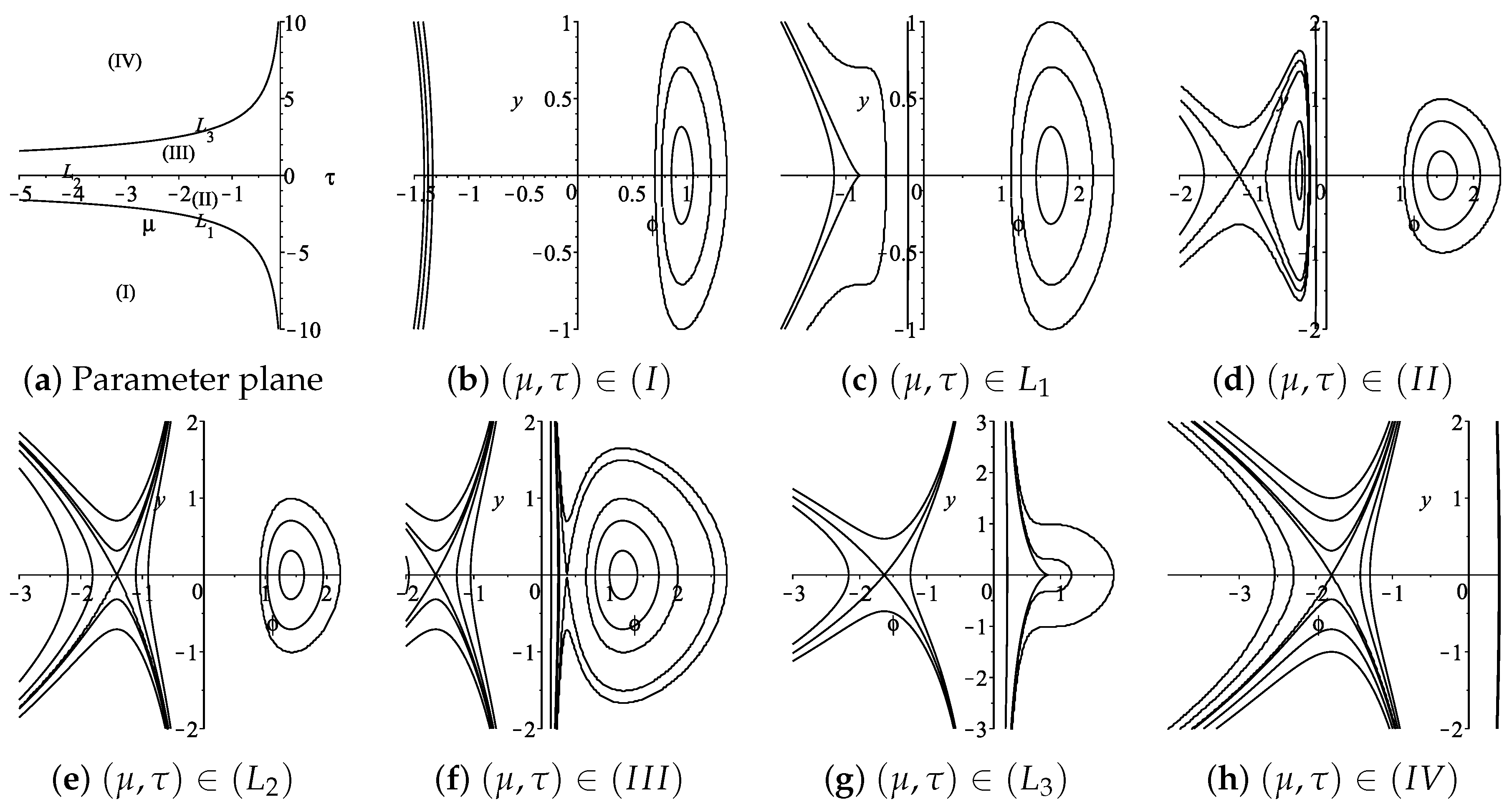
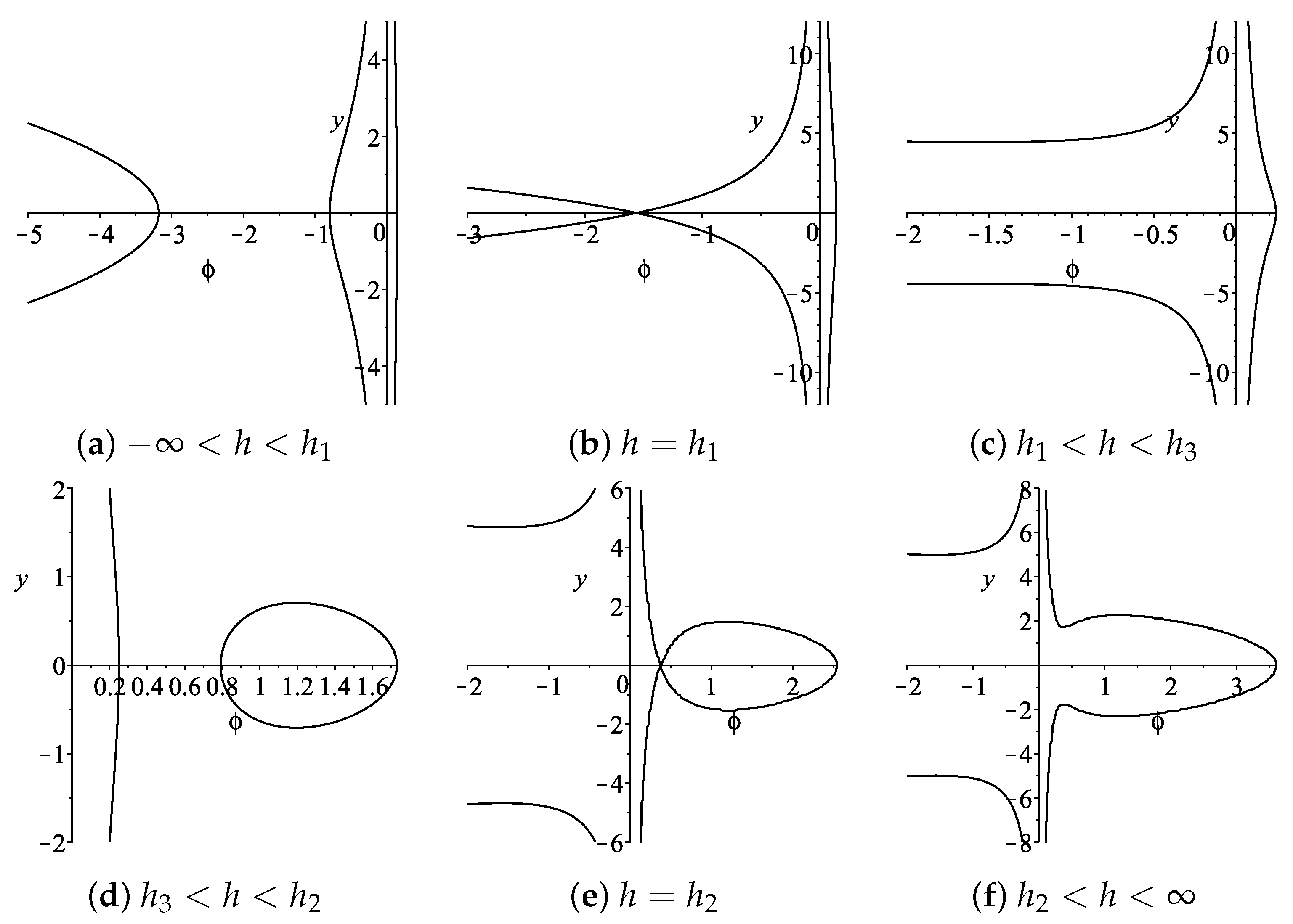
(1) For a fixed parameter , in the parameter plane, system (3) has the bifurcations of phase portraits shown in Figure 1 and Figure 2.
Figure 1.
Bifurcations of phase portraits of system (3) for .
Figure 2.
Bifurcations of phase portraits of system (3) for .
Assume that in system (3). Then, we have
(2) System (3) has exact periodic wave solutions given by (7) and (11). When , (7) gives rise to a periodic peakon family.
The following is a breakdown of the paper’s structure. The bifurcations of phase pictures of systems (3) based on parameter change when is fixed, as discussed in Section 2. In Section 3, we look into the existence of solitary wave solutions, periodic wave solutions, periodic peakons, pseudo-peakons, and compacton solutions, as well as all of their exact explicit parametric representations. The solitary wave solutions of Equation (1) are discussed in Section 4.
2. Bifurcation of Phase Portraits
We begin by considering all conceivable system (3) phase portraits. It is known that this system (3) has the same invariant curve solutions as the regular system it is connected with:
where for . We always assume that
To study the equilibrium points of system (5), we write that Obviously, if then, when From follow that Thus, when function has three real simple zeros . Namely, on the axis, system (5) has three equilibrium points When function has a simple real zero and a double real zeros. When function has only one simple real zero.
For a fixed in parameter plane, there exist three parameter curves
which partition parameter half-plane into four regions (see Figure 1a and Figure 2a below).
Let be the coefficient matrix of the linearized system of (5) at the equilibrium point . We have
According to the theory of planar dynamical systems (see [4]), if , then the equilibrium point is a saddle point. If and then it is a center point (a node point); if and the Poincaré index of the equilibrium point is 0, then this equilibrium point is a cusp.
We write that where H is given by (4).
By the above discussion, for a fixed parameter pair c, we have the bifurcations of phase portraits of system (3) shown in Figure 1 and Figure 2
3. Exact Pseudo-Peakons, Periodic Peakons and Compactons Determined by the Orbits When
When , we see from (4) that By using the first equation of (4), we obtain
By using (6), we can obtain the parametric representations of all orbits defined by system (3).
3.1. : Exact Periodic Solution Family Defined by the Level Curves
In this case, (6) can be written as where . It gives rise to the following parametric representations of periodic family:
where is the Jacobian elliptic function, are elliptic integral of the third kind (see [12]).
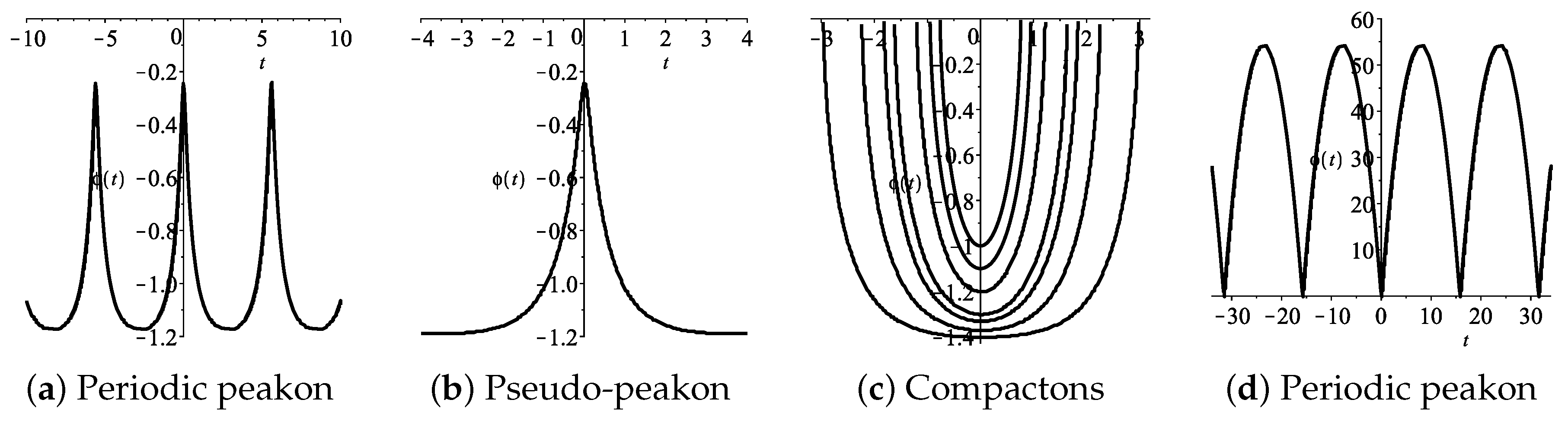
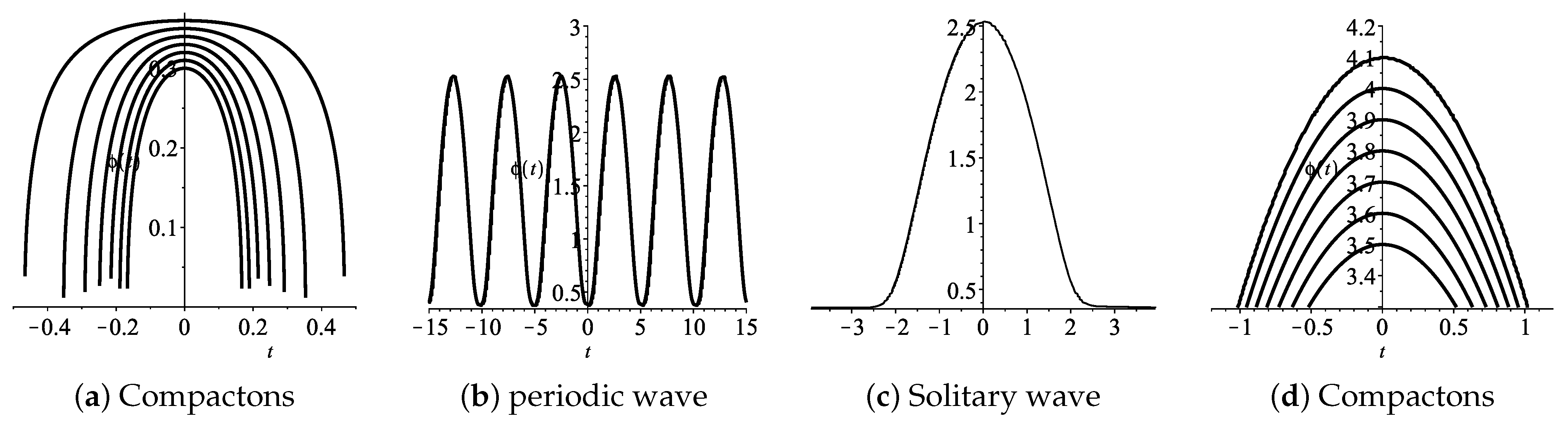
Notice that because system (3) has a singular straight line , when , (7) give rise to a periodic peakon family (see Figure 3d, below).
Figure 3.
Profiles of periodic peakon, pseudo-peakon, and compactons.
3.2. : Two Exact Periodic Solution Families Defined by the Level Curves , Respectively, and a Pseudo-Peakon or Solitary Wave Solution Defined by
(i) For two families of periodic orbits defined by , when , we have When we have They have the same parametric representations as (7).
3.3. : An Exact Compacton Solution Family Defined by and a Periodic Solution Family Defined by the Level Curves
(i) Corresponding to the open level curves passing though the point defined by , (6) can be written as Thus, we obtain the following parametric representation of the compacton solution family (see Figure 3c):
where .
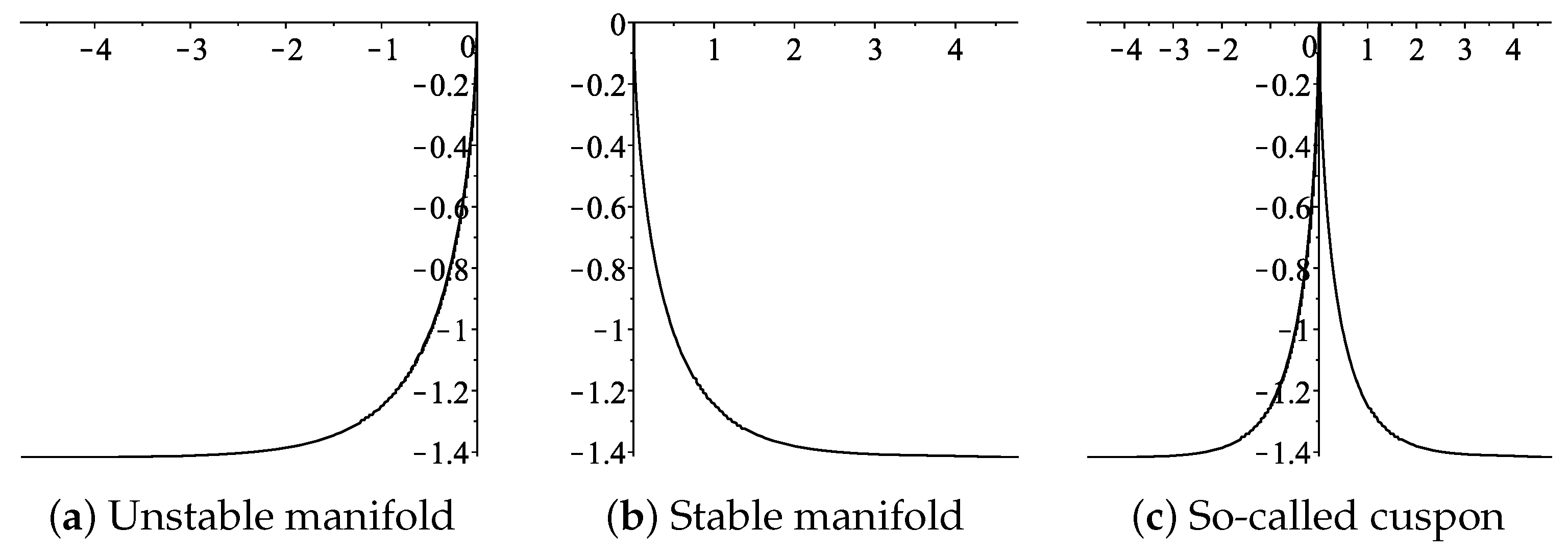
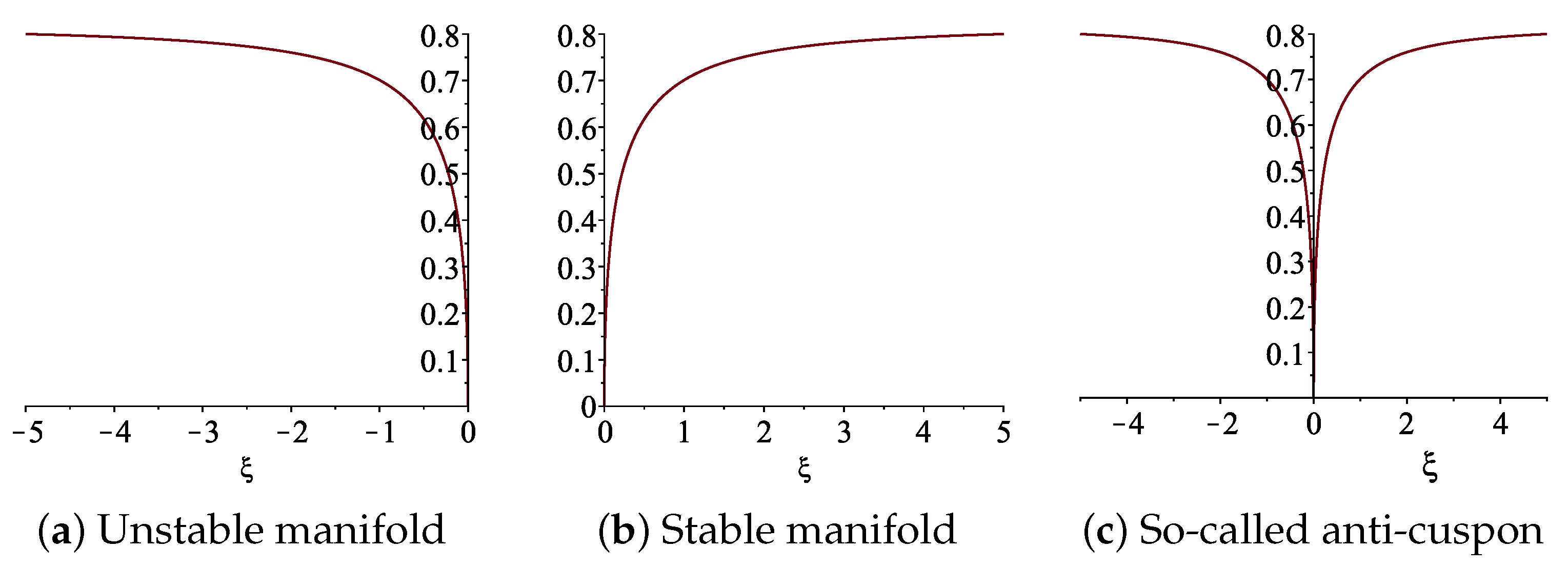
(ii) Corresponding to the right stable and unstable manifolds of the saddle point defined by (6) can be written as It follows the parametric representations of two bounded solutions (see Figure 4a,b):
Figure 4.
Profiles of two bounded solutions and so-called cuspon solution.
Notice that if we take together the above two bounded solutions, then, we get a “cuspon solution” (see Figure 4c), which is not a correct solution. It consists of two solutions.
(iii) Corresponding to the closed level curve family, enclosing the point , defined by , (6) becomes that Hence, we have the following parametric representation of periodic solution family:
where is the normal elliptic integral of the first kind.
3.4. : Two Exact Compacton Solution Families Defined by and a Periodic Solution Family Defined by the Level Curves , et al.
Figure 5.
Changes of level curves defined by when .
(i) Corresponding to the two open level curve families passing though the point and defined by (see Figure 5a), (6) can be written as and
As a result, we get the parametric representations of the two compacton solution families as follows:
where . And
where .
(ii) Corresponding to the right stable and unstable manifolds of the saddle point and a open curve passing through the point defined by (see Figure 5b), (6) can be written as and
It follows the parametric representations of two bounded solutions (similar to Figure 4a,b):
where . We have a compactom solution as follows:
(iii) Corresponding to the open curve family passing though the point or , defined by or (see Figure 5c,f), (6) can be written as It gives rise to the following parametric representation of a compacton solution family (see Figure 6d):
where .
Figure 6.
Profiles of solitary wave, periodic wave, and compactons.
3.5. : Exact Compacton Solution Families Defined by , and Two Bounded Solutions Defined by the Level Curves
(i) In this parameter condition, all compacton families have the same parametric representations as the above cases.
(ii) Correspoding to the stable and unstable manifolds to the double equilibrium point defined by , now, (6) has the form that Thus, the unstable manifold has the parametric representation:
The stable manifold has the parametric representation:
Notice that if we take together the above two bounded solutions, then we get a “anti-cuspon solution” (see Figure 7c), which is not a correct solution. It consists of two solutions.
Figure 7.
Profiles of two bounded solutions and so-called anti-cuspon solution.
4. Exact Solitary Wave Solutions Determined by the Orbits When
In this section, we consider the exact solutions for Equation (1). Because we use the transformation , such that Equation (1) becomes Equation (2), in order to study all solutions depending on parameters of system. Therefore, if a solution of system (3) can take some values which are near zero, then, becomes a unbounded solution. We do not like to consider the unbounded solution of Equation (1). By using the results of Section 3 we have the following conclusion.
Theorem 2.
For a fixed and we have
For the periodic wave solutions of Equation (1), we can give similar results as Theorem 2. We omit them.
Author Contributions
R.W.: Writing—review, Y.Z. editing. All authors have read and agreed to the published version of the manuscript.
Funding
This work is supported by Natural Science Foundation of Fujian Provincial (No.2022J01303).
Institutional Review Board Statement
Not applicable.
Informed Consent Statement
Not applicable.
Data Availability Statement
Not applicable.
Acknowledgments
We are very grateful to Jibin Li in the school of Mathematical Sciences, Huaqiao University, for his valuable instructions and suggestions on our paper.
Conflicts of Interest
The authors declare no conflict of interest.
References
- Camassa, R.; Holm, D.D. An integrable shallow water equation with peak solutions. Phys. Rev. Lett. 1993, 71, 1161–1164. [Google Scholar] [CrossRef] [PubMed] [Green Version]
- Camassa, R.; Holm, D.D.; Hyman, J.M. A new integrable shallow water equation. Adv. Appl. Mech. 1994, 31, 1–33. [Google Scholar]
- Camassa, R.; Hyman, J.M.; Luce, B.P. Nonlinear waves and solitons in physical sysytems. Physics D 1998, 123, 1–20. [Google Scholar] [CrossRef]
- Li, J. Singular Nonlinear Traveling Wave Equations: Bifurcations and Exact Solutions; Science Press: Beijing, China, 2013. [Google Scholar]
- Li, J.; Qiao, Z. Peakon, pseudo-peakon and cuspon solutions for two generalized Cammasa-Holm equations. J. Math. Phys. 2013, 54, 123501. [Google Scholar] [CrossRef] [Green Version]
- Li, J.; Chen, G. On a class of singular nonlinear traveling wave equations. Int. J. Bifurc. Chaos 2007, 17, 4049–4065. [Google Scholar] [CrossRef]
- Li, J.; Zhu, W.; Chen, G. Understanding peakons, periodic peakons and compactons via a shallow water wave equation. Int. J. Bifurc. Chaos 2016, 26, 1650207. [Google Scholar] [CrossRef]
- Li, J. Variform exact one-peakon solutions for some singular nonlinear traveling wave equations of the first kind. Int. J. Bifurc. Chaos 2014, 24, 1450160. [Google Scholar] [CrossRef] [Green Version]
- Geng, X.; Li, R.; Xue, B. A new integrable equation with peakons and cuspons and its bi-Hamiltonian structure. Appl. Math. Lett. 2015, 46, 64–69. [Google Scholar] [CrossRef]
- Oono, H. N soliton solution of Harry Dym equation by inverse scattering method. In Nonlinear Physics: Theory and Experiment; World Scientific Publishing: River Edge, NJ, USA, 1996; pp. 241–248. [Google Scholar]
- Fuchssteiner, B.; Schulze, T.; Carillo, S. Explicit solutions for the Harry Dym equation. J. Phys. A 1992, 25, 223–230. [Google Scholar] [CrossRef]
- Byrd, P.F.; Fridman, M.D. Handbook of Elliptic Integrals for Engineers and Scientists; Springer: Berlin, Germany, 1971. [Google Scholar]
Publisher’s Note: MDPI stays neutral with regard to jurisdictional claims in published maps and institutional affiliations. |
© 2022 by the authors. Licensee MDPI, Basel, Switzerland. This article is an open access article distributed under the terms and conditions of the Creative Commons Attribution (CC BY) license (https://creativecommons.org/licenses/by/4.0/).