
Abstract
This paper investigates the third Hankel determinant, denoted , for functions within the subclass of bi-univalent functions associated with crescent-shaped regions . The primary aim of this study is to establish upper bounds for . By analyzing functions within this specific geometric context, we derive precise constraints on the determinant, thereby enhancing our understanding of its behavior. Our results and examples provide valuable insights into the properties of bi-univalent functions in crescent-shaped domains and contribute to the broader theory of analytic functions.
MCS:
30C45; 30C50; 30C80
1. Introduction
We indicate by the class of analytic functions that have the formula
in the disk . Consider also that denotes the subclass of all functions that are also univalent in . It is well known that every function has an inverse satisfying and and given by
Let be a function in , and its inverse can be extended as a function belonging to ; then, is called bi-univalent in and denoted by . Subclasses of are namely bi-starlike (bi-convex) of order and have been established by Brannan and Taha [1]. These classes are non-sharp coefficient estimates and (see [1,2]). However, the Taylor–Maclaurin coefficients remain an unresolved challenge (see [1,2,3,4,5]).
Srivastava et al.’s pioneering work [6] has notably revived the study of bi-univalent functions in recent years. For a concise historical overview and various intriguing examples of functions within the class , one should refer to this influential research. Several authors have introduced and studied various subclasses of in works that followed [6], in which they established non-sharp bounds for the initial Taylor–Maclaurin coefficients. For further details, refer to [1,2,3,4,5,7,8,9,10,11,12]. We note that , since belongs to it, whereas the Koebe function does not belong to it.
In the following, an analytic function is subordinate to another if there exists an analytic function with satisfying and written as .
Ma and Minda [13] investigated the integration of different subclasses of starlike and convex functions. They explored situations where one of the functions, specifically or , is subordinated to another analytic function . For this purpose, they considered the analytic function satisfying the four below conditions:
- (1)
- ;
- (2)
- is univalent with ;
- (3)
- is starlike with respect to ;
- (4)
- is symmetric about a real axis.
In addition, if and are Ma–Minda starlike (or Ma–Minda convex), then is called Ma–Minda bi-starlike (or Ma–Minda bi-convex), respectively.
Ravichandran and Kummar [14] studied the class of starlike functions of reciprocal order denoted by and characterized by the condition
In this paper, we introduce the bi-univalent Ma–Minda type denoted by (see Definition 2). However, we assume that satisfies conditions (1)–(4) above. The function
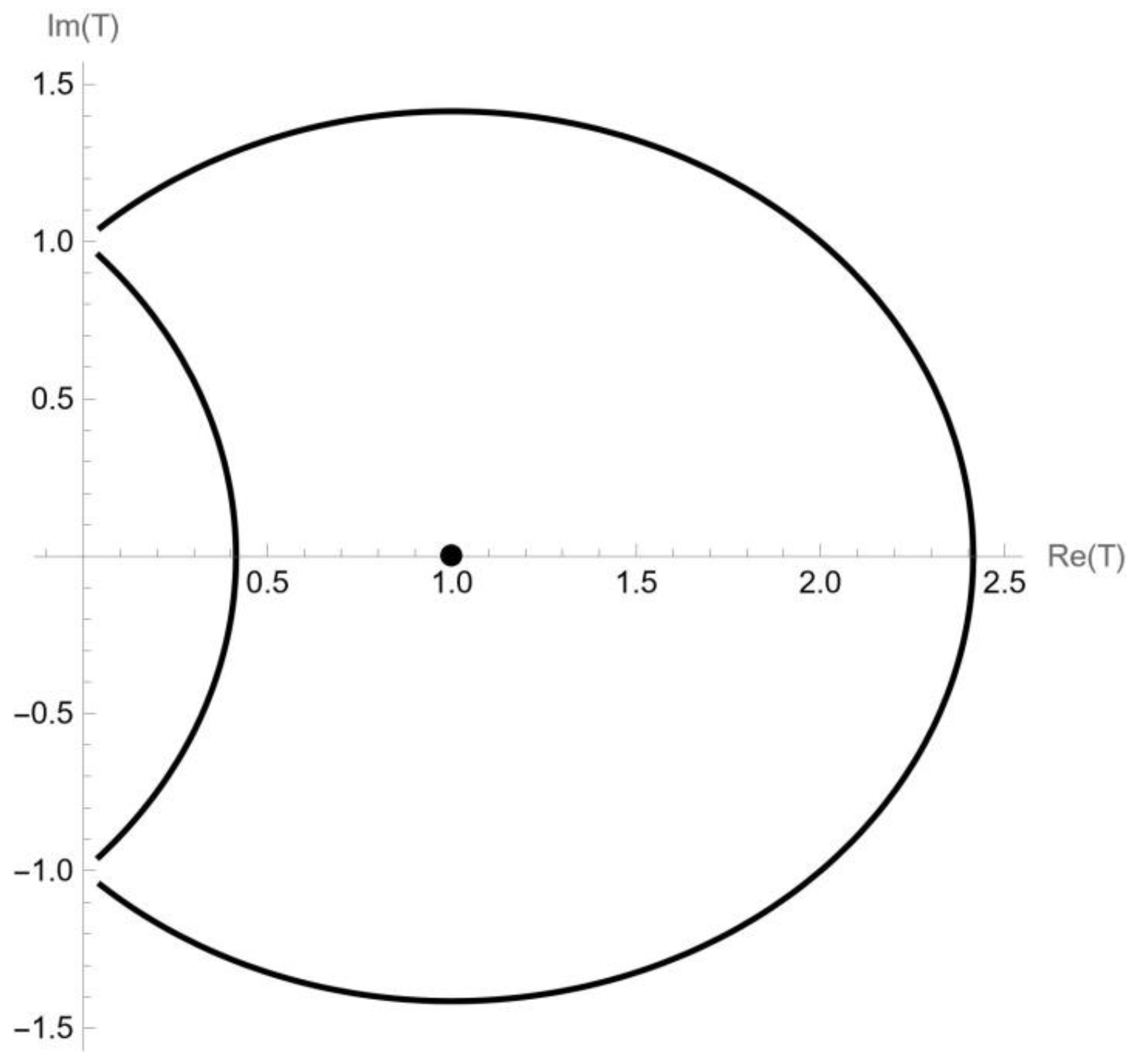
maps onto the crescent-shaped region given by , which satisfy the above four conditions (see Figure 1).
Figure 1.
Plot the boundary of .
Definition 1
(see Raina and Sokól [15]; see also [16,17,18]). Let be the class of all satisfying the subordination condition
Lemma 1
(see [16]). For , let and . Then,
Noonan and Thomas [19] defined the Hankel determinant of any function with the expression
by
In particular, we have
By applying the triangle inequality for , we have
Fekete and Szegö [20] considered the well-known functional (see also [21,22]). They performed an early study on the estimates of , with ; if , then
Inspired by the investigation of the second Hankel determinant for various subclasses of [23,24,25,26,27,28,29,30] and the third Hankel determinant for various subclasses of univalent functions [31,32,33,34,35], this article establishes the upper bound of for functions within .
Motivation.
Bi-univalent functions associated with crescent-shaped domains represent an intriguing area of complex analysis and hold significant implications across various applied fields. Understanding the properties of these functions contributes to the development of more accurate mathematical models. By deriving upper bounds for the third Hankel determinant, this research provides deeper insights into the behavior of analytic functions in these domains. Furthermore, the results pave the way for future studies and applications, enhancing both mathematical understanding and practical model development.
Objectives.
This study aims to analyze the third Hankel determinant for bi-univalent functions associated with crescent-shaped regions of these functions, while the second objective focuses on applying the results in specific fields. These objectives are essential in understanding the potential implications of these functions in some applications.
2. About
In this section, we will establish a subclass of associated with crescent-shaped regions. Additionally, we present non-trivial examples and illustrate them geometrically using the MathematicaTM program (version 13.2).
Definition 2.
Let . A function , given by (1), is said to be in the class , if it satisfies the following subordinations:
and
where and .
The below example gives the subclasses of .
Example 1.
The class is given by
and
The following example presents non-trivial functions that belong to the class of functions .
Example 2.
Consider the function
then
Clearly, and belong to for . By simple calculation, we have
Similarly,
In particular cases,
- (1)
- If , then (7) and (8) are reduced as follows:
Since , then leads to . Lemma 1 gives
Since , then
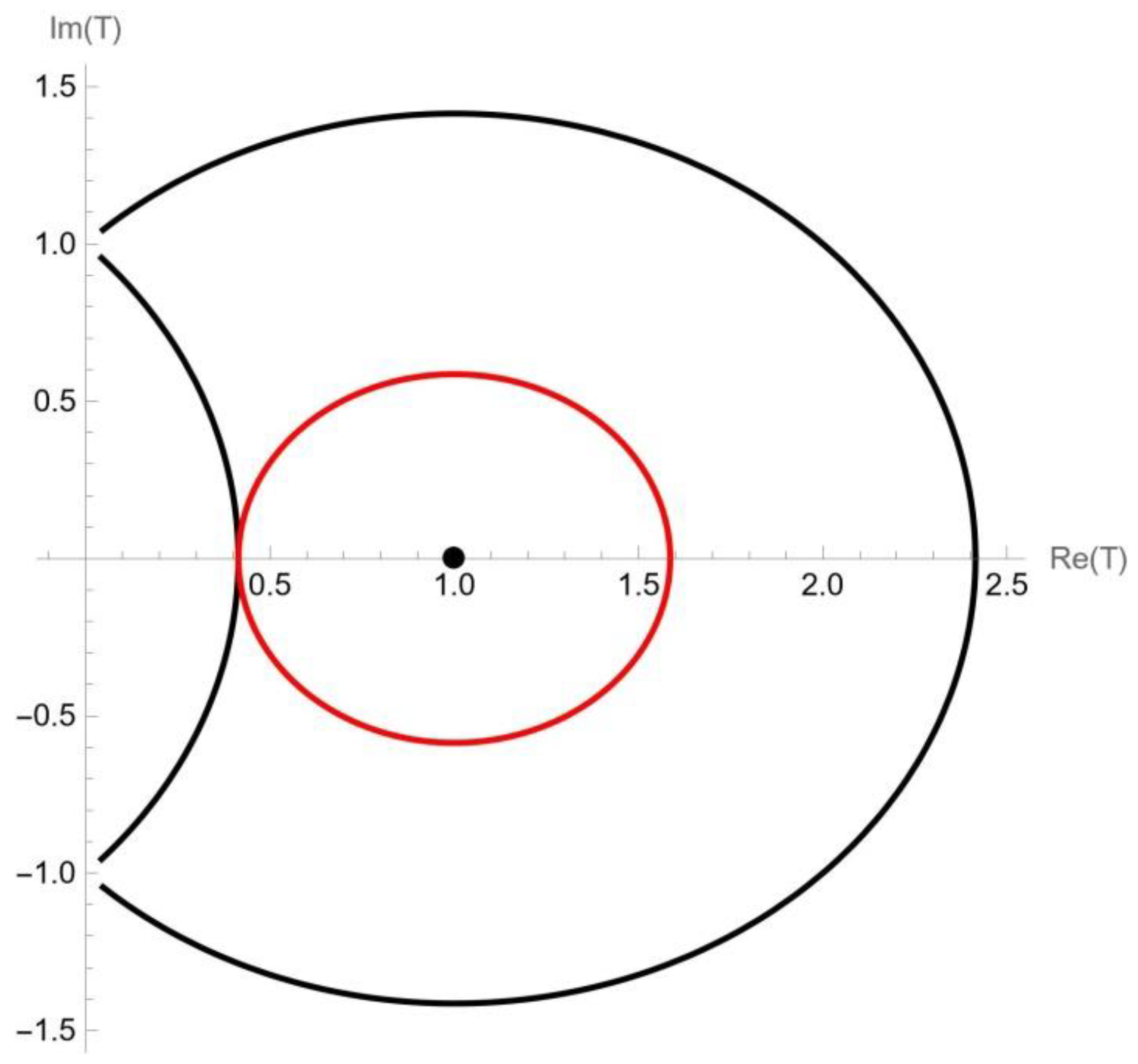
Hence, if and only if (see Figure 2).
Figure 2.
Plot of the boundaries of and in the colors black and red, respectively.
- (2)
- If , then (7) and (8) are reduced as follows:
Since , then leads to . Lemma 1 gives
leads to
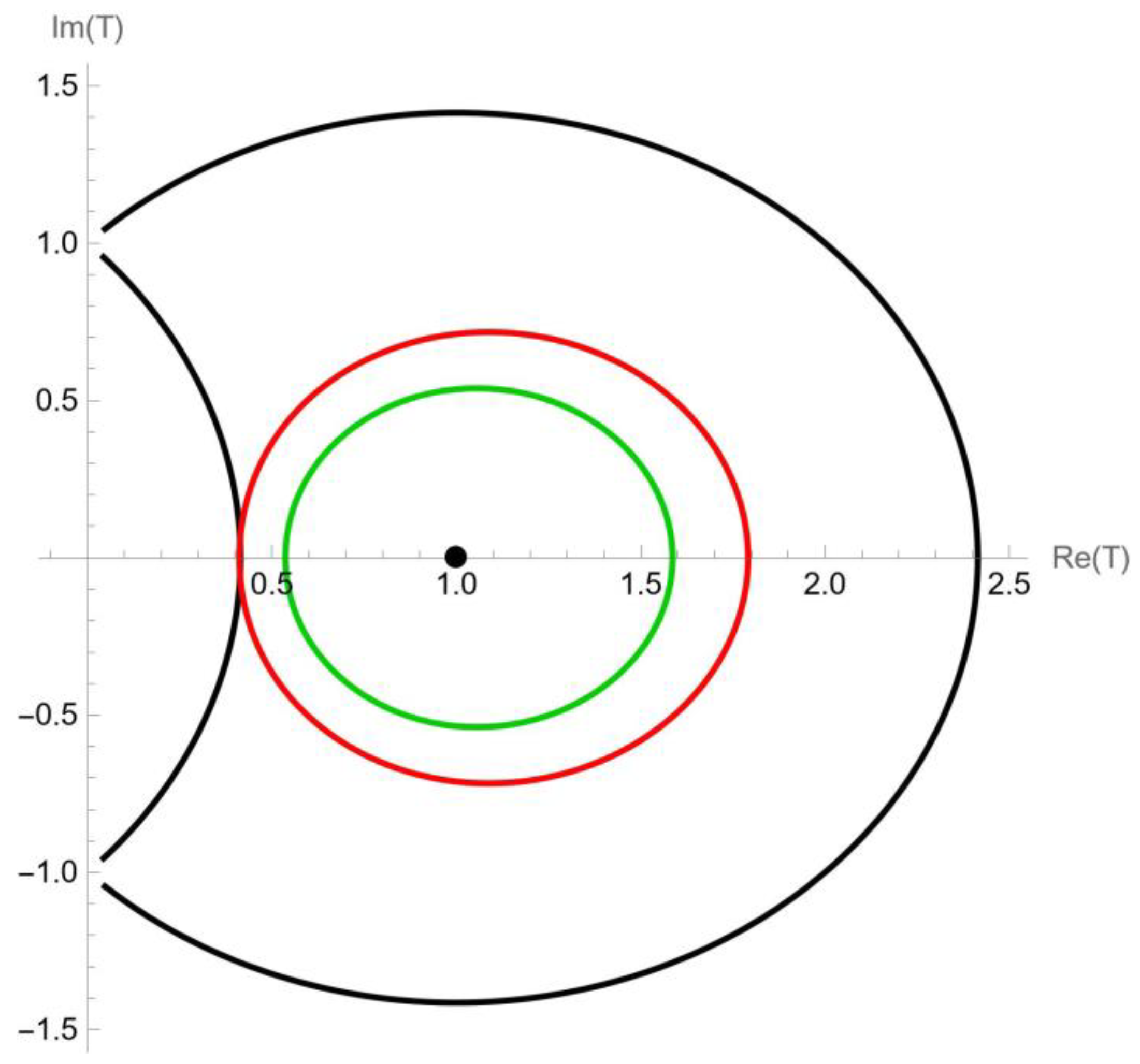
Hence, if and only if (see Figure 3).
Figure 3.
Plot of the boundaries of , , and in the colors black, red, and green, respectively.
3. Hankel Estimates of
The subsequent lemmas are important in establishing our results.
Lemma 2
(see [36]). Let be the class of all analytic functions of the form
with for all . Then, , for every .
Lemma 3
(see [37]). If the function is given by (9), then
for some with and .
Theorem 1.
Let given by (1) be in the class , . Then, we have
Proof.
Let . Then, there exists with where
and
Consider the functions with expansions
and
It follows that
and
Substituting (13) and (14) into (3), we obtain
and
Since has the Maclurian series defined by (1), computation shows that its inverse has the expansion by (2), and we have
and
From (15) and (17), we obtain that
and
Moreover, from (16) and (18), we obtain that
and
It follows from (19) and (23) that
i.e.,
Subtracting (24) from (20) and considering (27), we obtain
Moreover, subtracting (25) from (21) and considering (27) and (29), we find that
Hence, by (25), (27), and (28), it follows that
According Lemma 3 and (28), we obtain
and
for some and with and .
Since , we have . Letting , we may assume without loss of generality that . Thus, substituting expressions (32) and (33) in (31), and letting and , we have
where
and
We wish to maximize in the closed square for , because and , and we conclude that .
. Thus, the function cannot have a local maximum in the interior of the closed square. Now, we investigate the maximum of on the boundary of the closed square, such that and , and we obtain
Now, we deal with the two below cases.
- Case 1: Assume that . In this case, for , and any fixed with , it is clear thati.e., is an increasing function. Hence, for fixed , the maximum of occurs at and
- Case 2: , because , , where , and it is evident that and . Thus, the maximum of occurs at and , and we obtainso, from the cases of , we obtain
Since , we obtain on the boundary of square . We define the real function on by
Placing and in the function , we obtain
where
and
After a few calculations, we conclude that is an increasing function of . Therefore, we obtain the maximum of on and
Consequently, this completes the proof. □
Theorem 2.
Let . Then, we have
where
and
Proof.
From (27), (29), and (30), we obtain
According to Lemma 3, we suppose, without any restriction, that , such that . Therefore, for and , we have
where
and
We use the same proof technique as in Theorem 1. Thus, the maximum occurs at and in closed square ,
Substituting the values of and in , we obtain
where
Therefore,
if , then . Hence, , and so is an increasing function on the closed interval . Therefore, the function gives the maximum value at , i.e.,
On the other hand, if with , we obtain the following result
whenever . Then, we obtain , which means that this function is on the closed interval . Thus, has the maximum value at , which means that is a decreasing function on the closed interval ; thus, gives the maximum value at , i.e.,
Thus, the proof has been thoroughly established. □
Theorem 3.
Let . Then, we have
Proof.
By using (29) and Lemma 2, we obtain (36).
The following Fekete–Szegö functional, for and ,
By Lemma 2, we obtain
and, for we obtain (35). □
Theorem 4.
Let . Then, we have
Proof.
From (30) and by Lemma 2, we obtain (37).
Subtracting (26) from (22), we have
Substituting properly (27), (29), and (30), we have
By applying Lemma 2, we obtain (38). □
Theorem 5.
Let Then, we have
where , and are given by (36), (10), (37), (38), and (35), respectively.
Proof.
Since applying the triangle inequality, we have (4). Substituting (36), (10), (37), (38), and (35) into (4), we obtain (39). □
4. Conclusions
In this study, we have thoroughly examined the third Hankel determinant for functions belonging to a specific subclass of bi-univalent functions associated with the crescent-shaped region. Our investigation revealed that the upper bounds for this determinant can be precisely determined, contributing valuable insights into the behavior and properties of such functions within the given geometric context.
The analysis demonstrated that the upper bounds obtained are significant in understanding the functions’ characteristics in the crescent-shaped region, providing a clearer picture of the constraints and limitations imposed by this geometric domain. The results not only advance our knowledge of Hankel determinants in relation to bi-univalent functions but also offer potential pathways for further research in this area.
Future studies could explore the extension of these results to other geometric regions, higher-order Hankel determinants, or Toeplitz determinants or deal with fractional derivatives (see [38,39]), which may uncover additional relationships and applications in the theory of analytic functions. The findings presented here lay a robust foundation for such advancements and underscore the importance of geometric considerations in the study of function theory.
In conclusion, the insights gained from our analysis of the third Hankel determinant enhance our understanding of bi-univalent functions and their associated determinants in crescent-shaped regions, marking a significant contribution to the field of complex analysis.
Author Contributions
Conceptualization, Q.A.S. and A.S.T.; methodology, D.B. and L.-I.C.; software, A.S.T.; validation, Q.A.S., A.S.T. and D.B.; formal analysis, L.-I.C. and E.R.; investigation, F.M.S. and Q.A.S.; resources, A.S.T. and D.B.; data curation, L.-I.C. and E.R.; writing—original draft preparation, F.M.S. and Q.A.S.; writing—review and editing, A.S.T. and D.B.; visualization, L.-I.C. and E.R.; supervision, F.M.S. and Q.A.S.; project administration, A.S.T. and D.B.; funding acquisition, D.B., L.-I.C. and E.R. All authors have read and agreed to the published version of the manuscript.
Funding
This research received no external funding.
Data Availability Statement
No new data were created or analyzed in this study. Data sharing is not applicable to this article.
Conflicts of Interest
The authors declare no conflicts of interest.
References
- Brannan, D.A.; Taha, T.S. On some classes of bi-univalent functions. Studia Univ. Babes-Bolyai Math. 1986, 31, 70–77. [Google Scholar]
- Taha, T.S. Topics in Univalent Function Theory. Ph.D. Thesis, University of London, London, UK, 1981. [Google Scholar]
- Brannan, D.A.; Clunie, J.G. Aspects of Contemporary Complex Analysis. In Proceedings of the NATO Advanced Study Institute held at the University of Durham, Durham, UK, 1–20 July 1979; Academic Press: New York, NY, USA; London, UK, 1980. [Google Scholar]
- Lewin, M. On a coefficient problem for bi-univalent functions. Proc. Am. Math. Soc. 1967, 18, 63–68. [Google Scholar] [CrossRef]
- Netanyahu, E. The minimal distance of the image boundary from the origin and the second coefficient of a univalent function in |z| < 1. Arch. Ration. Mech. Anal. 1969, 32, 100–112. [Google Scholar] [CrossRef]
- Srivastava, H.M.; Mishra, A.K.; Gochhayat, P. Certain subclasses of analytic and bi-univalent functions. Appl. Math. Lett. 2010, 23, 1188–1192. [Google Scholar] [CrossRef]
- Xu, Q.-H.; Gui, Y.-C.; Srivastava, H.M. Coefficient estimates for a certain subclass of analytic and bi-univalent functions. Appl. Math. Lett. 2012, 25, 990–994. [Google Scholar] [CrossRef]
- Xu, Q.-H.; Xiao, H.-G.; Srivastava, H.M. A certain general subclass of analytic and bi-univalent functions and associated coefficient estimate problems. Appl. Math. Comput. 2012, 218, 11461–11465. [Google Scholar] [CrossRef]
- Shakir, Q.A.; Atshan, W.G. On third Hankel determinant for certain subclass of bi-univalent functions. Symmetry 2024, 16, 239. [Google Scholar] [CrossRef]
- Sakar, F.M.; Aydoğan, S.M. Inequalities of bi-starlike functions involving Sigmoid function and Bernoulli Lemniscate by subordination. Int. J. Open Problems Compt. Math. 2023, 16, 71–82. [Google Scholar]
- Swamy, S.R.; Breaz, D.; Venugopal, K.; Kempegowda, M.P.; Cotîrla, L.-I.; Rapeanu, E. Initial Coefficient Bounds Analysis for Novel Subclasses of Bi-Univalent Functions Linked with Lucas-Balancing Polynomials. Mathematics 2024, 12, 1325. [Google Scholar] [CrossRef]
- Srivastava, H.M.; El-Deeb, S.M.; Breaz, D.; Cotîrla, L.-I.; Salagean, G.S. Bi-Concave Functions Connected with the Combination of the Binomial Series and the Confluent Hypergeometric Function. Symmetry 2024, 16, 226. [Google Scholar] [CrossRef]
- Ma, W.; Minda, D. A unified treatment of some special classes of functions. In Proceedings of the Conference on Complex Analysis, Tianjin, China, 19–23 June 1992; Conference Proceedings and Lecture Notes in Analysis. Li, Z., Ren, F., Yang, L., Zhang, S., Eds.; International Press: Cambridge, MA, USA, 1994; Volume I, pp. 157–169. [Google Scholar]
- Ravichandran, V.; Kumar, S.S. Argument estimate for starlike functions of reciprocal order. Southeast Asian Bull. Math. 2011, 35, 837–843. [Google Scholar]
- Raina, R.K.; Sokół, J. Some properties related to a certain class of starlike functions. C. R. Math. Acad. Sci. Paris 2015, 353, 973–978. [Google Scholar] [CrossRef]
- Gandhi, S.; Ravichandran, V. Starlike functions associated with a lune. Asian Eur. J. Math. 2017, 10, 1750064. [Google Scholar] [CrossRef]
- Raina, R.K.; Sharma, P.; Sokól, J. Certain classes of analytic functions related to the crescent-shaped regions. J. Contemp. Math. Anal. 2018, 53, 355–362. [Google Scholar] [CrossRef]
- Sharma, P.; Raina, R.K.; Sokól, J. Certain Ma–Minda type classes of analytic functions associated with the crescent-shaped region. Anal. Math. Phys. 2019, 9, 1887–1903. [Google Scholar] [CrossRef]
- Noonan, J.W.; Thomas, D.K. On the second Hankel determinant of areally mean p-valent functions. Trans. Am. Math. Soc. 1076, 223, 337–346. [Google Scholar] [CrossRef]
- Fekete, M.; Szegö, G. Eine Bemerkung über ungerade schlichte Funktionen. J. Lond. Math. Soc. 1933, 8, 85–89. [Google Scholar] [CrossRef]
- Koepf, W. On the Fekete-Szego problem for close-to-convex functions. Proc. Am. Math. Soc. 1987, 101, 89–95. [Google Scholar]
- Koepf, W. On the Fekete-Szego problem for close-to-convex functions II. Arch. Math. 1987, 49, 420–433. [Google Scholar] [CrossRef]
- Altınkaya, S.; Yalçin, S. Second hankel determinant for a general subclass of bi-univalent functions. TWMS J. Pure Appl. Math. 2016, 7, 98–104. [Google Scholar]
- Cağlar, M.; Deniz, E.; Srivastava, H.M. Second Hankel determinant for certain subclasses of bi-univalent functions. Turk. J. Math. 2017, 41, 694–706. [Google Scholar] [CrossRef]
- Deniz, E.; Cağlar, M.; Orhan, H. Second Hankel determinant for bi-starlike and bi-convex functions of order β. Appl. Math. Comput. 2015, 271, 301–307. [Google Scholar]
- Motamednezhad, A.; Bulboaca, T.; Adegani, E.A.; Dibagar, N. Second Hankel determinant for a subclass of analytic bi-univalent functions defined by subordination. Turk. J. Math. 2018, 42, 2798–2808. [Google Scholar] [CrossRef]
- Mustafa, N.; Murugusundaramoorthy, G.; Janani, T. Second Hankel determinant for a certain subclass of bi-univalent functions. Mediterr. J. Math. 2018, 15, 119. [Google Scholar] [CrossRef]
- Srivastava, H.M.; Altınkaya, S.; Yalçin, S. Hankel determinant for a subclass of bi-univalent functions defined by using a symmetric q-derivative operator. Filomat 2018, 32, 503–516. [Google Scholar] [CrossRef]
- Srivastava, H.M.; Murugusundaramoorthy, G.; Bulboaca, T. The second Hankel determinant for subclasses of Bi-univalent functions associated with a nephroid domain. Rev. Real Acad. Cienc. Exactas Físicas Naturales. Ser. A. Matemáticas 2022, 116, 145. [Google Scholar] [CrossRef]
- Zaprawa, P. On the Fekete-Szego problem for classes of bi-univalent functions. Bull. Belg. Math. Soc.-Simon Stevin 2014, 21, 169–178. [Google Scholar] [CrossRef]
- Altınkaya, S.; Yalçin, S. Third Hankel determinant for Bazilevic functions. Adv. Math. 2016, 5, 91–96. [Google Scholar]
- Kowalczyk, B.; Lecko, A.; Sim, Y.J. The sharp bound for the Hankel determinant of the third kind for convex functions. Bull. Aust. Math. Soc. 2018, 97, 435–445. [Google Scholar] [CrossRef]
- Shanmugam, G.; Stephen, B.A.; Babalola, K.O. Third Hankel determinant for alpha-starlike functions. Gulf J. Math. 2014, 2, 107–113. [Google Scholar] [CrossRef]
- Shi, L.; Srivastava, H.M.; Arif, M.; Hussain, S.; Khan, H. An investigation of the third Hankel determinant problem for certain subfamilies of univalent functions involving the exponential function. Symmetry 2019, 11, 598. [Google Scholar] [CrossRef]
- Zaprawa, P. Third Hankel determinants for subclasses of univalent functions. Mediterr. J. Math. 2017, 14, 19. [Google Scholar] [CrossRef]
- Duren, P.L. Univalent Functions, In Grundlehren der Mathematischen Wissenschaften, Band 259; Springer: New York, NY, USA; Berlin/Heidelberg, Germany; Tokyo, Japan, 1983. [Google Scholar]
- Grenander, U.; Szegö, G. Toeplitz Forms and Their Applications, California Monographs in Mathematical Sciences; University of California Press: Berkeley, CA, USA, 1958. [Google Scholar]
- Tayyah, A.S.; Atshan, W.G. New Results on r,k,µ-Riemann–Liouville Fractional Operators in Complex Domain with Applications. Fractal Fract. 2024, 8, 165. [Google Scholar] [CrossRef]
- Aldawish, I.; Ibrahim, R.W. Studies on a new K-symbol analytic functions generated by a modified K-symbol Riemann-Liouville fractional calculus. MethodsX 2023, 11, 102398. [Google Scholar] [CrossRef]
Disclaimer/Publisher’s Note: The statements, opinions and data contained in all publications are solely those of the individual author(s) and contributor(s) and not of MDPI and/or the editor(s). MDPI and/or the editor(s) disclaim responsibility for any injury to people or property resulting from any ideas, methods, instructions or products referred to in the content. |
© 2024 by the authors. Licensee MDPI, Basel, Switzerland. This article is an open access article distributed under the terms and conditions of the Creative Commons Attribution (CC BY) license (https://creativecommons.org/licenses/by/4.0/).