


Abstract
The primary intent of this study is to establish some important inequalities of the Hermite–Hadamard, trapezoid, and midpoint types under fractional extended Riemann–Liouville integrals (FERLIs). The proofs are constructed using the renowned Jensen–Mercer, power-mean, and Holder inequalities. Various equalities for the FERLIs and convex functions are construed to be the mainstay for finding new results. Some connections between our main findings and previous research on Riemann–Liouville fractional integrals and FERLIs are also discussed. Moreover, a number of examples are featured, with graphical representations to illustrate and validate the accuracy of the new findings.
MSC:
26D07; 26D10; 26D15; 26A33
1. Introduction
In the context of nonconvex energy mappings, Panagiotopoulos proposed and expanded the theoretical framework of integral inequalities [1,2,3], in addition to their applicability in the fields of mechanical engineering and finance. We strongly suggest reading the article [4], which provides an analysis of this idea as well as further commentary. Following this helpful beginning of mathematical inequalities, the Bessel function and the improved Bessel function were linked to certain integral inequalities. They are also appropriate for use in different chemical engineering systems in which the Bessel function was first used. In regular-frequency radio waves, the zeros of the Bessel function have a great effect. Sine transporter waves and sine signal waves, both of which may be expressed mathematically using Bessel functions, are used in frequency-regulated transmission [5,6].
As an extension of traditional derivatives and integrals, the study of fractional calculus entails looking at derivatives and integrals with non-integer orders. It is as archaic as traditional calculus, but it has been garnering a lot of attention in the past twenty years thanks to its usefulness in numerous areas of science [7,8,9,10]. In recent years, researchers have been actively working to generalize previously discovered concepts by using modern ideas and innovative methods from the field of fractional calculus. Mathematical analysts are increasingly drawn to a technique known as “fractional operators” analysis. Integral inequalities with fractional integrals are very important because they may be used to check the solution advantages for many different types of integrodifferential fractional or fractal equations [11,12,13].
Fractional calculus was used by Sarikaya et al. [14] to prove many integral inequalities that are based on the inequality of Hermite–Hadamard. With this method, researchers now have a fresh avenue to explore this inequality. In addition, the authors in [15] covered important illustrations of a number of significant inequalities that were established by Set et al. [16]. Since that moment, a large number of researchers have put the concepts of fractional calculus to widespread use. As a result, they have obtained various novel and cutting-edge improvements of inequalities by using convexity and its extensions (see [17,18,19,20,21,22,23]).
Before getting into the main conclusions of the research, it may be helpful to look at a number of key terminology and obtained findings.
Definition 1
([24]). A function that is considered to be convex is one that satisfies the following inequality.
If () is convex, then the function is considered to have a concave form.
The following outcome offers an actual illustration of the convexity idea in a geometric manner.
Theorem 1
([25]). The subsequent inequality is found if we assume that is a convex function.
The converse orientation of (2) will also be valid if is concave.
In this study, we take into consideration the integral form inequality of the Hermite–Hadamard–Mercer kind, which is dependent on the inequalities of Hermite–Hadamard and Jensen–Mercer. Because of this, it is important to remember the Jensen–Mercer inequality.
Let and be weights such that and . For a convex mapp on , the inequality of Jensen is realized as follows [26,27]:
∀ and , .
In the literature, the following inequality is recognized as a Jensen–Mercer inequality.
Theorem 2
([27,28]). If the function is convex over , we obtain
∀, , and .
For more findings regarding the Jensen–Mercer inequality, see [29,30,31].
Definition 2
([32]). For and the gamma function, beta function, and incomplete beta function are described by
and
respectively.
Kilbas et al. [32] presented fractional integrals, also called Riemann–Liouville integrals, as follows:
Definition 3
([32]). Let , with . The integrals of Riemann–Liouville and of order are presented as follows:
and
respectively. Here, Γ denotes the Gamma integral form.
Jarad et al. [33] developed the fractional extended Riemann–Liouville integrals (FERLIs), gave their features, and compared them with many fractional tools studied before. Here is how to describe the FERLIs:
Definition 4
([33]). Let and . For , the FERLIs and are defined by
and
respectively.
If we assign , then the FERLIs in (7) and (8) equal the Riemann–Liouville fractional integrals in (5) and (6), respectively.
The following inequality of Hermite–Hadamard was proved for the FERLIs by Set et al. [34]
Theorem 3.
Assume that is convex and We obtain
for and
Set et al. [34] also proved the following Lemma:
Lemma 1.
Let the function be a differentiable on and Then, we have
for and
Hezenci and Budak proved the following result [35]:
Lemma 2.
If is differentiable over and , the following equality is valid:
Here,
Öǧülmüs and Sarikaya [36] proved an inequality for Riemann–Liouville fractional integrals, which is known as the Hermite–Hadamard–Mercer inequality. Butt et al. proved the following Hermite–Hadamard–Mercer inequality for FERLIs [37]:
Theorem 4.
The essential target of this discussion is to offer Hermite–Hadamard-, trapezoid-, and midpoint-kind inequalities for FERLIs using the Jensen–Mercer inequality. In Section 2, an identity will be established by utilizing Lemma 1, as given by Set et al. in [34]. By employing this equality and the well-known Hölder and power-mean inequalities, various trapezoid-type inequalities for FERLIs will be derived using the Jensen–Mercer inequality. Additionally, Section 3 will introduce an equality based on Lemma 2, proven by Hezenci and Budak in [35]. Subsequently, utilizing this newly established identity and the Jensen–Mercer inequality, several midpoint-type inequalities will be obtained. In both Section 2 and Section 3, we will discuss the connections between our main findings and prior studies conducted on Riemann–Liouville fractional integrals and FERLIs. Section 4 will feature a number of examples aimed at illustrating the primary outcomes. Furthermore, graphical representations will be used to validate the accuracy of these findings. Section 5 provides an overview of the conclusions drawn from the study.
The following equalities will be used in the new sections:
Lemma 3.
We have the following equalities for and .
2. Trapezoid-Type Inequalities with Jensen–Mercer Inequality
In this section, we present some trapezoid-type inequalities proved using the Jensen–Mercer inequality.
Lemma 4.
Assume that is differentiable on and Then, we have
for and
Proof.
If we write and instead of and , respectively, in Lemma 1, then we obtain the desired result immediately. One can find a corresponding proof in [37]. □
Theorem 5.
Proof.
In view of Lemma 4, we have
Next, we use the Jensen–Mercer inequality to derive
Here, we have
and
Remark 1.
If we choose and in Theorem 5, then we obtain the inequality
which was proved by Set et al. in [34].
Remark 2.
If we choose in Theorem 5, then we obtain the inequality
which was proved by Öğülmüş and Sarikaya in [36].
Theorem 6.
Proof.
According to Lemma 4 and Hölder’s inequality, we conclude
Utilizing the inequality of Jensen–Mercer and convexity of , we obtain
which completes the proof of Theorem 6. □
Remark 3.
If we choose and in Theorem 6, then we obtain the inequality
Remark 4.
If we choose in Theorem 6, then we obtain the inequality
3. Midpoint-Type Inequalities with Jensen–Mercer Inequality
Here, we use the Jensen–Mercer inequality to set up certain inequalities of the midpoint kind.
Lemma 5.
Note that is differentiable on and . For the FERLIs in (7) and (8), the following equality is valid.
Here,
Proof.
If we write and instead of and respectively, in Lemma 2, then we obtain the intended outcome right away. □
Theorem 7.
Assume that is differentiable on and is convex over . Consequently, the FERLIs satisfy the following inequality:
Proof.
By Lemma 5, we have
Then, using the Jensen–Mercer inequality, we obtain
Similarly, by the Jensen–Mercer inequality, we obtain
and
This wraps up the proof. □
Remark 5.
If we choose and in Theorem 7, then we obtain the inequality
which was proved by Hezenci and Budak in [35].
Remark 6.
If we choose in Theorem 7, then we obtain the inequality
Theorem 8.
Note that is differentiable on and is convex over for some . Then, the FERLIs fulfill the inequality below:
where and
Proof.
By the well-known Hölder inequality and Jensen–Mercer inequality, we have
Similarly, we obtain
and
This concludes the proof. □
Remark 7.
If we choose and in Theorem 8, the following inequality is valid:
which was proved by Hezenci and Budak in [35].
Remark 8.
If we choose in Theorem 7, then we obtain the inequality
4. Some Examples
Example 1.
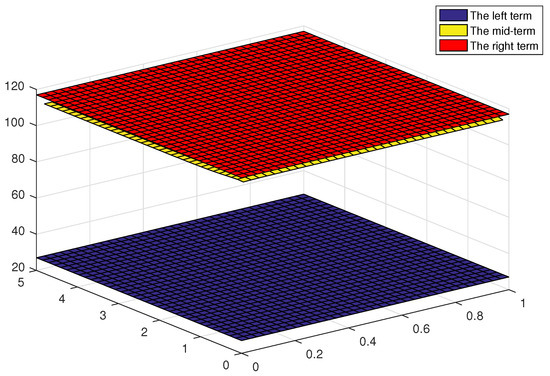
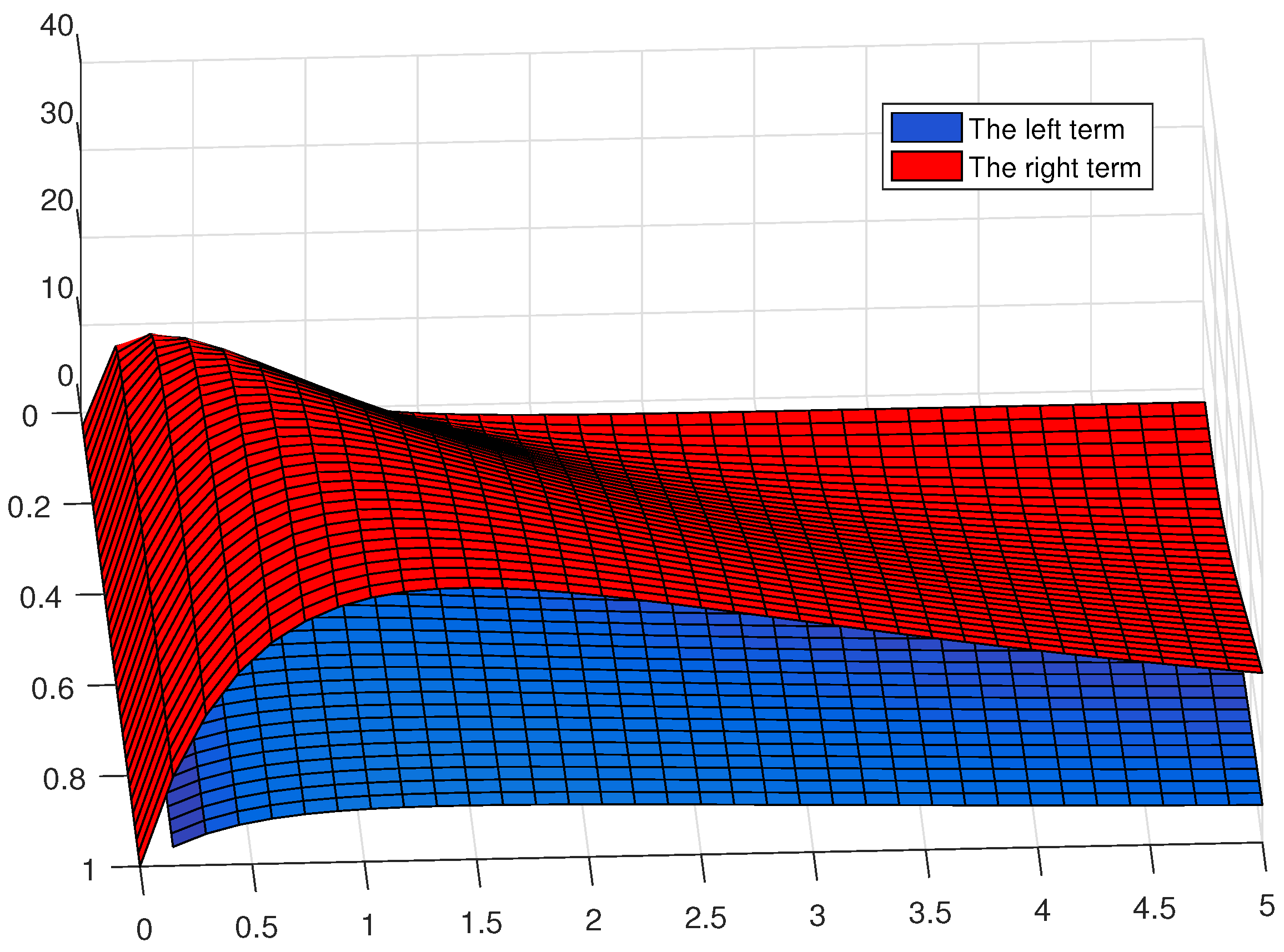
Consider the convex function For and , the left- and right-hand sides of (12) can be computed as
and
respectively. By (7), we have
and similarly, by (8), we have
Thus, the mid-term of (12) can be calculated as
Consequently, we have the following inequality from inequality (12):
Figure 1.
An example of Theorem 4, depending on and , analysed and visualized with MATLAB.
Example 2.
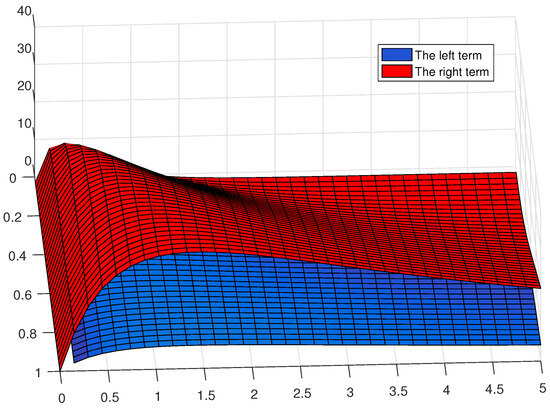
Let us consider the same function in Example 1. It is clear that the function is convex. By (7) and (8), we have
and
Thus, the left-hand side of the inequality (14) in Theorem 5 can be written as
On the other hand, since we can calculate the right-hand side of (14) as
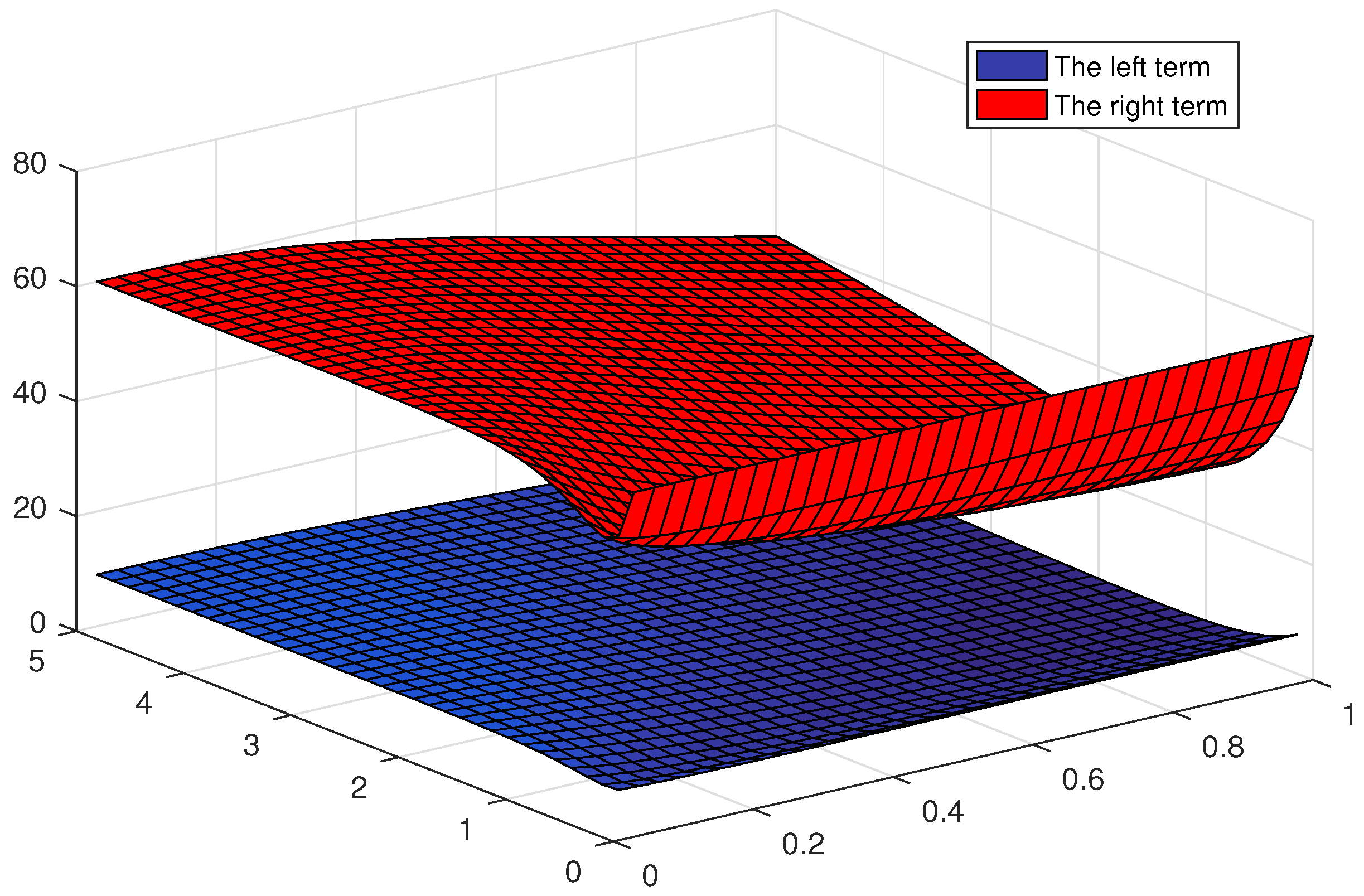
Therefore, we obtain the inequality
Figure 2.
An example of Theorem 5, depending on and , analysed and visualized with MATLAB.
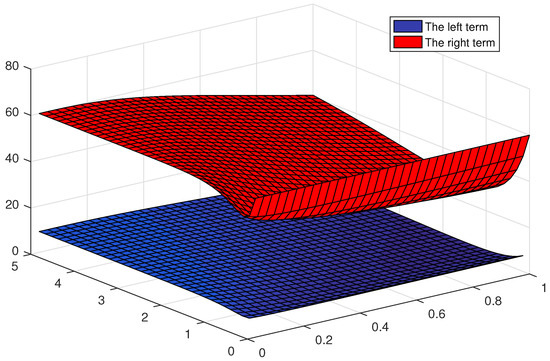
Similarly, we can calculate the left and right sides of the inequality (19) in Theorem 7 as follows:
and
Thus, we have the inequality
Figure 3.
An example of Theorem 7, depending on and , analysed and visualized with MATLAB.
5. Conclusions
This study aimed to investigate some important inequalities via the FERLIs and Jensen–Mercer inequality. The proven inequalities included the Hermite–Hadamard, trapezoid, and midpoint types. In order to obtain these new results, some equalities have been established with the FERLIs and the features of the convex functions. Also, in an easy way, one can see the connections between our main findings and prior studies conducted on Riemann–Liouville fractional integrals and FERLIs. To validate the accuracy of the new findings, a number of examples have been illustrated with graphical representations.
Author Contributions
Methodology and conceptualization, A.-A.H., A.A.A. and H.B.; data curation and writing—original draft, A.-A.H., A.A.A. and H.B.; investigation and visualization, A.-A.H., A.A.A. and H.B.; validation, writing—reviewing, and editing, A.-A.H., A.A.A. and H.B. All authors have read and agreed to the published version of the manuscript.
Funding
This research was funded by King Khalid University under grant (RGP.2/102/44) and Princess Nourah bint Abdulrahman University Researchers Supporting Project number (PNURSP2023R337).
Data Availability Statement
The corresponding author will provide the data used in this work upon reasonable request.
Acknowledgments
The authors extend their appreciation to the Deanship of Scientific Research at King Khalid University for funding this work through Research Groups Program under grant (RGP.2/102/44). The authors would like to acknowledge the Princess Nourah bint Abdulrahman University Researchers Supporting Project number (PNURSP2023R337), Princess Nourah bint Abdulrahman University, Riyadh, Saudi Arabia.
Conflicts of Interest
The authors declare no conflict of interest.
References
- Panagiotopoulos, P.D. Nonconvex energy functions. Hemivariational inequalities and substationarity principles. Acta Mech. 1983, 48, 111–130. [Google Scholar] [CrossRef]
- Panagiotopoulos, P.D. Inequality Problems in Mechanics and Applications: Convex and Nonconvex Energy Functions; Birkhäuser: Boston, MA, USA, 1985. [Google Scholar]
- Panagiotopoulos, P.D. Hemivariational inequalities and their applications. In Topics in Nonsmooth Mechanics; Birkhäuser: Basel, Swizerland, 1988. [Google Scholar]
- Fan, K. Some properties of convex sets related to fixed point theorems. Math. Ann. 1984, 266, 519–537. [Google Scholar] [CrossRef]
- Gil, A.; Segura, J.; Temme, N.M. Evaluation of the Modified Bessel Function of the Third Kind of Imaginary Orders. J. Comput. Phys. 2002, 175, 398–411. [Google Scholar] [CrossRef]
- Rappoport, J.M. Tables of Modified Bessel Functions ; Nauka: Moscow, Russia, 1979. (In Russian) [Google Scholar]
- Abdeljawad, T.; Baleanu, D. Monotonicity results for fractional difference operators with discrete exponential kernels. Adv. Differ. Equ. 2017, 2017, 78. [Google Scholar] [CrossRef]
- Agarwal, R.; Purohit, S.D.; Kritika. A mathematical fractional model with nonsingular kernel for thrombin receptor activation in calcium signalling. Math. Methods Appl. Sci. 2019, 42, 7160–7171. [Google Scholar] [CrossRef]
- Agarwal, R.; Yadav, M.P.; Baleanu, D.; Purohit, S.D. Existence and uniqueness of miscible flow equation through porous media with a non singular fractional derivative. AIMS Math. 2020, 5, 1062–1073. [Google Scholar] [CrossRef]
- Kumar, D.; Singh, J.; Purohit, S.D.; Swroop, R. A hybrid analytical algorithm for nonlinear fractional wave-like equations. Math. Model. Nat. Phenom. 2019, 14, 304. [Google Scholar] [CrossRef]
- Katugampola, U.N. A new approach to generalized fractional derivatives. Bull. Math. Anal. Appl. 2014, 6, 1–15. [Google Scholar]
- Mishra, A.M.; Baleanu, D.; Tchier, F.; Purohit, S.D. Certain Results Comprising the Weighted Chebyshev Function Using Pathway Fractional Integrals. Mathematics 2019, 7, 896. [Google Scholar] [CrossRef]
- Mishra, A.M.; Kumar, D.; Purohit, S.D. Unified integral inequalities comprising pathway operators. AIMS Math. 2020, 5, 399–407. [Google Scholar] [CrossRef]
- Sarikaya, M.Z.; Set, E.; Yaldiz, H.; Basak, N. Hermite–Hadamard’s inequalities for fractional integrals and related fractional inequalities. Math. Comput. Model. 2013, 57, 2403–2407. [Google Scholar] [CrossRef]
- Set, E.; Çelik, B. On generalizations related to the left side of Fejer’s inequality via fractional integral operator. Miskolc Math. Notes 2017, 18, 1043–1057. [Google Scholar] [CrossRef]
- Set, E.; İşcan, İ.; Zeki Sarikaya, M.; Emin Özdemir, M. On new inequalities of Hermite–Hadamard–Fejér type for convex functions via fractional integrals. Appl. Math. Comput. 2015, 259, 875–881. [Google Scholar] [CrossRef]
- Abbas Baloch, I.; Chu, Y.-M. Petrović-type inequalities for harmonic h-convex functions. J. Funct. Spaces 2020, 2020, 3075390. [Google Scholar] [CrossRef]
- Adil Khan, M.; Mohammad, N.; Nwaeze, E.R.; Chu, Y.-M. Quantum Hermite–Hadamard inequality by means of a Green function. Adv. Differ. Equ. 2020, 2020, 99. [Google Scholar] [CrossRef]
- Rashid, S.; Abdeljawad, T.; Jarad, F.; Noor, M.A. Some Estimates for Generalized Riemann-Liouville Fractional Integrals of Exponentially Convex Functions and Their Applications. Mathematics 2019, 7, 807. [Google Scholar] [CrossRef]
- Butt, S.I.; Umar, M.; Rashid, S.; Akdemir, A.O.; Chu, Y.M. New Hermite–Jensen–Mercer-type inequalities via k-fractional integrals. Adv. Differ. Equ. 2020, 2020, 635. [Google Scholar] [CrossRef]
- Set, E.; Gözpinar, A.; Butt, S.I. A study on Hermite—Hadamard-type inequalities via new fractional conformable integrals. Asian-Eur. J. Math. 2021, 14, 2150016. [Google Scholar] [CrossRef]
- Hyder, A.-A.; Barakat, M.A.; Fathallah, A. Enlarged integral inequalities through recent fractional generalized operators. J. Inequalities Appl. 2022, 2022, 95. [Google Scholar] [CrossRef]
- Barakat, M.A.; Hyder, A.-A.; Rizk, D. New fractional results for Langevin equations through extensive fractional operators. AIMS Math. 2023, 8, 6119–6135. [Google Scholar] [CrossRef]
- Peajcariaac, J.E.; Tong, Y.L. Convex Functions, Partial Orderings, and Statistical Applications; Academic Press: Cambridge, MA, USA, 1992. [Google Scholar]
- Hadamard, J. Etude sur les propriétés des fonctions entières et en particulier d’une fonction considérée par Riemann. J. Mathématiques Pures Appliquées 1893, 58, 171–215. [Google Scholar]
- Mitrinović, D.S.; Pečarić, J.E.; Fink, A.M. On the Jensen inequality. Univ. Beograd. Publ. Elektrotehn Fak. Ser. Mat. Fis. 1979, 639–677, 50–54. [Google Scholar]
- Matković, A.; Pečarić, J.; Perić, I. A variant of Jensens inequality of Mercers type for operators with application. Linear Algebra Appl. 2006, 418, 551–564. [Google Scholar] [CrossRef]
- Dragomir, S.S.; Pearce, C.E.M. Selected Topics on Hermite-Hadamard Inequalities and Applications; RGMIA Monographs, Victoria University: Melbourne, VC, Canada, 2000. [Google Scholar]
- Kian, M.; Moslehian, M.S. Refinements of the operator Jensen-Mercer inequality. Electron. J. Linear Algebra 2013, 26, 50. [Google Scholar] [CrossRef]
- Mercer, A.M. A variant of Jensens inequality. J. Ineq. Pure Appl. Math. 2003, 4, 73. [Google Scholar]
- Fink, A.M.; Jodeit, M., Jr. Jensen inequalities for functions with higher monotonicities. Aequ. Math. 1990, 40, 26–43. [Google Scholar] [CrossRef]
- Kilbas, A.A.; Srivastava, H.M.; Trujillo, J.J. Theory and Applications of Fractional Differential Equations, North-Holland Mathematics Studies, 204; Elsevier Sci. B.V.: Amsterdam, The Netherlands, 2006. [Google Scholar]
- Jarad, F.; Uğurlu, E.; Abdeljawad, T.; Baleanu, D. On a new class of fractional operators. Adv. Differ. Equ. 2017, 2017, 247. [Google Scholar] [CrossRef]
- Set, E.; Choi, J.; Gözpinar, A. Hermite-Hadamard type inequalities involving nonlocal conformable fractional integrals. Malays. J. Math. Sci. 2021, 15, 33–43. [Google Scholar]
- Hezenci, H.; Budak, H. A remark on midpoint-type inequalities for conformable fractional integrals. Miskolc Math. Notes, 2023; submitted. [Google Scholar]
- Öǧülmüs, H.; Sarikaya, M.Z. Hermite-Hadamard-Mercer type inequalities for fractional integrals. Filomat 2021, 35, 2425–2436. [Google Scholar] [CrossRef]
- Butt, S.I.; Akdemir, A.O.; Nasir, J.; Jarad, F. Some Hermite-Jensen-Mercer like inequalities for convex functions through a certain generalized fractional integrals and related results. Miskolc Math. Notes 2020, 21, 689–715. [Google Scholar] [CrossRef]
Disclaimer/Publisher’s Note: The statements, opinions and data contained in all publications are solely those of the individual author(s) and contributor(s) and not of MDPI and/or the editor(s). MDPI and/or the editor(s) disclaim responsibility for any injury to people or property resulting from any ideas, methods, instructions or products referred to in the content. |
© 2023 by the authors. Licensee MDPI, Basel, Switzerland. This article is an open access article distributed under the terms and conditions of the Creative Commons Attribution (CC BY) license (https://creativecommons.org/licenses/by/4.0/).