


Abstract
A vertex-degree-based topological index associates a real number to a graph G which is invariant under graph isomorphism. It is defined in terms of the degrees of the vertices of G and plays an important role in chemical graph theory, especially in QSPR/QSAR investigations. A subset of k edges in G with no common vertices is called a k-matching of G, and the number of such subsets is denoted by . Recently, this number was naturally extended to weighted graphs, where the weight function is induced by the topological index . This number was denoted by and called the k-matchings of G with respect to the topological index . It turns out that and so for the k-matching numbers can be viewed as kth order topological indices which involve both the topological index and the k-matching numbers. In this work, we solve the extremal value problem for the number of 2-matchings with respect to general sum-connectivity indices , over the set of trees with n vertices, when is a real number in the interval
MSC:
05C09; 05C35
1. Introduction
In chemical graph theory, the molecular structure of a compound is represented as a graph. In this context, atoms are represented as vertices, and chemical bonds are represented as edges connecting these vertices. One of the main goals of chemical graph theory is to analyze the molecular structure of a chemical compound through the study of its molecular graph, using graph theoretical and computation techniques [1].
A topological index, also called a molecular descriptor, is a numerical parameter of a graph which is invariant under graph isomorphism. It plays an important role in chemical graph theory, especially in the quantitative structure–property relationship (QSPR) and the quantitative structure–activity relationship (QSAR) investigations [2,3]. There are a variety of topological indices that are derived from different concepts such as entropy [4] and counting polynomials [5]. One important class of topological indices are the vertex-degree-based topological indices, which are defined in terms of the degrees of the vertices of the graph.
More precisely, let be a graph with vertex set and edge set . A vertex-degree-based (VDB for short) topological index is defined for the graph G as
where denotes the degree of the vertex , and is an appropriate function with the property . For recent results on VDB topological indices, we refer to [6,7,8,9], where extremal value problems in significant classes of graphs are solved. A geometrical approach to VDB topological indices is considered in [10,11], and in [12], applications to COVID-19 are found.
Among the VDB topological indices, the general sum-connectivity indices are defined as
They were introduced by Zhou and Trinajstić [13,14] and have attracted the attention of many researchers due to their interesting mathematical properties and chemical applicability. For instance, in [15], it is shown that there is a good correlation between physico-chemical properties and the general sum-connectivity index for benzenoid hydrocarbons. Bounds for the general sum-connectivity index in different classes of graphs are found in [16,17,18,19]. In [20,21], lower bounds of the line graph are found, and extremal graphs are characterized.
Another type of topological index is the well-known Hosoya index, denoted by and introduced by Haruo Hosoya in 1971 [22] to report a good correlation of the boiling points of alkane isomers. In order to properly define it, we must recall that a set of edges is called a matching of G if no two edges of M have a vertex in common. A matching of G with k edges is said to be a k-matching. We denote by the number of k-matchings of G and assume that . Then, the Hosoya index is defined as
It is well known that if T is a tree with n vertices; then,
for all , where is the star on n vertices, and is the path on n vertices (see [23] (Theorem 4.6)).
In view of its structural relationship to both the VDB topological index and the Hosoya topological index Z, the construction of a novel molecular descriptor was introduced in [24], called the Hosoya index of VDB-weighted graphs. It is defined as
where , and for ,
It turns out that so for , we recover the VDB topological index , and for , the k-matching numbers can be viewed as kth order topological indices which involve both the topological index and the k-matching numbers.
It is our main interest in this paper to study when T is a tree, and is the general sum-connectivity index. Concretely, we find the extremal values of the function , where is the set of trees with n vertices, and is a real number in the interval
2. 2-Matchings with Respect to
By , we denote the n-vertex star. It is straightforward that for any VDB topological index and different from the star,
Consequently, among all trees with n vertices, attains the minimum number of 2-matchings with respect to any VDB topological index .
In the next example, we show how to compute the number of 2-matchings with respect to any VDB topological index of the trees depicted in Figure 1.
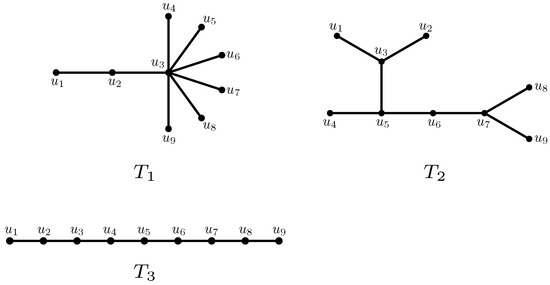
Figure 1.
Trees in Example 1.
Example 1.
Consider the tree depicted in Figure 1, and let be the set of 2-matchings of . The elements of are , , , , and . Then, the number of 2-matchings of with respect to φ is given by
The elements of the set of 2-matchings of in Figure 1 are , , , , , , , , , , , , , , , , and . Consequently,
For the tree of Figure 1, the elements of are , , , , , , , , , , , , , , , , , , , and . It follows that
In this section, we consider 2-matchings with respect to , where , over the set of trees with vertices. In order to find the second minimum, we first analyze 2-matchings with respect to over the set of double-star trees.
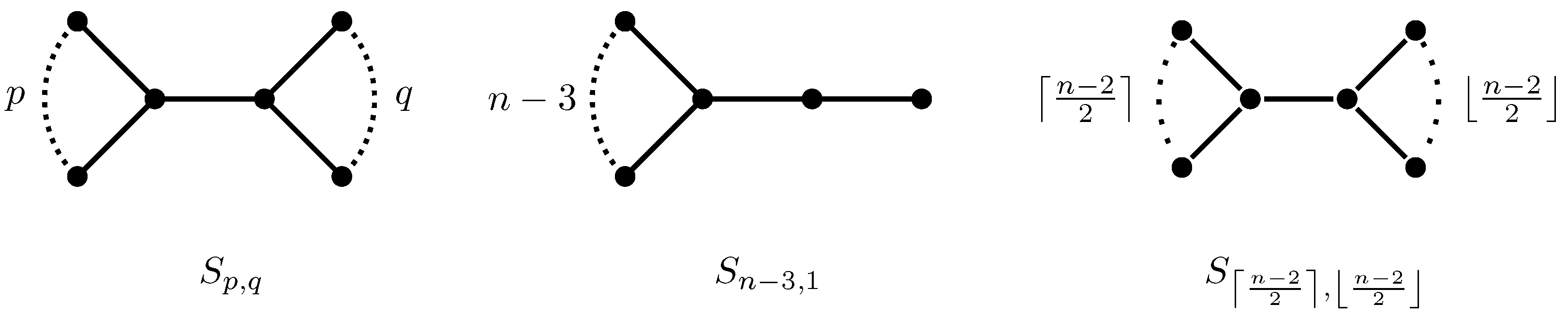
Let and . The double-star is a tree with exactly two vertices of degree greater than 1, one having degree and the other one having degree . It is easy to see that .
We distinguish two extreme double-stars with respect to parameters p and q, the double star and the balanced double-star (see Figure 2).
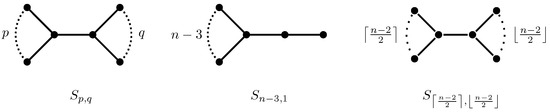
Figure 2.
Double-star trees , with , and .
Lemma 1.
Let and . If , then
Proof.
Let defined for . The derivative
since for and for and . Consequently, , and it is completed. □
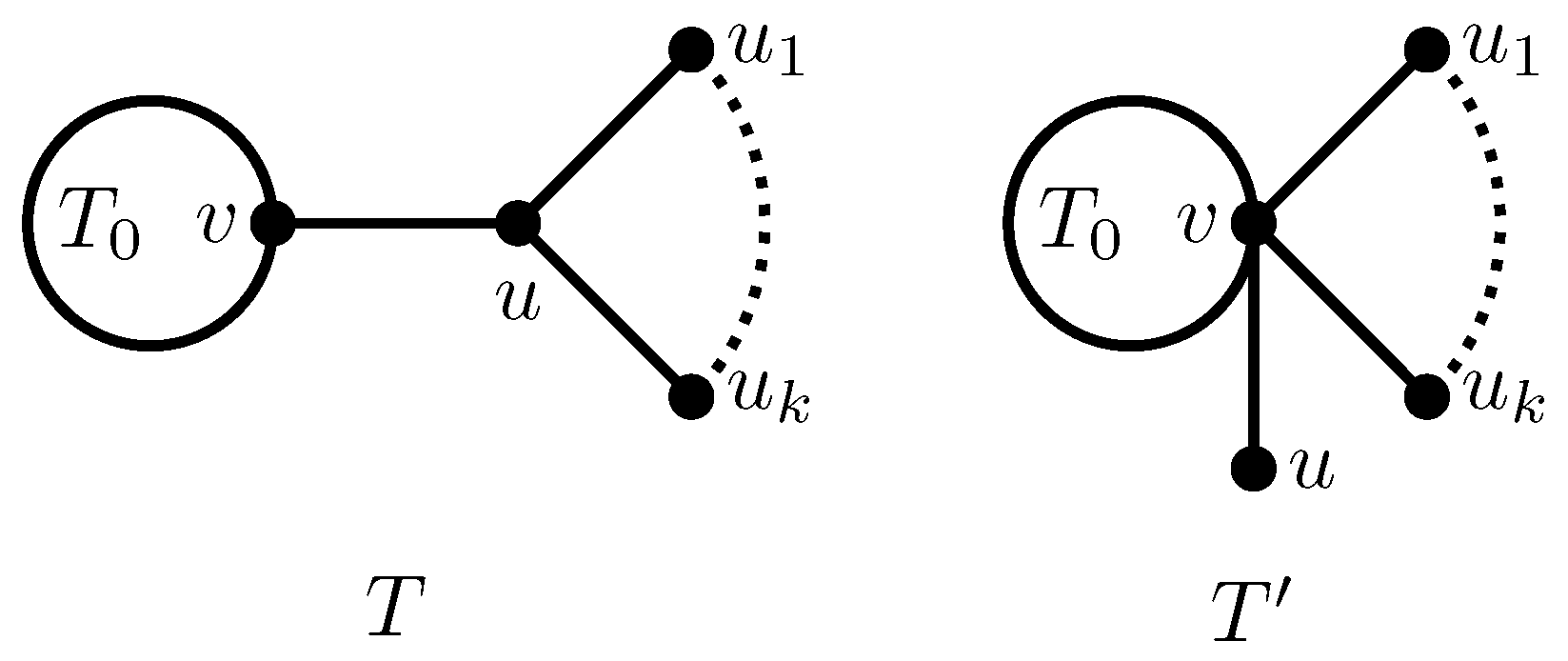
Next, we compute the variation of 2-matchings with respect to when “Transformation A” described in [25] is performed. Let , and where and are leaves. Let and (see Figure 3).
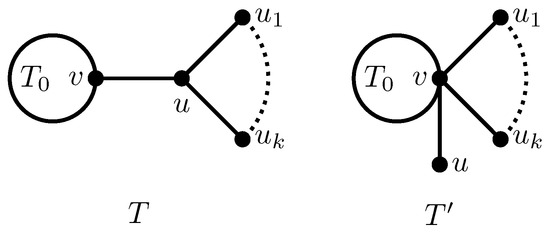
Figure 3.
Trees used in “Transformation A”.
Note that . For any other vertex in , we denote . Let , where means that and are independent edges, and
Then,
where .
Now, we can prove that the double-star attains the second minimum number of 2-matchings with respect to over the set .
Theorem 1.
Let such that and . If , then,
Proof.
Assume is not a double-star and is of the form depicted in Figure 3; then, is a subtree of T different from a star with v as a central vertex. If is the tree obtained from T by “Transformation A”, then, is not a star. Since , using relation (1), we obtain
Applying this transformation repeatedly, we obtain a sequence of trees such that , and is a double-star with n vertices. Now, the result follows from Lemma 1. □
Using appropriate values of in the previous theorem, we obtain the results for the sum-connectivity index [13] and the harmonic index [26,27].
Corollary 1.
Let and such that and .
- 1.
- .
- 2.
- .
Next, we show that for , the maximum number of 2-matchings with respect to is attained in the path , among all trees in . It is easy to see that
Recall that a branching vertex of a tree T is a vertex of degree . If v is a branching vertex of degree k of a tree T, then T can be viewed as the coalescence of k subtrees of T at the vertex v. A branching vertex v of T is an outer branching vertex of T if all branches of T at v (except for possibly one) are paths. The concept of the outer branching vertex was introduced in [28]. In the mentioned paper, it was shown that a tree has no outer branching vertex if and only if .
Now, we compute the variation of 2-matchings with respect to when “Transformation C” described in [25] is performed.
Let , ; then, there exists an outer branching vertex and two paths and (branches at ) with . Then, T can be viewed as a coalescence at vertex of a subtree and the path . We construct the tree as (see Figure 4).

Figure 4.
Trees used in “Transformation C”.
Let ; then, and . For any other vertex in , we denote . We also distinguish the subset of edges .
Now, we compute the difference , where . By symmetry, we may assume and consider only the following three cases:
- If and ,
- If and ,
- If and ,
Theorem 2.
Let and such that . If , then,
Proof.
Since with , then T has the form depicted in Figure 4. Let be a tree obtained from T by “Transformation C”. For , the expression for any integer . We have to consider the three cases in “Transformation C”.
Let defined for . The derivative
Note that for , and . It follows that for , which means that is strictly decreasing for . Then, Consequently, in this case, if .
Applying this transformation repeatedly, we obtain a sequence of trees such that and . □
Using appropriate values of in the previous theorem, we obtain the results for the sum-connectivity index and the harmonic index .
Corollary 2.
Let and such that .
- 1.
- .
- 2.
- .
In the following example, we show that if is not in this interval, the result is not necessarily true.
Example 2.
For , we have , the First Zagreb index [29], defined by . It is easy to see that
and
for . Consequently, the path is not an extreme tree with respect to the number of 2-matchings of trees weighted with the First Zagreb index.
The same situation occurs with the Second Zagreb index [29] defined by , as we can see in our next example.
Example 3.
It is easy to check that
and
for . Hence, the path is not an extreme tree with respect to the number of 2-matchings of trees weighted with the Second Zagreb index.
Finally, we give an example of a VDB topological index where is not an extreme tree over .
Example 4.
In the case of the Forgotten index [30], defined by , we have
and
for . In other words, the double-star is not an extreme tree with respect to the number of 2-matchings of trees weighted with the Forgotten index.
3. Conclusions
The novel topological indices of a graph G with respect to a VDB topological index described in [24] are natural extensions of VDB topological indices, which involve both the topological index and the k-matching numbers, perhaps two of the most important concepts of chemical graph theory. In this paper, we initiate the study of 2-matchings with respect to general sum-connectivity indices over the significant class of trees with a fixed number of vertices. The techniques used here are successful in showing that the extremal values of the function are attained in the path and the double-star , when is a real number in the interval As we noted in Example 2, the result is no longer true when . So, a first natural question is the following:
Problem 1.
Find the extremal values of , when
Other important types of vertex-degree-based topological indices are the general Randić indices [31,32], which are obtained from the symmetric functions where . Using the same technique with some minor adaptations, we were able to show that the double-star attains the second minimal value of when . However, we failed in showing that the path attains the maximal value. So, another problem is the following:
Problem 2.
Find the maximal value of , when
On the other hand, it would be of great interest to determine extremal values of or, more generally, of , when G belongs to other interesting classes of graphs, for instance, chemical trees, hexagonal systems or unicyclic graphs, just to mention a few.
Author Contributions
Conceptualization, R.C., M.L. and J.R.; methodology, R.C., M.L. and J.R.; validation, R.C., M.L. and J.R.; formal analysis, R.C., M.L. and J.R.; investigation, R.C., M.L. and J.R.; writing—original draft preparation, R.C., M.L. and J.R.; writing—review and editing, R.C., M.L. and J.R.; visualization, R.C., M.L. and J.R. All authors have read and agreed to the published version of the manuscript.
Funding
This research received no external funding.
Informed Consent Statement
Not applicable.
Data Availability Statement
Data are contained within the article.
Conflicts of Interest
The authors declare no conflicts of interest.
References
- Wagner, S.; Wang, H. Introduction to Chemical Graph Theory; Chapman and Hall/CRC: Boca Raton, FL, USA, 2018. [Google Scholar]
- Kulli, V.R. Handbook of Research of Advanced Applications of Graph Theory in Modern Society; Pal, M., Samanta, S., Pal, A., Eds.; IGI Global: Hershey, PA, USA, 2020; p. 66. [Google Scholar]
- Todeschini, R.; Consonni, V. Molecular Descriptors for Chemoinformatics; Wiley-VCH: Weinheim, Germany, 2009. [Google Scholar]
- Jäntschi, L.; Bolboacă, S.D. Informational Entropy of B-ary Trees after a Vertex Cut. Entropy 2008, 10, 576–588. [Google Scholar] [CrossRef]
- Jäntschi, L.; Bolboacă, S.D. Subgraphs of pair vertices. J. Math. Chem. 2009, 45, 364–371. [Google Scholar] [CrossRef]
- Das, K.C.; Ghalavand, A.; Ashrafi, A.R. On a Conjecture about the Sombor Index of Graphs. Symmetry 2021, 13, 1830. [Google Scholar] [CrossRef]
- Monsalve, J.; Rada, J. Sharp Upper and Lower Bounds of VDB Topological Indices of Digraphs. Symmetry 2021, 13, 1903. [Google Scholar] [CrossRef]
- Rizwan, M.; Shahab, S.; Bhatti, A.A.; Javaid, M.; Anjum, M. On the Hyper Zagreb Index of Trees with a Specified Degree of Vertices. Symmetry 2023, 15, 1295. [Google Scholar] [CrossRef]
- Su, Z.; Deng, H. Extremal Trees for Logarithmic VDB Topological Indices. Axioms 2024, 13, 632. [Google Scholar] [CrossRef]
- Cruz, R.; Espinal, C.; Rada, J. A matrix approach to vertex-degree-based topological indices. Mathematics 2024, 12, 2043. [Google Scholar] [CrossRef]
- Gutman, I.; Furtula, B.; Oz, M.S. Geometric approach to vertex-degree-based topological indices–Elliptic Sombor index, theory and application. Int. J. Quantum Chem. 2024, 124, e27346. [Google Scholar] [CrossRef]
- Altassan, A.; Imran, M. Generalized Quasi Trees with Respect to Degree Based Topological Indices and Their Applications to COVID-19 Drugs. Mathematics 2023, 11, 647. [Google Scholar] [CrossRef]
- Zhou, B.; Trinajstić, N. On a novel connectivity index. J. Math. Chem. 2009, 46, 1252–1270. [Google Scholar] [CrossRef]
- Zhou, B.; Trinajstić, N. On general sum-connectivity index. J. Math. Chem. 2010, 47, 210–218. [Google Scholar] [CrossRef]
- Hayat, S.; Arfan, A.; Khan, A.; Jamil, H.; Alenazi, M.J.F. An Optimization Problem for Computing Predictive Potential of General Sum/Product-Connectivity Topological Indices of Physicochemical Properties of Benzenoid Hydrocarbons. Axioms 2024, 13, 342. [Google Scholar] [CrossRef]
- Altassan, A.; Imran, M. Topological Properties of Polymeric Networks Modelled by Generalized Sierpiński Graphs. Fractal Fract. 2024, 8, 123. [Google Scholar] [CrossRef]
- Vetrík, T. General approach for obtaining extremal results on degree-based indices illustrated on the general sum-connectivity index. Electron. J. Graph Theor. Appl. 2023, 11, 125–133. [Google Scholar] [CrossRef]
- Swartz, E.; Vetrík, T. General sum-connectivity index and general Randic index of trees with given maximum degree. Discret. Math. Lett. 2023, 12, 181–188. [Google Scholar]
- Wang, H. General (α,2)-Path Sum-Connectivirty Indices of One Important Class of Polycyclic Aromatic Hydrocarbons. Symmetry 2018, 10, 426. [Google Scholar] [CrossRef]
- Chen, X. General sum-connectivity index of a graph and its line graph. Appl. Math. Comput. 2023, 443, 127779. [Google Scholar] [CrossRef]
- Su, Z.; Tang, Z.; Chen, S. A note on the general sum–connectivity index of a graph and its line graph. MATCH Commun. Math. Comput. Chem. 2024, 92, 631–642. [Google Scholar] [CrossRef]
- Hosoya, H. Topological index. A newly proposed quantity characterizing the topological nature of structural isomers of saturated hydrocarbons. Bull. Chem. Soc. Jpn. 1971, 44, 2332–2339. [Google Scholar] [CrossRef]
- Li, X.; Shi, Y.; Gutman, I. Graph Energy; Springer: New York, NY, USA, 2013. [Google Scholar]
- Cruz, R.; Gutman, I.; Rada, J. Hosoya index of VDB-weighted graphs. Discret. Appl. Math. 2022, 317, 18–25. [Google Scholar] [CrossRef]
- Deng, H. A unified approach to the extremal Zagreb indices for trees, unicyclic graphs and bicyclic graphs. MATCH Commun. Math. Comput. Chem. 2007, 57, 597–616. [Google Scholar]
- Ali, A.; Zhong, L.; Gutman, I. Harmonic index and its generalizations: Extremal results and bounds. MATCH Commun. Math. Comput. Chem. 2019, 81, 249–311. [Google Scholar]
- Fajtlovicz, S. On conjectures on Graffiti-II. Congr. Numer. 1987, 60, 187–197. [Google Scholar]
- Cruz, R.; Monsalve, J.; Rada, J. Trees with maximum exponential Randić index. Discret. Appl. Math. 2020, 283, 634–643. [Google Scholar] [CrossRef]
- Gutman, I.; Trinajstić, N. Graph theory and molecular orbitals. Total π-electron energy of alternant hydrocarbons. Chem. Phys. Lett. 1972, 17, 535–538. [Google Scholar] [CrossRef]
- Furtula, B.; Gutman, I. A forgotten topological index. J. Math. Chem. 2015, 53, 1184–1190. [Google Scholar] [CrossRef]
- Bollobás, B.; Erdős, P. Graphs of extremal weights. Ars Comb. 1998, 50, 225–233. [Google Scholar] [CrossRef]
- Randić, M. Generalized molecular descriptors. J. Math. Chem. 1991, 7, 155–168. [Google Scholar] [CrossRef]

Disclaimer/Publisher’s Note: The statements, opinions and data contained in all publications are solely those of the individual author(s) and contributor(s) and not of MDPI and/or the editor(s). MDPI and/or the editor(s) disclaim responsibility for any injury to people or property resulting from any ideas, methods, instructions or products referred to in the content. |
© 2024 by the authors. Licensee MDPI, Basel, Switzerland. This article is an open access article distributed under the terms and conditions of the Creative Commons Attribution (CC BY) license (https://creativecommons.org/licenses/by/4.0/).