


Abstract
In this article, we discuss the existence and uniqueness of extremal solutions for nonlinear initial value problems of fractional differential equations involving the -Caputo derivative. Moreover, some uniqueness results are obtained. Our results rely on the standard tools of functional analysis. More precisely we apply the monotone iterative technique combined with the method of upper and lower solutions to establish sufficient conditions for existence as well as the uniqueness of extremal solutions to the initial value problem. An illustrative example is presented to point out the applicability of our main results.
1. Introduction
Fractional differential equations have been applied in many fields of engineering, physics, biology, and chemistry see [1,2,3,4]. Moreover, to get a couple of developments about the theory of fractional differential equations, one can allude to the monographs of Abbas et al. [5,6,7], Kilbas et al. [8], Miller and Ross [9], Podlubny [10], and Zhou [11,12], as well as to the papers by Agarwal, et al. [13], Benchohra, et al. [14,15,16], and the references therein. In the recent past, Almeida in [17] presented a new fractional differentiation operator called by -Caputo fractional operator. For more details see [18,19,20,21,22,23], and the references given therein.
At the present day, different kinds of fixed point theorems are widely used as fundamental tools in order to prove the existence and uniqueness of solutions for various classes of nonlinear fractional differential equations for details, we refer the reader to a series of papers [24,25,26,27,28,29,30] and the references therein, but here we focus on those using the monotone iterative technique, coupled with the method of upper and lower solutions. This method is a very useful tool for proving the existence and approximation of solutions to many applied problems of nonlinear differential equations and integral equations (see [31,32,33,34,35,36,37,38,39,40,41,42]). However, as far as we know, there is no work yet reported on the existence of extremal solutions for the Cauchy problem with -Caputo fractional derivative. Motivated by this fact, in this paper we deal with the existence and uniqueness of extremal solutions for the following initial value problem of fractional differential equations involving the -Caputo derivative:
where is the -Caputo fractional derivative of order is a given continuous function and
2. Preliminaries
In this section, we introduce some notations and definitions of fractional calculus and present preliminary results needed in our proofs later.
We begin by defining -Riemann-Liouville fractional integrals and derivatives. In what follows,
Definition 1
([8,17]). For , the left-sided ψ-Riemann-Liouville fractional integral of order α for an integrable function with respect to another function that is an increasing differentiable function such that , for all is defined as follows
where Γ is the classical Euler Gamma function.
Definition 2
([17]). Let and let be two functions such that ψ is increasing and , for all . The left-sided ψ-Riemann–Liouville fractional derivative of a function x of order α is defined by
where .
Definition 3
([17]). Let and let be two functions such that ψ is increasing and , for all . The left-sided ψ-Caputo fractional derivative of x of order α is defined by
where for , for .
To simplify notation, we will use the abbreviated symbol
From the definition, it is clear that
We note that if the -Caputo fractional derivative of order of x is determined as
(see, for instance, [17], Theorem 3).
Lemma 1
([20]). Let and . Then
In particular, if , then
Lemma 2
([20]). Let The following holds:
If then
If . Then
Lemma 3
([8,20]). Let and Then
Definition 4
([43]). The one-parameter Mittag–Leffler function , is defined as:
Definition 5
([43]). The Two-parameter Mittag–Leffler function , is defined as:
Theorem 1
(Weissinger’s fixed point theorem [44]). Assume to be a non empty complete metric space and let for every such that converges. Furthermore, let the mapping satisfy the inequality
for every and every . Then, has a unique fixed point . Moreover, for any , the sequence converges to this fixed point .
3. Main Results
Let us recall the definition and lemma of a solution for problem (1). First of all, we define what we mean by a solution for the boundary value problem (1).
Definition 6.
A function is said to be a solution of Equation (1) if x satisfies the equation , for each and the condition
For the existence of solutions for problem (1) we need the following lemma for a general linear equation of , that generalizes expression (3.1.34) in [8].
Lemma 4.
For a given and , with , the linear fractional initial value problem
has a unique solution given by
Proof.
Since , from Lemma 2 we know that the Cauchy problem (5) is equivalent to the following Volterra integral equation
Note that the above equation can be written in the following form
where the operator is defined by
Let and . Then, we have
Hence, we have
It’s well known that
it follows that the mapping is a contraction. Hence, by Weissinger’s fixed point theorem, has a unique fixed point. That is (5) has a unique solution.
Now we apply the method of successive approximations to prove that the integral Equation (6) can be expressed by
For this, we set
It follows from Equation (8) and Lemma 3 that
Continuing this process, we derive the following relation
Taking the limit as , we obtain the following explicit solution to the integral Equation (6):
Taking into account (4), we get
Then the proof is completed. □
Lemma 5
(Comparison result). Let be fixed and . If satisfies the following inequalities
then for all .
Proof.
Using the integral representation (7) and the fact that, and for all and , (see [45]) it suffices to take with initial conditions . □
Definition 7.
Definition 8.
Theorem 2.
Let the function . In addition assume that:
- (H1)
- (H2)
- There exists a constant such that
Then there exist monotone iterative sequences and , which converge uniformly on the interval to the extremal solutions of (1) in the sector , where
Proof.
First, for any , we consider the following linear initial value problems of fractional order:
and
We will divide the proof into three steps.
- Step 1: We show that the sequences are lower and upper solutions of problem (1), respectively and the following relation holds
First, we prove that
Set . From (13) and Definition 7, we obtain
Again, since
By Lemma 5, , for . That is, . Similarly, we can show that .
Since, . By Lemma 5, we get .
Secondly, we show that are lower and upper solutions of problem (1), respectively. Since and are lower and upper solutions of problem (1), by , it follows that
also Therefore, is a lower solution of problem (1). Similarly, it can be obtained that is an upper solution of problem (1).
By the above arguments and mathematical induction, we can show that the sequences are lower and upper solutions of problem (1), respectively and the following relation holds
- Step 2: The sequences , converge uniformly to their limit functions , respectively.
Note that the sequence is monotone nondecreasing and is bounded from above by . Since the sequence is monotone nonincreasing and is bounded from below by , therefore the pointwise limits exist and these limits are denoted by and . Moreover, since , are sequences of continuous functions defined on the compact set , hence by Dini’s theorem [46], the convergence is uniform. This is
uniformly on and the limit functions , satisfy problem (1). Furthermore, and satisfy the relation
- Step 3: We prove that and are extremal solutions of problem (1) in .
Let be any solution of (1). We assume that the following relation holds for some :
Let . We have
Furthermore, . By Lemma 5, we obtain , which means
Using the same method, we can show that
Hence, we have
Therefore , are the extremal solutions of (1) in . This completes the proof. □
Now, we shall prove the uniqueness of the solution of the system (1) by monotone iterative technique.
Theorem 3.
Suppose that (H1) and (H2) are satisfied. Furthermore, we impose that:
- (H3)
Proof.
From the Theorem 2, we know that and are the extremal solutions of the IVP (1) and . It is sufficient to prove . In fact, let , in view of (H3), we have
Furthermore, . From Lemma 5, it follows that Hence, we obtain
Therefore, is the unique solution of the Cauchy problem (1) in . This ends the proof of Theorem 3. □
As a direct consequence of the previous result, we arrive at the following one
Corollary 1.
Suppose that (H1) is satisfied and that , is differentiable with respect to x and , with
Proof.
The proof follows immediately from the fact that E is a compact set and, as a consequence, is bounded in E. □
4. An Example
Example 1.
Consider the following problem:
Taking and , it is not difficult to verify that are lower and upper solutions of (20), respectively, and . So of Theorem 2 holds
On the other hand, it is clear that the function f is continuous and satisfies
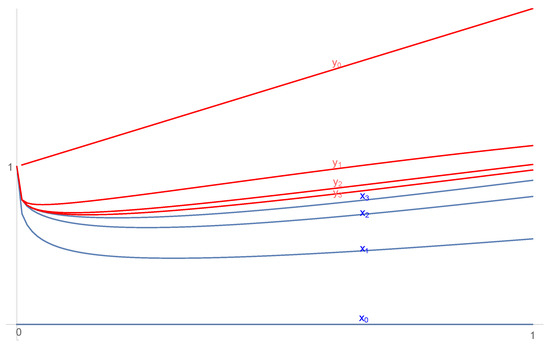
Hence, by Corollary 1, the initial value problem (20) has a unique solution and there exist monotone iterative sequences and converging uniformly to . Furthermore, we have the following iterative sequences
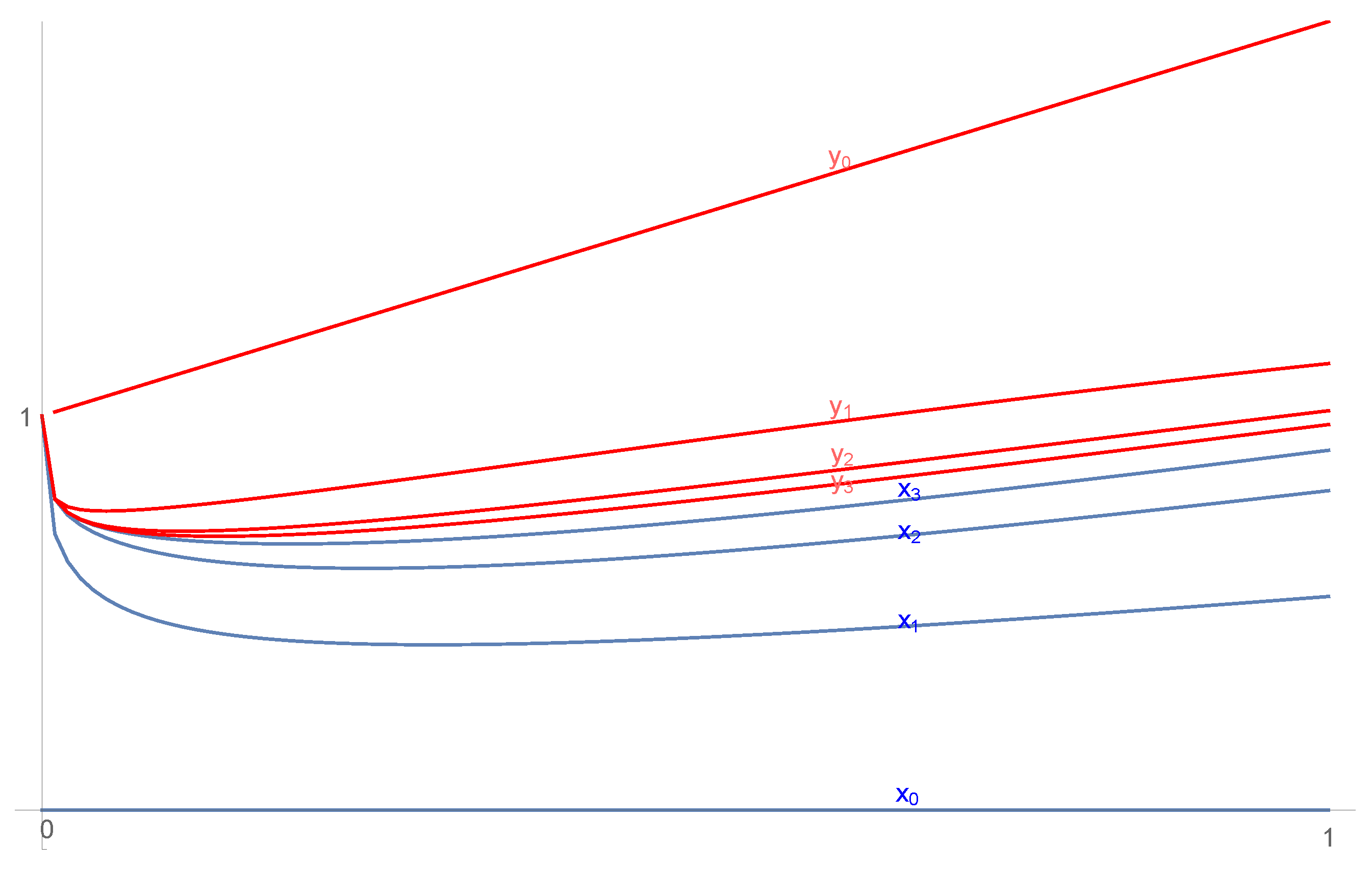
We notice that the sequences are obtained by solving a recurrence formula of the type , with A a suitable integral operator and given. So, by a simple numerical procedure, it is not difficult to represent some iterates of the recurrence sequence. We plot in Figure 1 the four first iterates of each sequence. We point out that the unique solution is lying within and which gives us a good approximation of such a solution.
Figure 1.
First four iterates for problem (20).
5. Conclusions
In previous sections, we have presented the existence and uniqueness of extremal solutions to a Cauchy problem with -Caputo fractional derivative. Moreover, some uniqueness results are obtained. The proof of the existence results is based on the monotone iterative technique combined with the method of upper and lower solutions. Moreover, an example is presented to illustrate the validity of our main results. Our results are not only new in the given configuration but also correspond to some new situations associated with the specific values of the parameters involved in the given problem.
Author Contributions
Conceptualization, C.D., Z.B., M.B. and A.C.; methodology, C.D., Z.B., M.B. and A.C.; formal analysis, C.D., Z.B., M.B. and A.C.; investigation, C.D., Z.B., M.B. and A.C.; writing—original draft preparation, C.D., Z.B., M.B. and A.C.; writing—review and editing, C.D., Z.B., M.B. and A.C.; funding acquisition, A.C. All authors have read and agreed to the published version of the manuscript.
Funding
The fourth author is supported by the Agencia Estatal de Investigación (AEI) of Spain under grant MTM2016-75140-P, co-financed by the European Community fund FEDER. The fourth author is also supported by Xunta de Galicia, project ED431C 2019/02 (Spain).
Conflicts of Interest
The authors declare no conflict of interest.
References
- Hilfer, R. Applications of Fractional Calculus in Physics; World Scientific: Singapore, 2000. [Google Scholar]
- Oldham, K.B. Fractional differential equations in electrochemistry. Adv. Eng. Softw. 2010, 41, 9–12. [Google Scholar] [CrossRef]
- Sabatier, J.; Agrawal, O.P.; Machado, J.A.T. Advances in Fractional Calculus-Theoretical Developments and Applications in Physics and Engineering; Springer: Dordrecht, The Netherlands, 2007. [Google Scholar]
- Tarasov, V.E. Fractional Dynamics: Application of Fractional Calculus to Dynamics of Particles, Fields and Media; Springer Science & Business Media: Berlin/Heidelberg, Germany, 2010. [Google Scholar]
- Abbas, S.; Benchohra, M.; N’Guŕékata, G.M. Topics in Fractional Differential Equations; Springer: New York, NY, USA, 2015. [Google Scholar]
- Abbas, S.; Benchohra, M.; Graef, J.R.; Henderson, J. Implicit Fractional Differential and Integral Equations: Existence and Stability; De Gruyter: Berlin, Germany, 2018. [Google Scholar]
- Abbas, S.; Benchohra, M.; N’Guŕékata, G.M. Advanced Fractional Differential and Integral Equations; Nova Sci. Publ.: New York, NY, USA, 2014. [Google Scholar]
- Kilbas, A.A.; Srivastava, H.M.; Trujillo, J.J. Theory and Applications of Fractional Differential Equations; vol. 204 of North-Holland Mathematics Sudies; Elsevier Science B.V.: Amsterdam, The Netherlands, 2006. [Google Scholar]
- Miller, K.S.; Ross, B. An Introduction to Fractional Calculus and Fractional Differential Equations; Wiley: New York, NY, USA, 1993. [Google Scholar]
- Podlubny, I. Fractional Differential Equations; Academic Press: San Diego, CA, USA, 1999. [Google Scholar]
- Zhou, Y. Basic Theory of Fractional Differential Equations; World Scientific: Singapore, 2014. [Google Scholar]
- Zhou, Y. Fractional Evolution Equations and Inclusions; Analysis and Control; Elsevier, Acad. Press: Cambridge, MA, USA, 2016. [Google Scholar]
- Agarwal, R.P.; Benchohra, M.; Hamani, S. A survey onexistence results for boundary value problems of nonlinear fractional differential equations and inclusions. Acta Appl. Math. 2010, 109, 973–1033. [Google Scholar] [CrossRef]
- Benchohra, M.; Graef, J.R.; Hamani, S. Existence results for boundary value problems with non-linear fractional differential equations. Appl. Anal. 2008, 87, 851–863. [Google Scholar] [CrossRef]
- Benchohra, M.; Hamani, S.; Ntouyas, S.K. Boundary value problems for differential equations with fractional order and nonlocal conditions. Nonlinear Anal. 2009, 71, 2391–2396. [Google Scholar] [CrossRef]
- Benchohra, M.; Lazreg, J.E. Existence results for nonlinear implicit fractional differential equations. Surv. Math. Appl. 2014, 9, 79–92. [Google Scholar]
- Almeida, R. A Caputo fractional derivative of a function with respect to another function. Commun. Nonlinear Sci. 2017, 44, 460–481. [Google Scholar] [CrossRef]
- Abdo, M.S.; Panchal, S.K.; Saeed, A.M. Fractional boundary value problem with ψ-Caputo fractional derivative. Proc. Math. Sci. 2019, 129, 14. [Google Scholar] [CrossRef]
- Almeida, R. Fractional Differential Equations with Mixed Boundary Conditions. Bull. Malays. Math. Sci. Soc. 2019, 42, 1687–1697. [Google Scholar] [CrossRef]
- Almeida, R.; Malinowska, A.B.; Monteiro, M.T.T. Fractional differential equations with a Caputo derivative with respect to a kernel function and their applications. Math. Meth. Appl. Sci. 2018, 41, 336–352. [Google Scholar] [CrossRef]
- Almeida, R.; Malinowska, A.B.; Odzijewicz, T. Optimal Leader-Follower Control for the Fractional Opinion Formation Model. J. Optim. Theory Appl. 2019, 182, 1171–1185. [Google Scholar] [CrossRef]
- Almeida, R.; Jleli, M.; Samet, B. A numerical study of fractional relaxation-oscillation equations involving ψ-Caputo fractional derivative. Rev. R. Acad. Cienc. Exactas Fís. Nat. Ser. A Mat. RACSAM 2019, 113, 1873–1891. [Google Scholar] [CrossRef]
- Samet, B.; Aydi, H. Lyapunov-type inequalities for an anti-periodic fractional boundary value problem involving ψ-Caputo fractional derivative. J. Inequal. Appl. 2018, 2018, 286. [Google Scholar] [CrossRef] [PubMed]
- Abbas, S.; Benchohra, M.; Samet, B.; Zhou, Y. Coupled implicit Caputo fractional q-difference systems. Adv. Diff. Equ. 2019, 2019, 527. [Google Scholar] [CrossRef]
- Abbas, S.; Benchohra, M.; Hamidi, N.; Henderson, J. Caputo–Hadamard fractional differential equations in Banach spaces. Fract. Calc. Appl. Anal. 2018, 21, 1027–1045. [Google Scholar] [CrossRef]
- Abbas, S.; Benchohra, M.; Hamani, S.; Henderson, J. Upper and lower solutions method for Caputo-Hadamard fractional differential inclusions. Math. Morav. 2019, 23, 107–118. [Google Scholar] [CrossRef]
- Aghajani, A.; Pourhadi, E.; Trujillo, J.J. Application of measure of noncompactness to a Cauchy problem for fractional differential equations in Banach spaces. Fract. Calc. Appl. Anal. 2013, 16, 962–977. [Google Scholar] [CrossRef]
- Kucche, K.D.; Mali, A.D.; Sousa, J.V.C. On the nonlinear Ψ-Hilfer fractional differential equations. Comput. Appl. Math. 2019, 38, 25. [Google Scholar] [CrossRef]
- Wu, G.C.; Zeng, D.Q.; Baleanu, D. Fractional impulsive differential equations: Exact solutions, integral equations and short memory case. Fract. Calc Appl. Anal. 2019, 22, 180–192. [Google Scholar] [CrossRef]
- Wu, G.C.; Deng, Z.G.; Baleanu, D.; Zeng, D.Q. New variable order fractional chaotic systems for fast image encryption. Chaos 2019, 29, 11. [Google Scholar] [CrossRef]
- Ali, S.; Shah, K.; Jarad, F. On stable iterative solutions for a class of boundary value problem of nonlinear fractional order differential equations. Math. Methods Appl. Sci. 2019, 42, 969–981. [Google Scholar] [CrossRef]
- Al-Refai, M.; Ali Hajji, M. Monotone iterative sequences for nonlinear boundary value problems of fractional order. Nonlinear Anal. 2011, 74, 3531–3539. [Google Scholar] [CrossRef]
- Chen, C.; Bohner, M.; Jia, B. Method of upper and lower solutions for nonlinear Caputo fractional difference equations and its applications. Fract. Calc. Appl. Anal. 2019, 22, 1307–1320. [Google Scholar] [CrossRef]
- Dhaigude, D.; Rizqan, B. Existence and uniqueness of solutions of fractional differential equations with deviating arguments under integral boundary conditions. Kyungpook Math. J. 2019, 59, 191–202. [Google Scholar]
- Fazli, H.; Sun, H.; Aghchi, S. Existence of extremal solutions of fractional Langevin equation involving nonlinear boundary conditions. Int. J. Comput. Math. 2020. [Google Scholar] [CrossRef]
- Lin, X.; Zhao, Z. Iterative technique for a third-order differential equation with three-point nonlinear boundary value conditions. Electron. J. Qual. Theory Differ. Equ. 2016, 12, 10. [Google Scholar] [CrossRef]
- Ma, K.; Han, Z.; Sun, S. Existence and uniqueness of solutions for fractional q-difference Schrödinger equations. J. Appl. Math. Comput. 2020, 62, 611–620. [Google Scholar] [CrossRef]
- Mao, J.; Zhao, Z.; Wang, C. The unique iterative positive solution of fractional boundary value problem with q-difference. Appl. Math. Lett. 2020, 100, 106002. [Google Scholar] [CrossRef]
- Meng, S.; Cui, Y. The extremal solution to conformable fractional differential equations involving integral boundary condition. Mathematics 2019, 7, 186. [Google Scholar] [CrossRef]
- Wang, G.; Sudsutad, W.; Zhang, L.; Tariboon, J. Monotone iterative technique for a nonlinear fractional q-difference equation of Caputo type. Adv. Diff. Equ. 2016, 2016, 211. [Google Scholar] [CrossRef]
- Yang, W. Monotone iterative technique for a coupled system of nonlinear Hadamard fractional differential equations. J. Appl. Math. Comput. 2019, 59, 585–596. [Google Scholar] [CrossRef]
- Zhang, S. Monotone iterative method for initial value problem involving Riemann-Liouville fractional derivatives. Nonlinear Anal. 2009, 71, 2087–2093. [Google Scholar] [CrossRef]
- Gorenflo, R.; Kilbas, A.A.; Mainardi, F.; Rogosin, S.V. Mittag–Leffler Functions, Related Topics and Applications; Springer: New York, NY, USA, 2014. [Google Scholar]
- Diethelm, K.; Ford, N.J. Analysis of fractional differential equations. J. Math. Anal. Appl. 2002, 265, 229–248. [Google Scholar] [CrossRef]
- Nieto, J.J. Maximum principles for fractional differential equations derived from Mittag-Leffler functions. Appl. Math. Lett. 2010, 23, 1248–1251. [Google Scholar] [CrossRef]
- Royden, H.L. Real Analysis, 3rd ed.; Macmillan Publishing Company: New York, NY, USA, 1988. [Google Scholar]
© 2020 by the authors. Licensee MDPI, Basel, Switzerland. This article is an open access article distributed under the terms and conditions of the Creative Commons Attribution (CC BY) license (http://creativecommons.org/licenses/by/4.0/).