1. Introduction
The silkworm (
Bombyx mori) is highly susceptible to a wide range of pathogenic microorganisms throughout its life cycle. These diseases not only severely compromise cocoon yield and quality but also constitute a major bottleneck restricting the sustainable development of the global sericulture industry. Among viral diseases,
B. mori nucleopolyhedrovirus (BmNPV), a double-stranded circular DNA virus, is the primary etiological agent of silkworm nucleopolyhedrosis. Following oral infection, BmNPV replicates in the midgut epithelial cells of silkworm larvae and subsequently disseminates to multiple tissues, including the fat body, epidermis, and trachea, resulting in highly contagious outbreaks characterized by explosive mortality and significant reductions in cocoon production [
1,
2].
In addition to viral pathogens, silkworms are frequently threatened by fungal and bacterial infections. Entomopathogenic fungi such as
Beauveria bassiana and
Metarhizium anisopliae primarily invade the host through the integument, proliferate extensively within the hemocoel, and secrete secondary metabolites that disrupt immune function and induce systemic mycosis [
3,
4,
5].
Aspergillus flavus, a facultative parasitic and saprophytic fungus ubiquitously distributed in silkworm rearing environments, produces highly potent mycotoxins that contaminate mulberry leaves and rearing facilities, leading to chronic intoxication manifested as growth retardation and developmental disorders in silkworms [
6,
7]. Among bacterial pathogens,
Bacillus bombysepticus, a Gram-positive spore-forming bacterium, and
Serratia marcescens, a Gram-negative opportunistic pathogen, are the principal causative agents of silkworm septicemia. Under conditions of elevated temperature and humidity, these bacterial diseases readily outbreak, with mortality rates commonly exceeding 50–80%, thereby imposing substantial economic losses on sericulture production [
8,
9,
10,
11,
12,
13,
14,
15].
The effective control of silkworm pathogens remains a core challenge for the sustainable development of the sericulture industry. Traditional chemical control strategies primarily rely on the application of agricultural antimicrobials and the periodic disinfection of rearing facilities. Although these approaches are cost-effective and operationally simple, increasing concerns regarding the emergence of antimicrobial resistance and the toxicity of persistent environmental residues have become increasingly prominent [
16,
17]. Biological control strategies, including microbial antagonists, phage-based therapies, and natural antimicrobial extracts, have been rapidly developed as environmentally friendly alternatives; however, their efficacy is often highly dependent on environmental conditions, and their stability and applicability require further improvement [
14,
18,
19]. Disease-resistant silkworm breeding represents a fundamental strategy to enhance intrinsic host resistance, yet its widespread industrial application is constrained by long breeding cycles, high technical complexity, and ongoing public concerns regarding genetically modified organisms [
7,
19,
20]. Consequently, the development of efficient, stable, and eco-friendly disease control strategies remains an urgent priority in sericulture.
In recent years, nanomaterials have emerged as innovative interdisciplinary tools with extensive application prospects in pest and disease management, owing to their nanoscale dimensions, high specific surface area, and favorable biocompatibility [
21]. Previous studies have demonstrated that silver nanoparticles (AgNPs) not only exert significant inhibitory effects on BmNPV replication but also markedly suppress the growth and development of the microsporidian pathogen
Nosema bombycis [
22]. Nevertheless, the antimicrobial spectrum, targeting capability, biosafety, and underlying mechanisms of nanocomposite materials against major silkworm pathogens have not been systematically investigated and remain at a preliminary stage [
23].
In order to develop an ideal antimicrobial agent for sericulture, the material must not only be effective against a wide range of pathogens, but also pose no threat to the silkworm host. Silver nanoparticles (Ag NPs) are widely recognized as one of the most potent metal-based antimicrobial and antiviral agents. Their unique, multi-target destructive mechanism effectively circumvents the development of pathogen resistance; however, their tendency to aggregate and their potential for off-target toxicity restrict their direct in vivo application. To address these issues, we selected chitosan (CS), a natural cationic polysaccharide derived from chitin, as the ideal complementary matrix. CS exhibits exceptional biodegradability, negligible toxicity to animal hosts and intrinsic antimicrobial properties. More importantly, its abundant protonated amino groups (-NH
3+) confer a strong positive surface charge [
24]. By synthesizing chitosan–silver nanocomposites (CS-Ag NPs), we have successfully integrated the unique properties of both materials into a highly synergistic architecture. In this system, the chitosan shell prevents silver aggregation and buffers its toxicity to protect silkworm development. Its cationic nature also acts as a ‘homing missile’ to facilitate targeted electrostatic binding to negatively charged pathogen membranes. This precise combination enables enhanced pathogen disruption and the controlled release of silver ions [
25,
26,
27], making the nanocomposites an exceptionally rational and potent candidate for combating silkworm diseases. In recent years, CS-Ag NPs have demonstrated promising potential in agricultural disease management, postharvest preservation, and antiviral applications [
28,
29,
30,
31,
32]. However, their application in silkworm disease control, particularly regarding in vivo protective efficacy and biosafety during silkworm development, remains largely unexplored.
Despite their immense potential, nanocomposites remain underutilized in sericulture due to a critical knowledge gap concerning their specific applications. This gap is characterized by a severe lack of systematic in vivo biosafety evaluations and multi-pathogen efficacy assessments within the delicate silkworm host. This study aimed to address this issue by systematically evaluating the antimicrobial potential of CS-Ag NPs against representative viral and bacterial pathogens of B. mori. Specifically, we investigated their antiviral activity against BmNPV and their antibacterial efficacy against Bacillus bombysepticus and S. marcescens. Crucially, we established a stringent in vivo toxicological safety baseline and demonstrated the robust protective effects of CS-Ag NPs at the level of the individual silkworm. Furthermore, we employed oxidative stress-related assessments to elucidate the underlying cytoprotective mechanisms. This work makes a significant contribution to the field by defining a clear operational window for nanomaterials in sericulture. It provides critical empirical evidence and a vital theoretical framework for developing next-generation, eco-friendly, precision nano-pharmaceuticals, offering a highly promising strategy for overcoming the limitations of traditional silkworm disease management.
2. Materials and Methods
2.1. Synthesis and Characterization of CS-Ag NPs
Chitosan–silver nanoparticles (CS-Ag NPs) were prepared via a two-step process involving in situ reduction followed by ionic gelation. First, 2 mg/mL of CS solution was prepared by dissolving chitosan (CS, molecular weight: 150 kDa, degree of deacetylation: ≥95%, purchased from Macklin Biochemical Co., Ltd., Shanghai, China) in 50 mL of 0.1% (
v/
v) acetic acid aqueous solution under continuous stirring. Then, 3.4 mg of silver nitrate (AgNO
3) powder was directly added to the prepared CS solution to achieve a final AgNO
3 concentration of 4 × 10
−4 M, and the mixture was stirred continuously at 500 rpm and 95 °C for 30 min to obtain a homogeneous solution. Next, 45 μL of 1 mol/L NaOH was added to the reaction mixture to provide an alkaline environment, which accelerates the reduction of Ag
+ to Ag
0 by chitosan and simultaneously induces the macroscopic precipitation of the composite via chitosan deprotonation. This rapidly turned the solution yellow, indicating the successful formation of silver nanoparticles. After the solution cooled to room temperature, it was vacuum-filtered—a method selected for its high efficiency in rapidly separating these large, flocculant CS-Ag precipitates from the bulk solution—and the collected yellow precipitate was washed twice with deionized water to remove any residual NaOH or free silver ions. The filter cake was then dried in a constant-temperature oven at 60 °C for six hours to obtain the intermediate CS-Ag powder, which was stored at −80 °C for subsequent use [
16,
33]. To fabricate the final crosslinked CS-Ag nanoparticles (NPs), an aqueous solution of 0.1% (
v/
v) glacial acetic acid was prepared and adjusted to pH 4.8 using 50 µL of 1 mol/L NaOH. The previously synthesized CS-Ag powder was dissolved in this acetic acid solution to a concentration of 2 mg/mL. Next, 7.5 mL of this CS-Ag solution was placed under magnetic stirring and 2.5 mL of a sodium tripolyphosphate (TPP) solution (1.6 mg/mL) was added dropwise. The immediate onset of turbidity indicated the formation of the nanocomposites. After 30 min of continuous stirring, the mixture was purified by centrifugation (LC-LX-H185C, Shanghai Lichen Bangxi Instrument Technology Co., Ltd., Shanghai, China) at 16,000 rpm for 30 min at 4 °C. The supernatant was discarded and the pellet ultrasonically redispersed in deionized water. This washing and centrifugation cycle was repeated three times under identical conditions. Finally, the purified precipitate was uniformly dispersed in deionized water to yield the final CS-Ag NP suspension.
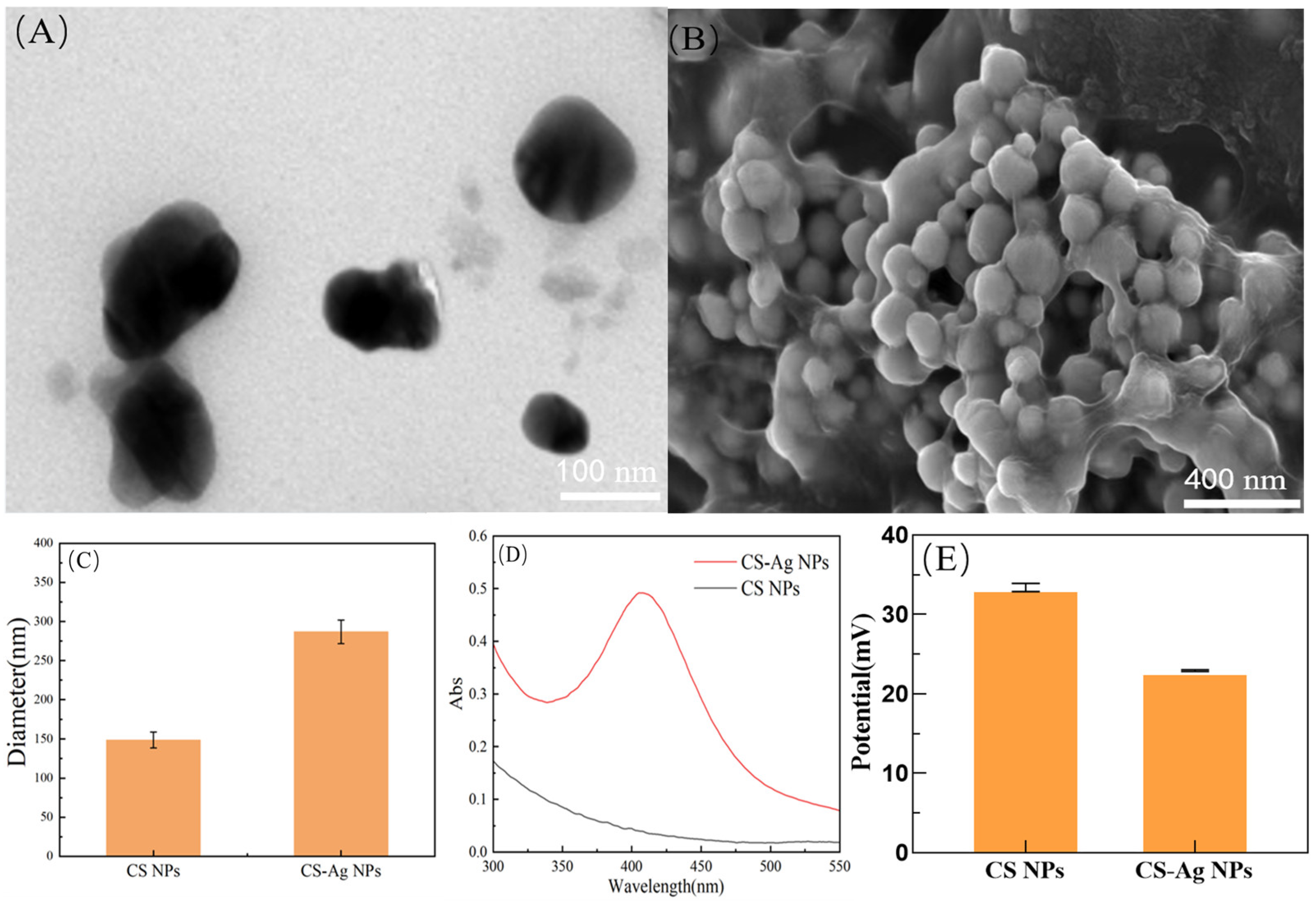
The physicochemical properties of the synthesized nanoparticles were systematically characterized using specific instrumental platforms. Optical absorption spectra were recorded using a Shimadzu UV-2550 UV-Vis spectrophotometer (Kyoto, Japan) in the 300–600 nm wavelength range. For UV-Vis measurements, the purified nanoparticle suspensions were diluted with deionized water to the appropriate concentration and analyzed in standard quartz cuvettes. The internal morphological features and core–shell structures were observed via transmission electron microscopy (TEM; HT-7800, Hitachi, Tokyo, Japan). TEM samples were prepared by ultrasonically dispersing the nanoparticle suspension for 10 min using an ultrasonic cleaner (SK2210HP, Shanghai Kudos, Shanghai, China), subsequently drop-casting 10 µL of the highly diluted suspension onto carbon-coated copper grids and allowing them to air-dry naturally at room temperature. The 3D surface morphology and aggregation state were also evaluated using a high-resolution field-emission scanning electron microscope (FE-SEM; Regulus 8100, Hitachi, Tokyo, Japan), operating at 5.0 kV. The SEM samples were prepared by dropping the diluted suspension onto a clean silicon wafer, allowing it to dry completely at room temperature and then sputter-coating the surface with a thin layer of gold to enhance electrical conductivity. Finally, the hydrodynamic diameter distributions and surface charge (zeta potential) of the nanoparticles were measured using a Zetasizer Nano ZS instrument (Malvern Panalytical, Malvern, UK) at a constant temperature of 25 °C. Prior to DLS and zeta potential measurements, the samples were diluted extensively in deionized water and sonicated gently for five minutes to ensure uniform dispersion and avoid multiple light scattering effects.
2.2. Cell Proliferation and Viability Assay (CCK-8 Assay)
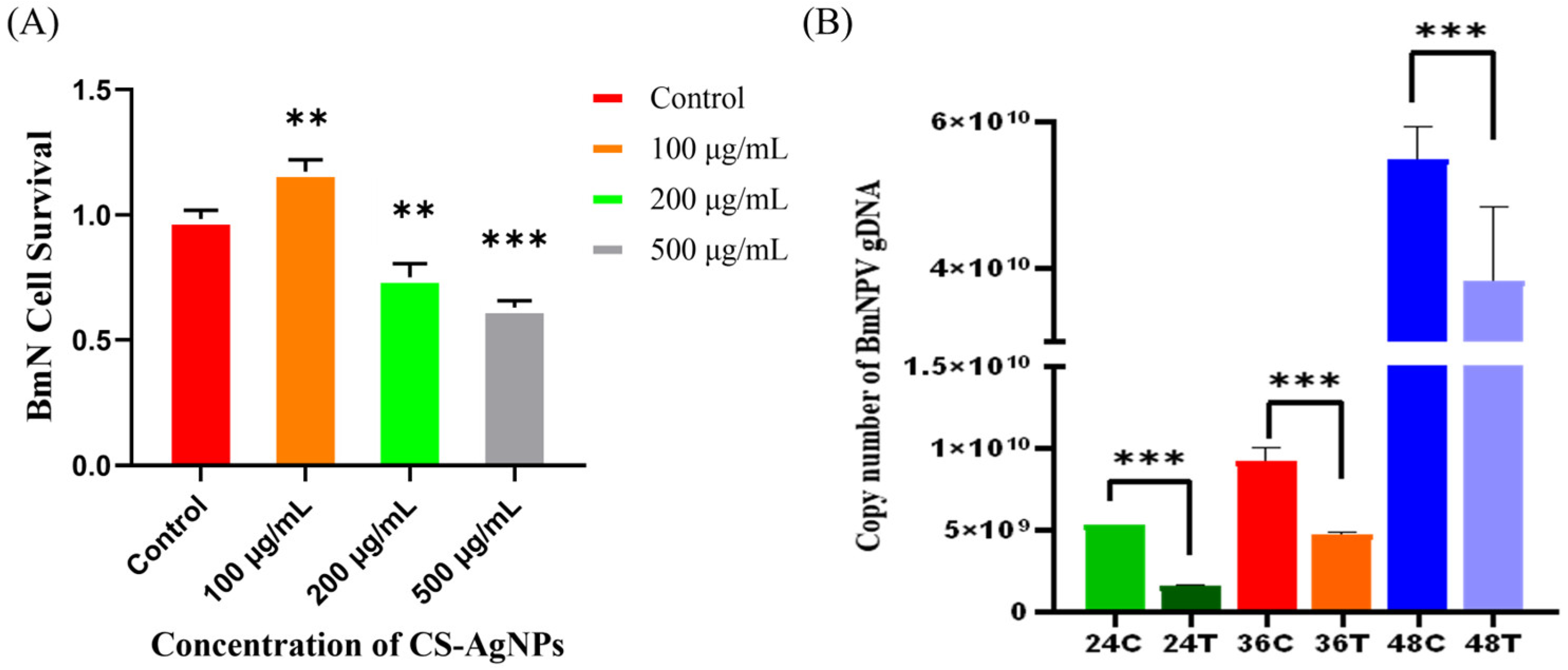
The B. mori ovary-derived cell line (BmN) was subcultured and maintained by the Silkworm Pathology Laboratory, Sericultural Research Institute, Chinese Academy of Agricultural Sciences (CAAS). This cell line was routinely cultured in TC-100 insect medium, which was supplemented with 10% (v/v) fetal bovine serum (FBS) and 1% penicillin-streptomycin. The cells were maintained in an incubator at 27 °C. For the viability assay, BmN cells in the logarithmic growth phase were harvested and seeded into 96-well plates at a density of 1 × 10³ cells per well. After achieving approximately 70–80% confluency, the cells were treated with serial concentration gradients of CS-Ag NPs and incubated at 27 °C for 24 h. Subsequently, 10 µL of CCK-8 reagent was added to each well. The 96-well plate was then incubated at 27 °C for 4 h. The optical density (OD) value was measured at 450 nm using a microplate reader (SpectraMax i3, Molecular Devices, San Jose, CA, USA).
2.3. Absolute Quantitative PCR Assay
In order to evaluate the antiviral efficacy of CS-Ag NPs, a BmNPV replication inhibition assay was performed using the
B. mori ovary-derived BmN cells. The cells were seeded into 6-well plates and cultured to approximately 80% confluency. The cells were then inoculated with BmNPV at a specific multiplicity of infection (MOI). Subsequent to a 2-h viral adsorption period, the viral inoculum was removed. For the treatment group, the cells were subsequently cultured in fresh medium containing 100 µg/mL CS-Ag NPs. For the control group, the cells were cultured in fresh medium devoid of nanoparticles. At 24, 36, and 48 h post-infection (hpi), BmN cells from each experimental group were harvested, and total genomic DNA was extracted using the SanPrep Column DNA Extraction Kit (Sangon Biotech (Shanghai) Co., Ltd., Shanghai, China). DNA concentration and purity were quantified with a NanoDrop 2000 spectrophotometer (Thermo Fisher Scientific, Waltham, MA, USA) and samples were normalized to a standard concentration for subsequent analyses. The BmNPV core gene
ie-1 (GenBank: NP_047491.1) was selected as the target gene. A standard curve was constructed by preparing serial dilutions (10
1–10
8 copies/µL) of a plasmid standard containing the
ie-1 fragment. Quantitative PCR reactions were performed using the ChamQ SYBR Master Mix system (Vazyme Biotech Co., Ltd., Nanjing, China). The thermal cycling protocol was as follows: initial denaturation at 94 °C for 30 s; followed by 40 cycles of denaturation at 94 °C for 5 s and annealing/extension at 60 °C for 30 s. Post-amplification melting curve analysis was conducted to verify amplicon specificity. Each experimental group was analyzed with three biological replicates and three technical replicates. Viral genome copy numbers were calculated using the standard curve method. The primers used in this study were presented in
Supplementary Materials.
2.4. Determination of Antimicrobial Activity via Disk Diffusion Assay
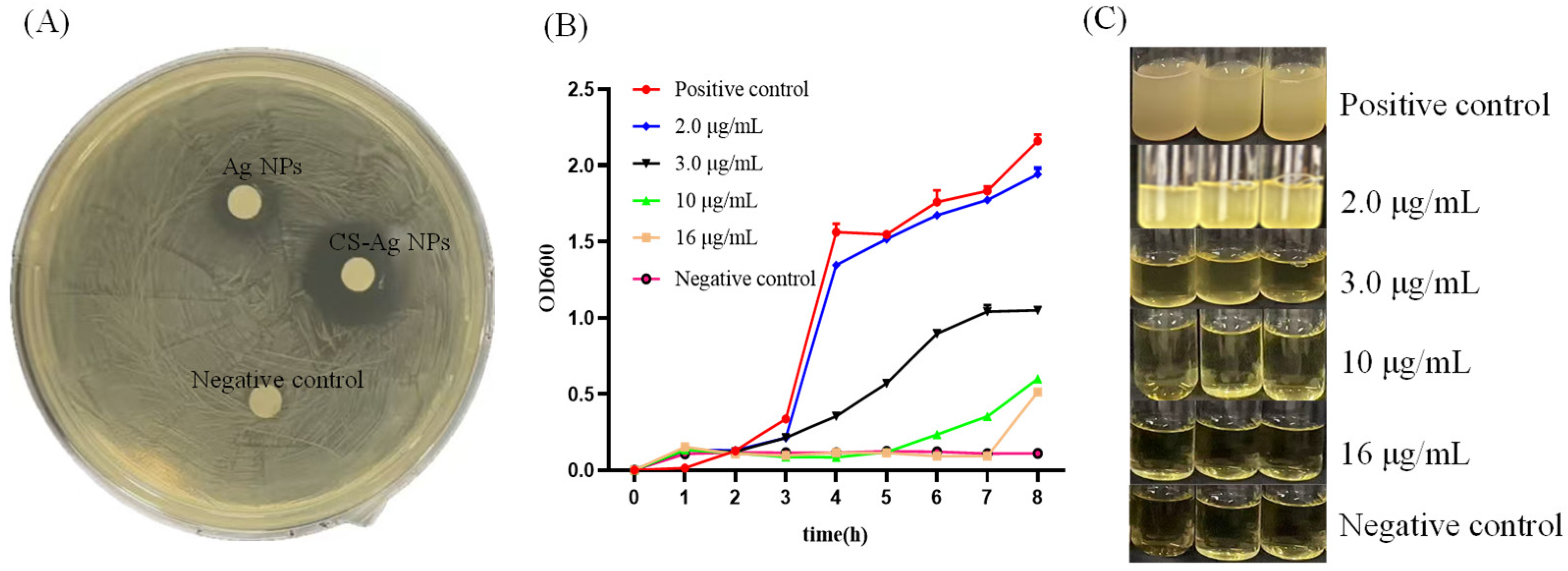
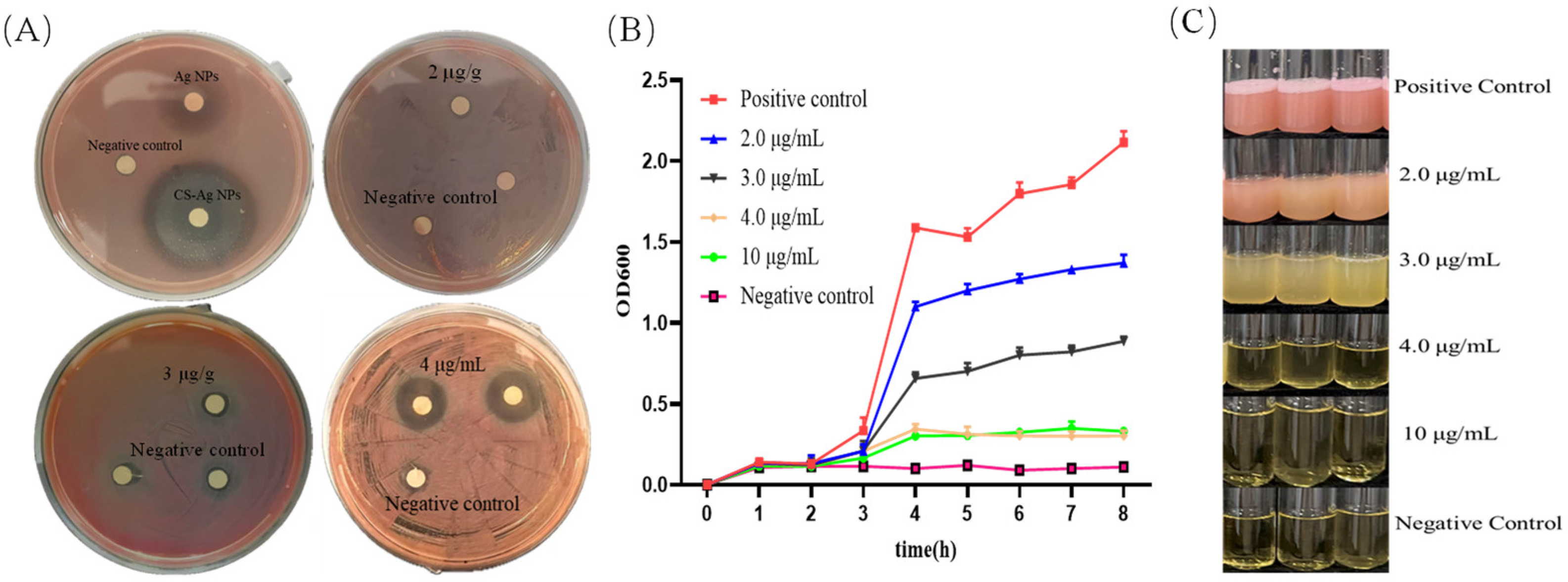
All pathogens used in this study, including BmNPV, B. bombysepticus, S. marcescens, Beauveria bassiana, Metarhizium anisopliae, and Aspergillus flavus, were isolated, purified, and maintained by the Silkworm Pathology Laboratory, Sericultural Research Institute, CAAS. Bacterial strains (S. marcescens, B. bombysepticus) were inoculated into LB liquid medium and cultured at 30 °C with shaking at 180 rpm until reaching the logarithmic growth phase. The bacterial suspension concentration was adjusted to approximately 1 × 10⁸ CFU/mL, and 100 µL aliquots were uniformly spread onto LB agar plates. Mature spores of Beauveria bassiana, Metarhizium anisopliae, and Aspergillus flavus were prepared as spore suspensions using a sterile 0.05% Tween-80 solution. After adjusting the concentration to 1 × 10⁶ spores/mL, 100 µL of the suspension was uniformly inoculated onto the surface of PDA medium. Sterile filter paper disks were impregnated with CS-Ag NPs at different concentrations. Equivalent concentrations of CS NPs and sterile water served as control groups. Bacterial plates were incubated at 30 °C for 18 h; fungal plates were incubated at 28 °C for 2–5 days until mycelial coverage was observed on control plates. The inhibition zone diameter (IZD) was measured for each group. Each experiment was independently replicated three times (n = 3).
2.5. Pathogen Growth Kinetics and Minimum Inhibitory Concentration (MIC) Assay
Bacterial suspensions of S. marcescens and B. bombysepticus were adjusted to 1 × 10⁶ CFU/mL, respectively, and thoroughly mixed with CS-Ag NPs at different final concentrations. Equivalent concentrations of pure CS NPs and sterile water served as control groups. All groups were incubated at 30 °C. The OD600 value of each group was measured every 1–2 h using a microplate reader or spectrophotometer. Growth kinetic curves were plotted with time on the x-axis and OD600 value on the y-axis. The MIC was defined as the lowest concentration of the test material at which no significant bacterial growth was visually observed (or the OD value growth rate was <5%) after 24 h of incubation.
2.6. Safety Assessment of CS-Ag NPs on Silkworm Growth
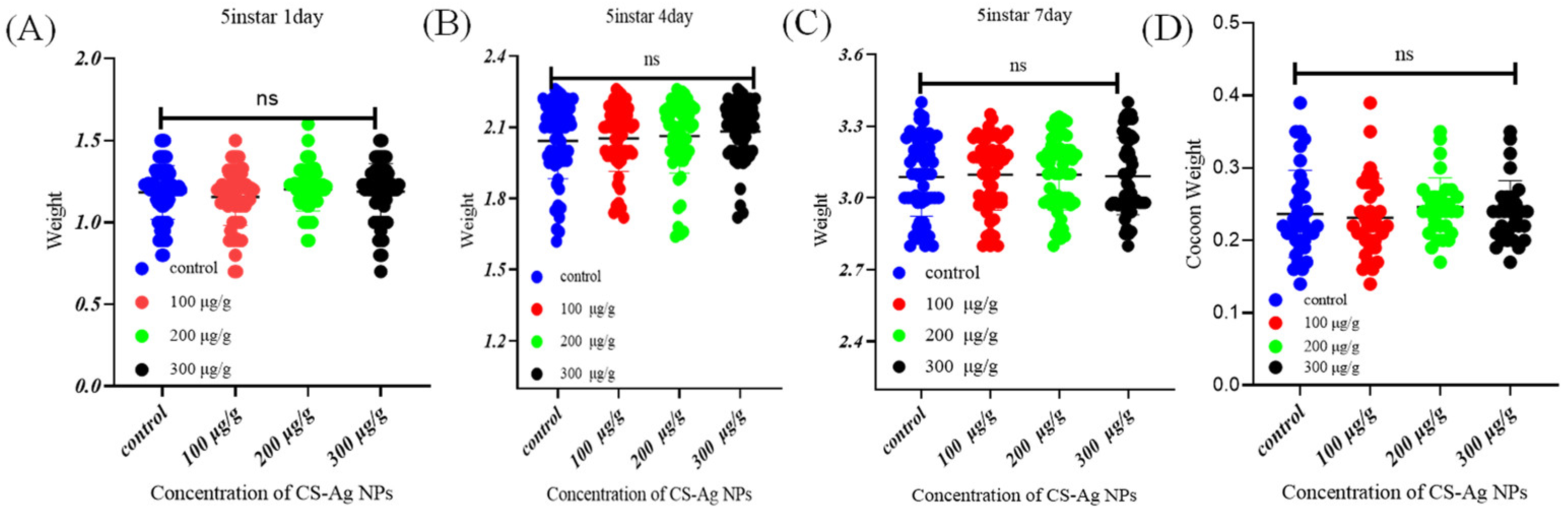
Test silkworms (strain P50, provided by the Silkworm Resource Conservation Center, Sericultural Research Institute, CAAS) were reared under controlled conditions of 28 °C, 60–80% relative humidity, and a 16 h:8 h light-dark cycle, with ad libitum feeding of fresh mulberry leaves until the initiation of the 5th instar stage. Healthy 5th-instar P50 larvae were randomly allocated into 4 experimental groups, with 45 larvae per group and three biological replicates (15 larvae per replicate), Baseline average body weight exhibited no statistically significant differences among groups. CS-Ag NPs and sterile water were uniformly applied to the surface of fresh mulberry leaves. The leaves were sectioned into standardized 4 cm × 4 cm segments, and each group received an equivalent quantity of treated leaves per feeding until cocoon formation. The blank control group was administered leaves treated with an equal volume of deionized water. Three experimental groups were established with CS-Ag NPs additive concentrations of 100 µg/g, 200 µg/g, and 300 µg/g per larva, respectively. Daily larval body weights were recorded, and comparative analyses of daily weight gain and cocoon weight were performed between treatment and control groups using appropriate statistical methods.
2.7. Evaluation of the In Vivo Protective Efficacy of CS-Ag NPs Against S. marcescens Infection in Silkworms
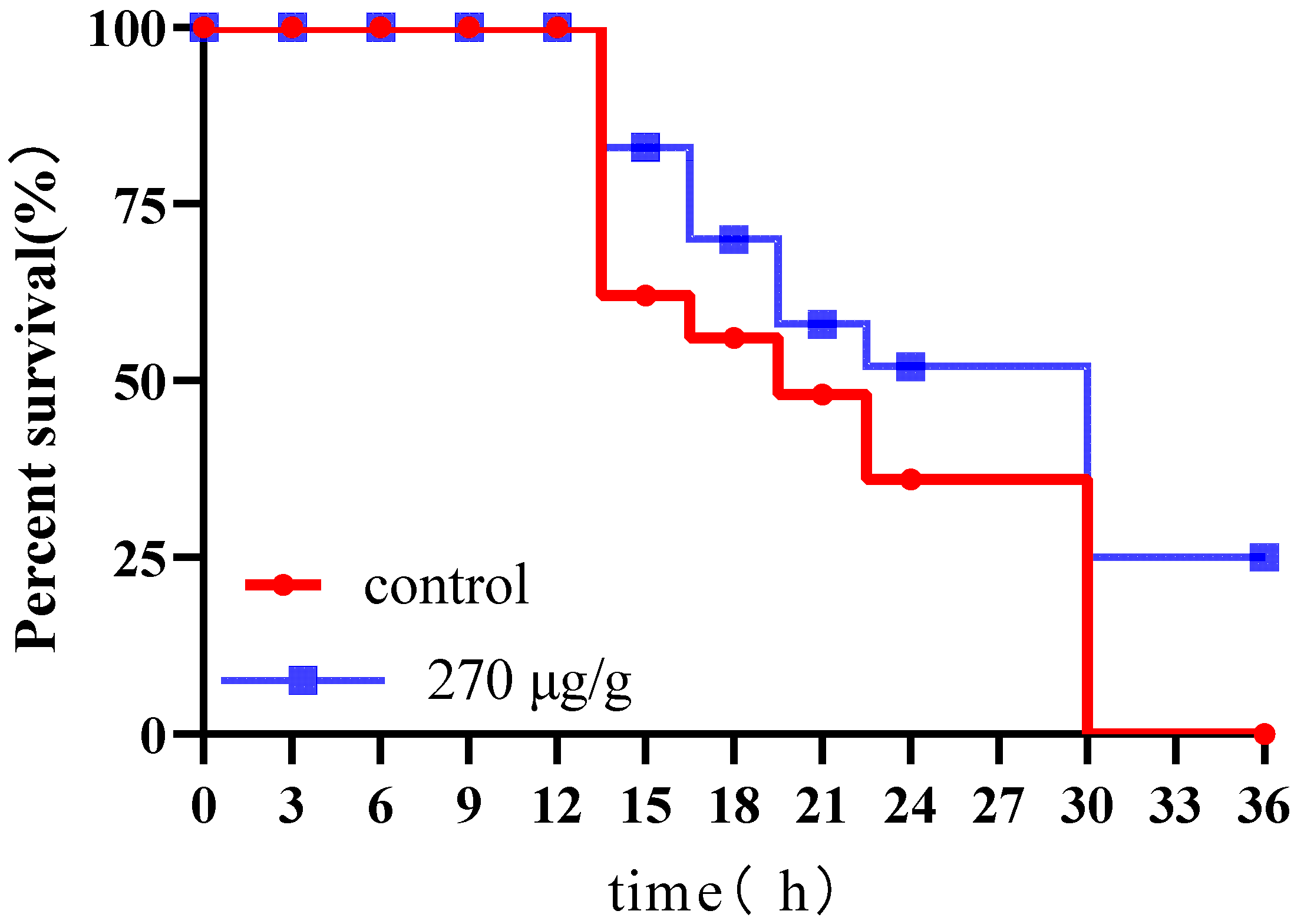
The experiment was designed with two experimental groups (45 silkworms per group) and 3 independent biological replicates. Group A: Silkworms were administered mulberry leaves coated with a specific safe dosage of 300 µg/g of CS-Ag NPs for 3 consecutive days to establish an in vivo defense barrier. Group B: Silkworms were fed an equivalent quantity of mulberry leaves treated with deionized water. Silkworms in both groups were inoculated via abdominal intersegmental injection with 10 µL of
S. marcescens at the LD
50 concentration. Survival status of silkworms in each group was continuously monitored for 96 h post-inoculation. Survival curves were constructed using the Kaplan–Meier method [
34].
2.8. Determination of Intracellular Reactive Oxygen Species (ROS) Levels
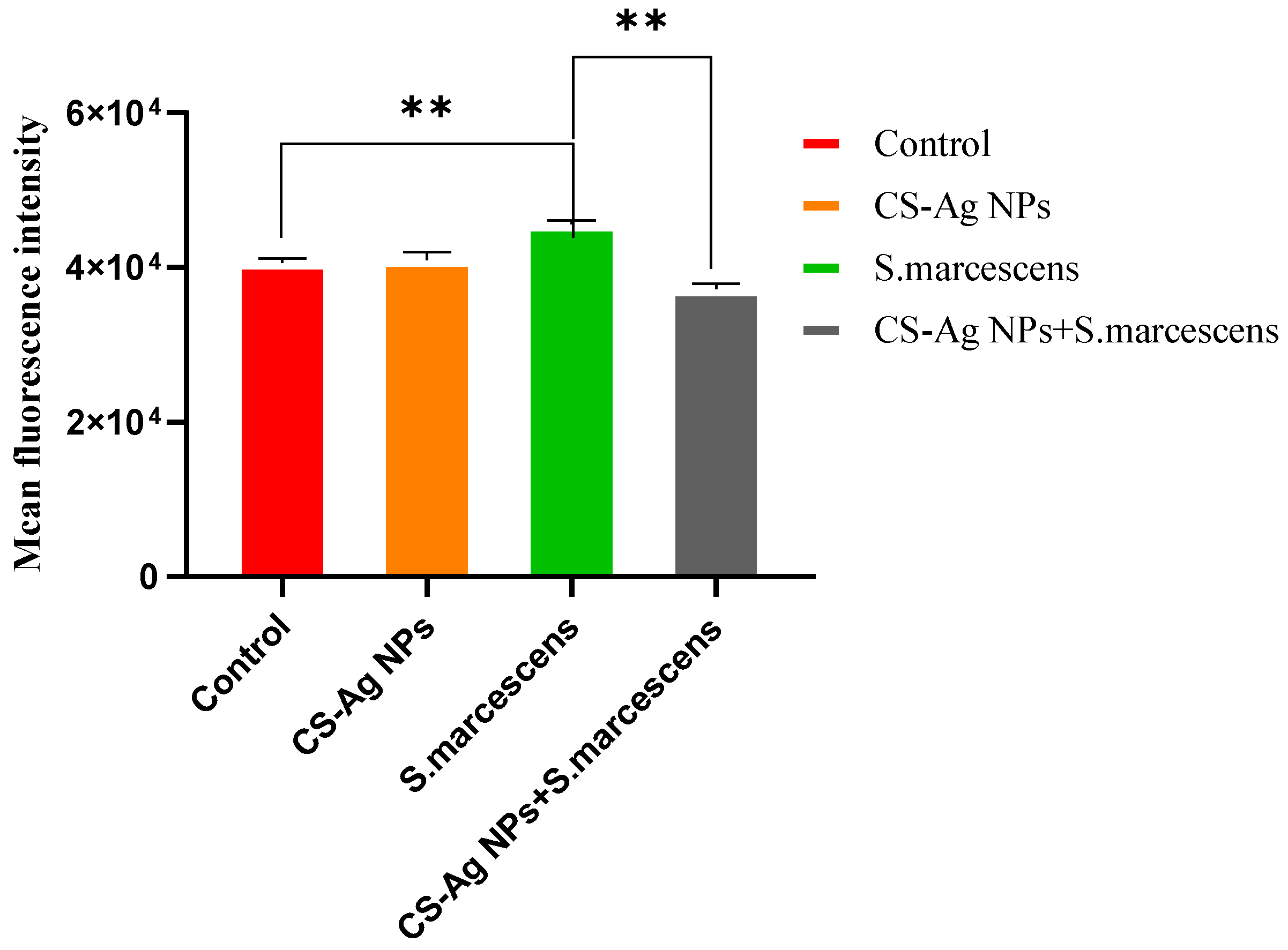
To elucidate the cytoprotective mechanism of the synthesized nanocomposites, an intracellular reactive oxygen species (ROS) assay was performed to evaluate whether CS-Ag NPs could mitigate oxidative stress induced by pathogens. BmN cells were seeded into 6-well plates at a density of 1 × 10
6 cells per well and cultured until they reached the required level of confluency. The experiment comprised a pathogen-infected control group and a nanocomposite treatment group. For the treatment group specifically, the cells were pre-treated with 100 µg/mL of CS-Ag NPs and then inoculated with
S. marcescens to induce intracellular oxidative stress. Subsequent to the designated incubation period, the culture medium was removed. The level of intracellular reactive oxygen species (ROS) was determined by means of the DCFH-DA fluorescent probe. Each well was then supplemented with DCFH-DA at a final concentration of 10 μmol/L and incubated in a 27 °C dark incubator for 30 min [
35]. Subsequent to the process of incubation, the cells were subjected to a washing procedure comprising three cycles of incubation in serum-free medium, with the objective of the removal of any extracellular probes. Fluorescence intensity was then measured using a multifunctional microplate reader with an excitation wavelength set at 488 nm and an emission wavelength set at 525 nm.
2.9. Statistical Analysis
All quantitative experimental data are expressed as mean ± standard error (Mean ± SE). Statistical analyses were performed using t-tests in GraphPad Prism version 8.0.2 (GraphPad Software, San Diego, CA, USA). Statistical significance was set at a p value < 0.05. Significance levels are denoted as follows: * for p < 0.05; ** for p < 0.01; *** for p < 0.001; **** for p < 0.0001; ns indicates no significant difference.
4. Discussion
The sustainable development of sericulture is constantly threatened by severe microbial diseases. Conventional chemical agents are widely used, but increasing concerns over environmental toxicity and pathogen resistance highlight the urgent need for safer, innovative anti-infective strategies. In this study, we successfully developed a new class of antimicrobial agent, namely, chitosan–silver nanocomposites (CS-Ag NPs), and demonstrated their potent efficacy against major pathogens of B. mori, in addition to excellent in vivo biocompatibility. The superior performance of these nanocomposites is fundamentally rooted in their synergistic physicochemical properties.
The physicochemical characterizations confirmed the successful construction of the CS-Ag NPs composite system. This system was specifically designed to overcome the inherent limitations of its individual components. While free silver nanoparticles (Ag NPs) have been shown to possess strong bactericidal activity, they have also been observed to exhibit a propensity for aggregation in complex biological microenvironments, such as the neutral-pH midgut of silkworms. The nonselective toxicity of free silver ions remains an unignorable concern. In contrast, pure chitosan (CS), despite its inherent antimicrobial properties mediated by protonated amino groups (-NH
3+) [
37], frequently exhibits inadequate charge density or effective membrane-binding sites to profoundly disrupt bacterial lipid bilayers when used independently [
38]. In synthesized CS-Ag NPs, transmission electron microscopy (TEM) and UV-Vis spectroscopy (which revealed an LSPR peak at 400–410 nm) [
36] confirmed a distinct core–shell architecture [
39]. This structure employs the low-electron-density CS matrix as a steric stabilizer, thereby effectively encapsulating the high-electron-density Ag core. This process serves to prevent aggregation, while concomitantly mitigating the biotoxicity of silver through physical confinement [
40].
In addition, the CS-Ag NPs demonstrated a highly positive surface charge, as indicated by Zeta potential analysis, which suggests inherent electrostatic targeting capabilities. The abundant amino and hydroxyl functional groups of the CS shell facilitate electrostatic neutralization and tight binding to the negatively charged bacterial membrane. This interaction induces localized membrane depolarization and pore expansion, thereby lowering the energy barrier for the sustained release of Ag+ ions to penetrate the cell envelope. Consequently, this synergistic mechanism not only ensures excellent colloidal stability but also drives the potent disruption of intracellular metabolic cascades, establishing a robust structural foundation for their successful application in the complex physiological microenvironment of B. mori.
In this study, we demonstrated that CS-Ag NPs significantly downregulate the transcriptional expression of
ie-1, indicating potent antiviral activity. The antiviral mechanism is hypothesized to primarily involve the synergistic effects of physical barrier formation and chemical interference. Due to the high density of positive surface charges on CS-Ag NPs, they effectively adsorb negatively charged viral envelope proteins through electrostatic interactions, thus physically preventing viral attachment and membrane fusion with BmN cells [
41]. The release of Ag
+ by CS-Ag NPs with high nucleophilicity allows it to penetrate the viral envelope and subsequently bind to viral genomic DNA/RNA. This interaction disrupts nucleic acid base pairing and interferes with the binding of transcription factors to promoter regions, thereby specifically inhibiting viral cascade transcription [
42].
It is imperative to note that the biological models utilized for antiviral and antibacterial evaluations in this study are distinct (in vitro BmN cells for BmNPV and in vivo B. mori larvae for bacterial pathogens). It is important to note that the experimental design was not intended for a direct, head-to-head comparison of CS-Ag NPs’ efficacy across different pathogen kingdoms. Instead, the BmN cell line was strategically employed to precisely quantify the absolute copy number of the viral ie-1 gene at the molecular level, thus isolating the direct interference of the nanomaterial from the complex systemic immune responses of the host. Conversely, pathogens such as S. marcescens characteristically invade via the gut to induce systemic septicemia; consequently, evaluating the protective efficacy necessitates the context of an intact intestinal barrier and systemic immunity, rendering the in vivo larval model indispensable. This multi-tiered screening approach is a comprehensive method of analyzing the versatile application potential of CS-Ag NPs from both molecular and organismal perspectives.
Recurrent outbreaks of microbial diseases caused by bacteria, fungi, and viruses, lead to substantial reductions in cocoon yield and quality, typically resulting in economic losses ranging from 30% to 60% [
43]. Traditional chemical control strategies are confronted with critical limitations, including the development of drug resistance and environmental persistence [
44]. In contrast, nanomaterials, characterized by their high specific surface area, unique physicochemical properties, and broad-spectrum antimicrobial activity, offer a promising alternative for addressing this challenge [
45]. Although CS-Ag NPs have exhibited potent antimicrobial efficacy in various applications, research on the utilization of CS-Ag NPs for the control of major silkworm pathogens remains in the preliminary stages. Our research systematically evaluated the intervention efficacy of CS-Ag NPs against two core pathogenic bacteria in silkworms. In vitro antibacterial assays confirmed that the diameter of the inhibition zone of CS-Ag NPs was significantly larger than that of individual components at equivalent doses, demonstrating a marked synergistic advantage of CS-Ag NPs in inhibiting pathogens. High resolution dynamic growth curve analysis revealed that CS-Ag NPs exhibited distinct dose dependent inhibitory effects, with heterogeneous sensitivity profiles observed across different pathogens. For
S. marcescens (Gram-negative), CS-Ag NPs showed exceptional inhibitory sensitivity. The MIC was precisely determined at 4.0 µg/mL, and bacterial proliferation was completely abrogated at this concentration. For
B. bombysepticus (Gram-positive), exposure to 3.0 μg/mL of CS-Ag NPs resulted in a significant prolongation of the lag phase, while the MIC required to achieve complete growth inhibition was determined to be 10.0 µg/mL. This differential sensitivity is attributed to the physical barrier function of the thick peptidoglycan layer in Gram-positive bacteria, which confers resistance to nanomaterial penetration. The superior antibacterial efficacy of CS-Ag NPs arises from the interplay between their distinctive physicochemical properties and the bacterial biointerface. The high positive surface potential of CS-Ag NPs generates strong electrostatic interactions with the negatively charged cell membranes of pathogens, facilitating efficient biointerface anchoring that directly compromises membrane integrity. Additionally, the chitosan scaffold not only provides structural support for the nanosilver component but also modulates Ag
+ release kinetics, enabling the maintenance of therapeutically effective local bactericidal concentrations over an extended duration [
46,
47]. Furthermore, the composite architecture significantly mitigates the self-aggregation propensity of Ag NPs in aqueous matrices, thereby maximizing their effective surface area. This enhancement in surface availability increases pathogen receptor interaction frequency and substantially reduces the minimal inhibitory dosage requirements [
48].
Subsequent to confirming the potent bactericidal and antiviral properties of CS-Ag NPs, this study further evaluated their inhibitory efficacy against common filamentous fungal pathogens affecting silkworms, including
Beauveria bassiana,
Metarhizium anisopliae, and
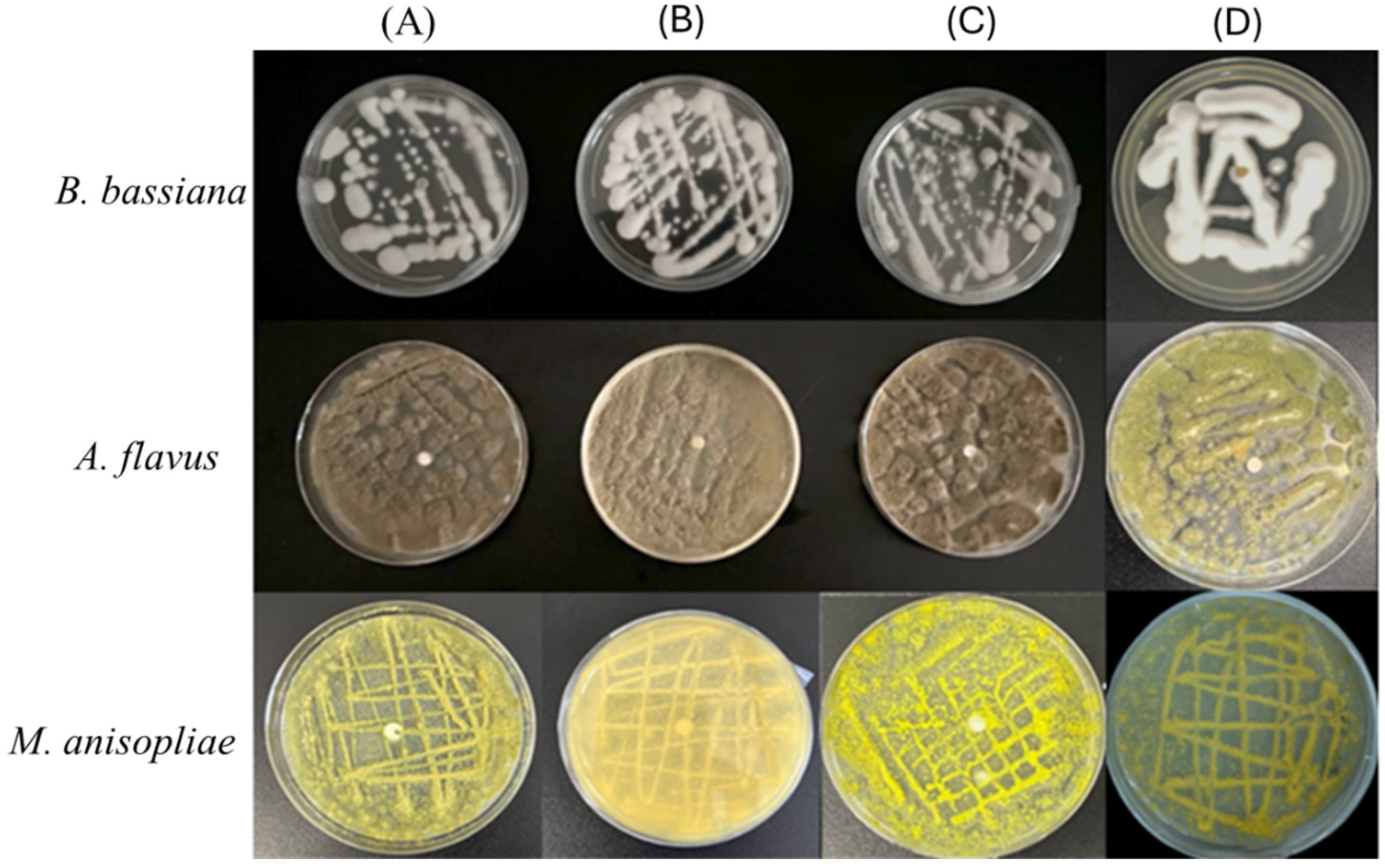
Aspergillus flavus. Our results demonstrated that even at an elevated CS-Ag NP treatment concentration of 100 µg/mL, no statistically significant differences were observed in colony growth kinetics or final diameter between the experimental and control groups. This result deviates from the previously reported antifungal efficacy of Chitosan@CuO and ZnO-CS [
49], thereby highlighting the pathogen-specific intervention characteristics of distinct hybrid nanosystems [
50]. The underlying mechanism for this phenomenon may be attributed to the structural complexity of the fungal cell wall, which differs fundamentally from the simple peptidoglycan layer or lipopolysaccharide (LPS) outer membrane of bacteria. Specifically, the fungal cell wall comprises a dense, cross-linked network structure composed of β-1,3-glucan, chitin, and mannoproteins. Despite the ability of CS-Ag NPs to adhere to bacterial surfaces via electrostatic interactions, their dimensions may be insufficient to penetrate the dense composite wall layer of fungi and reach the cell membrane. Furthermore, as eukaryotic organisms, filamentous fungi possess sophisticated antioxidant enzyme systems and highly developed intracellular transport networks [
51]. Even if trace amounts of Ag
+ penetrate the cell wall, they are likely to be rapidly chelated or expelled via efflux pumps, thereby maintaining intracellular redox homeostasis [
52].
The multifaceted protective effects of CS-Ag NPs—which range from the suppression of bacterial proliferation to the mitigation of pathogen-induced oxidative stress—can be unified by their physicochemical bio-interface interactions. The dense positive charges of the chitosan shell facilitate rapid electrostatic adherence to negatively charged bacterial membranes, causing structural disruption. In addition, the composite acts as a dynamic shield for host cells. As demonstrated by our intracellular ROS assessment, the pre-treatment with CS-Ag NPs effectively neutralized the pathogen-induced ROS burst in BmN cells. This finding indicates that, in addition to direct bactericidal and antiviral activities, CS-Ag NPs may also impede the action of virulence factors at the host–pathogen interface, thereby contributing to the maintenance of host redox homeostasis and the prevention of systemic immune collapse.
From a practical sericulture perspective, the synergistic roles of Ag and chitosan mean that CS-Ag NPs can be used as an effective prophylactic feed additive by spraying mulberry leaves, or as an environmentally friendly disinfectant for rearing facilities. However, to provide a balanced view of their potential uses, the limitations and conditional factors affecting their efficacy must be acknowledged. Firstly, as demonstrated in our empirical results, their antifungal efficacy is limited by the structural barriers of fungal cell walls, meaning they cannot serve as a universal cure for all sericultural diseases. Secondly, the antimicrobial activity and structural stability of the chitosan matrix depend heavily on environmental pH: its polycationic nature is most effective in slightly acidic to neutral environments, whereas highly alkaline conditions may induce nanoparticle aggregation or reduce the protonation of the functional amino groups, thereby weakening its electrostatic targeting capability. Furthermore, while we have established a safe in vivo dosage window for the silkworm host (B. mori), the long-term environmental fate and potential accumulation of silver nanoparticles in the broader sericultural ecosystem (e.g., mulberry field soils or groundwater) require rigorous, continuous monitoring. Therefore, the practical deployment of CS-Ag NPs must be carefully calibrated to take into account these environmental variables and the specific profiles of target pathogens to maximize efficacy while minimizing unintended ecological drawbacks.