Enhancing Perceived Restorativeness in Urban Commercial Pedestrian Streets: An Empirical Study on the Intervention of Public Art


Abstract
1. Introduction
1.1. The Urban Modern Environment and Human Predicament
1.2. Literature Review
1.2.1. Restorativeness
1.2.2. Restorative Environments
1.2.3. The Restorative Potential of Urban Commercial Streets
1.2.4. Restorativeness of Public Art
1.3. Research Objectives
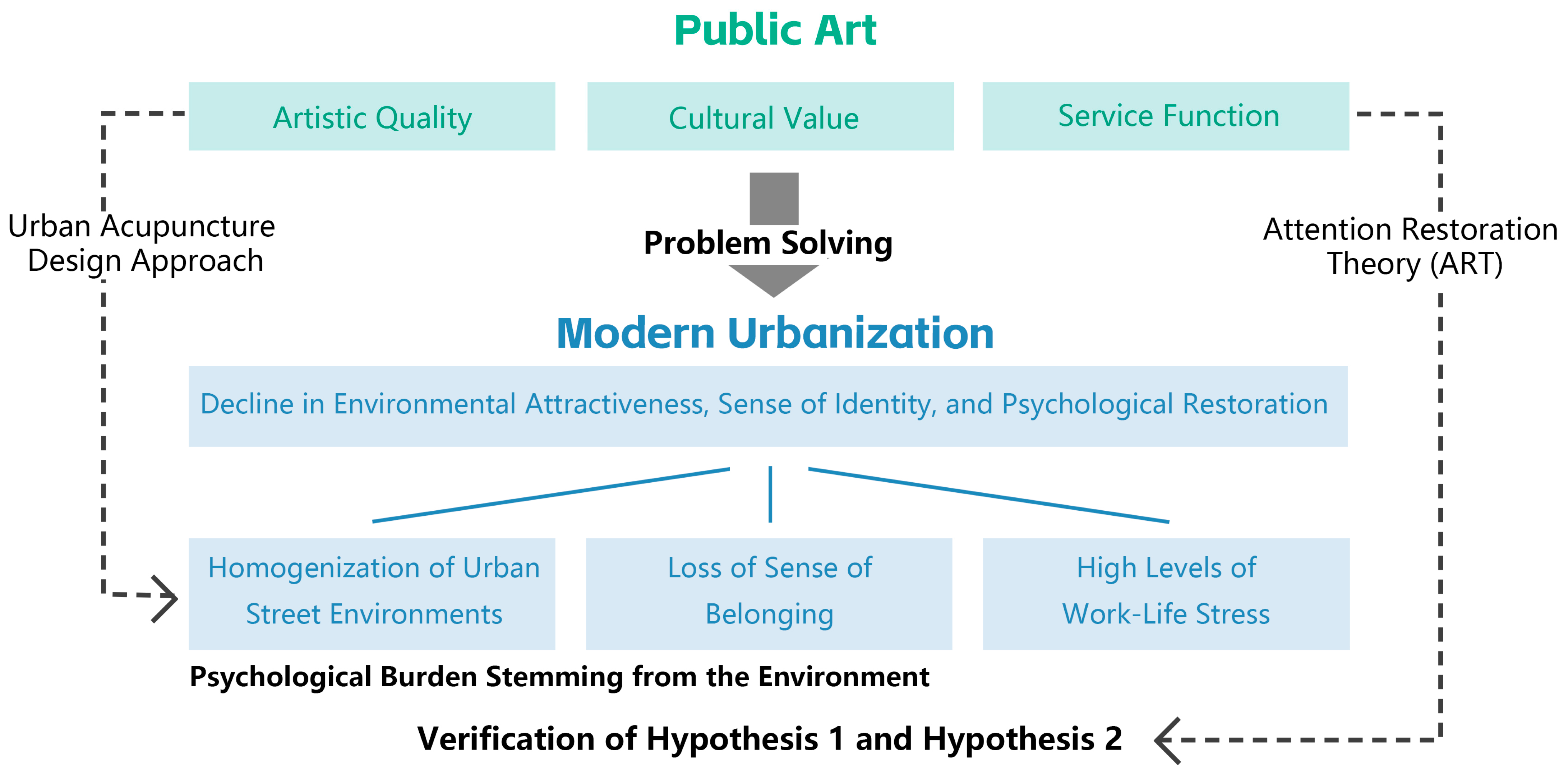
1.4. Research Framework
2. Materials and Methods
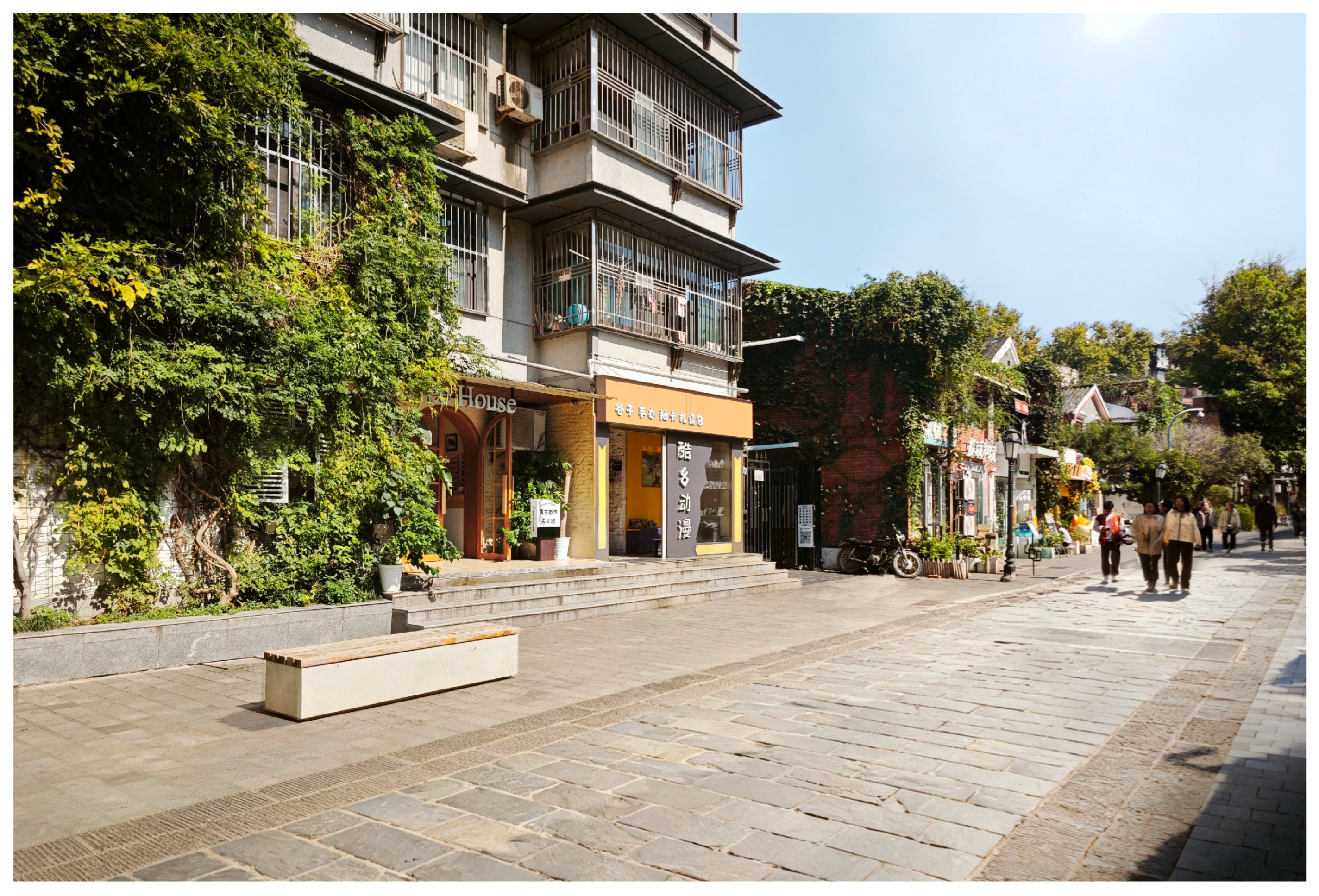
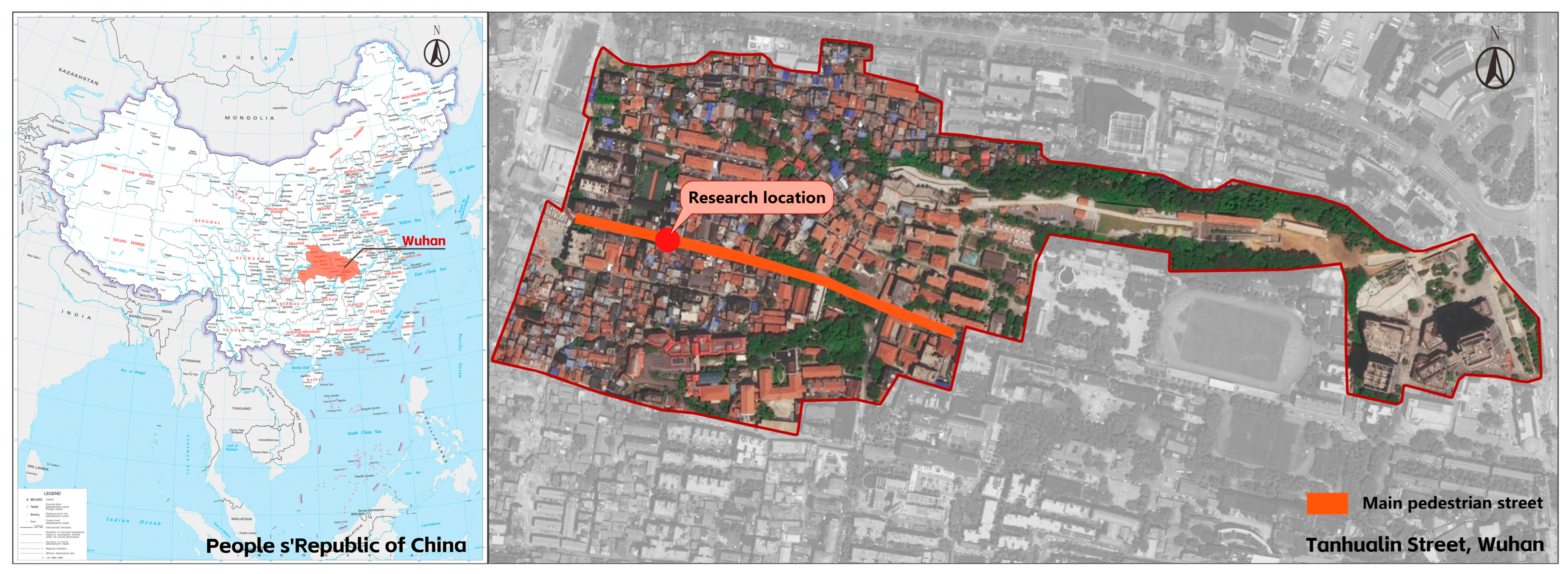
2.1. Study Area
2.2. Visual Stimulus Materials
- Step 1: Assessment of Wuhan Cultural Symbols
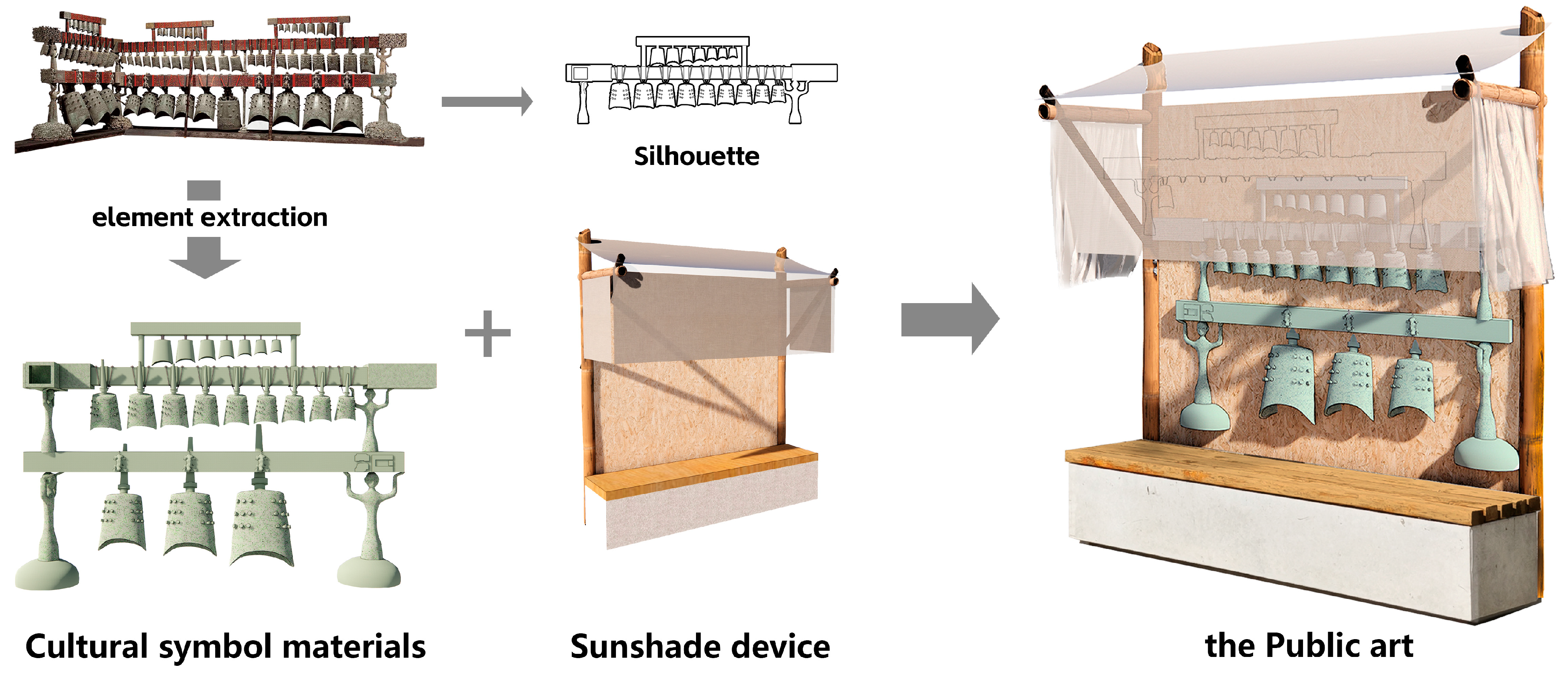
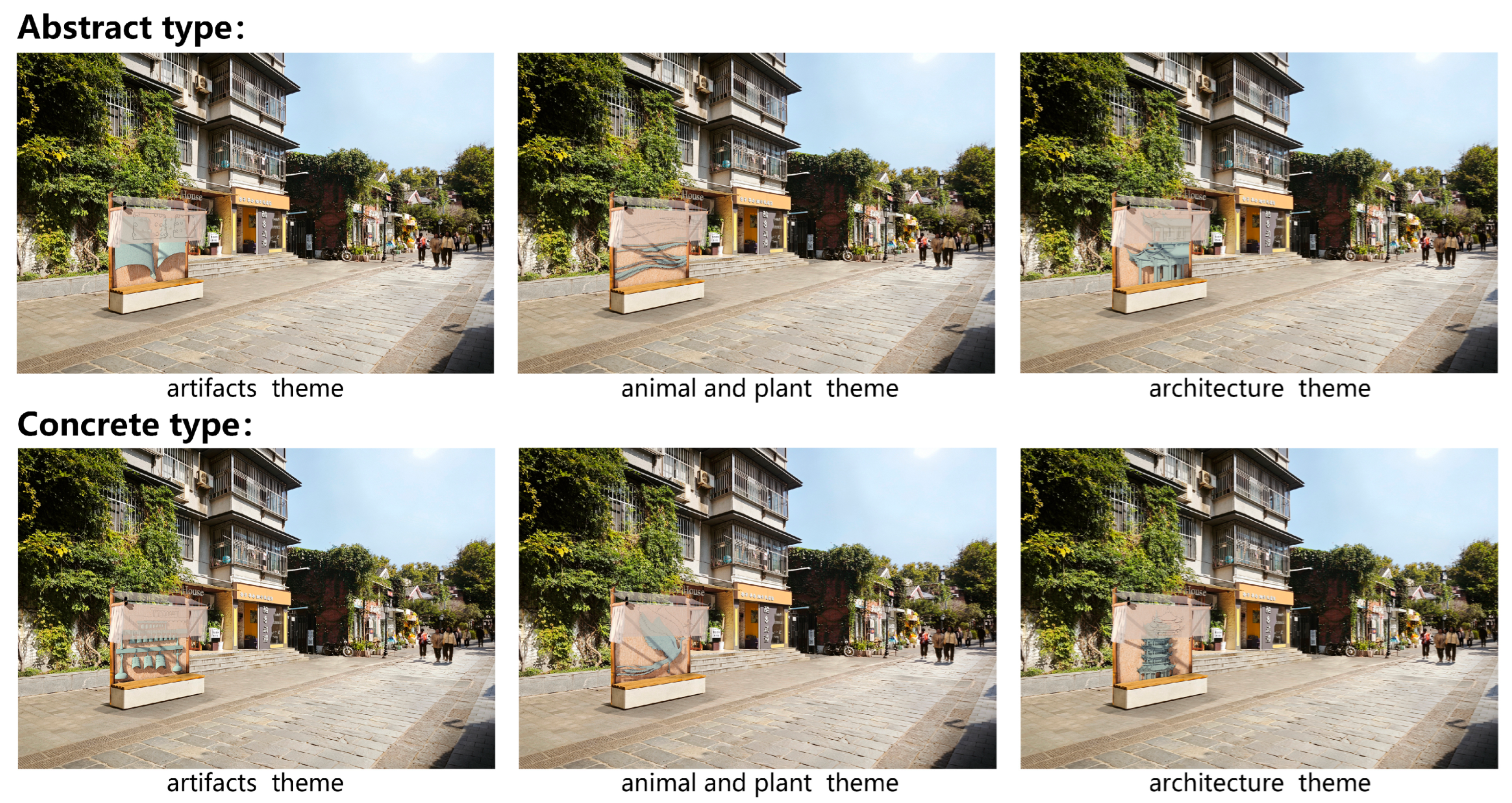
- Step 2: Generation of Images for Evaluation
2.3. Questionnaire Design
2.4. Participants
2.5. Statistical Analysis
3. Results
3.1. Reliability
3.2. Comparison of Restorative Capacity Between Streets with and Without Public Art
3.3. Comparison of Restorative Capacity Among Public Art with Different Forms and Themes
3.4. The Influence of Residence History in Wuhan on Perceived Restorativeness of Public Art
4. Discussion
4.1. The Restorative Potential of Public Art in Commercial Pedestrian Streets
4.2. Differences in Restorativeness Among Different Types of Public Art
4.3. The Influence of Residence History on Perceived Restorativeness of Public Art
5. Conclusions
5.1. Research Summary
5.2. Limitations and Future Research
- The participant sample consisted primarily of young adults (aged 18–35). Because recruitment relied mainly on online academic and social media channels, the sample showed limited diversity in age and sociodemographic characteristics, and systematically excluded individuals with limited access to digital resources, particularly older adults. While research has established the validity of using university student samples [59], subsequent studies should expand to include broader and more diverse participant groups to derive more precise and generalizable conclusions. Specifically, such future studies need to analyze whether and how participants from different age groups vary in their understanding of and preference for digital images, artistic themes, and representational forms, and whether these differences influence the restorative efficacy.
- Due to the lack of comprehensive sociodemographic data collection, the present questionnaire-based study could not fully examine the influence of background factors such as occupation, income, or household characteristics. Missing data may limit the depth and generalizability of the findings. For example, some studies suggest that art professionals tend to prefer figurative art, whereas non-professionals may show no clear preference in artistic form, potentially because professionals can better perceive artistic meaning, craftsmanship, and decorative qualities [48,87,88]. Other studies report contrasting patterns, indicating that professionals may prefer abstract art [89]. These divergent perspectives were not examined in the current study. Future research should investigate how such demographic and professional variables shape evaluations, thereby improving the robustness and relevance of the conclusions.
- The study context was a typical commercial pedestrian street in China, and the cultural background of the public art themes was rooted in the Central China region associated with Wuhan. To overcome this limitation, the findings should also be tested in other regions across China and worldwide.
- This study only evaluated the impact of the form and theme of public art on restorativeness. However, public art is a complex artistic category, and factors such as its shape, color, material, scale, quantity, and location—which may influence restorative quality—were not assessed and warrant further investigation.
- Photographic stimuli cannot represent the full, multisensory experience of a streetscape. When entering a pedestrian street, additional sensory stimuli such as auditory, olfactory, and tactile inputs may influence restorative evaluations. Future research could employ methods such as immersive virtual reality (VR) to more authentically simulate streetscape environments, thereby enhancing the practical relevance of the studies.
- This study’s online questionnaire approach has certain limitations. Although large-scale random sampling helped balance individual and device variations, participants evaluated the scenes under an instructed, assumed state of fatigue. Their actual physiological and emotional states at the time of response were not measured, which could have introduced variability into the ratings. Future research could validate these findings in controlled laboratory settings by incorporating physiological measurements and employ more covert experimental designs to reduce potential demand characteristics.
Author Contributions
Funding
Institutional Review Board Statement
Informed Consent Statement
Data Availability Statement
Acknowledgments
Conflicts of Interest
References
- Hartig, T. Restorative Environments. Encycl. Appl. Psychol. 2004, 273–279. [Google Scholar] [CrossRef] [Scilit]
- Jiang, B.; Zhang, T.; Sullivan, W.C. Healthy Cities: Mechanisms and Research Questions Regarding the Impacts of Urban Green Landscapes on Public Health and Well-Being. Landsc. Archit. Front. 2015, 3, 24–36. [Google Scholar]
- Jackson, L.E. The Relationship of Urban Design to Human Health and Condition. Landsc. Urban Plan. 2003, 64, 191–200. [Google Scholar] [CrossRef] [Scilit]
- Clark, C.; Myron, R.; Stansfeld, S.; Candy, B. A Systematic Review of the Evidence on the Effect of the Built and Physical Environment on Mental Health. J. Public Ment. Health 2007, 6, 14–27. [Google Scholar] [CrossRef] [Scilit]
- Carmona, M. Place Value: Place Quality and Its Impact on Health, Social, Economic and Environmental Outcomes. J. Urban Des. 2019, 24, 1–48. [Google Scholar] [CrossRef] [Scilit]
- Ryan, R.M.; Weinstein, N.; Bernstein, J.; Brown, K.W.; Mistretta, L.; Gagné, M. Vitalizing Effects of Being Outdoors and in Nature. J. Environ. Psychol. 2010, 30, 159–168. [Google Scholar] [CrossRef] [Scilit]
- Weber, A.M.; Trojan, J. The Restorative Value of the Urban Environment: A Systematic Review of the Existing Literature. Environ. Health Insights 2018, 12, 1178630218812805. [Google Scholar] [CrossRef] [Scilit]
- Galindo, M.P.; Hidalgo, M.C. Aesthetic Preferences and the Attribution of Meaning: Environmental Categorization Processes in the Evaluation of Urban Scenes. Int. J. Psychol. 2005, 40, 19–27. [Google Scholar] [CrossRef] [Scilit]
- Liu, H.; Li, B.; Liu, Q.; Li, Y.; Zhao, J.; Wang, X.; Cui, C.; Zeng, S. What Do Local People Really Need from a Place? Defining Local Place Qualities with Assessment of Users’ Perceptions. Int. J. Environ. Res. Public Health 2023, 20, 1269. [Google Scholar] [CrossRef] [Scilit]
- Carlotti, P. “Architectural Acupuncture” in Urban Morphology Studies. Land 2024, 13, 661. [Google Scholar] [CrossRef] [Scilit]
- de Solà-Morales, M. A Matter of Things; NAi Publishers: Rotterdam, The Netherlands, 2008; Volume 10. [Google Scholar]
- Lerner, J. Urban Acupuncture: Celebrating Pinpricks of Change That Enrich City Life; Island Press: Washington, DC, USA, 2014. [Google Scholar]
- Yang, J.; Xie, Y.; Yang, Q.; Zhang, Y. A Multi-Objective Crossover Parallel Combinatorial Optimization (MCPCO) Model for Site Selection of Catalyst Elements in Urban Micro-Renewal. Land 2025, 14, 1972. [Google Scholar] [CrossRef] [Scilit]
- Hemingway, J.M.; De Castro Mazarro, A. Pinning down Urban Acupuncture: From a Planning Practice to a Sustainable Urban Transformation Model? Plan. Theory Pract. 2022, 23, 305–309. [Google Scholar] [CrossRef] [Scilit]
- Hall, T.; Robertson, I. Public Art and Urban Regeneration: Advocacy, Claims and Critical Debates. Landsc. Res. 2001, 26, 5–26. [Google Scholar] [CrossRef] [Scilit]
- Hartig, T.; Kaiser, F.G.; Bowler, P.A. Further Development of a Measure of Perceived Environmental Restorativeness; Institute for Housing Research, Uppsala University: Uppsala, Sweden, 1997. [Google Scholar]
- Subiza-Pérez, M.; Pasanen, T.; Ratcliffe, E.; Lee, K.; Bornioli, A.; de Bloom, J.; Korpela, K. Exploring Psychological Restoration in Favorite Indoor and Outdoor Urban Places Using a Top-down Perspective. J. Environ. Psychol. 2021, 78, 101706. [Google Scholar] [CrossRef] [Scilit]
- Peen, J.; Schoevers, R.A.; Beekman, A.T.; Dekker, J. The Current Status of Urban-Rural Differences in Psychiatric Disorders. Acta Psychiatr. Scand. 2010, 121, 84–93. [Google Scholar] [CrossRef] [Scilit]
- Korpela, K.; Hartig, T. Restorative Qualities of Favorite Places. J. Environ. Psychol. 1996, 16, 221–233. [Google Scholar] [CrossRef] [Scilit]
- Lehto, X.Y. Assessing the Perceived Restorative Qualities of Vacation Destinations. J. Travel Res. 2013, 52, 325–339. [Google Scholar] [CrossRef] [Scilit]
- Korpela, K.M.; Hartig, T.; Kaiser, F.G.; Fuhrer, U. Restorative Experience and Self-Regulation in Favorite Places. Environ. Behav. 2001, 33, 572–589. [Google Scholar] [CrossRef] [Scilit]
- Yang, Y.; Chen, G. In Search of Fresher Air: The Influence of Relative Air Quality on Vacationers’ Perceptions of Destinations’ Restorative Qualities. Int. J. Tour. Res. 2021, 23, 504–516. [Google Scholar] [CrossRef] [Scilit]
- Kaplan, S. The Restorative Benefits of Nature: Toward an Integrative Framework. J. Environ. Psychol. 1995, 15, 169–182. [Google Scholar] [CrossRef] [Scilit]
- Ulrich, R.S. Aesthetic and Affective Response to Natural Environment. In Behavior and the Natural Environment; Altman, I., Wohlwill, J.F., Eds.; Springer: Boston, MA, USA, 1983; pp. 85–125. ISBN 978-1-4613-3541-2. [Google Scholar]
- Ulrich, R.S.; Simons, R.F.; Losito, B.D.; Fiorito, E.; Miles, M.A.; Zelson, M. Stress Recovery during Exposure to Natural and Urban Environments. J. Environ. Psychol. 1991, 11, 201–230. [Google Scholar] [CrossRef] [Scilit]
- Kaplan, S. Meditation, Restoration, and the Management of Mental Fatigue. Environ. Behav. 2001, 33, 480–506. [Google Scholar] [CrossRef] [Scilit]
- Kaplan, R.; Kaplan, S.; Brown, T. Environmental Preference: A Comparison of Four Domains of Predictors. Environ. Behav. 1989, 21, 509–530. [Google Scholar] [CrossRef] [Scilit]
- National Bureau of Statistics. Available online: https://data.stats.gov.cn/easyquery.htm?cn=C01&zb=A0301&sj=2023 (accessed on 8 December 2025).
- Barros, P.; Mehta, V.; Brindley, P.; Zandieh, R. The Restorative Potential of Commercial Streets. Landsc. Res. 2021, 46, 1017–1037. [Google Scholar] [CrossRef] [Scilit]
- Wang, S.; Li, A. Demographic Groups’ Differences in Restorative Perception of Urban Public Spaces in COVID-19. Buildings 2022, 12, 869. [Google Scholar] [CrossRef] [Scilit]
- Johansson, M.; Hartig, T.; Staats, H. Psychological Benefits of Walking: Moderation by Company and Outdoor Environment. Appl. Psychol. Health Well-Being 2011, 3, 261–280. [Google Scholar] [CrossRef] [Scilit]
- Kinnafick, F.-E.; Thøgersen-Ntoumani, C. The Effect of the Physical Environment and Levels of Activity on Affective States. J. Environ. Psychol. 2014, 38, 241–251. [Google Scholar] [CrossRef] [Scilit]
- Stigsdotter, U.K.; Corazon, S.S.; Sidenius, U.; Kristiansen, J.; Grahn, P. It Is Not All Bad for the Grey City—A Crossover Study on Physiological and Psychological Restoration in a Forest and an Urban Environment. Health Place 2017, 46, 145–154. [Google Scholar] [CrossRef] [Scilit] [PubMed]
- Jacobs, A.B. Keynote: Looking, Learning, Making [Streets: Old Paradigm, New Investment]. Places 1997, 11, 4–7. [Google Scholar]
- Merriman, P. Driving Places: Marc Augé, Non-Places, and the Geographies of England’s M1 Motorway. Theory Cult. Soc. 2004, 21, 145–167. [Google Scholar] [CrossRef] [Scilit]
- Carmona, M.; Gabrieli, T.; Hickman, R.; Laopoulou, T.; Livingstone, N. Street Appeal: The Value of Street Improvements. Prog. Plan. 2018, 126, 1–51. [Google Scholar] [CrossRef] [Scilit]
- Yin, Y.; Thwaites, K.; Simpson, J. Exploring the Use of Restorative Component Scale to Measure Street Restorative Expectations. Urban Des. Int. 2022, 27, 145–155. [Google Scholar] [CrossRef] [Scilit]
- Yuting, Y.; Yuhan, S.; Zhenying, X.; Thwaites, K.; Kexin, Z. An Explorative Study on the Identification and Evaluation of Restorative Streetscape Elements. Landsc. Archit. Front. 2020, 8, 76–90. [Google Scholar]
- Zhao, J.; Wu, J.; Wang, H. Characteristics of Urban Streets in Relation to Perceived Restorativeness. J. Expo. Sci. Environ. Epidemiol. 2020, 30, 309–319. [Google Scholar] [CrossRef] [Scilit]
- Barros, P.; Mehta, V. Does Restorativeness Support Liveliness on Commercial Streets? J. Urban Des. 2024, 29, 400–427. [Google Scholar] [CrossRef] [Scilit]
- Van Dillen, S.M.E.; de Vries, S.; Groenewegen, P.P.; Spreeuwenberg, P. Greenspace in Urban Neighbourhoods and Residents’ Health: Adding Quality to Quantity. J. Epidemiol. Community Health 2012, 66, e8. [Google Scholar] [CrossRef] [Scilit] [PubMed]
- Lin, Y.-H.; Tsai, C.-C.; Sullivan, W.C.; Chang, P.-J.; Chang, C.-Y. Does Awareness Affect the Restorative Function and Perception of Street Trees? Front. Psychol. 2014, 5, 906. [Google Scholar] [CrossRef] [Scilit]
- Lindal, P.J.; Hartig, T. Effects of Urban Street Vegetation on Judgments of Restoration Likelihood. Urban For. Urban Green. 2015, 14, 200–209. [Google Scholar] [CrossRef] [Scilit]
- Binoy, P. The Role of Public Art Has Changed in Recent Times: A Study. Liño 2024, 30, 161–165. [Google Scholar] [CrossRef] [Scilit]
- Matthews, T.; Gadaloff, S. Public Art for Placemaking and Urban Renewal: Insights from Three Regional Australian Cities. Cities 2022, 127, 103747. [Google Scholar] [CrossRef] [Scilit]
- Tang, J.; Yan, L.; Xu, J. Tourists’ Experience of Iconic Public Art in Macau. J. Tour. Cult. Change 2021, 19, 79–96. [Google Scholar] [CrossRef] [Scilit]
- Peruzzi, G.; Bernardini, V.; Riyahi, Y. Women’s Statues in Italian Cities. A Study of Public Art and Cultural Policies. Int. J. Cult. Policy 2024, 30, 49–66. [Google Scholar] [CrossRef] [Scilit]
- Cheng, Y.; Chen, J.; Li, J.; Li, L.; Hou, G.; Xiao, X. Research on the Preference of Public Art Design in Urban Landscapes: Evidence from an Event-Related Potential Study. Land 2023, 12, 1883. [Google Scholar] [CrossRef] [Scilit]
- Remesar, A. Urban Regeneration: A Challenge for Public Art; Edicions Universitat Barcelona: Barcelona, Spain, 1997; ISBN 978-84-475-1737-4. [Google Scholar]
- Tekle, A.M. Rectifying These Mean Streets: Percent-For-Art Ordinances, Street Furniture, and the New Streetscape. Ky. Law J. 2015, 104, 3. [Google Scholar]
- Brown. Keener Cary Public Art Master Plan. Available online: https://townofcary.uberflip.com/i/320439-cary-public-art-master-plan/0? (accessed on 22 January 2026).
- Abdulkarim, D.; Nasar, J.L. Are Livable Elements Also Restorative? J. Environ. Psychol. 2014, 38, 29–38. [Google Scholar] [CrossRef] [Scilit]
- Li, L.; Shukor, S.F.A.; Noor, M.S.B.M.; Hasna, M.F.B. The Impact of Virtual Immersive Public Art on the Restorative Experience of Urban Residents. Sustainability 2024, 16, 9292. [Google Scholar] [CrossRef] [Scilit]
- Wuhan Municipal Bureau of Statistics. Available online: https://tjj.wuhan.gov.cn/tjfw/tjnj/202511/t20251111_2675660.shtml (accessed on 9 December 2025).
- Gao, S.; Liang, Y.; Sun, M. The characteristics of OGC and TGC pictures and their applications in the construction and online dissemination of tourist destination image: A case of Tanhualin historical and cultural district. J. Cent. China Norm. Univ. (Nat. Sci. 2025, 60, 280–297. [Google Scholar]
- Zhao, H. Self-organized Renew Phenomenon in Hybrid Historic Neighborhoods Update and Its Implications: Tanhualin Neighborhoods in Wuchang Old City for Example. Zhuangshi 2015, 104–107. [Google Scholar] [CrossRef]
- Li, H.; Du, J.; Chow, D. Perceived Environmental Factors and Students’ Mental Wellbeing in Outdoor Public Spaces of University Campuses: A Systematic Scoping Review. Build. Environ. 2024, 265, 112023. [Google Scholar] [CrossRef] [Scilit]
- Lu, X.; Xu, J.; Lange, E.; Cao, J. Which Factors Enhance the Perceived Restorativeness of Streetscapes: Sound, Vision, or Their Combined Effects? Insights from Four Street Types in Nanjing, China. Land 2025, 14, 757. [Google Scholar] [CrossRef] [Scilit]
- Stamps, A.E., III. Demographic Effects in Environmental Aesthetics: A Meta-Analysis. J. Plan. Lit. 1999, 14, 155–175. [Google Scholar] [CrossRef] [Scilit]
- Hartig, T.; Böök, A.; Garvill, J.; Olsson, T.; Gärling, T. Environmental Influences on Psychological Restoration. Scand. J. Psychol. 1996, 37, 378–393. [Google Scholar] [CrossRef] [Scilit]
- Zhao, J.; Luo, P.; Wang, R.; Cai, Y. Correlations between Aesthetic Preferences of River and Landscape Characters. J. Environ. Eng. Landsc. Manag. 2013, 21, 123–132. [Google Scholar] [CrossRef] [Scilit]
- Palmer, J.F.; Hoffman, R.E. Rating Reliability and Representation Validity in Scenic Landscape Assessments. Landsc. Urban Plan. 2001, 54, 149–161. [Google Scholar] [CrossRef] [Scilit]
- Pazhouhanfar, M.; Kamal, M.S.M. Effect of Predictors of Visual Preference as Characteristics of Urban Natural Landscapes in Increasing Perceived Restorative Potential. Urban For. Urban Green. 2014, 13, 145–151. [Google Scholar] [CrossRef] [Scilit]
- Lothian, A. Landscape and the Philosophy of Aesthetics: Is Landscape Quality Inherent in the Landscape or in the Eye of the Beholder? Landsc. Urban Plan. 1999, 44, 177–198. [Google Scholar] [CrossRef] [Scilit]
- Zhao, R.; Guo, W.; Wei, F.; Luo, Y.; Liu, C. Improving the Environmental Health Benefits of Modern Community Public Spaces: Taking the Renovation of Residential Facades as an Example. Systems 2023, 11, 388. [Google Scholar] [CrossRef] [Scilit]
- Roth, M. Validating the Use of Internet Survey Techniques in Visual Landscape Assessment—An Empirical Study from Germany. Landsc. Urban Plan. 2006, 78, 179–192. [Google Scholar] [CrossRef] [Scilit]
- Wherrett, J.R. Issues in Using the Internet as a Medium for Landscape Preference Research. Landsc. Urban Plan. 1999, 45, 209–217. [Google Scholar] [CrossRef] [Scilit]
- Holloway, L.; Hubbard, P. People and Place: The Extraordinary Geographies of Everyday Life; Routledge: London, UK, 2014; ISBN 978-1-315-83869-4. [Google Scholar]
- Amundsen, I. The Road through the Landscape. In Road Development and Landscape Architecture in Norway; Edition Topos; Callwey: München, Germany, 2004; pp. 43–55. ISBN 978-3-7667-1604-0. [Google Scholar]
- Pasini, M.; Berto, R.; Brondino, M.; Hall, R.; Ortner, C. How to Measure the Restorative Quality of Environments: The PRS-11. Procedia Soc. Behav. Sci. 2014, 159, 293–297. [Google Scholar] [CrossRef] [Scilit]
- Li, Y.; Du, X.; Wu, J. Revision of the Chinese version of the Perceived Restorative Scale(PRS-11). China J. Health Psychol. 2024, 32, 1883–1889. [Google Scholar] [CrossRef]
- Berto, R. Exposure to Restorative Environments Helps Restore Attentional Capacity. J. Environ. Psychol. 2005, 25, 249–259. [Google Scholar] [CrossRef] [Scilit]
- Landis, J.R.; Koch, G.G. The Measurement of Observer Agreement for Categorical Data. Biometrics 1977, 33, 159–174. [Google Scholar] [CrossRef] [Scilit]
- Richardson, J.T.E. Eta Squared and Partial Eta Squared as Measures of Effect Size in Educational Research. Educ. Res. Rev. 2011, 6, 135–147. [Google Scholar] [CrossRef] [Scilit]
- Frick, S.; Smolders, K.; van der Meij, L.; Demerouti, E.; de Kort, Y. A Higher Illuminance Reduces Momentary Exhaustion in Exhausted Employees: Results from a Field Study. J. Environ. Psychol. 2025, 102, 102543. [Google Scholar] [CrossRef] [Scilit]
- Xu, W.; Zhao, J.; Ye, L. Culture Is New Nature: Comparing the Restorative Capacity of Cultural and Natural Landscapes. Int. J. Environ. Stud. 2018, 75, 847–865. [Google Scholar] [CrossRef] [Scilit]
- Sidhu, D.M.; McDougall, K.H.; Jalava, S.T.; Bodner, G.E. Prediction of Beauty and Liking Ratings for Abstract and Representational Paintings Using Subjective and Objective Measures. PLoS ONE 2018, 13, e0200431. [Google Scholar] [CrossRef] [Scilit]
- Leder, H.; Gerger, G.; Dressler, S.G.; Schabmann, A. How Art Is Appreciated. Psychol. Aesthet. Creat. Arts 2012, 6, 2–10. [Google Scholar] [CrossRef] [Scilit]
- Castellotti, S.; Scipioni, L.; Mastandrea, S.; Viva, M.M.D. Pupil Responses to Implied Motion in Figurative and Abstract Paintings. PLoS ONE 2021, 16, e0258490. [Google Scholar] [CrossRef] [Scilit]
- Hautamäki, R.; Laine, S. Heritage of the Finnish Civil War Monuments in Tampere. Landsc. Res. 2020, 45, 742–757. [Google Scholar] [CrossRef] [Scilit]
- Liu, S.; Zhang, W.; He, X.; Tang, X.; Lai, S.; Dai, Z. The Role of Understanding on Architectural Beauty: Evidence From the Impact of Semantic Description on the Aesthetic Evaluation of Architecture. Psychol. Rep. 2022, 125, 1438–1456. [Google Scholar] [CrossRef] [Scilit]
- Silvia, P.J. Cognitive Appraisals and Interest in Visual Art: Exploring an Appraisal Theory of Aesthetic Emotions. Empir. Stud. Arts 2005, 23, 119–133. [Google Scholar] [CrossRef] [Scilit]
- Mei, L. A Historical Study of the Relationship Between the Yellow Crane Tower and Daoism. Relig. Stud. 2016, 41–49. [Google Scholar]
- Semiz, S.N.C.; Özsoy, F.A. Transmission of Spatial Experience in the Context of Sustainability of Urban Memory. Sustainability 2024, 16, 9910. [Google Scholar] [CrossRef] [Scilit]
- Zhang, W. The Ideological Connotation and Heritage Significance of the Phoenix Culture in Jing-Chu. Hubei Soc. Sci. 2015, 196–198. [Google Scholar] [CrossRef]
- Mastandrea, S.; Bartoli, G.; Carrus, G. The Automatic Aesthetic Evaluation of Different Art and Architectural Styles. Psychol. Aesthet. Creat. Arts 2011, 5, 126–134. [Google Scholar] [CrossRef] [Scilit]
- Else, J.E.; Ellis, J.; Orme, E. Art Expertise Modulates the Emotional Response to Modern Art, Especially Abstract: An ERP Investigation. Front. Hum. Neurosci. 2015, 9, 525. [Google Scholar] [CrossRef] [Scilit]
- Darda, K.M.; Cross, E.S. The Role of Expertise and Culture in Visual Art Appreciation. Sci. Rep. 2022, 12, 10666. [Google Scholar] [CrossRef] [Scilit]
- Pihko, E.; Virtanen, A.; Saarinen, V.-M.; Pannasch, S.; Hirvenkari, L.; Tossavainen, T.; Haapala, A.; Hari, R. Experiencing Art: The Influence of Expertise and Painting Abstraction Level. Front. Hum. Neurosci. 2011, 5, 94. [Google Scholar] [CrossRef] [Scilit]



| Artifact Types | Vote Count | Animal and Plant Types | Vote Count | Architecture Types | Vote Count |
|---|---|---|---|---|---|
| Zeng Houyi’s chime bells | 42 | phoenix | 37 | Yellow Crane Tower | 45 |
| Sword of Goujian, King of Yue | 2 | lotus root | 4 | Qingchuan Pavilion | 0 |
| Drum with Tiger-shaped Base and Bird-shaped Stand | 1 | cherry blossom | 3 | Guqin Platform | 0 |
| Zun and Pan Ritual Vessels of Marquis Yi of Zeng | 0 | finless porpoise | 1 | Gude Temple | 0 |
| Blue-and-White “Four Passions” Plum Vase from the Yuan Dynasty | 0 | White headed duck | 0 | Jianghan Pass | 0 |
| Attribute Features | Classification | Number | Percentage |
|---|---|---|---|
| Gender | Male | 88 | 45.13% |
| Female | 107 | 54.87% | |
| Age | Under 18 | 2 | 1.03% |
| 18–35 | 176 | 90.26% | |
| 36–60 | 16 | 8.21% | |
| Over 60 | 1 | 0.51% | |
| Academic qualification | Junior high school and below | 3 | 1.54% |
| High school/Vocational school | 10 | 5.13% | |
| Undergraduate/Associate degree | 155 | 79.49% | |
| Master’s degree or above | 27 | 13.85% | |
| The impact of emotions on work and life over the past month | It has no impact at all | 38 | 19.49% |
| Slight impact | 82 | 42.05% | |
| Some impacts | 56 | 28.72% | |
| Significant impact | 19 | 9.74% | |
| Extreme impact | 0 | 0% | |
| Have you lived in Wuhan for more than two years | Yes | 86 | 44.1% |
| No | 109 | 55.9% |
| Paired Condition | Mean | Std. Deviation | T (df) | Sig. (2-Tailed) | Mean Difference |
|---|---|---|---|---|---|
| With Public Ar | 6.35 | 1.65 | 2.368 (194) | 0.019 | 0.32 |
| Without Public Art | 6.03 | 2.03 |
| Source | Type III Sum of Squares | df | Mean Square | F | Sig. | Partial η2 | Observed Power |
|---|---|---|---|---|---|---|---|
| Form | 22.912 | 1 | 22.912 | 33.446 | <0.001 | 0.147 | 1.000 |
| Error (Form) | 132.897 | 194 | 0.685 | ||||
| Theme | 6.271 | 2 | 3.136 | 5.161 | 0.006 | 0.026 | 0.825 |
| Error (Theme) | 235.723 | 388 | 0.608 | ||||
| Form × Theme | 2.303 | 2 | 1.152 | 2.036 | 0.132 | 0.010 | 0.419 |
| Error (Form × Theme) | 219.405 | 388 | 0.565 |
| Form | Mean (M) | Std. Error (SE) | 95% Confidence Interval | |
|---|---|---|---|---|
| Lower Bound | Upper Bound | |||
| Abstract | 6.206 | 0.122 | 5.965 | 6.447 |
| Figurative | 6.485 | 0.120 | 6.250 | 6.721 |
| Comparison | Mean Difference | Std. Error | Sig. b | 95% Confidence Interval for Difference b | |
|---|---|---|---|---|---|
| Lower Bound | Upper Bound | ||||
| Abstract vs. Figurative | −0.280 * | 0.048 | <0.001 | −0.375 | −0.184 |
| Theme | Mean (M) | Std. Error (SE) | 95% Confidence Interval | |
|---|---|---|---|---|
| Lower Bound | Upper Bound | |||
| Artifact | 6.243 | 0.121 | 6.004 | 6.482 |
| Flora & Fauna | 6.385 | 0.122 | 6.144 | 6.626 |
| Architecture | 6.409 | 0.125 | 6.162 | 6.655 |
| Comparison | Mean Difference | Std. Error | Sig. b | 95% Confidence Interval for Difference b | |
|---|---|---|---|---|---|
| Lower Bound | Upper Bound | ||||
| Artifact vs. Flora & Fauna | −0.142 * | 0.052 | 0.021 | −0.268 | −0.016 |
| Artifact vs. Architecture | −0.166 * | 0.058 | 0.014 | −0.306 | −0.026 |
| Flora & Fauna vs. Architecture | −0.024 | 0.057 | 1.000 | −0.162 | 0.115 |
| Group | n | Mean (M) | Std. Deviation (SD) | T (df) | Sig. (2-Tailed) |
|---|---|---|---|---|---|
| With Residence History | 86 | 6.44 | 1.76 | 1.108 (193) | 0.269 |
| Without Residence History | 109 | 6.19 | 1.42 |
Disclaimer/Publisher’s Note: The statements, opinions and data contained in all publications are solely those of the individual author(s) and contributor(s) and not of MDPI and/or the editor(s). MDPI and/or the editor(s) disclaim responsibility for any injury to people or property resulting from any ideas, methods, instructions or products referred to in the content. |
© 2026 by the authors. Licensee MDPI, Basel, Switzerland. This article is an open access article distributed under the terms and conditions of the Creative Commons Attribution (CC BY) license.
Share and Cite
Liu, L.; Zhou, X. Enhancing Perceived Restorativeness in Urban Commercial Pedestrian Streets: An Empirical Study on the Intervention of Public Art. Buildings 2026, 16, 593. https://doi.org/10.3390/buildings16030593
Liu L, Zhou X. Enhancing Perceived Restorativeness in Urban Commercial Pedestrian Streets: An Empirical Study on the Intervention of Public Art. Buildings. 2026; 16(3):593. https://doi.org/10.3390/buildings16030593
Chicago/Turabian StyleLiu, Letao, and Xinyuan Zhou. 2026. "Enhancing Perceived Restorativeness in Urban Commercial Pedestrian Streets: An Empirical Study on the Intervention of Public Art" Buildings 16, no. 3: 593. https://doi.org/10.3390/buildings16030593
APA StyleLiu, L., & Zhou, X. (2026). Enhancing Perceived Restorativeness in Urban Commercial Pedestrian Streets: An Empirical Study on the Intervention of Public Art. Buildings, 16(3), 593. https://doi.org/10.3390/buildings16030593