


Simple Summary
In the UK, owning wild animals as exotic pets has become a popular habit in recent decades, but information on the scale of the trade and the diversity of animals involved is lacking. We summarised the licensed sale of amphibians, reptiles, birds, and mammals as exotic pets in the UK, identifying geographical hotspots of trader activity, data gaps, and compliance issues related to this trade. We found that the maximum numbers of exotic pets permitted for sale included 54,634 amphibians, 64,810 reptiles, 23,507 birds, and 6479 mammals, and nearly 2000 pet traders located in 283 different local authority areas had permission to sell exotic pets in 2019. Given the scope and scale of the industry at this point in time, our study highlights compliance issues of concern, and draws attention to the lack of detailed information held on UK pet shop licences, all of which have the potential to hinder efforts to safeguard animal welfare.
Abstract
Keeping exotic pets has become a popular habit in the UK in recent decades. Yet, information on the current scale of the trade and the diversity of animals involved is lacking. Here, we review the licensed sale of amphibians, reptiles, birds, and mammals as exotic pets in the UK, identifying current geographical hotspots of trader activity, data gaps, and compliance issues related to this trade. In terms of trade volume, records showed large numbers of individual wild animals, across a wide range of species groups, are being legally sold in the UK. Maximum numbers of exotic pets permitted for sale included 54,634 amphibians, 64,810 reptiles, 23,507 birds, and 6479 mammals. Moreover, nearly 2000 pet traders located in 283 different local authority areas had permission to sell exotic pets. The scope and scale of the trade draws additional attention to the substantial animal welfare challenges associated with it, and our review serves to highlight several shortcomings associated with the licensed exotic pet trade in the UK. Pet shop licences often lacked detailed information about the specific type and number of animals permitted for sale, which raises compliance concerns and hinders efforts to carry out adequate inspection and monitoring. Ninety-five pet traders in England had been given a one star rating, indicating ‘minor failings’ in animal welfare, and some local authorities in England were still operating under the old Pet Animals Act (1951). We recommend that resources should be prioritised and focused towards local authorities in England that are not operating under the new Animal Welfare (Licensing of Activities Involving Animals) (England) Regulations (2018), and that local authorities should improve data reporting on all licenses issued to aid inspection and monitoring.
1. Introduction
Keeping wild (i.e., non-domesticated) animals as exotic pets has become increasingly popular across the world in recent decades [1,2,3,4,5] and is a major driver of the global wildlife trade [1,6]. In the UK, the exotic pet market is particularly prevalent [7,8,9]. While specific figures remain uncertain, recent data indicates that millions of fishes [10], and hundreds of thousands of amphibians, reptiles, birds, and mammals are being kept as exotic pets in UK households [7]. In 2015, it was also estimated that around two thirds of UK licensed pet shops were selling one or more exotic species across a wide range of taxa [11]. Furthermore, a recent study revealed how millions of live wild animals were imported into the UK for commercial purposes, including the exotic pet trade, between 2014 and 2018 [12]. This included over 2.4 million amphibians, ~0.5 million reptiles, ~0.1 million birds, and ~0.2 million mammals, highlighting the scale of the UK exotic pet market, and demonstrating that this industry is not a closed system within the UK. The diversity of the exotic pet market, and the availability of different species, has also expanded in recent years [13,14]. Over 13,000 species across all major animal classes are thought to be involved [15]. As with any successful market, the lucrative nature of the exotic pet trade has created financial opportunities for introducing new commodities [16], such as the introduction of novel colour and pattern strains in reptiles [17], as well as new species with morphology and behaviour considered as rare, unique, charismatic or otherwise appealing to consumers [2,18,19]. While the growth and diversification of the industry has likely been largely driven by increasing desire for exotic pets [2,20], it is thought to have been further compounded by the greater availability of wild animal species through online markets [4,21,22,23], along with increasing wealth and the commercialization of wild animals in popular media [4,18,24].
The exotic pet trade can deliver societal and economic benefits by providing companionship, pleasure, and livelihood opportunities [25,26]. The sourcing of wildlife for the trade, for instance, can bring income to communities, particularly in biodiverse developing countries [6], and wild animals have been kept as pets for companionship and entertainment throughout human history [25]. Yet, concerns have been raised that the burgeoning industry poses significant threats to biodiversity, species conservation, biosecurity, and animal welfare (e.g., [27,28,29,30,31]). From an animal welfare perspective, all stages of the exotic pet trade, from the point of capture or breeding to sales and ownership, can create potential for animal suffering [27,28,32,33]. From a public health and biosecurity perspective, wild animals host numerous viral, bacterial, fungal, and parasitic pathogens, some of which are of zoonotic concern [31,34]. Some abandoned or released non-native exotic pets may also become invasive species, threatening native biodiversity and posing further risk to biosecurity locally [2,16]. Data on the establishment and invasive potential of species within the exotic pet trade is, however, currently lacking [35,36]. The exploitation of species for the international exotic pet market can also put pressure on wild populations and contribute to the risk of species extinction [13,26,37,38].
Currently, exotic pets can be sold legally throughout the UK, although there are some legal restrictions based on animal welfare, conservation, and public safety grounds [39,40]. For example, to help safeguard animal welfare (under the broader auspices of the UK’s Animal Welfare Act (2006) [41]), the commercial sale of animals as pets in the UK requires a licence issued by a local authority. The Animal Welfare (Licensing of Activities Involving Animals) (England) Regulations (2018) (the 2018 regulations) [42] now serves as the main legislation for the licensing of selling animals as pets in England. Whereas in Wales and Scotland, local authorities still grant licenses to businesses under the Pet Animals Act (1951) (amended 1983) (Appendix A; [43]). The 2018 regulations aim to strengthen animal welfare and accountability in England by ensuring licensed sellers of all pets include the seller’s licence number, country of origin and country of residence of the pet in any advert for sale. The procedural guidance directed at local authorities, made under the 2018 regulations, requires that in order to meet the requirements of the 2018 regulations, namely the risk of a business in meeting the standards, a “star rating” system must be used. This rating system assesses pet traders on their record keeping and animal welfare standards [44]. The specific guidance directed to businesses selling animals as pets, made under the 2018 regulations, also aims to address concerns around the animal welfare and public safety risks posed by the sale of exotic animals by applying further animal welfare conditions to pet shop licenses related to specific taxa [42]. A separate licence is also required for keeping animals listed in the schedule of the Dangerous Wild Animals (DWAs) Act (1976) [39], which includes, for example, primates, venomous snakes and venomous lizards. Exotic species listed by the Convention on International Trade in Endangered Species of Wild Fauna and Flora (CITES) are restricted by separate export/import legislation, however there are no restrictions on their sale to the general public within the European Union (EU) [40]. There are also some national and international legislative restrictions on trade to prevent introduction and spread of invasive alien species, such as a ban on the trade of the red-eared slider (Trachemys scripta elegans) within the EU (Regulation No 1143/2014) (see [45]).
However, relatively few critical assessments of the regulations, standards and practices within legal exotic pet markets have featured in scientific research to date (but see e.g., [14]), with most studies instead focusing on the biosecurity and animal welfare concerns associated with the trade [15,16,46,47]. This situation arises despite acknowledgement in the literature that problems such as inadequate formal record-keeping and the potential for fraudulent activity exist within the industry [15,48]. Furthermore, while the exotic pet trade has grown in the UK in recent decades [7,9], information on the current scale of trade, and the diversity of animals involved, is lacking (but see [8,11]). The purpose of this study is to review the licensed sale of amphibians, reptiles, birds, and mammals as exotic pets in the UK, to quantify potential numbers of each taxa currently being sold by licensed UK pet traders, identify current geographical hotspots of trader activity, and to identify any data gaps or compliance issues related to the legal sale of exotic pets in the UK. It is hoped that our findings will help to inform the development and implementation of initiatives focused on minimizing the negative impacts of this industry on wild animal welfare.
2. Materials and Methods
2.1. Data Collection
Data on the licences in force for operators to sell wild animals in the UK, including the volume and range of animals by local authority area, was obtained from UK local authorities via Freedom of Information (FOI) requests. The FOI requests were submitted to all local authorities in England, Wales, and Scotland in May 2019, and specifically requested all available information regarding licences in force for operators to sell animals as pets under the 2018 regulations, or the Pet Animals Act (1951) (Scotland and Wales), along with copies of every licence currently in force for operators engaged in selling animals as pets, including the general and specific conditions of the licenses. Requested information was received between May and September 2019.
Relevant data from the licences obtained via the FOI requests was transferred into a data spreadsheet for analysis, including the name of trading entity (which was subsequently anonymised), issuing local authority, licence type, licence effect date and expiry date, star rating award issued by the local authority (for operators in England only), taxa listed as permitted for sale and maximum number of each taxa permitted for sale. We were concerned only with wild animal listings relating to vertebrates (excluding fish)—i.e., amphibians, reptiles, birds, and mammals. Accordingly, data on invertebrates and species considered as ‘domesticated’ (i.e., animals that have been selectively bred and genetically adapted over generations to live alongside humans, such as cats and dogs) were excluded from the analysis. However, some species considered as ‘semi-domesticated’ (e.g., common degu (Octodon degus) [49] and canary (Serinus canarius) [50]) were included. Ornamental fishes were excluded due to the high number of individuals traded, which would alter the relative proportions of taxonomic groups and distort our data, and because it is not a requirement for information on the number of fishes that may be kept on a premises to be included on a licence [42] (for a review of marine ornamental fishes, see Biondo and Burki, 2020 [10]).
2.2. Data Analysis
All statistical analysis was carried out in R version 3.6.3 [51]. Chi-squared goodness of fit was used to investigate the distribution of (i) licences issued across UK regions, (ii) the maximum number of animals permitted for sale across taxa (amphibians, reptiles, birds, and mammals), and (iii) the number of amphibians, reptiles, birds, and mammals permitted for sale across different local authorities. P values were significant at p < 0.05. Figures were created using R version 3.6.3 and QGIS 3.14. software (QGIS Association, Zurich, Switzerland. http://www.qgis.org) [52].
3. Results
3.1. Taxonomic Information
A total of 1192 pet shop licences (corresponding to 1192 different pet traders) containing wild animal listings were obtained via the FOI requests. Approximately half (50.5%; n = 602) stated that the pet trader had permission to sell amphibians and reptiles, 54.9% (n = 655) had permission to sell birds, and 34.8% (n = 415) had permission to sell mammals. Seven of the pet traders had permission to sell primates and 12 had permission to sell Dangerous Wild Animals (DWAs). However, taxonomic related information was inconsistently listed across licences, with detail of the animals permitted for sale ranging from species level to genus, family, class and order (see Appendix B). Taxonomic related information was missing completely on 27 (2.3%) of the licences. Where taxonomic related information was missing, but the number of animals permitted for sale was listed (a generic number of animals was listed although no description of the taxa permitted for sale), the number of animals permitted for sale ranged from 2–251,480 (mean = 17,731 ± 55,400 SD (standard deviation)).
3.2. Volume of Amphibians, Reptiles, Birds, and Mammals
The maximum number of individual wild animals listed across licences included a total of 54,634 amphibians, 64,810 reptiles, 23,507 birds, and 6479 mammals (Figure 1). The maximum number of amphibians, reptiles, birds, and mammals permitted for sale was not evenly distributed across the classes of organisms (χ2 = 58,810, df (degrees of freedom) = 3, p < 0.0001). Of the licences that listed amphibians, the average number permitted for sale was 116.9 ± 385.02 (range = 1–5000). For reptiles, the average number permitted for sale was 67.5 ± 262.1 (range = 1–5000), while for birds the average number permitted for sale was 32.9 ± 63.8 (range = 1–1000), and for mammals the average number permitted for sale was 14.2 ± 25.8 (range = 1–270). Across all taxonomic groups, the majority of individual listings (83.9%; n = 2327) permitted the sale of a maximum of 1000 animals or less, 78.6% (n = 2173) permitted the sale of a maximum of 100 animals or less, and 36.0% (n = 998) permitted the sale of a maximum of 10 animals or less. On 15.4% (n = 427) of the listings, the maximum number of animals permitted for sale was not stated.
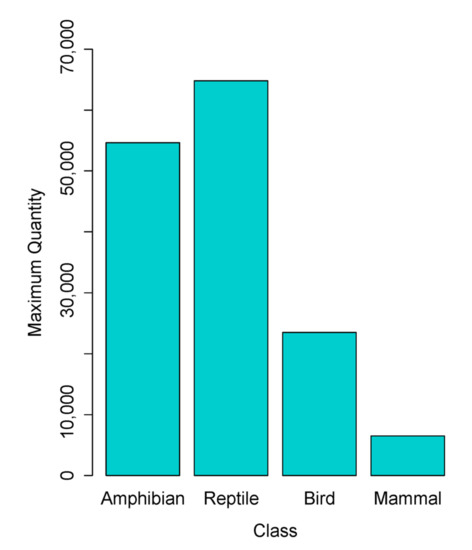
Figure 1.
Total (maximum) number of amphibians, reptiles, birds, and mammals permitted for sale across UK (England, Scotland, and Wales only) pet shop licences in 2019.
3.3. Specific Taxa Listed
In total, there were 2753 descriptive terms relating to amphibians, reptiles, birds, and mammals listed as permitted for sale across the 1192 licences. This information included 358 descriptive terms relating to amphibians, 1098 reptiles, 840 birds, and 552 mammals. Where the descriptive terms for amphibians, reptiles, birds, and mammals listed on the licences related to a specific species, genus, or family level, licences (n = 622) detailed at least 19 different terms relating to amphibians, 50 different terms relating to reptiles, 24 different terms relating to birds, and 36 different terms relating to mammals (Figure 2; Appendix B).
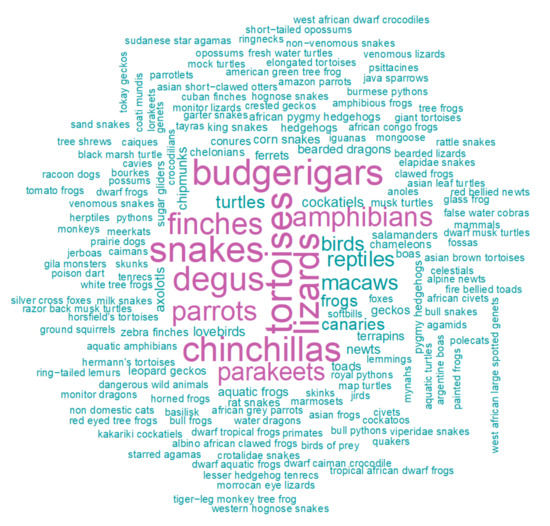
Figure 2.
Word frequency cloud showing the wild animal listings across all pet shop licences. The size of the word indicates the frequency of listing. Listings above a frequency of 180 are coloured in pink.
Across all licences, the most frequently used descriptive terms for amphibians were those relating to frogs (Anura) (92 listings; max. number of individuals potentially for sale (max. number hereafter) = 7180) and axolotls (Ambystoma mexicanum) (30 listings; max. number = 562). The most frequently used descriptive terms for reptiles were those relating to tortoises (Testudinidae) and turtles (Testudines) (377 listings; max. number = 10,844) (including e.g., Hermann’s tortoise (Testudo hermanni), Horsfield’s tortoise (Testudo horsfieldii), musk turtles (Sternotherus sp.), and map turtles (Graptemys sp.)) and snakes and lizards (Squamata) (631 listings; max. number > 60,098) (including e.g., boas (Boidae), pythons (Pythonidae), monitor lizards (Varanus sp.)). The most frequently used descriptive terms for birds were those relating to budgerigars (Psittaculidae) (316 listings; max. number = 14,084), finches (Fringillidae) (245 listings; max. number = 12,982), parrots (Psittacidae) (194 listings; max. number > 2986) (including, e.g., macaws (Ara sp.) and African grey parrots (Psittacus erithacus)), and parakeets (Psittacinae) (180 listings; max. number > 2955). The most frequently used descriptive terms for mammals were those relating to chinchillas (Chinchilla sp.) (301 listings; max. number = 3052) and degus (Octodon degus) (283 listings; max. number = 3056). Other descriptive terms for mammals related to hedgehogs/African pygmy hedgehogs (Atelerix sp.) (28 listings; max. number > 357), sugar gliders (Petaurus breviceps) (10 listings; max. number = 89), opossums/short-tailed opossums (Monodelphis sp.) (two listings; max. number = 65), skunks (Mephitidae) (five listings; max. number of individuals = 48), genets/West African large spotted genets (Genetta pardina) (2 listings; max. number > 2), and primates (including, e.g., marmosets (Callitrichidae) and ring-tailed lemurs (Lemur catta)), among others (see Appendix C).
Descriptive terms relating to specific species listed on the Dangerous Wild Animal Act (1976) schedule included tayras (Eira barbara), African civets (Civettictis civetta), Asian short-clawed otters (Aonyx cinerea), fossas (Cryptoprocta ferox), caimans (Alligatoridae), dwarf caimans (Paleosuchus palpebrosus)/crocodilians/West African dwarf crocodiles (Osteolaemus tetraspis), venomous snakes (including Viperidae and Elapidae), venomous lizards (including the Gila monster (Heloderma suspectum)) and ring-tailed lemurs (Lemur catta) (see Appendix D). Descriptive terms relating to specific species that are listed on the Great Britain Non-native Species Alert List [53] included racoon dogs (Nyctereutes procyonoides), American bullfrogs (Lithobates catesbeianus), Siberian chipmunks (Tamias sibiricus), and monk parakeets (Myiopsitta monachus) (see Appendix E). For a list of descriptive terms relating to specific species listed on CITES Appendices, see Appendix F.
3.4. Licences by Region
The 1192 licences related to pet traders located in 283 different local authority areas in the UK (Scotland, Wales and England only), meaning that 74.9% of local authorities responded to the FOI requests, of which 83.7% (n = 237) were located in England, 9.9% (n = 28) in Scotland, and 4.8% (n = 18) in Wales. The number of licences obtained were unevenly spread across UK regions (χ2 = 71.09, df = 10, p < 0.0001). The highest proportion of licences (13.3%; n = 158) were for pet shops located in the South East region of the UK (Appendix G). Within the regions of the UK, the local authorities of Durham (n = 26), Birmingham (n = 23) Cornwall (n = 18), Leeds (n = 17) and Bradford (n = 14) had issued the highest number of pet shop licences.
3.5. Geographical Trade Hotspots
The potential maximum number of amphibians, reptiles, birds, and mammals permitted for sale was not evenly distributed across different local authorities (χ2 = 140,485, df = 627, p < 0.0001). Overall, the local authorities with the highest number of animals permitted for sale (where amphibians, reptiles, birds, or mammals were listed) included Telford & Wrekin (n = 10,330; 6.9% of total amphibians, reptiles, birds, and mammals listed across licences), Bassetlaw (n = 10,271; 6.9% of total), South Oxfordshire (n = 10,213; 6.9% of total), and Enfield (n = 7311; 4.9% of total) (Figure 3).
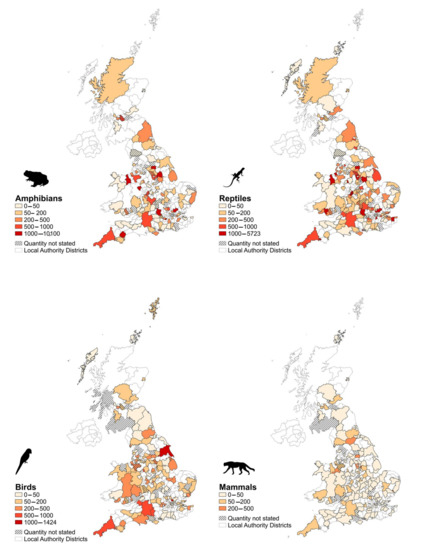
Figure 3.
Potential maximum number of amphibians, reptiles, birds and mammals permitted for sale by UK Local Authority area, excluding Northern Ireland.
In terms of taxonomic class, the potential maximum number of amphibians permitted for sale was highest in the local authorities of Telford & Wrekin (n = 10,100; 18.5% of total) and Bassetlaw (n = 10,100; 18.5% of total), followed by South Oxfordshire (n = 5025), and Epping Forest (n = 3008) (Figure 3). The maximum number of reptiles permitted for sale was highest in the local authority Enfield (n = 5723; 8.8% of total), followed by Epping Forest (n = 3920), North East Derbyshire (n = 2570), and Birmingham (n = 2543) (Figure 3). The maximum number of birds permitted for sale was highest in the local authority East Riding of Yorkshire (n = 1424; 6.1% of total), followed by Enfield (n = 1082), Cornwall (n = 923), and Wiltshire (n = 720) (Figure 3). The maximum number of mammals permitted for sale was highest in the local authority Richmondshire (n = 374; 5.8% of total), followed by Wrexham (n = 296), Mansfield (n = 285), and Ipswich (n = 272) (Figure 3).
3.6. Star Ratings
Of the licences for pet traders in England provided via the FOI requests (n = 1001), 86% (n = 861) had been given a star rating by their issuing local authority. Of these, approximately two thirds (59.3%; n = 511) of pet traders had been given either a four star or five star rating, indicating ‘Higher Standards’ in animal welfare as laid out in the guidance (relating to licence display; record keeping; use, number and type of animal; staffing; suitable environment; suitable diet; monitoring behaviour of animals; animal handling and interactions; protection from pain, suffering, injury and disease; and emergencies (Appendix A)). Just under a third (n = 255) had been given either a two star or three star rating, indicating ‘Minimum Standards’ in animal welfare (businesses that are meeting the minimum standards laid down in the schedules and guidance). Ninety-five pet traders had been given a one star rating by their issuing local authority, indicating ‘Minor Failings’ in animal welfare (businesses that are failing to meet minimum standards). Sixty local authorities had issued at least one one star rating (Figure 4). Of these, seven local authorities (Wyre, Babergh, Enfield, Greenwich, Herefordshire, Leicester City and Redbridge) had issued three or more one star ratings, with the highest number of one star ratings issued in Leicester City (n = 7).
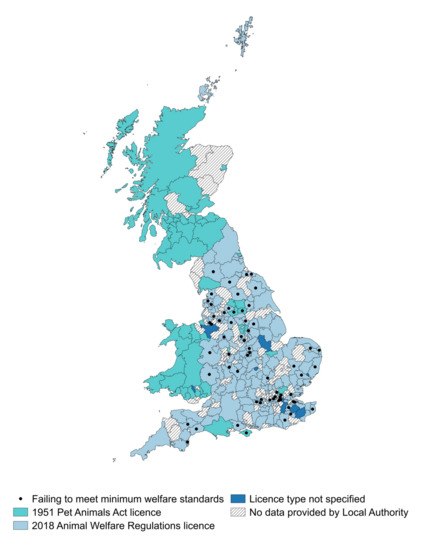
Figure 4.
Map showing (i) the local authority areas (England only) where at least one pet trader had been issued a one star, indicating ‘Minor Failings’ in animal welfare standards (businesses that are failing to meet minimum welfare standards) (black dot), (ii) the local authorities issuing the 1951 Pet Animals Act licence, and those solely issuing the 2018 Animal Welfare Regulations licence, (iii) the local authority areas where pet shop licence information was provided via the FOI requests, but the licence type was not specified, and (iiii) the local authorities that did not respond to the FOI requests. The local authorities of Dorset, South Lakeland, North Tyneside, Wakefield, Wirral, and Kirklees were issuing a mixture of both old (1951) and new (2018) licences.
3.7. Missing Data/Licence Type
A total of 95 (25.1%) local authorities did not respond to the FOI requests. Among them, 89.5% (n = 85) were located in England, 6.3% (n = 6) in Scotland, and 4.2% (n = 4) in Wales. On 17.3% (n = 206) of licences, there was no schedule of animals permitted for sale. For licences with amphibians and reptiles listed, 16.4% (issued by 48 and 39 local authorities, respectively) did not list a maximum number of animals permitted for sale. Where mammals were listed, 52.6% of licences (issued by 32 different local authorities) did not include a maximum number of animals permitted for sale, and for licences listing birds, a third (29.9%) (issued by 39 different local authorities) did not include the maximum number permitted for sale. Of the seven licences listing primates, 14.3% did not list the maximum number permitted for sale, and of those listing DWAs, 16.4% did not state the maximum number.
Of the local authorities that did respond to the FOI requests, 18.4% (n = 52) had solely issued licences under the old 1951 Pet Animals Act, 73.9% (n = 209) had issued licences under the 2018 regulations, and six local authorities (Dorset, South Lakeland, North Tyneside, Wakefield, Wirral, Kirklees) had issued a mixture of both old and new licences. Of the local authorities that had solely issued the 1951 Pet Animals Act licence, approximately half (48.1%; n = 25) were located in Scotland, 32.7% (n = 17) were located in Wales, and 19.2% (n = 11) in England (Bolsover, North East Derbyshire, Epping Forest, Peterborough City, Kensington & Chelsea, Waltham Forest, Isle of Wight, Purbeck District, Cannock Chase, Bradford and Leeds City) (Figure 4). For twelve local authorities, information on the licence type was not provided via the FOI request.
4. Discussion
This study provides important insight into the scope and scale of the licensed exotic pet market in the UK and the current geographical hotspots for this trade. Clearly, the exotic pet trade remains a prevalent business in the UK. In terms of trade volume, records show large numbers of individual wild animals across a wide range of species groups (2753 different descriptive terms) are being legally sold across England, Scotland, and Wales. Maximum numbers of exotic pets permitted for sale included 54,634 amphibians, 64,810 reptiles, 23,507 birds, and 6479 mammals. Moreover, nearly 2000 pet traders in 283 different local authority areas had permission to sell exotic pets between May and September 2019. Regionally, the highest proportion of licences had been issued in the South East of England. On a local scale, the authorities of Durham, Birmingham, Cornwall, Leeds, and Bradford had issued the highest number of licences overall.
The scope and scale of the exotic pet industry draws attention to the substantial animal welfare challenges associated with it [14]. In contrast to domesticated pets, exotic pets are adapted to a specific environment in the wild and, despite their presence in captivity, they retain complex social, physical and behavioural needs inherent in wild animals [28]. Therefore, substantial care and specialised knowledge are often required to maintain even a basic level of welfare in captivity [28]. In recognition of this fact, current guidance states that qualifications relevant to pet vending may not cover the care of non-domesticated species, particularly those that are less commonly traded [42]. Furthermore, it directs traders that are selling non-domesticated mammals to follow the minimum requirements as outlined in zoo standards, or industry or competent non-governmental organisation recommendations, and where these do not exist, standards for similar or related species must be considered and standards extrapolated [42].
4.1. Data Gaps and Compliance Issues
A robust and properly implemented regulatory system is required to help minimise negative impacts of pet trading on wild animal welfare [14]. Yet, our review serves to highlight several shortcomings associated with the licensed exotic pet trade in the UK. We found that the schedule of animals listed on pet shop licences often lacked detailed information about the specific type and number of animals permitted for sale. For example, in some cases, descriptions only stated “large selection of snakes” or “various birds”. In other cases, taxonomic information was missing completely, or taxa was listed without stating a maximum number of animals permitted for sale. The 2018 regulations state that no animal other than the type of animal specified in the licence may be sold. Further, according to the guidance for the conditions for selling animals as pets [42], the licence must state the numbers for each species or species group that may be kept on a premises (taking into account the number of staff to look after them), and that undeclared breach of these numbers can invalidate the licence. Missing information could therefore be grounds for complaint.
Such incomplete information not only raises compliance concerns, it also hinders efforts to carry out adequate inspection and monitoring. Specifically, with regards to the latter, under the 2018 regulations, ahead of granting, renewing or varying a licence, the local authority must appoint one or more suitably qualified inspectors to inspect any premises on which the licensable activity or any part of it is being or is to be carried on. Following that inspection, a licence will be granted, or renewed if the local authority is satisfied that the licence conditions will be met [54]. However, such spot checks can only work within the data provided, and without knowing the specific type and number of animal(s) that are permissible to be held on a given premises, it would be difficult for an inspector to determine whether a trader is compliant, particularly in relation to the general licence condition on the use, number, and type of animals. More generally, lack of species-specific data makes it difficult to identify the legality of species, or the type of training required for inspection, and to make meaningful assessments of the risk to human health and the welfare needs of the animals [33]. Given that the business operation may also include species considered as dangerous wild animals, or invasive or non-native species (listed on the Great Britain Non-native Species alert list [53]), this lack of detail on issued licences may also be hindering efforts to safeguard public safety and to conserve native wild animal species.
Records also show that 95 (9.5%) of the pet traders in England had been given a one star rating by their issuing local authority, indicating ‘Minor Failings’. In practice this means that each of these traders had failed to meet the minimum conditions set out in the 2018 regulations [55]. The procedural guidance confusingly heads the star system table under welfare standards, indicating that a one star means “Minor Failings” in welfare standards. However, the guidance goes on to state that a one star rating is only given if a trader fails to meet the administrative conditions (such as displaying licenses, record keeping), and no licence would be issued (or a licence would be revoked) if a trader fails to meet the conditions more specifically related to animal welfare (such as providing a suitable environment, protecting animals from pain, suffering, injury and disease). Regardless of whether minor failings include welfare standards, administrative failures, such as inadequate formal record keeping, can also pose significant, albeit perhaps less direct, risk for animal welfare, along with biosecurity and public health [15,29,56].
Furthermore, the records indicate that some local authorities in England were still operating under the old Pet Animals Act (1951). The 2018 regulations were introduced to strengthen animal welfare in England [44], and to specifically address concerns around the welfare and public safety risks presented by the sale of animals by applying further animal welfare conditions to pet shop licenses, including detailed guidance on specific taxa. The animal welfare standards under the provisions of the Pet Animals Act (1951) are based on the model conditions created by the Chartered Institute of Environmental Health in 2013, which are industry-supported minimum animal welfare standards [57]. However, unlike the 2018 regulations, where specific conditions are attached to licences, and licences can be revoked or not issued if minimum standards are not met, under the Pet Animals Act (1951), while pet traders are required to provide a suitable environment, and suitable food and drink, there are no detailed conditions or guidance on animal welfare. The fact that so many pet shops were operating under the old licencing system in 2019 raises additional concerns that the welfare of exotic species may be seriously compromised within the UK exotic pet market in these instances.
4.2. Study Limitations
We acknowledge that while this study provides an important summary of the licensed exotic pet trade in the UK, it should not be considered as a complete inventory of the industry for a number of reasons. Firstly, our findings report on the formal licensed part of the exotic pet market (including both online and offline traders) in the UK (excluding Northern Ireland) only (i.e., traders that have been granted formal permission to sell exotic pets by their local authority) and do not include the informal and illegal trade in wild animals as pets (e.g., [19,23,58]). Secondly, our analysis refers only to a limited number of local authorities in the UK because ninety-five did not respond to the FOI request. Furthermore, we capture the scale of trade in exotic pets at a point in time (the year 2019), and therefore the total numbers of individual animals being traded annually could vary substantially in other years. However, despite these limitations, to our knowledge, this study represents one of the most comprehensive summaries of the licensed exotic pet trade in the UK carried out in recent years.
4.3. Recommendations
Our findings can help to inform existing and future efforts to reduce the negative impacts of the exotic pet trade on animal welfare, conservation, and public health. In terms of improved compliance with existing legislation, we recommend that the Department of Environment, Food and Rural Affairs (Defra) (given its role as the central regulator and policy maker) should prioritise and focus its resources towards local authorities in England that are not operating under the 2018 regulations, and those UK local authorities that did not provide any information following a FOI requests on this subject matter (see Appendix H). With regards to local authorities themselves, we also recommend that efforts focused on improved data reporting on all licenses issued (in particular taxonomic clarity (ideally to species level) and maximum number of individuals permissible for sale) should be prioritised to aid inspection, training, and monitoring.
More generally, our findings identify key geographical hotspots where other interested stakeholders (e.g., NGOs focused on rescuing and rehoming abandoned, confiscated or unwanted exotic pets) could look to focus their efforts. For example, the local authorities where the highest number of wild animals legally sold as pets in 2019 were Telford & Wrekin and Bassetlaw in the Midlands, and South Oxfordshire and Enfield in the South East of England. With reference to specific taxa, geographical hotspots for the sale of amphibians were found in Telford & Wrekin and Bassetlaw, along with South Oxfordshire, Epping Forest and Woking; hotspots for the sale of reptiles occurred in Enfield, Epping Forest, Derbyshire, Birmingham and Plymouth, hotspots for the sale of birds occurred in East Riding of Yorkshire, Enfield, Cornwall, and Wiltshire, and hotspots for the sale of mammals occurred in Richmondshire, Wrexham, Mansfield, Ipswich, and Wakefield.
The number of wild animals that can be legally sold as exotic pets in the UK as per the formal market (i.e., vendors who have a successfully acquired a license from their relevant local authority) is far lower than the number of live wild animals imported annually for commercial purposes [29]. For example, when comparing these two estimates, there are obvious discrepancies for each taxa (54,634 vs. 480,000 for amphibians, 64,810 vs. 100,000 for reptiles, 23,507 vs. 20,000 for birds, and 6479 vs. 40,000 for mammals). These discrepancies are even greater when one considers that imports are known to be only a part of overall trade in exotic animals (e.g., many are captive-bred, or ‘under the radar’) [1]. Consequently, we recommend that future research should look to gather more information to determine whether these discrepancies are due to poor record keeping, a high turnover rate of stock for some taxa in licensed UK pet shops (particularly with regards to amphibians and mammals), a large portion of imported wild animals being subsequently re-exported from the UK (and vice versa), or whether imported wild animals enter the UK’s informal exotic pet market, such as through online platforms [8,21,23]. The lack of data on sourcing of wild animals for the exotic pet trade is further highlighted in this regard [1,59].
5. Conclusions
The high volume and diversity of species in the exotic pet trade being sold by vendors throughout the UK introduces significant husbandry issues (for vendors and owners alike) and inspection issues due to a range of factors, including a lack of appropriate specialist veterinary care and the difficulties in identifying species and their legal status [14]. Existing standards, guidance, and protocols for the exotic pet trade in the UK have previously been criticised for being widely variable both locally and internationally across different UK nations, and because of the lack of cohesive evidence-based and expert guidance on animal husbandry and inspection, which has led to alternative scientific evidence-led guidance becoming available [14]. There are many socio-cultural, political, economic, and conservation factors that create a complex and nuanced debate around the exotic pet trade [6,12,26,60], with policy options being discussed in the scientific literature ranging from those that would restrict the exotic pet industry [56] to those that would facilitate its continued growth [61]. However, such future decision-making aside, given the scope and scale of the industry at this point in time, our study highlights compliance issues of concern, and draws attention to the lack of detailed information held on UK pet shop licences, all of which have the potential to hinder efforts to safeguard animal welfare.
Author Contributions
Conceptualization, N.D. and J.G.; methodology, N.D. and J.G.; formal analysis, A.E.; data curation, A.E.; writing—original draft preparation, A.E.; writing—review and editing, A.E., N.D., and J.G.; visualization, A.E.; supervision, N.D. All authors have read and agreed to the published version of the manuscript.
Funding
This research received no external funding.
Acknowledgments
We would like to thank Peter Kemple-Hardy and Oyindamola Fashogbon for their valuable assistance with data acquisition and data processing.
Conflicts of Interest
The authors declare no conflict of interest.
Appendix A

Table A1.
Summary of the Pet Animals Act 1951 (amended 1983) and the Animal Welfare (Licensing of Activities Involving Animals) (England) Regulations 2018.
Table A1.
Summary of the Pet Animals Act 1951 (amended 1983) and the Animal Welfare (Licensing of Activities Involving Animals) (England) Regulations 2018.
| The Pet Animals Act 1951 (amended 1983) |
| This act protects the welfare of animals sold as pets. It requires any person keeping a pet shop to be licensed by the local council. Before granting a licence the council must be satisfied that:
Under Section 2 of this act, pets cannot be sold in the street, including on barrows and markets. |
| The Animal Welfare (Licensing of Activities Involving Animals) (England) Regulations 2018 |
| A local authority is the licensing authority for any licensable activity carried on premises in its area. A local authority may grant or renew a licence for a period of one, two or three years. The local authority must (a) appoint one or more suitably qualified inspectors to inspect any premises on which the licensable activity or any part of it is being or is to be carried on, and (b) following that inspection, grant a licence to the operator, or renew the operator’s licence, in accordance with the application if it is satisfied that it meets criteria. Conditions (general) include:
|
Appendix B
Table A2.
Descriptions of taxa permitted for sale in 2019 as listed across all licences, and number of licenses for each description.
Table A2.
Descriptions of taxa permitted for sale in 2019 as listed across all licences, and number of licenses for each description.
| Taxa (as Described on the Licence) | Number of Licences |
|---|---|
| Tortoises | 282 |
| Snakes & Lizards | 228 |
| Budgerigars/Finches & other small birds | 213 |
| No Schedule of animals permitted to sell | 206 |
| Chinchillas/Degus | 192 |
| Parrots/Parakeets & Macaws | 123 |
| Amphibians | 96 |
| Chinchillas | 79 |
| Reptiles & Amphibians | 78 |
| Degus | 72 |
| Parrots | 71 |
| Budgerigars | 66 |
| Turtles | 58 |
| Lizards | 56 |
| Snakes | 52 |
| Birds | 50 |
| Canaries | 49 |
| Reptiles | 40 |
| Other large birds | 33 |
| Cockatiels | 32 |
| Frogs | 32 |
| Parakeets | 30 |
| Chipmunks | 27 |
| Tortoises | 23 |
| Axolotls | 22 |
| Bearded Dragons | 17 |
| Lovebirds | 17 |
| Terrapins | 16 |
| Corn snakes | 15 |
| Aquatic Frogs | 13 |
| Chameleons | 13 |
| Small birds | 13 |
| Sugar gliders | 12 |
| Degus/Chinchillas | 11 |
| Musk Turtles | 11 |
| Pygmy Hedgehogs | 11 |
| Hedgehogs | 9 |
| Tortoises/Turtles | 9 |
| African Pygmy Hedgehogs | 8 |
| Lizards (various) | 8 |
| Newts | 8 |
| Zebra Finches | 8 |
| Chinchillas | 7 |
| Geckos | 7 |
| Large birds | 7 |
| Snakes (various) | 7 |
| Budgerigars & other small birds | 6 |
| Chelonians | 6 |
| Finches/Canaries | 6 |
| Frogs & Toads | 6 |
| King snakes | 6 |
| Other birds | 6 |
| Rat snakes | 6 |
| Snakes | 6 |
| Toads | 6 |
| Tortoises (various) | 6 |
| Amphibians/Newts & Frogs | 5 |
| Boas | 5 |
| Crocodilians | 5 |
| Geckos | 5 |
| Leopard Geckos | 5 |
| Macaws | 5 |
| Pythons | 5 |
| Skunks | 5 |
| Small Parakeets & Conures | 5 |
| Anoles | 4 |
| Budgerigars/Finches/Canaries | 4 |
| Frogs & Newts | 4 |
| Garter snakes | 4 |
| Iguanas | 4 |
| Marmosets | 4 |
| Meerkats | 4 |
| Salamanders | 4 |
| Skinks | 4 |
| Turtles/Terrapins | 4 |
| African Grey parrots | 3 |
| Amphibians (various) | 3 |
| Bird (Budgerigars, Lovebirds, Finches, Canaries) | 3 |
| Budgerigars/Canaries | 3 |
| Cockatiels/Budgerigars/Finches & other small birds | 3 |
| Crested Geckos | 3 |
| Horsefield Tortoises | 3 |
| Map Turtles | 3 |
| Other small birds | 3 |
| Parrots/Parakeets/Macaws | 3 |
| Parrots/Softbills/Pigeons/Other large birds | 3 |
| Royal Pythons | 3 |
| Shrimp/Snails/Frogs/Terrapins | 3 |
| Small Parakeets | 3 |
| Snakes/Lizards & Amphibians | 3 |
| Water Dragons | 3 |
| African Congo Frogs | 2 |
| Alpacas | 2 |
| Amphibians/Turtles | 2 |
| Aquatic Amphibians | 2 |
| Asian Frogs | 2 |
| Budgerigars/Cockatiels/Lovebirds | 2 |
| Budgerigars/Finches & Canaries | 2 |
| Budgerigars & Finches | 2 |
| Caged birds | 2 |
| Caimans | 2 |
| Chinese Quails | 2 |
| Chipmunks/Dormice/Chinchillas/Degus | 2 |
| Conures | 2 |
| Dwarf Tropical Frogs | 2 |
| Foxes | 2 |
| Frogs/Newts/Toads | 2 |
| Frogs/Toads | 2 |
| Hognose snakes | 2 |
| Milk snakes | 2 |
| Mongoose | 2 |
| Monitors | 2 |
| Mynahs/Small parrot like birds | 2 |
| Newts and Salamanders | 2 |
| Other Non-Domestic mammals | 2 |
| Other Non-Domestic Species | 2 |
| Parrots/Parakeets | 2 |
| Parrots/Parakeets/Macaws & Other large birds | 2 |
| Prairie Dogs | 2 |
| Pygmy Hegdehogs | 2 |
| Rabbits/Guinea Pigs/Chinchillas/Degus | 2 |
| Reptiles (Snakes and Lizards) | 2 |
| Reptiles (Snakes, Geckos, Chameleons, Bearded Dragons, Lizards, Tortoises) | 2 |
| Small birds (Finches/Canaries) | 2 |
| Smaller domesticated mammals (rabbits/guinea pigs/gerbils/hamsters/rats/mice/chinchillas/chipmunks/ferrets) | 2 |
| Tenrecs | 2 |
| Terrapins & Turtles | 2 |
| African Civets | 1 |
| African white-bellied Pygmy Hedgehogs | 1 |
| Agamids | 1 |
| Albino African Clawed Frogs | 1 |
| Alpine Newts | 1 |
| Amazon Parrots | 1 |
| Amphibians | 1 |
| Amphibians (Aquatic Frogs) | 1 |
| Amphibians (Axolotl/Frogs/Toads) | 1 |
| Amphibians (Frogs, Toads) | 1 |
| Amphibians (Turtles) | 1 |
| Amphibians/crabs/snails/molluscs | 1 |
| Amphibians/Crustaceans | 1 |
| Amphibians/Frogs | 1 |
| Amphibians & Invertebrates | 1 |
| Amphibious frogs/Filter shrimp | 1 |
| Aquatic Frogs/Salamanders/Terrapins | 1 |
| Aquatic Frogs/Shrimp/Crabs | 1 |
| Aquatic Frogs/Snails | 1 |
| Aquatic Turtles | 1 |
| Arachnids/Amphibians & Insects | 1 |
| Argentine Boas | 1 |
| Asian Brown Tortoises | 1 |
| Asian Leaf Turtles | 1 |
| Asian short-clawed Otters | 1 |
| Assorted Reptiles | 1 |
| Axolotl & Crustaceans | 1 |
| Axolotls/Dwarf Frogs/Newts | 1 |
| Basilisk | 1 |
| Bearded Dragons/Geckos | 1 |
| Bearded Lizards | 1 |
| Bird (Budgerigars, Lovebirds, Finches, Canaries, Celestials) | 1 |
| Birds (e.g., Budgies, Canaries, Finches etc) | 1 |
| Birds (Parakeets/Cockatiels/Budgerigars/Canaries/Lovebirds/Parrots) | 1 |
| Birds (various) | 1 |
| Birds/Budgerigars/Finches and other small birds | 1 |
| Birds including budgerigars and cockatiels | 1 |
| Birds of Prey | 1 |
| Black Marsh Turtle | 1 |
| Bourkes | 1 |
| Budgerigars | 1 |
| Budgerigars/Finches | 1 |
| Budgerigars/Finches/Canaries & other small birds | 1 |
| Budgerigars/Lovebirds | 1 |
| Budgerigars and Canaries | 1 |
| Bull Pythons | 1 |
| Bull snakes | 1 |
| Canaries/finches & other small birds | 1 |
| Canaries & Finches | 1 |
| Canaries & Finches | 1 |
| Canaries & Finches/Budgerigars/Lovebirds/Cockatiels | 1 |
| Canaries & Zebra Finches | 1 |
| Chinchillas/Ferrets & other exotic animals | 1 |
| Chipmunks/Rabbits & Cavies | 1 |
| Civets | 1 |
| Clawed Toads | 1 |
| Coati Mundis | 1 |
| Cockatiels/Conures/Caiques | 1 |
| Cockatiels/Lovebirds/Budgies/Canaries | 1 |
| Cockatiels/Parakeets | 1 |
| Cockatoos | 1 |
| Corn/Milk snakes | 1 |
| Corn, King, Milk snakes & Royal Pythons | 1 |
| Crabs/Shrimp/Coral/Aquatic Frogs | 1 |
| Cuban Finches | 1 |
| Dangerous Wild Animals | 1 |
| Degus/Chinchillas/Pygmy hedgehogs/Ferrets | 1 |
| Degus/Jirds | 1 |
| DWA | 1 |
| DWA Species - Dwarf Caiman Crocodile | 1 |
| Dwarf Aquatic Frogs | 1 |
| Dwarf Frogs | 1 |
| Dwarf Musk Turtles | 1 |
| Elongated Tortoises | 1 |
| Exotic Mammals | 1 |
| Finches & other small birds | 1 |
| Fossa | 1 |
| Fresh Water Turtles | 1 |
| Frogs | 1 |
| Frogs (Horned & White Tree) | 1 |
| Frogs (various) | 1 |
| Frogs/Axolotls/Newts | 1 |
| Frogs/Newts/crabs/shrimps/Axolotls/Turtles | 1 |
| Frogs/Toads/Axolotls | 1 |
| Frogs, Toads & Salamanders | 1 |
| Frogs: fire bellied toads/painted frog/glass frog/American green tree frog/Whites tree frog/Red eyed tree frog/Tiger monkey legged tree frog/Horned frog/Tomato frog/Poison dart/Bull frog | 1 |
| Geckos (various) | 1 |
| Genets | 1 |
| Giant Tortoises | 1 |
| Gila Monsters | 1 |
| Ground Squirrels & Chinchillas | 1 |
| Hedgehogs | 1 |
| Hedgehogs/Chinchillas/Sugar gliders/non DWA monkeys | 1 |
| Hermann’s Tortoises | 1 |
| Herptiles | 1 |
| Hognose snakes/Milk snakes/False Water Cobras | 1 |
| Invertebrates/Amphibians & exotics | 1 |
| Java Sparrows | 1 |
| Jerboas | 1 |
| Jirds | 1 |
| Kakariki Cockatiels | 1 |
| Large Parakeets & Conures | 1 |
| Leopard & Crested Geckos | 1 |
| Lesser Hedgehog Tenrecs | 1 |
| Lizards over 1 m | 1 |
| Llamas | 1 |
| Lorikeets | 1 |
| Lovebirds/Parakeets/Parrots | 1 |
| Marine invertebrates/Tropical invertebrates/Amphibians | 1 |
| Mock Turtles | 1 |
| Monitor Dragons | 1 |
| Moroccan Eye Lizards | 1 |
| Newts (Tropical) | 1 |
| Newts/Turtles | 1 |
| Non-Domestic Cats | 1 |
| Non-Human Primates | 1 |
| Non-venomous snakes | 1 |
| Opossums | 1 |
| Other medium birds | 1 |
| Other species - Arachnids/Frogs/Insects/snails | 1 |
| Other Species e.g., DWA | 1 |
| Parakeets (various) | 1 |
| Parakeets/Conures | 1 |
| Parakeets & other large birds | 1 |
| Parakeets and Lovebirds | 1 |
| Parrotlets | 1 |
| Parrots (various) | 1 |
| Parrots/Parakeets | 1 |
| Parrots & Macaws | 1 |
| Parrots & Parakeets | 1 |
| Parrots, Parakeets, Macaws & Cockatiels | 1 |
| Pigeons or other large birds | 1 |
| Polecats | 1 |
| Possums | 1 |
| Primates | 1 |
| Primates e.g., Marmosets | 1 |
| Psittacine | 1 |
| Pygmy Hedgehogs/Tortoises/Turtles/Toads & Newts | 1 |
| Quakers | 1 |
| Racoon Dogs | 1 |
| Rats/Mice/Gerbils/Hedgehogs | 1 |
| Rattle snakes | 1 |
| Razor Back Musk Turtles | 1 |
| Red Bellied Newts | 1 |
| Reptiles (Corn Snakes, Geckos, Bearded Dragons, Tortoises) | 1 |
| Reptiles/Invertebrates/Amphibians | 1 |
| Reptiles & Amphibians (various) | 1 |
| Reptiles & Lizards | 1 |
| Reptiles & Snakes | 1 |
| Reptiles & Tortoise | 1 |
| Ring-tailed Lemurs | 1 |
| Ringnecks | 1 |
| Salamanders & Newts | 1 |
| Sand Snakes | 1 |
| Short-tailed Opossums | 1 |
| Shrimp/Snails & Frogs | 1 |
| Shrimps/Crabs/Frogs/Axolotls | 1 |
| Silver cross Foxes | 1 |
| Small birds | 1 |
| Small Conures | 1 |
| Small mammals (Exotic hedgehogs/Tenrecs/Sugar Gliders/Skinny Pigs/Possums) | 1 |
| Small Monitors | 1 |
| Small Parakeets and Macaws | 1 |
| Small Parrots | 1 |
| Small reptiles | 1 |
| Small Rodents (Hamsters, Rats, Mice, Gerbils, Degus) | 1 |
| Small Rodents (Hamsters, Rats, Mice, Gerbils, Pygmy hedgehogs) | 1 |
| Small snakes | 1 |
| Smaller domesticated mammals including Chinchillas, Chipmunks & Ferrets | 1 |
| Snakes/Geckos/Skinks | 1 |
| Snakes/Lizards | 1 |
| Snakes/Lizards/Boas/Burmese/Royal Pythons | 1 |
| Snakes/Lizards/Frogs & Toads | 1 |
| Snakes/Lizards/Tortoises/Frogs & Amphibians | 1 |
| Snakes/Lizards & Frogs | 1 |
| Snakes & Geckos | 1 |
| Snakes & Reptiles | 1 |
| Snakes & Scorpions | 1 |
| Spiders/Scorpions/Amphibians | 1 |
| Spiders/Scorpions/Frogs | 1 |
| Spiders/Scorpions/Mantis/Turtle/Axolotls | 1 |
| Starred Agamas | 1 |
| Sudanese Star Agamas | 1 |
| Sugar gliders and Ferrets | 1 |
| Tayras | 1 |
| Tenrecidae | 1 |
| Tenrecs & Hedgehogs | 1 |
| Tokay Geckos | 1 |
| Tortoises (Hermann’s chipped for CITES) | 1 |
| Tortoises/Frogs/Crustaceans & Aquatic Amphibian reptiles | 1 |
| Tortoises/Snakes/Lizards/Terrapins/Amphibians | 1 |
| Tortoises/Snakes & Lizards | 1 |
| Totally aquatic amphibians | 1 |
| Tree Frogs | 1 |
| Tree Shrews | 1 |
| Tropical African Dwarf and Clawed Frogs | 1 |
| Tropical Amphibians | 1 |
| Tropical Aquatic Frogs | 1 |
| Tropical Freshwater Frogs | 1 |
| Turtles (various) | 1 |
| Turtles/Frogs/Newts/Crayfish & Crabs | 1 |
| Turtles/Frogs/Spiders/Stick insects | 1 |
| Turtles/Invertebrates/Amphibians | 1 |
| Turtles & Amphibians | 1 |
| Venomous Lizards | 1 |
| Venomous snakes | 1 |
| Venomous snakes (of the Elapidae, Viperidae and Crotalidae families) | 1 |
| West African Dwarf Crocodiles | 1 |
| West African large spotted Genets | 1 |
| Western Hognose Snakes | 1 |
| White Tree Frogs | 1 |
| Wild birds | 1 |
| Zebra Finches/Canaries | 1 |
Appendix C
Table A3.
Maximum number of individuals of each taxonomic description permitted for sale in 2019 as listed across all licences.
Table A3.
Maximum number of individuals of each taxonomic description permitted for sale in 2019 as listed across all licences.
| Taxa (as Described on the Licence) | Total Number of Individuals across All Licences |
|---|---|
| Generic number—no taxa | 360,759 |
| Snakes & Lizards | 22,781 |
| Budgerigars/Finches & other small birds | 11,553 |
| Amphibians | 10,783 |
| Reptiles & Amphibians | 10,507 |
| Crabs/Shrimp/Coral/Aquatic Frogs | 10,000 |
| No taxa | 10,000 |
| Shrimp/Snails & Frogs | 10,000 |
| Snakes | 5984 |
| Tortoises | 4607 |
| Lizards | 4241 |
| Reptiles | 4200 |
| Turtles | 3180 |
| Birds | 2427 |
| Parrots/Parakeets & Macaws | 2260 |
| Chinchillas/Degus | 1946 |
| Aquatic Frogs | 1818 |
| Frogs | 1742 |
| Shrimp/Snails/Frogs/Terrapins | 1450 |
| Budgerigars | 1238 |
| Aquatic Frogs/Snails | 1000 |
| Other | 1000 |
| Reptiles (Snakes and Lizards) | 800 |
| Small mammals | 796 |
| Frogs & Toads | 754 |
| Tortoises/Turtles | 742 |
| Frogs & Newts | 740 |
| Canaries | 699 |
| Degus | 681 |
| Terrapins | 612 |
| Parrots | 564 |
| Other large birds | 551 |
| Aquatic Frogs/Shrimp/Crabs | 500 |
| Marine invertebrates/Tropical invertebrates/Amphibians | 500 |
| Shrimps/Crabs/Frogs/Axolotls | 500 |
| Axolotls | 470 |
| Parakeets | 444 |
| Chinchillas | 411 |
| Small birds | 404 |
| Newts | 398 |
| Tortoises | 329 |
| Corn snakes | 312 |
| Amphibians/Newts & Frogs | 310 |
| Amphibians & Invertebrates | 300 |
| Tortoises/Snakes & Lizards | 300 |
| Smaller domesticated mammals (rabbits/guinea pigs/gerbils/hamsters/rats/mice/chinchillas/chipmunks/ferrets) | 296 |
| Budgerigars & other small birds | 276 |
| Pythons | 265 |
| Amphibians/Turtles | 250 |
| Cockatiels | 246 |
| Bearded Dragons | 238 |
| Non-venomous snakes | 230 |
| Dwarf Tropical Frogs | 220 |
| Other birds | 220 |
| Chipmunks | 215 |
| Snakes | 211 |
| Musk Turtles | 201 |
| Frogs/Newts/crabs/shrimps/Axolotls/Turtles | 200 |
| Small birds (Finches/Canaries) | 200 |
| Tropical African Dwarf and Clawed Frogs | 200 |
| Turtles/Invertebrates/Amphibians | 200 |
| Bird (Budgerigars, Lovebirds, Finches, Canaries) | 186 |
| Finches/Canaries | 166 |
| Rat snakes | 165 |
| Cockatiels/Budgerigars/Finches & other small birds | 156 |
| Other small birds | 155 |
| Geckos | 151 |
| Asian Frogs | 150 |
| King snakes | 150 |
| Boas | 141 |
| Budgerigars & Finches | 140 |
| Chelonians | 130 |
| Domestic small rodents (Hamster, Gerbils, Rats, Degus, Chinchillas) | 126 |
| Lovebirds | 118 |
| Amphibians (various) | 100 |
| Axolotl & Crustaceans | 100 |
| Canaries & Finches/Budgerigars/Lovebirds/Cockatiels | 100 |
| Dwarf Aquatic Frogs | 100 |
| Invertebrates/Amphibians & exotics | 100 |
| Large birds | 100 |
| Newts and Salamanders | 100 |
| Snakes/Lizards & Amphibians | 100 |
| Snakes & Reptiles | 100 |
| Snakes & Scorpions | 100 |
| Terrapins & Turtles | 100 |
| Tropical Freshwater Frogs | 100 |
| Turtles & Amphibians | 100 |
| Venomous snakes | 100 |
| Zebra Finches | 92 |
| Small Parakeets | 89 |
| Toads | 84 |
| Assorted Reptiles | 80 |
| Bird (Budgerigars, Lovebirds, Finches, Canaries, Celestials) | 80 |
| Budgerigars/Finches/Canaries | 80 |
| Chameleons | 80 |
| Small Rodents (Hamsters, Rats, Mice, Gerbils, Pygmy hedgehogs) | 80 |
| Turtles/Terrapins | 80 |
| Reptiles (Snakes, Geckos, Chameleons, Bearded Dragons, Lizards, Tortoises) | 78 |
| Sugar gliders | 77 |
| Reptiles/Invertebrates/Amphibians | 75 |
| Amphibians (Aquatic Frogs) | 70 |
| Budgerigars/Finches & Canaries | 66 |
| Short-tailed Opossums | 64 |
| Birds (various) | 60 |
| Budgerigars/Cockatiels/Lovebirds | 60 |
| Degus/Chinchillas | 60 |
| Pygmy Hedgehogs/Tortoises/Turtles/Toads & Newts | 60 |
| Tortoises (various) | 60 |
| Small Parakeets & Conures | 58 |
| Pygmy Hedgehogs | 57 |
| Chinchillas | 56 |
| Zebra Finches/Canaries | 55 |
| Aquatic Turtles | 50 |
| Dwarf Musk Turtles | 50 |
| Frogs (various) | 50 |
| Frogs, Toads & Salamanders | 50 |
| Hognose snakes/Milk snakes/False Water Cobras | 50 |
| Lizards (various) | 50 |
| Mock Turtles | 50 |
| Quakers | 50 |
| Reptiles & Amphibians (various) | 50 |
| Small reptiles | 50 |
| Snakes/Lizards & Frogs | 50 |
| Turtles/Frogs/Newts/Crayfish & Crabs | 50 |
| Meerkats | 49 |
| Skunks | 48 |
| Alpacas | 47 |
| Garter snakes | 46 |
| Anoles | 44 |
| Geckos | 44 |
| Parakeets/Conures | 44 |
| Rabbits/Guinea Pigs/Chinchillas/Degus | 44 |
| Skinks | 44 |
| African Congo Frogs | 40 |
| Agamids | 40 |
| Amphibians (Axolotl/Frogs/Toads) | 40 |
| Degus/Chinchillas/Pygmy hedgehogs/Ferrets | 40 |
| Spiders/Scorpions/Amphibians | 40 |
| Tenrecs | 40 |
| African Pygmy Hedgehogs | 36 |
| Map Turtles | 36 |
| Budgerigars/Canaries | 32 |
| Foxes | 32 |
| Parrotlets | 32 |
| Amphibians/Frogs | 30 |
| Budgerigars and Canaries | 30 |
| Chinese Quails | 30 |
| Frogs/Axolotl/Newts | 30 |
| Iguanas | 30 |
| Other medium birds | 30 |
| Salamanders | 30 |
| Conures | 28 |
| Snakes (various) | 25 |
| Cockatiels/Conures/Caiques | 24 |
| Monitors | 24 |
| Crocodilians | 23 |
| Marmosets | 23 |
| Axolotls/Dwarf Frogs/Newts | 22 |
| Hedgehogs | 22 |
| Parrots/Parakeets/Macaws | 22 |
| Macaws | 21 |
| Amphibians | 20 |
| Arachnids/Amphibians & Insects | 20 |
| Birds (e.g., Budgies, Canaries, Finches etc) | 20 |
| Budgerigars/Finches | 20 |
| Chipmunks/Dormice/Chinchillas/Degus | 20 |
| Dangerous Wild Animals | 20 |
| Degus/Jirds | 20 |
| Frogs | 20 |
| Newts/Turtles | 20 |
| Other species Arachnids/Frogs/Insects/snails | 20 |
| Pygmy Hegdehogs | 20 |
| Rats/Mice/Gerbils/Hedgehogs | 20 |
| Razor Back Musk Turtles | 20 |
| Reptiles (Corn Snakes, Geckos, Bearded Dragons, Tortoises) | 20 |
| Salamanders & Newts | 20 |
| Snakes/Lizards/Frogs & Toads | 20 |
| Spiders/Scorpions/Frogs | 20 |
| Birds including budgerigars and cockatiels | 19 |
| Frogs/Newts/Toads | 19 |
| Leopard Geckos | 19 |
| Parrots/Parakeets | 18 |
| Smaller domesticated mammals including Chinchillas, Chipmunks & Ferrets | 18 |
| Venomous snakes (of the Elapidae, Viperidae and Crotalidae families) | 18 |
| Canaries/finches & other small birds | 15 |
| Canaries & Zebra Finches | 15 |
| Gila Monsters | 15 |
| Milk snakes | 15 |
| Horsefield Tortoises | 14 |
| Parrots/Softbills/Pigeons/Other large birds | 13 |
| Budgerigars/Finches/Canaries & other small birds | 12 |
| Corn, King, Milk snakes & Royal Pythons | 12 |
| Fresh Water Turtles | 12 |
| Leopard & Crested Geckos | 12 |
| Mynahs/Small parrot like birds | 12 |
| Other Species e.g., DWA | 12 |
| Parrots/Parakeets/Macaws & Other large birds | 12 |
| Parrots & Parakeets | 12 |
| Prairie Dogs | 12 |
| Psittacines | 12 |
| Red Bellied Newts | 12 |
| Reptiles & Tortoise | 12 |
| Venomous Lizards | 12 |
| Hognose snakes | 11 |
| Alpine Newts | 10 |
| Amphibians/Crustaceans | 10 |
| Budgerigars | 10 |
| Bull snakes | 10 |
| Chinchillas/Ferrets & other exotic animals | 10 |
| Clawed Toads | 10 |
| Dwarf Frogs | 10 |
| Herptiles | 10 |
| Llamas | 10 |
| Newts (Tropical) | 10 |
| Parakeets and Lovebirds | 10 |
| Parrots/Parakeets | 10 |
| Small mammals (Exotic hedgehogs/Tenrecs/Sugar Gliders/Skinny Pigs/Possums) | 10 |
| Tree Frogs | 10 |
| Turtles/Frogs/Spiders/Stick insects | 10 |
| Water Dragons | 10 |
| Crested Geckos | 9 |
| Frogs/Toads | 9 |
| African Grey parrots | 8 |
| Bourkes | 8 |
| Budgerigars/Lovebirds | 8 |
| Canaries & Finches | 8 |
| Finches & other small birds | 8 |
| Lovebirds/Parakeets/Parrots | 8 |
| Other Non-Domestic Species | 8 |
| Parakeets & other large birds | 8 |
| Tenrces & Hedgehogs | 8 |
| Tropical Amphibians | 8 |
| Amphibians (Frogs, Toads) | 6 |
| Amphibians (Turtles) | 6 |
| Caimans | 6 |
| Chipmunks/Rabbits & Cavies | 6 |
| Fossas | 6 |
| Frogs: fire bellied toads/painted frog/glass frog/American green tree frog/Whites tree frog/Red eyed tree frog/Tiger monkey legged tree frog/Horned frog/Tomato frog/Poison dart/Bull frog | 6 |
| Ground Squirrels & Chinchillas | 6 |
| Large Parakeets & Conures | 6 |
| Mongoose | 6 |
| Non-Human Primates | 6 |
| Pigeons or other large birds | 6 |
| Small Monitors | 6 |
| Small Parrots | 6 |
| Small snakes | 6 |
| Tortoises/Frogs/Crustaceans & Aquatic Amphibian reptiles | 6 |
| Bearded Dragons/Geckos | 5 |
| Cockatiels/Parakeets | 5 |
| Exotic Mammals | 5 |
| Parrots, Parakeets, Macaws & Cockatiels | 5 |
| Royal Pythons | 5 |
| African Civets | 4 |
| Birds of Prey | 4 |
| Bull Pythons | 4 |
| Canaries & Finches | 4 |
| Hedgehogs | 4 |
| Hermann’s Tortoises | 4 |
| Java Sparrows | 4 |
| Jerboas | 4 |
| Lizards over 1 m | 4 |
| Non Domestic Cats | 4 |
| Parrots & Macaws | 4 |
| Primates | 4 |
| Ring-tailed Lemurs | 4 |
| Small birds | 4 |
| White Tree Frogs | 4 |
| Bearded Lizards | 3 |
| DWA Species - Dwarf Caiman Crocodile | 3 |
| Racoon Dogs | 3 |
| Amazon Parrots | 2 |
| Civets | 2 |
| Cockatoos | 2 |
| Genets | 2 |
| Possums | 2 |
| Primates e.g., Marmosets | 2 |
| Silver cross Foxes | 2 |
| Small Conures | 2 |
| Sugar gliders and Ferrets | 2 |
| Tayras | 2 |
| Tenrecidae | 2 |
| Tree Shrews | 2 |
| Asian short-clawed Otters | 1 |
| Basilisk | 1 |
| Coati Mundis | 1 |
| Corn/Milk snakes | 1 |
| Giant Tortoises | 1 |
| Kakariki Cockatiels | 1 |
| Monitor Dragons | 1 |
| Morrocan Eye Lizards | 1 |
| Opossums | 1 |
| Rattle snakes | 1 |
| Ringnecks | 1 |
| Sand Snakes | 1 |
| Small Parakeets and Macaws | 1 |
| Starred Agamas | 1 |
| Tokay Geckos | 1 |
| Totally aquatic amphibians | 1 |
| West African Dwarf Crocodiles | 1 |
| African white-bellied Pygmy Hedgehogs | Not stated |
| Albino African Clawed Frogs | Not stated |
| Amphibians/crabs/snails/molluscs | Not stated |
| Amphibious frogs/Filter shrimp | Not stated |
| Aquatic Amphibians | Not stated |
| Aquatic Frogs/Salamanders/Terrapins | Not stated |
| Argentine Boas | Not stated |
| Asian Brown Tortoises | Not stated |
| Asian Leaf Turtles | Not stated |
| Birds (Parakeets/Cockatiels/Budgerigars/Canaries/Lovebirds/Parrots) | Not stated |
| Birds/Budgerigars/Finches and other small birds | Not stated |
| Black Marsh Turtle | Not stated |
| Caged birds | Not stated |
| Cockatiels/Lovebirds/Budgies/Canaries | Not stated |
| Cuban Finches | Not stated |
| DWA | Not stated |
| Elongated Tortoises | Not stated |
| Frogs (Horned & White Tree) | Not stated |
| Frogs/Toads/Axolotls | Not stated |
| Geckos (various) | Not stated |
| Hedgehogs/Chinchillas/Sugar gliders/non DWA monkeys | Not stated |
| Jirds | Not stated |
| Lesser Hedgehog Tenrecs | Not stated |
| Lorakeets | Not stated |
| No Schedule of animals permitted to sell | Not stated |
| Other Non-Domestic mammals | Not stated |
| Parakeets (various) | Not stated |
| Parrots (various) | Not stated |
| Polecats | Not stated |
| Reptiles & Lizards | Not stated |
| Reptiles & Snakes | Not stated |
| Snakes/Geckos/Skinks | Not stated |
| Snakes/Lizards | Not stated |
| Snakes/Lizards/Boas/Burmese/Royal Pythons | Not stated |
| Snakes/Lizards/Tortoises/Frogs & Amphibians | Not stated |
| Snakes & Geckos | Not stated |
| Spiders/Scorpions/Mantis/Turtle/Axolotls | Not stated |
| Sudanese Star Agamas | Not stated |
| Tortoises (Hermann’s chipped for CITES) | Not stated |
| Tortoises/Snakes/Lizards/Terrapins/Amphibians | Not stated |
| Tropical Aquatic Frogs | Not stated |
| Turtles (various) | Not stated |
| West African large spotted Genets | Not stated |
| Western Hognose Snakes | Not stated |
| Wild birds | Not stated |
Appendix D
Table A4.
Taxa listed on licences relevant to the Dangerous Wild Animals Act (1976). Frequency refers to the frequency of listings of descriptive terms relating to the specific species.
Table A4.
Taxa listed on licences relevant to the Dangerous Wild Animals Act (1976). Frequency refers to the frequency of listings of descriptive terms relating to the specific species.
| Taxa | Frequency |
|---|---|
| African civet (Civettictis civetta) | 1 |
| Asian short-clawed otter (Aonyx cinerea) | 1 |
| Caimans (Caiman sp.) | 2 |
| Civet (Civettictis sp.) | 1 |
| Crocodilian (Crocodylidae sp. (all species)) | 5 |
| Dwarf caiman crocodile (Alligatoridae sp. (all species) | 1 |
| Elapidae snake (Elapidae sp. (all species) | 1 |
| False water cobra (Cyclagras gigas) | 1 |
| Fossa (Cryptoprocta ferox) | 1 |
| Gila monster (Heloderma suspectum) | 1 |
| Monkey (Cercopithecidae sp. (all species); Cebidae sp. (all species except those of the genera Aotus, Callicebus and Saimiri.) * | 1 |
| Non-domestic cat (Felidae sp.) * | 1 |
| Primate* | 2 |
| Rattlesnake (Crotalus sp. (all species)) | 1 |
| Tayra (Eira barbara) | 1 |
| Venomous lizard | 1 |
| Venomous snake | 2 |
| Viper snake (Viperidae sp. (all species)) | 1 |
| West African dwarf crocodile (Osteolaemus tetraspis) | 1 |
* Not all species are listed on the schedule of dangerous species.
Appendix E
Table A5.
Species on the GB Non-native secretariat 2020 Species alert list: http://www.nonnativespecies.org/alerts/index.cfm. Frequency refers to the frequency of listings of descriptive terms relating to the specific species.
Table A5.
Species on the GB Non-native secretariat 2020 Species alert list: http://www.nonnativespecies.org/alerts/index.cfm. Frequency refers to the frequency of listings of descriptive terms relating to the specific species.
| Taxa | Details | Frequency |
|---|---|---|
| American Bullfrog (Lithobates catesbeianus) | Status: Invasive (on species alert list). The American bullfrog is limited to a few populations in GB and has been the subject of targeted eradication. After considering the threat that American Bullfrog poses to biodiversity interests, the Government has decided that management of this species should be carried out. First recorded 1996. | 1 |
| Siberian Chipmunk (Tamias sibiricus/Eutamias sibiricus) | Status: Invasive (on species alert list). Chipmunks, probably mostly this species (the Siberian chipmunk), are occasionally reported GB as single or multiple escapes from captivity. First recorded 2004. | 32 |
| Monk Parakeet (Myiopsitta monachus) | Status: Invasive (on species alert list). This popular cagebird has formed a few small wild-living colonies in England, but is not presently considered self-sustaining in GB. It is currently the subject of active control measures. After considering all the known facts on the threat that monk parakeets pose to economic interests and taking a precautionary approach to any potential threat to biodiversity, the Government has decided that management of this species should be carried out. | 180 |
| Raccoon dog (Nyctereutes procyonoides) | Status: Non-native (on species alert list). | 1 |
Appendix F
Table A6.
Descriptive terms listed on licences relating to specific species listed on CITES Appendices [62].
Table A6.
Descriptive terms listed on licences relating to specific species listed on CITES Appendices [62].
| Taxa | Scientific Name | CITES Appendix |
|---|---|---|
| African civet | Civettictis civetta | III |
| African grey parrot | Psittacus erithacus | I |
| Argentine boa | Boa constrictor occidentalis | I |
| Asian leaf turtle | Cyclemys dentata/Cyclemys enigmatica | II |
| Asian small-clawed otter | Aonyx cinerea | I |
| Axolotl | Ambystoma mexicanum | II |
| Basilisk chameleon | Chamaeleo africanus | II |
| Black marsh turtle | Siebenrockiella crassicollis | II |
| Boa | Boidae spp. (except for Appendix I Boa constrictor occidentalis) | II |
| Caiman | Crocodylia spp. | I, II |
| Elongated tortoise | Indotestudo elongata | II |
| False water cobra | Cyclagras gigas | II |
| Fossa | Cryptoprocta ferox | II |
| Gila monster | Heloderma suspectum | II |
| Hermann’s tortoise | Testudo hermanni | II |
| Horsfield’s tortoise | Testudo horsfieldii | II |
| Java sparrow | Lonchura oryzivora | II |
| Lovebird * | Agapornis sp. | II |
| Macaw * | Ara sp. | I,II |
| Marmoset * | Callithrix sp. | I,II |
| Mongoose * | Herpestes sp. | III |
| Parrotlet * | Forpus sp., Touit sp. | II |
| Parrot * | Psittacidae | I,II |
| Python * | Pythonidae spp. (except for Appendix I Python molurus molurus) | II |
| Ring-tailed lemur | Lemur catta | I |
| Ringneck | Barnardius zonarius | II |
| Royal python | Python regius | II |
| Salamander * | Salamandridae | I,II,III |
| Skink * | Scincidae | II |
| Tayra | Eira barbara | III |
| Tokay gecko | Gekko gecko | II |
| Tomato frog | Dyscophus antongilii | II |
| West African dwarf crocodile | Osteolaemus tetraspis | I |
* not all species are listed on the Appendices.
Appendix G
Table A7.
Number of pet shop licences by UK region.
Table A7.
Number of pet shop licences by UK region.
| Region | Number of Licences |
|---|---|
| South East | 158 |
| North West | 128 |
| Yorkshire and the Humber | 126 |
| Eastern | 119 |
| East midlands | 118 |
| Scotland | 112 |
| South West | 111 |
| West midlands | 107 |
| Wales | 79 |
| London | 71 |
| North East | 63 |
Appendix H
Table A8.
List of local authorities that did not respond to the FOI request.
Table A8.
List of local authorities that did not respond to the FOI request.
| Local Authority |
|---|
| Aberdeenshire |
| Allerdale |
| Angus |
| Arun |
| Barnet |
| Bath and North East Somerset |
| Blackpool |
| Blaenau Gwent |
| Bolton |
| Bournemouth, Christchurch and Poole |
| Breckland |
| Brentwood |
| Bristol, City of |
| Bromley |
| Broxbourne |
| Broxtowe |
| Burnley |
| Bury |
| Cambridge |
| Cardiff |
| Chelmsford |
| Cheltenham |
| Cheshire East |
| Chiltern |
| City of London |
| Copeland |
| Corby |
| Craven |
| Crawley |
| Derbyshire Dales |
| Doncaster |
| Dudley |
| Ealing |
| East Cambridgeshire |
| Eastbourne |
| Eastleigh |
| Epsom and Ewell |
| Exeter |
| Falkirk |
| Flintshire |
| Gosport |
| Gravesham |
| Hackney |
| Hambleton |
| Haringey |
| Harrow |
| Hart |
| Hartlepool |
| Havering |
| Hertsmere |
| Hillingdon |
| Isles of Scilly |
| Islington |
| Lambeth |
| Lichfield |
| Liverpool |
| Luton |
| Moray |
| North Hertfordshire |
| North Lincolnshire |
| Norwich |
| Oxford |
| Pendle |
| Reigate and Banstead |
| Rossendale |
| Rother |
| Runnymede |
| Rushmoor |
| Rutland |
| Sandwell |
| Sedgemoor |
| Solihull |
| South Bucks |
| South Cambridgeshire |
| South Derbyshire |
| South Holland |
| South Staffordshire |
| Southwark |
| Stevenage |
| Stirling |
| Sutton |
| Swindon |
| Tandridge |
| Tewkesbury |
| Torridge |
| Vale of Glamorgan |
| Warrington |
| Wellingborough |
| West Devon |
| West Lancashire |
| Westminster |
| Winchester |
| Wolverhampton |
| Wycombe |
| Wyre Forest |
References
- Bush, E.R.; Baker, S.E.; Macdonald, D.W. Global Trade in Exotic Pets 2006–2012: Exotic Pet Trade. Conserv. Biol. 2014, 28, 663–676. [Google Scholar] [CrossRef] [PubMed]
- McMillan, S.E.; Dingle, C.; Allcock, J.A.; Bonebrake, T.C. Exotic animal cafes are increasingly home to threatened biodiversity. Conserv. Lett. 2020. [Google Scholar] [CrossRef]
- Patoka, J.; Kalous, L.; Kopecký, O. Imports of ornamental crayfish: The first decade from the Czech Republic’s perspective. Knowl. Managt. Aquat. Ecosyst. 2015, 4. [Google Scholar] [CrossRef]
- Spee, L.B.; Hazel, S.J.; Dal Grande, E.; Boardman, W.S.J.; Chaber, A.-L. Endangered Exotic Pets on Social Media in the Middle East: Presence and Impact. Animals 2019, 9, 480. [Google Scholar] [CrossRef]
- Novák, J.; Kalous, L.; Patoka, J. Modern ornamental aquaculture in Europe: Early history of freshwater fish imports. Rev. Aquacult. 2020, 12, 2042–2060. [Google Scholar] [CrossRef]
- Robinson, J.E.; Griffiths, R.A.; Fraser, I.M.; Raharimalala, J.; Roberts, D.L.; St. John, F.A.V. Supplying the wildlife trade as a livelihood strategy in a biodiversity hotspot. E&S 2018, 23, art13. [Google Scholar] [CrossRef]
- PFMA UK pet population statistics: Pet Population 2020. Pet Food Manufacturers’ Association. Available online: https://www.pfma.org.uk/pet-population-2020 (accessed on 6 October 2020).
- Tedds, H.L.; Sneddon, S.; Clubb, R.; Ollerton, J.; McCormick, W.D. Herps across England: Investigating the Scale of the Reptile and Amphibian Trade. Available online: Tedds_etal_2020_Herps_across_England_investigating_the_scale_of_reptile_and_amphibian_trade (accessed on 5 October 2020).
- Whitehead, M.; Forbes, N. Keeping exotic pets. Vet. Rec. 2013, 173, 558. [Google Scholar] [CrossRef]
- Biondo, M.V.; Burki, R.P. A Systematic Review of the Ornamental Fish Trade with Emphasis on Coral Reef Fishes—An Impossible Task. Animals 2020, 10, 2014. [Google Scholar] [CrossRef]
- Blue Cross; Born Free Foundation 2015. One Click Away: An Investigation into the Online sale of Exotic Animals as Pets. Available online: https://www.bornfree.org.uk/storage/media/content/files/Publications/ONE_CLICK_AWAY_REPORT_SPREADS.pdf (accessed on 20 October 2020).
- Green, J.; Coulthard, E.; Megson, D.; Norrey, J.; Norrey, L.; Rowntree, J.K.; Bates, J.; Dharmpaul, B.; Auliya, M.; D’Cruze, N. Blind Trading: A Literature Review of Research Addressing the Welfare of Ball Pythons in the Exotic Pet Trade. Animals 2020, 10, 193. [Google Scholar] [CrossRef]
- Scheffers, B.R.; Oliveira, B.F.; Lamb, I.; Edwards, D.P. Global wildlife trade across the tree of life. Science 2019, 366, 71–76. [Google Scholar] [CrossRef]
- Warwick, C.; Jessop, M.; Arena, P.; Pilny, A.; Steedman, C. Guidelines for Inspection of Companion and Commercial Animal Establishments. Front. Vet. Sci. 2018, 5, 151. [Google Scholar] [CrossRef] [PubMed]
- Warwick, C.; Steedman, C.; Jessop, M.; Arena, P.; Pilny, A.; Nicholas, E. Exotic pet suitability: Understanding some problems and using a labeling system to aid animal welfare, environment, and consumer protection. J. Vet. Behav. 2018, 26, 17–26. [Google Scholar] [CrossRef]
- Lockwood, J.L.; Welbourne, D.J.; Romagosa, C.M.; Cassey, P.; Mandrak, N.E.; Strecker, A.; Leung, B.; Stringham, O.C.; Udell, B.; Episcopio-Sturgeon, D.J.; et al. When pets become pests: The role of the exotic pet trade in producing invasive vertebrate animals. Front. Ecol. Environ. 2019, fee.2059. [Google Scholar] [CrossRef]
- Rose, M.P.; Williams, D.L. Neurological dysfunction in a ball python (Python regius) colour morph and implications for welfare. J. Exot. Pet. Med. 2014, 23, 234–239. [Google Scholar] [CrossRef]
- Norconk, M.A.; Atsalis, S.; Tully, G.; Santillán, A.M.; Waters, S.; Knott, C.D.; Ross, S.R.; Shanee, S.; Stiles, D. Reducing the primate pet trade: Actions for primatologists. Am. J. Primatol. 2020, 82. [Google Scholar] [CrossRef]
- Ribeiro, J.; Reino, L.; Schindler, S.; Strubbe, D.; Vall-llosera, M.; Araújo, M.B.; Capinha, C.; Carrete, M.; Mazzoni, S.; Monteiro, M.; et al. Trends in legal and illegal trade of wild birds: A global assessment based on expert knowledge. Biodivers. Conserv. 2019, 28, 3343–3369. [Google Scholar] [CrossRef]
- Fernandes-Ferreira, H.; Mendonça, S.V.; Albano, C.; Ferreira, F.S.; Alves, R.R.N. Hunting, use and conservation of birds in Northeast Brazil. Biodivers. Conserv. 2012, 21, 221–244. [Google Scholar] [CrossRef]
- Lavorgna, A. The Social Organization of Pet Trafficking in Cyberspace. Eur. J. Crim. Policy Res. 2015, 21, 353–370. [Google Scholar] [CrossRef]
- Martin, R.O.; Senni, C.; D’Cruze, N.C. Trade in wild-sourced African grey parrots: Insights via social media. Glob. Ecol. Conserv. 2018, 15, e00429. [Google Scholar] [CrossRef]
- Siriwat, P.; Nijman, V. Illegal pet trade on social media as an emerging impediment to the conservation of Asian otters species. J. Asia-Pac. Biodivers. 2018, 11, 469–475. [Google Scholar] [CrossRef]
- Megias, D.A.; Anderson, S.C.; Smith, R.J.; Veríssimo, D. Investigating the impact of media on demand for wildlife: A case study of Harry Potter and the UK trade in owls. PLoS ONE 2017, 12, e0182368. [Google Scholar] [CrossRef]
- Driscoll, C.A.; Macdonald, D.W. Top dogs: Wolf domestication and wealth. J. Biol. 2010, 9, 10. [Google Scholar] [CrossRef] [PubMed]
- Robinson, J.E.; Griffiths, R.A.; St. John, F.A.V.; Roberts, D.L. Dynamics of the global trade in live reptiles: Shifting trends in production and consequences for sustainability. Biol. Conserv. 2015, 184, 42–50. [Google Scholar] [CrossRef]
- Baker, S.E.; Cain, R.; Van Kesteren, F.; Zommers, Z.A.; D’Cruze, N.; Macdonald, D.W. Rough Trade: Animal Welfare in the Global Wildlife Trade. BioScience 2013, 63, 928–938. [Google Scholar] [CrossRef]
- Grant, R.; Montrose, V.; Wills, A. ExNOTic: Should We Be Keeping Exotic Pets? Animals 2017, 7, 47. [Google Scholar] [CrossRef]
- Green, J.; Coulthard, E.; Norrey, J.; Megson, D.; D’Cruze, N. Risky Business: Live Non-CITES Wildlife UK Imports and the Potential for Infectious Diseases. Animals 2020, 10, 1632. [Google Scholar] [CrossRef]
- Loeb, J. Covid-19 wake-up call for exotic pet trade. Vet. Rec. 2020, 186, 432. [Google Scholar] [CrossRef]
- Smith, K.M.; Zambrana-Torrelio, C.; White, A.; Asmussen, M.; Machalaba, C.; Kennedy, S.; Lopez, K.; Wolf, T.M.; Daszak, P.; Travis, D.A.; et al. Summarizing US Wildlife Trade with an Eye Toward Assessing the Risk of Infectious Disease Introduction. EcoHealth 2017, 14, 29–39. [Google Scholar] [CrossRef]
- Ashley, S.; Brown, S.; Ledford, J.; Martin, J.; Nash, A.-E.; Terry, A.; Tristan, T.; Warwick, C. Morbidity and Mortality of Invertebrates, Amphibians, Reptiles, and Mammals at a Major Exotic Companion Animal Wholesaler. J. Appl. Anim. Welf. Sci. 2014, 17, 308–321. [Google Scholar] [CrossRef]
- Warwick, C.; Steedman, C.; Toland, E. Welfare of exotic pets. Vet. Rec. 2016, 178, 640. [Google Scholar] [CrossRef]
- Friedman, C.R.; Torigian, C.; Shillam, P.J.; Hoffman, R.E.; Heltze, D.; Beebe, J.L.; Malcolm, G.; DeWitt, W.E.; Hutwagner, L.; Griffin, P.M. An outbreak of salmonellosis among children attending a reptile exhibit at a zoo. J. Pediatrics 1998, 132, 802–807. [Google Scholar] [CrossRef]
- Kopecký, O.; Patoka, J.; Kalous, L. Establishment risk and potential invasiveness of the selected exotic amphibians from pet trade in the European Union. J. Nat. Conserv. 2016, 31, 22–28. [Google Scholar] [CrossRef]
- Kopecký, O.; Kalous, L.; Patoka, J. Establishment risk from pet-trade freshwater turtles in the European Union. Knowl. Managt. Aquat. Ecosyst. 2013, 02. [Google Scholar] [CrossRef]
- Annorbah, N.N.D.; Collar, N.J.; Marsden, S.J. Trade and habitat change virtually eliminate the Grey Parrot Psittacus erithacus from Ghana. Ibis 2016, 158, 82–91. [Google Scholar] [CrossRef]
- Patoka, J.; Bláha, M.; Kouba, A. Cherax (Astaconephrops) gherardii, a new crayfish (Decapoda: Parastacidae) from West Papua, Indonesia. Zootaxa 2015, 3964, 526. [Google Scholar] [CrossRef]
- Dangerous Wild Animals Act 1976. Available online: https://www.legislation.gov.uk/ukpga/1976/38/schedule (accessed on 28 October 2020).
- Stoakes, L. Making sense of the legislation relating to buying and selling exotic animals. Vet. Nurs. J. 2014, 29, 335–338. [Google Scholar] [CrossRef]
- Animal Welfare Act 2006. Available online: https://www.legislation.gov.uk/ukpga/2006/45/contents (accessed on 10 October 2020).
- Department for Environment, Food & Rural Affairs The Animal Welfare (Licensing of Activities Involving Animals) (England) Regulations 2018: Guidance Notes for Conditions for Selling Animals as Pets. Available online: https://assets.publishing.service.gov.uk/government/uploads/system/uploads/attachment_data/file/880219/selling-animals-as-pets.pdf (accessed on 1 October 2020).
- Pet Animals Act 1951. Available online: https://www.legislation.gov.uk/ukpga/Geo6/14-15/35/contents. (accessed on 1 October 2020).
- Department for Environment, Food & Rural Affairs. 2018. Animal welfare boosted by new law coming into force. Available online: https://www.gov.uk/government/news/animal-welfare-boosted-by-new-law-coming-into-force (accessed on 1 September 2020).
- Patoka, J.; Magalhães, A.L.B.; Kouba, A.; Faulkes, Z.; Jerikho, R.; Vitule, J.R.S. Invasive aquatic pets: Failed policies increase risks of harmful invasions. Biodivers. Conserv. 2018, 27, 3037–3046. [Google Scholar] [CrossRef]
- Maceda-Veiga, A.; Escribano-Alacid, J.; Martínez-Silvestre, A.; Verdaguer, I.; Mac Nally, R. What’s next? The release of exotic pets continues virtually unabated 7 years after enforcement of new legislation for managing invasive species. Biol. Invasions 2019, 21, 2933–2947. [Google Scholar] [CrossRef]
- Patoka, J.; Bláha, M.; Kalous, L.; Kouba, A. Irresponsible vendors: Non-native, invasive and threatened animals offered for garden pond stocking: Non-native and threatened animals in garden ponds. Aquat. Conserv. Mar. Freshw. Ecosyst. 2017, 27, 692–697. [Google Scholar] [CrossRef]
- TRAFFIC. Captive Bred, or Wild Taken? TRAFFIC International: Cambridge, UK, 2012; Available online: https://www.traffic.org/site/assets/files/7446/captive-bred-or-wild-taken.pdf (accessed on 12 October 2020).
- Koene, P.; de Mol, R.M.; Ipema, B. Behavioral Ecology of Captive Species: Using Bibliographic Information to Assess Pet Suitability of Mammal Species. Front. Vet. Sci. 2016, 3. [Google Scholar] [CrossRef]
- Davenport, C.B. Inheritance in canaries. Carnegie Inst. Wash. 1908, 95. [Google Scholar]
- R Core Team. R: A Language and Environment for Statistical Computing; R Core Team: Vienna, Austria, 2020. [Google Scholar]
- QGIS Development Team. QGIS Geographic Information System. Open Source Geospatial Foundation Project. 2020. Available online: http://qgis.osgeo.org (accessed on 1 October 2020).
- NNSS Great Britain Non-native Secretariat. GB Non-Native Species Secretariat. 2020. Available online: http://www.nonnativespecies.org/home/index.cfm (accessed on 1 October 2020).
- The Animal Welfare (Licensing of Activities Involving Animals) (England) Regulations 2018. Available online: https://www.legislation.gov.uk/uksi/2018/486/contents (accessed on 28 October 2020).
- Department for Environment, Food and Rural Affairs. The Animal Welfare (Licensing of Activities Involving Animals) (England) Regulations 2018. Procedural Guidance Notes for Local Authorities; Department for Environment, Food and Rural Affairs: London, UK, 2018. [Google Scholar]
- Can, Ö.E.; D’Cruze, N.; Macdonald, D.W. Dealing in deadly pathogens: Taking stock of the legal trade in live wildlife and potential risks to human health. Glob. Ecol. Conserv. 2019, 17, e00515. [Google Scholar] [CrossRef]
- The Chartered Institute of Environmental Health Model Conditions for Pet Vending Licensing. 2013. Available online: https://ornamentalfish.org/wp-content/uploads/2015/05/Model-Conditions-for-Pet-Vending-Licensing-Sept-2013-1.pdf (accessed on 1 November 2020).
- Nijman, V.; Morcatty, T.; Smith, J.H.; Atoussi, S.; Shepherd, C.R.; Siriwat, P.; Nekaris, K.A.-I.; Bergin, D. Illegal wildlife trade—Surveying open animal markets and online platforms to understand the poaching of wild cats. Biodiversity 2019, 20, 58–61. [Google Scholar] [CrossRef]
- Nijman, V.; Shepherd, C.R. Wildlife Trade from ASEAN to the EU: Issues with the Trade in Captive-Bred Reptiles from Indonesia; TRAFFIC Europe Report for the European Commission: Brussels, Belgium, 2009. [Google Scholar]
- Tlusty, M. The benefits and risks of aquacultural production for the aquarium trade. Aquaculture 2002, 205, 203–219. [Google Scholar] [CrossRef]
- Pasmans, F.; Bogaerts, S.; Braeckman, J.; Cunningham, A.A.; Hellebuyck, T.; Griffiths, R.A.; Sparreboom, M.; Schmidt, B.R.; Martel, A. Future of keeping pet reptiles and amphibians: Towards integrating animal welfare, human health and environmental sustainability. Vet. Rec. 2017, 181, 450. [Google Scholar] [CrossRef]
- Convention on International Trade in Endangered Species of Wild Fauna and Flora (CITES). Available online: https://cites.org/sites/default/files/eng/app/2020/E-Appendices-2020-08-28.pdf (accessed on 18 November 2020).
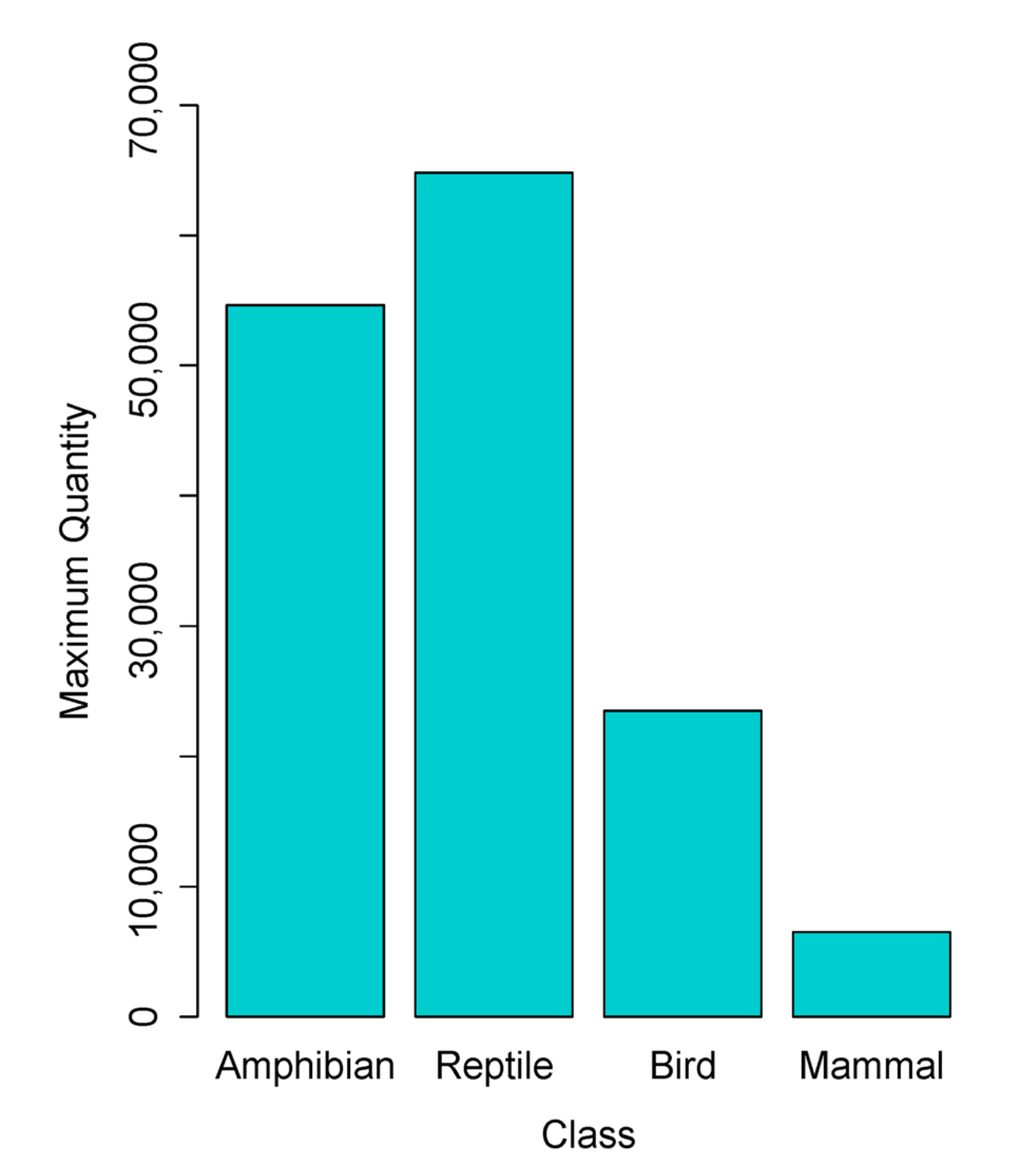
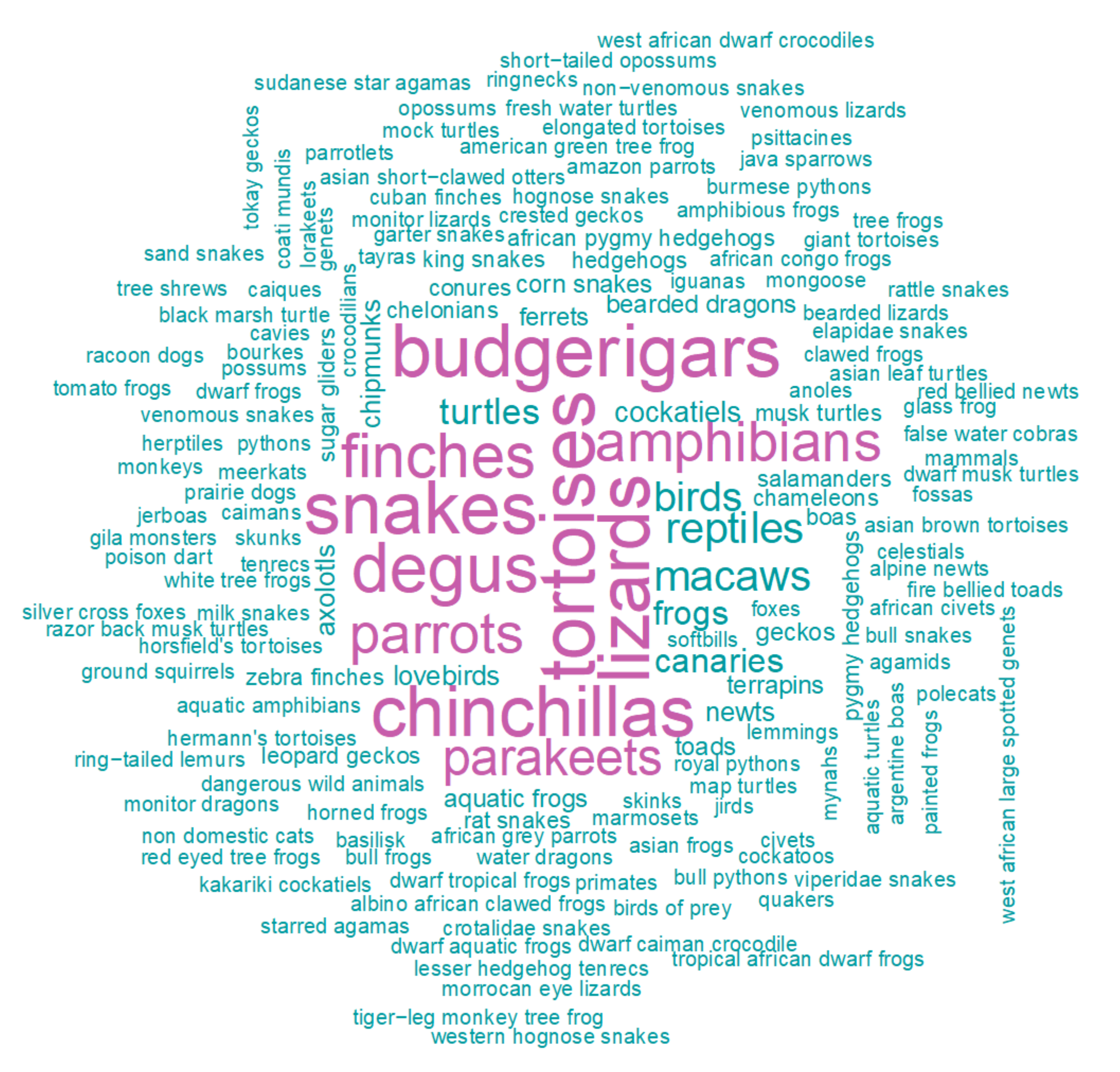
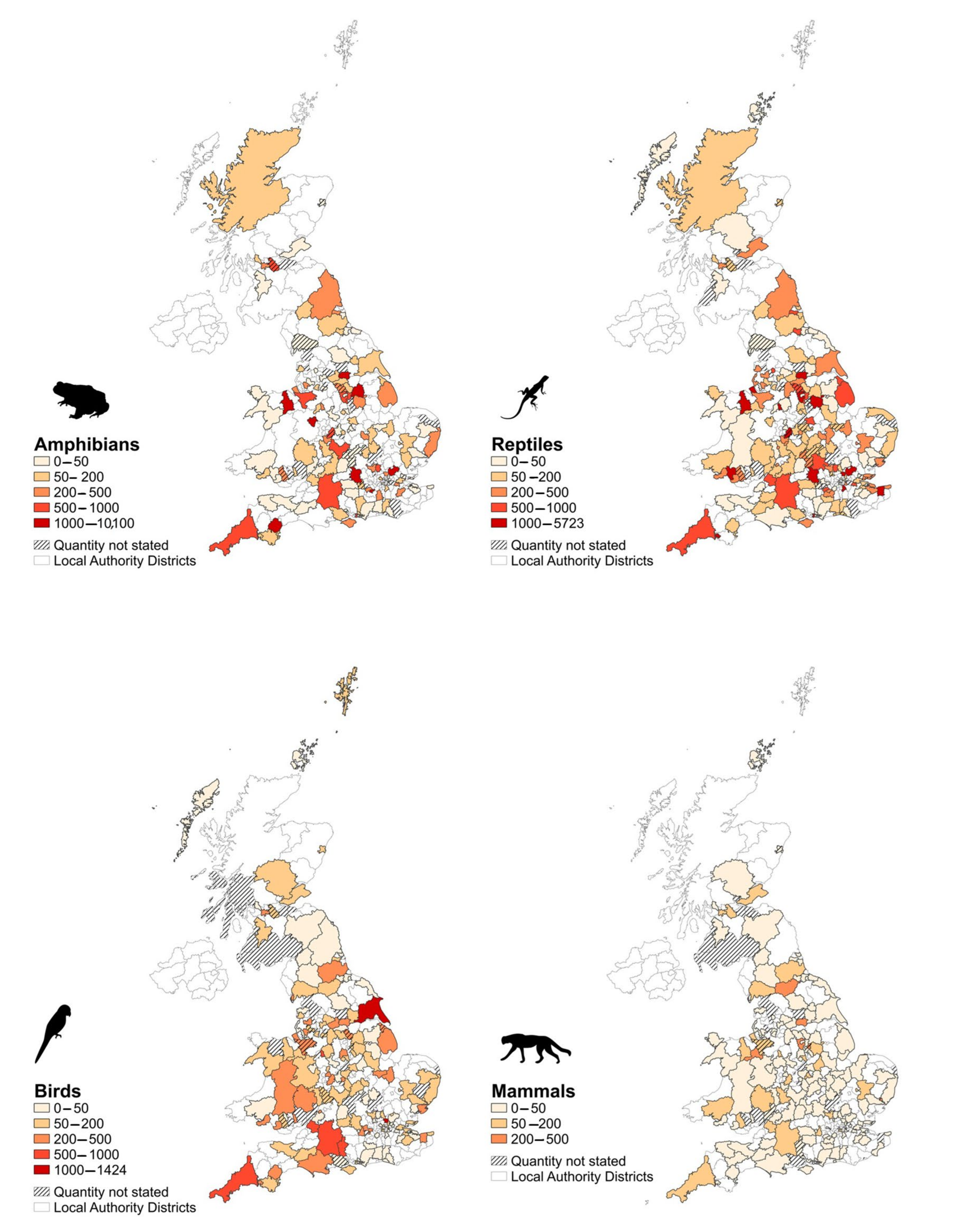
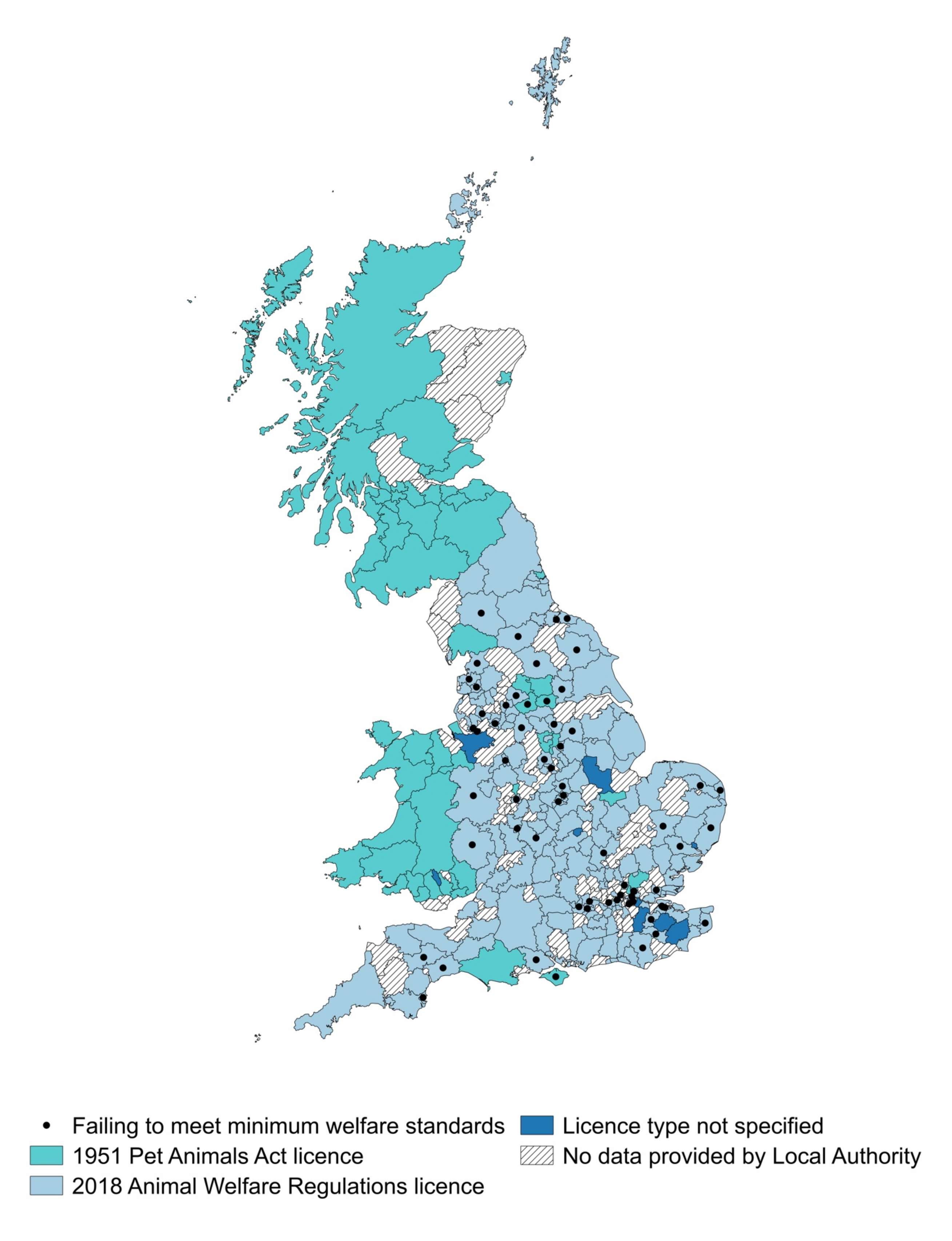
Publisher’s Note: MDPI stays neutral with regard to jurisdictional claims in published maps and institutional affiliations. |
© 2020 by the authors. Licensee MDPI, Basel, Switzerland. This article is an open access article distributed under the terms and conditions of the Creative Commons Attribution (CC BY) license (http://creativecommons.org/licenses/by/4.0/).