



You are currently on the new version of our website. Access the old version .

Animals

Animals is an international, peer-reviewed, open access journal devoted entirely to animals, including zoology and veterinary sciences, and is published semimonthly online by MDPI.
Indexed in PubMed | Quartile Ranking JCR - Q1 (Veterinary Sciences | Agriculture, Dairy and Animal Science)
All Articles (23,006)

The study of the relationship between testicular morphology and sperm quality is a pressing issue, for which molecular genetic approaches, including quantitative analysis of gene expression, are being implemented. The aim of this study was to identify correlations between the histomorphological structure of the testes, fresh sperm parameters, and the expression level of key spermatogenesis genes—TGFB2 and DMRT1—in roosters. The experiment was conducted on 10 Russian Snow White roosters aged 28–32 weeks. Sperm quality was assessed by volume, sperm concentration, total and progressive motility, and viability; histological analysis of the rooster testes was performed. The relative expression of the TGFB2 and DMRT1 genes in sperm was analyzed. Multiple correlation analysis of the data was conducted. A positive correlation was found between ejaculate volume and the number of spermatogonia (p = +0.651), a negative correlation between ejaculate volume and the number of second-order spermatocytes (p = −0.704), a negative correlation between the total cross-sectional area of the seminiferous tubules of the testes and sperm viability (p = −0.782), a negative correlation between the number of seminiferous tubules and the average diameter of their cross-section (p = −0.685), and a positive correlation between total and progressive sperm motility (p = +0.794). Analysis of TGFB2 and DMRT1 gene expression in sperm demonstrated a certain relationship between molecular genetic mechanisms and histomorphometric parameters. The expression level of the DMRT1 gene, which plays a key role in sex determination in birds during embryogenesis, had a number of negative correlations with such parameters as testicle weight (r = −0.782), total/progressive sperm motility (r = −0.552; r = −0.612), and viability (r = −0.552). Expression of the TGFB2 gene had no significant relationship with the studied parameters, but correlation analysis revealed a moderate positive relationship (r = +0.321) with DMRT1 gene expression. The data obtained indicate the expediency of integrating morphometric, cellular, and molecular analysis for an objective assessment of rooster reproductive function.
12 January 2026

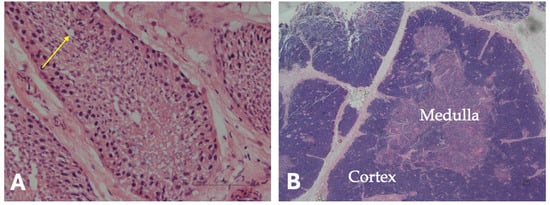
Histological section of the testicle. 1—seminiferous tubules of a rooster (magnification ×100, scale 200 µm).

Islands provide valuable opportunities to study how isolation affects phenotypic variation. Even though orchid bees are highly mobile, their movement can still be restricted by marine barriers. In this study, we assessed whether insular isolation impacts wing shape in the orchid bee Euglossa mixta across the Coiba archipelago and a nearby mainland site in Western Panama. Our study analyzed 271 individuals using geometric morphometrics, focusing on forewing venation landmarks, and evaluated the variation using multivariate analyses of shape variation and quantifying the shape of Mahalanobis distances. Additionally, we conducted a Mantel test to explore the relationship between geographic distance and morphological divergence. Our findings reveal that wing shape variation in E. mixta is largely conserved but shows fine-scale structuring consistent with spatial patterns expected in insular systems. These results suggest that even highly mobile pollinators may experience enough isolation for subtle phenotypic shifts to occur, highlighting the sensitivity of geometric morphometrics for detecting early stages of morphological differentiation.

12 January 2026

Galba truncatula acts as an intermediate host for several parasitic flukes of veterinary importance, but a targeted study on its spatial presence as well as the impact of environmental factors in Southeastern Europe has not been conducted. During the summer months of 2017 and 2018, a survey of 191 water bodies in 14 districts in Central, Southern and Western Bulgaria was conducted, with a focus on animal drinking fountains. Each site was assessed for snail presence and characterized by altitude, temperature, precipitation, shade and type of water body. Logistic regression modeling was used to identify the important factors related to the occurrence of snail species. The frequency of habitats found was 29.3%, with no differences observed between the studied districts (p > 0.05). Snails were present across a wide range of altitudes (78–1926 m), annual mean temperature (7.8–14.0 °C) and annual mean precipitation (523–796 mm). The high habitat frequencies were recorded in streams (60.0%) and on the banks on small rivers (50.0%). The presence of snails in the two studied types of fountains (without or with a concrete platform) was 24.1% and 17.2%, respectively, with no significant difference between them (p > 0.05). Regression analysis revealed temperature, shade, and type of water body as factors that could significantly influence the spatial presence of G. truncatula. The findings demonstrate the ecological adaptability of G. truncatula and highlight its presence in habitats with high potential for contact with domestic and wild ruminants. This information fills a regional knowledge gap and can support risk assessment and control measures for fluke-borne diseases in livestock and wildlife.

12 January 2026

  • Communication
  • Open Access

Surveillance of Shrew-Borne Hantaviruses Expands Viral Host Range in Hungary

  • Gréta Varga,
  • Renáta Dóró and
  • Anett Kuczmog
  • + 4 authors

Since the late 2000s, a growing diversity of distinct hantaviruses has been identified in shrews across Europe. However, knowledge about shrew-borne hantaviruses in Hungary is limited. This study was initiated to investigate the prevalence and host range of these viruses in shrew populations in Hungary. Between 2007 and 2011, 129 shrew specimens, representing six species, were collected from four locations in Southern Transdanubia. Lung tissues were analyzed for the presence of hantaviral RNA by RT-PCR targeting the L genomic segment. Hantavirus RNA was detected in four shrew species. This study provides the first molecular evidence of hantavirus infection in the pygmy shrew (Sorex minutus), Miller’s water shrew (Neomys milleri), and the Eurasian water shrew (Neomys fodiens) in Hungary, while also confirming infection in the Eurasian common shrew (Sorex araneus). The overall prevalence varied among species, with marked detection rates in S. minutus (50%) and N. fodiens (33.3%). Our findings document the co-circulation of hantaviruses in four distinct shrew species within the same ecosystems in Hungary, thereby expanding the known host range for these viruses within the country. This contributes to the understanding of the complex hantavirus landscape in Central Europe and highlights the need for genetic characterization of identified viruses to assess their evolutionary dynamics.

12 January 2026

News & Conferences

Issues

Open for Submission

Editor's Choice

Reprints of Collections

Morphological and Physiological Research on Fish
Reprint

Morphological and Physiological Research on Fish

Editors: Elena De Felice, Paola Scocco
Fishes and Crustaceans
Reprint

Fishes and Crustaceans

Biology and Ecology in a Changing Marine Environment
Editors: Sabrina Colella, Giorgia Gioacchini

Get Alerted

Add your email address to receive forthcoming issues of this journal.

XFacebookLinkedIn
Animals - ISSN 2076-2615