


Complex Fracture Network Modeling of Carbonate Reservoirs: A Case from Carboniferous KT-I Formation in the NT Oilfield, Kazakhstan
Abstract
1. Introduction
2. Geological Setting
3. Data and Methods
3.1. Data Collection
3.2. Prediction of Different Dip-Angle Fractures
3.2.1. Prediction of High-Angle Fracture
3.2.2. Prediction of Low-Angle Fractures
3.3. Fracture Modeling
4. Results
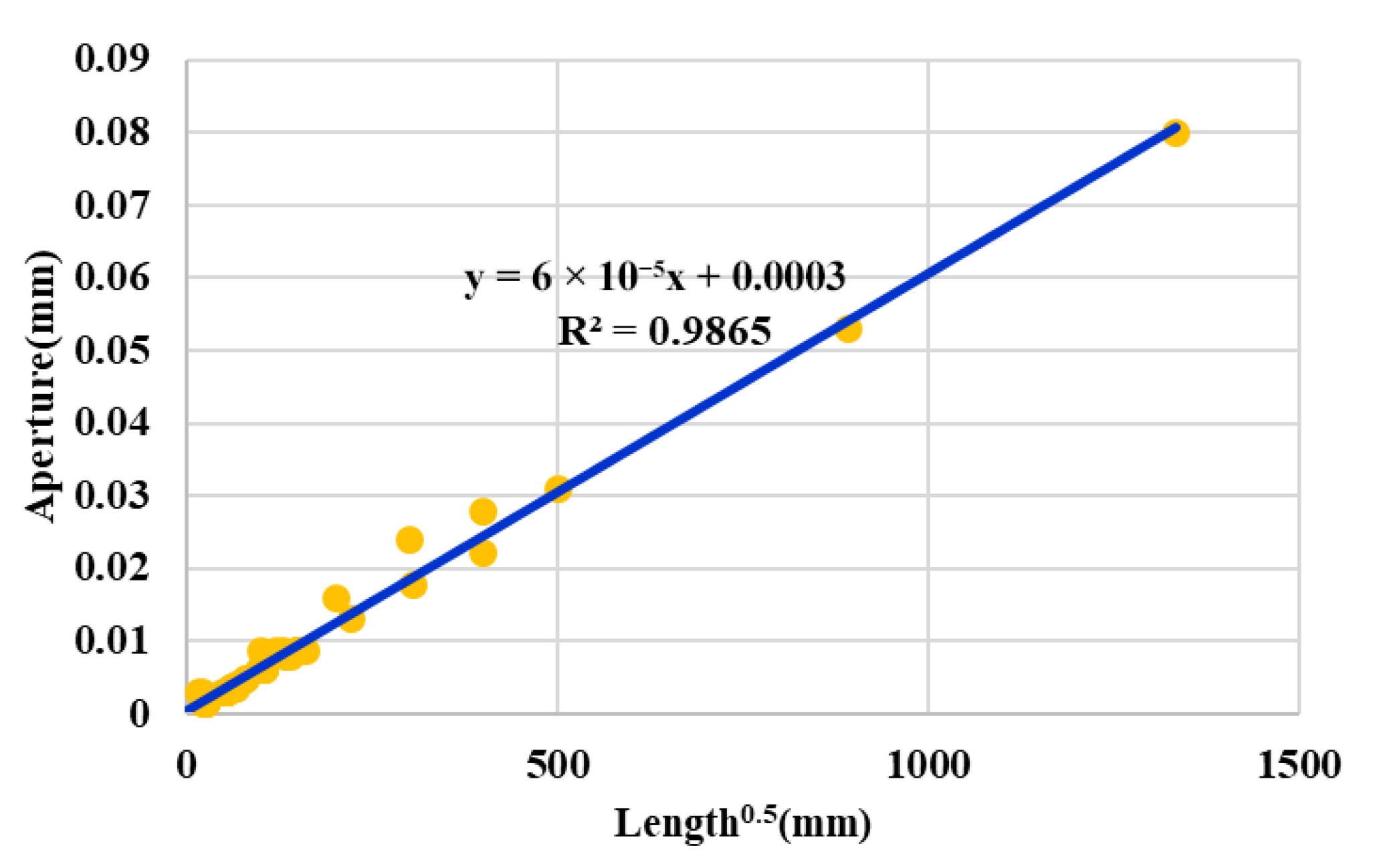
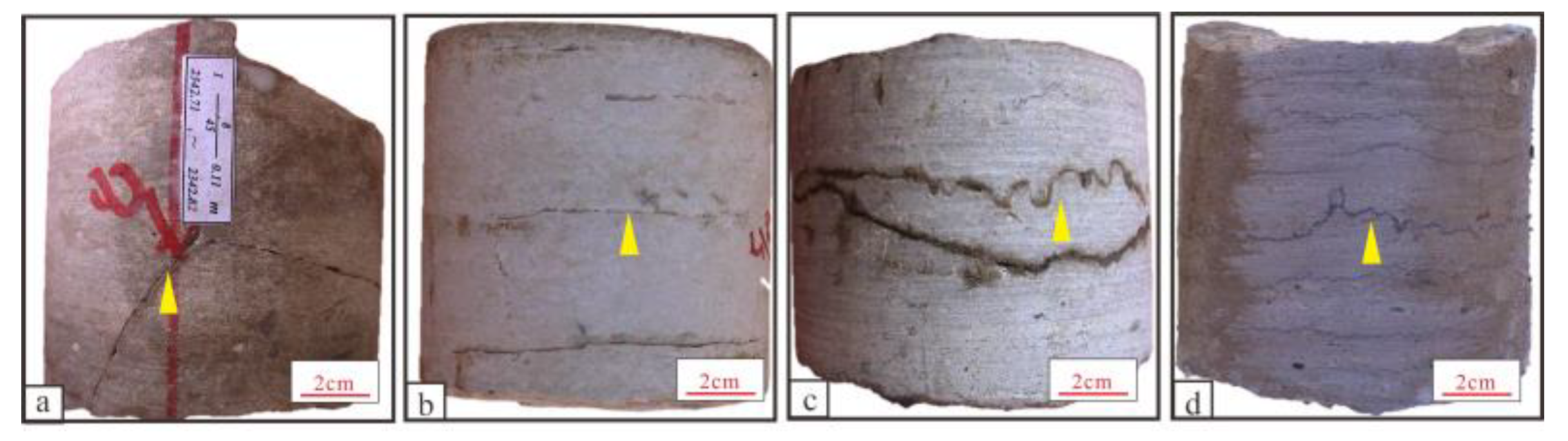
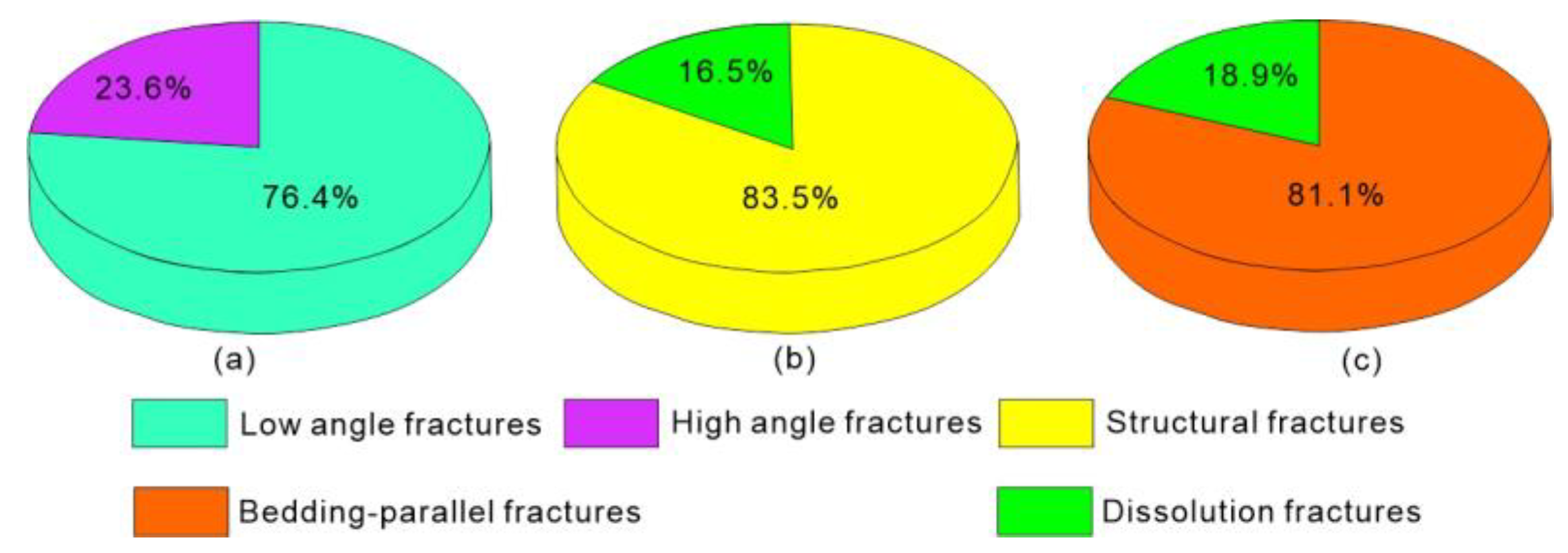
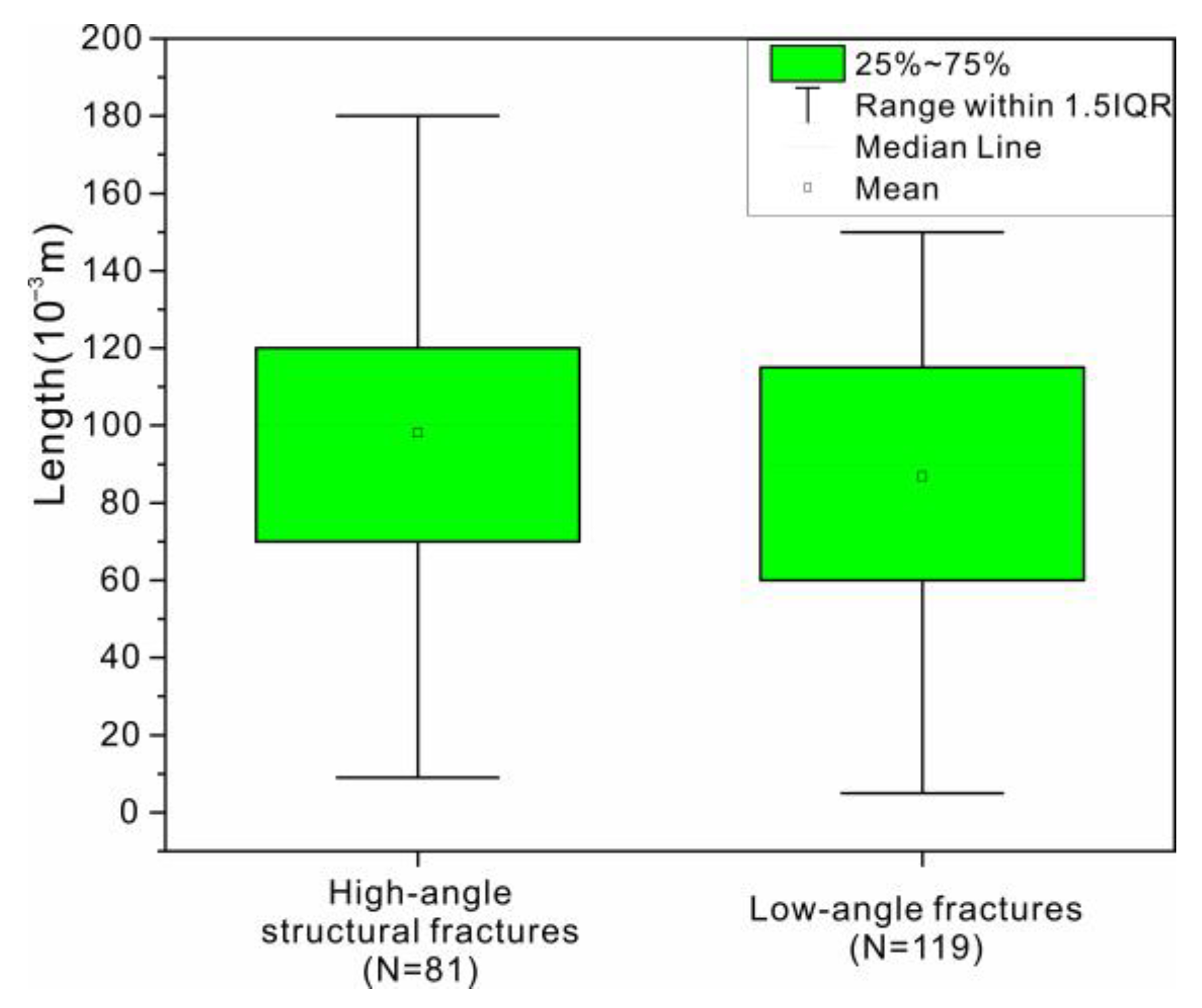
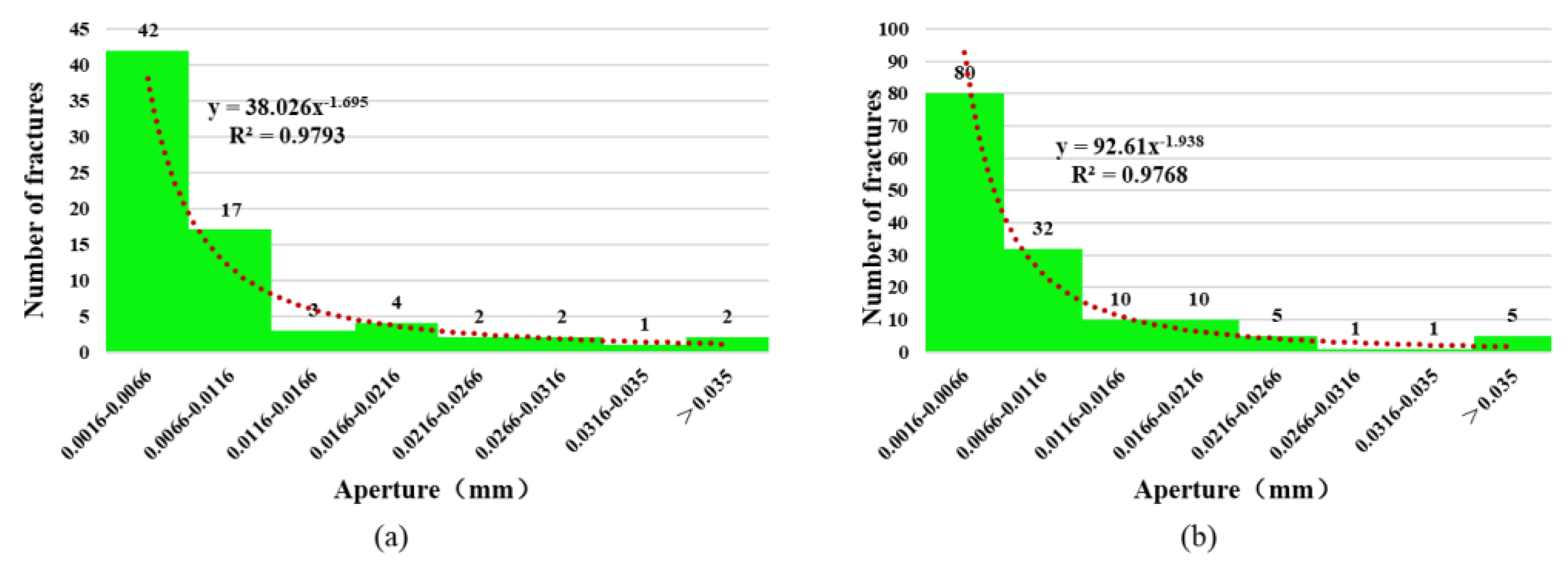
4.1. Fracture Characteristics
4.2. Distribution of Different Dip-Angle Fractures
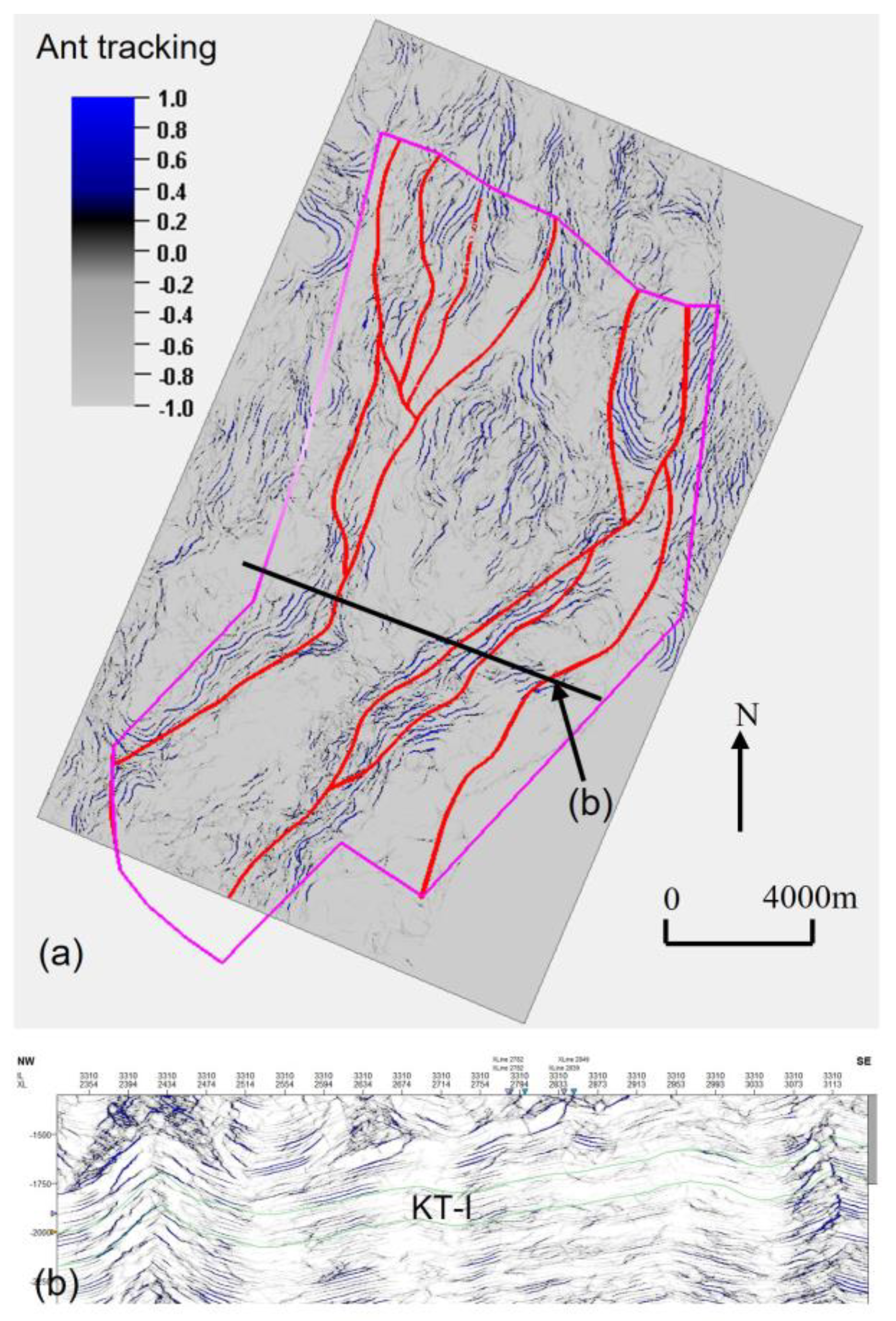
4.2.1. Distribution of Large-Scale Fractures
4.2.2. Distribution of Small-Scale High-Angle Fractures
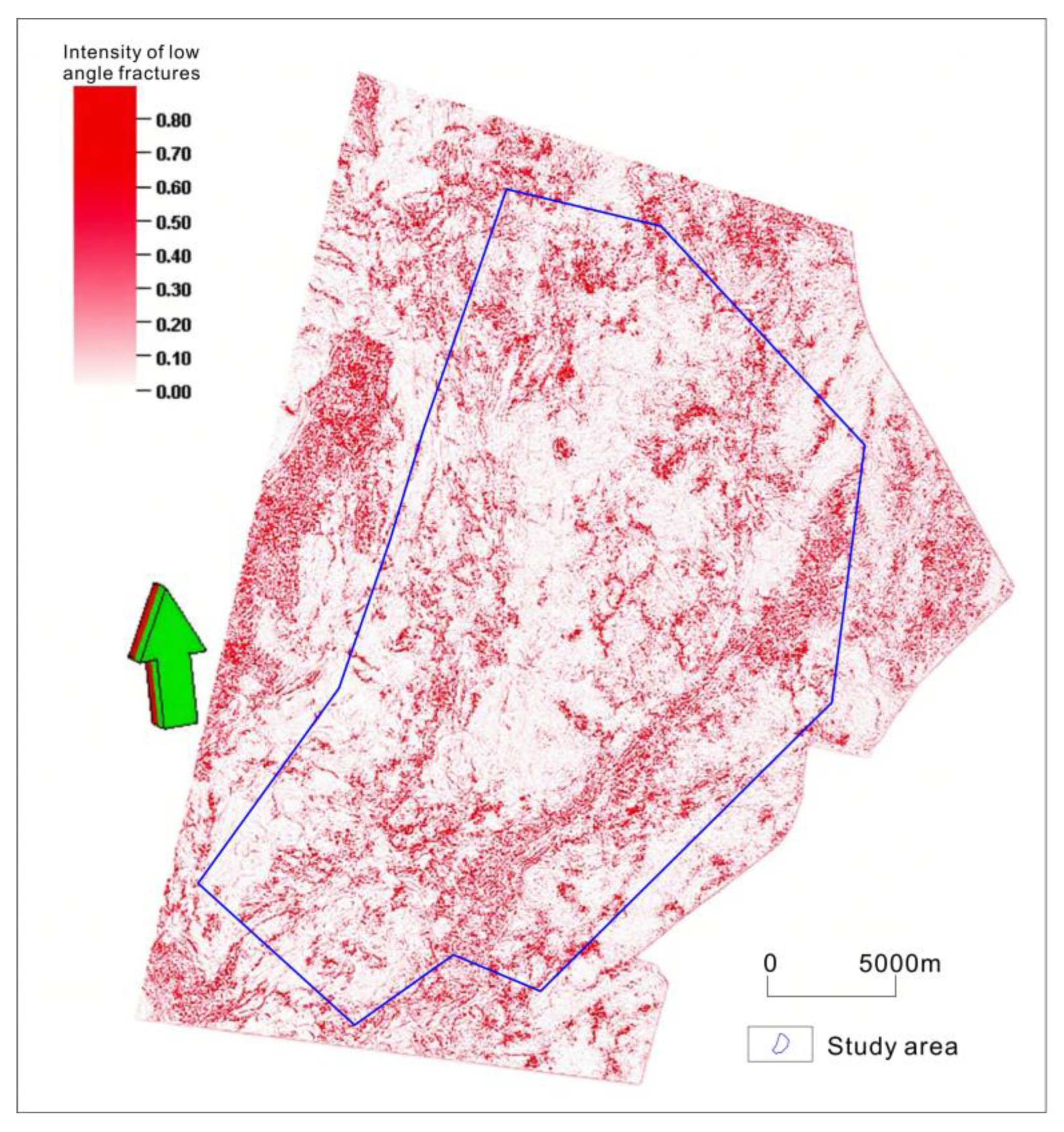
4.2.3. Prediction Results of Small-Scale Low-Angle Fractures
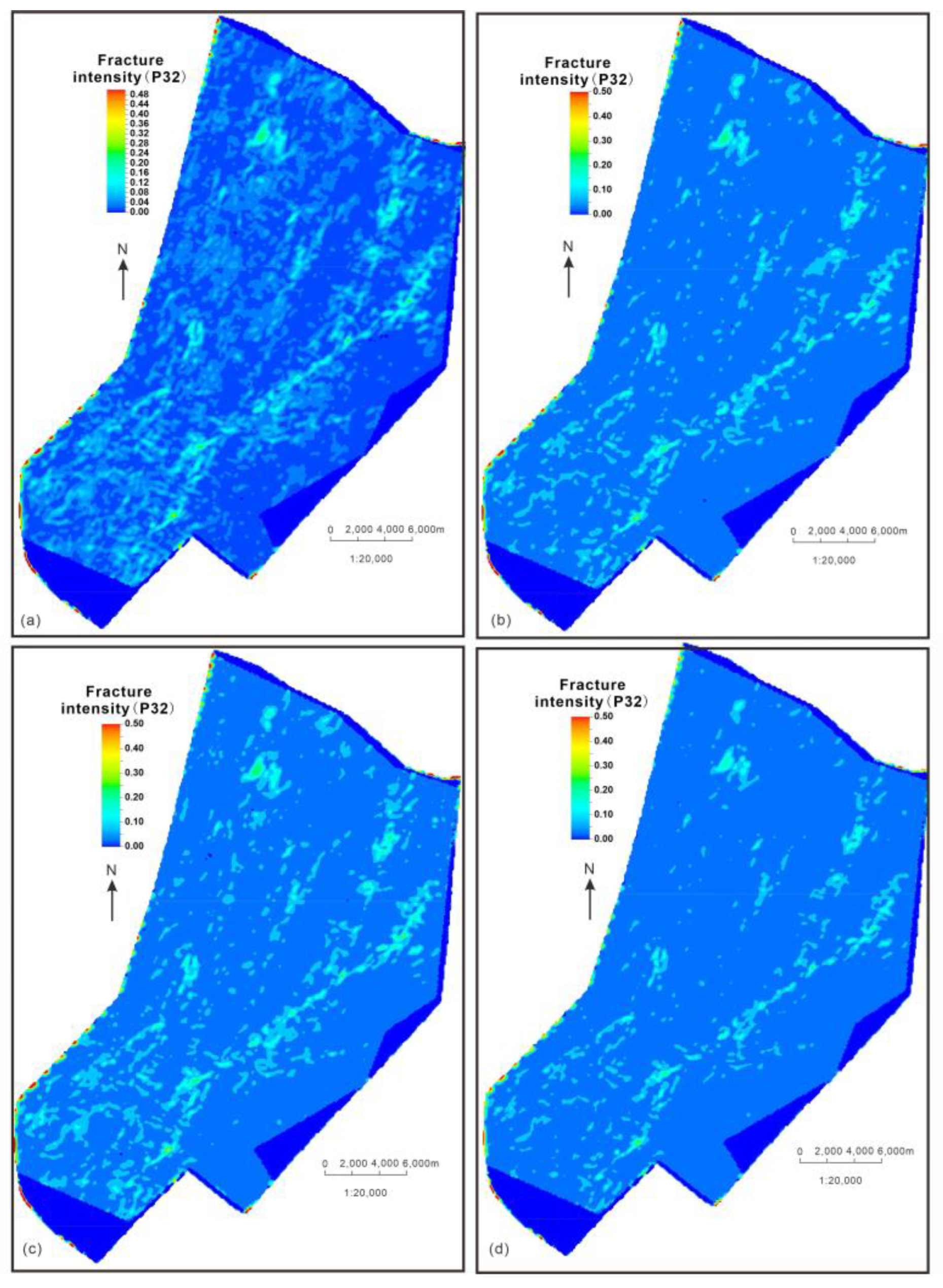
4.3. Fracture Modeling Results
5. Discussion
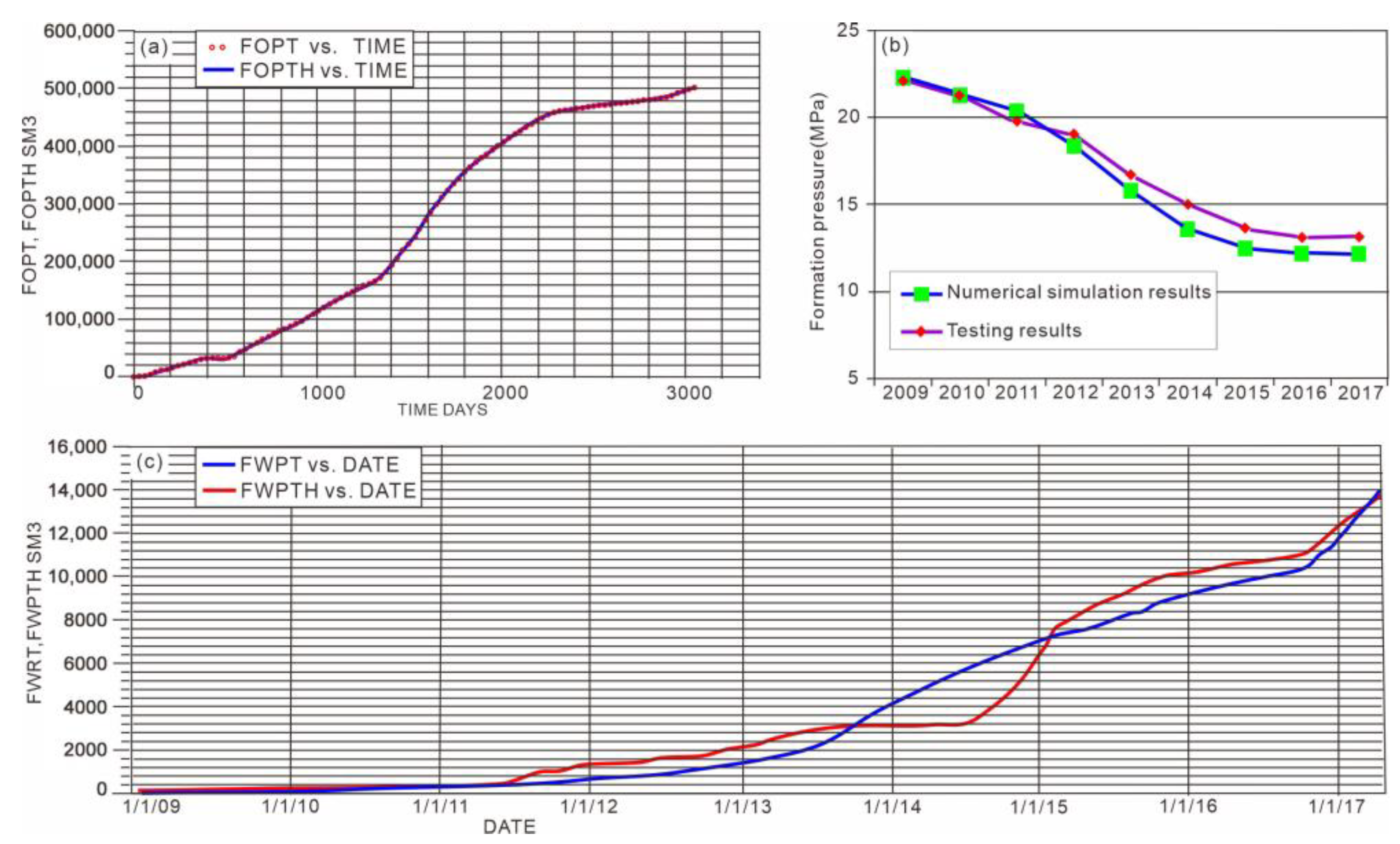
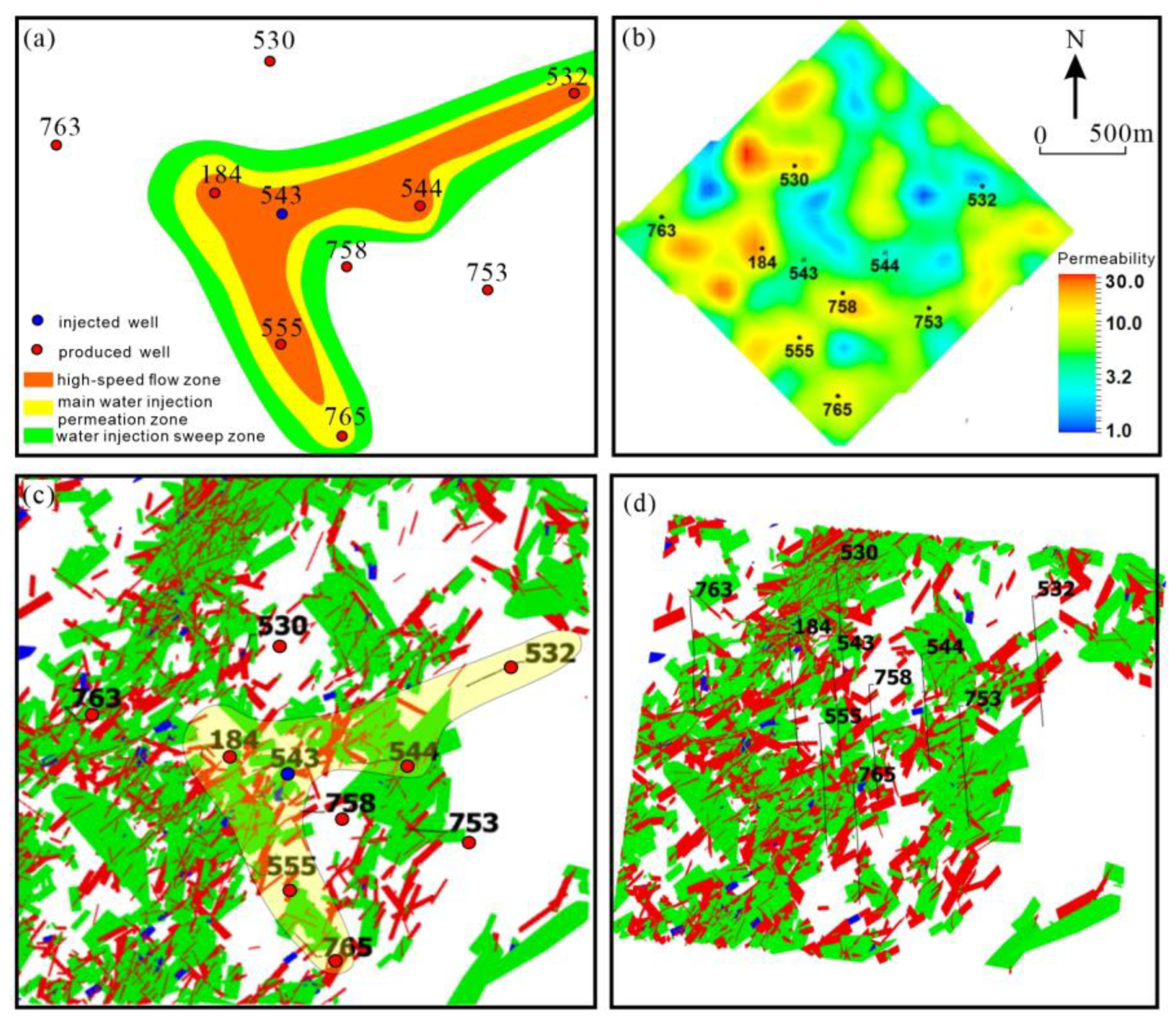
5.1. Model Accuracy Verification
5.2. Impacts of Fractures with Different Dip Angles on Oilfield Development
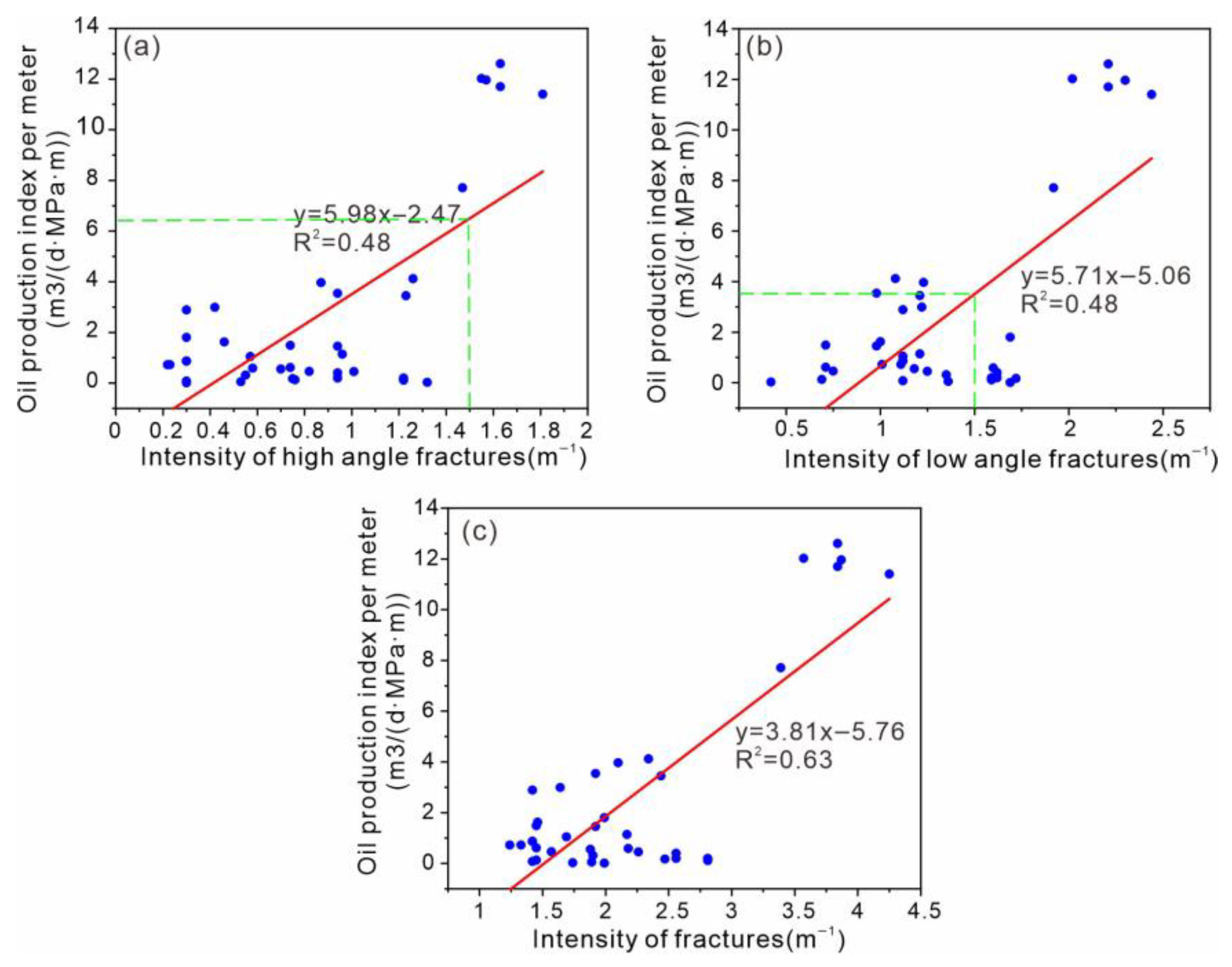
5.2.1. Impact of Different Dip-Angle Fractures on Initial Productivity
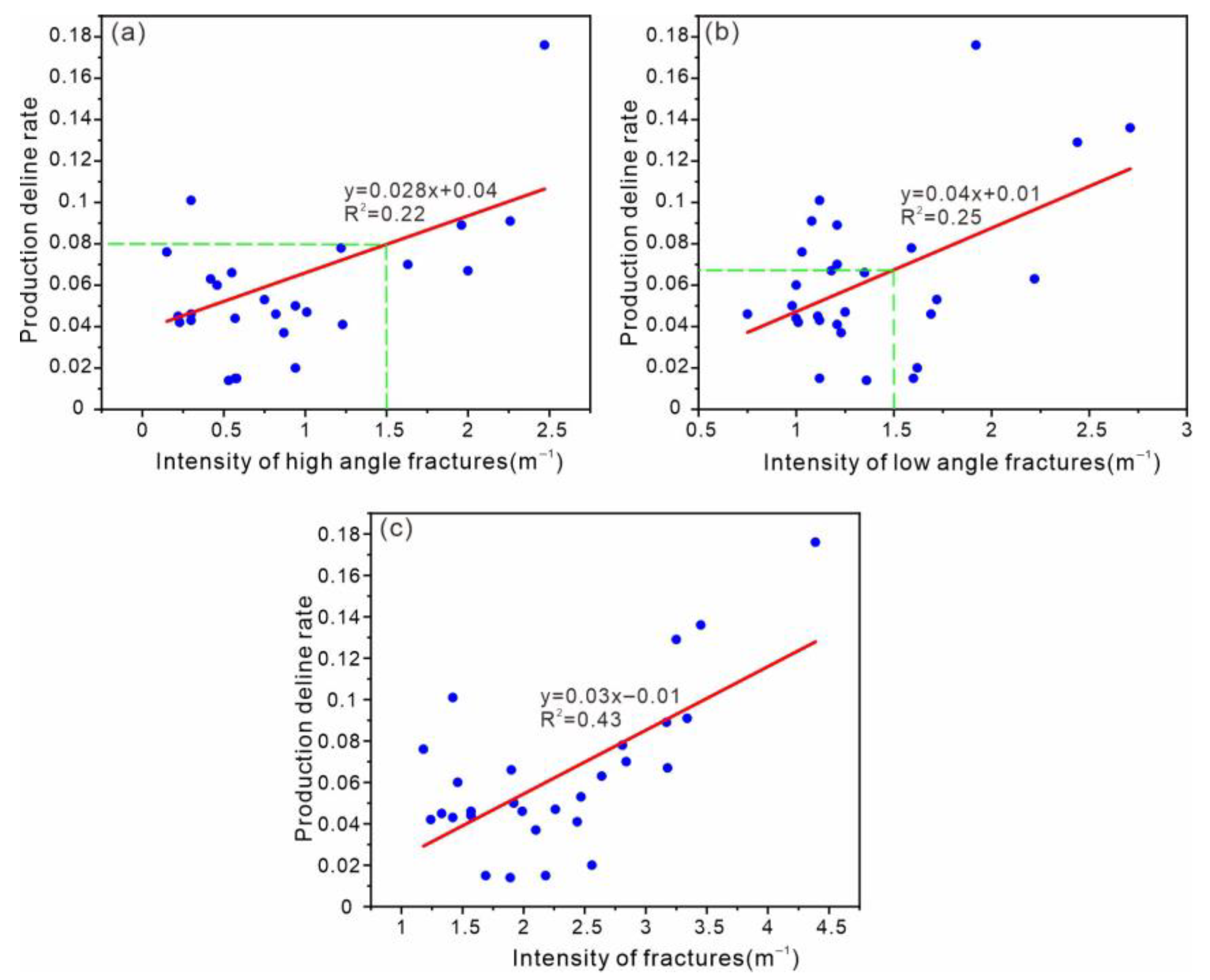
5.2.2. Influence of Fractures with Different Dip Angles on Production Decline Rate
6. Conclusions
Funding
Data Availability Statement
Acknowledgments
Conflicts of Interest
References
- Nelson, R. Geologic Analysis of Naturally Fractured Reservoirs; Gulf Publishing: Houston, TX, USA, 2001; 320p. [Google Scholar]
- Lavenu, A.P.; Lamarche, J. What controls diffuse fractures in platform carbonates? insights from Provence (France) and Apulia (Italy). J. Struct. Geol. 2018, 108, 94–107. [Google Scholar] [CrossRef]
- Laubach, S.E.; Lamarche, J.; Gauthier, B.D.; Dunne, W.M.; Sanderson, D.J. Spatial arrangement of faults and opening-mode fractures. J. Struct. Geol. 2018, 108, 2–15. [Google Scholar] [CrossRef]
- Wu, G.; Zhao, K.; Qu, H.; Scarselli, N.; Zhang, Y.; Han, J.; Xu, Y. Permeability distribution and scaling in multi-stages carbonate damage zones: Insight from strike-slip fault zones in the Tarim basin, NW China. Mar. Pet. Geol. 2020, 114, 104208. [Google Scholar] [CrossRef]
- Dan, L.; Shi, C.; Wem, J.; Wei, L.; Zhang, X.; Zhang, J. Application of multi-information fusion modeling technology for fractures in du-al-medium carbonate reservoir. Pet. Geol. Recovery Effic. 2022, 29, 46–52. [Google Scholar] [CrossRef]
- Tran, N.H. Characterisation and Modelling of Naturally Fractured Reservoirs; University of New South Wales Australia: Sydney, Australia, 2004; pp. 1–220. [Google Scholar]
- Mendez, J.N.; Jin, Q.; González, M.; Zhang, X.; Lobo, C.; Boateng, C.D.; Zambrano, M. Fracture characterization and modeling in karsted carbonate reservoirs: A case study in Tahe oilfield, Tarim basin (Western China). Mar. Pet. Geol. 2019, 112, 104104. [Google Scholar] [CrossRef]
- Taheri, K.; Alizadeh, H.; Askari, R.; Kadkhodaie, A.; Hosseini, S. Quantifying fracture density within the Asmari reservoir: An integrated analysis of borehole images, cores, and mud loss data to assess fracture-induced effects on oil production in the Southwestern Iranian Region. Carbonates Evaporites 2024, 39, 8. [Google Scholar] [CrossRef]
- Li, H.; You, Y.; Ceng, D.; Liu, G.; Zheng, W.; Zhang, R. 3D geological modeling of strongly heterogeneous dual-medium deep carbonate reservoirs: A case study of Feixianguan-Changxing Formations in Puguang Gas Field. Pet. Geol. Recovery Effic. 2024, 31, 44–53. [Google Scholar] [CrossRef]
- Liu, W.; Ning, Y.; Wang, H.; Cheng, J.; Lu, Y.; Wang, Y. The application of the technique of quantitatively characterizing double -porosity medium in the development of complex reef-limestone oilfields: A case of LH4-1 oilfield, Pearl river mouth basin. China Offshore Oil Gas 2014, 26, 65–71. [Google Scholar]
- Tanaka, A.P.B.; Borges, J.P.G.; de Matos, G.C.; Campos, M.T.R.; Cunha, B.M.; de Souza, R.B.; de Moraes Caldeira, J.N.; de Oliveria, T.A.; Macron, D.R.; Lima, A.P.M. Fault-related fracture modeling in a pre-salt lacustrine carbonate reservoir from Santos Basin, offshore Brazil: Predicting preferential fluid flow paths using 3D geological and flow simulation models. Mar. Pet. Geol. 2022, 135, 105392. [Google Scholar] [CrossRef]
- Di, Z. Research and application of geological modeling technology under the condition of binary medium—A case study of Capella oilfield in Colombia. Sino-Glob. Energy 2015, 20, 41–44. [Google Scholar]
- Yan, W.; Zhu, X.; Zhang, Q.; Gu Li Zhang, Q.; Zhang, Z.; Wang, X. The fissure type and characteristics of Liugouzhuang-Kulongshan reservoir in Qingxi depression. Pet. Explor. Dev. 2002, 29, 80–83. [Google Scholar]
- Liu, H.; Lei, W.U.; Cao, L.; Liu, B. Study of characteristics of sub-salt gypsum carbonate reservoir on the right bank of Amudar′ya basin. J. Oil Gas Technol. 2014, 29, 80–83. [Google Scholar]
- Du, G.; Hui, C.; Zhang, S.; Cao, Q. Development pattern and genesis of fractures in block l of Khorat basin. Spec. Oil Gas Reserv. 2016, 23, 21–25. [Google Scholar]
- Lianbo, Z.; Xiangyang, L. Fractures in sandstone reservoirs with ultra-low permeability: A case study of the upper triassic yanchang formation in the Ordos basin, China. Aapg. Bull. 2009, 93, 461–477. [Google Scholar] [CrossRef]
- Li, C.; Zhao, L.; Liu, B.; Liu, H.; Li, J.; Fan, Z.; Wang, J.; Li, W.; Zhao, W.; Sun, M. Origin, distribution and implications on production of bedding-parallel fractures: A case from the carboniferous KT-I formation in the NT oilfield, Precaspian basin, Kazakhstan. J. Pet. Sci. Eng. 2021, 107655. [Google Scholar] [CrossRef]
- Chen, Y.; Zhao, L.; Hou, J.; Li, Y.; Wang, S.; Li, J. Carboniferous sequence stratigraphy and sedimentary evolution in the North Troyes Oilfield, eastern margin of the Pre-Caspian Basin. J. Paleogeogr. 2024, 26, 58–74. [Google Scholar]
- Guo, K.; Fan, L.; Jin, S.; Cheng, X.; Sheng, S.; Wu, J. Identification of Carboniferous carbonate platform margin and its distribution characteristics in the eastern margin of the Pre-Caspian Basin. Pet. Geol. Eng. 2023, 37, 23–30. [Google Scholar]
- Tang, X.S.; Tan, X.C.; Liu, H. Characteristics and development mechanism of dolomite and dolomitic quartzite reservoirs of the middle permian maokou formation in eastern Sichuan basin. Oil Gas Geol. 2016, 37, 731–743. [Google Scholar]
- Zhao, L.; Wang, S.; Zhao, W.; Luo, M.; Wang, C.; Cao, H.; He, L. Combination and distribution of reservoir space in complex carbonate rocks. Pet. Sci. 2016, 13, 450–462. [Google Scholar] [CrossRef][Green Version]
- Ling, H. Evaluation of fracture-porosity carbonate reservoirs with conventional logging data. J. Oil Gas Technol. 2010, 32, 258–262. [Google Scholar]
- Lu, B.; Li, L.; Lu, J.; Wang, S.; Chen, Y.; Tan, X. Eogenetic karst characteristics and diagenetic facies types of Carboniferous KT-I layer in B Oilfield, eastern margin of Pre-Caspian Basin. Nat. Gas Geosci. 2023, 35, 1031–1043. [Google Scholar] [CrossRef]
- Wang, S.; Li, J.; Zhao, W.; Sun, M.; Zhang, D. Study on carbonate reservoir diagenesis of the eastern margin of the caspian basin—A case study on North Truva oilfield. In Proceedings of the 2015 International Conference on Advanced Engineering Materials and Technology, Guangzhou, China, 22–23 August 2015; pp. 615–619. [Google Scholar]
- Shi, X.; Chen, X.; Wang, J.; Li, Z.; Jin, S.; Guo, H.; Zhu, M. Geochemical characteristics of the carboniferours KT-I interval dolostone in eastern margin of coastal caspian sea basin. J. Palaeogeogr. 2012, 14, 777–785. [Google Scholar]
- Wang, S.; Zhao, L.; Cheng, X.; Fan, Z.; He, L. Geochemical characteristics and genetic model of dolomite reservoirs in the eastern margin of the pre-caspian basin. Pet. Sci. 2012, 9, 161–169. [Google Scholar] [CrossRef]
- Liang, S.; Wang, Y.; Jin, S.; Wang, Z.; Zheng, J. Controlling of tectonic evolution on hydrocarbon occurrence in pre-caspian basin. Pet. Geol. Exp. 2013, 35, 174. [Google Scholar]
- Volozh, Y.A.; Antipov, M.P.; Brunet, M.; Garagash, I.A.; Lobkovskii, L.I.; Cadet, J. Pre-mesozoic geodynamics of the precaspian basin (Kazakhstan). Sediment. Geol. 2003, 156, 35–58. [Google Scholar] [CrossRef]
- Li, C.; Zhao, L.; Li, J.; Wang, S.; Li, W. Structural fracture formation stages in the eastern margin of the caspian basin and genesis of low-angle structural fracture. Spec. Oil Gas Reserv. 2019, 26, 56–61. [Google Scholar]
- Ling, H. Petrophysical Evaluation the Microfracture-Typed Complex Carboniferous Carbonate Reservoir in the Eastern Margin of the Caspian Sea Basin; Yangtze University: Wuhan, China, 2015; pp. 1–156. [Google Scholar]
- Li, C.; Zhao, L.; Liu, B.; Zhao, W.; Wang, S.; Li, J.; Zheng, T.; Li, W. Connectivity of fracture networks of Carboniferous carbonate reservoirs in North Truva Oilfield, eastern margin of Precaspian Basin. Lithol. Reserv. 2024, 36, 113–123. [Google Scholar]
- Yang, H.; Bin, X.; Yankun, W. Tectonic evolution and hydrocarbon accumulation model in eastern precaspian basin. Sediment. Geol. Tethyan Geol. 2014, 34, 78. [Google Scholar]
- Liu, D.; Dou, L.; Hao, Y.; Zhang, Y. The origin of hydrocarbon accumulation below the lower permian salt bed and the prospecting in the east part of pre-caspian basin. Mar. Orig. Petoleum Geol. 2004, 9, 53–58. [Google Scholar]
- Chen, Y.; Cai, D.; Fan, Z.; Li, K.; Jun, N.I. 3D geological modeling of dual porosity carbonate reservoirs: A case from the Kenkiyak pre-salt oilfield, Kazakhstan. Pet. Explor. Dev. 2008, 35, 492–497. [Google Scholar] [CrossRef]
- Bourbiaux, B.; Basquet, R.; Daniel, J.M.; Hu, L.Y.; Jenni, S.; Lange, G.; Rasolofosaon, P. Fractured reservoirs modelling: A review of the challenges and some recent solutions. First Break 2005, 23, 33–40. [Google Scholar] [CrossRef]
- Hui, Y. Application of ant tracking technology in fine interpretation of seismic data. China Energy Environ. Prot. 2017, 39, 21–26. [Google Scholar]
- Basir, H.M.; Javaherian, A.; Yaraki, M.T. Multi-attribute ant-tracking and neural network for fault detection: A case study of an iranian oilfield. J. Geophys. Eng. 2013, 10, 015009. [Google Scholar] [CrossRef]
- Liang, Y.; Liu, P.; Feng, G. Modeling of fractured reservoirs based on ant tracking technology. Complex Hydrocarb. Reserv. 2014, 7, 11–15. [Google Scholar]
- Cox, T.; Seitz, K. Ant Tracking Seismic Volumes for Automated Fault Interpretation; CSPG CSEG Convention: Calgary, AB, Canada, 2017. [Google Scholar]
- Wang, Y. Cheng-Bei carbonate reservoir fracture identification and quantitative interpretation. Xinjiang Pet. Sci. Technol. 2012, 22, 35–38. [Google Scholar]
- Li, D. Study on the Methodology of Fracture Identification from Conventional Logging Curve; China University of Petroleum: Beijing, China, 2016; pp. 1–44. [Google Scholar]
- Guichao, D.; Shuangquan, H.; Hui, C. The identification method of low angle fracture by analysis of conventional logging data and its application in carbonate reservoirs. Chin. J. Eng. Geophys. 2016, 13, 590–594. [Google Scholar]
- Saboorian-Jooybari, H.; Dejam, M.; Chen, Z.J.; Pourafshary, P. Fracture identification and comprehensive evaluation of the parameters by dual laterolog data. In Proceedings of the Society of Petroleum Engineers, SPE Middle East Unconventional Resources Conference and Exhibition, Muscat, Oman, 26–28 January 2015; pp. 21–36. [Google Scholar]
- Lang, X.L.; Guo, S.J. Fractured reservoir modeling method based on discrete fracture network model. Acta Sci. Nat. Univ. Pekin. 2013, 49, 964–972. [Google Scholar]
- Lei, H. Reasearch on Fissured Carbonate Reservoir Prediction in the Central Block of Pre-Caspian Basin; China University of Geoiscience: Beijing, China, 2011; pp. 1–63. [Google Scholar]
- Jika, H.T.; Onuoha, M.K.; Okeugo, C.G.; Eze, M.O. Application of sequential indicator simulation, sequential Gaussian simulation and flow zone indicator in reservoir-E modelling Hatch Field Niger Delta Basin, Nigeria. Arab. J. Geosci. 2020, 13, 410. [Google Scholar] [CrossRef]
- Long, J.C.; Billaux, D.M. From field data to fracture network modeling: An example incorporating spatial structure. Water Resour. Res. 1987, 23, 1201–1216. [Google Scholar] [CrossRef]
- Schultz, R.A.; Soliva, R.; Fossen, H.; Okubo, C.H.; Reeves, D.M. Dependence of displacement–length scaling relations for fractures and deformation bands on the volumetric changes across them. J. Struct. Geol. 2008, 30, 1405–1411. [Google Scholar] [CrossRef]
- Oda, M. Permeability tensor for discontinuous rock masses. Geotechnique 1985, 35, 483–495. [Google Scholar] [CrossRef]
- Li, C.; Zhao, L.; Liu, B.; Li, W.; Shi, K.; Zhao, W.; Li, J.; Zhu, Q.; Li, Y.; Ma, C. Formation mechanical mechanism of low-angle fractures in pre-salt carbonate reservoirs: A case study from Carboniferous KT-I formation of the NT oilfield in the eastern margin of the Precaspian Basin, Kazakhstan. J. Pet. Explor. Prod. Technol. 2024, 14, 1707–1731. [Google Scholar] [CrossRef]
- Dan, L.; Chao, M.A.; Shi, C.; Yao, W.; Yin, Y. 3D geological modeling of dual-porosity carbonate reservoir in M oilfield, Iraq. Complex Hydrocarb. Reserv. 2018, 11, 42–46. [Google Scholar]
- Zhang, D.; Wang, S.; Zhao, W.; Fan, Z.F.; Li, Z.P. The main geological control factors of single well productivity for carbonate reservoir: Take the reservoir formation KT-I in North Truva field, Kazakhstan as example. Acta Petrol. Sin. 2016, 32, 903–914. [Google Scholar]



| Parameters | Function | Value Range | Actual Value |
|---|---|---|---|
| Initial ant boundary | The number of ants scattered in the earthquake body limits the moving boundary of each ant. | 1~40 | 7 |
| Ant track deviation | The larger the value, the higher the recognition rate for bending faults. | Large-scale fracture 1~5 | 2 |
| Small-scale fracture 3~4 | |||
| Ant step size | The maximum distance a single ant can travel at a time. | 5~7 | 3 |
| Illegal steps allowed | The maximum range within which a single ant can move when the preset conditions are not met. | 0~3 | 1 |
| Legal steps required | The maximum range within which a single ant can move when the preset conditions are met. | 0~3 | 3 |
| Stop criteria | The higher the value, the stronger the search ability. | 0~50% | 10% |
| Well | Half Fracture Length (m) | Fracture Length (m) | Remarks |
|---|---|---|---|
| CT-41 | 116 | 232 | Acid fracturing, 7 mm, 48 t/d |
| CT-45 | 202 | 404 | Acid fracturing, 9 mm, 63 t/d |
| CT-19 | 55 | 110 | Natural fracture, 9 mm, 87 t/d |
| CT-19 | 91.7 | 183.4 | Acid fracturing, 9 mm, 128 m3 |
| CT-23 | 38.7 | 77.4 | 9 mm, 79 t/d |
| CT-26 | 97.9 | 195.8 | Acid fracturing, 5 mm, 42 t/d |
| CT-26 | 85.7 | 171.4 | Acid fracturing, blow out, 17 t/d |
| CT-29 | 54.7 | 109.4 | Acid fracturing, 11 mm, 69 t/d |
| CT-30 | 56 | 112 | Acid fracturing, 11 mm, 96 t/d |
| CT-32 | 50 | 100 | Acid fracturing, 7 mm, 39 t/d |
| CT-35 | 147 | 294 | Acid fracturing, 11 mm, 78 t/d |
| L-6 | 48.4 | 96.8 | Acid fracturing, 11 mm, 139 t/d |
| L-9 | 24 | 48 | Acid fracturing, 13 mm, 156 t/d |
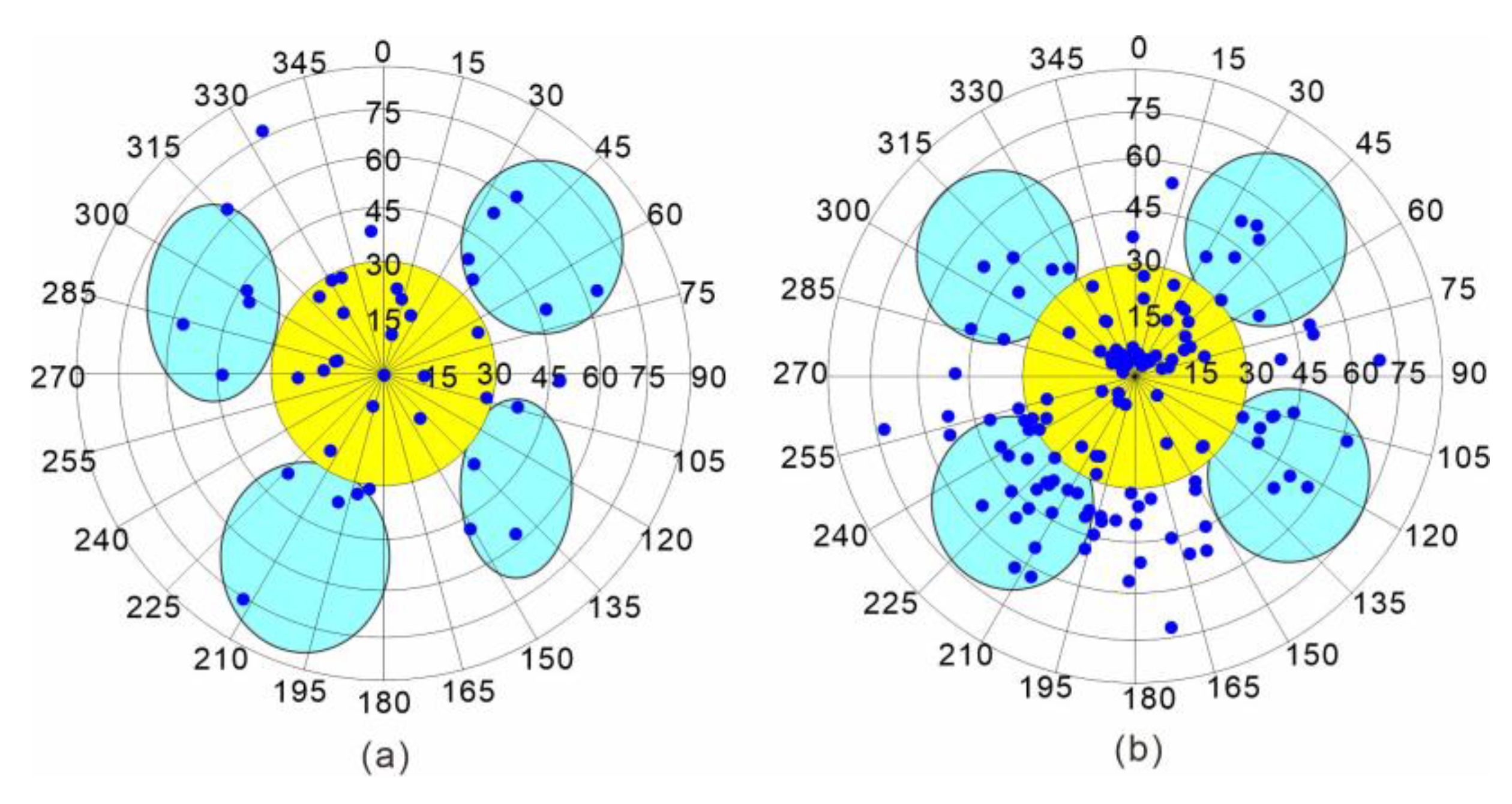
| Groups | Dip Angle (°) | Length (m) | Direction (°) | Concentration |
|---|---|---|---|---|
| NE High-angle structural fractures | >30 | 189.57 | 40 | 52 |
| SE High-angle structural fractures | >30 | 189.57 | 130 | 52 |
| SW High-angle structural fractures | >30 | 189.57 | 220 | 52 |
| NW High-angle structural fractures | >30 | 189.57 | 310 | 52 |
| Low-angle bedding-parallel fractures | ≤30 | 156.09 | —— | 13 |
Disclaimer/Publisher’s Note: The statements, opinions and data contained in all publications are solely those of the individual author(s) and contributor(s) and not of MDPI and/or the editor(s). MDPI and/or the editor(s) disclaim responsibility for any injury to people or property resulting from any ideas, methods, instructions or products referred to in the content. |
© 2025 by the author. Licensee MDPI, Basel, Switzerland. This article is an open access article distributed under the terms and conditions of the Creative Commons Attribution (CC BY) license (https://creativecommons.org/licenses/by/4.0/).
Share and Cite
Li, C. Complex Fracture Network Modeling of Carbonate Reservoirs: A Case from Carboniferous KT-I Formation in the NT Oilfield, Kazakhstan. Geosciences 2025, 15, 426. https://doi.org/10.3390/geosciences15110426
Li C. Complex Fracture Network Modeling of Carbonate Reservoirs: A Case from Carboniferous KT-I Formation in the NT Oilfield, Kazakhstan. Geosciences. 2025; 15(11):426. https://doi.org/10.3390/geosciences15110426
Chicago/Turabian StyleLi, Changhai. 2025. "Complex Fracture Network Modeling of Carbonate Reservoirs: A Case from Carboniferous KT-I Formation in the NT Oilfield, Kazakhstan" Geosciences 15, no. 11: 426. https://doi.org/10.3390/geosciences15110426
APA StyleLi, C. (2025). Complex Fracture Network Modeling of Carbonate Reservoirs: A Case from Carboniferous KT-I Formation in the NT Oilfield, Kazakhstan. Geosciences, 15(11), 426. https://doi.org/10.3390/geosciences15110426