
The Political Economy of Air Quality Governance: A Stakeholder Analysis in the Upper Hunter, NSW, Australia


Abstract
1. Introduction
- 1.
- A national undertow of embedded colonial settler institutions which continues a legacy of inequity in political and economic relations while marginalising Indigenous voices [20];
- 2.
- The structural dependence of the region on traditional resources in the face of heightened climate change pressures and the imperative to diversify beyond fossil fuels [21]; and
- 3.
- Limited institutional capacity of local governments, which constrains their ability to address both direct impacts of mining and the restrictive effects of mining governance itself [22].
2. Materials and Methods
2.1. Technical Solutions
2.2. Political Economy and Stakeholder Analysis
- Foundational factors (context including historical, geographical, and socio-economic);
- Rules (formal and informal institutions that shape incentives); and
- The present (current actors, events, and decision-making processes).
- 1.
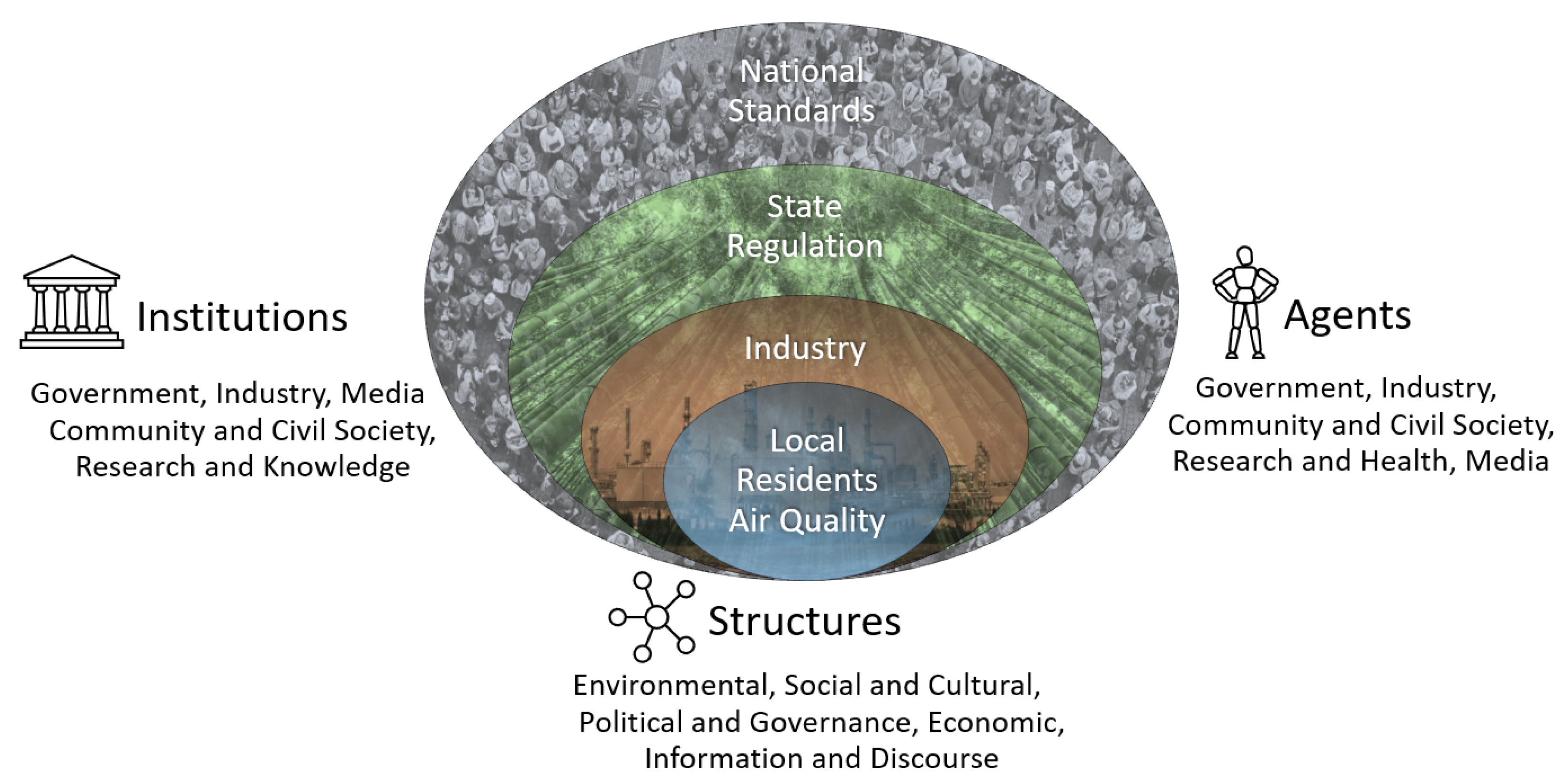
- National mandate or scale which involves policy, regulation and discourse at the federal or inter-state level.
- 2.
- State mandate or scale (i.e., NSW) where regulatory authority, planning and enforcement occurs;
- 3.
- Industry mandate or scale that involves operational and compliance-based influence on air quality; and
- 4.
- Local air quality mandate (i.e., Upper Hunter scale) that includes community, participatory governance, monitoring, and lived experience.
2.3. Identifying Stakeholders
- AS and Australian Coal Preparation Society (ACPS) technical meetings, leading to improvement and update of coal dustiness testing standard AS4156.6 [25];
- Community Consultative Committee (CCC) meetings at a local mine site, highlighting outcomes of applying more accurate air quality monitoring methods [26];
- Coal Services and Mine Safety Occupational Hygiene standing dust committee, consultation on enhancing coal dust exposure occupational monitoring [27];
- Port Hedland Industries Council (PHIC), Pilbara producers/exporters forum, on the update of AS4156.6 coal dustiness standard and its implementation in iron ore dust management [41]; and
3. Results, Analysis, and Discussion
3.1. Governance
3.2. Legislation and Regulation
3.3. Structures
3.4. Knowledge and Information
3.5. Economics
3.6. Discussion
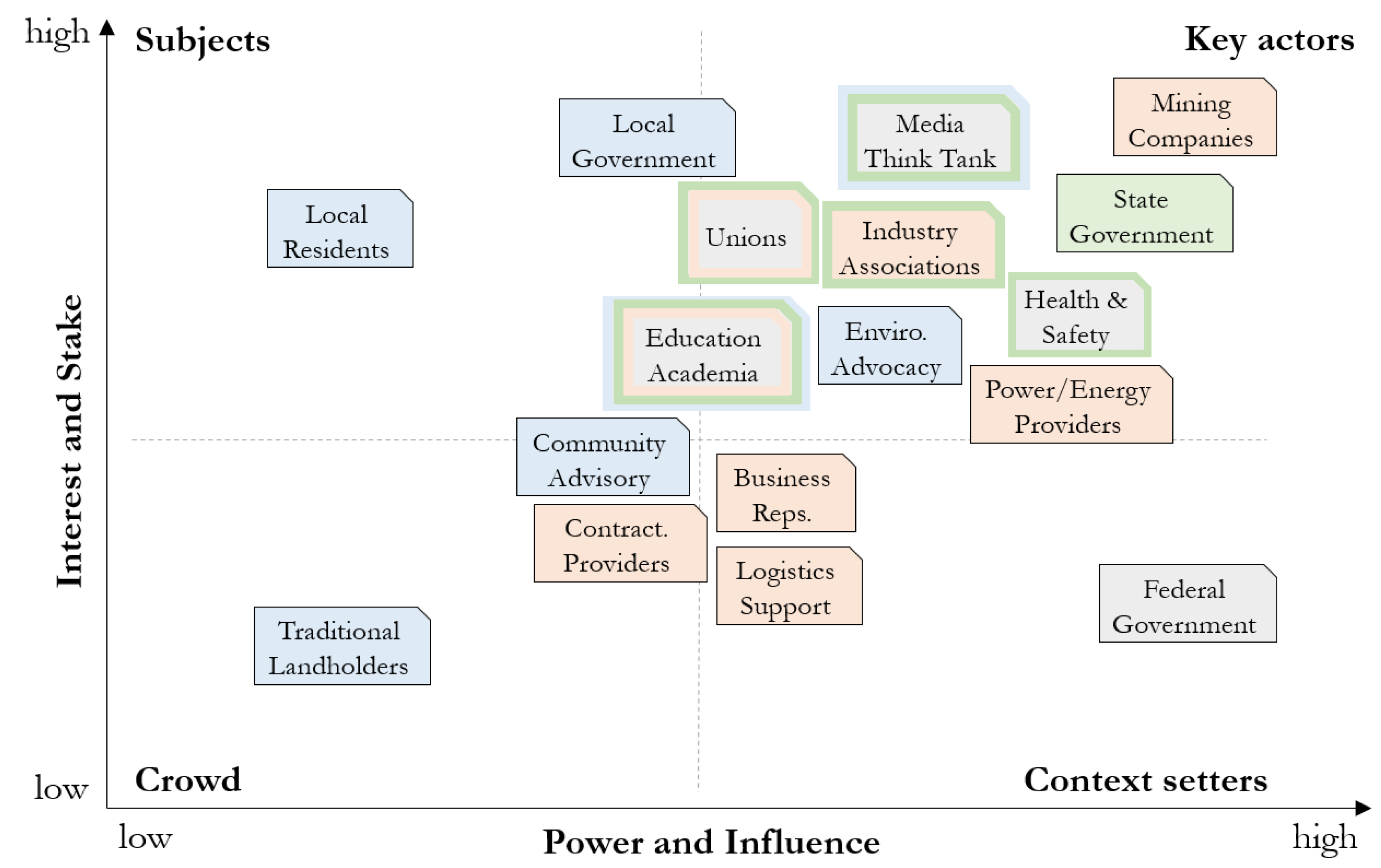
- National scale (coloured grey) which includes Federal Government, Education and Academic Organisations, Media and Think Tanks, and WHS Organisations and Unions);
- State scale (coloured green) that includes State Government, Industry Associations, WHS Organisations, Education and Academia, and Media and Think Tanks;
- Industry scale (coloured orange) including Mining and Power Companies, Industry Associations, Logistics and Support Services, Contractors and Service Providers, and Unions and Business Representatives; and
- Local scale (coloured blue) that includes Local Government, Community Advisory Groups, Advocacy and Environmental Groups, Indigenous Groups and Traditional Landholders, Local Residents, and Education and Academic Organisations, and Media.
4. Conclusions
Funding
Institutional Review Board Statement
Data Availability Statement
Acknowledgments
Conflicts of Interest
Abbreviations
| ABC | Australian Broadcasting Corporation |
| ACARP | Australian Coal Association Research Program (ACARP) |
| ACPS | Australian Coal Preparation Society |
| AGL | Australian Gas Light |
| AS | Australian Standards |
| CCC | Community Consultative Committee |
| CFMEU | Construction, Forestry, Maritime, Mining and Energy Union |
| CSIRO | Commonwealth Scientific and Industrial Research Organisation |
| DCCEEW | Department of Climate Change, Energy, the Environment and Water |
| DFID | Department for International Development |
| DPIE | Department of Primary Industries, Planning and Environment |
| EPA | Environment Protection Authority |
| IPC | Independent Planning Commission |
| LCS | Low-cost sensors |
| LiDAR | Light Detection and Ranging |
| NGOs | Non-government Organisations |
| NSW | New South Wales |
| METS | Mining equipment and technology services |
| NEPC | National Environment Protection Council |
| NEPM | National Environment Protection Measure |
| PEA | Political economy analysis |
| PM | Particulate Matter |
| PHIC | Port Hedland Industries Council |
| RSL | Returned and Services League |
| TAFE | Technical and Further Education |
| SSD | State Significant Developments |
| UHAQMN | Upper Hunter Air Quality Monitoring Network |
| UHMD | Upper Hunter Mining Dialogue |
| WA | Western Australia |
| WHS | Work Health and Safety |
| WWF | World Wildlife Fund |
References
- Hunter Joint Organisation of Councils (HJOC). Upper Hunter Diversification Action Plan: Implementation Priorities; HJOC: Thornton, Australia, 2018. [Google Scholar]
- McManus, P. Mines, Wines, and Thoroughbreds: Towards Regional Sustainability in the Upper Hunter, Australia. Reg. Stud. 2008, 42, 1275–1290. [Google Scholar] [CrossRef]
- NSW Mining. Our Economic Contribution. 2025. Available online: https://nswmining.com.au/mining-in-nsw/our-economic-contribution/ (accessed on 3 September 2025).
- Mills, C. Strategic Review of Resources for Regions Program; University of Technology Sydney: Ultimo, Australia, 2019. [Google Scholar]
- NSW Government. Regional Growth Fund. 2024. Available online: https://www.nsw.gov.au/grants-and-funding/regional-growth-fund (accessed on 28 June 2024).
- Cottle, D.; Keys, A. Open-cut coal mining in Australia’s Hunter valley: Sustainability and the Industry’s economic, ecological, and social implications. Int. J. Rural. Law Policy 2014, 1, 35–41. [Google Scholar] [CrossRef][Green Version]
- Climate and Health Alliance (CHA). Coal and Health in the Hunter: Lessons from one Valley for the World; Summary for Policymakers; CHA: Clifton Hill, Australia, 2015. [Google Scholar]
- Hibberd, M.F.; Selleck, P.W.; Keywood, M.D.; Cohen, D.D.; Stelcer, E.; Atanacio, A.J. Upper Hunter Particle Characterisation Study; CSIRO: Campbell, Australia, 2013. [Google Scholar]
- NSW Government. Better Evidence, Stronger Networks, Healthy Communities, Five Year Review of the Upper Hunter Air Quality Monitoring Network. Report. 2017. Available online: https://www.environment.nsw.gov.au/publications/better-evidence-stronger-networks-healthy-communities (accessed on 9 September 2025).
- NSW Government. Upper Hunter Air Quality Monitoring Network 5-Year Review 2022. Report. 2022. Available online: https://www.environment.nsw.gov.au/publications/upper-hunter-air-quality-monitoring-network-5-year-review-2022 (accessed on 9 September 2025).
- Ferro, K.; Zeederberg, S. Upper Hunter Mining Dialogue Perceptions Study. Summ. Rep. 2021, 10. [Google Scholar]
- McCarthy, J. The Independent Planning Commission is in Muswellbrook Today Considering a Mount Pleasant Coal Mine Application. Newcastle Herald. 2018. Available online: https://www.newcastleherald.com.au/story/5505849/muswellbrook-coal-mine-hearing-considers-serious-air-quality-concerns/ (accessed on 28 June 2024).
- Dalton, C.B.; Durrheim, D.N.; Marks, G.; Pope, C.A. Investigating the health impacts of particulates associated with coal mining in the Hunter Valley. Air Qual. Clim. Change 2014, 48, 39–43. [Google Scholar]
- Hendryx, M.; Islam, M.S.; Dong, G.H.; Paul, G. Air Pollution Emissions 2008–2018 from Australian Coal Mining: Implications for Public and Occupational Health. Int. J. Environ. Resour. Public Health 2020, 17, 1570. [Google Scholar] [CrossRef]
- Australian Government. Orderly Exit Management Framework; Consultation Paper; Australian Government: Canberra, Australia, 2023. [Google Scholar]
- NSW Government. Strategic Statement on Coal Exploration and Mining in NSW; NSW Government: Sydney, Australia, 2022. [Google Scholar]
- National Environment Protection Measure (NEPM). 2021. Available online: http://www.nepc.gov.au (accessed on 28 June 2024).
- Australian Government. Available online: https://www.directory.gov.au/ (accessed on 10 September 2025).
- NSW Government. Available online: https://www.nsw.gov.au/ (accessed on 10 September 2025).
- O’Faircheallaigh, C. Aborigines, mining companies and the state in contemporary Australia: A new political economy or ‘business as usual’? Aust. J. Political Sci. 2006, 41, 1–22. [Google Scholar] [CrossRef]
- Evans, G.R. Transformation from “Carbon Valley” to a “Post-Carbon Society” in a climate change hot spot: The coalfields of the Hunter Valley, New South Wales, Australia. Ecol. Soc. 2008, 13, 39. [Google Scholar] [CrossRef]
- Cheshire, L.; Everingham, J.; Lawrence, G. Governing the impacts of mining and the impacts of mining governance: Challenges for rural and regional local governments in Australia. J. Rural. Stud. 2014, 36, 330–339. [Google Scholar] [CrossRef]
- Department for International Development (DFID). How to Note: Political Economy Analysis; A DFID Practice Paper; DFID: London, UK, 2009. [Google Scholar]
- Reed, M.; Graves, A.; Dandy, N.; Posthumus, H.; Hubacek, K.; Morris, J.; Prell, C.; Quinn, C.H.; Stringer, L.C. ‘Who’s in and why? A typology of stakeholder analysis methods for natural resource management’. J. Environ. Manag. 2009, 90, 1933–1949. [Google Scholar] [CrossRef]
- Ilic, D. Update of Coal Dustiness and Dust Extinction Moisture (DEM) Standard AS4156.6. ACARP Project Number C33070. Final Report. 2023. Available online: https://www.acarp.com.au/abstracts.aspx?repId=C33070 (accessed on 11 September 2025).
- Ilic, D.; Lavrinec, A.; Sutton, L.; Holdsworth, J. Development and implementation of low-cost sensors and LiDAR for managing dust emissions due to mining activity. In Proceedings of the Iron Ore Conference 2023, Perth, Australia, 18–20 September 2023; Australasian Institute of Mining and Metallurgy: Carlton, Australia, 2023; pp. 292–306. [Google Scholar]
- Ilic, D.; Lavrinec, A. Integration of Real-Time Low-Cost Particulate Matter Sensors into Coal Mining Air Quality Management to Identify Sources and Reduce Hazardous Exposure, Final Report. Coal Services Health and Safety Trust. 2024. Available online: https://www.coalservices.com.au/wp-content/uploads/2024/05/Integration-of-real-time-low-cost-particulate-_20657-Final-Report_8_5_24.pdf (accessed on 10 September 2025).
- Vanka, K.S. Characterizing the Effects of Mining Dust Particulate Matter Exposure on Respiratory Health. Ph.D. Thesis, University of Newcastle, Callaghan, Australia, 2021. [Google Scholar]
- Vanka, K.S.; Shukla, S.; Gomez, H.M.; James, C.; Palanisami, T.; Williams, K.; Chambers, D.C.; Britton, W.J.; Ilic, D.; Hansbro, P.M.; et al. Understanding the pathogenesis of occupational coal and silica dust-associated lung disease. Eur. Respir. Rev. 2022, 31, 210250. [Google Scholar] [CrossRef] [PubMed]
- Ilic, D.; Williams, K.; Farnish, R.; Webb, E.; Liu, G. On the challenges facing the handling of solid biomass feedstocks. Biofuels Bioprod. Biorefining 2018, 12, 187–202. [Google Scholar] [CrossRef]
- Hudson, D.; Leftwich, A. From Political Economy to Political Analysis; Developmental Leadership Program; Research Paper 25; University of Birmingham: Birmingham, UK, 2014. [Google Scholar]
- Ostrom, E. Governing the Commons: The Evolution of Institutions for Collective Action; Cambridge University Press: Cambridge, UK, 1990. [Google Scholar]
- Worker, J.; Palmer, N. A Guide to Assessing the Political Economy of Domestic Climate Change Governance; Working Paper; World Resources Institute: Washington, DC, USA, 2021. [Google Scholar] [CrossRef]
- Denney, L. Using Political Economy Analysis in Conflict, Security and Justice Programmes; Toolkit; Overseas Development Institute: London, UK, 2016. [Google Scholar]
- Samji, S.; Andrews, M.; Pritchett, L.; Woolcock, M. PDIA toolkit. In A DIY Approach to Solving Complex Problems; Harvard Kennedy School: Cambridge, MA, USA, 2018. [Google Scholar]
- Australian Government. Department of Foreign Affairs and Trade (DFAT). Political Economy Analysis and Adaptive Management; Good practice note; DFAT: Barton, Australia, 2022. [Google Scholar]
- De Lopez, T.T. Stakeholder management for conservation projects: A case study of Ream National Park, Cambodia. Environ. Manag. 2001, 28, 47–60. [Google Scholar] [CrossRef] [PubMed]
- Eden, C.; Ackermann, F. Making Strategy: The Journey of Strategic Management; Sage Publications: London, UK, 1998. [Google Scholar]
- Reed, M.G.; Bruyneel, S. Rescaling environmental governance, rethinking the state: A three-dimensional review. Prog. Hum. Geogr. 2010, 34, 646–653. [Google Scholar] [CrossRef]
- Owonikoko, A. Characterisation of Biomass Feedstocks Relaxation Properties Using Visco-Elastic Models. Ph.D. Thesis, University of Newcastle, Callaghan, Australia, 2024. [Google Scholar]
- Ilic, D. Revised Dustiness and DEM Test Method (Update of AS4156.6) Part 2:Preparation. ACARP Project Number C26007. Final Report. 2018. Available online: https://www.acarp.com.au/abstracts.aspx?repId=C26007 (accessed on 12 September 2025).
- Parliamentary Education Office (PEO). Three Levels of Government: Governing Australia. 2025. Available online: https://peo.gov.au/understand-our-parliament/how-parliament-works/three-levels-of-government/three-levels-of-government-governing-australia (accessed on 8 September 2025).
- Dobbie, B.; Green, D. Australians are not equally protected from industrial air pollution. Environ. Res. Lett. 2015, 10, 055001. [Google Scholar] [CrossRef]
- NSW Environment Protection Authority (EPA). Pollution Reduction Programs. Operating Procedure. Environment Protection Authority, Sydney, Australia 2014. Available online: https://www.epa.nsw.gov.au/Publications/Licensing/140733-pollution-programs (accessed on 5 September 2025).
- NSW Environmental Protection Authority (EPA). NSW Coal Mining Benchmarking Study. In Best-Practice Measures for Reducting Non-Road Diesel Exhaust Emission; NSW Environmental Protection Authority (EPA): Griffith, Australia, 2015. [Google Scholar]
- Katestone Environmental. NSW Coal Mining Benchmarking Study: International Best Practice Measures to Prevent and/or Minimise Emissions of Particulate Matter from Coal Mining; Katestone Environmental: South Brisbane, Australia, 2011. [Google Scholar]
- Katestone Environmental. Literature Review of Coal Train Dust Management Practices; Katestone Environmental: South Brisbane, Australia, 2014. [Google Scholar]
- AGL Greenhouse Gas Policy. Available online: https://www.agl.com.au/about-agl/who-we-are/our-company (accessed on 25 July 2023).
- Newcastle Herald. Mount Arthur Coal Mine in Hunter Valley Fined $15,000 for Excessive Dust Emissions. 2019. Available online: https://www.newcastleherald.com.au/story/6298238/mine-fined-15000-for-failing-to-minimise-dust-blown-off-premises/ (accessed on 28 June 2024).
- NSW Government. Protection of the Environment Operations (PEO), General Regulation; NSW Government: Sydney, Australia, 2022. [Google Scholar]
- NSW Government. Protection of the Environment Operations (PEO) Act; NSW Government: Sydney, Australia, 1997; Volume 156. [Google Scholar]
- NSW Government. NSW Annual Air Quality Statement 2024: Air Quality Summary. 2024. Available online: https://www.environment.nsw.gov.au/topics/air/nsw-air-quality-statements/annual-air-quality-statement-2024/air-quality-summary#exceedance-days (accessed on 9 September 2025).
- Upper Hunter Mining Dialogue (UHMD). Upper Hunter Air Quality Monitoring Network Analysis Project—Annual Review for 2024. 2025. Available online: https://miningdialogue.com.au/news/2024-air-quality-update (accessed on 9 September 2025).
- Colagiuri, R.; Morrice, E. Do coal-related health harms constitute a resource curse? A case study from Australia’s Hunter Valley. Extr. Ind. Soc. 2015, 2, 252–263. [Google Scholar] [CrossRef]
- Johnston, V.; France-Hudson, B. Implications of Climate Change for Western Concepts of Ownership: Australian Case Study. UNSW Law J. 2019, 42, 869–898. [Google Scholar] [CrossRef]
- Layden, T.J.; David-Chavez, D.M.; Galofré García, E.; Gifford, G.L.; Lavoie, A.; Weingarten, E.R.; Bombaci, S.P. Confronting colonial history: Toward healing, just, and equitable Indigenous conservation futures. Ecol. Soc. 2025, 30, 33. [Google Scholar] [CrossRef]
- First Nations Portfolio. Marramarra Murru (Creating Pathways). In First Nations Economic Development Symposium; Background Paper; Australian National University: Canberra, Australia, 2025. [Google Scholar]
- Environmental Justice Australia. Clearing the Air, Why Australia Urgently Needs Effective National Air Pollution Laws; Environmental Justice Australia: Melbourne, Australia, 2014. [Google Scholar]
- Higginbotham, N.; Freeman, S.; Connor, L.; Albrecht, G. Environmental injustice and air pollution in coal affected communities, Hunter Valley, Australia. Health Place 2010, 16, 259–266. [Google Scholar] [CrossRef] [PubMed]
- Connor, L.; Freeman, S.; Higginbotham, N. Not Just a Coalmine: Shifting Grounds of Community Opposition to Coal Mining in Southeastern Australia. Ethnos 2009, 74, 490–513. [Google Scholar] [CrossRef]
- Doctors for the Environment Australia, Fossil Fuels Are a Health Hazard. Report. 2024. Available online: https://www.dea.org.au/fossil_fuels_are_a_health_hazard_report (accessed on 10 September 2025).
- Laurence, D. The devolution of the social licence to operate in the Australian mining industry. Extr. Ind. Soc. 2021, 8, 100742. [Google Scholar] [CrossRef] [PubMed]
- Connor, L. Experimental Publics: Activist Culture and Political Intelligibility of Climate Change Action in the Hunter Valley, Southeast Australia. Oceania 2012, 82, 228–249. [Google Scholar] [CrossRef]
- Arranz, A.M.; Askland, H.H.; Box, Y.; Scurr, I. United in criticism: The discursive politics and coalitions of Australian energy debates on social media. Energy Res. Social Sci. 2024, 108, 102591. [Google Scholar] [CrossRef]
- Schlosberg, D. Theorising environmental justice: The expanding sphere of a discourse. Environ. Politics 2021, 22, 37–55. [Google Scholar] [CrossRef]
- Head, L.; Adams, M.; McGregor, H.; Toole, S. Climate change and Australia. WIREs Clim. Change 2014, 5, 175–197. [Google Scholar] [CrossRef]
- Gruenhagen, J.H.; Cox, S. How do politics, news media and the public frame the discourse on coal mining? Implications for the legitimacy, (de)stabilisation and transition of an industry regime. Technol. Forecast. Soc. Change 2025, 218, 124217. [Google Scholar] [CrossRef]
- McKinnon, C. Climate Change and Future Justice: Precaution, Compensation and Triage, 1st ed.; Routledge: London, UK, 2012. [Google Scholar]
- McKnight, D.; Hobbs, M. Fighting for Coal: Public Relations and the Campaigns Against Lower Carbon Pollution Policies in Australia. In Carbon Capitalism and Communication, Palgrave Studies in Media and Environmental Communication; Brevini, B., Murdock, G., Eds.; Palgrave Macmillan: Cham, Switzerland, 2017; pp. 115–129. [Google Scholar]
- Wood, D.; Griffiths, K. Who’s in the Room? Access and Influence in Australian Politics. Working Paper. Grattan Institute. 2018. Available online: https://grattan.edu.au/wp-content/uploads/2018/09/908-Who-s-in-the-room-Access-and-influence-in-Australian-politics.pdf (accessed on 9 September 2025).
- O’Faircheallaigh, C. Resource development and inequality in indigenous societies. World Dev. 1998, 26, 381–394. [Google Scholar] [CrossRef]
- Geoscience Australia. Australia’s Identified Mineral Resources 2023. 2024. Available online: https://www.ga.gov.au/aimr2023/summary-of-reserve-and-resource-life (accessed on 9 September 2025).
- Geoscience Australia. Australia’s Energy Commodity Resources 2024, Gas. Available online: https://www.ga.gov.au/aecr2024/gas (accessed on 9 September 2025).
- Campbell, R. Seeing Through the Dust: Coal in the Hunter Valley Economy; Policy Brief No. 62; The Australia Institute: Canberra, Australia, 2014. [Google Scholar]
- NSW Minerals Council. NSW Mining Industry Expenditure Impact Survey 2022/23; Lawrence Consulting: Sydney, Australia, 2023; Available online: https://nswmining.com.au/wp-content/uploads/2024/06/NSW-Mining-Industry-Expenditure-Impact-Survey-2022-23-Final.pdf (accessed on 1 November 2025).
- Cattonar, L.; Suh, J.; Nursey-Bray, M. Coal dust pollution in regional Australian coal mining towns: Social License to Operate and community resistance. Geoforum 2024, 151, 104008. [Google Scholar] [CrossRef]
- Aulby, H. Undermining Our Democracy: Foreign Corporate Influence Through the Australian Mining Lobby; Discussion Paper; The Australia Institute: Canberra, Australia, 2023. [Google Scholar]
- Knaus, C. Christopher Pyne and the Revolving Door of MPs Turned Lobbyists. The Guardian. 2019. Available online: https://www.theguardian.com/australia-news/2019/jun/28/christopher-pyne-and-the-revolving-door-of-mps-turned-lobbyists (accessed on 28 June 2024).
- Lock the Gate Alliance. FREE-LOADERS. Air and Water Pollution from NSW Coal Mines. Analysis Paper. 2016. Available online: https://d3n8a8pro7vhmx.cloudfront.net/lockthegate/pages/2754/attachments/original/1458616247/LTG_Load_Based_Licensing_Report.pdf?1458616247 (accessed on 9 September 2025).
- NSW Environmental Protection Authority (EPA), Hunter Mines on Notice to Bust the Dust. 2025. Available online: https://www.epa.nsw.gov.au/news/epamedia/250901-hunter-mines-on-notice-to-bust-the-dust (accessed on 11 September 2025).
- Wood, D.; Chan, I.; Coates, B. Inflation and Inequality: How High Inflation Is Affecting Different Australian Households. Working Paper. Grattan Institute. 2025. Available online: https://www.rba.gov.au/publications/confs/2023/pdf/rba-conference-2023-wood-chan-coates.pdf (accessed on 9 September 2025).
- Coates, B.; Moloney, J.; Bowes, M. Housing Is Less Affordable Than Ever. 2025. Available online: https://grattan.edu.au/news/housing-is-less-affordable-than-ever/ (accessed on 9 September 2025).
- Catney, P.; Doyle, T. Challenges to the State, Understanding the Environmental and Social Policy; Fitzpatrick, T., Ed.; Policy Press: Bristol, UK, 2011. [Google Scholar]
- Parliament of Western Australia, Legislative Council Publication Details, Murujuga Rock Art-Monitoring Program, Tuesday 27 May 2025. 2024. Available online: https://www.parliament.wa.gov.au/hansard/daily/uh/2025-05-27/21 (accessed on 10 September 2025).
- Yeandle, C. Mount Pleasant Coal Mine Expansion Halted After Community Legal Challenge. ABC News. 2025. Available online: https://www.abc.net.au/news/2025-07-24/mount-pleasant-coal-mine-expansion-halted-by-court/105566836 (accessed on 9 September 2025).
- Crofts, K.; Phelan, L. ‘We Need to Restore the Land’: As Coal Mines Close, Here’s a Community Blueprint to Sustain the Hunter Valley. 2023. Available online: https://theconversation.com/we-need-to-restore-the-land-as-coal-mines-close-heres-a-community-blueprint-to-sustain-the-hunter-valley-198792 (accessed on 9 September 2025).


| Stakeholder | Representative Entities (Non-Exhaustive) |
|---|---|
| Mining Companies | Australian Pacific Coal, Bengalla, BHP, Bloomfield Group, Glencore, MACH Energy, Malabar Coal, Muswellbrook Coal, NuCoal Resources, Peabody Energy, Yancoal |
| Industry Associations | Australian Coal Association, NSW Minerals Council, Minerals Council of Australia, Business NSW |
| Logistics, Support Services | Hunter Valley Coal Chain Co-ordinator, Newcastle Coal Infrastructure Group, Pacific National, Port Authority of NSW, Port Waratah Coal Services |
| Power Companies, Energy Providers | AGL Energy, Verdant Technologies Australia, Origin Energy |
| Contractors, Service Providers | Environmental services, METS, Agricultural Industry, Consultancies - including air quality, Construction, Equine Industry, Tradesmen, Other non-mining |
| Local Government, Regional Authorities | Councils of Muswellbrook, Singleton, Dungog, Upper Hunter Shire, Hunter Joint Organisation of Councils |
| Environmental Advocacy Groups | Doctors for the Environment Australia, Lock the Gate Alliance, Climate and Health Alliance, Singleton Shire Healthy Environment Group, Denman, Aberdeen, Muswellbrook, and Scone Healthy Environment Group |
| Business Representatives | Hunter Business Chamber, Muswellbrook Chamber of Commerce and Industry, Singleton Business Chamber, Dungog District Chamber of Commerce, Master Builders Association, Hunter Region Business, HunterNet |
| Health and Safety Organisations | Coal Services, Hunter New England Local Health District, Medical Centres, SafeWork Australia, SafeWork NSW icare, Humanomics |
| Unions, Worker Representatives | Australian Council of Trade Unions, CFMEU, Australian Services Union |
| State Government, Environmental Regulators (State Level) | IPC, EPA, NSW Resources Regulator, Health Ministry, Department of Revional NSW, Chief Scientist and Engineer, Local Land Services |
| Federal Government, Environmental Regulators (National Level) | Various departments including DCCEEW, NEPC, Department of Health, Disability and Ageing, Regional Development Australia |
| Education Providers, Research Organisations, Academia | Regional Schools and Colleges in towns such as Muswellbrook, Singleton, Dungog, and Scone, Universities such as University of Newcastle, University of Queensland, CSIRO, TAFE |
| Media, Think Tanks | Grattan Institute, Australia Institute, Centre for Independent Studies, Institute of Public Affairs, Lowy Institute, Nine Entertainment Co., Australian Community Media, Singleton Argus, the Coalface, Radio, ABC, the Guardian |
| Community Advisory Groups | Newcastle Community Consultative Committee on the Environment, Upper Hunter Air Quality Advisory Committee, Air Pollution Expert Advisory Committee |
| Indigenous, Traditional Landholders | Wonnarua People, Wonnarua Nation Aboriginal Corporation |
| Local Residents | Large towns in the region include Muswellbrook, Singleton, Dungog, and Scone |
| Stakeholder | Perception | Relationship | Interest/Stake | Power/Influence |
|---|---|---|---|---|
| Industry Associations | Reactive to regulatory changes, often prioritising financial considerations before social benefits. | Represent mining companies, affiliates, and interests in public policy discussions. Administer UHMD, community programs, and lobbying campaigns aligned with mining priorities. Provide funding and partnerships with local communities and government. | Moderate to high interest, as public discontent can disrupt working relationships and threaten mining operations. | Moderate to high influence, exerted through UHMD, community engagement, lobbying, and environmental management initiatives. |
| Mining Companies | Responds primarily to financial drivers or regulatory obligations. Tracks and discloses performance publicly. Establishes targets aiming for “as low as economically feasible.” Implements management plans aligned with project approvals, EPL requirements, and pollution reduction initiatives. Measures and reports emissions. Co-established UHAQMN with power stations and government agencies. | Contributes to economic outcomes at regional, state, and national levels through jobs, infrastructure, partnerships, and community investment. Emissions affect air quality, with associated health, medical, and insurance costs. Spur environmental and climate advocacy. Collaborates with others to manage or reduce emissions. | Holds moderate to high interest since degraded air quality can reduce profitability, harm workforce health, and damage community trust and social licence. Strongly invested through economic development programs, partnerships, and initiatives. | Very high influence, with capacity to lead in air quality management using advanced technologies and innovative practices. Routine approaches risk penalties, while the long-term impacts of poor air quality may be costly and difficult to reverse. |
| Logistics, Support Services | Responsive in a similar way to mining companies. | Deliver logistical support services for mining operations. | Show less interest than mining companies, given they are not based within the region. | Exert less influence compared to mining companies. |
| Power Companies, Energy Providers | Reactive, driven by regulatory compliance and financial considerations. Tracks and publicly reports air emissions. Applies pollution management plans. Helped establish the UHAQMN alongside the mining sector and state government. | Create jobs and provide electricity supply. Contribute to emissions that degrade air quality. | Hold comparable interest and authority to mining companies. | Exercise a similar level of power and influence (high) as mining companies. Pursuing long-term diversification strategies to curb emissions. |
| Contractors, Service Providers | Generally reactive, proactive when financial incentives exist. | Support mining operations and provide local employment opportunities. | Moderate interest in air quality due to direct regional presence. | Moderate influence and authority. |
| Local Government, Regional Authorities | Reactive to poor air quality when it impacts community well-being or economics. Seldom lead. | Deliver services to residents and liaise with industry and government. | Typically low interest unless directly affected by air quality issues. | Low influence, potentially moderate to high depending on partnerships or advocacy. |
| Environmental Advocacy Groups | Proactively highlight negative impacts of mining, emphasis on air quality concerns and environmental damage outweighing potential benefits. | Lobby and publicly campaign opposing mining and the harmful effects of air pollution. | Hold moderate to high interest in air quality issues. | Possess limited influence individually, but can gain significant power through alliances and partnerships. |
| Business Representatives | Neutral, focused on representing economic interests of businesses. | Share information related to welfare, development, and growth. | Generally low interest in air quality unless directly affected. | Hold limited influence and authority. |
| Health and safety Organisations | Reactive to employee health concerns, offering insurance, medical services, and worker monitoring. Provide research funding through initiatives such as the Coal and Services Health and Safety Trust and the icare Dust Diseases Board. | Operate health and safety programs, including dust surveillance and monitoring coordination. Support medical centres and related services. | Hold moderate to high interest due to the financial and social costs of adverse health impacts. | Exercise moderate influence and authority through strong links with mining companies and government and/or related bodies. |
| Unions, Worker Representatives | Reactive to employee health and workplace safety, with proactive measures when financial interests are involved. | Represent and advocate for workers’ rights, benefits, and opportunities to maximise earnings. | Hold moderate to high interest, as air quality directly affects the work environment. | Exercise moderate to high influence and authority. |
| State Government, Environmental Regulators (State Level) | Administers and enforces laws and policies, regulating based on evidence (e.g., establishing safe minimum standards). Co-established the UHAQMN with mining and power sectors. Provides funding for research initiatives (e.g., NSW Environmental Trust). Oversees UHAQMN operations, monitors emissions, and reports data. Sets acceptable pollution thresholds. | Monitors and reports on regional air quality. Regulates industry performance and guides environmental compliance. Delivers health and public services, approves land use and resource tenure, and sets EPLs. Influences and incentivises standards for mining, power generation, and broader industrial activities. | Maintain high interest in air quality due to emissions’ economic and public health impacts. Also invested in sustaining industry for economic benefits, social welfare, and community development, particularly in regional areas. | Very high influence, as they establish emission limits, set regulatory standards, and determine whether mining companies can continue operations. |
| Federal Government, Environmental Regulators (National Level) | Proactively develop laws, policies, and standards, including emissions thresholds (e.g., safe minimum levels or “as low as practicable”). Establishes NEPM for air quality and evaluates their implementation and effectiveness. Supports innovation and research through funding programs such as ARENA, the Australian Research Council, and the Medical Research Future Fund. | Collaborates with and supports state governments, industry, and communities. Designs and delivers policies and programs to protect air quality, provides information to guide decision-making, and implements health-related initiatives including service quality, prevention, and insurance programs. | Generally low interest in air quality, due to other competing priorities such as immigration, biodiversity, land contamination, water management, urban planning, and national economic development. | Very high influence as they establish national emissions standards and air quality protection measures. |
| Education Providers, Research Organisations, Academia | Proactive in research and identifying knowledge gaps. Provide scientific evidence to guide policy and industry practices; build cross-sector knowledge aligned with government priorities (e.g., silicosis, bushfire smoke). | Disseminate research findings to communities, industry, and government; influence policy and innovation in air quality management. | Moderate to high interest due to funding opportunities, industry engagement, and social and government expectations. | Low to moderate influence individually, increasing through partnerships with government, industry, and community |
| Media, Think Tank | Seen as neutral conveyors of knowledge, but often criticised for selective framing that privileges state or industry narratives. | Maintain close ties with government and mining via advertising, sponsorships, and reliance on official data; limited but growing engagement with community groups and activists. | Moderate to high. Shape public opinion, legitimise policy directions, and influence political and community discourse on air quality and mining impacts. | High indirect influence. Control of narratives can amplify or stifle community concerns, support industry legitimacy, or bolster environmental advocacy depending on editorial stance. |
| Community Advisory Groups | Both proactive and reactive. Offer guidance and advice to government. | Represent diverse community interests and perspectives. | Hold moderate interest, shaped by the variety of concerns and how they are prioritised. | Exercise moderate influence. |
| Indigenous, Traditional Landholders | Largely neutral, with primary concerns tied to cultural identity, historical experiences, colonisation, and land use. | Hold land titles and rights. Engage in agreements and partnerships with mining companies, while providing support services and employment opportunities. | Typically low interest unless directly affected. | Limited influence, though it may increase under certain circumstances. |
| Local Residents | Reactive to poor air quality, often attributing responsibility to coal and power companies or government. | Live and work in the region, relying on mining companies and/or government for economic benefits; experience health, ecological, and economic impacts from poor air quality. | High interest due to direct exposure but also underlying values. | Limited influence and authority. |
Disclaimer/Publisher’s Note: The statements, opinions and data contained in all publications are solely those of the individual author(s) and contributor(s) and not of MDPI and/or the editor(s). MDPI and/or the editor(s) disclaim responsibility for any injury to people or property resulting from any ideas, methods, instructions or products referred to in the content. |
© 2025 by the author. Licensee MDPI, Basel, Switzerland. This article is an open access article distributed under the terms and conditions of the Creative Commons Attribution (CC BY) license (https://creativecommons.org/licenses/by/4.0/).
Share and Cite
Ilic, D. The Political Economy of Air Quality Governance: A Stakeholder Analysis in the Upper Hunter, NSW, Australia. Environments 2025, 12, 428. https://doi.org/10.3390/environments12110428
Ilic D. The Political Economy of Air Quality Governance: A Stakeholder Analysis in the Upper Hunter, NSW, Australia. Environments. 2025; 12(11):428. https://doi.org/10.3390/environments12110428
Chicago/Turabian StyleIlic, Dusan. 2025. "The Political Economy of Air Quality Governance: A Stakeholder Analysis in the Upper Hunter, NSW, Australia" Environments 12, no. 11: 428. https://doi.org/10.3390/environments12110428
APA StyleIlic, D. (2025). The Political Economy of Air Quality Governance: A Stakeholder Analysis in the Upper Hunter, NSW, Australia. Environments, 12(11), 428. https://doi.org/10.3390/environments12110428