Effects of Laser Applications on Fibroblasts Cultured on Zirconia Surfaces—A Systematic Review

 ,
,  , , ,
, , ,  and
and 
Abstract
1. Introduction
2. Materials and Methods
2.1. Focused Question
2.2. Protocol
2.3. Eligibility Criteria
- Application of laser treatment to fibroblasts cultured on zirconia surfaces;
- Experimental in vitro design;
- Presence of a control group;
- Publication written in English.
- Absence of laser application;
- Articles published in languages other than English;
- Randomized controlled trials (RCTs) or non-randomized controlled clinical studies (NRS);
- Clinical case reports;
- Expert opinions or commentaries;
- Editorials;
- Review papers;
- Lack of full-text availability;
- Duplicate publications.
2.4. Information Sources, Search Strategy, and Study Selection
- PubMed: (laser[All Fields]) AND (fibroblast[All Fields]) AND (zirconium[All Fields] OR zirconia[All Fields] OR ZrO2[All Fields] OR Y-TZP[All Fields]) AND (implant[All Fields] OR disk[All Fields] OR specimens[All Fields] OR plates[All Fields] OR blocks[All Fields])
- Scopus: TITLE-ABS-KEY(laser AND fibroblast AND (zirconium OR zirconia OR ZrO2 OR “Y-TZP”) AND (implant OR disk OR specimens OR plates OR blocks))
- Web of Science: TS = (laser AND fibroblast AND (zirconium OR zirconia OR ZrO2 OR Y-TZP) AND (implant OR disk OR specimens OR plates OR blocks))
- Embase: (laser:ti,ab AND fibroblast:ti,ab AND (zirconium:ti,ab OR zirconia:ti,ab OR ZrO2:ti,ab OR Y-TZP:ti,ab) AND (implant:ti,ab OR disc:ti,ab OR specimens:ti,ab OR plates:ti,ab OR blocks:ti,ab))
- WorldCat: laser AND fibroblast AND (zirconium OR zirconia OR ZrO2 OR Y-TZP) AND (implant OR disk OR specimens OR plates OR blocks)
2.5. Data Collection Process and, Data Items
2.6. Risk of Bias and Quality Assessment
2.7. Quality Assessment
- Is the sampling strategy relevant to address the research question?
- Is the sample representative of the target population?
- Are the measurements appropriate?
- Is the risk of nonresponse bias low?
- Is the statistical analysis appropriate to answer the research question?
3. Results
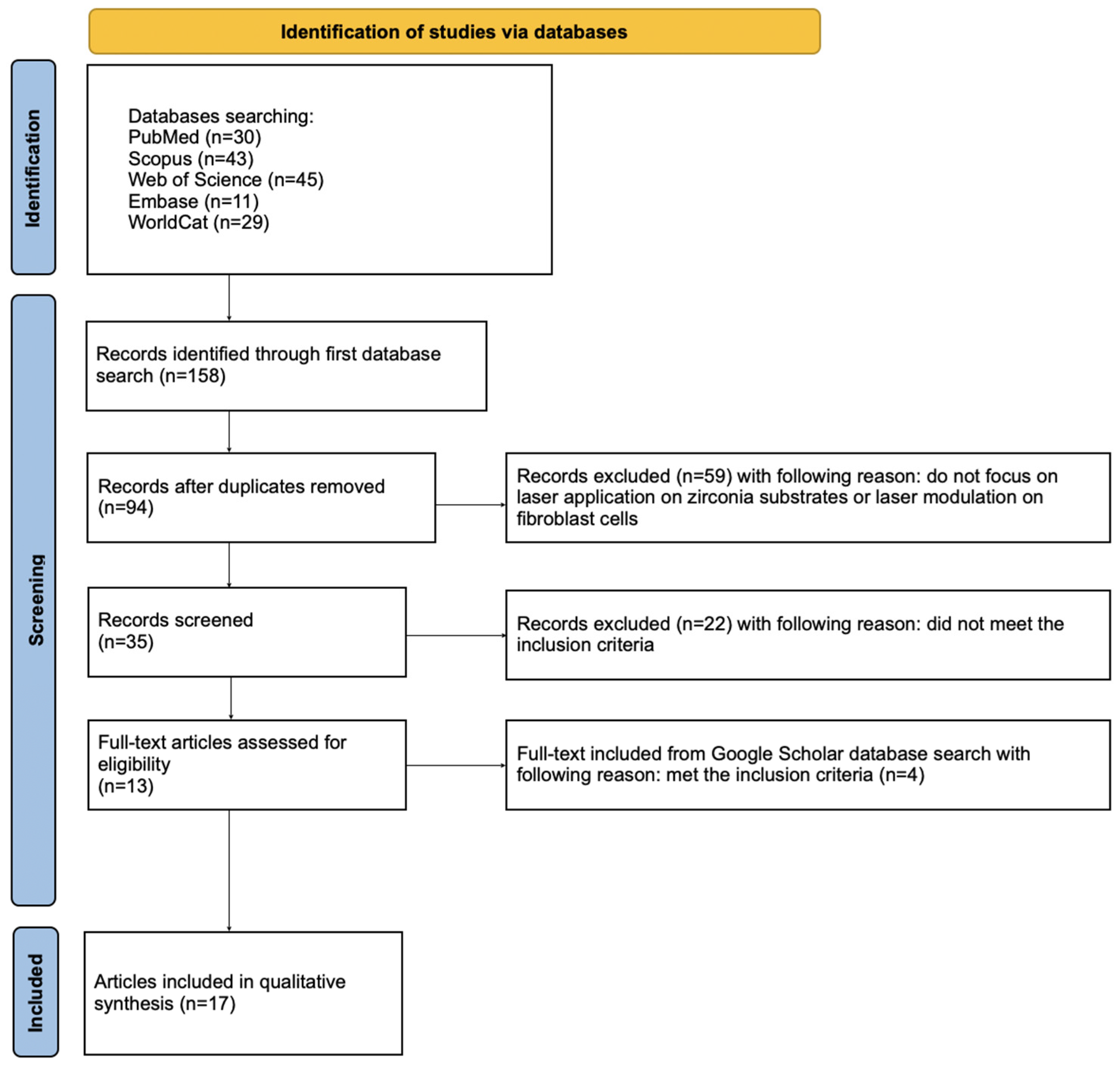
3.1. Study Selection
3.2. General Characteristics of the Included Studies
3.3. Main Study Outcomes
3.3.1. Surface Characteristics
3.3.2. Fibroblast Adhesion and Morphology
3.3.3. Proliferation and Viability
3.3.4. Gene Expression and Cytokine Secretion
3.3.5. Additional Findings
3.4. Quality Assessment of Individual Studies
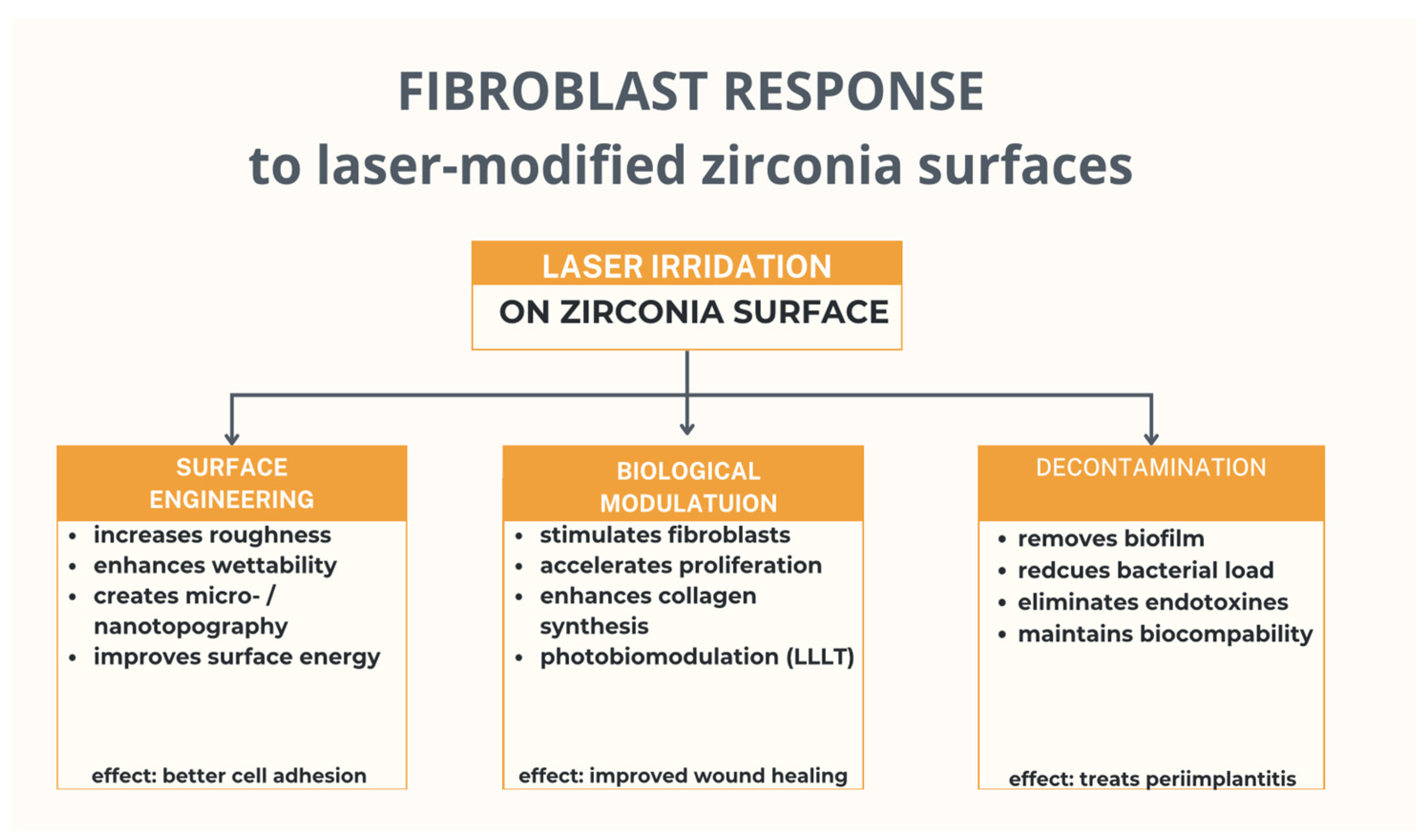
4. Discussion
5. Conclusions
Supplementary Materials
Author Contributions
Funding
Institutional Review Board Statement
Informed Consent Statement
Data Availability Statement
Conflicts of Interest
References
- Zhang, Z.; Li, Y.; Zhang, T.; Yang, X.; Fan, K.; Wang, D.; Li, S.; Hu, Y.; Fu, W. Titanium Implants Modified by Laser Microtexturing Enhance the Bioactivity of Gastric Epithelial Cells and Fibroblast Cells. J. Appl. Biomater. Funct. Mater. 2021, 19, 22808000211064951. [Google Scholar] [CrossRef] [PubMed]
- Hanawa, T. Zirconia versus Titanium in Dentistry: A Review. Dent. Mater. J. 2020, 39, 24–36. [Google Scholar] [CrossRef]
- Roehling, S.; Schlegel, K.A.; Woelfler, H.; Gahlert, M. Zirconia Compared to Titanium Dental Implants in Preclinical Studies—A Systematic Review and Meta-analysis. Clin. Oral. Implant. Res. 2019, 30, 365–395. [Google Scholar] [CrossRef]
- Biju, D.; Arumugam, P.; Kannan, S.; Yadalam, P.K.; Ronsivalle, V.; Cicciù, M.; Minervini, G. Development, Characterization, and Biocompatibility and Corrosion Analyses of a Silver-Decorated Graphene Oxide and Chitosan Surface Coating for Titanium Dental Implants: A Preliminary Report. Dent. Med. Probl. 2024, 61, 627–632. [Google Scholar] [CrossRef]
- Pecnik, C.M.; Roos, M.; Muff, D.; Spolenak, R.; Sailer, I. In Vitro Color Evaluation of Esthetic Coatings for Metallic Dental Implants and Implant Prosthetic Appliances. Clin. Oral. Implant. Res. 2015, 26, 563–571. [Google Scholar] [CrossRef]
- Ramanauskaite, A.; Sader, R. Esthetic Complications in Implant Dentistry. Periodontol. 2000 2022, 88, 73–85. [Google Scholar] [CrossRef] [PubMed]
- Cosyn, J.; Thoma, D.S.; Hämmerle, C.H.F.; De Bruyn, H. Esthetic Assessments in Implant Dentistry: Objective and Subjective Criteria for Clinicians and Patients. Periodontol. 2000 2017, 73, 193–202. [Google Scholar] [CrossRef] [PubMed]
- Fenner, N.; Hämmerle, C.H.F.; Sailer, I.; Jung, R.E. Long-term Clinical, Technical, and Esthetic Outcomes of All-ceramic vs. Titanium Abutments on Implant Supporting Single-tooth Reconstructions after at Least 5 Years. Clin. Oral. Implant. Res. 2016, 27, 716–723. [Google Scholar] [CrossRef]
- Totou, D.; Naka, O.; Mehta, S.B.; Banerji, S. Esthetic, Mechanical, and Biological Outcomes of Various Implant Abutments for Single-Tooth Replacement in the Anterior Region: A Systematic Review of the Literature. Int. J. Implant. Dent. 2021, 7, 85. [Google Scholar] [CrossRef] [PubMed]
- Aldhuwayhi, S. Zirconia in Dental Implantology: A Review of the Literature with Recent Updates. Bioengineering 2025, 12, 543. [Google Scholar] [CrossRef] [PubMed]
- Kongkiatkamon, S.; Rokaya, D.; Kengtanyakich, S.; Peampring, C. Current Classification of Zirconia in Dentistry: An Updated Review. PeerJ 2023, 11, e15669. [Google Scholar] [CrossRef]
- Mohseni, P.; Soufi, A.; Chrcanovic, B.R. Clinical Outcomes of Zirconia Implants: A Systematic Review and Meta-Analysis. Clin. Oral. Investig. 2023, 28, 15. [Google Scholar] [CrossRef]
- Afrashtehfar, K.I.; Del Fabbro, M. Clinical Performance of Zirconia Implants: A Meta-Review. J. Prosthet. Dent. 2020, 123, 419–426. [Google Scholar] [CrossRef]
- Nishihara, H.; Haro Adanez, M.; Att, W. Current Status of Zirconia Implants in Dentistry: Preclinical Tests. J. Prosthodont. Res. 2019, 63, 1–14. [Google Scholar] [CrossRef] [PubMed]
- Wilson, N.H.F.; Blum, I.R. Performance of Zirconia Implants. Evid. Based Dent. 2019, 20, 92–93. [Google Scholar] [CrossRef] [PubMed]
- Sztyler, K.; Pajączkowska, M.; Nowicka, J.; Rusak, A.; Chodaczek, G.; Dubniański, Ł.; Nikodem, A.; Wiglusz, R.J.; Watras, A.; Dobrzyński, M. Assessment of the Physico-Chemical, Microbial, and Cytotoxic Characteristics of Zirconia Crowns Utilized in Pediatric Dentistry. Appl. Sci. 2025, 15, 5444. [Google Scholar] [CrossRef]
- Singh, P.V.; Reche, A.; Paul, P.; Agarwal, S. Zirconia Facts and Perspectives for Biomaterials in Dental Implantology. Cureus 2023, 15, e46828. [Google Scholar] [CrossRef] [PubMed]
- Bapat, R.A.; Yang, H.J.; Chaubal, T.V.; Dharmadhikari, S.; Abdulla, A.M.; Arora, S.; Rawal, S.; Kesharwani, P. Review on Synthesis, Properties and Multifarious Therapeutic Applications of Nanostructured Zirconia in Dentistry. RSC Adv. 2022, 12, 12773–12793. [Google Scholar] [CrossRef]
- Degidi, M.; Artese, L.; Scarano, A.; Perrotti, V.; Gehrke, P.; Piattelli, A. Inflammatory Infiltrate, Microvessel Density, Nitric Oxide Synthase Expression, Vascular Endothelial Growth Factor Expression, and Proliferative Activity in Peri-Implant Soft Tissues Around Titanium and Zirconium Oxide Healing Caps. J. Periodontol. 2006, 77, 73–80. [Google Scholar] [CrossRef]
- Ban, S. Classification and Properties of Dental Zirconia as Implant Fixtures and Superstructures. Materials 2021, 14, 4879. [Google Scholar] [CrossRef]
- Kuzu, T.E.; Kiş, H.C. Effect of Different Cone Beam Computed Tomography Settings on Artifact Production in Titanium and Zirconia Dental Implants: An in Vitro Study. Dent. Med. Probl. 2024, 61, 233–239. [Google Scholar] [CrossRef] [PubMed]
- Bommala, M.; Koduganti, R.R.; Panthula, V.N.R.; Jammula, S.P.; Gireddy, H.; Ambati, M.; Ganachari, B. Efficacy of Root Coverage with the Use of the Conventional versus Laser-Assisted Flap Technique with Platelet-Rich Fibrin in Class I and Class II Gingival Recession: A Randomized Clinical Trial. Dent. Med. Probl. 2023, 60, 583–592. [Google Scholar] [CrossRef] [PubMed]
- Tang, K.; Luo, M.-L.; Zhou, W.; Niu, L.-N.; Chen, J.-H.; Wang, F. The Integration of Peri-Implant Soft Tissues around Zirconia Abutments: Challenges and Strategies. Bioact. Mater. 2023, 27, 348–361. [Google Scholar] [CrossRef] [PubMed]
- Bosshardt, D.D.; Chappuis, V.; Buser, D. Osseointegration of Titanium, Titanium Alloy and Zirconia Dental Implants: Current Knowledge and Open Questions. Periodontol. 2000 2017, 73, 22–40. [Google Scholar] [CrossRef]
- Sharma, M.; Bhatia, T.; Sharma, R.; Nandan, R.; Bagga, A.; Kapoor, H. Bridging the Gap: Soft Tissue Considerations in Dental Implants from Microscopic to Macroscopic Levels. Cureus 2024, 16, e64002. [Google Scholar] [CrossRef]
- Kara, N.; Selamet, H.; Benkli, Y.A.; Beldüz, M.; Gökmenoğlu, C.; Kara, C. Laser Therapy Induces Increased Viability and Proliferation in Isolated Fibroblast Cells. Wounds Compend. Clin. Res. Pract. 2020, 32, 69–73. [Google Scholar]
- Chao, D.; Komatsu, K.; Matsuura, T.; Cheng, J.; Stavrou, S.C.; Jayanetti, J.; Chang, T.-L.; Ogawa, T. Human Gingival Fibroblast Growth and Function in Response to Laser-Induced Meso- and Microscale Hybrid Topography on Dental Implant Healing Abutments. Int. J. Oral. Maxillofac. Implant. 2024, 39, 603–614. [Google Scholar] [CrossRef]
- Kono, A.; Oguri, A.; Yokoo, K.; Watanabe, H. YAG Laser Treatment Causes Rapid Degeneration and Regeneration of Collagen Fibres in Pig Skin and Facilitates Fibroblast Growth. J. Plast. Surg. Hand Surg. 2012, 46, 308–312. [Google Scholar] [CrossRef]
- Barbosa, T.P.; Naves, M.M.; Menezes, H.H.M.; Pinto, P.H.C.; De Mello, J.D.B.; Costa, H.L. Topography and Surface Energy of Dental Implants: A Methodological Approach. J. Braz. Soc. Mech. Sci. Eng. 2017, 39, 1895–1907. [Google Scholar] [CrossRef]
- Kumar, P.S.; Ks, S.K.; Grandhi, V.V.; Gupta, V. The Effects of Titanium Implant Surface Topography on Osseointegration: Literature Review. JMIR Biomed. Eng. 2019, 4, e13237. [Google Scholar] [CrossRef]
- Menezes, H.H.M.; Naves, M.M.; Costa, H.L.; Barbosa, T.P.; Ferreira, J.A.; Magalhães, D.; Martinez, E.F. Effect of Surgical Installation of Dental Implants on Surface Topography and Its Influence on Osteoblast Proliferation. Int. J. Dent. 2018, 2018, 1–13. [Google Scholar] [CrossRef]
- Almas, K.; Smith, S.; Kutkut, A. What Is the Best Micro and Macro Dental Implant Topography? Dent. Clin. North Am. 2019, 63, 447–460. [Google Scholar] [CrossRef] [PubMed]
- Dahiya, V.; Shukla, P.; Gupta, S. Surface Topography of Dental Implants: A Review. J. Dent. Implant. 2014, 4, 66. [Google Scholar] [CrossRef]
- Ciszyński, M.; Chwaliszewski, B.; Simka, W.; Dominiak, M.; Gedrange, T.; Hadzik, J. Zirconia Dental Implant Designs and Surface Modifications: A Narrative Review. Materials 2024, 17, 4202. [Google Scholar] [CrossRef]
- Matys, J.; Rygus, R.; Kensy, J.; Okoniewska, K.; Zakrzewski, W.; Kotela, A.; Struzik, N.; Gerber, H.; Fast, M.; Dobrzyński, M. Enhancing Osseointegration of Zirconia Implants Using Calcium Phosphate Coatings: A Systematic Review. Materials 2025, 18, 4501. [Google Scholar] [CrossRef] [PubMed]
- Divakar, S.; Rathee, M.; Jain, P.; Malik, S.; Tomar, S.S.; Alam, M. Comparative Evaluation of Mechanical Effects of Two Designs of Immediately Placed Customized Root-Analogue Zirconia Implants in the Maxillary and Mandibular Posterior Regions: A Finite Element Analysis. Dent. Med. Probl. 2025, 62, 99–106. [Google Scholar] [CrossRef]
- Karthigeyan, S.; Ravindran, A.; Bhat, R.R.; Nageshwarao, M.; Murugesan, S.; Angamuthu, V. Surface Modification Techniques for Zirconia-Based Bioceramics: A Review. J. Pharm. Bioallied Sci. 2019, 11 (Suppl. S2), S131–S134. [Google Scholar] [CrossRef]
- Dommeti, V.K.; Pramanik, S.; Roy, S. Design of Customized Coated Dental Implants Using Finite Element Analysis. Dent. Med. Probl. 2023, 60, 385–392. [Google Scholar] [CrossRef]
- Tardelli, J.D.C.; Loyolla, C.D.; Ferreira, I.; Kreve, S.; Dos Reis, A.C. Influence of Surface Modifications on the Fracture Resistance of Aged Zirconia Implants: A Systematic Review of in Vitro Experimental Studies. J. Oral Maxillofac. Surg. Med. Pathol. 2024, 36, 1–10. [Google Scholar] [CrossRef]
- Silva, N.R.F.A.; Coelho, P.G.; Valverde, G.B.; Becker, K.; Ihrke, R.; Quade, A.; Thompson, V.P. Surface Characterization of Ti and Y-TZP Following Non-thermal Plasma Exposure. J. Biomed. Mater. Res. B Appl. Biomater. 2011, 99B, 199–206. [Google Scholar] [CrossRef]
- Hong, G.; Liao, M.; Wu, T.; Zhou, Q.; Xie, H.; Chen, C. Improving Osteogenic Activity of Y-TZP (Yttria-Stabilized Tetragonal Zirconia Polycrystal) Surfaces by Grafting of Silanes with Different End Groups. Appl. Surf. Sci. 2021, 570, 151144. [Google Scholar] [CrossRef]
- Cunha, W.; Carvalho, O.; Henriques, B.; Silva, F.S.; Özcan, M.; Souza, J.C.M. Surface Modification of Zirconia Dental Implants by Laser Texturing. Lasers Med. Sci. 2022, 37, 77–93. [Google Scholar] [CrossRef]
- Papia, E.; Jimbo, R.; Chrcanovic, B.R.; Andersson, M.; Vult Von Steyern, P. Surface Structure and Mechanical Properties of Impaction-Modified Y-TZP. Dent. Mater. 2014, 30, 808–816. [Google Scholar] [CrossRef] [PubMed]
- Choe, R.; Balhaddad, A.A.; Fisher, J.P.; Melo, M.A.S.; Huang, H. Photodynamic Therapy for Biomodulation and Disinfection in Implant Dentistry: Is It Feasible and Effective? Photochem. Photobiol. 2021, 97, 916–929. [Google Scholar] [CrossRef] [PubMed]
- Harhash, T. Influence of Low Intensity Laser Biomodulation on the Osseointegration of Delayed and Delayed-Immediate Implants. Egypt. Dent. J. 2019, 65, 1187–1200. [Google Scholar] [CrossRef]
- Bose, V.P.; Sodha, A.S.; Jakhar, R.; Patel, M.L.; Gautam, P.; Parihar, P. A Brief Review on Laser Therapy in Periodontal and Peri-Implant Healing. J. Pharm. Bioallied Sci. 2025, 17, S1098–S1100. [Google Scholar] [CrossRef]
- Alam, H.; Aboelnagga, M.; Elsayed, A. Effect of Er,Cr:YSGG LASER Bio-Modulation of Osteotomy Site on Peri-Implant Crestal Bone Level in Lower Single Fixed Detachable Prosthesis. Egypt. Dent. J. 2022, 68, 665–675. [Google Scholar] [CrossRef]
- Reza, B.; Soheil, N.; Ehsan, B.; Kourosh, S.; Reza, F. Efficacy of Photo Bio-Modulation Therapy for Pain Relief and Soft Tissue Wound Healing after Dental Implant Surgery: A Double-Blind Randomized Clinical Trial. J. Photochem. Photobiol. 2021, 8, 100062. [Google Scholar] [CrossRef]
- Łukaszewska-Kuska, M.; Barylyak, A.; Bobitski, Y.; Piotr, K.; Buchwald, T.; Martyła, A.; Zinchenko, V.; Majchrowski, R.; Przekop, R.E.; Dorocka-Bobkowska, B. Electrodeposited Hydroxyapatite Coating on Titanium after Ultrashort-Pulsed Laser Processing for a Novel Surface of Endosseous Implants. Dent. Med. Probl. 2024, 61, 909–918. [Google Scholar] [CrossRef]
- Alqutub, M.N. Peri-Implant Parameters and Cytokine Profile among Peri-Implant Disease Patients Treated with Er Cr YSGG Laser and PDT. Photodiagnosis Photodyn. Ther. 2022, 37, 102641. [Google Scholar] [CrossRef]
- AlMarzooqi, A.M.A.; Ramachandra, S.S.; Kukreja, B.J.; Reddy, S.; Souza, J.L.D.; Abdelmagyd, H.A.E. Treatment of Peri-Implant Diseases Using Lasers: A Systematic Review. Open Dent. J. 2023, 17, e187421062305101. [Google Scholar] [CrossRef]
- Vohra, F.; Al-Rifaiy, M.Q.; Lillywhite, G.; Abu Hassan, M.I.; Javed, F. Efficacy of Mechanical Debridement with Adjunct Antimicrobial Photodynamic Therapy for the Management of Peri-Implant Diseases: A Systematic Review. Photochem. Photobiol. Sci. 2014, 13, 1160–1168. [Google Scholar] [CrossRef]
- Hashim, D.; Courvoisier, D.; Cionca, N. A Randomised Clinical Trial Comparing a Surgical Approach for Treatment of Peri-Implantitis to Non-Surgical Debridement with Adjunctive Diode Laser Therapy. Clin. Oral Investig. 2025, 29, 142. [Google Scholar] [CrossRef]
- Mizutani, K.; Aoki, A.; Coluzzi, D.; Yukna, R.; Wang, C.; Pavlic, V.; Izumi, Y. Lasers in Minimally Invasive Periodontal and Peri-implant Therapy. Periodontol. 2000 2016, 71, 185–212. [Google Scholar] [CrossRef] [PubMed]
- Santonocito, S.; Polizzi, A.; Cavalcanti, R.; Ronsivalle, V.; Chaurasia, A.; Spagnuolo, G.; Isola, G. Impact of Laser Therapy on Periodontal and Peri-Implant Diseases. Photobiomodulation Photomed. Laser Surg. 2022, 40, 454–462. [Google Scholar] [CrossRef]
- Abduljabbar, T.; Javed, F.; Kellesarian, S.V.; Vohra, F.; Romanos, G.E. Effect of Nd:YAG Laser-Assisted Non-Surgical Mechanical Debridement on Clinical and Radiographic Peri-Implant Inflammatory Parameters in Patients with Peri-Implant Disease. J. Photochem. Photobiol. B 2017, 168, 16–19. [Google Scholar] [CrossRef] [PubMed]
- Yasuno, K.; Kakura, K.; Taniguchi, Y.; Yamaguchi, Y.; Kido, H. Zirconia Implants with Laser Surface Treatment: Peri-Implant Bone Response and Enhancement of Osseointegration. J. Hard Tissue Biol. 2014, 23, 93–100. [Google Scholar] [CrossRef]
- Moura, C.G.; Pereira, R.; Buciumeanu, M.; Carvalho, O.; Bartolomeu, F.; Nascimento, R.; Silva, F.S. Effect of Laser Surface Texturing on Primary Stability and Surface Properties of Zirconia Implants. Ceram. Int. 2017, 43, 15227–15236. [Google Scholar] [CrossRef]
- Madeira, S.; Barbosa, A.; Moura, C.G.; Buciumeanu, M.; Silva, F.S.; Carvalho, O. Aunps and Agμps-Functionalized Zirconia Surfaces by Hybrid Laser Technology for Dental Implants. Ceram. Int. 2020, 46, 7109–7121. [Google Scholar] [CrossRef]
- Delgado-Ruíz, R.A.; Calvo-Guirado, J.L.; Moreno, P.; Guardia, J.; Gomez-Moreno, G.; Mate-Sánchez, J.E.; Ramirez-Fernández, P.; Chiva, F. Femtosecond Laser Microstructuring of Zirconia Dental Implants. J. Biomed. Mater. Res. B Appl. Biomater. 2011, 96B, 91–100. [Google Scholar] [CrossRef]
- Jin, H.W.; Noumbissi, S.; Wiedemann, T.G. Comparison of Zirconia Implant Surface Modifications for Optimal Osseointegration. J. Funct. Biomater. 2024, 15, 91. [Google Scholar] [CrossRef]
- Matys, J.; Hadzik, J.; Dominiak, M. Schneiderian Membrane Perforation Rate and Increase in Bone Temperature During Maxillary Sinus Floor Elevation by Means of Er: YAG Laser—An Animal Study in Pigs. Implant. Dent. 2017, 26, 238–244. [Google Scholar] [CrossRef] [PubMed]
- Matys, J.; Świder, K.; Flieger, R. Laser Instant Implant Impression Method: A Case Presentation. Dent. Med. Probl. 2017, 54, 101–106. [Google Scholar] [CrossRef]
- Matys, J.; Romeo, U.; Mroczka, K.; Grzech-Leśniak, K.; Dominiak, M. Temperature Changes and SEM Effects of Three Different Implants-Abutment Connection during Debridement with Er:YAG Laser: An Ex Vivo Study. Materials 2019, 12, 3748. [Google Scholar] [CrossRef] [PubMed]
- Kensy, J.; Dobrzyński, M.; Wiench, R.; Grzech-Leśniak, K.; Matys, J. Fibroblasts Adhesion to Laser-Modified Titanium Surfaces—A Systematic Review. Materials 2021, 14, 7305. [Google Scholar] [CrossRef]
- Rahman, S.; Nk, S.; Mehta, D.S. Evaluation of the Wound-Healing Potential of the Kiwifruit Extract by Assessing Its Effects on Human Gingival Fibroblasts and Angiogenesis. Dent. Med. Probl. 2023, 60, 71–77. [Google Scholar] [CrossRef]
- Yamaguchi, Y.; Ohshima, M.; Maekawa, S.; Meinzer, W.; Akira, A. Analysis of Collagen Gel Degradation in an Experimental Cell Culture Model Using Fibroblasts Isolated from Peri-Implantitis Lesions. Dent. Med. Probl. 2025, 62, 505–512. [Google Scholar] [CrossRef]
- Assery, N.; Alomeir, N.; Zeng, Y.; Xiao, J.; Tsigarida, A. The Effect of Er:YAG Laser Treatment on Biofilm Formation on Titanium and Zirconia Disc Surfaces. J. Periodontol. 2023, 94, 344–353. [Google Scholar] [CrossRef]
- Romanos, G.E. Wound Healing in Immediately Loaded Implants. Periodontol. 2000 2015, 68, 153–167. [Google Scholar] [CrossRef]
- Cheng, J.; Liu, D.; Bao, L.; Xu, K.; Yang, Y.; Han, K. A Single 2-(2′-Hydroxyphenyl)Benzothiazole Derivative Can Achieve Pure White-Light Emission. Chem. Asian J. 2014, 9, 3215–3220. [Google Scholar] [CrossRef]
- Tiainen, H.; Lyngstadaas, S.P.; Ellingsen, J.E.; Haugen, H.J. Ultra-Porous Titanium Oxide Scaffold with High Compressive Strength. J. Mater. Sci. Mater. Med. 2010, 21, 2783–2792. [Google Scholar] [CrossRef]
- Bullock, A.; Pickavance, P.; Haddow, D.; Rimmer, S.; MacNeil, S. Development of a Calcium-Chelating Hydrogel for Treatment of Superficial Burns and Scalds. Regen. Med. 2010, 5, 55–64. [Google Scholar] [CrossRef] [PubMed]
- Chen, Y.; Liu, C.; Chen, X.; Mo, A. Clinical Evidence of Photobiomodulation Therapy (PBMT) on Implant Stability and Success: A Systematic Review and Meta-Analysis. BMC Oral Health 2019, 19, 77. [Google Scholar] [CrossRef] [PubMed]
- Matys, J.; Flieger, R.; Gedrange, T.; Janowicz, K.; Kempisty, B.; Grzech-Leśniak, K.; Dominiak, M. Effect of 808 Nm Semiconductor Laser on the Stability of Orthodontic Micro-Implants: A Split-Mouth Study. Materials 2020, 13, 2265. [Google Scholar] [CrossRef] [PubMed]
- Matys, J.; Flieger, R.; Świder, K.; Gedrange, T.; Hutchings, G.; Dyszkiewicz-Konwińska, M.; Kempisty, B.; Nammour, S.; Dominiak, M.; Grzech-Leśniak, K. A Clinical Trial of Photobiomodulation Effect on Orthodontic Microscrews Stability Using a 635 Nm Red Laser Light. Photobiomodulation Photomed. Laser Surg. 2020, 38, 607–613. [Google Scholar] [CrossRef] [PubMed]
- Gómez-Florit, M.; Ramis, J.M.; Xing, R.; Taxt-Lamolle, S.; Haugen, H.J.; Lyngstadaas, S.P.; Monjo, M. Differential Response of Human Gingival Fibroblasts to Titanium- and Titanium-zirconium-modified Surfaces. J. Periodontal Res. 2014, 49, 425–436. [Google Scholar] [CrossRef]
- Yang, Y.; Zheng, M.; Liao, Y.; Zhou, J.; Li, H.; Tan, J. Different Behavior of Human Gingival Fibroblasts on Surface Modified Zirconia: A Comparison between Ultraviolet (UV) Light and Plasma. Dent. Mater. J. 2019, 38, 756–763. [Google Scholar] [CrossRef]
- Liu, D.; Tsoi, J.K.-H.; Matinlinna, J.P.; Wong, H.M. Effects of Some Chemical Surface Modifications on Resin Zirconia Adhesion. J. Mech. Behav. Biomed. Mater. 2015, 46, 23–30. [Google Scholar] [CrossRef]
- Groessner-Schreiber, B.; Neubert, A.; Müller, W.; Hopp, M.; Griepentrog, M.; Lange, K. Fibroblast Growth on Surface-modified Dental Implants: An in Vitro Study. J. Biomed. Mater. Res. A 2003, 64A, 591–599. [Google Scholar] [CrossRef]
- Depprich, R.; Zipprich, H.; Ommerborn, M.; Naujoks, C.; Wiesmann, H.-P.; Kiattavorncharoen, S.; Lauer, H.-C.; Meyer, U.; Kübler, N.R.; Handschel, J. Osseointegration of Zirconia Implants Compared with Titanium: An in Vivo Study. Head Face Med. 2008, 4, 30. [Google Scholar] [CrossRef] [PubMed]
- Borie, E.; Rosas, E.; De Souza, R.F.; Dias, F.J. Zirconia Implants: A Brief Review and Surface Analysis of a Lost Implant. Coatings 2024, 14, 995. [Google Scholar] [CrossRef]
- Gul, A.; Papia, E.; Naimi-Akbar, A.; Ruud, A.; Vult Von Steyern, P. Zirconia Dental Implants; the Relationship between Design and Clinical Outcome: A Systematic Review. J. Dent. 2024, 143, 104903. [Google Scholar] [CrossRef] [PubMed]
- Huang, X.; Lin, J.; Demner-Fushman, D. Evaluation of PICO as a Knowledge Representation for Clinical Questions. AMIA. Annu. Symp. Proc. 2006, 2006, 359–363. [Google Scholar]
- Page, M.J.; McKenzie, J.E.; Bossuyt, P.M.; Boutron, I.; Hoffmann, T.C.; Mulrow, C.D.; Shamseer, L.; Tetzlaff, J.M.; Akl, E.A.; Brennan, S.E.; et al. The PRISMA 2020 Statement: An Updated Guideline for Reporting Systematic Reviews. BMJ 2021, 372, n71. [Google Scholar] [CrossRef]
- Homa, K.; Zakrzewski, W.; Dobrzyński, W.; Piszko, P.J.; Piszko, A.; Matys, J.; Wiglusz, R.J.; Dobrzyński, M. Surface Functionalization of Titanium-Based Implants with a Nanohydroxyapatite Layer and Its Impact on Osteoblasts: A Systematic Review. J. Funct. Biomater. 2024, 15, 45. [Google Scholar] [CrossRef]
- Piszko, P.J.; Piszko, A.; Kiryk, J.; Lubojański, A.; Dobrzyński, W.; Wiglusz, R.J.; Matys, J.; Dobrzyński, M. The Influence of Fluoride Gels on the Physicochemical Properties of Tooth Tissues and Dental Materials—A Systematic Review. Gels 2024, 10, 98. [Google Scholar] [CrossRef] [PubMed]
- Stein, J.M.; Conrads, G.; Abdelbary, M.M.H.; Yekta-Michael, S.S.; Buttler, P.; Glock, J.; Sadvandi, G.; Kaufmann, R.; Apel, C. Antimicrobial Efficiency and Cytocompatibility of Different Decontamination Methods on Titanium and Zirconium Surfaces. Clin. Oral Implant. Res. 2023, 34, 20–32. [Google Scholar] [CrossRef] [PubMed]
- Da Cruz, M.B.; Marques, J.F.; Fernandes, B.F.; Pinto, P.; Madeira, S.; Carvalho, Ó.; Silva, F.S.; Caramês, J.M.M.; Da Mata, A.D.S.P. Laser Surface Treatment on Yttria-stabilized Zirconia Dental Implants: Influence on Cell Behavior. J. Biomed. Mater. Res. B Appl. Biomater. 2022, 110, 249–258. [Google Scholar] [CrossRef] [PubMed]
- Staehlke, S.; Oster, P.; Seemann, S.; Kruse, F.; Brief, J.; Nebe, B. Laser Structured Dental Zirconium for Soft Tissue Cell Occupation—Importance of Wettability Modulation. Materials 2022, 15, 732. [Google Scholar] [CrossRef]
- Pham, C.M.; Chen, C.-Y.; Kim, D.M. The Effects of Using Erbium, Chromium-Doped:Yttrium-Scandium-Gallium-Garnet Laser on the Surface Modification, Bacterial Decontamination, and Cell Adhesion on Zirconia Discs: An in Vitro Study. Lasers Med. Sci. 2021, 36, 1701–1708. [Google Scholar] [CrossRef]
- Pansani, T.N.; Basso, F.G.; De Souza Costa, C.A. In Vitro Effects of Photobiomodulation Applied to Gingival Fibroblasts Cultured on Titanium and Zirconia Surfaces and Exposed to LPS from Escherichia Coli. Lasers Med. Sci. 2020, 35, 2031–2038. [Google Scholar] [CrossRef]
- Lang, M.; Cerutis, D.; Miyamoto, T.; Nunn, M. Cell Attachment Following Instrumentation with Titanium and Plastic Instruments, Diode Laser, and Titanium Brush on Titanium, Titanium-Zirconium, and Zirconia Surfaces. Int. J. Oral Maxillofac. Implant. 2016, 31, 799–806. [Google Scholar] [CrossRef] [PubMed]
- Sun, J.; Ding, Q.; Chen, Y.; Li, J.; Wang, Z.; Wei, Z.; Ge, X.; Zhang, L. Effects and Underlying Mechanism of Micro-Nano-Structured Zirconia Surfaces on Biological Behaviors of Human Gingival Fibroblasts under Inflammatory Conditions. Acta Biomater. 2024, 183, 356–370. [Google Scholar] [CrossRef] [PubMed]
- Lepekhina, T.B.; Nikolaev, V.V.; Darvin, M.E.; Zuhayri, H.; Snegerev, M.S.; Lozhkomoev, A.S.; Senkina, E.I.; Kokhanenko, A.P.; Lozovoy, K.A.; Kistenev, Y.V. Two-Photon-Excited FLIM of NAD(P)H and FAD—Metabolic Activity of Fibroblasts for the Diagnostics of Osteoimplant Survival. Int. J. Mol. Sci. 2024, 25, 2257. [Google Scholar] [CrossRef] [PubMed]
- Jelínek, M.; Dostálová, T.; Teuberová, Z.; Seydlová, M.; Mašínová, P.; Kocourek, T.; Mróz, W.; Prokopiuk, A.; Smetana, K. Study of Laser Created ZRO2 and Hydroxyapatite/ZrO2 Films for Implantology. Biomol. Eng. 2007, 24, 103–106. [Google Scholar] [CrossRef]
- Hao, L.; Lawrence, J. Laser Surface Treatment of Magnesia Partially Stabilized Zirconia for Enhanced Human Skin Fibroblast Cell Response. J. Laser Appl. 2004, 16, 55–64. [Google Scholar] [CrossRef]
- Akashi, Y.; Shimoo, Y.; Hashiguchi, H.; Nakajima, K.; Kokubun, K.; Matsuzaka, K. Effects of Excimer Laser Treatment of Zirconia Disks on the Adhesion of L929 Fibroblasts. Materials 2022, 16, 115. [Google Scholar] [CrossRef]
- Petrović, S.; Peruško, D.; Mimidis, A.; Kavatzikidou, P.; Kovač, J.; Ranella, A.; Novaković, M.; Popović, M.; Stratakis, E. Response of NIH 3T3 Fibroblast Cells on Laser-Induced Periodic Surface Structures on a 15×(Ti/Zr)/Si Multilayer System. Nanomaterials 2020, 10, 2531. [Google Scholar] [CrossRef]
- Gnilitskyi, I.; Pogorielov, M.; Viter, R.; Ferraria, A.M.; Carapeto, A.P.; Oleshko, O.; Orazi, L.; Mishchenko, O. Cell and Tissue Response to Nanotextured Ti6Al4V and Zr Implants Using High-Speed Femtosecond Laser-Induced Periodic Surface Structures. Nanomed. Nanotechnol. Biol. Med. 2019, 21, 102036. [Google Scholar] [CrossRef]
- Marques, A.F.S.; Loureiro, F.A.P.; Sahoo, N.; Marques, J.R.O.F.; Da Cruz, M.F.B.; Mata, A.D.S.P.D.; Caramês, J.; Silva, F.S.C.P.D.; Carvalho, Ó.S.N. Nd-YAG Laser Texturing of Zirconia Implant Surfaces. Lasers Manuf. Mater. Process. 2023, 10, 1–18. [Google Scholar] [CrossRef]
- Aivazi, M.; Fathi, M.; Nejatidanesh, F.; Mortazavi, V.; Hashemi Beni, B.; Matinlinna, J.P. Effect of Surface Modification on Viability of L929 Cells on Zirconia Nanocomposite Substrat. J. Lasers Med. Sci. 2017, 9, 87–91. [Google Scholar] [CrossRef] [PubMed]
- Fernandes, B.F.; Silva, N.; Da Cruz, M.B.; Garret, G.; Carvalho, Ó.; Silva, F.; Mata, A.; Francisco, H.; Marques, J.F. Cell Biological and Antibacterial Evaluation of a New Approach to Zirconia Implant Surfaces Modified with MTA. Biomimetics 2024, 9, 155. [Google Scholar] [CrossRef] [PubMed]
- Da Cruz, M.B.; Marques, J.F.; Marques, A.F.S.; Madeira, S.; Carvalho, Ó.; Silva, F.; Caramês, J.; Da Mata, A.D.S.P. Modification of Zirconia Implant Surfaces by Nd:YAG Laser Grooves: Does It Change Cell Behavior? Biomimetics 2022, 7, 49. [Google Scholar] [CrossRef] [PubMed]
- Noro, A.; Kaneko, M.; Murata, I.; Yoshinari, M. Influence of Surface Topography and Surface Physicochemistry on Wettability of Zirconia (Tetragonal Zirconia Polycrystal). J. Biomed. Mater. Res. B Appl. Biomater. 2013, 101B, 355–363. [Google Scholar] [CrossRef]
- Schünemann, F.H.; Galárraga-Vinueza, M.E.; Magini, R.; Fredel, M.; Silva, F.; Souza, J.C.M.; Zhang, Y.; Henriques, B. Zirconia Surface Modifications for Implant Dentistry. Mater. Sci. Eng. C Mater. Biol. Appl. 2019, 98, 1294–1305. [Google Scholar] [CrossRef]
- Alagiriswamy, G.; Krishnan, C.; Ramakrishnan, H.; Jayakrishnakumar, S.; Mahadevan, V.; Azhagarasan, N. Surface Characteristics and Bioactivity of Zirconia (Y-TZP) with Different Surface Treatments. J. Pharm. Bioallied Sci. 2020, 12, 114. [Google Scholar] [CrossRef]
- Rohr, N.; Zeller, B.; Matthisson, L.; Fischer, J. Surface Structuring of Zirconia to Increase Fibroblast Viability. Dent. Mater. 2020, 36, 779–786. [Google Scholar] [CrossRef]
- Rutkunas, V.; Borusevicius, R.; Balciunas, E.; Jasinskyte, U.; Alksne, M.; Simoliunas, E.; Zlatev, S.; Ivanova, V.; Bukelskiene, V.; Mijiritsky, E. The Effect of UV Treatment on Surface Contact Angle, Fibroblast Cytotoxicity, and Proliferation with Two Types of Zirconia-Based Ceramics. Int. J. Environ. Res. Public. Health 2022, 19, 11113. [Google Scholar] [CrossRef]
- Guilardi, L.F.; Pereira, G.K.R.; Gündel, A.; Rippe, M.P.; Valandro, L.F. Surface Micro-Morphology, Phase Transformation, and Mechanical Reliability of Ground and Aged Monolithic Zirconia Ceramic. J. Mech. Behav. Biomed. Mater. 2017, 65, 849–856. [Google Scholar] [CrossRef]
- Camposilvan, E.; Torrents, O.; Anglada, M. Small-Scale Mechanical Behavior of Zirconia. Acta Mater. 2014, 80, 239–249. [Google Scholar] [CrossRef]
- Roitero, E.; Anglada, M.; Mücklich, F.; Jiménez-Piqué, E. Mechanical Reliability of Dental Grade Zirconia after Laser Patterning. J. Mech. Behav. Biomed. Mater. 2018, 86, 257–263. [Google Scholar] [CrossRef] [PubMed]
- Rubinstein, A.I.; Sabirianov, R.F.; Namavar, F. Enhanced Cell Growth by Nanoengineering Zirconia to Stimulate Electrostatic Fibronectin Activation. Nanotechnology 2014, 25, 065101. [Google Scholar] [CrossRef] [PubMed]
- Soon, G.; Pingguan-Murphy, B.; Akbar, S.A. Modulation of Osteoblast Behavior on Nanopatterned Yttria-Stabilized Zirconia Surfaces. J. Mech. Behav. Biomed. Mater. 2017, 68, 26–31. [Google Scholar] [CrossRef] [PubMed]
- Ghalandarzadeh, A.; Ganjali, M.; Hosseini, M. Tailoring Zirconia Surface Topography via Femtosecond Laser-Induced Nanoscale Features: Effects on Osteoblast Cells and Antibacterial Properties. Biomed. Mater. 2024, 19, 055017. [Google Scholar] [CrossRef]
- Garcia-de-Albeniz, N.; Müller, D.W.; Mücklich, F.; Ginebra, M.-P.; Jiménez-Piqué, E.; Mas-Moruno, C. Tailoring Cell Behavior and Antibacterial Properties on Zirconia Biomaterials through Femtosecond Laser-Induced Micropatterns and Nanotopography. ACS Appl. Mater. Interfaces 2025, 17, 29082–29099. [Google Scholar] [CrossRef]
- Ghalandarzadeh, A.; Javadpour, J.; Majidian, H.; Ganjali, M. The Evaluation of Prepared Microstructure Pattern by Carbon-Dioxide Laser on Zirconia-Based Ceramics for Dental Implant Application: An in Vitro Study. Odontology 2023, 111, 580–599. [Google Scholar] [CrossRef]
- Jing, X.; Pu, Z.; Zheng, S.; Wang, F.; Qi, H. Nanosecond Laser Induced Microstructure Features and Effects Thereof on the Wettability in Zirconia. Ceram. Int. 2020, 46, 24173–24182. [Google Scholar] [CrossRef]
- Daskalova, A.; Angelova, L.; Carvalho, A.; Trifonov, A.; Nathala, C.; Monteiro, F.; Buchvarov, I. Effect of Surface Modification by Femtosecond Laser on Zirconia Based Ceramics for Screening of Cell-Surface Interaction. Appl. Surf. Sci. 2020, 513, 145914. [Google Scholar] [CrossRef]
- Henriques, B.; Fabris, D.; Voisiat, B.; Boccaccini, A.R.; Lasagni, A.F. Direct Laser Interference Patterning of Zirconia Using Infra-Red Picosecond Pulsed Laser: Effect of Laser Processing Parameters on the Surface Topography and Microstructure. Adv. Funct. Mater. 2024, 34, 2307894. [Google Scholar] [CrossRef]
- Shabir, S.; Khan, N.Z.; Siddiquee, A.N. Laser-Induced Surface Modifications in Biomedical Materials: A Comprehensive Review. Surf. Topogr. Metrol. Prop. 2025, 13, 023002. [Google Scholar] [CrossRef]
- Majidov, I.; Allamyradov, Y.; Kylychbekov, S.; Khuzhakulov, Z.; Er, A.O. Phase Transition and Controlled Zirconia Implant Patterning Using Laser-Induced Shockwaves. Appl. Sci. 2025, 15, 362. [Google Scholar] [CrossRef]
- Li, W.; Ding, Q.; Gao, Y.; Li, J.; Wang, Z.; Wei, Z.; Zhang, L. Femtosecond Laser-Induced Three-Level Micro/Nanostructures for Zirconia Surface Modification. Appl. Opt. 2025, 64, 6157. [Google Scholar] [CrossRef] [PubMed]
- Wang, Y.; Zhang, J.; Yu, H.; Ding, N.; Ma, P.; Zeng, B. Photothermal Modulation of Gingival Fibroblasts via Polydopamine-Coated Zirconia: A Novel Approach for Promoting Peri-Implant Soft Tissue Integration. J. Stomatol. Oral Maxillofac. Surg. 2024, 125, 101925. [Google Scholar] [CrossRef] [PubMed]
- Yang, Z.; Liu, M.; Yang, Y.; Zheng, M.; Yang, Y.; Liu, X.; Tan, J. Biofunctionalization of Zirconia with Cell-Adhesion Peptides via Polydopamine Crosslinking for Soft Tissue Engineering: Effects on the Biological Behaviors of Human Gingival Fibroblasts and Oral Bacteria. RSC Adv. 2020, 10, 6200–6212. [Google Scholar] [CrossRef] [PubMed]
- Aoki, A.; Mizutani, K.; Schwarz, F.; Sculean, A.; Yukna, R.A.; Takasaki, A.A.; Romanos, G.E.; Taniguchi, Y.; Sasaki, K.M.; Zeredo, J.L.; et al. Periodontal and Peri-implant Wound Healing Following Laser Therapy. Periodontol. 2000 2015, 68, 217–269. [Google Scholar] [CrossRef]
- Rizo-Gorrita, M.; Luna-Oliva, I.; Serrera-Figallo, M.-Á.; Gutiérrez-Pérez, J.-L.; Torres-Lagares, D. Comparison of Cytomorphometry and Early Cell Response of Human Gingival Fibroblast (HGFs) between Zirconium and New Zirconia-Reinforced Lithium Silicate Ceramics (ZLS). Int. J. Mol. Sci. 2018, 19, 2718. [Google Scholar] [CrossRef] [PubMed]
- Stübinger, S.; Homann, F.; Etter, C.; Miskiewicz, M.; Wieland, M.; Sader, R. Effect of Er:YAG, CO2 and Diode Laser Irradiation on Surface Properties of Zirconia Endosseous Dental Implants. Lasers Surg. Med. 2008, 40, 223–228. [Google Scholar] [CrossRef]
- Faria, D.; Henriques, B.; Souza, A.C.; Silva, F.S.; Carvalho, O. Laser-Assisted Production of HAp-Coated Zirconia Structured Surfaces for Biomedical Applications. J. Mech. Behav. Biomed. Mater. 2020, 112, 104049. [Google Scholar] [CrossRef]
- Ergun Kunt, G.; Duran, I. Effects of Laser Treatments on Surface Roughness of Zirconium Oxide Ceramics. BMC Oral Health 2018, 18, 222. [Google Scholar] [CrossRef]
- Solaymani, S.; Kulesza, S.; Ţălu, Ş.; Bramowicz, M.; Nezafat, N.B.; Dalouji, V.; Rezaee, S.; Karami, H.; Malekzadeh, M.; Dorbidi, E.S. The Effect of Different Laser Irradiation on Rugometric and Microtopographic Features in Zirconia Ceramics: Study of Surface Statistical Metrics. J. Alloys Compd. 2018, 765, 180–185. [Google Scholar] [CrossRef]
- Abdo, B.M.A.; El-Tamimi, A.M.; Anwar, S.; Umer, U.; Alahmari, A.M.; Ghaleb, M.A. Experimental Investigation and Multi-Objective Optimization of Nd:YAG Laser Micro-Channeling Process of Zirconia Dental Ceramic. Int. J. Adv. Manuf. Technol. 2018, 98, 2213–2230. [Google Scholar] [CrossRef]


| Authors | Aim of the Study | Material and Methods | Results | Conclusions |
|---|---|---|---|---|
| Stein et al. [87] | Investigation of the efficiency of different implant decontamination methods regarding biofilm modification and potential cytotoxic effects on titanium and zirconium surfaces. | Titanium (1.3 µm) and zirconium (1.1 µm) disks were coated with a multispecies high-adherence biofilm (6 strains) and decontaminated using curette, ultrasonic scaler, glycine or erythritol powder air-polishing, and Er:YAG laser. Cell studies with immortalized human gingival fibroblasts (hGF-hTERT)—cultured 24–48 h to assess cytocompatibility. | Ultrasonic scaler, glycine powder AP, erythritol AP, Er:YAG reduced biofilm activity with air-polishing methods being most effective. Fibroblast assays presented high viability and low apoptosis rate after mechanical and laser treatment. CHX, PVI and doxycycline and NaOCL caused significant cytotoxicity PVI killed almost all fibroblasts | Air-polishing and ultrasonic scaler were most effective and presented best biological effect. Er:YAG reduced biofilm but less effective than other groups, chemicals presented cytotoxic effect. |
| da Cruz et al. [88] | Comparison of Nd:YAG laser vs. milling grooves on zirconia for osteoblast and fibroblast response | 3Y-TZP disks, grooves prepared by milling or Nd:YAG laser. Cells: hFOB osteoblast, immortalized HGF. | Milling improved osteoblast viability, collagen and osteopontin. In laser group fibroblasts showed little difference. | Milling favored osteoblasts over laser; fibroblasts groups shown no significant difference. |
| Staehlke et al. [89] | Assessment of physico-chemical modification of the zirconia neck region of implants to improve integration of the implant to surrounding tissue. | Polished zirconia disks were subjected to laser microstructuring, a process that entailed the creation of periodic cavities and convex waves, then activated with argon plasma. Characterization: SEM for surface topography and water contact angle for wettability. Cell studies with HGF-1—morphology, spreading, and actin cytoskeleton assessed during the first 24 h. | The laser-microstructered surfaces (originally hydrophobic), after argon plasma activation became hydrophilic (60 μm cavities 13.7°). HGF-1 cells on laser-induced waves spread well. Argon plasma activation promotes better adhesion and spreading of HGF-1 cells into the cavities. | The combination of laser and argon plasma activation of zirconia has been demonstrated to yield a solution that facilitates optimal gingival cell attachment. |
| Pham et al. [90] | Evaluation of usage of the laser on the surface roughness of zirconia disks. Assessment of single specie biofilm E. coli removal after laser treatment. Analysis of the amount of fibroblast adhesion and proliferation utilizing after laser treatment. | Yttria-stabilized zirconia (Y-TZP) disks (10 mm × 2 mm) were divided into four groups: control, Er,Cr:YSGG laser, ultrasonic scaler, and hand instrument (curette) treated. Characterization: visual inspection, SEM, and profilometry. Bacterial decontamination tested with GFP–E. coli using fluorescence microscopy and ImageJ (National Institutes of Health, Bethesda, MD, USA) counts. Cell studies—fibroblast adhesion assessed by CellTiter-Glo assay and SEM. Data analyzed by ANOVA. | Ultrasonic and hand scalers caused surface damage, while Er,Cr:YSGG laser did not alter roughness. Bacterial decontamination was most effective with the laser and ultrasonic treatment. Fibroblast adhesion was highest in control and laser groups, with laser-treated cells showing elongated morphology and filopodia, suggesting enhanced migration and growth. | The Er,Cr:YSGG laser effectively removed bacteria, outperforming hand instrumentation, and promoted stronger fibroblast adhesion. |
| Pansani et al. [91] | To evaluate whether specific photobiomodulation parameters can enhance metabolism and modulate the inflammatory response of gingival fibroblasts on titanium and zirconia surfaces after exposure to Escherichia coli LPS. | Standardized zirconia disks were polished and sintered. Primary gingival fibroblasts were cultured and irradiated with PBM (0.5, 1.5, 3 J/cm2) three times at 24 h intervals, with or without E. coli LPS exposure. Cell studies—viability, IL-6 and IL-8 synthesis, IL-6 and VEGF gene expression, and fibroblast morphology evaluated. | Fibroblasts on zirconia disks showed reduced viability after LPS exposure and lower survival under laser compared with titanium. IL-6 synthesis was lower, though gene expression was elevated with LPS and modulated by PBM at 3.0 J/cm2. IL-8 increased with LPS and was best regulated by PBM at 1.5 J/cm2, while VEGF was not upregulated by PBM. Morphologically, LPS impaired spreading, but PBM at 3.0 J/cm2 enhanced proliferation and cytoskeletal organization. | Specific PBM parameters can enhance fibroblast metabolism and modulate inflammation on Ti and ZrO2 surfaces, potentially improving soft-tissue attachment and reducing peri-implant inflammation. |
| Lang et al. [92] | To assess how titanium and plastic instruments, a diode laser, and a titanium brush affect the surface properties and fibroblast adhesion on zirconia disks. | Forty zirconia disks were treated with a plastic or titanium curette, diode laser, or rotary titanium brush, or left untreated. Each disk received 20 or 100 strokes to simulate clinical instrumentation. Characterization: surface roughness by optical profilometry. Cell studies—fibroblast adhesion evaluated by SEM cell counts. | For zirconia disks, instrumentation with plastic or titanium curettes, diode microlaser, or a rotary titanium brush caused only negligible changes in surface roughness. Fibroblast adhesion showed no meaningful variation between the different treatment methods. | For zirconia implants, repeated instrumentation did not alter surface roughness, and plastic curettes supported better fibroblast attachment than titanium curettes. |
| Sun et al. [93] | Assessment of biological response of human gingival fibroblasts (HGFs) and inflammatory response to micro- nano-structured zirconia surfaces created with a femtosecond laser. | Yttria-stabilized zirconia specimens were femtosecond laser-treated to create microgrooves (G3: 30 µm × 5 µm × 30 µm; G6: 60 µm × 5 µm × 60 µm). Cell studies with HGFs were conducted. Characterization: surface analysis, XRD, flexural strength, protein adsorption, and cell morphology, proliferation, and migration under inflammatory conditions. Gene expression and key gene verification by RNA sequencing. In vivo inflammatory response tested in rats. Statistical analysis performed. | Modified zirconia surfaces: decreased levels of proinflammatory cytokines and increased levels of anti-inflammatory cytokines, promoted expression of adhesion related molecules, promoted adhesion of HGFs (well developed cells arranged in the direction of microgrooves), decreased neutrophil infiltration and increased M2-type macrophage polarization. | Prepared surfaces exhibited lower inflammatory response and higher HGFs adhesion. Group with narrower groves (30 µm) performed better than other experimental group (60 µm) and control (polished). |
| Lepekhina et al. [94] | The study aimed to assess how ceramic implant surfaces made of zirconia influence fibroblast metabolic activity using laser-based imaging. | Mouse 3T3 fibroblasts were cultured on Y-TZP and ATZ zirconia ceramics. Characterization: two-photon laser excitation and FLIM imaging of NAD(P)H and FAD. Cell studies—viability by MTT assay and morphology by SEM. | The FLIM analysis showed that fibroblasts on ceramic surfaces shifted towards a glycolytic metabolic state (more free NAD(P)H), suggesting hypoxia. Despite this, MTT tests and SEM confirmed high viability and normal morphology. Y-TZP supported slightly better cell proliferation than ATZ. | Fibroblasts cultured on zirconia-based implants remained viable and metabolically active. Two-photon FLIM imaging revealed a shift toward glycolysis, likely due to surface porosity, indicating zirconia supports fibroblast attachment and growth while affecting oxygen-dependent pathways. |
| Jelínek et al. [95] | The purpose of the study was to investigate how zirconia and hydroxyapatite/zirconia coatings, created using laser-based deposition techniques, affect fibroblast behavior in vitro. | ZrO2 and HA/ZrO2 thin films were deposited on titanium alloy substrates using ArF and KrF excimer lasers. Characterization: XRD, SEM, and WDX. Cell studies with human and mouse fibroblasts—cytotoxicity, attachment, and spreading assessed in vitro. | The coatings were either amorphous or crystalline depending on laser settings. HA/ZrO2 films showed no cytotoxic effects and supported fibroblast adhesion and proliferation. In cell culture tests, fibroblasts formed healthy layers on the laser-processed surfaces, with good attachment and even spreading. | The study concluded that zirconia-based coatings enriched with hydroxyapatite, created via pulsed laser deposition on titanium, exhibit both promising mechanical characteristics and excellent compatibility with fibroblasts, supporting their potential application in biomedical implants requiring effective cellular integration. |
| Hao et al. [96] | The study aimed to evaluate how CO2 laser surface modification of magnesia partially stabilized zirconia (MgO–PSZ) affects its ability to support human skin fibroblast adhesion. | MgO–PSZ ceramic blocks were CO2 laser-treated at different power densities. Characterization: surface morphology, roughness, and oxygen content. Cell studies with human skin fibroblasts—adhesion analyzed by SEM after 7 days. | No fibroblasts adhered to untreated zirconia, while CO2 laser-treated surfaces showed significant cell attachment. Laser treatment increased surface roughness and oxygen content, both of which correlated with improved fibroblast adhesion. Optimal results were observed at 1.6 kW/cm2. | CO2 laser treatment effectively modifies the surface of MgO–PSZ, promoting favorable conditions for fibroblast adhesion by increasing roughness, oxygen content, and forming beneficial microstructures. |
| Akashi et al. [97] | The study aimed to investigate whether excimer laser treatment of zirconia surfaces enhances fibroblast adhesion. | Polished zirconia disks were divided into control and laser-treated groups. Characterization: surface roughness and wettability. Cell studies with L929 fibroblasts—adhesion evaluated by qRT-PCR (integrin β1, collagen I α1), 3D laser microscopy (morphology), and confocal microscopy (vinculin distribution). | Excimer laser treatment did not significantly affect surface roughness but markedly increased hydrophilicity. Fibroblasts on laser-treated zirconia exhibited higher expression of adhesion-related genes, developed elongated filopodia and microspikes, and showed stronger vinculin staining, indicating improved adhesion compared with controls. | The findings suggest that excimer laser irradiation improves fibroblast adhesion to zirconia by enhancing hydrophilicity and promoting focal adhesion formation. |
| Petrović et al. [98] | Assessment of novel titanium-zirconium nanocomposite coating modified by ultrafast laser in terms of cell response. | Titanium–zirconium multilayers were produced by ion sputtering and surface-modified using a Yb:KGW laser. Characterization: AES, XPS, optical microscopy, SEM–EDS, AFM, and TEM. Cell studies with NIH 3T3 fibroblasts included SEM analysis after 2 and 4 days. | Laser-processed surfaces featured uniformly distributed LIPSS (4–7 µm) with increased roughness (Ra = 65 nm) and total surface area. Laser modification enhanced chemical reactivity, forming a carbon-rich oxide layer. Fibroblast adhesion and proliferation were evident by 2 days, with cells aligning along LIPSS orientation and increased growth at 4 days, indicating faster proliferation on the modified surface. | High regularity LIPSS achieved with laser parameters: a pulse energy of 2.5 µJ and scan velocity of 3 mm s-1 Laser modification helped to achieve desired composition changes for optimal biocompatibility. |
| Gnilitskyi et al. [99] | Biocompatibility assessment of femtosecond laser nanotexturised surfaces of Ti6Al4V and Zr implants | Highly regular LIPSS were formed on polished Ti6Al4V and Zr surfaces. Characterization: SEM, FIB, AFM, surface roughness, XPS. Contact angle was measured. HDFa cell culture tested via Alamar Blue assay (viability). Animal study: samples implanted in male rats. | HR-LIPSS showed high regularity and homogeneity under SEM, greater on titanium than zirconium. Metal surfaces were highly oxidized. Cell attachment and viability were similar on Ti and Zr, with higher attachment on modified versus polished surfaces. In vivo, modified samples were covered with connective fibers and cells by 10 days, achieving full integration by 30 days. | Femtosecond laser generated HR-LIPSS improve cell adhesion and proliferation. Evidence suggests that surface topography has predominant role in cell proliferation but composition also plays a role on biological processes. |
| Marques et al. [100] | Assessment of osteoblasts and gingival fibroblasts response to Nd:YAG laser textured zirconia surfaces compared to conventionally treated surfaces. | Thirty six zirconia disks were prepared and treated either with two Nd:YAG laser parameters or sandblasting and acid-etching. Characterization: surface roughness and wettability Cell study: with human osteoblasts and fibroblasts cell viability measured after 1, 3 and 7 days, cytokine release and cell morphology and adhesion assessed using ELISA, fluorescence microscopy, and FEG-SEM measured on day 1 and 3. | Osteoblasts showed comparable survival on all surface types, while fibroblasts grew better on laser-treated zirconia than on the sandblasted and acid-etched disks. Inflammatory cytokine levels were similar among groups, and imaging demonstrated normal cell shape, early attachment, and a higher presence of fibroblasts on the laser-modified surfaces. | Osteoblasts respond similarly to laser-textured and conventionally treated zirconia, while fibroblasts perform even better on the laser-modified surfaces. |
| Aivazi et al. [101] | Comparison of the influence of two zirconia surface modifications- laser treatment and hydroxyapatite-zirconia nanocomposite coating on L929 fibroblast cells viability. | Three groups of A-Y-TZP20 zirconia nanocomposite disks were prepared: untreated, laser-treated with microgrooves, or laser-patterned and then coated with a hydroxyapatite–zirconia nanocomposite. Cell study: L929 fibroblast cells- cell morphology and cell viability was assessed used SEM and MTT assay. | Both surfaces supported cell growth, but laser-treated surfaces, especially the laser-treated surface with hydroxyapatite–zirconia nanocomposite coating, showed higher cell viability and proliferation than the untreated surface, comparable to the control. | Laser surface treatment improves L929 cell viability and proliferation, making treated surfaces more biocompatible than untreated ones. |
| Fernandes et al. [102] | To evaluate a novel surface treatment—Nd:YAG laser texturing with MTA coating on zirconia implant. | 4 groups were tested: MTA-coated laser-textured zirconia (Zr MTA), laser-textured zirconia (Zr textured), polished zirconia (Zr), and polished titanium (Ti). Human osteoblasts (hFOB 1.19) and gingival fibroblasts (HGF hTERT) were cultured for 1–14 days. Cell viability, morphology, osteocalcin, and IL-8 secretion were measured. Streptococcus oralis CFUs were counted at 24 h to assess antibacterial activity. | Zr textured showed significantly higher roughness (Ra = 27.73 ± 3.22 µm) vs. other groups. Osteoblast viability was lower on Zr MTA at all timepoints, but these cells showed enhanced differentiation with higher osteocalcin levels at day 3 and increased IL-8 secretion. Fibroblast viability was higher on Zr MTA vs. Zr textured at days 3 and 7. | MTA coating on laser-textured zirconia promoted osteoblast differentiation and fibroblast proliferation but did not demonstrate antibacterial effect against S. oralis. |
| da Cruz et al. [103] | Evaluation of the effect of Nd:YAG laser on zirconia surfaces on the behavior of osteoblasts and fibroblasts in comparison with standard surfaces. | 60 zirconia disks (3Y-TZP) divided into 4 groups (n = 15). Human osteoblasts (hFOB 1.19) and fibroblasts (HGF hTERT) cultured 1–14 days. Measured: viability, proliferation, morphology (SEM, 24 h), ALP (days 7,14), IL-1β (days 1,3), collagen I (days 3,7), osteopontin (days 3,7), IL-8 (days 1,3). | SEM showed cellular adhesion at 24 h with similar morphology across groups. Cells inside grooves were more rounded, between grooves more spread. No differences between osteoblast/fibroblast viability, proliferation, ALP activity, IL-1β, collagen I, osteopontin, or IL-8. | Nd:YAG laser microgrooves (45–125 µm width, 20–50 µm depth) on sandblasted/acid-etched zirconia do not significantly improve cell viability, proliferation, or differentiation compared to conventional surface treatment alone. |
| Authors | Type of Study | Zirconia Material | Laser Application | Cell Type | Fibroblast Outcomes | Other Biological Outcomes |
|---|---|---|---|---|---|---|
| Stein et al. [87] | In vitro | Zirconia disks (yttria-stabilized zirconium with roughness average of 1.1 μm) | Er:YAG, 100 mJ, 5 W, 50 Hz, 20 s with 0.9% NaCl cooling | Immortalized human gingival fibroblasts (hGF-hTERT) | Adhesion: Normal fibroblast shape (24 h) Proliferation: ↑ mech., air-polish, laser; ↓ CHX, PVI, doxy (48 h) Cytotoxicity: Low laser (6–7%), US, GPAP, EPAP; high CHX (Ti 41%, Zr 27%) (24 h) Apoptosis: High doxy, moderate NaOCl, minimal mech., laser (24 h) | Biofilm: ↓ after US, GPAP, EPAP, Er:YAG; NaOCl effective only on Ti; CHX, PVI—no reduction. XPS: Surface re-exposed after US, GPAP, EPAP; none after Er:YAG. |
| da Cruz et al. [88] | In vitro | 3Y-TZP disks Control group: sand blasted and acid etched Test groups: Nd:YAG laser grooves Milling grooves Test groups were also sandblasted and acid etched | Nd:YAG laser (Sisma, Italy): 6 W, 2000 mm/s, 1064 nm, 20 kHz, 0.3 mJ/pulse, focal spot of 30 µm | Human gingival fibroblasts (immortalized) Human fetal osteoblasts | Viability: Similar across all surfaces (1, 3, 7 d) Adhesion/Morphology: Normal adhesion and morphology (24 h) Collagen I: ↑ after laser vs. SBAE; similar to mechanical (3 d) IL-8: no significant differences (1, 3 d) | Osteoblasts: Better on mechanical vs. laser-grooved surfaces Surface: Nd:YAG caused local melting/microcracks, impairing osteoblast response Conclusion: Fibroblasts less sensitive to surface changes; Nd:YAG did not improve response vs. SBAE or mechanical grooves |
| Staehlke et al. [89] | In vitro | Yttria-stabilized zirconia disks (diameter: 12 mm, thickness: 1.5 mm) | TruMicro2030 (Yb:YAG laser)
| human gingival fibroblasts (HGF-1) | After 48 h:
| no data |
| Pham et al. [90] | In vitro | Yttria-stabilized zirconia (YTZP) disks (diameter: 10 mm, thickness 2 mm) sintered and polished. | Er,Cr:YSGG laser(Waterlase iPlus)-short pulse ‘’H’’ mode:
| Mouse fibroblasts NIH3T3 | Morphology: More elongated, spindle-shaped fibroblasts with filopodia on laser surfaces Cell Count: Higher in laser group Attachment: No significant difference vs. control | Decontamination: Er,Cr:YSGG most effective vs. E. coli; no significant difference vs. ultrasound |
| Pansani et al. [91] | In vitro | ZrO2 disks (8 mm diameter, 2 mm thickness) n = 19 | Diode laser (InGaAsP) Wavelength: 780± 3 nm Distance: 2.5 cm Power: 0.025 W Energy densities: 0.5, 1.5, and 3 J/cm2 | Human gingival fibroblasts | Viability: ↓ on ZrO2 + LPS; further ↓ with laser (~½ of Ti); highest in 3 J/cm2 ZrO2 group Morphology: LPS impaired spreading; 3 J/cm2 laser improved cell number, spreading, cytoskeleton IL-6 (protein): ↑ in all; lowest in 1.5 J/cm2 + LPS; highest in 1.5 J/cm2 alone IL-8: ↑ with LPS; better modulated by 1.5 J/cm2 laser IL-6 (gene): ↑ with LPS; ↓ after 3 J/cm2 laser VEGF (gene): No change after laser vs. control | no data |
| Lang et al. [92] | In vitro | ZrO2 disks 5 mm in diameter) n = 40 | Diode laser Time= 60 s Power: 1.4 W Laser mode: continuous mode | Human gingival fibroblasts | Cell count: The highest cell count was observed on zirconia disk surface treated with microlaser, while the lowest cell count was observed on disks treated with titanium curettes especially on the sample with 20 strokes | no data |
| Sun et al. [93] | In vitro + in vivo (Sprague Dawley rats) | Yttria-stabilized zirconia disks (diameter 15 mm, thickness 1.4 mm) | Ti:Sapphire femtosecond laser system central wave length: 800 nm repetition rate: 1 kHz pulse duration: 38 fs pulse energy: 80 μJ scanning speed: 1.48 mm/s | human gingival fibroblasts (HGF) | Protein Expression: ↑ adhesion-related proteins in G3 (narrow grooves) Morphology: Regular, elongated HGFs with filopodia; best in G3 (24 h) Migration: ↑ in G3 (12 h); G3 & G6 > control (24 h) Proliferation: Similar at 24 h; ↑ in G3 & G6 at 72 h | Cytokines: ↓ proinflammatory, ↑ anti-inflammatory under inflammation; best in G3 Neutrophils: ↓ infiltration in experimental groups; lowest in G3 |
| Lepekhina et al. [94] | In vitro |
| Two-photon laser Power: 7 mW Wavelength: 760 nm (NAD(P)H), 830 nm (FAD) Image size: 100 × 100 μm2 Resolution: 128 × 128 px Acquisition time: 12 s Fields: 5 per sample | Mouse 3T3 fibroblasts | Adhesion/Morphology: Fibroblasts attached, spindle-shaped with lamellipodia on both zirconia Viability/Proliferation: 24 h—50% (ATZ), 108% (Y-TZP); ↑ at 48 h Metabolism: Shift to glycolysis (↑ free NAD(P)H, shorter lifetimes); FAD/NAD(P)H trend ↑, not significant | Cytotoxicity: None observed Redox Ratio: Slightly ↑ FAD/NAD(P)H on ATZ & Y-TZP vs. control; not significant Zirconia Structure: Porosity may cause mild hypoxia due to reduced oxygen diffusion |
| Jelínek et al. [95] | In vitro | Zirconia thin films (ZrO2) and HA/ZrO2 composites on Ti6Al4V disks. Substrates: Ti6Al4V, diameter 10–12 mm, thickness 2 mm. Buffer layer ZrO2 ~100 nm. | Technique: Pulsed Laser Deposition (PLD) with excimer lasers (for coatings, not fibroblasts) ZrO2 Films: KrF laser, 248 nm, 10 Hz, 450 mJ, ~4 J/cm2, 4 cm distance, 20–700 °C, vacuum, ~4000 pulses (~100 nm) HA on ZrO2 (Set 1): ArF laser, 193 nm, 50 Hz, 330 mJ, ~6 J/cm2, 3 cm, 600 °C, H2O vapor 50 Pa, on ZrO2/Ti6Al4V HA on ZrO2 (Set 2): KrF laser, 248 nm, ~3 J/cm2, 6 cm, 600 °C, Ar + H2O 40 Pa (Ar/H2O ≈ 0.8), on ZrO2/Ti6Al4V | Mouse fibroblasts. Human fibroblasts. | Cytotoxicity: HA/ZrO2 highly biocompatible; fibroblasts viable Adhesion (24 h): 53% on HA/ZrO2, 47% on dish; total similar to control Spreading (96 h): 47% on surface, 53% surrounding; total cell number ~control Morphology: Flattened, evenly distributed cells forming sub- and confluent layers ECM Marker: Homogeneous fibronectin expression | Inflammation: Not reported Osteoblasts: Not reported In vivo Integration: Not investigated Cytotoxicity Controls: HA/ZrO2 showed highest fibroblast survival (~94% human, ~78% mouse) compared to red rubber, dental resin, ceramics |
| Hao et al. [96] | In vitro | Magnesia partially stabilized zirconia (MgO–PSZ) Blocks: 50 × 12 × 2.15 mm. Exact number of samples not specified. | CO2 Laser Mode: continuous wave, Power: 3 kW Wavelength: 10.6 μm Spot size: 11 mm (defocused beam) Scanning speed: 2000 mm/min Power densities: 0.5–2.5 kW/cm2 Protocol: single pass across the specimen surface Assist gas: oxygen (O2), 2 bar | Human skin fibroblasts | Adhesion: None on untreated MgO–PSZ; present on CO2 laser-treated surfaces Optimal Laser: 1.6 kW/cm2—sharp ↑ in attachment; no further increase at 1.9 kW/cm2 Morphology: Flattened fibroblasts reaching final adhesion stage on treated surfaces | Osteoblasts: Not reported Inflammation: Not reported Note: Higher oxygen content and rougher surfaces may enhance future osteoblast integration |
| Akashi et al. [97] | In vitro | zirconia disks—13 mm diameter, 0.5 mm thickness | Excimer laser (Xe excimer UV lamp) Wavelength: 172 nm Energy: 7.21 eV Total irradiance: 20 mW/cm2 Treatment duration: 10 min | L929 fibroblasts (mouse fibroblast cell line) | Surface: Roughness unchanged (0.0078→0.0080 μm); contact angle ↓ 55.3° → 33.1° Gene Expression: Integrin β1 ↑ 1.3×, Collagen I α1 ↑ 1.2× (6 h & 24 h) Morphology: Microspikes ↑ at 3 h, filopodia at 24 h; vinculin ↑ with focal adhesion localization | Adhesion: Excimer laser ↑ zirconia–fibroblast attachment Surface: Superhydrophilicity improved Clinical Potential: Better biological seal may help prevent peri-implantitis |
| Petrović et al. [98] | In vitro | titanium/zirconium multilayer thin films on silicon substrate Structure: 15 bilayers of Ti/Zr, total thickness 500 nm, individual Ti and Zr layers ~17 nm each | Femtosecond laser
| NIH 3T3 fibroblasts (established adherent mouse fibroblast cell line) | Surface: Roughness Ra = 65 nm; LIPSS periodicity ~880 nm, depth up to 200 nm Cell Response: ↑ adhesion & proliferation; 2 d—elongated cells along LIPSS (±15°), 4 d—full coverage, longer cells (±30°) Growth: Faster than flat controls, aligned with laser topography | Surface: Biocompatible Ti and Zr oxides; no silicon exposure Cell Response: ↑ adhesion and immobilization; enhanced interactions via increased surface area and topography Guidance: LIPSS direct cell orientation |
| Gnilitskyi et al. [99] | In vitro and in vivo | In vitro: Ti6Al4V (grade-5 titanium alloy) and Zr (99.7% purity) In vivo: Two groups of rats: Group 1: Titanium alloy and Zirconia with smooth surface implants Group 2: Titanium alloy and Zirconia with femtosecond laser modified surface; | Femtosecond laser
| In vitro: HDFa cells (Human Dermal Fibroblasts-Adult) In vivo: Rat cells and fibers covering implants | In vitro: Surface: Roughness ↑ (Ra 0.131 μm Ti6Al4V, 0.148 μm Zr); LIPSS periodicity ~820 nm Ti, 800 nm Zr; contact angles unchanged Cell Response: 2× higher attachment at day 3 vs. controls; sustained 2× proliferation through days 7–10 Comparison: No difference between Ti6Al4V and Zr In vivo: Smooth control Ti and Zr implants showed almost no cell or fiber attachment at 10 and 30 days. All modified implants were fully covered by connective fibers and cells at 10 days. Fibroblasts showed slightly higher density on Zr than on Ti. | In vivo: Cell Density (10 d): Erythrocytes 11.5–13.3/mm2, Leukocytes 2.1–3.6/mm2, Fibroblasts 7.4–8.8/mm2 30 Days: Full tissue integration, extensive connective tissue, difficult removal |
| Marques et al. [100] | In vitro | Yttria-stabilized zirconia disks (10 mm of diameter, 2.5 mm of thickness) | Nd:YAG laser
Protocol:
| Human fetal osteoblasts—hFOB 1.19; Immortalized human gingival fibroblasts (HGF-hTERT) | Cell response: Fibroblast viability rose over time, with laser-treated surfaces outperforming sandblast/acid-etch. Microscopy showed normal cell morphology in all groups, but firmer attachment and pronounced filopodia on laser-textured zirconia. | No differences were detected among surfaces for IL-1β or IL-6 release. IL-6 levels gradually declined, while IL-1β remained barely detectable across all groups, indicating that none of the surface treatments triggered an inflammatory reaction in fibroblasts. |
| Aivazi et al. [101] | In vitro | A-Y-TZP disks | Femtosecond laser | L929 fibroblasts cells | Cell response: all surfaces supported growth; laser-treated and laser patterned and then coated with a hydroxyapatite–zirconia nanocomposite showed higher proliferation than control; laser-only treated group showed the highest optical density at days 2 and 5 | no data |
| Fernandes et al. [102] | In vitro | Material: Y-TZP Samples: 60 disks total (8 mm diameter, 3 mm thickness) 4 groups:
| Laser: Nd:YAG Wavelength: 1064 nm Power: 40% (2.4 W) Pulse Width ~35 ns Scan Speed: 128 mm/s Focus Distance: 328 mm Post-laser treatment: Sintering at 1500 °C for 2 h, sandblasting (Al2O3, 250 µm, 30 s), HF acid etching (48%, 30 min) MTA coating: MTA Angelus powder + distilled water, applied with spatula, pressed 3–4 h, set 24 h. | Human Fetal Osteoblasts (hFOB 1.19)—ATCC CRL-11372TM Immortalized Human Gingival Fibroblasts (HGF hTERT) |
|
|
| da Cruz et al. [103] | In vitro | Material: 3Y-TZP Samples: 60 disks (8 mm diameter, 2 mm thickness) Groups: 4 groups (n = 15 each):
| Laser: Nd:YAG Wavelength: 1064 nm Power 6 W Pulse Width ~35 ns Repetition Rate 20 kHz Focal Spot ~30 µm Focus Distance: 328 mm Post-laser treatment: Sintering 1500 °C (2 h, 8 °C/min heating/cooling), sandblasting (Al2O3 250 µm, 6 bar, 30 s, 12 cm distance), HF acid (48%, 30 min, room temp), ultrasonic cleaning. | Human Fetal Osteoblasts (hFOB 1.19)—ATCC CRL-11372TM Immortalized Human Gingival Fibroblasts (HGF hTERT) |
| no data |
| Authors | 1. Is the Sampling Strategy Relevant to Address the Research Question? | 2. Is the Sample Representative of the Target Population? | 3. Are the Measurements Appropriate? | 4. Is the Risk of Nonresponse Bias Low? | 5. Is the Statistical Analysis Appropriate to Answer the Research Question? |
|---|---|---|---|---|---|
| Stein et al. [87] | Yes | No | Yes | Yes | Yes |
| da Cruz et al. [88] | Yes | No | Yes | Yes | Yes |
| Staehlke et al. [89] | Yes | No | Yes | Yes | Yes |
| Pham et al. [90] | Yes | No | Yes | Yes | Yes |
| Pansani et al. [91] | Yes | No | Yes | Yes | Yes |
| Lang et al. [92] | Yes | No | Yes | Yes | Yes |
| Sun et al. [93] | Yes | Yes | Yes | Yes | Yes |
| Lepekhina et al. [94] | Yes | No | Yes | Yes | Yes |
| Jelínek et al. [95] | Yes | No | Yes | Yes | Yes |
| Hao et al. [96] | Yes | No | Yes | Yes | Yes |
| Akashi et al. [97] | Yes | No | Yes | Yes | Yes |
| Petrović et al. [98] | Yes | No | Yes | Yes | Yes |
| Gnilitskyi et al. [99] | Yes | Yes | Yes | Yes | Yes |
| Marques et al. [100] | Yes | No | Yes | Yes | Yes |
| Aivazi et al. [101] | Yes | No | Yes | Yes | Yes |
| Fernandes et al. [102] | Yes | No | Yes | Yes | Yes |
| da Cruz et al. [103] | Yes | No | Yes | Yes | Yes |
Disclaimer/Publisher’s Note: The statements, opinions and data contained in all publications are solely those of the individual author(s) and contributor(s) and not of MDPI and/or the editor(s). MDPI and/or the editor(s) disclaim responsibility for any injury to people or property resulting from any ideas, methods, instructions or products referred to in the content. |
© 2025 by the authors. Licensee MDPI, Basel, Switzerland. This article is an open access article distributed under the terms and conditions of the Creative Commons Attribution (CC BY) license (https://creativecommons.org/licenses/by/4.0/).
Share and Cite
Matys, J.; Struzik, N.; Kotela, A.; Majchrzak, Z.; Kensy, J.; Laszczyńska, M.; Świenc, W.; Małyszek, A.; Rybak, Z.; Dobrzyński, M. Effects of Laser Applications on Fibroblasts Cultured on Zirconia Surfaces—A Systematic Review. J. Clin. Med. 2025, 14, 8668. https://doi.org/10.3390/jcm14248668
Matys J, Struzik N, Kotela A, Majchrzak Z, Kensy J, Laszczyńska M, Świenc W, Małyszek A, Rybak Z, Dobrzyński M. Effects of Laser Applications on Fibroblasts Cultured on Zirconia Surfaces—A Systematic Review. Journal of Clinical Medicine. 2025; 14(24):8668. https://doi.org/10.3390/jcm14248668
Chicago/Turabian StyleMatys, Jacek, Natalia Struzik, Agnieszka Kotela, Zuzanna Majchrzak, Julia Kensy, Marzena Laszczyńska, Witold Świenc, Agata Małyszek, Zbigniew Rybak, and Maciej Dobrzyński. 2025. "Effects of Laser Applications on Fibroblasts Cultured on Zirconia Surfaces—A Systematic Review" Journal of Clinical Medicine 14, no. 24: 8668. https://doi.org/10.3390/jcm14248668
APA StyleMatys, J., Struzik, N., Kotela, A., Majchrzak, Z., Kensy, J., Laszczyńska, M., Świenc, W., Małyszek, A., Rybak, Z., & Dobrzyński, M. (2025). Effects of Laser Applications on Fibroblasts Cultured on Zirconia Surfaces—A Systematic Review. Journal of Clinical Medicine, 14(24), 8668. https://doi.org/10.3390/jcm14248668