Patient and Observer Scar Assessment of Facial Keystone Flap Reconstruction in Korean Patients

Abstract
1. Introduction
2. Materials and Methods
2.1. Ethical Approval and Study Design
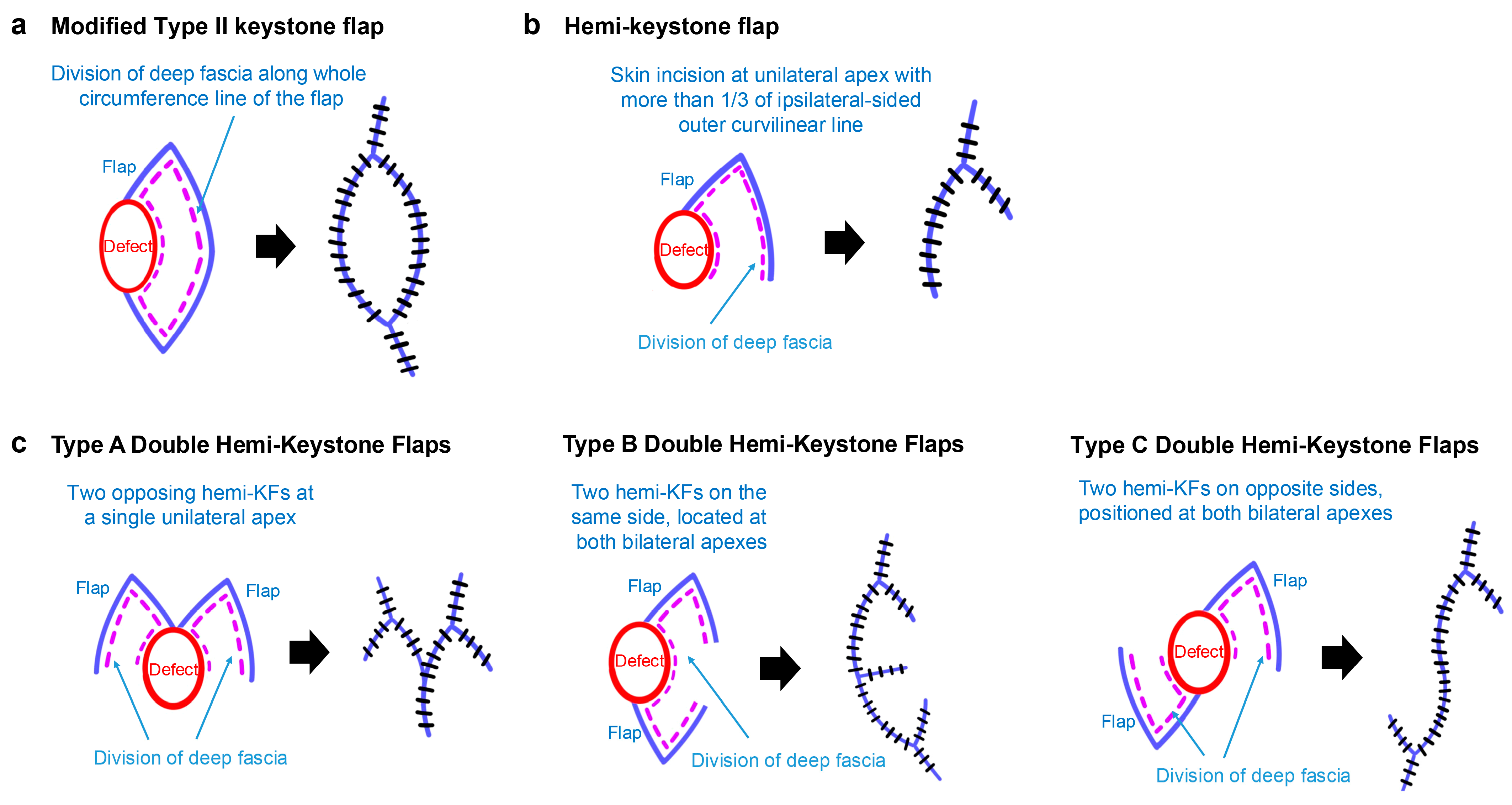
2.2. Surgical Techniques—Facial Defect Coverage with Modified KF Techniques
2.3. Postoperative Scar Management
2.4. Postoperative Scar Assessment
2.5. Data Collection and Patient Cohort Groups
2.6. Statistical Analysis
2.6.1. Software and Basic Statistics
2.6.2. Assessment of Normality of Distribution of Continuous Variables
2.6.3. Comparison of the Mean Difference in Paired Variables
3. Results
4. Discussion
Supplementary Materials
Author Contributions
Funding
Institutional Review Board Statement
Informed Consent Statement
Data Availability Statement
Acknowledgments
Conflicts of Interest
Abbreviations
| KF | Keystone flap |
| POSAS | Patient and Observer Scar Assessment Scale |
| PSAS | Patient Scar Assessment Scale |
| PROM | Patient-reported outcome measurement |
| OSAS | Observer Scar Assessment Scale |
| SD | Standard deviation |
References
- Yoon, C.S.; Kim, H.B.; Kim, Y.K.; Kim, H.; Kim, K.N. Relaxed skin tension line–oriented keystone–designed perforator island flaps considering the facial aesthetic unit concept for the coverage of small to moderate facial defects. Medicine 2019, 98, e14167. [Google Scholar] [CrossRef]
- Lim, S.Y.; Yoon, C.S.; Lee, H.G.; Kim, K.N. Keystone design perforator island flap in facial defect reconstruction. World J. Clin. Cases 2020, 8, 1832–1847. [Google Scholar] [CrossRef]
- Kim, Y.J.; Park, J.W.; Kim, J.M.; Park, S.H.; Hwang, J.H.; Kim, K.S.; Lee, S.Y.; Shin, J.H. The functionality of facial appearance and its importance to a Korean population. Arch. Plast. Surg. 2013, 40, 715–720. [Google Scholar] [CrossRef]
- Yıldız, T.; Selimen, D. The impact of facial aesthetic and reconstructive surgeries on patients’ quality of life. Indian J. Surg. 2015, 77, 831–836. [Google Scholar] [CrossRef]
- Rao, J.K.; Shende, K.S. Overview of local flaps of the face for reconstruction of cutaneous malignancies: Single institutional experience of seventy cases. J. Cutan. Aesthet. Surg. 2016, 9, 220–225. [Google Scholar] [CrossRef]
- Vaidya, T.S.; Mori, S.; Khoshab, N.; Dusza, S.W.; Bander, T.; Matros, E.; Rossi, A.M.; Nehal, K.S.; Lee, E.H. Patient-reported aesthetic satisfaction following facial skin cancer surgery using the FACE-Q Skin Cancer Module. Plast. Reconstr. Surg. Glob. Open 2019, 7, e2423. [Google Scholar] [CrossRef] [PubMed]
- Woodard, C.R. Complications in facial flap surgery. Facial Plast. Surg. Clin. N. Am. 2013, 21, 599–604. [Google Scholar] [CrossRef] [PubMed]
- Lee, H.G.; Kong, Y.T.; Kim, K.N. Use of keystone flaps in consideration of the facial aesthetic subunit concept as an alternative reconstructive option for nasal defect coverage. J. Craniofac. Surg. 2021, 32, 1864–1869. [Google Scholar] [CrossRef]
- Yoo, B.W.; Oh, K.S.; Kim, J.; Shin, H.W.; Kim, K.N. Modified keystone perforator island flap techniques for small- to moderate-sized scalp and forehead defect coverage: A retrospective observational study. J. Pers. Med. 2023, 13, 329. [Google Scholar] [CrossRef] [PubMed]
- Agrawal, N.K. Revisiting rhombic flaps for aesthetic facial resurfacing: Addressing a surgical conundrum. J. Cutan. Aesthet. Surg. 2021, 14, 330–336. [Google Scholar] [CrossRef]
- Gualtieri, M.; Scivoletto, G.; Pitino, F.; D’Archivio, L.; Valentini, V. Limberg flap for lateral midface reconstruction. J. Craniofac. Surg. 2025, 36, e27–e29. [Google Scholar] [CrossRef]
- Salgarelli, A.C.; Cangiano, A.; Sartorelli, F.; Bellini, P.; Collini, M. The bilobed flap in skin cancer of the face: Our experience on 285 cases. J. Craniomaxillofac. Surg. 2010, 38, 460–464. [Google Scholar] [CrossRef]
- Lombardo, G.A.; Tamburino, S.; Tracia, L.; Tarico, M.S.; Perrotta, R.E. Lateral nasal artery perforator flaps: Anatomic study and clinical applications. Arch. Plast. Surg. 2016, 43, 77–83. [Google Scholar] [CrossRef]
- Raklyar, E.; Zloty, D.M. Use of a patient and observer scar assessment scale to evaluate the V-Y advancement flap for reconstruction of medial cheek defects. Dermatol. Surg. 2012, 38, 1968–1974. [Google Scholar] [CrossRef] [PubMed]
- Ellabban, M.A.; Ibrahim, A.M.; Gomah, A.A.; Salah, O.; Abdelrahman, I.; Steinvall, I.; Adly, O.A.; Aboelnaga, A.M. Assessment of freestyle local facial perforator flaps for coverage of facial defects. J. Craniofac. Surg. 2021, 32, e122–e125. [Google Scholar] [CrossRef]
- Gulati, A.; Grekin, R.; Neuhaus, I.; Saylor, D.; Yu, S.; Park, A.; Seth, R.; Knott, P.D. Long-term appearance-related outcomes of facial reconstruction after skin cancer resection. Facial Plast. Surg. Aesthet. Med. 2023, 25, 344–350. [Google Scholar] [CrossRef]
- Peters, F.; Mücke, M.; Möhlhenrich, S.C.; Bock, A.; Stromps, J.P.; Kniha, K.; Hölzle, F.; Modabber, A. Esthetic outcome after nasal reconstruction with paramedian forehead flap and bilobed flap. J. Plast. Reconstr. Aesthet. Surg. 2021, 74, 740–746. [Google Scholar] [CrossRef] [PubMed]
- Kim, K.H.; Yoo, B.W.; Lim, S.Y.; Oh, K.S.; Kim, J.; Shin, H.W.; Kim, K.N. Modified keystone perforator island flap for tension-reducing coverage of axillary defects secondary to radical excision of chronic inflammatory skin lesions: A retrospective case series. BioMed Res. Int. 2022, 2022, 5600450. [Google Scholar] [CrossRef]
- Yoon, C.S.; Kong, Y.T.; Lim, S.Y.; Kim, J.; Shin, H.W.; Kim, K.N. A comparative study for tension-reducing effect of type I and type II keystone perforator island flap in the human back. Sci. Rep. 2021, 11, 16699. [Google Scholar] [CrossRef] [PubMed]
- Petukhova, T.A.; Navrazhina, K.; Minkis, K.V.-Y. V-Y Hemi-keystone advancement flap: A novel and simplified reconstructive modification. Plast. Reconstr. Surg. Glob. Open 2020, 8, e2654. [Google Scholar] [CrossRef]
- Hifny, M.A.; Park, T.H. Customized reconstruction with rotation Hemi-Keystone flap. J. Cosmet. Dermatol. 2022, 21, 5819–5824. [Google Scholar] [CrossRef]
- Park, T.H. Aesthetic reconstruction of auricular keloids with a novel hemi-keystone flap. Aesthet. Plast. Surg. 2022, 46, 2807–2813. [Google Scholar] [CrossRef]
- Draaijers, L.J.; Tempelman, F.R.H.; Botman, Y.A.M.; Tuinebreijer, W.E.; Middelkoop, E.; Kreis, R.W.; van Zuijlen, P.P.M. The patient and observer scar assessment scale: A reliable and feasible tool for scar evaluation. Plast. Reconstr. Surg. 2004, 113, 1960–1965, discussion 1966. [Google Scholar] [CrossRef]
- van de Kar, A.L.; Corion, L.U.M.; Smeulders, M.J.C.; Draaijers, L.J.; van der Horst, C.M.A.M.; van Zuijlen, P.P.M. Reliable and feasible evaluation of linear scars by the patient and observer scar assessment scale. Plast. Reconstr. Surg. 2005, 116, 514–522. [Google Scholar] [CrossRef] [PubMed]
- Dayan, S.; Clark, K.; Ho, A.A. Altering first impressions after facial plastic surgery. Aesthet. Plast. Surg. 2004, 28, 301–306. [Google Scholar] [CrossRef] [PubMed]
- Singh, P.; Birkett, L.; Dhar, S.; Krumhuber, E.; Mosahebi, A.; Ponniah, A. Facial beauty and the correlation of associated attributes: An empirical aesthetic database study. Plast. Reconstr. Surg. Glob. Open 2024, 12, e5382. [Google Scholar] [CrossRef]
- Sykes, J.M. Management of the aging face in the Asian patient. Facial Plast. Surg. Clin. N. Am. 2007, 15, 353–360. [Google Scholar] [CrossRef] [PubMed]
- McCurdy, J.A., Jr. Considerations in Asian cosmetic surgery. Facial Plast. Surg. Clin. N. Am. 2007, 15, 387–397. [Google Scholar] [CrossRef]
- Kim, S.; Choi, T.H.; Liu, W.; Ogawa, R.; Suh, J.S.; Mustoe, T.A. Update on scar management: Guidelines for treating Asian patients. Plast. Reconstr. Surg. 2013, 132, 1580–1589. [Google Scholar] [CrossRef]
- Shirakabe, Y.; Suzuki, Y.; Lam, S.M. A new paradigm for the aging Asian face. Aesthet. Plast. Surg. 2003, 27, 397–402. [Google Scholar] [CrossRef]
- Marcus, J.R.; Tyrone, J.W.; Bonomo, S.; Xia, Y.; Mustoe, T.A. Cellular mechanisms for diminished scarring with aging. Plast. Reconstr. Surg. 2000, 105, 1591–1599. [Google Scholar] [CrossRef]
- Nishiguchi, M.A.; Spencer, C.A.; Leung, D.H.; Leung, T.H. Aging suppresses skin-derived circulating SDF1 to promote full-thickness tissue regeneration. Cell Rep. 2018, 24, 3383–3392.e5. [Google Scholar] [CrossRef]
- Colboc, H.; Meaume, S. Chapter 44: Scar and Scarring in the Elderly. In Textbook on Scar Management: State of the Art Management and Emerging Technologies; Téot, L., Mustoe, T.A., Middelkoop, E., Gauglitz, G.G., Eds.; Springer: Cham, Switzerland, 2020. [Google Scholar]
- Larson, B.J.; Longaker, M.T.; Lorenz, H.P. Scarless fetal wound healing: A basic science review. Plast. Reconstr. Surg. 2010, 126, 1172–1180. [Google Scholar] [CrossRef]
- Han, S.-E.; Ryoo, S.-T.; Lim, S.Y.; Pyon, J.-K.; Bang, S.-I.; Oh, K.-S.; Mun, G.-H. Minimizing surgical skin incision scars with a latex surgical glove. Aesthet. Plast. Surg. 2013, 37, 459–462. [Google Scholar] [CrossRef]
- Veldhuizen, I.J.; Brouwer, P.; Aleisa, A.; Kurtansky, N.R.; Dusza, S.W.; Nehal, K.S.; Hoogbergen, M.M.; van der Hulst, R.R.W.J.; Lee, E.H. Nasal skin reconstruction: Time to rethink the reconstructive ladder? J. Plast. Reconstr. Aesthet. Surg. 2022, 75, 1239–1245. [Google Scholar] [CrossRef]
- Wallace, H.J.; Fear, M.W.; Crowe, M.M.; Martin, L.J.; Wood, F.M. Identification of factors predicting scar outcome after burn in adults: A prospective case-control study. Burns 2017, 43, 1271–1283. [Google Scholar] [CrossRef]
- Rahrovan, S.; Fanian, F.; Mehryan, P.; Humbert, P.; Firooz, A. Male versus female skin: What dermatologists and cosmeticians should know. Int. J. Womens Dermatol. 2018, 4, 122–130. [Google Scholar] [CrossRef]
- Kim, H.I.; Kwak, C.Y.; Kim, H.Y.; Yi, H.S.; Park, E.J.; Kim, J.H.; Park, J.H. Correlation between dermal thickness and scar formation in female patients after thyroidectomy. Arch. Craniofac. Surg. 2018, 19, 120–126. [Google Scholar] [CrossRef][Green Version]
- Kundu, K.; Rawat, V.S.; Chattopadhyay, D. Gender differences in quality of life and psychological impact of facial burn scars in a tertiary care center. Burns 2021, 47, 1153–1160. [Google Scholar] [CrossRef]
- Rankin, M.; Borah, G.L. Perceived functional impact of abnormal facial appearance. Plast. Reconstr. Surg. 2003, 111, 2140–2146, discussion 2147. [Google Scholar] [CrossRef]
- Ziolkowski, N.I.; Pusic, A.L.; Fish, J.S.; Mundy, L.R.; Wong She, R.; Forrest, C.R.; Hollenbeck, S.; Arriagada, C.; Calcagno, M.; Greenhalgh, D.; et al. Psychometric findings for the SCAR-Q patient-reported outcome measure based on 731 children and adults with surgical, traumatic, and burn scars from four countries. Plast. Reconstr. Surg. 2020, 146, 331e–338e. [Google Scholar] [CrossRef] [PubMed]
- Shao, K.; Taylor, L.; Miller, C.J.; Etzkorn, J.R.; Shin, T.M.; Higgins, H.W.; Giordano, C.N.; Sobanko, J.F. The natural evolution of facial surgical scars: A retrospective study of physician-assessed scars using the patient and observer scar assessment scale over two time points. Facial Plast. Surg. Aesthet. Med. 2021, 23, 330–338. [Google Scholar] [CrossRef] [PubMed]
- Marcaccini, G.; Seth, I.; Xie, Y.; Susini, P.; Pozzi, M.; Cuomo, R.; Rozen, W.M. Breaking Bones, Breaking Barriers: ChatGPT, DeepSeek, and Gemini in Hand Fracture Management. J. Clin. Med. 2025, 14, 1983. [Google Scholar] [CrossRef] [PubMed]


| Characteristics | Values |
|---|---|
| Total participants, n | 43 |
| Male sex, n (%) | 27 (62.79) |
| Female sex, n (%) | 16 (37.21) |
| Age, y, mean (SD) | 49.95 ± 20.66 |
| Defect cause | n (%) |
| Trauma | 30 (69.76) |
| Skin tumor | 10 (23.25) |
| Skin fistula | 3 (6.97) |
| Defect location | n (%) |
| Dorsal subunit of the nasal unit | 10 (23.25) |
| Central subunit of the forehead unit | 6 (13.95) |
| Zygomatic subunit of cheek unit | 5 (11.62) |
| Lateral subunit of the upper lip unit | 4 (9.30) |
| Lateral canthal subunit of the eyelid unit | 2 (4.65) |
| Lateral subunit of the cheek unit | 2 (4.65) |
| Philtrum subunit of the upper lip unit | 2 (4.65) |
| Lateral subunit of the forehead unit | 2 (4.65) |
| Tip subunit of the nasal unit | 2 (4.65) |
| Medial subunit of the cheek unit | 2 (4.65) |
| Eyebrow subunit of the forehead unit | 1 (2.32) |
| Lower lid subunit of the eyelid unit | 1 (2.32) |
| Tip and dorsal subunit of the nasal unit | 1 (2.32) |
| Buccal subunit of the cheek unit | 1 (2.32) |
| Mental unit | 1 (2.32) |
| Auricular unit | 1 (2.32) |
| Defect size, cm2, mean (SD) | 3.64 ± 2.96 |
| Flap size, cm2, mean (SD) | 5.63 ± 6.88 |
| Flap types | n (%) |
| Hemi-keystone flap | 26 (60.46) |
| Double hemi-keystone flap | 11 (25.58) |
| Modified Type II keystone flap | 6 (13.95) |
| Complications | n (%) |
| Infection | 0 |
| Dehiscence | 1 (2.32) |
| Hematoma | 0 |
| Flap failure | 0 |
| Follow-up periods, months, mean (SD) | 7.34 ± 2.85 |
| PSAS | Group A (Mean ± SD) | Group B (Mean ± SD) | Group C (Mean ± SD) | p-Value | Post Hoc Analysis |
|---|---|---|---|---|---|
| Pain | 2.35 ± 1.169 | 1.40 ± 0.507 | 1.27 ± 0.467 | 0.001 | A > B, C |
| Itching | 2.71 ± 1.312 | 1.47 ± 0.640 | 1.64 ± 0.674 | 0.004 | A > B |
| Color | 3.53 ± 1.663 | 2.67 ± 0.724 | 1.73 ± 0.786 | 0.001 | A, B > C |
| Stiffness | 3.29 ± 1.047 | 2.53 ± 0.743 | 2.18 ± 0.603 | 0.003 | A > B, C |
| Thickness | 3.12 ± 0.993 | 2.60 ± 0.828 | 2.55 ± 0.934 | 0.129 | A > C |
| Irregularity | 3.53 ± 1.068 | 2.67 ± 0.976 | 2.45 ± 0.934 | 0.020 | A > C |
| Total score | 18.53 ± 5.691 | 13.33 ± 3.266 | 11.82 ± 3.281 | 0.001 | A > B, C |
| Overall patient satisfaction score | 3.76 ± 1.480 | 2.80 ± 0.862 | 2.82 ± 0.874 | 0.074 | NA |
| OSAS | Group A (Mean ± SD) | Group B (Mean ± SD) | Group C (Mean ± SD) | p-Value | Post Hoc Analysis |
| Vascularity | 2.50 ± 0.829 | 2.70 ± 1.014 | 2.14 ± 0.234 | 0.339 | NA |
| Pigmentation | 2.53 ± 0.819 | 2.87 ± 1.288 | 2.18 ± 0.337 | 0.253 | NA |
| Thickness | 3.18 ± 0.749 | 3.37 ± 0.812 | 3.18 ± 1.079 | 0.403 | NA |
| Pliability | 2.82 ± 0.749 | 2.93 ± 0.799 | 2.55 ± 0.820 | 0.311 | NA |
| Relief | 2.76 ± 0.752 | 2.73 ± 0.799 | 2.55 ± 0.820 | 0.572 | NA |
| Surface area | 3.50 ± 0.729 | 3.37 ± 0.855 | 2.82 ± 1.007 | 0.034 | A > C |
| Total score | 17.29 ± 3.759 | 17.97 ± 4.011 | 15.41 ± 4.061 | 0.111 | NA |
| Objective scar rating | 3.56 ± 0.846 | 3.77 ± 0.904 | 3.09 ± 1.221 | 0.063 | NA |
| PSAS | Group D (Mean ± SD) | Group E (Mean ± SD) | p-Value |
|---|---|---|---|
| Pain | 1.92 ± 1.129 | 1.47 ± 0.514 | 0.186 |
| Itching | 2.00 ± 1.233 | 2.00 ± 0.935 | 0.693 |
| Color | 2.65 ± 1.198 | 2.94 ± 1.638 | 0.655 |
| Stiffness | 2.62 ± 1.061 | 2.94 ± 0.748 | 0.132 |
| Thickness | 2.65 ± 1.018 | 3.00 ± 0.791 | 0.088 |
| Irregularity | 2.88 ± 1.107 | 3.06 ± 1.088 | 0.517 |
| Total score | 14.73 ± 6.004 | 15.41 ± 3.825 | 0.337 |
| Overall patient satisfaction score | 3.08 ± 1.197 | 3.35 ± 1.272 | 0.466 |
| OSAS | Group D (Mean ± SD) | Group E (Mean ± SD) | p-Value |
| Vascularity | 2.48 ± 0.922 | 2.47 ± 0.649 | 0.364 |
| Pigmentation | 2.58 ± 1.046 | 2.53 ± 0.819 | 0.611 |
| Thickness | 3.08 ± 0.717 | 3.50 ± 0.984 | 0.176 |
| Pliability | 2.67 ± 0.706 | 2.97 ± 0.874 | 0.308 |
| Relief | 2.60 ± 0.788 | 2.85 ± 0.745 | 0.291 |
| Surface area | 3.13 ± 0.672 | 3.50 ± 1.104 | 0.233 |
| Total score | 16.54 ± 3.658 | 17.82 ± 4.387 | 0.304 |
| Objective scar rating | 3.42 ± 0.913 | 3.65 ± 1.101 | 0.587 |
| PSAS | Group F (Mean ± SD) | Group G (Mean ± SD) | p-Value |
|---|---|---|---|
| Pain | 1.48 ± 0.580 | 2.19 ± 1.276 | 0.472 |
| Itching | 1.81 ± 0.962 | 2.31 ± 1.302 | 0.796 |
| Color | 2.70 ± 1.463 | 2.88 ± 1.258 | 0.288 |
| Stiffness | 2.67 ± 0.832 | 2.88 ± 1.147 | 0.065 |
| Thickness | 2.59 ± 0.694 | 3.13 ± 1.204 | 0.052 |
| Irregularity | 2.70 ± 0.993 | 3.38 ± 1.147 | 0.245 |
| Total score | 13.96 ± 4.109 | 16.75 ± 6.445 | 0.110 |
| Overall patient satisfaction score | 2.93 ± 1.207 | 3.63 ± 1.147 | 0.124 |
| OSAS | Group F (Mean ± SD) | Group G (Mean ± SD) | p-Value |
| Vascularity | 2.59 ± 0.832 | 2.28 ± 0.774 | 0.473 |
| Pigmentation | 2.76 ± 1.050 | 2.22 ± 0.657 | 0.501 |
| Thickness | 3.26 ± 0.685 | 3.22 ± 1.095 | 0.179 |
| Pliability | 2.81 ± 0.709 | 2.75 ± 0.913 | 0.079 |
| Relief | 2.76 ± 0.698 | 2.59 ± 0.898 | 0.027 |
| Surface area | 3.03 ± 0.800 | 3.25 ± 1.017 | 0.045 |
| Total score | 17.48 ± 3.531 | 16.31 ± 4.629 | 0.356 |
| Objective scar rating | 3.52 ± 0.882 | 3.50 ± 1.169 | 0.072 |
Disclaimer/Publisher’s Note: The statements, opinions and data contained in all publications are solely those of the individual author(s) and contributor(s) and not of MDPI and/or the editor(s). MDPI and/or the editor(s) disclaim responsibility for any injury to people or property resulting from any ideas, methods, instructions or products referred to in the content. |
© 2025 by the authors. Licensee MDPI, Basel, Switzerland. This article is an open access article distributed under the terms and conditions of the Creative Commons Attribution (CC BY) license.
Share and Cite
Kim, W.; Jang, E.A.; Oh, K.S.; Kim, K.N. Patient and Observer Scar Assessment of Facial Keystone Flap Reconstruction in Korean Patients. J. Clin. Med. 2026, 15, 262. https://doi.org/10.3390/jcm15010262
Kim W, Jang EA, Oh KS, Kim KN. Patient and Observer Scar Assessment of Facial Keystone Flap Reconstruction in Korean Patients. Journal of Clinical Medicine. 2026; 15(1):262. https://doi.org/10.3390/jcm15010262
Chicago/Turabian StyleKim, Wooseob, Eun A Jang, Kap Sung Oh, and Kyu Nam Kim. 2026. "Patient and Observer Scar Assessment of Facial Keystone Flap Reconstruction in Korean Patients" Journal of Clinical Medicine 15, no. 1: 262. https://doi.org/10.3390/jcm15010262
APA StyleKim, W., Jang, E. A., Oh, K. S., & Kim, K. N. (2026). Patient and Observer Scar Assessment of Facial Keystone Flap Reconstruction in Korean Patients. Journal of Clinical Medicine, 15(1), 262. https://doi.org/10.3390/jcm15010262