


Abstract
Algae are existing macroscopic materials with substantial benefits, including as important growth regulators and macronutrients and micronutrients for the growth of healthy crop plants. Biofertilizers obtained from algae are identified as novel production fertilizers or innovative biofertilizers without the detrimental impacts of chemicals. Seaweeds contain many water-soluble minerals and nutrients that plants can easily absorb and that are valuable for crop plants’ growth. At present, Ascophyllum nodosum (L.) Le Jolis extract outperforms chemical fertilizers in terms of increasing seed germination, plant development, and yield, as well as protecting plants from severe biotic and abiotic stresses. A. nodosum contains bioactive compounds that exhibit an array of biological activities such as antibiotic, anti-microbial, antioxidant, anti-cancer, anti-obesity, and anti-diabetic activities. A. nodosum extract (AnE) contains alginic acid and poly-uronides that improve soil’s water-carrying ability, morsel structure, aeration, and capillary action, stimulating root systems in plants, increasing microbial activity in soil, and improving mineral absorption and availability. The scientific literature has comprehensively reviewed these factors, providing information about the different functions of A. nodosum in plant growth, yield, and quality, the alleviation of biotic and abiotic stresses in plants, and their effects on the interactions of plant root systems and microbes. The application of AnE significantly improved the germination rate, increased the growth of lateral roots, enhanced water and nutrient use efficiencies, increased antioxidant activity, increased phenolic and flavonoid contents, increased chlorophyll and nutrient contents, alleviated the effects of abiotic and biotic stresses in different crop plants, and even improved the postharvest quality of different fruits.
1. Introduction
The existing global scenario decisively highlights the need to accept eco-friendly agricultural tools for sustainable development. Chemicals have adverse impacts on the soil and the valuable soil microbes and microbial communities and the plants cultivated on these soils. Organic farming is a therapy for the evils of modern chemical agriculture. Many viable alternatives must be explored to meet the increasing demand for organic inputs. One such alternative is the application of seaweed extracts as plant stimulants, sources of nutrients, and biofertilizers [1]. According to the European Union (EU) Regulation 2019/1009, a plant biostimulant is “a product stimulating plant nutrition processes independently of the product’s nutrient content with the sole aim of improving one or more of the following plant or plant rhizosphere characteristics: (a) nutrient use efficiency; (b) tolerance to abiotic stress; (c) quality traits; or (d) availability of confined nutrients in the soil or rhizosphere” [2]. Biostimulants may be any substance or microorganism. The immediate use of seaweed is in the production of hydrocolloids such as alginates, carrageenan, and agar [3]. Various structures of natural products or bioactive components have been established in seaweed, such as carotenoids, terpenoids, polyphenols, peptides, sulfated polysaccharides, and fibers. These bioactive products demonstrate an array of biological properties, for instance, antibiotic, antioxidant, cytotoxic, anti-inflammatory, anti-diabetic, and anti-cancer activities [3,4]. Unlike synthetic chemicals, biofertilizers composed of algae are eco-friendly, non-toxic, pollution-free, and harmless to plants [5].
In various parts of the globe, a continuous reduction in rainfall is generating a high frequency of drought stress, which is negatively manipulating crop productivity and food security. In addition to water stress, salinity, heat, nutrient, and oxidative stresses limit agricultural productivity [6]. Leaf area and photosynthetic activity are reduced by drought stress due to partial stomatal closure, resulting in reduced growth, development, and productivity of crop plants [7]. Salt stress has a negative impact on approximately 6% of the world’s arable land area, including 30% of irrigated land [8]. Alleviating these abiotic stresses is a major challenge in various parts of the globe, mainly in arid and semi-arid regions [6].
Seaweed extracts are used as plant biostimulants and are considered the most economic and effective way to improve the growth, development, quality, and quantity of plants by increasing water and mineral use efficiencies under various environmental stresses [9]. The application of AnE significantly improved the germination rate, increased the growth of lateral roots, enhanced water and nutrient use efficiencies, increased antioxidant activity, increased phenolic and flavonoid contents, increased chlorophyll and nutrient contents, alleviated the effects of abiotic and biotic stresses in different crop plants, and even improved the postharvest quality of fruits [10].
Brassica napus, Solanum lycopersicum, Daucus carota, Cucumis sativus, Glycine max, Spinacia oleracea, and Hordeum vulgare were all stimulated by agricultural biostimulants (AnE) [10]. Seaweed extracts have the capacity to sustainably increase the quality and yield of crops with different soil types and farming systems; for example, foliar and soil applications of seaweed extract enhanced the yield and post-harvest qualities of strawberries, tomatoes, vegetables, and sugarcane [11,12]. Many other studies on the interactions of soil microbes showed that the application of seaweed extracts altered the microbial activity in the rhizosphere located in the soil, and these modifications coincided with improved plant development and yield [12,13]. According to the study by Renaut et al. [13], the effect of AnE on the soil and root microbiota diversity of pepper plants altered the bacterial diversity in the soil. AnE applied to tomato and sweet pepper crops significantly enhanced the upregulation of the gene transcripts Ga2Ox, IAA, and IPT, which are involved in the biosynthesis of gibberellin, auxin, and cytokinin, respectively [14]. The foliar spray of AnE on Paspalum vaginatum during protracted irrigation intervals and under conditions of salinity improved lipid peroxidation by means of linoleic acid and DPPH assays and increased the activities of antioxidant enzymes such as SOD, CAT, and APX, leading to the depletion of reactive oxygen species in the AnE-treated plants [15].
Seaweed extracts are used in plants to protect them from pathogenic infections, either directly or indirectly. A. nodosum has the potential to act as a protectant to control plant diseases. Both foliar (spray) and soil applications of seaweed extract were found to be effective in reducing foliar and soil-borne pathogens against a variety of crops [16,17]. Bioactive compounds present in A. nodosum are also considered potent elicitors of plant defense responses against various pathogens. The AnE improved plant disease resistance against Phytopthora melonis in cucumber [18] and against Phytophthora capsica in tomato [19].
This review represents the current state of biostimulants and their effects on plant growth and development. Biostimulants could be a long-term and cost-effective tool for improving plant development and resistance to various stresses. Recent research has shown that biostimulants defend plants and crops from different biotic and abiotic stresses, suggesting their potential for field application and measurement as organic inputs as they are safe for human health and are cost-effective and environmentally friendly alternatives.
2. Seaweeds
There are about 9000 species of marine algae integrated into different algal groups, such as Phaeophyta (brown), Chlorophyta (green), and Rhodophyta (red), depending upon their pigments, such as chlorophylls, carotenoids, and phycobilins [5]. For a long time, industries have used seaweeds as edible sources, fodder, green compost, and unprocessed materials [20]. Seaweeds, as important oceanic assets, are used in soil reformation to improve the plant growth of crops. In horticulture, using seaweed products is becoming a time-honored practice [21]. Seaweed extract can improve plant growth, yield, and quality by containing different plant growth hormones and hormones such as growth regulators, auxins, abscisic acid, gibberellins, cytokinins, betaines, brassinosteroids, jasmonates, polyamines, salicylates, and signal peptides. In addition to this, trace elements such as iron (Fe), copper (Cu), zinc (Zn), cobalt (Co), molybdenum (Mo), manganese (Mn), and nickel (Ni), as well as vitamins, and amino acids [5,22], are also found in seaweeds. Seaweed extract highly influences the cellular metabolism of plants, and its application has been used to raise the uptake of essential macro- and micronutrients from the soil and to improve plant resistance to pests, diseases, and stresses [23]. Many algal products are significant sources of plant biostimulants and are extensively used to increase agricultural productivity [24]. The most studied seaweed is the brown intertidal alga Ascophyllum nodosum (L.) Le Jolis. It is used as a source of many industrial and commercial plant growth stimulators to improve the regulation of physiological, biochemical, and molecular processes to enhance plant defenses against biotic and abiotic stresses [25]. The significance of Ascophyllum nodosum Extract (AnE) in the improvement of plant growth via different modes of action is shown in Figure 1.
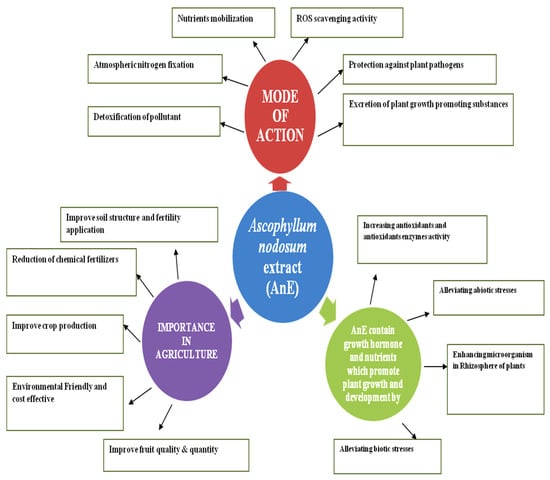
Figure 1.
Significance of Ascophyllum nodosum extract (AnE) in improving plant growth via different modes of action.
In the subsequent sections, we provide a detailed and plant-centered review of the composition, commercial products, and effects of AnE on different plants under various environmental biotic and abiotic stresses. We also show tables that provide an overview of the morphological, physiological, and biochemical changes in plants in response to AnE treatment.
3. Ascophyllum nodosum (L.) Le Jolis and Its Composition
Ascophyllum nodosum (L.) Le Jolis belongs to the group Phaeophyta (brown algae), and it is the most studied seaweed among other groups of seaweeds [26]. It is primarily found in the cold water of the North Atlantic Ocean, which stretches from eastern Canada to parts of northern Europe [27]. A. nodosum is a brown alga that is edible and is also known as rockweed, knotted kelp, Norwegian kelp, and knotted wrack (egg wrack). A. nodosum seaweed extract has the potential to improve plant growth, yield, and quality as it contains plant growth regulators such as auxins, cytokinins, gibberellins, betaines, mannitol, organic acids, polysaccharides, amino acids, and proteins [28]. Phlorotannins are unique polyphenolic compounds found only in some brown algae and not in terrestrial plants. A. nodosum is one of the most significant sources of phlorotannins [29].
A. nodosum has bioactive biopolymers, including alginates, fucoidan, and laminarin, as well as non-polysaccharide bioactive components such as polyphenols [30]. A. nodosum contains sulfated polysaccharide chains known as fucoidans, which have alternate (1–3) and (1–4) linkages [31,32] with both disulfate and trisulfate sugars. Most of them have disulfated sugars [33]. Ascophyllan [34] is the common name for a fucoidan with a high amount of sulfur residue that is found in Ascophyllum. It has a molecular size of 390 kDa [35]. Brown algae, i.e., the Phaeophyceae family, reveal high levels of phlorotannins. Phlorotannins are a type of polyphenol that is unique to aquatic organisms. These are oligomers and polymers of phloroglucinol (1,3,5-trihydroxy benzene) [36] that are linked by the acetate malonate pathway and have molecular sizes ranging from 126 to 650 kDa [37,38,39].
Components of A. nodosum contain the following sulfated polysaccharides (fucoidans):
- Foley et al. [40] found a fucoidan with a dry weight of 1.75%, carbohydrates at 65.4%, polyphenols at 13.5%, and proteins at 18.5%. The carbohydrates comprise L-fucose (52.1%), glucose (21.3%), galactose (6.1%), and xylose (16.5%) at a molecular size of 420 kDa.
- Kloareg et al. [41] discovered sulfated polysaccharide, a fucoidan with 38.7% L-fucose and 33.7% sulfate by weight.
- Fucoidan sulfate at 26.1%, uronic acid at 5.7%, and L-fucose at 31.3% at 556 kDa [42].
- A fucoidan of 47% L-fucose, 30% sulfate, and 6% uronic acid at 25 kDa [43].
- A fucoidan of L-fucose (39.7%), sulfate (27%), and uronic acid (4.1%) with a molecular weight of 18.6 kDa [44].
- The fucoidan of L-fucose is 45.4%, sulfate is 22.1%, and uronic acid is 9.9% at 417 kDa [45].
- At 1323 kDa, the fucoidan of sulfate contains 19.4% sulfate, 28.4% L-fucose, and 5.8% uronic acid [45].
Other different, useful components are also found in A. nodosum (Table 1).

Table 1.
Other components of A. nodosum.
4. Ascophyllum nodosum Extract (AnE) Enhances Plant Morphological and Physiological Characteristics
Ascophyllum nodosum extract (AnE) commercial products have been confirmed to regulate growth-stimulating behaviors. When low concentrations of AnE are applied to plants, they are commonly referred to as “biostimulants”, “biostimulators”, “biofertilizers”, and “plant growth stimulators” [59] (Table 2). A. nodosum seaweed extract is a well-known growth promoter for vascular family plants due to its ability to improve nutrient absorption via root tissues, thereby increasing yield while reducing the damaging effects of biotic and abiotic stresses [5,22,60]. The development and efficiency of crops are improved by applying AnE, which increases nutrient uptake and availability at the plant roots [24].
Table 2.
Commercial A. nodosum seaweed products utilized in farming and horticulture as biofertilizers and biostimulators for plant growth [59,60].
Commercial seaweed products significantly enhanced the yield and quality of citrus fruit [21] and grapes [61]. For example, a representative AnE-based biostimulant produced by PI Industries Ltd., India, BIOVITA, an agriculture product, is shown in Figure 2. Using seaweed extracts in Petunia and Ageratum improved vegetative plant growth, stomatal conductance, photosynthesis, transpiration rate, the water potential of leaves, and the relative water content (RWC) under prolonged irrigation conditions [62]. AnE transforms the concentration and localization of auxins, and it serves as a plant hormone that enhances plant growth [63]. AnE treatments extensively improve the number of leaves and their area, the height and dry weight of plants, antioxidant activity, and the phenolic, flavonoids, and tannin contents of Calibrachoa × hybrida (an ornamental plant) [64]. Crops treated with Bio-Algeen® have been accounted for in the yield, as in clover [65], sugar beet [66], tomatoes [67,68], and carrot [69]. Macro- and micronutrients in tomato fruit were increased using two commercial products derived from AnE, Rygex®, and Super Fifty® [70].
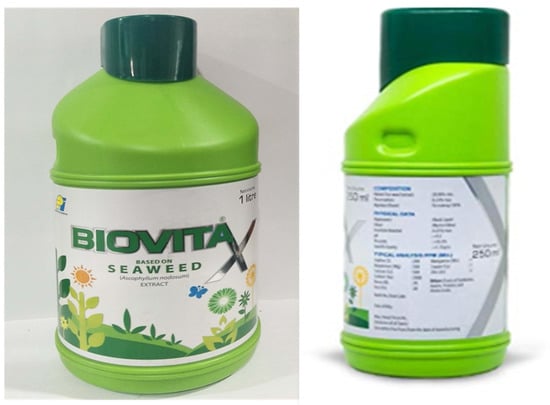
Figure 2.
Example of biostimulant (AnE) produced by PI Industries Ltd., Sagar, Madhya Pradesh, India.
In another study, Danesh et al. [71] observed that Ascophyllum seaweed extract affected the growth parameters of tropical crops. When treated with AnE, tomato plants (Lycopersicum esculentum Mill.) showed an increase in plant height and root and shoot biomass, with a significant enhancement in numerous minerals and nutrients in the shoots and fruits of tomato plants at a concentration of 0.5%. The mineral nutrients of the fruits were significantly increased: nitrogen by 81%, phosphorus by 8%, potassium by 50%, calcium by 57%, iron by 25%, and zinc by 33%, and the intensity of sodium was reduced by 2% [71]. The AnE enhanced the yield and quality of the tomato fruit, as betaines in the extract enhanced the chlorophyll pigment in the tomato leaves and decreased its deterioration rate [72,73]. The seaweed-treated tomato plants exhibited improved concentrations of minerals in their shoots and a significant increase in fruit quality and other attributes, including size, color, total soluble solids, ascorbic acid, and minerals under tropical growing conditions [73]. Mohamed et al. [74] observed that the foliar application of AnE in the chickpea cultivar Giza 195 improved the seed quality and amino acid and mineral contents in the seeds and induced favorable changes in the protein profile.
Similarly, the foliar application of AnE influenced the growth, yield, and quality attributes in four onion cultivars; a 0.5% concentration of AnE caused a significant increase in total soluble sugar, mineral-like N, P, and K, bulb weight, and yield (Table 3). In contrast, at a concentration of 3%, AnE enhanced ascorbic acid content compared to the respective controls [75]. Likewise, an A. nodosum-based biostimulant enhanced the protein content and nutrition value of green beans [76].
Table 3.
Physiological, morphological, and biochemical effects of A. nodosum extract (AnE) and commercial products of AnE on different plants.
5. Ascophyllum nodosum Extract (AnE) Promote Abiotic Stress Tolerance in Plants
A wide range of organic molecules such as alginates, fucoidan, laminarin, mannitol, polyphenols, and polysaccharides are present in AnE. These compounds could potentially promote stress tolerance and improve plant growth (Table 4) [60].
Table 4.
Effects of commercial products and ANE (seaweed extract) derived from A. nodosum on different plants under abiotic stress.
Ascophyllum products may assist in stress alteration because of betaines’ presence in the seaweed. Betaines serve as osmotic-compatible solutes under stress conditions [5]. Ascophyllum also contains mannitol, which facilitates osmotic adaptation [166]. AnE application alleviates drought stress in growing plants [140,141]. Several reports prove that the drought-stressed Arabidopsis thaliana plants can sustain strong stomatal conductance, water use efficiency (WUE), and mesophyll conductance after the application of AnE. The pre-treatment of A. thaliana plants with seaweed extract induced stomatal closure and changed the gene expression level involved in abscisic acid (ABA) response and antioxidant system pathways [151]. Shukla et al. [153] found that plants treated with AnE had a greater RWC, high stomatal conductance, and antioxidant activity under drought stress. Commercial seaweed extracts significantly improve the drought stress tolerance in grasses [167] crops, vegetables, ornamental plants [137], and container-grown “Hamlin” sweet orange trees [140]. Seaweed AnE has been applied to ornamental plants, such as Spiraea nipponica (Snow mound) and Pittosporum eugenioides (Variegatum), to increase drought stress tolerance. Under drought conditions, AnE improved the leaf gas exchange parameters, leaf water potential, and the RWC and increased the number of leaves and the dry weight and height of plants in Spiraea nipponica and Pittosporum eugenioides [147]. According to Elansary et al. [15], seaweed extract increases the turfgrass quality, the photochemical efficiency of leaves, root length, dry weight, and the total carbohydrates, potassium, calcium, and proline contents in supplemented Paspalum vaginatum (turfgrass) plants under extended irrigation and salt stress conditions. AnE alleviated the effect of salt stress on the growth and efficiency of Persea americana Mill. (avocado) by improving nutrient absorption and showing higher Ca+ and K+ ion contents [156]. Used as a biostimulant, seaweed AnE alleviated the water stress effect and improved the yield and nutrient content of Phaseolus vulgaris [158]. AnE also improved heat stress tolerance as it enhanced CO2 assimilation, rate of transpiration, and stomatal conductance and reduced the leaf temperature [168].
The application of alkaline AnE, Acadian (a commercial product), in drought-stressed Glycine max L. (soybean) altered the expression of GmCYP707A1a and GmCYP707A3b, genes that are implicated in the catabolism of ABA [153]. It was also noticed that the AnE-treated plants changed their expression of the “GmRD22, GmRD20, GmDREB1B, GmERD1, GmNFYA3, FIB1a, GmPIP1b, GmGST, GmBIP, and GmTp55” stress-responsive genes [153]. AnE improved the expression of diverse miRNAs related to nutrient uptake and enhanced salt stress tolerance in A. thaliana [169]. Bioactive organic compounds of AnE have been reported to regulate the union and communication of different transcription factors such as “DREB/CBF, COR47, NF-YA, COR15A, AGF2, CCA1, and LHY1,” which improve stress tolerance in plants [170,171]. Rayirath et al. [50] observed that AnE application in A. thaliana stimulated the cold-responsive genes “COR15A, RD29A, and CBF3” and improved the plant’s cold stress tolerance. Stimplex, an AnE-based commercial product, upregulated 635 genes and downregulated 456 genes and strongly influenced the expression of genes involved in CO2 fixation, glutathione, phenyl propanoid, stilbenoid metabolism, and plant–pathogen interactions [172]. In AnE, the upregulation of defense pathway genes such as PinII (jasmonic acid), Etr1 (ethylene), and PR-1a (salicylic acid) enhanced the auxin-responsive proteins such as SAUR21 and indole-3-acetic acid-amido synthetase in AnE-treated tomatoes [172]. It was observed that the AnE alleviated the effect of heat stress by activating heat shock proteins (HPS), which mainly influenced the AtHSP17 family, particularly AtHPS17.4 and AtHPS17.6A and B, confirming the most significant changes [173].
6. Ascophyllum nodosum Extract (AnE) Reduced Oxidative Stress
Stress causes the production of reactive oxygen species (ROS), which damage the structures of proteins, lipids, carbohydrates, and DNA, impairing plant growth and development [174]. Under stress, enzymatic and non-enzymatic mechanisms such as superoxide dismutase (SOD), ascorbate peroxidase (APX), catalase (CAT), glutathione reductase (GR), and glutathione peroxidase (GPX) play critical roles in ROS scavenging. The application of AnE to bean (P. vulgaris) improved drought tolerance by reducing ROS, inducing lipid peroxidation (MDA content), improving CAT activity, and enhancing proline biosynthesis [157]. AnE increases flavonoid content, and flavonoids protect the roundworm Caenorhabditis elegans from oxidative and heat stress [175]. It was found that there was an increase in root growth of 58% and enhanced freezing tolerance in A. thaliana while using A. nodosum extract [63,143]. Burchett et al. [176] observed that using AnE increased barley’s winter toughness and cold tolerance. It was reported that AnE improved the leaf water relations, maintained the cell turgor pressure, and enhanced the growth of spinach by reducing stomatal limitations under drought stress conditions [145]. The expression of glutathione-S transferase was elicited by bioactive substances of AnE, resulting in the reduction of salinity-induced oxidative damage in A. thaliana [177]. AnE reduces oxidative stress damage by altering the expression of miRNAs and targeting the copper–zinc SOD1 gene, AtCSD1, which is essential in superoxide radical detoxification [169]. Increases in the activities of antioxidant enzymes such as superoxide dismutase, catalase, ascorbate peroxidase, peroxidase, and reductase nitrate, as well as proline concentration, were observed following AnE concentration treatment [168]. The spray application of 0.3% AnE enhanced the chlorophyll content and the activities of anthocyanin, proline, and antioxidant enzymes [172].
7. Ascophyllum nodosum Extract (AnE) Induced Defense Enzymatic Activity
A. nodosum contains laminarans with low and high molecular weights. Laminarans are intracellular water-soluble β-D-(1--3) glucan and β-D-(1--3) oligoglucans known as elicitors of phytoalexins. Laminarans are competent in eliciting D-glycanase activities such as “laminaranase, α-amylase” in Rubus fruticosus suspended cell cultures [178]. Applying seaweed extract induced peroxidase activity in the Capsicum annuum plant [179]. Laminaran and fucoidan exhibit a sample array of elicitor and growth-development activities [45]. Carrot and cucumber plants accumulated high levels of defense-related gene transcripts, received higher activity from defense-related enzymes, and showed increased levels of phenols when treated with AnE. Seaweed extract significantly increased chitinase, glucanase, peroxidase (PO), polyphenol oxidase (PPO), phenylalanine ammonia-lyase (PAL), and lipoxygenase enzyme activities [16,17,18]. The AnE treatment of postharvest plums increased polygalacturonase (PG) activity [180].
8. Ascophyllum nodosum Extract (AnE) Improves Disease Resistance in Plants
In recent years, environmental conditions and exhaustive agricultural practices have increased the occurrences of highly infectious diseases in plants, reducing crop productivity [181]. Due to their effectiveness in controlling microbial infections in crop plants, the use of chemical-based fungicides in cultivation has become limited over time. As a result, researchers must explore alternatives to improve crop health that involve priming the defense systems of plants to enhance their resistance levels against microbial or pathogenic infections. Modern-day crop protection strategies and signaling biomolecules or elicitors are promising biological and eco-friendly practices [182]. Bioactive organic molecules present in AnE elicit defense reactions against the pathogens that cause plant diseases [60]. AnE has been formerly reported to decrease the severity of pathogens, including viruses [183], bacteria [184], and fungi [185].
Seaweed extracts are used in plants to protect them from pathogenic infections, either directly or indirectly. A. nodosum has the potential to act as a protectant to control plant diseases. Both foliar (spray) and soil applications of seaweed extract were found to be effective in reducing foliar and soil-borne pathogens against a variety of crops [16,17]. Cucumber plants sprayed with an A. nodosum commercial seaweed extract (StimplexTM) showed significant reductions in fungal pathogen inoculation levels with Alternaria cucumerinum, Didymella applanata, Fusarium oxysporum, and Botrytis cinerea [17]. Comparable results were obtained when carrot plants treated with AnE demonstrated prominently lower rates of infection from Alternaria radicina and B. cinerea fungi compared with control plants [16]. In Capsicum annuum, treatment with AnE increased foliar resistance to Phytophthora capsici [179]. The application of AnE to greenhouse cucumber plants revealed a considerable decline in damping-off disease caused by Phytophthora melonis [18]. The use of a commercial AnE significantly suppressed the infection of broccoli by Plasmodiophora brassicae [186]. Seaweed-supplemented A. thaliana plants elicited defense responses against the necrotrophic pathogen Sclerotinia sclerotiorum, and jasmonic-acid-dependent systemic resistance in the leaves was induced against the hemibiotrophic pathogen Pseudomonas syringae [187]. Radwan et al. [188] observed the consequences of algae (A. nodosum) on the root-nematode M. incognita in a tomato crop, finding a reduced number of root galls and a better growth of infected plants. Drenching Brassica oleracea with AnE stimulated microbes more than Pythium ultimum, resulting in a lower frequency of damping-off disease in seedlings [189]. In tropical tomato plants, using AnE via foliar application increased disease suppression frequency caused by Alternaria solani and Xanthomonas campteris and subsequently increased the fruit yield [190]. Ajah [191] found that A. nodosum possesses an antifungal activity against Candida albicans. Ali et al. [14] discovered that a 0.5% concentration of seaweed extract reduced the severity of bacterial spot disease and the early blight of tomato and sweet pepper in tropical conditions as an AnE biostimulant induced plant growth and a defense mechanism against foliar diseases caused by X. campestris pv. vesicatoria and A. solani [14]. The rigorousness of Fusarium head blight, which is caused by Fusarium graminearum (Gibberella zeae), was decreased by the application of AnE to Triticum aestivum (wheat) [89]. Similarly, at a concentration of 0.4 mL/L, AnE reduced brown rot disease in the plum fruits by 50%, a disease which is caused by members of the Monilinia genus: M. fructicola, M. laxa, and M. frutigena [180]. Paiva et al. [192] reported that at a concentration of 40 mL/L of AnE, the mycelia growth of the fungus Rhizopus stolonifer was significantly reduced, ultimately decreasing the incidence of soft rot by up to 22.3% in postharvest Fragaria ananassa (strawberry). Islam et al. [193] reported that the pretreatment of A. thaliana roots with alkaline AnE reduced the extent of Phytophthora cinnamomi colonization.
9. Ascophyllum nodosum Extract (AnE) Has Antimicrobial Activity
A. nodosum has anti-microbial activity: it reduces the growth of Escherichia coli, Streptococci, and Lactobacilli [194]. The soil application of AnE enhanced the antifungal activities of Calibrachoa × hybrida against Aspergillus flavus, Candida albicans, Penicillium funiculosum, and Penicillium ochrochloron [64]. A. nodosum has anti-microbial activity against pathogens such as E. coli, Murococcus pyogenes var. aureus, Streptococcus pyogenes, and Salmonella typhosa [195]. Laminarin shows antibacterial activity, and it inhibits the activities of E. coli, Listeria monocytogenes, Salmonella typhimurium, and Staphylococcus aureus [196]. Ascophyllan, an organic compound present in AnE, showed antibacterial [197] and antiviral [198] activities. The acetone extract of A. nodosum demonstrated significant antibacterial activity and was more effective against Gram-positive bacteria such as Micrococcus luteus and Staphylococcus aureus than against Gram-negative bacteria such as E. coli and Enterococcus aerogenes [199]. In another study, Frazzini et al. [200] reported that AnE inhibited the activity of E. coli more significantly in comparison to other seaweed extracts.
10. Ascophyllum nodosum Extract (AnE) Stimulates the Production and Antioxidant Activities of Secondary Metabolites
Secondary metabolites are phenolic compounds that play a vital role in plants as they have antioxidant potential. Flavonoids comprise an essential group of polyphenolic compounds in plants and demonstrate more potent antioxidant activities [201]. The use of the commercial product “Tasco-Forage”, a feed supplement derived from dried A. nodosum, increased the activities of the antioxidant enzymes SOD, GR, and APX and non-enzymatic antioxidants such as ascorbic acid, α-tocopherol, and β-carotene, in forage grasses and turf [202]. A. nodosum (AnE) stimulates flavonoid synthesis and increases the total phenolic content (TPC), total flavonoid contents (TFCs), and total antioxidant activities in Spinacia oleracea, thus enhancing its nutritional value [175]. In A. nodosum-treated plants of Calibrachoa, Elansary et al. [64] found enhanced phytochemical compositions. Similarly, the regular application of seaweed can potentially improve phytochemicals and significantly increase the TPC and TFC in cabbage [103]. Frioni et al. [125] observed that the application of seaweed extract significantly increased anthocyanin in the three most crucial grapevine cultivars. Spiraea nipponica and Pittosporum eugenioides showed higher phenolic and proline concentrations and flavonoid contents under drought stress when treated with AnE [147]. Under the conditions of prolonged irrigation gaps and salt stress, seaweed-treated turfgrass increased CAT, SOD, and APX activities and non-enzymatic antioxidants and also reduced lipid peroxidation [15]. Phlorotannins are central antioxidant molecules in the hydroalcoholic extracts of Ascophyllum [203]. Phlorotannins are important polyphenols for the biological activity of an organism [37,38,39]. Polymeric phlorotannins inhibit enzymes such as phospholipase, lipoxygenase, cyclooxygenase-1 [204] and hyaluronidase [205]. Phlorotannins isolated from A. nodosum with molecular weights ranging from 30 to 100 kDa inhibited α-amylase and trypsin in a noncompetitive manner [206]. Fucoidan from A. nodosum inhibited α-amylase and α-glucosidase enzymes effectively [207]. Chrysargyris et al. [159] observed that the foliar application of 1% biopost-AG200 biweekly for up to five weeks increased the comparative growth and postharvest quality of lettuce in a potassium-deficient condition by enhancing antioxidant activity. Applying Ascophyllum nodosum to postharvest plums increased the total phenolic content (TPC) in “Irati” plums [180]. The treatment of broccoli florets with A. nodosum and amino acid-based filtrate increased the TPC, sinapic acid, and quercetin levels [208]. AnE-treated okra plants showed significantly increased carotenoid contents under drought stress [172].
11. Ascophyllum nodosum Extract (AnE) Regulates the Biosynthesis of Growth Hormones in Plants
Growth hormones, also known as “phytohormones”, are low-molecular-weight compounds formed in very minute quantities. They regulate several physiological, morphological, and growth-developmental processes in plants [209]. Auxins, gibberellins, cytokinins, abscisic acid, ethylene, jasmonic acid, salicylic acid, brassinosteroids, and strigolactones are the major plant hormones [210]. Growth and development-supporting results of AnE in plants were recognized due to the different types of “phytohormone-like substances” present in A. nodosum [5,22,60,166]. Khan et al. [5] reported about a dry extract concentration of about 50 mg/g of indole-acetic acid (IAA) in A. nodosum. According to the results presented by Castaings et al. [211] and Krouk et al. [212], AnE upregulates the expression of the nitrate transporter gene (NRT1.1), which induces nitrogen (N2) sensing and the transport of auxins; consequently, the development of lateral roots improved, and nitrogen assimilation was enhanced. The findings of Rayorath et al. [63] proposed that the organic fraction of AnE regulates the auxins’ responsive promoter elements (AuxRE), which help in the regulation of the auxin activity of A. thaliana. At a concentration of 0.2%, the foliar application of neutral and alkaline-based AnE upregulated the expression of SAUR33, SAUR59, and SAUR71, whereas SAUR1 and SAUR50 were downregulated [213]. Small, auxin-induced RNAs, also called small auxin-up RNAs (SAURs), play a significant role in growth, physiological, morphological, and developmental procedures in plants [214]. A commercial product of AnE, Seamac, induced maximum callus formation in soybean, which indicates that AnE has cytokinin activity [215]. The root application of alkaline AnE triggered the cytokinin-responsive promoter ARR5 [209]. According to Wally et al. [209], AnE stimulated the expression of the IPT3, IPT4, and IPT5 genes, which regulate the activities of isopentenyl transferases (IPTs), which are involved in the biosynthesis of cytokinin in A. thaliana. Similarly, AnE stimulated the regulation of the gene involved in the synthesis of gibberellic acid (GA) when applied to roots [209]. The expressions of gibberellic-acid-responsive genes, GASA1 and GASA4, in A. thaliana were regulated by the foliar spray of AnE at a concentration of 0.2% [213].
12. Ascophyllum nodosum Extract (AnE) Improves the Soil Health and Rhizospheric Microbial Population
Soil health is the capability of the soil to function as an essential, living ecosystem that maintains animals, plants, and humans. The alginic acid and poly-uronides in AnE improve soil water retention, crumb organization, aeration, and capillary action, stimulating plant root systems, increasing soil microbial activity, and improving mineral accessibility and assimilation [216]. They also increase the movement of carbohydrates and other organic compounds inside the plant [217]. A commercial seaweed extract from A. nodosum applied to the roots of hydroponically grown Hordeum vulgare increased plant growth by 56–63% over the control [99]. It was found that the bioactive substances and organic sub-fractions reported in A. nodosum affected the rhizobia–legume signaling process, resulting in more functional, healthy nodules and enhancing the growth of the Medicago sativa plant [26]. A commercial product of AnE, Active, was used as a natural iron chelator, which increased the rhizospheric microbial population and productivity in the strawberry crop [218]. A. nodosum’s commercial product Acadian increased the number of microbes in the rhizosphere of a ten-day-old alfalfa plant prior to inoculation with Sinorhizobium meliloti [26]. A. nodosum increased soil microbial activity in treated strawberries and carrot roots, and the alginates in AnE improved the soil’s physical condition by binding with metal ions in the soil and forming high-molecular-weight polymers that took up moisture from the soil and increased soil aeration and water-holding capacity [5,166,218,219] (Table 5).
Table 5.
Effects of commercial products and Ascophyllum nodosum seaweed extract (AnE) derived from different plants under biotic stress.
13. Conclusions
The world’s population is increasing every day, and food demands are also increasing. Therefore, to maintain the increasing population, agriculture must be supplementary and more fruitful than ever. In modern agricultural practices, the cultivation of crops is dependent on synthetic fertilizers. To combat abiotic and biotic stresses and improve plant health, chemical fertilizers and pesticides are constantly used. To decrease dependence on elementary fertilizers and pesticides, it is essential to include natural resources and compounds in agricultural practices that promote the growth of crop plants under apparently poor growing conditions without adverse side effects on the surrounding ecosystems.
This review emphasized the significant role of AnE in various crops, vegetables, fruits, pulses, etc. The application of AnE significantly improved the germination rate, increased the growth of lateral roots, enhanced water and nutrient use efficiencies, increased antioxidant activity, increased phenolic and flavonoid contents, increased chlorophyll and nutrient contents, alleviated the effects of abiotic as well as biotic stresses in different crop plants, and even improved the postharvest quality of different fruits and vegetables. The applications of A. nodosum-based commercial products as plant biostimulants are diverse, as they promote plant growth while reducing the negative effects of biotic and abiotic stresses. In addition, AnE has been observed to perform as a biocontrol mediator and improve soil health and the rhizospheric bacterial population. Although the present situation for AnE as a biostimulator in agriculture shows potential and affects forward progress toward achieving goal of sustainability, it is essential to thoroughly focus the research on the saturation of these commercial AnE extracts in agricultural practices. Further identification of the mechanism of action of AnE on the plants will enhance the extension of AnE applications into many other fields of agriculture.
Author Contributions
Methodology design, draft preparation, and writing—original review, A.R.S.; data curation and investigation, S.K.; editing, K.D.S., A.R.S., D.P., R.C., S.N.S., V.D.R., M.S.V., R.A.M., A.N.S. and S.S.S. All authors have read and agreed to the published version of the manuscript.
Funding
The research was financially supported by the project of the Ministry of Science and Higher Education of Russia on the Young Scientist Laboratory (no. LabNOTs-21-01AB, FENW-2021-0014) and the Strategic Academic Leadership Program of the Southern Federal University (“Priority 2030”).
Institutional Review Board Statement
Not applicable.
Data Availability Statement
All data, tables, figures, and results in this article are our own and original.
Acknowledgments
The authors are thankful to the Department of Botany, M. D. University, Rohtak for proving all supports for the said research.
Conflicts of Interest
The authors declare no conflict of interest.
References
- Zodape, S.T. Seaweeds as a Biofertilizer. J. Sci. Ind. Res. 2001, 60, 378–382. [Google Scholar]
- European Union. Regulation (EU) 2019/1009 of the European Parliament and of the Council of 5 June 2019 Laying Down Rules on the Making Available on the Market of EU Fertilising Products and Amending Regulations (EC) No 1069/2009 and (EC) No 1107/2009 and Repealing Regulation (EC) No 2003/2003. 2019. Available online: https://eur-lex.europa.eu/legal-content/EN/TXT/PDF/?uri¼OJ:L:2019:170:FULL&from¼EN (accessed on 4 October 2020).
- Smit, A.J. Medicinal and pharmaceutical uses of seaweed natural products: A review. J. Appl. Phycol. 2004, 16, 245–262. [Google Scholar] [CrossRef]
- Blunt, J.W.; Copp, B.R.; Hu, W.P.; Munro, M.H.; Northcote, P.T.; Prinsep, M.R. Marine natural products. Nat. Prod. Rep. 2008, 25, 35–94. [Google Scholar] [CrossRef]
- Khan, W.; Rayirath, U.P.; Subramanian, S.; Jithesh, M.N.; Rayorath, P.; Hodges, D.M.; Critchley, A.T.; Craigie, J.S.; Norrie, J.; Prithiviraj, B. Seaweed Extracts as Biostimulants of Plant Growth and Development. J. Plant Growth Regul. 2009, 28, 386–399. [Google Scholar] [CrossRef]
- Francini, A.; Sebastiani, L. Abiotic stress effects on performance of horticultural crops. Horticulturae 2019, 5, 67. [Google Scholar] [CrossRef]
- Basu, S.; Ramegowda, V.; Kumar, A.; Pereira, A. Plant Adaptation to Drought Stress. F1000Research 2016, 5, 1554. [Google Scholar] [CrossRef] [PubMed]
- Fahad, S.; Hussain, S.; Matloob, A.; Khan, F.A.; Khaliq, A.; Saud, S.; Hassan, S.; Shan, D.; Khan, F.; Ullah, N.; et al. Phytohormones and plant responses to salinity stress: A review. Plant Growth Regul. 2015, 75, 391–404. [Google Scholar] [CrossRef]
- Ronga, D.; Biazzi, E.; Parati, K.; Carminati, D.; Carminati, E.; Tava, A. Microalgal biostimulants and biofertilisers in crop productions. Agronomy 2019, 9, 192. [Google Scholar] [CrossRef]
- De Saeger, J.; Van Praet, S.; Vereecke, D.; Park, J.; Jacques, S.; Han, T.; Depuydt, S. Toward the molecular understanding of the action mechanism of Ascophyllum nodosum extracts on plants. J. Appl. Phycol. 2020, 32, 573–597. [Google Scholar] [CrossRef]
- Arioli, T.; Hepworth, G.; Farnsworth, B. Effect of seaweed extract application on sugarcane production. Proc. Aust. Soc. Sugar Cane Technol. 2020, 42, 393–396. [Google Scholar]
- Hussain, H.I.; Kasinadhuni, N.; Arioli, T. The effect of seaweed extract on tomato plant growth, productivity and soil. J. Appl. Phycol. 2021, 33, 1305–1314. [Google Scholar] [CrossRef]
- Renaut, S.; Masse, J.; Norrie, J.; Blal, B.; Hijri, M. A commercial seaweed extract structured microbial communities associated with tomato and pepper roots and significantly increased crop yield. Microb. Biotechnol. 2019, 12, 1346–1358. [Google Scholar] [CrossRef]
- Ali, O.; Ramsubhag, A.; Jayaraman, J. Biostimulatory activities of Ascophyllum nodosum extract in tomato and Sweet pepper crops in a tropical environment. PLoS ONE 2019, 14, e0216710. [Google Scholar] [CrossRef]
- Elansary, H.O.; Yessoufou, K.; Abdel-Hamid, A.M.E.; El-Esawi, M.A.; Ali, H.M.; Elshikh, M.S. Seaweed extracts enhance Salam turfgrass performance during prolonged irrigation intervals and saline shock. Front. Plant Sci. 2017, 8, 830. [Google Scholar] [CrossRef]
- Jayaraj, J.; Wan, A.; Rahman, M.; Punja, Z.K. Seaweed extract reduces foliar fungal diseases on carrot. Crop Prot. 2008, 27, 1360–1366. [Google Scholar] [CrossRef]
- Jayaraman, J.; Norrie, J.; Punja, Z.K. Commercial extract from the brown seaweed Ascophyllum nodosum reduces fungal diseases in greenhouse cucumber. J. Appl. Phycol. 2011, 23, 353–361. [Google Scholar] [CrossRef]
- Abkhoo, J.; Sabbagh, S.K. Control of Phytophthora melonis damping-off, induction of defence responses, and gene expression of cucumber treated with a commercial extract from Ascophyllum nodosum. J. Appl. Phycol 2016, 28, 1333–1342. [Google Scholar] [CrossRef]
- Panjehkeh, N.; Abkhoo, J. Influence of marine brown alga extract (Dalgin) on damping-off tolerance of tomato. J. Mater. Environ. Sci. 2016, 7, 2369–2374. [Google Scholar]
- Sathya, B.; Indu, H.; Seenivasan, R.; Geetha, S. Influence of seaweed liquid fertilizer on the growth and biochemical composition of legume crop, Cajanus cajan (L.) Mill sp. J. Phytol. 2010, 2, 50–63. [Google Scholar]
- Fornes, F.; Sánchez-Perales, M.; Guardiola, J.L. Effect of a Seaweed Extract on the Productivity of ‘de Nules’ Clementine Mandarin and Navelina Orange. Bot. Mar. 2002, 45, 486–489. [Google Scholar] [CrossRef]
- Craigie, J.S. Seaweed extracts stimuli in plant science and agriculture. J. Appl. Phycol. 2011, 23, 371–393. [Google Scholar] [CrossRef]
- Verkleij, F.N. Seaweed extracts in agriculture and horticulture: A review. Biol. Agric. Hortic. 1992, 8, 309–324. [Google Scholar] [CrossRef]
- Van Oosten, M.J.; Pepe, O.; De Pascale, S.; Silletti, S.; Maggio, A. The role of biostimulants and bioeffectors as alleviators of abiotic stress in crop plants. Chem. Biol. Technol. Agric. 2017, 4, 5. [Google Scholar] [CrossRef]
- Shukla, P.S.; Mantin, E.G.; Adil, M.; Bajpai, S.; Critchley, A.T.; Prithiviraj, B. Ascophyllum nodosum Based Biostimulants: Sustainable Applications in Agriculture for the Stimulation of Plant Growth, Stress Tolerance, and Disease Management. Front. Plant Sci. 2019, 10, 655. [Google Scholar] [CrossRef] [PubMed]
- Khan, A.S.; Ahmad, B.; Jaskani, M.J.; Ahmad, R.; Malik, A.U. Foliar application of mixture of amino acids and seaweed (Ascophylum. nodosum) extract improve growth and physicochemical properties of grapes. Int. J. Agric. Biol. 2012, 14, 383–388. [Google Scholar]
- Cardozo, K.H.; Guaratini, T.; Barros, M.P.; Falcão, V.R.; Tonon, A.P.; Lopes, N.P.; Pinto, E. Metabolites from algae with economical impact. Comp. Biochem. Physiol. Part C Toxicol. Pharmacol. 2007, 146, 60–78. [Google Scholar] [CrossRef]
- Norrie, J. Seaweed extract research and applications in agriculture. Agro. Food Ind. Hi-Tech. 1999, 10, 15–18. [Google Scholar]
- Connan, S.; Goulard, F.; Stiger, V.; Deslandes, E.; Gall, E.A. Interspecific and temporal variation in phlorotannin levels in an assemblage of brown algae. Bot. Mar. 2004, 47, 410–416. [Google Scholar] [CrossRef]
- Chater, P.I.; Wilcox, M.; Cherry, P.; Herford, A.; Mustar, S.; Wheater, H.; Brownlee, I.; Seal, C.; Pearson, J. Inhibitory activity of extracts of Hebridean brown seaweeds on lipase activity. J. Appl. Phycol. 2016, 28, 1303–1313. [Google Scholar] [CrossRef]
- Chevolot, L.; Foucault, A.; Chaubet, F.; Kervarec, N.; Sinquin, C.; Fisher, A.M.; Boisson-Vidal, C. Further data on the structure of brown seaweed fucans: Relationships with anticoagulant activity. Carbohydr. Res. 1999, 319, 154–165. [Google Scholar] [CrossRef]
- Chevolot, L.; Mulloy, B.; Ratiskol, J.; Foucault, A.; Colliec-Jouault, S. A disaccharide repeat unit is the major structure in fucoidans from two species of brown algae. Carbohydr. Res. 2001, 330, 529–535. [Google Scholar] [CrossRef] [PubMed]
- Cumashi, A.; Ushakova, N.A.; Preobrazhenskaya, M.E.; D’Incecco, A.; Piccoli, A.; Totani, L.; Tinari, N.; Morozevich, G.E.; Berman, A.E.; Bilan, M.I.; et al. A comparative study of the anti-inflammatory, anticoagulant, antiangiogenic, and antiadhesive activities of nine different fucoidans from brown seaweeds. Glycobio 2007, 17, 541–552. [Google Scholar] [CrossRef] [PubMed]
- Jiang, Z.; Okimura, T.; Yamaguchi, K.; Oda, T. The potent activity of sulfated polysaccharide, ascophyllan, isolated from Ascophyllum nodosum to induce nitric oxide and cytokine production from mouse macrophage RAW264. 7 cells: Comparison between ascophyllan and fucoidan. Nitric Oxide 2011, 25, 407–415. [Google Scholar] [CrossRef] [PubMed]
- Wang, Y.; Jiang, Z.; Kim, D.; Ueno, M.; Okimura, T.; Yamaguchi, K.; Oda, T. Stimulatory effect of the sulfated polysaccharide ascophyllan on the respiratory burst in RAW264. 7 macrophages. Int. J. Biol. Macromol. 2013, 52, 164–169. [Google Scholar] [CrossRef]
- Heffernan, N.; Brunton, N.P.; FitzGerald, R.J.; Smyth, T.J. Profiling of the molecular weight and structural isomer abundance of macroalgae-derived phlorotannins. Mar. Drugs 2015, 13, 509–528. [Google Scholar] [CrossRef]
- Bocanegra, A.; Bastida, S.; Benedi, J.; Rodenas, S.; Sanchez-Muniz, F.J. Characteristics and nutritional and cardiovascular-health properties of seaweeds. J. Med. Food 2009, 12, 236–258. [Google Scholar] [CrossRef]
- Wijesekara, I.; Yoon, N.Y.; Kim, S.-K. Phlorotannins from Ecklonia cava (Phaeophyceae): Biological activities and potential health benefits. Biofactors 2010, 36, 408–414. [Google Scholar] [CrossRef]
- Lee, S.H.; Jeon, Y.J. Anti-diabetic effects of brown algae derived phlorotannins, marine polyphenols through diverse mechanisms. Fitoterapia 2013, 86, 129–136. [Google Scholar] [CrossRef]
- Foley, S.A.; Szegezdi, E.; Mulloy, B.; Samali, A.; Tuohy, M.G. An unfractionated fucoidan from Ascophyllum nodosum: Extraction, characterization, and apoptotic effects in vitro. J. Nat. Prod. 2011, 74, 1851–1861. [Google Scholar] [CrossRef]
- Kloareg, B.; Demarty, M.; Mabeau, S. Polyanionic characteristics of purified sulphated homofucans from brown algae. Int. J. Biol. Macromol. 1986, 8, 380–386. [Google Scholar] [CrossRef]
- Nardella, A.; Chaubet, F.; Boisson-Vidal, C.; Blondin, C.; Durand, P.; Jozefonvicz, J. Anticoagulant low molecular weight fucans produced by radical process and ion exchange chromatography of high molecular weight fucans extracted from the brown seaweed Ascophyllum nodosum. Carbohydr. Res. 1996, 289, 201–208. [Google Scholar] [CrossRef] [PubMed]
- Daniel, R.; Berteau, O.; Jozefonvicz, J.; Goasdoue, N. Degradation of algal (Ascophyllum. nodosum) fucoidan by an enzymatic activity contained in digestive glands of the marine mollusc Pecten maximus. Carbohydr. Res. 1999, 322, 291–297. [Google Scholar] [CrossRef]
- Haroun-Bouhedja, F.; Ellouali, M.; Sinquin, C.; Boisson-Vidal, C. Relationship between sulfate groups and biological activities of fucans. Thromb. Res. 2000, 100, 453–459. [Google Scholar] [CrossRef] [PubMed]
- Rioux, L.E.; Turgeon, S.L.; Beaulieu, M. Characterization of polysac-charides extracted from brown seaweeds. Carbohydr. Polym. 2007, 69, 530–537. [Google Scholar] [CrossRef]
- Baardseth, E. Synopsis of Biological Data on Knobbed Wrack Ascophyllum nodosum (Linnaeus) Le Jolis; FAO Fisheries: Synopsis; Food and Agriculture Organization of the United Nations: Rome, Italy, 1970; Volume 38, pp. 1–38. [Google Scholar]
- Indergaard, M.; Minsaas, J. Animal and human nutrition. In Seaweed Resources in Europe: Uses and Potential; Guiry, M.D., Blunden, G., Eds.; John Wiley & Sons: Chichester, UK, 1991; pp. 21–64. [Google Scholar]
- DaSilva, E.; Jensen, A. Benthic marine and blue-green algal species as a source of choline. J. Sci. Food Agric. 1973, 24, 855–861. [Google Scholar] [CrossRef] [PubMed]
- Blunden, G.; Currie, M.; Mathe, J.; Hohmann, J.; Critchley, A. Variations in betaine yields from marine algal species commonly used in the preparation of seaweed extracts used in agriculture. Phycologist 2009, 76, 14. [Google Scholar]
- Rayirath, P.; Benkel, B.; Mark Hodges, D.; Allan-Wojtas, P.; MacKinnon, S.; Critchley, A.T.; Prithiviraj, B. Lipophilic components of the brown seaweed, Ascophyllum nodosum, enhance freezing tolerance in Arabidopsis thaliana. Planta 2009, 230, 135–147. [Google Scholar] [CrossRef]
- Audibert, L.; Fauchon, M.; Blanc, N.; Hauchard, D.; Ar Gall, E. Phenolic compounds in the brown seaweed Ascophyllum. nodosum: Distribution and radical-scavenging activities. Phytochem. Anal. 2010, 21, 399–405. [Google Scholar] [CrossRef]
- Apostolidis, E.; Lee, C.M. In vitro potential of Ascophyllum nodosum phenolic antioxidant-mediated α-glucosidase and α-amylase inhibition. J. Food Sci. 2010, 75, H97–H102. [Google Scholar] [CrossRef]
- Hartung, J.; Brücher, O.; Hach, D.; Schulz, H.; Vilter, H.; Ruick, G. Bromoperoxidase activity and vanadium level of the brown alga Ascophyllum nodosum. Phytochemistry 2008, 69, 2826–2830. [Google Scholar] [CrossRef]
- Tutour, B.; Benslimane, F.; Gouleau, M.P.; Gouygou, J.P.; Saadan, B.; Quemeneur, F. Antioxidant and pro-oxidant activities of the brown algae, Laminaria digitata, Himanthalia elongata, Fucus vesiculosus, Fucus serratus and Ascophyllum nodosum. J. Appl. Phycol. 1998, 10, 121–129. [Google Scholar] [CrossRef]
- Moen, E.; Horn, S.; Østgaard, K. Biological degradation of Ascophyllum nodosum. J. Appl. Phycol. 1997, 9, 347–357. [Google Scholar] [CrossRef]
- Van Ginneken, V.J.; Helsper, J.P.; Visser, W.; Van Keulen, H.; Brandenburg, W.A. Polyunsaturated fatty acids in various macroalgal species from north Atlantic and tropical seas. Lipids Health Dis. 2011, 10, 104. [Google Scholar] [CrossRef] [PubMed]
- Kundel, M.; Thorenz, U.R.; Petersen, J.H.; Huang, R.J.; Bings, N.H.; Hoffmann, T. Application of mass spectrometric techniques for the trace analysis of short-lived iodine-containing volatiles emitted by seaweed. Anal. Bioanal. Chem. 2012, 402, 3345–3357. [Google Scholar] [CrossRef]
- Kandasamy, S.; Khan, W.; Kulshreshtha, G.; Evans, F. The fucose containing polymer (FCP) rich fraction of Ascophyllum nodosum (L.) Le Jol. Protects Caenohabditis elegans against Pseudomonas aeruginosa by triggering innate immune signalling pathways and suppression of pathogen virulence factors. Algae 2015, 30, 147–161. [Google Scholar] [CrossRef]
- Khan, W.; Palanisamy, R.; Hankins, S.D.; Critchley, A.T.; Smith, D.L.; Papadopoulos, Y.A.; Prithiviraj, B. Ascophyllum nodosum (L.) Le Jolis extract improves root nodulation in alfalfa. Can. J. Plant Sci. 2008, 88, 728. [Google Scholar]
- Sharma, H.S.; Shekhar, C.F.; Selby, C.; Rao, J.R.; Trevor, M. Plant Biostimulants: A Review on the Processing of Macroalgae and Use of Extracts for Crop Management to Reduce Abiotic and Biotic Stresses. J. Appl. Phycol. 2014, 26, 465–490. [Google Scholar] [CrossRef]
- Arioli, T.; Mattner, S.W.; Hepworth, G.; McClintock, D.; McClinock, R. Effect of seaweed extract application on wine grape yield in Australia. J. Appl. Phycol. 2021, 33, 1883–1891. [Google Scholar] [CrossRef]
- Elansary, H.O. Green roof Petunia, Ageratum, and Mentha responses to water stress, seaweeds, and trinexapac-ethyl treatments. Acta Physiol. Plant. 2017, 39, 145. [Google Scholar] [CrossRef]
- Rayorath, P.; Jithes, M.N.; Farid, A.; Khan, W.; Palanisamy, R.; Hankins, S.D.; Critchley, A.T.; Prithiviraj, B. Rapid bioassays to evaluate the plant growth promoting activity of Ascophyllum nodosum (L.) Le Jol. using a model plant, Arabidopsis thaliana (L) Heynh. J. Appl. Phycol. 2008, 20, 423–429. [Google Scholar] [CrossRef]
- Elansary, H.O.; Norrie, J.; Ali, H.M.; Salem, M.Z.M.; Mahmoud, E.A.; Yessoufou, K. Enhancement of Calibrachoa growth, secondary metabolites and bioactivity using seaweed extracts. BMC Complement. Altern. Med. 2016, 16, 341. [Google Scholar] [CrossRef] [PubMed]
- Sawicki, B.; Szymona, J. Yielding of permanent meadows under the influence of fertilization accepted as organic. In Integrating Efficient Grassland Farming and Biodiversity, Proceedings of the 13th International Occasional Symposium of the European Grassland Federation, Integrating Efficient Grassland Farming and Biodiversity, Volume 10: Grassland Science in Europe, Tartu, Estonia, 29–31 August 2005; Lillak, R., Viiralt, R., Linke, A., Geherman, V., Eds.; Estonian Grassland Society: Tartu, Estonia, 2005; pp. 409–412. [Google Scholar]
- Pospíšil, M.; Pospíšil, A.; Gunjača, J.; Husnjak, S.; Hrgović, S.; Redžepović, S. Application of the growth stimulant Bio-algeen S 90 increases sugar beet yield. Int. Sugar J. 2006, 108, 576–581. [Google Scholar]
- Dobromilska, R.; Mikiciuk, M.; Gubarewiczi, K. Evaluation of cherry tomato yielding and fruit mineral composition after using of Bio-algeen S-90 preparation. J. Elementol. 2008, 13, 491–499. [Google Scholar]
- Mikiciuk, M.; Dobromilska, R. Assessment of yield and physiological indices of small-sized tomato cv. Bianka F-1′ under the influence of biostimulators of marine algae origin. Acta Sci. Pol. Hortorum Cultus 2014, 13, 31–41. [Google Scholar]
- Kwiatkowski, C.A.; Kołodziej, B.; Woźniak, A. Yield and quality parameters of carrot (Daucus carota L.) roots depending on growth stimulators and stubble crops. Acta Sci. Pol. Hortorum Cultus 2013, 12, 55–68. [Google Scholar]
- Di Stasio, E.; Van Oosten, M.J.; Silletti, S.; Raimondi, G.; Carillo, P.; Maggio, A. Ascophyllum nodosum-based algal extracts act as enhancers of growth, fruit quality, and adaptation to stress in salinized tomato plants. J. Appl. Phycol. 2018, 30, 2675–2686. [Google Scholar] [CrossRef]
- Danesh, R.K.; Bidarigh, S.; Azarpour, E.; Moraditochaee, M.; Bozorgi, H.R. Study effects of nitrogen fertilizer management and foliar spraying of marine plant Ascophyllum nodosum extract on yield of cucumber (Cucumis sativus L.). Int. J. Agric. Crop. Sci. 2012, 4, 1492–1495. [Google Scholar]
- Blunden, G.E.R.A.L.D.; Gordon, S.M. Betaines and their sulphonio analogues in marine algae. Prog. Phycol. Res. 1986, 4, 39–80. [Google Scholar]
- Ali, N.; Farrell, A.; Ramsubhag, A.; Jayaraman, J. The effect of Ascophyllum nodosum extracts on the growth, yield and fruit quality of tomato grown under tropical conditions. J. Appl. Phycol. 2016, 28, 1353–1362. [Google Scholar] [CrossRef]
- Mohamed, S.B.; Dalia, A.H.S.; Rania, M.A.N.; Azza, M.S. Influence of foliar spray with seaweed extract on growth, yield and its quality, the profile of protein pattern and anatomical structure of chickpea plant (Cicer arietinum L.). Middle East J. Appl. Sci. 2016, 6, 207–221. [Google Scholar]
- Abbas, M.; Anwar, J.; Zafar-ul-Hye, M.; Iqbal Khan, R.; Saleem, M.; Rahi, A.A.; Danish, S.; Datta, R. Effect of seaweed extract on productivity and quality attributes of four onion cultivars. Horticulturae 2020, 6, 28. [Google Scholar] [CrossRef]
- Kocira, A.; Lamorska, J.; Kornas, R.; Nowosad, N.; Tomaszewska, M.; Leszczyńska, D.; Kozłowicz, K.; Tabor, S. Changes in biochemistry and yield in response to biostimulants applied in bean (Phaseolus vulgaris L.). Agronomy 2020, 10, 189. [Google Scholar] [CrossRef]
- Cassan, L.; Jeannin, I.; Lamaze, T.; Morot-Gaudry, J.F. The effect of the Ascophyllum nodosum extracts Goëmar GA 14 on the growth of spinach. Bot. Mar. 1992, 35, 437–440. [Google Scholar] [CrossRef]
- Whapham, C.A.; Blunden, G.; Jenkins, T.; Hankins, S.D. Significance of betaines in the increased chlorophyll content of plants treated with seaweed extract. J. Appl. Phycol. 1993, 5, 231–234. [Google Scholar] [CrossRef]
- Eris, A.; Sivritepe, H.Ö.; Sivritepe, N. The effect of seaweed (Ascophyllum nodosum) extracts on yield and quality criteria in peppers. In I International Symposium on Solanacea for Fresh Market; Fernández-Muñoz, R., Cuartero, J., Gómez-Guillamón, M.L., Eds.; ISHS: Malaga, Spain, 1995; Volume 412, pp. 185–192. [Google Scholar] [CrossRef]
- Fornes, F.; Sánchez-Perales, M.; Guardiola, J.L. Effect of a seaweed extract on citrus fruit maturation. Acta Hortic. 1995, 379, 75–82. [Google Scholar] [CrossRef]
- De Lucia, B.; Vecchietti, L. Type of biostimulant and application method effects on stem quality and root system growth in LA Lily. Eur. J. Hortic. Sci. 2012, 77, 10–15. [Google Scholar]
- Russo, R.; Poincelot, R.P.; Berlyn, G.P. The use of a commercial organic biostimulant for improved production of marigold cultivars. J. Home Consum. Hortic. 1994, 1, 83–93. [Google Scholar] [CrossRef]
- Chouliaras V, Gerascapoulos D, Lionakis S Effect of seaweed extract on fruit growth, weight, and maturation of ‘Hayward’ kiwifruit. Acta Hortic. 1997, 444, 485–489.
- Colapietra, M.; Alexander, A. Effect of foliar fertilization on yield and quality of table grapes. Acta Hortic. 2006, 721, 213–218. [Google Scholar] [CrossRef]
- Turan, M.; Köse, C. Seaweed extracts improve copper uptake of grapevine. Acta Agric. Scand. Sect. B Soi. Plant Sci. 2004, 54, 213–220. [Google Scholar] [CrossRef]
- Abdel-Mawgoud, A.M.R.; Tantaway, A.S.; Hafez, M.M.; Habib, H.A.M. Seaweed extract improves growth, yield and quality of different watermelon hybrids. Res. J. Agric. Biol. Sci. 2010, 6, 161–168. [Google Scholar]
- Loyola, N.; Munoz, C. Effect of the biostimulant foliar addition of marine algae on cv O’Neal blueberries production. J. Agric. Sci. Technol. 2011, 1, 1059–1074. [Google Scholar]
- Spinelli, F.; Fiori, G.; Noferini, M.; Sprocatti, M.; Costa, G. Perspectives on the use of a seaweed extract to moderate the negative effects of alternate bearing in apple trees. J. Hortic. Sci. Biotechnol. 2009, 84, 131–137. [Google Scholar] [CrossRef]
- Gunupuru, L.; Patel, J.; Sumarah, M.; Renaud, J.; Mantin, E.; Prithiviraj, B. A plant biostimulant made from the marine brown algae Ascophyllum nodosum and chitosan reduce Fusarium head blight and mycotoxin contamination in wheat. PLoS ONE 2019, 14, e220562. [Google Scholar] [CrossRef]
- Basak, A. Effect of preharvest treatment with seaweed products, Kelpak and Goemar BM 86 on fruit quality in apple. Int. J. Fruit Sci. 2008, 8, 1–14. [Google Scholar] [CrossRef]
- Chouliaras, V.; Tasioula, M.; Chatzissavvidis, C.; Therios, I.; Tsabolatidou, E. The effects of a seaweed extract in addition to nitrogen and boron fertilization on productivity, fruit maturation, leaf nutritional status and oil quality of the olive (Olea europaea L.) cultivar Koroneiki. J. Sci. Food Agric. 2009, 89, 984–988. [Google Scholar] [CrossRef]
- Blunden, G.; Jenkins, T.; Liu, Y.W. Enhanced leaf chlorophyll levels in plants treated with seaweed extract. J. Appl. Phycol. 1996, 8, 535–543. [Google Scholar] [CrossRef]
- Fan, D.; Kandasamy, S.; Hodges, D.M.; Critchley, A.T.; Prithiviraj, B. Pre-harvest treatment of spinach with Ascophyllum nodosum extract improves post-harvest storage and quality. Sci. Hortic. 2014, 170, 70–74. [Google Scholar] [CrossRef]
- Fan, D.; Hodges, D.M.; Critchley, A.T.; Prithiviraj, B. A commercial extract of Brown Macroalga (Ascophyllum. nodosum) affects yield and the nutritional quality of Spinach in vitro. Commun. Soil Sci. Plant Anal. 2013, 44, 1873–1884. [Google Scholar] [CrossRef]
- Lola-Luz, T.; Hennequart, F.; Gaffney, M. Effect on yield, total phenolic, total flavonoid and total isothiocyanate content of two broccoli cultivars (Brassica oleraceae var italica) following the application of a commercial brown seaweed extract (Ascophyllum nodosum). Agric. Food Sci. 2014, 23, 28–37. [Google Scholar] [CrossRef]
- Blunden, G.; Wildgoose, P.B. Effects of aqueous seaweed extract and kinetin on potato yields. J. Sci. Food Agric. 1977, 28, 121–125. [Google Scholar] [CrossRef]
- Kuisma, P. The effect of foliar application of seaweed extract on potato. J. Agric. Sci. 1989, 61, 371–377. [Google Scholar] [CrossRef]
- Moller, M.; Smith, M.L. The effects of priming treatments using seaweed suspensions on the water sensitivity of barley (Hordeum. vulgare L.) caryopses. Ann. Appl. Biol. 1999, 135, 515–521. [Google Scholar] [CrossRef]
- Steveni, C.M.; Norrington-Davies, J.; Hankins, S.D. Effect of seaweed concentrate on hydroponically grown spring barley. J. Appl. Phycol. 1992, 4, 173–180. [Google Scholar] [CrossRef]
- Rayorath, P.; Khan, W.; Palanisamy, R.; MacKinnon, S.L.; Stefanova, R.; Hankins, S.D.; Critchley, A.T.; Prithiviraj, B. Extracts of the brown seaweed Ascophyllum nodosum induce gibberellic acid (GA3)-independent amylase activity in barley. J. Plant Growth Regul. 2008, 27, 370–379. [Google Scholar] [CrossRef]
- Munshaw, G.C.; Ervin, E.H.; Shang, C.; Askew, S.D.; Zhang, X.; Lemus, R.W. Influence of late-season iron, nitrogen, and seaweed extract on fall colour retention and cold tolerance of four bermudagrass cultivars. Crop Sci. 2006, 46, 273–283. [Google Scholar] [CrossRef]
- Zhang, X.Z.; Ervin, E.H.; Schmidt, R.E. Physiological effects of liquid applications of a seaweed extract and a humic acid on creeping bentgrass. J. Am. Soc. Hortic. Sci. 2003, 128, 492–496. [Google Scholar] [CrossRef]
- Lola-Luz, T.; Franck, H.; Michael, G. Enhancement of Phenolic and Flavonoid Compounds in Cabbage (Brassica Oleraceae) Following Application of Commercial Seaweed Extracts of the Brown Seaweed, (Ascophyllum Nodosum). Agric. Food Sci. 2013, 22, 288–295. [Google Scholar] [CrossRef]
- Mac, J.E.; Hacking, J.; Weng, Y.; Norrie, J. Effects of Ascophyllum nodosum extract application in the nursery on root growth of containerized white spruce seedlings. Can. J. Plant Sci. 2013, 93, 735–739. [Google Scholar]
- Popescu, G.C.; Popescu, M. Effect of the brown alga Ascophyllum nodosum as biofertilizer on vegetative growth in grapevine (Vitis. vinifera L). Curr. Trends. Nat. Sci. 2014, 3, 61–67. [Google Scholar]
- Lorenc, F.; Pešková, V.; Modlinger, R.; Podrázský, V.; Baláš, M.; Kleinová, D. Effect of Bio-Algeen® preparation on growth and mycorrhizal characteristics of Norway spruce seedlings. J. For. Sci. 2016, 62, 285–291. [Google Scholar] [CrossRef]
- Hurtado, A.Q.; Yunque, D.A.; Tibubos, K.; Critchley, A.T. Use of Acadian Marine Plant Extract Powder from Ascophyllum nodosum in Tissue Culture of Kappaphycus Varieties. J. Appl. Phycol. 2009, 21, 633–639. [Google Scholar] [CrossRef]
- Jannin, L.; Arkoun, M.; Etienne, P.; Laîné, P.; Goux, D.; Garnica, M. Brassica. napus growth is promoted by Ascophyllum nodosum (L). Le Jol. seaweed extract: Microarray analysis and physiological characterization of N, C, and S metabolisms. J. Plant Growth Regul. 2013, 32, 31–52. [Google Scholar] [CrossRef]
- Sebastian, S.; Olivos-Del Rio, A.; Castro, S.; Brown, P.H. Foliar application of microbial and plant-based biostimulants increases growth and potassium uptake in almond (Prunus. dulcis [Mill.] D. A. Webb). Front. Plant. Sci. 2015, 6, 87. [Google Scholar]
- Pappachan, A.; Lungjo, B.; Kanika, T. Effect of application of Ascophyllum nodosum extract on the yield and quality of Mulberry leaves. Biosci. Discov. 2017, 8, 235–240. [Google Scholar]
- Colavita, G.M.; Spera, N.; Blackhall, V.; Sepulveda, G.M. Effects of seaweed extract on pear fruit quality and yield. Acta Hortic. 2011, 909, 601–607. [Google Scholar] [CrossRef]
- Mohamed, A.Y.; El-Sehrawy, O.A.M. Effect of seaweed extraction fruiting of Hindy Bisinnara mango trees. J. Am. Sci. 2013, 9, 537–544. [Google Scholar]
- Bozorgi, H.R. Effects of Foliar Spraying with Marine Plant Ascophyllum nodosum Extract and Nano Iron Chelate Fertilizer on Fruit Yield and Several Attributes of Eggplant (Solanum. melongena. L.). J. Agric. Biol. Sci. 2012, 7, 357–362. [Google Scholar]
- Ayub, R.A.; Sousa, A.M.D.; Viencz, T.; Botelho, R.V. Fruit set and yield of apple trees cv. Gala treated with seaweed extract of Ascophyllum nodosum and thidiazuron. Rev. Bras. Frutic. 2019, 41, 1–12. [Google Scholar] [CrossRef]
- Ozbay, N.; Demirkiran, A.R. Enhancement of growth in ornamental pepper (Capsicum. annuum L.) Plants with the application of a commercial seaweed product, stimplex®. Appl. Ecol. Environ. Res. 2019, 17, 4361–4375. [Google Scholar] [CrossRef]
- Melo, T.A.D.; Serra, I.M.R.D.S.; Sousa, A.A.; Sousa, T.Y.O.; Pascholati, S.F. Effect of Ascophyllum nodosum seaweed extract on post-harvest’ Tommy Atkins’ mangoes. Rev. Bras. Frutic. 2018, 40, 1–12. [Google Scholar] [CrossRef]
- Hidangmayum, A.; Sharma, R. Effect of different concentrations of commercial seaweed liquid extract of Ascophyllum nodosum as a plant biostimulant on growth, yield and biochemical constituents of onion (Allium cepa L). J. Pharmacogn. Phytochem. 2017, 6, 658–663. [Google Scholar]
- De Júnior, A.F.; Dos Santos Rodrigues, A.P.M.; Júnior, R.S.; Negreiros, A.M.P.; Bettini, M.O.; Freitas, C.D.M.; Da Silva França, K.R.; Gomes, T.R.R. Seaweed Extract Ascophyllum nodosum (L.) on the growth of watermelon plants. J. Exp. Agric. Int. 2019, 31, 1–12. [Google Scholar] [CrossRef]
- Valencia, R.T.; Acosta, L.S.; Fortis Hernández, M.; Rangel, P.P.; Robles, M.Á.G.; Del Antonio Cruz, R.C.; Vázquez, C.V. Effect of Seaweed Aqueous Extracts and Compost on Vegetative Growth, Yield, and Nutraceutical Quality of Cucumber (Cucumis sativus L.) Fruit. Agronomy 2018, 8, 264. [Google Scholar] [CrossRef]
- Ertani, A.; Francioso, O.; Tinti, A.; Schiavon, M.; Pizzeghello, D.; Nardi, S. Evaluation of seaweed extracts from Laminaria and Ascophyllum nodosum spp. as biostimulants in Zea mays L. using a combination of chemical, biochemical and morphological approaches. Front. Plant Sci. 2018, 9, 428. [Google Scholar] [CrossRef]
- Pohl, A.; Grabowska, A.; Kalisz, A.; Sekara, A. Preliminary screening of biostimulative effects of Goemar BM-86 on eggplant cultivars grown under field conditions in Poland. Acta Agrobot. 2018, 71, 1–10. [Google Scholar] [CrossRef]
- Pacheco, A.C.; Sobral, L.A.; Gorni, P.H.; Carvalho, M.E.A. Ascophyllum nodosum extract improves phenolic compound content and antioxidant activity of medicinal and functional food plant Achillea millefolium L. Aust. J. Crop Sci. 2019, 13, 418–423. [Google Scholar] [CrossRef]
- Manna, D.; Sarkar, A.; Maity, T.K. Impact of biozyme on growth, yield and quality of chilli (Capsicum. annuum L.). J. Crop Weed 2012, 8, 40–43. [Google Scholar]
- Sabir, A.; Yazar, K.; Sabir, F.; Kara, Z.; Yazici, M.A.; Goksu, N. Vine growth, yield, berry quality attributes and leaf nutrient content of grapevines as influenced by seaweed extract (Ascophyllum nodosum) and nanosize fertilizer pulverizations. Sci. Hortic. 2014, 175, 1–8. [Google Scholar] [CrossRef]
- Frioni, T.; Sabbatini, P.; Tombesi, S.; Norrie, J.; Poni, S.; Gatti, M.; Palliotti, A. Effects of a biostimulant derived from the brown seaweed Ascophyllum nodosum on ripening dynamics and fruit quality of grapevines. Sci. Hortic. 2018, 232, 97–106. [Google Scholar] [CrossRef]
- Mattner, S.W.; Milinkovic, M.; Arioli, T. Increased growth response of strawberry roots to a commercial extract from Durvillaea potatorum and Ascophyllum nodosum. J. Appl. Phycol. 2018, 30, 2943–2951. [Google Scholar] [CrossRef]
- Rouphael, Y.; Giordano, M.; Cardarelli, M.; Cozzolino, E.; Mori, M.; Kyriacou, M.; Bonini, P.; Colla, G. Plant-and seaweed-based extracts increase yield but differentially modulate nutritional quality of greenhouse spinach through biostimulant action. Agronomy 2018, 8, 126. [Google Scholar] [CrossRef]
- Kocira, S.; Szparaga, A.; Kocira, A.; Czerwińska, E.; Wójtowicz, A.; Bronowicka-Mielniczuk, U.; Findura, P. Modeling biometric traits, yield and nutritional and antioxidant properties of seeds of three soybean cultivars through the application of biostimulant containing seaweed and amino acids. Front. Plant Sci. 2018, 9, 388. [Google Scholar] [CrossRef] [PubMed]
- Gonçalves, B.; Morais, M.C.; Sequeira, A.; Ribeiro, C.; Guedes, F.; Silva, A.P.; Aires, A. Quality preservation of sweet cherry cv.‘staccato’by using glycine-betaine or Ascophyllum nodosum. Food Chem. 2020, 322, 126713. [Google Scholar] [CrossRef] [PubMed]
- Wadas, W.; Dziugieł, T. Quality of new potatoes (Solanum. tuberosum L.) in response to plant biostimulants application. Agriculture 2020, 10, 265. [Google Scholar] [CrossRef]
- Prisa, D. Ascophyllum nodosum extract on growing plants in Rebutia. heliosa and Sulcorebutia canigueralli. GSC Biol. Pharm. Sci. 2020, 10, 039–045. [Google Scholar] [CrossRef]
- Goñi, O.; Łangowski, Ł.; Feeney, E.; Quille, P.; O’Connell, S. Reducing Nitrogen Input in Barley Crops While Maintaining Yields Using an Engineered Biostimulant Derived From Ascophyllum. nodosum to Enhance Nitrogen Use Efficiency. Front. Plant Sci. 2021, 12, 664682. [Google Scholar] [CrossRef]
- Bernardes, R.D.S.; Santos, S.C.; Santos, C.C.; Heid, D.M.; Vieira, M.D.C.; Torales, E.P. Ascophyllum nodosum seaweed extract and mineral nitrogen in Alibertia edulis seedlings. Rev. Bras. Eng. Agrícola Ambient. 2023, 27, 173–180. [Google Scholar] [CrossRef]
- Zhang, X.; Schmidt, R.E. Hormone-containing products’ impact on antioxidant status of tall fescue and creeping bentgrass subjected to drought. Crop Sci. 2000, 40, 1344–1349. [Google Scholar] [CrossRef]
- Ross, R.; Holden, D. Commercial extracts of the brown seaweed Ascophyllum nodosum enhance the growth and yield of strawberries. In Hortscience; American Society for Horticultural Science: Alexandria, VA, USA, 2010; Volume 45, p. S141. [Google Scholar]
- Little, H.; Spann, T.M. Commercial extracts of Ascophyllum nodosum increase growth and improve the water status of potted citrus rootstocks under deficit irrigation. In Hortscience; American Society for Horticultural Science: Alexandria, VA, USA, 2010; Volume 45, p. S63.139. [Google Scholar]
- Neily, W.; Shishkov, W.; Nickerson, S.; Titus, D.; Norrie, J. Commercial extract from the brown seaweed Ascophyllum nodosum (Acadian®) improves early establishment and helps resist water stress in vegetable and flower seedlings. Hortscience 2010, 45, S105–S106. [Google Scholar] [CrossRef]
- Zhang, X.Z.; Ervin, E.H. Impact of seaweed extract-based cytokinins and zeatin riboside on creeping bentgrass heat tolerance. Crop Sci. 2008, 48, 364–370. [Google Scholar] [CrossRef]
- Zhang, X.Z.; Wang, K.H.; Ervin, E.H. Optimizing dosages of seaweed extract based cytokinins and zeatin riboside for improving creeping bentgrass heat tolerance. Crop Sci. 2010, 50, 316–320. [Google Scholar] [CrossRef]
- Spann, T.M.; Little, H.A. Applications of a commercial extract of the brown seaweed Ascophyllum nodosum increases drought tolerance in container-grown “hamlin” ANEet orange nursery trees. HortScience 2011, 46, 577–582. [Google Scholar] [CrossRef]
- MacDonald, J.E.; Hacking, J.; Weng, Y.; Norrie, J. Root growth of containerized lodgepole pine seedlings in response to Ascophyllum nodosum extract application during nursery culture. Can. J. Plant Sci. 2012, 92, 1207–1212. [Google Scholar] [CrossRef]
- Nair, P.; Kandasamy, S.; Zhang, J.; Ji, X.; Kirby, C.; Benkel, B.; Hodges, M.D.; Critchley, A.T.; Hiltz, D.; Prithiviraj, B. Transcriptional and metabolomic analysis of Ascophyllum nodosum mediated freezing tolerance in Arabidopsis thaliana. BMC Genom. 2012, 13, 643. [Google Scholar] [CrossRef]
- Nair, P.; Kandasamy, S.; Zhang, J.; Ji, X.; Kirby, C.; Benkel, B.; Hodges, M.D.; Critchley, A.T.; Hiltz, D.; Prithiviraj, B. Transcriptional and metabolomic analysis of Ascophyllum nodosum mediated freezing tolerance in Arabidopsis thaliana. BMC Genom. 2012, 13, 643. [Google Scholar] [CrossRef]
- Guinan, K.J.; Sujeeth, N.; Copeland, R.B.; Jones, P.W.; O’brien, N.M.; Sharma, H.S.S.; Prouteau, P.F.J.; O’sullivan, J.T. Discrete roles for extracts of Ascophyllum nodosum in enhancing plant growth and tolerance to abiotic and biotic stresses. In I World Congress on the Use of Biostimulants in Agriculture; ISHS: Leuven, Belgium, 2012; Volume 1009, pp. 127–135. [Google Scholar]
- Xu, C.; Leskovar, D.I. Effects of A. nodosum seaweed extracts on spinach growth, physiology and nutrition value under drought stress. Sci. Hortic. 2015, 183, 39–47. [Google Scholar] [CrossRef]
- Kumar, M.; Reddy, C.R.K.; Jha, B. The ameliorating effect of Acadian marine plant extracts against ionic liquids-induced oxidative stress and DNA damage in marine macroalga Ulva lactuca. J. Appl. Phycol. 2013, 25, 369–378. [Google Scholar] [CrossRef]
- Elansary, H.O.; Skalicka-Wo’zniak, K.; King, I.W. Enhancing stress growth traits as well as phytochemical and antioxidant contents of Spiraea and Pittosporum under seaweed extract treatments. Plant Physiol. Biochem. 2016, 105, 310–320. [Google Scholar] [CrossRef]
- Marroig, R.G.; Loureiro, R.R.; Reis, R.P. The effect of Ascophyllum nodosum (Ochrophyta) extract powderon the epibiosis of Kappaphycus. alvarezii (Rhodophyta) commercially cultivated on floating rafts. J. Appl. Phycol. 2016, 28, 2471–2477. [Google Scholar] [CrossRef]
- Loureiro, R.R.; Reis, R.P.; Marroig, R.G. Effect of the commercial extract of the brown alga Ascophyllum nodosum Mont. on Kappaphycus alvarezii (Doty) Doty ex P.C. Silva in situ submitted to lethal temperatures. J. Appl. Phycol. 2014, 26, 629–634. [Google Scholar] [CrossRef]
- El-Sharkawy, M.; El-Beshsbeshy, T.; Al-Shal, R.; Missaoui, A. Effect of Plant Growth Stimulants on Alfalfa Response to Salt Stress. Agric. Sci. 2017, 8, 267–291. [Google Scholar] [CrossRef]
- Santaniello, A.; Scartazza, A.; Gresta, F.; Loreti, E.; Biasone, A.; Di Tommaso, D.; Piaggesi, A.; Perata, P. Ascophyllum nodosum seaweed extract alleviates drought stress in Arabidopsis by affecting photosynthetic performance and related gene expression. Front. Plant Sci. 2017, 8, 1362. [Google Scholar] [CrossRef] [PubMed]
- Goni, O.; Quille, P.; OConnell, S. Ascophyllum nodosum extract biostimulants and their role in enhancing tolerance to drought stress in tomato plants. Plant. Physiol. Biochem. 2018, 126, 63–73. [Google Scholar] [CrossRef] [PubMed]
- Shukla, P.S.; Shotton, K.; Norman, E.; Neily, W.; Critchley, A.T.; Prithiviraj, B. Seaweed extract improve drought tolerance of soybean by regulating stress-response genes. AOB Plants 2018, 10, 51. [Google Scholar] [CrossRef] [PubMed]
- Carrasco-Gil, S.; Hernandez-Apaolaza, L.; Lucena, J.J. Effect of several commercial seaweed extracts in the mitigation of iron chlorosis of tomato plants (Solanum. lycopersicum L.). Plant Growth Regul. 2018, 86, 401–411. [Google Scholar] [CrossRef]
- Martynenko, A.; Shotton, K.; Astatkie, T.; Petrash, G.; Fowler, C.; Neily, W.; Critchley, A.T. Thermal imaging of soybean response to drought stress: The effect of Ascophyllum nodosum seaweed extract. SpringerPlus 2016, 5, 1393. [Google Scholar] [CrossRef]
- Bonomelli, C.; Celis, V.; Lombardi, G.; Mártiz, J. Salt Stress Effects on Avocado (Persea americana Mill.) Plants with and without Seaweed Extract (Ascophyllum nodosum) Application. Agronomy 2018, 8, 64. [Google Scholar] [CrossRef]
- Carvalho, M.E.A.; De Camargo, E.; Castro, P.R.; Gaziola, S.A.; Azevedo, R.A. Is seaweed extract an elicitor compound? Changing proline content in drought-stressed bean plants. Comun. Sci. 2018, 9, 292–297. [Google Scholar] [CrossRef]
- Spyridon, P.A.; Fernandes, Â.; Plexida, S.; Chrysargyris, A.; Tzortzakis, N.; Barreira, J.C.M.; Barros, L.; Ferreira, I.C.F.R. Biostimulants Application Alleviates Water Stress Effects on Yield and Chemical Composition of Greenhouse Green Bean (Phaseolus vulgaris L.). Agronomy 2020, 10, 181. [Google Scholar] [CrossRef]
- Chrysargyris, X.P.; Anastasiou, M.; Pantelides, I.; Tzortzakis, N. Effects of Ascophyllum nodosum seaweed extracts on lettuce growth, physiology and fresh-cut salad storage under potassium deficiency. J. Sci. Food Agric. 2018, 98, 5861–5872. [Google Scholar] [CrossRef] [PubMed]
- Linda, S.; Cecilia, B.; Eleonora, C.; Paolo, S.; Giovan, B.M. Eco-Physiological Traits and Phenylpropanoid Profiling on Potted Vitis vinifera L. cv Pinot Noir Subjected to Ascophyllum nodosum Treatments under Post-Veraison LowWater Availability. Appl. Sci. 2020, 10, 4473. [Google Scholar]
- Carmody, N.; Goñi, O.; Łangowski, Ł.; O’Connell, S. Ascophyllum nodosum Extract Biostimulant Processing and Its Impact on Enhancing Heat Stress Tolerance During Tomato Fruit Set. Front. Plant Sci. 2020, 11, 807. [Google Scholar] [CrossRef]
- Cabo, S.; Morais, M.C.; Aires, A.; Carvalho, R.; Pascual-Seva, N.; Silva, A.P.; Gonçalves, B. Kaolin and seaweed-based extracts can be used as a middle and long-term strategy to mitigate negative effects of climate change in physiological performance of hazelnut tree. J. Agron. Crop Sci. 2020, 206, 28–42. [Google Scholar] [CrossRef]
- Campobenedetto, C.; Agliassa, C.; Mannino, G.; Vigliante, I.; Contartese, V.; Secchi, F.; Bertea, C.M. A Biostimulant Based on Seaweed (Ascophyllum nodosum and Laminaria digitata) and Yeast Extracts Mitigates Water Stress Effects on Tomato (Solanum lycopersicum L.). Agriculture 2021, 11, 557. [Google Scholar] [CrossRef]
- Dell’Aversana, E.; Cirillo, V.; Van Oosten, M.J.; Di Stasio, E.; Saiano, K.; Woodrow, P.; Ciarmiello, L.F.; Maggio, A.; Carillo, P. Ascophyllum nodosum Based Extracts Counteract Salinity Stress in Tomato by Remodeling Leaf Nitrogen Metabolism. Plants 2021, 10, 1044. [Google Scholar] [CrossRef]
- Bantis, F.; Koukounaras, A. Ascophyllum. nodosum and Silicon-Based Biostimulants Differentially Affect the Physiology and Growth of Watermelon Transplants under Abiotic Stress Factors: The Case of Drought. Horticulturae 2022, 8, 1177. [Google Scholar] [CrossRef]
- Battacharyya, D.; Babgohari, M.Z.; Rathor, P.; Prithiviraj, B. Seaweed extracts as biostimulants in horticulture. Sci. Hortic. 2015, 196, 39–48. [Google Scholar] [CrossRef]
- Zhang, X.; Ervin, E.H. Cytokinin-containing seaweed and humic acid extracts associated with creeping bentgrass leaf cytokinins and drought resistance. Crop Sci. 2004, 44, 1737–1745. [Google Scholar] [CrossRef]
- Repke, R.A.; Silva, D.M.R.; Dos Santos, J.C.C.; De Almeida Silva, M. Increased soybean tolerance to high-temperature through biostimulant based on Ascophyllum nodosum (L.) seaweed extract. J. Appl. Phycol. 2022, 34, 3205–3218. [Google Scholar] [CrossRef]
- Shukla, P.S.; Borza, T.; Critchley, A.T.; Hiltz, D.; Norrie, J.; Prithiviraj, B. Ascophyllum nodosum extract mitigates salinity stress in Arabidopsis thaliana by modulating the expression of miRNA involved in stress tolerance and nutrient acquisition. PLoS ONE 2018, 13, e206221. [Google Scholar] [CrossRef] [PubMed]
- Faisal, M.; Faizan, M.; Tonny, S.H.; Rajput, V.D.; Minkina, T.; Alatar, A.A.; Pathirana, R. Strigolactone-Mediated Mitigation of Negative Effects of Salinity Stress in Solanum lycopersicum through Reducing the Oxidative Damage. Sustainability 2023, 15, 5805. [Google Scholar] [CrossRef]
- Akhtar, M.; Jaiswal, A.; Taj, G.; Jaiswal, J.P.; Qureshi, M.I.; Singh, N.K. DREB1/CBF transcription factors: Their structure, function and role in abiotic stress tolerance in plants. J. Genet. 2012, 91, 385–395. [Google Scholar] [CrossRef]
- Ali, O.; Ramsubhag, A.; Benn, D., Jr.; Ramnarine, S.; Jayaraman, J. Transcriptomic changes induced by applications of a commercial extract of Ascophyllum nodosum on tomato plants. Sci. Rep. 2022, 12, e11263. [Google Scholar] [CrossRef] [PubMed]
- Cocetta, G.; Landoni, M.; Pilu, R.; Repiso, C.; Nolasco, J.; Alajarin, M.; Ugena, L.; Levy, C.C.B.; Scatolino, G.; Villa, D.; et al. Priming Treatments with Biostimulants to Cope the Short-Term Heat Stress Response: A Transcriptomic Profile Evaluation. Plants 2022, 11, 1130. [Google Scholar] [CrossRef]
- Karuppanapandian, T.; Moon, J.C.; Kim, C.; Manoharan, K.; Kim, W. Reactive oxygen species in plants: Their generation, signal transduction, and scavenging mechanisms. Aust. J. Crop Sci. 2011, 5, 709–725. [Google Scholar]
- Fan, D.; Hodges, D.M.; Zhang, J.; Kirby, C.W.; Ji, X.; Locke, S.J.; Critchley, A.T.; Prithiviraj, B. Commercial extract of the brown seaweed Ascophyllum nodosum enhances the phenolic antioxidant content of spinach (Spinacia oleracea L) which protects Caenorhabditis elegans against oxidative and thermal stress. Food. Chem. 2011, 124, 195–202. [Google Scholar] [CrossRef]
- Burchett, S.; Fuller, M.P.; Jellings, A.J. Application of seaweed extract improves winter hardiness of winter barley cv Igri. In The Society for Experimental Biology, Annual Meeting, The York University; Experimental Biology Online; Springer: Berlin/Heidelberg, Germany, 1998; pp. 22–27. ISSN 1430-34-8. [Google Scholar]
- Jithesh, M.N.; Shukla, P.S.; Kant, P.; Joshi, J.; Critchley, A.T.; Prithiviraj, B. Physiological and transcriptomics analyses reveal that Ascophyllum nodosum extracts induce salinity tolerance in Arabidopsis by regulating the expression of stress responsive genes. J. Plant Growth Regul. 2019, 38, 463–478. [Google Scholar] [CrossRef]
- Patier, P.; Yvin, J.C.; Kloareg, B.; Liénart, Y.; Rochas, C. Seaweed liquid fertilizer from Ascophyllum nodosum contains elicitors of plant d-glycanases. J. Appl. Phycol. 1993, 5, 343–349. [Google Scholar] [CrossRef]
- Lizzi, Y.; Coulomb, C.; Polian, C.; Coulomb, P.J.; Coulomb, P.O. Seaweed and mildew: What does the future hold? Phytoma La Def. Des Veg. 1998, 5, 29–30. [Google Scholar]
- Viencz, T.; Ires Cristina, R.O.; Ricardo, A.A.; Cacilda, M.; Duarte, R.F.; Renato, V.B. Postharvest quality and brown rot incidence in plums treated with Ascophyllum nodosum extract. Semin. Ciências Agrárias 2020, 41, 753–766. [Google Scholar] [CrossRef]
- Ayliffe, M.A.; Lagudah, E.S. Molecular genetics of disease resistance in cereals. Ann. Bot. 2004, 94, 765–773. [Google Scholar] [CrossRef] [PubMed]
- Burketová, L.; Trdá, L.; Ott, P.G.; Valentová, O. Bio-based resistance inducers for sustainable plant protection against pathogens. Biotechnol. Adv. 2015, 33, 994–1004. [Google Scholar] [CrossRef]
- Klarzynski, O.; Descamps, V.; Please, B.; Yvin, J.C.; Kloareg, B.; Fritig, B. Sulfated fucan oligosaccharides elicit defence responses in tobacco and local and systemic resistance against tobacco mosaic virus. Mol. Plant Microbe Interact. 2003, 16, 115–122. [Google Scholar] [CrossRef]
- Kandasamy, S.; Khan, W.; Evans, F.; Critchley, A.T.; Prithiviraj, B. Tasco®: A Product of Ascophyllum nodosum Enhances Immune Response of Caenorhabditis elegans against Pseudomonas aeruginosa Infection. Mar. Drugs 2012, 10, 84–105. [Google Scholar] [CrossRef] [PubMed]
- Hernández-Herrera, R.M.; Santacruz-Ruvalcaba, F.; Ruiz-López, M.A.; Norrie, J.; Hernández-Carmona, G. Effect of liquid seaweed extracts on growth of tomato seedlings (Solanum lycopersicum L.). J. Appl. Phycol. 2014, 26, 619–628. [Google Scholar] [CrossRef]
- Wite, D.; Mattner, S.W.; Porter, I.J.; Arioli, T. The suppressive effect of a commercial extract from Durvillaea potatorum and Ascophyllum nodosum on infection of broccoli by Plasmodiophora brassicae. J. Appl. Phycol. 2015, 27, 2157–2161. [Google Scholar] [CrossRef] [PubMed]
- Subramanian, S.; Sangha, J.S.; Gray, B.A.; Singh, R.P.; Hiltz, D.; Critchley, A.T.; Prithiviraj, B. Extracts of the marine brown macroalga, Ascophyllum nodosum, induce jasmonic acid-dependent systemic resistance in Arabidopsis thaliana against Pseudomonas. syringae pv. tomato DC3000 and Sclerotinia. sclerotiorum. Eur. J. Plant Pathol. 2011, 131, 237–248. [Google Scholar] [CrossRef]
- Radwan, M.A.; Farrag, S.A.A.; Abu-Elamayem, M.M.; Ahmed, N.S. Biological control of the root-knot nematode, Meloidogyne incognita on tomato using bioproducts of microbial origin. Appl. Soil Ecol. 2012, 56, 58–62. [Google Scholar] [CrossRef]
- Dixon, G.R.; Walsh, U.F. Suppressing Pythium ultimum induced damping-off in cabbage seedlings by biostimulation with proprietary liquid seaweed extracts. Acta Hortic. 2002, 635, 103–106. [Google Scholar] [CrossRef]
- Nerissa, A.; Ramkissoon, A.; Ramsubhag, A.; Jayaraj, J. Ascophyllum Extract Application Causes Reduction of Disease Levels in Field Tomatoes Grown in a Tropical Environment. Crop Prot. 2016, 83, 67–75. [Google Scholar] [CrossRef]
- Ajah, H.A. In vitro and in vivo studies on the antifungal activity of probiotics and Seaweed extract (Ascophyllum. nodosum). Int. J. Innov. Sci. Eng. Technol. 2016, 3, 306–312. [Google Scholar]
- Paiva, K.D.; Martins, F.A.; Dos Santos, T.A.; Rezende, D.C.; Boas, B.M.V.; Xavier-Mis, D.M. Ascophyllum nodosum Seaweed Extract As an Alternative for Control of Post-Harvest Soft Rot in Strawberries/Extrato De Alga Marinha De Ascophyllum nodosum Como Alternativa Para Controle Da podridão Mole pós-Colheita Em Morangos. Braz. J. Dev. 2020, 6, 13531–13543. [Google Scholar] [CrossRef]
- Islam, M.T.; Gan, H.M.; Ziemann, M.; Hussain, H.I.; Arioli, T.; Cahill, D. Phaeophyceaean (brown algal) extracts activate plant defence systems in Arabidopsis thaliana challenged with Phytophthora cinnamomi. Front. Plant Sci. 2020, 11, 852. [Google Scholar] [CrossRef] [PubMed]
- Dierick, N.; Ovyn, A.; De Smet, S. Effect of feeding intact brown seaweed Ascophyllum nodosum on some digestive parameters and iodine content in edible tissues in pigs. J. Sci. Food Agric. 2009, 89, 584–594. [Google Scholar] [CrossRef]
- Vacca, D.D.; Walsch, R.A. The antibacterial activity of an extract obtained from Ascophyllum nodosum. J. Am. Pharm. Assoc. 1954, 43, 24–26. [Google Scholar] [CrossRef]
- Shannon, E.; Abu-Ghannam, N. Antibacterial Derivatives of Marine Algae: An Overview of Pharmacological Mechanisms and Applications. Mar. Drugs 2016, 14, 81. [Google Scholar] [CrossRef]
- Yu, G.; Chen, Y.; Bao, Q.; Jiang, Z.; Zhu, Y.; Ni, H.; Li, Q.; Oda, T. A low-molecular-weight ascophyllan prepared from Ascophyllum nodosum: Optimization, analysis and biological activities. Int. J. Biol. Macromol. 2020, 153, 107–117. [Google Scholar] [CrossRef]
- Ueno, M.; Nogawa, M.; Siddiqui, R.; Watashi, K.; Wakita, T.; Kato, N.; Ikeda, M.; Okimura, T.; Isaka, S.; Oda, T.; et al. Acidic polysaccharides isolated from marine algae inhibit the early step of viral infection. Int. J. Biol. Macromol. 2019, 124, 282–290. [Google Scholar] [CrossRef]
- Jimenez, J.; O’Connell, S.; Lyons, H.; Bradley, B.; Hall, M. Antioxidant, antimicrobial, and tyrosinase inhibition activities of acetone extract of Ascophyllum nodosum. Chem. Pap. 2010, 64, 434–442. [Google Scholar] [CrossRef]
- Frazzini, S.; Scaglia, E.; Dell’Anno, M.; Reggi, S.; Panseri, S.; Giromini, C.; Lanzoni, D.; Sgoifo Rossi, C.A.; Rossi, L. Antioxidant and Antimicrobial Activity of Algal and Cyanobacterial Extracts: An In Vitro Study. Antioxidants 2022, 11, 992. [Google Scholar] [CrossRef] [PubMed]
- Wang, X.; Li, C.; Liang, D.; Zou, Y.; Li, P.; Ma, F. Phenolic compounds and antioxidant activity in red-fleshed apples. J. Funct. Foods 2015, 18, 1086–1094. [Google Scholar] [CrossRef]
- Allen, V.G.; Pond, K.R.; Saker, K.E.; Fontenot, J.P.; Bagley, C.P.; Ivy, R.L.; Evans, R.R.; Schmidt, R.E.; Fike, J.H.; Zhang, X.; et al. Tasco: Influence of brown seaweed on antioxidants in forages and livestock—A review. J. Animal. Sci. 2001, 79, E21–E31. [Google Scholar] [CrossRef]
- Blanc, N.; Hauchard, D.; Audibert, L.; Gall, E.A. Radical-scavenging capacity of phenol fractions in the brown seaweed Ascophyllum nodosum: An electrochemical approach. Talanta 2011, 84, 513–518. [Google Scholar] [CrossRef]
- Shibata, T.; Nagayama, K.; Tanaka, R.; Yamaguchi, K.; Nakamura, T. Inhibitory effects of brown algal phlorotannins on secretory phospholipase A2s, lipoxygenases and cyclooxygenases. J. Appl. Phycol. 2003, 15, 61–66. [Google Scholar] [CrossRef]
- Shibata, T.; Fujimoto, K.; Nagayama, K.; Yamaguchi, K.; Nakamura, T. Inhibitory activity of brown algal phlorotannins against hyaluronidase. Int. J. Food Sci. Techcol. 2002, 37, 703–709. [Google Scholar] [CrossRef]
- Barwell, C.J.; Blunden, G.; Manandhar, P.D. Isolation and characterization of brown algal polyphenols as inhibitors of α-amylase, lipase and trypsin. J. Appl. Phycol. 1989, 1, 319–323. [Google Scholar] [CrossRef]
- Kim, K.T.; Rioux, L.E.; Turgeon, S.L. Alpha-amylase and alpha-glucosidase inhibition are differentially modulated by fucoidan obtained from Fucus vesiculosus and Ascophyllum nodosum. Phytochemistry 2014, 98, 27–33. [Google Scholar] [CrossRef]
- Franzoni, G.; Cocetta, G.; Prinsi, B.; Ferrante, A.; Espen, L. Biostimulants on Crops: Their Impact under Abiotic Stress Conditions. Horticulturae 2022, 8, 189. [Google Scholar] [CrossRef]
- Wally, O.S.; Critchley, A.T.; Hiltz, D.; Craigie, J.S.; Han, X.; Zaharia, L.I.; Abrams, S.R.; Prithiviraj, B. Regulation of phytohormone biosynthesis and accumulation in Arabidopsis following treatment with commercial extract from the marine macroalga Ascophyllum nodosum. J. Plant Growth Regul. 2013, 32, 324–339. [Google Scholar] [CrossRef]
- Wani, S.H.; Kumar, V.; Shriram, V.; Sah, S.K. Phytohormones and their metabolic engineering for abiotic stress tolerance in crop plants. Crop J. 2016, 4, 162–176. [Google Scholar] [CrossRef]
- Castaings, L.; Marchive, C.; Meyer, C.; Krapp, A. Nitrogen signalling in Arabidopsis: How to obtain insights into a complex signalling network. J. Exp. Bot. 2011, 62, 1391–1397. [Google Scholar] [CrossRef] [PubMed]
- Krouk, G.; Lacombe, B.; Bielach, A.; Perrine-Walker, F.; Malinska, K.; Mounier, E.; Hoyerova, K.; Tillard, P.; Leon, S.; Ljung, K.; et al. Nitrate-regulated auxin transport by NRT1. 1 defines a mechanism for nutrient sensing in plants. Dev. Cell 2010, 18, 927–937. [Google Scholar] [CrossRef] [PubMed]
- Goni, O.; Fort, A.; Quille, P.; McKeown, P.C.; Spillane, C.; O’Connell, S. Comparative transcriptome analysis of two Ascophyllum nodosum extract biostimulants: Same seaweed but different. J. Agric. Food Chem. 2016, 64, 2980–2989. [Google Scholar] [CrossRef]
- Ren, H.; Gray, W.M. SAUR proteins as effectors of hormonal and environmental signals in plant growth. Mol. Plant 2015, 8, 1153–1164. [Google Scholar] [CrossRef]
- Stirk, W.A.; Van Staden, J. Comparison of cytokinin- and auxin-like activity in some commercially used seaweed extracts. J. Appl. Phycol. 1996, 8, 503–508. [Google Scholar] [CrossRef]
- Moore, K.K. Using seaweed compost to grow bedding plants. BioCycle 2004, 45, 43–44. [Google Scholar]
- Mohanty, D.; Adhikary, S.P.; Chattopadhyay, N. Seaweed liquid fertiliser (SLF) and its role in agricultural productivity. Ecosan 2013, 3, 147–155. [Google Scholar]
- Spinelli, F.; Fiori, G.; Noferini, M.; Sprocatti, M.; Costa, G. A novel type of seaweed extract as a natural alternative to the use of iron chelates in strawberry production. Sci. Hortic. 2010, 125, 263–269. [Google Scholar] [CrossRef]
- Illera-Vives, M.; López-Fabal, A.; López-Mosquera, M.E.; Ribeiro, H.M. Mineralization dynamics in soil fertilized with seaweed–fish waste compost. J. Sci. Food Agric. 2015, 95, 3047–3054. [Google Scholar] [CrossRef]
- Hankins, S.D.; Hockey, H.P. The effect of a liquid seaweed extract from Ascophyllum nodosum (Fucales, Phaeophyta) on the two-spotted red spider mite Tetranychus urticae. Hydrobiologia 1990, 204, 555–559. [Google Scholar] [CrossRef]
- Wu, Y.; Jenkins, T.; Blunden, G.; Von Mende, N.; Hankins, S.D. Suppression of fecundity of the root-knot nematode, Meloidogyne. javanica, in monoxenic cultures of Arabidopsis thaliana treated with an alkaline extract of Ascophyllum nodosum. J. Appl. Phycol. 1998, 10, 91. [Google Scholar] [CrossRef]
- Martin, T.J.G.; Turner, S.J.; Fleming, C.C. Management of the potato cyst nematode (Globodera pallida) with bio-fumigants/stimulants. Commun. Agric. Appl. Biol. Sci. 2007, 72, 671–675. [Google Scholar] [PubMed]
- Loureiro, R.R.; Reis, R.P.; Critchley, A.T. In vitro cultivation of three Kappaphycus. alvarezii (Rhodophyta, Areschougiaceae) variants (green, red and brown) exposed to a commercial extract of the brown alga Ascophyllum nodosum (Fucaceae, Ochrophyta). J. Appl. Phycol. 2010, 22, 101–104. [Google Scholar] [CrossRef]
- Uppal, A.K.; El Hadrami, A.; Adam, L.R.; Tenuta, M.; Daayf, F. Biological control of potato Verticillium wilt under controlled and field conditions using selected bacterial antagonists and plant extracts. Biol. Control 2008, 44, 90–100. [Google Scholar] [CrossRef]
- Goicoechea, N.; Aguirreolea, J.; Garcıa-Mina, J.M. Alleviation of verticillium wilt in pepper (Capsicum. annuum L.) by using the organic amendment COA H of natural origin. Sci. Hortic. 2004, 101, 23–37. [Google Scholar] [CrossRef]
- Ali, M.K.M.; Yasir, S.M.; Critchley, A.T.; Hurtado, A.Q. Impacts of Ascophyllum marine plant extract powder (AMPEP) on the growth, incidence of the endophyte Neosiphonia apiculata and associated carrageenan quality of three commercial cultivars of Kappaphycus. J. Appl. Phycol. 2018, 30, 1185–1195. [Google Scholar] [CrossRef]
- Cook, J.; Zhang, J.; Norrie, J.; Blal, B.; Cheng, Z. Seaweed extract (Stella Maris R.) activates innate immune responses in Arabidopsis thaliana and protects host against bacterial pathogens. Mar. Drugs 2018, 16, 221. [Google Scholar] [CrossRef]
- Somai-Jemmali, L.; Siah, A.; Randoux, B.; Magnin-Robert, M.; Halama, P.; Hamada, W.; Reignault, P. Brown alga Ascophyllum nodosum extract-based product, Dalgin Active®, triggers defence mechanisms and confers protection in both bread and durum wheat against Zymoseptoria tritici. J. Appl. Phycol. 2020, 32, 3387–3399. [Google Scholar] [CrossRef]
- Patel, J.S.; Selvaraj, V.; Gunupuru, L.R.; Rathor, P.K.; Prithiviraj, B. Combined application of Ascophyllum nodosum extract and chitosan synergistically activates host-defence of peas against powdery mildew. BMC Plant Biol. 2020, 20, 113. [Google Scholar] [CrossRef]
- Tkaczyk, M.; Szmidla, H.; Sikora, K. The use of biostimulants containing Ascophyllum nodosum (L.) Le Jolis algal extract in the cultivation and protection of English oak Quercus robur L. seedlings in forest nurseries. Sylwan 2022, 166, 244–252. [Google Scholar]
- Rashad, Y.M.; El-Sharkawy, H.H.A.; Elazab, N.T. Ascophyllum nodosum Extract and Mycorrhizal Colonization Synergistically Trigger Immune Responses in Pea Plants against Rhizoctonia Root Rot, and Enhance Plant Growth and Productivity. J. Fungi 2022, 8, 268. [Google Scholar] [CrossRef] [PubMed]
Disclaimer/Publisher’s Note: The statements, opinions and data contained in all publications are solely those of the individual author(s) and contributor(s) and not of MDPI and/or the editor(s). MDPI and/or the editor(s) disclaim responsibility for any injury to people or property resulting from any ideas, methods, instructions or products referred to in the content. |
© 2023 by the authors. Licensee MDPI, Basel, Switzerland. This article is an open access article distributed under the terms and conditions of the Creative Commons Attribution (CC BY) license (https://creativecommons.org/licenses/by/4.0/).