Article

Using Machine Learning Algorithms to Evaluate the TVPD Evapotranspiration Prediction Model for Use in Irrigation Management

by
Ronnie J. Dunn
1,
Hannah Kinmonth-Schultz
2,* and
Michael P. Nattrass
3
1
Independent Researcher, Baxter, TN 38544, USA
2
Department of Biology, Tennessee Technological University, 1 William L Jones Dr, Cookeville, TN 38505, USA
3
School of Agriculture, Tennessee Technological University, Cookeville, TN 38505, USA
*
Author to whom correspondence should be addressed.
Agriculture 2026, 16(12), 1307; https://doi.org/10.3390/agriculture16121307 (registering DOI)
Submission received: 9 April 2026 / Revised: 28 May 2026 / Accepted: 3 June 2026 / Published: 12 June 2026
(This article belongs to the Special Issue Precision Irrigation System: Challenges and Opportunities)

Abstract

In the future, agriculture will need better irrigation management options to produce more food and decrease its air and water pollution contributions. Hydroponic systems conserve water over field production, but up to 50% of applied irrigation could be discharged from open-drain systems. TVPD is an evapotranspiration model developed for greenhouse production, particularly for hydroponics. In this study, we calibrate and evaluate TVPD on environmental and evapotranspiration data from hydroponic tomato production and compare predictions to those of random forest (RF) and K-nearest neighbors (KNN). Using five time-ordered data splits, we sought to gauge prediction accuracy for data-limited settings, where the model needs to be implemented with the least calibration time possible, and we evaluated TVPD, RF, and KNN with a 10-fold cross-validation to assess overall model robustness. Across the five data splits, TVPD produced more accurate predictions (r2: 0.86 to 0.90; RMSE: 0.1739 to 0.5796 L tray−1) than RF (r2: 0.06 to 0.73; RMSE: 0.7354 to 2.0505 L tray−1) and KNN (r2: 0.06 to 0.59; RMSE: 0.7694 to 1.7090 L tray−1). With calibration on only the first five days of data, TVPD was able to produce acceptable predictions (r2 = 0.87, RMSE = 0.5796 L tray−1). The mean r2 for a 10-fold cross-validation was 0.81 for TVPD, 0.88 for RF and 0.81 for KNN, and mean RMSE values were slightly better for the cross-validation for RF (0.4970 L tray−1) and KNN (0.4968 L tray−1) than for TVPD (0.5922 L tray−1). Overall, TVPD could be a useful model to predict evapotranspiration for irrigation management and could decrease the volume of discharged hydroponic waste solution.

1. Introduction

Agriculture is receiving pressure from opposite directions. The need exists to expand production to feed more people [1], but at the same time, producers must deal with the role agriculture continues to play in environmental pollution [2,3,4]. Within this tension, water scarcity impacts both ends by lowering the quantity and quality of food produced, thus, hindering the ability of producers to reach food production goals [5].
Better irrigation management techniques and production systems could help growers optimize production while reducing water demand. Hydroponic production systems have improved water use while producing more food per unit area [6], but the amount of applied irrigation drained from open hydroponic production systems can be up to 50% [7]. Many growers rely on moisture sensors, which can lead to between 20 and 92% in water savings [8], but these sensors are not always reliable, particularly for drip irrigation or production in growing media other than soil [9,10].
In addition to sensors, models have been used to predict transpiration volumes from environmental data [11,12,13,14], and these predictions can be used to inform irrigation choices or to control irrigation in real-time. Complex models, like Penman–Monteith have produced excellent coefficients of determination (r2 = 0.98) for sap flow predictions but can be difficult to implement [14]. Simpler models, such as PrHo (r2 = 0.78 to 0.9) and TVPD (r2 = 0.44 to 0.95), that require a calibration period have also been shown to produce relatively accurate transpiration predictions [12,13].
Machine learning (ML) algorithms, such as random forest (RF) and K-nearest neighbors (KNN), have been used for classification and regression, with RF averaging across decision trees and KNN evaluating a certain number, k, of nearest neighbors [15,16,17]. Researchers have shown RF and KNN to be effective at making transpiration and sap flow predictions [18,19,20,21]. Peng et al. [21] used RF and partial least squares, along with meteorological (temperature, humidity, solar radiation, and vapor pressure deficit) and soil water content data to estimate sap flow in grapes. Their work showed RF to be capable of making relatively accurate predictions of measured sap flow when all variables were used, RF (r2 = 0.85 to 0.95; root mean square error (RMSE) = 14.95 to 43.54 mL h−1). Jain and Gupta [20] used KNN on climatic data from India to estimate reference evapotranspiration and compared it against calculations of reference evapotranspiration made from the same data using the FAO-PM56 method, which is a version of the Penman–Monteith equation [22]. They reported that KNN accurately predicted (r2 = 0.996; RMSE = 0.2071 mm/d) the results of applying the climatic data to the FAO-PM56 method [20]. For prediction of evapotranspiration in greenhouse tomatoes, Ge et al. [19] showed that RF and KNN, using factors of solar radiation, temperature, relative humidity, and wind speed, made accurate predictions of evapotranspiration (RF: r2 = 0.805, RMSE = 0.285 mm d−1; KNN: r2 = 0.807, RMSE = 0.303 mm d−1) when evaluated against evapotranspiration calculated using the water balance method. In that study, both RF and KNN predicted evapotranspiration adequately based on 0.80 as a standard of model reliability for r2 [21,23]. These uses of RF and KNN suggest that they could be used for evapotranspiration predictions in hydroponic systems.
Evaluating the evapotranspiration predictions of RF and KNN and comparing these with predictions from simple, process-based models, like TVPD, could provide decision-making information to growers seeking to automate fertigation. Such comparisons could be helpful because, although simple transpiration prediction models can successfully inform irrigation decisions, implementation problems remain. For instance, TVPD daily predictions suggested that some amount of overwatering and underwatering could exist when using the model for irrigation management [12]. Overwatering and underwatering would also likely be a problem with PrHo, particularly considering the daily drainage prediction results (r2 = 0.27 to 0.47) produced by its evaluation by Gallardo et al. [13]. Evaluating the classification results from RF and KNN could reveal the reason that models like TVPD and PrHo sometimes produced daily transpiration predictions with relatively large amounts of error.
In addition to the possible use of RF and KNN to classify daily water status, it would be helpful to compare predictions of these machine learning algorithms with those from simple, process-based transpiration models, such as TVPD, in a real-world, data-limited setting. Most simple models, whether process-based or statistical, can be used only after some period of calibration and can only be transferred to another production system without calibration when that system is similar to the calibration system [12,13]. While the complexity of some transpiration prediction models hinders their adoption, a lengthy calibration process could also hinder the adoption of simple transpiration models and machine learning algorithms. The required length of calibration time needed to achieve acceptable prediction accuracy should be examined and minimized. Previous research showed that RF [24,25] and KNN [26] could produce acceptable predictions under data-limited settings, and a consensus of outputs from multiple machine learning algorithms produced excellent reference evapotranspiration predictions [27]. However, RF and KNN transpiration predictions, along with those of TVPD, need to be evaluated with limited calibration data sets, as would be the case in real-world production scenarios, to determine if these simple models can produce accurate transpiration predictions under such constraints. If calibration can be completed in only a few days, simple models, such as TVPD, and machine learning algorithms become more viable for irrigation management as the barriers to adoption are decreased.

Objectives

With the problems associated with the measurement of growing media moisture via sensors in drip irrigation production systems [9], particularly with coco coir or some other non-soil substrate [10], it is important to strengthen the use of models for irrigation management. Evaluating models, like TVPD [12], and machine learning algorithms, such as RF and KNN, in a data-limited, real-world setting could inform the practical usability of these model and algorithms for producers. Therefore, this study’s aims were to (1) analyze the correlation between environmental factors and evapotranspiration; (2) calibrate and evaluate an existing transpiration model, TVPD, on new data; (3) train and test random Forest and K-nearest neighbors on the same new data; (4) compare TVPD, random forest, and K-nearest neighbors using a K-fold cross-validation; (5) determine the ability of random forest and K-nearest neighbors to classify, as underwatered, sufficiently watered, or overwatered, daily water status resulting from TVPD predictions.

2. Materials and Methods

2.1. Plant Material and Growth Conditions

Tomato seeds of the ‘Big Beef’ cultivar, an indeterminate hybrid, were seeded on 3 July 2024, and after emergence, they were provided with a complete nutrient solution, at half strength, beginning on 10 July. On 12 August, the plants were transplanted into Riococo 300 (GB300-094-W) 15 L coco coir grow bags (Riococo Worldwide, Ceyhinz Link, Irving, TX, USA) in an approximately 1100 m2 gutter-connected greenhouse at Tennessee Technological University’s Oakley Greenhouse Complex (lat. 36.32151447385345, long. −85.28950893457912, 310 m elevation). The coco coir bags had previously been used for a spring crop. The rows, running approximately east and west, were 1.5 m apart, and the plants, three per coco coir bag, were approximately 0.3 m apart within the rows. As necessary, the greenhouse was heated at night and was ventilated using sidewall curtains, a top vent, and a fan/vent system. Regular cultural practices were maintained, and the plants were trained to one main stem. The growth point was removed on 18 November, and the experiment ended on 18 December.
A drip irrigation system was used with a venturi-style injection system, along with drip emitters (1.9 L h−1) that were connected, three per bag, to three spikes in each bag. The hydroponic nutrient solution that was delivered via this system was the full-strength recommended mix [28] of Masterblend Tomato Formula 4-18-38 (Masterblend International, LLC, Morris, IL, USA), magnesium sulfate MgSO4, calcium nitrate Ca(NO3)2. Electroconductivity (EC) was maintained at approximately 1.6 to 1.7 dS m−1, and the pH was kept near 5.8 with 30% white distilled vinegar (Blendmagic, East Islip, New York, NY, USA). On 25 October, the grow bags of plants related to the study were moved to their own separate system where irrigation was provided from a 151 L reservoir, but the nutrient solution delivered remained the same as with the injection system.

2.2. Data Collection

Temperature, humidity, and vapor pressure deficit (VPD) data were collected using a Govee Hygrometer Thermometer H5074 (Govee, Blue Island, IL, USA). Solar radiation (RN) readings were taken using a meter that was constructed based on a paper by Tan et al. [29]. The authors indicated that the error of their solar meter ranged from 1.2% to 15.9%, stating that the percentage error decreased as solar irradiance increased. Both the Govee device and the solar radiation meter were installed just above the mature canopy, approximately 3 m.
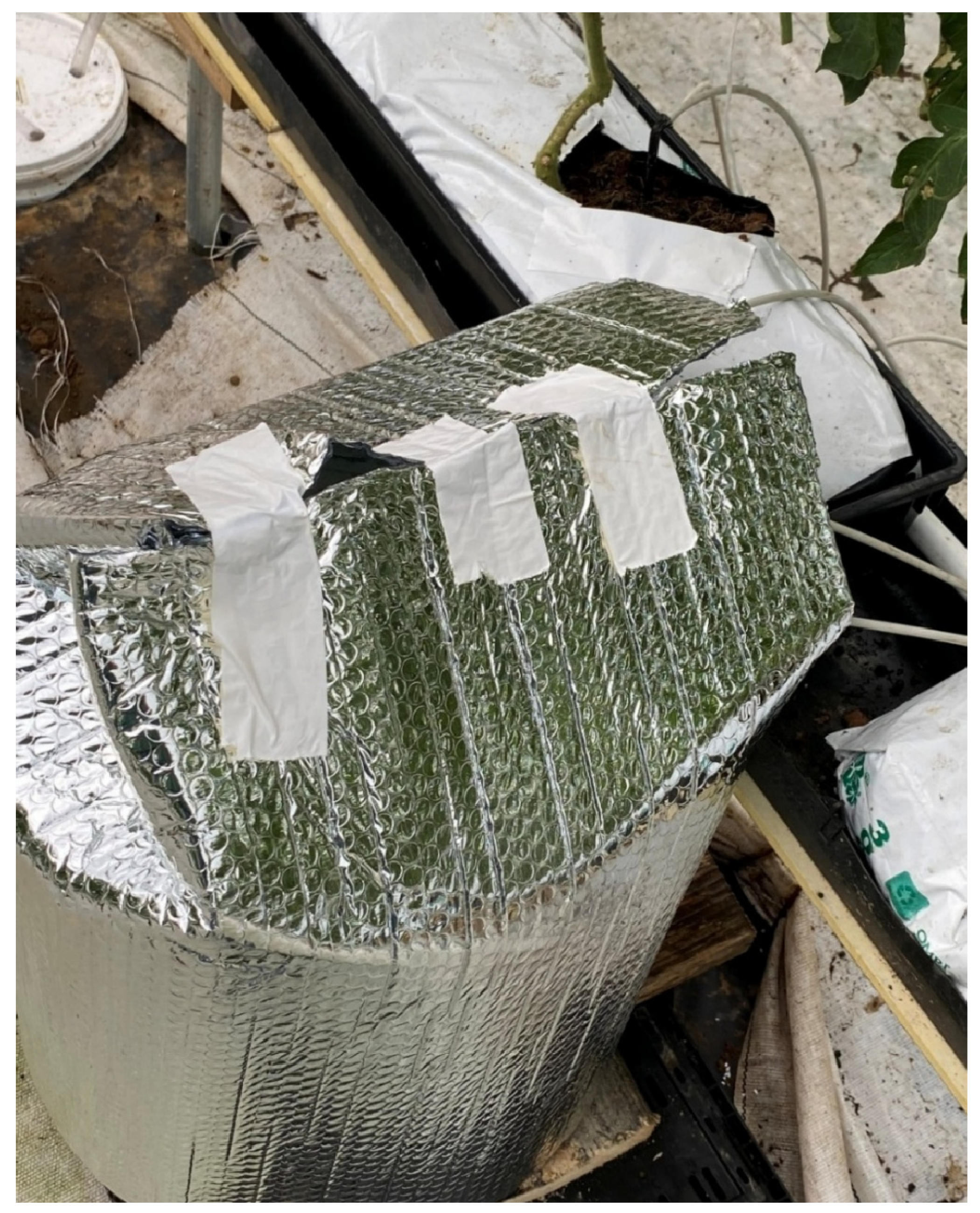
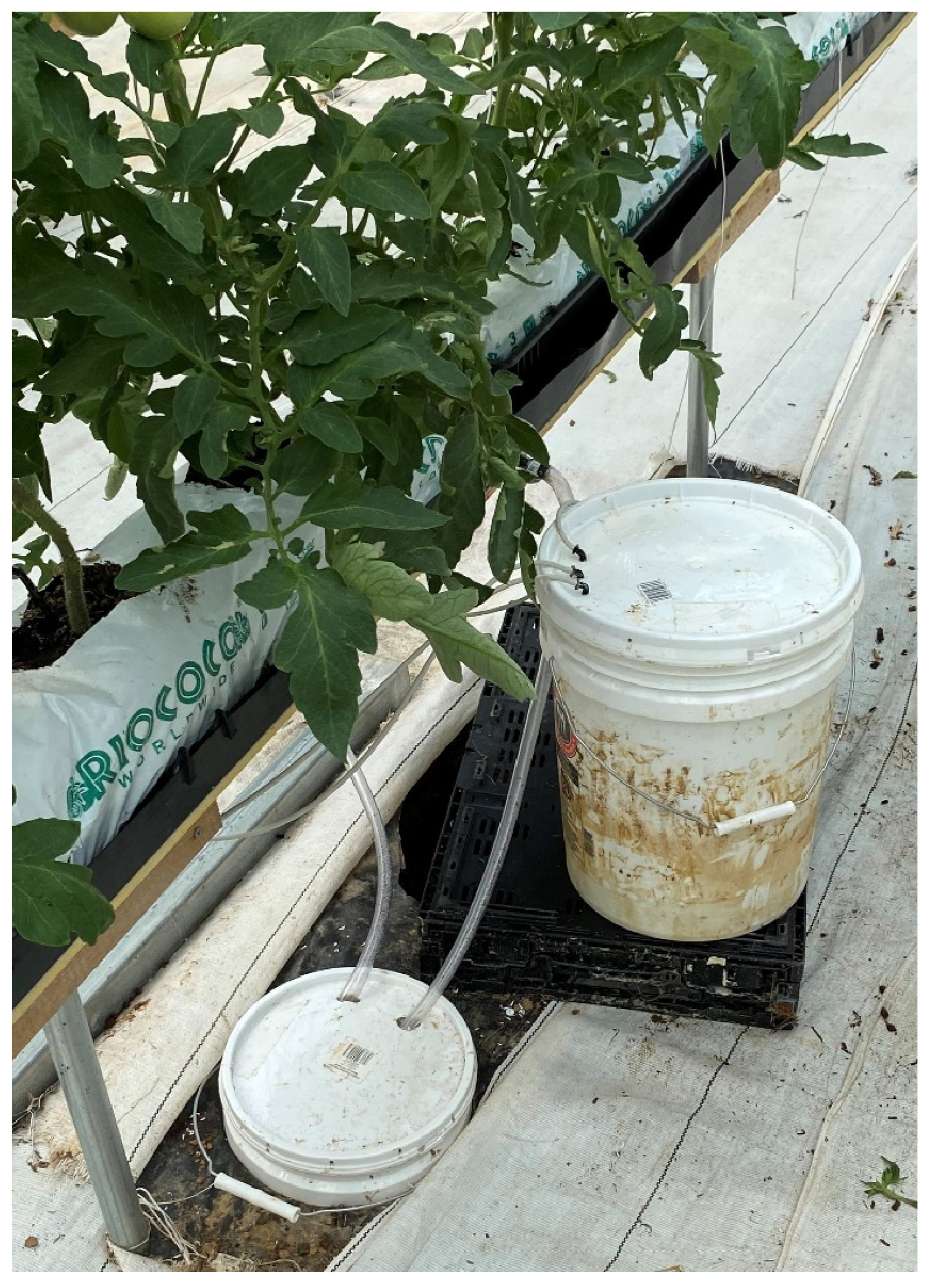
To measure the irrigation volume per tray, three spikes, that were connected to drip emitters, were placed into a bucket with the top approximately level with the three equivalent spikes in the coco coir grow bags. The bucket was covered with reflective insulation material to limit evaporation (Figure 1). Drainage was collected into another bucket, this one partially underground (Figure 1), via two drainpipes from a Beekenkamp Dutch Leach Tray (Beekenkamp Group, Maasdijk, The Netherlands) that held a grow bag of three plants. One drainage and irrigation collection system (Figure 2) was placed randomly in each of three rows. The trays were sloped to ensure proper drainage. Volumes of irrigation and drainage in the buckets were taken between 8:00 a.m. and 8:30 a.m., prior to the start of irrigation, four days in a row per week, except for the first two weeks when only two days of data were taken. We acknowledge that this non-continuous sampling could affect predicted evapotranspiration (ETc) estimates via accumulated effects, such as from too little or too much irrigation, from the day(s) prior to a week’s first day of data taking. The volumes from the three setups were averaged to arrive at daily mean irrigation (Im) and drainage (Dm) volumes. Using these values, observed evapotranspiration (ET), which averaged 2.14 L tray−1 in the present study, was calculated as:
E T = I m D m .
Following Gallardo et al. [13], evaporation from the plastic-wrapped coco coir grow bag was considered negligible; however, ET may be affected by small amounts of unmeasured evaporation, particularly on very hot days, as well as by changes in media and plant water storage. All data and code used are freely available on Open Science Framework (OSF; https://osf.io/ah7x9/, accessed on 2 June 2026). The files are organized alphabetically, with the dataset provided as “Bucket Data Revised” and code files organized by the model type (TVPD, RF, or KNN) and by the stage of analysis (e.g., calibration and evaluation).

2.3. Model Calibration and Evaluation

2.3.1. Correlating Environmental Factors with ET

Data analysis began with Pearson correlation analysis between environmental factors and ET. This was conducted with R Statistical Computing Software (v4.3.1; R Core Team, Vienna, Austria), as were all the following analyses in this study. We deemed the use of Pearson appropriate based on visual comparison of the data’s regression line with a locally estimated scatterplot smoothing (LOESS) line. Correlation strength classifications were as follows: very strong (r ≥ 0.8), strong (0.6 ≤ r < 0.8), moderate (0.4 ≤ r < 0.6), weak (0.2 ≤ r < 0.4), or very weak to no correlation (0 ≤ r < 0.2).

2.3.2. Calibrating and Evaluating TVPD

We used TVPD as in Dunn and Kinmonth–Schultz [12]:
E T o = c 1 ( V P D ) P W + c 2 ( R N ) L H W ,   V P D   < B P d 1 ( V P D ) P W + d 2 ( R N ) L H W ,   V P D   B P
where ETo is reference evapotranspiration; c1, c2, d1, and d2 are empirical coefficients from calibration that are used to minimize the root mean square error (RMSE) between observed evapotranspiration and predicted evapotranspiration (ETc); VPD is vapor pressure deficit; PW is the pressure of water (0.0065378 kPa L−1); RN is the daily solar radiation (MJ m−2 d−1); LHW is the latent heat of water (2.45 MJ m−2 d−1 L−1); and BP is the breakpoint at which the direct influence of VPD on transpiration slows due to stomatal closure. BP was set at 0.5 kPa in that study. PW and LHW were converted to kPa L−1 based on the area associated with each tray of plants being 1.5 m2; this changed the value for PW but not for LHW. As in previous studies and recommendations, ETo was used with a crop coefficient (Kc), which incorporates crop characteristics, to arrive at predicted evapotranspiration (ETc) [13,30]:
ETc = ETo · Kc.
In this study, Kc was set at 1.4, following Gallardo et al. [13] and Dunn et al. [12], until growth point removal on 18 Nov. Afterward, the Kc value was decreased, evenly across observations, to 0.7 for the last day, resulting in a daily Kc decrease of 0.0368421 from growth point removal to the end of the study. This was done similarly to the Kc decrease based on Julian Day (JD) used in Gallardo et al. [13], and decreased to the lowest value recommended by Allen et al. [30] for an end-of-season Kc. Therefore, beginning on 18 Nov, Kc was calculated as follows:
K c ( t ) = K c ( t 1 ) 0.0368421
where Kc(t) is the Kc for a day, and Kc(t−1) is the Kc for the previous day.
Thirty-one days of data were used for calibration and evaluation. To determine whether a minimum number of data points could be effective in model calibration, five different data splits were used with TVPD—either 5, 10, 15, 20, or 25 days of calibration data out of the 31 days. The calibration to evaluation data splits were chosen as follows: 5 d to 26 d (16%/84%, C5), 10 d to 21 d (32%/68%, C10), 15 d to 16 d (48%/52%, C15), 20 d to 11 d (65%/35%, C20), and 25 d to 6 d (81%/19%, C25), where the first number of days and the first percentage relate to the calibration dataset and the second number of days and percentage relate to the corresponding evaluation dataset. The calibration and evaluation datasets were chosen to respect temporal order, with the calibration data preceding, in time, the evaluation data. From this point forward, CX will be used to notate each data split, where X is the number of calibration days for that split. The BP was determined for each data split using the segmented package [31] in R Statistical Computing Software (v4.3.1; R Core Team). The Davies’ test [32] was used to analyze breakpoints for significance based on whether the regression slope was constant or whether it changed at some breakpoint.
BP analysis was followed by calibration of the empirical coefficients for each data split using the optim function (stats package, R Core Team) with R Statistical Computing Software. The function was set to minimize the RMSE between measured ET and ETc. R Statistical Computing Software was used to make predictions from TVPD. We evaluated the results of TVPD based on the RMSE, the coefficient of determination (r2), bias, and the difference between the slope and intercept of the regressions between ET and ETc relative to the 1:1 line. The significance (p < 0.05) of any differences with the 1:1 line were evaluated with the Wald test [33].

2.3.3. Training and Testing Random Forest (RF) and K-Nearest Neighbors (KNN)

RF was used to predict ETc on the same data splits as was TVPD, while using only RN and VPD as factors. The seed was set at 123, and the mtry value was optimized for r2 for each data split. The ntree value was 12,000 when optimizing mtry, but it was set at 25,000 to ensure stabilization of r2 values when running the test with the optimal mtry value. RF was also tested with all factors, RN, VPD, temperature, humidity, and JD, while not specifying any data split. For this, values of mtry and ntree were optimized based on r2 values and stability across increasing ntree values. The same evaluation metrics were used for RF as were for TVPD evaluation. The evaluation was conducted in R using the randomForest package [34].
KNN was used to predict ETc on the same data splits as was TVPD, while using only RN and VPD as factors. The seed was set at 123, and the k value was optimized for RMSE for each data split, using leave-one-out cross-validation within the calibration dataset, leaving the remaining data for evaluation. KNN was also tested with all factors, RN, VPD, temperature, humidity, and JD. For this, values of k and the data split used were optimized, using leave-one-out cross-validation within the calibration dataset, based on RMSE. The same evaluation metrics were used for KNN as were for TVPD evaluation. The evaluation was conducted in R using the FNN package [35].

2.3.4. Cross-Validating TVPD, RF, and KNN

To maintain consistency, we used a 10-fold cross-validation with a set.seed value of 123 for TVPD, RF, and KNN. The BP that was associated with the data split with the lowest RMSE was used for 10-fold cross-validation of TVPD. For RF, mtry was determined by analysis of RMSE at different mtry values prior to the 10-fold cross validation. For cross-validation of KNN, k was first set by analyzing RMSE at various k values, and then the 10-fold cross-validation for that k was analyzed. The cross-validation we used chose days of data randomly, which aligns with the way TVPD treats each day as an independent sample, but it is possible that days of data temporally close to one another could have appeared in both the training and testing datasets at any given fold. This random choosing of the days of data could have had a positive effect on prediction accuracy, but TVPD, RF, and KNN were treated the same in this respect. RMSE, bias, and r2 values were reported for these setups for TVPD, RF, and KNN.

2.3.5. Classifying Daily Water Status Using RF and KNN

RF and KNN were used to classify water status that would theoretically result from TVPD predictions. The daily water status was classified based on drainage fraction (DF) as follows: overwatered (DF > 35%), underwatered (DF < 5%), or sufficiently watered (5% ≤ DF ≤ 35%). TVPD predictions were increased by 20%, a standard desired drainage fraction [36], to arrive at a model-recommended irrigation volume (Ir) per day, and DF was calculated using the following equation:
D F = ( I r E T ) / I r
RF was used with 1000 trees and an mtry of 5, meaning that JD, temperature, humidity, VPD, and RN, which were all the available factors, were randomly sampled at each node. JD corresponds to 1 on 1 January and 365 on 31 December. Different mtry values were also evaluated based on out-of-bag error rate and class error rate.
KNN was used with an 80/20 data split and a k of 5, where k was the square root of the number of rows in the test data and represents the number of nearest neighbors considered when classifying. All available factors (JD, temperature, humidity, VPD, and RN) were used. Evaluation was based on overall error rate and class error rate.

3. Results

The accurate prediction of evapotranspiration is important for irrigation management. In this study, correlations were analyzed between environmental factors and evapotranspiration. Then, we used TVPD, an existing model, to produce predicted evapotranspiration (ETc) values, comparing TVPD predictions with those from two supervised machine learning models, random forest (RF) and K-nearest neighbors (KNN). We also used RF and KNN to classify the daily water status that would result from TVPD predictions. Below are the results of those evaluations.

3.1. Correlations of Environmental Factors with Observed Evapotranspiration (ET)

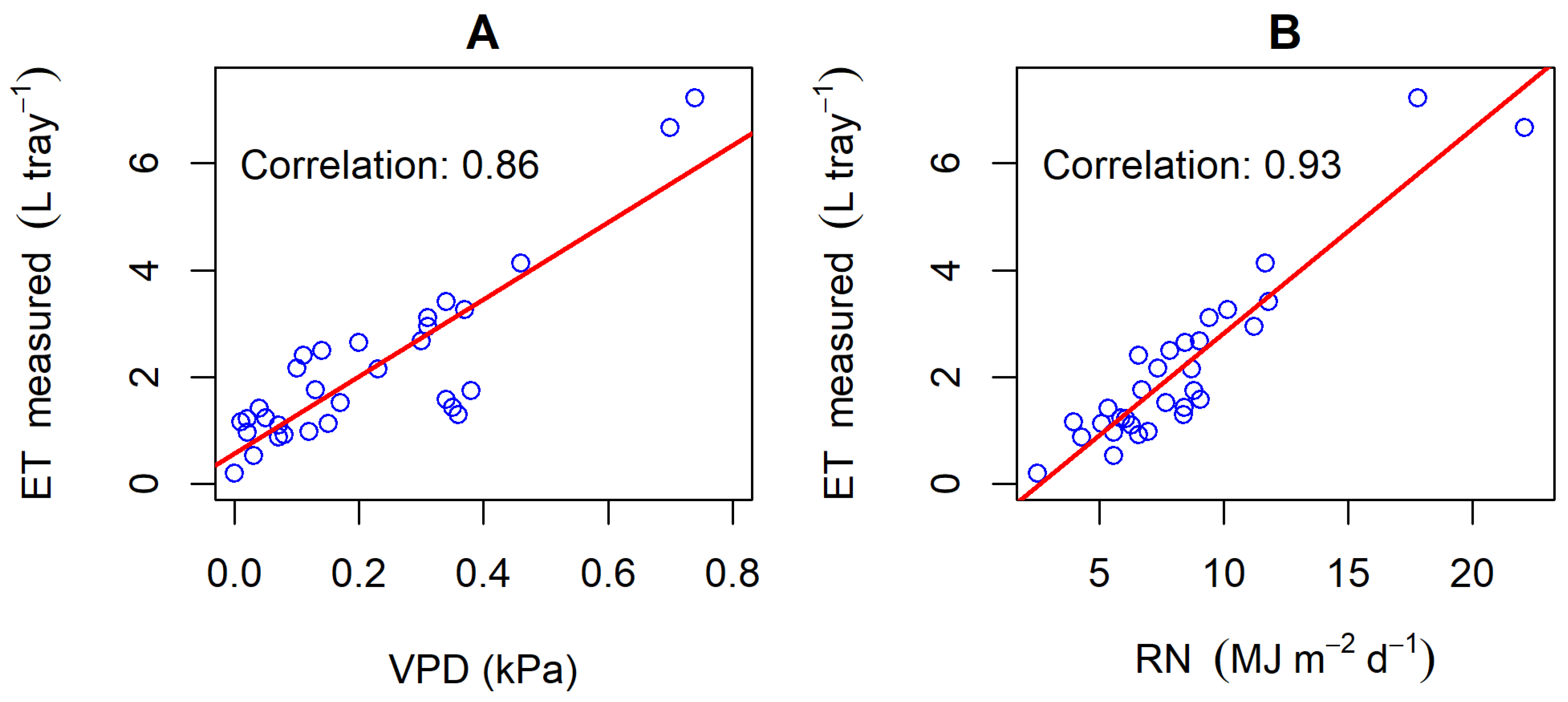
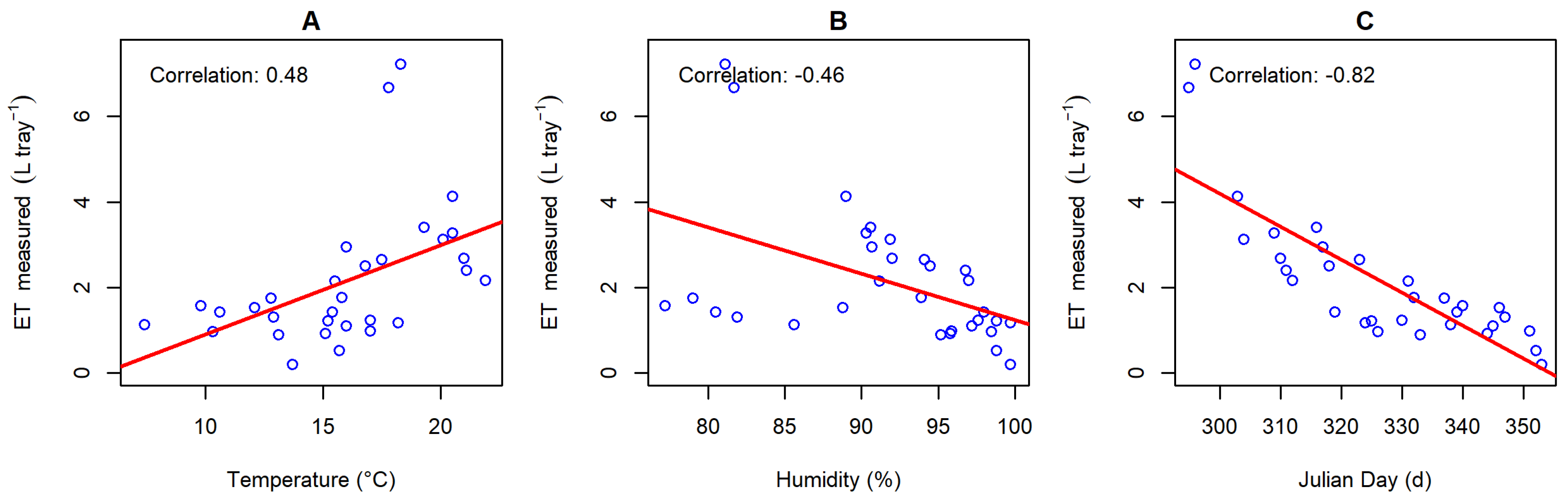
The environmental factors used in the study were moderately to very strongly correlated with ET (Figure 3 and Figure 4). Correlation analysis showed a very strong positive relationship between vapor pressure deficit (VPD) and ET (r = 0.86) and between solar radiation (RN) and ET (r = 0.93), the factors that are used in TVPD. There was also a strong relationship, though negative, between Julian Day (JD) and ET (r = −0.82). Temperature (r = 0.48) and humidity (r = −0.46) were moderately correlated with ET. While TVPD uses only RN and VPD, we included JD, temperature, and humidity when implementing RF and KNN, along with also using RN and VPD alone.

3.2. Calibration and Evaluation of TVPD

3.2.1. VPD Breakpoint Analysis and Calibration of TVPD

For TVPD to make predictions from the dataset, possible VPD breakpoints were first determined, followed by the calibration of TVPD coefficients. In trying to determine which division of data, as far as calibration to evaluation ratio, produced the most accurate predictions, we looked for VPD breakpoints, and subsequently calibrated and evaluated TVPD, using five data splits: C5, C10, C15, C20, C25. The breakpoints determined for each data split ranged from 0.38 to 0.425, and the four empirical coefficients were also calibrated for each breakpoint and in relation to each data split (Table 1).

3.2.2. Evaluation of TVPD

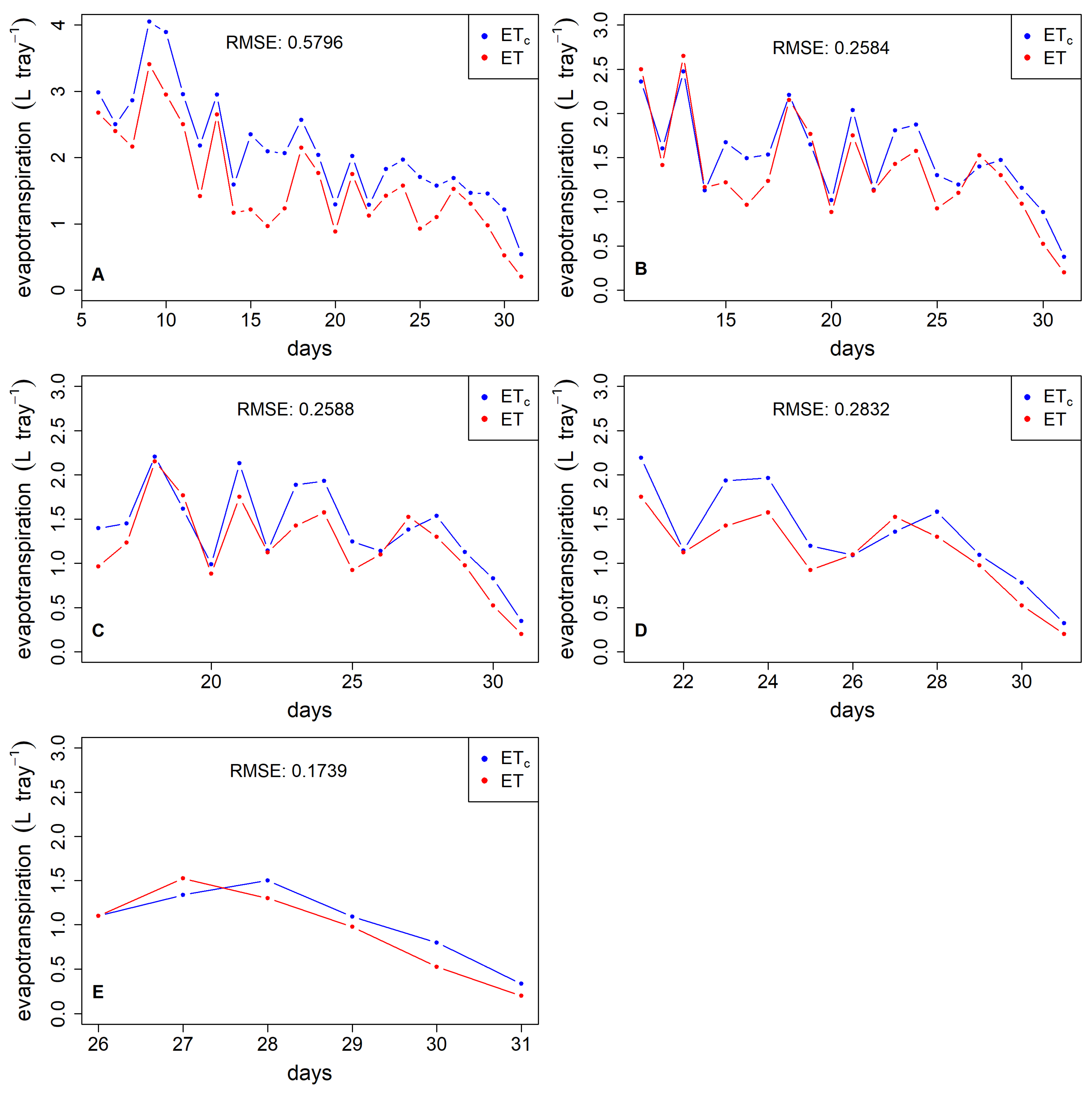
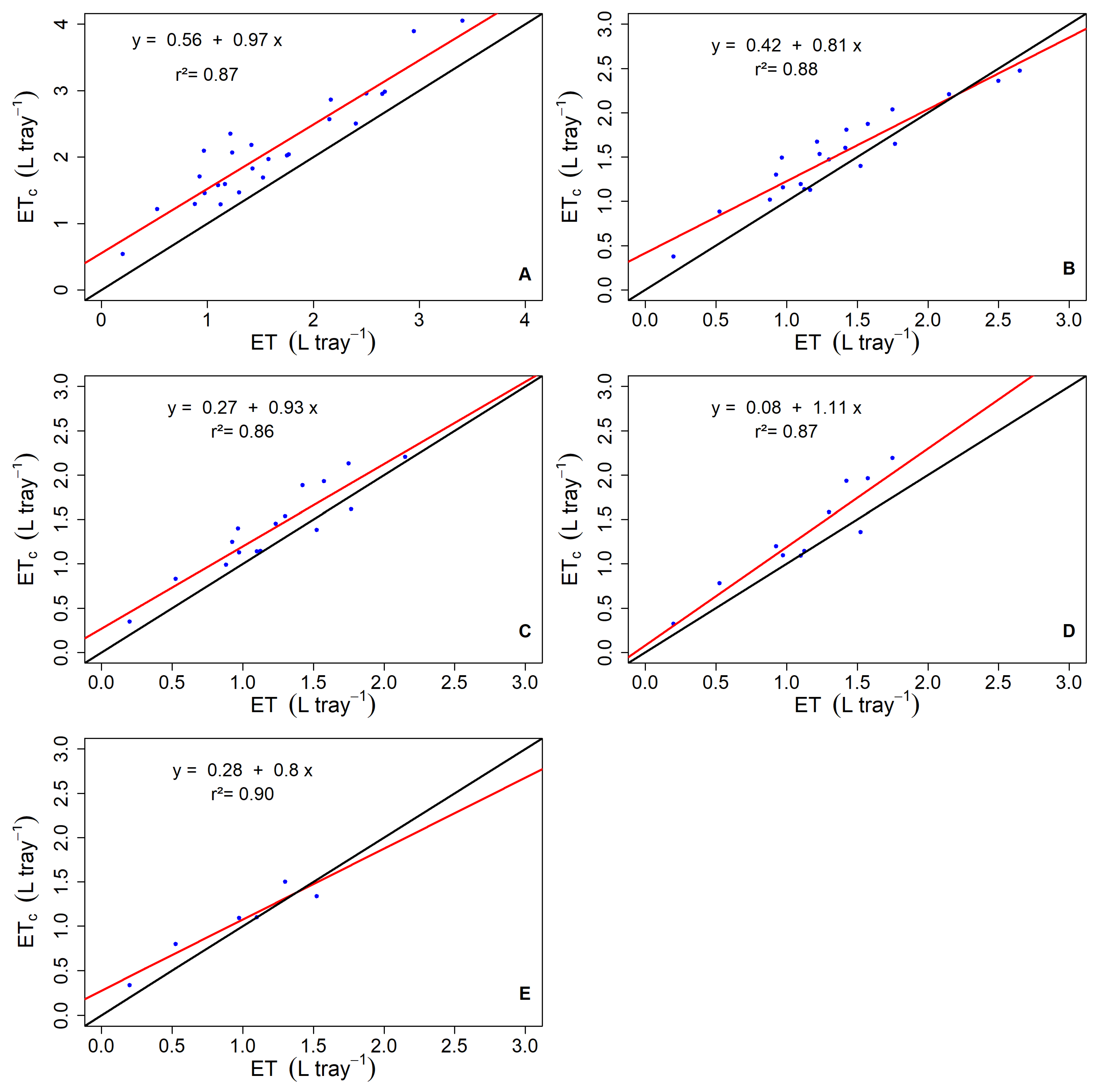
The range of values for r2, from TVPD evaluation, across data splits was relatively small, indicating limited variability (Figure 5 and Figure 6; Table 2). Values of r2 ranged from 0.86 to 0.90 (0.88 ± 0.02; CV = 2%), with the greatest value at C25. The root mean square error (RMSE) ranged from 0.1739 to 0.5796 L tray−1 (0.3108 ± 0.1559; CV = 50%), with the smallest value being for C25. Bias indicated consistent overprediction across data splits, with the least amount of bias occurring at C25. The slopes and intercepts of the regression lines were not significantly different (p < 0.05) from that of the 1:1 line, except for the intercepts at C5, C10, and C25.

3.3. Training and Testing of RF and KNN

Training and Testing of RF

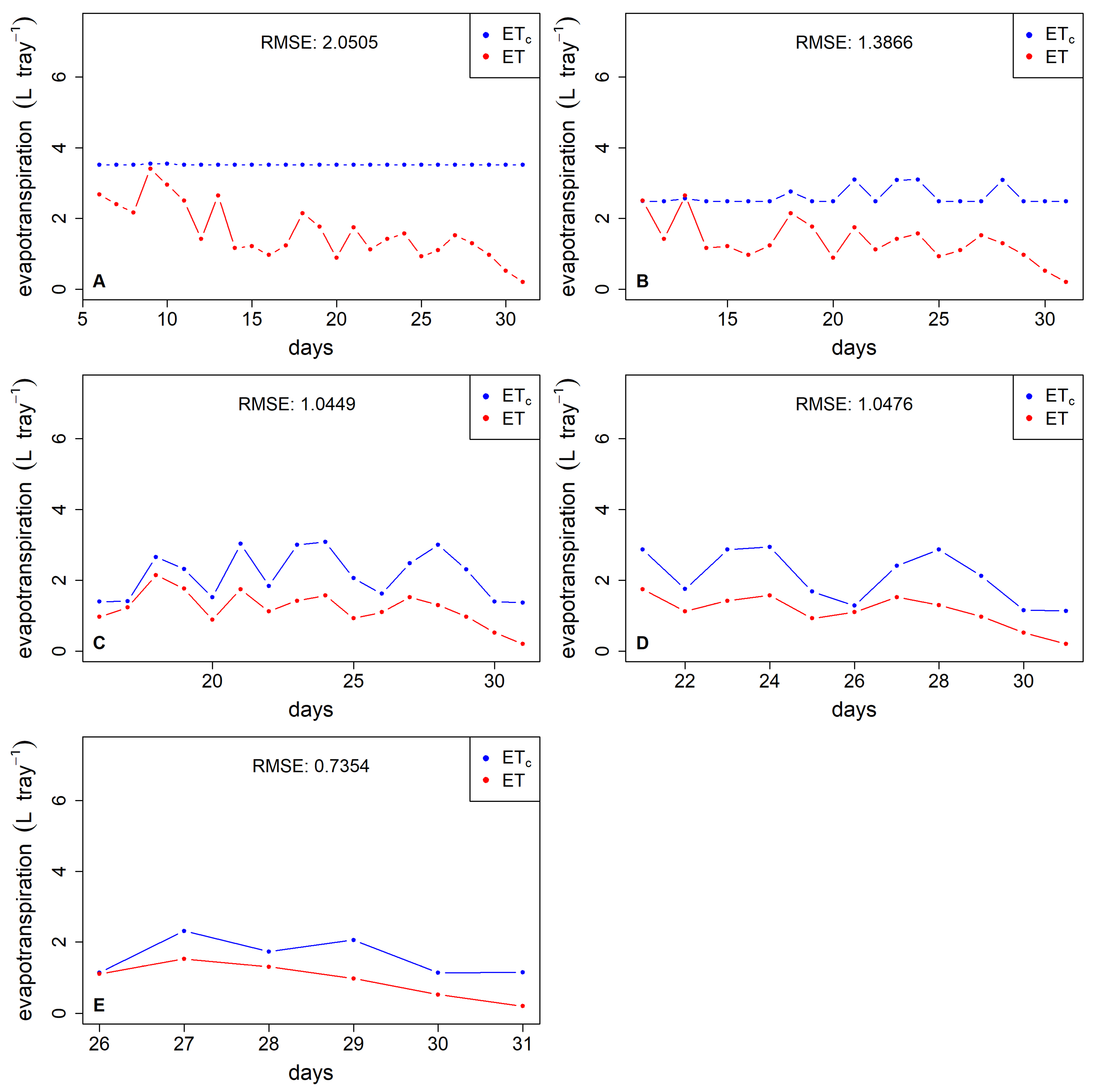
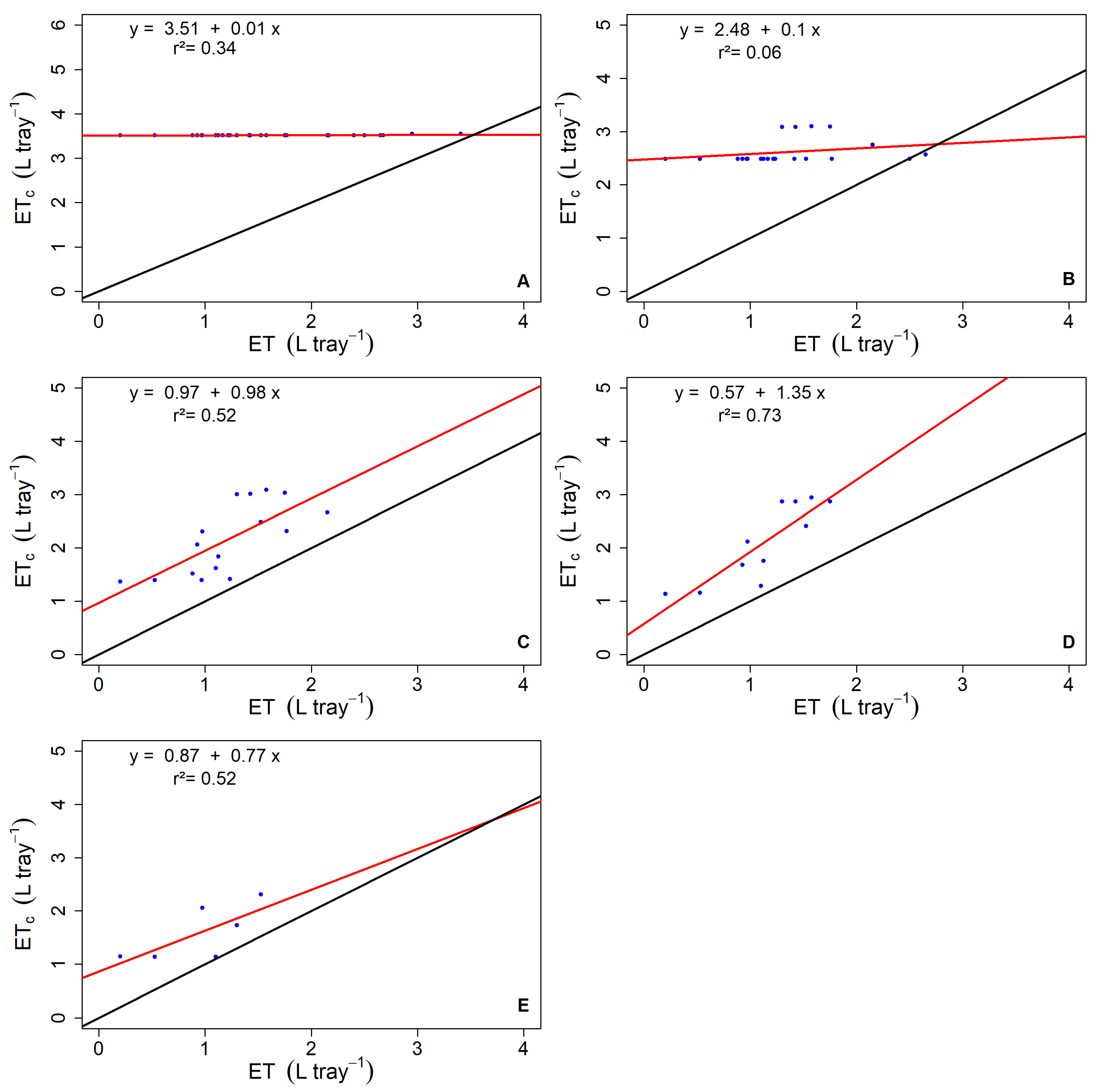
RF was trained on the training data for each data split, and the optimal mtry and ntree values were 2 and 25,000, respectively, except that mtry was 1 for the C20 data split. RF produced a relatively wide range of values for the evaluation metrics, across data splits, which indicated some instability in RF with changing data splits (Figure 7 and Figure 8; Table 2). RMSE ranged from 0.7354 to 2.0505 L tray−1, with the smallest value being at C25. Values of r2 ranged from 0.06 to 0.73, with the largest value at C20. Bias indicated overprediction at all data splits. The slopes and intercepts of the regression lines were not significantly different (p < 0.05) from that of the 1:1 line at C20, and the intercepts were not significantly different at C15 and C25. VPD was the most important factor, based on the mean decrease in accuracy across random permutations of each factor, at C5 and C15, and RN was the most important factor at all other data splits.
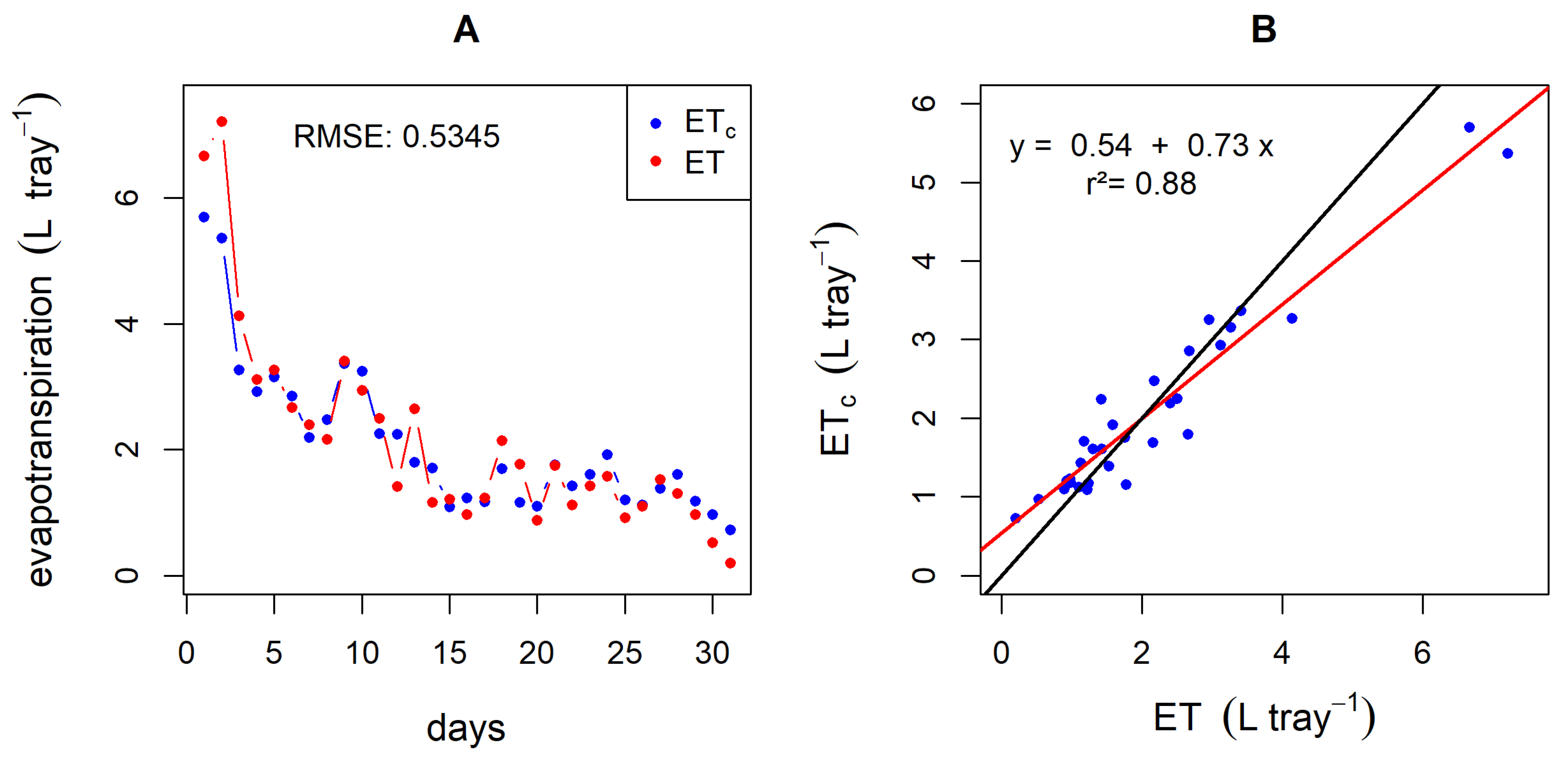
RF regression predictions improved when using all factors, RN, VPD, temperature, humidity, and JD, while not specifying a dataset (Figure 9). The r2 increased to 0.88, while RMSE decreased to 0.5345 L tray−1. With all five factors, RF underpredicted (bias = −0.0443) overall, turning to mostly overprediction beyond day 19. The top three factors were JD, RN, and VPD, in order of importance. Both the slope and the intercept of the regression line between ET and ETc were significantly different (p < 0.05) from that of the 1:1 line.

3.4. Training and Testing of KNN

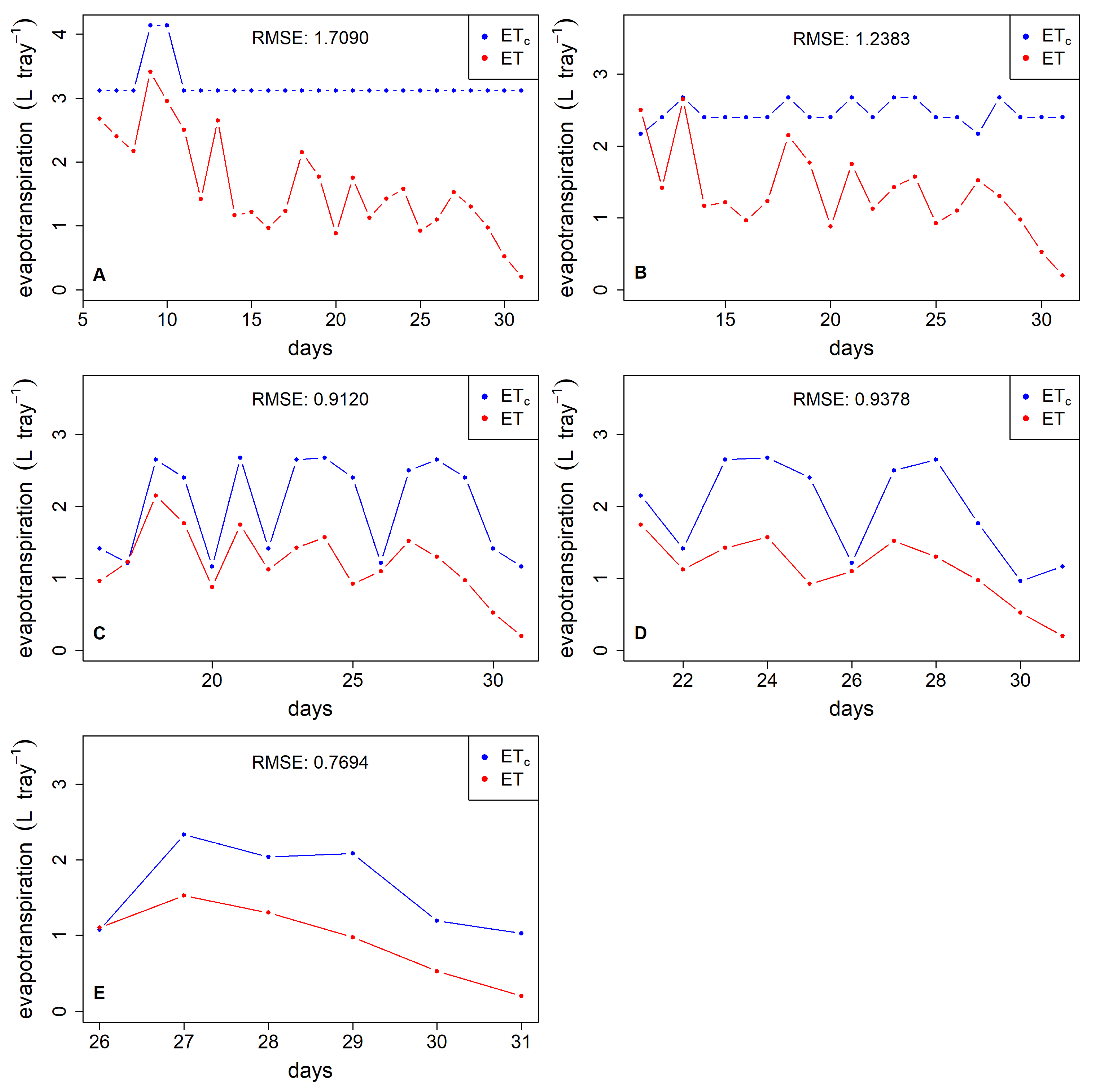
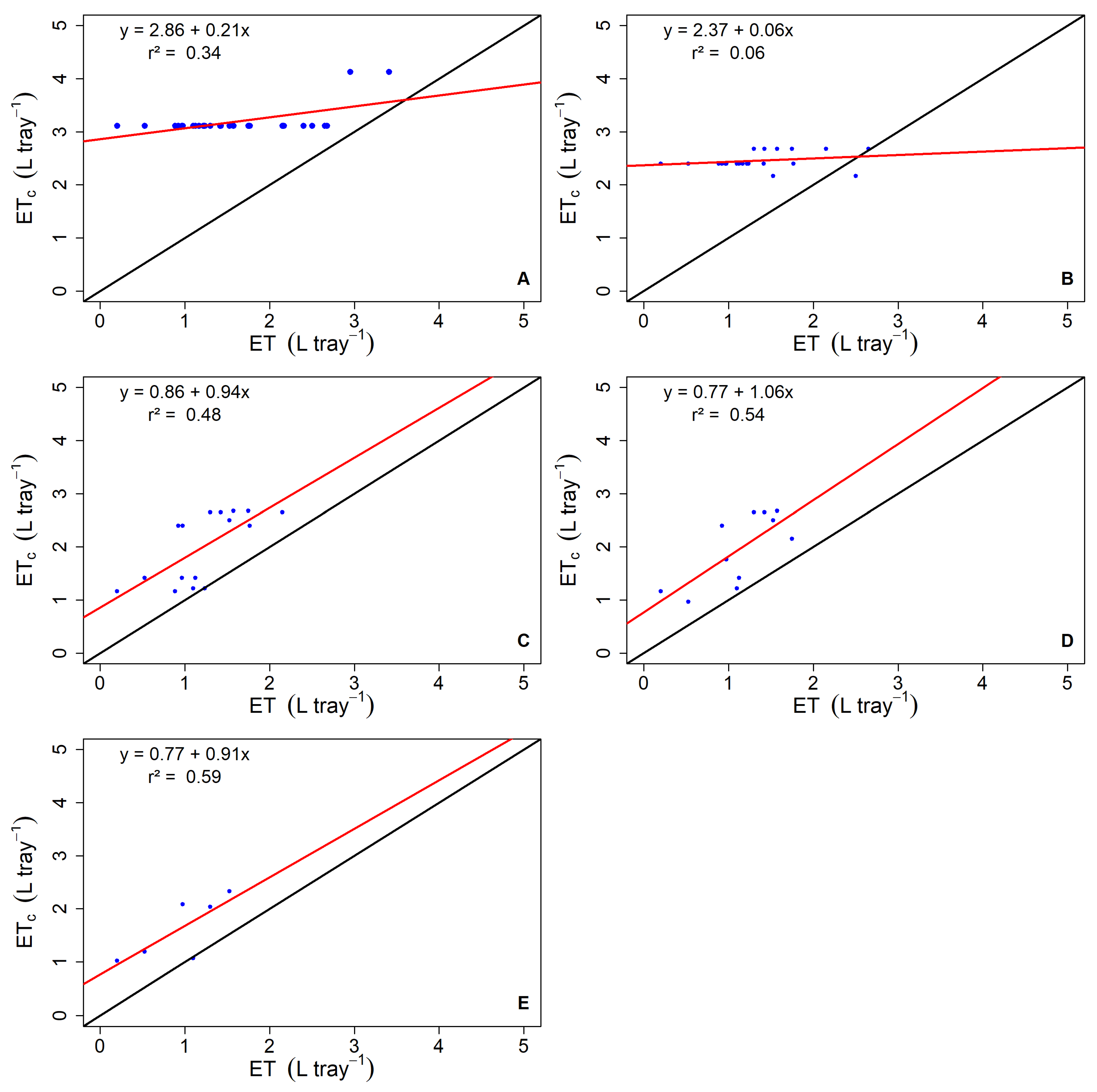
KNN was trained on the training data for each data split, and the optimal k values were 1 for C5 and C25, 2 for C10 and C15, and 3 for C20. As with RF, KNN also produced a relatively wide range of values for the evaluation metrics, across data splits, which indicated some instability in KNN with changing data splits (Figure 10 and Figure 11; Table 2). RMSE ranged from 0.7694 to 1.7090 L tray−1, with the smallest value being at C25. Values of r2 ranged from 0.06 to 0.59, with the largest value at C25. Bias indicated overprediction at all data splits. The slopes and intercepts of the regression lines were not significantly different (p < 0.05) from that of the 1:1 line at C20 and C25, and the intercept was not significantly different at C15.
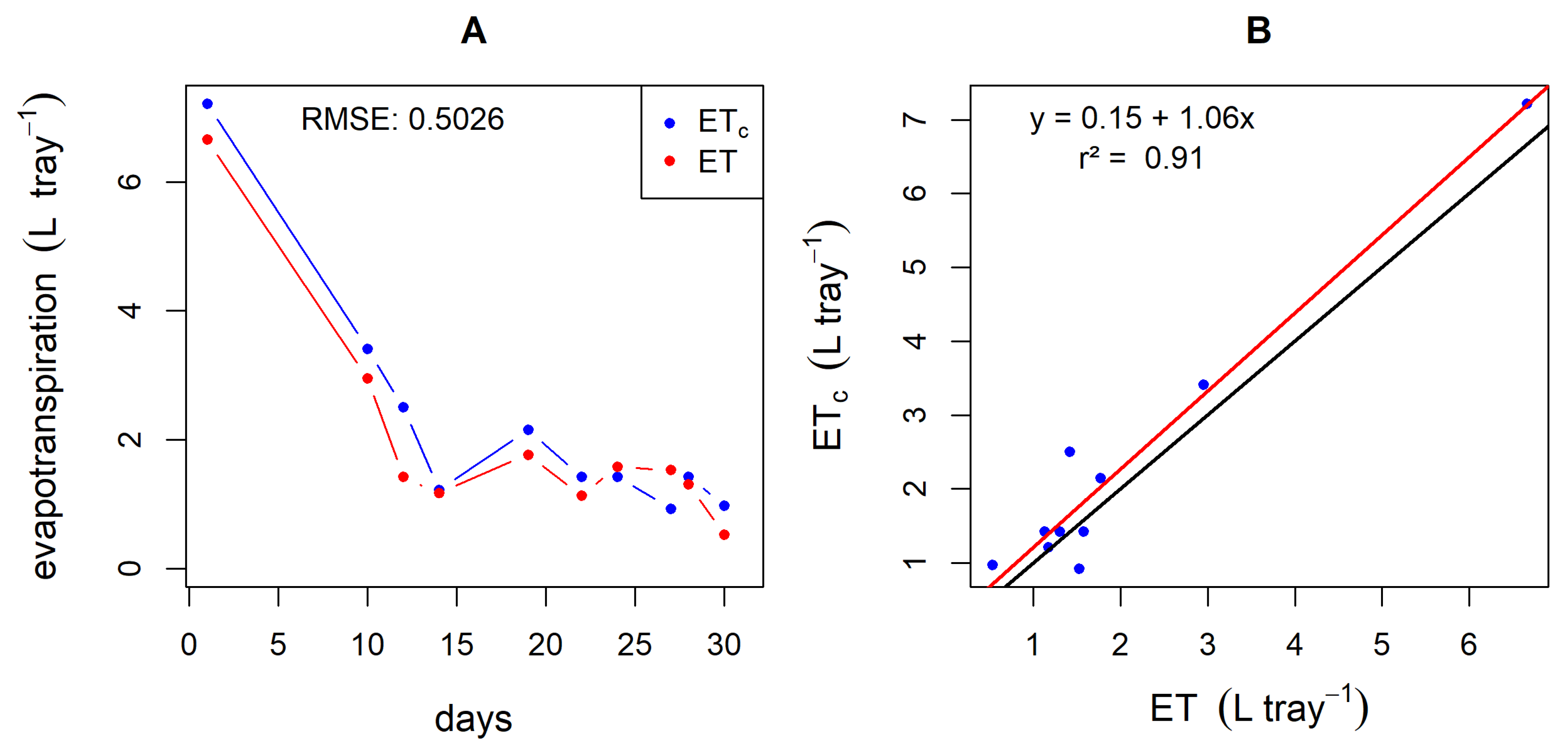
KNN regression predicted evapotranspiration better when using RN, VPD, temperature, humidity, and JD as factors and selecting for the optimal data split, which was a 70/30 split with a k of 1 (Figure 12). The r2 value increased to 0.91, and RMSE decreased to 0.5026 L tray−1. KNN slightly overpredicted (bias = 0.2650) with this setup. Neither the slope nor the intercept of the regression line between ET and ETc were significantly different (p < 0.05) from that of the 1:1 line.

3.5. 10-Fold Cross-Validations of TVPD, RF, and KNN

3.5.1. 10-Fold Cross-Validation of TVPD

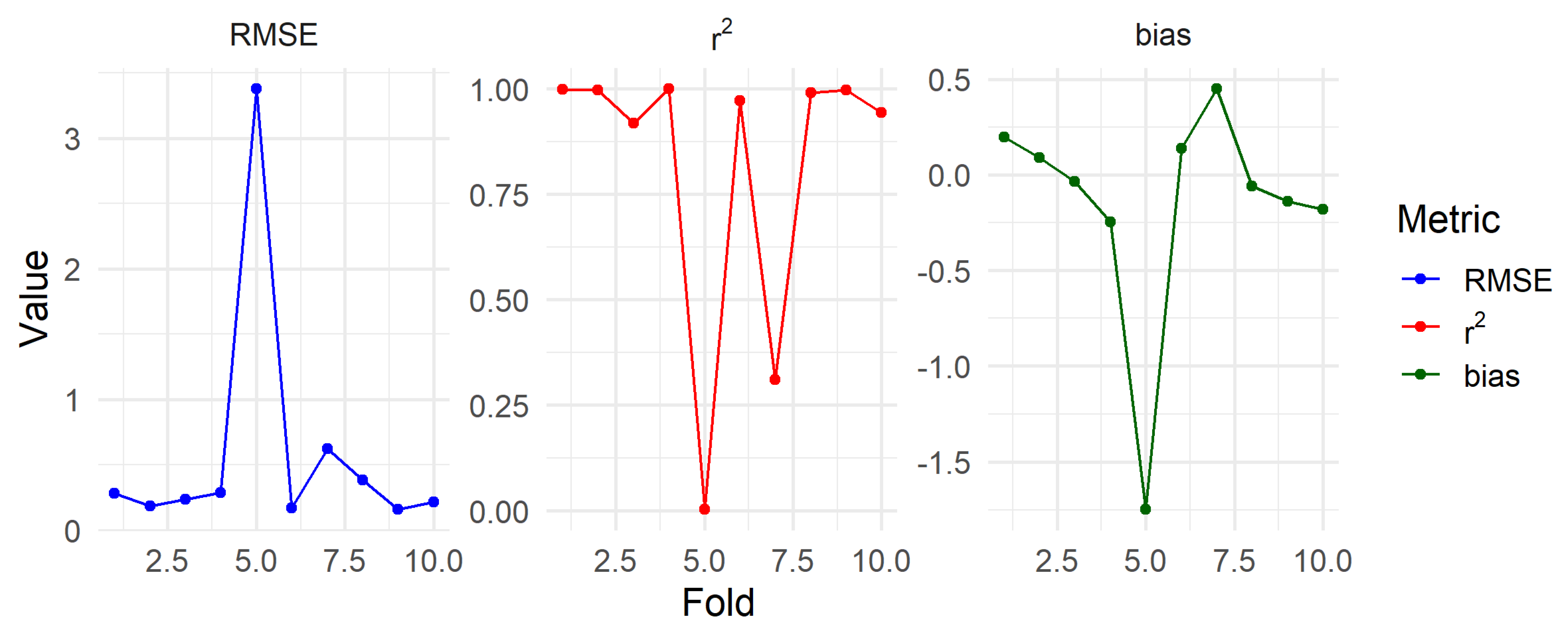
A 10-fold cross-validation of TVPD at the 0.38 VPD breakpoint produced a mean RMSE of 0.5922 L tray−1 (SD = 0.9880), mean r2 of 0.81 (SD = 0.35), and a mean bias of −0.1534 L tray−1 (SD = 0.5965). Training data metrics for TVPD (r2 = 0.94, RMSE = 0.3547 L tray−1), both being better than those returned from the cross-validation, indicated that the model likely suffered from some degree of overfitting. The metrics showed some fluctuation between folds, having one to two outliers for each (Figure 13).

3.5.2. 10-Fold Cross-Validation of RF

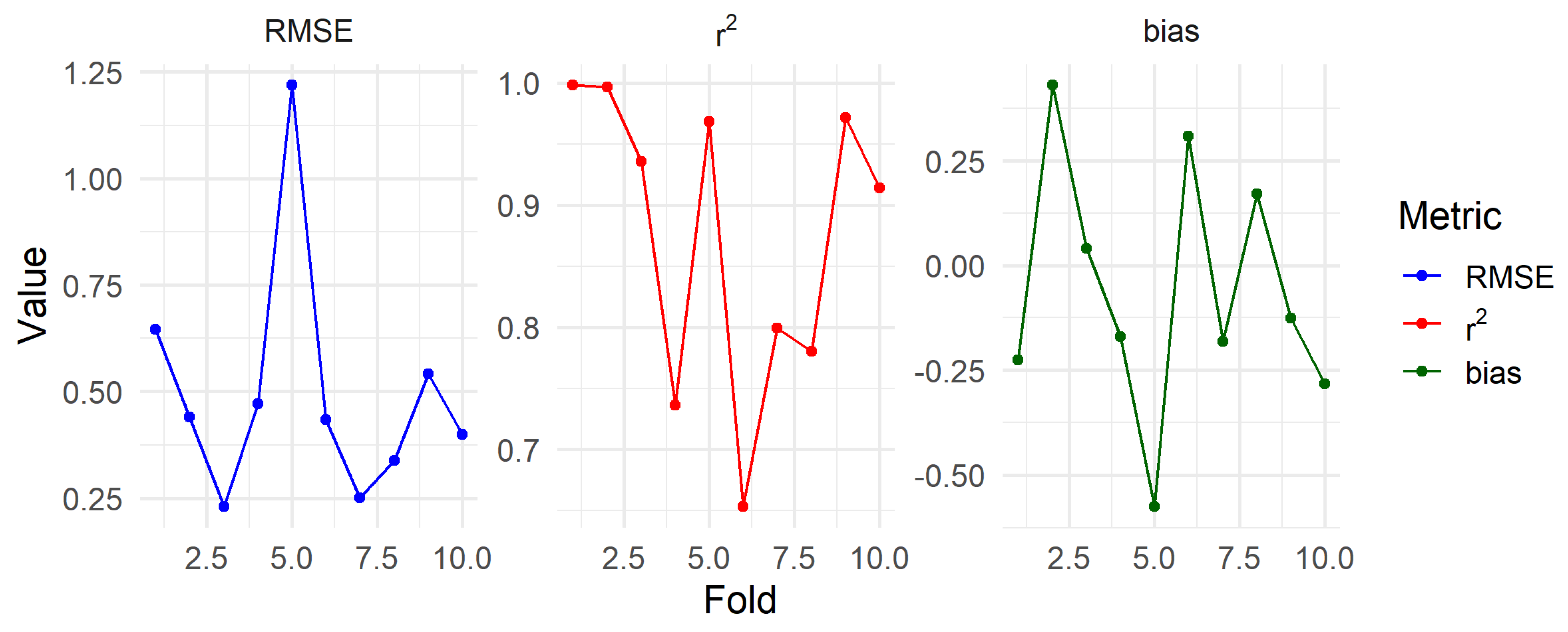
After choosing mtry 3 by evaluating mean RMSE, across the 10 folds at each mtry, (Table 3), a 10-fold cross-validation of RF was conducted (Figure 14). The mtry is the number of factors considered at each node. The cross-validation showed a mean RMSE of 0.4970 L tray−1 (SD = 0.2827), mean r2 of 0.88 (SD = 0.12), and a mean bias of −0.0613 L tray−1 (SD = 0.3006). On the training data, RF produced an r2 of 0.99 and an RMSE of 0.2720 L tray−1, which were better than the cross-validation output metrics for RF. This difference in training versus cross-validation metrics, along with fluctuations in bias, r2, and RMSE values indicated overfitting and instability in RF for this dataset.

3.5.3. 10-Fold Cross-Validation of KNN

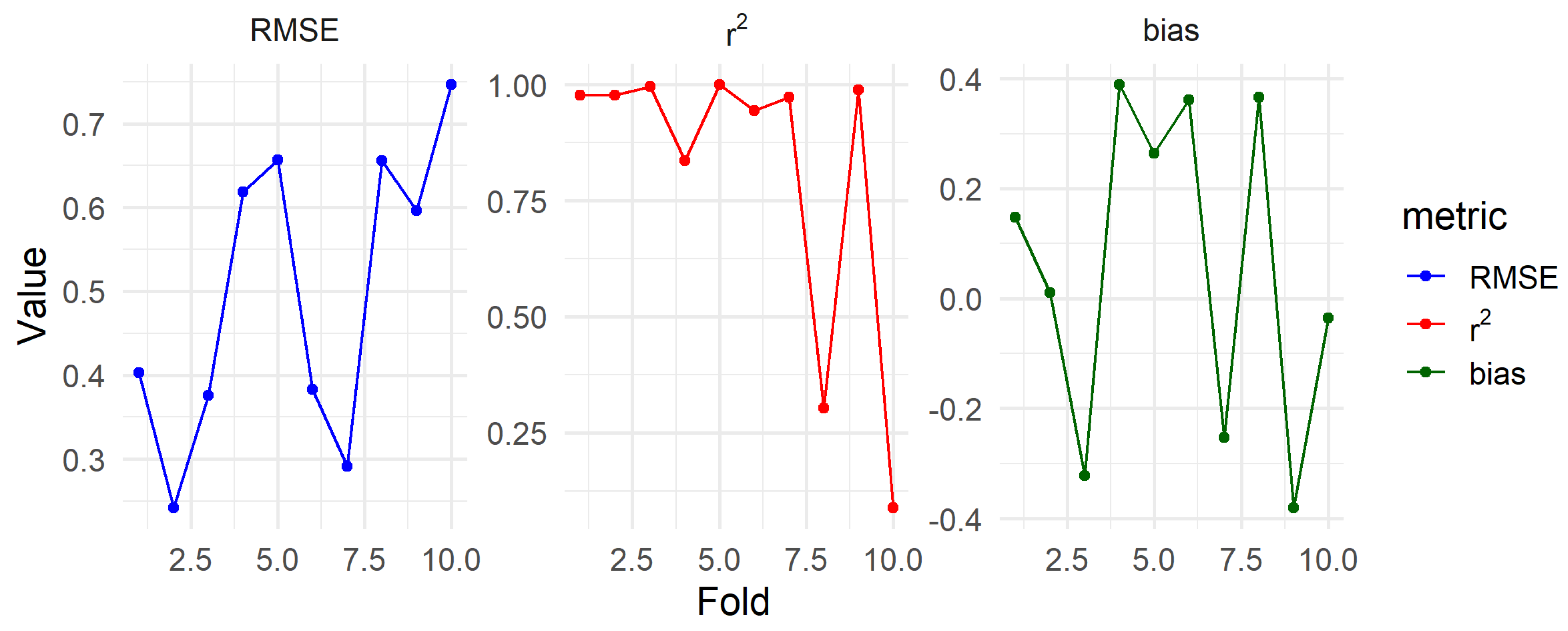
We set k as 1 by evaluating mean RMSE, across the 10 folds for each k (Table 4), and a 10-fold cross-validation was conducted (Figure 15). In this case, k is the number of nearby points averaged to predict ET. Cross-validation showed a mean RMSE of 0.4698 L tray−1 (SD = 0.1767), mean r2 of 0.81 (SD = 0.33), and a mean bias of 0.0548 L tray−1 (SD = 0.2966). Metrics produced from the training data (r2 = 1, RMSE = 0 L tray−1) were considerably better than those from the cross-validation, indicating possible overfitting. As with random forest, the overfitting, along with the fluctuations in bias, r2, and RMSE, suggested instability in KNN for this dataset.

3.6. Classification of Watering Status Using RF and KNN

3.6.1. Classification of Watering Status Using RF

RF classification of daily watering status, which was based on drainage fraction (DF) as follows: overwatered (DF > 35%), underwatered (DF < 5%), or sufficiently watered (5% ≤ DF ≤ 35%). This classification produced an OOB estimate of error rate of 25.81%, with almost all days (28 of 31) classified as sufficiently watered (Table 5). The one overwatered day was classified as sufficiently watered, as were five of the underwatered days. The predominance of the sufficiently watered classification can be partly explained by class imbalance, with this class comprising 77% of observations, which would reduce model sensitivity to the other two conditions.

3.6.2. Classification of Watering Status Using KNN

K-nearest neighbor classification of daily watering status as overwatered (DF > 35%), underwatered (DF < 5%), or sufficiently watered (5% ≤ DF ≤ 35%) had an overall error rate was 28.57%, with all seven days of testing data classified as sufficiently watered (Table 6). As with RF above, this result is partly explained by class imbalance among the observations.

4. Discussion

To analyze the prediction accuracy of TVPD, as compared to random forest (RF) and K-nearest neighbors (KNN) in a data-limited setting, we studied correlations between environmental factors and evapotranspiration and evaluated the prediction accuracy of TVPD, RF, and KNN, as well as the number of calibration/training days each model required to produce acceptable predicted evapotranspiration (ETc) estimations. We also evaluated all three models with a K-fold cross-validation. Lastly, we attempted to use RF and KNN to classify the daily water status that would result from TVPD predictions.

4.1. Solar Radiation (RN) and Vapor Pressure Deficit (VPD) Were the Factors Most Correlated with Observed Evapotranspiration (ET)

For these data, the two environmental factors with the strongest correlations with ET were RN (r = 0.93) and VPD (r = 0.86). RN provides the energy for ET while VPD represents atmospheric demand, and when both RN and VPD values increase, ET also tends to increase. However, RN and VPD can exert separate pressure on ET, particularly when the VPD value is large enough to lead to diminished stomatal conductance, which leads to less ET, even at high RN. The relationship between RN and ET was described early [37], and because of this, RN has been used in many ET and sap flow models [11,12,13,14,21] The very strong correlation of ET with VPD was expected based on the relationship between ET and stomatal conductance, which is influenced by VPD [38,39,40]. The next most related factor was Julian Day (JD; r = −0.82), which has been used to reflect seasonal temperature changes [41]. JD has a negative relationship with ET because the daylight hours were getting shorter and the temperature was getting cooler as the study progressed from October to December. Temperature (r = 0.48) and humidity (r = −0.46) both had moderate correlation with ET but in opposite directions.

4.2. TVPD Produced Accurate Predictions with Less Training Data than RF or KNN

If the De Jager [23] standard for model reliability (r2 = 0.80) is used to determine the acceptability of a model for prediction of ETc, TVPD exceeded that standard at C5 with only five days of data in the training dataset. Neither RF nor KNN reached an r2 of 0.80 at any data split studied. Across all data splits, maximum r2 values were at C25 for TVPD (r2 = 0.90) and KNN (r2 = 0.59) and at C20 for RF (r2 = 0.73). Root mean square error (RMSE) was lowest at C25 (TVPD: 0.1739 L tray−1; RF: 0.7354 L tray−1; KNN: 0.7694 L tray−1). With the average measured ET being 2.14 L tray−1 for this dataset, the best RMSE values from RF and KNN represent approximately one-third of measured ET, which is much greater than for TVPD, where the RMSE value is approximately one-twelfth of measured ET. TVPD produced more accurate predictions than RF and KNN across all data splits (Figure 5, Figure 6, Figure 7, Figure 8, Figure 10 and Figure 11; Table 2).
When tested without the data splits and factors used with TVPD, allowing the use of all factors (RN, VPD, temperature, humidity, and JD) and optimizing for mtry in the case of RF and k and data split in the case of KNN, the predictions of RF and KNN were more accurate (Figure 9 and Figure 12). RF achieved an r2 of 0.88 and an RMSE of 0.5345 L tray−1, which remained worse than all TVPD RMSE values, except at C5, and worse than the best TVPD r2 value. With the use of all factors, KNN (r2 = 0.91) exceeded the best TVPD r2 value, but its RMSE value (0.5026 L tray−1) was worse than all TVPD RMSE values except at C5. These comparisons show that while RF and KNN have some potential to predict transpiration when provided multiple factors, TVPD, being developed and tuned for predicting transpiration with only two factors, performed better in the data-limited scenario in the present study and could be useful to producers who need to implement a transpiration model that requires a short calibration period and needs few factors.
These results, in the case of TVPD, are in line with previous findings where r2 values up to 0.95 were reported for TVPD with a VPD breakpoint and up to 0.97 for TVPD with no VPD breakpoint [12]. In that study, when using random subsets of data, TVPD produced r2 values of 0.87 to 0.91. The r2 values found in the present study were comparable to those reported for RF (r2 = 0.78 to 0.91) in the prediction of grape vine sap flow with meteorological factors by Peng et al. [21]. However, they produced more accurate results (r2 = 0.85 to 0.95) when also considering soil moisture factors. Ge et al. [19] used RF to predict evapotranspiration from greenhouse tomatoes, reporting an r2 of 0.805 for RF, which is also in line with the present study. They also looked at KNN, reporting an r2 of 0.807, which is similar to the present study, though lower than the r2 of 0.996 reported for KNN using climactic data to predict the results of the FAO PM56 method on that same data [20].
The metrics compared above indicate that, for this limited dataset, TVPD outperformed RF and KNN. It is possible that TVPD outperformed RF and KNN in this study because TVPD was developed with physiological factors in mind, particularly the response of stomata to VPD and RN, while RF and KNN generally exploit patterns in the numbers [12]. The additive nature of TVPD enables different weightings, affected by the calibrated empirical coefficients, of the contributions of VPD and RN to evapotranspiration [12,37]. Also, the VPD breakpoint that is used in TVPD allows for stomatal response to rising VPD [38,39]. Although the VPD breakpoint in the present study is different than the 0.5 kPa VPD breakpoint previously published, the production conditions are quite different between the studies, with the data used in the previous study coming from a sunken-solar greenhouse in China and the present study being conducted in a gutter-connected, above-ground greenhouse in Tennessee [12,14]. The difference in production methods and environment could have impacted plant response to TVPD, which might also mean that there is no universal VPD breakpoint for specific plant species, but that VPD breakpoints may be more dependent on the set of conditions previously experienced by the plant. The mechanism behind the VPD breakpoints was not analyzed in the present study, and further analysis should be a subject of future research.

4.3. TVPD Was More Stable than RF and KNN

A 10-fold cross-validation of TVPD, RF, and KNN was conducted to provide an additional means of comparison, as well as, through plots of r2, RMSE, and bias, to serve as a visual representation of model stability. In this analysis, TVPD produced a mean r2 (0.81) that was less than that of RF (r2 = 0.88) and similar to that of KNN (r2 = 0.81) and a larger mean RMSE value (TVPD: 0.5922 L tray−1; RF: 0.4970 L tray−1; KNN: 0.4968 L tray−1). As far as stability, TVPD had fewer outlying metric values per 10 than did RF and KNN (Figure 13, Figure 14 and Figure 15). Also, TVPD, RF and KNN, produced mean training data metrics (TVPD: r2 = 0.94, RMSE = 0.3547 L tray−1; RF: r2 = 0.99, RMSE = 0.2720 L tray−1; KNN: r2 = 1, RMSE = 0 L tray−1) that were somewhat better than those returned for the cross-validation, suggesting some degree of overfitting, despite that RF generally resists overfitting [15,34]. These comparisons suggest that, while TVPD showed some instability for this small dataset, RF and KNN were more unstable for this data. The model instability seen in this study could also be partly caused by the small dataset used.

4.4. RF and KNN Could Not Accurately Classify Daily Water Status

Although TVPD produces relatively accurate estimations of predicted evapotranspiration (ETc), there are days, approximately 7 out of 31 in this study, when the reliance on TVPD estimates for irrigation calculations produced over- or underwatered conditions, based on a desired drainage fraction of 20%. An underwatered condition was considered as a drainage fraction of 5% or less while overwatered was 35% or greater. RF and KNN were used to classify days, from the meteorological data, as being either over- or underwatered. Neither model was able to do this successfully, with 28 of 31 days classified as sufficiently watered by RF (Table 5) and all days classified as sufficiently watered by KNN (Table 6). RF was used with all days of data while KNN was used on the optimal data split. RF classified the one overwatered day and five of the six underwatered days as sufficiently watered. Class imbalance, inherent in transpiration modeling with a limited dataset, likely contributes greatly to these results. However, the results also suggest that other factors, beyond RN, VPD, temperature, humidity, and JD, are leading to certain days being over or underwatered when relying on TVPD estimates. Further study could reveal these other factors.

4.5. Data-Limited Setting

While a dataset of only 31 observations is not typical of common machine learning algorithm experiments, we sought to study evapotranspiration predictions under production scenarios that a grower, seeking to implement an irrigation management system with as few days lost to calibration time as possible, might face. TVPD, RF, and KNN all faced this same constraint, but the nature of the 10-fold cross validation and comparison metrics presented could have been impacted by the small dataset. For example, the 10-fold cross-validation used only 3 or 4 observations for each test fold, making fold-specific RMSE values sensitive to error in any one prediction. While averaging across all ten folds provided a more stable metric than reported for a single fold, the small differences in these RMSE values for TVPD, RF, and KNN should be interpreted with this limitation in mind. The evaluation and comparison of TVPD, RF, and KNN across the data splits reflected a realistic use scenario for these models in a greenhouse setting, and each model showed unique and consistent performance trends across data splits. However, the data-limited setting, which was our aim in the present study, could also impact the generalizability of model performance.

4.6. Possible Limitations

The results and recommendations in this study are the result of analyzing transpiration from mature-stage ‘Big Beef’ tomatoes in a plastic-covered, gutter-connected greenhouse in the midsouth United States in the fall with drip hydroponic production in coco coir substrate. These study specifics should be kept in mind when attempting to generalize results to other settings. The limited dataset we used mimicked real-world constraints, but it may negatively affect model generalizability. In the future, studies need to be conducted to evaluate TVPD with different crop species, in different climates, and with the use of different production systems.
Another possible limitation is that the pyranometer constructed for this study was not calibrated against a commercial reference pyranometer. Solar sensor uncertainty could influence the absolute accuracy of evapotranspiration predictions, but the comparisons of TVPD, RF, and KNN, all based on the same dataset, remain informative. Additionally, the data collection method, though not unique to this study, differs from other methods, such as the water balance method of calculating evapotranspiration. Future studies should compare other methods of calculating evapotranspiration to determine which is the best method to use for model comparison.

5. Conclusions

Considering the importance of efficient irrigation management, it is necessary to seek better and diverse methods of evapotranspiration prediction that can apply across a multitude of production systems and climates. In this study, we compared TVPD with random forest (RF) and K-nearest neighbors (KNN) in a data-limited scenario. TVPD produced acceptable predictions for the data split with the least amount of calibration time (5d) and made predictions comparable to or exceeding the accuracy of RF and KNN. A 10-fold cross validation showed that TVPD performed similarly to RF and KNN, and the evaluation of metrics across folds indicated that, for this data, TVPD was more stable than either RF or KNN. While RF and KNN were unable to classify watering status from this unbalanced and limited dataset, it is likely that, applied to a much larger dataset, RF and KNN would improve in both prediction and classification accuracy.
Overall, these findings suggest that TVPD could be useful in predicting evapotranspiration for irrigation management purposes where a short calibration period is desirable, and that RF and KNN could be applied for the same use in situations where ample training data is already available. Specifically, TVPD could be calibrated on 30 or fewer days of data from a production season and then applied to predict daily evapotranspiration, which would then inform irrigation needs. It could also be possible for TVPD, as well as RF and KNN, to make predictions of evapotranspiration for shorter periods of time, allowing for use in systems where irrigation is applied multiple times per day. Application for recirculating hydroponic systems would also be possible.

Author Contributions

Conceptualization, R.J.D., H.K.-S. and M.P.N.; methodology, R.J.D., H.K.-S. and M.P.N.; data collection and analysis, R.J.D.; data interpretation, R.J.D. and H.K.-S.; writing—original draft preparation, R.J.D.; writing—review and editing, R.J.D., H.K.-S. and M.P.N. All authors have read and agreed to the published version of the manuscript.

Funding

This research was supported in part by the National Science Foundation under grant no. 2152218.

Data Availability Statement

All data and codes used in production of this work are freely available at Open Science Framework and can be accessed by the following link: https://osf.io/ah7x9/, accessed on 2 June 2026.

Acknowledgments

We acknowledge the use of ChatGPT (OpenAI, San Francisco, CA, USA), a GPT-4/5–class large language model, for guidance and troubleshooting in writing some of the R code. The authors have reviewed and edited the output and take full responsibility for the content of this publication.

Conflicts of Interest

The authors declare no conflicts of interest.

Abbreviations

The following abbreviations are used in this manuscript:
BPVapor pressure deficit breakpoint
CxData split where x is the number of days of data used for calibration
DFDrainage fraction
DmMean daily drainage volume
ETObserved evapotranspiration
ETcPredicted evapotranspiration
EToReference evapotranspiration
ImMean daily irrigation volume
IrModel-recommended daily irrigation volume
JDJulian Day
KcCrop coefficient
KNNK-nearest neighbors
LHWLatent heat of water
PWPressure of water
RFRandom forest
RMSERoot mean square error
RNSolar radiation
VPDVapor pressure deficit

References

  1. van Dijk, M.; Morley, T.; Rau, M.L.; Saghai, Y. A Meta-Analysis of Projected Global Food Demand and Population at Risk of Hunger for the Period. Nat. Food 2021, 2, 494–501. [Google Scholar] [CrossRef]
  2. Frei, R.J.; Lawson, G.M.; Norris, A.J.; Cano, G.; Vargas, M.C.; Kujanpää, E.; Hopkins, A.; Brown, B.; Sabo, R.; Brahney, J.; et al. Limited Progress in Nutrient Pollution in the U.S. Caused by Spatially Persistent Nutrient Sources. PLoS ONE 2021, 16, e0258952. [Google Scholar] [CrossRef]
  3. International Atomic Energy Agency [IAEA]. Greenhouse Gas Reduction. Available online: https://www.iaea.org/topics/greenhouse-gas-reduction (accessed on 23 August 2023).
  4. Mateo-Sagasta, J.; Marjani Zadeh, S.; Turral, H.; Burke, J. Water Pollution from Agriculture: A Global Review. Executive Summary; FAO: Rome, Italy; International Water Management Institute (IWMI): Colombo, Sri Lanka; CGIAR Research Program on Water, Land and Ecosystems (WLE): Montpellier, France, 2017. [Google Scholar]
  5. Ingrao, C.; Strippoli, R.; Lagioia, G.; Huisingh, D. Water Scarcity in Agriculture: An Overview of Causes, Impacts and Approaches for Reducing the Risks. Heliyon 2023, 9, e18507. [Google Scholar] [CrossRef]
  6. Despommier, D.D. The Vertical Farm: Feeding the World in the 21st Century; Macmillan: New York, NY, USA, 2010; ISBN 978-1-4299-4604-9. [Google Scholar]
  7. Nederhoff, E.; Stanghellini, C. Water Use Efficiency of Tomatoes. Pract. Hydroponics Greenh. 2010, 52–59. [Google Scholar]
  8. Touil, S.; Richa, A.; Fizir, M.; Argente García, J.E.; Skarmeta Gómez, A.F. A Review on Smart Irrigation Management Strategies and Their Effect on Water Savings and Crop Yield. Irrig. Drain. 2022, 71, 1396–1416. [Google Scholar] [CrossRef]
  9. Amiri, Z.; Gheysari, M.; Mosaddeghi, M.R.; Amiri, S.; Tabatabaei, M.S. An Attempt to Find a Suitable Place for Soil Moisture Sensor in a Drip Irrigation System. Inf. Process. Agric. 2022, 9, 254–265. [Google Scholar] [CrossRef]
  10. Park, S.T.; Jung, G.H.; Yoo, H.J.; Choi, E.-Y.; Choi, K.-Y.; Lee, Y.-B. Measuring Water Content Characteristics by Using Frequency Domain Reflectometry Sensor in Coconut Coir Substrate. J. Bio-Environ. Control 2014, 23, 158–166. [Google Scholar] [CrossRef]
  11. Choi, Y.B.; Shin, J.H. Development of a Transpiration Model for Precise Irrigation Control in Tomato Cultivation. Sci. Hortic. 2020, 267, 109358. [Google Scholar] [CrossRef]
  12. Dunn, R.J.; Kinmonth-Schultz, H. Simulation of Transpiration and Drainage in Soil-Based Tomato Production with Potential Hydroponic Application. Agronomy 2025, 15, 2134. [Google Scholar] [CrossRef]
  13. Gallardo, M.; Thompson, R.B.; Rodríguez, J.S.; Rodríguez, F.; Fernández, M.D.; Sánchez, J.A.; Magán, J.J. Simu-lation of Transpiration, Drainage, N Uptake, Nitrate Leaching, and N Uptake Concentration in Tomato Grown in Open Substrate. Agric. Water Manag. 2009, 96, 1773–1784. [Google Scholar] [CrossRef]
  14. Shao, M.; Liu, H.; Yang, L. Estimating Tomato Transpiration Cultivated in a Sunken Solar Greenhouse with the Penman-Monteith, Shuttleworth-Wallace and Priestley-Taylor Models in the North China Plain. Agronomy 2022, 12, 2382. [Google Scholar] [CrossRef]
  15. Breiman, L. Random Forests. Mach. Learn. 2001, 45, 5–32. [Google Scholar] [CrossRef]
  16. Biau, G.; Scornet, E. A Random Forest Guided Tour. TEST 2016, 25, 197–227. [Google Scholar] [CrossRef]
  17. Fix, E.; Hodges, J.L. Discriminatory Analysis: Nonparametric Discrimination, Consistency Properties; USAF School of Aviation Medicine: Dayton, OH, USA, 1951; Volume 1. [Google Scholar]
  18. Frazier, A.; Song, L. Artificial Intelligence in Landscape Ecology: Recent Advances, Perspectives, and Opportunities. Curr. Landsc. Ecol. Rep. 2024, 10, 1. [Google Scholar] [CrossRef]
  19. Ge, J.; Zhao, L.; Yu, Z.; Liu, H.; Zhang, L.; Gong, X.; Sun, H. Prediction of Greenhouse Tomato Crop Evapotranspiration Using XGBoost Machine Learning Model. Plants 2022, 11, 1923. [Google Scholar] [CrossRef] [PubMed]
  20. Jain, S.K.; Gupta, A.K. Modeling and Prediction of Reference Evapotranspiration (ETo) Using Variants of k-Nearest Neighbour Algorithm. In Proceedings of the 2022 IEEE International Conference on Current Development in Engineering and Technology (CCET); IEEE: New York, NY, USA, 2022; pp. 1–7. [Google Scholar]
  21. Peng, X.; Hu, X.; Chen, D.; Zhou, Z.; Guo, Y.; Deng, X.; Zhang, X.; Yu, T. Prediction of Grape Sap Flow in a Greenhouse Based on Random Forest and Partial Least Squares Models. Water 2021, 13, 3078. [Google Scholar] [CrossRef]
  22. Allen, R.G.; Pereira, L.; Raes, D.; Smith, M. FAO Penman-Monteith Equation. Available online: https://www.fao.org/3/X0490E/x0490e06.htm (accessed on 30 October 2023).
  23. De Jager, J.M. Accuracy of Vegetation Evaporation Ratio Formulae for Estimating Final Wheat Yield. Water SA 1994, 20, 307–314. [Google Scholar]
  24. Islam, K.I.; Elias, E.; Carroll, K.C.; Brown, C. Exploring Random Forest Machine Learning and Remote Sensing Data for Streamflow Prediction: An Alternative Approach to a Process-Based Hydrologic Modeling in a Snowmelt-Driven Watershed. Remote Sens. 2023, 15, 3999. [Google Scholar] [CrossRef]
  25. Widyastuti, R.; Suwardhi, D.; Meilano, I.; Hernandi, A.; Putri, N.S.; Saptari, A.Y.; Sudarman. Performance Analysis of Random Forest Algorithm in Automatic Building Segmentation with Limited Data. ISPRS Int. J. Geo-Inf. 2024, 13, 235. [Google Scholar] [CrossRef]
  26. Boloron, N.L.R.; Magallones, T.M.; Verula, C.M.; Opiso, E.M.; Yadao, R.O.; Mendoza, G.A. Evaluating Machine Learning Models for Short-Term Hydropower Output Prediction Using Limited Data. In Proceedings of the IOP Conference Series: Earth and Environmental Science; IOP Publishing: Bristol, UK, 2025; Volume 1557, p. 012036. [Google Scholar]
  27. Zhou, H.; Lu, S.; Li, J.; Su, Y.; Sun, Y.; Li, R.; Ma, L.; Chen, C.; Peng, Z.; Zhang, L. Reference Evapotranspiration Estimation in Data-Limited Environments: An Interpretable Stacking Ensemble Framework Integrating Heterogeneous Feature Selection. Inf. Process. Agric. 2026; in press.
  28. Masterblend International. 4-18-38 Tomato Formula. Masterblend International. Available online: https://www.masterblend.com/4-18-38-tomato-formula/ (accessed on 11 September 2023).
  29. Tan, R.H.G.; Tai, P.L.J.; Mok, V.H. Solar Irradiance Estimation Based on Photovoltaic Module Short Circuit Current Measurement. In Proceedings of the 2013 IEEE International Conference on Smart Instrumentation, Measurement and Applications (ICSIMA); IEEE: New York, NY, USA, 2013; pp. 1–4. [Google Scholar]
  30. Allen, R.G.; Pereira, L.; Raes, D.; Smith, M. Crop Evapotranspiration: Guidelines for Computing Crop Water Requirements—FAO Irrigation and Drainage Paper; Food and Agriculture Organization of the United Nations: Rome, Italy, 1998; ISBN 978-92-5-104219-9. [Google Scholar]
  31. Muggeo, V. Interval Estimation for the Breakpoint in Segmented Regression: A Smoothed Score-based Approach. Aust. N. Z. J. Stat. 2017, 59, 311–322. [Google Scholar] [CrossRef]
  32. Davies, R.B. Hypothesis Testing when a Nuisance Parameter is Present Only under the Alternative. Biometrika 1987, 74, 33–43. [Google Scholar]
  33. Wald, A.; Wolfowitz, J. An Exact Test for Randomness in the Non-Parametric Case Based on Serial Correlation. Ann. Math. Stat. 1943, 14, 378–388. [Google Scholar] [CrossRef]
  34. Liaw, A.; Wiener, M. Classification and Regression by randomForest. R News 2002, 2, 18–22. [Google Scholar]
  35. Beygelzimer, A.; Kakadet, S.; Langford, J.; Arya, S.; Mount, D.; Li, S. FNN: Fast Nearest Neighbor Search Algorithms and Applications; CRAN: Vienna, Austria, 2024. [Google Scholar]
  36. Grasselly, D.; Merlin, G.; Sédilot, C.; Vanel, F.; Dufour, G.; Rosso, L. Denitrification of Soilless Tomato Crops Run-off Water by Horizontal Subsurface Constructed Wetlands. Acta Hortic. 2005, 691, 329–332. [Google Scholar] [CrossRef]
  37. Martin, E.V. Effect of Solar Radiation on Transpiration of Helianthus Annuus. Plant Physiol. 1935, 10, 341. [Google Scholar] [CrossRef] [PubMed]
  38. Grossiord, C.; Buckley, T.N.; Cernusak, L.A.; Novick, K.A.; Poulter, B.; Siegwolf, R.T.W.; Sperry, J.S.; McDowell, N.G. Plant Responses to Rising Vapor Pressure Deficit. New Phytol. 2020, 226, 1550–1566. [Google Scholar] [CrossRef] [PubMed]
  39. Jalakas, P.; Takahashi, Y.; Waadt, R.; Schroeder, J.I.; Merilo, E. Molecular Mechanisms of Stomatal Closure in Response to Rising Vapour Pressure Deficit. New Phytol. 2021, 232, 468–475. [Google Scholar] [CrossRef]
  40. Patanè, C. Leaf Area Index, Leaf Transpiration and Stomatal Conductance as Affected by Soil Water Deficit and VPD in Processing Tomato in Semi Arid Mediterranean Climate. J. Agron. Crop Sci. 2011, 197, 165–176. [Google Scholar] [CrossRef]
  41. Bonachela, S.; González, A.M.; Fernández, M.D. Irrigation Scheduling of Plastic Greenhouse Vegetable Crops Based on Historical Weather Data. Irrig. Sci. 2006, 25, 53–62. [Google Scholar] [CrossRef]
Figure 1. An irrigation collection bucket covered with reflective insulation and a partially buried drainage collection bucket that can be seen in the background.
Agriculture 16 01307 g001
Figure 2. A collection system comprised of an irrigation collection bucket and a partially buried drainage collection bucket, along with a leach tray and coco coir bag of three plants that can be seen at the top.
Agriculture 16 01307 g002
Figure 3. Strong correlations existed between (A) vapor pressure deficit (VPD) and evapotranspiration (ET) and between (B) solar radiation (RN) and ET. Blue dots are observed daily data points. The red line shows the fitted linear regression.
Agriculture 16 01307 g003
Figure 4. Moderate to very strong correlations existed between (A) temperature and evapotranspiration (ET), (B) humidity and ET, and (C) Julian Day (JD) and ET. Blue dots are observed daily data points. The red line shows the fitted linear regression.
Agriculture 16 01307 g004
Figure 5. Predicted evapotranspiration (ETc, blue) and observed evapotranspiration (ET, red) values (L tray−1) from TVPD Across the days of data for (A) C5, (B) C10, (C) C15, (D) C20, and (E) C25. Prediction accuracy improved from C5 to C25 as the days of training data increased, evidenced by the decreasing RMSE values.
Agriculture 16 01307 g005
Figure 6. Predicted evapotranspiration (ETc) and observed evapotranspiration (ET) values (L tray−1) with the regression line (red) and the 1:1 Line (black) for TVPD for (A) C5, (B) C10, (C) C15, (D) C20, and (E) C25. Despite the increase in days of training data, the proportion of variance explained stayed approximately the same from C5 to C25, as evidenced by the r2 values.
Agriculture 16 01307 g006
Figure 7. Predicted evapotranspiration (ETc, blue) and observed evapotranspiration (ET, red) values (L tray−1) from random forest across the days of data for (A) C5, (B) C10, (C) C15, (D) C20, and (E) C25. Prediction accuracy improved from C5 to C25 as the days of training data increased, evidenced by the decreasing RMSE values.
Agriculture 16 01307 g007
Figure 8. Predicted evapotranspiration (ETc) and observed evapotranspiration (ET) values (L tray−1) with the regression line (red) and the 1:1 Line (black) for random forest for (A) C5, (B) C10, (C) C15, (D) C20, and (E) C25. As evidenced by the r2 values, the proportion of variance explained mostly increased from C5 to C20 as days of training data increased but decreased at C25.
Agriculture 16 01307 g008
Figure 9. Random forest was used, with VPD, RN, temperature, humidity, and JD to predict evapotranspiration. (A) Predicted evapotranspiration (ETc, blue) and observed evapotranspiration (ET, red) values (L tray−1) from random forest across the days of data. (B) ETc and ET values (L tray−1) with the regression line (red) and the 1:1 line (black).
Agriculture 16 01307 g009
Figure 10. Predicted evapotranspiration (ETc, blue) and observed evapotranspiration (ET, red) values (L tray−1) from K-nearest neighbors across the days of data for (A) C5, (B) C10, (C) C15, (D) C20, and (E) C25. Prediction accuracy improved from C5 to C25 as the days of training data increased, evidenced by the decreasing RMSE values.
Agriculture 16 01307 g010
Figure 11. Predicted evapotranspiration (ETc) and observed evapotranspiration (ET) values (L tray−1) with the regression line (red) and the 1:1 Line (black) for K-nearest neighbors for (A) C5, (B) C10, (C) C15, (D) C20, and (E) C25. As evidenced by the r2 values, the proportion of variance explained mostly increased from C5 to C25 as days of training data increased.
Agriculture 16 01307 g011
Figure 12. KNN was used, with VPD, RN, temperature, humidity, and JD to predict evapotranspiration. (A) Predicted evapotranspiration (ETc, blue) and observed evapotranspiration (ET, red) values (L tray−1) from KNN across the days of data. (B) ETc and ET values (L tray−1) with the regression line (red) and the 1:1 line (black).
Agriculture 16 01307 g012
Figure 13. Results for RMSE (L tray−1), r2, and bias (L tray−1) for a 10-fold cross-validation of TVPD at VPD breakpoint of 0.38.
Agriculture 16 01307 g013
Figure 14. Results for RMSE (L tray−1), r2, and bias (L tray−1) for a 10-fold cross-validation of random forest at an mtry of 3.
Agriculture 16 01307 g014
Figure 15. Results for RMSE (L tray−1), r2, and bias (L tray−1) for a 10-fold cross validation of KNN at a k of 1.
Agriculture 16 01307 g015
Table 1. Breakpoints and empirical coefficients for TVPD for different data splits.
Data SplitBPc1c2d1d2
16/84, C50.384−0.013923580.751498980.04606781−0.02135220
32/68, C100.386 *0.0004641125 0.52264613550.0460585145−0.0211909817
48/52, C150.419 *0.0043998050.4832787920.046058990−0.021226803
65/35, C200.425 *0.0074640380.4497315580.046040947−0.020969096
81/19, C250.38 *0.0047394150.4646650310.0364912580.097182653
Note. BP = VPD Breakpoint. c1, c2, d1, and d2 are empirical coefficients used in TVPD. CX represents the data splits where X is the number of calibration days corresponding to that split. * = significant (p < 0.05).
Table 2. Comparison statistics for TVPD, random forest, and K-nearest neighbors across data splits.
Data SplitModelRMSE (L)Bias (L).r2Regression Line
16/84, C5TVPD0.57960.50570.87 y = 0.56   * + 0.97 x
RF2.05051.90200.34 y = 3.51   * + 0.01   * x
KNN1.70901.58040.34 y = 2.86   * + 0.21   * x
32/68, C10TVPD0.25840.16160.88 y = 0.42   * + 0.81 x
RF1.38671.26670.06 y = 2.48   * + 0.1   * x
KNN1.23831.10520.06 y = 2.37   * + 0.06   * x
48/52, C15TVPD0.25880.18320.86 y = 0.27 + 0.93 x
RF1.04490.94470.52 y = 0.97   * + 0.98 x
KNN0.91200.78700.48 y = 0.86   * + 0.94 x
65/35, C20TVPD0.28320.20370.87 y = 0.08 + 1.11 x
RF1.04760.97120.73 y = 0.57 + 1.35 x
KNN0.93780.83030.54 y = 0.77 + 1.06 x
81/19, C25TVPD0.17390.08970.90 y = 0.28   * + 0.80 x
RF0.73540.64830.52 y = 0.87   * + 0.77 x
KNN0.76940.68610.59 y = 0.77 + 0.91 x
Note. RMSE = root mean square error, r2 = coefficient of determination. RF = random forest. KNN = K-nearest neighbors. Asterisk (*) = values significantly different (p < 0.05) from the intercept (0) or slope (1) of the 1:1 line.
Table 3. Prediction accuracy for random forest at various mtry levels.
MtryRMSE (L Tray−1)r2Bias
10.54470.88−0.0748
20.50190.88−0.0694
30.49700.88−0.0613
40.50100.86−0.0514
50.50870.85−0.0479
Table 4. Prediction accuracy for KNN at various k values.
kRMSE (L Tray−1)r2Bias
10.49680.810.0548
20.50080.86−0.1185
30.58930.88−0.1730
40.64040.82−0.1536
50.64460.84−0.1142
60.69260.91−0.1489
70.73670.89−0.1347
80.76140.82−0.1566
90.79120.81−0.1325
Table 5. Confusion matrix and error estimates for random forest classification of TVPD model predictions as leading to sufficiently watered, overwatered, or underwatered Conditions.
SufficientOverwateredUnderwateredClass Error
Sufficient22020.0833
Overwatered1001.0000
Underwatered5010.8333
Table 6. Confusion matrix and error estimates for K-nearest neighbor classification of TVPD model predictions as leading to sufficiently watered, overwatered, or underwatered conditions.
SufficientOverwateredUnderwateredClass Error
Sufficient5000
Overwatered1001
Underwatered1001
Disclaimer/Publisher’s Note: The statements, opinions and data contained in all publications are solely those of the individual author(s) and contributor(s) and not of MDPI and/or the editor(s). MDPI and/or the editor(s) disclaim responsibility for any injury to people or property resulting from any ideas, methods, instructions or products referred to in the content.