Review

Climate-Resilient Soybean: Integrated Breeding Strategies for Mitigating Drought and Heat Stress

1
Department of Life Science, Dongguk University, Seoul 04620, Republic of Korea
2
Department of Applied Plant Sciences, Graduate School, Sangji University, Wonju 26339, Republic of Korea
3
Department of Agriculture, Forestry and Bioresources, Research Institute of Agriculture and Life Sciences, Seoul National University, Seoul 08826, Republic of Korea
4
Crop Genomics Lab, Plant Genomics and Breeding Institute, Seoul National University, Seoul 08826, Republic of Korea
*
Author to whom correspondence should be addressed.
Agriculture 2026, 16(4), 445; https://doi.org/10.3390/agriculture16040445
Submission received: 26 January 2026 / Revised: 11 February 2026 / Accepted: 13 February 2026 / Published: 14 February 2026

Abstract

Soybean (Glycine max (L.) Merr.) plays a pivotal role in global food security as a primary source of vegetable protein and oil. However, its production is increasingly jeopardized by the frequent concurrence of drought and heat stress, a scenario predicted to intensify under ongoing climate change. While the effects of individual stresses have been well documented, the combined occurrence of drought and heat imposes unique physiological challenges, such as the conflict between stomatal closure for water conservation and transpirational cooling, that critically impair yield stability. This review provides a comprehensive synthesis of the physiological and molecular mechanisms governing soybean responses to these combined stresses, with a specific focus on modifications of root system architecture and the sensitivity of biological nitrogen fixation. We critically analyze recent advances in genomic resources, highlighting key quantitative trait loci (QTLs) and candidate genes identified through genome-wide association studies (GWAS) and multi-omics integration. Furthermore, we propose integrated breeding strategies that bridge conventional breeding with cutting-edge technologies, including high-throughput phenotyping, speed breeding, and CRISPR/Cas9-mediated genome editing, underpinned by high-throughput phenotyping and speed breeding. By presenting a roadmap for developing climate-smart soybean cultivars, this review aims to support sustainable agricultural practices that ensure both adaptation and mitigation in a changing climate.

1. Introduction

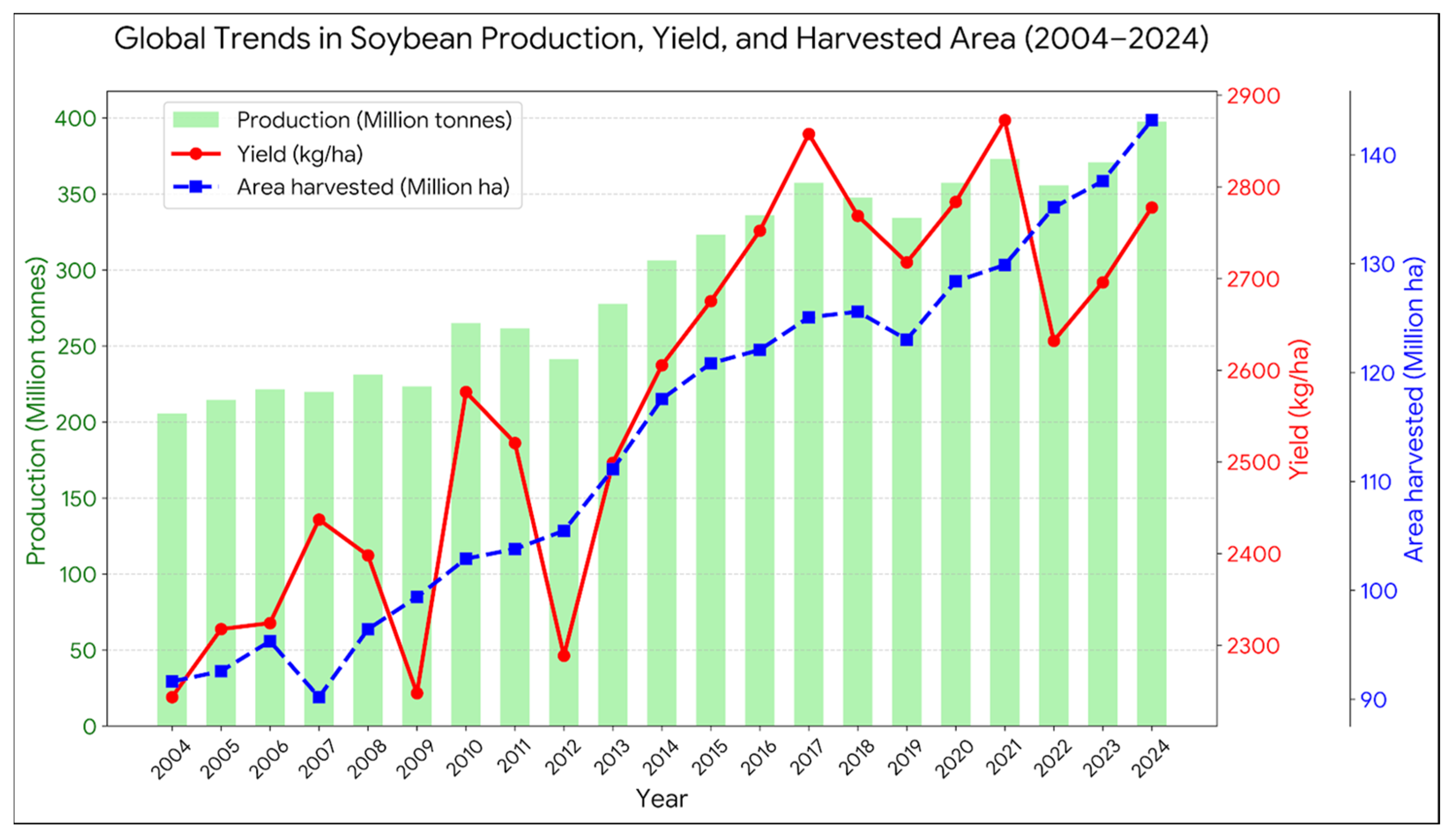
Soybean (Glycine max (L.) Merr.) is a major legume crop worldwide and a primary source of high-quality vegetable protein and oil for human consumption and livestock feed. Furthermore, driven by the rising demand for renewable energy, soybean has emerged as a vital feedstock for biodiesel production, further elevating its global economic significance [1,2]. Reflecting this growing importance, global soybean production has shown an overall upward trajectory over the past two decades (2004–2024), surging by approximately 93.5% from 205.5 to 397.7 million tonnes. This remarkable growth has been driven by a 56.3% expansion in harvested area (from 91.6 to 143.2 million ha) combined with a 23.8% improvement in yield (from 2243 to 2778 kg ha−1) (Figure 1) [3].
According to recent reports by the Food and Agriculture Organization (FAO), global demand for soybean is projected to nearly double by 2050, driven by rapid population growth and shifting dietary patterns toward protein-rich foods. Consequently, ensuring stable yield and quality within the constraints of limited arable land has become an urgent priority for maintaining global food security [2,4]. Beyond its economic value, soybean plays a pivotal environmental role in sustainable agriculture. As a major biological nitrogen fixer, it naturally enhances soil fertility and reduces the dependence on synthetic nitrogen fertilizers. This biological capability supports environmentally friendly production systems and contributes to climate change mitigation by lowering greenhouse gas emissions associated with the manufacturing and application of chemical fertilizers [2]. Despite its global economic significance, soybean production is increasingly threatened by accelerating climate change. Rising global mean surface temperatures, together with more irregular precipitation patterns, pose severe risks to crop productivity, particularly in major soybean-producing regions, including the United States, Brazil, and Argentina [5,6]. Climate projections suggest that these and other key production areas will experience more frequent and intense droughts, heat waves, and erratic rainfall patterns throughout this century [5]. Quantitative assessments underscore the magnitude of this threat. Crop modeling and empirical studies estimate that global yields of major crops, including soybean, may decline by approximately 3.1–7.4% for every 1 °C increase in global mean temperature in the absence of effective adaptation measures [7]. These yield penalties are most severe when extreme weather events coincide with critical reproductive stages. Field observations and crop model simulations indicate that water deficits and high temperatures during flowering and pod-filling can substantially and sometimes irreversibly impair yield potential [8,9]. Moreover, such stress conditions not only reduce overall yield but can also modify seed composition, often leading to unfavorable changes in protein and oil content. The increasing prevalence of combined stress scenarios (where drought and heat occur simultaneously) in both rainfed and irrigated production systems highlights an urgent need to develop climate-resilient soybean varieties that can maintain yield and quality under future climate conditions [7].
Field-grown crops frequently encounter drought and heat stresses concurrently. A growing body of evidence indicates that the convergence of these stresses exerts a synergistic and often more severe impact on plant growth and productivity than the additive effects of each stress applied alone [10,11]. Moreover, plant responses to combined stress are unique and cannot be reliably extrapolated from single-stress studies. For instance, recent research highlights that complex stress scenarios, such as drought coupled with high nighttime temperatures, significantly alter seed yield and quality traits in ways not observed under individual stresses [12]. Under concurrent drought and heat, plants confront a physiological conflict between hydraulic protection and thermoregulation, typically resulting in stomatal closure, canopy overheating, and cascading metabolic dysfunction [10]. A key difference in resilience to these conditions lies in the photosynthetic pathways of crop species. C4 crops, such as maize, possess carbon-concentrating mechanisms (CCM) that enable efficient CO2 assimilation even under stomatal closure. In contrast, soybean, as a C3 legume, is highly susceptible to photorespiration and oxidative damage when stomatal conductance is restricted [11]. This fundamental physiological constraint is further exacerbated by the sensitivity of biological nitrogen fixation (BNF), a process specific to the legume–rhizobia symbiosis. Soil drying and high temperatures promote premature nodule senescence and substantially inhibit nitrogenase activity, thereby compromising N supply and exacerbating yield losses [13,14]. Consequently, translating resilience strategies identified in model C4 crops to C3 legumes requires a nuanced understanding of these distinct physiological constraints [15].
In light of the escalating challenges posed by climate change, securing stable soybean production requires a multi-faceted strategy that combines immediate agronomic solutions with long-term genetic improvement. While short-term physiological relief can be partially achieved through agronomic interventions, such as the foliar application of mineral nutrients and organic acids, which has been recently highlighted as an effective approach for mitigating drought stress in soybean [16], sustainable resilience will ultimately depend on more fundamental genetic and breeding innovations. Accordingly, the primary objective of this review is to provide an integrated framework for developing climate-resilient soybean varieties adapted to the increasingly common scenario of combined drought and heat stress. Specifically, this article aims to (i) summarize the physiological and developmental impacts of drought, heat, and their combination on soybean, with particular attention to root system architecture adaptations [17]; (ii) outline key molecular mechanisms and regulatory networks that underlie stress perception and tolerance; (iii) compile recent advances in trait discovery enabled by quantitative trait loci (QTL) mapping, genome-wide association studies (GWAS), and multi-omics integration [18]; and (iv) propose integrated breeding strategies that bridge the gap between extensive genomic resources and practical application, leveraging New Breeding Technologies (NBTs) such as CRISPR/Cas9 and digital tools including high-throughput phenotyping and predictive, AI-enabled breeding models [19]. By linking these components, this review seeks to support the rational design of a climate-resilient soybean ideotype and to inform strategic breeding programs capable of sustaining global food security in a warming world. While most global impact assessments aggregate major cereals and oilseeds, legumes such as soybean face an additional layer of vulnerability due to BNF sensitivity and ureide-mediated feedback inhibition, making them particularly fragile under combined drought and heat.

2. Impacts of Drought and Heat Stresses on Physiological Behavior of Soybean

2.1. Drought Stress: Root System Architecture and Biological Nitrogen Fixation

Drought stress is a major environmental constraint on soybean productivity, severely affecting plant morphology and physiology from the vegetative through the reproductive stages. Among the most critical adaptive traits determining drought resistance is Root System Architecture (RSA). Under water-limited conditions, soybean plants often display pronounced plasticity in RSA, including an increased root-to-shoot ratio and deeper root proliferation. Genotypes with deep-rooting traits can access residual moisture in subsoil layers, thereby maintaining plant water status, delaying canopy senescence, and sustaining biomass accumulation during dry periods [20]. Beyond simple water mining, there is also emerging evidence that deep-rooted soybean genotypes may contribute to hydraulic lift or redistribution, transiently releasing water from deeper, wetter horizons into drier upper soil layers and thereby buffering rhizosphere-level water dynamics for both the crop itself and neighboring plants. However, under severe or prolonged drought, even these adaptive mechanisms can be compromised, as root elongation is inhibited and restricted root volume limits the uptake of both water and essential nutrients [20,21].
A distinct physiological vulnerability of soybean, particularly when compared with C4 cereals such as maize, is the high sensitivity of Biological Nitrogen Fixation (BNF) to water deficit. Soybean depends on a symbiotic association with Bradyrhizobium japonicum to fix atmospheric nitrogen, yet this process is often more sensitive to drought than leaf gas exchange or photosynthesis [22]. Drought stress impairs BNF through both physical and biochemical pathways. Physically, soil water deficit reduces nodule number and mass and promotes leghemoglobin degradation, thereby disrupting the low-oxygen environment required for optimal nitrogenase activity [21]. Biochemically, the accumulation of ureides and other nitrogen-rich compounds in shoots and nodules activates a feedback inhibition mechanism that sharply downregulates nitrogenase activity [22,23]. Classical and more recent studies, from field experiments to controlled-environment analyses, consistently show that xylem sap ureide concentrations rise sharply as soil water potential declines, and that this increase coincides with the onset of N2 fixation inhibition in soybean, reinforcing the concept of ureides as systemic signals coupling soil moisture status to nodule activity and whole-plant nitrogen economy [22,23,24,25]. Premature cessation of nitrogen fixation forces the plant to rely on limited soil mineral nitrogen, which is typically insufficient to support seed filling. As a result, drought-induced failure of BNF accelerates leaf senescence and causes substantial reductions in yield potential, highlighting BNF impairment as a major driver of yield loss under prolonged water deficit [21,23].
While root system architecture and biological nitrogen fixation are critical for vegetative adaptation, water deficit exerts its most detrimental impact during the reproductive stages (R1–R5), leading to severe yield penalties primarily driven by reproductive failure. Drought stress triggers widespread flower and pod abortion, with severe drought (soil water content <45% of field capacity) causing yield losses of 30–50% [26,27]. The most sensitive period for abortion occurs 3–5 days after anthesis (DAA), when cell division is most active in the developing ovaries [27,28]. Mechanistically, drought-induced ABA accumulation in floral tissues inhibits cell expansion and disrupts water potential homeostasis, directly contributing to pod abortion [27,28]. Furthermore, stomatal closure restricts photosynthetic carbon assimilation, causing ‘carbon starvation’ in developing reproductive organs. This creates a severe source-sink imbalance that forces the plant to abort late-formed pods and reduces individual seed weight by 20–50% [29,30]. Drought stress during the seed-filling phase also disrupts the translocation of photoassimilates from pod walls to seeds, compromising seed vigor and germination potential [30,31]. These reproductive vulnerabilities underscore that drought, like heat, acts as a systemic constraint on both vegetative and reproductive development, highlighting the need for integrated breeding strategies that address multiple stress tolerance mechanisms simultaneously.

2.2. Heat Stress: Reproductive Failure and Physiological Anomalies

While soybean is generally considered a warm-season crop, it exhibits marked sensitivity to temperatures exceeding the optimal threshold (typically 30–32 °C) during critical reproductive stages. Heat stress specifically targets reproductive organs, leading to a phenomenon often described as “heat blasting,” characterized by widespread abortion of flowers and pods. Even transient heat waves occurring during microsporogenesis and anthesis can cause irreversible yield losses. In soybean, daytime canopy temperatures in the range of approximately 35–40 °C and elevated night-time temperatures above about 26–28 °C during critical reproductive stages (R1–R5) are frequently cited as physiological thresholds, beyond which pollen viability, pod set, and seed filling decline sharply even when exposure is limited to a few days, whereas shorter high-temperature spikes of only a few hours tend to be partially reversible if they occur outside these sensitive windows. A primary physiological bottleneck under these conditions is pollen sterility, which arises from the disruption of carbohydrate metabolism in the anther. High temperatures induce premature degeneration of the tapetum layer, the nutritive tissue responsible for supplying energy to developing microspores. This disruption inhibits starch accumulation in pollen grains and impairs pollen tube kinetics, resulting in fertilization failure and reduced seed set, even when stigmas remain receptive [32].
At the cellular level, heat stress fundamentally alters the structural and functional integrity of photosynthetic apparatus. It increases lipid bilayer fluidity, causing electrolyte leakage and the disorganization of thylakoid membranes. Concurrently, heat stress induces the overproduction of Reactive Oxygen Species (ROS), such as hydrogen peroxide (H2O2) and superoxide radicals (O2∙−). These ROS cause oxidative damage to photosynthetic pigments and photosystem II (PSII) reaction centers. Furthermore, the activity of RuBisCO activase, a highly heat-labile enzyme, is severely inhibited at elevated temperatures, which limits the carboxylation capacity of RuBisCO and leads to a substantial decline in net photosynthetic efficiency [33].
Beyond reproductive failure, heat stress significantly compromises root system architecture and biological nitrogen fixation (BNF), two critical components that directly determine seed yield and protein accumulation in legumes [34,35]. Elevated soil temperatures (>32 °C) inhibit lateral root proliferation, reduce root hair formation, and accelerate premature root senescence by disrupting carbon allocation and increasing oxidative damage [34,36]. Root nodules are particularly vulnerable; temperatures above 35 °C markedly suppress nodule formation, reduce nodule size, and drastically lower specific nitrogenase activity [35,36]. At the molecular level, heat stress triggers the oxidative degradation of leghemoglobin, which is essential for maintaining the microaerobic environment required by nitrogenase. Simultaneously, heat denatures the nitrogenase enzyme complex itself [37,38]. This dual disruption of both the oxygen-buffering system and the catalytic machinery leads to a precipitous decline in nitrogen fixation efficiency during critical reproductive stages, thereby limiting the nitrogen supply essential for seed filling and protein synthesis [25,39]. Recent studies, however, have identified nodule-localized small heat shock proteins (e.g., GmHSP17.1) that can partially mitigate heat-induced damage by stabilizing leghemoglobin and preserving nitrogenase activity, highlighting them as promising breeding targets for improving BNF thermotolerance [40,41].
Heat stress also acts as a “dual constraint” on soybean productivity, penalizing both yield and seed quality. High temperatures during the seed-filling stage accelerate maturation but sharply shorten the duration of grain filling, resulting in physical deformities such as seed wrinkling and discoloration. In addition, heat stress induces profound alterations in the seed metabolome, disrupting the accumulation of key nutritional and physiological metabolites. According to a metabolomic profiling study by Chebrolu et al. [42], heat stress significantly modifies the levels of sugars, amino acids, and secondary metabolites in developing soybean seeds. In particular, heat stress challenges the plant’s ability to accumulate antioxidant compounds—such as tocopherols, flavonoids, and phenylpropanoids—which are critical for mitigating oxidative damage within the seed. The failure to maintain homeostatic levels of these protective metabolites under high temperatures is closely linked to reduced seed germination potential and loss of vigor, thereby compromising not only the immediate market value but also the quality of seeds for future planting [42]. Interactions between heat stress and elevated atmospheric CO2 further complicate this picture. While higher CO2 can partially enhance photosynthetic carbon gain and water-use efficiency under moderate stress, recent soybean studies indicate that such benefits do not fully compensate for heat-induced reproductive failure and quality deterioration, especially under episodes of high nighttime temperature.

2.3. Combined Drought and Heat Stress: The Stomatal Dilemma and Metabolic Conflict

In field environments, soybean crops frequently encounter drought and heat stresses concurrently, creating a unique and often synergistic challenge described as the “stomatal dilemma.” Under heat stress alone, soybean plants typically increase stomatal conductance to cool leaf surfaces via transpiration, whereas under drought stress, they close stomata to maintain turgor and prevent hydraulic failure. When both stresses occur simultaneously, the water-saving response usually overrides the cooling mechanism. In soybean, this closure prevents transpirational cooling, causing canopy temperatures to rise significantly—often 2–5 °C above ambient air temperature. From a phenotyping perspective, this loss of transpirational cooling can be captured as a reduction in canopy temperature depression (CTD), that is, a smaller difference between canopy and air temperature, which has become an informative remote-sensing indicator of genotypic variation in combined drought and heat resilience. This “canopy overheating” creates a distinct physiological state compared with single-stress conditions, exacerbating thermal damage to photosynthetic apparatus and accelerating the accumulation of Reactive Oxygen Species (ROS) [10,43].
Recent soybean-specific studies indicate that this physical dilemma is closely associated with a severe metabolic imbalance. While stomatal closure restricts CO2 uptake, elevated temperatures simultaneously accelerate dark respiration and carbohydrate consumption in leaves and developing seeds. This imbalance forces the plant to deplete stored starch and sucrose reserves more rapidly. Siebers et al. [44] demonstrated that, although soybean can display rapid physiological recovery from oxidative stress after heat waves, transient damage occurring during early pod development is sufficient to cause significant and irreversible yield penalties. Transcriptomic and gene expression analyses further suggest that combined stress is associated with distinct regulatory patterns of molecular chaperones (e.g., GmHSP70s) and Dehydration-Responsive Element-Binding proteins (GmDREB), which differ from those observed under single-stress conditions and tend to prioritize cellular survival over biomass accumulation [41,44].
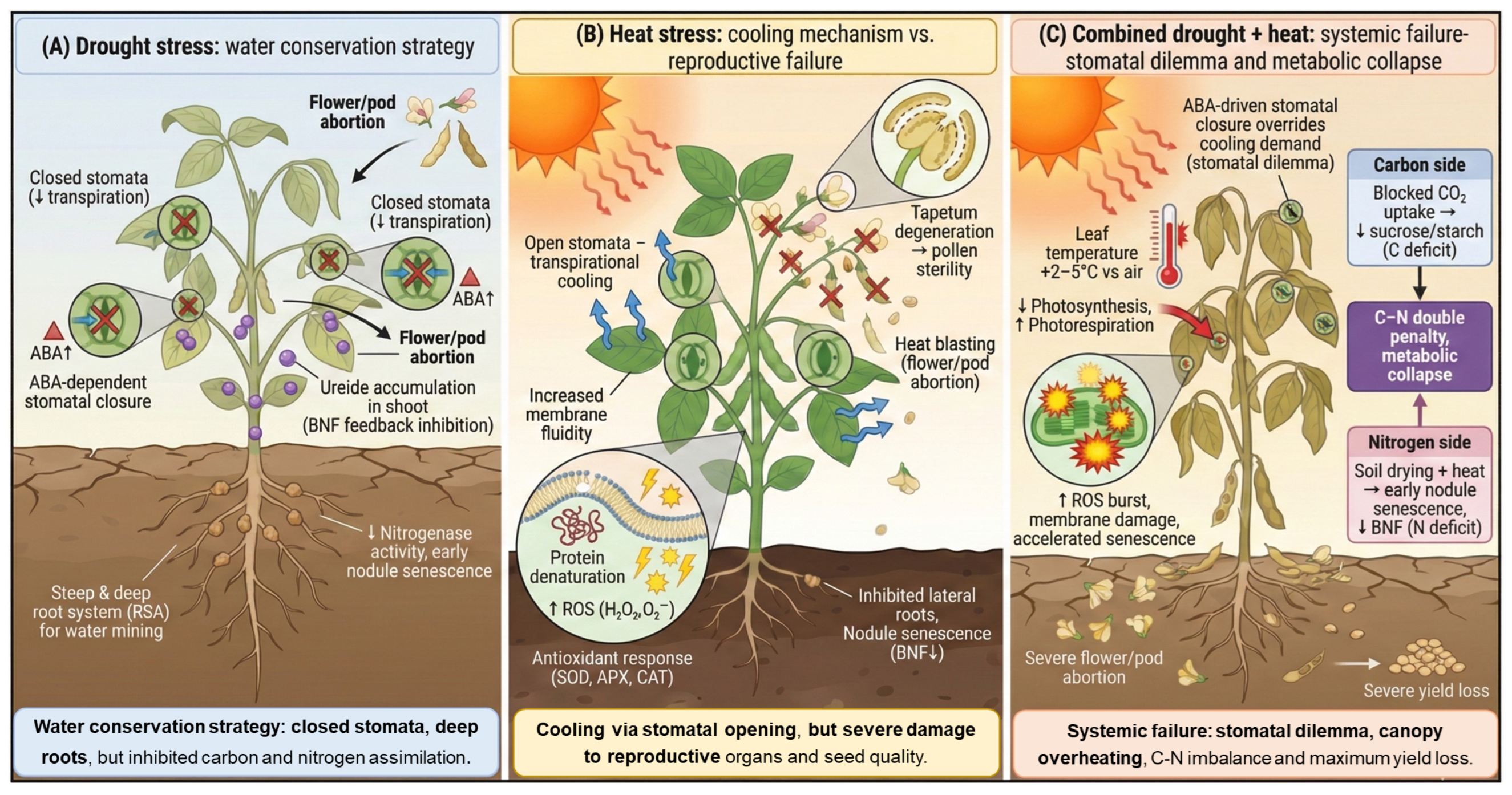
For a legume such as soybean, this combination is particularly detrimental because it simultaneously impairs photosynthetic carbon assimilation and Biological Nitrogen Fixation (BNF). According to a metabolomic study by Das et al. [45] combined stress significantly disrupts the balance between sugar and nitrogen metabolism, reducing the availability of carbon skeletons required for ammonia assimilation. This creates a “nitrogen–carbon double penalty,” in which resource limitations reinforce each other and amplify productivity losses. At the whole-plant level, combined drought and heat stress during the critical R3 (pod initiation) to R5 (seed filling) stages has been shown to cause markedly greater reductions in node number, pod set, and seed weight than either stress applied alone. As a result, total yield losses under combined conditions frequently exceed the sum of losses observed under individual stresses, underscoring the need for integrative breeding criteria that explicitly target these soybean-specific physiological trade-offs [15,43,45]. Taken together, these observations illustrate how drought, heat, and their combination differentially shape soybean water status, photosynthesis, and nitrogen metabolism. These whole-plant and metabolic trade-offs under simultaneous drought and heat—encompassing the stomatal dilemma, canopy overheating, and the nitrogen–carbon double penalty—are schematically summarized in Figure 2 to provide an integrated overview of physiological and metabolic responses under single and combined stresses.

2.4. Crosstalk with Other Climatic Stresses: Salinity and Beyond

While drought and heat are the primary focus of this review, “climate resilience” in soybean must inevitably address the complexity of multiple concurrent stresses, particularly salinity. Salinity stress is intrinsically linked to drought, as both conditions impose severe osmotic stress on plant cells, reducing water potential and triggering turgor loss [1,2]. At the cellular level, salt stress elicits a dual constraint: an osmotic component that restricts water uptake, analogous to drought, and an ionic toxicity dimension arising from the accumulation of Na+ and Cl ions in the cytoplasm, which disrupts enzyme function and induces excessive reactive oxygen species (ROS) production [52,53].
Field observations and controlled-environment studies consistently demonstrate that salinity stress severely impairs soybean growth, photosynthetic capacity, and biological nitrogen fixation (BNF) [53,54]. For instance, comparative physiological studies indicate that sensitive soybean genotypes experience significant reductions in stomatal conductance and chlorophyll content under saline conditions, directly compromising biomass accumulation [55]. The sensitivity of BNF to both drought and salinity underscores a shared vulnerability pathway in soybean. Recent evidence highlights that nitrate supply, often elevated under stress conditions, exacerbates ureide accumulation in shoots and nodules [56]. This accumulation triggers a systemic feedback inhibition of nodule nitrogenase activity and accelerates nodule senescence, a mechanism critical for understanding yield penalties under combined stress scenarios.
At the molecular level, drought and salinity responses converge on the Abscisic Acid (ABA) signaling pathway, which functions as a master regulator of osmotic stress adaptation [52,57]. Upon perception of reduced soil water potential or ionic imbalance, roots synthesize ABA, which triggers stomatal closure and activates stress-responsive transcription factors to coordinate cellular protection [52]. Recent work has revealed that ABA signaling also plays a temporally regulated role in mitigating Na+-induced cellular damage, acting as a gatekeeper that modulates root growth and architecture under saline conditions [57]. Consequently, genetic interventions that enhance ABA sensitivity or downstream signaling can confer simultaneous tolerance to both drought and salinity. For example, the overexpression of the syntaxin gene GmSYP24 in transgenic lines has been shown to improve tolerance to high salinity and osmotic stress by regulating vesicle trafficking and minimizing membrane damage [58].
Comparative metabolomic analyses further support this crosstalk. A recent multi-stress evaluation demonstrated that resilient soybean genotypes accumulated up to 38 mg g−1 FW of proline, nearly threefold higher than sensitive genotypes, and exhibited coordinated upregulation of ROS-scavenging enzymes (e.g., POD, CAT) under saline conditions [55]. This mechanistic convergence suggests that breeding programs targeting drought resilience may inherently capture salinity tolerance traits, provided that the underlying genetic architecture encompasses these pleiotropic ABA-mediated pathways and metabolic adjustments.
Although this review prioritizes the synergistic impact of drought and heat due to their global prevalence and co-occurrence, the uncertainty of climate change introduces other climate-related abiotic constraints that warrant consideration in a comprehensive “climate resilience” framework. Waterlogging resulting from extreme precipitation creates hypoxic conditions in the root zone, restricting root respiration and nutrient uptake. A recent multi-season study demonstrated that transient waterlogging at critical reproductive stages can reduce soybean yield by 47–68%, with losses strongly modulated by ambient temperature and humidity [59]. Similarly, cold stress during early sowing or late-season frosts causes cellular membrane damage and activates ABA-dependent pathways analogous to those observed under drought, including induction of cold-responsive transcription factors (e.g., CBF/DREB1) [60]. The mechanistic convergence of osmotic stress responses (spanning drought, salinity, waterlogging, and cold) suggests that a core set of physiological and molecular traits (including efficient ABA signaling, robust antioxidant systems, and adaptive root system architecture) may confer broad-spectrum resilience. Therefore, the breeding strategies proposed herein, targeting ABA signaling hubs, root plasticity, and multi-omics-guided trait integration (detailed in Section 4, Section 5 and Section 6), offer a foundational framework for developing “climate-resilient” soybean cultivars capable of withstanding this wider array of environmental fluctuations, including salinity and alkaline stress.

3. Molecular Mechanisms of Stress Tolerance

Understanding the molecular networks governing stress responses is a prerequisite for developing climate-resilient cultivars. In soybean (Glycine max), the response to drought and heat involves a complex interplay of signal transduction, transcriptional reprogramming, and the accumulation of functional proteins and metabolites. While foundational studies have mapped the core signaling pathways, recent transcriptomic and metabolomic analyses (2020–2025) have begun to unravel the unique regulatory networks that are specifically activated under combined stress conditions. According to a recent comprehensive review by Andreata et al. [61], dissecting the crosstalk between water deficit and thermal stress signaling is critical for identifying new molecular breeding targets and for moving beyond traditional single-stress paradigms [15].

3.1. Sensing and Signaling: Integrating ABA-Dependent and Independent Pathways

Upon perceiving stress signals, such as changes in membrane fluidity or a drop in osmotic potential, soybean plants activate two primary signaling cascades. These cascades correspond to the Abscisic Acid (ABA)-dependent and ABA-independent pathways. In the ABA-dependent pathway, accumulated ABA binds to the PYR/PYL/RCAR receptor complex. This binding induces a conformational change that allows these receptors to inhibit clade A PP2C phosphatases, thereby releasing the suppression of SnRK2 kinases. Once activated, SnRK2s phosphorylate downstream transcription factors (TFs), such as AREB/ABF proteins, to promote stomatal closure and the expression of numerous stress-responsive genes [46]. Although this core pathway is conserved across species, genome-wide analyses have revealed that the GmPYL gene family in soybean has expanded to include multiple isoforms (e.g., GmPYL21), with specific isoforms playing distinct roles in modulating ABA sensitivity and fine-tuning stress responses in a tissue-specific manner [61]. Conversely, the ABA-independent pathway is primarily mediated by DREB (Dehydration-Responsive Element-Binding) proteins that bind to DRE/CRT cis-elements in the promoters of stress-inducible genes. Studies have shown that MAPK cascades function as integrative hubs, converging inputs from ABA, ROS, and calcium signaling to coordinate transcriptional responses during complex stress scenarios [62]. In soybean reproductive tissues (flowers and pods), Correa Molinari et al. [63] reported that drought-responsive gene expression patterns differ markedly from those in vegetative organs, involving specific interactions between hormonal signals and key TF families to protect yield-determining organs.
Most notably, Sinha et al. [64] revealed a sophisticated physiological and molecular acclimation strategy in soybean termed “differential transpiration.” Under combined drought and heat stress, soybean leaves predominantly close stomata to conserve water in an ABA-driven manner, whereas flowers maintain or increase stomatal opening to facilitate transpirational cooling. This mechanism lowers internal flower temperature by approximately 2–3 °C compared with leaves, thereby protecting heat-sensitive pollen development. Sinha et al. further showed that this response is associated with characteristic changes in hormone profiles and the expression of stress-related transcription factors, including specific GmHSF and GmDREB genes, which are regulated differently under combined stress than under individual drought or heat treatments. Together with recent soybean-focused reviews, these findings underscore a high degree of regulatory plasticity in soybean, in which signaling networks are reconfigured to prioritize reproductive success under multifactorial stress. Yet, only a limited number of transcription factors, signaling components, and downstream effectors have been functionally validated under simultaneous drought and heat rather than under single-stress assays, representing a key knowledge gap that currently constrains the rational design of breeding strategies for combined-stress resilience.

3.2. Key Transcription Factors: Orchestrators of Stress Resilience

Transcription factors (TFs) act as master switches that modulate the expression of downstream stress-responsive genes. In soybean, extensive genomic and functional studies have highlighted six major TF families (DREB, WRKY, NAC, bZIP, HSF, and HD-Zip) as pivotal regulators in conferring tolerance to drought, heat, and their combination [65]. These regulators not only control osmolyte synthesis and ROS detoxification but also govern developmental adaptations such as root architecture remodeling and leaf senescence.
The DREB (Dehydration-Responsive Element Binding) family remains central to abiotic stress tolerance. In soybean, DREB subfamilies have distinct functions; GmDREB1-type TFs are predominantly cold-inducible but also contribute to drought and heat stress response [66], whereas GmDREB2A is strongly activated by both drought and heat stress. A seminal study by Mizoi et al. [67] demonstrated that GmDREB2A;2 functions as a canonical DREB2-type TF that specifically binds to DRE sequences, thereby mediating dehydration-responsive element-dependent gene expression and activating both heat-shock and drought-responsive genes. In addition, DREB factors promote the accumulation of compatible solutes, such as proline, contributing to osmotic adjustment under water deficit [66].
While traditionally associated with biotic stress, the WRKY family has emerged as a critical regulator of abiotic stress in soybean, acting at the interface between ABA signaling and transcriptional regulation. For example, GmWRKY12 confers enhanced drought and salt tolerance when overexpressed, and several WRKY genes show strong induction under water deficit conditions [68]. Mechanistically, these TFs bind to W-box elements in the promoters of target genes, thereby facilitating rapid transcriptional and physiological responses to modulate ABA-responsive and other stress-inducible genes.
Regarding structural adaptation, the NAC family plays a vital role, particularly in remodeling the root system. Overexpression of specific soybean NAC genes, such as GmNAC085 and GmNAC109, has been shown to promote lateral root formation and enhance abiotic stress tolerance in transgenic plants [69]. Genome-wide expression analyses further indicate that numerous GmNAC genes are differentially regulated by drought, salinity, and temperature extremes, suggesting their broad involvement in stress adaptation networks and vascular tissue development [70].
In the ABA-dependent pathway, bZIP transcription factors serve as crucial mediators of stress signaling. A pivotal study characterized GmbZIP1 as a TF strongly induced by drought, high salinity, cold, and ABA treatments [71]. Transgenic plants overexpressing GmbZIP1 exhibited significantly enhanced tolerance to multiple abiotic stresses compared with wild-type plants. This enhanced tolerance is associated with the ability of GmbZIP1 to bind ABA-responsive elements (ABREs) and upregulate key downstream stress-responsive genes involved in cellular protection. In the context of heat and combined stress, Heat Shock Factors (HSFs) cooperate with other TFs to maintain protein homeostasis; functional studies indicate that HSFs can interact with DREB2-type factors to drive the transcriptional activation of heat-shock protein genes, thereby supporting chaperone activity under elevated temperatures [67]. Recently, the application of CRISPR/Cas9 genome editing has provided direct functional validation of HD-Zip transcription factors as breeding targets. Zhong et al. [72] demonstrated that targeted editing of GmHdz4 significantly enhances drought tolerance in soybean. The gene-edited lines displayed a more robust root system architecture and higher antioxidant enzyme activities than wild-type plants. These physiological adjustments effectively suppress ROS accumulation under stress and underscore the potential of precise gene editing technologies to engineer stress-resilient crops by modifying key regulatory nodes. To provide a systematic overview of these regulatory components, Table 1 summarizes the key transcription factors discussed above and highlights their specific roles and target mechanisms in mediating tolerance to drought, heat, and other abiotic stresses.

3.3. Functional Proteins and Metabolites: The Cellular Defense System

Downstream of transcriptional regulation, the synthesis of functional proteins and the accumulation of compatible solutes constitute the immediate cellular machinery required for stress survival. In soybean, this defense system operates through coordinated mechanisms involving the protection of cellular structures, the maintenance of osmotic and hydraulic balance, and the detoxification of reactive oxygen species (ROS).
Chaperone-like Protectants and Aquaporins. Under frequent or intense heat episodes, the rapid accumulation of small Heat Shock Proteins (sHSPs) can prevent irreversible denaturation and aggregation of cellular proteins, thereby contributing to the preservation of key metabolic functions and photosynthetic performance. Recent proteomic profiling in soybean further supports that specific sHSP isoforms are strongly induced under combined heat and water deficit conditions, consistent with a tailored protective mechanism that helps safeguard the photosynthetic apparatus [73]. Concurrently, Late Embryogenesis Abundant (LEA) proteins function as highly hydrophilic protectants that stabilize macromolecules and lipid membranes, thereby reducing the risk of structural collapse during severe dehydration in legumes [74]. In addition, aquaporins play a pivotal role in regulating hydraulic conductance; genome-wide and expression analyses have revealed that multiple soybean aquaporin genes, including several plasma membrane intrinsic proteins (GmPIPs) and tonoplast intrinsic proteins (GmTIPs), are differentially upregulated under abiotic stress, in line with their role in facilitating water transport and maintaining cellular hydration [75].
Osmolytes and Soluble Carbohydrate Metabolism. Metabolic adjustments involving compatible solutes are fundamental for osmotic adjustment and membrane stabilization under drought and heat stress. Proline acts not only as a potent osmolyte that helps maintain cell turgor but also as a molecular chaperone-like molecule that stabilizes proteins and contributes to buffering of the cellular redox status. Recent integrated transcriptomic and metabolomic studies at the seedling stage have shown that drought tolerance in soybean is closely associated with pronounced adjustments in soluble sugar metabolism, including increased accumulation of sucrose and specific oligosaccharides [76]. These soluble carbohydrates provide readily available energy during recovery and also function as signaling molecules that contribute to the regulation of stress-responsive pathways.
Antioxidant Enzymes and ROS Detoxification. The antioxidant defense system is critical for constraining oxidative damage caused by stress-induced ROS accumulation. Combined or severe drought and heat stress can trigger massive ROS production, leading to lipid peroxidation and programmed cell death if not properly controlled [77]. Resilient soybean cultivars typically exhibit enhanced activities of key antioxidant enzymes, including superoxide dismutase (SOD), catalase (CAT), and ascorbate peroxidase (APX), which together contribute to efficient detoxification of superoxide and hydrogen peroxide. Field and controlled-environment studies have shown that the coordinated upregulation of these enzymes is strongly associated with improved membrane integrity, reduced oxidative damage, and higher seed yield, particularly when drought stress coincides with the flowering and early pod-setting stages [9].

4. Genomic Resources and Trait Discovery

The rapid evolution of high-throughput sequencing technologies has shifted the paradigm of soybean breeding from traditional phenotypic selection to Genomics-Assisted Breeding (GAB). Over the past decade, the availability of the soybean reference genome (Glycine max Wm82.a2.v1) and high-density SNP genotyping platforms (e.g., SoySNP50K, Njau 355K) has enabled more precise dissection of genomic regions controlling drought and heat tolerance. This section synthesizes key findings from Quantitative Trait Loci (QTL) mapping and Genome-Wide Association Studies (GWAS), illustrating how these genomic resources are beginning to unravel the complex genetic architecture of stress resilience (Table 2).

4.1. Identification of QTLs and Candidate Genes via GWAS

GWAS has complemented and extended bi-parental QTL mapping by capturing broader allelic diversity within natural soybean germplasm panels. Recent research efforts have been strategically concentrated on two major physiological categories: water conservation traits, such as root system and canopy architecture, and reproductive stability under heat stress. Together, these studies provide a set of validated loci and candidate genes that can be deployed in marker-assisted selection pipelines.

4.1.1. Drought Tolerance: Root Architecture and Canopy Wilting

Root System Architecture (RSA) serves as the first line of defense against soil moisture deficit, governing the spatial and temporal dynamics of water uptake. A landmark study by Prince et al. highlighted the value of tapping into wild soybean (Glycine soja) germplasm to uncover novel alleles for root traits. By analyzing genetic variants in root architecture-related genes, they identified key SNPs on chromosomes 2 and 6 that underpin natural variation in root volume and surface area. Notably, these variants co-localize with expansin family genes (e.g., GmEXPB2), which are crucial for cell wall loosening and root elongation. This finding underscores the potential of introgressing wild alleles to improve the soil exploration capacity and water uptake efficiency of cultivated soybean [78].
Another critical drought-avoidance trait is canopy wilting, particularly the “slow-wilting” (delayed canopy wilting) phenotype that reflects sustained plant water status under prolonged water deficit. Hwang et al. confirmed stable QTLs on chromosomes 11 and 19 (e.g., qCW-11) that explain a substantial proportion of the phenotypic variance in canopy wilting across multiple soybean mapping populations. These QTL regions have been consistently validated using near-isogenic lines (NILs) and are increasingly being targeted in breeding programs to enhance Water Use Efficiency (WUE) [79]. Furthermore, Dhanapal et al. conducted a comprehensive Genome-Wide Association Study (GWAS) for carbon isotope ratio (δ13C), a robust physiological proxy for intrinsic Water Use Efficiency (WUE). Utilizing a diverse panel of 373 soybean genotypes, they identified 39 distinct genomic regions associated with δ13C across multiple environments. Notably, these loci often co-localized with genes involved in stomatal regulation and photosynthetic capacity, suggesting that breeding for optimal δ13C can improve hydration status without necessarily compromising carbon assimilation. This study provides a foundational genetic map for targeting physiological traits that govern long-term water use efficiency in soybean [80].

4.1.2. Heat Tolerance: Reproductive Stability

Compared with drought, the genetic basis of heat tolerance in soybean has been more challenging to dissect due to the ephemeral nature of heat episodes. However, recent breakthroughs utilizing advanced genomic tools are accelerating this discovery process. Heat stress during flowering (R1) and pod formation (R3–R5) serves as a primary bottleneck for yield. To address this, Van der Laan et al. [81] recently conducted a comprehensive genetic dissection of heat stress tolerance. By integrating Genome-Wide Association Studies (GWAS) with Genomic Prediction models, they successfully identified key genomic regions associated with heat resilience. Crucially, their work demonstrates that combining GWAS-derived markers with genomic prediction significantly enhances the accuracy of selecting for complex traits like heat tolerance, providing a robust framework for breeding programs to improve reproductive stability under high-temperature regimes [81]. In the context of yield stability across varying climates, Li et al. [82] conducted a multi-environment analysis across three contrasting Chinese latitudes (high, medium, and low) to identify traits contributing to high and stable yields. By integrating agronomic data with phenotypic descriptors across diverse temperature and photoperiod regimes, they delineated key traits—such as effective branch number and pod number per plant—that are critical for maintaining yield stability. Their findings highlight specific genomic regions that govern phenotypic plasticity, suggesting that selecting for these stability-linked loci can buffer soybean productivity against environmental fluctuations, including heat waves [82].

4.2. Future Directions: Consolidating Genomic Data and Integrating Envirotyping

Given the quantitative nature of drought and heat tolerance and the strong genotype-by-environment (G×E) interactions involved, there is an urgent need to move beyond isolated QTL reports toward integrated genomic resources. Over the past decade, community databases such as SoyBase have provided a foundational layer by aggregating reference assemblies, genetic maps, and curated QTL information [83]. However, capturing the full spectrum of genetic diversity requires substantially higher resolution. A new generation of platforms has recently expanded the scale and depth of available data. SoybeanGDB, for instance, integrates 39 high-quality de novo genome assemblies with more than 15 million SNPs and Indels scored across nearly 3000 accessions, enabling detailed queries of allele frequencies across wild, landrace, and elite germplasm [84]. Complementary efforts such as SoyOD further consolidate multi-omics datasets (spanning assembled genomes, transcriptomes, and phenomics) into a unified framework that supports candidate gene mining for complex agronomic traits [85].
To fully leverage these resources for climate-resilient breeding, future strategies must evolve in at least three directions: (i) exploiting structural variation, (ii) validating targets via meta-analysis and multi-omics integration, and (iii) incorporating envirotyping information. First, large-scale initiatives such as Soybean2035 highlight the importance of graph-based pan-genomes for capturing structural variations (SVs), including presence–absence variations and inversions, that are often missed by standard SNP arrays [86]. Demonstrating the practical utility of this approach, Wang et al. [87] recently used long-read sequencing to reveal novel SV markers associated with key agronomic and quality traits, underscoring that capturing these hidden variants can be decisive for precise stress-adaptation breeding. Second, robust candidate-gene identification requires combining QTL mapping with expression evidence. For example, a recent study by Park et al. [88] pinpointed drought-tolerance candidates by integrating QTL mapping with RNA-seq, illustrating how multi-omics information can refine broad QTL intervals into actionable gene targets. Similarly, large-scale GWAS meta-analyses, such as those performed by Zhang et al. [89], help identify environment-stable quantitative trait nucleotides (QTNs) and mitigate the inconsistency of single-environment studies. Finally, tackling G×E interactions will require explicit integration of envirotyping (the high-resolution characterization of environmental variables) into prediction and selection models. Chamarthi et al. [90] showed that incorporating environmental covariates into genomic prediction significantly improved selection accuracy for water-use efficiency compared with models based on genomic data alone. Consequently, future breeding programs would greatly benefit from curated summary resources (as exemplified by Table 2 in this review) that systematically collate validated QTLs, GWAS hits, structural variants, and expression-supported candidates across diverse environments. Such integrative platforms will support breeders in prioritizing targets for gene stacking, marker-assisted backcrossing (MABC), and AI-driven genomic selection (GS), thereby accelerating the development of durable, climate-resilient soybean cultivars.

4.3. Multi-Omics Approaches: Unraveling Regulatory Networks

To bridge the gap between genomic regions (QTLs) and physiological phenotypes, multi-omics (the integration of transcriptomics, proteomics, and metabolomics) provides a holistic view of soybean stress responses. While genomics pinpoints putative tolerance loci, multi-omics reveals how these genetic instructions are functionally realized at the levels of RNA, proteins, and metabolites. According to a foundational review by Deshmukh et al. [65], this integrative approach is essential for enabling a mechanistic interpretation of complex drought and heat resilience traits, which cannot be fully deciphered by single-layer studies.

4.3.1. Transcriptomics and Proteomics: From Gene Expression to Functional Proteins

Transcriptomic analysis (RNA-Seq) serves as the primary platform for identifying Differentially Expressed Genes (DEGs). Comparative studies consistently show that tolerant soybean genotypes undergo extensive transcriptional reprogramming. This involves a strong enrichment of antioxidant pathways (e.g., genes encoding SOD, POD) and Abscisic Acid (ABA) signaling modules, including receptors such as GmPYL homologs. This coordinated activation supports tighter control of cellular redox homeostasis and stomatal regulation, which is critical for maintaining photosynthetic performance under water deficit [65]. However, mRNA levels do not always correlate with protein abundance due to post-transcriptional and post-translational regulation. Wang and Komatsu, in their comprehensive proteomics review, highlighted that soybean responses to water-related stresses are mediated by complex protein networks. Their synthesis indicated that tolerant genotypes better maintain calcium homeostasis and limit protein misfolding in the endoplasmic reticulum (ER) through the differential accumulation of chaperones and protein disulfide isomerases. Furthermore, proteomic datasets repeatedly reveal the upregulation of glycolysis-associated enzymes and fermentative proteins, such as alcohol dehydrogenase and pyruvate decarboxylase. This points to a critical metabolic shift toward anaerobic ATP production to sustain cell survival when mitochondrial respiration is compromised during severe water stress [91].

4.3.2. Metabolomics and Systems Biology: The Chemical Phenotype

Metabolomics provides the final “chemical phenotype,” capturing the end-products of cellular regulatory networks. Recent profiling of soybean exposed to drought and heat has underscored the central role of soluble sugars and amino acid-derived metabolites. Specifically, Das et al. [45] reported that the accumulation of compatible solutes such as pinitol and GABA (gamma-aminobutyric acid) is significantly higher in tolerant lines. These metabolites reflect a concerted adjustment of sugar and nitrogen metabolism; they not only contribute to osmotic adjustment but also support redox balance and ROS scavenging, thereby protecting cellular integrity during prolonged stress episodes [45]. The current trajectory in soybean stress biology is moving toward “Systems Biology,” where omics datasets are combined to construct gene–protein–metabolite networks. Recent integrative analyses have begun to identify transcriptional “hub genes,” such as the MYB-type regulator GmMYB118, which are co-expressed with key enzymes in flavonoid biosynthesis. These networks enhance oxidative stress tolerance through the increased accumulation of antioxidant flavonoids. As highlighted in recent reviews by Rasheed et al. [15] and Andreata et al. [61] such systems biology frameworks enable the discovery of high-confidence biomarkers and candidate genes for genome editing or genomic selection, paving the way for next-generation precision breeding strategies. Furthermore, extending these multi-omics approaches to broader genetic pools—including wild relatives and landraces—offers a powerful strategy to rediscover adaptive alleles lost during domestication, effectively bridging the gap between functional genomics and practical germplasm utilization.

4.4. Exploitation of Landraces: Bridging the Gap Between Wild and Elite Germplasm

Beyond wild relatives, cultivated landraces represent a critical yet underutilized genetic resource for breeding stress-tolerant soybeans. While modern breeding has achieved significant yield gains, it has drastically reduced genetic diversity: domestication eliminated approximately 81% of the rare alleles found in wild soybean (Glycine soja), and subsequent improvement from landraces to elite cultivars caused an additional loss of approximately 22% in nucleotide diversity [92,93]. Crucially, landraces retain adaptive alleles lost in elite germplasm while maintaining domesticated agronomic traits, making them more accessible donor parents than wild relatives due to reduced linkage drag associated with domesticated genomic backgrounds [94]. For instance, genome-wide analyses of Chinese germplasm collections revealed that landraces harbor unique stress-adaptive QTL alleles absent in both wild soybean and modern cultivars, particularly for root system architecture and osmotic adjustment under drought stress [94]. Recent pre-breeding efforts have demonstrated that introgressing specific chromosome segments from exotic landraces into elite backgrounds can achieve yield gains of 8–25% without compromising maturity or seed quality [95]. This evidence underscores the strategic importance of systematically evaluating landraces to recover “lost” resilience genes for climate-smart variety development.

5. Integrated Breeding Strategies for Stress Tolerance

To synthesize these multidisciplinary approaches into a coherent workflow, this section presents a comprehensive translational pipeline structured into four hierarchical tiers: (1) germplasm-based approaches exploiting natural genetic variation through conventional breeding (Section 5.1); (2) genomics-enabled selection leveraging molecular markers and predictive models to accelerate genetic gain (Section 5.2); (3) transgenic engineering introducing heterologous genetic elements that expand the available gene pool (Section 5.3); and (4) precision genome editing utilizing CRISPR/Cas9 systems for targeted modifications free of transgene integration (Section 5.4). Underpinning these four tiers is a unified high-throughput phenotyping platform (Section 5.5), which serves as a critical enabler for trait dissection, validation, and cultivar deployment across all breeding strategies. By systematically linking these advanced technologies with soybean-specific physiological targets—such as a “steep, cheap, and deep” root system and ureide-tolerant biological nitrogen fixation—this roadmap provides a strategic framework for assembling a climate-smart ideotype capable of sustaining yield stability under combined drought and heat stress.

5.1. Non-Transgenic Approaches: Exploiting Physiological Traits and Microbiome

Conventional breeding remains the cornerstone of crop improvement, offering high public acceptance, minimal regulatory burden, and the capacity to harness extensive natural variation within cultivated and wild soybean germplasm. Unlike transgenic strategies that introduce foreign genetic material, non-transgenic approaches rely on phenotypic selection and controlled hybridization to pyramid favorable alleles that already exist within the Glycine gene pool. For legumes such as soybean, which face unique physiological constraints including the extreme sensitivity of biological nitrogen fixation (BNF) to water deficit and the ureide-mediated feedback mechanism, targeting physiological adaptations that operate “from below ground upward” represents a rational and sustainable breeding philosophy. The following subsections synthesize key non-transgenic targets (root system architecture (RSA), BNF efficiency, and emerging microbiome-assisted strategies) that collectively form a robust foundation for drought and heat resilience in soybean.

5.1.1. Root System Architecture (RSA): The “Steep, Cheap, and Deep” Ideotype

The root system acts as the primary interface for water and nutrient acquisition, yet it remains one of the most underutilized breeding targets because it is difficult to observe directly in the field. In soybean, unlike in major cereals such as maize and wheat, breeding for combined drought and heat resilience must simultaneously consider legume-specific constraints, including the high sensitivity of biological nitrogen fixation and ureide-mediated feedback regulation under water deficit. For drought avoidance, the “Steep, Cheap, and Deep” (SCD) ideotype, originally proposed for maize by Lynch [96] provides a useful conceptual blueprint that can be adapted for soybean improvement. This ideotype is defined by “steep” root angles that promote penetration into deeper soil layers to access subsoil moisture; “cheap” metabolic construction and maintenance costs—partly achieved through features such as root cortical aerenchyma that reduce living cortical tissue—to optimize carbon investment; and ultimately a “deep” rooting profile that secures water from lower horizons while maintaining an efficient balance between below-ground investment and above-ground growth and reproduction.
Recent breeding efforts have focused on introgressing these favorable RSA attributes from exotic germplasm, including wild Glycine soja accessions, into elite cultivars [78]. In parallel, cultivated exotic lines such as PI 416937 have been identified as valuable donors with dense and relatively deep fibrous root systems, traits that are associated with improved plant water status and the characteristic “slow canopy wilting” phenotype under severe water deficit [97,98]. By utilizing molecular markers linked to RSA-related loci, breeders are beginning to transfer such “hidden” below-ground traits into commercial lines, thereby shifting the breeding emphasis from mere survival under drought to “productive resilience,” where yield and physiological stability are maintained despite chronic water limitation [99]. To accelerate this process, high-throughput phenotyping platforms—including rhizobox systems, shovelomics-based field root sampling, and 2D/3D imaging pipelines supported by computer vision and machine learning—are being deployed to quantitatively characterize RSA traits in diverse soybean germplasm panels [100]. Combining these high-throughput phenotypic data with existing QTL mapping and GWAS results enables more precise identification and validation of RSA-related loci controlling root depth, angle, and branching patterns. A recent breakthrough identified and functionally validated GmGA20ox1 as a domestication gene regulating primary root length at the seedling stage, offering a promising genetic target for engineering deeper and more vigorous root systems [101]. These favorable alleles can be introgressed into elite backgrounds through marker-assisted backcrossing or prioritized as key predictors in genomic selection (GS) models, effectively bridging the gap between physiological understanding of root function and practical breeding outcomes in soybean.

5.1.2. Breeding for Biological Nitrogen Fixation (BNF) Efficiency

A unique physiological challenge in soybean, distinguishing it from cereal crops, is the extreme sensitivity of Biological Nitrogen Fixation (BNF) to water deficit. Moreover, in soybean, root and canopy traits need to be optimized not only for water capture and transpirational cooling but also for sustaining nodule function and carbon supply to the rhizobia–legume symbiosis, which distinguishes soybean ideotype design from that in non-leguminous crops. Unlike photosynthesis, which typically declines gradually under mild stress, nitrogenase activity in nodules can cease abruptly soon after the onset of drought, even when leaf gas exchange is still relatively active. This inhibition has been widely attributed to the accumulation of ureides (allantoin and allantoic acid) in the shoots, which triggers a systemic feedback mechanism that downregulates nodule activity to prevent nitrogen toxicity [102]. Consequently, premature shutdown of BNF frequently leads to “nitrogen starvation” during the critical seed-filling period, drastically reducing yield potential even if rainfall resumes later in the season. To overcome this bottleneck, breeding for “ureide tolerance”—the metabolic capacity to catabolize and utilize ureides under water-limited conditions—has emerged as a promising strategy. Physiological screening of diverse soybean germplasm has identified specific genotypes, most notably the slow-wilting line PI 471938, that can sustain relatively high rates of nitrogen fixation at low fractions of transpirable soil water [103]. Physiological and biochemical studies suggest that such tolerance may be linked to sustained activity of ureide catabolic enzymes, including allantoinase (ALN) and manganese-dependent allantoate amidohydrolase (AAH), in leaves under drought, thereby preventing excessive ureide accumulation and maintaining nodule function.

5.1.3. Microbiome-Assisted Strategies and Agronomic Priming

Beyond enhancing host plant genetics, leveraging the plant holobiont—the integrated system of host and associated microbiome—offers a powerful non-transgenic avenue for building climate resilience. Plant Growth-Promoting Rhizobacteria (PGPR) induce systemic tolerance to abiotic stress through multiple mechanisms: modulating endogenous hormonal networks, synthesizing phytohormones (auxins, cytokinins), and improving nutrient acquisition via phosphate solubilization and siderophore-mediated iron uptake. However, these benefits depend critically on maintaining functional legume–Bradyrhizobium symbiosis under combined heat and drought, as nitrogen fixation ceases when either partner fails.
Arif et al. [19] emphasized that co-selecting elite soybean genotypes with stress-tolerant Bradyrhizobium strains prevents ecological collapse of symbiotic partnerships under climate extremes. This dual optimization ensures that nitrogen fixation efficiency remains high even when water deficit and thermal stress occur simultaneously, thereby maximizing whole-plant performance through stabilized below-ground partnerships. Agronomic practices provide immediate, cost-effective enhancement without genetic modification. Seed priming with osmoprotectants (polyethylene glycol, proline) preconditions seedlings for stress environments, while foliar applications during reproductive phases offer targeted physiological support. Kim et al. [16] demonstrated that sprays containing salicylic acid, ascorbic acid, and trace elements (zinc, boron) significantly alleviate drought stress by upregulating antioxidant enzymes and preserving cellular turgor, thereby stabilizing pod set and seed filling when stress intensity fluctuates.
Combining these microbiome and agronomic strategies with the root system architecture optimization (Section 5.1.1) and ureide-tolerant biological nitrogen fixation traits (Section 5.1.2) creates a synergistic defense framework. This integration—spanning microbial partnerships, root morphology, nitrogen metabolism, and agronomic practices—maximizes genetic potential expression under field stress conditions. Because all components operate through non-transgenic mechanisms, this holistic approach facilitates adoption across regulatory environments where transgenic crops face restrictions, establishing a robust foundation for climate-smart soybean production through biological and agronomic innovations.
Challenges and Limitations: While physiological breeding offers sustainable solutions, it is constrained by a significant “phenotyping bottleneck.” Root system architecture and nodulation efficiency are notoriously difficult to quantify directly in large field populations without labor-intensive destructive sampling [104]. Furthermore, traits such as deep rooting may incur a “carbon penalty,” where excessive resource allocation to below-ground structures reduces above-ground biomass and seed yield under non-stress conditions [105].

5.2. Molecular Breeding: Marker-Assisted Selection (MAS) and Genomic Selection (GS)

Physiological traits critical for drought adaptation, such as deep root systems and efficient biological nitrogen fixation (BNF), are notoriously difficult to assess in large breeding populations. Root architecture evaluation requires labor-intensive excavation or specialized imaging systems [100], while measuring BNF efficiency often necessitates destructive sampling. Although High-Throughput Phenotyping (HTP) (discussed in Section 5.5) is alleviating some of these bottlenecks, it is often limited to later growth stages. To bridge this gap, Marker-Assisted Selection (MAS) serves as an indispensable tool for early-stage selection. By linking single nucleotide polymorphisms (SNPs) to quantitative trait loci (QTLs), breeders can perform genotypic selection at the seedling stage, drastically reducing time and cost while increasing selection intensity.

5.2.1. QTL Pyramiding and Germplasm Expansion

A core application of MAS in soybean is QTL pyramiding, which is the simultaneous introgression of multiple favorable alleles from different genomic regions into a single elite genetic background. Since stress tolerance is governed by numerous small-effect loci distributed across the genome, stacking complementary QTLs can produce cumulative and sometimes synergistic improvements in resilience. For instance, combining validated root system architecture loci (e.g., qCW-11, qCW-19 for canopy wilting) with BNF-efficiency markers enables the development of cultivars that maintain both water capture and nitrogen supply under stress. To support this pyramiding strategy, multi-parental populations are increasingly utilized. Multi-parent Advanced Generation Inter-Cross (MAGIC) populations promote extensive recombination across multiple founder lines, facilitating fine-mapping of complex trait loci, whereas Nested Association Mapping (NAM) populations are specifically designed to capture broader allelic diversity from diverse founders while maintaining statistical power for QTL detection. These resources have been pivotal in dissecting complex traits such as water use efficiency (δ13C) [80] and yield stability [82]. High-density SNP arrays (e.g., SoySNP50K, Njau 355K) [80] further enable the precise tracking of rare favorable alleles within these populations that would otherwise be missed in conventional bi-parental crosses, thereby broadening the genetic base available for stress adaptation.

5.2.2. Genomic Selection (GS) for Polygenic Traits

While MAS is effective for major-effect loci, it has limitations for highly polygenic traits where performance is determined by hundreds of small-effect alleles. For such traits, Genomic Selection (GS) offers a superior prediction framework [106]. Unlike traditional MAS, which uses only markers linked to known QTLs, GS utilizes genome-wide marker information to calculate Genomic Estimated Breeding Values (GEBVs) for all individuals prior to phenotyping. In GS, a training population is phenotyped and genotyped to build a prediction model that captures the collective effects of all markers; this model is then applied to a breeding population that is genotyped but not yet phenotyped, allowing early selection without the need for extensive field trials. Recent studies highlight the efficacy of this approach in soybean stress breeding. Van der Laan et al. [81] successfully integrated GWAS-derived marker information with genomic prediction models to enhance selection accuracy for heat stress tolerance in soybean, demonstrating that this combined approach significantly improves reproductive stability under high-temperature regimes. Similarly, Chamarthi et al. [90] demonstrated the utility of GS models in identifying loci associated with water use efficiency (WUE) and showed that genomic prediction can effectively capture the genetic architecture underlying this complex physiological trait. Furthermore, incorporating environmental covariates (envirotyping) into GS models is proving essential for explicitly modeling genotype × environment (G×E) interactions to improve prediction accuracy across diverse agroclimatic zones [106].

5.2.3. Accelerating Gains via Speed Breeding

The full potential of molecular breeding is realized when MAS and GS are coupled with Speed Breeding (SB) protocols. SB utilizes controlled LED-spectrum photoperiods (typically 22 h light per day) and optimized temperature regimes to shorten the soybean generation time from approximately 150–180 days to as little as 60–70 days, enabling up to five to six generations per year compared to the conventional two to three generations under field conditions [107]. Integrating this with genomic selection (termed “Speed GS”) allows breeders to genotype seedlings, calculate GEBVs, and advance top-ranked lines immediately without field evaluation [108]. This convergence of QTL pyramiding via MAS, genome-wide prediction via GS, and rapid generation turnover via Speed Breeding creates a transformative breeding pipeline. It is estimated to potentially shorten the breeding cycle for complex, polygenic stress-tolerance traits from the conventional 10–12 years to approximately 5–6 years [108], thereby providing a practical mechanism to keep pace with the accelerating demands imposed by climate change [109]. Taken together, these molecular breeding technologies represent a paradigm shift in soybean improvement, enabling breeders to systematically stack favorable alleles for drought and heat tolerance at a rate commensurate with the urgency of global food security challenges.
Challenges and Limitations: The implementation of Genomic Selection (GS) and speed breeding necessitates substantial initial investment in high-density genotyping platforms and controlled-environment facilities. A critical challenge for GS is optimizing training populations; prediction models developed for specific environments or genetic backgrounds often lose accuracy when applied to distinct germplasm due to complex Genotype × Environment (G×E) interactions, necessitating continuous model recalibration [110].

5.3. Transgenic Approaches: Engineering Stress Resilience Beyond Species Barriers

Despite the power of MAS and genomic selection, their effectiveness is ultimately constrained by the genetic diversity present within cultivated and wild soybean germplasm. For instance, extreme heat tolerance mechanisms or novel ROS-scavenging pathways may simply not exist at sufficient levels in the Glycine gene pool [65]. Transgenic approaches transcend these natural boundaries by introducing heterologous genes or modulating endogenous regulators to engineer resilience beyond natural limits. Although public concerns over foreign DNA integration have limited commercial adoption in some regions, transgenic strategies remain powerful tools for functional genomics and have demonstrated significant improvements in controlled environments and field trials.

5.3.1. Transcription Factor Overexpression

Transcription factors (TFs) serve as master regulators controlling multiple downstream stress-responsive genes, making them attractive targets for genetic engineering. Overexpression of individual TFs can simultaneously activate entire tolerance networks, including genes for osmolyte biosynthesis and cellular protection.
DREB Family: The DREB (Dehydration-Responsive Element-Binding) family remains central to transgenic strategies. In soybean, GmDREB2A;2 functions as a canonical transcription factor that binds to DRE sequences, activating downstream heat-shock and drought-responsive genes. Mizoi et al. [67] demonstrated that this TF undergoes posttranslational regulation and plays a pivotal role in combined stress survival. Similarly, GmDREB1 operates broadly in heat and drought stress-responsive gene expression [66].
WRKY Family: Though traditionally associated with pathogen defense, WRKY proteins critically regulate abiotic responses. GmWRKY12 enhances drought and salt tolerance by modulating ABA signaling through binding to W-box cis-elements in promoter regions [68]. Mechanistically, these TFs bind to W-box elements to facilitate rapid physiological responses.
NAC and bZIP Families: NAC transcription factors mediate developmental reprogramming under stress. Hao et al. [69] showed that GmNAC085 overexpression promotes lateral root formation and stress tolerance. Furthermore, genome-wide analyses indicate that numerous GmNAC genes are differentially regulated by abiotic stress [70]. Within ABA-dependent pathways, GmbZIP1 serves as a key mediator. Transgenic lines overexpressing this gene exhibited enhanced multi-stress tolerance by upregulating protective gene networks compared with wild-type plants [71].
However, constitutive overexpression of TFs can impose growth penalties under favorable conditions due to resource reallocation. To mitigate this trade-off, stress-inducible promoters are increasingly preferred to minimize fitness costs while ensuring robust protection during stress episodes.

5.3.2. Metabolic Engineering and Antioxidant Defense

Beyond transcriptional regulation, direct metabolic engineering complements these strategies by fortifying cellular defense mechanisms.
Osmotic Adjustment: Recent transcriptomic and metabolomic studies have highlighted that drought tolerance in soybean is closely associated with adjustments in soluble sugar metabolism and osmolyte accumulation [76]. Consequently, engineering key enzymes in these biosynthetic pathways represents a viable transgenic strategy to enhance osmotic adjustment capacity and maintain cell turgor under stress.
Antioxidant Enhancement: The antioxidant defense system is critical for constraining oxidative damage caused by stress-induced Reactive Oxygen Species (ROS) [77]. Transgenic lines engineered for enhanced activities of Superoxide Dismutase (SOD) and Ascorbate Peroxidase (APX) exhibit superior membrane integrity and yield stability under drought and heat stress, particularly during the critical flowering stage [9].

5.3.3. Engineering Nitrogen Fixation

For legumes, engineering sustained Biological Nitrogen Fixation (BNF) under stress represents a unique transgenic opportunity. Drought stress typically triggers the accumulation of ureides, leading to feedback inhibition of nodule activity and limiting nitrogen availability precisely when plants face resource constraints [21]. To overcome this, modulating ureide metabolism has emerged as a promising strategy. Thu and Tegeder [22] recently demonstrated that enhancing ureide partitioning from shoots to roots and promoting catabolism significantly improved soybean performance under water deficit. This transgenic approach addresses a legume-specific vulnerability and complements the non-transgenic ureide-tolerant germplasm selection strategies described in Section 5.1.2.
Challenges and Limitations: The primary hurdle for transgenic cultivars is the prohibitive cost and extended timeline associated with regulatory approval, which can impede commercial release in many regions. Biologically, the constitutive overexpression of stress-responsive genes often results in “yield drag” or stunted growth under optimal conditions, driven by the metabolic cost of synthesizing stress proteins in the absence of stress [111].

5.4. New Breeding Technologies (NBTs): Precision Engineering via CRISPR/Cas9

In contrast to transgenic methods that introduce foreign DNA, New Breeding Technologies (NBTs), particularly CRISPR/Cas9-mediated genome editing, provide the unprecedented capacity to precisely modify specific loci without introducing extensive linkage drag. This precision is transforming the development of climate-resilient soybean cultivars by targeting transcription factors and developmental regulators.
One of the most notable examples is the manipulation of flowering time to avoid environmental stress. Cai et al. [112] utilized CRISPR/Cas9-mediated targeted mutagenesis of the photoperiod pathway gene GmFT2a to generate soybean lines with delayed flowering and altered maturity. By fine-tuning GmFT2a activity, breeders can better align flowering and pod set with favorable thermal and moisture conditions, potentially expanding the adaptation range of high-yielding cultivars into lower-latitude regions where short day lengths would otherwise induce excessively early flowering. Furthermore, plant architecture optimization for high-density planting (critical for maximizing yield per unit area) is another area where genome editing has shown promise. Targeted mutagenesis of GmSPL9 genes has been reported to alter branching patterns and node number, generating more compact yet highly pod-productive plants that improve light interception [113]. Looking ahead, several regulators that integrate drought and heat responses in soybean, such as GmDREB2A;2, selected members of the GmPYL–PP2C hub in ABA signaling, and stress-responsive aquaporins (e.g., GmPIP and GmTIP isoforms), represent promising future editing candidates for engineering combined-stress resilience, particularly when their modification is guided by multi-environment and multi-omics evidence. To synthesize current progress and future potential, Table 3 compiles scientifically validated gene targets together with promising candidates in which CRISPR/Cas9-mediated editing has demonstrated, or is predicted to deliver, improvements in agronomic traits relevant to climate resilience. Looking further ahead, multiplex genome editing strategies that simultaneously target multiple genes involved in drought and heat response networks are being explored to stack beneficial alleles in a single genetic background. As regulatory frameworks in several major soybean-producing countries increasingly distinguish transgene-free, site-directed nuclease type 1 (SDN-1) products from traditional GMOs, these NBTs are poised to accelerate the commercial release of climate-smart soybean cultivars.
Challenges and Limitations: Although CRISPR/Cas9 minimizes linkage drag, editing complex traits like drought tolerance remains challenging because these traits are highly polygenic and controlled by numerous small-effect QTLs. Targeting single or few genes often yields limited phenotypic gains compared to transgenic approaches that introduce novel metabolic pathways. Additionally, while “off-target” effects have been significantly reduced, rigorous genomic screening is still required to ensure genomic integrity prior to commercialization [114].

5.5. High-Throughput Phenotyping (HTP): Accelerating Selection via Remote Sensing

The efficacy of all the breeding strategies discussed above—whether conventional, molecular, transgenic, or gene-edited—relies on the ability to accurately assess phenotypes. However, this has long been constrained by the “phenotyping bottleneck”, which refers to the difficulty of accurately and rapidly measuring complex physiological traits across large breeding populations under field conditions. High-Throughput Phenotyping (HTP) using Unmanned Aerial Vehicles (UAVs) equipped with multi-sensor payloads now offers a scalable solution, shifting the observation scale from individual plants or plots to entire breeding nurseries while preserving quantitative trait information [115].
Multispectral and hyperspectral imaging enable the capture of reflected radiation across tens to hundreds of spectral bands, from which vegetation indices such as the Normalized Difference Vegetation Index (NDVI), a proxy for biomass, and the Photochemical Reflectance Index (PRI), an indicator of photosynthetic efficiency, can be derived. Moving beyond simple indices, Maimaitijiang et al. [116] demonstrated the power of multimodal data fusion by combining spectral information, thermal data, and structural metrics (e.g., canopy height) with deep learning models such as convolutional neural networks (CNNs). Their study showed that this integrated approach can predict soybean yield with high accuracy (R2 ≈ 0.80) well before harvest, thereby substantially shortening the selection cycle and enabling earlier, data-driven down-selection of lines [116]. In parallel, thermal imaging has become a robust proxy for plant water status and transpiration. Under drought, stomatal closure reduces transpirational cooling, leading to an increase in canopy temperature relative to the surrounding air. UAV-mounted thermal cameras allow rapid quantification of Canopy Temperature Depression (CTD) across thousands of plots, facilitating the identification of genotypes with favorable hydraulic behavior. By integrating CTD metrics and spectral signatures into multi-trait genomic selection models, breeders can increase prediction accuracy for drought- and heat-adaptive ideotypes. Recent advancements have demonstrated that integrating these HTP-derived physiological traits into genomic prediction models significantly improves the selection accuracy for complex stress tolerance traits, paving the way for climate-resilient breeding [81].
Challenges and Limitations: The vast amount of spectral data generated by UAVs creates a “data processing bottleneck” that requires advanced computational infrastructure and expertise. Moreover, spectral indices (e.g., NDVI, thermal) function as indirect proxies; their correlation with actual yield or physiological status can vary significantly depending on environmental variables (e.g., wind, cloud cover), necessitating extensive “ground-truthing” validation to ensure selection accuracy [115] (Araus & Cairns, 2014).

5.6. From Research to Market: Current Status of Climate-Resilient Soybean Cultivars

Despite the complexity of stress tolerance traits, significant strides have been made in translating genomic discoveries into elite germplasm and commercial cultivars. The transition from exotic germplasm to field-ready cultivars represents a critical pathway for mitigating climate risks in soybean production systems (Table 4).
Public breeding programs, particularly those led by USDA-ARS and university collaborations, have successfully introgressed physiological traits from exotic Asian germplasm into elite backgrounds. A prominent example is the utilization of PI 416937 and PI 471938 (of Japanese origin), which exhibit a “slow-wilting” phenotype [98,117] and sustained nitrogen fixation under drought [104], respectively. These accessions served as parental lines for the development of USDA-N8002, a maturity group VIII cultivar that derives 37.5% of its pedigree from these stress-tolerant ancestors (25% from PI 471938 and 12.5% from PI 416937). USDA-N8002 exhibits reduced canopy wilting and high yield potential under water-limited conditions, verifying the efficacy of physiological breeding approaches [118].
Table 4. Representative climate-resilient soybean cultivars and elite germplasm.
CategoryCultivar/LineTarget StressKey Mechanism/TraitsDeveloper/OriginReference
Commercial (Biotech)HB4® SoybeanDroughtExpression of HaHB-4 (sunflower TF); improved water-use efficiency (WUE).Bioceres/
Verdeca
[119]
Regional (China)Longhuang SeriesDrought/SaltMarker-assisted selection for GmCHX1 gene; field-validated resilience.CUHK/
Gansu Ag. Univ.
[120,121]
Public/
Breeding
USDA-N8002DroughtSlow canopy wilting; sustained N-fixation. (Pedigree includes PI 471938).USDA-ARS/
NCSU
[118]
Elite GermplasmPI 416937DroughtSlow-wilting phenotype; hydraulic limitation to conserve soil water.USDA Germplasm
(Japan)
[98,117]
Elite GermplasmPI 471938DroughtSustained nitrogen fixation under water deficit conditions.USDA Germplasm
(Japan)
[103]
In the private sector, transgenic approaches have generated cultivars with enhanced drought resilience, although their deployment remains constrained by regulatory frameworks and market acceptance. The HB4® technology, developed by Bioceres and Verdeca, utilizes a sunflower-derived transcription factor (HaHB-4) to improve water use efficiency through the modulation of stomatal conductance and osmotic adjustment. Extensive field trials across 27 environments in Argentina demonstrated that HB4® soybean lines significantly outyielded non-transgenic controls in warm and dry conditions without yield penalties in optimal environments, achieving regulatory approval in the United States, Argentina, Brazil, and China [119].
Regional breeding programs have also delivered targeted solutions through marker-assisted selection and genomic approaches. In China, the Longhuang series (Longhuang 1, 2, and 3) was co-developed by the Chinese University of Hong Kong and the Gansu Academy of Agricultural Sciences following the identification of the functional GmCHX1 salt tolerance gene from wild soybean (Glycine soja W05) via whole-genome sequencing [121]. The GmCHX1 gene encodes a cation/H+ exchanger that reduces Na+ accumulation in photosynthetic tissues, thereby conferring salt and drought tolerance. These non-transgenic cultivars have demonstrated field-validated resilience on marginal lands of the Loess Plateau, with cumulative adoption exceeding 12,400 hectares in Gansu Province between 2016 and 2019, generating an additional farmer income of RMB 3.12 million during this period [120].
Despite these advances, the portfolio of climate-resilient cultivars remains limited due to several constraints. First, inherent trade-offs between stress tolerance mechanisms and yield potential under optimal conditions, often known as yield drag, have been observed in some stress-tolerant lines, reflecting resource allocation conflicts between constitutive defense systems and reproductive investment. Second, the polygenic architecture of drought tolerance, controlled by numerous small-effect QTLs with significant genotype-by-environment (G×E) interactions, hinders the predictable transfer of stress resilience across genetic backgrounds and target environments. Third, regulatory barriers and market acceptance issues continue to restrict the deployment of biotechnology-derived traits, particularly in export-oriented production regions. These limitations underscore the necessity for integrated breeding strategies that combine (i) multi-omics approaches (genomics, transcriptomics, metabolomics) to dissect stress response networks; (ii) high-throughput phenotyping platforms for canopy temperature, transpiration efficiency, and root architecture; (iii) genomic selection to accelerate genetic gain; and (iv) transgene-free genome editing technologies (e.g., CRISPR/Cas9) to fine-tune regulatory networks without introducing foreign DNA. Furthermore, the integration of climate-resilient cultivars with precision agronomy and bioactive compounds, such as salicylic acid and chitosan nanoparticles as discussed in previous sections, represents a holistic pathway to ensure sustainable soybean production under climate change.

5.7. Selection of Superior Stress-Resistant Varieties

Effective exploitation of landrace diversity requires a three-stage selection pipeline that balances stress tolerance with agronomic performance:
Stage 1: Germplasm Screening and Pre-breeding. Initial screening of landrace collections under controlled stress conditions is essential to identify donor parents with superior adaptive traits. High-throughput phenotyping platforms enable the quantification of key selection criteria, including root system architecture, canopy temperature depression (an indicator of transpirational cooling capacity), and chlorophyll fluorescence (reflecting photosynthetic efficiency under stress) [122,123]. Subsequently, marker-assisted backcrossing (MABC) facilitates the introgression of target genomic regions into elite backgrounds while recovering >95% of the recurrent parent genome [81]. For polygenic stress tolerance traits, genomic selection (GS) using genome-wide markers has been shown to achieve prediction accuracies of r = 0.50–0.68 for yield and quality traits, substantially accelerating breeding cycles compared to conventional phenotypic selection [81,124].
Stage 2: Multi-Environment Trials (METs). Selected advanced breeding lines must undergo evaluation across multiple locations and years to assess genotype × environment interactions (GEI). Statistical frameworks, including AMMI (Additive Main effects and Multiplicative Interaction) and GGE biplot analysis, are critical for identifying genotypes that possess both high mean yield and stability [125,126]. In recent soybean METs, environmental effects accounted for 65.89% of total yield variation, emphasizing the necessity of multi-location testing to ensure stable performance across target production zones [126]. Genotypes exhibiting low GEI variance and yielding ≥105% of regional checks under stress conditions should be advanced to commercial evaluation.
Stage 3: Integrated Selection Indices and Final Variety Advancement. Final variety selection must integrate multiple traits using weighted selection indices that balance stress tolerance, yield stability, and farmer-preferred agronomic attributes [125]. Unlike single-trait selection, which may inadvertently compromise other essential characteristics, multi-trait stability indices enable simultaneous genetic gains across 5–8 traits, optimizing variety performance for real-world production conditions. For instance, when evaluating landrace-derived lines for drought tolerance, a weighted selection index might allocate 40% to yield under stress, 30% to yield stability across environments, 20% to root system architecture traits, and 10% to maturity and lodging resistance. This approach ensures that introgressed alleles from exotic germplasm confer practical agronomic benefits without compromising seed size, plant height, or other traits critical to farmer adoption. By applying these multi-trait indices, breeding programs can objectively rank candidates and advance only those lines that meet comprehensive performance criteria, thereby accelerating the deployment of climate-resilient cultivars that maintain competitiveness across diverse production environments.

6. Future Perspectives

While significant progress has been made in dissecting the genetic architecture of stress tolerance, the current rate of genetic gain in soybean yield (estimated at approximately 1.3% per year globally) is insufficient to meet the projected food demand by 2050 under worsening climate conditions [109]. To bridge this gap, future breeding programs must evolve into data-driven and accelerated systems that tightly integrate physiological insight, genomic information, and computational decision support.

6.1. Speed Breeding: Accelerating Generation Advancement

The traditional soybean breeding cycle is inherently slow, typically permitting only 1–2 generations per year due to the crop’s strict short-day photoperiod requirement, which constrains flowering induction in many environments. This biological limitation acts as a major bottleneck in delivering improved cultivars on timescales commensurate with rapid climatic change. Speed Breeding (SB) protocols offer a transformative solution by manipulating photoperiod (e.g., extended light periods under controlled LED spectra) and temperature to accelerate development and induce earlier flowering.
Recent optimizations for short-day crops, including soybean, using LED-controlled growth chambers have reduced the seed-to-seed generation time to approximately 70 days, enabling up to five generations per year compared with the conventional one to two [107]. The true power of SB emerges when it is combined with genomic selection (GS), a strategy often termed “Speed GS.” In this framework, segregating individuals are genotyped at the seedling stage and selection decisions are made using genomic estimated breeding values (GEBVs), without waiting for full phenotypic evaluation in the field [108]. Such rapid cycling allows breeders to stack favorable alleles for drought and heat tolerance in a fraction of the time required by traditional schemes, substantially increasing the rate at which climate-resilient soybean cultivars can be developed and deployed.
Challenges and Limitations: Despite its potential to accelerate crop improvement, the widespread adoption of speed breeding is constrained by high infrastructure and operational costs, particularly for maintaining controlled temperature and extended photoperiods [127]. A fundamental biological concern is that rapid generation advancement under artificial conditions may distort plant stress responses. Phenotypes selected in controlled environments often exhibit poor correlation with field performance due to the lack of complex environmental fluctuations and biotic stresses [108]. Therefore, rigorous field validation remains indispensable to ensure that rapid cycling does not compromise adaptive traits required for real-world production.

6.2. AI and Machine Learning: From Big Data to Prediction Breeding

The accumulation of multi-omics datasets and high-throughput phenotyping imagery has outpaced the capacity of conventional statistical tools to extract actionable insights. Artificial Intelligence (AI), particularly Deep Learning (DL) models, provides a transformative framework for predicting complex phenotypes and exploiting non-linear relationships that traditional statistical methods often miss. In contrast to standard linear models such as RR-BLUP, which primarily capture additive genetic effects, DL architectures—including convolutional neural networks (CNNs) and recurrent neural networks (RNNs)—can learn higher-order interactions (epistasis) and complex genotype × environment (G×E) patterns from large, heterogeneous datasets [106].
Recent applications in soybean have demonstrated the potential of AI-driven approaches to integrate multi-modal data streams. For instance, combining spectral, thermal, and structural phenotyping data with genomic profiles using deep learning has achieved prediction accuracies (R2 > 0.80) for yield and stress tolerance traits well before harvest [116]. Similarly, genomic prediction models enhanced with environmental covariates (envirotyping) have significantly improved selection accuracy for water use efficiency compared to models based on genomic data alone [90].
Looking forward, the future of AI in soybean breeding will likely focus on three key frontiers: (1) model interpretability: developing explainable AI frameworks that reveal the biological basis of predictions, thereby building breeder confidence and enabling knowledge discovery; (2) real-time decision support: integrating AI models with in-season UAV-based phenotyping to enable dynamic, within-season management and selection decisions; and (3) multi-trait optimization: employing AI to simultaneously optimize trade-offs between stress tolerance, yield potential, and quality attributes, effectively navigating the complex fitness landscapes that constrain conventional breeding. As training datasets expand and computational infrastructure becomes more accessible, AI-driven breeding platforms are poised to become standard tools in climate-smart cultivar development, enabling breeders to keep pace with the accelerating demands of global food security under climate change.
Challenges and Limitations: The reliability of AI-driven breeding is fundamentally limited by the quality and quantity of training data. Inconsistent or noisy phenotypic data can lead to model overfitting and poor generalization across different environments [128]. Furthermore, many deep learning models operate as “black boxes,” offering little biological interpretability regarding the underlying genetic mechanisms. This lack of transparency creates a barrier for breeders who need to understand the physiological basis of selected traits. Additionally, capturing complex genotype-by-environment (G×E) interactions remains challenging when environmental conditions deviate substantially from the training datasets.

6.3. Designing the “Integrated Climate-Smart Ideotype”

Ultimately, adaptation to combined drought and heat stress will require a holistic redesign of the soybean plant, moving decisively beyond single trait improvement toward a comprehensive ideotype. The ideal “Climate-Smart” soybean of the future must deploy a coordinated defense system that operates from the rhizosphere to the reproductive organs.
Below ground, the plant should exhibit a “Steep, Cheap, and Deep” root system architecture. A recent breakthrough identified GmGA20ox1 as a domestication gene regulating primary root length; manipulating such loci offers a genetic pathway to engineer deeper root systems that efficiently explore subsoil water reserves [101]. At the same time, the nodulation and Biological Nitrogen Fixation apparatus must be ureide-tolerant, capable of sustaining N2 fixation as soil water potential declines, thereby avoiding the yield-penalizing nitrogen starvation that currently accompanies drought in many cultivars. Above ground, this ideotype should combine optimized stomatal regulation, balancing water conservation with sufficient transpirational cooling, with a robust antioxidant network. Finally, reproductive resilience must be ensured through heat-stable pollen and pod set mechanisms that remain functional even during episodic heat waves. Li et al. [82] demonstrated that specific traits contribute to high and stable yields across different latitudes, suggesting that selecting for stability parameters in reproductive traits is feasible. Constructing such an integrated ideotype will depend on the convergence of precise gene editing, accelerated generation turnover through speed breeding, and AI-driven genomic prediction, collectively enabling the design and deployment of soybean cultivars that maintain high productivity under the increasingly volatile climates of the coming decades.
Challenges and Limitations: Theoretically stacking multiple adaptive traits—such as deep roots, ureide tolerance, and heat-stable reproduction—into a single elite genotype presents a formidable genetic challenge. These traits are often quantitative and controlled by distinct genetic mechanisms, raising the risk of linkage drag and negative epistatic interactions [129]. Realistically, developing such a comprehensive ideotype is a long-term endeavor that may require over a decade of recursive breeding cycles. Consequently, breeding programs must prioritize trait combinations based on specific regional climate scenarios rather than pursuing a universal “one-size-fits-all” solution.

7. Conclusions

Soybean production currently stands at a critical juncture. Climate change is intensifying the frequency and severity of abiotic stresses, posing a formidable threat to global food and nutritional security. This review has synthesized current knowledge to demonstrate that the combined occurrence of drought and heat stress generates unique and synergistic physiological challenges, creating a “perfect storm” for yield loss. Foremost among these are the “stomatal dilemma” (the physiological conflict between conserving water and maintaining transpirational cooling) and the acute sensitivity of biological nitrogen fixation driven by ureide accumulation. These intertwined processes exert yield penalties that cannot be adequately understood or mitigated by studying individual stresses in isolation. This reality underscores the need to move from reductionist approaches toward holistic, system-level thinking.
To secure the future supply of this essential crop, breeding strategies must evolve into an Integrated Breeding System that synergizes physiological insight with cutting-edge genomic tools. As highlighted throughout this review, the foundation of adaptation lies in targeting robust ideotypes, most notably the “Steep, Cheap, and Deep” root architecture for efficient water acquisition and ureide-tolerant symbiotic associations for sustained nitrogen supply. Recent advances in high-resolution GWAS and multi-omics have begun to unravel the genetic architecture governing these traits, yielding a growing repertoire of functional markers and candidate genes for targeted improvement. Yet, the identification of beneficial alleles is only the first step. Two critical bottlenecks persist: (i) their rapid and precise incorporation into elite germplasm, and (ii) rigorous validation under true combined drought–heat field environments, as most candidate genes have been tested only under controlled or single-stress conditions. Addressing these gaps will require coordinated phenotyping–genotyping networks across major soybean-growing regions to enable multi-environment trials that capture genotype × environment interactions under realistic combined-stress scenarios.
Meeting this challenge will require the convergence of multidisciplinary innovations. High-Throughput Phenotyping (HTP) using UAVs and advanced sensors is helping to break the long-standing bottleneck of field selection by enabling rapid, quantitative assessment of complex physiological traits across large breeding populations. Simultaneously, New Breeding Technologies (NBTs), particularly CRISPR/Cas9-mediated genome editing, provide the precision needed to manipulate key regulatory hubs (such as those controlling flowering time and plant architecture) without the linkage drag inherent to conventional recombination. When these precision tools are coupled with Speed Breeding to accelerate generation turnover and AI-driven Genomic Selection to enhance prediction accuracy, breeders gain the capacity to stack favorable alleles for drought and heat tolerance at a pace that realistically matches the rate of climatic change.
Beyond biological resilience, the integration of these advanced technologies offers profound socioeconomic and environmental benefits. By compressing the breeding cycle, the combined application of Speed Breeding and CRISPR/Cas9 can substantially reduce the research and development (R&D) time and costs required to bring new cultivars to market. Moreover, the widespread deployment of nitrogen-efficient, climate-smart varieties is expected to contribute to global carbon-neutrality goals by decreasing agriculture’s reliance on synthetic nitrogen fertilizers, a major source of greenhouse gas emissions. The comprehensive roadmap outlined in this review provides an actionable framework for transforming soybean from a climate-vulnerable crop into a resilient cornerstone of sustainable global agriculture, a transition that is no longer optional, but essential.

Author Contributions

Conceptualization, K.-H.K. and B.-M.L.; methodology, K.-H.K. and B.-M.L.; validation, S.D.L. and J.H.; data collection (or investigation), S.H.L.; writing—original draft preparation, K.-H.K.; writing—review and editing, K.-H.K., S.D.L., J.H. and B.-M.L.; supervision, B.-M.L. All authors have read and agreed to the published version of the manuscript.

Funding

Rural Development Administration, RS-2024-00398371, Byung-Moo Lee.

Institutional Review Board Statement

Not applicable.

Data Availability Statement

No new data were created or analyzed in this study. Data sharing is not applicable to this article.

Acknowledgments

This work was carried out with the support of “Cooperative Research Program for Agriculture Science and Technology Development (Project No. RS-2024-00398371)” Rural Development Administration, Republic of Korea. This research was supported by the Regional Innovation System & Education (RISE) program through the Gangwon RISE Center, funded by the Ministry of Education (MOE) and the Gangwon State (G.S.), Republic of Korea (2025-RISE-10-005).

Conflicts of Interest

The authors declare no conflicts of interest.

References

  1. Pagano, M.C.; Miransari, M. The Importance of Soybean Production Worldwide; Elsevier Inc.: Amsterdam, The Netherlands, 2016; Volume 5, ISBN 9780128015360. [Google Scholar]
  2. Voora, V.; Larrea, C.; Bermudez, S. Global Market Report: Soybeans. Int. Inst. Sustain. Dev. 2020, I, 1–20. [Google Scholar]
  3. FAO. FAOSTAT Database. Available online: https://www.fao.org/faostat/ (accessed on 19 January 2026).
  4. Food and Agriculture Organization. World Food and Agriculture—Statistical Pocketbook 2023; Food and Agriculture Organization: Rome, Italy, 2023; ISBN 9789251382622. [Google Scholar]
  5. Jägermeyr, J.; Müller, C.; Ruane, A.C.; Elliott, J.; Balkovic, J.; Castillo, O.; Faye, B.; Foster, I.; Folberth, C.; Franke, J.A.; et al. Climate Impacts on Global Agriculture Emerge Earlier in New Generation of Climate and Crop Models. Nat. Food 2021, 2, 873–885. [Google Scholar] [CrossRef]
  6. Lesk, C.; Rowhani, P.; Ramankutty, N. Influence of Extreme Weather Disasters on Global Crop Production. Nature 2016, 529, 84–87. [Google Scholar] [CrossRef]
  7. Zhao, C.; Liu, B.; Piao, S.; Wang, X.; Lobell, D.B.; Huang, Y.; Huang, M.; Yao, Y.; Bassu, S.; Ciais, P.; et al. Temperature Increase Reduces Global Yields of Major Crops in Four Independent Estimates. Proc. Natl. Acad. Sci. USA 2017, 114, 9326–9331. [Google Scholar] [CrossRef]
  8. Poudel, S.; Vennam, R.R.; Sankarapillai, L.V.; Liu, J.; Reddy, K.R.; Wijewardane, N.K.; Mukhtar, M.S.; Bheemanahalli, R. Negative Synergistic Effects of Drought and Heat during Flowering and Seed Setting in Soybean. Environ. Exp. Bot. 2024, 222, 105769. [Google Scholar] [CrossRef]
  9. Poudel, S.; Vennam, R.R.; Shrestha, A.; Reddy, K.R.; Wijewardane, N.K.; Reddy, K.N.; Bheemanahalli, R. Resilience of Soybean Cultivars to Drought Stress during Flowering and Early-Seed Setting Stages. Sci. Rep. 2023, 13, 1277. [Google Scholar] [CrossRef]
  10. Mittler, R. Abiotic Stress, the Field Environment and Stress Combination. Trends Plant Sci. 2006, 11, 15–19. [Google Scholar] [CrossRef]
  11. Kamatchi, K.A.M.; Anitha, K.; Kumar, K.A.; Senthil, A.; Kalarani, M.K.; Djanaguiraman, M. Impacts of Combined Drought and High-Temperature Stress on Growth, Physiology, and Yield of Crops. Plant Physiol. Rep. 2024, 29, 28–36. [Google Scholar] [CrossRef]
  12. Thenveettil, N.; Bheemanahalli, R.; Kharel, T.P.; Reddy, K.N.; Gao, W.; Reddy, K.R. Drought and High Nighttime Temperature Impact on Soybean Seed Yield and Quality under Ambient and Elevated CO2 Environments. Sci. Rep. 2025, 15, 36679. [Google Scholar] [CrossRef]
  13. Staniak, M.; Szpunar-Krok, E.; Kocira, A. Responses of Soybean to Selected Abiotic Stresses—Photoperiod, Temperature and Water. Agriculture 2023, 13, 146. [Google Scholar] [CrossRef]
  14. Zandalinas, S.I.; Mittler, R.; Balfagón, D.; Arbona, V.; Gómez-Cadenas, A. Plant Adaptations to the Combination of Drought and High Temperatures. Physiol. Plant. 2018, 162, 2–12. [Google Scholar] [CrossRef]
  15. Rasheed, A.; Mahmood, A.; Maqbool, R.; Albaqami, M.; Sher, A.; Sattar, A.; Bakhsh, G.; Nawaz, M.; Hassan, M.U.; Al-Yahyai, R.; et al. Key Insights to Develop Drought-Resilient Soybean: A Review. J. King Saud Univ. 2022, 34, 102089. [Google Scholar]
  16. Kim, K.-H.; Park, D.; Lim, S.H.; Lee, B.-M. Recent Advances in Foliar Application for Enhancing Drought Tolerance in Soybean Under Climate Change. Korean J. Crop Sci. 2025, 70, 121–134. [Google Scholar]
  17. Sánchez-Bermúdez, M.; Del Pozo, J.C.; Pernas, M. Effects of Combined Abiotic Stresses Related to Climate Change on Root Growth in Crops. Front. Plant Sci. 2022, 13, 918537. [Google Scholar] [CrossRef]
  18. Varshney, R.K.; Bohra, A.; Yu, J.; Graner, A.; Zhang, Q.; Sorrells, M.E. Designing Future Crops: Genomics-Assisted Breeding Comes of Age. Trends Plant Sci. 2021, 26, 631–649. [Google Scholar] [CrossRef]
  19. Arif, M.; Shamshad, J.; Khalid, F.; Kuzyakov, Y.; Younas, A.; Li, L. Biotechnological and Sustainable Approaches to Climate-Resilient Agriculture. J. Agron. Crop Sci. 2025, 211, e70105. [Google Scholar]
  20. Zhang, Y.; Wu, X.; Wang, X.; Dai, M.; Peng, Y. Crop Root System Architecture in Drought Response. J. Genet. Genom. 2025, 52, 4–13. [Google Scholar] [CrossRef]
  21. Kunert, K.J.; Vorster, B.J.; Fenta, B.A.; Kibido, T.; Dionisio, G.; Foyer, C.H. Drought Stress Responses in Soybean Roots and Nodules. Front. Plant Sci. 2016, 7, 1015. [Google Scholar] [CrossRef]
  22. Thu, S.W.; Tegeder, M. Enhanced Ureide Partitioning Improves Soybean Performance under Drought Stress. J. Exp. Bot. 2025, 76, 2786–2808. [Google Scholar] [CrossRef]
  23. King, C.A.; Purcell, L.C. Inhibition of N2 Fixation in Soybean Is Associated with Elevated Ureides and Amino Acids. Plant Physiol. 2005, 137, 1389–1396. [Google Scholar] [CrossRef]
  24. Vadez, V.; Sinclair, T.R. Leaf Ureide Degradation and N2 Fixation Tolerance to Water Deficit in Soybean. J. Exp. Bot. 2001, 52, 153–159. [Google Scholar] [CrossRef] [PubMed]
  25. Ciampitti, I.A.; de Borja Reis, A.F.; Córdova, S.C.; Castellano, M.J.; Archontoulis, S.V.; Correndo, A.A.; Antunes De Almeida, L.F.; Moro Rosso, L.H. Revisiting Biological Nitrogen Fixation Dynamics in Soybeans. Front. Plant Sci. 2021, 12, 727021. [Google Scholar] [CrossRef] [PubMed]
  26. Liu, F.; Andersen, M.N.; Jacobsen, S.-E.; Jensen, C.R. Stomatal Control and Water Use Efficiency of Soybean (Glycine max L. Merr.) during Progressive Soil Drying. Environ. Exp. Bot. 2005, 54, 33–40. [Google Scholar] [CrossRef]
  27. Liu, F.; Jensen, C.R.; Andersen, M.N. Pod Set Related to Photosynthetic Rate and Endogenous ABA in Soybeans Subjected to Different Water Regimes and Exogenous ABA and BA at Early Reproductive Stages. Ann. Bot. 2004, 94, 405–411. [Google Scholar] [CrossRef]
  28. Liu, F.; Andersen, M.N.; Jensen, C.R. Loss of Pod Set Caused by Drought Stress Is Associated with Water Status and ABA Content of Reproductive Structures in Soybean. Funct. Plant Biol. 2003, 30, 271–280. [Google Scholar] [CrossRef]
  29. Desclaux, D.; Huynh, T.; Roumet, P. Identification of Soybean Plant Characteristics That Indicate the Timing of Drought Stress. Crop Sci. 2000, 40, 716–722. [Google Scholar] [CrossRef]
  30. Du, X.; Zhang, X.; Chen, X.; Jin, W.; Huang, Z.; Kong, L. Drought Stress Reduces the Photosynthetic Source of Subtending Leaves and the Transit Sink Function of Podshells, Leading to Reduced Seed Weight in Soybean Plants. Front. Plant Sci. 2024, 15, 1337544. [Google Scholar] [CrossRef]
  31. He, J.; Du, Y.-L.; Wang, T.; Turner, N.C.; Yang, R.-P.; Jin, Y.; Xi, Y.; Zhang, C.; Cui, T.; Fang, X.-W.; et al. Conserved Water Use Improves the Yield Performance of Soybean (Glycine max (L.) Merr.) under Drought. Agric. Water Manag. 2017, 179, 236–245. [Google Scholar] [CrossRef]
  32. Djanaguiraman, M.; Prasad, P.V.V.; Boyle, D.L.; Schapaugh, W.T. Soybean Pollen Anatomy, Viability and Pod Set under High Temperature Stress. J. Agron. Crop Sci. 2013, 199, 171–177. [Google Scholar]
  33. Hasanuzzaman, M.; Nahar, K.; Alam, M.M.; Roychowdhury, R.; Fujita, M. Physiological, Biochemical, and Molecular Mechanisms of Heat Stress Tolerance in Plants. Int. J. Mol. Sci. 2013, 14, 9643–9684. [Google Scholar] [CrossRef]
  34. Valdés-López, O.; Batek, J.; Gomez-Hernandez, N.; Nguyen, C.T.; Isidra-Arellano, M.C.; Zhang, N.; Joshi, T.; Xu, D.; Hixson, K.K.; Weitz, K.K.; et al. Soybean Roots Grown under Heat Stress Show Global Changes in Their Transcriptional and Proteomic Profiles. Front. Plant Sci. 2016, 7, 517. [Google Scholar] [CrossRef] [PubMed]
  35. Zahran, H.H. Rhizobium-Legume Symbiosis and Nitrogen Fixation under Severe Conditions and in an Arid Climate. Microbiol. Mol. Biol. Rev. 1999, 63, 968–989. [Google Scholar] [CrossRef] [PubMed]
  36. Hungria, M.; Vargas, M.A.T. Environmental Factors Affecting N2 Fixation in Grain Legumes in the Tropics, with an Emphasis on Brazil. Field Crops Res. 2000, 65, 151–164. [Google Scholar]
  37. Matamoros, M.A.; Dalton, D.A.; Ramos, J.; Clemente, M.R.; Rubio, M.C.; Becana, M. Biochemistry and Molecular Biology of Antioxidants in the Rhizobia-Legume Symbiosis. Plant Physiol. 2003, 133, 499–509. [Google Scholar] [CrossRef]
  38. Wahid, A.; Gelani, S.; Ashraf, M.; Foolad, M.R. Heat Tolerance in Plants: An Overview. Environ. Exp. Bot. 2007, 61, 199–223. [Google Scholar] [CrossRef]
  39. Sita, K.; Sehgal, A.; HanumanthaRao, B.; Nair, R.M.; Vara Prasad, P.V.; Kumar, S.; Gaur, P.M.; Farooq, M.; Siddique, K.H.M.; Varshney, R.K.; et al. Food Legumes and Rising Temperatures: Effects, Adaptive Functional Mechanisms Specific to Reproductive Growth Stage and Strategies to Improve Heat Tolerance. Front. Plant Sci. 2017, 8, 1658. [Google Scholar] [CrossRef]
  40. Yang, Z.; Du, H.; Sun, J.; Xing, X.; Kong, Y.; Li, W.; Li, X.; Zhang, C. A Nodule-Localized Small Heat Shock Protein GmHSP17.1 Confers Nodule Development and Nitrogen Fixation in Soybean. Front. Plant Sci. 2022, 13, 838718. [Google Scholar]
  41. Zhang, L.; Zhao, H.-K.; Dong, Q.-L.; Zhang, Y.-Y.; Wang, Y.-M.; Li, H.-Y.; Xing, G.-J.; Li, Q.-Y.; Dong, Y.-S. Genome-Wide Analysis and Expression Profiling under Heat and Drought Treatments of HSP70 Gene Family in Soybean (Glycine max L.). Front. Plant Sci. 2015, 6, 773. [Google Scholar] [CrossRef]
  42. Chebrolu, K.K.; Fritschi, F.B.; Ye, S.; Krishnan, H.B.; Smith, J.R.; Gillman, J.D. Impact of Heat Stress during Seed Development on Soybean Seed Metabolome. Metabolomics 2016, 12, 28. [Google Scholar] [CrossRef]
  43. Jumrani, K.; Bhatia, V.S. Impact of Combined Stress of High Temperature and Water Deficit on Growth and Seed Yield of Soybean. Physiol. Mol. Biol. Plants 2018, 24, 37–50. [Google Scholar] [CrossRef]
  44. Siebers, M.H.; Yendrek, C.R.; Drag, D.; Locke, A.M.; Rios Acosta, L.; Leakey, A.D.B.; Ainsworth, E.A.; Bernacchi, C.J.; Ort, D.R. Heat Waves Imposed during Early Pod Development in Soybean (G Lycine max) Cause Significant Yield Loss despite a Rapid Recovery from Oxidative Stress. Glob. Chang. Biol. 2015, 21, 3114–3125. [Google Scholar] [CrossRef] [PubMed]
  45. Das, A.; Rushton, P.J.; Rohila, J.S. Metabolomic Profiling of Soybeans (Glycine max L.) Reveals the Importance of Sugar and Nitrogen Metabolism under Drought and Heat Stress. Plants 2017, 6, 21. [Google Scholar] [CrossRef] [PubMed]
  46. Cutler, S.R.; Rodriguez, P.L.; Finkelstein, R.R.; Abrams, S.R. Abscisic Acid: Emergence of a Core Signaling Network. Annu. Rev. Plant Biol. 2010, 61, 651–679. [Google Scholar] [CrossRef] [PubMed]
  47. Ye, H.; Roorkiwal, M.; Valliyodan, B.; Zhou, L.; Chen, P.; Varshney, R.K.; Nguyen, H.T.; Ye Heng, Y.H.; Manish Roorkiwal, M.R.; Babu Valliyodan, B.V.; et al. Genetic Diversity of Root System Architecture in Response to Drought Stress in Grain Legumes. J. Exp. Bot. 2018, 69, 3267–3277. [Google Scholar] [CrossRef]
  48. Mittler, R. ROS Are Good. Trends Plant Sci. 2017, 22, 11–19. [Google Scholar] [CrossRef]
  49. Prasad, P.V.V.; Staggenborg, S.A.; Ristic, Z. Impacts of Drought and/or Heat Stress on Physiological, Developmental, Growth, and Yield Processes of Crop Plants. In Response of Crops to Limited Water: Understanding and Modeling Water Stress Effects on Plant Growth Processes; Ahuja, L.R., Reddy, V.R., Saseendran, S.A., Yu, Q., Eds.; American Society of Agronomy, Crop Science Society of America, Soil Science Society of America: Madison, WI, USA, 2008; Volume 1, pp. 301–355. [Google Scholar]
  50. Suzuki, N.; Rivero, R.M.; Shulaev, V.; Blumwald, E.; Mittler, R. Abiotic and Biotic Stress Combinations. New Phytol. 2014, 203, 32–43. [Google Scholar] [CrossRef]
  51. Sehgal, A.; Sita, K.; Siddique, K.H.M.; Kumar, R.; Bhogireddy, S.; Varshney, R.K.; HanumanthaRao, B.; Nair, R.M.; Prasad, P.V.V.; Nayyar, H. Drought or/and Heat-Stress Effects on Seed Filling in Food Crops: Impacts on Functional Biochemistry, Seed Yields, and Nutritional Quality. Front. Plant Sci. 2018, 9, 1705. [Google Scholar] [CrossRef]
  52. Zhu, J.-K. Salt and Drought Stress Signal Transduction in Plants. Annu. Rev. Plant Biol. 2002, 53, 247–273. [Google Scholar] [CrossRef]
  53. Bouzroud, S.; Henkrar, F.; Fahr, M.; Smouni, A. Salt Stress Responses and Alleviation Strategies in Legumes: A Review of the Current Knowledge. 3 Biotech 2023, 13, 287. [Google Scholar] [CrossRef]
  54. He, J.; Chen, Y.; Zhang, M.; Qiu, Y.; Zhou, H.; Li, M. Current Perspectives on Improving Soybean Performance on Saline-Alkaline Lands. New Crop. 2025, 100079. [Google Scholar] [CrossRef]
  55. Kokebie, D.; Enyew, A.; Masresha, G.; Fentie, T.; Mulat, E. Morphological, Physiological, and Biochemical Responses of Three Different Soybean (Glycine max L.) Varieties under Salinity Stress Conditions. Front. Plant Sci. 2024, 15, 1440445. [Google Scholar] [CrossRef] [PubMed]
  56. Wang, X.; Zhang, Y.; Lian, Z.; Lyu, X.; Yan, C.; Yan, S.; Gong, Z.; Li, S.; Ma, C. Nitrate Inhibits Nodule Nitrogen Fixation by Accumulating Ureide in Soybean Plants. Plants 2024, 13, 2045. [Google Scholar] [CrossRef] [PubMed]
  57. Lamers, J.; Zhang, Y.; van Zelm, E.; Leong, C.K.; Meyer, A.J.; de Zeeuw, T.; Verstappen, F.; Veen, M.; Deolu-Ajayi, A.O.; Gommers, C.M.M.; et al. Abscisic Acid Signaling Gates Salt-Induced Responses of Plant Roots. Proc. Natl. Acad. Sci. USA 2025, 122, e2406373122. [Google Scholar] [CrossRef] [PubMed]
  58. Chen, L.-M.; Fang, Y.-S.; Zhang, C.-J.; Hao, Q.-N.; Cao, D.; Yuan, S.-L.; Chen, H.-F.; Yang, Z.-L.; Chen, S.-L.; Shan, Z.-H.; et al. GmSYP24, a Putative Syntaxin Gene, Confers Osmotic/Drought, Salt Stress Tolerances and ABA Signal Pathway. Sci. Rep. 2019, 9, 5990. [Google Scholar] [CrossRef]
  59. Gangana Gowdra, V.M.; Lalitha, B.S.; Halli, H.M.; Senthamil, E.; Negi, P.; Jayadeva, H.M.; Basavaraj, P.S.; Harisha, C.B.; Boraiah, K.M.; Adavi, S.B.; et al. Root Growth, Yield and Stress Tolerance of Soybean to Transient Waterlogging under Different Climatic Regimes. Sci. Rep. 2025, 15, 6968. [Google Scholar] [CrossRef]
  60. Sanghera, G.S.; Wani, S.H.; Hussain, W.; Singh, N.B. Engineering Cold Stress Tolerance in Crop Plants. Curr. Genom. 2011, 12, 30–43. [Google Scholar] [CrossRef]
  61. Andreata, E.C.; Molinari, M.D.C.; Kafer, J.M.; Marin, S.R.R.; Marin, D.R.; Fuganti-Pagliarini, R.; Vanzela, A.L.L.; Rech, E.L.; Nepomuceno, A.L.; Mertz-Henning, L.M. Molecular Mechanisms and Crosstalk Signaling in Soybean’s Response to Water Deficit and Excess: Implications for Stress Resilience and Productivity. Plants 2025, 14, 3245. [Google Scholar] [CrossRef]
  62. Zhu, J.-K. Abiotic Stress Signaling and Responses in Plants. Cell 2016, 167, 313–324. [Google Scholar] [CrossRef]
  63. Correa Molinari, M.D.; Fuganti-Pagliarini, R.; Marcolino-Gomes, J.; de Amorim Barbosa, D.; Rockenbach Marin, S.R.; Mertz-Henning, L.M.; Nepomuceno, A.L.; Rech Filho, E.L. Flower and Pod Genes Involved in Soybean Sensitivity to Drought. J. Plant Interact. 2021, 16, 187–200. [Google Scholar] [CrossRef]
  64. Sinha, R.; Zandalinas, S.I.; Fichman, Y.; Sen, S.; Zeng, S.; Gómez-Cadenas, A.; Joshi, T.; Fritschi, F.B.; Mittler, R. Differential Regulation of Flower Transpiration during Abiotic Stress in Annual Plants. New Phytol. 2022, 235, 611–629. [Google Scholar] [CrossRef]
  65. Deshmukh, R.; Sonah, H.; Patil, G.; Chen, W.; Prince, S.; Mutava, R.; Vuong, T.; Valliyodan, B.; Nguyen, H.T. Integrating Omic Approaches for Abiotic Stress Tolerance in Soybean. Front. Plant Sci. 2014, 5, 244. [Google Scholar] [CrossRef] [PubMed]
  66. Kidokoro, S.; Watanabe, K.; Ohori, T.; Moriwaki, T.; Maruyama, K.; Mizoi, J.; Myint Phyu Sin Htwe, N.; Fujita, Y.; Sekita, S.; Shinozaki, K.; et al. Soybean DREB 1/CBF-type Transcription Factors Function in Heat and Drought as Well as Cold Stress-responsive Gene Expression. Plant J. 2015, 81, 505–518. [Google Scholar] [CrossRef] [PubMed]
  67. Mizoi, J.; Ohori, T.; Moriwaki, T.; Kidokoro, S.; Todaka, D.; Maruyama, K.; Kusakabe, K.; Osakabe, Y.; Shinozaki, K.; Yamaguchi-Shinozaki, K. GmDREB2A; 2, a Canonical DEHYDRATION-RESPONSIVE ELEMENT-BINDING PROTEIN2-Type Transcription Factor in Soybean, Is Posttranslationally Regulated and Mediates Dehydration-Responsive Element-Dependent Gene Expression. Plant Physiol. 2013, 161, 346–361. [Google Scholar] [CrossRef] [PubMed]
  68. Shi, W.-Y.; Du, Y.-T.; Ma, J.; Min, D.-H.; Jin, L.-G.; Chen, J.; Chen, M.; Zhou, Y.-B.; Ma, Y.-Z.; Xu, Z.-S.; et al. The WRKY Transcription Factor GmWRKY12 Confers Drought and Salt Tolerance in Soybean. Int. J. Mol. Sci. 2018, 19, 4087. [Google Scholar] [CrossRef]
  69. Hao, Y.; Wei, W.; Song, Q.; Chen, H.; Zhang, Y.; Wang, F.; Zou, H.; Lei, G.; Tian, A.; Zhang, W.; et al. Soybean NAC Transcription Factors Promote Abiotic Stress Tolerance and Lateral Root Formation in Transgenic Plants. Plant J. 2011, 68, 302–313. [Google Scholar] [CrossRef]
  70. So, H.-A.; Lee, J.-H. NAC Transcription Factors from Soybean (Glycine max L.) Differentially Regulated by Abiotic Stress. J. Plant Biol. 2019, 62, 147–160. [Google Scholar] [CrossRef]
  71. Gao, S.-Q.; Chen, M.; Xu, Z.-S.; Zhao, C.-P.; Li, L.; Xu, H.; Tang, Y.; Zhao, X.; Ma, Y.-Z. The Soybean GmbZIP1 Transcription Factor Enhances Multiple Abiotic Stress Tolerances in Transgenic Plants. Plant Mol. Biol. 2011, 75, 537–553. [Google Scholar] [CrossRef]
  72. Zhong, X.; Hong, W.; Shu, Y.; Li, J.; Liu, L.; Chen, X.; Islam, F.; Zhou, W.; Tang, G. CRISPR/Cas9 Mediated Gene-Editing of GmHdz4 Transcription Factor Enhances Drought Tolerance in Soybean (Glycine max [L.] Merr.). Front. Plant Sci. 2022, 13, 988505. [Google Scholar] [CrossRef]
  73. Katam, R.; Shokri, S.; Murthy, N.; Singh, S.K.; Suravajhala, P.; Khan, M.N.; Bahmani, M.; Sakata, K.; Reddy, K.R. Proteomics, Physiological, and Biochemical Analysis of Cross Tolerance Mechanisms in Response to Heat and Water Stresses in Soybean. PLoS ONE 2020, 15, e0233905. [Google Scholar] [CrossRef]
  74. Battaglia, M.; Covarrubias, A.A. Late Embryogenesis Abundant (LEA) Proteins in Legumes. Front. Plant Sci. 2013, 4, 190. [Google Scholar] [CrossRef]
  75. Feng, Z.-J.; Liu, N.; Zhang, G.-W.; Niu, F.-G.; Xu, S.-C.; Gong, Y.-M. Investigation of the AQP Family in Soybean and the Promoter Activity of TIP2; 6 in Heat Stress and Hormone Responses. Int. J. Mol. Sci. 2019, 20, 262. [Google Scholar] [CrossRef]
  76. Wang, X.; Song, S.; Wang, X.; Liu, J.; Dong, S. Transcriptomic and Metabolomic Analysis of Seedling-Stage Soybean Responses to PEG-Simulated Drought Stress. Int. J. Mol. Sci. 2022, 23, 6869. [Google Scholar] [CrossRef]
  77. Hasanuzzaman, M.; Bhuyan, M.H.M.B.; Zulfiqar, F.; Raza, A.; Mohsin, S.M.; Mahmud, J.A.; Fujita, M.; Fotopoulos, V. Reactive Oxygen Species and Antioxidant Defense in Plants under Abiotic Stress: Revisiting the Crucial Role of a Universal Defense Regulator. Antioxidants 2020, 9, 681. [Google Scholar] [CrossRef] [PubMed]
  78. Prince, S.J.; Song, L.; Qiu, D.; Maldonado dos Santos, J.V.; Chai, C.; Joshi, T.; Patil, G.; Valliyodan, B.; Vuong, T.D.; Murphy, M.; et al. Genetic Variants in Root Architecture-Related Genes in a Glycine Soja Accession, a Potential Resource to Improve Cultivated Soybean. BMC Genom. 2015, 16, 132. [Google Scholar] [CrossRef] [PubMed]
  79. Hwang, S.; King, C.A.; Ray, J.D.; Cregan, P.B.; Chen, P.; Carter, T.E., Jr.; Li, Z.; Abdel-Haleem, H.; Matson, K.W.; Schapaugh, W., Jr.; et al. Confirmation of Delayed Canopy Wilting QTLs from Multiple Soybean Mapping Populations. Theor. Appl. Genet. 2015, 128, 2047–2065. [Google Scholar] [CrossRef] [PubMed]
  80. Dhanapal, A.P.; Ray, J.D.; Singh, S.K.; Hoyos-Villegas, V.; Smith, J.R.; Purcell, L.C.; Andy King, C.; Cregan, P.B.; Song, Q.; Fritschi, F.B. Genome-Wide Association Study (GWAS) of Carbon Isotope Ratio (Δ13C) in Diverse Soybean [Glycine max (L.) Merr.] Genotypes. Theor. Appl. Genet. 2015, 128, 73–91. [Google Scholar] [CrossRef]
  81. Van der Laan, L.; de Azevedo Peixoto, L.; Singh, A.K. Genetic Dissection of Heat Stress Tolerance in Soybean through Genome-Wide Association Studies and Use of Genomic Prediction to Enhance Breeding Applications. npj Sci. Plants 2025, 1, 9. [Google Scholar] [CrossRef]
  82. Li, M.; Liu, Y.; Wang, C.; Yang, X.; Li, D.; Zhang, X.; Xu, C.; Zhang, Y.; Li, W.; Zhao, L. Identification of Traits Contributing to High and Stable Yields in Different Soybean Varieties Across Three Chinese Latitudes. Front. Plant Sci. 2020, 10, 1642. [Google Scholar] [CrossRef]
  83. Brown, A.V.; Conners, S.I.; Huang, W.; Wilkey, A.P.; Grant, D.; Weeks, N.T.; Cannon, S.B.; Graham, M.A.; Nelson, R.T. A New Decade and New Data at SoyBase, the USDA-ARS Soybean Genetics and Genomics Database. Nucleic Acids Res. 2021, 49, D1496–D1501. [Google Scholar] [CrossRef]
  84. Li, H.; Chen, T.; Jia, L.; Wang, Z.; Li, J.; Wang, Y.; Fu, M.; Chen, M.; Wang, Y.; Huang, F.; et al. SoybeanGDB: A Comprehensive Genomic and Bioinformatic Platform for Soybean Genetics and Genomics. Comput. Struct. Biotechnol. J. 2023, 21, 3327–3338. [Google Scholar] [CrossRef]
  85. Li, J.; Ni, Q.; He, G.; Huang, J.; Chao, H.; Li, S.; Chen, M.; Hu, G.; Whelan, J.; Shou, H. SoyOD: An Integrated Soybean Multi-Omics Database for Mining Genes and Biological Research. Genom. Proteom. Bioinform. 2024, 22, qzae080. [Google Scholar] [CrossRef] [PubMed]
  86. Tian, Z.; Nepomuceno, A.L.; Song, Q.; Stupar, R.M.; Liu, B.; Kong, F.; Ma, J.; Lee, S.-H.; Jackson, S.A. Soybean2035: A Decadal Vision for Soybean Functional Genomics and Breeding. Mol. Plant 2025, 18, 245–271. [Google Scholar] [CrossRef] [PubMed]
  87. Wang, Z.; Belay, K.; Paterson, J.; Bewick, P.; Singer, W.; Song, Q.; Zhang, B.; Li, S. Long-Read Sequencing Reveals Novel Structural Variation Markers for Key Agronomic and Quality Traits of Food-Grade Soybean. Front. Plant Sci. 2025, 16, 1557748. [Google Scholar] [CrossRef] [PubMed]
  88. Park, G.-R.; Bae, S.-H.; Kang, B.-K.; Seo, J.-H.; Oh, J.-H. Identification of Candidate Genes for Drought Tolerance in Soybean through QTL Mapping and Gene Expression Analysis. Front. Genet. 2025, 16, 1564160. [Google Scholar] [CrossRef]
  89. Zhang, C.; Hong, H.; Yuan, R.; Zhang, S.; Gao, T.; Yan, S.; Lamlom, S.F.; Ren, H.; Liu, Z.; Wang, J. Genome-Wide Association Study and Fine-Mapping Identify a Major Quantitative Trait Locus Controlling Hundred-Seed Weight in Soybean. Front. Plant Sci. 2025, 16, 1716186. [Google Scholar] [CrossRef]
  90. Chamarthi, S.K.; Purcell, L.C.; Fritschi, F.B.; Ray, J.D.; Smith, J.R.; Kaler, A.S.; King, C.A.; Gillman, J.D. Association Mapping for Water Use Efficiency in Soybean Identifies Previously Reported and Novel Loci and Permits Genomic Prediction. Front. Plant Sci. 2024, 15, 1486736. [Google Scholar] [CrossRef]
  91. Wang, X.; Komatsu, S. Proteomic Approaches to Uncover the Flooding and Drought Stress Response Mechanisms in Soybean. J. Proteom. 2018, 172, 201–215. [Google Scholar] [CrossRef]
  92. Hyten, D.L.; Song, Q.; Zhu, Y.; Choi, I.-Y.; Nelson, R.L.; Costa, J.M.; Specht, J.E.; Shoemaker, R.C.; Cregan, P.B. Impacts of Genetic Bottlenecks on Soybean Genome Diversity. Proc. Natl. Acad. Sci. USA 2006, 103, 16666–16671. [Google Scholar] [CrossRef]
  93. Li, Y.; Zhao, S.; Ma, J.; Li, D.; Yan, L.; Li, J.; Qi, X.; Guo, X.; Zhang, L.; He, W.; et al. Molecular Footprints of Domestication and Improvement in Soybean Revealed by Whole Genome Re-Sequencing. BMC Genom. 2013, 14, 579. [Google Scholar] [CrossRef]
  94. Gai, J.; Chen, L.; Zhang, Y.; Zhao, T.; Xing, G.; Xing, H. Genome-Wide Genetic Dissection of Germplasm Resources and Implications for Breeding by Design in Soybean. Breed. Sci. 2012, 61, 495–510. [Google Scholar] [CrossRef]
  95. Ru, S.; Bernardo, R. Predicted Genetic Gains from Introgressing Chromosome Segments from Exotic Germplasm into an Elite Soybean Cultivar. Theor. Appl. Genet. 2020, 133, 605–614. [Google Scholar] [CrossRef]
  96. Lynch, J.P. Steep, Cheap and Deep: An Ideotype to Optimize Water and N Acquisition by Maize Root Systems. Ann. Bot. 2013, 112, 347–357. [Google Scholar] [CrossRef] [PubMed]
  97. Fried, H.G.; Narayanan, S.; Fallen, B. Characterization of a Soybean (Glycine max L. Merr.) Germplasm Collection for Root Traits. PLoS ONE 2018, 13, e0200463. [Google Scholar] [CrossRef] [PubMed]
  98. Ye, H.; Song, L.; Schapaugh, W.T.; Ali, M.L.; Sinclair, T.R.; Riar, M.K.; Mutava, R.N.; Li, Y.; Vuong, T.; Valliyodan, B.; et al. The Importance of Slow Canopy Wilting in Drought Tolerance in Soybean. J. Exp. Bot. 2020, 71, 642–652. [Google Scholar] [CrossRef] [PubMed]
  99. Chamarthi, S.K.; Kaler, A.S.; Abdel-Haleem, H.; Fritschi, F.B.; Gillman, J.D.; Ray, J.D.; Smith, J.R.; Purcell, L.C. Identification of Genomic Regions Associated with the Plasticity of Carbon 13 Ratio in Soybean. Plant Genome 2023, 16, e20284. [Google Scholar] [CrossRef]
  100. Falk, K.G.; Jubery, T.Z.; Mirnezami, S.V.; Parmley, K.A.; Sarkar, S.; Singh, A.; Ganapathysubramanian, B.; Singh, A.K. Computer Vision and Machine Learning Enabled Soybean Root Phenotyping Pipeline. Plant Methods 2020, 16, 5. [Google Scholar] [CrossRef]
  101. Li, Y.; Gu, J.; Zhao, B.; Yuan, J.; Li, C.; Lin, Y.; Chen, Y.; Yang, X.; Li, Y.; Wang, Z.-Y. Identification and Confirmation of Novel Genetic Loci and Domestication Gene GmGA20ox1 Regulating Primary Root Length in Soybean Seedling Stage. Ind. Crops Prod. 2024, 217, 118814. [Google Scholar] [CrossRef]
  102. Sinclair, T.R.; Nogueira, M.A. Selection of Host-Plant Genotype: The next Step to Increase Grain Legume N2 Fixation Activity. J. Exp. Bot. 2018, 69, 3523–3530. [Google Scholar] [CrossRef]
  103. Devi, M.J.; Sinclair, T.R. Fixation Drought Tolerance of the Slow-wilting Soybean PI 471938. Crop Sci. 2013, 53, 2072–2078. [Google Scholar] [CrossRef]
  104. Valliyodan, B.; Ye, H.; Song, L.; Murphy, M.; Shannon, J.G.; Nguyen, H.T. Genetic Diversity and Genomic Strategies for Improving Drought and Waterlogging Tolerance in Soybeans. J. Exp. Bot. 2017, 68, 1835–1849. [Google Scholar] [CrossRef]
  105. Lynch, J.P. Root Phenotypes for Improved Nutrient Capture: An Underexploited Opportunity for Global Agriculture. New Phytol. 2019, 223, 548–564. [Google Scholar] [CrossRef] [PubMed]
  106. Jubair, S.; Domaratzki, M. Crop Genomic Selection with Deep Learning and Environmental Data: A Survey. Front. Artif. Intell. 2023, 5, 1040295. [Google Scholar] [CrossRef] [PubMed]
  107. Jähne, F.; Hahn, V.; Würschum, T.; Leiser, W.L. Speed Breeding Short-Day Crops by LED-Controlled Light Schemes. Theor. Appl. Genet. 2020, 133, 2335–2342. [Google Scholar] [CrossRef] [PubMed]
  108. Watson, A.; Ghosh, S.; Williams, M.J.; Cuddy, W.S.; Simmonds, J.; Rey, M.-D.; Asyraf Md Hatta, M.; Hinchliffe, A.; Steed, A.; Reynolds, D.; et al. Speed Breeding Is a Powerful Tool to Accelerate Crop Research and Breeding. Nat. Plants 2018, 4, 23–29. [Google Scholar] [CrossRef]
  109. Ray, D.K.; Mueller, N.D.; West, P.C.; Foley, J.A. Yield Trends Are Insufficient to Double Global Crop Production by 2050. PLoS ONE 2013, 8, e66428. [Google Scholar] [CrossRef]
  110. Crossa, J.; Pérez-Rodríguez, P.; Cuevas, J.; Montesinos-López, O.; Jarquín, D.; de los Campos, G.; Burgueño, J.; González-Camacho, J.M.; Pérez-Elizalde, S.; Beyene, Y.; et al. Genomic Selection in Plant Breeding: Methods, Models, and Perspectives. Trends Plant Sci. 2017, 22, 961–975. [Google Scholar] [CrossRef]
  111. Passioura, J.B. Phenotyping for Drought Tolerance in Grain Crops: When Is It Useful to Breeders? Funct. Plant Biol. 2012, 39, 851–859. [Google Scholar] [CrossRef]
  112. Cai, Y.; Chen, L.; Liu, X.; Guo, C.; Sun, S.; Wu, C.; Jiang, B.; Han, T.; Hou, W. CRISPR/Cas9-mediated Targeted Mutagenesis of GmFT2a Delays Flowering Time in Soya Bean. Plant Biotechnol. J. 2018, 16, 176–185. [Google Scholar] [CrossRef]
  113. Bao, A.; Chen, H.; Chen, L.; Chen, S.; Hao, Q.; Guo, W.; Qiu, D.; Shan, Z.; Yang, Z.; Yuan, S.; et al. CRISPR/Cas9-Mediated Targeted Mutagenesis of GmSPL9 Genes Alters Plant Architecture in Soybean. BMC Plant Biol. 2019, 19, 131. [Google Scholar] [CrossRef]
  114. Scheben, A.; Edwards, D. Bottlenecks for Genome-Edited Crops on the Road from Lab to Farm. Genome Biol. 2018, 19, 178. [Google Scholar] [CrossRef]
  115. Araus, J.L.; Cairns, J.E. Field High-Throughput Phenotyping: The New Crop Breeding Frontier. Trends Plant Sci. 2014, 19, 52–61. [Google Scholar] [CrossRef]
  116. Maimaitijiang, M.; Sagan, V.; Sidike, P.; Hartling, S.; Esposito, F.; Fritschi, F.B. Soybean Yield Prediction from UAV Using Multimodal Data Fusion and Deep Learning. Remote Sens. Environ. 2020, 237, 111599. [Google Scholar] [CrossRef]
  117. Sloane, R.J.; Patterson, R.P.; Carter, T.E., Jr. Field Drought Tolerance of a Soybean Plant Introduction. Crop Sci. 1990, 30, 118–123. [Google Scholar] [CrossRef]
  118. Carter, T.E., Jr.; Todd, S.M.; Gillen, A.M. Registration of ‘USDA-N8002’Soybean Cultivar with High Yield and Abiotic Stress Resistance Traits. J. Plant Regist. 2016, 10, 238–245. [Google Scholar] [CrossRef]
  119. Ribichich, K.F.; Chiozza, M.; Ávalos-Britez, S.; Cabello, J.V.; Arce, A.L.; Watson, G.; Arias, C.; Portapila, M.; Trucco, F.; Otegui, M.E.; et al. Successful Field Performance in Warm and Dry Environments of Soybean Expressing the Sunflower Transcription Factor HB4. J. Exp. Bot. 2020, 71, 3142–3156. [Google Scholar] [CrossRef]
  120. Li, M.-W.; Wang, Z.; Jiang, B.; Kaga, A.; Wong, F.-L.; Zhang, G.; Han, T.; Chung, G.; Nguyen, H.; Lam, H.-M. Impacts of Genomic Research on Soybean Improvement in East Asia. Theor. Appl. Genet. 2020, 133, 1655–1678. [Google Scholar] [CrossRef]
  121. Qi, X.; Li, M.-W.; Xie, M.; Liu, X.; Ni, M.; Shao, G.; Song, C.; Kay-Yuen Yim, A.; Tao, Y.; Wong, F.-L.; et al. Identification of a Novel Salt Tolerance Gene in Wild Soybean by Whole-Genome Sequencing. Nat. Commun. 2014, 5, 4340. [Google Scholar] [CrossRef]
  122. Rathore, P.; Shivashakarappa, K.; Ghimire, N.; Dumenyo, K.; Yadegari, Z.; Taheri, A. Genome-Wide Association Study for Root System Architecture Traits in Field Soybean [Glycine max (L.) Merr.]. Sci. Rep. 2024, 14, 25075. [Google Scholar] [CrossRef]
  123. Chen, H.; Song, L.; Nguyen, H.T.; Xu, D.; Su, C. Soybean Breeding for Abiotic Stress Tolerance: Towards Sustainable Agriculture. Front. Plant Sci. 2025, 16, 1578039. [Google Scholar] [CrossRef]
  124. Miller, M.J.; Song, Q.; Li, Z. Genomic Selection of Soybean (Glycine max) for Genetic Improvement of Yield and Seed Composition in a Breeding Context. Plant Genome 2023, 16, e20384. [Google Scholar] [CrossRef]
  125. Majidian, P.; Masoudi, B.; Hezarjaribi, E.; Razmi, N.; Peyghamzadeh, K.; Gholizadeh, A. Deciphering Genotype-by-environment Interaction in New Soybean Lines Based on Multiple Traits Using Different Adaptability and Stability Methods. Food Sci. Nutr. 2024, 12, 3295–3308. [Google Scholar] [CrossRef]
  126. Hailemariam Habtegebriel, M. Adaptability and Stability for Soybean Yield by AMMI and GGE Models in Ethiopia. Front. Plant Sci. 2022, 13, 950992. [Google Scholar] [CrossRef]
  127. Potts, J.; Jangra, S.; Michael, V.N.; Wu, X. Speed Breeding for Crop Improvement and Food Security. Crops 2023, 3, 276–291. [Google Scholar] [CrossRef]
  128. van Dijk, A.D.J.; Kootstra, G.; Kruijer, W.; de Ridder, D. Machine Learning in Plant Science and Plant Breeding. Iscience 2021, 24. [Google Scholar] [CrossRef]
  129. Bailey-Serres, J.; Parker, J.E.; Ainsworth, E.A.; Oldroyd, G.E.D.; Schroeder, J.I. Genetic Strategies for Improving Crop Yields. Nature 2019, 575, 109–118. [Google Scholar] [CrossRef]
Figure 1. Global trends in soybean production, harvested area, and yield from 2004 to 2024. The data illustrate an overall expansion in both harvested area (blue dashed line) and total production (green bars) over the past two decades, whereas yield (red solid line) shows a general upward trend with intermittent fluctuations that are likely linked to interannual environmental variability. Source: FAOSTAT [3].
Agriculture 16 00445 g001
Figure 2. Physiological and molecular mechanisms of divergent and synergistic stress responses in soybean. (A) Drought: stomatal closure and root investment for water conservation. (B) Heat: stomatal opening for transpirational cooling despite photosynthetic impairment. (C) Combined stress: “stomatal dilemma” causing systemic failure of nitrogen fixation, reproductive development, and seed filling. Note: Arrows in the diagram indicate causal relationships, signaling pathways, or the direction of physiological and metabolic flux. This schematic synthesizes mechanisms reported in the literature. Key references include: ABA (abscisic acid) signaling and stomatal regulation [46]; root system architecture [47]; ROS (reactive oxygen species) signaling and antioxidant defense [48]; reproductive physiology under heat [49]; and the “stomatal dilemma” under combined stress [50,51].
Agriculture 16 00445 g002
Table 1. Key transcription factors regulating drought and heat tolerance in soybean.
TF FamilyGene NameStress TypeBiological Function & MechanismReference
DREBGmDREB2A;2Drought, HeatFunctions as a canonical DREB2-type factor; activates both heat-shock and drought-responsive genes by binding to DRE sequences.[67]
GmDREB1Cold, Drought, HeatPredominantly cold-inducible but also responds to drought and heat stress; activates stress-responsive genes via DRE elements.[66]
WRKYGmWRKY12Drought, SaltModulates ABA signaling and confers enhanced tolerance when overexpressed; binds to W-box elements.[68]
NACGmNAC085DroughtPromotes lateral root formation and enhances broad abiotic stress tolerance.[69]
GmNAC109
bZIPGmbZIP1Drought, Salt, ColdBinds to ABA-responsive elements (ABREs) to upregulate downstream stress-protective genes.[71]
HSFGmHSFsHeat, CombinedCooperates with DREB2-type factors to drive the expression of Heat Shock Proteins (HSPs) and maintain protein homeostasis.[67]
HD-ZipGmHdz4DroughtRegulates root system architecture and antioxidant enzyme activity; validated via CRISPR/Cas9 editing.[72]
Table 2. Summary of validated Quantitative Trait Loci (QTLs) and candidate genes for drought and heat tolerance in soybean.
Stress TypeTraitChromosome Candidate Gene/MarkerMethodologyReference
DroughtRoot Architecture
(Surface Area, Volume)
Chr 2, 6GmEXPB2
(Expansin family)
GWAS
(SoySNP50K)
[78]
DroughtCanopy Wilting
(Slow-wilting phenotype)
Chr 11, 19qCW-11, qCW-19Meta-QTL/GWAS[79]
DroughtWater Use Efficiency
(Carbon Isotope Ratio δ13C)
Multiple
(39 regions)
Stomatal/Photosynthetic regulatorsGWAS
(Diverse Panel)
[80]
HeatHeat Stress Tolerance (Genomic Prediction)MultipleGenome-wide markersGWAS &
Genomic Prediction
[43]
CombinedYield Stability
(Multi-environment)
MultipleStability-linked loci
(Branch/Pod number)
Multi-environment Analysis[44]
Table 3. Validated and potential gene targets for CRISPR/Cas9-mediated editing in soybean.
Target GeneTrait CategoryPhenotypic Improvement via EditingReference
GmFT2aFlowering TimeDelayed flowering and altered maturity to avoid environmental stress windows.[112]
GmSPL9Plant ArchitectureOptimized branching patterns and node number for high-density planting conditions.[113]
GmHdz4Drought ToleranceEnhanced root system architecture and increased antioxidant enzyme capacity.[72]
GmHdz4Root ArchitectureRegulation of primary root length (validated domestication gene).[101]
GmDREB2A;2Combined StressPotential target for enhancing resilience to simultaneous heat and drought (Proposed).[67]
Disclaimer/Publisher’s Note: The statements, opinions and data contained in all publications are solely those of the individual author(s) and contributor(s) and not of MDPI and/or the editor(s). MDPI and/or the editor(s) disclaim responsibility for any injury to people or property resulting from any ideas, methods, instructions or products referred to in the content.