1. Introduction
The Korean white dandelion (
Taraxacum coreanum Nakai) is a native Korean species belonging to the family Asteraceae [
1] and is recognized as a useful resource for both edible and medicinal purposes [
2,
3]. As both the shoots and roots of
T. coreanum are consumed in the Republic of Korea, this species is considered a promising crop. Previous studies have reported that extracts or isolated constituents of
T. coreanum exhibit various bioactivities, including antioxidant, antimicrobial, tyrosinase-inhibitory, anti-inflammatory, and intestinal barrier-protective effects [
3,
4,
5]. However, research on the regulation of environmental factors for stable production of uniform
T. coreanum plants under controlled conditions remains limited. Therefore, a more precise understanding of the growth characteristics of
T. coreanum and its responses to environmental conditions is required.
Similar to other crops, the production of medicinal or functional resource plants requires uniformity, reproducibility, and standardization [
6,
7]. Recent studies on controlled environmental conditions have shown that such systems can provide a favorable basis for consistent quality and standardized production of medicinal crops by enabling precise control of the light environment, temperature, humidity, CO
2, water, nutrient supply, and air movement [
8,
9]. In other words, a controlled environment should not be viewed merely as a cultivation space designed to promote plant growth. Rather, it should also be regarded as a production platform that can minimize environmental variability and more precisely secure morphological uniformity and physiological stability [
10,
11]. From this perspective, analyzing the morphophysiological responses of resource plants such as
T. coreanum, for which cultivation techniques have not yet been fully established under controlled environmental conditions, is meaningful from both agronomic and practical standpoints.
Light is not only the energy source required for plant growth but also a key environmental signal that regulates photomorphogenesis and physiological responses in plants [
12,
13,
14]. Through photoreceptors, such as phytochromes, cryptochromes, phototropins, and UVR8, plants perceive light quality, light intensity, and photoperiod, resulting in a wide range of responses, including stem or petiole elongation, leaf unfolding and expansion, chloroplast movement, stomatal responses, and photosynthetic activity [
15,
16,
17,
18]. Red and far-red lights are closely associated with morphogenesis and biomass accumulation through phytochrome-mediated responses [
19], whereas blue light regulates shoot elongation inhibition, pigment accumulation, leaf development, and photomorphogenic responses through cryptochromes and phototropins [
15]. More recently, blue-light responses have been interpreted not simply as the result of a single photoreceptor pathway, but rather as outcomes determined by integrated interactions among phytochrome state, circadian regulation, hormone signaling, and carbon status [
20]. Therefore, differences in spectral composition and wavelength combinations should be regarded as important regulatory factors that can simultaneously alter both structural development and photophysiological acclimation, rather than merely serving as sources of plant radiant energy [
21,
22].
Recently, in controlled environment agriculture (CEA), considerable attention has been directed toward designing crop-specific light recipes using artificial light sources [
23,
24]. In practice, different combinations and proportions of red, green, blue, and far-red light can differentially influence fresh biomass, leaf area, pigment concentration, carbohydrate accumulation, and antioxidant-related metabolic traits in crops. Even under the same light-quality treatment, response patterns may vary depending on species, cultivar, and growth stage [
25,
26,
27,
28]. Against this background, rather than assuming a universally optimal light spectrum for a given crop, an experimental approach is required to comprehensively analyze the morphological and physiological characteristics of the target species [
29]. In particular, because a few basic indicators are insufficient for adequately interpreting plant responses to the light environment, an integrated morphophysiological approach is required [
30].
Accordingly, an evaluation of plant quality indices, which collectively account for structural stability, resource allocation patterns, and physiological integrity, is warranted [
8,
31]. Even when plants show nearly comparable values for individual indicators, their agronomic usefulness and subsequent growth potential may differ depending on trends in resource allocation, extent of root development, leaf tissue robustness, and physiological stability [
31,
32]. Recent studies have attempted to assess plant quality more comprehensively by integrating physiological performance with morphological parameters [
31]. Therefore, when interpreting plant responses to light environments, an approach centered on plant quality indices that goes beyond simple comparisons of individual growth traits and integrates multiple morphological and physiological indicators is needed.
However, as noted, studies on the morphophysiological responses of
T. coreanum to spectral distribution, as well as those addressing its overall plant quality, remain relatively limited. Previous studies have shown that at the seedling stage, shading level can influence shoot height, leaf size, shoot and root growth, and photosynthetic responses [
1]. In addition, under a closed-type plant factory system, photoperiod and light intensity under an RBW light source were reported to affect growth and yield, with the 16/8 h·d
−1 photoperiod and 150 μmol·m
−2·s
−1 treatment being relatively favorable [
33]. However, these studies focused mainly on factors such as shading level, light intensity, and photoperiod, and direct information regarding how different spectral distributions regulate morphogenesis and physiological responses in
T. coreanum is limited. In other words, although previous studies have provided important baseline information for understanding the responses of
T. coreanum to light environment factors other than light quality, studies adopting an integrated perspective on morphophysiological responses centered specifically on spectral composition are still needed.
Therefore, this study aimed to investigate the effects of different spectral distributions on the growth, morphogenesis, and physiological responses of T. coreanum under controlled environmental conditions. We hypothesized that broader-spectrum white LED treatments would promote more balanced morphophysiological development and overall plant quality in T. coreanum than monochromatic LED treatments during early growth under controlled-environment conditions, and that responses would differ among white LEDs with different correlated color temperatures. These findings are expected to provide useful baseline information for establishing an appropriate light environment for T. coreanum and developing a more uniform production system in the future.
2. Materials and Methods
2.1. Plant Materials and Seedling Preparation
In the present study, T. coreanum was used as the plant material. To prepare seedlings, seeds were obtained from a T. coreanum farm in Seongmun-myeon, Dangjin-si, Chungcheongnam-do, Republic of Korea (37°01′32″ N, 126°33′34″ E). Three seeds were sown per pot in pots measuring 6.5 (W) × 6.5 (L) × 6.5 (H) cm filled with a fertilized horticultural substrate (Hanareumsangto, Shinsung Mineral, Goesan-gun, Republic of Korea). Germination was induced under greenhouse conditions in approximately 25% shade. When the first true leaf had fully expanded, one uniformly growing seedling was selected per pot, and the remaining seedlings were thinned out. The selected seedlings were then transferred to a closed-type plant factory system to control environmental conditions.
2.2. Cultivation Environment and Light-Emitting Diode (LED) Spectral Treatments
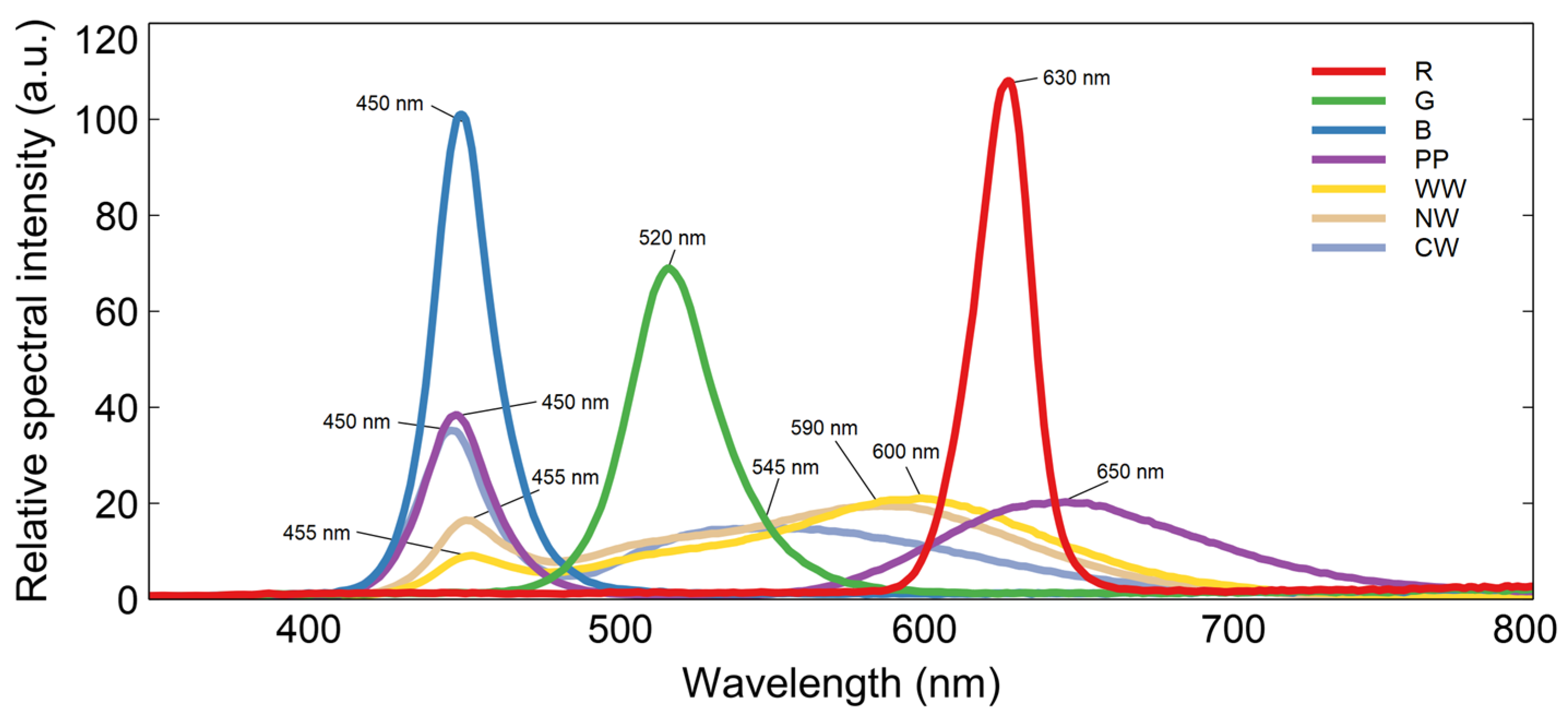
The experiment was conducted in a closed-type plant factory located within the experimental greenhouse of Sahmyook University in Nowon-gu, Seoul, Republic of Korea, from 11 March 2024 to 10 April 2024. T5 light-emitting diode (LED) bars (Zhong Shan Jinsung Electronic, Zhongshan, China) were used as the light source, and seven spectra were applied. The treatments consisted of monochromatic red light (R; 630 nm), green light (G; 520 nm), and blue light (B; 450 nm); a purple-phyto LED (PP; 450 and 650 nm) composed of combined red and blue wavelengths with supplemental far-red light; and three white LED treatments with different correlated color temperatures, specifically warm white (WW; 3000 K), natural white (NW; 4100 K), and cool white (CW; 6500 K) (
Figure 1). The purple-phyto LED included approximately 17.6% far-red radiation in its spectral power distribution over the 350–800 nm range [
34]. The plants were cultivated under these spectral treatments for 30 days.
Photon flux density (PFD) across the 350–800 nm range was maintained at 100 ± 2 μmol·m
−2·s
−1 at the top of the plant canopy, and the photoperiod was set to 14 h light/10 h dark. The distance between the LED bars and the plant canopy was adjusted twice weekly, and PFD was measured simultaneously to maintain the target level. The PFD reaching the plants was measured using a spectroradiometer (SpectraPen Mini; Photon Systems Instruments, Drásov, Czech Republic). During the cultivation period, air temperature and relative humidity within the closed-type plant factory system were maintained at 20 ± 1 °C and 62.4 ± 12.1%, respectively. Irrigation was performed once per week using the sub-irrigation method. To promote plant growth, a liquid fertilizer with an N–P–K composition of 7–10–6 (High-Grade S, Hyponex, Osaka, Japan) was diluted to 1000 ppm with purified water and supplied by sub-irrigation 20 days after the initiation of the treatments, following the method of Shin et al. [
27].
2.3. Growth and Morphological Measurements
Morphological traits, including shoot height and width, were evaluated on the final day of the experiment (30 days after treatment initiation). Shoot height was defined as the distance from the substrate surface to the uppermost point of the plant, and shoot width was defined as the maximum lateral width of the plant viewed from the side. Root length was defined as the length of the longest root. In addition, the stem diameter, leaf number, leaf length, leaf width, leaf area, and leaf thickness were measured. For leaf-related traits, two fully expanded, non-senescent leaves were randomly selected from each plant, and the measured values were averaged.
2.4. Biomass Components, Relative Moisture Content, and Plant Quality Indices
After harvesting, the shoots and roots were separated, and the fresh weight of each plant was measured. The samples were then dried in a hot-air drying oven (HK-DO135F, HANKUK S&I, Hwaseong-si, Republic of Korea) at 90 °C for 24 h, after which their dry weights were determined. Relative moisture content was calculated according to the method described by Lee and Nam [
1], whereas dry matter content was calculated using the following equation:
(RMC: relative moisture content; FW: fresh weight; DW: dry weight; and DM: dry matter).
Plant quality indices used to assess overall plant quality and growth performance were calculated based on data for morphological traits, biomass components, and physiological parameters. The following indices were calculated: shoot-to-root ratio (S/R), top-heavy index (THI), root investment ratio (RIR), compactness (CPN), compact biomass index (CBI), structural stability index (SSI), leaf efficiency index (LEI), simple growth quality index (SGQI), Dickson quality index (DQI), and integrated morphophysiological index (IMI). The equations used for these indices are based on Lee et al. [
31] and are presented below.
(SDW: shoot dry weight; RDW: root dry weight; SH: shoot height; RL: root length; TDW: total dry weight; SW: shoot width; SD: stem diameter; LN: leaf number; LL: leaf length; LW: leaf width; and NDVI: normalized difference vegetation index).
2.5. Leaf Color Readings
Leaf color was evaluated by measuring the Commission Internationale de l’Eclairage Lab (CIELAB)
L*,
a*, and
b* values using a spectrophotometer (CM-2600d; Konica Minolta, Tokyo, Japan). During leaf color measurements, the midrib was avoided. CIELAB measurements were conducted using the D65/10° mode and the specular component included (SCI) mode following the method described by Lee [
35].
2.6. Chlorophyll Content and Chlorophyll a Fluorescence
The chlorophyll content was measured using a portable chlorophyll meter (SPAD-502Plus; Konica Minolta, Tokyo, Japan). Fully expanded leaves were measured for each plant. Similar to the leaf color measurements, SPAD readings were taken while avoiding the midrib. The chlorophyll fluorescence responses were measured using a portable fluorometer (FluorPen FP 110/D; Photon Systems Instruments, Drásov, Czech Republic). Prior to measurement, leaves were dark-adapted for approximately 15 min using a leaf clip, according to the manufacturer’s instructions [
36]. All chlorophyll fluorescence measurements were conducted indoors under consistent measurement conditions; therefore, the potential influence of time of day and temperature on fluorescence readings was minimized. During fluorescence measurement, the excitation wavelength was set to 455 nm, and a saturating light pulse of 1500 μmol·m
−2·s
−1 was applied to induce maximum fluorescence (F
m) [
27]. In this study, F
v/F
m and PI
ABS, which are effective indicators for comparing plant physiological status, were selected, and the corresponding equations are presented below [
36,
37].
2.7. Measurement of Remote Sensing Vegetation Indices
Remote sensing vegetation indices were calculated based on reflectance spectra obtained using a spectroradiometer (PolyPen RP410; Photon Systems Instruments, Drásov, Czech Republic). The selected vegetation indices included the normalized difference vegetation index (NDVI), photochemical reflectance index (PRI), and modified chlorophyll absorption ratio index (MCARI). The corresponding equations are presented below [
24].
2.8. Experimental Design and Statistical Analysis
The experiment was conducted using a completely randomized design (CRD). Each spectral treatment consisted of ten replicates (n = 10), with each replicate defined as an independent plant grown individually in a separate pot. For CIELAB color values, chlorophyll fluorescence parameters, and vegetation indices, measurements were taken from two randomly selected, fully expanded, non-senescent leaves per plant, and the resulting values were averaged. Data were analyzed using SAS 9.4 (SAS Institute, Cary, NC, USA). Differences among treatments were assessed using one-way analysis of variance (ANOVA), and when significance was detected (p < 0.05), mean separation was performed using Duncan’s multiple range test (DMRT).
To interpret treatment responses from a multivariate perspective, selected variables were standardized using Z-scores. Principal component analysis (PCA) was conducted to examine the overall structure of variation among variables. The relationships between treatments and variables were visualized using a Z-score heatmap. In addition, associations among variables were evaluated using Pearson’s correlation analysis, and the results were visualized as a correlation heatmap. Similarities among treatments were further analyzed by hierarchical clustering based on standardized treatment means for each variable, using Euclidean distance and Ward’s linkage method. In addition, the clustering structure among variables was analyzed using hierarchical clustering with average linkage after converting Pearson correlation coefficients into distance values (1 − r).
3. Results
3.1. Plant Growth Characteristics
3.1.1. Basic Growth Parameters
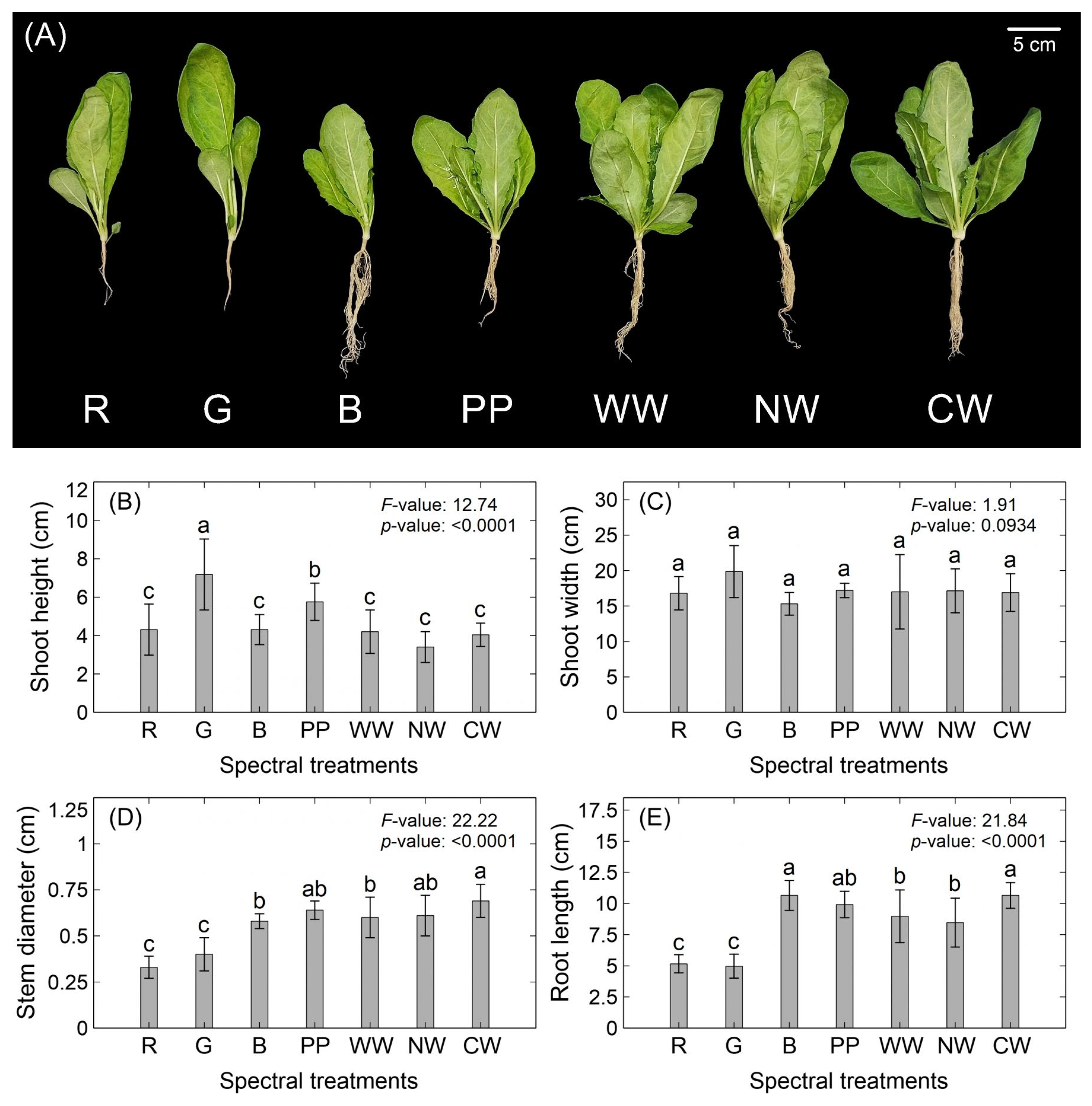
Representative photographs of the experimental results are shown in
Figure 2. According to the results for the basic growth parameters, shoot height was greatest under the G treatment, reaching 7.18 cm. In contrast, plants grown under the three white LED treatments (WW, NW, and CW) had relatively shorter shoot heights, ranging from 3.40 to 4.20 cm. However, unlike shoot height, shoot width did not differ significantly among the treatments. Meanwhile, stem diameter was relatively greater under the CW treatment, reaching 0.69 cm, although it did not differ significantly from the PP and NW treatments (0.64 and 0.61 cm, respectively). In contrast, stem diameter was markedly reduced under the R and G treatments, measuring 0.33 and 0.40 cm, respectively. Regarding root length, the B and CW treatments produced relatively long roots, both reaching 10.65 cm, although these values were not significantly different from those in the PP treatment (9.92 cm). In contrast, root length was substantially reduced in the R and G treatments, and these plants had significantly shorter roots than those under other treatments (5.16 and 4.97 cm, respectively).
3.1.2. Leaf Growth and Chlorophyll Content (SPAD Units)
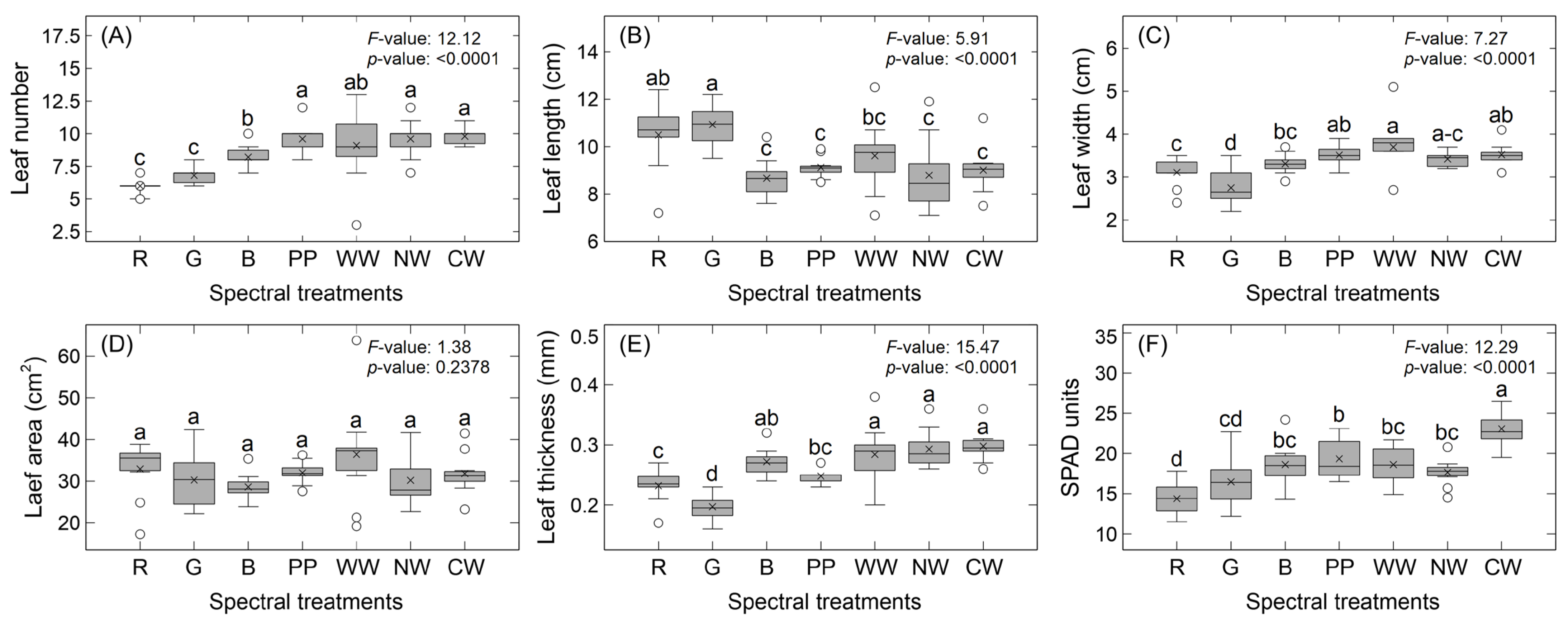
According to the results for leaf-related morphological traits and chlorophyll content (SPAD units), leaf number was relatively high under the PP, NW, and CW treatments, with 9.6, 9.6, and 9.8 leaves, respectively, and did not differ significantly from that under the WW treatment (9.1 leaves) (
Figure 3). In contrast, leaf number was markedly reduced under the R and G treatments, reaching 6.0 and 6.8 leaves, respectively. Meanwhile, leaf length was greatest under the G treatment, reaching 10.93 cm, and was relatively longer than that under the B, PP, WW, NW, and CW treatments, which ranged from 8.66 to 9.61 cm. By contrast, unlike the pattern observed for leaf length, leaf width was relatively greater under the WW treatment (3.70 cm) than under the G treatment (2.75 cm). Leaf area did not differ significantly among treatments, whereas leaf thickness was greater under the WW, NW, and CW treatments, with values of 0.284, 0.293, and 0.298 mm, respectively, compared with 0.197 mm under the G treatment.
With respect to chlorophyll content (SPAD units), the CW treatment showed the highest value (23.07 SPAD units), whereas the R treatment showed a relatively low value (14.38 SPAD units). In addition, compared with the CW treatment, SPAD units were clearly reduced under the WW and NW treatments, with values of 18.62 and 17.66 SPAD units, respectively.
3.2. Biomass Accumulation and Relative Moisture Content
According to the biomass analysis, shoot fresh weights were relatively high under the WW and NW treatments, reaching 2819 and 2690 mg, respectively, although these values were not significantly different from those under the CW treatment (2428 mg) (
Table 1). In contrast, shoot fresh weight under the R treatment was relatively low (1046 mg) compared with that under the three white LED treatments. Meanwhile, shoot dry weight was also relatively high under the PP, WW, NW, and CW treatments, ranging from 152.3 to 171.4 mg, whereas it was lower under the R treatment at 61.7 mg.
With respect to root biomass, root fresh weight was greatest under the WW treatment (266.3 mg), whereas it was markedly lower under the R treatment (31.3 mg). For root dry weight, the CW treatment tended to show a relatively high value of 21.0 mg, although it was not significantly different from the WW and NW treatments, which showed 18.7 and 19.8 mg, respectively. In contrast, the root dry weight in the R treatment was low (5.3 mg).
The relative moisture content was highest under the WW treatment at 94.1%, indicating a relatively higher moisture content than that observed under the CW treatment (92.8%). In contrast, dry matter was highest under the CW treatment (7.1%), which was significantly greater than that under the WW treatment (5.8%).
3.3. Resource Allocation and Plant Quality Indices
According to the results for indices related to resource allocation, the shoot-to-root ratio (S/R) was relatively high under the R treatment, reaching 11.8; however, it did not differ significantly from the values observed under the G, PP, and NW treatments, which were 11.2, 11.5, and 9.4, respectively (
Table 2). In contrast, compared with the R treatment, the CW treatment showed a relatively lower S/R value of 8.5. For THI, an index reflecting the relative degree of shoot development, the highest value was observed under the G treatment at 16.5. By contrast, RIR, which indicates the relative degree of root development, was relatively high under the CW treatment at 0.29, although it did not differ significantly from the values under the B and NW treatments, which were 0.28 and 0.25, respectively.
CPN, which reflects the simple compactness of the shoot, showed relatively high values under the three white LED treatments, ranging from 41.6 to 52.2, whereas it was relatively low in the G treatment, at 12.1. With respect to CBI, an index representing the overall compactness of the shoot, the WW treatment showed a relatively high value of 4.14 compared with 0.68 under the G treatment. SSI, which reflects the relative structural stability of the shoot, was relatively high in the NW treatment (3.23), although it was not significantly different from the value in the CW treatment (2.90).
LEI, which reflects the relative density-based efficiency of leaves, did not differ significantly among the treatments. In contrast, SGQI, which represents the degree of biomass accumulation relative to the total shoot–root length of the plant, was relatively high under the WW and NW treatments, with values of 15.0 and 16.1, respectively; however, these values did not differ significantly from those under the CW treatment (12.9). In comparison, the SGQI was markedly reduced under R, G, and B treatments, ranging from 7.2 to 8.5.
DQI, which reflects the overall morphological quality of the plant, was relatively high in the NW and CW treatments, with values of 13.0 and 13.6, respectively, compared with those in the R and G treatments (2.7 and 3.0, respectively). Similarly, IMI, which represents the integrated morphophysiological quality of the plant, was relatively high under the WW, NW, and CW treatments, ranging from 58.5 to 75.1, whereas it was markedly lower under the R and G treatments, with values of 14.4 and 13.0, respectively.
3.4. Qualitative Parameters and Physiological Traits
3.4.1. Leaf Color Traits
According to the CIELAB values, all three parameters—
L*,
a*, and
b—differed significantly among the treatments (
Table 3). The
L* value, which represents leaf lightness, was lower in the CW treatment (48.5) than in the R treatment (54.4). Meanwhile, the
a* value, which represents the green–red opponent axis, was highest under the R treatment at −8.5, indicating the least negative value among the treatments. The
b* value, which represents the blue–yellow opponent axis, was relatively high under the G treatment (35.4), although it did not differ significantly from that under the R treatment (33.3).
3.4.2. Maximum Quantum Yield and Performance Index on an Absorption Basis
F
v/F
m, which represents the maximum quantum yield of photosystem II (PSII), was markedly reduced in the R and G treatments, with values of 0.623 and 0.620, respectively. In contrast, relatively high values were observed for the NW and CW treatments, reaching 0.804 and 0.819, respectively (
Table 3). PI
ABS, which represents the performance index on an absorption basis, was the highest under the CW treatment at 2.90. By comparison, PI
ABS was markedly reduced under the R and G treatments, with values of 0.18 and 0.31, respectively.
3.4.3. Remote Sensing-Based Vegetation Indices
According to the results for the vegetation indices, NDVI, an indicator of plant greenness and overall vigor, was relatively higher under the NW treatment (0.591) than under the R and G treatments, with values of 0.503 and 0.506, respectively (
Table 3). Meanwhile, the PRI, which reflects photochemical efficiency, was relatively high under the WW treatment at 0.024, although it did not differ significantly from the values under the B, NW, and CW treatments, which were 0.022, 0.022, and 0.020, respectively. MCARI, which is associated with chlorophyll content, showed relatively high values in the R, G, B, PP, and WW treatments, ranging from 0.577 to 0.629, whereas it was markedly reduced in the NW and CW treatments, ranging from 0.458 to 0.489.
3.5. Multivariate Analysis
3.5.1. Principal Component Analysis (PCA)
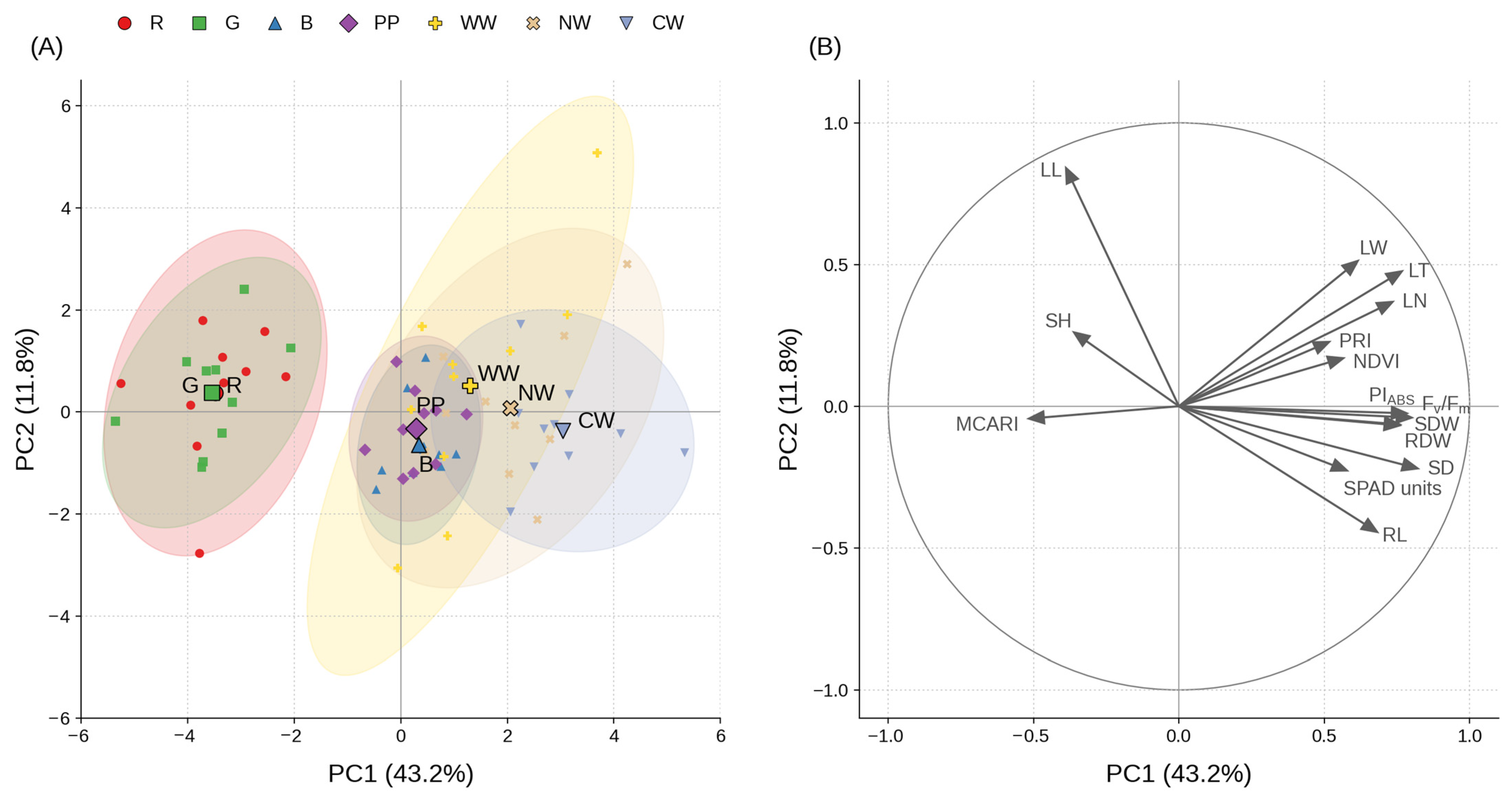
PCA was performed using selected variables. PC1 and PC2 explained 43.2% and 11.8% of the total variance, respectively, resulting in a cumulative explained variance of 55.0% for the first two components (
Figure 4). When PC3 (9.8%) was included, the cumulative explained variance increased to 64.8% (
Table 4).
In the PCA score plot, treatments R and G were clearly distributed along the negative side of PC1, whereas treatments WW, NW, and CW were positioned along the positive side of PC1 (
Figure 4A). The B and PP treatments were in the intermediate regions near the origin. These results suggest that the morphophysiological responses to different LED spectra were primarily differentiated along PC1.
In the loading plot, stem diameter, F
v/F
m, PI
ABS, leaf thickness, shoot dry weight, root dry weight, root length, leaf number, NDVI, and PRI were mainly positioned on the positive side of PC1, whereas shoot height, leaf length, and MCARI contributed relatively strongly to the negative side (
Figure 4B). These results indicated that PC1 may be interpreted as an axis that contrasts elongation-related traits such as shoot height and leaf length with stem thickening, root development, biomass accumulation, photochemical stability, and vegetation indices. In contrast, leaf length showed the largest contribution to PC2, whereas leaf width, leaf thickness, and leaf number were positioned in the same direction and root length was in the opposite direction. Therefore, PC2 was interpreted as an axis representing secondary variation primarily associated with patterns of leaf elongation and expansion.
For PC3, NDVI and PRI showed the largest positive loadings, whereas SPAD units, leaf number, and shoot height were positioned in a relatively strongly negative direction (
Table 4). This suggests that PC3 represents a secondary axis reflecting the relative differences between the remote sensing-based vegetation indices and chlorophyll content, together with certain morphological variables.
3.5.2. Correlation Analysis
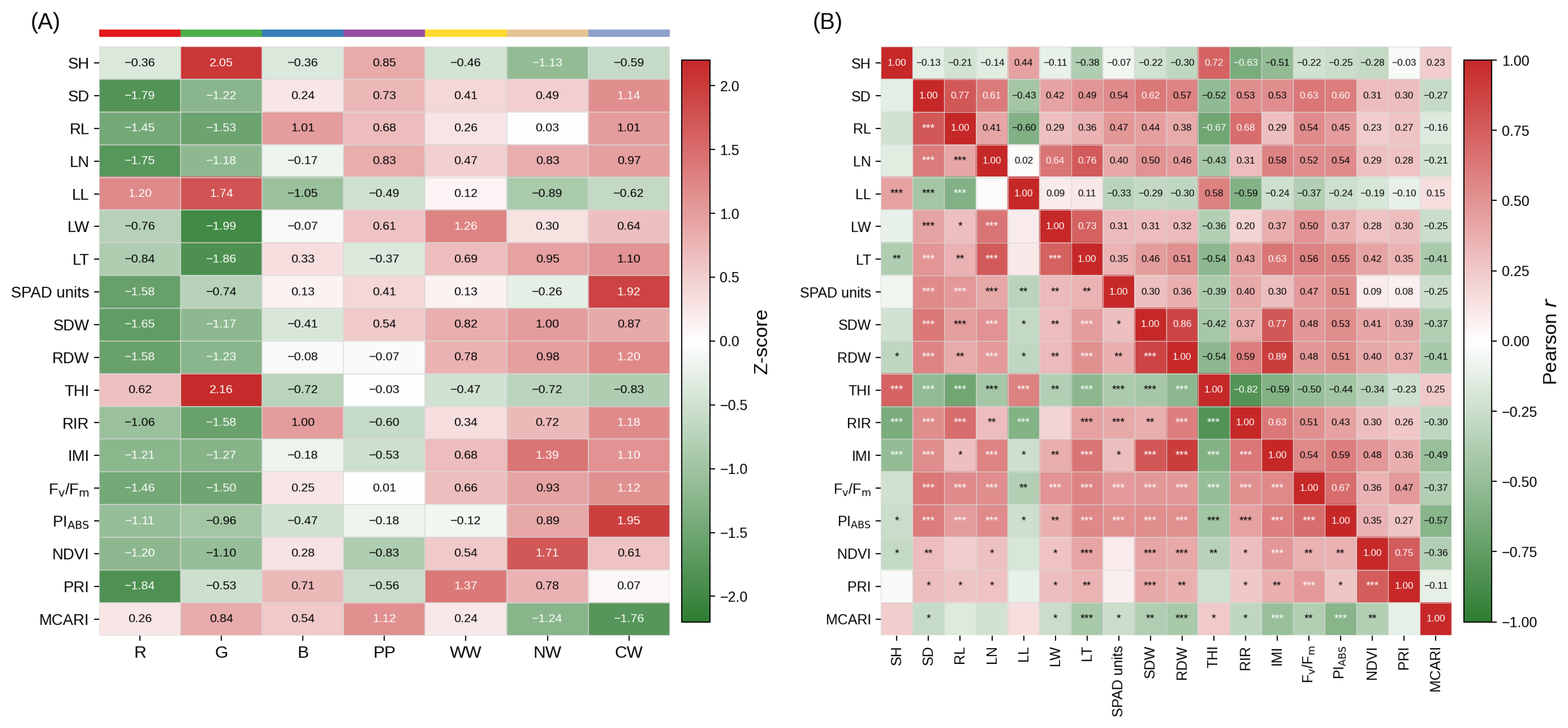
The treatment-by-variable heatmap generated using Z-score-standardized treatment means clearly illustrated the overall response patterns of the measured variables across the seven LED spectra (
Figure 5A). Overall, monochromatic light treatments R and G were more closely associated with variables related to leaf length and shoot elongation. Among the white-light treatments, NW and CW tended to be more closely associated with variables related to structural development, biomass accumulation, and physiological stability. In particular, treatment G showed the highest positive deviations in shoot height, leaf length, and THI, whereas marked negative deviations were observed in stem diameter, root length, leaf thickness, and several physiological indicators (NDVI, F
v/F
m, and PI
ABS). The R treatment likewise generally exhibited negative values for stem diameter, root length, leaf number, SPAD units, shoot dry weight, root dry weight, F
v/F
m, PI
ABS, NDVI, and PRI. In contrast, the CW treatment showed highly positive values for stem diameter, root length, leaf number, leaf thickness, SPAD units, root dry weight, RIR, IMI, F
v/F
m, and PI
ABS. The NW treatment showed a similar pattern, with positive associations with leaf number, leaf thickness, shoot dry weight, root dry weight, IMI, F
v/F
m, PI
ABS, NDVI, and PRI. Under the WW treatment, leaf width and PRI were relatively high, and biomass- and chlorophyll fluorescence-related variables were generally positive. The PP treatment showed positive deviations in shoot height, stem diameter, root length, leaf number, leaf width, and MCARI, whereas RIR, IMI, NDVI, and PRI were relatively negative. Overall, the B treatment showed intermediate responses, although relatively high values were observed for root length, RIR, and PRI.
With respect to the relationships among the variables, the structural traits, biomass components, and physiological indicators generally tended to form positive correlations with one another (
Figure 5B). Strong positive correlations were observed between the stem diameter and root length (
r = 0.77), leaf number and leaf thickness (
r = 0.76), shoot dry weight and root dry weight (
r = 0.86), IMI and root dry weight (
r = 0.89), IMI and shoot dry weight (
r = 0.77), and PRI and NDVI (
r = 0.75). In addition, F
v/F
m and PI
ABS generally showed positive correlations with biomass components and several morphological parameters, indicating that improvements in photochemical stability tended to coincide with enhanced structural development. In contrast, variables associated with elongation generally showed negative correlations with indices related to resource allocation to the root system, structural stability, and physiological integrity. Shoot height showed a strong positive correlation with THI (
r = 0.72), whereas THI showed a strong negative correlation with RIR (
r = −0.82) and was also generally negatively related to root length, leaf thickness, root dry weight, F
v/F
m, and PI
ABS. MCARI likewise showed a negative correlation with PI
ABS (
r = −0.57) and with several biomass- and chlorophyll fluorescence-related parameters, indicating that this index did not vary in the same direction as the major structural and photochemical response axes.
3.5.3. Hierarchical Cluster Analysis
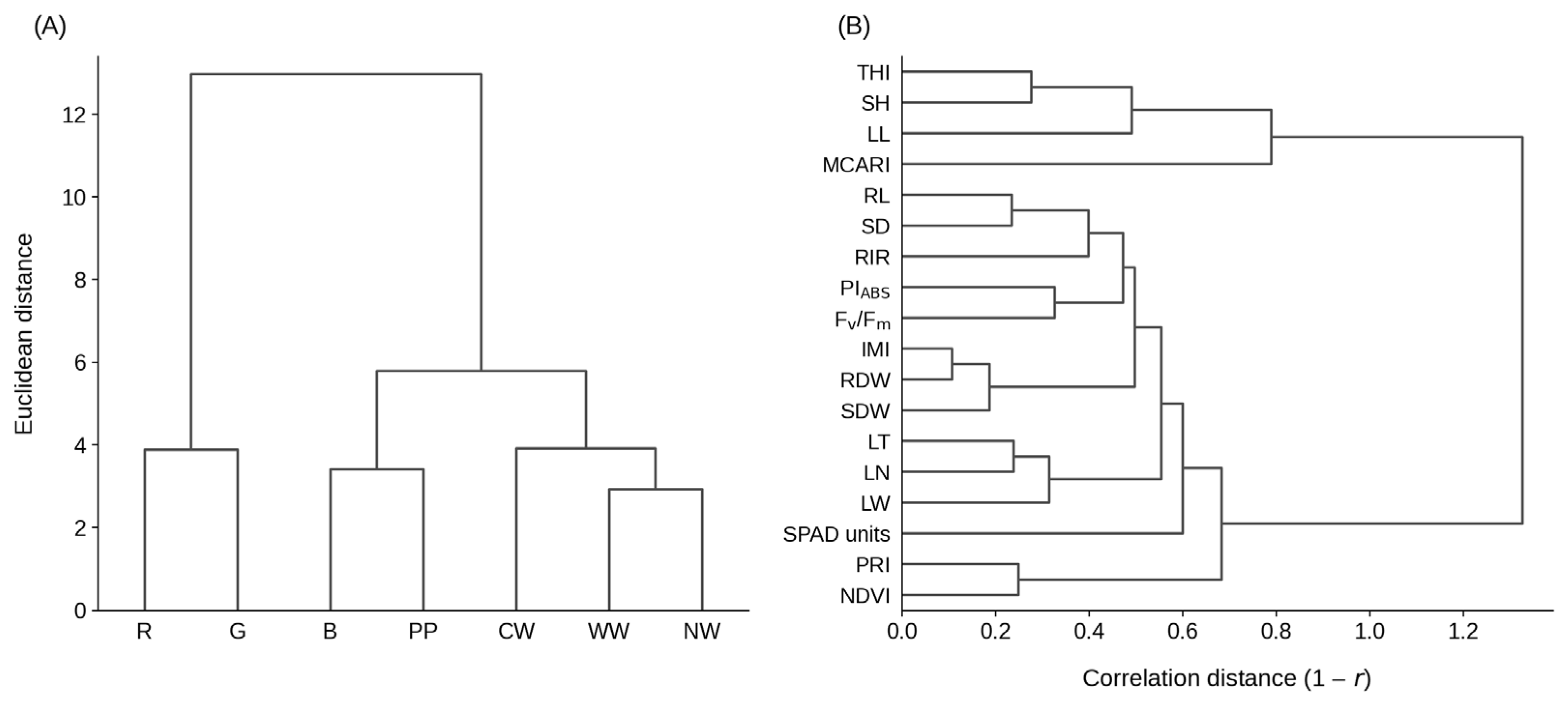
The treatments were divided into several distinct clusters based on their overall response patterns (
Figure 6). The R and G treatments formed a single cluster that was clearly separated from the other treatments, whereas the white-light treatments (WW, NW, and CW) were grouped into a closely related cluster. In addition, the B and PP treatments formed an intermediate subcluster (
Figure 6A).
For the hierarchical clustering among variables, Pearson correlation coefficients were converted into distance values (1 −
r), and the average linkage method was applied. The selected variables were separated into several functional clusters (
Figure 6B). Shoot height, leaf length, and THI formed a closely related cluster, representing an elongation growth-oriented response. Stem diameter and root length formed a distinct subcluster and were grouped as variables associated with structural development. In addition, shoot and root dry weights showed high similarity, and IMI was positioned adjacent to this cluster. F
v/F
m and PI
ABS formed a clear subcluster, whereas NDVI and PRI were grouped closely together. In contrast, MCARI was positioned at a certain distance from these clusters, indicating that it did not follow the exact same pattern as the other reflectance- or chlorophyll fluorescence-related indicators. Overall, the clustering structure of the variables suggested that elongation-related traits, structural- and biomass-related variables, chlorophyll fluorescence response variables, and remote sensing-based vegetation indices tended to form distinct groups.
4. Discussion
4.1. Spectral Effects on Vegetative Growth, Structural Development, and SPAD Units
In the present study,
T. coreanum exhibited clear differences in morphological traits, biomass accumulation, resource allocation, and physiological responses under seven different LED spectra. These findings support the need for diverse experimental approaches, as plant responses to light quality can be highly species- and cultivar-specific [
24,
29]. In other words, differences in light quality did not simply alter the magnitude of growth but simultaneously reshaped plant morphological balance, resource allocation patterns, and photophysiological stability.
Evaluation of basic growth parameters showed that treatment G markedly increased shoot height and leaf length, whereas stem diameter and root length were relatively reduced. Similarly, the R treatment resulted in relatively low stem and root lengths. These results suggest that under both treatments, structural integrity and root development were not sufficiently supported relative to shoot elongation. Previous studies have reported that green light can act as a shade-like signal under certain conditions, thereby promoting elongation growth, that is, shade avoidance responses [
38]. In
Arabidopsis, green light rapidly stimulates stem elongation during the early growth stage [
39], and other studies have reported an elongation-promoting effect of monochromatic green light on
Coleus cultivars [
26]. In addition, monochromatic red light may be associated with red-light syndrome and can be relatively unfavorable for tissue development and photosynthetic function [
40,
41].
Among the white-light treatments, the CW treatment tended to increase stem diameter despite producing relatively short shoots, and it also maintained high levels of leaf number and thickness. Root length was also greater in the CW treatment and was not significantly different from that in the B and PP treatments. In a previous study, chicory (
Cichorium intybus), another member of the Asteraceae family, was reported to produce higher-quality plants under white LEDs than under monochromatic or purple-phyto LEDs [
27], similar to the response observed here in
T. coreanum. This may be because broadband white light induces a more integrated light-signaling response mediated by phytochromes, cryptochromes, and phototropins, thereby promoting a more balanced photomorphogenesis than the biased elongation responses often observed under monochromatic light [
29]. Although the G treatment increased leaf length, leaf width and thickness did not increase. This suggests that leaf development under different light qualities may manifest not only as simple elongation but also as enhanced tissue robustness, as observed under white light.
In addition to the photoreceptor-mediated mechanisms described, white light may simultaneously promote palisade development through blue wavelengths and enhance light penetration through green wavelengths. Therefore, white light may induce healthier leaf development and concurrent increases in leaf thickness rather than the abnormal leaf elongation commonly observed under monochromatic light conditions [
42,
43]. These responses may arise as synergistic effects when multiple regions of the visible spectrum act together, as in the case of white light. Although previous studies have demonstrated the distinct advantages of individual wavelength regions, the present results indicate that when these wavelengths are applied only as monochromatic light rather than as composite light, negative effects may be induced, as observed in the R and G treatments.
SPAD units, which are associated with chlorophyll content, were highest under the CW treatment and were markedly reduced under the R treatment. In addition, relative to the CW treatment, the SPAD units were also clearly lower under the other white-light treatments (WW and NW). These results suggest that white light with a broader spectral distribution, particularly white light with a relatively high correlated color temperature, is more favorable for chlorophyll accumulation. This tendency may be related to the fact that white light, with a relatively high correlated color, generally contains a greater proportion of blue light [
21,
44]. Previous studies have shown that in
Arabidopsis, blue light is more effective than red light in inducing chloroplast development [
45], and in grapevines (
Vitis vinifera), a high proportion of blue light has been reported to promote the expression of chlorophyll biosynthesis-related genes [
46]. In contrast, other studies have reported that SPAD units tend to decline significantly under spectral distributions lacking blue light or with relatively low proportions of blue light [
24,
27,
34]. In tea plants (
Camellia sinensis), red-light-induced yellowing has also been reported to cause abnormalities in chlorophyll metabolism [
47].
4.2. Biomass Accumulation and Plant Quality Indices
Overall, biomass accumulation showed a similar pattern. Shoot fresh and dry weights were generally higher under the WW and NW treatments, and root biomass tended to be relatively greater under the white-light treatments, particularly WW and, to a lesser extent, NW and CW, than under the monochromatic light treatments. In contrast, both shoot and root biomasses were consistently low under the R treatment, and the elongation growth tendency observed mainly under the G treatment did not translate into increased dry matter accumulation. In particular, the relatively higher root dry weight under white LED treatments than under monochromatic LED treatments indicated that root development was more stably maintained during the early growth stage, which may be favorable for subsequent growth or establishment from a long-term perspective.
Previous studies have shown that in cucumber (
Cucumis sativus), monochromatic red light lacking blue wavelengths reduces F
v/F
m, stomatal conductance, leaf hydraulic conductance, and net photosynthesis, and that leaves developed under pure red light exhibit red-light syndrome, characterized by low leaf mass per area and impaired growth [
40,
48]. In contrast, white light increases radiation-use efficiency in dwarf tomatoes [
49] and enhances root biomass, together with an increase in the net photosynthetic rate, in ginseng (
Panax ginseng) [
50]. In addition, Kim et al. [
8] reported that in danshen (
Salvia miltiorrhiza), a medicinal crop, root biomass increased significantly under white LED treatments compared with monochromatic R, G, and B treatments. Therefore, the relatively high root dry weight observed under white light treatments in the present study may be interpreted as the result of a broader spectral distribution maintaining shoot–root carbon partitioning and root sink formation more stably [
51]. The finding that the relative moisture content was highest under the WW treatment and lowest under the CW treatment indicated that plant water retention and internal tissue water status may differ even among white light treatments. Nevertheless, based on the overall results presented thus far, the WW treatment maintained a relatively high fresh-mass-based moisture proportion in parallel with biomass accumulation.
In the present study, plant quality indices provided an integrated basis for evaluating shoot–root balance, structural stability, and physiological integrity [
31]. Although individual parameters are useful for indicating the direction of specific responses, actual plant quality can be assessed more accurately when shoot–root balance, structural stability, and physiological integrity are considered together. In this context, the plant quality indices examined in this study provide a more integrated summary of the growth patterns discussed thus far. Compared with the white-light treatments, the relatively high S/R and THI values observed under the R and G treatments indicated that resource allocation to the shoot was biased and that a more top-heavy growth form was promoted. In particular, the fact that THI was highest under the G treatment indicated that shoot elongation and shoot dominance occurred simultaneously. In other words, the increase in shoot height observed under the G treatment appeared to represent a shoot-dominant morphological response rather than a true improvement in tissue robustness. Although the plants may have appeared more elongated, such elongation cannot necessarily be interpreted as evidence of superior seedling quality.
In contrast, RIR was higher in the CW treatment and, to a lesser extent, in the B and NW treatments than in the R, G, and PP treatments. Similarly, the relatively high DQI and IMI values in the NW and CW treatments suggested that root investment, structural stability, overall morphological quality, and integrated morphophysiological quality were superior under these treatments relative to the others. In general, active resource investment in the root system during the early growth stage indicates that the foundation for subsequent water and nutrient uptake is being established more stably; this tendency may also be interpreted positively in terms of subsequent growth stability. In addition, the generally higher values of compactness, CBI, and SGQI under the WW, NW, and CW treatments than under the monochromatic light treatments further support the conclusion that the white LED treatments not only promoted biomass accumulation but also produced a more compact and balanced growth form. In the case of DQI and IMI, the markedly higher values under the NW and CW treatments compared with the R and G treatments demonstrated that increased shoot height alone did not necessarily indicate superior plant quality during the early growth stages of T. coreanum. Instead, an integrated interpretation that simultaneously accounts for stem thickening, root development, biomass partitioning, and physiological integrity is required. Taken together, under the conditions of the present study, white LED treatments, particularly NW and CW, were considered to provide a more favorable combination of traits in terms of marketable quality and subsequent growth potential in T. coreanum.
4.3. Qualitative Traits, Chlorophyll Fluorescence, Vegetation Indices
Both CIELAB color coordinates and vegetation indices are non-destructive (or non-invasive) indicators derived from optical information reflected from the leaf surface and are useful for indirectly assessing chlorophyll content, pigment composition, and plant physiological status in a complementary manner [
52,
53]. Leaf color, remote sensing-based vegetation indices, and chlorophyll content also clearly reflected differences among the LED spectra. In terms of leaf color, treatment R showed a relatively high
L* value and a less negative
a* value, indicating that the leaves tended to be brighter and less green. In contrast, the CW treatment resulted in a markedly lower
L* value, indicating the formation of darker green leaves. This pattern was generally consistent with the higher SPAD units observed under CW, and the combination of high
L* and
b* values with low SPAD units suggests that the chlorophyll content per unit leaf area may have been relatively low. SPAD units are known to be strongly positively correlated with leaf chlorophyll concentration, particularly chlorophyll content, on an area basis [
54]. Previous studies have shown that CIELAB values, such as
L* and
b*, are closely related to chlorophyll content and that chlorophyll content tends to vary inversely with
L* and
b* [
27].
With respect to chlorophyll fluorescence, F
v/F
m reflects the maximum quantum yield of PSII in the dark-adapted state [
55], and unstressed higher plants are generally known to exhibit values of approximately 0.78–0.84 [
56,
57,
58]. Based on this criterion, the reduced F
v/F
m values in the R and G treatments (0.620–0.623) indicated a clear decline in the maximum quantum yield of PSII. The B and PP treatments (0.735–0.753) also tended to show values below the typical non-stressed range, although the B treatment was not completely separated from the WW, NW, and CW treatments. Therefore, rather than categorizing these responses uniformly as abiotic stresses, they may be more appropriately interpreted as reflecting relatively unfavorable or intermediate levels of photochemical efficiency.
The results of the vegetation indices also generally support the interpretations presented above. Compared with the other monochromatic light treatments, NDVI tended to be relatively high under the NW treatment, whereas PRI was relatively higher under the WW treatment than under the monochromatic light treatments. This suggests that the NW treatment is generally associated with greater leaf greenness and vegetation vigor [
59], whereas the WW treatment may have been relatively favorable in terms of leaf photosynthetic activity or light-use efficiency. The PRI is not merely an indicator of pigment content; rather, it reflects information related to the xanthophyll cycle and light-use efficiency, based on changes in reflectance near 531 nm [
60]. Therefore, the highest PRI observed under the WW treatment suggests that photoprotective regulation and photochemical efficiency may have been relatively well maintained under this treatment [
61]. However, because the PRI under the WW treatment did not differ significantly from those under the B, NW, or CW treatments, it would be difficult to draw a definitive conclusion regarding the photochemical superiority of WW based on the PRI alone. Meanwhile, MCARI was significantly higher under the R, G, B, PP, and WW treatments but significantly lower in the NW and CW treatments, indicating that this index does not necessarily vary in the same direction as NDVI, SPAD units, or photochemical stability indicators such as PRI. In other words, indices reflecting specific pigments or reflectance characteristics may not always reflect the overall physiological superiority of a plant. This suggests that changes in optical indices may selectively emphasize particular optical properties rather than directly reflecting the overall performance of the plant in a one-to-one manner.
From a more detailed perspective, both F
v/F
m and PI
ABS were lower under the R and G treatments than under the white-light treatments, whereas higher values were observed under the NW and CW treatments; in particular, PI
ABS was highest under the CW treatment. This suggests that, among the white-light treatments, CW may have been relatively favorable for maintaining PSII stability and energy-use efficiency. In particular, the marked increase in PI
ABS indicated that treatment differences extended beyond simple differences in PSII damage status and reflected broader differences in photochemical performance, including energy capture and electron transport. Because PI
ABS is an integrated index that incorporates the density of active reaction centers, primary photochemical efficiency, and electron transport efficiency, it may respond more sensitively than F
v/F
m to treatment differences [
62,
63]. Indeed, PI
ABS is widely used as a sensitive indicator of PSII reaction center integrity and plant vitality. Higher F
v/F
m and PI
ABS values under white light than under monochromatic red or green light have been previously reported [
8,
27].
4.4. Integrative Interpretation Based on Multivariate Analyses
The PCA results of the present study were broadly consistent with the findings of the individual parameter analyses described above. The placement of the R and G treatments in the negative region of PC1 was consistent with the fact that these treatments were associated with relatively increased shoot height and leaf length but generally lower stem diameter, root length, leaf thickness, biomass accumulation, F
v/F
m, and PI
ABS. Conversely, the positioning of white LED treatments, particularly NW and CW, on the positive side of PC1 indicated that these treatments were associated with a shorter and more compact plant form, improved stem and root development, greater dry matter accumulation, and a more stable photochemical response. This suggests that the treatment effects on
T. coreanum cannot be adequately evaluated based on elongation alone and that structural stability, biomass formation, and photophysiological integrity should also be considered. This interpretation is consistent with previous reports that light quality regulates plant morphogenesis, biomass allocation, photosynthesis, and physiological responses in an interconnected manner [
29,
64,
65].
In addition, the opposing placement of variables in the loading plot indicated that spectral treatment effects were not expressed merely as uniform increases or decreases in overall growth, but rather as shifts in distinct and, at least in part, independent directions involving leaf morphogenesis and expansion patterns, root elongation, and chlorophyll accumulation. The fact that MCARI was not positioned in the same direction as NDVI, PRI, or chlorophyll fluorescence suggests that indices reflecting pigment absorption characteristics do not necessarily vary in parallel with overall biomass accumulation or photochemical stability. In this context, under controlled environmental cultivation of
T. coreanum, an increase in MCARI may be considered a candidate indicator for detecting potentially unfavorable growth responses in future studies. Taken together, these results suggest that the interpretation of spectral responses in
T. coreanum should not rely on a single vegetation index or individual morphological traits but rather should be based on an integrated assessment of morphological and photochemical indicators. Indeed, because vegetation indices reflect different optical and physiological properties, even a chlorophyll-related index may not necessarily behave in parallel with NDVI or PRI, depending on species-specific characteristics and differences in leaf structure [
66,
67]. Likewise, because the PRI is primarily associated with the xanthophyll cycle and light-use efficiency, it may show response patterns distinct from those of simple chlorophyll content indices [
68,
69], and therefore should be interpreted with caution.
PC3 may be interpreted as a secondary physiological axis, distinct from the structural growth and biomass axes represented by PC1 and the leaf morphology-related variation represented by PC2. Although NDVI and PRI showed strong positive contributions, SPAD units contributed negatively, indicating that treatment-induced changes in remote sensing-based vegetation indices do not always occur in the same direction as changes in chlorophyll content. This suggests that the light quality-dependent optical responses or pigment-related reflectance properties of leaves may vary independently of simple chlorophyll accumulation. In addition, because the contributions of Fv/Fm and PIABS to PC3 were relatively small, PC3 appeared to reflect subtle differences in spectral and pigment-related responses rather than photochemical stability itself.
Heatmap analysis more intuitively illustrated the combinations of traits associated with each treatment. This analysis was conducted for exploratory purposes. The results showed that the generally high values of stem diameter, root length, leaf number, leaf thickness, shoot dry weight, root dry weight, IMI, F
v/F
m, PI
ABS, and NDVI under the NW and CW treatments suggested that these white-light treatments were associated with greater biomass accumulation, a more balanced plant structure, and a more stable photochemical state. Similar tendencies have been previously reported [
24,
70]. In contrast, the closer association of the G treatment, and to some extent the R treatment, with shoot height, leaf length, and THI suggests that the response under these treatments was characterized more by elongation-oriented growth than by an overall improvement in plant quality. This suggests that early elongation growth does not necessarily indicate superior plant quality and should be interpreted together with biomass accumulation, root development, and photochemical stability.
Correlation analysis suggested that plant quality in
T. coreanum was associated with coordinated variation in morphology, resource allocation, and physiological stability. The positive correlations among stem diameter, root length, leaf number, leaf thickness, shoot dry weight, root dry weight, F
v/F
m, PI
ABS, NDVI, and PRI suggest that plants with superior structural development also tend to exhibit enhanced photochemical efficiency and more favorable vegetation index values. In contrast, the strong negative correlation between THI and RIR, together with the negative relationships between THI and root-related traits and biomass components, indicate that growth biased toward shoot elongation may be accompanied by reduced root investment and poorer structural balance [
31]. In addition, the negative correlations involving MCARI suggest that pigment- or reflectance-related indices do not always vary in parallel with structural quality or photochemical stability.
Because the correlation heatmap included derived indices such as THI, RIR, and IMI, some strong correlations may partly reflect shared mathematical components and should therefore be interpreted with caution. Overall, the correlation analysis indicated that structural development, biomass accumulation, and photochemical stability were positively associated, whereas elongation-related traits were generally opposed to root investment and structural balance.
Hierarchical clustering of the treatments separated the R and G treatments from the WW, NW, and CW treatments, with the B and PP treatments forming an intermediate sub-cluster. This pattern places B and PP in an intermediate position between the monochromatic and white-light treatments. Hierarchical clustering of the variables showed that shoot height, leaf length, and THI were grouped together, indicating their close association with elongation-oriented growth. In contrast, stem diameter, root length, shoot dry weight, root dry weight, Fv/Fm, and PIABS formed separate clusters associated with structural development, biomass accumulation, and photochemical stability. NDVI and PRI were also closely grouped, suggesting a shared physiological response axis, whereas MCARI showed a relatively isolated pattern, indicating that it did not vary in parallel with biomass accumulation or photochemical stability.





 ,
,