


Abstract
Although the existing literature has shown that the choice of governance structure plays a key role in inter-organizational performance, the nature of construct measurability still remains equivocal. The diversity of terminologies used means that the full potential of most studies may be lost in the confusion of indistinctive and misapplied terms. To better understand the relationship between governance structures and performance, a descriptive systematic review was conducted on the extant literature; essentially, to provide a comprehensive point of reference for researchers interested in this research area and to identify future research gaps. A simple analytical framework—Search, Appraisal, and Synthesis—was used to extract data. A total of 110 peer-reviewed journal articles were identified and analyzed. The results indicated that different governance structures are positively related to performance except for the spot market. The findings provide strong evidence that under certain circumstances, the contractual governance structure is negatively related to performance. Whereas in other circumstances, there is a positive interaction. Furthermore, the results revealed that numerous proxy indicators have been used to measure governance structures and performance. Overall, this study provides new insights on the relationship between governance structures and performance in the agrifood sector and beyond. The contribution of the study, implications, and suggestions for future research outlook are discussed in relation to governance structures and performance.
1. Introduction
Several terms such as governance mechanisms, vertical coordination, collaboration, distribution channels, or market arrangements have been used in the extant literature to refer to chain governance structures. Whichever term is used, it refers to a set of rules that govern transactions between the buyer and the supplier. Whereas some rules in the transactions are defined by law, others are informally designed. Similarly, Williamson [1] argues that governance structures are institutional arrangements within which the integrity of a transaction is decided. The choice of governance structure is an element in assessing the cost of transaction. It is not only to minimize the costs of transaction required for coordination and control but also to make the relationship between the buyer and supplier better-off by safeguarding specific assets and adaptation [2,3,4]. This is because the safeguarding problem arises when a firm setups specific assets and fears that its partner may opportunistically exploit these investments [5,6]. Therefore, governance structures are safeguards which business partners engage in to control inter-firm exchanges, minimize exposure to opportunism [7], protect transaction-specific investments, and promote the continuance of the business relationships [8].
Unfortunately, the above definition is at the macroeconomic level, where it is difficult for noneconomic components such as social control or relational ties and trust to be incorporated in the governance of exchange relationships. Socially embedded personal relationships play an important role in economic exchange [9,10,11]. The suitable way to define governance structures is through the double bottom line which simultaneously considers the balance between formal and social issues from the microeconomic point of view [12]. Consequently, governance structures are institutional or structural arrangements where formal and informal laws and norms are designed to determine and influence the behavior of buyer-supplier relationships. Formal control emphasizes written procedures for monitoring, specifying responsibilities to be performed, and outcomes expected to be delivered [13,14,15]. Whereas informal norms (social control) mean that the business organization uses shared values, norms, and trust to encourage specific behavior that harmonizes the partner’s interests and limit opportunism [13,16,17,18]. Trust and cooperation are important aspects in ensuring business success among buyer-supplier relationships [19]. Since the economic behaviors are closely embedded in social control and economic logic, we ought to acknowledge their influence on both the buyer and the supplier [17,20].
In the literature, there are several distinct forms of governance structures that explicitly regulate business transactions. For instance, on the coordination continuum, governance structures range from spot markets to vertical integrations [21,22]. On one hand, transactions are determined by price incentives and on the other hand by the intensity of resource control and ownership. In between these two extremes lie several vertical coordination strategies, namely, spot/cash markets, specification contracts, relation-based alliances, equity-based alliances, and vertically integrated structures [21]. As the vertical coordination continuum moves from the far-left spot market to the far-right vertical integration, the characteristics of the “invisible hand” coordination are gradually replaced by the characteristics of the “managed” coordination [21,23,24]. However, the central debate is on what form of governance structure performs better than the other. Williamson [25] suggests that in order to understand governance structures, we first need to appreciate the theory of transaction cost economics (TCE) and economics of organization [26,27].
It is well known that the father of new institutional economics, Oliver Williamson, incorporated the theory of transaction cost economics into the economic organization to explain the existence of alternative forms of governance structures to minimize transaction costs [26]. Therefore, transaction cost economics (TCE) is mainly concerned with alternative institutional arrangements, particularly aligning governance structures with transactions [28]. TCE has been widely applied in buyer-supplier relationships in industrial marketing, management, and strategic business research [8,29,30,31]. In agrifood chains, TCE has been presented by Sporleder [32], Henderson [33], Schulze and Spiller [34], Banterle and Stranieri [35], and most recently by Wever and Wognum [36] and Kilelu and Klerkx [37], in the context of chain management [38,39]. According to TCE, one of the determinants of governance structure is the nature and level of the transaction costs, which is the degree of uncertainty, asset specificity, and frequency [26]. This implies that simple governance structures should be used in conjunction with simple contractual relations and the complex should be reserved for complex transactions [1,23]. Numerous studies have confirmed the assumption that transaction costs are the main incentives for the vertically integrated form of governance structures [34,40,41,42].
On the contrary, Mahoney [43] states that the motives for the choice of governance structures between business partners go even beyond TCE. This is because he questions the results derived from TCE on the potential advantages of a single ownership of all production assets along the chain, conditional of uncertainty and asset specificity while underestimating the cost to the firm of governing internal exchanges [43]. Therefore, he classified those other driving forces into four major categories: (i) transaction costs consideration; (ii) strategic considerations; (iii) output/input prices advantages; and (iv) uncertainty in prices or costs. Similarly, Bello and Gilliland [44] point out that transaction costs, production costs, and strategic considerations need to be considered while governing buyer-supplier relationship. The firm’s decisions on governance can be motivated by power considerations and social responsibilities, rather than solely by transaction cost minimization or profit maximization interests [45]. Particularly in the agrifood sector, Young and Hobbs [46] identified a set of forces driving governance structures which comprise of transactions characteristics and costs; product characteristics and their relationship with transaction characteristics; and technological, regulatory, and socioeconomic factors. The latter two include widespread food safety legislation and the resulting need for traceability, alongside consumer demand for product quality. Consequently, the determinants identified in TCE, the strategic and sector-specific aspects need to be taken into account when discussing potential attributes that influence the choice of governance structures and performance outcome among business partners [47]. Numerous reviews on transaction cost economics have been synthesized, for instance, Rindfleisch and Heide [4], David and Han [48], and Shelanski and Klein [49].
The relationship between governance structures and performance has also received considerable attention in previous studies such as those by Pyone and Smith [50], Delbufalo [51], Pilbeam and Alvarez [52], Song and Liu [53], and Wilding and Wagner [52]. However, a few researchers have partially synthesized the interaction between governance structures and performance. For example, Zhang and Aramyan [23] identified two governance structures and their performance outcomes. Nevertheless, knowledge of the relationship between governance structures and performance in agrifood chains and beyond has not been cumulative and consistent conclusions are far from being reached. The purpose of this study is to ascertain the relationship between governance structures and performance and to explore the theories that underpin these relationships with a systematic review. By combining a qualitative and descriptive analysis, this study addresses the above limitations. Therefore, the main research questions guiding this paper are:
- RQ1. How has the relationship between governance structures and performance in the agrifood sector and beyond evolved over the last two decades?
- RQ2. What theories have been applied in investigating the relationship between governance structures and performance?
Following the above research questions, the contribution of this study to the governance structure and performance literature are twofold. First, by summarizing and categorizing the extensive studies on the relationship between governance structure and performance, we develop a better understanding of how the extant literature measured and defined the concepts as well as how they derived their conclusions. Second, the descriptive statistics reveal insightful findings on the interaction between governance structures, performance, and the theories applied. The findings extend our understanding of the boundary of these concepts. In the following sections, we propose an overview of the performance measurement and its interaction with governance structures, then we present the methodology of the systematic literature review. This is followed by the results or findings of the synthesized studies. Finally, we discuss the theoretical contributions, managerial implications, and future research directions.
2. Performance Measurement in Agrifood Chains and Beyond
The performance measurement has proven to be a difficult task, especially in agrifood chains. Despite the fact that many researchers have generated numerous indicators to measure performance, the results are still debatable [54]. There are key issues to be addressed when defining measures of performance [55,56,57,58,59,60]. The diversity of performance measurement indicators range from qualitative indicators like customer or employee satisfaction to quantitative indicators such as profit margins [54]. For instance, Fattahi and Nookabadi [61] measured the performance for meat supply chains using the indicators of financial gain, efficiency, flexibility, customer service, chain coordination, quality, and safety. Aramyan and Oude Lansink [54] investigated the performance of a tomato supply chain with four key performance indicators, namely efficiency, flexibility, quality, and responsiveness. Gellynck and Molnár [62] added to the performance indicators by Aramyan and Oude Lansink [54] by defining growth in terms of market share, traditionalism, and chain balance in agrifood chains. There is an overlap in the operationalization of performance measurement despite the contradiction.
Accordingly, performance measurement can be defined as “the process of quantifying the efficiency and effectiveness of an action” [55,63]. Thus, the essence of selecting a given form of governance structures should be determined by its efficiency and effectiveness, given the nature of the business organization. In construction companies, for instance, Yang and Yeung [64] suggests that performance measurement is the process whereby an organization establishes the parameters within which programs, investments, and acquisitions reach the desired performance results. Some of the popular techniques for performance measurement in construction companies are spider diagrams and ‘Z’ charts. These techniques are graphical in nature and can be easily understood because they can show multiple dimensions simultaneousness. Jones and Kaluarachchi [65] introduced an improved spider diagram to the performance measurement of construction projects called “Bull’s eye” to define the key performance indicators (KPIs), excellence models (Ems), and balanced scorecards (BSC) in agrifood chains. These performance measurement frameworks have been tested in several empirical studies, for instance, References [61,66,67,68,69].
Interestingly some scholars argue that in the context of governance structures, performance measurement relates to four indicators described as reduced opportunism (Zhou and Xu [70], Liu and Luo [17]), relationship performance (Chen and Zhu [71], Cannon and Achrol [72]), overall satisfaction (Poppo and Zenger [14], Jap and Ganesan [8]), and market performance (Abdi and Aulakh [73]). Though, in the UK food supply chains instead of reducing opportunism to hence market performance. Jack and Florez-Lopez [74] ascertain that UK suppliers draw attention to opportunistic trading and value extraction by the UK retailers which led to horizontal and vertical disintegration because everyone was trying to pass the risks and costs onto somebody else. This disintegration was due to the lack of formal contracts in the fresh meat supply chains [74]. In this regard, governance structures are required to facilitate the interaction between exchange partners and create joint/relationship performance [75] which is generated through relationship-specific investments. To avoid eliminating a large number of studies because of variations in qualitative and quantitative indicators of performance measurement, we consider a wider range of both qualitative and quantitative performance indicators.
3. Material and Methods
According to Staples and Niazi [76], a systematic review is defined as a methodical way of identifying, assessing, and analyzing published studies in order to investigate a specific research question, in which there is a comprehensive search for the relevant studies on a specific topic. Conducting a comprehensive coverage of the literature and ensuring comparability, there are five main steps to follow as suggested by Tranfield and Denyer [77] and Higgins and Green [78].
- Planning;
- Searching/paper identification;
- Screening/eligibility and inclusion criteria;
- Extraction and synthesis;
- Reporting.
3.1. Planning
Due to the extended diversity of the concept of governance structures and performance in various research disciplines, the main research questions guiding the review were defined by the authors. Therefore, the review was steered by four sub-research questions to deconstruct the main research question basing on the strategy by Pittaway and Robertson [79] and Rashman and Withers [80].
- How has the relationship between governance structures and performance in the agrifood sector and beyond evolved over the last two decades?
- What theoretical mechanisms underpin the outcome relationship?
- What types of governance structures are being measured in agrifood chains, manufacturing companies, or service companies?
- What performance measurement indicators have been proposed and observed in linking its relationship to governance structure?
3.2. Paper Identification/Searching
The search and identification of papers was guided by the process outlined by Tranfield and Denyer [77] to provide comprehensive answers to the above research questions. The identification of the main keywords used in the different databases of literature came first. These keywords were later used to build search strings which were applied in the academic databases. The selected keywords were then used to construct search strings with Boolean connectors (AND, OR, AND NOT). The definition of search terms aimed at generating a list of articles that would be wide enough to recall sufficient quantities of references and precise information explosion to eliminate unnecessary materials [81]. Alternative words were found for different key terms to address the divergence in terminology used by different areas of literature. The final search string—which was used to search for titles and abstracts containing these terms among scholarly peer-reviewed journal databases including Emerald, Science Direct, Web of science, EBSCO Business Source, and Wiley—was compiled as follows. In addition, more databases such as Google Scholar, ERIC, Agricola, AgEcon, and Greenfile were added to the list of databases searched.
(“Governance Structures” OR “Coordination Mechanisms” OR “Governance Mechanisms” OR “Vertical Coordination” OR “Distribution Channels” OR “Governance Arrangements” OR “Relational Governance” OR “Formal OR Contractual Governance”) AND (“Performance Measurement” OR “Chain Performance” OR “Chain Enhancement” OR “Effectiveness” OR “Business outcome” OR “Customer satisfaction” OR “Performance”) AND NOT (“Corporate governance” OR “Corporate Performance”), (“Agrifood chain”).
3.3. Screening/Eligibility and Inclusion Criteria
The initial search string based on the relevance of the title to the objectives of the study generated 1169 papers from major databases. Other bibliographies produced 137, which made a total of 1306 papers. The relevant papers were then selected using inclusion and exclusion criteria and quality as recommended by Jadad and Cook [82] and Higgins and Green [78]. First, the selection was carried out by reviewing duplicates and unwanted papers; 373 papers, 56 book chapters, and 234 conference contributions were rejected, thus reducing the number of articles to 643 papers. Second, after reviewing the titles and abstracts of the remainder, a total of 362 papers were also excluded because they focused on corporate governance mechanisms and firm performance (Table 1).

Table 1.
The quality criteria for inclusion and exclusion.
Third, 169 articles that were not peer-reviewed were eliminated based on peer-review criteria, leaving 112 papers. Fourth, three articles were also rejected because their year of publication was before 1996, namely, Noordewier and John [83], Ring and Van de Ven [10], Ruekert and Walker Jr. [84], and two other articles that were no longer accessible. During the review process, an anonymous reviewer proposed to include the word “agrifood” by setting a constraint into the search syntax, from which we generated 3 more articles. This resulted in 110 articles which were then coded and analyzed in Table 4 as a yardstick for this review. Consequently, several qualitative inclusion and exclusion criteria are established in Table 1 above based on similar reviews in the literature [85,86].
3.4. Extraction and Synthesis
A summary of the information contained in each article was prepared using the spreadsheet format organized under the descriptive methods. The descriptive statistics were extracted because of the diversity of contexts, mechanisms, and outcomes considered by individual article rather than describing each article in detail. The study used a textual narrative synthesis approach which arranged the studies into more homogeneous groups. It has been proven to be useful in synthesizing evidence from different research types (qualitative and quantitative) [87]. The study characteristics such as year of publication, context, and key findings are reported in Table 2. The structured summaries are developed in the subsequent sections to elaborate the characteristics of the extracted studies [88,89].
Table 2.
The industry Sectors.
In contrast, there are a number of alternative approaches to synthesis in reviewing the literature systematically. For instance, where empirical data have been collected in the same way to address the same research question, the statistical procedure of meta-analysis is possible to increase the reliability of such findings [77]. However, heterogeneous data which form the basis of this review are much less amenable to this type of aggregative synthesis [90]. To determine what works for this study, we have followed the guidance of Rousseau and Manning [91] in adopting a descriptive method of synthesis. The qualitative data assessed the main research issues from the research questions; for instance, what is measured—governance structures, governance mechanism, business arrangements, vertical coordination, vertical integration, or distribution channels; how it is measured—predicting the outcome/performance; and what theory underpins the relationship? This is because there are a considerable number of articles published that explore governance structures that are not linked to performance outcome.
3.5. Reporting
The sub-research questions, as structured in Section 3.1, are used to report the findings of the review. We felt more confident to integrate the findings when there was both a conceptual and empirical relationship to support the relationship between governance structures and performances. Furthermore, the theoretical paradigm presented in the reviews were identified, and the analysis of the data was executed. Figure 1 summaries the methods applied in this review which conforms to the PRISMA guidelines.
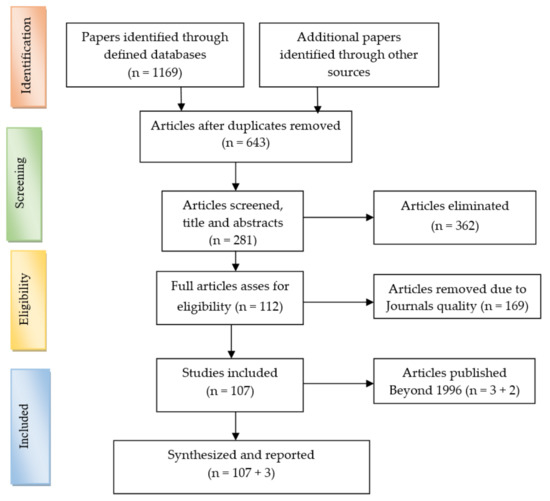
Figure 1.
The search-appraisal-synthesis chart.
4. Findings
Descriptive frequencies, according to the thematic findings, provide quantifiable statistics on the final sample of 110 articles in this section.
4.1. Industry Sectors and Distribution of Research Methods
Similar to other reviews for instance that by Beske-Janssen and Johnson [85], we found out that the reviewed literature covers a number of different industry sectors ranging from manufacturing to agriculture. This diversity makes the synthesis of the findings difficult. Nevertheless, by processing abstraction we categorized the synthesis into four contextual sectors. Out of the 110 articles synthesized, 23 articles were from the agrifood sector (20.91%) [92,93,94,95]. Furthermore, seven studies were cross-sectional studies, investigating multiple cases from both agrifood and non-agrifood sectors [96,97,98,99]. As observed from the statistical evidence, the non-agrifood sector (68.18%) has witnessed a boost in empirical research areas such as information system, apparel industries, and electronics [100,101,102,103]. It is important to mention that not all papers were organized into one single non-agrifood sector as they covered several industries. In contrast, three papers were found investigating the influence of governance structures on environment performance as summarized in Table 2.
The methodological contexts in which these studies have been investigated are presented in Table 3. The range of research methods applied on the governance structures and performance extends from case studies (6.36%)—Koopmans and Rogge [92], Mooi and Ghosh [104], and Wever and Wognum [36]—surveys (90%)—Hoetker and Mellewigt [105], Li and Xie [106], Han and Trienekens [107], Lavie and Haunschild [108], Huang and Cheng [20]—conceptual papers (2.72%)—Zhang and Aramyan [23], Whipple abd Frankel [109] Tachizawa and Wong [110]—to experimental research designs [111].
Table 3.
The distribution of the research methods.
Another bibliometric analysis is the distribution of publications synthesized in different journals. Notably, the number of publications in core journals is the same as the number of publications in related journals [112]. Supplementary Table S1 gives an overview of the journal article frequencies and the types of journals identified. In total, 49 journals have published papers on the relationship between governance structures and performance, of which most journals (39) have contributed 1–2 papers on the topic. The top three journals are Strategic Management Journal (9), Journal of Operations Management (8), and Industrial Marketing Management (9).
With regard to the focus of investigating the relationship between governance structures and performance as evidenced in Table 4, the majority of publications concentrate on the effect of contractual and relational governance structures on performance (49%) and do not adopt other forms for governance structures [113,116,185]. In contrast, governance structures that intend to embed themselves in social norms discourage behavioral practices that can encourage opportunism [125]. However, Zhou and Xu [70] found out that relational governance structures complement detailed contracts but if legal institutions are weak, relational governance curtails opportunism. Moreover, we found that spot market transactions have a negative impact on performance [107,148].
Table 4.
The summary of the key findings on the relationship between governance structures and performance.
Furthermore, formal contracts are also called contractual governance (Mahapatra and Narasimhan [144]), legal contracts (Cai and Yang [146]), or formal controls [99]. The measurements of contractual governance can be classified into three conceptualization categories. The first category uses only one single item to measure contractual governance labeled as “the formal contract is highly customized and required considerable legal work” [14]. The second category measures contractual governance structures following studies such as Jap and Ganesan [8], Lusch and Brown [184], Cannon and Achrol [72], and Cannon and Perreault Jr. [29]. These studies used several reflective items to measure contractual governance, for instance, “we have specific or well-defined agreements with this partner,” or “most aspects of our relationship are specified in the contract” [13,70]. The third category of measurement can be traced back to Parkhe [188] and has been employed in several studies [137,189], whereby composite indices are labeled as formative to measure contractual governance structure.
The counterpart to relational governance, also named as social control (Osmonbekov and Osmonbekov [124], Li and Poppo [13]), is governed by social relations and shared norms [70]. Different from contractual governance that relies on a formal structure and third-party enforcement, relational governance relies on an informal structure and the self-enforcement of each party [20]. Relational governance factors, for instance, trust, long-term cooperation, and transparency improve both the environmental and economic business performances [117]. Trust is perceived as an important aspect for solving commitment problems and reduces opportunist behavior which enhances long-term relationships [19,142]. There are two ways to measure relational governance. Most studies have used the first-order reflective model relational norms [17,72]. In contrast, only a few studies have used the second-order model [135,142].
While the systematic literature review revealed that a considerable number of publications deal with governance structures and performance in one way or another. Surprisingly, only a few of these studies measure vertical integration and spot market governance structures [36,92,107,127]. Proxies such as joint problem-solving, collaboration, joint planning, and joint venture have been operationalized to measure the choice of governance structures among business partners [146,166,170]. Furthermore, some authors speak of equity-based contracts [36], hierarchical contracts [14], and interdependency contracts [184]. By defining these proxies as vertically integrated forms of governance structures, researchers would clarify the discussion further.
4.2. Major Theories That Have Been Applied
The most dominating theory in the extant literature is the Transaction Cost Theory. The descriptive frequency Table 5 revealed that 57 articles synthesized in this manuscript applied the theory of transaction cost economics to assess the interaction between governance structure and performance [8,93,107]. The transaction cost approach has been developed through institutional economics, organization theory, and contract law by Williamson [2]. This approach, which has become very popular in economic organization studies, draws a comparative institutional efficiency and ascertains which of the alternatives forms of governance minimizes transaction costs and curtails partners’ opportunistic behavior [72,129]. Whipple and Frankel [109] found out that certain governance structures may be efficient in reducing transaction costs in an exchange but may not be effective in providing services that satisfy customers. According to transaction cost theory, exchange decisions are determined by asset specificity, uncertainty, and the frequency of the transaction [2].
Table 5.
The theories applied in the synthesized articles.
Furthermore, relational exchange theory (RET) emphasizes the social aspects of economic transactions, for instance, trust, which reduces opportunism [14,70]. This theory highlighted the importance of relational governance in deterring opportunistic behaviors of exchange partners [14]. Scholars with Resource Based View argue that RBV reports a firm as a bundle of resources that are critical for the firm to create a competitive advantage. More than 10% of the empirical and conceptual studies synthesized identified the key assumptions of RBV as resources are valuable, inherently complex, and difficult to replicate [190]. Therefore, the strategic resources and knowledge of a firm come not only from within the organizational boundaries but also from outside partners [13,130,132,143].
As evidenced in Table 5, we found eleven articles (9.65%) that have linked the Theory of Social Network (SNT) to the relationship between governance structures and performance, especially in non-agrifood industry. Similar to relational exchange theory, SNT underpins the effectiveness of business relationships; it is also a valuable asset that can help buyer-supplier exchange relationships contribute to the partner’s competitive advantage [13,92,150]. Koopmans and Rogge [92], in their study, noted that SNT enhances trust which is an instrumental aspect of reducing transaction costs and improving investments. The other 16 articles used several theories such as institutional theory (Yang and Su [135], Abdi and Aulakh [73]), property rights theory (Fischer and Hartmann [47]), organizational theory (Fink and Edelman [154]), contract theory (Ness and Haugland [168]), organizational control theory (Stouthuysen and Slabbinck [115]), and so forth, as synthesized in Table 4.
4.3. Governance Structures Measured over the Past 22 Years
The bibliometric measuring forms of governance structures examined over the past 22 years from the reviewed articles revealed that a greater number of both empirical and conceptual studies explored contracts and relational forms of governance especially from 2011 to 2017. However, the conceptual developments of the connection between governance structures and performance outcome was reliant on three articles [23,109,110]. Without these, there would little or no conceptualization of how contracts and relational governance affect performance. In contrast, there are few studies on spot market and vertical integration in the extant literature [107,118,121]. This may be because most of the synthesized papers evaluate the interplay between contracts and relational governance in relation to performance. For instance, Birthal and Chand [113], Chi and Zhao [114], Abdi and Aulakh [116], and Lu and Guo [125]. This interplay has been mainly attributed to the debate on whether contracts and relational governance are complements or whether one substitutes the other in regard to the performance outcome. Authors with a complementary view argue that relational governance has a positive and significant effect on performance. Therefore, a combination of both contracts and relational enhance performance is important [103,135,136]. However, those with a substitute perspective argue that formal contracts attempt to mitigate risk and uncertainty in exchange relationships which improves exchange performance more than relational [70,125]. Figure 2 illustrates the distribution forms of governance structures published in relation to performance from 1996 to 2017.
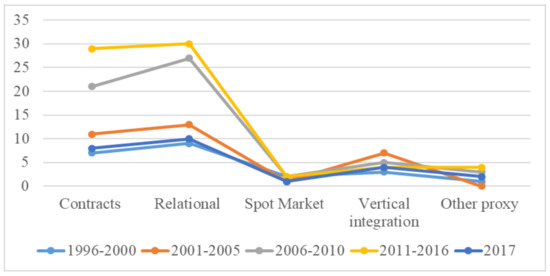
Figure 2.
The synthesized governance structures.
4.4. Measured Performance Indicators
In the extant literature, the majority of the performance indicators mentioned fall into the efficiency/low costs category [23,103,122,125,134]. Obviously, the logic behind selecting a given form of governance structure is to minimize transaction costs [8,26]. Consequently, various surveys show the high potential of this approach to improving business relationships. Efficiency was followed by relationship performance [96,114,123,124,127]. For instance, Gyau and Spiller [148] found out that relationship performance is a multi-dimensional construct with economic and behavioral relationships as the two main dimensions. These influence the firms to adopt a more coordinated type of governance structure in order to enhance economic performance and the efficiency of the exchange partners [17,96,108]. This is similar to Fischer and Hartmann [47] who mentioned that relationship performance is largely independent of the contract type adopted by the exchange partners. Furthermore, profitability or financial and quality performance indicators were frequently examined in relation to governance structures as observed in Figure 3. Lastly, a closer look at the performance indicators ordered by frequency, reveals that customer satisfaction (Zhou and Zhang [97], Yang and Zhao [100], Burkert and Ivens [102]), responsiveness ([23], Trifković [121], Luo and Liu [127]), and market growth or sales network (Lavie and Haunschild [108], Hoetker and Mellewigt [105], Gong and Shenkar [155]), have all been studied in the extant literature to a certain extent in relation to governance structure. Reduce opportunism, flexibility, environmental uncertainty, and commitment (in descending order) have also received gradual attention in the synthesized review.
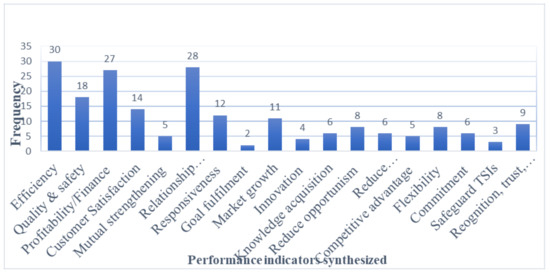
Figure 3.
The performance indicators ordered by frequency.
5. Discussion and Conclusions
The study provides an overall impression of the interaction between governance structures and performance in the agrifood chain and beyond for the last 22 years in the scientific community. It is observed that while the systematic literature review revealed that all the considered publications deal with the interaction between governance structures and performance in one way or another, few studies focus on the agrifood sector.
The key issue of governance structures is to safeguard the supplier and buyer against uncertainties that might threaten their exchange relationship. However, in the existing literature, the increasing findings on the relationship between contractual versus relational governance and performance are inconsistent. Besides, the theoretical clarification on the contradiction is also incomplete. The most appropriate governance structure employed in supplier–buyer relationships is formal contracts. This is because a formal contract specifies the obligation of each party and allows business partners to go to a third party to sanction an opportunistic partner [141,143]. Contracts go beyond its safeguarding function to establishing a fair frame of reference when an uncertainty rises [129]. However, it is important to mention that contracts suffer from a low rate of compliance because of poor law enforcement mechanisms in some economies [113]. Consequently, the extant literature shows that formal contracts and relational governance play a key role in exchange relationships, the nature of their interplay complements each other to positively affect relationship performance and to control opportunism [70,110].
The interaction between governance structures and performance has been shown. This is the first systematic review to pave the way to knowledge accumulation by showing very interesting findings in a complex multi-dimensional nature. Furthermore, this investigation revealed that performance has been majorly measured as efficiency/low costs, relationship performance, profitability, and service or product quality which may serve as a guide for the selection of appropriate performance measurements. The implication is that if suppliers and buyers build more coordinated forms of governance structures with one another, this would reduce hold up and improve the efficiency of the firm by improving the quality of the services or products which would result in profitability and a strengthening of relationship performance [109].
The study also offers an important implication for exchange partners to consider while transacting. The extant literature has pointed out several governance structures—for instance, contractual, relational, and vertical integration—as essential elements of performance outcome [13,17,137]. Hence, contributing to a better understanding of how combined governance arrangements improve performance, the findings not only revealed that opportunism can be reduced by contracts, trust, joint decision making, and relational norms but also that satisfaction and relationship performance can be improved by alternative governance structures [163,165]. Additionally, contracts should value the importance of developing trust and relational norms for performance improvement and opportunism reduction for the exchange partners. It acknowledged that contracts do not reduce opportunism directly but indirectly by increasing trust and relational norms.
Contributions
This study contributes to the debate on the relationship between different forms of governance structures and performance where three contributions emerge. First, contrary to the extant reviews, for instance, Cao and Lumineau [191], we have incorporated the argument of alternative forms of governance structures and their outcome. Most existing literature reviews do not link governance structures to performance outcome whereas the ultimate reason for business partners to adhere to a given form of governance structure is to enhance relationship performance [52,53]. Our findings highlight the predictive power of several governance mechanisms [140,148,155].
Second, we contribute to the debate on the nature of measuring both the independent variable of governance structure and the dependent variable of performance. The concept governance structure is viewed as a continuum. At one extreme lies spot markets whereas on the other end lies full vertical integration. In between li the relational, equity-based, and contract forms of economic organization. This is one of few systematic reviews covering all articles on all aforementioned forms of governing economic activities. Furthermore, performance indicators have been controversial due to the diversification in terms of qualitative and quantitative. Therefore, with our comprehensive sample, we are able to document the key performance indicators in relation to governance structures to justify the inconsistency of measurability. Essentially, to provide a comprehensive point of reference for researchers interested in the research area.
The theory of transaction cost has been traditionally the primary theoretical lens to explore the determining factors of governance structure. These findings provide evidence that the transaction cost theory does not solely determine the form of the governance structure and its performance outcome, but also that complementing theories such as the social network theory (Koopmans and Rogge [92]), the relational theory (Zhou and Xu [70]), and the resource based-view theory (Poppo and Zhou [129]) are been increasingly explored. This is because the intention of selecting a given form of governance structure is of economic value [43].
In conclusion, governance mechanisms are conceptualized from a continuum perspective, a series of key findings between governance structures and performance have been recorded. However, these findings are qualitative in nature. The existing literature has shown that different forms of governance mechanisms contain different degrees of exchange hazards [4,102]. Therefore, meta-regression research is needed to find out whether different forms of governance structures influence performance differently.
Supplementary Materials
The following are available online at http://www.mdpi.com/2077-0472/8/4/51/s1, Table S1: Number of articles by Journal.
Acknowledgments
VLIR-IUC provided the funding for this study as a dissertation grant for the first author. She is a Ph.D. student at Ghent University, Belgium, in the Department of Agricultural Economics. We are grateful to the two anonymous reviewers for their insightful and valuable comments during the review and publication process. Furthermore, we express our sincere gratitude to Ms. Annie Zhang, the Assistant Editor, for guiding us through the revision and publication process.
Author Contributions
The findings contribute to the understanding of the relationship between governance structure and performance in the extant literature. We developed a better understanding of how conceptual and empirical studies measure and define the concepts and derived their conclusions.
Conflicts of Interest
The authors declared that they have no conflicts of interest to this work.
References
- Williamson, O.E. The Mechanisms of Governance; Oxford University Press: Oxford, UK, 1996. [Google Scholar]
- Williamson, O.E. The Economic Intstitutions of Capitalism; Simon and Schuster: New York, NY, USA, 1985. [Google Scholar]
- Dyer, J.H. Does governance matter? Keiretsu alliances and asset specificity as sources of Japanese competitive advantage. Organ. Sci. 1996, 7, 649–666. [Google Scholar] [CrossRef]
- Rindfleisch, A.; Heide, J.B. Transaction cost analysis: Past, present, and future applications. J. Market. 1997, 61, 30–54. [Google Scholar] [CrossRef]
- Caniëls, M.C.; Gelderman, C.J. The safeguarding effect of governance mechanisms in inter-firm exchange: The decisive role of mutual opportunism. Br. J. Manag. 2010, 21, 239–254. [Google Scholar] [CrossRef]
- Léger, P.-M.; Cassivi, L.; Hadaya, P.; Caya, O. Safeguarding mechanisms in a supply chain network. Ind. Manag. Data Syst. 2006, 106, 759–777. [Google Scholar] [CrossRef]
- Wathne, K.H.; Heide, J.B. Opportunism in interfirm relationships: Forms, outcomes, and solutions. J. Market. 2000, 64, 36–51. [Google Scholar] [CrossRef]
- Jap, S.D.; Ganesan, S. Control mechanisms and the relationship life cycle: Implications for safeguarding specific investments and developing commitment. J. Market. Res. 2000, 37, 227–245. [Google Scholar] [CrossRef]
- Granovetter, M. Economic action and social structure: The problem of embeddedness. Am. J. Sociol. 1985, 91, 481–510. [Google Scholar] [CrossRef]
- Ring, P.S.; Van de Ven, A.H. Structuring cooperative relationships between organizations. Strateg. Manag. J. 1992, 13, 483–498. [Google Scholar] [CrossRef]
- Zaheer, A.; Venkatraman, N. Relational governance as an interorganizational strategy: An empirical test of the role of trust in economic exchange. Strateg. Manag. J. 1995, 16, 373–392. [Google Scholar] [CrossRef]
- Das, T.K.; Teng, B.-S. Between trust and control: Developing confidence in partner cooperation in alliances. Acad. Manag. Rev. 1998, 23, 491–512. [Google Scholar]
- Li, J.J.; Poppo, L.; Zhou, K.Z. Relational mechanisms, formal contracts, and local knowledge acquisition by international subsidiaries. Strateg. Manag. J. 2010, 31, 349–370. [Google Scholar] [CrossRef]
- Poppo, L.; Zenger, T. Do formal contracts and relational governance function as substitutes or complements? Strateg. Manag. J. 2002, 23, 707–725. [Google Scholar] [CrossRef]
- Wang, K.Y.; Fulop, L. Managerial trust and work values within the context of international joint ventures in China. J. Int. Manag. 2007, 13, 164–186. [Google Scholar] [CrossRef]
- Petersen, K.J.; Handfield, R.B.; Lawson, B.; Cousins, P.D. Buyer dependency and relational capital formation: The mediating effects of socialization processes and supplier integration. J. Supply Chain Manag. 2008, 44, 53–65. [Google Scholar] [CrossRef]
- Liu, Y.; Luo, Y.; Liu, T. Governing buyer–supplier relationships through transactional and relational mechanisms: Evidence from China. J. Oper. Manag. 2009, 27, 294–309. [Google Scholar] [CrossRef]
- Tangpong, C.; Hung, K.-T.; Ro, Y.K. The interaction effect of relational norms and agent cooperativeness on opportunism in buyer–supplier relationships. J. Oper. Manag. 2010, 28, 398–414. [Google Scholar] [CrossRef]
- Fałkowski, J.; Chlebicka, A.; Łopaciuk-Gonczaryk, B. Social relationships and governing collaborative actions in rural areas: Some evidence from agricultural producer groups in poland. J. Rural Stud. 2017, 49, 104–116. [Google Scholar] [CrossRef]
- Huang, M.-C.; Cheng, H.-L.; Tseng, C.-Y. Reexamining the direct and interactive effects of governance mechanisms upon buyer–supplier cooperative performance. Ind. Market. Manag. 2014, 43, 704–716. [Google Scholar] [CrossRef]
- Peterson, H.C.; Wysocki, A.; Harsh, S.B. Strategic choice along the vertical coordination continuum. Int. Food Agribus. Manag. Rev. 2001, 4, 149–166. [Google Scholar] [CrossRef]
- Raynaud, E.; Sauvee, L.; Valceschini, E. Alignment between quality enforcement devices and governance structures in the agro-food vertical chains. J. Manag. Gov. 2005, 9, 47–77. [Google Scholar] [CrossRef]
- Zhang, X.; Aramyan, L.H. A conceptual framework for supply chain governance: An application to agri-food chains in China. China Agric. Econ. Rev. 2009, 1, 136–154. [Google Scholar] [CrossRef]
- Wever, M.; Wognum, P.M.; Trienekens, J.H.; Omta, S.W.F. Supply chain-wide consequences of transaction risks and their contractual solutions: Towards an extended transaction cost economics framework. J. Supply Chain Manag. 2012, 48, 73–91. [Google Scholar] [CrossRef]
- Williamson, O.E. Calculativeness, trust, and economic organization. J. Law Econ. 1993, 36, 453–486. [Google Scholar] [CrossRef]
- Williamson, O.E. The institutions of governance. Am. Econ. Rev. 1998, 88, 75–79. [Google Scholar]
- Williamson, O.E. Comparative economic organization: The analysis of discrete structural alternatives. Adm. Sci. Q. 1991, 36, 269–296. [Google Scholar] [CrossRef]
- Zúñiga-Arias, G.; Ruben, R. Determinants of market outlet choice for mango producers in costa rica. Gov. Qual. Trop. Food Chains 2007, 2, 49–68. [Google Scholar]
- Cannon, J.P.; Perreault, W.D., Jr. Buyer-seller relationships in business markets. J. Market. Res. 1999, 36, 439–460. [Google Scholar] [CrossRef]
- Sambasivan, M.; Deepak, T.; Salim, A.N.; Ponniah, V. Analysis of delays in tanzanian construction industry: Transaction cost economics (TCE) and structural equation modeling (SEM) approach. Eng. Constr. Archit. Manag. 2017, 24, 308–325. [Google Scholar] [CrossRef]
- Brown, J.R.; Krishen, A.S.; Dev, C.S. The role of ownership in managing interfirm opportunism: A dyadic study. J. Market. Channels 2014, 21, 31–42. [Google Scholar] [CrossRef]
- Sporleder, T.L. Managerial economics of vertically coordinated agricultural firms. Am. J. Agric. Econ. 1992, 74, 1226–1231. [Google Scholar] [CrossRef]
- Henderson, D.R. Measuring and assessing vertical ties in the agro-food system. Can. J. Agric. Econ. Rev. Can. D’agroecon. 1994, 42, 549–560. [Google Scholar] [CrossRef]
- Schulze, B.; Spiller, A.; Theuvsen, L. A broader view on vertical coordination: Lessons from german pork production. J. Chain Netw. Sci. 2007, 7, 35–53. [Google Scholar] [CrossRef]
- Banterle, A.; Stranieri, S. The consequences of voluntary traceability system for supply chain relationships. An application of transaction cost economics. Food Policy 2008, 33, 560–569. [Google Scholar] [CrossRef]
- Wever, M.; Wognum, N.; Trienekens, J.; Omta, O. Alignment between chain quality management and chain governance in EU pork supply chains: A transaction-cost-economics perspective. Meat Sci. 2010, 84, 228–237. [Google Scholar] [CrossRef] [PubMed]
- Kilelu, C.W.; Klerkx, L.; Leeuwis, C. Supporting smallholder commercialisation by enhancing integrated coordination in agrifood value chains: Experiences with dairy hubs in Kenya. Exp. Agric. 2017, 53, 269–287. [Google Scholar] [CrossRef]
- Waller, M.A.; Fawcett, S.E. Data science, predictive analytics, and big data: A revolution that will transform supply chain design and management. J. Bus. Logist. 2013, 34, 77–84. [Google Scholar] [CrossRef]
- Prajogo, D.; Oke, A.; Olhager, J. Supply chain processes: Linking supply logistics integration, supply performance, lean processes and competitive performance. Int. J. Oper. Prod. Manag. 2016, 36, 220–238. [Google Scholar] [CrossRef]
- Hobbs, J.E. A transaction cost approach to supply chain management. Supply Chain Manag. Int. J. 1996, 1, 15–27. [Google Scholar] [CrossRef]
- Weseen, S.; Hobbs, J.E.; Kerr, W.A. Reducing hold-up risks in ethanol supply chains: A transaction cost perspective. Int. Food Agribus. Manag. Rev. 2014, 17, 83–106. [Google Scholar]
- Frank, S.D.; Henderson, D.R. Transaction costs as determinants of vertical coordination in the US food industries. Am. J. Agric. Econ. 1992, 74, 941–950. [Google Scholar] [CrossRef]
- Mahoney, J.T. The choice of organizational form: Vertical financial ownership versus other methods of vertical integration. Strateg. Manag. J. 1992, 13, 559–584. [Google Scholar] [CrossRef]
- Bello, D.C.; Gilliland, D.I. The effect of output controls, process controls, and flexibility on export channel performance. J. Market. 1997, 61, 22–38. [Google Scholar] [CrossRef]
- Cox, A. The art of the possible: Relationship management in power regimes and supply chains. Supply Chain Manag. Int. J. 2004, 9, 346–356. [Google Scholar] [CrossRef]
- Young, L.M.; Hobbs, J.E. Vertical linkages in agri-food supply chains: Changing roles for producers, commodity groups, and government policy. Rev. Agric. Econ. 2002, 24, 428–441. [Google Scholar] [CrossRef]
- Fischer, C.; Hartmann, M.; Reynolds, N.; Leat, P.; Revoredo-Giha, C.; Henchion, M.; Albisu, L.M.; Gracia, A. Factors influencing contractual choice and sustainable relationships in european agri-food supply chains. Eur. Rev. Agric. Econ. 2009, 36, 541–569. [Google Scholar] [CrossRef]
- David, R.J.; Han, S.K. A systematic assessment of the empirical support for transaction cost economics. Strateg. Manag. J. 2004, 25, 39–58. [Google Scholar] [CrossRef]
- Shelanski, H.A.; Klein, P.G. Empirical research in transaction cost economics: A review and assessment. J. Law Econom. Organ. 1995, 11, 335–361. [Google Scholar]
- Pyone, T.; Smith, H.; van den Broek, N. Frameworks to assess health systems governance: A systematic review. Health Policy Plan. 2017, 32, 710–722. [Google Scholar] [CrossRef] [PubMed]
- Delbufalo, E. Outcomes of inter-organizational trust in supply chain relationships: A systematic literature review and a meta-analysis of the empirical evidence. Supply Chain Manag. Int. J. 2012, 17, 377–402. [Google Scholar] [CrossRef]
- Pilbeam, C.; Alvarez, G.; Wilson, H. The governance of supply networks: A systematic literature review. Supply Chain Manag. Int. J. 2012, 17, 358–376. [Google Scholar] [CrossRef]
- Song, H.; Liu, J.; Chen, G. Tourism value chain governance: Review and prospects. J. Travel Res. 2013, 52, 15–28. [Google Scholar] [CrossRef]
- Aramyan, L.H.; Oude Lansink, A.G.; Van Der Vorst, J.G.; Van Kooten, O. Performance measurement in agri-food supply chains: A case study. Supply Chain Manag. Int. J. 2007, 12, 304–315. [Google Scholar] [CrossRef]
- Neely, A.; Gregory, M.; Platts, K. Performance measurement system design: A literature review and research agenda. Int. J. Oper. Prod. Manag. 1995, 15, 80–116. [Google Scholar] [CrossRef]
- Beamon, B.M. Supply chain design and analysis: Models and methods. Int. J. Prod. Econ. 1998, 55, 281–294. [Google Scholar] [CrossRef]
- Christopher, M. Logistics and Supply Chain Management: Strategies for Reducing Cost and Improving Service; Financial Times: London, UK, 1998. [Google Scholar]
- Gunasekaran, A.; Patel, C.; Tirtiroglu, E. Performance measures and metrics in a supply chain environment. Int. J. Oper. Prod. Manag. 2001, 21, 71–87. [Google Scholar] [CrossRef]
- Gunasekaran, A.; Ngai, E.W. Information systems in supply chain integration and management. Eur. J. Oper. Res. 2004, 159, 269–295. [Google Scholar] [CrossRef]
- Gunasekaran, A.; Lai, K.-H.; Edwin Cheng, T. Responsive supply chain: A competitive strategy in a networked economy. Omega 2008, 36, 549–564. [Google Scholar] [CrossRef]
- Fattahi, F.; Nookabadi, A.S.; Kadivar, M. A model for measuring the performance of the meat supply chain. Br. Food J. 2013, 115, 1090–1111. [Google Scholar] [CrossRef]
- Gellynck, X.; Molnár, A.; Aramyan, L. Supply chain performance measurement: The case of the traditional food sector in the EU. J. Chain Netw. Sci. 2008, 8, 47–58. [Google Scholar] [CrossRef]
- Neely, A.D.; Adams, C.; Kennerley, M. The Performance Prism: The Scorecard for Measuring and Managing Business Success; Financial Times/Prentice Hall: London, UK, 2002. [Google Scholar]
- Yang, H.; Yeung, J.F.; Chan, A.P.; Chiang, Y.; Chan, D.W. A critical review of performance measurement in construction. J. Facil. Manag. 2010, 8, 269–284. [Google Scholar] [CrossRef]
- Jones, K.; Kaluarachchi, Y. Performance measurement and benchmarking of a major innovation programme. Benchmark. Int. J. 2008, 15, 124–136. [Google Scholar] [CrossRef]
- Ugwu, O.; Haupt, T. Key performance indicators and assessment methods for infrastructure sustainability—A south African construction industry perspective. Build. Environ. 2007, 42, 665–680. [Google Scholar] [CrossRef]
- Singh, R.; Singh, A.P.; Metri, B.A. Key performance indicators for the organized farm products retailing in India. Bus. Anal. Cyber Secur. Manag. Organ. 2016, 256. [Google Scholar] [CrossRef]
- Naser, S.S.A.; Al Shobaki, M.J.; Amuna, Y.M.A. Knowledge management maturity in universities and its impact on performance excellence “comparative study”. Int. J. Inf. Technol. Electr. Eng. 2016, 5, 46–54. [Google Scholar]
- Ghasemi, A.; Nadiri, M. Performance assessment of Iranian petrochemical companies using sustainable excellence model. Saf. Sci. 2016, 87, 280–291. [Google Scholar] [CrossRef]
- Zhou, K.Z.; Xu, D. How foreign firms curtail local supplier opportunism in China: Detailed contracts, centralized control, and relational governance. J. Int. Bus. Stud. 2012, 43, 677–692. [Google Scholar] [CrossRef]
- Chen, C.; Zhu, X.; Ao, J.; Cai, L. Governance mechanisms and new venture performance in China. Syst. Res. Behav. Sci. 2013, 30, 383–397. [Google Scholar] [CrossRef]
- Cannon, J.P.; Achrol, R.S.; Gundlach, G.T. Contracts, norms, and plural form governance. J. Acad. Market. Sci. 2000, 28, 180–194. [Google Scholar] [CrossRef]
- Abdi, M.; Aulakh, P.S. Do country-level institutional frameworks and interfirm governance arrangements substitute or complement in international business relationships? J. Int. Bus. Stud. 2012, 43, 477–497. [Google Scholar] [CrossRef]
- Jack, L.; Florez-Lopez, R.; Ramon-Jeronimo, J.M. Accounting, performance measurement and fairness in uk fresh produce supply networks. Account. Organ. Soc. 2018, 64, 17–30. [Google Scholar] [CrossRef]
- Huang, M.-C.; Chiu, Y.-P. Relationship governance mechanisms and collaborative performance: A relational life-cycle perspective. J. Purch. Supply Manag. 2018. [Google Scholar] [CrossRef]
- Staples, M.; Niazi, M. Experiences using systematic review guidelines. J. Syst. Softw. 2007, 80, 1425–1437. [Google Scholar] [CrossRef]
- Tranfield, D.; Denyer, D.; Smart, P. Towards a methodology for developing evidence-informed management knowledge by means of systematic review. Br. J. Manag. 2003, 14, 207–222. [Google Scholar] [CrossRef]
- Higgins, J.P.; Green, S. Cochrane Handbook for Systematic Reviews of Interventions; Wiley Online Library: Hoboken, NJ, USA, 2008; Volume 5. [Google Scholar]
- Pittaway, L.; Robertson, M.; Munir, K.; Denyer, D.; Neely, A. Networking and innovation: A systematic review of the evidence. Int. J. Manag. Rev. 2004, 5, 137–168. [Google Scholar] [CrossRef]
- Rashman, L.; Withers, E.; Hartley, J. Organizational learning and knowledge in public service organizations: A systematic review of the literature. Int. J. Manag. Rev. 2009, 11, 463–494. [Google Scholar] [CrossRef]
- Duff, A. The literature search: A library-based model for information skills instruction. Libr. Rev. 1996, 45, 14–18. [Google Scholar] [CrossRef]
- Jadad, A.R.; Cook, D.J.; Jones, A.; Klassen, T.P.; Tugwell, P.; Moher, M.; Moher, D. Methodology and reports of systematic reviews and meta-analyses: A comparison of cochrane reviews with articles published in paper-based journals. JAMA 1998, 280, 278–280. [Google Scholar] [CrossRef] [PubMed]
- Noordewier, T.G.; John, G.; Nevin, J.R. Performance outcomes of purchasing arrangements in industrial buyer-vendor relationships. J. Market. 1990, 54, 80–93. [Google Scholar] [CrossRef]
- Ruekert, R.W.; Walker, O.C., Jr.; Roering, K.J. The organization of marketing activities: A contingency theory of structure and performance. J. Market. 1985, 49, 13–25. [Google Scholar] [CrossRef]
- Beske-Janssen, P.; Johnson, M.P.; Schaltegger, S. 20 years of performance measurement in sustainable supply chain management–what has been achieved? Supply Chain Manag. Int. J. 2015, 20, 664–680. [Google Scholar] [CrossRef]
- Johnson, M.P.; Schaltegger, S. Two decades of sustainability management tools for smes: How far have we come? J. Small Bus. Manag. 2016, 54, 481–505. [Google Scholar] [CrossRef]
- Lucas, P.J.; Baird, J.; Arai, L.; Law, C.; Roberts, H.M. Worked examples of alternative methods for the synthesis of qualitative and quantitative research in systematic reviews. BMC Med. Res. Methodol. 2007, 7, 4. [Google Scholar] [CrossRef] [PubMed]
- Harden, A.; Garcia, J.; Oliver, S.; Rees, R.; Shepherd, J.; Brunton, G.; Oakley, A. Applying systematic review methods to studies of people’s views: An example from public health research. J. Epidemiol. Community Health 2004, 58, 794–800. [Google Scholar] [CrossRef] [PubMed]
- Barnett-Page, E.; Thomas, J. Methods for the synthesis of qualitative research: A critical review. BMC Med. Res. Methodol. 2009, 9, 59. [Google Scholar] [CrossRef] [PubMed]
- Denyer, D.; Tranfield, D. Producing a Systematic Review; Sage Publications Ltd.: Thousand Oaks, CA, USA, 2009. [Google Scholar]
- Rousseau, D.M.; Manning, J.; Denyer, D. 11 evidence in management and organizational science: Assembling the field’s full weight of scientific knowledge through syntheses. Acad. Manag. Ann. 2008, 2, 475–515. [Google Scholar] [CrossRef]
- Koopmans, M.E.; Rogge, E.; Mettepenningen, E.; Knickel, K.; Šūmane, S. The role of multi-actor governance in aligning farm modernization and sustainable rural development. J. Rural Stud. 2017, 59, 252–262. [Google Scholar] [CrossRef]
- Watanabe, K.; Bánkuti, S.S.; Lourenzani, A.E. “Pingado dilemma”: Is formal contract sweet enough? J. Rural Stud. 2017, 54, 126–137. [Google Scholar] [CrossRef]
- Abebe, G.K.; Chalak, A.; Abiad, M.G. The effect of governance mechanisms on food safety in the supply chain: Evidence from the lebanese dairy sector. J. Sci. Food Agric. 2017, 97, 2908–2918. [Google Scholar] [CrossRef] [PubMed]
- Dolci, P.C.; Maçada, A.C.G.; Paiva, E.L. Models for understanding the influence of supply chain governance on supply chain performance. Supply Chain Manag. Int. J. 2017, 22, 424–441. [Google Scholar] [CrossRef]
- Griffith, D.A.; Zhao, Y. Contract Specificity, Contract Violation, and Relationship Performance in International Buyer–Supplier Relationships; American Marketing Association: Chicago, IL, USA, 2015. [Google Scholar]
- Zhou, Y.; Zhang, X.; Zhuang, G.; Zhou, N. Relational norms and collaborative activities: Roles in reducing opportunism in marketing channels. Ind. Market. Manag. 2015, 46, 147–159. [Google Scholar] [CrossRef]
- Styles, C.; Patterson, P.G.; Ahmed, F. A relational model of export performance. J. Int. Bus. Stud. 2008, 39, 880–900. [Google Scholar] [CrossRef]
- Germain, R.; Claycomb, C.; Dröge, C. Supply chain variability, organizational structure, and performance: The moderating effect of demand unpredictability. J. Oper. Manag. 2008, 26, 557–570. [Google Scholar] [CrossRef]
- Yang, Q.; Zhao, X.; Yeung, H.Y.J.; Liu, Y. Improving logistics outsourcing performance through transactional and relational mechanisms under transaction uncertainties: Evidence from China. Int. J. Prod. Econ. 2016, 175, 12–23. [Google Scholar] [CrossRef]
- Wu, A.; Wang, Z.; Chen, S. Impact of specific investments, governance mechanisms and behaviors on the performance of cooperative innovation projects. Int. J. Proj. Manag. 2017, 35, 504–515. [Google Scholar] [CrossRef]
- Burkert, M.; Ivens, B.S.; Shan, J. Governance mechanisms in domestic and international buyer–supplier relationships: An empirical study. Ind. Market. Manag. 2012, 41, 544–556. [Google Scholar] [CrossRef]
- Carey, S.; Lawson, B.; Krause, D.R. Social capital configuration, legal bonds and performance in buyer–supplier relationships. J. Oper. Manag. 2011, 29, 277–288. [Google Scholar] [CrossRef]
- Mooi, E.A.; Ghosh, M. Contract specificity and its performance implications. J. Market. 2010, 74, 105–120. [Google Scholar] [CrossRef][Green Version]
- Hoetker, G.; Mellewigt, T. Choice and performance of governance mechanisms: Matching alliance governance to asset type. Strateg. Manag. J. 2009, 30, 1025–1044. [Google Scholar] [CrossRef]
- Li, Y.; Xie, E.; Teo, H.-H.; Peng, M.W. Formal control and social control in domestic and international buyer–supplier relationships. J. Oper. Manag. 2010, 28, 333–344. [Google Scholar] [CrossRef]
- Han, J.; Trienekens, J.H.; Omta, S.O. Relationship and quality management in the chinese pork supply chain. Int. J. Prod. Econ. 2011, 134, 312–321. [Google Scholar] [CrossRef]
- Lavie, D.; Haunschild, P.R.; Khanna, P. Organizational differences, relational mechanisms, and alliance performance. Strateg. Manag. J. 2012, 33, 1453–1479. [Google Scholar] [CrossRef]
- Whipple, J.S.; Frankel, R.; Anselmi, K. The effect of governance structure on performance: A case study of efficient consumer response. J. Bus. Logist. 1999, 20, 43. [Google Scholar]
- Tachizawa, E.M.; Wong, C.Y. The performance of green supply chain management governance mechanisms: A supply network and complexity perspective. J. Supply Chain Manag. 2015, 51, 18–32. [Google Scholar] [CrossRef]
- Capaldo, A.; Giannoccaro, I. How does trust affect performance in the supply chain? The moderating role of interdependence. Int. J. Prod. Econ. 2015, 166, 36–49. [Google Scholar] [CrossRef]
- Bradford, S. Specific subjects. J. Inf. Sci. 1985, 10, 173–180. [Google Scholar]
- Birthal, P.S.; Chand, R.; Joshi, P.; Saxena, R.; Rajkhowa, P.; Khan, M.T.; Khan, M.A.; Chaudhary, K.R. Formal versus informal: Efficiency, inclusiveness and financing of dairy value chains in Indian punjab. J. Rural Stud. 2017, 54, 288–303. [Google Scholar] [CrossRef]
- Chi, M.; Zhao, J.; George, J.F.; Li, Y.; Zhai, S. The influence of inter-firm it governance strategies on relational performance: The moderation effect of information technology ambidexterity. Int. J. Inf. Manag. 2017, 37, 43–53. [Google Scholar] [CrossRef]
- Stouthuysen, K.; Slabbinck, H.; Roodhooft, F. Formal controls and alliance performance: The effects of alliance motivation and informal controls. Manag. Account. Res. 2017, 37, 49–63. [Google Scholar] [CrossRef]
- Abdi, M.; Aulakh, P.S. Locus of uncertainty and the relationship between contractual and relational governance in cross-border interfirm relationships. J. Manag. 2017, 43, 771–803. [Google Scholar] [CrossRef]
- Zhu, Q.; Feng, Y.; Choi, S.-B. The role of customer relational governance in environmental and economic performance improvement through green supply chain management. J. Clean. Prod. 2017, 155, 46–53. [Google Scholar] [CrossRef]
- Martins, F.M.; Trienekens, J.; Omta, O. Governance structures and coordination mechanisms in the brazilian pork chain–diversity of arrangements to support the supply of piglets. Int. Food Agribus. Manag. Rev. 2017, 20, 511–532. [Google Scholar] [CrossRef]
- Li, Y.; Xu, F.; Zhao, X. Governance mechanisms of dual-channel reverse supply chains with informal collection channel. J. Clean. Prod. 2017, 155, 125–140. [Google Scholar] [CrossRef]
- Wacker, J.G.; Yang, C.; Sheu, C. A transaction cost economics model for estimating performance effectiveness of relational and contractual governance: Theory and statistical results. Int. J. Oper. Prod. Manag. 2016, 36, 1551–1575. [Google Scholar] [CrossRef]
- Trifković, N. Vertical coordination and farm performance: Evidence from the catfish sector in vietnam. Agric. Econ. 2016, 47, 547–557. [Google Scholar] [CrossRef]
- Xie, E.; Liang, J.; Zhou, K.Z. How to enhance supplier performance in China: An integrative view of partner selection and partner control. Ind. Market. Manag. 2016, 56, 156–166. [Google Scholar] [CrossRef]
- Navarro-García, A.; Sánchez-Franco, M.J.; Rey-Moreno, M. Relational governance mechanisms in export activities: Their determinants and consequences. J. Bus. Res. 2016, 69, 4750–4756. [Google Scholar] [CrossRef]
- Osmonbekov, T.; Gregory, B.; Chelariu, C.; Johnston, W.J. The impact of social and contractual enforcement on reseller performance: The mediating role of coordination and inequity during adoption of a new technology. J. Bus. Ind. Market. 2016, 31, 808–818. [Google Scholar] [CrossRef]
- Lu, P.; Guo, S.; Qian, L.; He, P.; Xu, X. The effectiveness of contractual and relational governances in construction projects in China. Int. J. Proj. Manag. 2015, 33, 212–222. [Google Scholar] [CrossRef]
- Yang, D.L.; Ju, M.; Gao, G.Y. Export relational governance and control mechanisms: Substitutable and complementary effects. Int. Market. Rev. 2015, 32, 627–645. [Google Scholar] [CrossRef]
- Luo, Y.; Liu, Y.; Yang, Q.; Maksimov, V.; Hou, J. Improving performance and reducing cost in buyer–supplier relationships: The role of justice in curtailing opportunism. J. Bus. Res. 2015, 68, 607–615. [Google Scholar] [CrossRef]
- Heide, J.B.; Kumar, A.; Wathne, K.H. Concurrent sourcing, governance mechanisms, and performance outcomes in industrial value chains. Strateg. Manag. J. 2014, 35, 1164–1185. [Google Scholar] [CrossRef]
- Poppo, L.; Zhou, K.Z. Managing contracts for fairness in buyer–supplier exchanges. Strateg. Manag. J. 2014, 35, 1508–1527. [Google Scholar] [CrossRef]
- Lai, F.; Li, X.; Lai, V.S. Transaction-specific investments, relational norms, and erp customer satisfaction: A mediation analysis. Decis. Sci. 2013, 44, 679–711. [Google Scholar] [CrossRef]
- Han, J.; Lu, H.; Trienekens, J.H.; Omta, S.W.F. The impact of supply chain integration on firm performance in the pork processing industry in China. Chin. Manag. Stud. 2013, 7, 230–252. [Google Scholar] [CrossRef]
- Zhang, X.; Chen, W.; Tong, J.; Liu, X. Relational mechanisms, market contracts and cross-enterprise knowledge trading in the supply chain: Empirical research based on chinese manufacturing enterprises. Chin. Manag. Stud. 2012, 6, 488–508. [Google Scholar] [CrossRef]
- Rai, A.; Keil, M.; Hornyak, R.; WüLlenweber, K. Hybrid relational-contractual governance for business process outsourcing. J. Manag. Inf. Syst. 2012, 29, 213–256. [Google Scholar] [CrossRef]
- Arranz, N.; Arroyabe, J. Effect of formal contracts, relational norms and trust on performance of joint research and development projects. Br. J. Manag. 2012, 23, 575–588. [Google Scholar] [CrossRef]
- Yang, Z.; Su, C.; Fam, K.-S. Dealing with institutional distances in international marketing channels: Governance strategies that engender legitimacy and efficiency. J. Market. 2012, 76, 41–55. [Google Scholar] [CrossRef]
- Srivastava, S.C.; Teo, T.S. Contract performance in offshore systems development: Role of control mechanisms. J. Manag. Inf. Syst. 2012, 29, 115–158. [Google Scholar] [CrossRef]
- Lumineau, F.; Henderson, J.E. The influence of relational experience and contractual governance on the negotiation strategy in buyer–supplier disputes. J. Oper. Manag. 2012, 30, 382–395. [Google Scholar] [CrossRef]
- Wang, L.; Yeung, J.H.Y.; Zhang, M. The impact of trust and contract on innovation performance: The moderating role of environmental uncertainty. Int. J. Prod. Econ. 2011, 134, 114–122. [Google Scholar] [CrossRef]
- Zhao, Y.; Wang, G. The impact of relation-specific investment on channel relationship performance: Evidence from China. J. Strateg. Market. 2011, 19, 57–71. [Google Scholar] [CrossRef]
- Cai, S.; Yang, Z.; Jun, M. Cooperative norms, structural mechanisms, and supplier performance: Empirical evidence from chinese manufacturers. J. Purch. Supply Manag. 2011, 17, 1–10. [Google Scholar] [CrossRef]
- Zhang, X.; Hu, D. Farmer-buyer relationships in China: The effects of contracts, trust and market environment. China Agric. Econ. Rev. 2011, 3, 42–53. [Google Scholar] [CrossRef]
- Yang, Z.; Zhou, C.; Jiang, L. When do formal control and trust matter? A context-based analysis of the effects on marketing channel relationships in China. Ind. Market. Manag. 2011, 40, 86–96. [Google Scholar] [CrossRef]
- Hernández-Espallardo, M.; Rodríguez-Orejuela, A.; Sánchez-Pérez, M. Inter-organizational governance, learning and performance in supply chains. Supply Chain Manag. Int. J. 2010, 15, 101–114. [Google Scholar] [CrossRef]
- Mahapatra, S.K.; Narasimhan, R.; Barbieri, P. Strategic interdependence, governance effectiveness and supplier performance: A dyadic case study investigation and theory development. J. Oper. Manag. 2010, 28, 537–552. [Google Scholar] [CrossRef]
- Francis, J.; Mukherji, A.; Mukherji, J. Examining relational and resource influences on the performance of border region smes. Int. Bus. Rev. 2009, 18, 331–343. [Google Scholar] [CrossRef]
- Cai, S.; Yang, Z.; Hu, Z. Exploring the governance mechanisms of quasi-integration in buyer–supplier relationships. J. Bus. Res. 2009, 62, 660–666. [Google Scholar] [CrossRef]
- Yu, C.-M.J.; Liao, T.-J. The impact of governance mechanisms on transaction-specific investments in supplier-manufacturer relationships: A comparison of local and foreign manufacturers. Manag. Int. Rev. 2008, 48, 95–114. [Google Scholar] [CrossRef]
- Gyau, A.; Spiller, A. The impact of supply chain governance structures on the inter-firm relationship performance in agribusiness. Zemed. Ekon. Praha 2008, 54, 176. [Google Scholar] [CrossRef]
- Paulraj, A.; Lado, A.A.; Chen, I.J. Inter-organizational communication as a relational competency: Antecedents and performance outcomes in collaborative buyer–supplier relationships. J. Oper. Manag. 2008, 26, 45–64. [Google Scholar] [CrossRef]
- Narasimhan, R.; Mahapatra, S.; Arlbjørn, J.S. Impact of relational norms, supplier development and trust on supplier performance. Oper. Manag. Res. 2008, 1, 24–30. [Google Scholar] [CrossRef]
- Fink, R.C.; James, W.L.; Hatten, K.J. Duration and relational choices: Time based effects of customer performance and environmental uncertainty on relational choice. Ind. Market. Manag. 2008, 37, 367–379. [Google Scholar] [CrossRef]
- Robson, M.J.; Katsikeas, C.S.; Bello, D.C. Drivers and performance outcomes of trust in international strategic alliances: The role of organizational complexity. Organ. Sci. 2008, 19, 647–665. [Google Scholar] [CrossRef]
- Gulati, R.; Nickerson, J.A. Interorganizational trust, governance choice, and exchange performance. Organ. Sci. 2008, 19, 688–708. [Google Scholar] [CrossRef]
- Fink, R.C.; Edelman, L.F.; Hatten, K.J. Supplier performance improvements in relational exchanges. J. Bus. Ind. Market. 2007, 22, 29–40. [Google Scholar] [CrossRef]
- Gong, Y.; Shenkar, O.; Luo, Y.; Nyaw, M.K. Do multiple parents help or hinder international joint venture performance? The mediating roles of contract completeness and partner cooperation. Strateg. Manag. J. 2007, 28, 1021–1034. [Google Scholar] [CrossRef]
- Terawatanavong, C.; Whitwell, G.J.; Widing, R.E. Buyer satisfaction with relational exchange across the relationship lifecycle. Eur. J. Market. 2007, 41, 915–938. [Google Scholar] [CrossRef]
- Lee, Y.; Cavusgil, S.T. Enhancing alliance performance: The effects of contractual-based versus relational-based governance. J. Bus. Res. 2006, 59, 896–905. [Google Scholar] [CrossRef]
- Cousins, P.D.; Handfield, R.B.; Lawson, B.; Petersen, K.J. Creating supply chain relational capital: The impact of formal and informal socialization processes. J. Oper. Manag. 2006, 24, 851–863. [Google Scholar] [CrossRef]
- Yu, C.-M.J.; Liao, T.-J.; Lin, Z.-D. Formal governance mechanisms, relational governance mechanisms, and transaction-specific investments in supplier–manufacturer relationships. Ind. Market. Manag. 2006, 35, 128–139. [Google Scholar] [CrossRef]
- Fink, R.C.; Edelman, L.F.; Hatten, K.J. Relational exchange strategies, performance, uncertainty, and knowledge. J. Market. Theory Pract. 2006, 14, 139–153. [Google Scholar] [CrossRef]
- Sako, M. Does trust improve business performance. In Organisafional Trust: A Reader; Oxford University Press: Oxford, UK, 2006; pp. 267–294. [Google Scholar]
- Rooks, G.; Raub, W.; Tazelaar, F. Ex post problems in buyer–supplier transactions: Effects of transaction characteristics, social embeddedness, and contractual governance. J. Manag. Gov. 2006, 10, 239–276. [Google Scholar] [CrossRef][Green Version]
- Delmas, M.; Tokat, Y. Deregulation, governance structures, and efficiency: The US electric utility sector. Strateg. Manag. J. 2005, 26, 441–460. [Google Scholar] [CrossRef]
- Griffith, D.A.; Myers, M.B. The performance implications of strategic fit of relational norm governance strategies in global supply chain relationships. J. Int. Bus. Stud. 2005, 36, 254–269. [Google Scholar] [CrossRef]
- Eng, T.Y. An empirical analysis of the influence of cross-relational impacts of strategy analysis on relationship performance in a business network context. J. Strateg. Market. 2005, 13, 219–237. [Google Scholar] [CrossRef]
- Kopfer, H.; Kotzab, H.; Corsten, D.; Felde, J. Exploring the performance effects of key-supplier collaboration: An empirical investigation into swiss buyer-supplier relationships. Int. J. Phys. Distrib. Logist. Manag. 2005, 35, 445–461. [Google Scholar]
- Ferguson, R.J.; Paulin, M.; Bergeron, J. Contractual governance, relational governance, and the performance of interfirm service exchanges: The influence of boundary-spanner closeness. J. Acad. Market. Sci. 2005, 33, 217–234. [Google Scholar] [CrossRef]
- Ness, H.; Haugland, S.A. The evolution of governance mechanisms and negotiation strategies in fixed-duration interfirm relationships. J. Bus. Res. 2005, 58, 1226–1239. [Google Scholar] [CrossRef]
- Hoetker, G.P.; Mellewigt, T. Choice and Performance of Governance mechanisms: Matching Contractual and Relational Governance to Sources of Asset Specificity. 2004. Available online: https://ssrn.com/abstract=621742 (accessed on 10 December 2017).
- Claro, D.P.; Hagelaar, G.; Omta, O. The determinants of relational governance and performance: How to manage business relationships? Ind. Market. Manag. 2003, 32, 703–716. [Google Scholar] [CrossRef]
- Bello, D.C.; Chelariu, C.; Zhang, L. The antecedents and performance consequences of relationalism in export distribution channels. J. Bus. Res. 2003, 56, 1–16. [Google Scholar] [CrossRef]
- Zhang, C.; Cavusgil, S.T.; Roath, A.S. Manufacturer governance of foreign distributor relationships: Do relational norms enhance competitiveness in the export market? J. Int. Bus. Stud. 2003, 34, 550–566. [Google Scholar] [CrossRef]
- Lee, J.-R.; Chen, W.-R.; Kao, C. Determinants and performance impact of asymmetric governance structures in international joint ventures: An empirical investigation. J. Bus. Res. 2003, 56, 815–828. [Google Scholar] [CrossRef]
- Handfield, R.B.; Bechtel, C. The role of trust and relationship structure in improving supply chain responsiveness. Ind. Market. Manag. 2002, 31, 367–382. [Google Scholar] [CrossRef]
- Buvik, A.; Andersen, O. The impact of vertical coordination on ex post transaction costs in domestic and international buyer-seller relationships. J. Int. Market. 2002, 10, 1–24. [Google Scholar] [CrossRef]
- Buvik, A. Hybrid governance and governance performance in industrial purchasing relationships. Scand. J. Manag. 2002, 18, 567–587. [Google Scholar] [CrossRef]
- Luo, Y. Contract, cooperation, and performance in international joint ventures. Strateg. Manag. J. 2002, 23, 903–919. [Google Scholar] [CrossRef]
- Boger, S. Quality and contractual choice: A transaction cost approach to the polish hog market. Eur. Rev. Agric. Econ. 2001, 28, 241–262. [Google Scholar] [CrossRef]
- Kale, P.; Singh, H.; Perlmutter, H. Learning and protection of proprietary assets in strategic alliances: Building relational capital. Strateg. Manag. J. 2000, 217–237. [Google Scholar] [CrossRef]
- O’Toole, T.; Donaldson, B. Relationship governance structures and performance. J. Market. Manag. 2000, 16, 327–341. [Google Scholar] [CrossRef]
- Poppo, L.; Zenger, T. Substitutes or complements? Exploring the relationship between formal contracts and relational governance. Poppo, Laura and Zenger, Todd, Substitutes or Complements? Exploring the Relationship between Formal Contracts and Relational Governance (17 April 2000). 2000. Available online: https://ssrn.com/abstract=223518 or http://dx.doi.org/10.2139/ssrn.223518 (accessed on 24 December 2017).
- Houston, M.B.; Johnson, S.A. Buyer–supplier contracts versus joint ventures: Determinants and consequences of transaction structure. J. Market. Res. 2000, 37, 1–15. [Google Scholar] [CrossRef]
- Paulin, M.; Perrien, J.; Ferguson, R. Relational contract norms and the effectiveness of commercial banking relationships. Int. J. Serv. Ind. Manag. 1997, 8, 435–452. [Google Scholar] [CrossRef]
- Lusch, R.F.; Brown, J.R. Interdependency, contracting, and relational behavior in marketing channels. J. Market. 1996, 60, 19–38. [Google Scholar] [CrossRef]
- Frankel, R.; Schmitz Whipple, J.; Frayer, D.J. Formal versus informal contracts: Achieving alliance success. Int. J. Phys. Distrib. Logist. Manag. 1996, 26, 47–63. [Google Scholar] [CrossRef]
- Aulakh, P.S.; Kotabe, M.; Sahay, A. Trust and performance in cross-border marketing partnerships: A behavioral approach. J. Int. Bus. Stud. 1996, 27, 1005–1032. [Google Scholar] [CrossRef]
- Bahlmann, J.; Spiller, A. The relationship between supply chain coordination and quality assurance systems: A case study approach on the german meat sector. In Proceedings of the System Dynamics and Innovation in Food Networks, Innsbruck-Igls, Austria, 18–22 February 2008; pp. 189–200. [Google Scholar]
- Parkhe, A. Strategic alliance structuring: A game theoretic and transaction cost examination of interfirm cooperation. Acad. Manag. J. 1993, 36, 794–829. [Google Scholar] [CrossRef]
- Leiblein, M.J.; Reuer, J.J.; Dalsace, F. Do make or buy decisions matter? The influence of organizational governance on technological performance. Strateg. Manag. J. 2002, 23, 817–833. [Google Scholar] [CrossRef]
- Barney, J.B.; Clark, D.N. Resource-Based Theory: Creating and Sustaining Competitive Advantage; Oxford University Press: Oxford, UK, 2007. [Google Scholar]
- Cao, Z.; Lumineau, F. Revisiting the interplay between contractual and relational governance: A qualitative and meta-analytic investigation. J. Oper. Manag. 2015, 33, 15–42. [Google Scholar] [CrossRef]
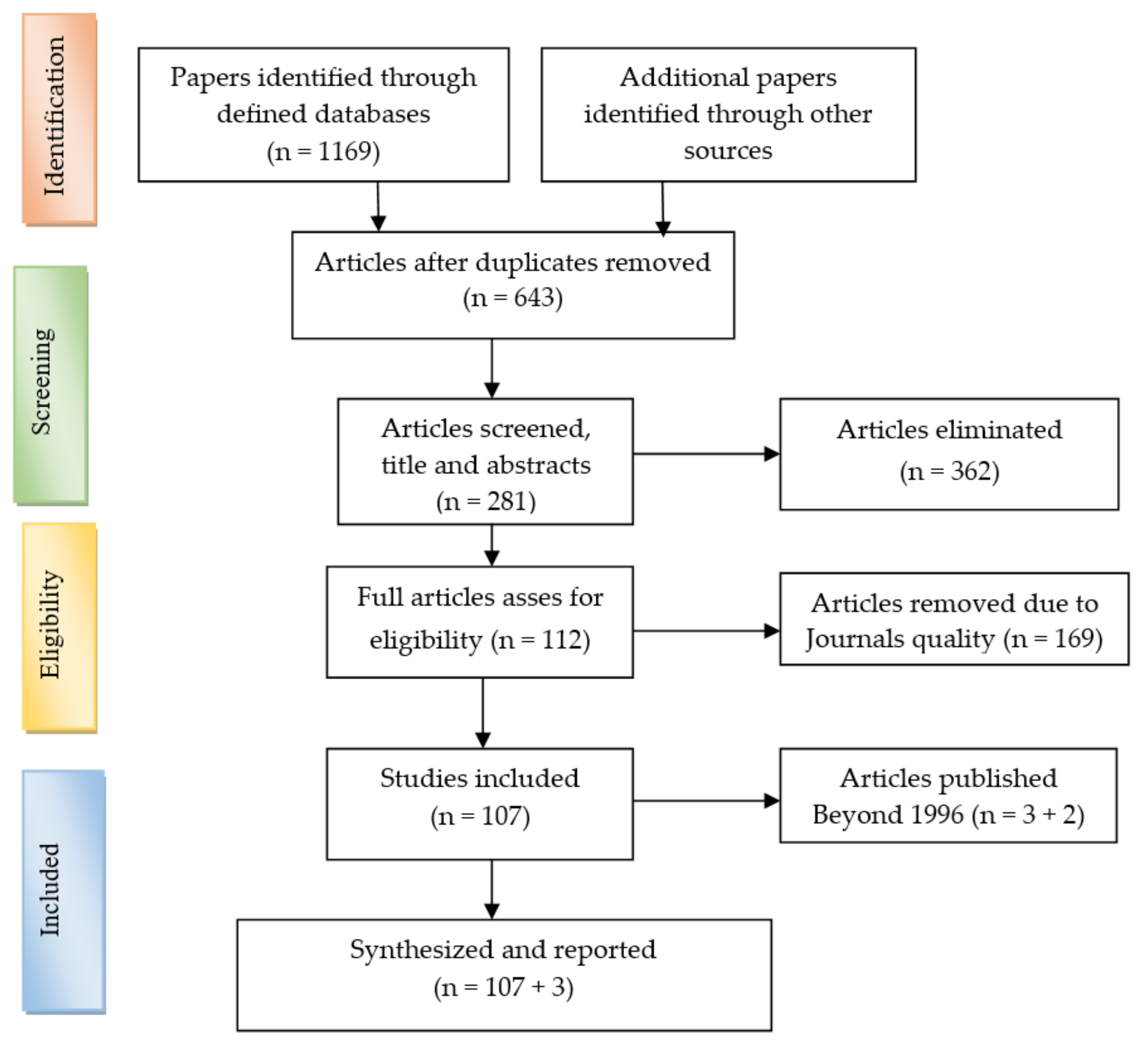
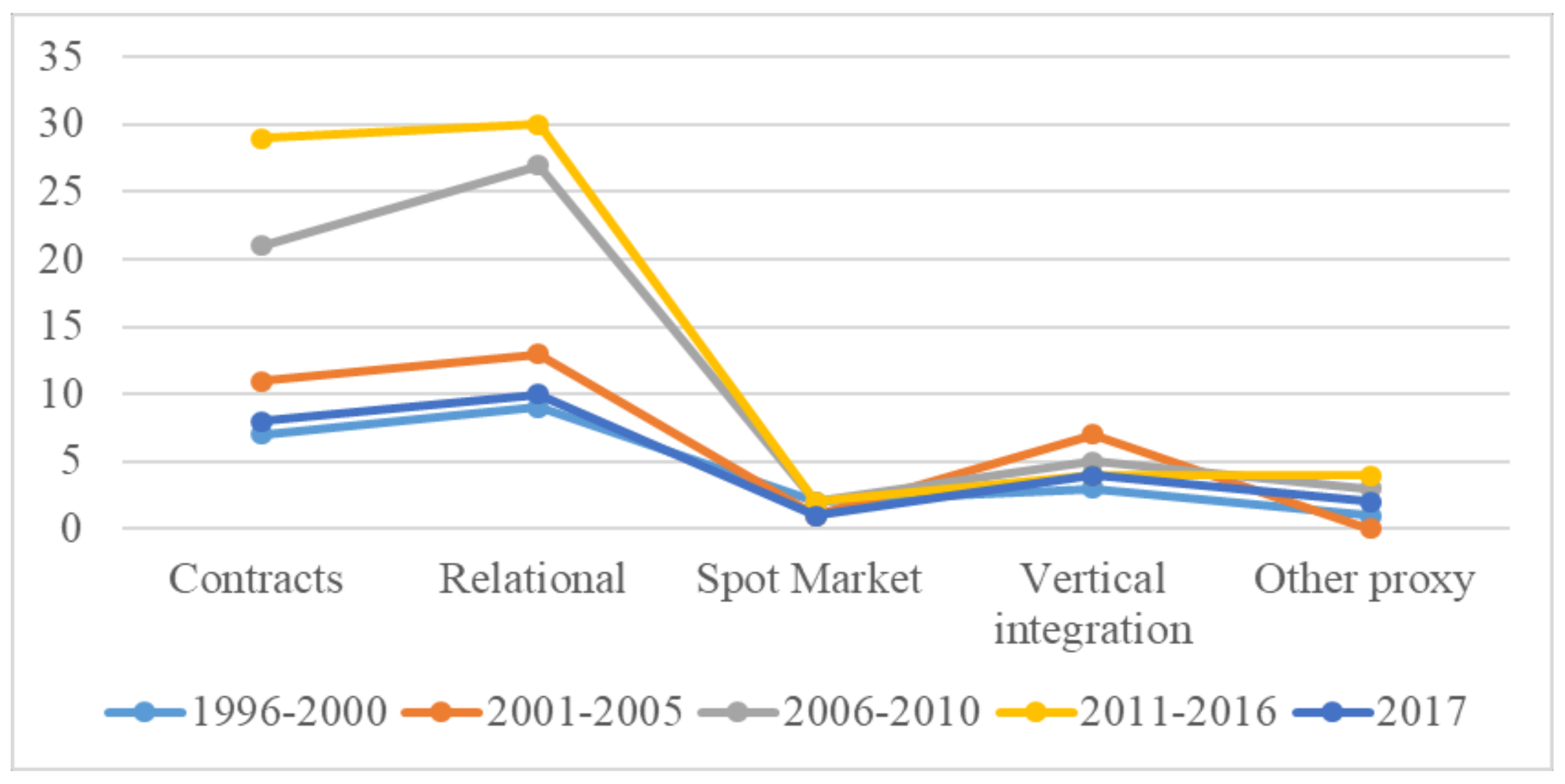
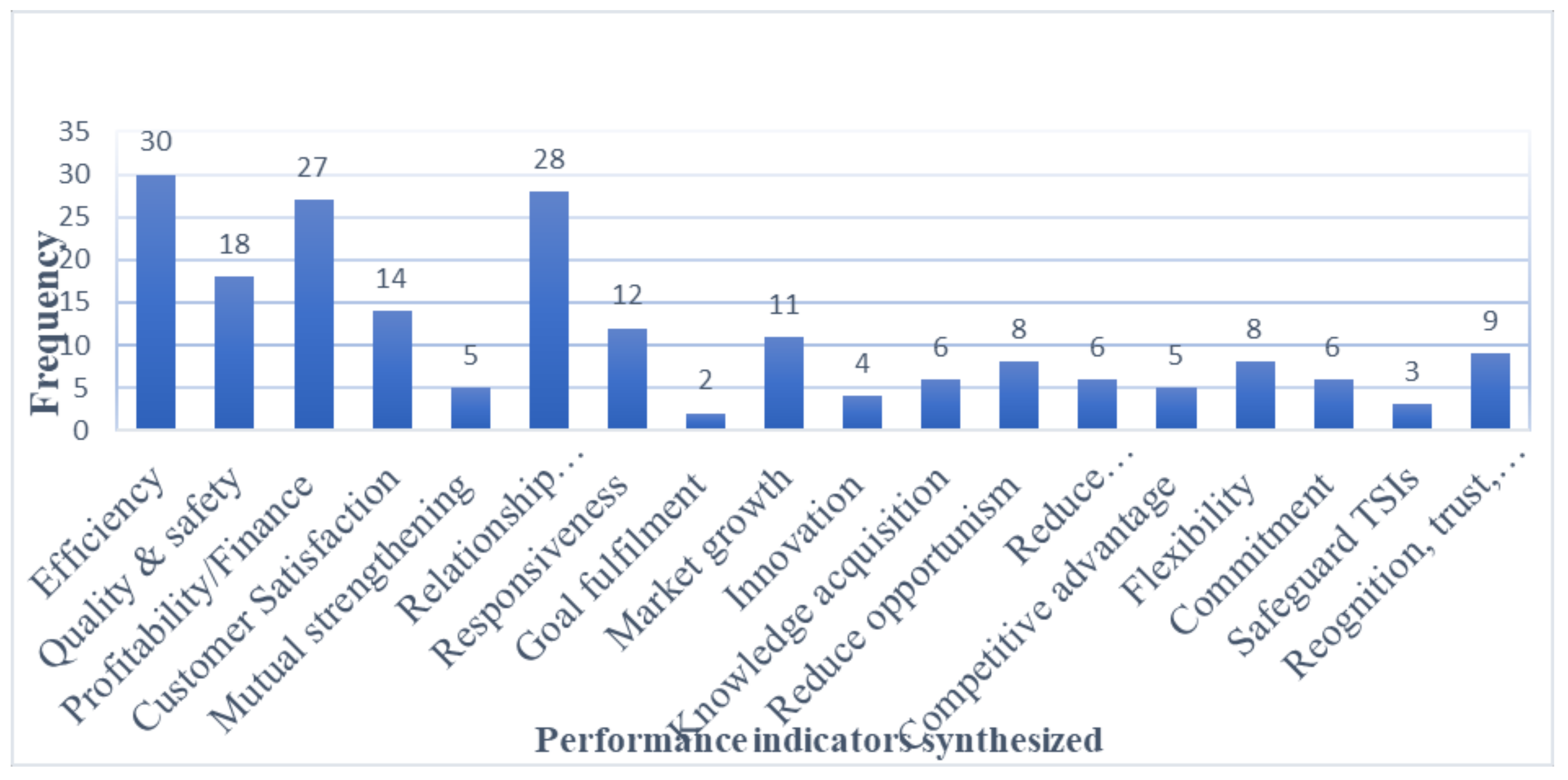
© 2018 by the authors. Licensee MDPI, Basel, Switzerland. This article is an open access article distributed under the terms and conditions of the Creative Commons Attribution (CC BY) license (http://creativecommons.org/licenses/by/4.0/).