Article

Enhancing the Interpretability of NLI Models Using LLMs and Active Learning Algorithms

by
Qi Wang
and
Junqiang Liu
*
School of Information and Electronic Engineering, Zhejiang Gongshang University, Hangzhou 310018, China
*
Author to whom correspondence should be addressed.
Information 2026, 17(2), 119; https://doi.org/10.3390/info17020119
Submission received: 25 November 2025 / Revised: 13 January 2026 / Accepted: 21 January 2026 / Published: 26 January 2026
(This article belongs to the Section Artificial Intelligence)

Abstract

In the field of Natural Language Inference (NLI), model interpretability remains an urgent and unresolved challenge. Existing interpretability-oriented annotated datasets are highly limited, and manually constructing natural language explanations is both costly and inconsistent, making it difficult to balance model performance and interpretability. To address this issue, this paper proposes an interpretable NLI framework based on active learning, Explanation Generation Model-Prediction Model (EGM-PM), and designs an active learning sampling algorithm, Explanation-aware Transition from Clustering to Margin (ETCM), that incorporates natural-language explanation information. In this framework, Large Language Models (LLMs) are employed to automate explanation annotation, reducing dependence on human experts in traditional active learning. A small number of high-value samples obtained via ETCM sampling are used to train the EGM, whose generated natural-language explanations are then used to guide the PM in label inference. Experimental results show that data sampled by ETCM substantially enhance the model’s ability to learn relational and logical structures between premise–hypothesis pairs. Compared with other active learning algorithms, ETCM approaches full-data performance more rapidly while using significantly fewer labeled samples. This finding confirms the value of natural language explanation semantics in improving both model performance and interpretability. Furthermore, this paper employs prompt engineering to construct an interpretability-oriented NLI dataset, Explainable Natural Language Inference (ExNLI), which augments traditional premise–hypothesis pairs with natural-language explanations. Human and automated evaluations confirm the consistency and faithfulness of these explanations. The dataset has been publicly released, offering a low-cost and scalable data construction approach for future research on explainable NLI.

1. Introduction

Natural Language Inference (NLI) is a core task in natural language understanding. It determines the logical relationship—entailment, contradiction, or neutrality—between a premise and a hypothesis. Beyond label prediction, models are increasingly expected to provide verifiable reasoning for their decisions, particularly in logic-intensive domains such as legal judgment prediction and medical diagnosis verification [1]. Without clear explanations, NLI models can remain “black boxes” and may rely on spurious cues (e.g., lexical overlap) rather than genuine reasoning [2].
However, the high cost of annotation has limited the availability of natural language explanations in this field. Existing mainstream datasets [3,4,5,6] primarily provide labels only, whereas explainable datasets such as e-SNLI [7] rely on large-scale manual annotation. Crowdsourcing such explanations is costly and labor-intensive and may introduce inconsistencies, which hinder scaling to additional languages and low-resource settings. To mitigate annotation costs, Active Learning (AL) [8] is often used to select the most informative samples for annotation.
Nevertheless, directly applying traditional AL to explainable NLI faces two key limitations. First, most AL algorithms rely solely on label uncertainty or input diversity for sampling. They typically do not exploit the semantic information contained in natural language explanations, which can provide complementary signals for identifying high-value instances. Second, even within an active learning cycle, the overall process still depends on human experts. In explanation generation, the high cost of writing natural language explanations means that selective sampling alone does not adequately reduce the workload of human annotators.
This paper addresses these challenges by proposing an automated, explanation-aware framework. To reduce reliance on human annotators, we use large language models (LLMs) as explanation annotators and, through optimized prompt engineering, prompt them to generate explanations in place of manual expert annotations at each active learning iteration. Moreover, to overcome the limitations of conventional sampling strategies, we propose Explanation Transition from Clustering to Margin (ETCM). Unlike prior methods, ETCM explicitly leverages semantic representations of LLM-generated explanations and progressively shifts the sampling criterion from diversity-based exploration to uncertainty-based exploitation, thereby selecting semantically informative instances for model training.
To operationalize this paradigm, we develop the Explanation Generation Model–Prediction Model (EGM–PM). This framework establishes an iterative process in which LLMs provide explanation-based supervision, while the ETCM algorithm selectively filters data. This mechanism improves both predictive performance and interpretability in low-resource scenarios.
The main contributions of this paper are summarized as follows:
  • This paper proposes a dual-model architecture, EGM–PM, tailored for low-resource scenarios. By replacing manual annotation with LLMs, this framework reduces annotation costs and jointly improves predictive performance and interpretability.
  • This paper proposes ETCM, an explanation-enhanced active learning sampling method that progressively integrates explanation semantics to improve diversity-driven selection in the cold-start phase and introduces an explanation-discrepancy criterion to complement uncertainty signals, thereby increasing the semantic complementarity and information gain of the queried set.
  • This paper constructs ExNLI, a cross-lingual NLI dataset enriched with LLM-generated natural language explanations. This dataset serves as a benchmark for evaluating our framework and facilitates research on explainable multilingual inference.

2. The Research Problem and Related Works

2.1. Related Works

2.1.1. Explainable Artificial Intelligence

One of the central goals of explainable artificial intelligence (XAI) is to enable models to provide clear, plausible, and verifiable explanations for their decisions while maintaining strong predictive performance [9]. However, the “black-box” nature of deep learning models remains a major barrier to deployment in high-stakes settings, making improved transparency and interpretability a core challenge in artificial intelligence.
Early work in this area primarily focused on post-hoc explanation methods, such as saliency maps and attention visualizations [10,11]. These approaches aim to explain decisions by highlighting specific regions of the input that the model attends to. Yet, because such explanations are confined to post-hoc analysis, they do not intervene in the model’s reasoning process and may not faithfully reflect it. Subsequently, natural language explanations (NLEs) gained attention as a more intuitive modality, and a recent survey [12] systematically summarizes their value for improving model transparency. More recent studies, such as [13], explore efficient extractive natural language explanations for interpretable NLI. LiTEx reveals substantial within-label variation, where annotators may agree on the same label yet provide divergent explanations [14].
Existing paradigms have considerable limitations—they largely emphasize static analysis of generated explanations, rather than treating them as signals for dynamic correction. Concretely, these methods do not leverage the semantic content of explanations to support decision-making, nor do they provide a feedback mechanism to automatically verify and filter high-confidence explanations during training. Moreover, constructing high-quality rationale datasets via human annotation is prohibitively expensive, which remains a primary bottleneck for scaling these approaches.
To bridge this gap, we investigate the role of NLEs in data selection and inference. We propose an explanation-aware active learning algorithm, ETCM, and a dual-model architecture, EGM–PM. Unlike prior work, our framework turns explanations from static outputs into dynamic signals for selection. By integrating explanation semantics into the active sampling process, we establish a feedback loop that selectively retains high-quality natural language explanations to support downstream inference, thereby prioritizing the most informative samples under limited resources.

2.1.2. Active Learning

In explainable NLP, acquiring high-quality human-annotated explanations is highly resource-intensive. Given the scarcity of human explanations, active learning (AL) offers a natural strategy: it aims to reduce annotation cost while maximizing data utility by selectively querying only the most valuable samples from an unlabeled pool [8].
Existing AL methods are commonly grouped into two families: uncertainty-based sampling and diversity-based sampling. However, both face clear limitations. Uncertainty-based sampling can be sensitive to model miscalibration [15], whereas diversity-based sampling may overlook high-value boundary instances [16,17]. The two-stage sampling strategy TCM [18] adopts a heuristic schedule that first emphasizes diversity and then switches to uncertainty-driven selection. While this stage-wise design improves sampling stability, it remains primarily driven by input representations and predictive uncertainty, and it does not explicitly incorporate explanation semantics as a sampling signal.
To bridge this gap, we propose an algorithmic advance: an explanation-aware sampling algorithm, ETCM, that integrates the semantic information of natural language explanations. Unlike prior approaches, ETCM learns representations that fuse information from natural language explanations, leveraging their semantics to identify the most worthwhile samples to annotate, thereby improving both interpretability and performance.

2.1.3. Large Language Models and Prompt Engineering

Since ETCM relies on natural language explanations as a key supervision signal for sampling, explanation-based selection is only effective when the explanations are faithful and well-structured. However, obtaining such explanations at each active learning iteration remains a practical bottleneck due to its reliance on human effort [19]. To alleviate this dependency, we replace the conventional human oracle with large language models (LLMs) as explanation annotators, thereby establishing an automated annotation loop.
Nevertheless, enabling LLMs to reliably serve in this role requires explicit control over the quality and format of their outputs. Prompt engineering provides a direct mechanism for steering LLM behavior by refining prompt templates [20]. For instance, Chain-of-Thought (CoT) prompting [21] has been shown to substantially enhance LLM performance on complex reasoning tasks. Recent studies have further examined the utility of LLM-generated explanations for downstream modeling and underscored the importance of explanation evaluation and reliability [14,22].
However, naive application of LLM-generated natural language explanations is not sufficient. As demonstrated by Pham et al. [23], directly using LLMs to generate NLI natural language explanations often yields outputs that are overly long and highly redundant with the input, making them ill-suited as training inputs and potentially diluting the signals used for sample selection.
To address these issues, we leverage prompt engineering to develop prompt templates that explicitly enforce conciseness and faithfulness, while discouraging pronoun overuse and redundant restatement. This optimized prompting strategy enables LLMs to serve as effective automated explanation annotators. Combined with ETCM, it yields a unified framework that reduces annotation cost and improves both interpretability and predictive performance.

2.2. The Research Problem and Research Questions

Natural Language Inference (NLI) aims to determine the logical relationship between a premise and a hypothesis—entailment, contradiction, or neutral. As a canonical reasoning task, NLI underpins a wide range of downstream applications that require reliable textual reasoning, such as legal document analysis and question answering.
Recent NLI research has substantially broadened linguistic coverage, from multilingual benchmarks such as XNLI [5] to lower-resource languages including Basque [24] and Burmese [25]. However, most of this line of work emphasizes predictive accuracy and multilingual coverage, and rarely evaluates the interpretability of the underlying reasoning process. Although datasets such as e-SNLI [7] introduced natural language explanations through manual annotation, scaling human-written explanations is prohibitively time-consuming and labor-intensive. This gap creates a pronounced interpretability bottleneck, especially in low-resource settings where expert annotators are scarce.
Motivated by this challenge, we investigate an explanation-aware active learning framework for NLI. Our goal is to reduce the cost and inconsistency of explanation annotation while using explanations to improve not only transparency but also the reliability of learning and inference. Rather than treating explanations as static targets or mere post-hoc justifications, we study mechanisms that make explanation signals reliable and actionable for (i) efficient explanation annotation, (ii) explanation-guided sample selection, and (iii) explanation-assisted NLI inference, where LLM-annotated explanations serve as auxiliary signals.
Based on these objectives, we formulate the following research questions:
  • RQ1, Annotation efficiency. How can we obtain scalable, low-cost natural language explanations while ensuring that their quality is controllable and that they are sufficient to serve as effective supervision signals?
  • RQ2, Explanation-guided sample selection. Under annotation budgets, how can explanation semantics be integrated into active sample selection to approach full-data performance with fewer labeled instances?
  • RQ3, Explanation-assisted inference. How can LLM-annotated explanations be leveraged as auxiliary signals to improve NLI inference compared with explanation-free baselines?

3. Materials and Methods

This section introduces the methods and implementation pipeline proposed in this paper, focusing on addressing the challenges of insufficient model interpretability and the scarcity of explanation data in NLI tasks. Section 3.1 presents the proposed ETCM active learning sampling algorithm, which integrates the strengths of uncertainty-based and diversity-based sampling to enable efficient sample selection. Section 3.2 describes the architecture and implementation of the EGM-PM model. Section 3.3 and Section 3.4 detail the process of generating natural language explanations through prompt engineering, as well as the construction of the ExNLI dataset. Overall, this section aims to systematically present the design and integration of each module, laying the foundation for subsequent experiments and result analysis.

3.1. ETCM—Active Learning Sampling Algorithm

This paper proposes a novel active learning sampling algorithm—Explanation Transition from Clustering to Margin(ETCM). Its core idea is to incorporate semantic information from natural-language explanations into the active learning process, combining the strengths of diversity-based and uncertainty-based sampling to achieve efficient, interpretable sample selection.
Stage 1: TypiClust–Explanation
In the initial stage, the algorithm incorporates semantic information from natural language explanations to support diversity-based sampling. This aims to address the “cold start” problem encountered by traditional active learning when data are scarce. To fully exploit semantic information, this paper integrates premise-hypothesis pairs and semantic representations of explanations. This approach maintains coverage during the cold start phase while progressively introducing explanation information to enhance the interpretability and representativeness of selected samples. The following section provides a formal description and implementation details.
For any sample x = ( p , h ) , where p and h denote the premise and the hypothesis, respectively. To fully leverage the semantic information carried by natural language explanations, we treat the explanations pre-annotated by LLMs as teacher explanations, denoted as e LLM ( x ) . During active learning iterations, the natural language explanation produced by the explanation generation model at round t is used as the student explanation, denoted as e ^ t ( x ) = EGM t ( x ) , which is used only as the training and test input of the NLI prediction model to remain consistent with the deployment setting.
Both the textual representation and the explanation representation of a sample are computed by the pretrained encoder Sentence-BERT (SBERT) [26], whose output dimension is d:
r text ( x ) = SBERT ( p , h ) R d , r expl ( x ) = SBERT e LLM ( x ) R d .
To enable a smooth transition and gradually strengthen explanation guidance, we introduce a stage-dependent fusion weight α t [ 0 , 1 ] , where t denotes the active learning iteration index, and define the fused representation:
r ( x ; t ) = ( 1 α t ) r text ( x ) + α t r expl ( x ) .
Let D train denote the initial training data pool for active learning, which contains all samples to be labeled, and let D prev ( t ) denote the set of labeled samples obtained up to the beginning of round t (the cumulative labeled set). Then, the unlabeled candidate pool at round t is
D pool ( t ) = D train D prev ( t ) .
Let B denote the stage-switch threshold (i.e., the algorithm transitions to the next stage when the cumulative number of labeled samples reaches B). We then adopt a linear warm-up in the TypiClust–Explanation stage as the number of labeled samples increases, as follows:
α t = 0.5 × min 1 , | D prev ( t ) | B .
when | D prev ( t ) | < B (TypiClust–Explanation stage), α t increases linearly from 0, encouraging the model to rely on textual semantics first and then smoothly incorporate explanation semantics; when | D prev ( t ) | B (MarginNLI stage), α t saturates and is fixed at 0.5, thereby achieving equal-weight fusion of textual and explanation features.
It should be emphasized that r expl ( x ) in Equation (1)–(2) is always computed from the teacher explanation e LLM ( x ) and is used for the semantic measurement and distance computation in the ETCM sampling stage; the student explanation e ^ t ( x ) = EGM t ( x ) does not participate in sampling-distance computation, and is only used as the training and test input of the NLI prediction model, thereby avoiding information leakage and maintaining deployment consistency.
Based on the fused representation r ( x ; t ) , we formalize representativeness as the within-cluster K-nearest neighbors N K ( x ; t ) of sample x. At round t, we first perform l 2 normalization on the fused representations of the candidate pool D pool ( t ) , and run k-means on the normalized representations to obtain a cluster assignment function c ( · ) . For any sample x D pool ( t ) , let c ( x ) denote its assigned cluster, and let N K ( x ; t ) denote the set of K nearest neighbors retrieved within the same cluster c ( x ) under Euclidean distance ( l 2 ). We set the upper bound of the neighborhood size to K = 10 ; when the cluster contains insufficient samples, the effective neighborhood size is updated as follows:
K min K , | c ( x ) | 1 ,
where | c ( x ) | is the number of samples in the cluster of x; if | c ( x ) | 1 , the within-cluster typicality of this sample is not computed. Accordingly, the within-cluster average neighborhood distance of sample x is defined as d ¯ K ( x ; t ) :
d ¯ K ( x ; t ) = 1 K x i N K ( x ; t ) r ( x ; t ) r ( x i ; t ) 2 ,   x D pool ( t ) .
and then take its reciprocal as the typicality score:
T ( x ; t ) = d ¯ K ( x ; t ) + ε 1 .
Here, a small constant ε ( = 10 6 ) is added to avoid division-by-zero or numerical explosion when d ¯ K ( x ; t ) 0 ; since the magnitude of ε is far smaller than typical neighborhood distances, it only takes effect in extreme cases and does not change the relative ranking of general samples.
To ensure the diversity of samples queried in the current round, during the within-cluster greedy selection at round t, we denote the query batch as D selected ( t ) , and initialize it at the beginning of the round as D selected ( t ) = . This set satisfies D selected ( t ) D pool ( t ) , and thus D selected ( t ) D prev ( t ) = . After labeling D selected ( t ) , the historical labeled set is updated as
D prev ( t + 1 ) = D prev ( t ) D selected ( t ) .
The minimum distance from a candidate sample to the current selected set is used as a diversity-compensation term:
D ( x ; D selected ( t ) ; t ) = min s D selected ( t ) r ( x ; t ) r ( s ; t ) 2 .
when D selected ( t ) = , we set D ( x ; D selected ( t ) ; t ) = 0 . By combining typicality and diversity, we obtain a stage-wise composite score:
Score ( x ; D selected ( t ) ; t ) = T ( x ; t ) T max ( c ( x ) , t ) + D ( x ; D selected ( t ) ; t ) D max ( c ( x ) , t ) .
We perform within-cluster dual normalization for both the typicality term and the diversity term, constraining both to [ 0 , 1 ] to facilitate linear addition and avoid bias caused by distance-scale differences. For any cluster c, we define the following:
D max ( c , t ) = max x c D ( x ; D selected ( t ) ; t ) , T max ( c , t ) = max x c T ( x ; t ) .
If D max ( c , t ) = 0 or T max ( c , t ) = 0 , it is set to 1 to avoid division by zero. During within-cluster candidate selection, let the per-round query budget be n; the number of clusters is set to m = ceil ( n / 2 ) , and at most two samples are selected from each cluster to form the query set for the current round. Specifically, we perform greedy selection within each cluster according to Equation (10) and progressively update D selected ( t ) , until  D selected ( t ) = n or the candidate pool is exhausted. The above process is referred to as TypiExplanation (as shown in Algorithm 1), which is used to alleviate insufficient representativeness caused by information scarcity in the cold-start stage.
Stage 2: MarginNLI
As active learning proceeds, when the cumulative labeled set size reaches the stage-switch threshold B (i.e., | D prev ( t ) | B ), ETCM switches from the cold-start stage TypiClust–Explanation to the more uncertainty-driven sampling strategy MarginNLI. At this point, the model has acquired a relatively stable discriminative capability; therefore, focusing on the decision boundary can achieve a systematic balance between representativeness and uncertainty.
The traditional Margin algorithm in binary classification is defined as the difference between the predicted probabilities of two classes. For a sample x:
Margin ( x ) = p ( c 1 | x ) p ( c 2 | x ) .
The NLI task studied in this work can be treated as a three-class classification problem; however, when extending the traditional Margin to multi-class settings, using only the difference between the maximum and minimum probabilities may be insufficient to reflect true uncertainty. Therefore, we define Margin as the difference between the maximum probability and the second-largest probability, yielding the Top-two Margin:
Top-two Margin ( x ) = p max ( x ) p second ( x ) .
Algorithm 1 TypiClust–Explanation
Require: 
Initial data pool D train ; previously labeled set D prev ( t ) ; query budget per round n; stage-switch threshold B; neighbor cap K max ; per-cluster selection cap q (default q = 2 ).
Ensure: 
Selected query set (to be labeled) D selected ( t ) .  
1:
Construct the unlabeled candidate pool: D pool ( t ) D train D prev ( t ) .
2:
Compute the fusion weight α t according to the cumulative labeled size (see Equation (4)).
3:
for all  x D pool ( t )  do
4:
    Compute fused representation r ( x ; t ) (see Equation (2)).
5:
     r ( x ; t ) r ( x ; t ) / r ( x ; t ) 2 All distances use l 2 -normalized representations.
6:
end for
7:
Set the number of clusters m n / q .
8:
Run k-means on { r ( x ; t ) x D pool ( t ) } to obtain cluster assignment c ( · ) .
9:
for all  x D pool ( t )   do
10:
   Retrieve the K-NN set N K ( x ; t ) within the same cluster c ( x ) using Euclidean distance, where the effective K is given by Equation (5) and capped by K max .
11:
    if  | N K ( x ; t ) | = 0  then
12:
        continue
13:
    end if
14:
    Compute d ¯ K ( x ; t ) (Equation (6)) and the typicality term T ( x ; t ) (Equation (7)).
15:
end for
16:
Initialize D selected ( t ) .
17:
For each cluster, initialize its selected count to 0 with an upper bound q.
18:
while  | D selected ( t ) | < n  and candidates remain do
19:
    for all eligible clusters c (not reaching cap q and still having candidates) do
20:
        For each candidate x in cluster c, compute its minimum distance to the current selected set, D ( x ; D selected ( t ) ) (Equation (9)); if D selected ( t ) = , set this term to 0.
21:
        Compute D max ( c , t ) (Equation (11)); if D max ( c , t ) = 0 , set D max ( c , t ) 1 .
22:
        Compute the acquisition score Score ( x , t ) for candidates in cluster c (Equation (10)).
23:
        Let x c arg max x c Score ( x , t ) be the cluster representative.
24:
    end for
25:
    Select the globally best representative: x arg max c Score ( x c , t ) .
26:
     D selected ( t ) D selected ( t ) { x } .
27:
    Update the selected count and remove x from its cluster candidate list.
28:
    Add exactly one sample per iteration to refresh D ( · ) and re-score; q enforces cross-cluster balance.
29:
end while
30:
return  D selected ( t ) .
After annotation (in the overall pipeline):  D prev ( t + 1 ) D prev ( t ) D selected ( t ) .
Note that Top-twoMargin ( x ) [ 0 , 1 ] , and a smaller value indicates higher uncertainty. Accordingly, we use 1 Top-twoMargin ( x ) as the uncertainty term.
In addition, we introduce entropy as a global uncertainty measure to quantify the uniformity of the predictive distribution. Compared with Margin, which only considers the top two classes, entropy reflects the model’s overall ambiguity over the full label space. The equation is as follows:
H ( x ) = y Y p ( y | x ) log p ( y | x ) .
where, Y is the set of class labels; for the NLI task in this work, | Y | = 3 , and thus H ( x ) [ 0 , log | Y | ] . To make each term comparable in numerical scale, we use the normalized entropy H ( x ) / log | Y | [ 0 , 1 ] .
On this basis, to characterize the semantic difference of a candidate sample x at the explanation level relative to historically labeled samples, we align and compare text and explanations in the embedding space of the same sentence encoder. Specifically, we apply l 2 normalization to the candidate text embedding and the historical teacher-explanation embeddings:
r ˜ text ( x ) = r text ( x ) r text ( x ) 2 , x D pool ( t ) , r ˜ expl ( x i ) = r expl ( x i ) r expl ( x i ) 2 , x i D prev ( t ) .
Based on the idea of nearest-neighbor consistency, we define the explanation semantic difference as follows:
D expl ( x ) = 1 max x j D prev ( t ) cos r ˜ text ( x ) , r ˜ expl ( x j ) , x D pool ( t ) .
This definition searches, among all historical teacher-explanation embeddings, for the one most similar to the candidate sample’s text embedding; the lower the cosine similarity, the larger D expl ( x ) , indicating that the candidate sample may introduce a more “novel” explanation-semantic pattern. Since cos ( · ) [ 1 , 1 ] , we have D expl ( x ) [ 0 , 2 ] . To keep scales comparable, we use 0.5 × D expl ( x ) [ 0 , 1 ] in the fusion, and use the weight γ to control its contribution.
By integrating the above three types of information, we define the sampling score of MarginNLI as follows:
MarginNLI ( x ) = 1 Top-two Margin ( x ) + H ( x ) log | Y | + γ · D expl ( x ) 2 , x D pool ( t ) .
In each sampling round, we select the top n samples with the highest MarginNLI ( x ) scores from the candidate pool for labeling. Experimental results show that the improved uncertainty measure can more efficiently filter samples with richer information under the same labeling budget, thereby simultaneously improving the model’s prediction performance and explanation quality. The overall scheduling process of ETCM is shown in Algorithm 2.
Benefiting from the staged sampling mechanism, ETCM alleviates the lack of high-confidence information in the initial iterations; after entering the subsequent stage, it further focuses on highly uncertain samples, achieving a synergistic trade-off between diversity and uncertainty. Compared with the method of Yao et al. [19], ETCM is more advantageous in computational efficiency: the algorithm only needs to compute the neighborhood distance of each sample within its cluster, without explicitly informing the full pairwise similarity matrix over the entire pool, thereby significantly reducing time and memory overhead. Moreover, ETCM is designed to jointly consider diversity and interpretability, enabling it to prioritize samples that are both representative and rich in explanatory value under a limited labeling budget, providing more sufficient information support for subsequent analysis and decision-making.
Active learning experiments further verify that, compared with traditional Core-Set and TypiClust methods, ETCM can better exploit the semantic association between text and explanations, achieving more notable improvements in sample-selection efficiency and representativeness.
Algorithm 2 ETCM
Require: 
Fixed pool D train ; initial labeled set D prev ( 0 ) ; per-round budget n; stage threshold B; maximum rounds T (optional).
Ensure: 
Final labeled set D prev .
1:
for  t = 0 , 1 , 2 ,   do
2:
    Construct candidate pool:  D pool ( t ) D train D prev ( t )
3:
    if  D pool ( t ) = 0  or (T is set and t T ) then
4:
        break
5:
    end if
6:
    Train model: Train the NLI predictor M t (and the student EGM) on D prev ( t ) .
7:
    Obtain predictions P t ( y x ) for all x D pool ( t ) using M t .
8:
    Select strategy by stage:
9:
    if  D prev ( t ) < B  then
10:
           Stage 1: D selected ( t )  TypiExplanation D pool ( t ) , n , D prev ( t )
11:
    else
12:
           Stage 2: Compute MarginNLI ( x ) for all x D pool ( t ) using Equations (12)–(17).
13:
            D selected ( t ) TopN ( D pool ( t ) , n ,  MarginNLI ( · ) )
14:
    end if
15:
    update:  D prev ( t + 1 ) D prev ( t ) D selected ( t ) .
16:
end for
17:
return  D prev ( t )

3.2. EGM–PM: A Dual Model Active Learning Framework

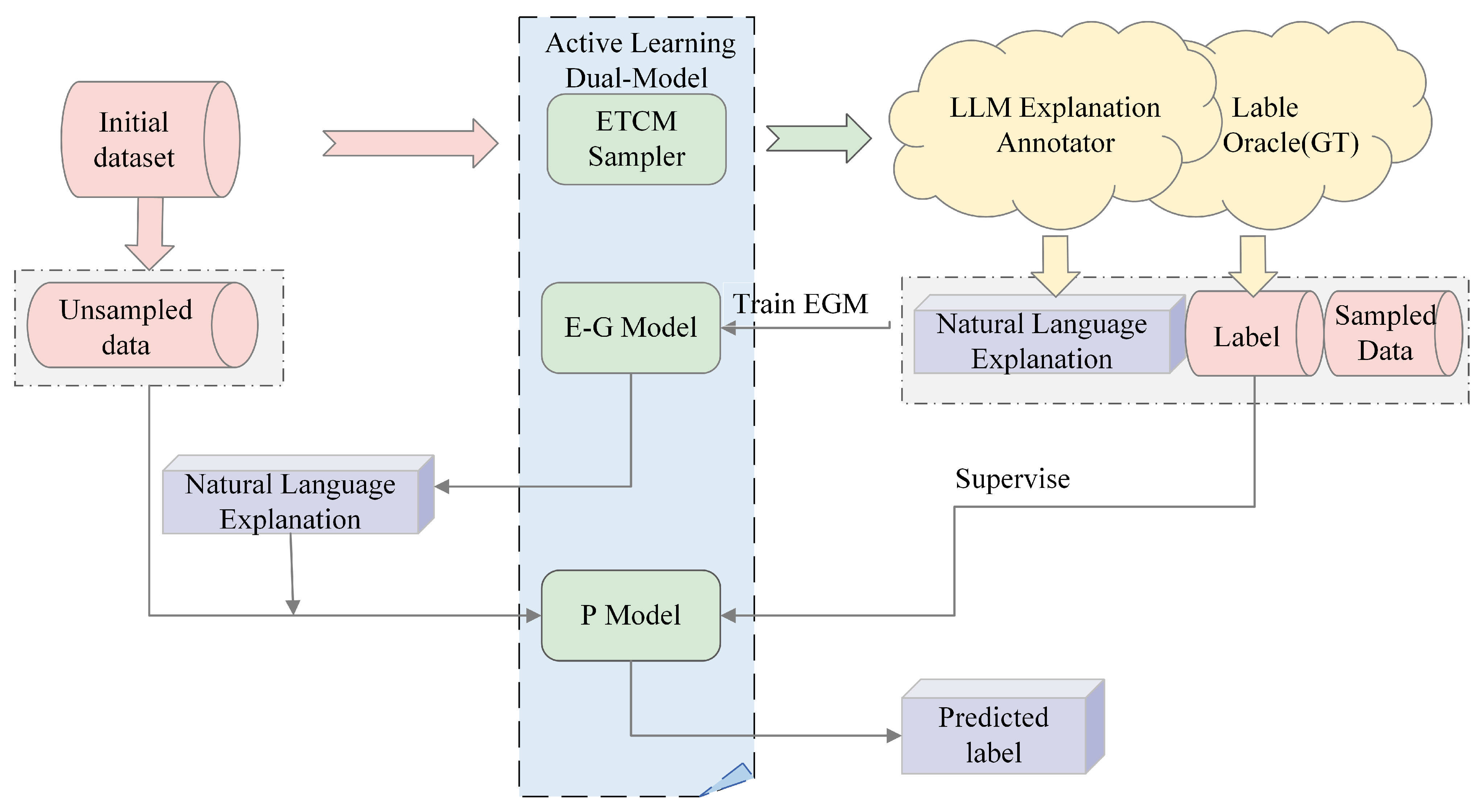
To address the heavy reliance on human experts in traditional AL during data annotation, this paper proposes replacing human experts with LLMs as the source of explanation annotation, thus enabling the automated generation of natural language explanations. In conventional active learning, human experts must not only determine the relationship between the premise and the hypothesis but also compose natural-language explanations. This process is labor-intensive, time-consuming, and difficult to scale in low-resource scenarios. In contrast, leveraging LLMs for explanation generation significantly reduces annotation costs, improves efficiency, and improves scalability. To this end, this paper proposes EGM-PM, a dual-model active-learning framework that comprises three components. The overall architecture is illustrated in Figure 1.
  • Explanation-Generation Model
This model takes the premise-hypothesis pairs as input and is fine-tuned under supervision from existing explanation data. Through fine-tuning, the EGM can generate free-form natural language explanations that provide additional semantic information for the inference process. These explanations not only facilitate a deeper understanding of the data but also provide supplementary contextual cues to the prediction model, thereby enhancing both the transparency and interpretability of the inference.
  • Prediction Model
The prediction model takes as joint inputs both the premise-hypothesis pairs and the explanations produced by the EGM, and it is trained using ground-truth labels provided by the dataset. Its primary objective is to leverage the semantic information provided by explanations to improve inference accuracy. Compared with models that rely solely on data content, the PM benefits from explanation-based enhancement, achieving stronger discriminative capability and improved interpretability in its predictions.
  • Active Learning Sampler
The data sampler is implemented using the proposed ETCM algorithm, which selects the most representative and informative samples from the unlabeled pool in each iteration for annotation by the oracle (simulated by ground-truth labels in our experiments). The sampling process operates in two stages. During the initial stage, the sampler computes semantic similarity between unlabeled premise-hypothesis pairs and natural-language explanations, and applies diversity-based selection to address the cold-start problem; as annotated data increases, the sampler shifts to an uncertainty-based strategy (MarginNLI) to ensure that selected samples maximize performance gains. In this manner, the sampler identifies high-value samples within a limited annotation budget, thereby improving both training efficiency and overall system effectiveness.
In the practical implementation of active learning iterations, the overall workflow of EGM-PM is as follows: The sampler first employs the ETCM algorithm to select unlabeled samples, which are then passed to the oracle for relation-label annotation (simulated by ground-truth labels in our experiments), while LLMs can be invoked to generate natural language explanations. Subsequently, the EGM is fine-tuned under the supervision of the generated explanations, thereby enhancing its ability to produce high-quality explanations. Next, the PM is trained using both the data content (premise-hypothesis pairs) and the explanations generated by the EGM as inputs, with the ground-truth labels serving as supervision, thereby gradually improving its predictive performance. Through this iterative cycle, the EGM-PM achieves synergistic enhancement across both explanation and prediction dimensions, ultimately attaining improvements in both performance and interpretability.
Given the unified text-to-text paradigm of T5 (Text-to-Text Transfer Transformer) [27], this paper adopts FLAN-T5 [28] as the base model for both the EGM and the PM. The proposed method was evaluated on both the e-SNLI and ExNLI datasets. Detailed experimental results and analyses are presented in the next chapter.

3.3. Natural Language Explanation Generation

This paper leverages LLMs to replace human experts in generating natural-language explanations from ground-truth labels. Prompt engineering exploits LLMs’ pre-existing knowledge without requiring additional fine-tuning, offering flexibility and efficiency. Pham et al. [23] have previously explored processing natural language inference data using LLMs. They categorized premise-hypothesis pairs into seven semantic relationship types (conditional, contrastive, neutral, consensus, causal, comparative, and temporal) and instructed LLMs to generate natural-language explanations for each category. While this method reduces the risk of invalid explanations caused by LLMs’ reasoning errors, it constrains output diversity and lacks quality control mechanisms. Moreover, it overlooks the hallucination problem inherent to LLMs, often resulting in overly lengthy, redundant natural-language explanations that waste training resources.
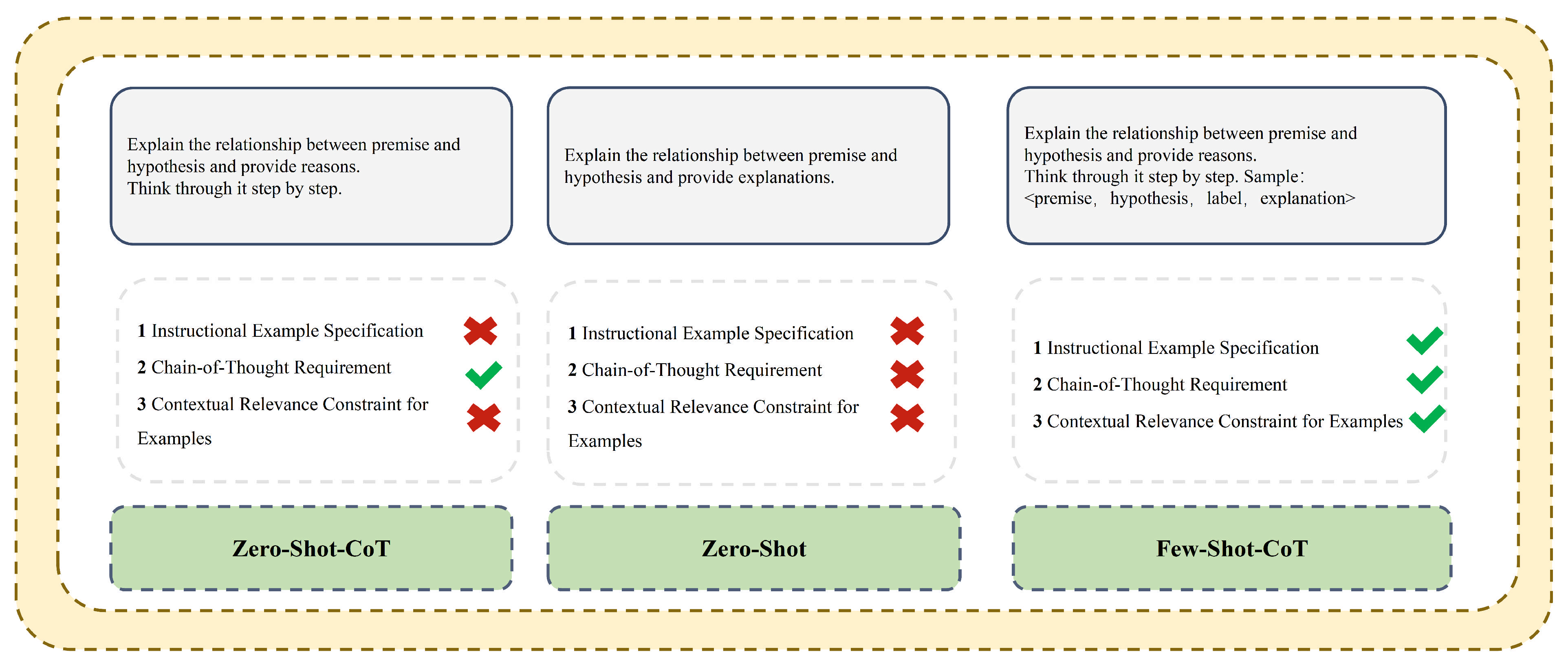
To address these limitations, this paper introduces explicit constraints into prompt design, requiring explanations to avoid redundancy, prohibit the use of anaphora, and maintain semantic consistency, thereby improving the utility of generated explanations.
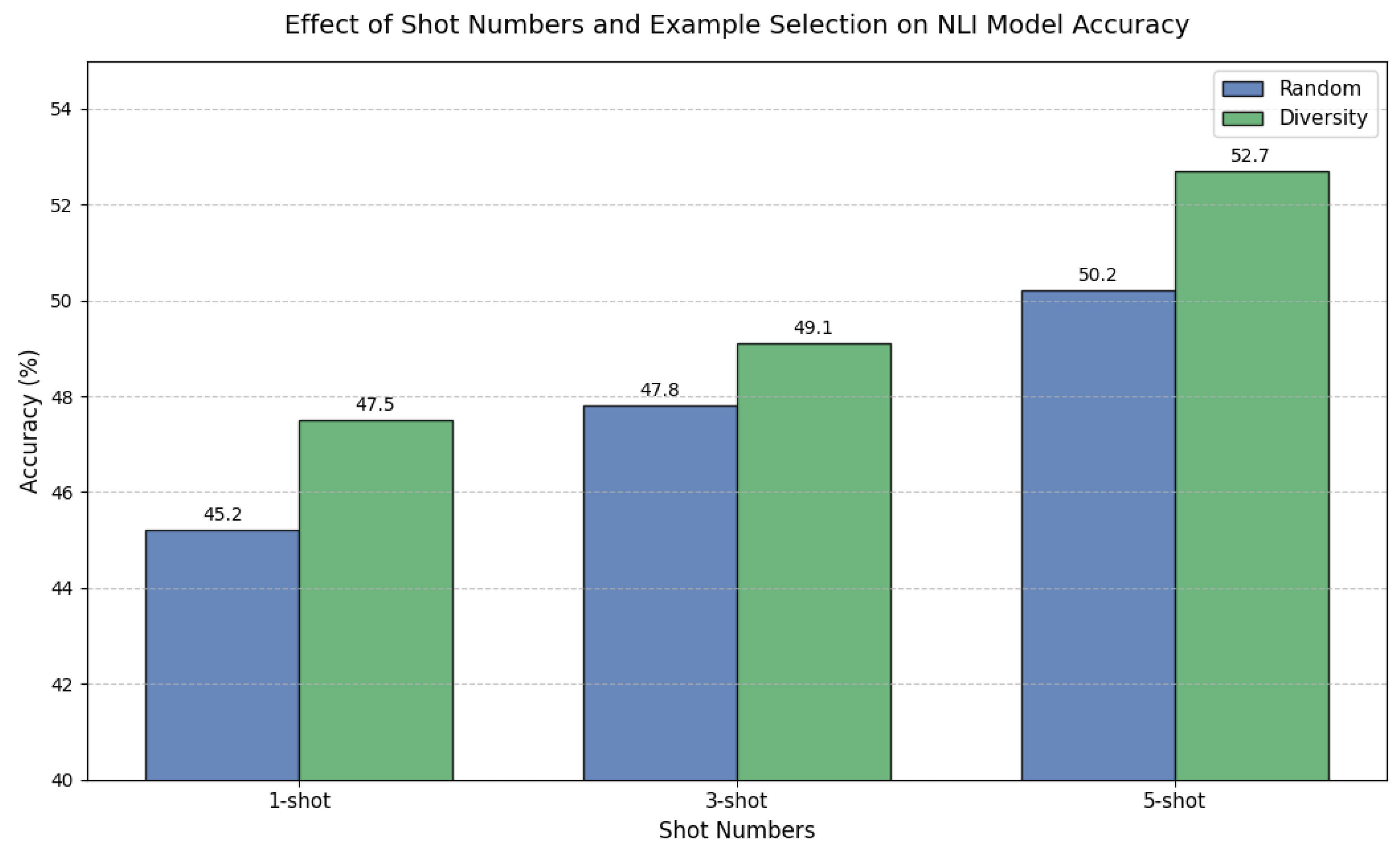
Three prompting strategies—zero-shot, zero-shot-CoT, and few-shot-CoT—were designed and compared under the same baseline model. Figure 2 illustrates example prompt templates, highlighting the differences among these strategies. To explore the impact of different shot numbers and different example selections on explanation generation, this paper conducted corresponding comparative experiments, which compared the effects of different shot numbers and example selection strategies on explanation generation. The results and analysis of the experiments can be found in Section 4.2.
During the construction phase, 90 samples (balanced across languages) were randomly selected in each iteration for human evaluation, focusing on the consistency and completeness of the generated explanations. The experimental results indicate that the few-shot-CoT method yields the highest quality explanations. Table 1 lists the prompt templates used in this paper, where <text> can be substituted with other task-specific content, enabling rapid extension to additional AIGC scenarios. Furthermore, the transfer experiments presented in Section 4.6 provide additional evidence for the effectiveness of this method across other downstream natural language processing tasks.
To enhance the quality of natural language explanations, this paper conducts experiments on multiple large language models by synchronously applying the constructed prompts, including FLAN-T5 [28], Qwen2.5-Coder-7B-Instruct [29], and DeepSeek-R1-Distill-Qwen-7B [30]. The selection of these models was deliberate. Since this paper focuses on low-resource NLI scenarios, the parameter scale of the base models was intentionally constrained to ensure deployability under limited computational budgets. In contrast, mainstream general-purpose LLMs such as GPT-3.5 and Llama 3 contain tens to hundreds of billions or even trillions of parameters. These models require large-scale GPU clusters, making them impractical for local or edge-device environments. Consequently, this paper adopts moderate-sized models (0.7B–7B parameters) to investigate how prompt engineering and explainable architecture design can jointly improve interpretability and performance under realistic hardware constraints. This configuration aligns with the practical objective of enabling explainable AI systems that remain both efficient and deployable in low-resource contexts.
Each record in the dataset (JSONL file) was processed locally, with the premise, hypothesis, and label extracted as inputs to generate explanations individually, thereby avoiding interference across different texts.
Experiments were conducted on an NVIDIA RTX 3070Ti GPU using CUDA 12.2 and PyTorch 2.2.1. Compared with crowdsourced annotation, local deployment substantially improved efficiency while reducing computational and annotation costs. For instance, Qwen2.5-Coder-7B-Instruct required 5.8 GB of GPU memory and averaged 2.1 s per sample, while DeepSeek-R1-Distill-Qwen-7B consumed 7.2 GB and averaged 1.7 s per sample—both achieving generation speeds far exceeding those of manual annotation.The results demonstrate that even 7B-parameter models can efficiently generate high-quality natural language explanations on a single GPU, confirming the feasibility of the proposed approach in low-resource environments.

3.4. Construction of the ExNLI Dataset

This paper constructs the ExNLI (explainable natural language inference) dataset based on XNLI [5] and OCNLI [6]. XNLI is a classic cross-lingual natural language inference benchmark that covers multiple languages; in contrast, OCNLI is a high-quality NLI dataset built for Chinese contexts and contains more native Chinese expressions. Based on their complementarity, ExNLI provides both cross-lingual coverage and diverse Chinese expressions, and can be used for NLI learning and evaluation in explanation generation and explanation enhancement.

3.4.1. Balanced Sampling, Translation, and Explanation Annotation

Since XNLI mainly provides dev/test splits for cross-lingual evaluation in target languages such as DE/FR/ZH (as shown in Table 2), and the available sample size for each language is relatively limited, while OCNLI provides a larger-scale Chinese training set (as shown in Table 3), directly concatenating them may introduce training bias caused by differences in data scale. Therefore, this paper adopts a balanced sampling strategy: a Chinese subset is constructed by stratified sampling by label from the public splits of OCNLI, and then translated into English, German, and French. Subsequently, it is merged with the corresponding XNLI cross-lingual evaluation data to form ExNLI.
For translation, ExNLI uses NLLB-200 (facebook/nllb-200-distilled-600M) as the translation model, and adopts deterministic beam-search decoding (do_sample=False, num_beams=4) to ensure stable and reproducible outputs. To reduce translation artifacts, we protect distortion-prone patterns such as numbers with placeholders, and perform automatic quality control based on language-consistency checks, length-ratio constraints, and abnormal-output detection, exporting suspicious samples for manual spot-checking. In addition, we will release the derived translations and data construction scripts to ensure reproducibility, and strictly follow the license terms and usage constraints of the original datasets.
For each premise–hypothesis pair, we generate natural language explanations based on a pre-designed prompt template. Training/validation samples keep a single teacher explanation (explanation_1) by default, while test samples provide three explanations (explanation_1–3) for a more comprehensive evaluation of robustness and expressive diversity.

3.4.2. Data Selection and Splits

Since the gold labels of the OCNLI test split are not publicly available, we use only the OCNLI train and dev splits. From OCNLI-train (50 k instances), we conduct label-stratified sampling and select 2000 examples per class (entailment/contradiction/neutral), yielding 6000 instances as the primary training source for ExNLI. From OCNLI-dev, we similarly sample 1000 examples per class to form a 3000-instance test source. For XNLI, we focus on the cross-lingual evaluation portion (dev/test) and keep the original evaluation scale for target languages such as DE/FR/ZH (per language: dev = 2490; test = 5010). These XNLI subsets are merged into ExNLI’s training and test sources, respectively, to broaden cross-lingual coverage and facilitate zero-shot evaluation.
To prevent data leakage arising from cross-lingual parallel corpora, ExNLI enforces a group-wise split at the sentence-pair level: all language realizations (EN/DE/FR/ZH) of the same premise–hypothesis pair are assigned to the same split. We further stratify the English training portion by label into train and dev (90%/10%); the dev split is used exclusively for model selection and hyperparameter tuning. The test split is kept strictly independent and is used only for final evaluation and reporting. Label distribution statistics for XNLI, OCNLI, and the constructed ExNLI are summarized in Table 2, Table 3 and Table 4.
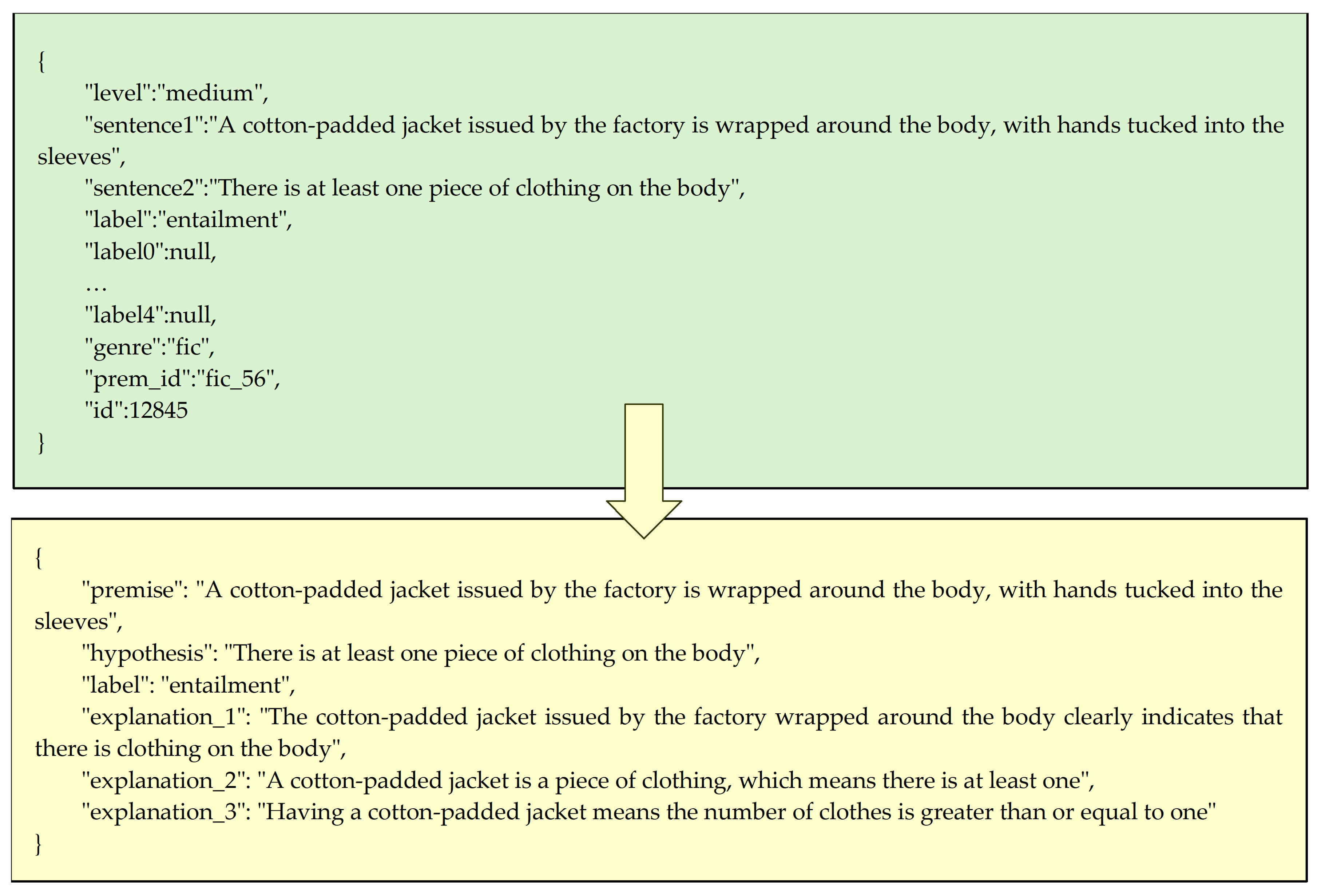
Taking OCNLI data as an example, the process of constructing a single ExNLI entry is as follows: first, the original premise and hypothesis are selected and the corresponding NLI label is retained; then, based on a pre-designed prompt template, the (premise, hypothesis, label) are used as inputs to offline call a large language model to generate a natural language explanation. The data field explanation_1 corresponds to the generated and retained teacher explanation. In the training/validation splits, we keep a single explanation (explanation_1) by default; in the test split, additional explanations (e.g., explanation_1–3) are retained for more comprehensive evaluation. To improve explanation quality and cover expressive diversity, we perform human or model-assisted selection and deduplication over candidate explanations, prioritizing explanations that are natural, logically consistent, and match the label relation; finally, the selected explanations are written into the corresponding fields to form a complete ExNLI entry. Figure 3 illustrates how an OCNLI entry is converted into an ExNLI entry, including the premise, hypothesis, original label, and the prompt-generated explanation.

4. Experimental Setup and Results

This section presents experiments and analyses centered on the methods proposed in this paper. Specifically, Section 4.1 describes preliminary experiments used to determine the size of the candidate pool for active learning, ensuring that the model can achieve performance close to full-data training even under limited data conditions. Section 4.2 examines how different numbers of shots affect the generated explanations. To ensure reliability, stability, and reproducibility, Section 4.3 conducts hyperparameter sensitivity analyses. Section 4.4 presents comparative experiments evaluating the effectiveness of the ETCM sampling algorithm. Section 4.5 assesses explanation quality from both human and automated evaluation perspectives. Section 4.6 tests the generalization ability of EGM-PM on question-answering tasks. Section 4.7 reports ablation and comparative studies to examine the contributions of explanation generation and ETCM, as well as comparisons with other language models, further demonstrating the effectiveness of the proposed approach. The experimental design and analyses in this section provide comprehensive support for the effectiveness and scalability of the proposed method.

4.1. Preliminary Experiment to Determine Candidate Pool Size

Due to the high computational cost of using the full dataset, this paper first conducted preliminary experiments aimed at identifying the minimal data size that achieves performance close to that of full-data training. This size was then used as the candidate pool for subsequent active learning simulations. This approach ensures that the selected data neither introduces distributional bias nor significantly reduces model performance, without requiring adjustments to the entire dataset.
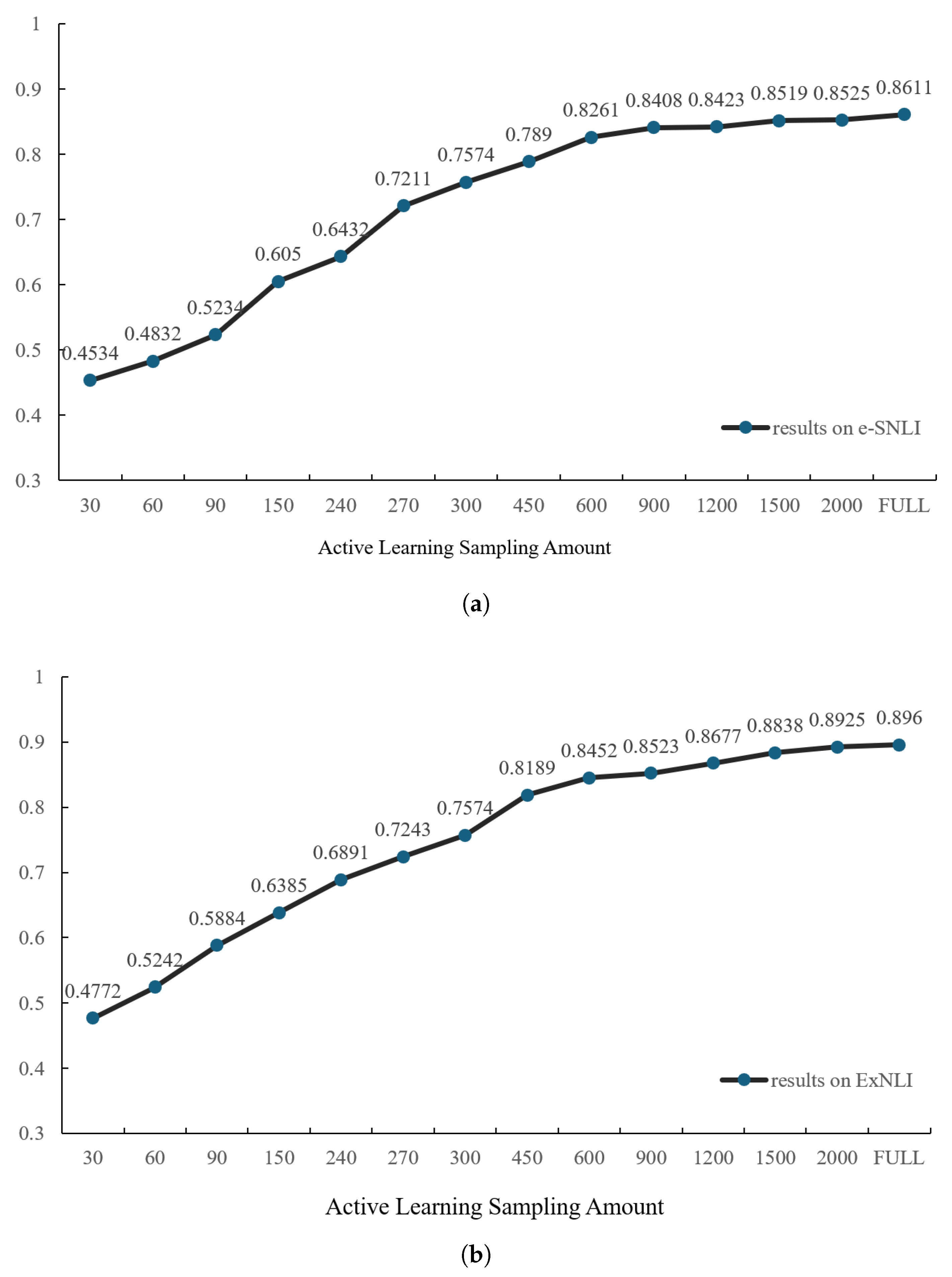
To establish the upper bound of performance and observe the model’s behavior under reduced training data, this paper randomly sampled an equal number of instances for each relation type—including Entailment, Contradiction, and Neutral—to prevent potential bias from class imbalance. For each category, multiple sampling scales were tested for comparative analysis, specifically including 30, 60, 90, 150, 240, 270, 300, 450, 600, 900, 1200, 1500, 2000, and the full dataset.
FLAN-T5 was used as the backbone to alternately fine-tune the EGM-PM model and conduct a hyperparameter search, followed by evaluation on the ExNLI and e-SNLI datasets. Figure 4a,b presents the experimental results, with the x-axis representing the number of samples and the y-axis showing the average accuracy over three independent runs. The results indicate that when the number of samples per class exceeds 1500, the performance drop is minimal (from 89.60% to 88.38%), demonstrating that a small-scale dataset can achieve performance close to full-data training. Based on this finding, the candidate pool size for unlabeled data in the active learning simulation was set to 1500 samples per class.
These results further indicate that the dual-model active learning framework can effectively leverage the semantic information contained in LLM-generated natural language explanations, enabling the model to acquire reliable reasoning capabilities even with limited labeled data.

4.2. Impact of Shot Number and Example Selection

In prompt engineering practice, to investigate the impact of different shot numbers on generated explanations and to evaluate the role of natural language explanations in practical tasks, this paper conducted experiments in which the generated explanations were used as auxiliary input to guide the PM model’s predictions. The experiments compared the performance of the baseline model (using only premise–hypothesis pairs) with that of models incorporating natural language explanations across varying shot sizes (1-shot, 3-shot, and 5-shot) and different example selection strategies (Random and diversity).
Considering the context window limitations of LLMs, inference costs, and diminishing marginal returns, this paper selected 1–5 shots as a cost-effective experimental range. While additional examples might yield slight performance improvements, the associated costs increase significantly, and thus, they were not explored in this experiment.
The results indicate that as the number of shots increases, the model’s prediction accuracy on the NLI task gradually improves. For the same number of shots, examples selected based on semantic diversity further enhance prediction performance compared with randomly selected examples (as shown in Figure 5). These findings suggest that high-quality, well-designed natural language explanations not only facilitate human understanding of model decisions but also significantly improve the model’s downstream predictive capabilities.

4.3. Hyperparameter Sensitivity Analysis Experiment

This paper conducts hyperparameter sensitivity analyses to ensure the reliability, stability, and reproducibility of the experiments. Based on the existing baseline settings and prior experience [17,19], we manually conducted small-scale pilot trials on a few candidate configurations; for example, we tried different combinations of epoch numbers in { 10 , 20 , 25 , 30 , 40 , 100 , 150 } , then selected the unified setting in Table 5 mainly according to validation accuracy.
As shown in Table 5, the learning rate is set to 1 × 10 4 , which demonstrates strong convergence behavior and training stability across multiple preliminary experiments, effectively balancing model performance and gradient update magnitude under low-resource settings. All experiments use a fixed random seed of 42 to reduce the influence of stochastic factors and improve reproducibility. With respect to optimizer configurations, EGM adopts the Adam optimizer to obtain more stable gradients for generation tasks, while PM uses AdamW, whose weight decay mechanism can more effectively mitigate overfitting in classification models. The batch size is uniformly set to 4, balancing GPU memory constraints and ensuring stable gradient estimates under few-shot conditions. The dropout rate is set to 0.1, which helps improve model generalization while avoiding excessive regularization that may negatively affect explanation generation quality. The maximum input length of both EGM and PM is set to 512, and the Max Output Length of EGM is set to 128, to cover the context and output range required for explanation generation. During EGM inference, we use beam search (beam size = 4) to balance generation quality and computational cost.
Regarding the training epochs, we evaluate EGM–PM under different epoch combinations while keeping all other hyperparameters fixed; in each active-learning iteration, we sample 150 instances for each label. We focus on two sensitivity aspects: (1) the convergence speed in the early training stage, and (2) the marginal gains and potential signs of overfitting after entering a stable region, thereby providing a basis for selecting a unified epoch setting. The candidate epochs of EGM are { 10 , 20 , 25 , 30 , 40 } , and the candidate epochs of PM are { 20 , 25 , 30 , 40 , 50 , 100 , 150 } .
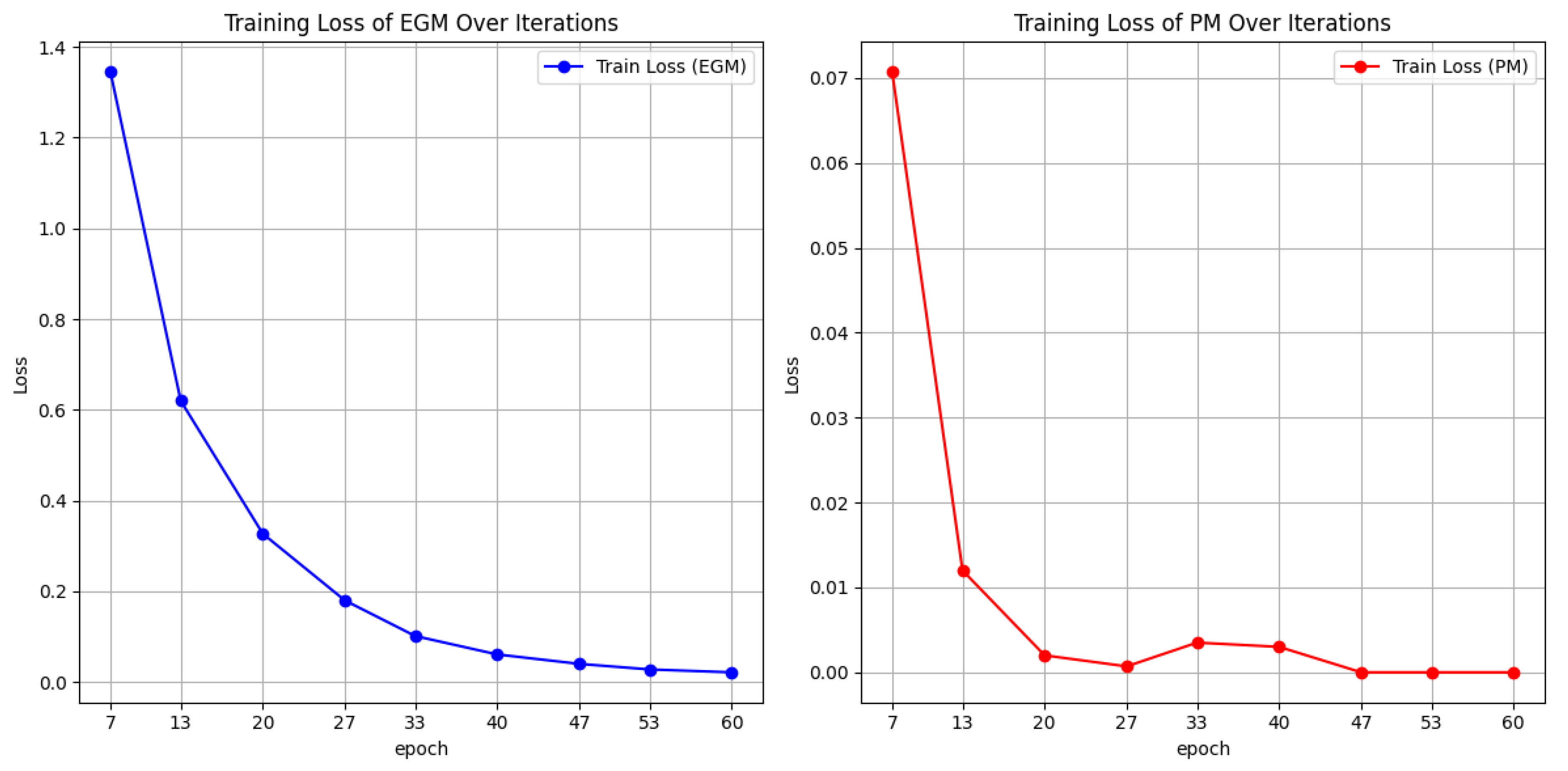
As shown in Figure 6, as the number of iterations increases, the training loss of EGM decreases substantially in the early stage and stabilizes after around 20 epochs, indicating that EGM can reach relatively desirable performance with fewer training epochs and that further increasing the iterations beyond 25 epochs brings limited additional improvement; in contrast, PM exhibits a faster loss reduction and approaches zero after roughly 13 epochs, suggesting that natural language explanations help the model quickly learn task-relevant features for natural language inference in the early stage of training. Moreover, the curve shapes show that EGM decreases more gradually whereas PM drops more sharply, which is consistent with the optimization characteristics of the two tasks: as a model for explanation generation, EGM needs to fit the target distribution progressively in a more complex output space, leading to a more gradual convergence process, whereas PM, as a discriminative classification model, can typically capture the main discriminative signals early in training and thus shows a faster loss decrease.
In the pilot comparison of training-budget combinations (Table 6), we observe diminishing marginal returns. Validation accuracy improves as the EGM training epochs increase up to 25, but does not exhibit consistent gains beyond this point. Moreover, substantially increasing the PM training epochs alone fails to yield stable improvements. Based on these, we set the training epochs to 25 for EGM and 20 for PM, and keep this configuration fixed in all subsequent experiments.

4.4. Comparative Experiment of Active Learning Sampling Algorithms

After determining the experimental hyperparameters, this paper conducts comparative experiments to further evaluate the effectiveness of the ETCM sampling algorithm by comparing its performance with multiple active learning sampling strategies on the ExNLI dataset.
Experimental setup: In each iteration, 10 samples per class (Entailment, Contradiction, Neutral) were selected, totaling 30 samples per iteration. After 15 iterations, a total of 450 samples were annotated. For each experiment, 1500 samples per class were randomly selected from the full training dataset to form the candidate data pool, as determined in the preliminary experiments.
To ensure that performance differences during each experiment were attributable to the sampling algorithms rather than variations in the unlabeled data pool, the same data were used within the proposed dual-model framework while employing different data selectors for active learning simulation. After each iteration, 900 samples were randomly drawn from the ExNLI test set for evaluation.
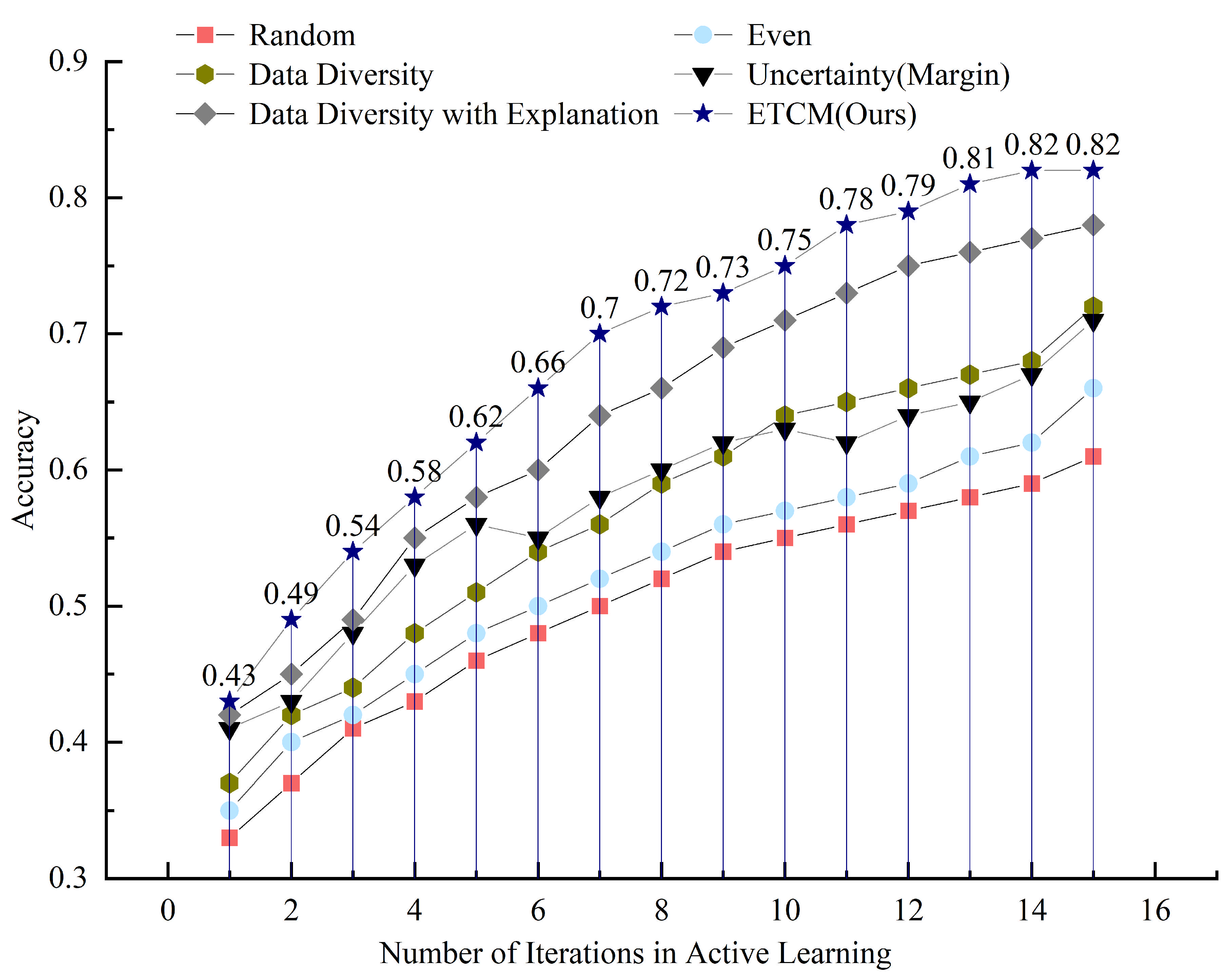
The experiments compared random sampling, even sampling, diversity-based sampling TypiClust [17], uncertainty-based sampling Margin, explanation-enhanced uncertainty sampling [19], and the proposed ETCM sampling algorithm. The results of the active learning simulations are shown in Figure 7, where each point represents the average accuracy over 80 trials for each data selector in a single iteration.
The comparison between Margin sampling and explanation-enhanced uncertainty sampling demonstrates that using LLM-generated natural language explanations for data selection yields better predictive performance than relying solely on the data content. In each iteration, ETCM consistently outperformed the baseline data selectors, confirming the effectiveness of the stepwise algorithm that combines interpretability-based uncertainty with diversity. Even when only 150 samples per label were annotated, the system achieved an average accuracy of 82%. Through continuous active learning iterations, the system was able to reach a global performance level of 85% using a very small amount of data, achieving faster convergence.
By learning embeddings of natural-language explanations, the model can better understand the relationship between the premise and the hypothesis, resulting in improved performance on prediction tasks. This indicates that incorporating high-quality natural language explanations during data selection can effectively enhance model performance.

4.5. Dataset Quality Evaluation

This section evaluates the consistency and faithfulness of natural language explanations generated by LLMs, as well as those in the constructed ExNLI dataset. We conduct the evaluation from two complementary perspectives: (1) human assessment of subjective quality; and (2) objective evaluation using automatic metrics, where BERTScore measures semantic similarity to reference explanations, and LaBSE [31] measures cross-lingual semantic alignment among explanations.

4.5.1. Human Evaluation of Explanation Quality

To assess the quality of model-generated natural language explanations, we recruited three researchers in natural language processing as annotators. We drew evaluation instances from ExNLI via stratified random sampling by label, including 10 examples for each of the three relation labels (30 instances in total), to mitigate rating bias induced by class imbalance and to enable a fairer comparison of explanation quality across relation types. For each instance, annotators were shown the original premise, hypothesis, the corresponding relation label, and the natural language explanations generated by different large language models. We adopted a blind rating setup in which annotators did not know which model produced each explanation, reducing source-induced prior preferences and confirmation bias and thereby improving the objectivity and reliability of human evaluation. In addition, we randomized the order of instances and, within each instance, randomly permuted the explanations produced by different models to minimize order effects and contrast bias.
A Likert scale was created based on the randomly selected samples. Without knowledge of how the explanations were generated, each participant was asked to respond to the following questions:
  • Does the explanation accurately reflect the logical relationship between the premise and hypothesis (Entailment, Contradiction, Neutral)?
  • Is the language of the explanation clear and easy to understand?
  • Is the explanation primarily grounded in the premise and hypothesis, and free of obviously fabricated information that contradicts the text?
  • Is the explanation itself factually correct?
  • Regardless of the AI’s correctness, does the explanation help you understand why the premise and hypothesis have the given relationship?
  • Would you trust and use this AI in a real-world scenario?
These six questions correspond to relation consistency (Q1), readability (Q2), faithfulness/avoidance of fabrication (Q3), statement correctness (Q4), usability (Q5), and subjective trust (Q6), respectively, providing a multi-dimensional characterization of explanation quality under a limited evaluation budget.
In the experiment, each of the three human evaluators scored the same set of 30 samples, and for each sample, scored the explanations produced by different models separately. Taking the three models evaluated in this study as an example, the total number of question ratings was 3 evaluators × 30 samples × 3 explanations/sample × 6 questions = 1620 question ratings. Each question was rated on a 5-point Likert scale (1–5), where 1 = strongly disagree (very poor), 3 = neutral, and 5 = strongly agree (very good). For reporting, scores were linearly mapped to 0–100 (i.e., each per-question score × 20 ), and the mean was reported as the Average Score.
In addition, we compute inter-rater agreement for each question using the intraclass correlation coefficient (ICC; Equation (18)) under a two-way random-effects model and Fleiss’ kappa (Equations (19) and (20)) to quantify how consistently different annotators evaluate the same set of instances. Both metrics are computed on the original 1–5 ratings, while the 0–100 mapping is used only for reporting the mean scores. After pooling explanations generated by different models, we report the Average Score for each question together with the corresponding ICC and Fleiss’ kappa, as shown in Table 7.
I C C = M S R M S E M S R + ( k 1 ) · M S E + k · MSC MSE n
where k represents the number of raters, n is the number of samples, MSR is the mean square between groups, and represents the variance among samples, MSE is the mean square within groups, represents the variance among raters, and MSC is the mean square for columns.
K a p p = P 0 P e 1 P e
where P 0 is the observed agreement among raters, and P e is the expected agreement by chance.
P 0 = 1 N i = 1 N 1 r j = 1 k n ij ( n i j 1 ) r 1 , P e = j = 1 k p j 2
where N is the total number of items evaluated, r is the number of raters per item, n i j is the number of raters who assigned item i to category j, p j is the overall proportion of ratings assigned to category j across all items and raters, P 0 is the observed agreement among raters, and P e is the expected agreement by chance.
Beyond the overall agreement results, we further aggregate the ratings at the model level by averaging, for each model, its explanation scores across all questions, and use these averages to compute an overall score per model. Notably, Q4 (statement correctness) exhibits a ceiling effect, yielding limited discriminative power and potentially attenuating differences on other, more informative dimensions; therefore, we exclude it from the overall score. Based on the aggregated results, under the same prompt template setting, the overall human-evaluation performance of explanations ranks as follows: DeepSeek-R1-Distill-Qwen-7B (96.62) > Qwen2.5-Coder-7B-Instruct (94.10) > FLAN-T5 (92.17). Overall, the results are strong, suggesting that under the proposed prompt template constraints, different models can generate natural language explanations that help humans understand relation judgments.
Table 7 shows generally high agreement metrics across question dimensions, indicating that annotators’ judgments of explanation quality are relatively stable and consistent. Nevertheless, human evaluation may still be influenced by subjective factors such as individual preferences and writing styles, and a limited sample size cannot fully capture all facets of explanation quality. Therefore, we further conduct complementary validation with automatic metrics, using BERTScore to measure the semantic similarity between generated explanations and human reference explanations, and LaBSE to assess cross-lingual alignment among explanations. Together, these human and automatic evaluations provide converging evidence for the effectiveness of explanations in terms of semantic consistency and cross-lingual alignment.

4.5.2. Automated Evaluation

To systematically evaluate the quality of generated explanations and consistency, we adopt two complementary automatic metrics: (1) BERTScore (F1), which measures semantic consistency between generated explanations and human reference explanations; and (2) LaBSE-based cross-lingual alignment, which quantifies semantic alignment between explanations in different languages for the same instance.
For the BERTScore evaluation, we perform stratified random sampling from ExNLI by relation label, yielding 90 instances (30 each for entailment/contradiction/neutral). We then write Chinese and English reference explanations, and ensure that each generated explanation and its reference explanation are in the same language. The human reference explanations are written by two researchers with NLP backgrounds, following a unified guideline, and are cross-checked by each other.
For cross-lingual alignment evaluation, we use LaBSE [31] to compute a language-agnostic embedding alignment score for four-language generated explanations. Concretely, for each instance, we encode its explanations in the four languages, compute all pairwise cosine similarities and average them, and then take the mean over all instances as the overall alignment metric.
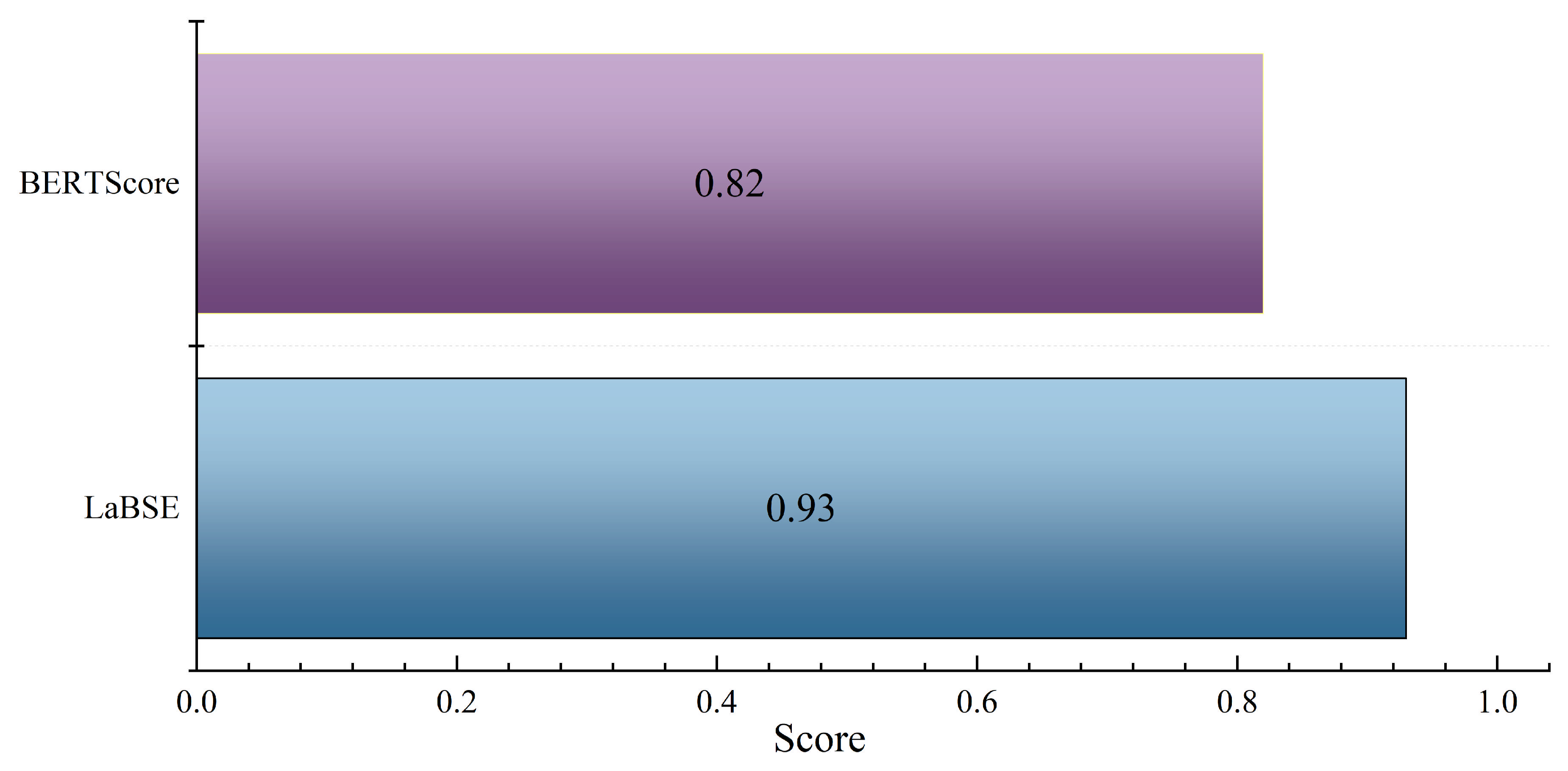
As shown in Figure 8, the LaBSE score is 0.93, indicating high cross-lingual consistency of the four-language generated explanations; the BERTScore (F1) is 0.82, suggesting strong semantic consistency between generated explanations and human reference explanations. Overall, the generated explanations exhibit stable performance in both semantic consistency and cross-lingual alignment. The contribution of explanations to model performance will be further validated in subsequent ablation studies and active-learning experiments.

4.6. Cross-Task Transfer Experiment: Evaluation on Question Answering

To explore the applicability of the proposed framework to other natural language processing tasks and to verify the generalization ability of EGM–PM, we conduct a transfer experiment on the Stanford Question Answering Dataset (SQuAD) [32]. We use the official train/dev split provided by SQuAD, and evaluate under an Answerable-only setting (i.e., only questions with at least one valid reference answer are included for evaluation).
We adopt a T5-based sequence-to-sequence (seq-to-seq) formulation for extractive-style question answering by generating answer text. Formally, given a question q and a context passage c, the model generates an answer a ^ . Specifically, the prediction model (PM) takes ( q , c ) as input and directly generates a ^ . In EGM–PM, we first use an explanation-generation model (EGM) to produce a natural language explanation e solely based on ( q , c ) , where e is expected to summarize the evidence and reasoning that support the answer. Importantly, the explanation generation process does not access or include any reference (gold) answer information. Then, the prediction model generates the final answer a ^ conditioned on ( q , c , e ) . At test time, we also use only the explanations automatically generated by EGM, without introducing any human/Oracle information. The unified input template is question:{q} context:{c}, and the output is the answer text.
This experiment is not intended to demonstrate that EGM can generate human-standard explanations that conform to QA conventions; rather, it aims to test the transferability of the explanation-conditioned mechanism in QA scenarios. Although NLI and QA are different tasks, they share a common underlying reasoning process of locating evidence relevant to the query in the input text and performing semantic compression. In particular, NLI explanations typically involve restating and aligning key evidence spans, while QA likewise relies on focusing on evidence relevant to the question. Therefore, we hypothesize that EGM transfers this “evidence searching” capability to the QA task, and the generated explanations can serve as a guiding signal that helps PM attend to relevant context more precisely. Specifically, EGM fully inherits the weights trained on ExNLI and is directly used to generate explanation-style auxiliary text for SQuAD inputs, without any additional fine-tuning of EGM on the QA dataset, whereas PM is still trained on the SQuAD training split in the standard QA setting.
We evaluate using the official SQuAD evaluation script and report EM/F1. EM denotes the proportion of predictions that exactly match any reference answer, and F1 is the token-level overlap F1 between the prediction and reference answers (based on token-level precision and recall). We emphasize that explanations are used only as input conditions: the prediction model outputs only answer text, and the explanation text is not directly included in metric computation. Under the same training configuration as in the main experiments (with other hyperparameters kept unchanged), we repeat each setting 10 times and report the averaged results.
As shown in Table 8, compared with PM without explanations, EGM–PM consistently improves both EM and F1, indicating that conditioning on explanations as an intermediate semantic variable is not only helpful for NLI decision-making, but can also effectively benefit question answering tasks that require evidence localization and reasoning integration, even under an unsupervised transfer setting for EGM.

4.7. Ablation Experiment and Model Comparison

4.7.1. Ablation Study on the Explanation Components in ETCM

To assess the practical contribution of natural language explanations within the ETCM algorithm and to examine their stage-wise effects on the sampling process, we conduct ablation and sensitivity studies on the explanation component of ETCM in this subsection.
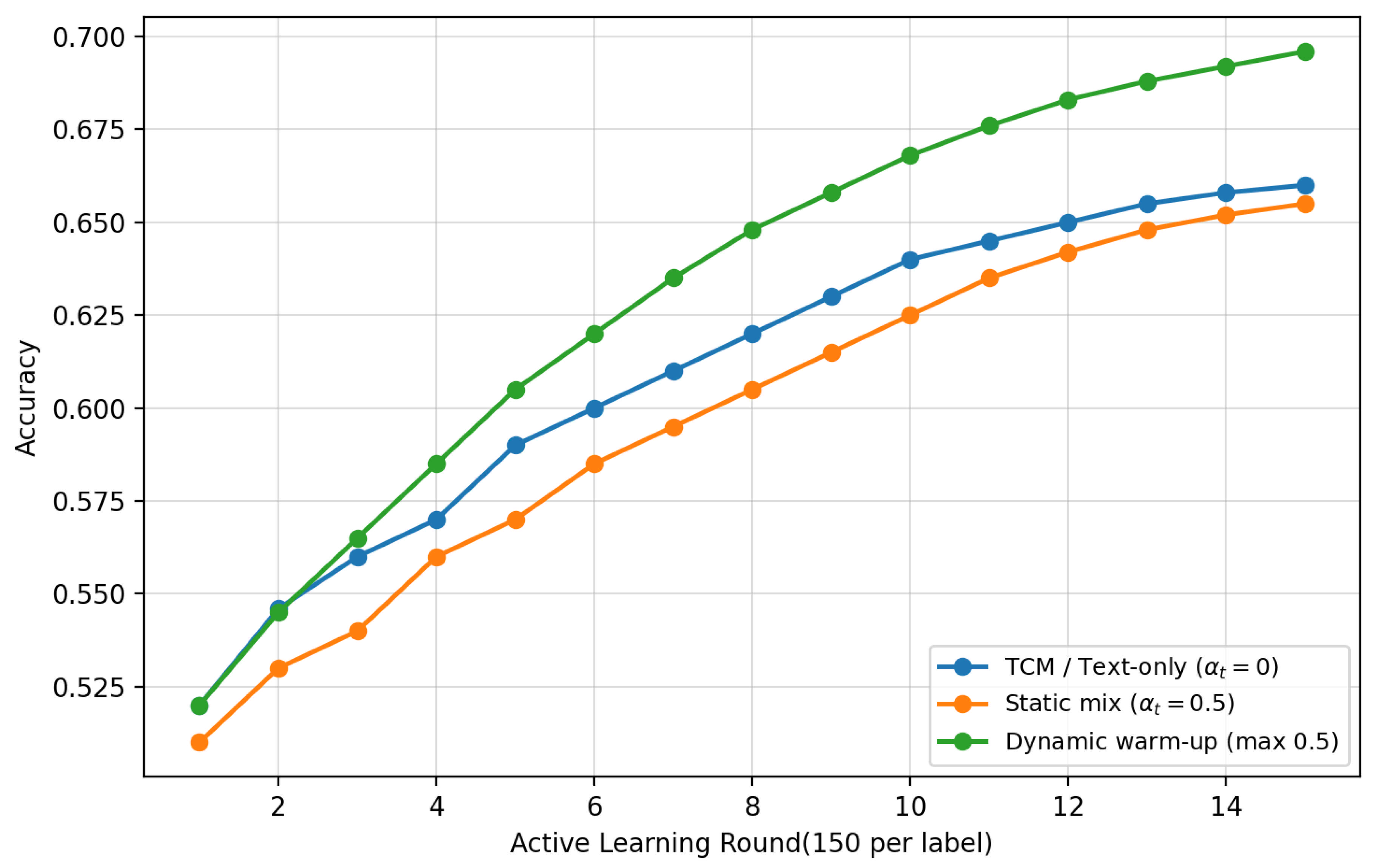
Specifically, we analyze the explanation fusion strategy in Stage 1 and the explanation-discrepancy component in Stage 2, corresponding to α t in Equation (2) and γ in Equation (17), respectively. The former determines how the text representation is fused with the natural language explanations representation r expl ( x ) , whereas the latter controls the weight of the explanation-discrepancy signal in uncertainty-based sampling. The results are reported in Table 9 and Figure 9.
Meanwhile, we introduce TCM [18] and treat it as a special case of ETCM with the explanation-enhancement mechanism removed: in Stage 1, set α t 0 so that sample representations are determined solely by textual semantics; in Stage 2, set γ 0 so that sampling no longer depends on the explanation-aware component.
Effect of the Explanation Fusion Strategy ( α t , Stage 1)
In Stage 1 (TypiClust–Explanation), we use the fused representation r ( x ; t ) to support clustering and diversity-based selection, where r ( x ; t ) is obtained by combining the text representation and the natural language explanations representation with weight α t . Let γ 0 , and holding all other parameters fixed, we compare the following three configurations:
  • TCM/Text-Only ( α t 0 ): clustering and selection are performed using only the text representation;
  • Static Mix ( α t 0.5 ): an equal-weight fusion of text and explanations is used throughout;
  • ETCM/Dynamic Warm-up (Max = 0.5): a dynamic linear warm-up is applied, such that α t increases progressively with iterations and eventually stabilizes at 0.5 .
As shown in Figure 9, Static Mix performs worse than Dynamic Warm-up in the early iterations, whereas the latter maintains stability during the cold-start stage while continuing to yield larger gains in subsequent iterations. This suggests that when labeled data are still scarce and the semantic structure has not yet fully emerged, an “immediate equal-weight” introduction of explanation signals is not necessarily optimal. In contrast, introducing explanation information by progressively increasing α t better balances early coverage with later exploitation of semantic structure, resulting in a more robust active-learning trajectory.
Notably, active learning is strongly path-dependent: even after the warm-up phase, when α t is fixed at 0.5 , Dynamic Warm-up and Static Mix may still differ because they select different sample sequences in the early rounds, which in turn leads to divergent subsequent training states (e.g., the labeled set and model parameters). TCM/Text-Only matches ETCM in the early rounds; however, after the second iteration, ETCM progressively captures implicit information in natural language inference, thereby enabling better reasoning performance and demonstrating the effectiveness of natural language explanations in active learning.
Contribution of Explanation Semantic Discrepancy ( γ , Stage 2).
In MarginNLI, ETCM introduces the explanation semantic discrepancy D expl in addition to probabilistic uncertainty, and uses γ to control its weight. To evaluate the contribution of this component and examine sensitivity to its weighting, we compare γ { 0 , 0.1 , 0.5 , 1.0 , 2.0 } while fixing α t 0 .
The results in Table 9 show that incorporating D expl (i.e., γ > 0 ) generally yields better overall performance than the γ = 0 baseline. Compared with sampling based solely on margin/entropy, the explanation-discrepancy component improves the semantic complementarity of the selected samples. The best performance is achieved at γ = 1.0 . This is likely because both the probabilistic-uncertainty component and D expl are normalized and mapped to comparable scales before fusion; consequently, γ = 1.0 places the two signals at similar magnitudes, facilitating a more appropriate trade-off between “high-uncertainty samples near the decision boundary” and “semantically more novel samples”. Increasing γ further leads to a slight degradation, suggesting that an overly strong bias toward explanation discrepancy may reduce attention to high-uncertainty samples and thus diminish the benefits of uncertainty-based sampling.
Overall, natural language explanations provide a controllable source of semantic supplementation in ETCM. Early on, r expl ( x ) is introduced progressively via α t to improve the semantic organization of clustered representations, while care must be taken to avoid excessive disruption of the representation space by noisy explanations during cold start; later, D expl introduces a semantic-complementarity preference beyond uncertainty, mitigating semantically redundant sampling.

4.7.2. Ablation Study on the ETCM and NLEs

To evaluate the effectiveness of the proposed ETCM active learning algorithm and natural language explanations in the NLI task, this paper designs the following groups as ablation study baselines:
(a)
PM (FLAN-T5 220 M): The prediction model is trained without active learning processing, without the ETCM sampling algorithm, and without supervision from natural language explanations generated by the EGM.
(b)
EGM-PM (Random 220 M): The EGM model is incorporated to generate natural language explanations, which are used as part of the input to the prediction model for explanation-based supervision. Active learning is employed with Random sampling to select data for annotation. This setting aims to evaluate the contribution of the EGM and the effectiveness of natural language explanations in the NLI task.
(c)
EGM-PM (ETCM 220 M): The EGM-generated explanations are similarly integrated into the prediction model as explanatory input, while the proposed ETCM algorithm is used for active learning sample selection. This variant is designed to assess the efficacy of the ETCM sampling strategy.
As shown in Table 10, under otherwise identical experimental conditions, models with larger parameter counts generally achieve better performance, as illustrated in rows 2–3. However, when natural language explanations generated by EGM are incorporated into the PM as supervisory signals in configuration (b), the resulting 220 M-parameter model not only significantly outperforms its same-sized counterpart without explanation supervision (configuration (a)), but also surpasses the much larger PM (780 M) trained without explanations. This result indicates that the semantic information contained in natural language explanations enhances the model’s ability to understand natural language inference tasks. Moreover, replacing the random sampling strategy with the proposed ETCM active learning algorithm further improves NLI accuracy to 88.89%, which is the highest among all ablation and baseline configurations, clearly demonstrating the effectiveness of the ETCM sampling strategy.
In summary, the integration of the ETCM active learning algorithm and the EGM-PM architecture achieves superior performance while using substantially fewer parameters than larger baseline models.

4.7.3. Comparison with Other Methods

To further investigate model performance on natural language inference tasks, this paper conducts a systematic comparison of several commonly used language models on the e-SNLI dataset. To ensure a fair evaluation under limited data conditions, the experiments adopt the settings determined in preliminary experiments, fixing the candidate data pool size at 1500 and maintaining the hyperparameter configurations described above. The experimental results are presented in Table 10.
A detailed analysis of the experimental results reveals that, in resource-constrained NLI tasks, general-purpose pretrained models perform suboptimally when model parameter sizes are limited. For instance, RoBERTa [33] and FLAN-T5 780M [28] achieve accuracies of merely 44.08% and 57.29%, respectively, failing to effectively capture the semantic relationships between hypotheses and premises when contextual information is insufficient.
Although a stepwise distillation approach based on large models [34] raises the accuracy to 75.38%, its training cost is prohibitively high, making it unsuitable for low-resource scenarios with limited interpretability and difficult to generalize to other few-shot tasks. Pham et al. [23] guided LLMs along specific generative directions to produce natural language explanations for NLI prediction, achieving an accuracy of 83.93%. However, the resulting natural language explanations are often lengthy and contain considerable redundancy, which increases computational overhead and leads to resource inefficiency, thereby limiting the scalability and efficiency of real-world systems. In contrast, Yao et al. [19] combined the core-set approach with manually annotated explanations and achieved iterative optimization via active learning, attaining the highest reported accuracy of 87.02% on the e-SNLI dataset.
Surpassing these baselines, the proposed ETCM algorithm achieves an accuracy of 88.89% by training on only a small subset of the full dataset annotated with natural language explanations, significantly outperforming all competing methods. These findings validate the effectiveness of the proposed sampling algorithm and the EGM-PM framework, while highlighting the rich semantic potential embedded within natural language explanations. Moreover, the results underscore the feasibility and value of integrating efficient, scalable, and interpretable large language models into practical NLI applications.

5. Discussion

  • Efficiency of Explanation Supervision in Low-Resource Settings. As shown in Table 10, under the same low-resource setting, EGM–PM with 220 M parameters in EGM-PM outperforms the substantially larger 780 M-parameter FLAN-T5. This result indicates that, when data are limited, the quality of the supervision signal plays a critical role. Standard NLI fine-tuning implicitly relies on the model to infer logical patterns from labels; in contrast, explanations generated by EGM provide explicit intermediate reasoning steps. This structure functions as a reasoning scaffold, enabling a smaller model to align with task logic more efficiently than a larger model trained with sparse label supervision alone.
  • Dynamic Integration of Explanation Semantics. An ablation study on the fusion weight α t (Figure 9) shows that a progressive “dynamic warm-up” strategy outperforms static fusion. This observation highlights that explanation semantics are sensitive to the stage of learning and inference. During the early “cold-start” phase, EGM is trained on only a handful of samples, so the resulting explanation embeddings may be noisy or overly generic. Consequently, over-reliance on explanations for clustering in the initial rounds can be detrimental. ETCM derives its effectiveness from a dynamic adjustment mechanism: it prioritizes textual diversity when explanation quality is uncertain, and gradually incorporates explanation semantics as EGM stabilizes, thereby improving the trajectory of active learning.
  • Complementarity between Semantic Discrepancy and Uncertainty. A sensitivity analysis of γ (Table 9) suggests that the explanation discrepancy ( D expl ) captures information that differs from probabilistic uncertainty. Uncertainty sampling typically targets instances near the decision boundary (e.g., low-confidence cases), whereas D expl identifies instances that exhibit semantically novel reasoning patterns relative to the labeled set. The performance drop observed at high γ (e.g., γ = 2.0 ) indicates that these two signals should be balanced rather than treated as substitutes. Our findings suggest that NLEs can serve as an effective orthogonal signal that complements, rather than replaces, conventional uncertainty measures in active sampling.

6. Limitations

This study has several limitations, particularly regarding evaluation reliability and deployment cost, which also point to directions for future work:
  • Subjectivity and Scope of Human Evaluation: Human evaluation is inherently susceptible to cognitive biases. Although we implemented rigorous controls to mitigate these effects—including double-blind annotation, randomized ordering, and inter-rater agreement checks (ICC/Kappa)—subjectivity cannot be entirely eliminated. Annotators may still unconsciously favor fluent or verbose explanations while discounting concise ones. Moreover, due to resource constraints, our human evaluation was conducted on a stratified subset. This limited scope may fail to fully capture the model’s behavior on long-tail instances, motivating more comprehensive, large-scale evaluation protocols in future work.
  • Logical Validity of Generated Explanations:Although EGM is conditioned on ground-truth labels, this does not fully guarantee that the generated explanations are always logically sound. In some cases, the LLM may rely on tautological paraphrasing or hallucinated details not supported by the text to justify a given label. Such “plausible but ungrounded” explanations constitute noisy supervision signals; while our current framework partially mitigates this issue through active selection, it does not explicitly filter them out.
  • Computational Overhead in Sampling: Although EGM–PM reduces human annotation cost, ETCM introduces additional computational overhead. Computing explanation embeddings for the full candidate pool requires encoder inference, which is computationally more expensive than simple uncertainty sampling.
  • Dependence on Base Model Capability: Our method assumes that the base LLM possesses a minimum level of reasoning capability. In extremely low-resource languages where the base model performs poorly, the generated explanations may be too noisy to provide effective guidance.

7. Conclusions

To address the challenges of interpretability in Natural Language Inference (NLI) and the high cost of manual expert annotation for explanations, this paper proposes EGM–PM, a dual-model active learning framework that leverages large language models (LLMs) as surrogate experts. By replacing the human oracle with automated explanation generation, the framework reduces reliance on costly manual annotation and supports scalable data construction.
In addition, we introduce ETCM, a staged sampling algorithm that integrates explanation semantics with textual diversity to complement standard uncertainty-based sampling. Within the iterative loop of EGM–PM, the generated explanations provide additional supervision signals that can guide the prediction model during training.
Experiments on the e-SNLI and ExNLI datasets show that our approach can achieve competitive predictive performance under limited annotation budgets and with smaller model sizes. In particular, the 220 M-parameter EGM–PM outperforms larger 780 M-parameter baselines in our low-resource setting, suggesting that high-quality explanation supervision may partially offset model capacity when labeled data are scarce.
Overall, this work offers a practical framework for building interpretable NLI systems under constrained resources. Future work will focus on (1) improving the faithfulness of generated explanations to reduce ungrounded supervision signals, and (2) extending the EGM–PM framework to more complex reasoning tasks beyond NLI, such as multi-hop question answering.

Author Contributions

Conceptualization, Q.W. and J.L.; methodology, Q.W.; software, Q.W.; validation, Q.W.; formal analysis, Q.W. and J.L.; investigation, Q.W.; resources, Q.W. and J.L.; data curation, Q.W.; writing—original draft preparation, Q.W.; writing—review and editing, J.L.; visualization, Q.W. and J.L.; supervision, J.L.; project administration, J.L.; funding acquisition, Q.W. All authors have read and agreed to the published version of the manuscript.

Funding

This paper was funded by the National Natural Science Foundation of China (NSFC.62276231).

Institutional Review Board Statement

The study was conducted in accordance with the Declaration of Helsinki and approved by the Institutional Review Board Academic Committee of the School of Information and Electronic Engineering, Zhejiang Gongshang University (30001820250922 on 22 September 2025).

Informed Consent Statement

Informed consent was obtained from all subjects involved in the study.

Data Availability Statement

The dataset ExNLI created by the study is available at https://github.com/wangqizjgsu/exnli (accessed on 25 November 2025).

Conflicts of Interest

The authors declare no conflicts of interest.

References

  1. Saarela, M.; Podgorelec, V. Recent applications of Explainable AI (XAI): A systematic literature review. Appl. Sci. 2024, 14, 8884. [Google Scholar] [CrossRef]
  2. Lipton, Z.C. The mythos of model interpretability: In machine learning, the concept of interpretability is both important and slippery. Queue 2018, 16, 31–57. [Google Scholar] [CrossRef]
  3. Bowman, S.; Angeli, G.; Potts, C.; Manning, C.D. A large annotated corpus for learning natural language inference. In Proceedings of the 2015 Conference on Empirical Methods in Natural Language Processing, Lisbon, Portugal, 17–21 September 2015; pp. 632–642. [Google Scholar] [CrossRef]
  4. Williams, A.; Nangia, N.; Bowman, S. A Broad-Coverage Challenge Corpus for Sentence Understanding through Inference. In Proceedings of the 2018 Conference of the North American Chapter of the Association for Computational Linguistics: Human Language Technologies, Volume 1 (Long Papers), Orleans, LA, USA, 1–6 June 2018; pp. 1112–1122. [Google Scholar] [CrossRef]
  5. Conneau, A.; Rinott, R.; Lample, G.; Schwenk, H.; Stoyanov, V.; Williams, A.; Bowman, S.R. XNLI: Evaluating cross-lingual sentence representations. In Proceedings of the 2018 Conference on Empirical Methods in Natural Language Processing, EMNLP 2018, Brussels, Belgium, 31 October–4 November 2018; pp. 2475–2485. [Google Scholar] [CrossRef]
  6. Hu, H.; Richardson, K.; Xu, L.; Li, L.; Kübler, S.; Moss, L.S. OCNLI: Original Chinese Natural Language Inference. In Proceedings of the Findings of the Association for Computational Linguistics: EMNLP 2020, Online Event, 16–20 November 2020; pp. 3512–3526. [Google Scholar]
  7. Camburu, O.M.; Rocktäschel, T.; Lukasiewicz, T.; Blunsom, P. e-snli: Natural language inference with natural language explanations. In Proceedings of the Advances in Neural Information Processing Systems 31, Montréal, QC, Canada, 3–8 December 2018. [Google Scholar]
  8. Zhang, S.; Gong, C.; Liu, X.; He, P.; Chen, W.; Zhou, M. ALLSH: Active Learning Guided by Local Sensitivity and Hardness. In Proceedings of the 2022 Annual Conference of the North American Chapter of the Association for Computational Linguistics, Washington, DC, USA, 10–15 July 2022. [Google Scholar] [CrossRef]
  9. Barredo Arrieta, A.; Díaz-Rodríguez, N.; Del Ser, J.; Bennetot, A.; Tabik, S.; Barbado, A.; García, S.; Gil-López, S.; Molina, D.; Benjamins, R.; et al. Explainable Artificial Intelligence (XAI): Concepts, taxonomies, opportunities and challenges toward responsible AI. Inf. Fusion 2020, 58, 82–115. [Google Scholar] [CrossRef]
  10. Liu, G.; Zhang, J.; Chan, A.B.; Hsiao, J.H. Human attention guided explainable artificial intelligence for computer vision models. Neural Netw. 2024, 177, 106392. [Google Scholar] [CrossRef] [PubMed]
  11. Quan, X.; Valentino, M.; Dennis, L.; Freitas, A. Verification and Refinement of Natural Language Explanations through LLM-Symbolic Theorem Proving. In Proceedings of the 2024 Conference on Empirical Methods in Natural Language Processing, Miami, FL, USA, 12–16 November 2024; pp. 2933–2958. [Google Scholar] [CrossRef]
  12. Gurrapu, S.; Kulkarni, A.; Huang, L.; Lourentzou, I.; Batarseh, F.A. Rationalization for explainable NLP: A survey. Front. Artif. Intell. 2023, 6, 1225093. [Google Scholar] [CrossRef] [PubMed]
  13. Popovič, N.; Färber, M. Extractive Fact Decomposition for Interpretable Natural Language Inference in one Forward Pass. In Proceedings of the 2025 Conference on Empirical Methods in Natural Language Processing, Suzhou, China, 4–9 November 2025; pp. 31692–31705. [Google Scholar] [CrossRef]
  14. Hong, P.; Chen, B.; Peng, S.; de Marneffe, M.C.; Plank, B. LiTEx: A Linguistic Taxonomy of Explanations for Understanding Within-Label Variation in Natural Language Inference. In Proceedings of the 2025 Conference on Empirical Methods in Natural Language Processing, Suzhou, China, 4–9 November 2025; pp. 34065–34085. [Google Scholar] [CrossRef]
  15. Zong, C.C.; Wang, Y.W.; Ning, K.P.; Ye, H.B.; Huang, S.J. Bidirectional Uncertainty-Based Active Learning for Open-Set Annotation. In Proceedings of the European Conference on Computer Vision (ECCV 2024), Milan, Italy, 29 September–4 October 2024; Part XXVIII. Springer: Cham, Switzerland, 2024; pp. 127–143. [Google Scholar] [CrossRef]
  16. Sener, O.; Savarese, S. Active Learning for Convolutional Neural Networks: A Core-Set Approach. arXiv 2017, arXiv:1706.03762. [Google Scholar]
  17. Hacohen, G.; Dekel, A.; Weinshall, D. Active Learning on a Budget: Opposite Strategies Suit High and Low Budgets. In Proceedings of the 39th International Conference on Machine Learning (ICML 2022), Baltimore, MD USA, 17–23 July 2022; Chaudhuri, K., Jegelka, S., Song, L., Szepesvári, C., Niu, G., Sabato, S., Eds.; Proceedings of Machine Learning Research. PMLR: Cambridge, MA, USA, 2022; Volume 162, pp. 8175–8195. [Google Scholar]
  18. Doucet, P.; Estermann, B.; Aczel, T.; Wattenhofer, R. Bridging Diversity and Uncertainty in Active learning with Self-Supervised Pre-Training. In Proceedings of the 5th Workshop on Practical ML for Limited/Low Resource Settings (PML4LRS) @ ICLR 2024, Vienna, Austria, 11 May 2024; OpenReview: Alameda, CA, USA, 2024. [Google Scholar] [CrossRef]
  19. Yao, B.; Jindal, I.; Popa, L.; Katsis, Y.; Ghosh, S.; He, L.; Lu, Y.; Srivastava, S.; Hendler, J.A.; Wang, D. Beyond labels: Empowering human with natural language explanations through a novel active-learning architecture. In Proceedings of the Findings of the Association for Computational Linguistics: EMNLP 2023, Singapore, 6–10 December 2023; Association for Computational Linguistics: Stroudsburg, PA, USA, 2023. [Google Scholar] [CrossRef]
  20. Liu, P.; Yuan, W.; Fu, J.; Jiang, Z.; Hayashi, H.; Neubig, G. Pre-train, prompt, and predict: A systematic survey of prompting methods in natural language processing. ACM Comput. Surv. 2023, 55, 1–35. [Google Scholar] [CrossRef]
  21. Wei, J.; Wang, X.; Schuurmans, D.; Bosma, M.; Ichter, B.; Xia, F.; Chi, E.H.; Le, Q.V.; Zhou, D. Chain-of-thought prompting elicits reasoning in large language models. In Proceedings of the Advances in Neural Information Processing Systems 35 (NIPS ’22), Red Hook, NY, USA, 28 November–9 December 2022. [Google Scholar]
  22. Dhaini, M.; Vladika, J.; Erdogan, E.; Attaoui, Z.; Kasneci, G. Can LLM-Generated Textual Explanations Enhance Model Classification Performance? An Empirical Study. In Proceedings of the Artificial Neural Networks and Machine Learning—ICANN 2025, Kaunas, Lithuania, 9–12 September 2025; Senn, W., Sanguineti, M., Saudargiene, A., Tetko, I.V., Villa, A.E.P., Jirsa, V., Bengio, Y., Eds.; Lecture Notes in Computer Science. Springer: Cham, Switzerland, 2026; Volume 16070, pp. 192–204. [Google Scholar] [CrossRef]
  23. Pham, D.H.; Le, T.; Nguyen, H.T. How rationals boost textual entailment modeling: Insights from large language models. Comput. Electr. Eng. 2024, 119, 109517. [Google Scholar] [CrossRef]
  24. Heredia, M.; Etxaniz, J.; Zulaika, M.; Saralegi, X.; Barnes, J.; Soroa, A. XNLIeu: A dataset for cross-lingual NLI in Basque. In Proceedings of the 2024 Conference of the North American Chapter of the Association for Computational Linguistics: Human Language Technologies (Volume 1: Long Papers), Mexico City, Mexico, 16–21 June 2024; pp. 4177–4188. [Google Scholar] [CrossRef]
  25. Htet, A.K.; Dras, M. Myanmar XNLI: Building a dataset and exploring low-resource approaches to natural language inference with Myanmar. Lang. Resour. Eval. 2025, 59, 3267–3310. [Google Scholar] [CrossRef]
  26. Reimers, N.; Gurevych, I. Sentence-BERT: Sentence Embeddings using Siamese BERT-Networks. In Proceedings of the 2019 Conference on Empirical Methods in Natural Language Processing and the 9th International Joint Conference on Natural Language Processing (EMNLP-IJCNLP), Hong Kong, China, 3–7 November 2019; Association for Computational Linguistics: Stroudsburg, PA, USA, 2019; pp. 3982–3992. [Google Scholar]
  27. Raffel, C.; Shazeer, N.; Roberts, A.; Lee, K.; Narang, S.; Matena, M.; Zhou, Y.; Li, W.; Liu, P.J. Exploring the limits of transfer learning with a unified text-to-text transformer. J. Mach. Learn. Res. 2020, 21, 5485–5551. [Google Scholar]
  28. Chung, H.W.; Hou, L.; Longpre, S.; Zoph, B.; Tay, Y.; Fedus, W.; Li, Y.; Wang, X.; Dehghani, M.; Brahma, S.; et al. Scaling Instruction-Finetuned Language Models. J. Mach. Learn. Res. 2024, 25, 3381–3433. [Google Scholar]
  29. Hui, B.; Yang, J.; Cui, Z.; Yang, J.; Liu, D.; Zhang, L.; Liu, T.; Zhang, J.; Yu, B.; Lu, K.; et al. Qwen2.5-coder technical report. arXiv 2024, arXiv:2409.12186. [Google Scholar] [CrossRef]
  30. Guo, D.; Yang, D.; Zhang, H.; Song, J.; Wang, P.; Zhu, Q.; Xu, R.; Zhang, R.; Ma, S.; Bi, X.; et al. DeepSeek-R1 incentivizes reasoning in LLMs through reinforcement learning. Nature 2025, 645, 633–638. [Google Scholar] [CrossRef] [PubMed]
  31. Feng, F.; Yang, Y.; Cer, D.; Arivazhagan, N.; Wang, W. Language-agnostic BERT Sentence Embedding. In Proceedings of the 60th Annual Meeting of the Association for Computational Linguistics (Volume 1: Long Papers), Dublin, Ireland, 22–27 May 2022; pp. 878–891. [Google Scholar] [CrossRef]
  32. Rajpurkar, P.; Zhang, J.; Lopyrev, K.; Liang, P. SQuAD: 100,000+ Questions for Machine Comprehension of Text. In Proceedings of the 2016 Conference on Empirical Methods in Natural Language Processing, Austin, TX, USA, 1–4 November 2016; pp. 2383–2392. [Google Scholar] [CrossRef]
  33. Liu, Y.; Ott, M.; Goyal, N.; Du, J.; Joshi, M.; Chen, D.; Levy, O.; Lewis, M.; Zettlemoyer, L.; Stoyanov, V. RoBERTa: A Robustly Optimized BERT Pretraining Approach. arXiv 2019, arXiv:1907.11692. [Google Scholar]
  34. Hsieh, C.Y.; Li, C.L.; Yeh, C.K.; Nakhost, H.; Fujii, Y.; Ratner, A.J.; Krishna, R.; Lee, C.Y.; Pfister, T. Distilling Step-by-Step! Outperforming Larger Language Models with Less Training Data and Smaller Model Sizes. In Proceedings of the the 61st Annual Meeting of the Association for Computational Linguistics, Toronto, ON, Canada, 9–14 July 2023. [Google Scholar] [CrossRef]
Figure 1. Proposed active learning dual-model architecture: EGM-PM.
Information 17 00119 g001
Figure 2. The comparison covered zero-shot, zero-shot-CoT, and few-shot-CoT.
Information 17 00119 g002
Figure 3. Data construction process from OCNLI to ExNLI, illustrated with an example from OCNLI.
Information 17 00119 g003
Figure 4. The results of the preliminary experiment. (a) Results on the public e-SNLI dataset. (b) Results on the proposed ExNLI dataset.
Information 17 00119 g004
Figure 5. Prediction accuracy of the model under different shot numbers and example selection strategies.
Information 17 00119 g005
Figure 6. Training loss curves of EGM and PM models over epochs.
Information 17 00119 g006
Figure 7. Performance of different active learning sampling algorithms on ExNLI across iterations.
Information 17 00119 g007
Figure 8. Automated evaluation results.
Information 17 00119 g008
Figure 9. Effect of the Explanation Fusion Strategy ( α t , Stage 1) on ExNLI.
Information 17 00119 g009
Table 1. Illustration of the prompt template used to generate natural language explanations.
Prompt TypesContent
Task DescriptionPlease provide an explanation based on the given premise, hypothesis, and their relationship. The explanation should accurately reflect the logical connection between the premise-hypothesis pairs, be clear and easy to understand, avoid vagueness or redundancy, and stay faithful to logical reasoning without fabricating false reasons.
Background KnowledgeNatural Language Inference is a common task in the field of Natural Language Processing. It requires computers to understand the relationship between two sentences. Simply put, it asks the computer to determine whether a sentence can be reasonably inferred from another sentence. The possible logical relations between the two are: Entailment, Contradiction, or Neutral.
Example DataPremise: The church choir is singing joyful songs inside the church to the crowd.
Hypothesis:  The church is very quiet.
Label: contradiction
Explanation: Since the choir is singing in the church, it cannot be quiet because there is singing.
… (examples of the other two types of relationships)
RequirementsAvoid redundancy: Explanations should be concise and must not contain repetitive or irrelevant information.
Prohibit anaphora: Do not use vague pronouns such as “it” or “this”, and do not directly quote the premise or hypothesis; the explanation itself must be a complete sentence.
Maintain consistency: Explanations must remain logically consistent with the premise and hypothesis, avoiding contradictions.
Faithful reasoning: Explanations should be based solely on the logical relationship between the premise and hypothesis, without introducing additional assumptions.
Formal style: Responses should be written in complete natural language sentences, avoiding bullet points or colloquial expressions.
Table 2. Label distribution of each language in the XNLI dataset.
DatasetEntailmentContradictionNeutralTotal
Dev Set8258258402490
Test Set1665166516805010
Total2500250025007500
Table 3. Distribution of labels in the OCNLI dataset.
DatasetEntailmentContradictionNeutralTotal
Training Set16,89116,62216,48750,000
Dev Set1000100010003000
Total17,89117,62217,48753,000
Table 4. Label distribution of the ExNLI dataset with balanced sample sizes across English, German, French, and Chinese.
DatasetEntailmentContradictionNeutralTotal
Train Set2542254225577641
Dev Set283283283849
Test Set2665266526808010
Total54905490552016,500
Table 5. Hyperparameter settings.
HyperparameterExplanation Generation ModelPrediction Model
Learning Rate0.00010.0001
OptimizerAdamAdamW
Training Epochs2520
Dropout0.10.1
Batch Size44
Seed4242
Max Input Length512512
Max Output Length128N/A
Decoding StrategyBeam Search (beam size = 4)N/A
Table 6. Effect of epoch settings on model performance.
Epoch-EGMEpoch-PMAccuracy
10200.756
20200.789
25200.819
30200.816
251000.818
101500.761
Table 7. Human evaluation results.
QuestionAverage Score 1ICC ScoreFleiss’ Kappa
Q191.930.920.90
Q294.830.930.91
Q394.890.940.93
Q4100.001.001.00
Q592.680.890.88
Q692.570.870.89
1 Derived from manual scoring, with a full mark of 100.
Table 8. Generalization performance of the EGM-PM model on the SQuAD question answering dataset.
ModelSQuAD1.1
EM F1
PM85.4492.08
EGM-PM87.6893.89
Table 9. Effect of the explanation semantic discrepancy ( γ , Stage 2) on ExNLI.
γ Accuracy@Round15
00.623
0.10.632
0.50.667
1.00.689
2.00.667
Table 10. Comparison of model performance on the e-SNLI dataset.
ModelArchitectureAccuracy
RoBERTa (125 M)Encoder-only44.08
PM FLAN-T5 (220 M)Encoder-Decoder56.32
PM FLAN-T5 (780 M)Encoder-Decoder57.29
Distilling Step by StepEncoder-Decoder75.38
EGM-PM(Random) (220 M)Encoder-Decoder82.13
Pham et al. [23]Encoder-Decoder83.93
Yao et al. [19]Encoder-Decoder87.02
EGM-PM(ETCM) (220 M)Encoder-Decoder88.89
Disclaimer/Publisher’s Note: The statements, opinions and data contained in all publications are solely those of the individual author(s) and contributor(s) and not of MDPI and/or the editor(s). MDPI and/or the editor(s) disclaim responsibility for any injury to people or property resulting from any ideas, methods, instructions or products referred to in the content.