


Abstract
We present here a theory of Majorana excitons, photo-excited conduction electron-valence band hole pairs, interacting with Majorana Fermions in a Kitaev chain of semiconductor quantum dots embedded in a nanowire. Using analytical tools and exact diagonalization methods, we identify the presence of Majorana zero modes in the nanowire absorption spectra.
1. Introduction
There is currently interest in realizing synthetic topological quantum matter with topologically protected quasiparticles at its edges [1,2,3], with potential application in topological quantum computation [4,5,6,7,8,9]. Haldane fractional spin quasiparticles in a spin-one chain and Majorana Fermions in topological superconductors are good examples [9,10,11]. To realize Majorana Fermions, Kitaev proposed [11,12] a chain of quantum dots on a p-wave superconductor that carries such non-local zero energy Majorana Fermions localized on its two ends, the Majorana zero modes (MZMs). Since then there have been numerous proposals to realize the Kitaev chain [13,14,15,16,17,18,19]. In all cases, experimental confirmation of the presence of the MZMs has proven to be a non-trivial and challenging task [20,21,22,23,24,25,26,27,28].
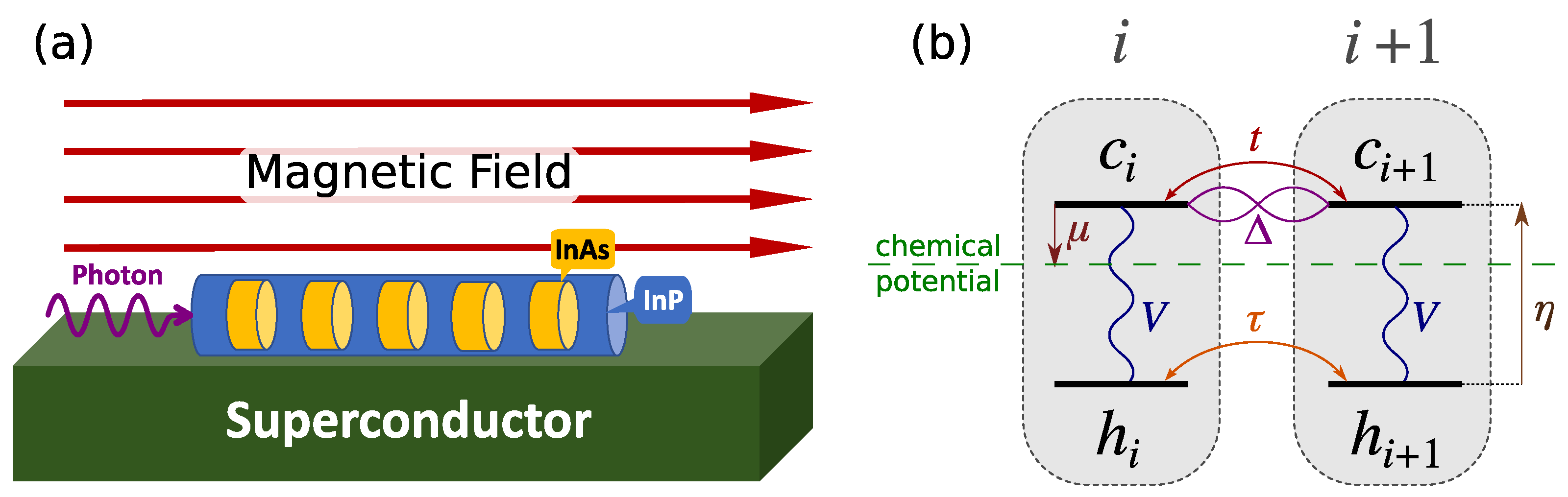
Recent progress in semiconductor quantum dots in nanowires [29,30,31,32,33,34,35,36] opens the possibility of realizing Kitaev chains and optical detection of their Majorana zero modes. In this work, we consider such an array of InAsP quantum dots embedded in an InP nanowire as the material system [29,30,31,32,33,34,35,36] for realization of MZM and study its signature in light–matter interaction. As the schematic in Figure 1a shows, we combine a semiconductor nanowire with a p-wave superconductor [37,38,39,40,41,42]. The p-wave pairing in this system is introduced by the proximity effect among electrons that are spin-polarized by an external magnetic field, making sure that Cooper pairs can only form between electrons in the conduction band (CB) of adjacent dots. We will show that one can tune the system parameters into a topological regime, where two MZMs appear at the two ends of the chain. With semiconductor quantum dots, light can generate a hole in the valence band (VB) and an electron in the conduction band. The electron adds to an existing gas of Majorana Fermions while the hole then interacts with all the quasiparticles of the Kitaev chain, including MZMs, to form composite objects similar to excitons and trions in the Fermi Edge Singularity problem [43,44,45,46]. This leads to a structure in the absorption spectrum of the chain as a function of photon energy. Here we present a theory for the signatures of the MZMs in the optical spectra of the semiconductor nanowire.
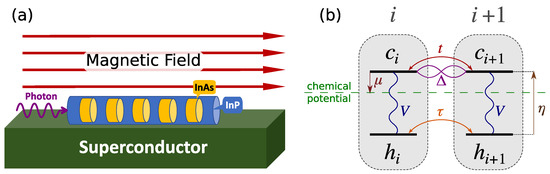
Figure 1.
(a) Schematic of the system and the light absorption experiment. (b) Schematic of the Hamiltonian terms between two adjacent dots according to Equation (1), where conduction (valence) levels are labeled by operators. The conduction level is the reference of energy, hence the downward arrow indicates negative . For TEM image and an atomistic description of the quantum dot nanowire system, see Refs. [30,34,36].
After describing the model in Section 2, in Section 3 we introduce the exact diagonalization (ED) method and introduce Majorana and bond Fermion representation of the Kitaev Hamiltonian. Next, in Section 4 we describe exciton–Majorana Fermion complexes and predict the absorption spectrum. We focus discussion on the optical signature of the MZM in the absorption spectrum. Finally, in Section 5 we conclude by summarising our results and discuss potential experiments detecting Majorana Fermions in a semiconductor Kitaev chain.
2. Kitaev Chain in a Semiconductor Nanowire
Figure 1a shows a schematic representation of the Kitaev chain we are considering. It consists of a hexagonal InP nanowire with an array of embedded InAsP quantum dots in the proximity of a p-wave superconductor [37,38,39,40,41,42], in the presence of an applied external magnetic field. Such arrays have been extensively investigated [29,30,31,32,33,34,35,36], including their excitonic complexes [29,36]. The current advanced fabrication techniques allow for controlling various aspects of this design. The challenging part, which requires more experimental efforts, is the induction of p-wave superconductivity in the chain. As Figure 1b shows, in our model we include the lowest conduction spin level of each dot and the highest spin valence band level, which are effectively both spin-polarized due to the external magnetic field. Consequently, in the presence of superconductivity, only the electrons from the adjacent conduction levels can pair up, as there is only one conduction level available in each dot. The magnetic field should be large enough to cause a Zeeman splitting larger than hopping and pairing, but smaller than level separation in each dot. A magnetic field in any direction can provide the desired Zeeman splitting, but by choosing it along the wire we avoid unnecessary complications related to Landau quantization and level repulsion in neighboring dots. As the incident photon in Figure 1 represents, the spectroscopy of the Kitaev chain is assumed to be carried out with photons incident along the wire growth. This is dictated by embedding nanowire in an InP shell, which confines photons and increases light–matter coupling.
The Kitaev Hamiltonian, , in Equation (1a) describes the hopping and pairing of electrons in conduction band levels. The chemical potential is tuned to bring the chain to near half filling in the absence of superconductivity. Therefore, in the equilibrium the valence levels are full and the system is described by the Kitaev Hamiltonian. However, when a photon with energy close to the band gap of InAsP illuminates the dots, it generates a hole in VB and an electron in CB. Adding an electron to the superconducting ground state excites its quasiparticles. The hole then forms a bound state with the quasiparticles of the electronic system that is in a collective superconducting state. These possible bound states generate peaks in the absorption spectrum of the system, among which there is the signature of MZM, as we shall show below.
The hole is described by a simple tight binding Hamiltonian, , in Equation (1b). We also consider electron–hole interaction, , in Equation (1c), which is the strongest when both conduction electron and valence band hole are on the same quantum dot. Hence, we write the full Hamiltonian as
where is the normal Fermionic creation operator of an electron(hole) in dot i, is hopping between adjacent conduction (valence) levels, is the pairing energy between adjacent conduction levels, is the chemical potential measured from the conduction energy level, and is the CB to VB energy gap in each dot. In the interaction term Equation (1c), V is the Coulomb attraction energy between electrons and holes, where we also introduced , the electron (hole) number operator in dot i. Figure 1b schematically shows different terms of Equation (1) between two adjacent dots.
Throughout the paper, we are going to express energies in the units of , which can be tuned in the range of eV to meV [30,47]. The electron–hole attraction, V, can be tuned independently and is much larger than in typical designs [30,36], while hole hopping energy, , is expected to be much smaller than as VB effective mass is much larger than CB effective mass [48]. The onsite gap, , is of the order of the bandgap of InAs and is in the eV range [48]. The pairing is also expected to be in the µeV–meV range [37,38,39,40,41,42], and since t is more controllable, one would need to tune t accordingly to bring the system into topological regime.
Next, before describing the absorption experiment, we start with a brief discussion of Kitaev Hamiltonian.
3. Majorana and Bond Fermions in Kitaev Hamiltonian
The Kitaev Hamiltonian, , in Equation (1a), originally introduced in Ref. [11], supports two MZMs localized on the two ends of the chain, when the Hamiltonian is in topological regime. For a finite chain, the topological region is centered on parameters and [11], which is our focus throughout this work. Here, after describing the exact diagonalization (ED) method for normal Fermions, following Kitaev [11], we show how using Majorana Fermions reveals the usefulness of a new set of Fermions we refer to as bond Fermions. Next, after matching energy spectra obtained by ED in both normal and bond Fermion bases, we shall use the bond Fermion basis for the rest of the paper.
3.1. Exact Diagonalization in Normal Fermion Basis
We start off by introducing the exact diagonalization method (ED) for finding the energy spectrum of the Kitaev Hamiltonian. In ED, we span the Hilbert space of the system by configuration basis [49]. For our electronic system being made of N spinless orbitals, there are possible configurations, which we construct as
where is the vacuum of electrons, , which corresponds to having (1) or not having (0) an electron in orbital i.
For a given number of electrons, M, we generate electron configurations, . However, as Kitaev Hamiltonian, being a Hamiltonian for a superconductor, does not conserve the particle number, its eigenstates are coherent linear combinations of electronic configurations with different electron numbers as
where we are populating N sites with electrons. To solve for coefficients , we apply the Hamiltonian on this state, and by using the orthogonality of the configurations we obtain the eigenvalue equation
However, since the Kitaev Hamiltonian, , in Equation (1a) only changes particle number in pairs, the matrix element is non-zero only if M and have the same parity, i.e., if they are both even or odd. This parity symmetry allows us to break the Hilbert space into two decoupled subspaces of even and odd configurations. In Appendix A we explicitly show the configurations and the Hamiltonian matrix in each of these subspaces, for the case of .
3.2. Bond Fermions
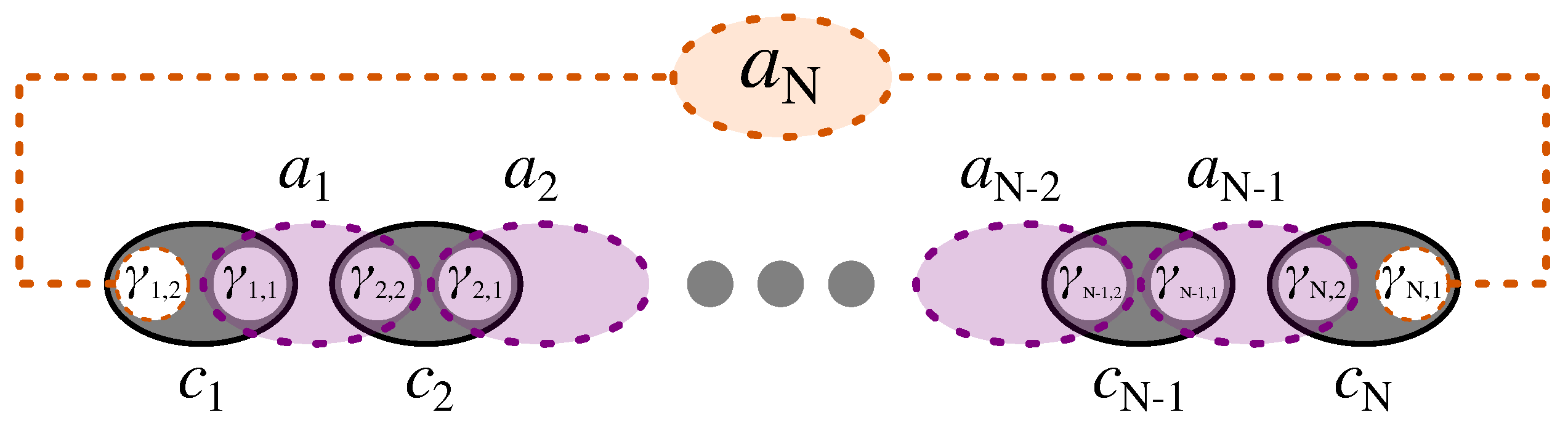
We now express the Kitaev Hamiltonian in Equation (1a) in terms of Majorana and bond Fermions. First, as schematically shown in Figure 2, we write each electron operator, c and , in terms of two Majorana Fermion operators, and , as
where the ’s are Majorana Fermion operators. Majorana Fermions satisfy a slightly different anti-commutation relation than ordinary Fermions, .
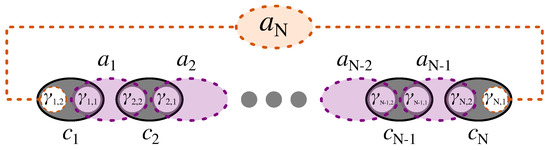
Figure 2.
Schematic of Kitaev chain in the Majorana and bond representation, with non-zero bond Fermions in purple, and the nonlocal zero mode, , living on the two ends of the chain.
Using Equation (5) and Majorana anti-commutation relations, the Hamiltonian, , can be written in terms of Majorana Fermions as
The form in Equation (6) shows the pairing between Majoranas of different types in adjacent sites. While the Hamiltonian is not diagonal in terms of Majoranas, the new pairing scheme suggests the introduction of a new set of auxiliary Fermions to diagonalize the Hamiltonian, as generally for two Majorana of different types we have . Hence, following Kitaev [11], as shown in Figure 2, we define a new set of Fermionic operators, bond Fermions, which are made of two Majoranas of different types from adjacent sites as
where we also defined , to which we refer as the zero mode, out of the two unpaired Majoranas at the two ends of the chain, as shown in Figure 2. Then, the Hamiltonian in terms of bond Fermion operators is
where in the second and the third sum one should identify . Note that in the topological regime, when and , the bond Fermions diagonalize the Hamiltonian in Equation (8) and reduce it to
which implies a set of quasiparticles with energy , and one non-local quasiparticle, , with zero energy, hence the name zero mode. In this case, since bond Fermions are the quasiparticles of Kitaev Hamiltonian, their configurations are the eigenstates of the system.
In this spirit, we also use bond Fermion configurations for exact diagonalization of Kitaev Hamiltonian. In the same fashion as in Equation (2), we define bond Fermion configurations as
where is the vacuum of bond Fermions, and we used the overline to distinguish these configurations from the normal Fermion configurations. Next, an equation similar to the equation in Equation (3) can be written for the eigenstates of the Hamiltonian in terms of bond Fermion configurations, where now would represent the configuration of having M bond Fermions. Similar to the case of normal Fermions, since in Equation (8) also conserves the parity of bond Fermion numbers, we can split the Hilbert space into even and odd subspaces. In Appendix A, we explicitly show the bond Fermion configurations and the Hamiltonian matrix of Equation (8) in each of these subspaces, for the case of .
3.3. Energy Spectrum
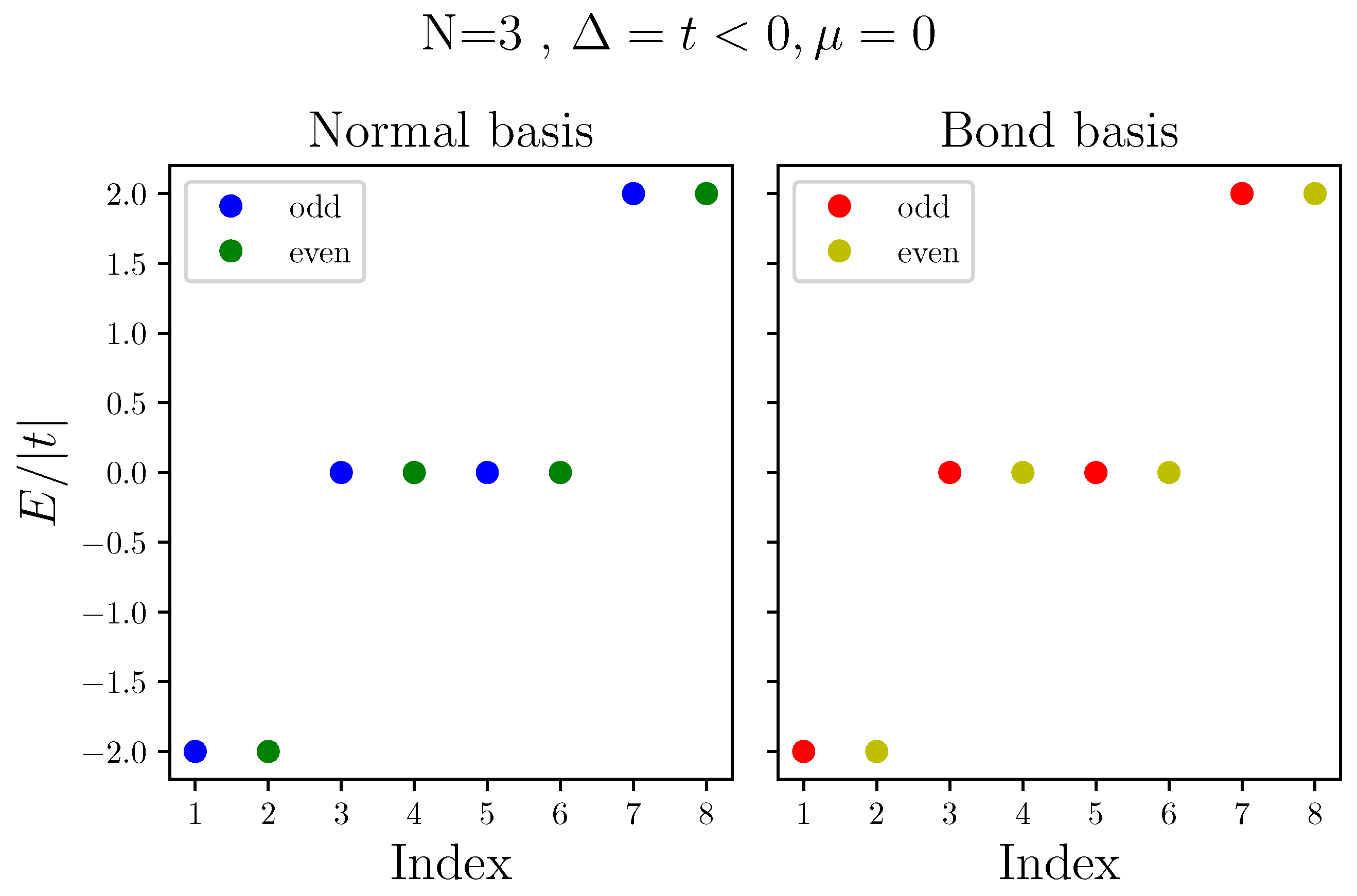
To demonstrate the usefulness of bond Fermion basis, we now describe the energy spectrum of a chain of quantum dots, obtained on both the normal and bond Fermion basis. Figure 3 shows the energy spectrum for the case of . Throughout this work, we consider , as it is the case for conduction bands hopping integrals. As we mentioned above, in this case, the configurations of bond Fermions are also the eigenstates of the system. Being in a topological regime, with these parameters the system has a doubly degenerate ground state, one in the odd subspace, , with all bond Fermions, and the other in the even subspace, , which is missing the zero energy bond Fermion, . Next, we have the singly excited states, missing one non-zero bond Fermion, with excitation energy , from which we have two in each subspace: and in the even subspace and and in the odd subspace. Finally, in each subspace, there is one doubly excited state, missing two non-zero bond Fermion with excitation energy , in the even subspace and in the odd subspace. Table 1 summarizes the description of the spectrum in terms of bond Fermions.
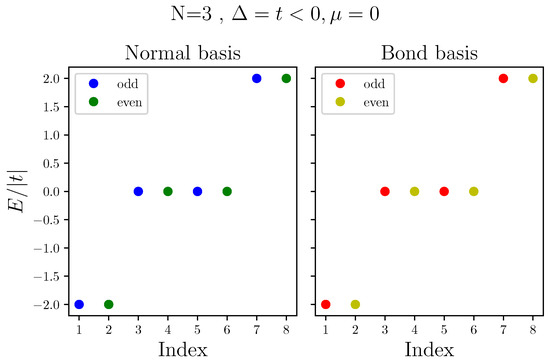
Figure 3.
Energy spectra of Kitaev chain in normal (left) and bond (right) basis, where and . Energy is normalized to .

Table 1.
Describing the spectra plotted in Figure 3. Configurations of bond Fermions are the eigenstates of Kitaev Hamiltonian when and .
4. Kitaev Chain and a Light Induced Valence Hole
Absorption of a photon injects an electron–hole pair into the system. Therefore, the relevant optically excited states live in the subspace of all configurations with one hole. Here, after studying the energy spectrum of the full Hamiltonian in Equation (1) with one hole in the configuration space of bond Fermions, we discuss the absorption spectrum of the chain and the optical signature of the MZM.
4.1. Exact Diagonalization of Electron–Hole System
Having demonstrated the benefit of the bond Fermion basis, we now study the Hamiltonian with one hole in the configuration basis of bond Fermions and one hole. Using to refer to M bond Fermions being in their configuration, and the hole being at site m, we can find the spectrum by solving an equation similar to Equation (4), but considering the full Hamiltonian, H, in Equation (1) rather than , and in the configuration basis of bond Fermions and one hole.
For instance, for dots, following the convention we introduced in Section 3.3 and Table 1, we can list these configurations as Table 2.
Table 2.
Configurations of bond Fermions with one hole for dots.
In this subspace, the hole Hamiltonian, , in Equation (1b) amounts to a constant, , and mixes states with the same electronic configurations and different locations of the hole by hopping matrix element . Therefore, with the ordering in Table 2, the full Hamiltonian with one hole for the example of dots has the following structure:
where each block is a matrix, is the identity matrix times , and the diagonal blocks are given by the matrix elements of in Equation (1) over the configurations in Table 2. The interaction term in Equation (1c) for each of the diagonal blocks, , is , and it mixes up different bond Fermion configurations as we have
which implies that when the hole is not at the two ends of the chain then the interaction mixes up two non-zero bond Fermions, and when it is at one of the two ends, the interaction mixes the zero mode with one of the non-zero ones. For instance, for the operators and in the even configuration basis in Table 2 we have
while , in a similar fashion to , mixes with and with .
4.2. Energy Spectrum of the Electron–Hole System
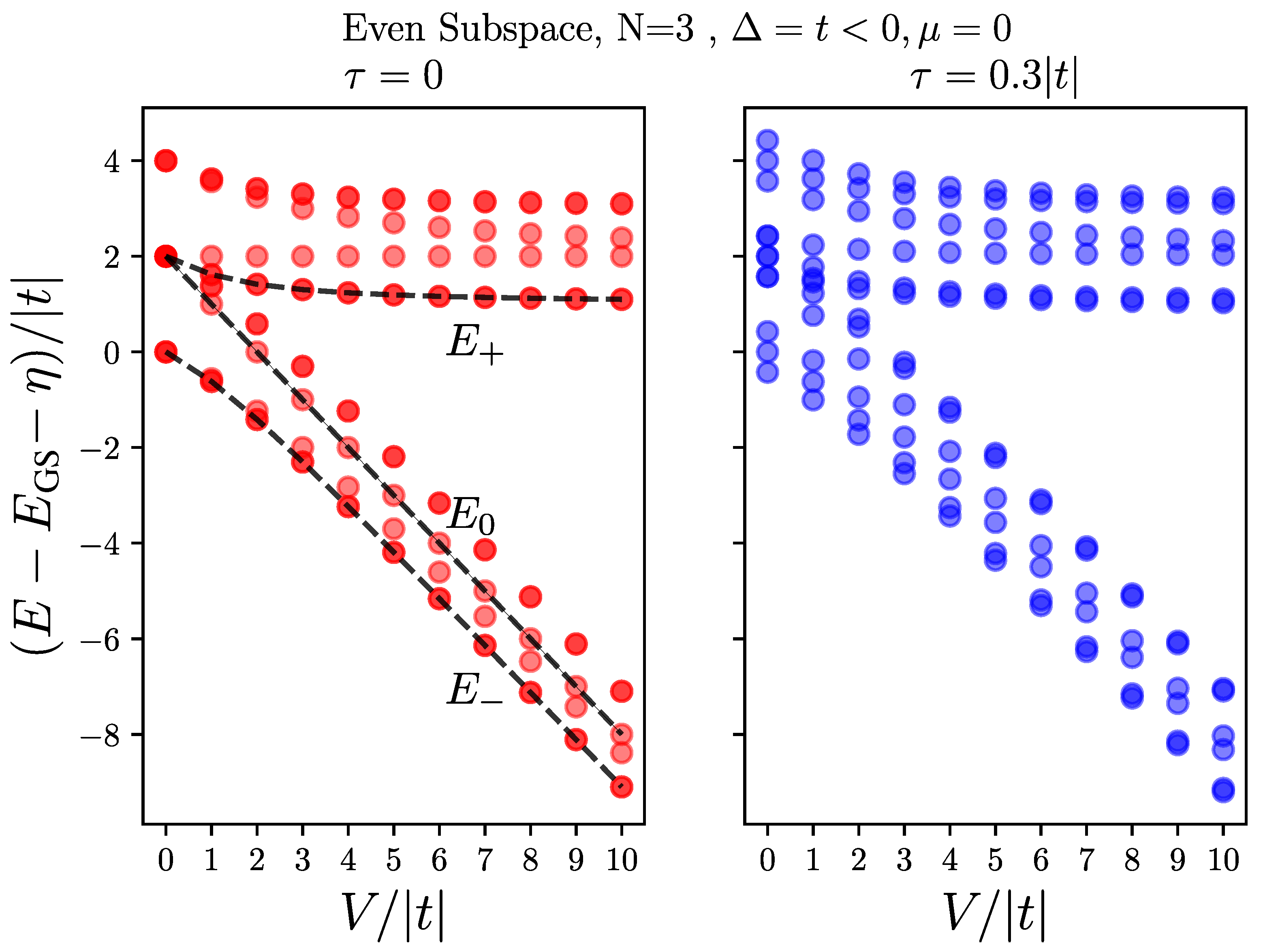
Figure 4 shows the energy spectrum of a chain of length dots in the even subspace and for and , as the electron–hole interaction V increases, for a localized hole () on the left panel and for a mobile hole with on the right panel. Both cases show branching into two groups, pertaining to bonding and antibonding pairs of states, mixed by the interaction V.
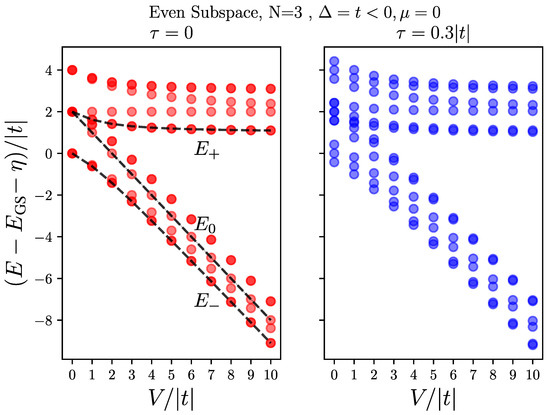
Figure 4.
Energy spectra of the full Hamiltonian Equation (1) with one hole in the even subspace, as a function of electron–hole interaction, V, for dots, , and . (left) for the case of localized hole, , (right) for a mobile hole with . The overlap of transparent markers makes the degenerate levels look darker. The peak energies, and , discussed in Section 4.3.1 are also shown according to Equation (18a,b).
The case of a localized hole allows us to understand the spectrum better. There are four electronic states associated with the valence hole being at each dot, and since the two end dots are geometrically the same, the spectrum always shows four pairs of doubly degenerate states. As we show in Appendix B, and it can also be seen from Equation (13), for the two end dots, two of these four states are mixtures of and that give us visible peaks at , as described in Section 4.3.1, and also indicated on the plot. The two other pairs of degenerate levels are mixtures of and , which do not get excited by absorbing a photon, as the polarization operator does not couple them to the ground state (see Appendix B). For the middle dot, as can be seen from Equation (13), one pair of states are mixture of and , where only the bonded state gets excited by absorbing a photon (see Appendix B), resulting in the peak ; this is also described in Section 4.3.1 and shown on the plot. Finally, the last pair of states, which also do not get excited by absorbing a photon, are a mixtures of and .
As can be seen in the right panel of Figure 4, for a mobile hole, when , we still have one pair of doubly degenerate states as a result of the chain’s spatial symmetry. At for the case, there is an extra triple degeneracy because of the non-dispersive nature of the localized hole band. However, for a mobile hole, it can be seen on the right panel of Figure 4 that at the degenerate levels split into sets of triples, corresponding to the three propagating modes of the hole band. More importantly, in this case, since the three dot subspaces are connected by hole hopping (see Equation (11)), the above described pairs of states mix up by , and the ones that are closer in energy mix more. As a result of this mixture, more peaks arise in the absorption spectrum, as we discuss in the next section.
4.3. Absorption Spectrum
As the schematic in Figure 1a shows, in the absorption experiment a photon probes the chain along the nanowire. InAsP dots have a significantly smaller bandgap than the InP bulk of the nanowire [48], which guaranties that the photon can only be absorbed by the dots. For calculating the absorption spectrum of the chain, we assume that the photon creates an electron–hole pair with uniform probability along the nanowire, and so define the polarization operator as
where we also introduced the local electron–hole pair operator . The strength of the polarization operator is determined by the dipole matrix element d, as well as the light polarization of the photon. The direction of the magnetic field with respect to the incident wave determines which helicity of photon is absorbed better. By choosing the form in Equation (14), we are factoring out the helicity of the incident photon and normalizing the result to , as these multiplicative factors do not change the absorption profile.
We are assuming that one can also set up the system to create the electron–hole pair on a chosen specific dot, i [35,50,51,52], i.e., acting with the operator on the chain, rather than P. As we discussed, having access to such a spatially resolved spectrum is important in detecting the optical signature of the MZM.
The polarization operator —we use this notation to simultaneously refer to P and —takes the ground state of the system to an excited state with one hole and different electron parity. Since the ground state can be degenerate, as it is when and , the absorption spectrum has an even and an odd part pertaining to each ground state
where are the eigenstates of the one hole subspace and the corresponding electron parity, and we used the notation to simultaneously refer to the regular absorption spectrum A, and the spatially resolved absorption spectrum coming from dot i.
4.3.1. Analytic Result for Localized Hole
If , the full Hamiltonian becomes block diagonal (see Equation (11)), i.e., the subspaces of having the hole in each of the dots decouple. Consequently, we have
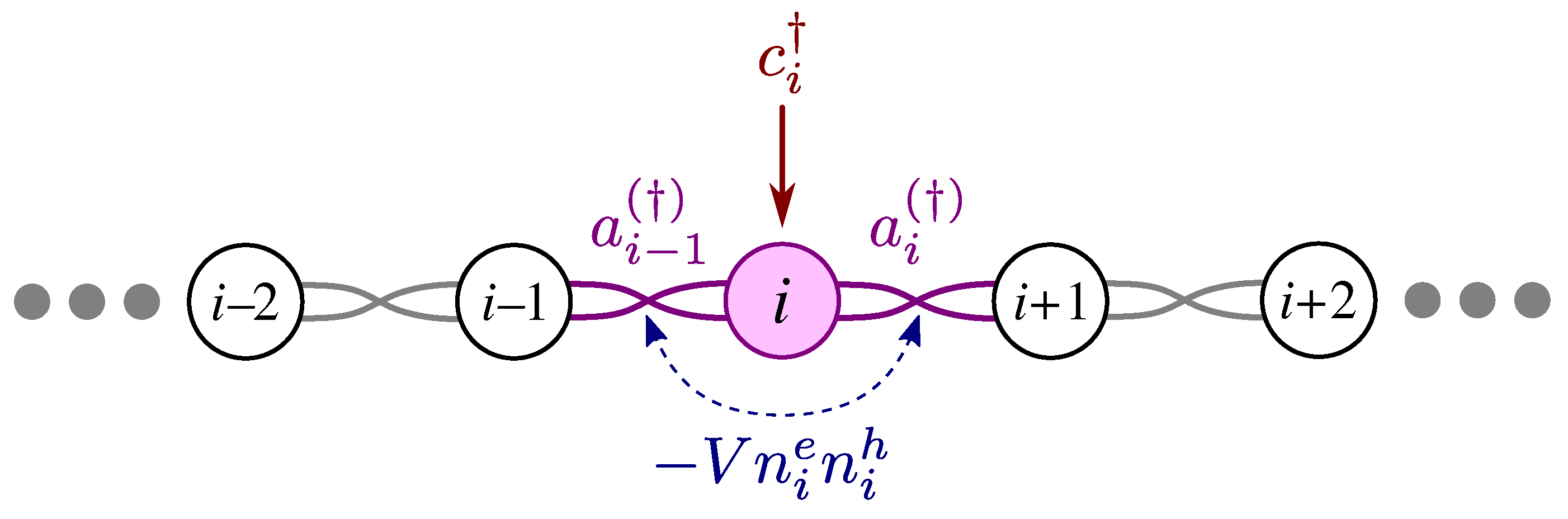
At the heart of the topological regime when and [11], as depicted graphically in Figure 5 and expressed in Equation (A6), an electron created at site i by decomposes into a superposition of creation and annihilation operators of the two bond Fermions on its two sides, and . If the electron is created at one of the two ends, one of the bond Fermions is the zero mode . On the other hand, when the hole is at site i, the interaction mixes the two bond Fermions, as shown in Figure 5 and expressed in Equations (A8) and (A12). As we show in Appendix B, combining these two mechanisms, one can find an analytic expression for the spatially resolved absorption spectrum for a chain of arbitrary length N if the hole is created on site i as
where
and then the full absorption spectrum is given by the simple sum in Equation (16).
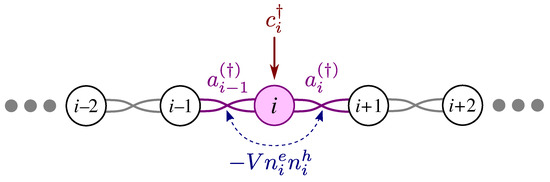
Figure 5.
An electron created by is a superposition of creation and annihilation operators of two bond Fermions, and , according to Equation (A6). The interaction mixes up the two bond Fermions according to Equation (A8). Note that when i is one of the two ends, then one of the bond Fermions is the zero mode (see Appendix B for more details).
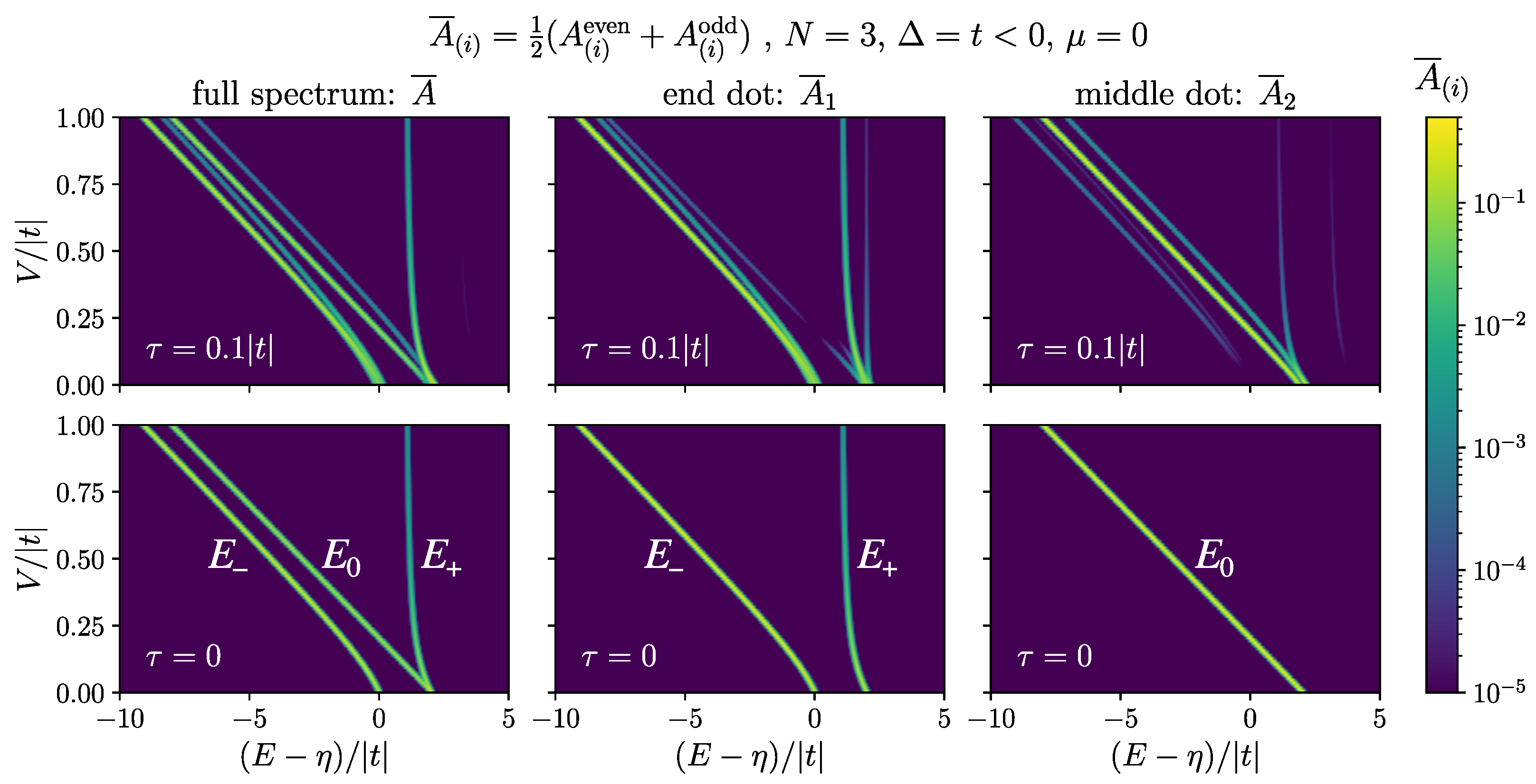
The bottom row of Figure 6 shows the results in Equations (17) and (18) for the case of . The peak is only present in the middle, while the peaks are present at the two ends of the chain. As we show in Appendix B, the two peaks, , have a mixture of zero mode in them, while is purely made of non-zero bond Fermions. At , is purely made of zero mode while is purely made of non-zero bond Fermions. As we increase V, acquires more zero mode contribution, while mixes more with non-zero bond Fermions. At the same time, by increasing V, the peak at diminishes, as can be seen from Equation (18c). If not too weak, the peak is a better resolved optical signature for the MZM than , as it is separated from the rest of the spectrum by V, and we expect to have . This presents an advantage over the scanning tunnelling microscopy approach for detecting MZM [21]. Moreover, if one can perform spatially resolved absorption spectroscopy on the chain, the presence of the zero mode can be determined by the presence of a visible peak at high energy near when probing the end dots, and its absence when probing other dots.
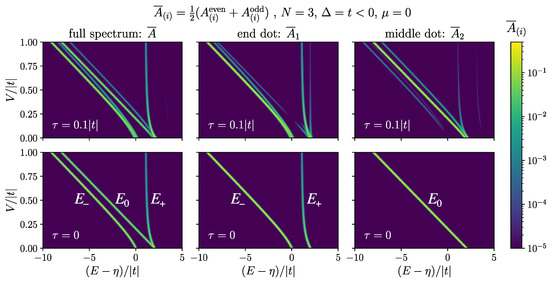
Figure 6.
(left) The averaged absorption spectrum, , and (middle and right) spatially resolved absorption, , for , and for dots: (top) for a mobile hole with , (bottom) for a localized hole, , according to the analytic results in Equations (17) and (18). The spectra are plotted against while changing on the y-axis. The bright curves show the location of the peaks as V changes, and the color scale shows their heights. Gaussian profile was used for the peaks with the width . The maximum value of each peak shows the magnitude of the corresponding matrix element.
4.3.2. Absorption for Mobile Hole
When the hole is mobile, there are N itinerant hole states with different energies. Therefore, one would expect N different transitions to each electronic state. More importantly, as can be seen in Equation (11), the hopping hole mixes up different subspaces of having the hole in different dots. As a result, more transitions are allowed, leading to the emergence of more peaks in the absorption spectrum.
In Figure 6, we compare the absorption spectrum of a mobile hole with (top row), and the analytic result of Equation (17) for localized hole (bottom row), for the case of . It is evident how more peaks are visible for the case of the mobile hole, while the major peaks are still close to the location of and . Moreover, note how in the full spectrum (top left) there is only one visible peak at high energy near , and how the same peak is large in (top middle) and faint in (top right), pertaining to the localized nature of the MZM that carries. In plotting Figure 6, we used , as for a mobile hole the even and odd parts of the absorption spectrum are not the same. But since there is no preference between the two ground states, one would expect to observe an average of the two.
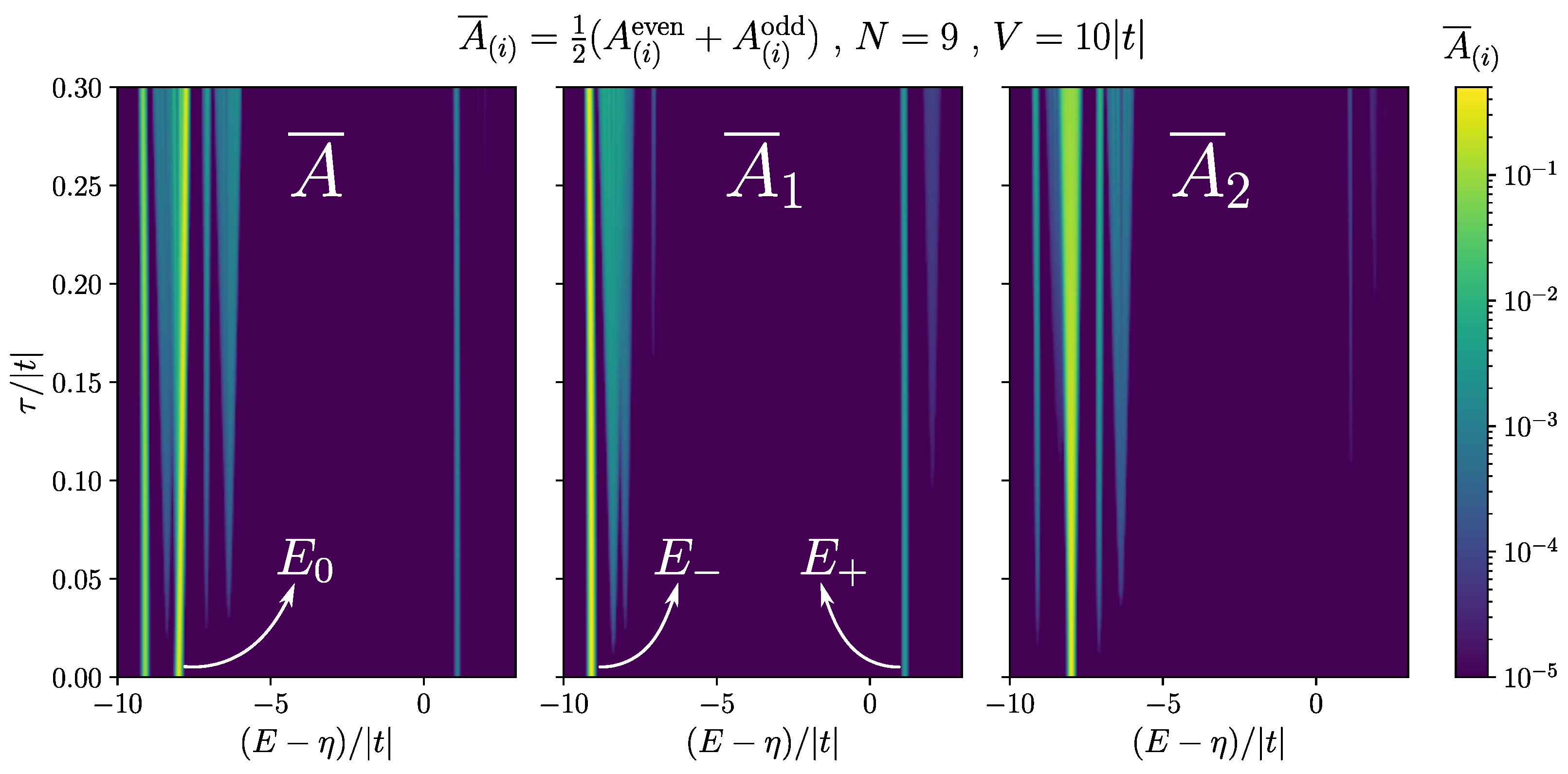
The same logic is valid for a chain of any length, as the analytic result in Equation (17) is for general N. The analytic results are particularly insightful as the computation complexity increases exponentially in the exact diagonalization method. In our system, after taking into account the parity symmetry of the Kitaev Hamiltonian, the size of the Hilbert space with one valence hole grows as . Figure 7 shows the absorption spectrum of a chain of length . Here, we set while changing . When , we approach the idealized case of a localized hole, where the subspaces of having the hole on each dot are decoupled. Growing mixes up the modes of different dots. Consequently, the zero mode starts leaking out of the two ends of the chain. On the first panel of Figure 7, we can see that at high energy there is still only one visible peak near , until about , where a faint peak appears to the right of it. This makes a very robust signature for a relatively large range of hole hopping. Having access to spatially resolved spectrum, we can further confirm that the peak is indeed coming from the two ends. It can be seen from the third panel of Figure 7 that there is no visible high energy peak on the site next to the end dot () until around . In contrast, we can observe in that , which also contains a large share of zero mode and is a stronger peak, starts leaking out of the end dot very quickly for small ’s.
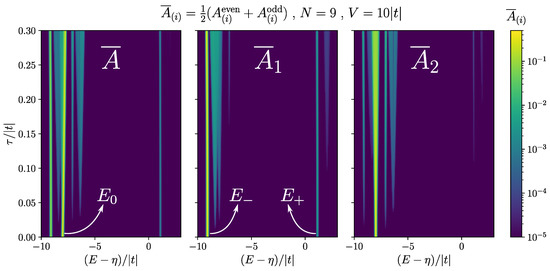
Figure 7.
Absorption spectrum for a chain of length , and for , and changing . (left) The full averaged spectrum , (middle) the spatially resolved spectrum for the first dot , and (right) the spatially resolved spectrum for the second dot . The bright curves show the location of the peaks as changes, and the colorscale shows their heights. Gaussian profile was used for the peaks with the width . The maximum value of each peak shows the magnitude of the corresponding matrix element.
5. Conclusions
We present here a theory of Majorana excitons, photo-excited conduction electron-valence band hole pairs, interacting with Majorana Fermions in a Kitaev chain of semiconductor quantum dots embedded in a nanowire. We demonstrate how the excited states of the superconducting system can be represented by different configurations of bond Fermions, and using exact diagonalization techniques we compute the energy spectra of the system. We confirm the existence of nonlocal bond Fermion, a superposition of Majorana Fermions at the two ends of the chain, with zero energy. We introduce a valence band hole and describe its interaction with Majorana fermions. We predict interband absorption spectra and discuss the signature of Majorana zero modes in the absorption spectra. We demonstrate how a spatially resolved absorption spectrum can be used to confirm the localized character of the MZMs.
We hope this preliminary work motivates future theoretical and experimental work on hybrid nanowire semiconductor quantum dots/superconductor systems for the demonstration of Majorana Fermions.
Author Contributions
Conceptualization, P.H. and M.K.; methodology, P.H.; software, M.M., D.M. and H.A.; validation, M.M., D.M., H.A. and D.J.G.; formal analysis, H.A., M.M. and D.J.G.; investigation, P.H., M.M. and H.A.; resources, P.H. and D.M.; data curation, H.A. and M.M.; writing—original draft preparation, H.A. and M.M.; writing—review and editing, P.H., H.A., M.M. and D.M.; visualization, M.M. and H.A.; supervision, P.H.; project administration, P.H.; funding acquisition, P.H. and M.K. All authors have read and agreed to the published version of the manuscript.
Funding
This research was supported by the Quantum Sensors and Applied Quantum Computing Challenge Programs at the National Research Council of Canada, by NSERC Discovery Grant No. RGPIN- 2019-05714, and the University of Ottawa Research Chair in Quantum Theory of Materials, Nanostructures, and Devices.
Data Availability Statement
The codes used to produce data presented in this study are openly available in “Kitaev Exciton” at Ref. [53].
Conflicts of Interest
The authors declare no conflict of interest.
Appendix A. Exact Diagonalization for Chain of Length Three
Following Equation (2), for a chain of length , the configurations of normal Fermions in the even and odd subspaces are
Computing the matrix elements of all terms in the Kitaev Hamiltonian, , in Equation (1a) between every pair of configurations in Equation (A1a,b), we can explicitly write the matrix in Equation (4), in each of the subspaces as
for which we used the same ordering as in Equation (A1).
Then, for ED in the bond Fermion basis, following Equation (10), the configurations are
and one can use Equation (8) to find the corresponding Kitaev Hamiltonian matrices in each of the subspaces as
for which we used the same ordering as in Equation (A3). Notice how the two Hamiltonian matrices in Equation (A4) become diagonal when and .
Appendix B. Analytic Calculation of Absorption Spectrum for Localized Hole
Following the notation in Table 1, for a chain of arbitrary length N, and for and , we express the two degenerate ground states of the system as
Here, we derive the result in Equations (17) and (18) using in Equation (A5a), and the procedure is the same for .
To start, first note that from Equation (7) we have
which means for we have
where we used the same notation as in Table 2 for the excited states. On the other hand, from Equation (12a) we have
Recalling that both and are eigenstates of with excitation energy , then in the basis , the full Hamiltonian is
with the following two eigenstates
Now, using Equation (A7) we have and , which gives us the result in Equation (17) for the case of .
Next, we show the second case for , and the procedure is the same for . In this case, using Equation (A6b) we have
where is identical to the other ground state up to a global phase, hence its excitation energy is zero. Then, from Equation (12b) we have
Therefore, considering that and are eigenstates of with excitation energy and zero, respectively, the full Hamiltonian on the basis is
and its two eigenstates are given by
with
Now, using Equation (A11) we have and , where we used Equation (A15) to express these matrix elements in terms of in Equation (18c). From this follows the result in Equation (17) for the case of .
References
- Gyongyosi, L.; Imre, S. A survey on quantum computing technology. Comput. Sci. Rev. 2019, 31, 51–71. [Google Scholar] [CrossRef]
- Field, B.; Simula, T. Introduction to topological quantum computation with non-Abelian anyons. Quantum Sci. Technol. 2018, 3, 045004. [Google Scholar] [CrossRef]
- Campbell, E.T.; Terhal, B.M.; Vuillot, C. Roads towards fault-tolerant universal quantum computation. Nature 2017, 549, 172–179. [Google Scholar] [CrossRef]
- Stern, A.; Lindner, N.H. Topological quantum computation—From basic concepts to first experiments. Science 2013, 339, 1179–1184. [Google Scholar] [CrossRef]
- Nayak, C.; Simon, S.H.; Stern, A.; Freedman, M.; Sarma, S.D. Non-Abelian anyons and topological quantum computation. Rev. Mod. Phys. 2008, 80, 1083. [Google Scholar] [CrossRef]
- Sarma, S.D.; Freedman, M.; Nayak, C. Majorana zero modes and topological quantum computation. NPJ Quantum Inf. 2015, 1, 1–13. [Google Scholar] [CrossRef]
- Das Sarma, S.; Freedman, M.; Nayak, C. Topological quantum computation. Phys. Today 2006, 59, 32–38. [Google Scholar] [CrossRef]
- Freedman, M.; Kitaev, A.; Larsen, M.; Wang, Z. Topological quantum computation. Bull. Am. Math. Soc. 2002, 40, 31–38. [Google Scholar] [CrossRef]
- Jaworowski, B.; Hawrylak, P. Quantum bits with macroscopic topologically protected states in semiconductor devices. Appl. Sci. 2019, 9, 474. [Google Scholar] [CrossRef]
- Haldane, F.D.M. Nonlinear field theory of large-spin Heisenberg antiferromagnets: Semiclassically quantized solitons of the one-dimensional easy-axis Néel state. Phys. Rev. Lett. 1983, 50, 1153. [Google Scholar] [CrossRef]
- Kitaev, A.Y. Unpaired Majorana fermions in quantum wires. Physics-Uspekhi 2001, 44, 131. [Google Scholar] [CrossRef]
- Kitaev, A.Y. Fault-tolerant quantum computation by anyons. Ann. Phys. 2003, 303, 2–30. [Google Scholar] [CrossRef]
- Lutchyn, R.M.; Sau, J.D.; Sarma, S.D. Majorana fermions and a topological phase transition in semiconductor-superconductor heterostructures. Phys. Rev. Lett. 2010, 105, 077001. [Google Scholar] [CrossRef] [PubMed]
- Mourik, V.; Zuo, K.; Frolov, S.M.; Plissard, S.; Bakkers, E.P.; Kouwenhoven, L.P. Signatures of Majorana fermions in hybrid superconductor-semiconductor nanowire devices. Science 2012, 336, 1003–1007. [Google Scholar] [CrossRef] [PubMed]
- Sau, J.D.; Sarma, S.D. Realizing a robust practical Majorana chain in a quantum-dot-superconductor linear array. Nat. Commun. 2012, 3, 964. [Google Scholar] [CrossRef]
- Leijnse, M.; Flensberg, K. Parity qubits and poor man’s Majorana bound states in double quantum dots. Phys. Rev. B 2012, 86, 134528. [Google Scholar] [CrossRef]
- Dvir, T.; Wang, G.; van Loo, N.; Liu, C.X.; Mazur, G.P.; Bordin, A.; Ten Haaf, S.L.; Wang, J.Y.; van Driel, D.; Zatelli, F.; et al. Realization of a minimal Kitaev chain in coupled quantum dots. Nature 2023, 614, 445–450. [Google Scholar] [CrossRef] [PubMed]
- Nadj-Perge, S.; Drozdov, I.K.; Li, J.; Chen, H.; Jeon, S.; Seo, J.; MacDonald, A.H.; Bernevig, B.A.; Yazdani, A. Observation of Majorana fermions in ferromagnetic atomic chains on a superconductor. Science 2014, 346, 602–607. [Google Scholar] [CrossRef]
- Sun, H.H.; Jia, J.F. Detection of Majorana zero mode in the vortex. NPJ Quantum Mater. 2017, 2, 34. [Google Scholar] [CrossRef]
- Liu, D.E.; Baranger, H.U. Detecting a Majorana-fermion zero mode using a quantum dot. Phys. Rev. B 2011, 84, 201308. [Google Scholar] [CrossRef]
- Jäck, B.; Xie, Y.; Yazdani, A. Detecting and distinguishing Majorana zero modes with the scanning tunnelling microscope. Nat. Rev. Phys. 2021, 3, 541–554. [Google Scholar] [CrossRef]
- Pientka, F.; Romito, A.; Duckheim, M.; Oreg, Y.; von Oppen, F. Signatures of topological phase transitions in mesoscopic superconducting rings. New J. Phys. 2013, 15, 025001. [Google Scholar] [CrossRef]
- Pikulin, D.I.; van Heck, B.; Karzig, T.; Martinez, E.A.; Nijholt, B.; Laeven, T.; Winkler, G.W.; Watson, J.D.; Heedt, S.; Temurhan, M.; et al. Protocol to identify a topological superconducting phase in a three-terminal device. arXiv 2021, arXiv:2103.12217. [Google Scholar] [CrossRef]
- Liu, J.; Potter, A.C.; Law, K.T.; Lee, P.A. Zero-bias peaks in the tunneling conductance of spin-orbit-coupled superconducting wires with and without Majorana end-states. Phys. Rev. Lett. 2012, 109, 267002. [Google Scholar] [CrossRef] [PubMed]
- Sarma, S.D.; Pan, H. Disorder-induced zero-bias peaks in Majorana nanowires. Phys. Rev. B 2021, 103, 195158. [Google Scholar] [CrossRef]
- Rubbert, S.; Akhmerov, A. Detecting Majorana nonlocality using strongly coupled Majorana bound states. Phys. Rev. 2016, 94, 115430. [Google Scholar] [CrossRef]
- Aghaee, M.; Akkala, A.; Alam, Z.; Ali, R.; Ramirez, A.A.; Andrzejczuk, M.; Antipov, A.E.; Astafev, M.; Bauer, B.; Becker, J.; et al. InAs-Al hybrid devices passing the topological gap protocol. arXiv 2022, arXiv:2207.02472. [Google Scholar] [CrossRef]
- Baldelli, N.; Bhattacharya, U.; González-Cuadra, D.; Lewenstein, M.; Graß, T. Detecting Majorana zero modes via strong field dynamics. ACS Omega 2022, 7, 47424–47430. [Google Scholar] [CrossRef]
- Cygorek, M.; Korkusinski, M.; Hawrylak, P. Atomistic theory of electronic and optical properties of InAsP/InP nanowire quantum dots. Phys. Rev. B 2020, 101, 075307. [Google Scholar] [CrossRef]
- Manalo, J.; Cygorek, M.; Altintas, A.; Hawrylak, P. Electronic and magnetic properties of many-electron complexes in charged InAsxP1−x quantum dots in InP nanowires. Phys. Rev. B 2021, 104, 125402. [Google Scholar] [CrossRef]
- Koong, Z.X.; Ballesteros-Garcia, G.; Proux, R.; Dalacu, D.; Poole, P.J.; Gerardot, B.D. Multiplexed single photons from deterministically positioned nanowire quantum dots. Phys. Rev. Appl. 2020, 14, 034011. [Google Scholar] [CrossRef]
- Dalacu, D.; Mnaymneh, K.; Lapointe, J.; Wu, X.; Poole, P.J.; Bulgarini, G.; Zwiller, V.; Reimer, M.E. Ultraclean emission from InAsP quantum dots in defect-free wurtzite InP nanowires. Nano Lett. 2012, 12, 5919–5923. [Google Scholar] [CrossRef] [PubMed]
- Jaworowski, B.; Rogers, N.; Grabowski, M.; Hawrylak, P. Macroscopic singlet-triplet qubit in synthetic spin-one chain in semiconductor nanowires. Sci. Rep. 2017, 7, 5529. [Google Scholar] [CrossRef] [PubMed]
- Phoenix, J.; Korkusinski, M.; Dalacu, D.; Poole, P.J.; Zawadzki, P.; Studenikin, S.; Williams, R.L.; Sachrajda, A.S.; Gaudreau, L. Magnetic tuning of tunnel coupling between InAsP double quantum dots in InP nanowires. Sci. Rep. 2022, 12, 5100. [Google Scholar] [CrossRef]
- Northeast, D.B.; Weber, J.F.; Dalacu, D.; Phoenix, J.; Poole, P.J.; Aers, G.; Lapointe, J.; Williams, R.L. Optical fibre-based (plug-and-play) single photon source using InAsP quantum dot nanowires and gradient-index lens collection. arXiv 2021, arXiv:2104.11197. [Google Scholar] [CrossRef]
- Laferrière, P.; Yeung, E.; Korkusinski, M.; Poole, P.J.; Williams, R.L.; Dalacu, D.; Manalo, J.; Cygorek, M.; Altintas, A.; Hawrylak, P. Systematic study of the emission spectra of nanowire quantum dots. Appl. Phys. Lett. 2021, 118, 161107. [Google Scholar] [CrossRef]
- Talantsev, E.; Iida, K.; Ohmura, T.; Matsumoto, T.; Crump, W.; Strickland, N.; Wimbush, S.; Ikuta, H. p-wave superconductivity in iron-based superconductors. Sci. Rep. 2019, 9, 14245. [Google Scholar] [CrossRef]
- Wang, W.S.; Zhang, C.C.; Zhang, F.C.; Wang, Q.H. Theory of chiral p-wave superconductivity with near nodes for Sr2RuO4. Phys. Rev. Lett. 2019, 122, 027002. [Google Scholar] [CrossRef]
- Yuan, N.F.; Mak, K.F.; Law, K. Possible topological superconducting phases of MoS2. Phys. Rev. Lett. 2014, 113, 097001. [Google Scholar] [CrossRef] [PubMed]
- Frigeri, P.; Agterberg, D.; Koga, A.; Sigrist, M. Superconductivity without Inversion Symmetry: MnSi versus CePt3Si. Phys. Rev. Lett. 2004, 92, 097001. [Google Scholar] [CrossRef] [PubMed]
- Hardy, F.; Huxley, A. p-wave superconductivity in the ferromagnetic superconductor URhGe. Phys. Rev. Lett. 2005, 94, 247006. [Google Scholar] [CrossRef]
- Ishida, K.; Mukuda, H.; Kitaoka, Y.; Asayama, K.; Mao, Z.; Mori, Y.; Maeno, Y. Spin-triplet superconductivity in Sr2RuO4 identified by 17O Knight shift. Nature 1998, 396, 658–660. [Google Scholar] [CrossRef]
- Mahan, G. Many-Particle Physics; Physics of Solids and Liquids; Springer: Berlin/Heidelberg, Germany, 2012. [Google Scholar] [CrossRef]
- Wojs, A.; Hawrylak, P. Negatively charged magnetoexcitons in quantum dots. Phys. Rev. B 1995, 51, 10880–10885. [Google Scholar] [CrossRef] [PubMed]
- Hawrylak, P. Excitonic effects in optical spectra of a quasi-one-dimensional electron gas. Solid State Commun. 1992, 81, 525–527. [Google Scholar] [CrossRef]
- Hawrylak, P. Optical properties of a two-dimensional electron gas: Evolution of spectra from excitons to Fermi-edge singularities. Phys. Rev. B 1991, 44, 3821–3828. [Google Scholar] [CrossRef]
- Vora, P.M.; Bracker, A.S.; Carter, S.G.; Kim, M.; Kim, C.S.; Gammon, D. Strong coupling of a quantum dot molecule to a photonic crystal cavity. Phys. Rev. B 2019, 99, 165420. [Google Scholar] [CrossRef]
- Adachi, S. Properties of Group-IV, III-V and II-VI Semiconductors; John Wiley & Sons, Ltd.: Hoboken, NJ, USA, 2005; Chapter 6, p. 116; Chapter 7; pp. 150, 167. [Google Scholar] [CrossRef]
- Weiße, A.; Fehske, H. Exact Diagonalization Techniques. In Computational Many-Particle Physics; Fehske, H., Schneider, R., Weiße, A., Eds.; Springer: Berlin/Heidelberg, Germany, 2008; pp. 529–544. [Google Scholar] [CrossRef]
- Dalacu, D.; Poole, P.J.; Williams, R.L. Tailoring the geometry of bottom-up nanowires: Application to high efficiency single photon sources. Nanomaterials 2021, 11, 1201. [Google Scholar] [CrossRef] [PubMed]
- Laferriere, P.; Yeung, E.; Giner, L.; Haffouz, S.; Lapointe, J.; Aers, G.C.; Poole, P.J.; Williams, R.L.; Dalacu, D. Multiplexed single-photon source based on multiple quantum dots embedded within a single nanowire. Nano Lett. 2020, 20, 3688–3693. [Google Scholar] [CrossRef] [PubMed]
- Laferriére, P.; Haffouz, S.; Northeast, D.B.; Poole, P.J.; Williams, R.L.; Dalacu, D. Position-controlled telecom single photon emitters operating at elevated temperatures. Nano Lett. 2023, 23, 962–968. [Google Scholar] [CrossRef]
- Allami, H. Kitaev Exciton. 2023. Available online: https://github.com/hassan-allami/KitaevExciton.git (accessed on 26 July 2023).
Disclaimer/Publisher’s Note: The statements, opinions and data contained in all publications are solely those of the individual author(s) and contributor(s) and not of MDPI and/or the editor(s). MDPI and/or the editor(s) disclaim responsibility for any injury to people or property resulting from any ideas, methods, instructions or products referred to in the content. |
© 2023 by the authors. Licensee MDPI, Basel, Switzerland. This article is an open access article distributed under the terms and conditions of the Creative Commons Attribution (CC BY) license (https://creativecommons.org/licenses/by/4.0/).