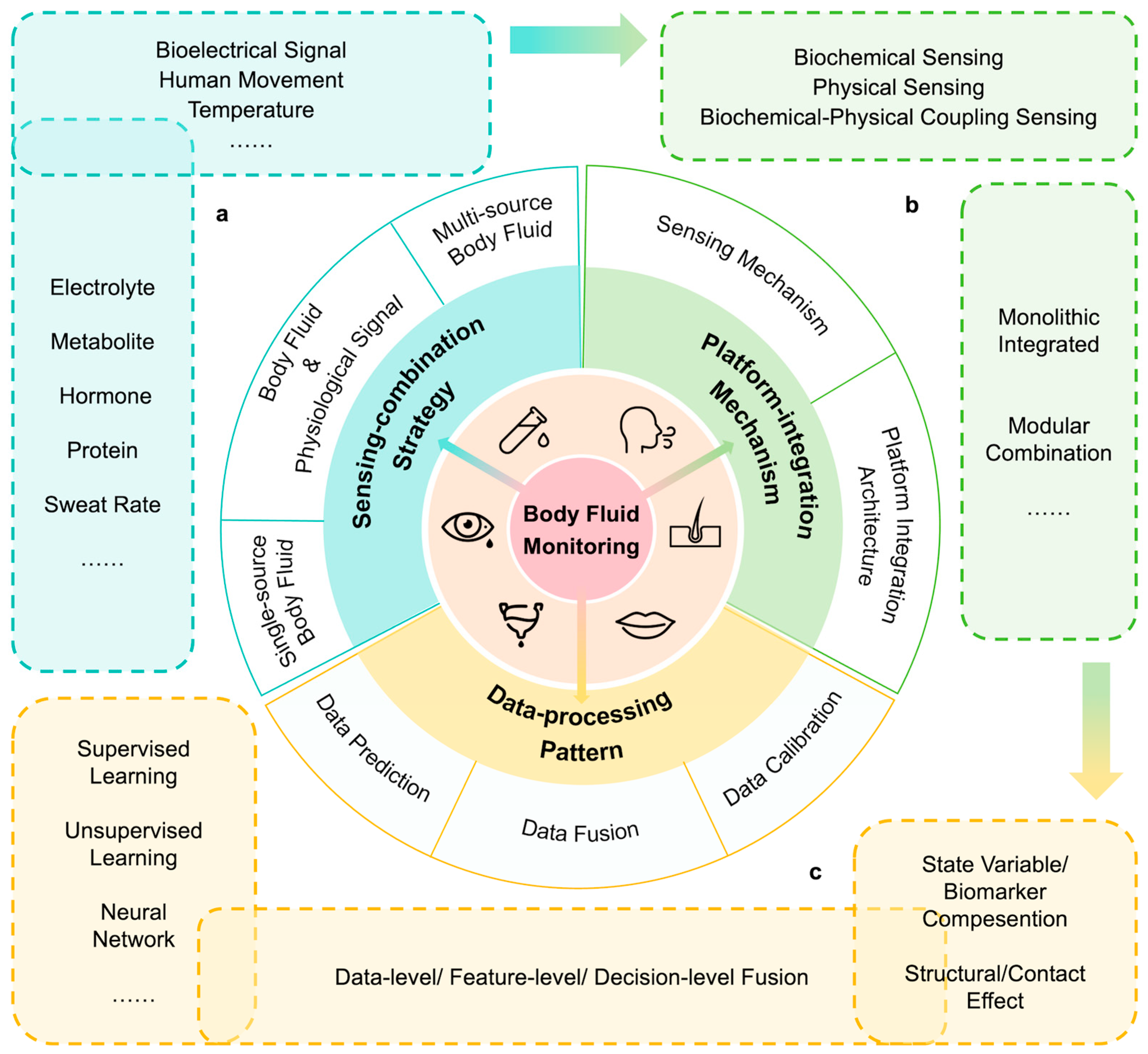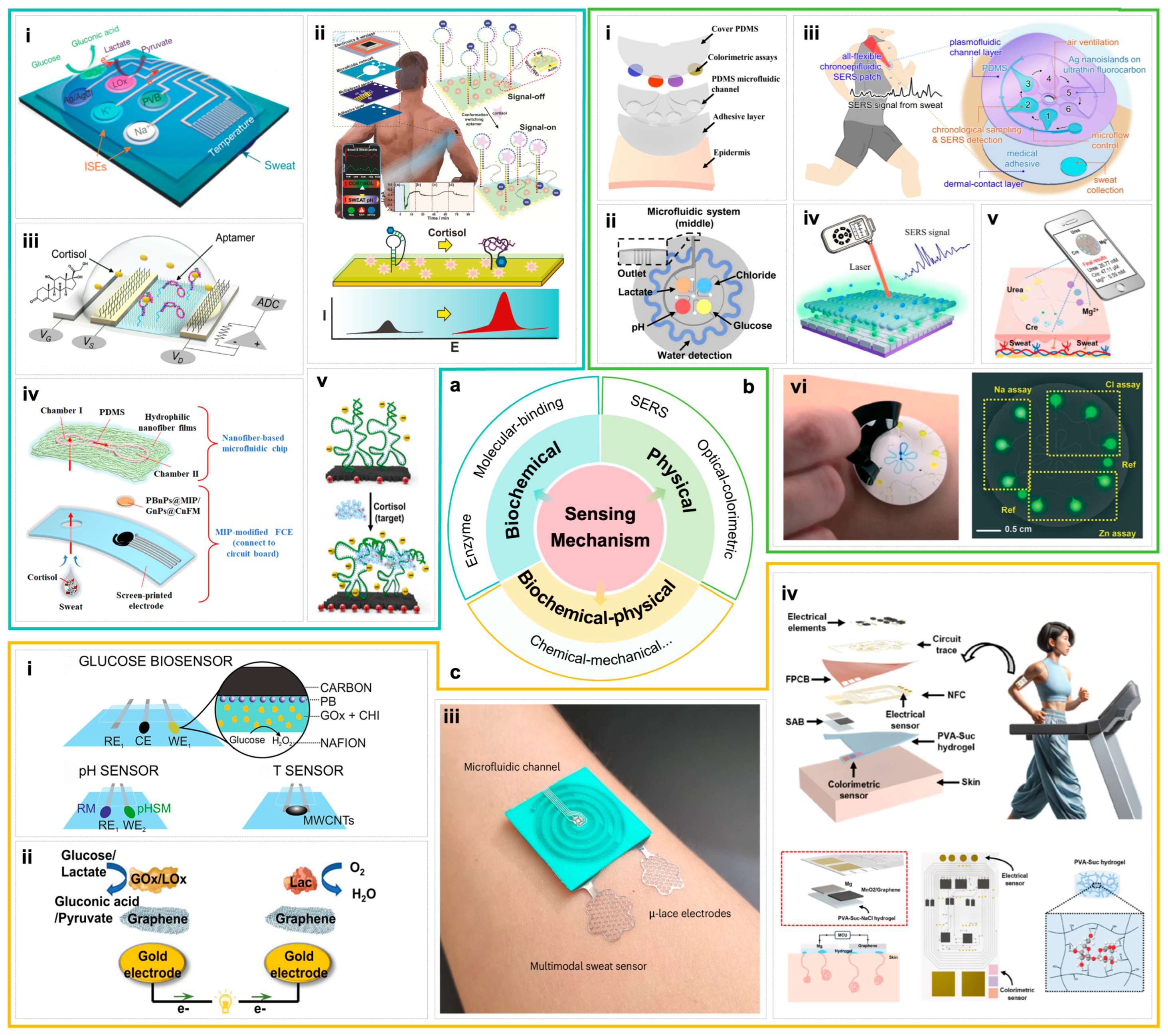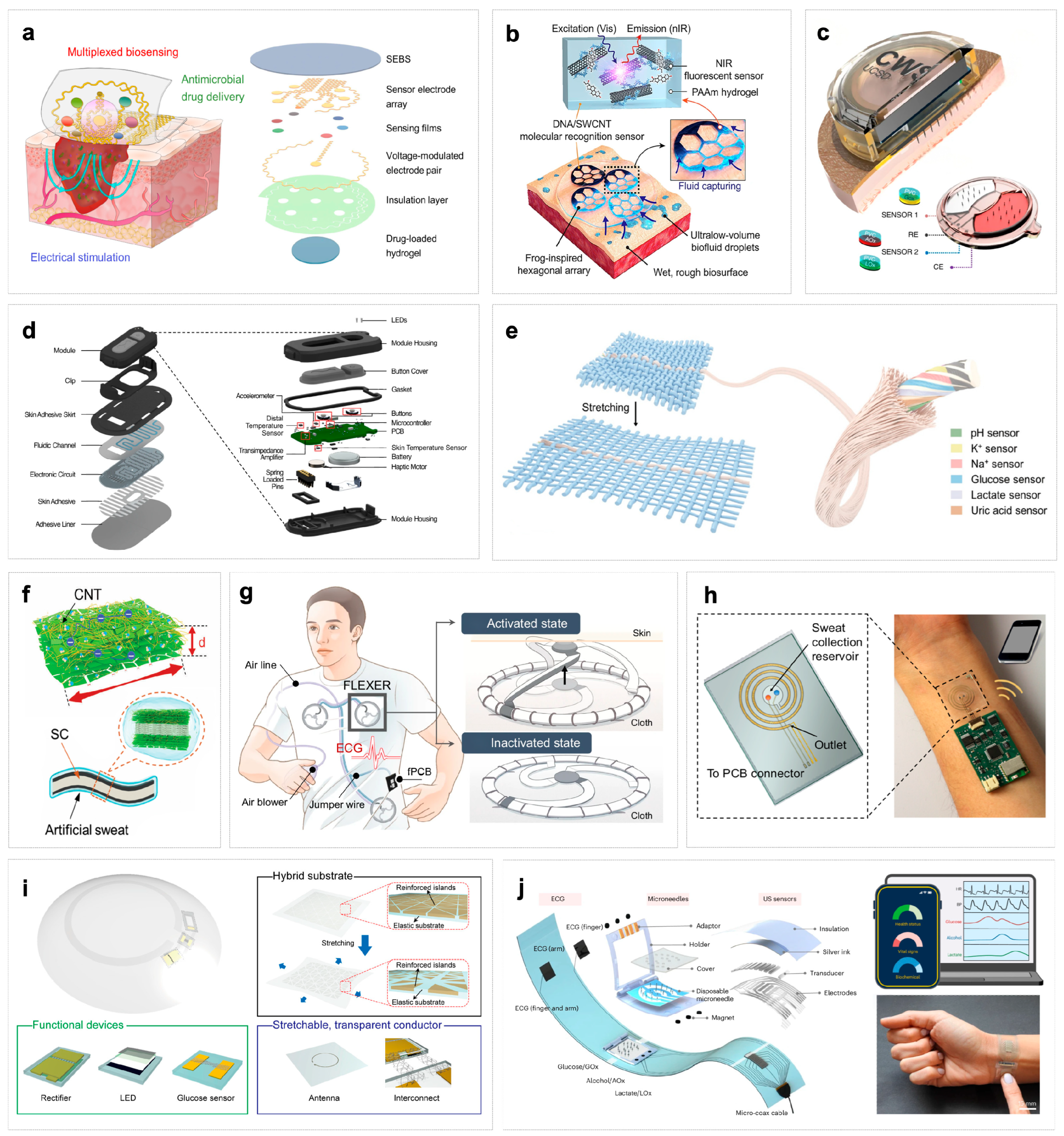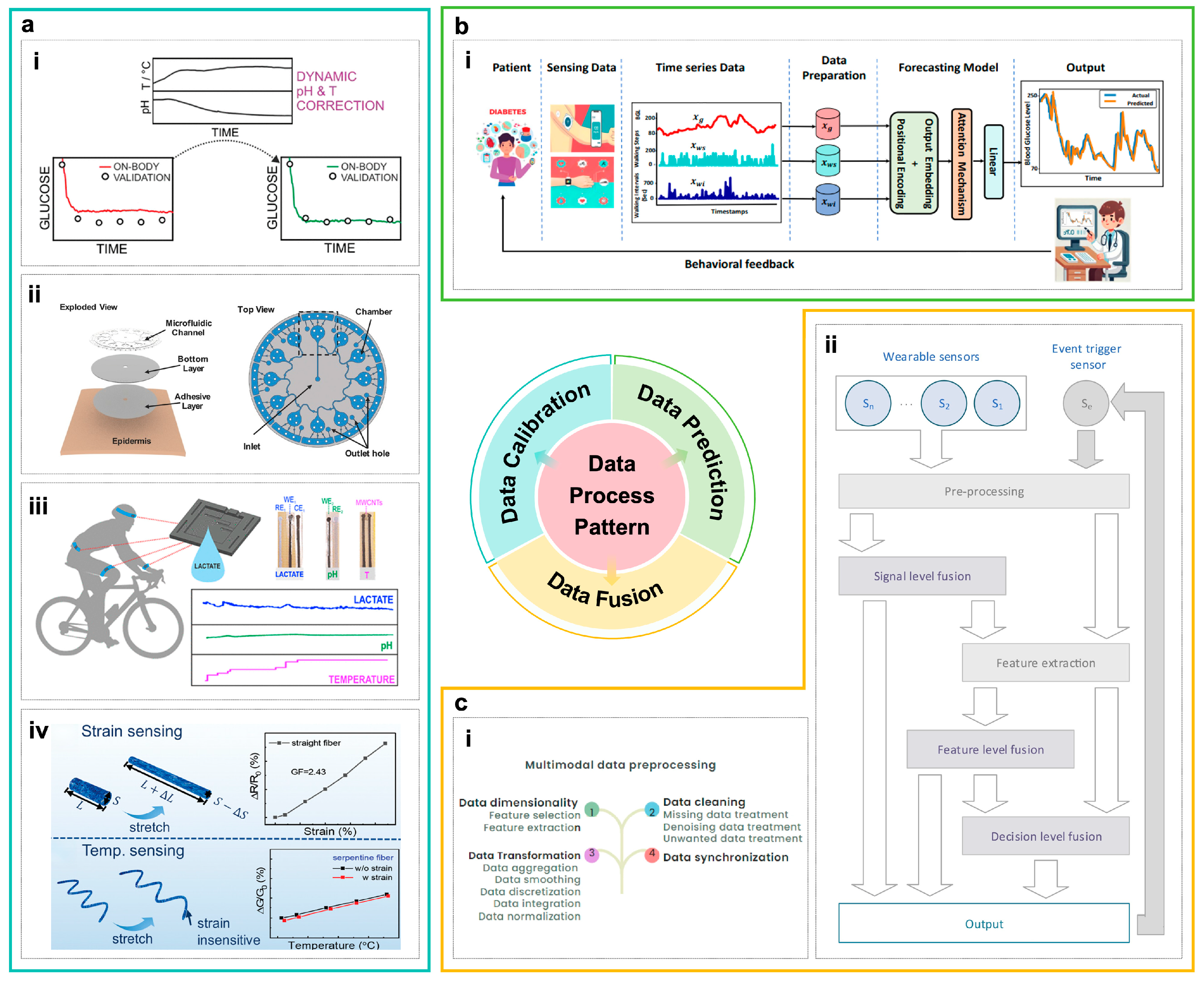
Wearable Sensing Systems for Multi-Modal Body Fluid Monitoring: Sensing-Combination Strategy, Platform-Integration Mechanism, and Data-Processing Pattern

 ,
,  and
and
Abstract
1. Introduction
2. Sensing-Combination Strategy
2.1. Single-Source Body Fluid Collection
2.1.1. Sweat
2.1.2. Other Sources of Body Fluid
2.2. Coupling Acquisition of Body Fluid and Other Physiological Signals
2.2.1. Bioelectrical Signals
2.2.2. Human Movement Information
2.2.3. Skin Temperature
2.2.4. Cardiovascular Parameters
2.3. Multi-Source Body Fluid Collection

| Year | Device/Study | Body Fluid | Analyte | Performance Parameters |
|---|---|---|---|---|
| 2021 | Epidermal patch for the simultaneous monitoring of hemodynamic and metabolic biomarkers [78] | Sweat | Lactate | Feasibility validation during exercise |
| Caffeine | Feasibility validation during caffeine intake | |||
| Alcohol | Feasibility validation during alcohol consumption | |||
| Interstitial fluid | Glucose | Feasibility validation during food intake | ||
| 2022 | A machine learning-based multi-modal electrochemical analytical device based on eMoSx-LIG [80] | Sweat, saliva | Tyrosine | Limit of detection: 116 μM (SWV), 21 μM (DPV) Sensitivity: 4.1 mAM−1 (SWV), 4.5 mAM−1 (DPV) |
| Uric acid | Limit of detection: 3.5 μM (SWV), 1.2 μM (DPV) Sensitivity: 27.8 mAM−1 (SWV), 19.6 mAM−1 (DPV) | |||
| 2022 | Ammonium sensing patch with ultra-wide linear range and eliminated interference [79] | Sweat, tear, saliva, urine, blood | NH4+ | Linear range: 10 μM–100 mM (sensitivity: 58.7 mV/dec) |
| K+ | Linear range: 1–20 mM (sensitivity: 61.5 mV/dec) | |||
| 2023 | Single fully integrated wearable sensor arrays for wirelessly, noninvasively, and simultaneously measuring [81] | Sweat, saliva, urine | Uricacid | Linear range: 0.005–0.6 mM and 0.6–4.5 mM Limit of detection: 1.42 μM |
| pH | Linear range: 3–8 (sensitivity: −59.65 mV/pH) | |||
| Na+ | Linear range: 5–320 mM (sensitivity: 58.73 mV/dec) |
3. Platform-Integration Mechanism
3.1. Sensing Mechanism
3.1.1. Biochemical Sensing Mechanism
3.1.2. Physical Sensing Mechanism
3.1.3. Biochemical-Physical Coupling Mechanism
3.1.4. Summary and Prospects
3.2. Platform-Integration Architecture
3.2.1. Monolithic Integrated Platform

3.2.2. Modular Combination Platform
3.2.3. Architecture Comparison and Assessment
4. Data-Processing Pattern
4.1. Cross-Validation and Calibration of Multi-Modal Data
4.2. Machine Learning and Prediction of Multi-Modal Data
4.2.1. Core Algorithmic Families and Their Complementary Roles
4.2.2. End-to-End Pipelines and Performance Trade-Offs
4.2.3. Advanced Models for Multi-Modal Fusion and Inference
4.2.4. Key Challenges in Practical Applications
4.2.5. Development Trends and Practical Training Loops
4.3. Intelligent Fusion and Applications of Multi-Modal Data
5. Conclusions
Author Contributions
Funding
Institutional Review Board Statement
Informed Consent Statement
Data Availability Statement
Conflicts of Interest
References
- Ates, H.C.; Dincer, C. Wearable Breath Analysis. Nat. Rev. Bioeng. 2023, 1, 80–82. [Google Scholar] [CrossRef]
- Marzinke, M.A.; Clarke, W. (Eds.) Contemporary Practice in Clinical Chemistry, 4th ed.; Academic Press: London, UK, 2020; ISBN 978-0-12-815833-3. [Google Scholar]
- Kim, J.; Campbell, A.S.; De Ávila, B.E.-F.; Wang, J. Wearable Biosensors for Healthcare Monitoring. Nat. Biotechnol. 2019, 37, 389–406. [Google Scholar] [CrossRef] [PubMed]
- Sempionatto, J.R.; Khorshed, A.A.; Ahmed, A.; De Loyola E Silva, A.N.; Barfidokht, A.; Yin, L.; Goud, K.Y.; Mohamed, M.A.; Bailey, E.; May, J.; et al. Epidermal Enzymatic Biosensors for Sweat Vitamin C: Toward Personalized Nutrition. ACS Sens. 2020, 5, 1804–1813. [Google Scholar] [CrossRef]
- Lee, H.; Choi, T.K.; Lee, Y.B.; Cho, H.R.; Ghaffari, R.; Wang, L.; Choi, H.J.; Chung, T.D.; Lu, N.; Hyeon, T.; et al. A Graphene-Based Electrochemical Device with Thermoresponsive Microneedles for Diabetes Monitoring and Therapy. Nat. Nanotechnol. 2016, 11, 566–572. [Google Scholar] [CrossRef]
- Wang, M.; Yang, Y.; Min, J.; Song, Y.; Tu, J.; Mukasa, D.; Ye, C.; Xu, C.; Heflin, N.; McCune, J.S.; et al. A Wearable Electrochemical Biosensor for the Monitoring of Metabolites and Nutrients. Nat. Biomed. Eng. 2022, 6, 1225–1235. [Google Scholar] [CrossRef]
- Jia, W.; Bandodkar, A.J.; Valdés-Ramírez, G.; Windmiller, J.R.; Yang, Z.; Ramírez, J.; Chan, G.; Wang, J. Electrochemical Tattoo Biosensors for Real-Time Noninvasive Lactate Monitoring in Human Perspiration. Anal. Chem. 2013, 85, 6553–6560. [Google Scholar] [CrossRef] [PubMed]
- Bandodkar, A.J.; Molinnus, D.; Mirza, O.; Guinovart, T.; Windmiller, J.R.; Valdés-Ramírez, G.; Andrade, F.J.; Schöning, M.J.; Wang, J. Epidermal Tattoo Potentiometric Sodium Sensors with Wireless Signal Transduction for Continuous Non-Invasive Sweat Monitoring. Biosens. Bioelectron. 2014, 54, 603–609. [Google Scholar] [CrossRef]
- Zhong, B.; Qin, X.; Xu, H.; Liu, L.; Li, L.; Li, Z.; Cao, L.; Lou, Z.; Jackman, J.A.; Cho, N.-J.; et al. Interindividual- and Blood-Correlated Sweat Phenylalanine Multimodal Analytical Biochips for Tracking Exercise Metabolism. Nat. Commun. 2024, 15, 624. [Google Scholar] [CrossRef]
- Tang, W.; Yin, L.; Sempionatto, J.R.; Moon, J.; Teymourian, H.; Wang, J. Touch-Based Stressless Cortisol Sensing. Adv. Mater. 2021, 33, 2008465. [Google Scholar] [CrossRef]
- Ye, C.; Wang, M.; Min, J.; Tay, R.Y.; Lukas, H.; Sempionatto, J.R.; Li, J.; Xu, C.; Gao, W. A Wearable Aptamer Nanobiosensor for Non-Invasive Female Hormone Monitoring. Nat. Nanotechnol. 2024, 19, 330–337. [Google Scholar] [CrossRef]
- Tu, J.; Yeom, J.; Ulloa, J.C.; Solomon, S.A.; Min, J.; Heng, W.; Kim, G.; Dao, J.; Vemu, R.; Pang, M.; et al. Stressomic: A Wearable Microfluidic Biosensor for Dynamic Profiling of Multiple Stress Hormones in Sweat. Sci. Adv. 2025, 11, eadx6491. [Google Scholar] [CrossRef] [PubMed]
- Ray, T.R.; Choi, J.; Bandodkar, A.J.; Krishnan, S.; Gutruf, P.; Tian, L.; Ghaffari, R.; Rogers, J.A. Bio-Integrated Wearable Systems: A Comprehensive Review. Chem. Rev. 2019, 119, 5461–5533. [Google Scholar] [CrossRef] [PubMed]
- Gao, W.; Ota, H.; Kiriya, D.; Takei, K.; Javey, A. Flexible Electronics toward Wearable Sensing. Acc. Chem. Res. 2019, 52, 523–533. [Google Scholar] [CrossRef]
- Xu, S.; Kim, J.; Walter, J.R.; Ghaffari, R.; Rogers, J.A. Translational Gaps and Opportunities for Medical Wearables in Digital Health. Sci. Transl. Med. 2022, 14, eabn6036. [Google Scholar] [CrossRef] [PubMed]
- Smith, A.A.; Li, R.; Tse, Z.T.H. Reshaping Healthcare with Wearable Biosensors. Sci. Rep. 2023, 13, 4998. [Google Scholar] [CrossRef]
- Vo, D.-K.; Trinh, K.T.L. Advances in Wearable Biosensors for Healthcare: Current Trends, Applications, and Future Perspectives. Biosensors 2024, 14, 560. [Google Scholar] [CrossRef]
- Masoumian Hosseini, M.; Masoumian Hosseini, S.T.; Qayumi, K.; Hosseinzadeh, S.; Sajadi Tabar, S.S. Smartwatches in Healthcare Medicine: Assistance and Monitoring; a Scoping Review. BMC Med. Inform. Decis. Mak. 2023, 23, 248. [Google Scholar] [CrossRef]
- Mahato, K.; Saha, T.; Ding, S.; Sandhu, S.S.; Chang, A.-Y.; Wang, J. Hybrid Multimodal Wearable Sensors for Comprehensive Health Monitoring. Nat. Electron. 2024, 7, 735–750. [Google Scholar] [CrossRef]
- Lee, H.; Song, S.; Yea, J.; Ha, J.; Oh, S.; Jekal, J.; Hong, M.S.; Won, C.; Jung, H.H.; Keum, H.; et al. Vialess Heterogeneous Skin Patch for Multimodal Monitoring and Stimulation. Nat. Commun. 2025, 16, 650. [Google Scholar] [CrossRef]
- Brasier, N.; Wang, J.; Gao, W.; Sempionatto, J.R.; Dincer, C.; Ates, H.C.; Güder, F.; Olenik, S.; Schauwecker, I.; Schaffarczyk, D.; et al. Applied Body-Fluid Analysis by Wearable Devices. Nature 2024, 636, 57–68. [Google Scholar] [CrossRef]
- Hozumi, S.; Honda, S.; Arie, T.; Akita, S.; Takei, K. Multimodal Wearable Sensor Sheet for Health-Related Chemical and Physical Monitoring. ACS Sens. 2021, 6, 1918–1924. [Google Scholar] [CrossRef]
- Imani, S.; Bandodkar, A.J.; Mohan, A.M.V.; Kumar, R.; Yu, S.; Wang, J.; Mercier, P.P. A Wearable Chemical–Electrophysiological Hybrid Biosensing System for Real-Time Health and Fitness Monitoring. Nat. Commun. 2016, 7, 11650. [Google Scholar] [CrossRef]
- Wang, J.; Luo, Y.; Zhou, Z.; Xiao, J.; Xu, T.; Zhang, X. Epidermal Wearable Optical Sensors for Sweat Monitoring. Commun. Mater. 2024, 5, 77. [Google Scholar] [CrossRef]
- Ates, H.C.; Nguyen, P.Q.; Gonzalez-Macia, L.; Morales-Narváez, E.; Güder, F.; Collins, J.J.; Dincer, C. End-to-End Design of Wearable Sensors. Nat. Rev. Mater. 2022, 7, 887–907. [Google Scholar] [CrossRef]
- Lenar, N.; Paczosa-Bator, B. Nanosensors and Microsensors for Body Fluid Monitoring: Various Analyte Detection and Construction Solutions. Int. J. Mol. Sci. 2025, 26, 5001. [Google Scholar] [CrossRef]
- Ma, C.-B.; Shang, X.; Sun, M.; Bo, X.; Bai, J.; Du, Y.; Zhou, M. Emerging Multifunctional Wearable Sensors: Integrating Multimodal Sweat Analysis and Advanced Material Technologies for Next-Generation Health Monitoring. ACS Sens. 2025, 10, 2388–2408. [Google Scholar] [CrossRef]
- Hadba, M.Z.A.; Zaylaa, A.J.; Ayache, M. ECG Signal Classification for Heart Disease Detection: A Systematic Review and Future Directions. In Proceedings of the 2025 Eighth International Conference on Advances in Biomedical Engineering (ICABME), Debbieh, Lebanon, 9–10 October 2025; pp. 1–8. [Google Scholar]
- Oparah, S.O.; Gado, P.; Ezeh, F.E.; Gbaraba, S.V.; Adeleke, A.S. Wearable Biosensor Integration with Edge AI for Continuous Monitoring of Cardiometabolic Risk: A Review of Hardware Architecture, Signal Preprocessing, and Predictive Modeling Pipelines. GMPJ 2024, 1, 27–35. [Google Scholar] [CrossRef]
- Silva, G.; Silva, P.; Moreira, G.; Freitas, V.; Gertrudes, J.; Luz, E. A Systematic Review of ECG Arrhythmia Classification: Adherence to Standards, Fair Evaluation, and Embedded Feasibility. arXiv 2025, arXiv:2503.07276. [Google Scholar] [CrossRef]
- Naik, S.; Debnath, S.; Justin, V. A Review of Arrhythmia Classification with Artificial Intelligence Techniques: Deep vs Machine Learning. In Proceedings of the 2021 2nd International Conference for Emerging Technology (INCET), Belagavi, India, 21–23 May 2021; pp. 1–14. [Google Scholar]
- Celik, Y.; Godfrey, A. Bringing It All Together: Wearable Data Fusion. npj Digit. Med. 2023, 6, 149. [Google Scholar] [CrossRef] [PubMed]
- Childs, A.; Mayol, B.; Lasalde-Ramírez, J.A.; Song, Y.; Sempionatto, J.R.; Gao, W. Diving into Sweat: Advances, Challenges, and Future Directions in Wearable Sweat Sensing. ACS Nano 2024, 18, 24605–24616. [Google Scholar] [CrossRef]
- Bakri, M.H.; Özarslan, A.C.; Erarslan, A.; Basaran Elalmis, Y.; Ciftci, F. Biomedical Applications of Wearable Biosensors. Next Mater. 2024, 3, 100084. [Google Scholar] [CrossRef]
- Yuan, Z.; Hou, L.; Bariya, M.; Nyein, H.Y.Y.; Tai, L.-C.; Ji, W.; Li, L.; Javey, A. A Multi-Modal Sweat Sensing Patch for Cross-Verification of Sweat Rate, Total Ionic Charge, and Na+ Concentration. Lab Chip 2019, 19, 3179–3189. [Google Scholar] [CrossRef]
- Xu, Z.; Qiao, X.; Tao, R.; Li, Y.; Zhao, S.; Cai, Y.; Luo, X. A Wearable Sensor Based on Multifunctional Conductive Hydrogel for Simultaneous Accurate pH and Tyrosine Monitoring in Sweat. Biosens. Bioelectron. 2023, 234, 115360. [Google Scholar] [CrossRef]
- Kim, S.; Kang, J.; Lee, I.; Jang, J.; Park, C.B.; Lee, W.; Bae, B.-S. An Intrinsically Stretchable Multi-Biochemical Sensor for Sweat Analysis Using Photo-Patternable Ecoflex. npj Flex. Electron. 2023, 7, 33. [Google Scholar] [CrossRef]
- Cheng, Y.; Feng, S.; Ning, Q.; Li, T.; Xu, H.; Sun, Q.; Cui, D.; Wang, K. Dual-Signal Readout Paper-Based Wearable Biosensor with a 3D Origami Structure for Multiplexed Analyte Detection in Sweat. Microsyst. Nanoeng. 2023, 9, 36. [Google Scholar] [CrossRef]
- Liu, S.; Yang, D.S.; Wang, S.; Luan, H.; Sekine, Y.; Model, J.B.; Aranyosi, A.J.; Ghaffari, R.; Rogers, J.A. Soft, Environmentally Degradable Microfluidic Devices for Measurement of Sweat Rate and Total Sweat Loss and for Colorimetric Analysis of Sweat Biomarkers. EcoMat 2023, 5, e12270. [Google Scholar] [CrossRef]
- Zhang, A.; Zhou, L.; Liang, Q.; Wang, X.; Hu, X.; Jia, K.; Chu, H.; Luo, Y.; Qiu, L.; Peng, H.; et al. All-in-One Multifunctional and Stretchable Electrochemical Fiber Enables Health-Monitoring Textile with Trace Sweat. Sci. China Mater. 2024, 67, 251–260. [Google Scholar] [CrossRef]
- Sempionatto, J.R.; Brazaca, L.C.; García-Carmona, L.; Bolat, G.; Campbell, A.S.; Martin, A.; Tang, G.; Shah, R.; Mishra, R.K.; Kim, J.; et al. Eyeglasses-Based Tear Biosensing System: Non-Invasive Detection of Alcohol, Vitamins and Glucose. Biosens. Bioelectron. 2019, 137, 161–170. [Google Scholar] [CrossRef] [PubMed]
- Xu, J.; Tao, X.; Liu, X.; Yang, L. Wearable Eye Patch Biosensor for Noninvasive and Simultaneous Detection of Multiple Biomarkers in Human Tears. Anal. Chem. 2022, 94, 8659–8667. [Google Scholar] [CrossRef]
- De Castro, L.F.; De Freitas, S.V.; Duarte, L.C.; De Souza, J.A.C.; Paixão, T.R.L.C.; Coltro, W.K.T. Salivary Diagnostics on Paper Microfluidic Devices and Their Use as Wearable Sensors for Glucose Monitoring. Anal. Bioanal. Chem. 2019, 411, 4919–4928. [Google Scholar] [CrossRef] [PubMed]
- Tehrani, F.; Teymourian, H.; Wuerstle, B.; Kavner, J.; Patel, R.; Furmidge, A.; Aghavali, R.; Hosseini-Toudeshki, H.; Brown, C.; Zhang, F.; et al. An Integrated Wearable Microneedle Array for the Continuous Monitoring of Multiple Biomarkers in Interstitial Fluid. Nat. Biomed. Eng. 2022, 6, 1214–1224. [Google Scholar] [CrossRef] [PubMed]
- Dai, Y.; Nolan, J.; Madsen, E.; Fratus, M.; Lee, J.; Zhang, J.; Lim, J.; Hong, S.; Alam, M.A.; Linnes, J.C.; et al. Wearable Sensor Patch with Hydrogel Microneedles for In Situ Analysis of Interstitial Fluid. ACS Appl. Mater. Interfaces 2023, 15, 56760–56773. [Google Scholar] [CrossRef]
- Abbasiasl, T.; Mirlou, F.; Mirzajani, H.; Bathaei, M.J.; Istif, E.; Shomalizadeh, N.; Cebecioğlu, R.E.; Özkahraman, E.E.; Yener, U.C.; Beker, L. A Wearable Touch-Activated Device Integrated with Hollow Microneedles for Continuous Sampling and Sensing of Dermal Interstitial Fluid. Adv. Mater. 2024, 36, 2304704. [Google Scholar] [CrossRef]
- Oppliger, R.A.; Bartok, C. Hydration Testing of Athletes. Sports Med. 2002, 32, 959–971. [Google Scholar] [CrossRef]
- Baker, L.B.; Ungaro, C.T.; Sopeña, B.C.; Nuccio, R.P.; Reimel, A.J.; Carter, J.M.; Stofan, J.R.; Barnes, K.A. Body Map of Regional vs. Whole Body Sweating Rate and Sweat Electrolyte Concentrations in Men and Women during Moderate Exercise-Heat Stress. J. Appl. Physiol. 2018, 124, 1304–1318. [Google Scholar] [CrossRef]
- Sonner, Z.; Wilder, E.; Heikenfeld, J.; Kasting, G.; Beyette, F.; Swaile, D.; Sherman, F.; Joyce, J.; Hagen, J.; Kelley-Loughnane, N.; et al. The Microfluidics of the Eccrine Sweat Gland, Including Biomarker Partitioning, Transport, and Biosensing Implications. Biomicrofluidics 2015, 9, 031301. [Google Scholar] [CrossRef]
- Klous, L.; De Ruiter, C.J.; Scherrer, S.; Gerrett, N.; Daanen, H.A.M. The (in)Dependency of Blood and Sweat Sodium, Chloride, Potassium, Ammonia, Lactate and Glucose Concentrations during Submaximal Exercise. Eur. J. Appl. Physiol. 2021, 121, 803–816. [Google Scholar] [CrossRef] [PubMed]
- Van Rossum, E.F.C. Obesity and Cortisol: New Perspectives on an Old Theme. Obesity 2017, 25, 500–501. [Google Scholar] [CrossRef]
- Rohleder, N.; Wolf, J.M.; Kirschbaum, C. Glucocorticoid Sensitivity in Humans-Interindividual Differences and Acute Stress Effects. Stress 2003, 6, 207–222. [Google Scholar] [CrossRef]
- Pali, M.; Jagannath, B.; Lin, K.; Sankhala, D.; Upasham, S.; Muthukumar, S.; Prasad, S. Tracking Metabolic Responses Based on Macronutrient Consumption: A Comprehensive Study to Continuously Monitor and Quantify Dual Markers (Cortisol and Glucose) in Human Sweat Using WATCH Sensor. Bioeng. Transl. Med. 2021, 6, e10241. [Google Scholar] [CrossRef] [PubMed]
- Moreddu, R.; Elsherif, M.; Adams, H.; Moschou, D.; Cordeiro, M.F.; Wolffsohn, J.S.; Vigolo, D.; Butt, H.; Cooper, J.M.; Yetisen, A.K. Integration of Paper Microfluidic Sensors into Contact Lenses for Tear Fluid Analysis. Lab Chip 2020, 20, 3970–3979. [Google Scholar] [CrossRef]
- Hegde, A.; Neekhra, V.; Shetty, S. Evaluation of Levels of Nitric Oxide in Saliva of Children with Rampant Caries and Early Childhood Caries: A Comparative Study. J. Clin. Pediatr. Dent. 2008, 32, 283–286. [Google Scholar] [CrossRef]
- Mani, V.; Beduk, T.; Khushaim, W.; Ceylan, A.E.; Timur, S.; Wolfbeis, O.S.; Salama, K.N. Electrochemical Sensors Targeting Salivary Biomarkers: A Comprehensive Review. TrAC Trends Anal. Chem. 2021, 135, 116164. [Google Scholar] [CrossRef]
- Fogh-Andersen, N.; Altura, B.M.; Altura, B.T.; Siggaard-Andersen, O. Composition of Interstitial Fluid. Clin. Chem. 1995, 41, 1522–1525. [Google Scholar] [CrossRef] [PubMed]
- Wiorek, A.; Parrilla, M.; Cuartero, M.; Crespo, G.A. Epidermal Patch with Glucose Biosensor: pH and Temperature Correction toward More Accurate Sweat Analysis during Sport Practice. Anal. Chem. 2020, 92, 10153–10161. [Google Scholar] [CrossRef]
- Kwon, K.; Kim, J.U.; Deng, Y.; Krishnan, S.R.; Choi, J.; Jang, H.; Lee, K.; Su, C.-J.; Yoo, I.; Wu, Y.; et al. An On-Skin Platform for Wireless Monitoring of Flow Rate, Cumulative Loss and Temperature of Sweat in Real Time. Nat. Electron. 2021, 4, 302–312. [Google Scholar] [CrossRef]
- Zahed, M.A.; Sharifuzzaman, M.; Yoon, H.; Asaduzzaman, M.; Kim, D.K.; Jeong, S.; Pradhan, G.B.; Shin, Y.D.; Yoon, S.H.; Sharma, S.; et al. A Nanoporous Carbon-MXene Heterostructured Nanocomposite-Based Epidermal Patch for Real-Time Biopotentials and Sweat Glucose Monitoring. Adv. Funct. Mater. 2022, 32, 2208344. [Google Scholar] [CrossRef]
- Zhao, T.; Fu, Y.; Sun, C.; Zhao, X.; Jiao, C.; Du, A.; Wang, Q.; Mao, Y.; Liu, B. Wearable Biosensors for Real-Time Sweat Analysis and Body Motion Capture Based on Stretchable Fiber-Based Triboelectric Nanogenerators. Biosens. Bioelectron. 2022, 205, 114115. [Google Scholar] [CrossRef]
- Alam, M.S.; Kim, J.K.; Choi, J. Multifunctional Wearable System for Mapping Body Temperature and Analyzing Sweat. ACS Sens. 2023, 8, 1980–1988. [Google Scholar] [CrossRef] [PubMed]
- Sun, Y.; Xie, Y.; Zou, H.; Chen, Y.; Wen, Z.; Liang, Q.; Peng, X.; Sui, J.; Chen, J.; He, Y.; et al. Fabrication and Application of Multifunctional Conductive Hydrogel Film for Wearable Sensors via Efficient Freeze-Thaw Cycling and Annealing Process. Chem. Eng. J. 2024, 495, 153487. [Google Scholar] [CrossRef]
- Wei, J.; Liu, C.; Shi, L.; Liu, Y.; Lu, H. One-Pot Synthesis of Organic–Inorganic Network Hydrogels with High Extensibility, Self-Healing, Self-Adhesive, 3D-Printing, and Antibacterial Properties. ACS Appl. Polym. Mater. 2024, 6, 10154–10167. [Google Scholar] [CrossRef]
- Xu, C.; Song, Y.; Sempionatto, J.R.; Solomon, S.A.; Yu, Y.; Nyein, H.Y.Y.; Tay, R.Y.; Li, J.; Heng, W.; Min, J.; et al. A Physicochemical-Sensing Electronic Skin for Stress Response Monitoring. Nat. Electron. 2024, 7, 168–179. [Google Scholar] [CrossRef]
- Shi, S.; Ming, Y.; Wu, H.; Zhi, C.; Yang, L.; Meng, S.; Si, Y.; Wang, D.; Fei, B.; Hu, J. A Bionic Skin for Health Management: Excellent Breathability, In Situ Sensing, and Big Data Analysis. Adv. Mater. 2024, 36, 2306435. [Google Scholar] [CrossRef]
- Wakeling, J.M. Patterns of Motor Recruitment Can Be Determined Using Surface EMG. J. Electromyogr. Kinesiol. 2009, 19, 199–207. [Google Scholar] [CrossRef]
- Faude, O.; Kindermann, W.; Meyer, T. Lactate Threshold Concepts: How Valid Are They? Sports Med. 2009, 39, 469–490. [Google Scholar] [CrossRef]
- Karpova, E.V.; Laptev, A.I.; Andreev, E.A.; Karyakina, E.E.; Karyakin, A.A. Relationship Between Sweat and Blood Lactate Levels During Exhaustive Physical Exercise. ChemElectroChem 2020, 7, 191–194. [Google Scholar] [CrossRef]
- Yang, X.; McCoy, E.; Anaya-Boig, E.; Avila-Palencia, I.; Brand, C.; Carrasco-Turigas, G.; Dons, E.; Gerike, R.; Goetschi, T.; Nieuwenhuijsen, M.; et al. The Effects of Traveling in Different Transport Modes on Galvanic Skin Response (GSR) as a Measure of Stress: An Observational Study. Environ. Int. 2021, 156, 106764. [Google Scholar] [CrossRef] [PubMed]
- Axelrod, J.; Reisine, T.D. Stress Hormones: Their Interaction and Regulation. Science 1984, 224, 452–459. [Google Scholar] [CrossRef]
- Liu, X.; Wang, H.; Li, Z.; Qin, L. Deep Learning in ECG Diagnosis: A Review. Knowl.-Based Syst. 2021, 227, 107187. [Google Scholar] [CrossRef]
- Hou, Z.; Gao, T.; Liu, X.; Guo, W.; Bai, L.; Wang, W.; Yang, L.; Yang, H.; Wei, D. Dual Detection of Human Motion and Glucose in Sweat with Polydopamine and Glucose Oxidase Doped Self-Healing Nanocomposite Hydrogels. Int. J. Biol. Macromol. 2023, 252, 126473. [Google Scholar] [CrossRef] [PubMed]
- Shibasaki, M.; Crandall, C.G. Mechanisms and Controllers of Eccrine Sweating in Humans. Front. Biosci. (Sch. Ed.) 2010, 2, 685–696. [Google Scholar] [CrossRef]
- Wang, S.; Rovira, M.; Demuru, S.; Lafaye, C.; Kim, J.; Kunnel, B.P.; Besson, C.; Fernandez-Sanchez, C.; Serra-Graells, F.; Margarit-Taulé, J.M.; et al. Multisensing Wearables for Real-Time Monitoring of Sweat Electrolyte Biomarkers During Exercise and Analysis on Their Correlation with Core Body Temperature. IEEE Trans. Biomed. Circuits Syst. 2023, 17, 808–817. [Google Scholar] [CrossRef]
- Chen, J.Y.; Chew, K.S.; Mary, S.; Boder, P.; Bagordo, D.; Rossi, G.P.; Touyz, R.M.; Delles, C.; Rossitto, G. Skin-Specific Mechanisms of Body Fluid Regulation in Hypertension. Clin. Sci. 2023, 137, 239–250. [Google Scholar] [CrossRef]
- Wang, L.; Cui, L.; Wang, Y.; Vaidya, A.; Chen, S.; Zhang, C.; Zhu, Y.; Li, D.; Hu, F.B.; Wu, S.; et al. Resting Heart Rate and the Risk of Developing Impaired Fasting Glucose and Diabetes: The Kailuan Prospective Study. Int. J. Epidemiol. 2015, 44, 689–699. [Google Scholar] [CrossRef]
- Sempionatto, J.R.; Lin, M.; Yin, L.; De La Paz, E.; Pei, K.; Sonsa-ard, T.; De Loyola Silva, A.N.; Khorshed, A.A.; Zhang, F.; Tostado, N.; et al. An Epidermal Patch for the Simultaneous Monitoring of Haemodynamic and Metabolic Biomarkers. Nat. Biomed. Eng. 2021, 5, 737–748. [Google Scholar] [CrossRef]
- Huang, M.; Ma, X.; Wu, Z.; Li, J.; Shi, Y.; Yang, T.; Xu, J.; Wang, S.; Lv, K.; Lin, Y. Ammonium Sensing Patch with Ultrawide Linear Range and Eliminated Interference for Universal Body Fluids Analysis. Nano-Micro Lett. 2025, 17, 92. [Google Scholar] [CrossRef]
- Kammarchedu, V.; Butler, D.; Ebrahimi, A. A Machine Learning-Based Multimodal Electrochemical Analytical Device Based on eMoSx-LIG for Multiplexed Detection of Tyrosine and Uric Acid in Sweat and Saliva. Anal. Chim. Acta 2022, 1232, 340447. [Google Scholar] [CrossRef] [PubMed]
- Bi, Y.; Sun, M.; Wang, J.; Zhu, Z.; Bai, J.; Emran, M.Y.; Kotb, A.; Bo, X.; Zhou, M. Universal Fully Integrated Wearable Sensor Arrays for the Multiple Electrolyte and Metabolite Monitoring in Raw Sweat, Saliva, or Urine. Anal. Chem. 2023, 95, 6690–6699. [Google Scholar] [CrossRef] [PubMed]
- Kuscu, M.; Akan, O.B. On the Physical Design of Molecular Communication Receiver Based on Nanoscale Biosensors. IEEE Sens. J. 2016, 16, 2228–2243. [Google Scholar] [CrossRef]
- Kawde, A.-N.; Rodriguez, M.C.; Lee, T.M.H.; Wang, J. Label-Free Bioelectronic Detection of Aptamer–Protein Interactions. Electrochem. Commun. 2005, 7, 537–540. [Google Scholar] [CrossRef]
- Gooding, J.J.; Wasiowych, C.; Barnett, D.; Hibbert, D.B.; Barisci, J.N.; Wallace, G.G. Electrochemical Modulation of Antigen–Antibody Binding. Biosens. Bioelectron. 2004, 20, 260–268. [Google Scholar] [CrossRef] [PubMed]
- Gao, W.; Emaminejad, S.; Nyein, H.Y.Y.; Challa, S.; Chen, K.; Peck, A.; Fahad, H.M.; Ota, H.; Shiraki, H.; Kiriya, D.; et al. Fully Integrated Wearable Sensor Arrays for Multiplexed in Situ Perspiration Analysis. Nature 2016, 529, 509–514. [Google Scholar] [CrossRef] [PubMed]
- Huang, X.; Li, J.; Liu, Y.; Wong, T.; Su, J.; Yao, K.; Zhou, J.; Huang, Y.; Li, H.; Li, D.; et al. Epidermal Self-Powered Sweat Sensors for Glucose and Lactate Monitoring. Bio-Des. Manuf. 2022, 5, 201–209. [Google Scholar] [CrossRef]
- Yang, Y.; Sheng, C.; Dong, F.; Liu, S. An Integrated Wearable Differential Microneedle Array for Continuous Glucose Monitoring in Interstitial Fluids. Biosens. Bioelectron. 2024, 256, 116280. [Google Scholar] [CrossRef]
- Scheibel, D.M.; Gitsov, I.P.I.; Gitsov, I. Enzymes in “Green” Synthetic Chemistry: Laccase and Lipase. Molecules 2024, 29, 989. [Google Scholar] [CrossRef] [PubMed]
- Singh, N.K.; Chung, S.; Chang, A.-Y.; Wang, J.; Hall, D.A. A Non-Invasive Wearable Stress Patch for Real-Time Cortisol Monitoring Using a Pseudoknot-Assisted Aptamer. Biosens. Bioelectron. 2023, 227, 115097. [Google Scholar] [CrossRef]
- Wang, B.; Zhao, C.; Wang, Z.; Yang, K.-A.; Cheng, X.; Liu, W.; Yu, W.; Lin, S.; Zhao, Y.; Cheung, K.M.; et al. Wearable Aptamer-Field-Effect Transistor Sensing System for Noninvasive Cortisol Monitoring. Sci. Adv. 2022, 8, eabk0967. [Google Scholar] [CrossRef]
- Mei, X.; Yang, J.; Yu, X.; Peng, Z.; Zhang, G.; Li, Y. Wearable Molecularly Imprinted Electrochemical Sensor with Integrated Nanofiber-Based Microfluidic Chip for in Situ Monitoring of Cortisol in Sweat. Sens. Actuators B Chem. 2023, 381, 133451. [Google Scholar] [CrossRef]
- Naseri, M.; Mohammadniaei, M.; Sun, Y.; Ashley, J. The Use of Aptamers and Molecularly Imprinted Polymers in Biosensors for Environmental Monitoring: A Tale of Two Receptors. Chemosensors 2020, 8, 32. [Google Scholar] [CrossRef]
- Yuan, C.; Shu, M.; Fu, Z.; Zhou, L.; Guo, L.; Ding, D.; Wang, Y.; Xu, Z.; Wang, J.; Wang, D. Electrochemical Biosensors: Rapid Detection Methods in Wastewater-Based Epidemiology Research. Environ. Sci. Water Res. Technol. 2024, 10, 316–338. [Google Scholar] [CrossRef]
- An, J.E.; Kim, K.H.; Park, S.J.; Seo, S.E.; Kim, J.; Ha, S.; Bae, J.; Kwon, O.S. Wearable Cortisol Aptasensor for Simple and Rapid Real-Time Monitoring. ACS Sens. 2022, 7, 99–108. [Google Scholar] [CrossRef]
- Wang, Z.; Dong, Y.; Sui, X.; Shao, X.; Li, K.; Zhang, H.; Xu, Z.; Zhang, D. An Artificial Intelligence-Assisted Microfluidic Colorimetric Wearable Sensor System for Monitoring of Key Tear Biomarkers. npj Flex. Electron. 2024, 8, 35. [Google Scholar] [CrossRef]
- Koh, A.; Kang, D.; Xue, Y.; Lee, S.; Pielak, R.M.; Kim, J.; Hwang, T.; Min, S.; Banks, A.; Bastien, P.; et al. A Soft, Wearable Microfluidic Device for the Capture, Storage, and Colorimetric Sensing of Sweat. Sci. Transl. Med. 2016, 8, 366ra165. [Google Scholar] [CrossRef] [PubMed]
- Jeon, J.; Lee, S.; Chae, S.; Lee, J.H.; Kim, H.; Yu, E.-S.; Na, H.; Kang, T.; Park, H.-S.; Lee, D.; et al. All-Flexible Chronoepifluidic Nanoplasmonic Patch for Label-Free Metabolite Profiling in Sweat. Nat. Commun. 2025, 16, 8017. [Google Scholar] [CrossRef] [PubMed]
- Pan, S.; Tian, X.; Lu, Y.; Liao, Y.; Liu, M.; Meng, L.; Zhou, L.; Zhang, Y. Wearable SERS-Microfluidic Patch for Real-Time in Situ Monitoring of Chiral Metabolites in Sweat. Small 2025, 21, 2500770. [Google Scholar] [CrossRef]
- Li, F.; Zhang, L.; Yang, C.; Shen, N.; Gao, J.; Ma, Z.; Kong, W.; Liu, L.; Li, B.; He, J. Flexible Wearable Microfluidic Colorimetric Sensor for Multiplex Bioenzyme-Free Detection of Creatinine, Urea, and Magnesium Ions in Sweat. ACS Appl. Mater. Interfaces 2025, 17, 36444–36454. [Google Scholar] [CrossRef]
- Kim, S.-R.; Zhan, Y.; Davis, N.; Bellamkonda, S.; Gillan, L.; Hakola, E.; Hiltunen, J.; Javey, A. Electrodermal Activity as a Proxy for Sweat Rate Monitoring during Physical and Mental Activities. Nat. Electron. 2025, 8, 353–361. [Google Scholar] [CrossRef]
- He, X.; Li, Z.; Huang, X.; Zhang, Q.; Zeng, Y.; Li, J.; Yiu, C.K.; Yang, Y.; Zhou, J.; Xu, G.; et al. Sweat-powered, Skin-adhesive Multimodal Sensor for Long-term and Real-time Sweat Monitoring. BMEMat 2025, 3, e12124. [Google Scholar] [CrossRef]
- Bandodkar, A.J.; Gutruf, P.; Choi, J.; Lee, K.; Sekine, Y.; Reeder, J.T.; Jeang, W.J.; Aranyosi, A.J.; Lee, S.P.; Model, J.B.; et al. Battery-Free, Skin-Interfaced Microfluidic/Electronic Systems for Simultaneous Electrochemical, Colorimetric, and Volumetric Analysis of Sweat. Sci. Adv. 2019, 5, eaav3294. [Google Scholar] [CrossRef]
- Wang, W.; Chen, Y.; Xiao, C.; Xiao, S.; Wang, C.; Nie, Q.; Xu, P.; Chen, J.; You, R.; Zhang, G.; et al. Flexible SERS Wearable Sensor Based on Nanocomposite Hydrogel for Detection of Metabolites and pH in Sweat. Chem. Eng. J. 2023, 474, 145953. [Google Scholar] [CrossRef]
- Jing, T.; Gao, R.; Zhan, C.; Yu, Y.; Chen, X.; Lu, Y.; Nam, H.K.; Kim, Y.-J.; Yu, L. Flexible Surface-Enhanced Raman Scattering Substrates: A Review on Design Strategies, Fabrication Technologies, and Applications. Coord. Chem. Rev. 2025, 539, 216739. [Google Scholar] [CrossRef]
- Han, Q.; Wang, H.; Wang, J. Multi-Mode/Signal Biosensors: Electrochemical Integrated Sensing Techniques. Adv. Funct. Mater. 2024, 34, 2403122. [Google Scholar] [CrossRef]
- Kadian, S.; Kumari, P.; Shukla, S.; Narayan, R. Recent Advancements in Machine Learning Enabled Portable and Wearable Biosensors. Talanta Open 2023, 8, 100267. [Google Scholar] [CrossRef]
- Park, J.; Kim, J.; Kim, S.-Y.; Cheong, W.H.; Jang, J.; Park, Y.-G.; Na, K.; Kim, Y.-T.; Heo, J.H.; Lee, C.Y.; et al. Soft, Smart Contact Lenses with Integrations of Wireless Circuits, Glucose Sensors, and Displays. Sci. Adv. 2018, 4, eaap9841. [Google Scholar] [CrossRef] [PubMed]
- Shirzaei Sani, E.; Xu, C.; Wang, C.; Song, Y.; Min, J.; Tu, J.; Solomon, S.A.; Li, J.; Banks, J.L.; Armstrong, D.G.; et al. A Stretchable Wireless Wearable Bioelectronic System for Multiplexed Monitoring and Combination Treatment of Infected Chronic Wounds. Sci. Adv. 2023, 9, eadf7388. [Google Scholar] [CrossRef] [PubMed]
- Liu, Y.; Pharr, M.; Salvatore, G.A. Lab-on-Skin: A Review of Flexible and Stretchable Electronics for Wearable Health Monitoring. ACS Nano 2017, 11, 9614–9635. [Google Scholar] [CrossRef] [PubMed]
- Spinelli, J.C.; Suleski, B.J.; Wright, D.E.; Grow, J.L.; Fagans, G.R.; Buckley, M.J.; Yang, D.S.; Yang, K.; Beil, S.M.; Wallace, J.C.; et al. Wearable Microfluidic Biosensors with Haptic Feedback for Continuous Monitoring of Hydration Biomarkers in Workers. npj Digit. Med. 2025, 8, 76. [Google Scholar] [CrossRef] [PubMed]
- Lee, Y.S.; Shin, S.; Kang, G.R.; Lee, S.; Kim, D.W.; Park, S.; Cho, Y.; Lim, D.; Jeon, S.H.; Cho, S.-Y.; et al. Spatiotemporal Molecular Tracing of Ultralow-Volume Biofluids via a Soft Skin-Adaptive Optical Monolithic Patch Sensor. Nat. Commun. 2025, 16, 3272. [Google Scholar] [CrossRef] [PubMed]
- Wang, Y.; Luo, Z.; Zheng, Z.; Ye, X.; Xue, G.; Qian, Y.; Chen, L. “Sweat-Driven” MXene Composites with Energy-Storage and Thermal-Management Multifunctions: A Platform for Versatile Electronic Skins. Small 2024, 20, 2309498. [Google Scholar] [CrossRef] [PubMed]
- Lee, S.; Ho, D.H.; Jekal, J.; Cho, S.Y.; Choi, Y.J.; Oh, S.; Choi, Y.Y.; Lee, T.; Jang, K.-I.; Cho, J.H. Fabric-Based Lamina Emergent MXene-Based Electrode for Electrophysiological Monitoring. Nat. Commun. 2024, 15, 5974. [Google Scholar] [CrossRef]
- Nyein, H.Y.Y.; Tai, L.-C.; Ngo, Q.P.; Chao, M.; Zhang, G.B.; Gao, W.; Bariya, M.; Bullock, J.; Kim, H.; Fahad, H.M.; et al. A Wearable Microfluidic Sensing Patch for Dynamic Sweat Secretion Analysis. ACS Sens. 2018, 3, 944–952. [Google Scholar] [CrossRef]
- Chang, A.-Y.; Lin, M.; Yin, L.; Reynoso, M.; Ding, S.; Liu, R.; Dugas, Y.; Casanova, A.; Park, G.; Li, Z.; et al. Integration of Chemical and Physical Inputs for Monitoring Metabolites and Cardiac Signals in Diabetes. Nat. Biomed. Eng. 2025. [Google Scholar] [CrossRef]
- Park, H.; Park, W.; Lee, C.H. Electrochemically Active Materials and Wearable Biosensors for the in Situ Analysis of Body Fluids for Human Healthcare. NPG Asia Mater. 2021, 13, 23. [Google Scholar] [CrossRef]
- Min, J.; Tu, J.; Xu, C.; Lukas, H.; Shin, S.; Yang, Y.; Solomon, S.A.; Mukasa, D.; Gao, W. Skin-Interfaced Wearable Sweat Sensors for Precision Medicine. Chem. Rev. 2023, 123, 5049–5138. [Google Scholar] [CrossRef] [PubMed]
- Honda, S.; Tanaka, R.; Matsumura, G.; Seimiya, N.; Takei, K. Wireless, Flexible, Ionic, Perspiration-Rate Sensor System with Long-Time and High Sweat Volume Functions Toward Early-Stage, Real-Time Detection of Dehydration. Adv. Funct. Mater. 2023, 33, 2306516. [Google Scholar] [CrossRef]
- Lee, J.; Liberty, L.M.; Soltis, I.; Kwon, K.; Chong, D.; Kwon, Y.; Yeo, W.-H. Wireless Flexible Potentiometric Microsensors for Temperature-Compensated Sweat Electrolyte Monitoring. ACS Appl. Mater. Interfaces 2025, 17, 36345–36355. [Google Scholar] [CrossRef]
- Choi, J.; Kang, D.; Han, S.; Kim, S.B.; Rogers, J.A. Thin, Soft, Skin-Mounted Microfluidic Networks with Capillary Bursting Valves for Chrono-Sampling of Sweat. Adv. Healthc. Mater. 2017, 6, 1601355. [Google Scholar] [CrossRef] [PubMed]
- Xuan, X.; Pérez-Ràfols, C.; Chen, C.; Cuartero, M.; Crespo, G.A. Lactate Biosensing for Reliable On-Body Sweat Analysis. ACS Sens. 2021, 6, 2763–2771. [Google Scholar] [CrossRef]
- Wang, W.; Yao, D.; Wang, H.; Ding, Q.; Luo, Y.; Ding, H.; Yu, J.; Zhang, H.; Tao, K.; Zhang, S.; et al. A Breathable, Stretchable, and Self-Calibrated Multimodal Electronic Skin Based on Hydrogel Microstructures for Wireless Wearables. Adv. Funct. Mater. 2024, 34, 2316339. [Google Scholar] [CrossRef]
- Farahmand, E.; Azghan, R.R.; Chatrudi, N.T.; Kim, E.; Gudur, G.K.; Thomaz, E.; Pedrielli, G.; Turaga, P.; Ghasemzadeh, H. AttenGluco: Multimodal Transformer-Based Blood Glucose Forecasting on AI-READI Dataset. arXiv 2025, arXiv:2502.09919. [Google Scholar]
- Chaabene, S.; Boudaya, A.; Bouaziz, B.; Chaari, L. An Overview of Methods and Techniques in Multimodal Data Fusion with Application to Healthcare. Int. J. Data Sci. Anal. 2025, 20, 3093–3117. [Google Scholar] [CrossRef]
- King, R.C.; Villeneuve, E.; White, R.J.; Sherratt, R.S.; Holderbaum, W.; Harwin, W.S. Application of Data Fusion Techniques and Technologies for Wearable Health Monitoring. Med. Eng. Phys. 2017, 42, 1–12. [Google Scholar] [CrossRef] [PubMed]
- Ursem, R.F.R.; Steijlen, A.; Parrilla, M.; Bastemeijer, J.; Bossche, A.; De Wael, K. Worth Your Sweat: Wearable Microfluidic Flow Rate Sensors for Meaningful Sweat Analytics. Lab Chip 2025, 25, 1296–1315. [Google Scholar] [CrossRef]
- Chortos, A.; Liu, J.; Bao, Z. Pursuing Prosthetic Electronic Skin. Nat. Mater. 2016, 15, 937–950. [Google Scholar] [CrossRef]
- Xue, Z.; Gai, Y.; Wu, Y.; Liu, Z.; Li, Z. Wearable Mechanical and Electrochemical Sensors for Real-Time Health Monitoring. Commun. Mater. 2024, 5, 211. [Google Scholar] [CrossRef]
- Matsuhisa, N.; Chen, X.; Bao, Z.; Someya, T. Materials and Structural Designs of Stretchable Conductors. Chem. Soc. Rev. 2019, 48, 2946–2966. [Google Scholar] [CrossRef]
- Dai, Y.; Hu, H.; Wang, M.; Xu, J.; Wang, S. Stretchable Transistors and Functional Circuits for Human-Integrated Electronics. Nat. Electron. 2021, 4, 17–29. [Google Scholar] [CrossRef]
- Li, Y.; Wang, X.; Lin, Y.; Veronica, A.; Nyein, H.Y.Y. Multimodal Sponge-Based Wearable Sensor for Continuous Monitoring of Electrochemical and Electrophysiological Signals during Exercise. J. Mater. Chem. B 2025, 13, 13245–13255. [Google Scholar] [CrossRef]
- Hong, Y.J.; Lee, H.; Kim, J.; Lee, M.; Choi, H.J.; Hyeon, T.; Kim, D. Multifunctional Wearable System That Integrates Sweat-Based Sensing and Vital-Sign Monitoring to Estimate Pre-/Post-Exercise Glucose Levels. Adv. Funct. Mater. 2018, 28, 1805754. [Google Scholar] [CrossRef]
- Rabost-Garcia, G.; Colmena, V.; Aguilar-Torán, J.; Vieyra Galí, J.; Punter-Villagrasa, J.; Casals-Terré, J.; Miribel-Catala, P.; Muñoz, X.; Cadefau, J.; Padullés, J.; et al. Non-Invasive Multiparametric Approach To Determine Sweat–Blood Lactate Bioequivalence. ACS Sens. 2023, 8, 1536–1541. [Google Scholar] [CrossRef]
- Kim, D.; Min, J.; Ko, S.H. Recent Developments and Future Directions of Wearable Skin Biosignal Sensors. Adv. Sens. Res. 2024, 3, 2300118. [Google Scholar] [CrossRef]
- Hoffmann, J.; Mahmood, S.; Fogou, P.S.; George, N.; Raha, S.; Safi, S.; Schmailzl, K.J.; Brandalero, M.; Hubner, M. A Survey on Machine Learning Approaches to ECG Processing. In Proceedings of the 2020 Signal Processing: Algorithms, Architectures, Arrangements, and Applications (SPA), Poznan, Poland, 23–25 September 2020; pp. 36–41. [Google Scholar]
- Alhaddad, A.Y.; Aly, H.; Gad, H.; Al-Ali, A.; Sadasivuni, K.K.; Cabibihan, J.-J.; Malik, R.A. Sense and Learn: Recent Advances in Wearable Sensing and Machine Learning for Blood Glucose Monitoring and Trend-Detection. Front. Bioeng. Biotechnol. 2022, 10, 876672. [Google Scholar] [CrossRef]
- Mohapatra, P.; Aravind, V.; Bisram, M.; Lee, Y.-J.; Jeong, H.; Jinkins, K.; Gardner, R.; Streamer, J.; Bowers, B.; Cavuoto, L.; et al. Wearable Network for Multilevel Physical Fatigue Prediction in Manufacturing Workers. PNAS Nexus 2024, 3, pgae421. [Google Scholar] [CrossRef] [PubMed]
- Kiaghadi, A.; Baima, M.; Gummeson, J.; Andrew, T.; Ganesan, D. Fabric as a Sensor: Towards Unobtrusive Sensing of Human Behavior with Triboelectric Textiles. In Proceedings of the 16th ACM Conference on Embedded Networked Sensor Systems, Shenzhen, China, 4–7 November 2018; pp. 199–210. [Google Scholar]
- Bent, B.; Cho, P.J.; Henriquez, M.; Wittmann, A.; Thacker, C.; Feinglos, M.; Crowley, M.J.; Dunn, J.P. Engineering Digital Biomarkers of Interstitial Glucose from Noninvasive Smartwatches. npj Digit. Med. 2021, 4, 89. [Google Scholar] [CrossRef]
- Tan, C.; Dong, Z.; Li, Y.; Zhao, H.; Huang, X.; Zhou, Z.; Jiang, J.-W.; Long, Y.-Z.; Jiang, P.; Zhang, T.-Y.; et al. A High Performance Wearable Strain Sensor with Advanced Thermal Management for Motion Monitoring. Nat. Commun. 2020, 11, 3530. [Google Scholar] [CrossRef]
- Zhang, L.; Kumar, K.S.; He, H.; Cai, C.J.; He, X.; Gao, H.; Yue, S.; Li, C.; Seet, R.C.-S.; Ren, H.; et al. Fully Organic Compliant Dry Electrodes Self-Adhesive to Skin for Long-Term Motion-Robust Epidermal Biopotential Monitoring. Nat. Commun. 2020, 11, 4683. [Google Scholar] [CrossRef] [PubMed]
- Rodríguez-Rodríguez, I.; Chatzigiannakis, I.; Rodríguez, J.-V.; Maranghi, M.; Gentili, M.; Zamora-Izquierdo, M.-Á. Utility of Big Data in Predicting Short-Term Blood Glucose Levels in Type 1 Diabetes Mellitus Through Machine Learning Techniques. Sensors 2019, 19, 4482. [Google Scholar] [CrossRef] [PubMed]
- Wang, Y.; Zhao, C.; Wang, J.; Luo, X.; Xie, L.; Zhan, S.; Kim, J.; Wang, X.; Liu, X.; Ying, Y. Wearable Plasmonic-Metasurface Sensor for Noninvasive and Universal Molecular Fingerprint Detection on Biointerfaces. Sci. Adv. 2021, 7, eabe4553. [Google Scholar] [CrossRef]
- De Melo Ribeiro, H.; Arnold, A.; Howard, J.P.; Shun-Shin, M.J.; Zhang, Y.; Francis, D.P.; Lim, P.B.; Whinnett, Z.; Zolgharni, M. ECG-Based Real-Time Arrhythmia Monitoring Using Quantized Deep Neural Networks: A Feasibility Study. Comput. Biol. Med. 2022, 143, 105249. [Google Scholar] [CrossRef]
- Farahmand, E.; Azghan, R.R.; Chatrudi, N.T.; Ansu-Baidoo, V.Y.; Kim, E.; Gudur, G.K.; Malu, M.; Krueger, O.; Thomaz, E.; Pedrielli, G.; et al. GluMind: Multimodal Parallel Attention and Knowledge Retention for Robust Cross-Population Blood Glucose Forecasting. arXiv 2025, arXiv:2509.18457. [Google Scholar]
- Kasnesis, P.; Toumanidis, L.; Pagliari, D.J.; Burrello, A. Replacing Attention with Modality-Wise Convolution for Energy-Efficient PPG-Based Heart Rate Estimation Using Knowledge Distillation. IEEE J. Biomed. Health Inform. 2025, 1–14. [Google Scholar] [CrossRef] [PubMed]
- Liu, Y.; Chen, P.-H.C.; Krause, J.; Peng, L. How to Read Articles That Use Machine Learning: Users’ Guides to the Medical Literature. JAMA 2019, 322, 1806–1816. [Google Scholar] [CrossRef] [PubMed]
- Haick, H.; Tang, N. Artificial Intelligence in Medical Sensors for Clinical Decisions. ACS Nano 2021, 15, 3557–3567. [Google Scholar] [CrossRef] [PubMed]
- Baker, L.B.; Model, J.B.; Barnes, K.A.; Anderson, M.L.; Lee, S.P.; Lee, K.A.; Brown, S.D.; Reimel, A.J.; Roberts, T.J.; Nuccio, R.P.; et al. Skin-Interfaced Microfluidic System with Personalized Sweating Rate and Sweat Chloride Analytics for Sports Science Applications. Sci. Adv. 2020, 6, eabe3929. [Google Scholar] [CrossRef]
- Conceição, M.A.; Dubois, A.; Haustein, S.; Miranda, B.; Azevedo, C.L. Deep-Seeded Clustering for Emotion Recognition from Wearable Physiological Sensors. arXiv 2025, arXiv:2308.09013v2. [Google Scholar]
- Uwamahoro, H.; Allaoui, M.; Hedjam, R.; Abdulrazak, B. Hybrid Embedding and Clustering Techniques for Enhanced Stress Detection. In Proceedings of the 2025 International Conference on Artificial Intelligence, Computer, Data Sciences and Applications (ACDSA), Antalya, Turkiye, 7–9 August 2025; pp. 1–6. [Google Scholar]
- Wu, Y.; Daoudi, M.; Amad, A.; Sparrow, L.; D’Hondt, F. Unsupervised Learning Method for Exploring Students’ Mental Stress in Medical Simulation Training. In Proceedings of the Companion Publication of the 2020 International Conference on Multimodal Interaction, Virtual, 25–29 October 2020; pp. 165–170. [Google Scholar]
- Başaran, O.T.; Can, Y.S.; André, E.; Ersoy, C. Relieving the Burden of Intensive Labeling for Stress Monitoring in the Wild by Using Semi-Supervised Learning. Front. Psychol. 2024, 14, 1293513. [Google Scholar] [CrossRef]
- Islam, T.; Washington, P. Personalized Prediction of Recurrent Stress Events Using Self-Supervised Learning on Multimodal Time-Series Data. arXiv 2023, arXiv:2307.03337. [Google Scholar]
- Saha, T.; Khan, M.I.; Sandhu, S.S.; Yin, L.; Earney, S.; Zhang, C.; Djassemi, O.; Wang, Z.; Han, J.; Abdal, A.; et al. A Passive Perspiration Inspired Wearable Platform for Continuous Glucose Monitoring. Adv. Sci. 2024, 11, 2405518. [Google Scholar] [CrossRef]
- Yu, D.; Zhu, Z.; Sheng, Q.; Luo, M.; Zhang, M.; Ren, X.; Xing, C.; Fu, T.; Fan, W.; Chen, D. Multimodal Wearable Sensing for Biomechanics and Biomolecules Enabled by the M-MPM/VCFs@Ag Interface with Machine Learning Pipeline. ACS Sens. 2025, 10, 4307–4317. [Google Scholar] [CrossRef]
- Stetter, B.J.; Krafft, F.C.; Ringhof, S.; Stein, T.; Sell, S. A Machine Learning and Wearable Sensor Based Approach to Estimate External Knee Flexion and Adduction Moments During Various Locomotion Tasks. Front. Bioeng. Biotechnol. 2020, 8, 9. [Google Scholar] [CrossRef]
- Zheng, W.-L.; Liu, W.; Lu, Y.; Lu, B.-L.; Cichocki, A. EmotionMeter: A Multimodal Framework for Recognizing Human Emotions. IEEE Trans. Cybern. 2019, 49, 1110–1122. [Google Scholar] [CrossRef]
- Mu, S.; Cui, M.; Huang, X. Multimodal Data Fusion in Learning Analytics: A Systematic Review. Sensors 2020, 20, 6856. [Google Scholar] [CrossRef]
- John, A.; Cardiff, B.; John, D. A Review on Multisensor Data Fusion for Wearable Health Monitoring. arXiv 2024, arXiv:2412.05895. [Google Scholar] [CrossRef]
- Oladunni, T.; Aneni, E. Explainable Deep Neural Network for Multimodal ECG Signals: Intermediate Versus Late Fusion. IEEE Access 2025, 13, 202700–202736. [Google Scholar] [CrossRef]
- Huang, S.-C.; Pareek, A.; Seyyedi, S.; Banerjee, I.; Lungren, M.P. Fusion of Medical Imaging and Electronic Health Records Using Deep Learning: A Systematic Review and Implementation Guidelines. npj Digit. Med. 2020, 3, 136. [Google Scholar] [CrossRef] [PubMed]
- Cui, C.; Yang, H.; Wang, Y.; Zhao, S.; Asad, Z.; Coburn, L.A.; Wilson, K.T.; Landman, B.A.; Huo, Y. Deep Multimodal Fusion of Image and Non-Image Data in Disease Diagnosis and Prognosis: A Review. Prog. Biomed. Eng. 2023, 5, 022001. [Google Scholar] [CrossRef]
- Moshawrab, M.; Adda, M.; Bouzouane, A.; Ibrahim, H.; Raad, A. Reviewing Multimodal Machine Learning and Its Use in Cardiovascular Diseases Detection. Electronics 2023, 12, 1558. [Google Scholar] [CrossRef]
- Garnica, O.; Gómez, D.; Ramos, V.; Hidalgo, J.I.; Ruiz-Giardín, J.M. Diagnosing Hospital Bacteraemia in the Framework of Predictive, Preventive and Personalised Medicine Using Electronic Health Records and Machine Learning Classifiers. EPMA J. 2021, 12, 365–381. [Google Scholar] [CrossRef] [PubMed]


| Body Fluid | Year | Device/Study | Analyte | Performance Parameters |
|---|---|---|---|---|
| Sweat | 2019 | Internally cross-validating multi-modal sweat sensing patch [35] | Na+ | Linear range: 10–200 mM |
| Sweat rate | Linear range: 0.5–3 μL/min | |||
| Total ionic charge | Sensitivity: 0.063 μS mM−1 | |||
| 2023 | Wearable sweat sensor based on multifunctional conductive hydrogel [36] | Tyrosine | Linear range: 10–200 μM (R2 = 0.9985) Limit of detection: 3.3 μM | |
| pH | Linear range: 3.98–8.09 (R2 = 0.9975) | |||
| 2023 | PPE(Photo-patternable Ecoflex) for intrinsically stretchable multi-biochemical sensor [37] | Glucose | Working range: 0.1–0.5 mM | |
| Lactate | Working range: 1–15 mM | |||
| pH | Working range: 5–7 | |||
| Humidity | Qualitatively assessed | |||
| 2023 | Dual-signal readout paper-based wearable biosensor [38] | Glucose | Linear range: ~10–250 μM (R2 = 0.997) | |
| Lactate | Linear range: ~2–25 mM (R2 = 0.991) | |||
| Uric acid | Linear range: ~10–250 μM (R2 = 0.995) | |||
| Magnesium ions | Linear range: ~0.5–5 mM (R2 = 0.992) | |||
| Cortisol | Log-Linear Range: 0.1–10,000 mM (R2 = 0.994) | |||
| pH | Linear range: 3–8 (R2 = 0.994) | |||
| 2023 | Soft, environmentally degradable microfluidic devices for multi-purpose sweat sensor [39] | Sweat loss | Feasibility validation during exercise | |
| Sweat rate | Feasibility validation during exercise | |||
| pH | Linear range: 4.5–7 (R2 = 0.985) | |||
| Chloride | Linear range: 25–100 mM (R2 = 0.982) | |||
| 2024 | Sweat phenylalanine multi-modal analytical biochips [9] | Phenylalanine | Working range: 10–1000 μM | |
| Chloride | Feasibility validation during exercise | |||
| Sweat rate | Working range: 0.5–2 μL/min | |||
| 2024 | All-in-one multifunctional and stretchable electrochemical fiber [40] | K+ | Working range: 2–32 mM (sensitivity: 62.3 mV/dec) Limit of detection: 20.4 μM | |
| Na+ | Working range: 10–160 mM (sensitivity: 49.1 mV/dec) Limit of detection: 79.1 μM | |||
| Glucose | Sensitivity: 0.79 nA μM−1 Limit of detection: 4.2 μM | |||
| Lactate | Sensitivity: 86 nA μM−1 Limit of detection: 0.4 mM | |||
| Uric acid | Sensitivity: 3.4 nA μM−1 | |||
| pH | Working range: 4–7 (sensitivity: 56.8 mV/pH) | |||
| Tear | 2019 | Eyeglasses-based tear biosensing system [41] | Alcohol | Feasibility validation during alcohol consumption |
| Vitamins | Feasibility validation during vitamin intake | |||
| Glucose | Feasibility validation during food intake | |||
| 2022 | Wearable Eye Patch Biosensor for Non-invasive and Simultaneous Detection of tears [42] | Protein | Limit of detection: 0.17 g/L | |
| Ascorbic acid | Limit of detection: 7.0 μM | |||
| Glucose | Limit of detection: 3.0 μM | |||
| pH | Measurement precision: 0.15 pH unit | |||
| Saliva | 2019 | Salivary diagnostics on paper microfluidic devices [43] | Glucose | Linear range: 0–2.0 mM (R2 ≥ 0.994) |
| Nitrite | Linear range: 0–400 μM (R2 ≥ 0.994) | |||
| Interstitial fluid | 2022 | Integrated wearable microneedle array for the continuous monitoring of interstitial fluid [44] | Lactate | Dynamic ranges: 0–28 mM Limit of detection: 0.15 mM |
| Glucose | Dynamic ranges: 0–40 mM Limit of detection: 0.32 mM | |||
| Alcohol | Dynamic ranges: 0–100 mM Limit of detection: 0.50 mM | |||
| 2023 | Wearable Sensor Patch with Hydrogel Microneedles [45] | Glucose | Linear range: 0.1–3 mM (sensitivity: 0.024 ± 0.002 μA mM−1) | |
| Lactate | Linear range: 0.1–12 mM (sensitivity: 0.0030 ± 0.0004 μA mM−1) | |||
| 2024 | Laser-drilled hollow microneedle (HMN) patch for continuous sampling and sensing of interstitial fluid [46] | Glucose | Low conc. (0.02–1 mM): Sensitivity: 0.254 μA mM−1, Limit of detection: 5.6 μM High conc. (3–15 mM): Sensitivity: 7.1 nA mM−1, Limit of detection: 0.2 mM | |
| pH | Working range: 6.94–9.23 Linear range: 7.17–8.19 (sensitivity: 50.38 mV/pH) |
| Year | Device/Study | Sweat Analyte/Physiological Signal | Performance Parameters |
|---|---|---|---|
| 2020 | Dynamically calibrated epidermal patch for sweat glucose analysis [58] | Glucose | Linear range: 10–200 μM |
| pH | Linear range: 4.5–8.1 | ||
| Temperature | Linear range: 19–43 °C | ||
| 2021 | Soft on-skin platform for wireless monitoring of sweat [59] | Sweat rate | Working range: 0–5 μL/min |
| Sweat loss | Feasibility validation during exercise | ||
| pH | Working range: 4.5–6.5 | ||
| Chloride | Working range: 12.5–100 mM | ||
| Creatinine | Working range: 5–75 μM | ||
| Glucose | Working range: 5–75 μM | ||
| Skin temperature | Working range: 25–35 °C | ||
| 2022 | Nanoporous carbon-MXene heterostructured nanocomposite-based epidermal patch [60] | Glucose | Linear range: 3 μM–1.5 mM (R2 = 0.9956, sensitivity: 82.68 μA mM−1 cm−2) |
| pH | Linear range: 2–10 (R2 = 0.9951) | ||
| Sweat temperature | Linear range: 25–45 °C (R2 = 0.9991, sensitivity: 0.921% °C−1 | ||
| ECG | SNR: 27 ± 5 dB SNR with sweat: 26 ± 9 dB | ||
| EEG | Power spectral density: 0.029 μV2/Hz | ||
| EMG | SNR: 21 ± 4 dB SNR with sweat: 19 ± 9 dB | ||
| 2022 | Wearable biosensors based on stretchable fiber-based triboelectric nanogenerators (F-TENG) [61] | Glucose | Linear range: 0–56 mM (R2 > 0.997) |
| Creatinine | Linear range: 0–88 mM (R2 > 0.996) | ||
| Lactate acid | Linear range: 0–200 mM (R2 > 0.996) | ||
| Movement | Feasibility validation during exercise | ||
| 2023 | Multifunctional wearable system for mapping body temperature and analyzing sweat [62] | Sweat loss | Feasibility validation during exercise |
| Chloride | Linear range: 25–100 mM | ||
| Skin temperature | Feasibility validation during exercise | ||
| 2024 | Multifunctional conductive hydrogel film for wearable sensors [63] | Glucose | Linear range: 20 μM−1 mM (R2 = 0.99067, sensitivity: 117.6 μA mM−1 cm−2) Limit of detection: 2.82 μM |
| Movement | Feasibility validation during exercise | ||
| 2024 | Multifunctional wearable sensor ACBt/P(AA-MA) hydrogel with an organic–inorganic network [64] | NaCl | Working range: 0.25–5 mg/mL |
| pH | Working range: 4.0–8.0 | ||
| Temperature | Working range: 20.0–60.6 °C | ||
| Movement | Feasibility validation | ||
| Handwritten | Feasibility validation for digit recognition | ||
| 2024 | Physicochemical-sensing electronic skin for stress response monitoring [65] | Glucose | Sensitivity: 33.65 nA μM−1 cm−2 |
| Lactate | Sensitivity: 185.56 nA m M−1 cm−2 | ||
| Uric acid | Sensitivity: 26.36 nA μM−1 cm−2 | ||
| Na+ | Sensitivity: 58.9 mV/dec | ||
| K+ | Sensitivity: 60.6 mV/dec | ||
| Ammonium | Sensitivity: 61.2 mV/dec | ||
| Pulse waveform | Pressure sensor linear range: 0–500 Pa (sensitivity: 113.1% kPa−1) | ||
| EDA | Feasibility validation during exercise | ||
| Skin temperature | Linear range: 25–50 °C (sensitivity: 0.115% °C−1) | ||
| 2024 | Nanofiber membrane-based bionic skin for health management [66] | Glucose | Linear range: 50–500 μM (sensitivity: 3.6 nA μM−1) |
| Lactic acid | Linear range: 5–25 mM (sensitivity: 156.6 nA mM−1) | ||
| pH | Linear range: 3.7–8.5 | ||
| Skin temperature | Linear range: 26–46 °C (sensitivity: 0.11% °C−1) | ||
| Skin impedance | Feasibility validation during exercise | ||
| EMG | SNR: 10.7 dB |
| Category | Specific Type | Advantages | Challenges | Future Directions |
|---|---|---|---|---|
| Sensing Mechanisms | Biochemical Sensing | High specificity High sensitivity | Insufficient stability Limited enzyme lifespan | Develop more stable biochemical recognition units and non-enzyme strategies Establish multi-modal combination mechanisms that enhance signal robustness and physiological relevance |
| Physical Sensing | Simple structures Portable Non-contact | Physical environmental interference Nanostructure preparation | ||
| Biochemical-Physical Coupling | Accuracy | Long-term reliability | ||
| Platform Integration | Monolithic Integrated Platforms | High integration and flexibility | Costs Limited reusability | Promote the development of highly integrated, low-power, and flexible/stretchable platforms Design system-level solutions that are repeatable and scalable for mass production and standardized processes Optimize packaging and anti-contamination strategies to improve long-term reliability |
| Modular Combination Platforms | Functional scalability Lower costs Easy maintenance | Interface stability Conformal | ||
| Data-Processing Pattern | Data Calibration | Accuracy, reliability, and less errors Suppressed mechanical artifacts and electrical noise | Less reliance on semi-empirical calibration models Capture complex cross-calibration relationships | Achieve calibration and generalization using large-scale multi-center clinical data Enhance physiological interpretation through AI model analysis, supporting personalized and predictive healthcare |
| Data Prediction | Higher prediction sensitivity Intelligent inference and individual assessment Boosted robustness Noise and artifact suppression | Sample size and data quality Model fitting and black-box interpretability Limited un-supervised/semi-supervised use in sweat sensing | ||
| Data Fusion | Comprehensive physiological/pathological perspective Supported 3PM | Heterogeneous signal fusion Feature-level fusion Vulnerable multi-modal data |
| Purpose | Accuracy | Cost | Response Speed | Comfort | Stability | Operational Complexity |
|---|---|---|---|---|---|---|
| Clinical Application | **** | **** | *** | ** | *** | **** |
| Sports Monitoring | ** | *** | *** | **** | **** | ** |
| Daily Assistance | * | * | * | **** | *** | * |
Disclaimer/Publisher’s Note: The statements, opinions and data contained in all publications are solely those of the individual author(s) and contributor(s) and not of MDPI and/or the editor(s). MDPI and/or the editor(s) disclaim responsibility for any injury to people or property resulting from any ideas, methods, instructions or products referred to in the content. |
© 2026 by the authors. Licensee MDPI, Basel, Switzerland. This article is an open access article distributed under the terms and conditions of the Creative Commons Attribution (CC BY) license.
Share and Cite
Peng, M.; Ning, Y.; Zhang, J.; He, Y.; Xu, Z.; Li, D.; Yang, Y.; Ren, T.-L. Wearable Sensing Systems for Multi-Modal Body Fluid Monitoring: Sensing-Combination Strategy, Platform-Integration Mechanism, and Data-Processing Pattern. Biosensors 2026, 16, 46. https://doi.org/10.3390/bios16010046
Peng M, Ning Y, Zhang J, He Y, Xu Z, Li D, Yang Y, Ren T-L. Wearable Sensing Systems for Multi-Modal Body Fluid Monitoring: Sensing-Combination Strategy, Platform-Integration Mechanism, and Data-Processing Pattern. Biosensors. 2026; 16(1):46. https://doi.org/10.3390/bios16010046
Chicago/Turabian StylePeng, Manqi, Yuntong Ning, Jiarui Zhang, Yuhang He, Zigan Xu, Ding Li, Yi Yang, and Tian-Ling Ren. 2026. "Wearable Sensing Systems for Multi-Modal Body Fluid Monitoring: Sensing-Combination Strategy, Platform-Integration Mechanism, and Data-Processing Pattern" Biosensors 16, no. 1: 46. https://doi.org/10.3390/bios16010046
APA StylePeng, M., Ning, Y., Zhang, J., He, Y., Xu, Z., Li, D., Yang, Y., & Ren, T.-L. (2026). Wearable Sensing Systems for Multi-Modal Body Fluid Monitoring: Sensing-Combination Strategy, Platform-Integration Mechanism, and Data-Processing Pattern. Biosensors, 16(1), 46. https://doi.org/10.3390/bios16010046