β-Lactam/β-Lactamase Inhibitor Combinations in Sepsis-Associated Acute Kidney Injury and Renal Replacement Therapy
 , ,
, ,  , , ,
, , ,  , and
, and
Abstract
1. Introduction
2. Pharmacokinetics Changes in Sepsis and AKI
3. Antibiotics
3.1. Ceftolozane–Tazobactam
3.2. Ceftazidime–Avibactam
3.3. Aztreonam–Avibactam
3.4. Cefiderocol
3.5. Meropenem–Vaborbactam
3.6. Imipenem–Relebactam
4. BL/BLIC Incoming
4.1. Sulbactam–Durlobactam
4.1.1. Structure, Chemical Characteristics, and Clinical Indication
4.1.2. Prescription and RRT
4.2. Cefepime–Enmetazobactam
4.3. Cefepime–Taniborbactam
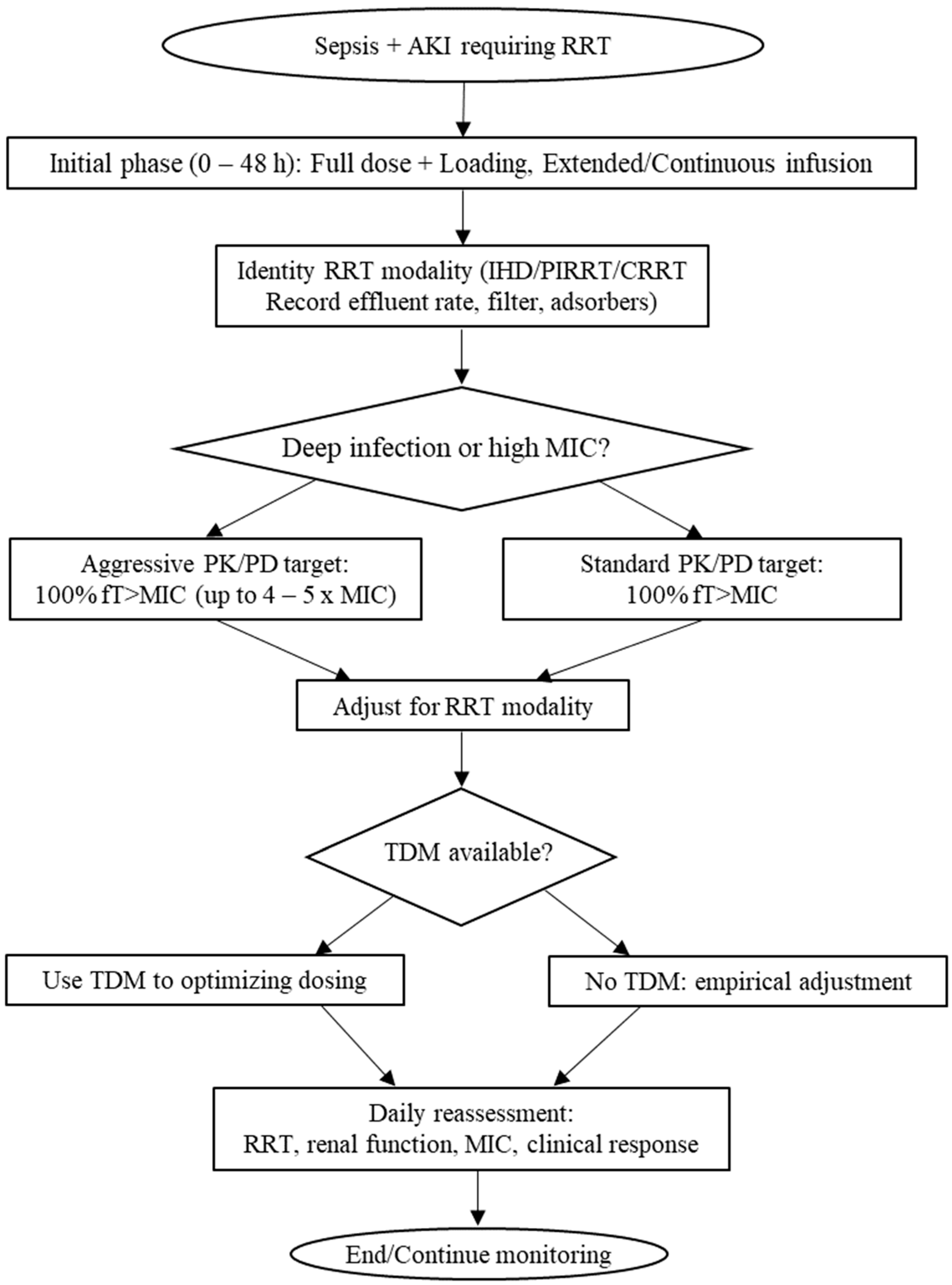
5. BL/BLI Dosing Algorithm in Sepsis-Associated AKI Under RRT
- Initial Phase (0–48 h): It is advisable to avoid an empirical dose reduction, whereas it appears reasonable to initiate a full standard dose, including a loading dose and extended/continuous infusion when feasible. This strategy is justified by the high variability of renal and extracorporeal clearance in the early stage, where underexposure increases the risk of treatment failure.
- RRT Characterization: The RRT modality (IHD, PIRRT, CRRT: CVVH, CVVHD, CVVHDF) should be identified. Effluent flow rate, the main determinant of extracorporeal clearance, should be recorded, along with membrane type and potential use of adsorptive devices.
- Drug- and Patient-Specific Factors: BL/BLI physicochemical properties (hydrophilicity, low protein binding, small Vd, resulting in high extracorporeal clearance) should be considered. Residual renal clearance or ARC should be assessed, and the infection site as well as the pathogen MIC should be evaluated.
- Practical Dosing Considerations:
- C/T: Standard 1.5 g q8h is often insufficient in CRRT; 3 g q8h may be required for high MIC or deep-seated infections.
- CZA: 1.25–2.5 g q8h depending on MIC and effluent; dose fractionation is preferred over interval extension.
- AZA: Limited RRT data; high clearance expected; extended infusion and higher dosing recommended.
- FDC: Manufacturer guidance for CRRT ranges from 1.5 g q12h to 2 g q8h, with 3 h infusion; TDM is advised.
- MVB: Risk of vaborbactam accumulation in CRRT; regimens vary from 2 to 4 g q8h depending on MIC and effluent.
- IMR: Ex vivo data indicate strong extracorporeal removal; simulated dosing suggests 200–600 mg IMI q6h + 100 mg REL q6h depending on PK/PD targets.
- Adjustment for RRT Modality:
- CRRT: Full dosing should be maintained, with increased dose or frequency at higher effluent rates (≥35 mL/kg/h).
- PIRRT: A loading dose should be administered before the session, with possible supplemental dosing afterward.
- IHD: Supplemental dosing should be administered post-dialysis for hydrophilic BL with low protein binding and low Vd.
- TDM: TDM should be performed whenever available. The target is 100% fT > MIC; in severe infections, 100% fT > 4–5 × MIC may be considered. Adjustments should primarily involve increasing dose or frequency rather than prolonging the dosing interval.
- Daily Reassessment: RRT settings, residual renal function, pathogen MIC, clinical response, and potential toxicity should be re-evaluated daily. De-escalation should only be undertaken when both renal function and RRT prescription are stable.
6. Discussion
Author Contributions
Funding
Institutional Review Board Statement
Informed Consent Statement
Data Availability Statement
Conflicts of Interest
Abbreviations
| AKI | Acute Kidney Injury |
| ARC | Augmented Renal Clearance |
| AZA | Aztreonam–Avibactam |
| BL | Beta-Lactam |
| BL/BLI | Beta-Lactam/Beta-Lactamase Inhibitor |
| BLI | Beta-Lactamase Inhibitor |
| CEFI | Cefiderocol |
| CLSI | Clinical and Laboratory Standards Institute |
| CPE | Carbapenemase-Producing Enterobacteriaceae |
| CRE | Carbapenem-Resistant Enterobacterales |
| CRKP | Carbapenem-Resistant Klebsiella pneumoniae |
| CRO | Carbapenem-Resistant Organism |
| CRRT | Continuous Renal Replacement Therapy |
| CT | Concentration Threshold |
| CVVH | Continuous Veno-Venous Hemofiltration |
| CVVHDF | Continuous Veno-Venous Hemodiafiltration |
| CZA | Ceftazidime–Avibactam |
| DOI | Digital Object Identifier |
| EUCAST | European Committee on Antimicrobial Susceptibility Testing |
| FDA | Food and Drug Administration |
| fT | Free Time |
| GFR | Glomerular Filtration Rate |
| ICU | Intensive Care Unit |
| IHD | Intermittent Hemodialysis |
| IMI | Imipenem |
| IMI/REL | Imipenem–Relebactam |
| IMP | Imipenemase (Metallo-Beta-Lactamase class) |
| KPC | Klebsiella pneumoniae Carbapenemase |
| MBL | Metallo-Beta-Lactamase |
| MDR | Multidrug-Resistant |
| MIC | Minimum Inhibitory Concentration |
| MRSA | Methicillin-Resistant Staphylococcus aureus |
| MVB | Meropenem–Vaborbactam |
| MW | Molecular Weight |
| NDM | New Delhi Metallo-Beta-Lactamase |
| OXA | Oxacillinase (Class D Beta-Lactamase) |
| PD | Pharmacodynamics |
| PEDI | Pediatric Cefiderocol Trial (PEDI-CEFI) |
| PIRRT | Prolonged Intermittent Renal Replacement Therapy |
| PK | Pharmacokinetics |
| PK/PD | Pharmacokinetics/Pharmacodynamics |
| PTA | Probability of Target Attainment |
| REL | Relebactam |
| RRT | Renal Replacement Therapy |
| SA | Sepsis-Associated |
| SC | Sieving Coefficient |
| SMART | Study for Monitoring Antimicrobial Resistance Trends |
| TBCL | Total Body Clearance |
| TDM | Therapeutic Drug Monitoring |
| TRCL | Total Renal Clearance |
References
- Singer, M.; Deutschman, C.S.; Seymour, C.W.; Shankar-Hari, M.; Annane, D.; Bauer, M.; Bellomo, R.; Bernard, G.R.; Chiche, J.-D.; Coopersmith, C.M.; et al. The Third International Consensus Definitions for Sepsis and Septic Shock (Sepsis-3). J. Am. Med. Assoc. 2016, 315, 801–810. [Google Scholar] [CrossRef]
- Bauer, M.; Gerlach, H.; Vogelmann, T.; Preissing, F.; Stiefel, J.; Adam, D. Mortality in Sepsis and Septic Shock in Europe, North America and Australia between 2009 and 2019—Results from a Systematic Review and Meta-Analysis. Crit. Care 2020, 24, 239. [Google Scholar] [CrossRef]
- GBD 2019 Antimicrobial Resistance Collaborators. Global Mortality Associated with 33 Bacterial Pathogens in 2019: A Systematic Analysis for the Global Burden of Disease Study 2019. Lancet 2022, 400, 2221–2248. [Google Scholar] [CrossRef] [PubMed]
- Kumar, A.; Roberts, D.; Wood, K.E.; Light, B.; Parrillo, J.E.; Sharma, S.; Suppes, R.; Feinstein, D.; Zanotti, S.; Taiberg, L.; et al. Duration of Hypotension before Initiation of Effective Antimicrobial Therapy Is the Critical Determinant of Survival in Human Septic Shock. Crit. Care Med. 2006, 34, 1589–1596. [Google Scholar] [CrossRef]
- Im, Y.; Kang, D.; Ko, R.E.; Lee, Y.J.; Lim, S.Y.; Park, S.; Na, S.J.; Chung, C.R.; Park, M.H.; Oh, D.K.; et al. Time-to-Antibiotics and Clinical Outcomes in Patients with Sepsis and Septic Shock: A Prospective Nationwide Multicentre Cohort Study. Crit. Care 2022, 26, 19. [Google Scholar] [CrossRef] [PubMed]
- Taylor, S.P.; Anderson, W.E.; Beam, K.; Taylor, B.; Ellerman, J.; Kowalkowski, M.A. The Association between Antibiotic Delay Intervals and Hospital Mortality among Patients Treated in the Emergency Department for Suspected Sepsis. Crit. Care Med. 2021, 49, 741–747. [Google Scholar] [CrossRef] [PubMed]
- Puskarich, M.A.; Trzeciak, S.; Shapiro, N.I.; Arnold, R.C.; Horton, J.M.; Studnek, J.R.; Kline, J.A.; Jones, A.E. Association between Timing of Antibiotic Administration and Mortality from Septic Shock in Patients Treated with a Quantitative Resuscitation Protocol. Crit. Care Med. 2011, 39, 2066–2071. [Google Scholar] [CrossRef]
- Force, I.S.T. Infectious Diseases Society of America (IDSA) Position Statement: Why IDSA Did Not Endorse the Surviving Sepsis Campaign Guidelines. Clin. Infect. Dis. 2018, 66, 1631–1635. [Google Scholar] [CrossRef]
- Rhee, C.; Chiotos, K.; Cosgrove, S.E.; Heil, E.L.; Kadri, S.S.; Kalil, A.C.; Gilbert, D.N.; Masur, H.; Septimus, E.J.; Sweeney, D.A.; et al. Infectious Diseases Society of America Position Paper: Recommended Revisions to the National Severe Sepsis and Septic Shock Early Management Bundle (SEP-1) Sepsis Quality Measure. Clin. Infect. Dis. 2020, 72, 541–552. [Google Scholar] [CrossRef]
- Baggs, J.; Fridkin, S.K.; Pollack, L.A.; Srinivasan, A.; Jernigan, J.A. Estimating National Trends in Inpatient Antibiotic Use among US Hospitals from 2006 to 2012. JAMA Intern. Med. 2016, 176, 1639–1648. [Google Scholar] [CrossRef]
- Al-Dorzi, H.M.; Eissa, A.T.; Khan, R.M.; Harbi, S.A.A.; Aldabbagh, T.; Arabi, Y.M. Dosing Errors of Empirical Antibiotics in Critically Ill Patients with Severe Sepsis or Septic Shock: A Prospective Observational Study. Int. J. Health Sci. 2019, 13, 48–55. [Google Scholar]
- De Waele, J.J.; Lipman, J.; Akova, M.; Bassetti, M.; Dimopoulos, G.; Kaukonen, M.; Koulenti, D.; Martin, C.; Montravers, P.; Rello, J.; et al. Risk Factors for Target Non-attainment during Empirical Treatment with β-Lactam Antibiotics in Critically Ill Patients. Intensive Care Med. 2014, 40, 1340–1351. [Google Scholar] [CrossRef]
- Casu, G.S.; Hites, M.; Jacobs, F.; Cotton, F.; Wolff, F.; Beumier, M.; de Backer, D.; Vincent, J.-L.; Taccone, F.S. Can Changes in Renal Function Predict Variations in Beta-Lactam Concentrations in Septic Patients? Int. J. Antimicrob. Agents 2013, 42, 422–428. [Google Scholar] [CrossRef]
- Roberts, J.A.; Joynt, G.M.; Lee, A.; Choi, G.; Bellomo, R.; Kanji, S.; Mudaliar, M.Y.; Peake, S.L.; Stephens, D.; Taccone, F.S. The Effect of Renal Replacement Therapy and Antibiotic Dose on Antibiotic Concentrations in Critically Ill Patients: Data from the Multinational Sampling Antibiotics in Renal Replacement Therapy Study. Clin. Infect. Dis. 2021, 72, 1369–1378. [Google Scholar] [CrossRef]
- Choi, G.; Gomersall, C.D.; Tian, Q.; Joynt, G.M.; Freebairn, R.; Lipman, J. Principles of Antibacterial Dosing in Continuous Renal Replacement Therapy. Crit. Care Med. 2009, 37, 2268–2275. [Google Scholar] [CrossRef]
- Forrest, A.; Ballow, C.H.; Nix, D.E.; Birmingham, M.C.; Schentag, J.J. Development of a Population Pharmacokinetic Model and Optimal Sampling Strategies for Intravenous Ciprofloxacin. Antimicrob. Agents Chemother. 1993, 37, 1065–1072. [Google Scholar] [CrossRef] [PubMed]
- Isla, A.; Rodriguez-Gascon, A.; Troconiz, I.F.; Bueno, L.; Solinis, M.A.; Maynar, J.; Sánchez-Izquierdo, J.Á.; Pedraz, J.L. Population Pharmacokinetics of Meropenem in Critically Ill Patients Undergoing Continuous Renal Replacement Therapy. Clin. Pharmacokinet. 2008, 47, 173–180. [Google Scholar] [CrossRef]
- Mahmoud, S.H.; Shen, C. Augmented Renal Clearance in Critical Illness: An Important Consideration in Drug Dosing. Pharmaceutics 2017, 9, 36. [Google Scholar] [CrossRef]
- Udy, A.A.; Varghese, J.M.; Altukroni, M.; Briscoe, S.; McWhinney, B.C.; Ungerer, J.P.; Lipman, J.; Roberts, J.A. Subtherapeutic Initial Beta-Lactam Concentrations in Select Critically Ill Patients: Association between Augmented Renal Clearance and Low Trough Drug Concentrations. Chest 2012, 142, 30–39. [Google Scholar] [CrossRef] [PubMed]
- Baptista, J.P.; Sousa, E.; Martins, P.J.; Pimentel, J.M. Augmented Renal Clearance in Septic Patients and Implications for Vancomycin Optimisation. Int. J. Antimicrob. Agents 2012, 39, 420–423. [Google Scholar] [CrossRef]
- Herrera-Gutiérrez, M.E.; Seller-Pérez, G.; Banderas-Bravo, E.; Muñoz-Bono, J.; Lebrón-Gallardo, M.; Fernandez-Ortega, J.F. Replacement of 24-h Creatinine Clearance by 2-h Creatinine Clearance in Intensive Care Unit Patients: A Single-Centre Study. Intensive Care Med. 2007, 33, 1900–1906. [Google Scholar] [CrossRef]
- Abdul-Aziz, M.H.; Alffenaar, J.C.; Bassetti, M.; Bracht, H.; Dimopoulos, G.; Marriott, D.; Neely, M.N.; Paiva, J.A.; Pea, F.; Sjövall, F.; et al. Antimicrobial Therapeutic Drug Monitoring in Critically Ill Adult Patients: A Position Paper. Intensive Care Med. 2020, 46, 1127–1153. [Google Scholar] [CrossRef]
- Gonçalves-Pereira, J.; Póvoa, P. Antibiotics in Critically Ill Patients: A Systematic Review of the Pharmacokinetics of Beta-Lactams. Crit. Care 2011, 15, R206. [Google Scholar] [CrossRef]
- Wong, G.; Briscoe, S.; Adnan, S.; McWhinney, B.; Ungerer, J.; Lipman, J.; Roberts, J.A. Protein Binding of Beta-Lactam Antibiotics in Critically Ill Patients: Can We Successfully Predict Unbound Concentrations? Antimicrob. Agents Chemother. 2013, 57, 6165–6170. [Google Scholar] [CrossRef]
- Pereira, J.G.; Fernandes, J.; Duarte, A.R.; Fernandes, S.M. β-Lactam Dosing in Critical Patients: A Narrative Review of Optimal Efficacy and the Prevention of Resistance and Toxicity. Antibiotics 2022, 11, 1839. [Google Scholar] [CrossRef]
- Thompson, A.; Li, F.; Gross, A.K. Considerations for Medication Management and Anticoagulation during Continuous Renal Replacement Therapy. AACN Adv. Crit. Care 2017, 28, 51–63. [Google Scholar] [CrossRef]
- Pistolesi, V.; Morabito, S.; Di Mario, F.; Regolisti, G.; Cantarelli, C.; Fiaccadori, E. A Guide to Understanding Antimicrobial Drug Dosing in Critically Ill Patients on Renal Replacement Therapy. Antimicrob. Agents Chemother. 2019, 63, e00583-19. [Google Scholar] [CrossRef] [PubMed]
- Bugge, J.F. Influence of Renal Replacement Therapy on Pharmacokinetics in Critically Ill Patients. Best Pract. Res. Clin. Anaesthesiol. 2004, 18, 175–187. [Google Scholar] [CrossRef]
- Scharf, C.; Liebchen, U.; Paal, M.; Taubert, M.; Vogeser, M.; Irlbeck, M.; Zoller, M.; Schroeder, I. The Higher the Better? Defining the Optimal Beta-Lactam Target for Critically Ill Patients to Reach Infection Resolution and Improve Outcome. J. Intensive Care 2020, 8, 86. [Google Scholar] [CrossRef] [PubMed]
- European Medicines Agency. Guideline on the Use of Pharmacokinetics and Pharmacodynamics in the Development of Antimicrobial Medicinal Products; European Medicines Agency: London, UK, 2016; Available online: https://www.ema.europa.eu/en/documents/scientific-guideline/guideline-use-pharmacokinetics-and-pharmacodynamics-development-antimicrobial-medicinal-products_en.pdf (accessed on 30 December 2024).
- Blot, S.I.; Pea, F.; Lipman, J. The Effect of Pathophysiology on Pharmacokinetics in the Critically Ill Patient—Concepts Appraised by the Example of Antimicrobial Agents. Adv. Drug Deliv. Rev. 2014, 77, 3–11. [Google Scholar] [CrossRef] [PubMed]
- Abdulla, A.; Dijkstra, A.; Hunfeld, N.G.M.; Endeman, H.; Bahmany, S.; Ewoldt, T.M.J.; Muller, A.E.; van Gelder, T.; Gommers, D.; Koch, B.C.P. Failure of Target Attainment of Beta-Lactam Antibiotics in Critically Ill Patients and Associated Risk Factors: A Two-Centre Prospective Study (EXPAT). Crit. Care 2020, 24, 558. [Google Scholar] [CrossRef]
- Zerbaxa® Ceftolozane and Tazobactam for Injection. Available online: https://www.merck.com/product/usa/pi_circulars/z/zerbaxa/zerbaxa_pi.pdf (accessed on 30 December 2024).
- Assefa, G.M.; Roberts, J.A.; Mohammed, S.A.; Sime, F.B. What Are the Optimal Pharmacokinetic/Pharmacodynamic Targets for β-Lactamase Inhibitors? A Systematic Review. J. Antimicrob. Chemother. 2024, 79, 946–958. [Google Scholar] [CrossRef]
- Guilhaumou, R.; Benaboud, S.; Bennis, Y.; Dahyot-Fizelier, C.; Dailly, E.; Gandia, P.; Goutelle, S.; Lefeuvre, S.; Mongardon, N.; Roger, C.; et al. Optimisation of the Treatment with Beta-Lactam Antibiotics in Critically Ill Patients—Guidelines from the French Society of Pharmacology and Therapeutics (Société Française de Pharmacologie et Thérapeutique-SFPT) and the French Society of Anaesthesia and Intensive Care Medicine (Société Française d’Anesthésie et Réanimation-SFAR). Crit. Care 2019, 23, 104. [Google Scholar] [PubMed]
- Zhanel, G.G.; Chung, P.; Adam, H.; Zelenitsky, S.; Denisuik, A.; Schweizer, F.; Lagacé-Wiens, P.R.S.; Rubinstein, E.; Gin, A.S.; Walkty, A.; et al. Ceftolozane/Tazobactam: A Novel Cephalosporin/Beta-Lactamase Inhibitor Combination with Activity against Multidrug-Resistant Gram-Negative Bacilli. Drugs 2014, 74, 31–51. [Google Scholar] [CrossRef] [PubMed]
- Merdjan, H.; Tarral, A.; Das, S.; Li, J. Phase 1 Study Assessing the Pharmacokinetic Profile and Safety of Avibactam in Patients with Renal Impairment. J. Clin. Pharmacol. 2017, 57, 211–218. [Google Scholar] [CrossRef]
- Wooley, M.; Miller, B.; Krishna, G.; Hershberger, E.; Chandorkar, G. Impact of Renal Function on the Pharmacokinetics and Safety of Ceftolozane–Tazobactam. Antimicrob. Agents Chemother. 2014, 58, 2249–2255. [Google Scholar] [CrossRef]
- El Nekidy, W.S.; Al Ali, M.; Abidi, E.; Ghazi, I.M.; Attallah, N.; El Lababidi, R.; Mooty, M.; Ghosn, M.; Mallat, J. Microbiologic Outcomes of Ceftazidime–Avibactam Dosing in Patients with Sepsis Utilising Renal Replacement Therapies. Hemodial. Int. 2023, 27, 289–295. [Google Scholar] [CrossRef] [PubMed]
- Gatti, M.; Giannella, M.; Raschi, E.; Viale, P.; De Ponti, F. Ceftolozane/Tazobactam Exposure in Critically Ill Patients Undergoing Continuous Renal Replacement Therapy: A PK/PD Approach to Tailor Dosing. J. Antimicrob. Chemother. 2021, 76, 199–205. [Google Scholar] [CrossRef]
- Bremmer, D.N.; Nicolau, D.P.; Burcham, P.; Chunduri, A.; Shidham, G.; Bauer, K.A. Ceftolozane/Tazobactam Pharmacokinetics in a Critically Ill Adult Receiving Continuous Renal Replacement Therapy. Pharmacotherapy 2016, 36, e30–e33. [Google Scholar] [CrossRef]
- El Nekidy, W.S.; Al Ali, M.; Abidi, E.; El Lababidi, R.; Alrahmany, D.; Ghazi, I.M.; Mooty, M.; Hijazi, F.; Ghosn, M.; Mallat, J. Clinical Outcomes of Ceftazidime–Avibactam versus Ceftolozane–Tazobactam in Managing Pseudomonal Infections in Patients Undergoing Renal Replacement Therapy. Antibiotics 2024, 13, 699. [Google Scholar] [CrossRef]
- Natesan, S.; Pai, M.P.; Lodise, T.P. Determination of Alternative Ceftolozane/Tazobactam Dosing Regimens for Patients with Infections Due to Pseudomonas aeruginosa with MIC Values between 4 and 32 mg/L. J. Antimicrob. Chemother. 2017, 72, 2813–2816. [Google Scholar] [CrossRef] [PubMed]
- Butragueño-Laiseca, L.; Troconiz, I.F.; Grau, S.; Campillo, N.; García, X.; Padilla, B.; Fernández, S.N.; Santiago, M.J. Finding the Dose for Ceftolozane–Tazobactam in Critically Ill Children with and without Acute Kidney Injury. Antibiotics 2020, 9, 887. [Google Scholar] [CrossRef]
- Zhanel, G.G.; Lawson, C.D.; Adam, H.; Schweizer, F.; Zelenitsky, S.; Lagacé-Wiens, P.; Denisuik, A.; Rubinstein, E.; Gin, A.S.; Hoban, D.J.; et al. Ceftazidime–Avibactam: A Novel Cephalosporin/β-Lactamase Inhibitor Combination. Drugs 2013, 73, 159–177. [Google Scholar] [CrossRef]
- Ulldemolins, M.; Roberts, J.A.; Lipman, J.; Rello, J. Antibiotic Dosing in Multiple Organ Dysfunction Syndrome. Chest 2011, 139, 1210–1220. [Google Scholar] [CrossRef]
- Food and Drug Administration. Highlights of Prescribing Information. Ceftazidime–Avibactam Package Insert. Allergen. AVYCAZ Safely and Effectively. 2015. Available online: https://www.accessdata.fda.gov/drugsatfda_docs/label/2015/206494s000lbl.pdf (accessed on 30 March 2025).
- Wenzler, E.; Bunnell, K.L.; Bleasdale, S.C.; Benken, S.; Danziger, L.H.; Rodvold, K.A. Pharmacokinetics and Dialytic Clearance of Ceftazidime–Avibactam in a Critically Ill Patient on Continuous Venovenous Hemofiltration. Antimicrob. Agents Chemother. 2017, 61, e00464-17. [Google Scholar] [CrossRef] [PubMed]
- Soukup, P.; Faust, A.C.; Edpuganti, V.; Putnam, W.C.; McKinnell, J.A. Steady-State Ceftazidime–Avibactam Serum Concentrations and Dosing Recommendations in a Critically Ill Patient Being Treated for Pseudomonas aeruginosa Pneumonia and Undergoing Continuous Venovenous Hemodiafiltration. Pharmacother. J. Hum. Pharmacol. Drug Ther. 2019, 39, 1216–1222. [Google Scholar] [CrossRef] [PubMed]
- Shields, R.K.; Nguyen, M.H.; Chen, L.; Press, E.G.; Kreiswirth, B.N.; Clancy, C.J. Pneumonia and Renal Replacement Therapy Are Risk Factors for Ceftazidime–Avibactam Treatment Failures and Resistance among Patients with Carbapenem-Resistant Enterobacteriaceae Infections. Antimicrob. Agents Chemother. 2018, 62, e02497-17. [Google Scholar] [CrossRef]
- Shields, R.K.; Chen, L.; Cheng, S.; Chavda, K.D.; Press, E.G.; Snyder, A.; Pandey, R.; Doi, Y.; Kreiswirth, B.N.; Nguyen, M.H.; et al. Emergence of Ceftazidime–Avibactam Resistance Due to Plasmid-Borne blaKPC-3 Mutations during Treatment of Carbapenem-Resistant Klebsiella pneumoniae Infections. Antimicrob. Agents Chemother. 2017, 61, e02097-16. [Google Scholar]
- Ji, Z.; Sun, K.; Li, Z.; Cheng, W.; Yang, J. Carbapenem-Resistant Klebsiella pneumoniae Osteomyelitis Treated with Ceftazidime–Avibactam in an Infant: A Case Report. Infect. Drug Resist. 2021, 14, 3109–3113. [Google Scholar] [CrossRef]
- Wang, W.; Wang, R.; Zhang, Y.; Zeng, L.; Kong, H.; Bai, X.; Zhang, W.; Liang, T. Ceftazidime–Avibactam as Salvage Therapy in Paediatric Liver Transplantation Patients with Infections Caused by Carbapenem-Resistant Enterobacterales. Infect. Drug Resist. 2022, 15, 3323–3332. [Google Scholar] [CrossRef]
- Perruccio, K.; Rosaria, D.; Amico, M.; Valentina, B.; Daniela, O.; Francesca, C.; Elisabetta, C.; Paola, M.; Antonella, C.; Daniele, Z.; et al. Ceftolozane/Tazobactam and Ceftazidime/Avibactam: An Italian Multi-Centre Retrospective Analysis of Safety and Efficacy in Children with Haematologic Malignancies and Multi-Drug Resistant Gram-Negative Bacteria Infections. Pediatr. Infect. Dis. J. 2022, 41, 994–996. [Google Scholar] [CrossRef]
- Meng, H.; Zhao, Y.; An, Q.; Zhu, B.; Cao, Z.; Lu, J. Use of Ceftazidime–Avibactam for Suspected or Confirmed Carbapenem-Resistant Organisms in Children: A Retrospective Study. Infect. Drug Resist. 2023, 16, 5815–5824. [Google Scholar] [CrossRef] [PubMed]
- Araujo da Silva, A.R.; Quijada, R. Use of Ceftazidime–Avibactam in Children Admitted to Paediatric Intensive Care Units. Children 2024, 11, 664. [Google Scholar] [CrossRef]
- Li, D.; Yu, H.; Huang, X.; Long, S.; Zhang, J. In Vitro Activity of Ceftazidime–Avibactam, Imipenem–Relebactam, Aztreonam–Avibactam, and Comparators toward Carbapenem-Resistant and Hypervirulent Isolates. Microbiol. Spectr. 2023, 11, e0280623. [Google Scholar] [CrossRef] [PubMed]
- Ran, X.; Chen, X.; Wang, C.; Wang, H.; Xie, W.; Jing, C. Carbapenem-Resistant Klebsiella pneumoniae Infections in Chinese Children: In Vitro Activities of Ceftazidime–Avibactam and Aztreonam–Avibactam against Carbapenemase-Producing Strains in a Two-Centre Study. Front. Cell. Infect. Microbiol. 2025, 15, 1545999. [Google Scholar] [CrossRef] [PubMed]
- Ehmann, D.E.; Jahić, H.; Ross, P.L.; Gu, R.-F.; Hu, J.; Kern, G.; Walkup, G.K.; Fisher, S.L. Avibactam Is a Covalent, Reversible, Non-β-Lactam β-Lactamase Inhibitor. Proc. Natl. Acad. Sci. USA 2012, 109, 11663–11668. [Google Scholar] [CrossRef]
- Carmeli, Y.; Cisneros, J.M.; Paul, M.; Daikos, G.L.; Wang, M.; Torre-Cisneros, J.; Singer, G.; Titov, I.; Gumenchuk, I.; Zhao, Y.; et al. Aztreonam–Avibactam versus Meropenem for the Treatment of Serious Infections Caused by Gram-Negative Bacteria (REVISIT): A Descriptive, Multinational, Open-Label, Phase 3, Randomised Trial. Lancet Infect. Dis. 2025, 25, 218–230. [Google Scholar] [CrossRef]
- Li, J.; Learoyd, M.; Qiu, F.; Zhu, L.; Edeki, T. A Randomised, Phase I Study to Assess the Safety, Tolerability and Pharmacokinetics of Ceftazidime–Avibactam in Healthy Chinese Subjects. Clin. Drug Investig. 2016, 36, 119–126. [Google Scholar] [CrossRef]
- Gatti, M.; Rinaldi, M.; Gaibani, P.; Siniscalchi, A.; Tonetti, T.; Giannella, M.; Viale, P.; Pea, F. A Descriptive Pharmacokinetic/Pharmacodynamic Analysis of Continuous Infusion Ceftazidime–Avibactam for Treating DTR Gram-Negative Infections in a Case Series of Critically Ill Patients Undergoing Continuous Veno-Venous Haemodiafiltration (CVVHDF). J. Crit. Care 2023, 76, 154301. [Google Scholar] [CrossRef]
- Lodise, T.P.; O’Donnell, J.N.; Raja, S.; Guptill, J.T.; Zaharoff, S.; Schwager, N.; Fowler, V.G., Jr.; Beresnev, T.; Wall, A.; Wiegand, K.; et al. Safety of Ceftazidime–Avibactam in Combination with Aztreonam (COMBINE) in a Phase I, Open-Label Study in Healthy Adult Volunteers. Antimicrob. Agents Chemother. 2022, 66, e0093522. [Google Scholar] [CrossRef]
- Cornely, O.A.; Cisneros, J.M.; Torre-Cisneros, J.; Rodríguez-Hernández, M.J.; Tallón-Aguilar, L.; Calbo, E.; Horcajada, J.P.; Queckenberg, C.; Zettelmeyer, U.; Arenz, D.; et al. Pharmacokinetics and Safety of Aztreonam/Avibactam for the Treatment of Complicated Intra-Abdominal Infections in Hospitalised Adults: Results from the REJUVENATE Study. J. Antimicrob. Chemother. 2020, 75, 618–627. [Google Scholar] [CrossRef] [PubMed]
- Barbier, F.; Hraiech, S.; Kernéis, S.; Veluppillai, N.; Pajot, O.; Poissy, J.; Roux, D.; Zahar, J.R.; French Intensive Care Society. Rationale and Evidence for the Use of New Beta-Lactam/Beta-Lactamase Inhibitor Combinations and Cefiderocol in Critically Ill Patients. Ann. Intensive Care 2023, 13, 65. [Google Scholar] [CrossRef] [PubMed]
- Livermore, D.M.; Mushtaq, S.; Vickers, A.; Woodford, N. Activity of Aztreonam/Avibactam Against Metallo-β-Lactamase-Producing Enterobacterales from the UK: Impact of Penicillin-Binding Protein-3 Inserts and CMY-42 β-Lactamase in Escherichia coli. Int. J. Antimicrob. Agents 2023, 61, 106776. [Google Scholar] [CrossRef] [PubMed]
- Nichols, W.W.; Newell, P.; Critchley, I.A.; Riccobene, T.; Das, S. Avibactam Pharmacokinetic/Pharmacodynamic Targets. Antimicrob. Agents Chemother. 2018, 62, e02446-17. [Google Scholar] [CrossRef]
- Das, S.; Riccobene, T.; Carrothers, T.J.; Wright, J.G.; MacPherson, M.; Cristinacce, A.; McFadyen, L.; Xie, R.; Luckey, A.; Raber, S. Dose Selection for Aztreonam–Avibactam, Including Adjustments for Renal Impairment, for Phase IIa and Phase III Evaluation. Eur. J. Clin. Pharmacol. 2024, 80, 529–543. [Google Scholar] [CrossRef]
- Zou, C.; Wei, J.; Shan, B.; Chen, X.; Wang, D.; Niu, S. In Vitro Activity of Ceftazidime–Avibactam and Aztreonam–Avibactam Against Carbapenem-Resistant Isolates Collected from Three Secondary Hospitals in Southwest China Between 2018 and 2019. Infect. Drug Resist. 2020, 13, 3563–3568. [Google Scholar] [CrossRef]
- Ilham, D.; Souad, L.; Asmae, L.; Kawtar, N.; Mohammed, T.; Nabila, S. Prevalence, Antibiotic Resistance Profile, MBLs Encoding Genes, and Biofilm Formation Among Clinical Carbapenem-Resistant Enterobacterales Isolated from Patients in Mohammed VI University Hospital Centre, Morocco. Lett. Appl. Microbiol. 2023, 76, ovad107. [Google Scholar] [CrossRef]
- Wu, J.Y.; Srinivas, P.; Pogue, J.M. Cefiderocol: A Novel Agent for the Management of Multidrug-Resistant Gram-Negative Organisms. Infect. Dis. Ther. 2020, 9, 17–40. [Google Scholar] [CrossRef]
- Nakamura, R.; Ito-Horiyama, T.; Takemura, M.; Toba, S.; Matsumoto, S.; Ikehara, T.; Tsuji, M.; Sato, T.; Yamano, Y. In Vivo Pharmacodynamic Study of Cefiderocol, a Novel Parenteral Siderophore Cephalosporin, in Murine Thigh and Lung Infection Models. Antimicrob. Agents Chemother. 2019, 63, e02031-18. [Google Scholar] [CrossRef]
- Katsube, T.; Echols, R.; Arjona Ferreira, J.C.; Krenz, H.K.; Berg, J.K.; Galloway, C. Cefiderocol, a Siderophore Cephalosporin for Gram-Negative Bacterial Infections: Pharmacokinetics and Safety in Subjects with Renal Impairment. J. Clin. Pharmacol. 2017, 57, 584–591. [Google Scholar] [CrossRef]
- Katsube, T.; Echols, R.; Wajima, T. Pharmacokinetic and Pharmacodynamic Profiles of Cefiderocol, a Novel Siderophore Cephalosporin. Clin. Infect. Dis. 2019, 69 (Suppl. S7), S552–S558. [Google Scholar] [CrossRef]
- Mornese Pinna, S.; Corcione, S.; De Nicolò, A.; Montrucchio, G.; Scabini, S.; Vita, D.; De Benedetto, I.; Lupia, T.; Mula, J.; Di Perri, G.; et al. Pharmacokinetics of Cefiderocol in Critically Ill Patients Receiving Renal Replacement Therapy: A Case Series. Antibiotics 2022, 11, 1830. [Google Scholar] [CrossRef] [PubMed]
- Shionogi Inc. Fetroja: Cefiderocol for Injection for Intravenous Use, Prescribing Information; Food and Drug Administration: Silver Spring, MD, USA, 2021.
- Available online: https://www.ema.europa.eu/en/documents/product-information/fetcroja-epar-product-information_en.pdf (accessed on 30 December 2024).
- Katsube, T.; Echols, R.; Wajima, T. Prediction of Cefiderocol Pharmacokinetics and Probability of Target Attainment in Paediatric Subjects for Proposing Dose Regimens. Open Forum Infect. Dis. 2019, 6, S330–S331. [Google Scholar]
- Katsube, T.; Nicolau, D.P.; Rodvold, K.A.; Wunderink, R.G.; Echols, R.; Matsunaga, Y.; Menon, A.; Portsmouth, S.; Wajima, T. Intrapulmonary Pharmacokinetic Profile of Cefiderocol in Mechanically Ventilated Patients with Pneumonia. J. Antimicrob. Chemother. 2021, 76, 2902–2905. [Google Scholar] [CrossRef]
- Bottari, G.; Isabella, G.; Corrado, C.; Cairoli, S.; Marano, M.; Galaverna, F.; Stoppa, F.; Boccieri, E.; Labbadia, R.; Cappoli, A.; et al. Impact of Continuous Renal Replacement Therapy and CytoSorb on Cefiderocol Pharmacokinetics: “One Size Does Not Fit All”. Int. J. Artif. Organs 2025, 48, 204–210. [Google Scholar] [CrossRef]
- Wunderink, R.G.; Giamarellos-Bourboulis, E.J.; Rahav, G.; Mathers, A.J.; Bassetti, M.; Vazquez, J.; Cornely, O.A.; Solomkin, J.; Bhowmick, T.; Bishara, J.; et al. Effect and Safety of Meropenem–Vaborbactam versus Best-Available Therapy in Patients with Carbapenem-Resistant Enterobacteriaceae Infections: The TANGO II Randomized Clinical Trial. Infect. Dis. Ther. 2018, 7, 439–455. [Google Scholar] [CrossRef]
- Griffith, D.C.; Sabet, M.; Tarazi, Z.; Lomovskaya, O.; Dudley, M.N. Pharmacokinetics/Pharmacodynamics of Vaborbactam, a Novel β-Lactamase Inhibitor, in Combination with Meropenem. Antimicrob. Agents Chemother. 2019, 63, e01659-18. [Google Scholar] [CrossRef]
- Griffith, D.C.; Loutit, J.S.; Morgan, E.E.; Keedy, K.; Persson, T.; Brown, D.; Doyle, T.B.; Steenbergen, J.N.; Scangarella, N.E.; Dudley, M.N. Phase 1 Study of the Safety, Tolerability, and Pharmacokinetics of the β-Lactamase Inhibitor Vaborbactam (RPX7009) in Healthy Adult Subjects. Antimicrob. Agents Chemother. 2016, 60, 6326–6332. [Google Scholar] [CrossRef]
- Rubino, C.M.; Bhavnani, S.M.; Loutit, J.S.; Dudley, M.N. Single-Dose Pharmacokinetics and Safety of Meropenem–Vaborbactam in Subjects with Chronic Renal Impairment. Antimicrob. Agents Chemother. 2018, 62, e02103-17. [Google Scholar] [CrossRef] [PubMed]
- Kufel, W.D.; Eranki, A.P.; Paolino, K.M.; Call, A.; Miller, C.D.; Mogle, B.T. In Vivo Pharmacokinetic Analysis of Meropenem/Vaborbactam During Continuous Venovenous Haemodialysis. J. Antimicrob. Chemother. 2019, 74, 2117–2118. [Google Scholar] [CrossRef] [PubMed]
- Sime, F.B.; Pandey, S.; Karamujic, N.; Parker, S.; Alexander, E.; Loutit, J.; Durso, S.; Griffith, D.; Lipman, J.; Wallis, S.C.; et al. Ex Vivo Characterisation of Effects of Renal Replacement Therapy Modalities and Settings on Pharmacokinetics of Meropenem and Vaborbactam. Antimicrob. Agents Chemother. 2018, 62, e01306-18. [Google Scholar] [CrossRef]
- Trang, M.; Griffith, D.C.; Bhavnani, S.M.; Rubino, C.M.; Ambrose, P.G. Population Pharmacokinetics of Meropenem and Vaborbactam Based on Data from Noninfected Subjects and Infected Patients. Antimicrob. Agents Chemother. 2021, 65, e02606-20. [Google Scholar] [CrossRef]
- Reed, G.; Valadez, A.; Smith, B.J.; McCreary, E.K.; Kline, E.G.; Neely, M.N.; Squires, K.M.; Shields, R.K.; Rhodes, N.J. Population Pharmacokinetics of Meropenem–Vaborbactam in Acutely Ill Hospitalised Patients with Various Degrees of Renal Dysfunction Including Continuous Renal Replacement Therapy. Antimicrob. Agents Chemother. 2025, 69, e00108-25. [Google Scholar]
- Fornari, C.; Arrieta, A.; Bradley, J.S.; Tout, M.; Magalhaes, P.; Auriol, F.K.; Borella, E.; Piana, C.; Della Pasqua, O.; Vallespir, B.P.; et al. Dose Rationale for the Use of Meropenem/Vaborbactam Combination in Paediatric Patients with Gram-Negative Bacterial Infections. Br. J. Clin. Pharmacol. 2024, 90, 2597–2610. [Google Scholar] [CrossRef]
- Brown, M.L.; Motsch, J.; Kaye, K.S.; File, T.M.; Boucher, H.W.; Vendetti, N.; Aggrey, A.; Joeng, H.K.; Tipping, R.W.; Du, J.; et al. Evaluation of Renal Safety Between Imipenem/Relebactam and Colistin Plus Imipenem in Patients with Imipenem-Nonsusceptible Bacterial Infections in the Randomised, Phase III RESTORE-IMI 1 Study. Open Forum Infect. Dis. 2020, 7, ofaa054. [Google Scholar] [CrossRef] [PubMed]
- Fratoni, A.J.; Kois, A.K.; Gluck, J.A.; Nicolau, D.P.; Kuti, J.L. Imipenem/Relebactam Pharmacokinetics in Critically Ill Patients Supported on Extracorporeal Membrane Oxygenation. J. Antimicrob. Chemother. 2024, 79, 1118–1125. [Google Scholar] [CrossRef]
- Motsch, J.; Murta de Oliveira, C.; Stus, V.; Köksal, I.; Lyulko, O.; Boucher, H.W.; Kaye, K.S.; File, T.M.; Brown, M.L.; Khan, I.; et al. RESTORE-IMI 1: A Multicentre, Randomised, Double-Blind Trial Comparing Efficacy and Safety of Imipenem/Relebactam vs Colistin Plus Imipenem in Patients with Imipenem-Nonsusceptible Bacterial Infections. Clin. Infect. Dis. 2020, 70, 1799–1808. [Google Scholar] [CrossRef] [PubMed]
- Merck & Co., Inc. Recarbrio: Package Insert. Available online: https://www.merckconnect.com/recarbrio/dosing-administration (accessed on 30 March 2025).
- Jang, S.M.; Infante, S.; Abdi Pour, A. Drug Dosing Considerations in Critically Ill Patients Receiving Continuous Renal Replacement Therapy. Pharmacy 2020, 8, 18. [Google Scholar] [CrossRef] [PubMed]
- Hoff, B.M.; Maker, J.H.; Dager, W.E.; Heintz, B.H. Antibiotic Dosing for Critically Ill Adult Patients Receiving Intermittent Haemodialysis, Prolonged Intermittent Renal Replacement Therapy, and Continuous Renal Replacement Therapy: An Update. Ann. Pharmacother. 2020, 54, 43–55. [Google Scholar] [CrossRef]
- Jang, S.M.; Yessayan, L.; Dean, M.; Costello, G.; Katwaru, R.; Mueller, B.A. Imipenem/Relebactam Ex Vivo Clearance During Continuous Renal Replacement Therapy. Antibiotics 2021, 10, 1184. [Google Scholar] [CrossRef]
- DeRyke, C.A.; Wise, M.G.; Bauer, K.A.; Siddiqui, F.; Young, K.; Motyl, M.R.; Sahm, D.F. Antimicrobial Activity of Imipenem/Relebactam and Comparator Agents Against Gram-Negative Isolates Collected from Paediatric Patients: SMART 2018–2022 Global Surveillance. J. Pediatr. Infect. Dis. Soc. 2025, 14, piae134. [Google Scholar] [CrossRef]
- Karlowsky, J.A.; Lob, S.H.; Young, K.; Motyl, M.R.; Sahm, D.F. In Vitro Activity of Imipenem/Relebactam Against Gram-Negative Bacilli from Paediatric Patients—Study for Monitoring Antimicrobial Resistance Trends (SMART) Global Surveillance Program 2015–2017. J. Pediatr. Infect. Dis. Soc. 2021, 10, 274–281. [Google Scholar] [CrossRef]
- White, K.C.; Serpa-Neto, A.; Hurford, R.; Clement, P.; Laupland, K.B.; See, E.; McCullough, J.; White, H.; Shekar, K.; Tabah, A.; et al. Sepsis-Associated Acute Kidney Injury in the Intensive Care Unit: Incidence, Patient Characteristics, Timing, Trajectory, Treatment, and Associated Outcomes. A Multicentre, Observational Study. Intensive Care Med. 2023, 49, 1079–1089. [Google Scholar] [CrossRef]
- Papp-Wallace, K.M.; McLeod, S.M.; Miller, A.A. Durlobactam, a Broad-Spectrum Serine β-Lactamase Inhibitor, Restores Sulbactam Activity Against Acinetobacter Species. Clin. Infect. Dis. 2023, 76 (Suppl. S2), S194–S201. [Google Scholar] [CrossRef]
- Penwell, W.F.; Shapiro, A.B.; Giacobbe, R.A.; Gu, R.-F.; Gao, N.; Thresher, J.; McLaughlin, R.E.; Huband, M.D.; DeJonge, B.L.M.; Ehmann, D.E.; et al. Molecular Mechanisms of Sulbactam Antibacterial Activity and Resistance Determinants in Acinetobacter baumannii. Antimicrob. Agents Chemother. 2015, 59, 1680–1689. [Google Scholar] [CrossRef]
- O’Donnell, J.; Preston, R.A.; Mamikonyan, G.; Stone, E.; Isaacs, R. Pharmacokinetics, Safety, and Tolerability of Intravenous Durlobactam and Sulbactam in Subjects with Renal Impairment and Healthy Matched Control Subjects. Antimicrob. Agents Chemother. 2019, 63, e00794-19. [Google Scholar] [CrossRef] [PubMed]
- Abouelhassan, Y.; Shen, Y.; Chen, A.; Ye, X.; Nicolau, D.P.; Kuti, J.L. Ex Vivo Assessment of Sulbactam–Durlobactam Clearance During Continuous Renal Replacement Therapy to Guide Dosing Recommendations. Antimicrob. Agents Chemother. 2025, 69, e0167423. [Google Scholar] [CrossRef]
- Kufel, W.D.; Zeineddine, N.; Fouad, A.; Roenfanz, H.F.; Shields, R.K.; Kline, E.G.; Warner, J.; Hanrahan, K.; Kuti, J.L. Pharmacokinetic and Pharmacodynamic Evaluation of Sulbactam–Durlobactam in a Critically Ill Patient on Continuous Venovenous Hemofiltration Infected with Carbapenem-Resistant Acinetobacter baumannii–calcoaceticus Complex. Pharmacotherapy 2025, 45, 396–402. [Google Scholar] [CrossRef]
- Kaye, K.S.; Belley, A.; Barth, P.; Matharu, T.; Krsanac, I.; Ong, C.; Kazmierczak, K.; Stone, E.; Lademacher, C.; Sahm, D.F.; et al. Effect of Cefepime/Enmetazobactam vs Piperacillin/Tazobactam on Clinical Cure and Microbiological Eradication in Patients with Complicated Urinary Tract Infection or Acute Pyelonephritis: A Randomised Clinical Trial. JAMA 2022, 328, 1304–1314. [Google Scholar] [CrossRef]
- Keam, S.J. Cefepime/Enmetazobactam: First Approval. Drugs 2024, 84, 737–744. [Google Scholar] [CrossRef]
- Knechtle, P.; Shapiro, S.; Morrissey, I.; De Piano, C.; Belley, A. Sigmoid Emax Modelling to Define the Fixed Concentration of Enmetazobactam for MIC Testing in Combination with Cefepime. Antimicrob. Agents Chemother. 2021, 65, e00926-21. [Google Scholar] [CrossRef] [PubMed]
- Fouad, A.; McGrath, C.; Buyukyanbolu, E.; Kuti, J.L. Ex Vivo Assessment and Simulation to Guide Cefepime–Taniborbactam Dosing Recommendations for Patients Receiving Continuous Renal Replacement Therapy. Antimicrob. Agents Chemother. 2025, 69, e0006125. [Google Scholar] [CrossRef] [PubMed]


| Antibiotic Combination | MW (Da) | Protein Binding (%) | Vd (L/kg) | Renal Clearance | RRT Dosing Considerations |
|---|---|---|---|---|---|
| Ceftolozane–Tazobactam | 666/300 | ~20 | 0.2–0.3 | Predominant | Standard 1.5 g q8h often insufficient; consider 3 g q8h in CRRT, deep infections |
| Ceftazidime–Avibactam | 546/265 | ~10 | 0.2–0.3 | Predominant | 1.25 g q8h may suffice (MIC < 4 mg/L); higher doses in CRRT or high MIC |
| Aztreonam–Avibactam | 435/265 | <10 | 0.2–0.3 | Predominant | No RRT data; extrapolate from aztreonam + CZA; high clearance expected |
| Cefiderocol | 751 | 40–60 | 0.2–0.3 | Predominant | Manufacturer: 1.5 g q12h–2 g q8h; TDM advised in CRRT |
| Meropenem–Vaborbactam | 383/297 | 2/33 | 0.3 | Predominant | 4 g q8h adequate for MIC ≤ 1 mg/L; accumulation risk of vaborbactam in CRRT |
| Imipenem–Relebactam | 299/310 | ~20 | 0.2–0.3 | Predominant | Ex vivo/model-based data: 200–600 mg IMI q6h; 100 mg REL q6h; clearance depends on effluent |
| Sulbactam–Durlobactam | 233/348 | <40 | 0.2–0.3 | Predominant | q8h for effluent <3 L/h; q6h if 3–5 L/h; case: q4h at 6 L/h |
| Cefepime–Enmetazobactam | 480/300 | <10 | 0.2–0.3 | Predominant | 1 g/0.25 g q12–24h if eGFR < 30; higher doses in CRRT |
| Cefepime–Taniborbactam | 480/314 | <20 | 0.2–0.3 | Predominant | Ex vivo/model-based data: dose tailored to effluent flow; q8h or q12h regimens |
Disclaimer/Publisher’s Note: The statements, opinions and data contained in all publications are solely those of the individual author(s) and contributor(s) and not of MDPI and/or the editor(s). MDPI and/or the editor(s) disclaim responsibility for any injury to people or property resulting from any ideas, methods, instructions or products referred to in the content. |
© 2025 by the authors. Licensee MDPI, Basel, Switzerland. This article is an open access article distributed under the terms and conditions of the Creative Commons Attribution (CC BY) license (https://creativecommons.org/licenses/by/4.0/).
Share and Cite
Lacquaniti, A.; Pistolesi, V.; Smeriglio, A.; Santoro, D.; Iannetti, C.; Lentini, G.; Chimenz, R.; Chirico, V.; Trombetta, D.; Morabito, S.; et al. β-Lactam/β-Lactamase Inhibitor Combinations in Sepsis-Associated Acute Kidney Injury and Renal Replacement Therapy. Antibiotics 2025, 14, 1097. https://doi.org/10.3390/antibiotics14111097
Lacquaniti A, Pistolesi V, Smeriglio A, Santoro D, Iannetti C, Lentini G, Chimenz R, Chirico V, Trombetta D, Morabito S, et al. β-Lactam/β-Lactamase Inhibitor Combinations in Sepsis-Associated Acute Kidney Injury and Renal Replacement Therapy. Antibiotics. 2025; 14(11):1097. https://doi.org/10.3390/antibiotics14111097
Chicago/Turabian StyleLacquaniti, Antonio, Valentina Pistolesi, Antonella Smeriglio, Domenico Santoro, Cristina Iannetti, Giuseppe Lentini, Roberto Chimenz, Valeria Chirico, Domenico Trombetta, Santo Morabito, and et al. 2025. "β-Lactam/β-Lactamase Inhibitor Combinations in Sepsis-Associated Acute Kidney Injury and Renal Replacement Therapy" Antibiotics 14, no. 11: 1097. https://doi.org/10.3390/antibiotics14111097
APA StyleLacquaniti, A., Pistolesi, V., Smeriglio, A., Santoro, D., Iannetti, C., Lentini, G., Chimenz, R., Chirico, V., Trombetta, D., Morabito, S., & Monardo, P. (2025). β-Lactam/β-Lactamase Inhibitor Combinations in Sepsis-Associated Acute Kidney Injury and Renal Replacement Therapy. Antibiotics, 14(11), 1097. https://doi.org/10.3390/antibiotics14111097