Article

Electrochemical and Optical Insights into Interfacial Connection for Fast Pollutant Removal: Experimental Study of g-C3N4/BiOCl Heterojunction for Rhb and MO Photodegradation


1
School of Materials Science and Engineering, Wuhan University of Technology, Wuhan 430070, China
2
State Key Laboratory of Advanced Technology for Materials Synthesis and Processing, Wuhan University of Technology, Wuhan 430070, China
3
Shaoxing Institute for Advanced Research, Wuhan University of Technology, Shaoxing 312300, China
4
School of Resources and Environmental Engineering, Wuhan University of Technology, Wuhan 430070, China
5
School of Physics and Mechanics, Wuhan University of Technology, 122 Luoshi Road, Wuhan 430070, China
6
Hubei Engineering Technology Research Center of Environmental Purification Materials, Hubei University of Education, Wuhan 430205, China
7
School of Chemistry, Chemical Engineering, and Life Science, Wuhan University of Technology, Wuhan 430070, China
*
Authors to whom correspondence should be addressed.
Coatings 2026, 16(1), 138; https://doi.org/10.3390/coatings16010138
Submission received: 14 December 2025 / Revised: 6 January 2026 / Accepted: 17 January 2026 / Published: 21 January 2026
(This article belongs to the Special Issue Coatings for Batteries and Energy Storage)

Abstract

Developing efficient heterojunction photocatalysts is essential to address the challenge of degrading persistent organic pollutants. In this study, a multi-scale characterization strategy was employed to investigate the implications of interfacial connectivity between synthesized graphitic carbon nitride (g-C3N4) /bismuth oxychloride (BiOCl)e removal of Rhodamine B (RhB) and Methyl Orange (MO). Morpho-structural characterizations, including Scanning/Transmission Electron Microscopy (SEM/TEM), X-ray diffraction (XRD), X-ray photoelectron spectroscopy (XPS), and N2 physisorption (Brunauer–Emmett–Teller (BET)) analyses, confirmed the successful construction of an intimate interfacial contact between g-C3N4 and BiOCl. The optimized composite (15% g-C3N4/BiOCl), prepared via a one-step hydrothermal method, exhibited enhanced photocatalytic performance following pseudo-first-order kinetics described by the Langmuir–Hinshelwood model, with apparent rate constants of 0.166 min−1 for MO and 0.519 min−1 for RhB. Under visible-light irradiation, degradation efficiencies of 98% for MO (120 min) and 99% for RhB (35 min) were achieved, outperforming the pristine components. Complementary optical and electrochemical analyses indicate improved light absorption and charge-separation efficiency in the heterojunction system. In addition, the photocatalyst demonstrated good operational stability over four consecutive cycles, maintaining 91.70% activity for MO and 99.76% for RhB. Overall, this work highlights the synergistic photocatalytic g-C3N4/BiOCl heterojunction and provides a valuable insight to guide the design of advanced materials for pollutant remediation.

1. Introduction

The discharge of synthetic organic dyes from industrial activities constitutes a significant environmental challenge, contaminating water sources and posing risks to aquatic life and human health [1,2,3]. As representative cationic and anionic dyes, Rhodamine B (RhB) and Methyl Orange (MO) are widely studied owing to their high stability and resistance to conventional degradation methods [4,5,6,7,8]. Such pollutants are degraded via semiconductor-based photocatalysis, which is emerging as a promising advanced oxidation process for wastewater treatment, using light to generate electron-hole pairs that drive the formation of reactive oxygen species capable of mineralizing complex organic molecules [9,10,11].
Among various semiconductors, graphitic carbon nitride (g-C3N4) is a prominent metal-free photocatalyst active under visible light due to its moderate bandgap (typically 2.6–3.2 eV, depending on synthesis conditions and optical analysis methods), excellent stability, and ease of synthesis [12,13,14]. Nevertheless, g-C3N4 faces limitations, including limited photo-response to sunlight and rapid charge-carrier recombination. Conversely, bismuth oxychloride (BiOCl) has a unique layered crystal structure of [Bi2O2]2+ slabs interleaved with double chlorine layers, which induces a strong internal electric field that promotes charge separation [15,16]. Despite these advantages, BiOCl’s wide band gap (3.0–3.5 eV) confines light absorption to the ultraviolet spectrum, thereby severely limiting its solar energy-harvesting efficiency [17,18]. Consequently, the development of the g-C3N4/BiOCl composite photocatalyst has attracted significant research interest owing to the synergy between its visible-light response and the superior charge-separation capability of BiOCl [19,20,21,22]. These studies have demonstrated enhanced degradation rates for various dye treatments and antibiotics compared to individual components. This improvement is enabled by the formation of a heterojunction, which facilitates interfacial charge transfer [23,24,25].
However, a critical examination of the literature reveals a substantial mechanistic gap. Most research relies on indirect evidence, such as photoluminescence (PL) quenching or assumed band gaps from separate material measurements, to infer improved charge separation [26,27,28,29]. Crucially, there is a pronounced lack of direct, quantitative investigations into how the interfacial structure governs charge-transfer dynamics. The precise resistance at the heterojunction/electrolyte interface remains unclear. Additionally, the interfacial interactions that affect carrier density and flat-band potential warrant further investigation with respect to photocatalytic activity. Without employing quantitative analysis techniques, the relationship between materials engineering and photoelectrochemical performance remains correlative rather than understood. This gap hinders the rational design of next-generation heterojunctions with optimized charge-flow pathways.
To address this gap, we engineered an interfacial heterojunction between g-C3N4 and BiOCl via a facile one-step hydrothermal method. The tightly coupled structure, lacking a covalent interface, enabled highly efficient charge-carrier transport, resulting in synergistic enhancements in both adsorption capacity and photocatalytic degradation kinetics. Subsequently, rigorous tests, including morphological and structural analyses, scanning/transmission electron microscopy (SEM/TEM), X-ray diffraction (XRD), X-ray photoelectron spectroscopy (XPS), and N2 physisorption (BET), were conducted to confirm the successful formation of the heterostructure. Additionally, UV–Vis diffuse reflectance spectroscopy (DRS), transient photocurrent response, EIS, and Mott–Schottky measurements were performed to quantitatively probe light absorption, charge-separation efficiency, interfacial resistance, and band alignment. Furthermore, active-species Scavenger experiments were conducted to elucidate the degradation mechanism. This article presents a novel approach to streamline the synthesis and evaluation of the interfacial g-C3N4/BiOCl heterojunction for the synergistic removal of RhB and MO. This not only gives an effective photocatalyst but also a generalizable electrochemical framework for understanding interfacial charge dynamics in heterojunction-based environmental remediation technologies.

2. Results and Discussion

2.1. Morphological and Phase Structural Analysis of the g-C3N4/BiOCl Composite

2.1.1. Morphology of Individual Components

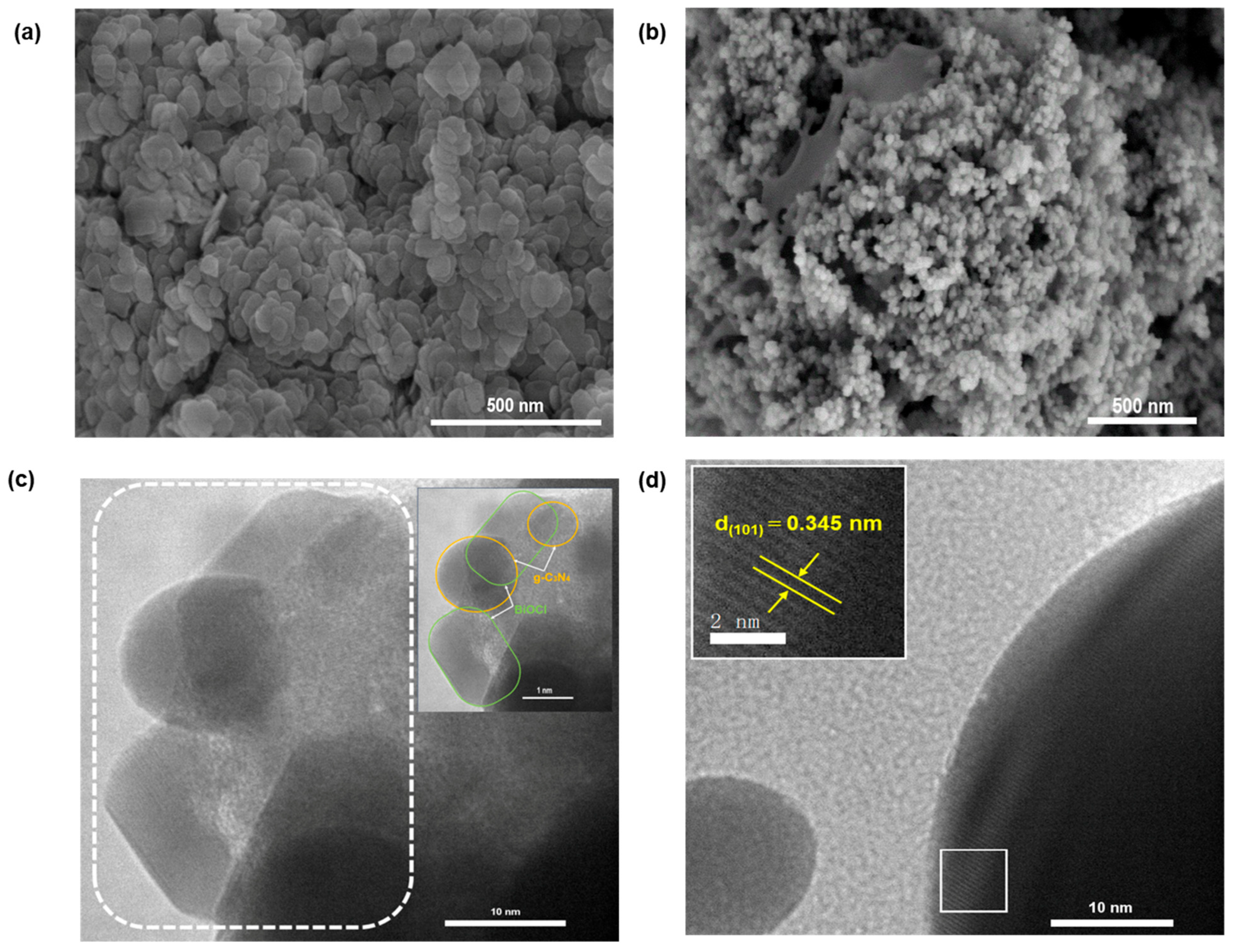
After synthesizing the individual g-C3N4 and BiOCl catalysts as described in Section 3, their distinct morphologies were first examined by SEM. As shown in Figure 1a, the BiOCl sample consists of smooth, well-defined nanoplates with a particle size distribution of 43.4–184.3 nm, indicating a relatively uniform morphology. Similar platelet-like BiOCl nanostructures with high crystallinity have been widely reported in previous studies [30], which provide well-defined crystalline domains that are favorable for subsequent heterojunction formation. In contrast, the g-C3N4 material (Figure S1a) exhibits an aggregated morphology of rolled flakes, significantly larger in size (318 to 743.5 nm).

2.1.2. Formation of Heterojunction

The SEM image of the g-C3N4/BiOCl composite, prepared via a one-step hydrothermal method (Section 3), reveals a dramatic morphological evolution (Figure 1b). The previously distinct features of isolated BiOCl nanoplates and g-C3N4 aggregates are no longer observed. Instead, an intimate, integrated heterostructure is formed. This suggests strong interfacial interactions during synthesis, attributable to van der Waals forces and electrostatic coupling between the components [31,32,33,34]. These interactions promote heterojunction nucleation and partial phase coalescence, thereby maximizing the interfacial contact area, which is widely considered favorable for interfacial charge transfer in photocatalytic systems [35,36].

2.1.3. Multiscale TEM Analysis of the Heterointerface

To elucidate the hierarchical architecture of the g-C3N4/BiOCl heterojunction at this interface, multiscale TEM analysis was performed. Low-magnification TEM (Figure S1b) confirms the intimate aggregation of the two phases. Higher-resolution imaging (Figure 1c,d) distinctly reveals the two components: semicrystalline, diffuse sheets of g-C3N4 and well-defined, lamellar crystalline domains of BiOCl, sharing a continuous, coherent interface. As a result, the highest-resolution TEM images (Figure 1d and Figure S1c) provide definitive evidence of the composite’s crystallinity. Clear lattice fringes within the BiOCl domains show interplanar spacings of 0.345 nm, corresponding to the (101) planes of tetragonal BiOCl (JCPDS 06-0249 [37]). The absence of significant lattice distortion at the interface where BiOCl anchors onto the g-C3N4 matrix is noteworthy. Such a clean, intimate interface minimizes charge-recombination sites and promotes direct carrier transfer (electrons and holes) between the two semiconductors, thereby enabling efficient interfacial charge separation, as widely reported for 2D/2D heterostructured photocatalysts [38,39].

2.1.4. Implication for Photocatalytic Performance

The observed structural evolution from separate components to an integrated heterostructure directly supports the enhanced photocatalytic activity reported in our study (see Section 2 on activity tests). The maximized interfacial contact area and a coherent interface reduce the diffusion length of photogenerated charges and lower the energy barrier for interfacial charge transfer. This architectural advantage, combined with appropriate band alignment between g-C3N4 and BiOCl [36], contributes to the composite’s superior performance relative to its single-component counterparts.
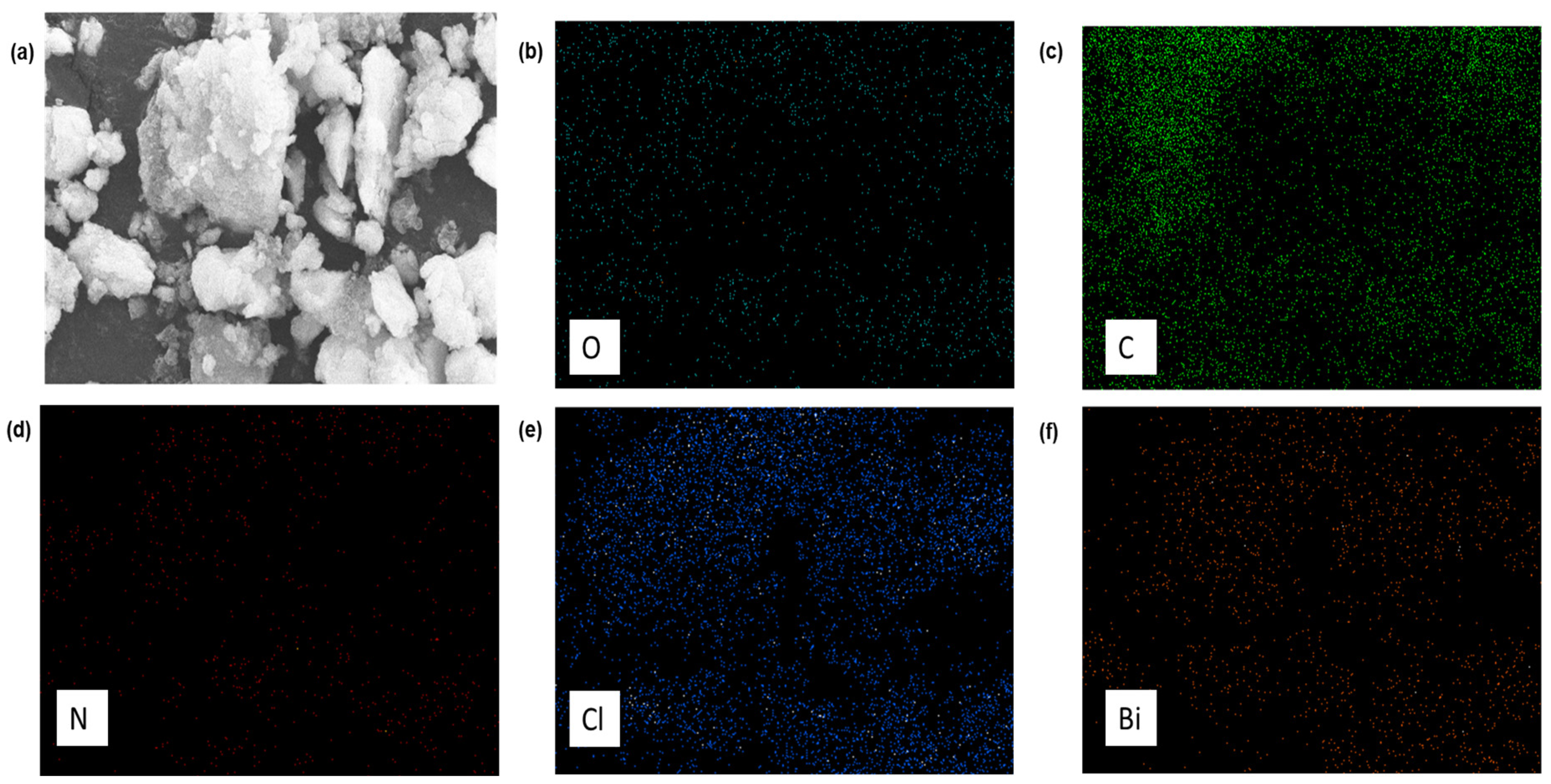
To further elucidate the elemental distribution and confirm the interfacial contact between g-C3N4 and BiOCl in the heterojunction, energy-dispersive X-ray spectroscopy (EDS) elemental mapping was conducted. As shown in Figure 2, the characteristic signals of Bi, O, and Cl are uniformly distributed throughout the microstructure, confirming the homogeneous formation of the BiOCl phase.
Meanwhile, the C and N elements, originating from g-C3N4, are also detected and spatially overlapped with the BiOCl framework. The simultaneous presence and overlapping distribution of all constituent elements provide direct evidence of intimate interfacial contact between g-C3N4 and BiOCl, rather than simple physical mixing at the microscale. Such close interfacial integration is expected to facilitate efficient interfacial charge transfer and is beneficial for suppressing charge-carrier recombination during photocatalytic reactions. It should be noted that variations in signal intensity among different elements arise from their intrinsic atomic numbers and the detector sensitivity of EDS analysis, and therefore do not indicate compositional inhomogeneity.

2.2. Structural, Optical, and Surface Characterization of the g-C3N4/BiOCl Heterojunction

2.2.1. X-Ray Powder Diffractometer

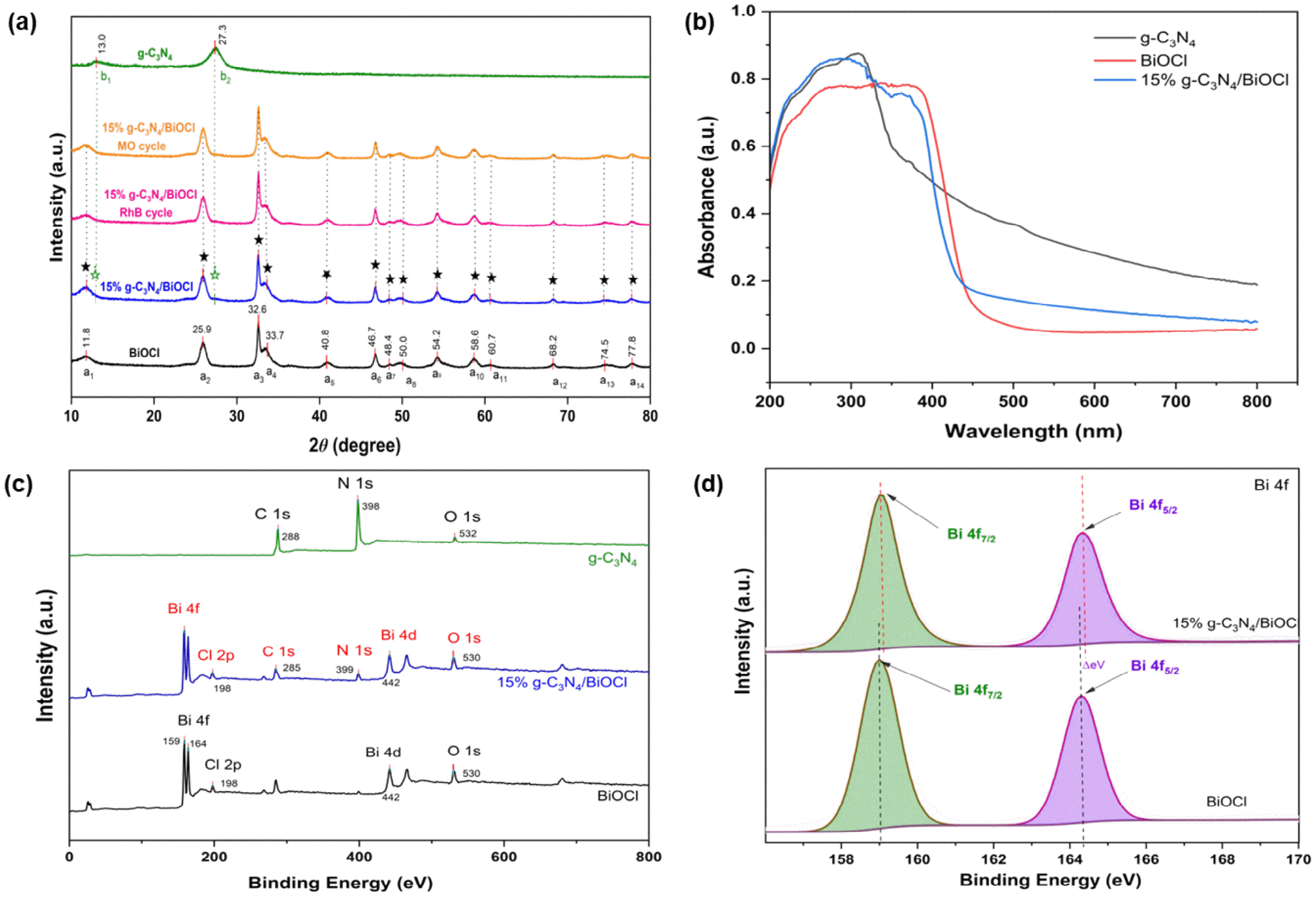
XRD analysis (Figure 3a) reveals the structural characteristics of the synthesized materials. Pristine g-C3N4 exhibits two characteristic diffraction peaks at 13.0° (b1) and 23.37° (b2), corresponding to the (100) and (002) planes of graphitic carbon nitride (JCPDS 87-1526), respectively. The intense b2 peak originates from interlayer stacking of the conjugated aromatic system. Pure BiOCl has fourteen diffraction peaks (labelled a1–a14) consistent with the tetragonal phase (JCPDS 06-0244). The prominent a1 peak at 11.79° corresponds to the (001) plane, suggesting preferential orientation along the C-axis. Other characteristic peaks include a2 (25.95° (101)) and a3 (32.60° (110)). In the 15% heterojunction coating, all peaks remain clearly visible while the g-C3N4 signatures, particularly the strong b2 peak, are significantly diminished. The significant diminution of the characteristic (002) interlayer stacking peak of g-C3N4 (b2) in the composite, while the BiOCl crystallinity remains intact, strongly suggests that the g-C3N4 sheets are effectively exfoliated and dispersed within the BiOCl matrix, rather than merely physically mixed. This type of intimate contact is crucial for forming an effective heterojunction interface, thereby facilitating interfacial charge transfer. Similar peak suppression has been linked to layer separation and enhanced photocatalytic activity in other 2D/2D composites [38,39]. Furthermore, the retention of the XRD pattern after four reaction cycles (Figure 3a) underscores the exceptional structural and phase stability of this heterojunction under photocatalytic conditions, which is essential for practical applications [40].

2.2.2. Optical Ability

The UV–vis DRS spectra (Figure 3b) reveal distinct absorption behaviors for g-C3N4, BiOCl, and the 15% g-C3N4/BiOCl heterojunction. Compared with the pristine components, the heterojunction exhibits an enhanced absorption intensity in the UV–visible region, indicating altered electronic transitions induced by interfacial interactions. This behavior corroborates the strong interfacial coupling inferred from XRD analysis and reflects a significant modification of the composite’s electronic structure relative to the isolated components. The calculated optical band gaps (derived from Tauc analysis) indicate that pristine g-C3N4 and BiOCl fall within the ranges commonly reported in the literature. At the same time, the heterojunction exhibits an intermediate apparent band gap, reflecting electronic coupling between the two components [41,42].

2.2.3. Surface Chemical Composition

The survey XPS spectra (Figure 3c) confirm the surface composition of the materials. Pristine g-C3N4 exhibits characteristic N 1s and C 1s peaks at 398 eV and 288 eV, respectively, with a minor O 1s signal at 530 eV, attributed to surface adsorbed oxygen from ambient exposure. Pure BiOCl shows distinct Bi 4f peaks at 159 eV and 164 eV, Cl 2p at 198 eV, and O 1s at 530 eV corresponding to lattice oxygen. The 15% g-C3N4/BiOCl heterojunction spectrum contains all characteristic elements of both components. Detailed chemical analysis was performed using high-resolution X-ray photoelectron spectroscopy (XPS). The 15% g-C3N4/BiOCl heterojunction spectrum contains all characteristic elements of both components. Compared with pristine BiOCl, the Bi 4f and Cl 2p peaks in the composite exhibit reduced intensity and slight shifts in binding energy, indicating interfacial electronic interactions and charge redistribution upon heterojunction formation.
Further insight is provided by the high-resolution Bi 4f spectra (Figure 3d), which show visibly shifted and slightly broadened Bi 4f peaks in the heterojunction relative to pure BiOCl, suggesting interfacial charge redistribution and a modified bismuth chemical environment at the interface. Complementary high-resolution spectra for all detected elements (C 1s, N 1s, Cl 2p, O 1s) are provided in Supplementary Figure S2 and show consistent evidence of interfacial electronic modification [43].
This consistent evidence from XPS, combined with structural and optical data, provides a coherent picture of a tightly coupled g-C3N4/BiOCl system with a modified electronic structure, poised for enhanced photocatalytic activity.

2.3. Photocatalytic Investigation of g-C3N4/BiOCl

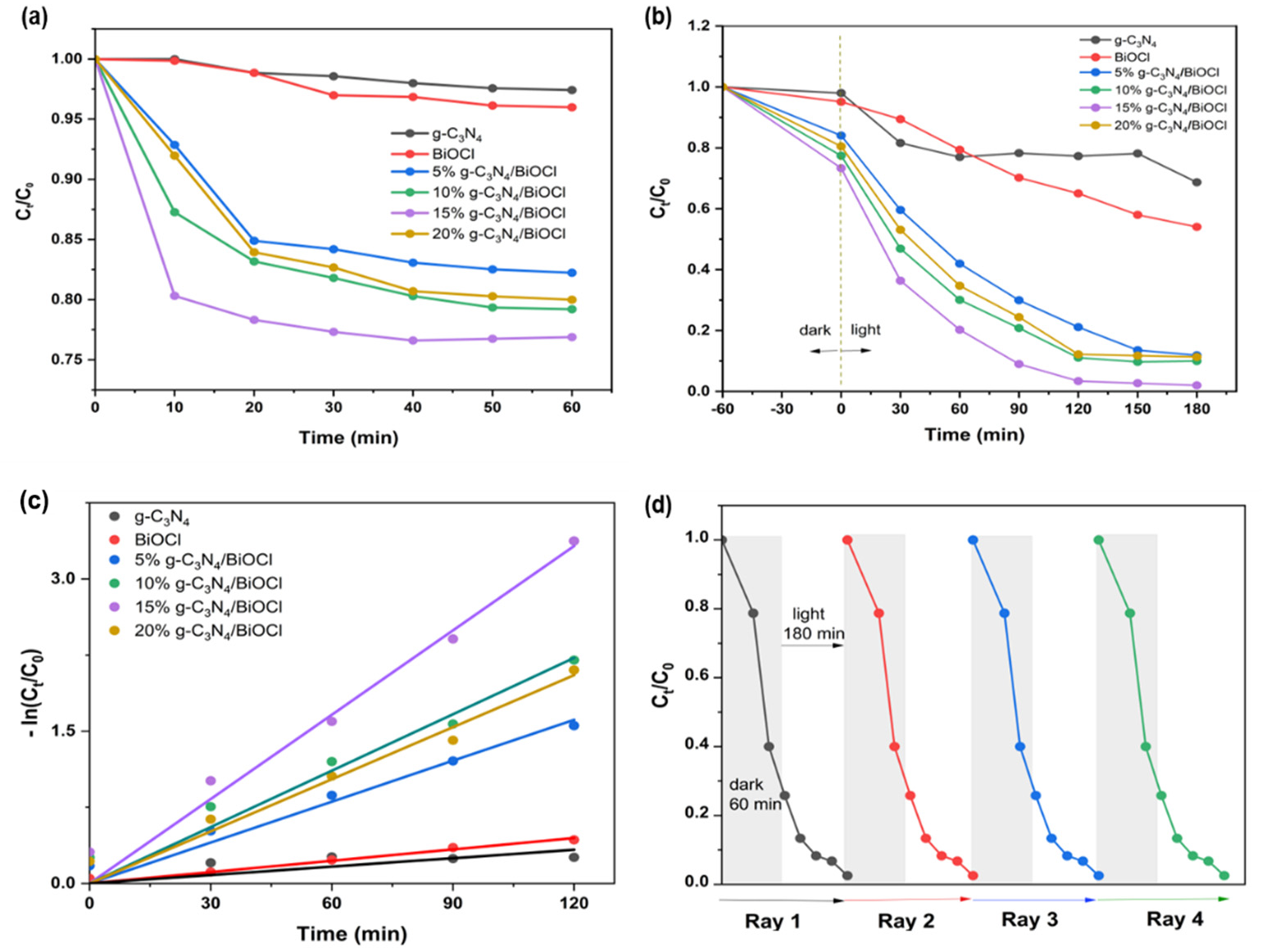
The photocatalytic performance of g-C3N4/BiOCl heterojunction coatings was evaluated through methyl orange (MO) degradation under visible light (Figure 4a). The 15% g-C3N4/BiOCl heterojunction exhibited optimal activity, achieving 98% degradation within 120 min, significantly exceeding that of the pure components (g-C3N4: 31%, BiOCl: 29%). Enhanced dye adsorption (23.4% in dark, Figure 4b) preceded photocatalytic degradation. A volcano-type dependence on g-C3N4 loading was observed, with photocatalytic activity increasing up to 15% and then decreasing at 20%, consistent with the characteristic behavior of heterojunction systems. At the optimal composition, a balance between interfacial contact density and light accessibility is achieved, whereas excessive g-C3N4 loading likely causes aggregation and light shielding, thereby weakening the synergistic effect [44,45,46].
The reaction followed pseudo-first-order kinetics (Figure 4c, Table 1), with the 15% heterojunction exhibiting the highest rate constant (0.166 min−1, R2 = 0.993), representing a 2.8-fold enhancement over pure BiOCl (0.060 min−1) and a 3.1-fold improvement over pure g-C3N4 (0.053 min−1). A similar trend was observed for Rhodamine B (RhB) degradation (Figure S3, Table S1), where the optimal composite achieved a rate constant of 0.519 min−1 (R2 = 0.993). These results indicate that the optimized heterojunction composition promotes efficient reaction kinetics for both anionic and cationic dyes.
The enhanced photocatalytic activity is attributed to the formation of an intimate heterojunction interface between g-C3N4 and BiOCl, as evidenced by SEM and TEM observations (Figure 1b,c). This interfacial architecture facilitates effective separation of photogenerated charge carriers and suppresses recombination, thereby increasing the availability of electrons and holes for surface redox reactions, such as the formation of reactive oxygen species, as commonly reported for g-C3N4/BiOCl-based photocatalytic systems [21]. The photocatalytic kinetics of MO and RhB were further analyzed using the Langmuir–Hinshelwood (L–H) model. At low initial dye concentrations (KC ≪ 1), the reaction follows pseudo-first-order kinetics and can be expressed as −ln(Ct/C0) = kt. The good linearity observed in Figure 4c confirms the applicability of this model, and the apparent rate constant k reflects the combined effects of adsorption capacity and interfacial charge-transfer efficiency [47]. The photocatalytic experiments were performed under identical conditions to enable comparative evaluation, and the observed trends were highly reproducible and consistently supported by independent electrochemical and spectroscopic characterizations.
The coating exhibited excellent stability, maintaining 91.7% degradation efficiency after four consecutive MO cycles (Figure 4d) and 99% retention of RhB activity. Such remarkable stability and reusability (>91% efficiency after four cycles) are crucial for practical photocatalytic applications. This performance can be attributed to the intimate, faceted, and robust heterojunction architecture revealed by morphological analysis, which effectively minimizes photo-corrosion and catalyst leaching during repeated operation. Furthermore, stable interfacial interactions between g-C3N4 and BiOCl, potentially formed during synthesis, contribute to the firm anchoring of the two components [48,49]. The negligible loss of RhB activity further underscores the coating’s structural integrity and durability under photocatalytic conditions. As summarized in Table 2, the present system is competitive with state-of-the-art powder photocatalysts while offering the distinct advantage of a stable and reusable coating configuration, which simplifies catalyst recovery and enhances practical applicability.

2.4. Electronic Structure and Band Alignment Analysis

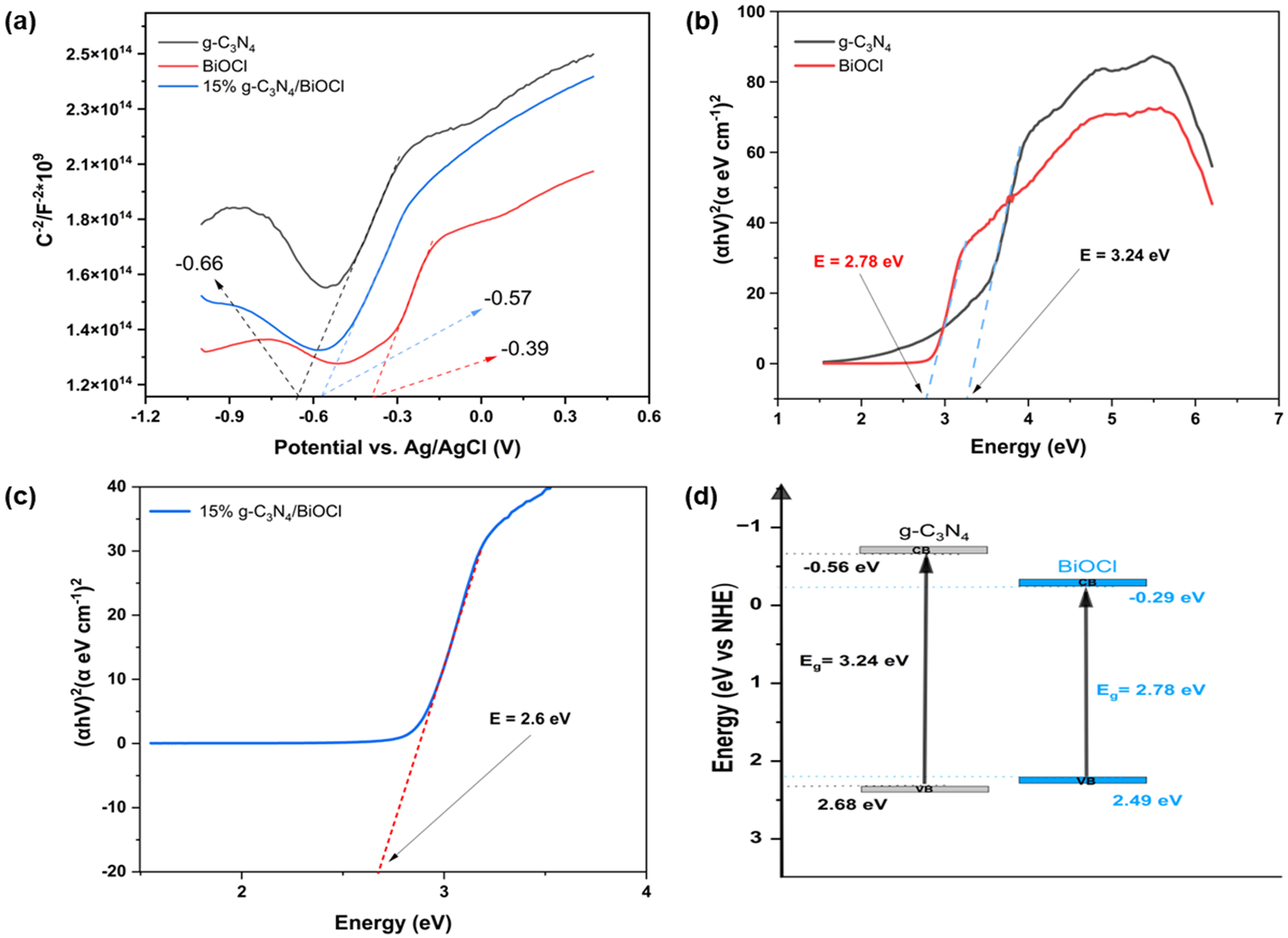
The optical band gaps of the materials were estimated from Tauc plots using the direct transition model (n = 2). Although g-C3N4 is sometimes described as an indirect semiconductor, this approach was adopted to ensure internal consistency and enable comparative analysis across all samples, following commonly reported methodologies for g-C3N4/Bi-based photocatalytic systems [46,55]. As shown in Figure 5b, pristine g-C3N4 and BiOCl exhibit apparent optical band-gap values of 3.24 eV and 2.78 eV, respectively. In comparison, the 15% g-C3N4/BiOCl heterojunction shows a reduced apparent band gap of approximately 2.6 eV (Figure 5c). It should be emphasized that these values are method-dependent and may differ from those reported in the literature, depending on the synthesis conditions, optical models, and fitting ranges. Nevertheless, the observed relative trend suggests modified electronic transitions that may be associated with interfacial electronic interactions and hybridization effects [53].
To further elucidate the charge-transfer characteristics, Mott–Schottky analysis was performed to determine the semiconductor type and band-edge positions. The positive slopes of the plots (Figure 5a) confirm the n-type character of both constituents. The flat-band potentials (Efb) were determined by linear extrapolation of the Mott–Schottky plots and were estimated to be −0.46 V and −0.19 V vs. NHE for g-C3N4 and BiOCl, respectively. The potential values shown on the x-axis of Figure 5a correspond to the applied bias range used for data acquisition and do not represent the extracted flat-band potentials. For n-type semiconductors, the conduction band minimum (ECB) is approximately 0.1 V more negative than Efb, yielding ECB values of −0.56 V (g-C3N4) and −0.29 V (BiOCl) vs. NHE. The valence band maxima (EVB) were subsequently calculated using the fundamental relation:
EVB = ECB + Eg
Resulting in values of +2.68 eV for g-C3N4 and +2.49 eV for BiOCl vs. NHE.
The derived band positions are schematically illustrated in Figure 5d, which represents the proposed band alignment of the 15% g-C3N4/BiOCl heterojunction based on experimental optical and electrochemical data. It should be noted that the absolute band-gap values obtained from Tauc analysis are method-dependent and may vary with the choice of optical model and material parameters. However, the present study provides a consistent framework for evaluating relative band alignment and potential charge-transfer behavior within the heterojunction system.

2.5. Charge Transfer Dynamics, Textural Properties, and Proposed Photocatalytic Mechanism

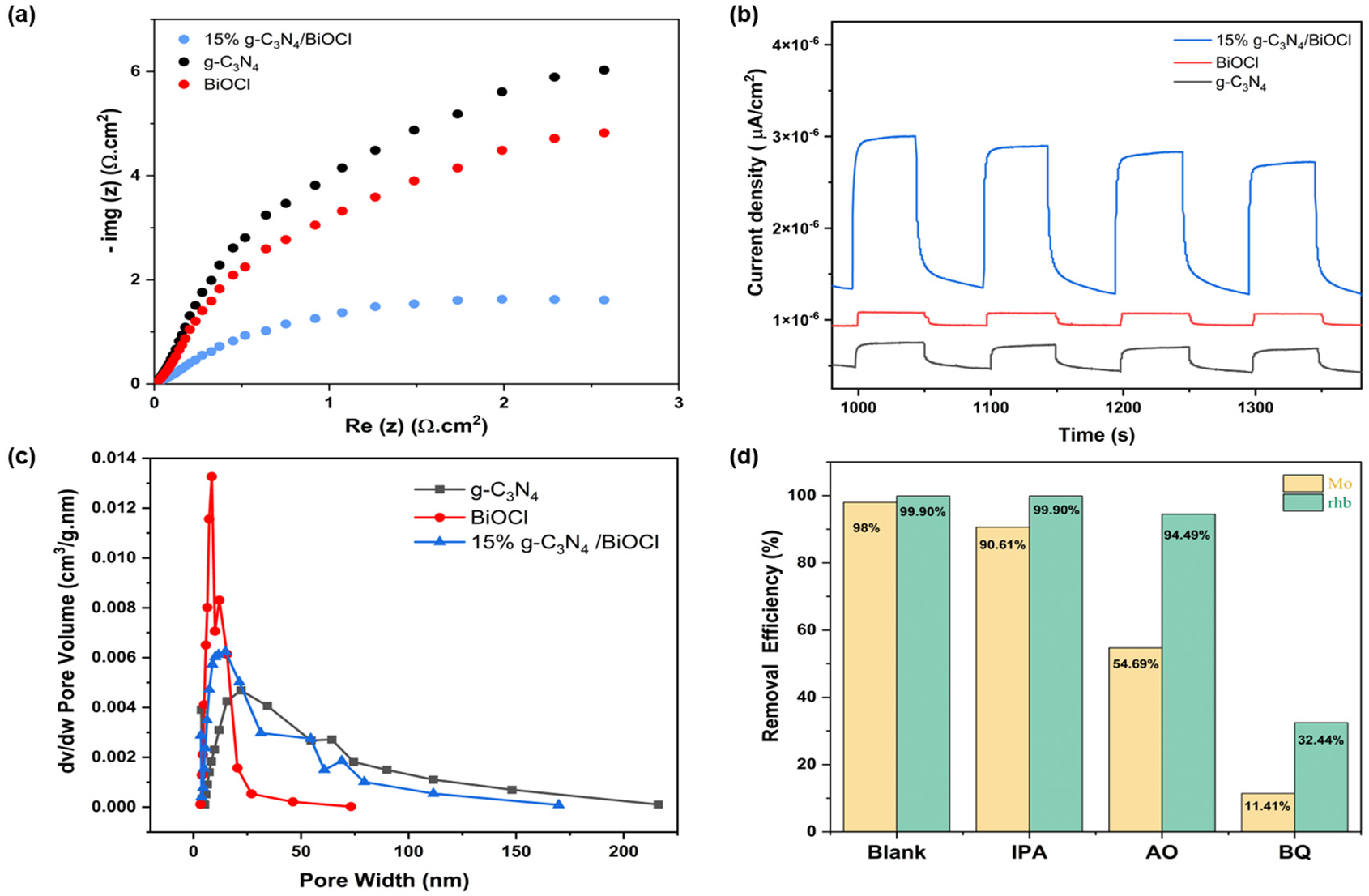
Electrochemical impedance spectroscopy (EIS) and transient photocurrent measurements were used to investigate charge-separation efficiency. The EIS Nyquist plots (Figure 6a) reveal that the 15% g-C3N4/BiOCl heterojunction exhibits a significantly smaller semicircle than the pure components, indicating reduced charge-transfer resistance. This facilitates more efficient interfacial electron transport within the heterostructure. Correspondingly, the connected material exhibits the strongest photocurrent under visible-light illumination (Figure 6b), indicating enhanced generation and separation of photogenerated charge carriers [56,57,58]. These electrochemical improvements correlate directly with the superior photocatalytic performance reported in the previous section [59].
Nitrogen adsorption–desorption analysis (Figure S4) reveals type-IV isotherms with H3 hysteresis loops, characteristic of mesoporous materials based on the IUPAC classification (micropores ≤ 2 nm, mesopores 2–50 nm, and macropores > 50 nm) [60]. The 15% g-C3N4/BiOCl heterojunction exhibits a specific surface area of 55.1319 m2/g (Table 3), intermediate between those of g-C3N4 (65.6448 m2/g) and BiOCl (42.2720 m2/g). Pore-size distribution analysis (Figure 6c) indicates a dominant mesoporous structure with an average pore diameter of 22.9 nm, compared with 35.3 nm for g-C3N4 and 11.1 nm for BiOCl. This optimized textural configuration enhances dye adsorption while maintaining accessibility to active sites [61,62,63].
Reactive-species trapping experiments were conducted to elucidate the dominant oxidative species involved in the photocatalytic process (Figure 6d) [64,65]. The addition of benzoquinone, a selective scavenger for superoxide radicals (·O2), resulted in the most pronounced suppression of photocatalytic activity [66,67,68], suggesting that ·O2 plays a dominant role in the degradation mechanism as commonly reported for g-C3N4-based heterojunctions [69]. In contrast, scavengers for hydroxyl radicals and photogenerated holes exhibited comparatively weaker effects.
From a thermodynamic perspective, the reduction of dissolved oxygen to ·O2 (E° (O2/·O2) = −0.33 V vs. NHE) is feasible for electrons located on the conduction band of g-C3N4. In contrast, the formation of hydroxyl radicals (·OH/OH, E° = +2.40 V vs. NHE) is less favored under the present experimental conditions. This analysis is consistent with the scavenger results and supports the dominant role of superoxide radicals in the photocatalytic degradation process [70,71].
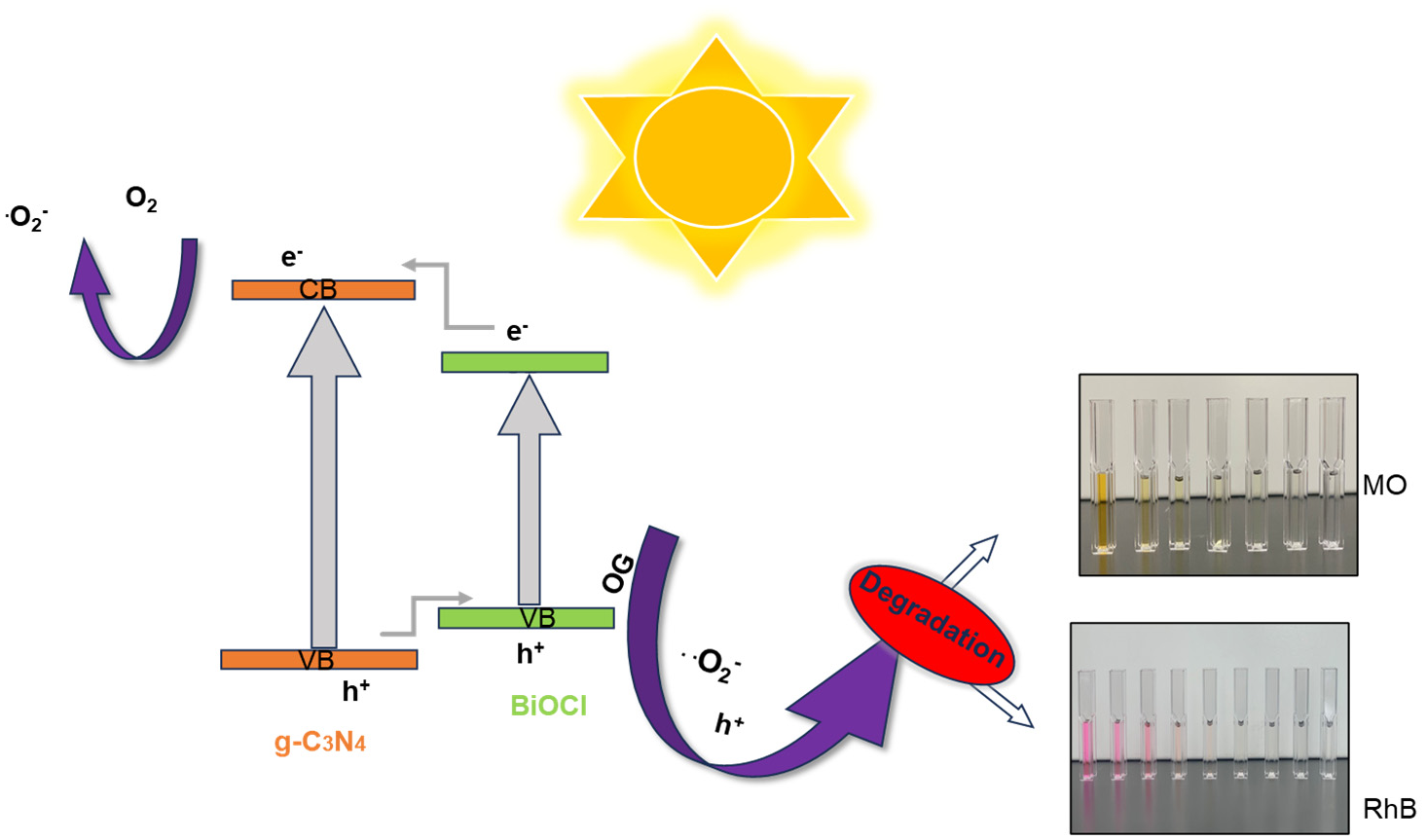
Based on the combined results of band alignment analysis (Figure 5), electrochemical characterization, textural properties, and reactive-species trapping experiments (Figure 6), a plausible photocatalytic charge-transfer scenario is schematically illustrated in Figure 7 [72,73]. Upon visible-light irradiation, both g-C3N4 and BiOCl can be photoexcited to generate electron–hole pairs. The intimate interfacial contact between the two semiconductors facilitates spatial separation of photogenerated charge carriers, thereby suppressing recombination and enhancing photocatalytic efficiency [74,75].
The charge-transfer scenario discussed here is inferred from a combination of experimental observations. While the exact charge-transfer pathway cannot be unambiguously resolved within the scope of the present study, the proposed schematic provides a reasonable and self-consistent interpretation of the enhanced photocatalytic performance of the g-C3N4/BiOCl heterojunction based on the available experimental evidence.

3. Materials and Methods

3.1. Materials

Supplier: Aladdin Chemical Reagent Co., Ltd. (Shanghai, China), Chemical formula: Bi(NO3)3·5H2O; Bismuth nitrate pentahydrate. Macklin Biochemical Co., Ltd. (of Shanghai, China) supplied the isopropanol (IPA). Sinopharm Chemical Reagent Co., Ltd. (Shanghai, China), provided the following chemicals: urea (CH4N2O), Ammonium oxalate (AO), methyl orange, glycerol (C3H8O3), 1,4-benzoquinone (BQ), and pure ethanol (C2H5O). Sodium chloride (NaCl) was obtained from Tianjin Comeo Chemical Reagent Co., Ltd. (Tianjin, China). The PVP K30 (polyvinylpyrrolidone) and nitric acid (HNO3) were procured from Bio-Technology Co., Ltd. (Shanghai, China), and RO water was obtained from Zhejiang Zhongxing Co., Ltd. (Zhejiang, China). All chemical compounds were of analytical grade and were used without further purification.

3.2. Methodology

3.2.1. Synthesis of g-C3N4/BiOCl Heterojunction

Graphitic carbon nitride (g-C3N4) was synthesized via thermal polycondensation of urea, as reported in the literature [76]. Specifically, 10 g of urea precursor was calcined in a covered crucible at 550 °C for 2 h (ramp rate: 10 °C min−1) in a muffle furnace. The resulting product was subsequently washed with three cycles of Milli-Q water (20 mL) and 0.1 M HNO3 (20 mL), then dried at 55 °C for 24 h and ground into a fine powder.
Subsequently, bismuth oxychloride (BiOCl) was prepared via a hydrothermal route [54]. A homogeneous reaction mixture containing bismuth nitrate pentahydrate (1 mmol, 0.485 g), sodium chloride (1 mmol, 0.058 g), propylene glycol (0.4 g), and glycerol (25 mL) in reverse osmosis (RO) water (25 mL) was stirred for 1 h. This solution was transferred to a 100 mL Teflon-lined autoclave and heated at 160 °C for 6 h. After cooling to ambient temperature, the precipitate was collected, dried at 55 °C, and washed sequentially with RO water (40 mL) and ethanol (20 mL).
Finally, a series of g-C3N4/BiOCl hybrid composites with varying g-C3N4 contents (5, 10, 15, and 20 wt%) was synthesized using a similar hydrothermal method. For each composite, a designated mass of g-C3N4 (0.013 g, 0.026 g, 0.039 g, and 0.052 g) was dispersed in 25 mL of deionized water together with the BiOCl precursors, including Bi(NO3)3·5H2O (1 mmol) and NaCl (1 mmol). Polyvinylpyrrolidone (PVP K30, 0.4 g) was added as a structure-directing and dispersing agent to promote uniform nucleation and intimate interfacial contact between g-C3N4 and BiOCl during hydrothermal synthesis. For comparison, propylene glycol was used only in the synthesis of pristine BiOCl. After 1 h of stirring, the resulting slurry was subjected to hydrothermal treatment at 160 °C for 6 h. The final products were collected using the same washing and drying protocol as that used for pristine BiOCl.

3.2.2. Photocatalytic Materials Characterization

Firstly, the morphology and microstructure were examined using scanning electron microscopy (SEM) on a JSM-6360LV (JEOL, Tokyo, Japan) at 5 kV and transmission electron microscopy (TEM) on a JEOL-7100F (JEOL, Tokyo, Japan). Particle size distribution was subsequently quantified from TEM images using ImageJ software (version 1.53). Energy-dispersive X-ray spectroscopy (EDS) elemental mapping was carried out using an Oxford Instruments X-Max detector (Oxford Instruments, Abingdon, UK) coupled to the SEM to analyze the elemental composition and spatial distribution of Bi, O, Cl, C, and N in the g-C3N4/BiOCl heterojunction. Following morphological analysis, the crystalline structure was determined by X-ray diffraction (XRD) using an Empyrean diffractometer (Malvern Panalytical, Almelo, The Netherlands) with Cu Kα radiation (λ = 0.15418 nm). Measurements were performed in the 2θ range of 10–80° at a scan rate of 4° min−1. In addition, the surface chemical composition and elemental states were analyzed by X-ray photoelectron spectroscopy (XPS) with an ESCALAB250Xi spectrometer (Thermo Fisher Scientific Waltham, MA, USA), using the C 1s peak (284.8 eV) for energy calibration. Furthermore, textural properties were evaluated from nitrogen physisorption isotherms at 77 K, recorded on a Micromeritics ASAP 2460 system (Micromeritics Instrument Corp., Norcross, GA, USA). The specific surface area was calculated according to the multipoint Brunauer–Emmett–Teller (BET) method [77]. Finally, the optical properties were assessed by ultraviolet-visible diffuse reflectance spectroscopy (UV–Vis DRS) on a Shimadzu UV-2550 spectrophotometer (Shimadzu, Kyoto, Japan), with spectra collected over 200–800 nm.

3.2.3. Photoelectrochemical Investigation

All photoelectrochemical measurements were conducted in a standard three-electrode configuration using a CHI660E electrochemical workstation (CH Instruments, Shanghai, China), following an established method [78]. The system consisted of a working electrode, an Ag/AgCl reference electrode (3.0 M KCl), and a platinum plate counter electrode (1 cm2), with 0.5 M Na2SO4 (Sinopharm Chemical Reagent Co., Ltd., Shanghai, China) as the electrolyte. The working electrode was fabricated by sonicating 5 mg of catalyst powder in a mixture of 1 mL anhydrous ethanol and 50 µL Nafion (Dupont, Wilmington, DE, USA) binder for 30 min, then drop casting the ink onto a fluorine-doped tin oxide (FTO) substrate and drying it at 55 °C for 4 h. A 500 W xenon arc lamp equipped with a UV cut-off filter (λ > 400 nm) provided visible-light illumination (Beijing, China). Transient photocurrent response was recorded at a constant bias of 0.5 V vs. Ag/AgCl under chopped light, while electrochemical impedance spectroscopy (EIS) was performed with a 5 mV sinusoidal perturbation across a frequency range of 104 Hz to 0.1 Hz; Mott–Schottky analysis was also carried out to determine semiconductor characteristics.

3.2.4. Photocatalytic Performance Test

For decomposition experiments, 50 mg of photocatalyst (PC) was dispersed in an aqueous solution containing either 10 mg·L−1 MO or 20 mg·L−1 RhB for photodegradation. Different initial concentrations of MO and RhB were selected to account for their distinct molar absorptivities, adsorption behaviors, and degradation kinetics, thereby ensuring comparable absorbance ranges and reliable kinetic analysis. Photocatalytic degradation experiments were conducted under visible-light irradiation using a PL-XQ 500 W xenon lamp equipped with a UV cut-off filter (λ > 400 nm) (Perfectlight, Beijing, China) for 180 min (MO) or 35 min (RhB). The lamp-to-reactor distance was kept constant for all experiments. No external temperature control was applied, and the reaction temperature remained close to ambient conditions during irradiation. The solution pH (4.6–4.8) corresponded to the natural pH of the dye solutions and was not externally adjusted. Light irradiance at the solution surface was not directly measured and is therefore not reported.
During the photocatalytic reaction, aliquots (1 mL) were withdrawn at regular intervals (every 5 min for RhB and every 30 min for MO), centrifuged at 10,000 rpm for 5 min at ambient temperature to remove the catalyst, and analyzed. A UV-1900i UV–Vis spectrophotometer (Shimadzu, Kyoto, Japan) was then used to determine the concentrations of MO and RhB in the body water specimen at 464 nm and 554 nm, respectively. Using the following formula to determine the catalyst’s efficacy in decomposing MO or RhB:
E (%) = (C0 − Ct)/C0 × 100
Degradation efficiency (E) of Methyl Orange, Rhodamine B, or C0 is the initial dye amount before the catalytic reaction, and Ct is the final concentration of the process [79]. The photocatalytic degradation kinetics were analyzed using the Langmuir–Hinshelwood (L–H) model, which is commonly applied to heterogeneous photocatalytic systems under low pollutant concentration conditions (KC ≪ 1) [47,70].
R = −dC/dt = −k0 K × C/1 + KC
For low organic pollutant equilibrium concentrations, Formula (3) can be simplified as (4) and (5): (KC ≪ 1)
R = −dC/dt = −k0 × K × C
Ln (Ct/C0) = k0 × K × t = −k × t
  • R: current of process, mg/L·min−1.
  • C0: Initiate the amount of toxic pigment, mg/L.
  • Ct: Final amount of the toxin (mg·L−1).
  • K: adsorption equilibrium constant, L/mg.
  • k0: the progression variable of the Langmuir-Hinshelwood process, mg/(L·min).
  • k: the uniform pace, min−1.
All photocatalytic degradation experiments were repeated at least twice under identical conditions to verify reproducibility. The observed trends were consistent within experimental uncertainty.
After each photodegradation cycle, the recycling experiment was performed by centrifuging the PC to separate it from the contaminated aqueous solution. To prepare the PC sample for the subsequent cycle, it was thoroughly washed and dried in an oven at 55 °C for 12 h. Recycling experiments were conducted over multiple consecutive cycles to evaluate the reusability and operational stability of the photocatalyst.
Scavenger tests, as described in the literature [80,81], were performed to identify the active species responsible for photodegradation. Isopropanol (IPA) was used as a scavenger for hydroxyl radicals, ammonium oxalate (AO) was used as a scavenger for holes, and 1,4-benzoquinone (BQ) was used as a scavenger for superoxide radicals.
Before irradiation, 0.05 mmol of IPA, AO, or BQ was added to the photocatalytic system, which consisted of the dye solution (either Rhodamine B or Methyl Orange) and the g-C3N4/BiOCl photocatalyst. The suspension was agitated in the dark for 60 min to reach equilibrium between adsorption and desorption. Subsequently, the mixture was irradiated with a 300 W xenon lamp for 35 min for RhB or 180 min for MO. Specimens were collected at consistent time intervals (every 5 min and 30 min, respectively) and examined using a UV–Vis spectrophotometer to quantify the amount of the dye. The impact of each scavenger on photocatalytic degradation efficiency was assessed by comparing degradation rates in the presence and absence of each scavenger.

4. Conclusions

This study demonstrates the successful fabrication of an efficient and stable g-C3N4/BiOCl heterojunction photocatalytic coating via a one-step hydrothermal method. Comprehensive evaluation confirms that the optimized 15% g-C3N4/BiOCl composite exhibits excellent photocatalytic performance for water purification, achieving 98% degradation of methyl orange within 120 min and 99% removal of rhodamine B within 35 min under visible-light irradiation. The enhanced photocatalytic activity is attributed to the formation of an intimate heterojunction interface between g-C3N4 and BiOCl. Structural and morphological analyses (SEM and TEM) confirm close interfacial contact, while XPS results indicate electron interference. Combined optical and electrochemical analyses reveal improved visible-light utilization and more efficient separation and transport of photogenerated charge carriers, as evidenced by reduced charge-transfer resistance in EIS measurements and enhanced transient photocurrent responses. Reactive-species trapping experiments further indicate that superoxide radicals (·O2) play a dominant role in the photocatalytic degradation process, with photogenerated holes contributing to a lesser extent. In addition, the heterojunction coating exhibits excellent operational stability over multiple degradation cycles, highlighting its potential for practical photocatalytic applications. Overall, the combined structural, optical, electrochemical, and photocatalytic results provide a coherent framework for understanding the enhanced performance of the g-C3N4/BiOCl heterojunction.
In conclusion, this work establishes g-C3N4/BiOCl heterojunction coatings as promising, stable, and efficient photocatalytic materials for environmental remediation. By correlating photoelectrochemical properties with photocatalytic activity, this study offers valuable insights into heterojunction design principles and provides a foundation for future investigations into advanced photocatalytic coating systems.

Supplementary Materials

The following supporting information can be downloaded at: https://www.mdpi.com/article/10.3390/coatings16010138/s1, Figure S1: (a) SEM of g-C3N4, (b) and (c) TEM image of 15% g-C3N4/BiOCl, respectively, present distribution size, morphology, and BiOCl lattice; Figure S2: High-resolution XPS spectra of the C 1s (a), N 1s (b), Cl 2p (c), and O 1s (d) on the surface of g-C3N4, BiOCl, and 15% g-C3N4BiOCl composite. Figure S3: (a) Photodegradation of RhB by g-C3N4, BiOCl, and g-C3N4/BiOCl with different g-C3N4 to Cl molar ratios. (b) Adsorption of RhB in the dark. (c) Pseudo-first-order reaction kinetic curves of g-C3N4, BiOCl, and g-C3N4/BiOCl under visible light. (d) Cycling photocatalytic experiments with 15% g-C3N4/BiOCl degrading RhB. Figure S4: Nitrogen adsorption and desorption thermodynamics for g-C3N4, BiOCl, and 15% g-C3N4/BiOCl. Table S1: Pseudo-first-order kinetic parameters for RhB photodegradation.

Author Contributions

H.K.A.Z. Conceptualization, Methodology, Investigation, Formal Analysis, Writing—Original Draft, Visualization. M.L. Investigation, Formal Analysis, Visualization. X.L. Investigation, Formal Analysis. M.X. Conceptualization, Methodology, Validation. T.Z. Supervision, Funding Acquisition, Project Administration. W.L. Supervision Funding Acquisition, Project Administration, Resources, Writing, Review & Editing. All authors have read and agreed to the published version of the manuscript.

Funding

This project was supported by the National Natural Science Foundation of China (No. 42272355), the National Natural Science Foundation of China (No. 52101269), and the Natural Science Foundation of Hubei Province (No. 2024AFD039).

Institutional Review Board Statement

Not applicable.

Informed Consent Statement

Not applicable.

Data Availability Statement

Data is contained within the article or Supplementary Material.

Conflicts of Interest

The authors declare that the research was conducted in the absence of any commercial or financial relationships that could be construed as a potential conflict of interest.

References

  1. Parida, V.K.; Datta, D.; Singh, N.; Tambi, A. Insights into the synthetic dye contamination in textile wastewater: Impacts on aquatic ecosystems and human health, and eco-friendly remediation strategies for environmental sustainability. J. Ind. Eng. Chem. 2025, 150, 247–264. [Google Scholar] [CrossRef]
  2. Al-Tohamy, R.; Ali, S.S.; Li, F.; Okasha, K.M.; Mahmoud, Y.A.-G.; Elsamahy, T.; Jia, H.; Fu, Y.; Sun, J. A critical review on the treatment of dye-containing wastewater: Ecotoxicological and health concerns of textile dyes and possible remediation approaches for environmental safety. Ecotoxicol. Environ. Saf. 2022, 231, 113160. [Google Scholar] [CrossRef]
  3. Kant, R. Textile dyeing industry: An environmental hazard. Nat. Sci. 2012, 4, 22–26. [Google Scholar] [CrossRef]
  4. Kusumlata; Ambade, B.; Kumar, A.; Gautam, S. Sustainable Solutions: Reviewing the Future of Textile Dye Contaminant Removal with Emerging Biological Treatments. Limnol. Rev. 2024, 24, 126–149. [Google Scholar] [CrossRef]
  5. Yagub, M.T.; Sen, T.K.; Afroze, S.; Ang, H.M. Dye and its removal from aqueous solution by adsorption: A review. Adv. Colloid Interface Sci. 2014, 209, 172–184. [Google Scholar] [CrossRef] [PubMed]
  6. Ai, L.; Jiang, J. Removal of methylene blue from aqueous solution with self-assembled cylindrical graphene–carbon nanotube hybrid. Chem. Eng. J. 2012, 192, 156–163. [Google Scholar] [CrossRef]
  7. Waghchaure, R.H.; Adole, V.A.; Jagdale, B.S. Photocatalytic degradation of methylene blue, rhodamine B, methyl orange and eriochrome black T dyes by modified ZnO nanocatalysts: A concise review. Inorg. Chem. Commun. 2022, 143, 109764. [Google Scholar] [CrossRef]
  8. Wu, L.; Liu, X.; Lv, G.; Zhu, R.; Tian, L.; Liu, M.; Li, Y.; Rao, W.; Liu, T.; Liao, L. Study on the adsorption properties of methyl orange by natural one-dimensional nano-mineral materials with different structures. Sci. Rep. 2021, 11, 10640. [Google Scholar] [CrossRef]
  9. Saeed, M.; Muneer, M.; Haq, A.U.; Akram, N. Photocatalysis: An effective tool for photodegradation of dyes—A review. Environ. Sci. Pollut. Res. 2022, 29, 293–311. [Google Scholar]
  10. Kumari, H.; Sonia; Suman; Ranga, R.; Chahal, S.; Devi, S.; Sharma, S.; Kumar, S.; Kumar, P.; Kumar, S.; et al. A review on photocatalysis used for wastewater treatment: Dye degradation. Water Air Soil Pollut. 2023, 234, 349. [Google Scholar] [CrossRef]
  11. Ruíz-Santoyo, V.; Marañon-Ruiz, V.F.; Romero-Toledo, R.; González Vargas, O.A.; Pérez-Larios, A. Photocatalytic degradation of rhodamine B and methylene orange using TiO2-ZrO2 as nanocomposite. Catalysts 2021, 11, 1035. [Google Scholar] [CrossRef]
  12. Muhmood, T.; Ahmad, I.; Haider, Z.; Haider, S.K.; Shahzad, N.; Aftab, A.; Ahmed, S.; Ahmad, F. Graphene-like graphitic carbon nitride (g-C3N4) as a semiconductor photocatalyst: Properties, classification, and defects engineering approaches. Mater. Today Sustain. 2024, 25, 100633. [Google Scholar] [CrossRef]
  13. Bhanderi, D.; Lakhani, P.; Modi, C.K. Graphitic carbon nitride (g-C3N4) as an emerging photocatalyst for sustainable environmental applications: A comprehensive review. RSC Sustain. 2024, 2, 265–287. [Google Scholar] [CrossRef]
  14. Yang, X.; Sun, S.; Cui, J.; Yang, M.; Luo, Y.; Liang, S. Synthesis, functional modifications, and diversified applications of hybrid BiOCl-based heterogeneous photocatalysts: A review. Cryst. Growth Des. 2021, 21, 6576–6618. [Google Scholar]
  15. Chen, X.; Chen, P.; Yang, S.; Gao, H. Recent advances in bismuth oxyhalides photocatalysts and their applications. Nanotechnology 2023, 34, 052001. [Google Scholar]
  16. Liu, W.-W.; Peng, R.-F. Recent advances of bismuth oxychloride photocatalytic material: Property, preparation and performance enhancement. J. Electron. Sci. Technol. 2020, 18, 100020. [Google Scholar] [CrossRef]
  17. Hao, L.; Sang, H.; Hou, Y.; Li, P.; Zhang, J.; Yang, J.-H. Advances in the improvement of photocatalytic activity of BiOCl nanomaterials under visible light. Rev. Inorg. Chem. 2024, 44, 25–63. [Google Scholar] [CrossRef]
  18. He, L.; Wang, Y.; Li, Y.; Wang, X.; Shan, L. Research progress and perspectives of BiOCl photocatalytic materials. Ferroelectrics 2024, 618, 983–998. [Google Scholar] [CrossRef]
  19. Ren, Q.; Liu, J.; Yang, Q.; Shen, W. A review: Photocatalysts based on BiOCl and g-C3N4 for water purification. Catalysts 2021, 11, 1084. [Google Scholar] [CrossRef]
  20. Chang, F.; Xie, Y.; Zhang, J.; Chen, J.; Li, C.; Wang, J.; Luo, J.; Deng, B.; Hu, X. Construction of exfoliated g-C3N4 nanosheets–BiOCl hybrids with enhanced photocatalytic performance. RSC Adv. 2014, 4, 28519. [Google Scholar] [CrossRef]
  21. Su, Y.; Gao, Z.; Zhang, L.; Zhang, B.; Xu, R.; Cheng, X.; Lia, N.; Zhao, W. g-C3N4-modified BiOCl as a visible light catalyst and its enhanced photocatalytic degradation/sterilization performance. Catal. Sci. Technol. 2025, 15, 2261–2271. [Google Scholar] [CrossRef]
  22. Zhao, H.; Zhang, Y.; Li, G.; Tian, F.; Tang, H.; Chen, R. Rhodamine B-sensitized BiOCl hierarchical nanostructure for methyl orange photodegradation. RSC Adv. 2016, 6, 7772–7779. [Google Scholar]
  23. Lei, L.; Jin, H.; Zhang, Q.; Xu, J.; Gao, D.; Fu, Z. A novel enhanced visible-light-driven photocatalyst via hybridization of nanosized BiOCl and graphitic C3N4. Dalton Trans. 2015, 44, 795–803. [Google Scholar]
  24. Cai, W.; Tang, J.; Shi, Y.; Wang, H.; Jiang, X. Improved in situ synthesis of heterostructured 2D/2D BiOCl/g-C3N4 with enhanced dye photodegradation under visible-light illumination. ACS Omega 2019, 4, 22187–22196. [Google Scholar]
  25. Senasu, T.; Lorwanishpaisarn, N.; Hemavibool, K.; Nijpanich, S.; Chanlek, N.; Nanan, S. Construction of g-C3N4/BiOCl/CdS heterostructure photocatalyst for complete removal of oxytetracycline antibiotic in wastewater. Sep. Purif. Technol. 2023, 306, 122735. [Google Scholar]
  26. Zhao, Y.; Liu, X.; Gu, S.; Liu, J. Enhanced photocatalytic performance of rhodamine B and enrofloxacin by Pt loaded Bi4V2O11: Boosted separation of charge carriers, additional superoxide radical production, and the photocatalytic mechanism. RSC Adv. 2021, 11, 9746. [Google Scholar] [CrossRef]
  27. Xu, Q.; Xu, Q.; Zhang, L.; Cheng, B.; Fan, J.; Yu, J. S-Scheme Heterojunction Photocatalyst. Chem 2020, 6, 1543–1559. [Google Scholar] [CrossRef]
  28. Sudrajat, H.; Nobatova, M. Heterojunction photocatalysts: Where are they headed? RSC Appl. Interfaces 2025, 2, 599–619. [Google Scholar] [CrossRef]
  29. Ramírez-Meneses, E.; Valencia-Barrón, J.P.; Hernández-Pérez, M.A.; Domínguez-Crespo, M.A.; Torres-Huerta, A.M.; Palacios-Gonzalez, E. Synthesis and Characterization of BiOCl Powders with Soft Templates. J. Inorg. Organomet. Polym. 2018, 28, 2350–2364. [Google Scholar] [CrossRef]
  30. Phuruangrat, A.; Thongtem, S.; Thongtem, T. Characterization of BiOCl Nanoplates Synthesized by PVP-Assisted Hydrothermal Method and Their Photocatalytic Activities. Appl. Phys. A 2020, 126, 245. [Google Scholar] [CrossRef]
  31. Chen, X.; Pan, W.-g.; Guo, R.-t.; Hu, X.; Bi, Z.-x.; Wang, J. Recent progress on van der Waals heterojunctions applied in photocatalysis. J. Mater. Chem. A 2022, 10, 7604. [Google Scholar] [CrossRef]
  32. Balapure, A.; Ray Dutta, J.; Ganesan, R. Recent advances in semiconductor heterojunctions: A detailed review of the fundamentals of photocatalysis, charge transfer mechanism and materials. RSC Appl. Interfaces 2024, 1, 43–69. [Google Scholar] [CrossRef]
  33. Zhang, W.; Liang, Y. Facile synthesis of ternary g-C3N4@BiOCl/Bi12O17Cl2 composites with excellent visible light photocatalytic activity for NO removal. Front. Chem. 2019, 7, 231. [Google Scholar] [CrossRef]
  34. Hou, J.; Wang, H.; Qin, R.; Zhang, Q.; Wu, D.; Hou, Z.; Yang, W.; Hussain, A.; Tahir, M.; Yin, W.; et al. Grinding preparation of 2D/2D g-C3N4/ BiOCl with oxygen vacancy heterostructure for improved visible-light-driven photocatalysis. Carbon Res. 2024, 3, 1. [Google Scholar] [CrossRef]
  35. Rojviroon, O.; Abimannan, G.; Arumugam, P.; Palanisamy, M.; Rajendran, R.; Ramasamy, G.; Sirivithayapakorn, S.; Phetyim, N.; Rojviroon, T. Novel Z-scheme BiOCl/g-C3N4 nanocomposite for high performance photocatalytic degradation of organic pollutants and charge carrier dynamics. Environ. Nanotechnol. Monit. Manag. 2025, 24, 101086. [Google Scholar] [CrossRef]
  36. Low, J.; Yu, J.; Jaroniec, M.; Wageh, S.; Al-Ghamdi, A.A. Heterojunction Photocatalysts. Adv. Mater. 2017, 29, 1601694. [Google Scholar] [CrossRef]
  37. JCPDS 06-0249; Powder Diffraction File (PDF) Card for BiOCl. International Centre for Diffraction Data (ICDD): Newtown Square, PA, USA, n.d.
  38. Alenizi, M.A.; Kumar, R.; Aslam, M.; Alseroury, F.A.; Barakat, M.A. Construction of a ternary g-C3N4/TiO2@polyaniline nanocomposite for the enhanced photocatalytic activity under solar light. Sci. Rep. 2019, 9, 12091. [Google Scholar] [CrossRef]
  39. Kumari, R.; Kumar, R. Enhanced photocatalytic performance of 2D/3D g-C3N4/MoS2 heterojunction for water remediation of real-world pollutants. J. Appl. Phys. 2025, 138, 014303. [Google Scholar] [CrossRef]
  40. Xiao, M.; Wang, Z.; Maeda, K.; Liu, G.; Wang, L. Addressing the stability challenge of photo(electro)catalysts towards solar water splitting. Chem. Sci. 2023, 14, 3415–3427. [Google Scholar] [CrossRef]
  41. Lewis, N.S. Progress in understanding electron-transfer reactions at semiconductor/liquid interfaces. J. Phys. Chem. B 1998, 102, 4843–4855. [Google Scholar] [CrossRef]
  42. Li, X.; Yu, J.; Low, J.; Fang, Y.; Xiao, J.; Chen, X. Engineering heterogeneous semiconductors for solar water splitting. J. Mater. Chem. A 2015, 3, 2485–2534. [Google Scholar] [CrossRef]
  43. Tyczkowski, J.; Kierzkowska-Pawlak, H. Classical concept of semiconductor heterojunctions in the approach to nanohybrid catalysts. ACS Appl. Mater. Interfaces 2024, 16, 37339–37345. [Google Scholar] [CrossRef]
  44. Li, J.; Guan, L.; Jiang, L.; Xu, M.; Li, J.; Zuo, J.; Tan, C.; Xia, Z. Construction of 2D/3D g-C3N4/BiOI photocatalysts with p–n heterojunction and their performance in photocatalytic degradation of amaranth dye. ACS Omega 2024, 9, 361–370. [Google Scholar] [CrossRef]
  45. Li, X.; Zhang, Y.; Wang, Y.; Zhu, L.; Liu, Y.; Wang, L. AgIn5S8/g-C3N4 composite photocatalyst coupled with low-temperature plasma-enhanced degradation of hydroxypropyl-guar-simulated oilfield wastewater. Molecules 2024, 29, 2862. [Google Scholar] [CrossRef] [PubMed]
  46. Ahmed, M.A.; Mahmoud, S.A.; Mohamed, A.A. Unveiling the Photocatalytic Potential of Graphitic Carbon Nitride (g-C3N4): A State-of-the-Art Review. RSC Adv. 2024, 14, 25629–25662. [Google Scholar] [CrossRef]
  47. Herrmann, J.-M. Heterogeneous Photocatalysis: Fundamentals and Applications to the Removal of Various Types of Aqueous Pollutants. Chem. Rev. 1999, 99, 1103–1142. [Google Scholar] [CrossRef]
  48. Li, J.; He, C.; Xu, N.; Wu, K.; Huang, Z.; Zhao, X.; Nan, J.; Xiao, X. Interfacial bonding of hydroxyl-modified g-C3N4 and Bi2O2CO3 toward boosted CO2 photoreduction: Insights into the key role of OH groups. Chem. Eng. J. 2023, 452, 139191. [Google Scholar] [CrossRef]
  49. Song, T.; Yu, X.; Tian, N.; Huang, H.-w. Preparation, structure and application of g-C3N4/BiOX composite photocatalyst. Int. J. Hydrogen Energy 2021, 46, 1857–1878. [Google Scholar] [CrossRef]
  50. Bellamkonda, S.; Rao, G.R. Nanojunction-mediated visible light photocatalytic enhancement in heterostructured ternary BiOCl/CdS/g-C3N4 nanocomposites. Catal. Today 2019, 321–322, 18–25. [Google Scholar] [CrossRef]
  51. Liu, W.; Qiao, Q.; Zhu, A.; Liu, Y.; Pan, J. Constructing 2D BiOCl/C3N4 layered composite with large contact surface for visible-light-driven photocatalytic degradation. Appl. Surf. Sci. 2017, 426, 897–905. [Google Scholar] [CrossRef]
  52. Wang, L.; Fan, Z.; Cao, X.; Fan, P.; Xie, Y.; Sun, Q.; Zhao, J. Template-free synthesis of g-C3N4 nanoball/BiOCl nanotube heterojunction with enhanced photocatalytic activity. Nanomaterials 2022, 12, 2569. [Google Scholar] [CrossRef]
  53. Jia, T.; Li, J.; Long, F.; Fu, F.; Zhao, J.; Deng, Z.; Wang, X.; Zhang, Y. Ultrathin g-C3N4 nanosheet-modified BiOCl hierarchical flower-like plate heterostructure with enhanced photostability and photocatalytic performance. Crystals 2017, 7, 266. [Google Scholar] [CrossRef]
  54. Deng, Y.; Xu, M.; Jiang, X.; Wang, J.; Tremblay, P.-L.; Zhang, T. Versatile iodine-doped BiOCl with abundant oxygen vacancies and (110) crystal planes for enhanced pollutant photodegradation. Environ. Res. 2023, 216, 114808. [Google Scholar] [CrossRef]
  55. Mancuso, A.; Pipolo, A.; Iannece, P.; Albarano, L.; Carotenuto, M.; Lofrano, G.; Libralato, G.; Venditto, V.; Sacco, O.; Vaiano, V. Engineered g-C3N4/N-TiO2 heterostructure for enhanced visible-light photocatalytic degradation of chloramphenicol: Mechanistic insight and ecotoxicological assessment of the treated effluent. J. Environ. Chem. Eng. 2025, 13, 119711. [Google Scholar] [CrossRef]
  56. Weng, S.; Chen, B.; Xie, L.; Zheng, Z.; Liu, P. Facile in situ synthesis of a Bi/BiOCl nanocomposite with high photocatalytic activity. J. Mater. Chem. A 2013, 1, 3068. [Google Scholar] [CrossRef]
  57. Bell, N.J.; Ng, Y.H.; Du, A.; Coster, H.; Smith, S.C.; Amal, R. Understanding the enhancement in photoelectrochemical properties of photocatalytically prepared TiO2-reduced graphene oxide composite. J. Phys. Chem. C 2011, 115, 6004–6009. [Google Scholar] [CrossRef]
  58. Bisquert, J. Theory of the Impedance of Electron Diffusion and Recombination in a Thin Layer. J. Phys. Chem. B 2002, 106, 325–333. [Google Scholar] [CrossRef]
  59. Wan, S.; Ou, M.; Zhong, Q.; Zhang, S.; Cai, W. Supramolecular synthesis of multifunctional holey carbon nitride nanosheet with high-efficiency photocatalytic performance. Adv. Opt. Mater. 2017, 5, 1700536. [Google Scholar] [CrossRef]
  60. Thommes, M.; Kaneko, K.; Neimark, A.V.; Olivier, J.P.; Rodriguez-Reinoso, F.; Rouquerol, J.; Sing, K.S.W. Physisorption of gases, with special reference to the evaluation of surface area and pore size distribution (IUPAC Technical Report). Pure Appl. Chem. 2015, 87, 1051–1069. [Google Scholar] [CrossRef]
  61. Solayman, H.M.; Hossen, M.A.; Abd Aziz, A.; Yahya, N.Y.; Leong, K.H.; Sim, L.C.; Monir, M.U.; Zoh, K.-D. Performance evaluation of dye wastewater treatment technologies: A review. J. Environ. Chem. Eng. 2023, 11, 109610. [Google Scholar] [CrossRef]
  62. Zahoor, S.; Muhammad, S.; Kashif, M.; Shahzad, N.; Liu, Y.-c.; Celik, C.; Ambreen, N.; Ali, A.; Wu, H.-F.; Azizi, S.; et al. Advances in mesoporous nanomaterials for photocatalytic degradation of pollutants: Fundamentals, material classifications, challenges and future prospects. Coord. Chem. Rev. 2026, 549, 217239. [Google Scholar] [CrossRef]
  63. Niu, B.; Wang, X.; Wu, K.; He, X. Mesoporous titanium dioxide: Synthesis and applications in photocatalysis, energy and biology. Materials 2018, 11, 1910. [Google Scholar] [CrossRef]
  64. Ismail, A.A.; Bahnemann, D.W. Mesoporous titania photocatalysts: Preparation, characterization and reaction mechanisms. J. Mater. Chem. 2011, 21, 11686. [Google Scholar] [CrossRef]
  65. Trenczek-Zajac, A.; Synowiec, M.; Zakrzewska, K.; Zazakowny, K.; Kowalski, K.; Dziedzic, A.; Radecka, M. Scavenger-supported photocatalytic evidence of an extended Type I electronic structure of the TiO2@Fe2O3 interface. ACS Appl. Mater. Interfaces 2022, 14, 38255–38269. [Google Scholar] [CrossRef]
  66. Chakraborty, A.; Alam, A.; Pal, U.; Sinha, A.; Das, S.; Saha-Dasgupta, T.; Pachfule, P. Enhancing photocatalytic hydrogen peroxide generation by tuning hydrazone linkage density in covalent organic frameworks. Nat. Commun. 2025, 16, 503. [Google Scholar] [CrossRef]
  67. Fónagy, O.; Szabó-Bárdos, E.; Horváth, O. 1,4-Benzoquinone and 1,4-hydroquinone based determination of electron and superoxide radical formed in heterogeneous photocatalytic systems. J. Photochem. Photobiol. A Chem. 2021, 407, 113057. [Google Scholar]
  68. Martín-Gómez, J.; Pérez-Losada, M.; López-Tenllado, F.J.; Hidalgo-Carrillo, J.; Herrera-Beurnio, M.C.; Estévez, R.; Marinas, A.; Urbano, F.J. Insight into the reaction mechanism of photocatalytic production of solketal. Catal. Today 2024, 429, 114506. [Google Scholar] [CrossRef]
  69. Ong, W.-J.; Tan, L.-L.; Ng, Y.H.; Yong, S.-T.; Chai, S.-P. Graphitic Carbon Nitride (g-C3N4)-Based Photocatalysts for Artificial Photosynthesis and Environmental Remediation: Are We a Step Closer to Achieving Sustainability? Chem. Rev. 2016, 116, 7159–7329. [Google Scholar] [CrossRef]
  70. Hoffmann, M.R.; Martin, S.T.; Choi, W.; Bahnemann, D.W. Environmental Applications of Semiconductor Photocatalysis. Chem. Rev. 1995, 95, 69–96. [Google Scholar] [CrossRef]
  71. Bard, A.J.; Faulkner, L.R.; White, H.S. Electrochemical Methods: Fundamentals and Applications, 3rd ed.; Wiley: Hoboken, NJ, USA, 2022; ISBN 978-1-119-33405-7. [Google Scholar]
  72. Serpone, N.; Emeline, A.V. Semiconductor photocatalysis past, present, and future outlook. J. Phys. Chem. Lett. 2012, 3, 673–677. [Google Scholar] [CrossRef] [PubMed]
  73. Schumacher, L.; Marschall, R. Recent advances in semiconductor heterojunctions and Z-schemes for photocatalytic hydrogen generation. Top. Curr. Chem. 2022, 380, 53. [Google Scholar]
  74. Pei, J.; Li, H.; Yu, D.; Zhang, D. g-C3N4-Based Heterojunction for Enhanced Photocatalytic Performance: A Review of Fabrications, Applications, and Perspectives. Catalysts 2024, 14, 825. [Google Scholar] [CrossRef]
  75. Yang, J.; Zhao, Z.; Liu, X.; Yang, H.; Yang, J.; Zhou, M.; Li, S.; Liu, X.; Xu, X.; Cheng, C. Homologous heteropolyaromatic covalent organic frameworks for enhancing photocatalytic hydrogen peroxide production and aerobic oxidation. Nat. Commun. 2025, 16, 7654. [Google Scholar] [CrossRef]
  76. Xu, M.; Tremblay, P.-L.; Jiang, L.; Zhang, T. Stimulating bioplastic production with light energy by coupling Ralstonia eutropha with the photocatalyst graphitic carbon nitride. Green Chem. 2019, 21, 2392–2400. [Google Scholar] [CrossRef]
  77. Dogan, A.U.; Dogan, M.; Onal, M.; Sarikaya, Y.; Aburub, A.; Wurster, D.E. Baseline studies of the Clay Minerals Society source clays: Specific surface area by the Brunauer-Emmett-Teller (BET) method. Clays Clay Miner. 2006, 54, 62–66. [Google Scholar] [CrossRef]
  78. Xu, M.; Kang, Y.; Jiang, L.; Jiang, L.; Tremblay, P.-L.; Zhang, T. The one-step hydrothermal synthesis of CdS nanorods modified with carbonized leaves from Japanese raisin trees for photocatalytic hydrogen evolution. Int. J. Hydrogen Energy 2022, 47, 15516–15527. [Google Scholar] [CrossRef]
  79. Zhuang, J.; Dai, W.; Tian, Q.; Li, Z.; Xie, L.; Wang, J.; Liu, P.; Shi, X.; Wang, D. Photocatalytic degradation of RhB over TiO2 bilayer films: Effect of defects and their location. Langmuir 2010, 26, 9686–9694. [Google Scholar] [CrossRef] [PubMed]
  80. Jin, T.; Liu, C.; Chen, F.; Qian, J.; Qiu, Y.; Meng, X.; Chen, Z. Synthesis of g-C3N4/CQDs composite and its photocatalytic degradation property for rhodamine B. Carbon Lett. 2022, 32, 1451–1462. [Google Scholar] [CrossRef]
  81. Nosaka, Y.; Nosaka, A.Y. Generation and Detection of Reactive Oxygen Species in Photocatalysis. Chem. Rev. 2017, 117, 11302–11336. [Google Scholar] [CrossRef]
Figure 1. (a) The BiOCl SEM. (b) SEM of 15% g-C3N4/BiOCl. (c) A TEM image of 15% g-C3N4/BiOCl. (d) The 15% g-C3N4/BiOCl TEM with a lattice fringes were observed.
Coatings 16 00138 g001
Figure 2. Electron image acquired during EDS analysis and corresponding EDS elemental mapping of the 15% g-C3N4/BiOCl heterojunction: (a) electron image, (b) O, (c) C, (d) N, (e) Cl, and (f) Bi elemental maps, demonstrating the uniform distribution of all constituent elements and the intimate interfacial contact between g-C3N4 and BiOCl.
Coatings 16 00138 g002
Figure 3. (a) XRD of catalyst materials, (b) UV–Vis spectroscopy of g-C3N4, BiOCl, and 15% g-C3N4/BiOCl, (c) X-ray photoelectron spectroscopy (XPS) Survey spectra, (d) High-resolution analysis XPS of BiOCl 15% g-C3N4/BiOCl. Pentagrams indicate the characteristic diffraction peaks, the colored areas highlight the main spectral regions of interest, and the dashed lines are guides to the eye.
Coatings 16 00138 g003
Figure 4. (a) Adsorption investigation on methyl orange in the dark with g-C3N4, BiOCl, and g-C3N4/BiOCl with different percentages of g-C3N4, (b) Photodegradation of MO with respective samples, (c) Kinetic process plotted, (d) Long-lived application experiment of 15% g-C3N4/BiOCl. The shaded area indicates the dark adsorption period before visible-light irradiation.
Coatings 16 00138 g004
Figure 5. (a) Mott–Schottky curves g-C3N4, BiOCl, and 15% g-C3N4/BiOCl. Tauc plot (b,c), and (d) Schematic band alignment of 15% g-C3N4/BiOCl.The dashed lines indicate the band positions (guides to the eye), and the arrows represent the charge-transfer pathways between the components.
Coatings 16 00138 g005
Figure 6. (a) Electron impedance spectroscopic (EIS) of g-C3N4, BiOCl, and 15% g-C3N4/BiOCl. (b) Transient photo current response, (c) Pore size distribution of catalyst material, (d) Scavenger experiment.
Coatings 16 00138 g006
Figure 7. Schematic illustration of the proposed photocatalytic charge-transfer pathway for methyl orange (MO) and rhodamine B (RhB) degradation over the 15% g-C3N4/BiOCl heterojunction under visible-light irradiation. The colors distinguish the two components (g-C3N4 and BiOCl), and the arrows indicate the direction of charge transfer and the generation of reactive species involved in dye degradation.
Coatings 16 00138 g007
Table 1. Table content of the pseudo-first-order kinetic parameters.
PhotocatalystK (1/min)R2
g-C3N40.0530.876
BiOCl0.060.992
5% g-C3N4/BiOCl0.1150.990
10% g-C3N4/BiOCl0.1360.987
15% g-C3N4/BiOCl0.1660.993
20% g-C3N4/BiOCl0.0170.989
Table 2. Comparative table on the adsorption and efficiency degradation of pollutants, based on reported research and our work.
PhotocatalystPollutants/Lamp SourceEfficiency
Degradation
K (min−1)AdsorptionPhotocatalyst
g-C3N4/BiOCl
heterojunction
(15% g-C3N4/BiOCl)
MO/PL-XQ
500WXenon lamp
RhB/PL-XQ
500WXenon lamp
98% (120 min)
98% (15 min)
0.166
0.519
23.4% (40 min)
18.27% (40 min)
This work
BiOCl/CdS/g-C3N4
nanocomposites
RhB/Visible light
Phenol/Visible light
90% (30 min)
97% (60 min)
0.09not measured[50]
2D BiOCl/C3N4
layered composite
MO/Xe lamp (300 W)84.28% (180 min)not measurednot measured[51]
BiOCl/g-C3N4
(B2C1, 2:1 mole)
RhB/Visible (Xe lamp)90% (30 min)0.0747not measured[24]
g-C3N4 nanoball/
BiOCl nanotube
RhB/Visible light
MO/Visible light
93% (60 min)
75% (60 min)
0.045
0.001
15%[52]
BiOCl/g-C3N4RhB/Visible light
MO/Visible light
90% (10 min)
100% (180 min)
0.045
(180 min)
0.045
(180 min)
18%[21]
g-C3N4/BiOCl
(O-vacancy-rich)
TC/Visible light89% (120 min)0.019312%[34]
Ultrathin g-C3N4 nanosheet-modified BiOCl (flower-like)MB/Visible lightAlmost 100%
(30 min)
0.157not measured[53]
I0.6/BOCRhB/PL-XQ 500 W Xenon lamp
TC/PL-XQ 500 W Xenon lamp
85% (5 min)
89% (10 min)
0.350
0.1
72.5% (60 min)
45% (30 min)
[54]
Table 3. Samples’ BET-specific surfaces and BJH pore diameters.
MaterialsSpecific Surface BET (m2/g)BJH Pore Diameters (nm)
g-C3N465.644835.32
BiOCl42.272011.05
15% g-C3N4/BiOCl55.131922.90
Disclaimer/Publisher’s Note: The statements, opinions and data contained in all publications are solely those of the individual author(s) and contributor(s) and not of MDPI and/or the editor(s). MDPI and/or the editor(s) disclaim responsibility for any injury to people or property resulting from any ideas, methods, instructions or products referred to in the content.