Impacts of Internal and External Uncertainties on Logistics Service Flexibility in Cross-Border E-Commerce Logistics: Evidence from South Korea


Abstract
1. Introduction
2. Materials and Methods
2.1. Development of Research Hypotheses
2.1.1. Uncertainties and Dynamic Capabilities
2.1.2. Impact of Internal and External Uncertainties on Logistics Service Flexibility
2.1.3. Impact of Internal/External Uncertainties on Logistics Information Systems Utilization
2.1.4. Impact of Logistics Information System Utilization on Logistics Service Flexibility
3. Results
3.1. Research Design and Data Collection
3.2. Validation of Measurement Tools
3.2.1. Exploratory Factor Analysis
3.2.2. Confirmatory Factor Analysis
3.2.3. Goodness-of-Fit and Model Validity
3.3. Measurement Tool for Research
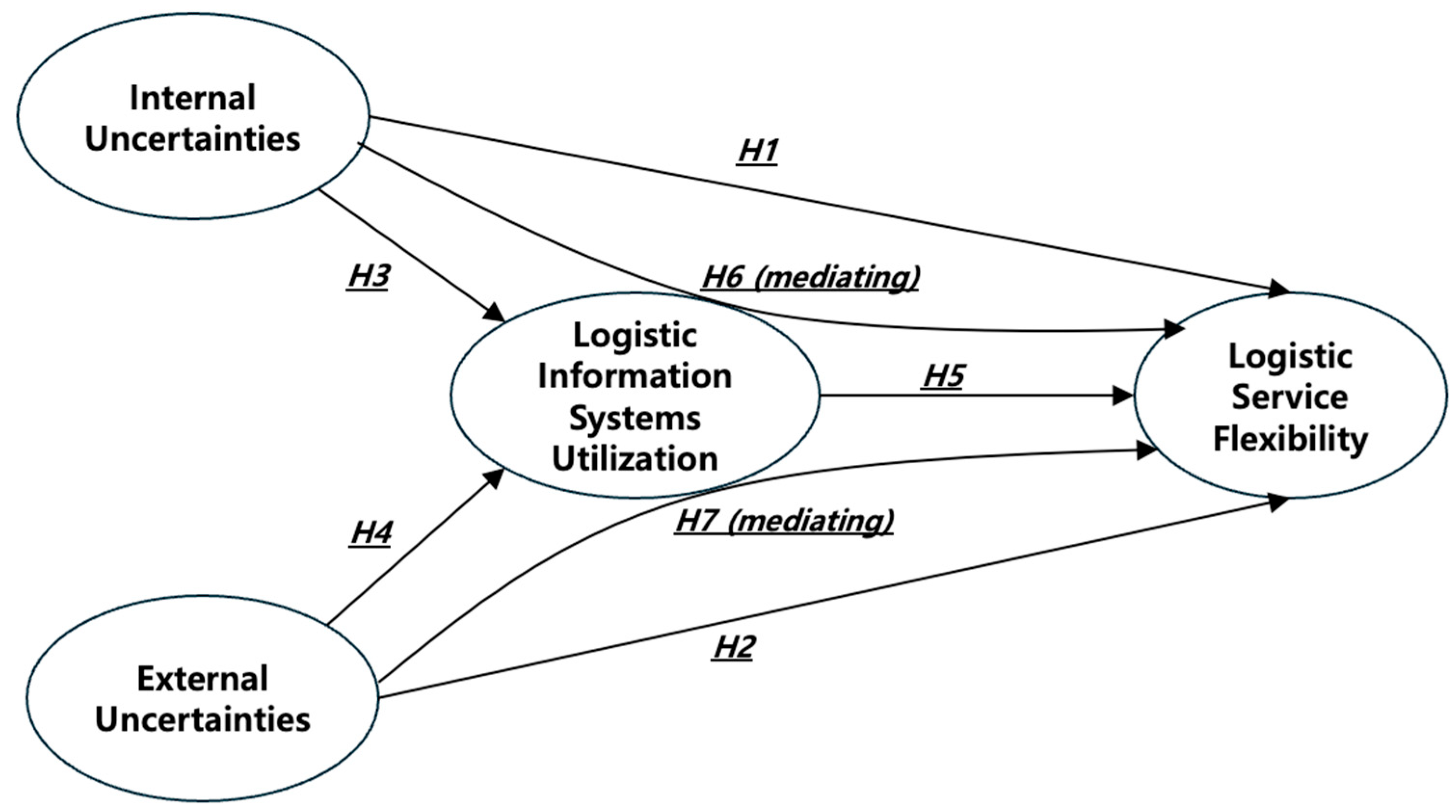
3.3.1. Research Testing Model
3.3.2. Relationship Between Internal and External Uncertainties, Logistics Service Flexibility, and LIS Utilization in CBEC Logistics
3.3.3. The Mediating Role of LIS Utilization on the Relationship Between Internal and External Uncertainties and Logistics Service Flexibility
4. Discussion
4.1. Overview of Key Findings
4.2. Differences Between Internal and External Uncertainties on Logistics Service Flexibility
4.3. Negative Influence of Internal Uncertainties and Marginal Tendency of External Uncertainties on LIS Utilization
4.4. Mediating Role of LIS Utilization Between Internal Uncertainties and Logistics Service Flexibility
4.5. Methods and Characteristics of the Survey Sample
5. Conclusions
5.1. Asymmetric Effects of Internal/External Uncertainties on Flexibility and Digital Adaptation
5.2. Academic Contributions
5.3. Managerial Implications
5.4. Future Directions
5.5. Limitations
Supplementary Materials
Author Contributions
Funding
Data Availability Statement
Conflicts of Interest
Abbreviations
| AI | Artificial Intelligence |
| AR | Augmented Reality |
| CBEC | Cross Border E-Commerce |
| CRM | Customer Relationship Management |
| ERP | Enterprise Resource Planning |
| IDRN | Information and Decision Risk Network |
| LIS | Logistics Information System |
| LoT | Internet of Things (IoT) |
| LSF | Logistics Service Flexibility |
| MM | Material Management |
| SD | Sales and Distribution |
| 3PL | Third Party Logistics |
| TMS | Transportation Management System |
| WMS | Warehouse Management System |
References
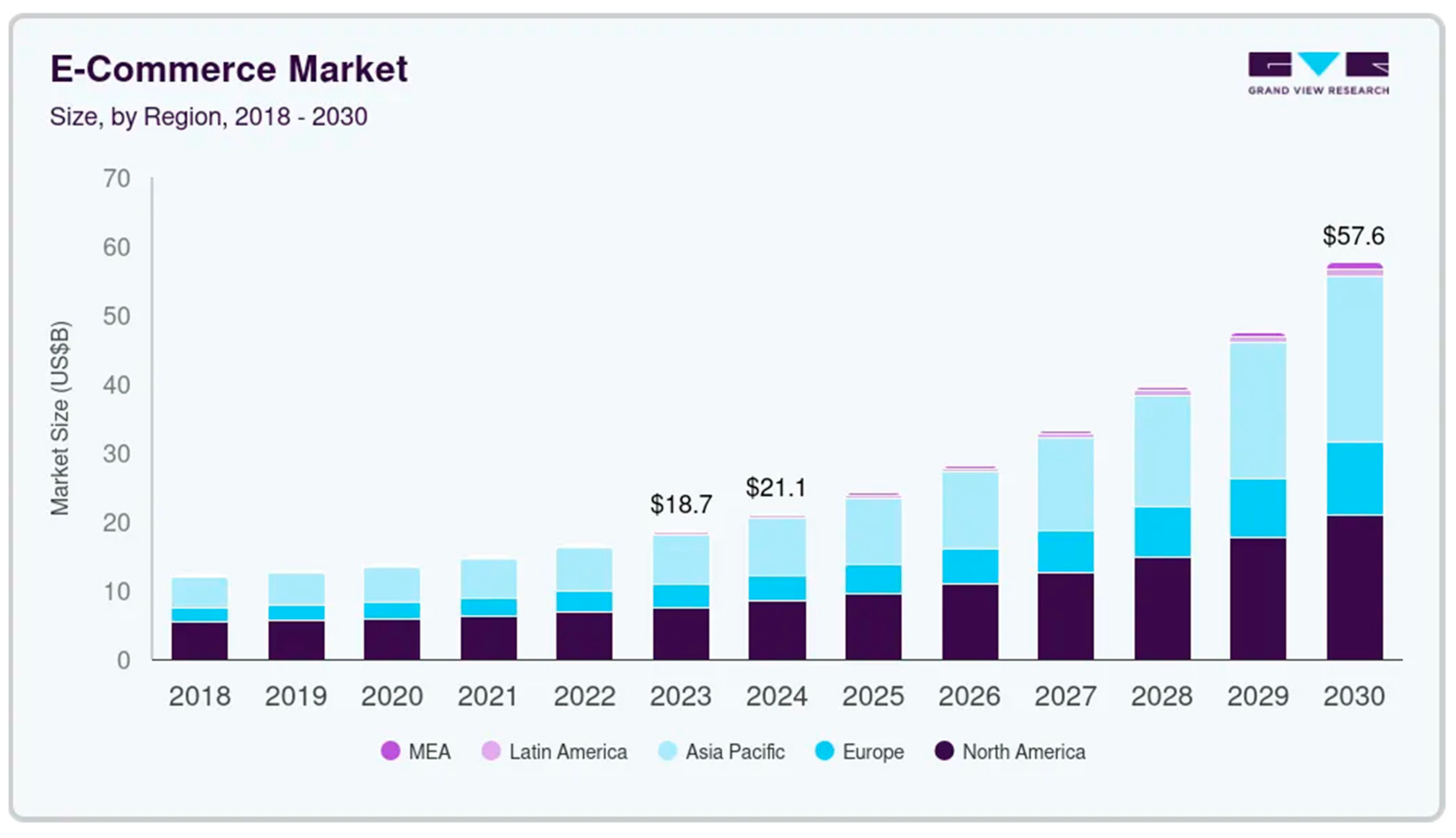
- Grandviewresearch. E-Commerce Worldwide Market Size 2018–2030. Available online: https://www.grandviewresearch.com/industry-analysis/e-commerce-market (accessed on 5 October 2025).
- Alcedo, J.; Cavallo, A.; Mishra, P.; Spilimbergo, A. Back to trend: COVID effects on e-commerce in 44 countries. J. Macroecon. 2025, 85, 103682. [Google Scholar] [CrossRef]
- Barlow, A.; Li, F. Online value network linkages: Integration, information sharing and flexibility. Electron. Commer. Res. Appl. 2005, 4, 100–112. [Google Scholar] [CrossRef]
- Park, J. Status and outlook of cross-border e-commerce in Korea. Korea Inst. Ind. Econ. Trade 2019, 19, 66–76. [Google Scholar]
- Lee, Y. Risk and risk management in cross border e-commerce. J. Int. Trade Insur. 2022, 23, 103–117. [Google Scholar] [CrossRef]
- Zhang, J.; Li, J.; Hou, Z.; Chen, M.; ICEB, G. A study of the research hot topics and visualization analysis of cross-border ecommerce in China. In Proceedings of the 18th International Conference on Electronic Business, Guilin, China, 2–6 December 2018; Available online: https://aisel.aisnet.org/iceb2018/94 (accessed on 5 October 2025).
- Simangunsong, E.; Hendry, L.C.; Stevenson, M. Supply-chain uncertainty: A review and theoretical foundation for future research. Int. J. Prod. Res. 2012, 50, 4493–4523. [Google Scholar] [CrossRef]
- Giuffrida, M.; Jiang, H.; Mangiaracina, R. Investigating the relationships between uncertainty types and risk management strategies in cross-border e-commerce logistics. Int. J. Logist. Manag. 2021, 32, 1406–1433. [Google Scholar] [CrossRef]
- Abdul Rahman, N.S.F.; Karim, N.H.; Md Hanafiah, R.; Abdul Hamid, S.; Mohammed, A. Decision analysis of warehouse productivity performance indicators to enhance logistics operational efficiency. Int. J. Product. Perform. Manag. 2023, 72, 962–985. [Google Scholar] [CrossRef]
- Shi, Y.; Zhang, A.; Arthanari, T.; Liu, Y. Third-party purchase: An empirical study of Chinese third-party logistics users. Int. J. Oper. Prod. Manag. 2016, 36, 286–307. [Google Scholar] [CrossRef]
- Tilokavichai, V.; Sophatsathit, P.; Chandrachai, A. Establishing customer service and logistics management relationship under uncertainty. World Rev. Bus. Res. 2012, 2, 12–23. [Google Scholar]
- Russell, D.; Ruamsook, K.; Roso, V. Managing supply chain uncertainty by building flexibility in container port capacity: A logistics triad perspective and the COVID-19 case. Marit. Econ. Logist. 2020, 24, 92–113. [Google Scholar] [CrossRef]
- Wong, C.Y.; Boon-Itt, S.; Wong, C.W. The contingency effects of environmental uncertainty on the relationship between supply chain integration and operational performance. J. Oper. Manag. 2011, 29, 604–615. [Google Scholar] [CrossRef]
- Lee, H.; Park, C. A study on the relationship between integration and performance of the R&D chain in the context of environmental uncertainty: Focusing on the R&D perspective. Corp. Manag. Res. 2018, 25, 1–26. [Google Scholar]
- Teece, D.J. Explicating dynamic capabilities: The nature and microfoundations of (sustainable) enterprise performance. Strateg. Manag. J. 2007, 28, 1319–1350. [Google Scholar] [CrossRef]
- Rehman, A.U.; Jajja, M.S.S. The interplay of integration, flexibility and coordination: A dynamic capability view to responding environmental uncertainty. Int. J. Oper. Prod. Manag. 2023, 43, 916–946. [Google Scholar] [CrossRef]
- Zhang, X.; Zha, X.; Zhang, H.; Dan, B. Information sharing in a cross-border e-commerce supply chain under tax uncertainty. Int. J. Electron. Commer. 2022, 26, 123–146. [Google Scholar] [CrossRef]
- Lim, S.; Choi, S. An empirical study on the effect of service quality on logistics performance of logistics information systems. Electron. Trade Res. 2009, 7, 61–87. [Google Scholar]
- Mlimbila, J.; Mbamba, U.O. The role of information systems usage in enhancing port logistics performance: Evidence from the Dar Es Salaam port, Tanzania. J. Shipp. Trade 2018, 3, 10. [Google Scholar] [CrossRef]
- Vakhovych, I.; Kryvovyazyuk, I.; Kovalchuk, N.; Kaminska, I.; Volynchuk, Y.; Kulyk, Y. Application of information technologies for risk management of logistics systems. In Proceedings of the 2021 62nd International Scientific Conference on Information Technology and Management Science of Riga Technical University (ITMS), Riga, Latvia, 14–15 October 2021; Available online: https://ieeexplore.ieee.org/document/9615297 (accessed on 5 October 2025).
- Zeng, Z.; Wang, N.; Xu, D.; Chen, R. Cascading failure modeling and resilience analysis of coupled centralized supply chain networks under hybrid loads. Systems 2025, 13, 729. [Google Scholar] [CrossRef]
- Bell, J.E.; Bradley, R.V.; Fugate, B.S.; Hazen, B.T. Logistics information system evaluation: Assessing external technology integration and supporting organizational learning. J. Bus. Logist. 2014, 35, 338–358. [Google Scholar] [CrossRef]
- Lee, C. Effect of logistics information system and organizational learning degree under environmental uncertainty on logistics performance. Ind. Econ. Res. 2008, 21, 2179–2202. [Google Scholar]
- Sun, P.; Gu, L. Optimization of cross-border e-commerce logistics supervision system based on Internet of Things technology. Complexity 2021, 2021, 4582838. [Google Scholar] [CrossRef]
- Lee, C.; Noh, J.; Kim, J. A study on the utilization of green IT for green growth in Korea. Digit. Trade Rev. 2009, 7, 155–174. [Google Scholar]
- Mor, A.; Orsenigo, C.; Soto Gomez, M.; Vercellis, C. Shaping the causes of product returns: Topic modeling on online customer reviews. Electron. Commer. Res. 2024, 1, 1–35. [Google Scholar] [CrossRef]
- Davoodi, L.; Mezei, J.; Heikkilä, M. Aspect-based sentiment classification of user reviews to understand customer satisfaction of e-commerce platforms. Electron. Commer. Res. 2025, 1, 1–43. [Google Scholar] [CrossRef]
- Schmenner, R.W.; Tatikonda, M.V. Manufacturing process flexibility revisited. Int. J. Oper. Prod. Manag. 2005, 25, 1183–1189. [Google Scholar] [CrossRef]
- Gupta, S.; Drave, V.A.; Bag, S.; Luo, Z. Leveraging smart supply chain and information system agility for supply chain flexibility. Inf. Syst. Front. 2019, 21, 547–564. [Google Scholar] [CrossRef]
- Huo, B.; Haq, M.Z.U.; Gu, M. The impact of information sharing on supply chain learning and flexibility performance. Int. J. Prod. Res. 2021, 59, 1411–1434. [Google Scholar] [CrossRef]
- Song, J. Statistical Analysis Method SPSS/AMOS. Paju 21st Century Company. 2014. Available online: https://library.kribb.re.kr/search/catalog/view.do?bibctrlno=116301&ty=B&se=b0 (accessed on 5 October 2025).
- Kang, H. A guide on the use of factor analysis in the assessment of construct validity. J. Korean Acad. Nurs. 2013, 43, 587–594. [Google Scholar] [CrossRef] [PubMed]
- Bagozzi, R.P.; Yi, Y. On the use of structural equation models in experimental designs. J. Mark. Res. 1989, 26, 271–284. [Google Scholar] [CrossRef]
- Hair, J.F. Multivariate Data Analysis; Kennesaw State University: Kennesaw, GA, USA, 2009; Available online: https://digitalcommons.kennesaw.edu/facpubs/2925/ (accessed on 5 October 2025).
- Fornell, C.; Larcker, D.F. Evaluating structural equation models with unobservable variables and measurement error. J. Mark. Res. 1981, 18, 39–50. [Google Scholar] [CrossRef]
- Woo, J. A study of itemized bias in multidimensional concepts in structural equation models. Korean Manag. Rev. 2015, 44, 1131–1147. [Google Scholar] [CrossRef]
- Lei, L.; Yu, S.; Ke, Y.; Deng, L.; Kang, Q. Evaluation model for emergency material suppliers in emergency logistics systems based on game theory-TOPSIS method. Systems 2025, 13, 493. [Google Scholar] [CrossRef]
- Carr, A.S.; Kaynak, H. Communication methods, information sharing, supplier development and performance: An empirical study of their relationships. Int. J. Oper. Prod. Manag. 2007, 27, 346–370. [Google Scholar] [CrossRef]
- Kampf, R.; Lizbetinova, L.; Tislerova, K. Management of customer service in terms of logistics information systems. Open Eng. 2017, 7, 26–30. [Google Scholar] [CrossRef]
- Preacher, K.J.; Hayes, A.F. Asymptotic and resampling strategies for assessing and comparing indirect effects in multiple mediator models. Behav. Res. Methods 2008, 40, 879–891. [Google Scholar] [CrossRef] [PubMed]
- Zakaria, H.; Zailani, S.; Fernando, Y. Moderating role of logistics information technology on the logistics relationships and logistics service quality. Oper. Supply Chain Manag. Int. J. 2014, 3, 134–147. [Google Scholar] [CrossRef]
- Wang, M. Logistics Capability, Supply Chain Uncertainty and Risk, and Logistics Performance: An Empirical Analysis of the Australian Courier Industry. Ph.D. Thesis, RMIT University, Melbourne, Australia, 2024. [Google Scholar]
- Wu, L.; Zhang, Z.; Huang, J.; Su, I.; Tian, S. Digital technologies and supply chain resilience: A resource-action-performance perspective. Inf. Syst. Front. 2025, 2025, 1–22. [Google Scholar] [CrossRef]
- Pan, X.; Dresner, M.; Xie, Y. Logistics IS resources, organizational factors, and operational performance: An investigation into domestic logistics firms in China. Int. J. Logist. Manag. 2025, 30, 569–594. [Google Scholar] [CrossRef]
- Richey, R.G.; Roath, A.S.; Adams, F.G.; Wieland, A. A responsiveness view of logistics and supply chain management. J. Bus. Logist. 2022, 43, 62–91. [Google Scholar] [CrossRef]
- Müller, J.; Hoberg, K.; Fransoo, J.C. Realizing supply chain agility under time pressure: Ad hoc supply chains during the COVID-19 pandemic. J. Oper. Manag. 2023, 69, 426–449. [Google Scholar] [CrossRef]
- Yang, L.; Huo, B.; Ye, Y. The impact of IT use on supply chain coordination: The moderating role of environmental uncertainty. J. Bus. Ind. Mark. 2024, 39, 1809–1826. [Google Scholar] [CrossRef]
- Eisenhardt, K.M.; Martin, J.A. Dynamic capabilities: What are they? Strateg. Manag. J. 2000, 21, 1105–1121. [Google Scholar] [CrossRef]
- Lamba, D.; Yadav, D.K.; Barve, A.; Panda, G. Prioritizing barriers in reverse logistics of e-commerce supply chain using fuzzy-analytic hierarchy process. Electron. Commer. Res. 2020, 20, 381–403. [Google Scholar] [CrossRef]
- Wang, F.; Yang, Y.; Tso, G.K.; Li, Y. Analysis of launch strategy in cross-border e-commerce market via topic modeling of consumer reviews. Electron. Commer. Res. 2019, 19, 863–884. [Google Scholar] [CrossRef]



| Category | Subcategory | Frequency | % |
|---|---|---|---|
| Industry | Manufacturing/Trading | 55 | 26% |
| Logistics service providers | 12 | 6% | |
| CBEC platform providers | 136 | 64% | |
| Others | 11 | 5% | |
| Annual sales | <40 billion KRW | 67 | 31% |
| 40–150 billion KRW | 78 | 36% | |
| 150–500 billion KRW | 14 | 7% | |
| >500 billion KRW | 55 | 26% | |
| Company size | <100 | 99 | 46% |
| (employees) | 100–299 | 70 | 33% |
| 300–999 | 19 | 9% | |
| ≥1000 | 26 | 12% | |
| Position | Staff | 12 | 6% |
| Assistant Manager | 66 | 31% | |
| Manager | 76 | 36% | |
| Senior Manager | 42 | 20% | |
| Executive | 18 | 8% |
| Divisions | Factors | # | Standardized Loadings | Mean | Metrics |
|---|---|---|---|---|---|
| Internal uncertainty | Returns | 1 | 0.909 | 3.88 | α = 0.937 AVE = 0.800 CR = 0.923 |
| 2 | 0.938 | 3.95 | |||
| 3 | 0.893 | 3.80 | |||
| Inventory | 1 | 0.791 | 4.03 | α = 0.928 | |
| 2 | 0.796 | 4.06 | AVE = 0.731 | ||
| 3 | 0.919 | 3.87 | CR = 0.916 | ||
| 4 | 0.913 | 3.88 | |||
| External uncertainty | Int’l transport | 1 | 0.882 | 4.41 | α = 0.838 AVE = 0.723 CR = 0.839 |
| 2 | 0.818 | 4.40 | |||
| Business environment | 1 | 0.852 | 4.28 | α = 0.884 AVE = 0.726 CR = 0.888 | |
| 2 | 0.910 | 3.76 | |||
| 3 | 0.794 | 3.91 | |||
| Demand | 1 | 0.821 | 3.88 | α = 0.821 AVE = 0.693 CR = 0.871 | |
| 2 | 0.860 | 4.29 | |||
| 3 | 0.823 | 4.15 | |||
| Logistics service Flexibility | 1 | 0.774 | 4.77 | α = 0.874 AVE = 0.646 CR = 0.878 | |
| 2 | 0.767 | 4.72 | |||
| 3 | 0.731 | 4.56 | |||
| 4 | 0.924 | 4.73 | |||
| Logistics information systems | 1 | 0.849 | 4.94 | α = 0.921 AVE = 0.800 CR = 0.923 | |
| 2 | 0.935 | 5.13 | |||
| 3 | 0.898 | 5.02 | |||
| Measured Variables | χ2 | df | CMIN/df | CFI | NFI | TLI | RMSEA |
|---|---|---|---|---|---|---|---|
| 22 | 369.1 | 190 | 1.94 | 0.97 | 0.95 | 0.97 | 0.047 |
| Hypotheses | β | C.R. | p | Result | Remark |
|---|---|---|---|---|---|
| H1: Internal uncertainty → LSF | −0.041 | −0.947 | 0.344 | Not supported | |
| H2: External uncertainty → LSF | 0.650 | 3.070 | 0.020 | Supported | |
| H3: Internal uncertainty → LIS | −0.163 | −1.976 | 0.048 | Not supported | negative effect |
| H4: External uncertainty → LIS | 0.599 | 2.743 | 0.060 | Not supported | |
| H5: LIS → LSF | 0.495 | 9.419 | <0.001 | Supported |
| Hypotheses | β | p | Result | Remarks |
|---|---|---|---|---|
| H6: Internal uncertainty → LIS → LSF | −0.081 | 0.007 | Supported | negative mediation |
| H7: External uncertainty → LIS → LSF | 0.297 | 0.068 | Not supported |
| Factors | LSF | LIS | IT_UNC | R_UNC | I_UNC | B_UNC | D_UNC |
|---|---|---|---|---|---|---|---|
| Logistics service flexibility | 0.646 | ||||||
| Logistics information systems | 0.519 | 0.800 | |||||
| Int’l Transport uncertainty | 0.095 | −0.009 | 0.723 | ||||
| Return uncertainty | −0.042 | −0.129 | 0.321 | 0.800 | |||
| Inventory uncertainty | 0.057 | −0.062 | 0.341 | 0.616 | 0.731 | ||
| Bus. Environment uncertainty | 0.193 | 0.097 | 0.611 | 0.389 | 0.478 | 0.726 | |
| Demand uncertainty | 0.048 | 0.076 | 0.299 | 0.525 | 0.620 | 0.378 | 0.693 |
| Hypotheses | Result |
|---|---|
| H1: Internal uncertainties in CBEC logistics positively influence logistics service flexibility. | Not supported |
| H2: External uncertainties in CBEC logistics positively influence logistics service flexibility. | Supported |
| H3: Internal uncertainties in CBEC logistics positively influence LIS utilization. | Not supported (negative effect) |
| H4: External uncertainties in CBEC logistics positively influence LIS utilization | Not supported |
| H5: LIS utilization in CBEC positively influences logistics service flexibility. | Supported |
| H6: LIS utilization in CBEC mediates the impact of internal uncertainties on logistics service flexibility. | Supported (negative mediation) |
| H7: LIS utilization in CBEC mediates the impact of external uncertainties on logistics service flexibility. | Not supported |
Disclaimer/Publisher’s Note: The statements, opinions and data contained in all publications are solely those of the individual author(s) and contributor(s) and not of MDPI and/or the editor(s). MDPI and/or the editor(s) disclaim responsibility for any injury to people or property resulting from any ideas, methods, instructions or products referred to in the content. |
© 2025 by the authors. Licensee MDPI, Basel, Switzerland. This article is an open access article distributed under the terms and conditions of the Creative Commons Attribution (CC BY) license (https://creativecommons.org/licenses/by/4.0/).
Share and Cite
Chung, S.; Kim, H.; Choi, D. Impacts of Internal and External Uncertainties on Logistics Service Flexibility in Cross-Border E-Commerce Logistics: Evidence from South Korea. Systems 2025, 13, 1082. https://doi.org/10.3390/systems13121082
Chung S, Kim H, Choi D. Impacts of Internal and External Uncertainties on Logistics Service Flexibility in Cross-Border E-Commerce Logistics: Evidence from South Korea. Systems. 2025; 13(12):1082. https://doi.org/10.3390/systems13121082
Chicago/Turabian StyleChung, Seiwook, Hyunho Kim, and Donghyun Choi. 2025. "Impacts of Internal and External Uncertainties on Logistics Service Flexibility in Cross-Border E-Commerce Logistics: Evidence from South Korea" Systems 13, no. 12: 1082. https://doi.org/10.3390/systems13121082
APA StyleChung, S., Kim, H., & Choi, D. (2025). Impacts of Internal and External Uncertainties on Logistics Service Flexibility in Cross-Border E-Commerce Logistics: Evidence from South Korea. Systems, 13(12), 1082. https://doi.org/10.3390/systems13121082