Provisioning Tacit Knowledge from a Human Resources Management Perspective: A Preliminary Causal Loop Diagram

 , ,
, ,
Abstract
1. Introduction
1.1. Theoretical Framework
1.1.1. Tacit Knowledge
1.1.2. KB-HRM and Knowledge Transfer
1.1.3. KB-HRM Processes
1.2. Theories and Methodologies Support
1.3. Previous Research
2. Materials and Methods
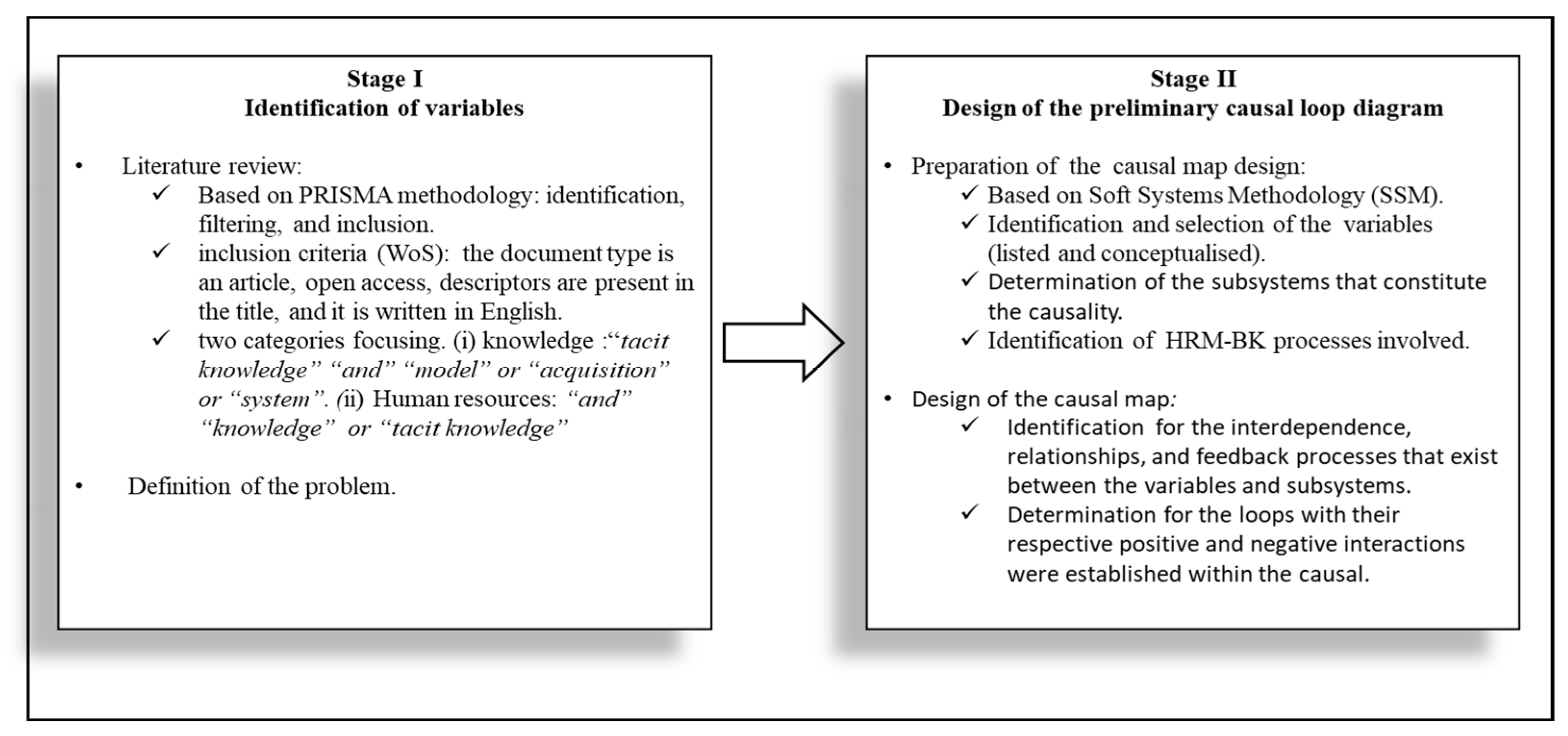
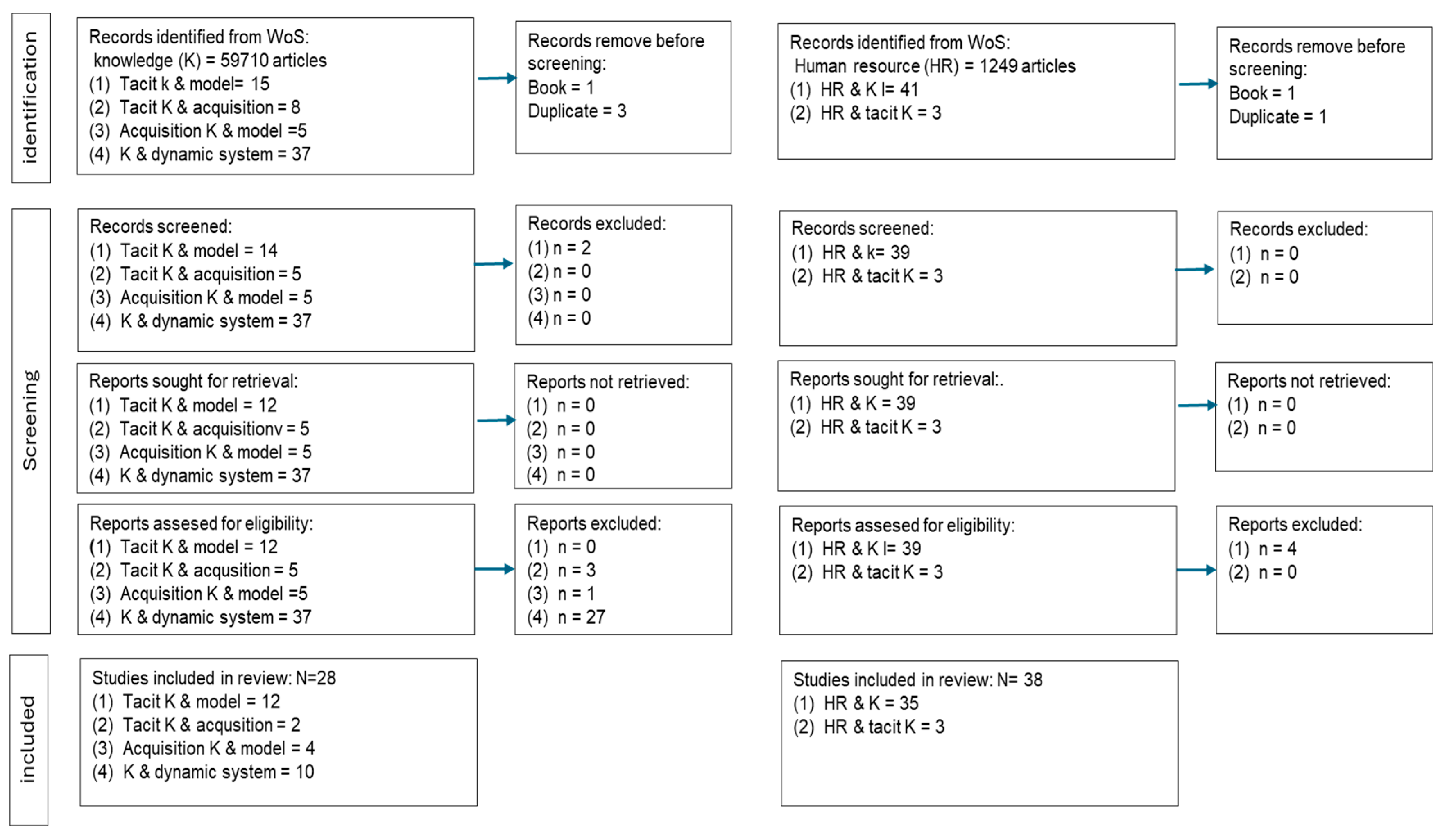
2.1. Phase I: Variables Identification
2.2. Phase II: Design of a Preliminary Causal Loop Diagram
3. Results
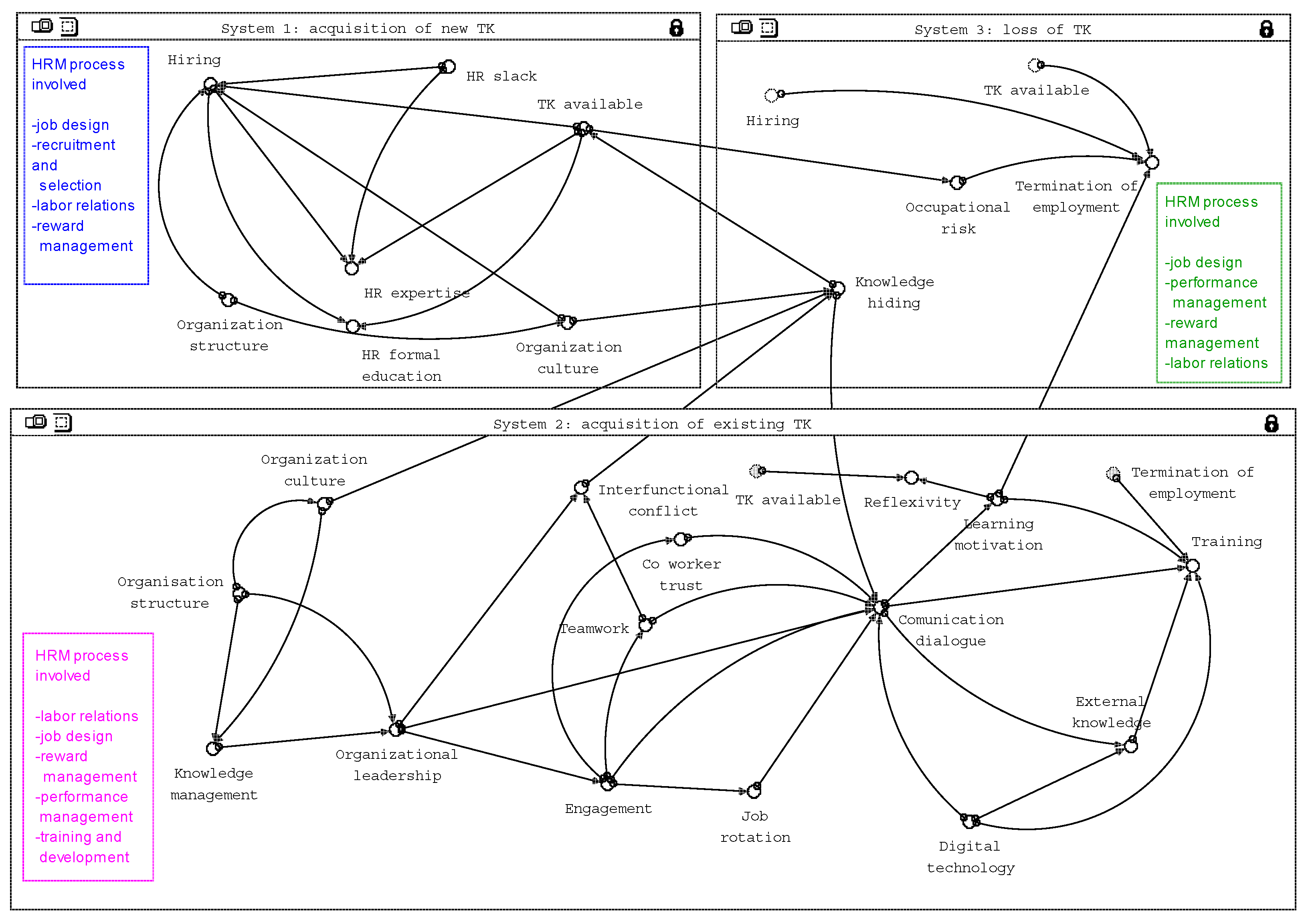
3.1. Stratification of KB-HRM Variables and Processes by System
3.1.1. System 1: New TK Acquisition
3.1.2. System 2: Existing TK Acquisition
3.1.3. System 3: Loss of TK
3.2. Integration of Procurement System: Causalities
3.3. KB-HRM and Available TK
3.4. Model’s Implications and Limitations
4. Discussion
Limitations and Future Research
Author Contributions
Funding
Institutional Review Board Statement
Informed Consent Statement
Data Availability Statement
Acknowledgments
Conflicts of Interest
Abbreviations
| PCLD | Preliminary causal loop diagram |
| TK | Tacit knowledge |
| HR | Human Resource |
| KB-HRM | Knowledge-based human resource management |
| HRM | Human Resource Management |
| RBV | Resource-based view |
| S1 | System 1 |
| S2 | System 2 |
| S3 | System 3 |
References
- Nonaka, I. La Organización Creadora de Conocimiento; Oxford University Press: Oxford, UK, 1999. [Google Scholar]
- Zhou, H.; Yang, Y. Research on the Differential Mechanisms of Knowledge Cross-Border Searching on Firms’ Dual Innovation in the Digital Context: Based on Simulation of System Dynamics Model. Discret. Dyn. Nat. Soc. 2021, 2021, 2493380. [Google Scholar] [CrossRef]
- Papa, A.; Dezi, L.; Gregori, G.L.; Mueller, J.; Miglietta, N. Improving innovation performance through knowledge acquisition: The moderating role of employee retention and human resource management practices. J. Knowl. Manag. 2020, 24, 589–605. [Google Scholar] [CrossRef]
- Kianto, A.; Sáenz, J.; Aramburu, N. Knowledge-based human resource management practices, intellectual capital and innovation. J. Bus. Res. 2017, 81, 11–20. [Google Scholar] [CrossRef]
- Snell, S.; Morris, S. Administración de Recursos Humanos; Cengage Learning: CDMX, México, 2020. [Google Scholar]
- Phaladi, M. Human resource management as a facilitator of a knowledge-driven organisational culture and structure for the reduction of tacit knowledge loss in South African state-owned enterprises. SA J. Inf. Manag. 2022, 24, 10. [Google Scholar] [CrossRef]
- Paolino, L.; Lizcano, D.; López, G.; Lloret, J. A Multiagent System Prototype of a Tacit Knowledge Management Model to Reduce Labor Incident Resolution Times. Appl. Sci. 2019, 9, 5448. [Google Scholar] [CrossRef]
- Oliva, F.L.; Semensato, B.I.; Prioste, D.B.; Winandy, E.J.; Bution, J.L.; Couto, M.H.; Bottacin, M.A.; Mac Lennan, M.L.; Teberga, P.M.; Santos, R.F.; et al. Innovation in the main Brazilian business sectors: Characteristics, types and comparison of innovation. J. Knowl. Manag. 2018, 23, 135–175. [Google Scholar] [CrossRef]
- Wang, L.; Song, M.; Zhang, M.; Wang, L. How does contract completeness affect tacit knowledge acquisition? J. Knowl. Manag. 2021, 25, 989–1005. [Google Scholar] [CrossRef]
- Nonaka, I. A Dynamic Theory of Organizational Knowledge Creation. Organ. Sci. 1994, 5, 14–37. [Google Scholar] [CrossRef]
- Li, H.; Li, C.; Wang, Z.; Li, X. Simulating the impacts of mutual trust on tacit knowledge transfer using agent-based modelling approach. Knowl. Manag. Res. Pract. 2019, 17, 227–244. [Google Scholar] [CrossRef]
- Polanyi, M. The Tacit Dimension; University of Chicago Press: Chicago, IL, USA, 2009. [Google Scholar]
- Wang, W. System dynamics modelling for examining knowledge transfer during crises. Syst. Res. Behav. Sci. 2011, 28, 105–127. [Google Scholar] [CrossRef]
- Chergui, W.; Zidat, S.; Marir, F. An approach to the acquisition of tacit knowledge based on an ontological model. J. King Saud Univ. Comput. Inf. Sci. 2020, 32, 818–828. [Google Scholar] [CrossRef]
- Leonard, D.; Sensiper, S. The role of tacit knowledge in group innovation. Calif. Manag. Rev. 1998, 40, 112–132. [Google Scholar] [CrossRef]
- Dixon, N.M. Common Knowledge: How Companies Thrive by Sharing What They Know; Harvard Business School Press: Boston, MA, USA, 2000; 188p. [Google Scholar]
- Baumard, P. Tacit Knowledge in Organizations; Sage Publications: London, UK, 1999. [Google Scholar]
- Argyris, C. On Organizational Learning; Wiley-Blackwell: Malden, MA, USA, 2012; 480p. [Google Scholar]
- Nelson, R.; Winter, S. An Evolutionary Theory of Economic Change; Belknap Press: Cambridge, MA, USA, 2004; 454p. [Google Scholar]
- Lugar, C.; Novićević, R. Knowledge based human resource management and employee creativity: The dual mediation of knowledge sharing and knowledge hiding. Econ. Ecol. Socium 2021, 5, 1–10. [Google Scholar] [CrossRef]
- Al-Tal, M.J.Y.; Emeagwali, O.L. Knowledge-based HR Practices and Innovation in SMEs. Organizacija 2019, 52, 6–21. [Google Scholar] [CrossRef]
- Jiang, K.; Lepak, D.P.; Hu, J.; Baer, J.C. How Does Human Resource Management Influence Organizational Outcomes? A Meta-analytic Investigation of Mediating Mechanisms. Acad. Manag. J. 2012, 55, 1264–1294. [Google Scholar] [CrossRef]
- Gao, B. Exploration of talent mining based on machine learning and the influence of knowledge acquisition. Knowl. Manag. Res. Pract. 2021, 1–9. [Google Scholar] [CrossRef]
- Iqbal, S.; Litvaj, I.; Drbúl, M.; Rasheed, M. Improving Quality of Human Resources through HRM Practices and Knowledge Sharing. Adm. Sci. 2023, 13, 224. [Google Scholar] [CrossRef]
- Armstrong, M. Reward Management: A Handbook of Remuneration Strategy and Practice; Kogan Page Publishers: London, UK, 2007; 748p. [Google Scholar]
- Chen, C.-J.; Huang, J.-W. Strategic human resource practices and innovation performance—The mediating role of knowledge management capacity. J. Bus. Res. 2009, 62, 104–114. [Google Scholar] [CrossRef]
- OIT. Informe Sobre el Diálogo Social 2022: La Negociación Colectiva en Aras de Una Recuperación Inclusiva, Sostenible y Resiliente; OIT: Ginebra, Suiza, 2022. [Google Scholar]
- Liu, Y.; Li, Y.; Shi, L.H.; Liu, T. Knowledge transfer in buyer-supplier relationships: The role of transactional and relational governance mechanisms. J. Bus. Res. 2017, 78, 285–293. [Google Scholar] [CrossRef]
- Lepak, D.P.; Snell, S.A. Examining the Human Resource Architecture: The Relationships Among Human Capital, Employment, and Human Resource Configurations. J. Manag. 2002, 28, 517–543. [Google Scholar] [CrossRef]
- Kong, E.; Chadee, D.; Raman, R. Managing Indian IT professionals for global competitiveness: The role of human resource practices in developing knowledge and learning capabilities for innovation. Knowl. Manag. Res. Pract. 2013, 11, 334–345. [Google Scholar] [CrossRef][Green Version]
- Lecuona, J.; Reitzig, M. Knowledge worth having in “excess”: The value of tacit and firm-specific human resource slack. Strateg. Manag. J. 2014, 35, 954–973. [Google Scholar] [CrossRef]
- Le Nhut, Q.; Quoc, T.V.; Xuan, N.N.A.; Le, D.V. Leveraging Knowledge Management to Enhance Human Resource Management Efficiency: Insights from Mekong Delta Service Enterprises. J. Chin. Hum. Resour. Manag. 2024, 15, 91–100. [Google Scholar] [CrossRef]
- Martinez-Sanchez, A.; Vicente-Oliva, S. Supporting agile innovation and knowledge by managing human resource flexibility. Int. J. Innov. Sci. 2023, 15, 558–578. [Google Scholar] [CrossRef]
- Ouyang, H.; Cui, X.; Peng, X.; Udemba, E.N. Reverse knowledge transfer in digital era and its effect on ambidextrous innovation: A simulation based on system dynamics. Heliyon 2023, 9, e22717. [Google Scholar] [CrossRef]
- Zebal, M.; Ferdous, A.; Chambers, C. An integrated model of marketing knowledge—A tacit knowledge perspective. J. Res. Mark. Entrep. 2019, 21, 2–18. [Google Scholar] [CrossRef]
- Asher, D.; Popper, M. Tacit knowledge as a multilayer phenomenon: The ‘onion’ model. Learn. Organ. 2019, 26, 264–275. [Google Scholar] [CrossRef]
- Thoene, M.A.; Buszko, A. Quantitative Model of Tacit Knowledge Estimation for Pharmaceutical Industry. Eng. Econ. 2014, 25, 40–46. [Google Scholar] [CrossRef]
- Akhavan, P.; Shahabipour, A.; Hosnavi, R. A model for assessment of uncertainty in tacit knowledge acquisition. J. Knowl. Manag. 2018, 22, 413–431. [Google Scholar] [CrossRef]
- Zahedi, M.; Khanachah, S. Provide a model for acquisition and recording of organizational lessons learned in the framework of the knowledge handbook with emphasis on effective components. Sigma J. Eng. Nat. Sci.-Sigma Muhendis. Ve Fen Bilim. Derg. 2024, 42, 905–918. [Google Scholar] [CrossRef]
- Arnett, D.B.; Wittmann, C.M.; Hansen, J.D. A process model of tacit knowledge transfer between sales and marketing. Ind. Mark. Manag. 2021, 93, 259–269. [Google Scholar] [CrossRef]
- Lin, C.-P. To Share or Not to Share: Modeling Tacit Knowledge Sharing, Its Mediators and Antecedents. J. Bus. Ethics 2007, 70, 411–428. [Google Scholar] [CrossRef]
- Flanagan, T.; Eckert, C.; Clarkson, P. Extemalizing tacit overview knowledge: A model-based approach to supporting design teams. Ai Edam-Artif. Intell. Eng. Des. Anal. Manuf. 2007, 21, 227–242. [Google Scholar] [CrossRef]
- Monks, K.; Conway, E.; Fu, N.; Bailey, K.; Kelly, G.; Hannon, E. Enhancing knowledge exchange and combination through HR practices: Reflexivity as a translation process. Hum. Resour. Manag. J. 2016, 26, 304–320. [Google Scholar] [CrossRef]
- Wu, L.-W.; Lin, J.-R. Knowledge sharing and knowledge effectiveness: Learning orientation and co-production in the contingency model of tacit knowledge. J. Bus. Ind. Mark. 2013, 28, 672–686. [Google Scholar] [CrossRef]
- Chen, H.; Nunes, J.M.B.; Ragsdell, G.; An, X. Somatic and cultural knowledge: Drivers of a habitus-driven model of tacit knowledge acquisition. J. Doc. 2019, 75, 927–953. [Google Scholar] [CrossRef]
- Li, Q.; Gao, H. How External Knowledge Acquisition Contribute to Innovation Performance: A Chain Mediation Model; Sage Open: London, UK, 2023; Volume 13. [Google Scholar]
- Kucharska, W.; Erickson, G.S. Tacit knowledge acquisition & sharing, and its influence on innovations: A Polish/US cross-country study. Int. J. Inf. Manag. 2023, 71, 102647. [Google Scholar] [CrossRef]
- Merriam, S.B.; Tisdell, E.J. Qualitative Research: A Guide to Design and Implementation, 4th ed.; Jossey-Bass Inc. Pub: San Francisco, CA, USA, 2016; 346p. [Google Scholar]
- Page, M.J.; McKenzie, J.E.; Bossuyt, P.M.; Boutron, I.; Hoffmann, T.C.; Mulrow, C.D.; Shamseer, L.; Tetzlaff, J.M.; Akl, E.A.; Brennan, S.E.; et al. The PRISMA 2020 statement: An updated guideline for reporting systematic reviews. BMJ 2021, 372, n71. [Google Scholar] [CrossRef]
- Klein, G.A. Using knowledge engineering to preserve corporate memory. In The Psychology of Expertise: Cognitive Research and Empirical AI; Springer: Berlin/Heidelberg, Germany, 1992; pp. 170–187. [Google Scholar]
- UNESCO. Clasificación Internacional Normalizada de la Educación CINE Montreal: UNESCO. 2011. Available online: https://unesdoc.unesco.org/ark:/48223/pf0000220782 (accessed on 2 September 2024).
- Gürlek, M.; Gurlek, M. Knowledge management and human resources management. In Tech Development Through HRM; Emerald Publishing Limited: England, UK, 2020; 25p. [Google Scholar]
- Pu, B.; Sang, W.; Yang, J.; Ji, S.; Tang, Z. The Effect of Entrepreneurial Leadership on Employees’ Tacit Knowledge Sharing in Start-Ups: A Moderated Mediation Model. Psychol. Res. Behav. Manag. 2022, 15, 137–149. [Google Scholar] [CrossRef]
- Kahn, W.A. To Be Fully There: Psychological Presence at Work. Hum. Relat. 1992, 45, 321–349. [Google Scholar] [CrossRef]
- Pinto, L.; Veloso, A.; Oliveira, A.; Silva, I. The influence of work engagement and trust in the tacit knowledge transfer: Proposal of a model. Estud. Gerenciales 2021, 37, 610–621. [Google Scholar] [CrossRef]
- Suh, T.; Khan, O.J.; Schnellbächer, B.; Heidenreich, S. Strategic accord and tension for business model innovation: Examining different tacit knowledge types and open action strategies. Int. J. Innov. Manag. 2020, 24, 2050039. [Google Scholar] [CrossRef]
- Miller, K.; Zhao, M.; Calantone, R. Adding interpersonal learning and tacit knowledge to March’s exploration-exploitation model. Acad. Manag. J. 2006, 49, 709–722. [Google Scholar] [CrossRef]
- Costa, A. A Matter of Trust: Effects on the Performance and Effectiveness of Teams in Organizations; Ridderprint: Lisboa, Portugal, 2000. [Google Scholar]
- De Wit, F.R.; Greer, L.L.; Jehn, K.A. The paradox of intragroup conflict: A meta-analysis. J. Appl. Psychol. 2012, 97, 360. [Google Scholar] [CrossRef] [PubMed]
- Connelly, C.E.; Zweig, D.; Webster, J.; Trougakos, J.P. Knowledge hiding in organizations. J. Organ. Behav. 2012, 33, 64–88. [Google Scholar] [CrossRef]
- Tsoukas, H. Do we really understand tacit knowledge? In Complex Knowledge: Studies in Organizational Epistemology; Oxford University Press: Oxford, UK, 2023. [Google Scholar]
- Sinkula, J.M.; Baker, W.E.; Noordewier, T. A Framework for Market-Based Organizational Learning: Linking Values, Knowledge, and Behavior. J. Acad. Mark. Sci. 1997, 25, 305–318. [Google Scholar] [CrossRef]
- Antonacopoulou, E. The Dynamics of Reflexive Practice: The Relationship Between Learning and Changing. In Organizing Reflection; Routledge: London, UK, 2004. [Google Scholar]
- Chen, S.N.; Luh, D.B. A social network supported CAI model for tacit knowledge acquisition. Int. J. Technol. Des. Educ. 2018, 28, 613–630. [Google Scholar] [CrossRef]
- Hagemeister, M.; Rodríguez-Castellanos, A. Knowledge acquisition, training, and the firm’s performance: A theoretical model of the role of knowledge integration and knowledge options. Eur. Res. Manag. Bus. Econ. 2019, 25, 48–53. [Google Scholar] [CrossRef]
- Zhu, Y.-W.; Bathelt, H.; Zeng, G. Learning in Context: A Structural Equation Modeling Approach to Analyze Knowledge Acquisition at Trade Fairs. Z. Fur Wirtsch. 2020, 64, 165–179. [Google Scholar] [CrossRef]
- GOBMEX. Ley Federal del Trabajo; Ediciones Fiscales ISEF: Ciudad de México, Mexico, 2024. [Google Scholar]
- Sveiby, K.; Simons, R. Collaborative climate and effectiveness of knowledge work—An empirical study. J. Knowl. Manag. 2002, 6, 420–433. [Google Scholar] [CrossRef]
- Gurtner, A.; Tschan, F.; Semmer, N.K.; Nägele, C. Getting groups to develop good strategies: Effects of reflexivity interventions on team process, team performance, and shared mental models. Organ. Behav. Hum. Decis. Process. 2007, 102, 127–142. [Google Scholar] [CrossRef]
- Swift, M.L.; Virick, M. Perceived Support, Knowledge Tacitness, and Provider Knowledge Sharing. Group Organ. Manag. 2013, 38, 717–742. [Google Scholar] [CrossRef]
- Kehoe, R.R.; Wright, P.M. The Impact of High-Performance Human Resource Practices on Employees’ Attitudes and Behaviors. J. Manag. 2013, 39, 366–391. [Google Scholar] [CrossRef]
- Buch, R.; Dysvik, A.; Kuvaas, B.; Nerstad, C.G.L. It Takes Three to Tango: Exploring the Interplay among Training Intensity, Job Autonomy, and Supervisor Support in Predicting Knowledge Sharing. Hum. Resour. Manag. 2015, 54, 623–635. [Google Scholar] [CrossRef]
- Khin, S.; Ho, T.C. Digital technology, digital capability and organizational performance: A mediating role of digital innovation. Int. J. Innov. Sci. 2019, 11, 177–195. [Google Scholar] [CrossRef]
- Chen, Y.-J. Development of a method for ontology-based empirical knowledge representation and reasoning. Decis. Support Syst. 2010, 50, 1–20. [Google Scholar] [CrossRef]
- Li, H.; Li, L.; Cai, S. Systems Dynamics Application to Motivating Tacit Knowledge Management. In Proceedings of the 4th International Conference on Wireless Communications, Networking and Mobile Computing, Dalian, China, 18 November 2008. [Google Scholar]
- Boon, C.; Kalshoven, K. How High-Commitment HRM Relates to Engagement and Commitment: The Moderating Role of Task Proficiency. Hum. Resour. Manag. 2014, 53, 403–420. [Google Scholar] [CrossRef]
- Rudawska, A. Commitment-based human resource practices, job satisfaction and proactive knowledge-seeking behavior: The moderating role of organizational identification. Manag. Bus. Adm. Central Eur. 2024, 33, 144–162. [Google Scholar] [CrossRef]
- Mintzberg, H. Policy as a field of management theory. Acad. Manag. Rev. 1977, 2, 88–103. [Google Scholar] [CrossRef]
- Nonaka, I.; Von Krogh, G. Perspective—Tacit knowledge and knowledge conversion: Controversy and advancement in organizational knowledge creation theory. Organ. Sci. 2009, 20, 635–652. [Google Scholar] [CrossRef]
- Bratianu, C.; Bejinaru, R. The Theory of Knowledge Fields: A Thermodynamics Approach. Systems 2019, 7, 20. [Google Scholar] [CrossRef]
- Anwar, H.; Khan, S.U.R.; Iqbal, J.; Akhunzada, A. A Tacit-Knowledge-Based Requirements Elicitation Model Supporting COVID-19 Context. IEEE Access 2022, 10, 24481–24508. [Google Scholar] [CrossRef]
- Beatty, R.W.; McEvoy, G.M.; Beer, M.; Spector, B.; Lawrence, P.R.; Mills, D.Q.; Walton, R.E. Managing Human Assets. ILR Rev. 1984, 39, 618. [Google Scholar] [CrossRef]
- Checkland, P. Systems thinking. In Rethinking Management Information Systems: An Interdisciplinary Perspective; OUP Oxford: Oxford, UK, 1999. [Google Scholar]



| Variable | Definition | Author Who Proposes the Variable |
|---|---|---|
| Hiring (H) | Employment relationship, which can be for a definite or indefinite period [5]. | [35] |
| HR slack (HRs) | HR excess in an enterprise possessing tacit knowledge. | [31] |
| HR expertise (HRexp) | Knowledge and skills that the HR increase through experience [50]. | [36] |
| HR formal education (HRfe) | Institutionalised, intentional, and planned education by public organisations and accredited private bodies [51]. | [37] |
| Organisational structure (Os) | Way in which systems, processes, and activities are set up and coordinated in the firm [6]. | [6,38] |
| Organisational culture (Oc) | Non-physical infrastructure that governs an enterprise [52]. | [6,38,39] |
| TK available (TKa) | TK held by the firm’s HR. | [1] |
| Variable | Definition | Author Who Proposes the Variable |
|---|---|---|
| Knowledge management (KM) | A process that identifies, generates, applies, and socialises critical knowledge. | [38,39] |
| Leadership organisational (Lo) | Abilities to lead a firm and their divisions. | [38,53] |
| Engagement (E) | HR on-task behaviours that promote an interrelationship with work, active and complete role performance, personal presence (cognitive, physical, and emotional), and with others [54]. | [11,40,41,55] |
| Teamwork (Tw) | Social network with shared expectations in which knowledge is exchanged by providing mutual support [41]. | [42,56] |
| Job rotation (Jr) | Mechanism through which HR move laterally between two or more jobs, in a planned manner, to socialise experiences, knowledge and skills [13]. | [35,57] |
| Co-worker trust (CwT) | HR Disposition to trust other members of the firm [58]. | [11,40,41,42,55] |
| Interfunctional conflict (Ic) | Damaging behaviours within a firm include the distortion and withholding of information, hostility and mistrust in interactions, and obstacles to effective decision-making [59]. | [40] |
| Knowledge hiding (Kh) | HR behaviour is characterised by intentionally concealing or withholding knowledge that has been requested by a member of the firm [60]. | [20] |
| Communication/dialogue (C/D) | Social interaction between firm’s HR, through generation or socialisation of new knowledge of the firm [61]. | [40,42,43,44] |
| Learning motivation (Lm) | HR capacity to generate, disperse and exploit knowledge [62]. | [38,39,44,45,57] |
| Reflexivity (R) | HR behaviour characterised by dynamic interaction between action and reflection motivated by learning and change [63]. | [43] |
| Digital technology (Dt) | Tools that eliminate physical space and enable information processing, storage, and distribution [11]. | [38,39,45,64] |
| Training (T) | Acquisition of capabilities (knowledge, skills, values, attitudes) through training. | [35,65] |
| External knowledge (EK) | Process of interaction and communication between firms, competitors, customers, suppliers, distributors, and scientific research institutions [46]. | [46,66] |
| Termination of employment (Te) | Legal termination of employment relationship [5]. | - |
| Organisational structure (Os) | Idem Table I | - |
| Organisational culture (Oc) | Idem Table I | - |
| TK available | Idem Table I | - |
| Variable | Definition | Author Who Proposes the Variable |
|---|---|---|
| Occupational risk (Or) | Accidents or illnesses caused by HR during work-related activities [67]. | - |
| Termination of employment (Te) | Idem Table III. | - |
| Knowledge hiding (Kh) | Idem Table III. | - |
| Hiring (H) | Idem Table I. | - |
| TK available | Idem Table I. |
Disclaimer/Publisher’s Note: The statements, opinions and data contained in all publications are solely those of the individual author(s) and contributor(s) and not of MDPI and/or the editor(s). MDPI and/or the editor(s) disclaim responsibility for any injury to people or property resulting from any ideas, methods, instructions or products referred to in the content. |
© 2026 by the authors. Licensee MDPI, Basel, Switzerland. This article is an open access article distributed under the terms and conditions of the Creative Commons Attribution (CC BY) license.
Share and Cite
Aguilar-Fernández, M.; Salgado-Escobar, G.; León-Romero, L.P.; García-Jarquín, B.; Francisco-Márquez, M. Provisioning Tacit Knowledge from a Human Resources Management Perspective: A Preliminary Causal Loop Diagram. Systems 2026, 14, 64. https://doi.org/10.3390/systems14010064
Aguilar-Fernández M, Salgado-Escobar G, León-Romero LP, García-Jarquín B, Francisco-Márquez M. Provisioning Tacit Knowledge from a Human Resources Management Perspective: A Preliminary Causal Loop Diagram. Systems. 2026; 14(1):64. https://doi.org/10.3390/systems14010064
Chicago/Turabian StyleAguilar-Fernández, Mario, Graciela Salgado-Escobar, Luvis P. León-Romero, Brenda García-Jarquín, and Misaela Francisco-Márquez. 2026. "Provisioning Tacit Knowledge from a Human Resources Management Perspective: A Preliminary Causal Loop Diagram" Systems 14, no. 1: 64. https://doi.org/10.3390/systems14010064
APA StyleAguilar-Fernández, M., Salgado-Escobar, G., León-Romero, L. P., García-Jarquín, B., & Francisco-Márquez, M. (2026). Provisioning Tacit Knowledge from a Human Resources Management Perspective: A Preliminary Causal Loop Diagram. Systems, 14(1), 64. https://doi.org/10.3390/systems14010064