Article

A Data-Driven Framework to Reduce Information Asymmetry in the Second-Hand Battery Electric Vehicle Market


Department of Energy, Politecnico di Milano, 20156 Milan, Italy
*
Author to whom correspondence should be addressed.
Electronics 2026, 15(12), 2614; https://doi.org/10.3390/electronics15122614 (registering DOI)
Submission received: 7 May 2026 / Revised: 8 June 2026 / Accepted: 10 June 2026 / Published: 12 June 2026

Abstract

The second-hand Battery Electric Vehicle (BEV) market in Italy is affected by substantial information asymmetry, particularly with regard to battery State of Health (SOH), residual value, and expected maintenance costs. This lack of transparency limits consumer confidence and reduces the potential of used BEVs to support a broader and more inclusive electric mobility transition. In this study, a data-driven decision-support framework is developed to improve the evaluation of second-hand BEVs in the Italian market. The proposed approach combines market data collected from major online platforms with historical price reconstruction and an assessment of the information asymmetries that limit user confidence in the second-hand BEV market. It also incorporates a semi-empirical SOH estimation model based on observable vehicle characteristics. The results reveal a consistent depreciation gap between BEVs and comparable internal combustion engine vehicles across different market segments and indicate that battery-related uncertainty appears to be one of the factors associated with consumer hesitation. The framework shows that combining non-invasive battery-health estimation with maintenance-related information can support a more objective assessment of used electric vehicles. Overall, the study demonstrates the potential of integrated digital and engineering-based tools to reduce uncertainty and enhance transparency in the second-hand BEV market.

1. Introduction

The transition toward electric mobility is widely recognized as a key pathway for reducing greenhouse gas emissions in the transport sector. Nevertheless, the pace of Battery Electric Vehicle (BEV) adoption remains heterogeneous across countries, and Italy still shows a slower diffusion trajectory than several other European markets. This delay cannot be explained by purchase cost alone; it is also associated with infrastructural, cultural, and informational barriers that continue to affect consumers’ attitudes and purchasing behaviour [1,2,3]. In parallel, recent studies have highlighted that the electrification of road transport is not only a vehicle-market issue, but also an infrastructure-planning challenge, involving charging-site identification, charging-station design, and data-oriented support architectures [4,5,6]. At the same time, engineering studies on electric mobility have increasingly emphasized the role of experimentally validated vehicle models under real driving conditions and of demand-oriented energy models as key tools for performance assessment, operational planning, and decision support [7,8]. Within this context, the second-hand BEV market plays a potentially strategic role. By lowering the initial capital requirement, it may widen access to electric mobility beyond early adopters and high-income users. However, the used-BEV segment is currently characterized by a stronger information asymmetry than that typically observed for conventional Internal Combustion Engine (ICE) vehicles. While the residual value of used ICE vehicles can usually be approximated from age, mileage, and maintenance history, used BEVs introduce additional uncertainty related to battery degradation, residual range, future replacement costs, and technological obsolescence. In practice, these uncertainties affect price formation, reduce buyer confidence, and may hinder the maturation of the secondary market [3,9,10,11]. Recent studies have shown that BEVs often experience a faster depreciation pattern than comparable gasoline vehicles, and that this difference cannot be attributed only to conventional usage-related variables. Rather, part of the observed depreciation appears to be associated with uncertainty surrounding battery condition, limited transparency in second-hand transactions, and the market perception of rapid technological change [9,10,11]. From this perspective, the used-BEV market does not merely reflect technical wear, but also a structural valuation penalty linked to incomplete information. Among all the factors affecting second-hand BEV valuation, battery State of Health (SOH) is arguably the most critical and the least transparent. A broad body of literature has investigated lithium-ion battery ageing and SOH estimation through empirical, semi-empirical, diagnostic, and signal-based approaches [12,13,14]. However, many of the currently available methods rely on onboard diagnostics, proprietary telemetry, or controlled laboratory measurements, which are rarely accessible in online used-vehicle marketplaces. As a result, the parameter that most strongly influences trust in a second-hand BEV is often unavailable to the final buyer at the time of purchase. At the same time, used-BEV assessment should not be reduced to battery condition alone. Total Cost of Ownership (TCO) studies have shown that electric vehicles may offer lower operating and maintenance costs than conventional vehicles, especially over medium-to-long ownership horizons. Yet these lifecycle benefits are not easily translated into transparent and user-friendly indicators in the second-hand market, where purchase decisions are often driven by incomplete or fragmented information [15,16]. This gap highlights the need for integrated tools capable of combining market data, technical battery-related proxies, and cost-oriented indicators within a unified evaluation framework. Starting from this background, the present study develops a data-driven decision-support framework for the Italian second-hand BEV market. The proposed approach combines large-scale online listing data with a static repository of technical vehicle specifications and a non-invasive semi-empirical SOH estimation model based on observable variables, including vehicle age, mileage, battery chemistry, and thermal management system. The objective is twofold: first, to analyse depreciation dynamics in the used-BEV market and compare them with those of comparable ICE vehicles; second, to reduce battery-related uncertainty through an engineering-informed estimation procedure applicable in marketplace-oriented contexts. The contribution of this work is fourfold. First, it provides empirical evidence on depreciation dynamics in the Italian second-hand BEV market and their divergence from conventional ICE patterns. Second, it proposes a scalable data architecture for integrating heterogeneous market and technical information. Third, it develops a zero-telemetry SOH estimation methodology suitable for non-diagnostic contexts. Fourth, it introduces a conceptual Information Asymmetry Index and embeds the overall framework in an interactive web application designed to support more informed purchasing decisions and improve transparency in used-BEV valuation. This paper is organized as follows: Section 2 describes the data acquisition process and the overall system architecture. Section 3 presents the methodological framework, including the depreciation analysis and the SOH estimation model. Section 4 discusses the main results and their implications for the second-hand BEV market. Finally, Section 5 summarizes the main conclusions and outlines areas for future development.

2. System Architecture and Data Acquisition

This study is based on a data-driven framework designed to analyse the Italian second-hand Battery Electric Vehicle (BEV) market by combining market evidence with engineering-oriented vehicle information. The objective of the framework is to move beyond a purely price-based description of used vehicles and to support a more comprehensive interpretation of second-hand BEV value, including battery-related aspects that are typically not visible in standard online listings. The empirical basis of the analysis consists of a large-scale dataset collected from online classified platforms. To ensure broad coverage of the Italian second-hand market, data were gathered from AutoScout24 and Subito.it, which represent two major digital environments for used-vehicle listings in Italy. The first is more structured and largely oriented toward professional dealers, whereas the second includes a wider mix of private and professional listings. Combining the two sources made it possible to enlarge the observable market and reduce the dependence on a single platform. The data acquisition process was implemented in Python 3.10 through a hybrid scraping workflow. Selenium WebDriver was used to manage dynamically rendered pages and simulate browser interaction, while BeautifulSoup was employed for HTML parsing and structured data extraction. This approach ensured both robustness and flexibility, since the two platforms required partially different acquisition logics. AutoScout24 was handled through a more deterministic strategy based on stable selectors and URL-driven navigation, whereas Subito.it required a more adaptive approach to manage dynamically loaded contents and heterogeneous page structures. The extracted variables included the vehicle brand and model, registration year, mileage, and asking price. Data acquisition was conducted during the first quarter of 2025. The scraping procedure was applied continuously throughout the observation window in order to capture a representative snapshot of the Italian second-hand vehicle market. The final dataset therefore reflects the market conditions observed during this specific period rather than a long-term longitudinal evolution. Although seasonal and macroeconomic factors may influence used-vehicle prices, all vehicles were collected within the same observation window, ensuring internal consistency for the comparative analysis between BEVs and ICE vehicles. Consequently, the reported depreciation patterns should be interpreted as relative differences between powertrains rather than as absolute indicators of future market behaviour. Because raw listing data are not directly suitable for statistical analysis, a dedicated preprocessing stage was applied before building the final database. Incomplete records and clearly implausible entries were removed, and the data were harmonized across the two platforms. A cross-platform deduplication procedure was also introduced to avoid counting the same vehicle more than once when listed simultaneously on different websites by professional sellers. This operation was based on a composite key including model, registration year, mileage, and asking price. After cleaning and harmonization, the resulting dataset included more than 50,000 vehicles, split into 9603 pure BEVs and 41,035 pure Internal Combustion Engine (ICE) vehicles. Hybrid configurations were excluded in order to preserve a clearer comparison between fully electric and conventional powertrains. In addition to market data, survey evidence was collected through two questionnaires: a general public survey involving 129 respondents, aimed at identifying adoption barriers and perception-related factors, and an owner/expert survey involving 123 respondents, focused on SOH, real driving range, and maintenance-related experience. To analyse value retention, the observed asking price of each vehicle was compared with an estimated original price. Since online listings generally do not report the exact trim level, the original Manufacturer’s Suggested Retail Price (MSRP) was reconstructed through an external historical price source, using an intermediate trim as a representative baseline for each model–year combination. This choice provided a statistically consistent approximation of the original value while limiting distortions associated with entry-level or top-end configurations. On this basis, depreciation could be estimated consistently across the database. Beyond data collection, the proposed framework was structured to integrate two complementary information layers. The first layer consists of dynamic market data, namely, the cleaned listing database used to analyse asking prices, mileage distributions, registration years, and depreciation patterns. The second layer consists of a static repository of engineering-related vehicle specifications, including battery chemistry, battery capacity, and thermal management system. This second layer was introduced to compensate for the lack of technical detail typically found in online classified ads and to provide the input variables required by the battery-related analyses developed later in the paper. The integration of these two layers is one of the key features of the proposed framework. Market data describe how vehicles are positioned and valued in the second-hand market, whereas the static technical layer provides the engineering context needed to interpret those values more accurately. In practical terms, this architecture enables the combined use of financial and technical indicators within the same analytical workflow, supporting depreciation analysis as well as more advanced modules related to battery State of Health estimation and broader decision-support functionalities. A schematic overview of the proposed framework is shown in Figure 1.

3. Methodology

This section describes the methodological framework adopted to evaluate second-hand Battery Electric Vehicles (BEVs) through an integrated analysis of market depreciation, battery condition, and ordinary maintenance requirements. The overall approach combines financial indicators derived from online listings with engineering-based models built on observable vehicle characteristics, with the aim of supporting a more transparent assessment of the information asymmetry that currently affects the used-BEV market.

3.1. Integrated Analytical Framework

The analysis is based on a large-scale dataset of more than 50,000 second-hand vehicles collected from the Italian online marketplaces AutoScout24 and Subito.it. After cleaning, harmonization, and cross-platform deduplication, the final database included 9603 pure BEVs and 41,035 pure internal combustion engine (ICE) vehicles. Hybrid configurations were excluded in order to preserve a clearer comparison between fully electric and conventional powertrains. For each listing, the core variables retained for the analysis were brand, model, registration year, mileage, and asking price. Since online listings do not report the original purchase price of the vehicle, a reconstruction procedure was introduced to estimate the Manufacturer’s Suggested Retail Price (MSRP). For each model–year combination, the historical price was retrieved from external catalogues and associated with an intermediate trim level, selected as a representative proxy when the exact vehicle configuration was not available. This choice makes it possible to estimate depreciation while limiting distortions related to entry-level or top-end versions.
To assess the robustness of the depreciation estimates with respect to the reconstructed MSRP, a deterministic sensitivity check was performed by varying the reconstructed initial price P 0 by ± 10 % . This analysis was introduced because the exact trim level and optional equipment of each vehicle are not systematically available in online listings. For each case-study comparison, alternative depreciation values were therefore calculated as:
D e p 10 % = 0.90 P 0 P t 0.90 P 0 × 100
D e p + 10 % = 1.10 P 0 P t 1.10 P 0 × 100
where D e p 10 % and D e p + 10 % represent the depreciation values obtained by assuming, respectively, a 10% decrease and a 10% increase in the reconstructed MSRP defined in Equation (1). This sensitivity check does not replace a full trim-level reconstruction, which would require information not available in the collected listings. However, it provides a transparent robustness assessment of the extent to which the reported depreciation patterns depend on the intermediate-trim MSRP assumption. The methodological framework was then extended beyond market data alone by integrating a static technical layer associated with each vehicle model. This second layer includes battery-related specifications such as chemistry, gross capacity, nominal voltage, efficiency, and thermal management system. The integration of these data enables the transition from a purely descriptive market analysis to a more informative assessment of the vehicle’s technical condition, particularly with respect to battery ageing. In this sense, the proposed methodology is conceived as a unified analytical workflow in which market evidence and engineering variables are interpreted jointly rather than separately.

3.2. Decision Support Web Application

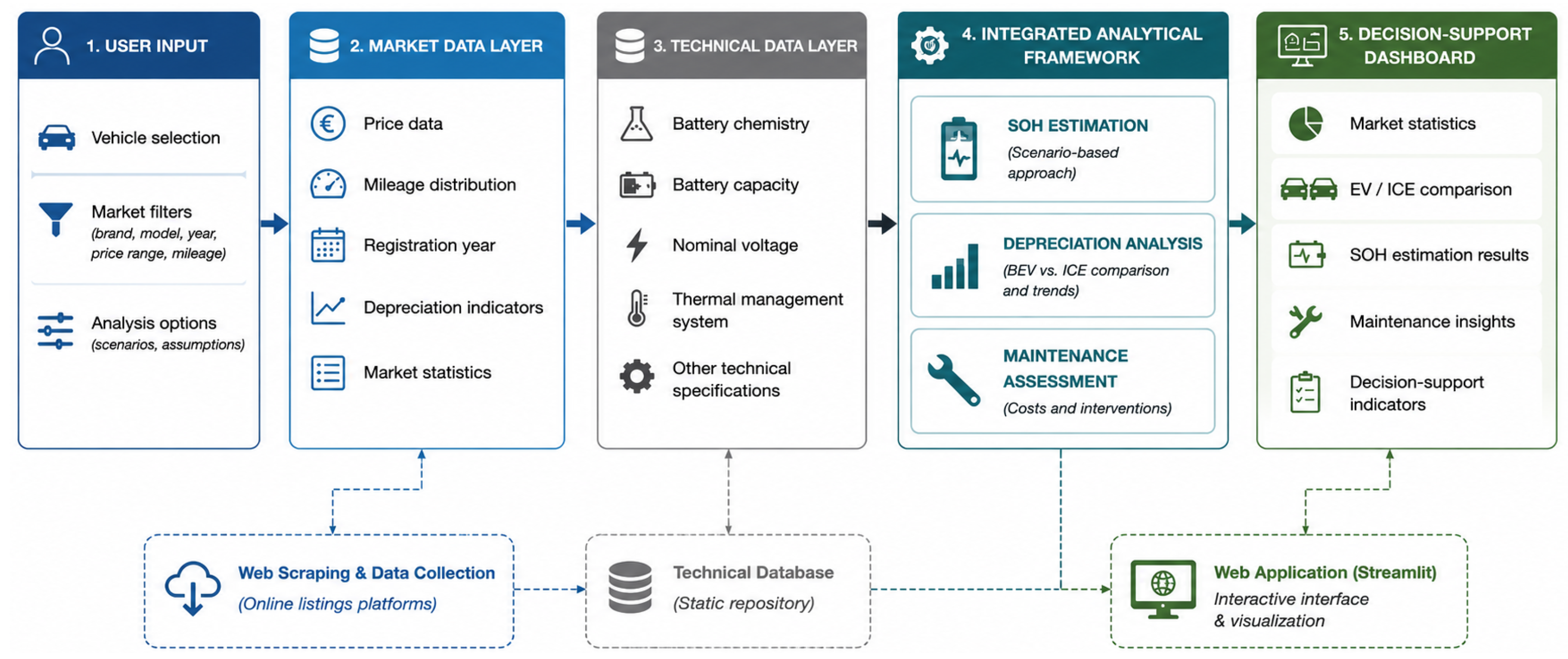
To translate the proposed framework into an operational decision-support tool, the methodology was implemented as a prototype web application developed in Python using the Streamlit framework. The application was designed to support second-hand BEV evaluation by integrating market information with engineering-based battery-health estimation. The architecture is based on two complementary data layers. The first layer consists of dynamic market data extracted from online listings, including vehicle price, mileage, registration year, and depreciation indicators. The second layer consists of a static repository of technical vehicle specifications, including battery chemistry, battery capacity, efficiency, nominal voltage, and thermal-management configuration. The application enables users to explore second-hand BEVs through multiple analytical modules, including market comparison tools, depreciation analysis, SOH estimation, and maintenance-related assessment. After selecting a vehicle or vehicle category, users can visualize market statistics, compare electric and conventional vehicles, estimate battery State of Health under different operating scenarios, and obtain decision-support indicators intended to support the interpretation of battery-related uncertainty. The objective of the application is not to replace certified battery diagnostics, but to provide a transparent and scalable environment capable of supporting more informed second-hand BEV purchasing decisions. The implementation therefore acts as the operational layer of the proposed framework, translating the underlying analytical models into an accessible interface suitable for marketplace-oriented applications and stakeholder decision support. A schematic representation of the decision-support web application architecture is shown in Figure 2.

3.3. Battery Health and Maintenance Assessment

To address the lack of transparent battery information in second-hand listings, a semi-empirical model was adopted to estimate battery State of Health (SOH) from observable or inferable variables. The model was developed for large-scale applications in which direct access to proprietary telemetry or diagnostic data is unavailable. In contrast with diagnostic methods based on OBD data or laboratory testing, this approach relies on variables that can reasonably be associated with each used vehicle, namely, age, mileage, battery chemistry, cooling architecture, energy efficiency, and nominal pack voltage. The model is based on the superposition principle, according to which total degradation is described as the sum of calendar ageing and cycle ageing contributions:
SOH ( % ) = 100 Q cal + Q cyc
where Q c a l represents capacity loss associated with time-dependent ageing mechanisms, and Q c y c represents the contribution related to battery usage. Calendar ageing was modelled through a generalized Arrhenius-type formulation, in which degradation depends on vehicle age, thermal conditions, and a stress factor associated with the assumed storage state of charge:
Q cal = α t z exp E a R T β SOC
where α is a calibrated pre-exponential factor, t is the vehicle age expressed in months, z is the time exponent, E a is the activation energy, R is the universal gas constant, T is the effective battery temperature, and β S O C is a correction factor used to represent different user charging habits. Distinct parameter values were assigned according to battery chemistry and cooling system, in order to reflect the different degradation sensitivity of LFP and NMC/NCA cells as well as the thermal penalty associated with passive air-cooled packs. To improve model transparency and reproducibility, Table 1 summarizes the main parameters adopted in the semi-empirical SOH estimation framework, together with their physical meaning and units.
The values of α , z, E a , and B were selected according to degradation mechanisms reported in the lithium-ion battery ageing literature and subsequently calibrated to ensure consistency with the validation dataset. Distinct values were assigned to LFP and NMC/NCA chemistries as well as to liquid-cooled and air-cooled battery packs, reflecting their different sensitivity to thermal and electrochemical stress. Cycle ageing was instead described as a throughput-based contribution expressed as a function of the equivalent full cycles:
Q cyc = B EFC
where B is a chemistry-dependent coefficient. The equivalent full cycle count was derived from the cumulative energy throughput of the vehicle rather than from mileage alone. In particular, the total energy processed by the battery was estimated as:
E throughput = d · η
where d is the cumulative mileage of the vehicle [km], and η is the real-world energy consumption [kWh/km]. The equivalent full cycles were then calculated as:
E F C = E throughput C bat
where C bat is the gross battery capacity [kWh]. This formulation converts mileage into an electrochemical stress indicator, accounting for the fact that the same travelled distance may correspond to different battery stress levels depending on vehicle efficiency and battery size. Since historical driving style, charging power, depth of discharge, and thermal exposure are not available in online listings, the resulting EFC value should be interpreted as an approximate screening-level indicator rather than as a direct diagnostic measurement. To account for the uncertainty associated with charging behaviour, thermal exposure, and storage conditions, the SOH estimation procedure was applied under three operating scenarios. Rather than producing a single deterministic value, the framework provides a plausible SOH interval bounded by optimistic and pessimistic assumptions, with a baseline scenario representing average user behaviour.The three operating scenarios adopted for SOH estimation are summarized in Table 2.
The optimistic scenario represents favourable operating conditions that minimize calendar and cycle ageing. The baseline scenario reflects typical private-vehicle usage patterns, whereas the pessimistic scenario represents unfavourable charging and storage conditions associated with accelerated degradation. The final SOH estimate is therefore expressed as a range rather than as a single value, providing a more realistic representation of uncertainty in marketplace-oriented applications.
The original crowdsourced validation set included 52 vehicle profiles. Standard error metrics were calculated on the 51 complete records for which the prediction error could be consistently evaluated. The prediction error was defined as:
e i = S O H ^ i S O H i r e f
where S O H ^ i is the estimated SOH, and S O H i r e f is the user-reported reference SOH. To improve the transparency of the validation procedure, Table 3 summarizes the main characteristics and outcomes of the SOH validation dataset. The table does not report individual vehicle records, but provides an aggregate overview of the validation sample and of the interpretation limits associated with the use of user-reported SOH values. Detailed quantitative validation metrics are reported in Table 4, including Mean Absolute Error (MAE), Root Mean Square Error (RMSE), mean bias, median absolute error, maximum absolute error, and the percentage of vehicles falling within selected error bands. Error values are expressed in percentage points of SOH.
The quantitative metrics reported in Table 4 suggest that the proposed method can provide a reasonable approximation for the large-scale screening of second-hand BEVs. However, the validation should be interpreted as a screening-level assessment rather than a substitute for direct diagnostic measurements, since residual deviations may arise from heterogeneous real-world battery histories, different charging behaviours, thermal exposure, battery chemistry, and cooling architecture. To further describe the validation dataset, Table 5 summarizes its main characteristics. The objective of the validation sample was not to reproduce the market distribution of specific vehicle models, but rather to maximize heterogeneity in terms of manufacturers, battery chemistries, vehicle ages, and mileage conditions. For this reason, the validation dataset was intentionally constructed to maximize technological and operational diversity across the analysed vehicles. Future validation campaigns will further expand the sample size and provide a more detailed statistical characterization of the validation dataset. As shown in Table 4, the validation supports the use of the proposed model as a non-invasive screening tool for second-hand BEV evaluation. At the same time, the crowdsourced nature of the reference SOH values and the lack of standardized diagnostic measurements prevent interpreting the model as a substitute for certified battery testing.

4. Results and Discussion

This section discusses the main results obtained from the proposed framework, with particular attention to depreciation patterns, the role of battery-related uncertainty, and the broader implications for second-hand BEV market efficiency. Overall, the evidence points to a divergence between observable technical indicators and the way used electric vehicles are currently priced in the market.

4.1. Market-Wide Depreciation Patterns

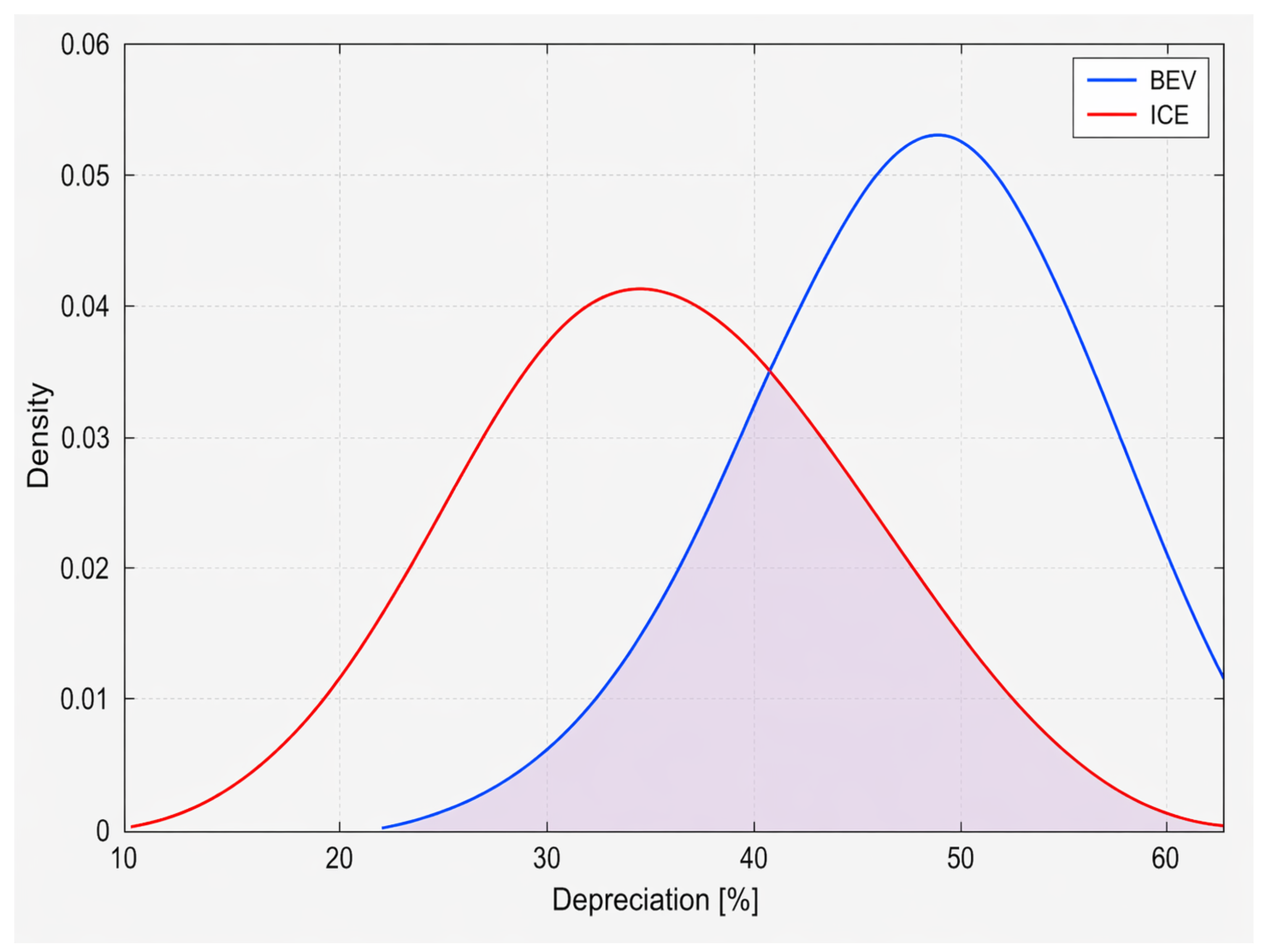
A central result emerging from the analysis is the presence of a clear depreciation gap between Battery Electric Vehicles (BEVs) and Internal Combustion Engine (ICE) vehicles. Figure 3 shows the kernel density estimation of depreciation rates for BEVs and ICE vehicles.
This pattern is not limited to a single vehicle category. Instead, it emerges across different segments, from city cars to compact vehicles and premium SUVs, suggesting that it reflects a broader structural characteristic of the second-hand BEV market rather than an isolated behaviour associated with a few specific models. To make the cross-segment evidence more transparent, Table 6 summarizes the main case-study comparisons discussed in the analysis. The table reports only aggregate values derived from the cleaned dataset and already used in the individual case-study interpretation, including sample size, median asking prices, depreciation peaks, and the resulting BEV–ICE depreciation gap. A deterministic sensitivity check was also carried out to evaluate whether the main BEV–ICE depreciation gap remains visible when the reconstructed MSRP is varied by ± 10 % . The results are reported in Table 7. Even under this simplified robustness test, the BEV depreciation values remain higher than the corresponding ICE benchmarks across all case-study comparisons. This indicates that the main depreciation pattern is not solely an artefact of the intermediate-trim MSRP assumption. At the same time, the analysis confirms that trim-level and optional-equipment uncertainty remains an important limitation, especially for premium vehicles.

4.2. Case Study: Fiat 500e vs. Fiat 500

A particularly representative example is provided by the comparison between the Fiat 500e and the petrol Fiat 500 for vehicles registered in 2021. Because the two models belong to the same family and urban segment, they offer a useful benchmark for isolating powertrain-related differences in second-hand market behaviour. The petrol Fiat 500 shows an original list price of approximately EUR 17,650 and a median resale price of about EUR 11,850. By contrast, the Fiat 500e starts from a substantially higher MSRP, around EUR 33,225, but reaches a median second-hand value of approximately EUR 15,500. When expressed in relative terms, the difference becomes more evident: the petrol version exhibits a depreciation peak around 33%, whereas the electric version reaches approximately 56%. This result is especially relevant because it cannot be attributed only to stronger use of the electric vehicle. In fact, the 500e cohort is characterized by lower median mileage than the petrol one, yet it still undergoes a much sharper reduction in market value. The Fiat 500 case therefore illustrates, in a particularly intuitive way, the central result of this study: in the second-hand BEV market, valuation is not determined by mileage alone, and the observed evidence is consistent with battery-related uncertainty being one of the factors associated with market valuation. From a market perspective, this case suggests that the electric version may be discounted more aggressively than would be expected from mileage alone. For this reason, the Fiat 500 family provides a concrete example of how perception-driven mechanisms may contribute to an uncertainty-related discount in the used-BEV segment.

4.3. Battery Health, Perceived Risk, and Information Asymmetry

The interpretation of the observed depreciation patterns becomes clearer when market evidence is considered together with the battery-health assessment and the broader information-asymmetry framework discussed in this study. Battery-related uncertainty emerges as one of the most relevant barriers in the second-hand BEV market, while SOH and real driving range represent key variables associated with purchase confidence. This is consistent with the idea that, in the current used-BEV market, the battery is still perceived as a critical but only partially observable component. To provide an exploratory interpretation of information asymmetry, a conceptual Information Asymmetry Index (IAI) was introduced. The index is designed as a composite indicator to organize three observable dimensions of uncertainty affecting second-hand BEV transactions: the absence of battery-related information in online listings, price dispersion among comparable vehicles, and battery-health concerns expressed by survey respondents.
I A I = M + D + U 3
where M represents the normalized battery-information missing rate in online listings, D represents the normalized price dispersion observed among comparable vehicles, and U represents a normalized uncertainty score derived from survey responses concerning battery degradation and residual range. All variables are scaled between 0 and 1, resulting in an index ranging from complete transparency ( I A I = 0 ) to maximum information asymmetry ( I A I = 1 ). It is important to clarify that the IAI is proposed as a conceptual and exploratory composite indicator, not as an externally validated measurement scale. Its purpose is to support the interpretation of market transparency by combining observable information gaps, price dispersion, and survey-based uncertainty into a single descriptive framework. Therefore, the index should not be interpreted as a predictive variable or as a certified measure of transaction-level information asymmetry. Rather, higher values of the IAI may indicate contexts in which precautionary discounts and divergences between technical condition and observed market valuation are more likely to occur. Future research should validate the index against transaction-level prices, certified SOH data, and longitudinal market observations.
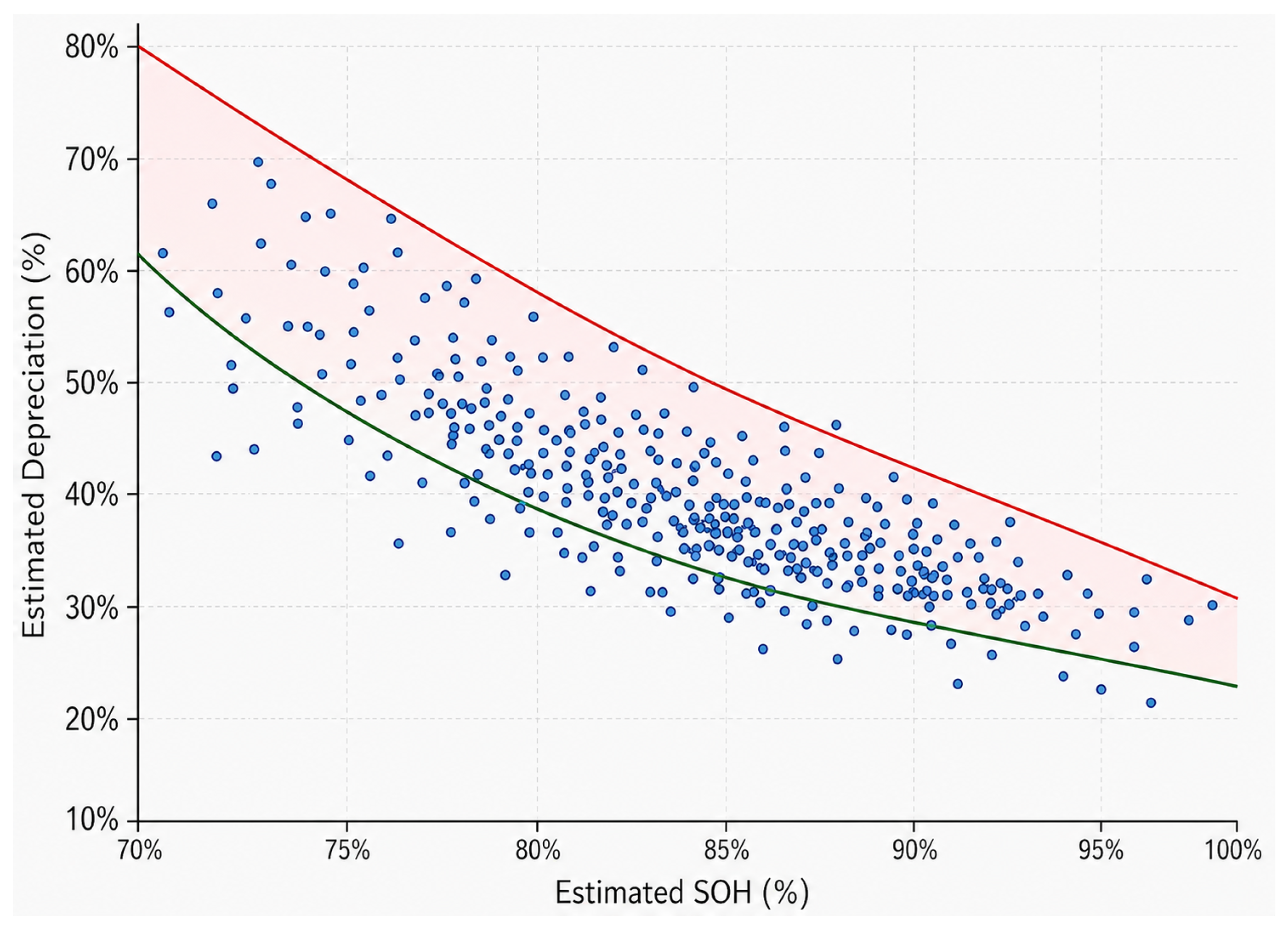
The survey evidence collected during the study was also integrated into the analytical framework. Both the general public survey and the owner/expert survey consistently identified battery State of Health (SOH) and residual driving range as the most influential factors affecting second-hand BEV purchasing decisions. These findings support the interpretation that battery-related uncertainty represents a major source of information asymmetry in the market. For this reason, perception-based concerns regarding battery degradation and residual performance were incorporated into the uncertainty component (U) of the Information Asymmetry Index. In this way, survey results contribute not only as contextual evidence but also as an explicit component of the conceptual framework used to interpret market behaviour and valuation differences among comparable vehicles. Within this context, the proposed SOH model provides a technical proxy for battery condition based on observable vehicle variables. The validation results showed an MAE of 4.59 percentage points and an RMSE of 6.22 percentage points on the complete records used for error-metric calculation. Moreover, 72.5% of the complete records fell within ± 6 percentage points and 82.4% within ± 7 percentage points. These results suggest that a non-invasive approximation of battery health can provide meaningful screening-level information in the absence of direct diagnostics, without replacing certified battery diagnostic procedures. The same validation exercise also indicated that, in private-use vehicles, calendar ageing may play a more important role than cycle ageing, confirming that battery degradation cannot be inferred from mileage alone. These findings help explain why technical condition and market valuation are only partially aligned. A second-hand BEV may still exhibit a relatively favourable estimated SOH and nonetheless undergo substantial depreciation, because battery condition is not directly observable by the buyer and is therefore incorporated into the price through a precautionary discount. In this sense, the pricing mechanism reflects not only actual degradation, but also uncertainty surrounding degradation. Figure 4 summarizes this mechanism in conceptual form, showing how the market value of a second-hand BEV may fall below the level expected on the basis of its underlying technical condition. The figure is illustrative and represents the possible divergence between estimated battery health and perceived market depreciation due to incomplete information on the battery condition.
This interpretation is also coherent with the broader evidence on maintenance and reliability, which indicates relatively limited routine maintenance requirements for BEVs and, in several cases, lower breakdown rates than comparable ICE vehicles, particularly over medium-to-long ownership horizons. The persistence of conservative pricing in the second-hand BEV market therefore suggests that perceived risk still outweighs the operational evidence currently available to buyers. Before drawing final conclusions, it is important to clarify the methodological boundaries within which the proposed framework and the empirical results should be interpreted. Although the proposed framework provides a structured and data-driven interpretation of the second-hand BEV market, some methodological limitations should be acknowledged. The market analysis is based on online asking prices rather than final transaction prices. Consequently, the estimated depreciation values should be interpreted as indicators of market positioning and perceived residual value, rather than exact resale prices. Moreover, asking prices may incorporate seller expectations, negotiation margins, and listing-specific pricing strategies, which can differ from final transaction outcomes. The reconstruction of the Manufacturer’s Suggested Retail Price (MSRP) also introduces a degree of uncertainty, as it relies on a representative intermediate-trim assumption. Exact configurations, optional equipment, and commercial discounts are not systematically available in online advertisements, especially for premium models where optional features can significantly affect the original purchase price. This limitation may influence the calculated depreciation rates, although the adopted approach provides a consistent reference baseline across the analysed dataset. Future research should include a more detailed trim- and option-level reconstruction to further quantify how alternative MSRP assumptions may affect the estimated depreciation rates, particularly for premium models and vehicles with highly variable optional equipment. Another limitation concerns the temporal nature of the dataset. The analysis reflects a specific observation window of the Italian second-hand market and should therefore be interpreted as a market snapshot rather than as a complete longitudinal assessment of price evolution. Future studies could strengthen this perspective by repeating the data collection over time and by tracking the same vehicle models across multiple market phases. The comparison between BEVs and ICE vehicles is also affected by the intrinsic heterogeneity of online listings. Differences in platform coverage, seller strategies, vehicle condition, warranty status, equipment levels, and past purchase incentives may influence the observed price distributions. Although filtering and cleaning procedures were applied to reduce outliers and improve comparability, some residual variability may remain. The SOH estimation model should be interpreted as a screening-level tool rather than as a substitute for certified battery diagnostics. The validation was based on user-reported SOH values, which may originate from different sources, including dashboards, diagnostic applications, or owner-accessible battery information. Moreover, relevant degradation drivers such as thermal history, fast-charging frequency, storage conditions, and previous charging behaviour cannot be fully reconstructed from public listing data. These limitations do not undermine the usefulness of the proposed approach, but define its appropriate scope of application as a decision-support framework aimed at improving transparency in the second-hand BEV market.

4.4. Economic Interpretation and Implications

From an economic perspective, the observed market dynamics are consistent with a classic problem of asymmetric information. In the second-hand BEV market, battery condition is highly relevant for asset valuation, yet it is not directly observable by the buyer through standard listing information. Under these conditions, the market tends to discount the vehicle not on the basis of its actual technical state, but on the basis of uncertainty surrounding that state. This interpretation is coherent with the “market for lemons” framework proposed by Akerlof [17]. When buyers cannot distinguish accurately between higher-quality and lower-quality assets, they incorporate a risk premium into their willingness to pay. In the specific case of second-hand BEVs, the battery becomes the central hidden variable, and this lack of transparency is consistent with the undervaluation patterns observed in the market. The empirical findings presented here support this view. First, the depreciation gap between BEVs and ICE vehicles is persistent across different segments. Second, price behaviour is only partially explained by mileage, which would normally be one of the main value drivers in the used-vehicle market. Third, the introduction of battery-health estimation suggests that technical condition and market valuation are not necessarily aligned. Taken together, these elements are consistent with the hypothesis that some used BEVs may be priced below the value implied by observable technical indicators. This inefficiency has a double implication. On the one hand, it creates a potential opportunity for informed buyers, who may access relatively advanced electric vehicles at prices that are lower than their technical characteristics would suggest. On the other hand, it represents a structural weakness of the market, because uncertainty may reduce consumer confidence, potentially slowing transactions and limiting the broader diffusion of electric mobility through the secondary market. In this context, the role of data-driven decision-support tools becomes particularly relevant. By integrating listing data, reconstructed depreciation metrics, SOH estimation, and maintenance-related information, the proposed framework can contribute to a more transparent preliminary evaluation of second-hand BEVs. More broadly, the results suggest that greater transparency in battery-health reporting, together with standardized indicators for second-hand BEV evaluation, could support more informed market assessments and strengthen the strategic role of the used electric vehicle market in the transition toward sustainable mobility.

4.5. Practical Implications for Different Stakeholders

Although the proposed framework was primarily developed to support second-hand BEV buyers, its potential applications extend to several stakeholder groups involved in the electric mobility ecosystem. The benefits and implementation requirements differ according to the specific objectives of each actor. Private Buyers. For private buyers, the framework provides an additional layer of transparency regarding battery condition, expected maintenance requirements, and market positioning. By combining estimated SOH values with depreciation indicators, users can access additional information that may support more informed preliminary purchasing decisions, particularly when battery-health information is not directly available from the seller. An additional factor that may influence second-hand BEV valuation is the remaining battery warranty period. Battery warranties reduce the perceived risk associated with future degradation and replacement costs, potentially affecting both buyer confidence and residual value. However, warranty information was not consistently available across the online listings collected for this study and therefore could not be incorporated systematically into the present framework. Future developments could integrate battery warranty coverage as an additional explanatory variable, enabling a more comprehensive assessment of second-hand BEV valuation and information asymmetry. Private Sellers. For private sellers, the framework may support a more objective justification of the asking price. Vehicles characterized by favourable estimated battery conditions may be presented with greater technical transparency, potentially supporting buyer confidence and limiting precautionary discounts associated with battery uncertainty. Professional Dealers. Professional dealers may benefit from the framework as a large-scale screening and inventory-management tool. Since the methodology relies exclusively on publicly observable variables, it can be applied rapidly across large vehicle portfolios without requiring proprietary telemetry or diagnostic measurements. This characteristic may facilitate preliminary valuation and stock-classification activities. Financial Institutions and Leasing Companies. Financial institutions, leasing companies, and insurance providers may use similar methodologies to improve residual-value estimation and risk-assessment procedures. Battery-health proxies and depreciation indicators can contribute to more robust evaluations of second-hand BEV assets, particularly in contexts where direct battery diagnostics are unavailable. Policymakers and Public Authorities. For policymakers, the framework highlights the role of information asymmetry as a potential barrier to the development of the second-hand BEV market. The results suggest that greater standardization of battery-health reporting and improved transparency requirements for used-vehicle listings could contribute to more efficient market functioning and support the broader diffusion of electric mobility.
From an implementation perspective, the proposed framework requires only a limited set of input variables that are generally available or inferable from online listings, namely, vehicle model, registration year, mileage, asking price, and basic technical specifications, such as battery capacity, chemistry, and thermal-management configuration. This makes the approach suitable for preliminary large-scale screening applications. However, higher-value or professional applications, such as dealer certification, financial residual-value assessment, or policy-oriented monitoring, would require progressively more standardized data inputs, including certified SOH values, battery warranty information, and harmonized reporting formats across listing platforms. Overall, the proposed framework should not be interpreted as a substitute for certified battery diagnostics or as definitive evidence of reduced transaction-level information asymmetry. Rather, it should be considered as a scalable screening-level decision-support tool that can support preliminary evaluations across multiple stakeholder groups. Its value lies in providing an accessible and transparent assessment methodology suitable for marketplace-oriented applications.

5. Conclusions

This study examined the role of information asymmetry in shaping the second-hand Battery Electric Vehicle (BEV) market and developed a data-driven framework to assess information-related uncertainty and support more transparent second-hand BEV evaluation. The results reveal a consistent depreciation gap between BEVs and Internal Combustion Engine (ICE) vehicles across different market segments. This gap cannot be fully explained by conventional variables such as mileage alone, suggesting that second-hand BEV pricing appears to be influenced by uncertainty and perception in addition to measurable technical variables. To address this issue, the paper proposed a semi-empirical approach for estimating battery State of Health (SOH) based on non-invasive and observable variables. The SOH validation showed an MAE of 4.59 percentage points and an RMSE of 6.22 percentage points on the complete records used for error-metric calculation. In addition, 72.5% of the complete records fell within ± 6 percentage points and 82.4% within ± 7 percentage points. These results indicate that battery condition can be approximated at the screening level even in the absence of proprietary diagnostic data, although the model cannot replace certified diagnostic procedures. By combining large-scale market data with engineering-based modelling, the proposed framework makes it possible to move from a perception-driven assessment of second-hand BEVs to a more evidence-based evaluation. In this respect, the weak alignment observed between estimated SOH and market prices is a key result of the study, as it suggests that residual value may be associated not only with technical degradation, but also with perceived risk and limited transparency. From an economic perspective, these findings are consistent with a market affected by asymmetric information, in which uncertainty may encourage buyers to adopt more conservative pricing behaviour and may contribute to an uncertainty-related discount in asset valuation. Improving the information available to market participants through transparent, scalable, and technically grounded analytical tools may therefore support more efficient preliminary evaluation processes and strengthen the role of the second-hand BEV market in the wider transition to electric mobility. Future research could also benchmark the proposed framework against commercial vehicle-valuation systems and data-driven pricing models using performance metrics such as MAE and RMSE. Such comparisons would provide further evidence regarding the incremental value of battery-health information in second-hand BEV assessment. Further developments should also investigate the effect of residual battery warranty coverage on vehicle valuation and extend the analysis to transaction-level data, so as to distinguish more clearly between asking-price behaviour and actual market-clearing prices. Additional extensions may focus on improving the SOH estimation framework through the inclusion of additional explanatory variables and, where available, real-world telemetry data. Further extensions may also involve predictive pricing models, real-time market monitoring, and the application of the proposed methodology to other geographical contexts. Overall, this study shows that the integration of data engineering, battery-oriented modelling, and economic interpretation can provide a useful basis for interpreting market inefficiencies in emerging mobility systems and for supporting more transparent preliminary evaluations of second-hand electric vehicles.

Author Contributions

Conceptualization, L.B. and M.L.; methodology, L.B. and N.M.; software, L.B.; formal analysis, N.M.; data curation, N.M.; writing—original draft preparation, L.B., N.M. and M.L.; writing—review and editing, N.M. and M.L.; visualization, L.B., N.M. and M.L.; supervision, M.L.; project administration, M.L.; funding acquisition, M.L. All authors have read and agreed to the published version of the manuscript.

Funding

This research received no external funding.

Data Availability Statement

The original contributions presented in this study are included in the article. Further inquiries can be directed to the corresponding author.

Conflicts of Interest

The authors declare no conflicts of interest.

References

  1. Giansoldati, M.; Monte, A.; Scorrano, M. Barriers to the Adoption of Electric Cars: Evidence from an Italian Survey. Energy Policy 2020, 146, 111812. [Google Scholar] [CrossRef]
  2. Lanzini, P. Charging Ahead: A Survey-Based Study of Italian Consumer Readiness for Electric Vehicle Adoption. Urban Sci. 2024, 8, 142. [Google Scholar] [CrossRef]
  3. Rezvani, Z.; Jansson, J.; Bodin, J. Advances in Consumer Electric Vehicle Adoption Research: A Review and Research Agenda. Transp. Res. Part D Transp. Environ. 2015, 34, 122–136. [Google Scholar] [CrossRef]
  4. Brost, W.; Funke, T.; Lembach, M. Spatial Analysis of the Public Transport Accessibility for Modelling the Modal Split in the Context of Site Identification for Charging Infrastructure. Infrastructures 2018, 3, 21. [Google Scholar] [CrossRef]
  5. Hospodka, J.; Sadil, J.; Bínová, H.; Kekula, F.; Hykš, O.; Hykšová, M.; Neubergová, K. Conceptual Design of Public Charging Stations for Freight Road Transport. Infrastructures 2024, 9, 7. [Google Scholar] [CrossRef]
  6. Oliveira e Sá, J.; Rebelo, F.; Silva, D.; Teles, G.; Ramos, D.; Romeu, J. A Big Data System Architecture to Support the Monitoring of Paved Roads. Infrastructures 2023, 8, 167. [Google Scholar] [CrossRef]
  7. Covello, A.; Di Martino, A.; Longo, M. Experimental Observation and Validation of EV Model for Real Driving Behavior. IEEE Access 2024, 12, 130763–130776. [Google Scholar] [CrossRef]
  8. Di Martino, A.; Prasad, G.S.; Foiadelli, F.; Longo, M. Energy Demand Model of Battery E-Buses for LPT: Implementation, Validation and Scheduling Optimization. IEEE Access 2023, 11, 52185–52198. [Google Scholar] [CrossRef]
  9. Schloter, L. Empirical Analysis of the Depreciation of Electric Vehicles Compared to Gasoline Vehicles. Transp. Policy 2022, 126, 268–279. [Google Scholar] [CrossRef]
  10. Domínguez, S.; Pedreros, S.; Delgadillo, D.; Anzola, J. A Depreciation Method Based on Perceived Information Asymmetry in the Market for Electric Vehicles in Colombia. World Electr. Veh. J. 2024, 15, 511. [Google Scholar] [CrossRef]
  11. Gautam, P.; Pode, G.; Pode, R.; Ayetor, G.K.; Diouf, B. Depreciation in the Electric Vehicle Transition: Sustainability of the Second-Hand Electric Vehicle Market. Vehicles 2024, 6, 2044–2074. [Google Scholar] [CrossRef]
  12. Ecker, M.; Gerschler, J.B.; Vogel, J.; Käbitz, S.; Hust, F.; Dechent, P.; Sauer, D.U. Development of a Lifetime Prediction Model for Lithium-Ion Batteries Based on Extended Accelerated Aging Test Data. J. Power Sources 2012, 215, 248–257. [Google Scholar] [CrossRef]
  13. Ecker, M.; Nieto, N.; Käbitz, S.; Schmalstieg, J.; Blanke, H.; Warnecke, A.; Sauer, D.U. Calendar and Cycle Life Study of Li(NiMnCo)O2-Based 18650 Lithium-Ion Batteries and Parameter Identification of a Capacity Fade Model. J. Power Sources 2014, 248, 839–851. [Google Scholar] [CrossRef]
  14. Schaltz, E.; Stroe, D.I.; Nørregaard, K.; Ingvardsen, L.S.; Christensen, A. Incremental Capacity Analysis Applied on Electric Vehicles for Battery State-of-Health Estimation. IEEE Trans. Ind. Appl. 2021, 57, 1810–1817. [Google Scholar] [CrossRef]
  15. Hagman, J.; Ritzén, S.; Janhager Stier, J.; Susilo, Y.O. Total Cost of Ownership and Its Potential Implications for Battery Electric Vehicle Diffusion. Res. Transp. Bus. Manag. 2016, 18, 11–17. [Google Scholar] [CrossRef]
  16. Danielis, R.; Giansoldati, M.; Rotaris, L. A Probabilistic Total Cost of Ownership Model to Evaluate the Current and Future Prospects of Electric Cars Uptake in Italy. Energy Policy 2018, 119, 268–281. [Google Scholar] [CrossRef]
  17. Akerlof, G.A. The Market for “Lemons”: Quality Uncertainty and the Market Mechanism. Q. J. Econ. 1970, 84, 488–500. [Google Scholar] [CrossRef]
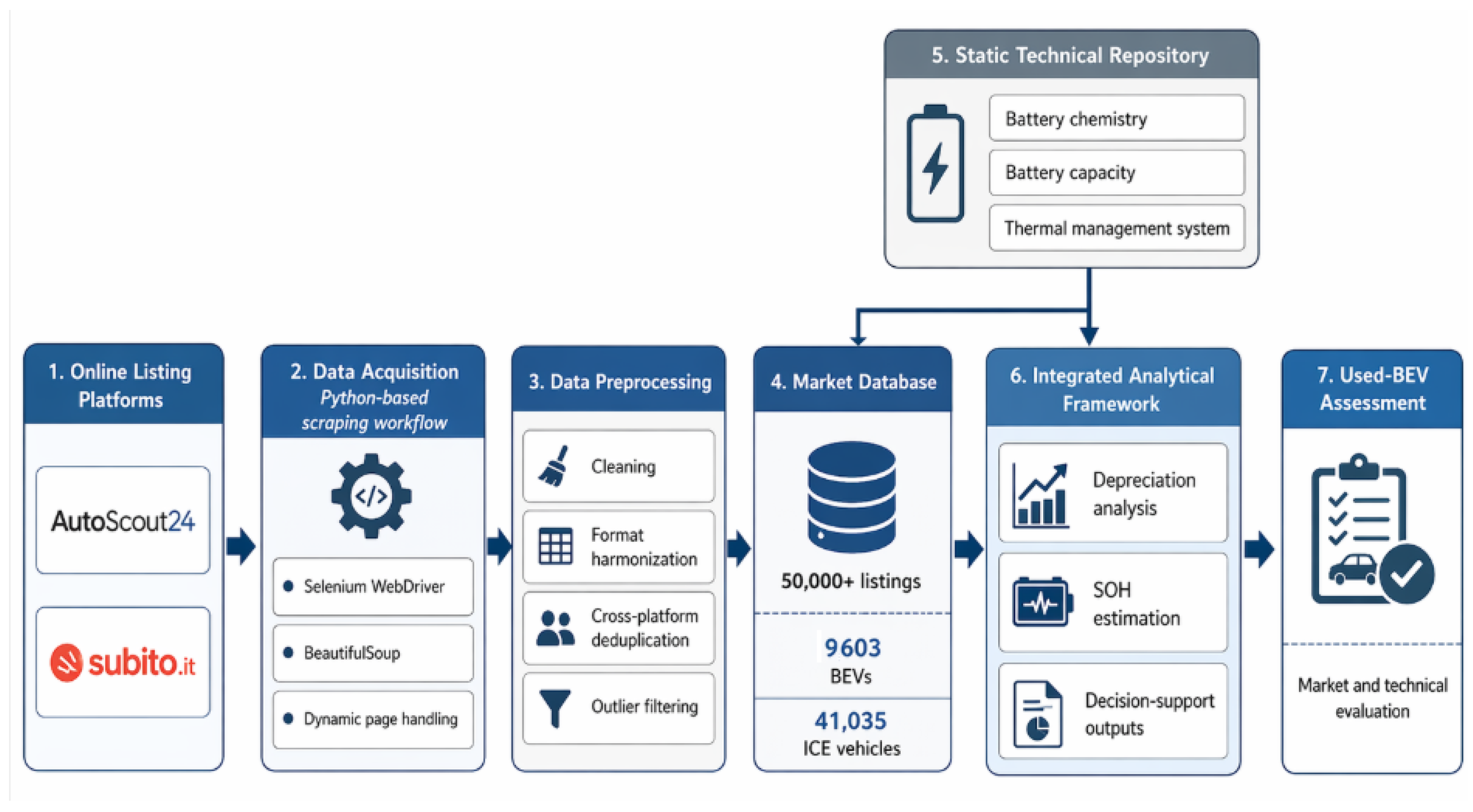
Figure 1. Overview of the proposed data-driven framework. The system combines dynamic market data from online listings with a static repository of engineering specifications, enabling an integrated evaluation of second-hand BEVs from both market and technical perspectives.
Electronics 15 02614 g001
Figure 2. Architecture of the decision-support web application. User-selected market data and technical vehicle specifications are integrated within a unified analytical framework that combines depreciation analysis, SOH estimation, and maintenance assessment to generate decision-support outputs for second-hand BEV evaluation. The coloured blocks distinguish the main functional layers of the application, including user input, market data, technical data, analytical framework, and decision-support dashboard.
Electronics 15 02614 g002
Figure 3. Kernel density estimation of depreciation rates for Battery Electric Vehicles (BEVs) and Internal Combustion Engine (ICE) vehicles. The BEV distribution is shifted toward higher depreciation values, indicating lower value retention in the second-hand market. The purple shaded area indicates the overlap between the BEV and ICE depreciation distributions.
Electronics 15 02614 g003
Figure 4. Conceptual representation of the divergence between technical condition and perceived market value in second-hand BEVs. Blue circles represent illustrative vehicle observations, the green line indicates the expected depreciation trend associated with technical condition, and the red line represents an upper uncertainty-related depreciation boundary. The figure is illustrative and is intended to summarize the uncertainty-related discount mechanism between estimated State of Health (SOH) and market depreciation.
Electronics 15 02614 g004
Table 1. Main parameters adopted in the SOH estimation model.
ParameterMeaningUnitOrigin
α Calendar ageing pre-exponential factorCalibrated
zTime ageing exponentLiterature-based
E a Activation energyJ mol−1Literature-based
RUniversal gas constantJ mol−1 K−1Physical constant
TEffective battery temperatureKScenario-dependent
β S O C State-of-charge stress factorScenario-dependent
BCycle ageing coefficientChemistry-dependent
E F C Equivalent full cyclescyclesCalculated
Table 2. Scenario assumptions adopted for SOH estimation.
ScenarioSOC BehaviourThermal ConditionsCharging Pattern
Optimistic40–60% storage SOC20–25 °CRare DC fast charging
Baseline50–80% storage SOC25–30 °CModerate DC charging
Pessimistic80–100% storage SOC>35 °CFrequent DC fast charging
Table 3. Summary of the SOH model validation procedure and main outcomes.
Validation ItemDescription
Validation datasetCrowdsourced dataset of 52 real BEV profiles.
Reference SOH valueUser-reported SOH value obtained from vehicle dashboard, diagnostic applications,
or owner-accessible battery information.
Input variables used by the modelVehicle age, mileage, battery chemistry, cooling system, real-world efficiency,
nominal voltage, and assumed storage/charging behaviour scenario.
Model outputEstimated SOH range derived from multiple usage scenarios rather than a single deterministic value.
Validation criterionPrediction error between estimated and user-reported SOH, assessed through MAE, RMSE, mean bias, median absolute error, maximum absolute error, and selected error bands.
Main validation outcomeQuantitative validation metrics are reported in Table 4.
InterpretationThe model provides a screening-level approximation of battery health for
second-hand BEV assessment.
Main limitationThe reference SOH is not based on a standardized diagnostic protocol and may be affected by BMS buffering, dashboard smoothing, heterogeneous measurement sources, and unknown battery history.
Table 4. Quantitative validation metrics for the SOH estimation model. Error values are expressed in percentage points of SOH.
MetricValue
Original crowdsourced validation set52 vehicle profiles
Complete records used for error metrics51 vehicles
Mean Absolute Error (MAE)4.59 percentage points
Root Mean Square Error (RMSE)6.22 percentage points
Mean bias+0.24 percentage points
Median absolute error3.00 percentage points
Vehicles within ± 3 percentage points26/51 (51.0%)
Vehicles within ± 6 percentage points37/51 (72.5%)
Vehicles within ± 7 percentage points42/51 (82.4%)
Maximum absolute error23 percentage points
Error range 11 to + 23 percentage points
Table 5. Characteristics of the SOH validation dataset.
ItemDescription
Validation sample sizeA total of 52 real-world BEV profiles collected through EV-owner communities and crowdsourced sources.
Vehicle manufacturersMultiple manufacturers represented, including vehicles from different market segments and technological generations.
Battery chemistriesBoth LFP and NMC/NCA battery chemistries included in the validation dataset.
Vehicle ageHeterogeneous age distribution covering vehicles with different registration years and battery
ageing conditions.
Mileage rangeHeterogeneous mileage distribution including low-, medium-, and high-mileage vehicles.
Input variables usedVehicle age, mileage, battery chemistry, battery capacity, cooling architecture, efficiency, nominal voltage, and assumed charging/storage behaviour scenario.
Reference SOH sourceUser-reported SOH values obtained from vehicle dashboards, diagnostic applications, or owner-accessible battery information.
Validation objectiveAssessment of the model’s capability to provide screening-level SOH estimates
under real-world conditions.
Table 6. Summary of the main case-study results used to compare BEV and ICE depreciation patterns. Values refer to the selected registration year and filtered second-hand listings considered in each case study.
Case StudyYearBEV ResultsICE Results
Fiat 500e vs. Fiat 500 petrol2021446 listings; median price EUR 15,500; depreciation peak approx. 56%68 listings; median price EUR 11,850; depreciation peak approx. 33%
Opel Corsa-e vs. Opel Corsa petrol202182 listings; median price EUR 13,950; depreciation peak approx. 62–65%273 listings; median price EUR 11,500; depreciation peak approx. 45–50%
Peugeot e-208 vs. Peugeot 208 petrol2021121 listings; median price EUR 15,600; depreciation peak approx. 58–60%223 listings; median price EUR 13,300; depreciation peak approx. 41–43%
Opel Mokka-e vs. Opel Mokka diesel202222 listings; median price EUR 17,950; depreciation peak approx. 53–55%89 listings; median price EUR 18,400; depreciation peak approx. 35–37%
Mercedes EQA vs. Mercedes GLA diesel202232 listings; median price EUR 30,000; depreciation peak approx. 50–52%227 listings; median price EUR 35,000; depreciation peak approx. 28–32%
Table 7. Sensitivity of depreciation estimates to a ± 10 % variation in reconstructed MSRP. Values refer to the depreciation peaks reported in the case-study analysis.
Case StudyPowertrainBaseline Depreciation [%]MSRP 10 % [%]MSRP + 10 % [%]
Fiat 500e vs. Fiat 500 petrolBEV5651.160.0
Fiat 500e vs. Fiat 500 petrolICE3325.639.1
Opel Corsa-e vs. Opel Corsa petrolBEV62–6557.8–61.165.5–68.2
Opel Corsa-e vs. Opel Corsa petrolICE45–5038.9–44.450.0–54.5
Peugeot e-208 vs. Peugeot 208 petrolBEV58–6053.3–55.661.8–63.6
Peugeot e-208 vs. Peugeot 208 petrolICE41–4334.4–36.746.4–48.2
Opel Mokka-e vs. Opel Mokka dieselBEV53–5547.8–50.057.3–59.1
Opel Mokka-e vs. Opel Mokka dieselICE35–3727.8–30.040.9–42.7
Mercedes EQA vs. Mercedes GLA dieselBEV50–5244.4–46.754.5–56.4
Mercedes EQA vs. Mercedes GLA dieselICE28–3220.0–24.434.5–38.2
Disclaimer/Publisher’s Note: The statements, opinions and data contained in all publications are solely those of the individual author(s) and contributor(s) and not of MDPI and/or the editor(s). MDPI and/or the editor(s) disclaim responsibility for any injury to people or property resulting from any ideas, methods, instructions or products referred to in the content.