Skip Content
You are currently on the new version of our website. Access the old version .

Electronics

Electronics is an international, peer-reviewed, open access journal on the science of electronics and its applications published semimonthly online by MDPI.
The Polish Society of Applied Electromagnetics (PTZE) is affiliated with Electronics and their members receive a discount on article processing charges.
Quartile Ranking JCR - Q2 (Engineering, Electrical and Electronic)

All Articles (27,786)

  • Feature Paper
  • Article
  • Open Access

2QGRU: Power-of-Two Quantization for Efficient FPGA-Based Gated Recurrent Unit Architectures

  • Miguel Molina Fernandez,
  • Shao Jie Hu Chen and
  • Marisa Lopez-Vallejo
  • + 3 authors

This paper proposes a power-of-two-based quantization technique aimed at improving the hardware efficiency of artificial neural networks (ANNs) implemented on field-programmable gate arrays (FPGAs). The effectiveness of the proposed approach is validated using gated recurrent unit (GRU) models. The resulting architecture, referred to as 2QGRU, exploits parallelism, optimized operation scheduling, and fine-grained data bit-width management to achieve efficient hardware realization. Compared with state-of-the-art FPGA implementations based on sparsity compression, 2QGRU demonstrates superior performance in terms of resource utilization and power consumption, while eliminating the need for dedicated DSP blocks. Furthermore, area and power efficiency can be further improved by trading latency for reduced hardware cost through an integrated implementation reduction strategy, enabling deployment on highly resource-constrained devices. Finally, the 2QGRU model is integrated into an automated ANN framework, allowing the proposed quantization and hardware optimization techniques to be readily extended to other ANN models and FPGA-based deployments.

7 February 2026

Equations of the MLP (top) and the RNN (bottom).

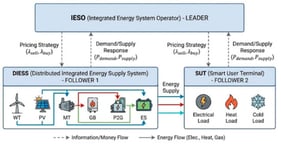
As the composition of energy markets becomes increasingly diverse and distributed in character, it is difficult for traditional vertically integrated energy system (IES) structures and centralized optimization methods to stimulate coupled interactions and interactive synergies among multiple subjects. Consequently, a collaborative low-carbon scheduling strategy utilizing a leader–follower game framework is introduced for the distributed IES. Making the integrated energy system operator (IESO) a leader, distributed integrated energy supply system (DIESS) and smart user terminal (SUT) as followers, the optimal interaction operation strategy of each subject in the game process can be solved. Firstly, the overall energy interaction process of the system and the game objectives of each participant are introduced to construct a distributed collaborative optimization model with one leader and multiple followers. Secondly, the integrated demand response (IDR) and the ladder-type carbon trading scheme are considered, the two-stage operation process of the electrical gas technology (P2G) equipment is analyzed in detail, and the genetic algorithm nested CPLEX solver is used to solve the model. Finally, the results show that this paper can provide guarantee and theoretical support for the optimal operation of the integrated energy market in terms of trading model and algorithm.

7 February 2026

Schematic diagram of the game subject framework of the distributed integrated energy system.

The light-trap attraction rate (LTARI) is an important metric for characterizing diel activity patterns and supports studies in insect behavioral ecology and pest management. However, conventional automatic light-trap devices often rely on lethal methods (e.g., high-voltage grids or infrared heating), causing high mortality of non-target insects and severe image obstruction due to stacking of insect bodies. These issues disturb natural populations and bias attempts to quantify LTARI. Our primary objective is to develop and evaluate a non-lethal monitoring system as a methodological basis for future LTARI research, rather than to provide head-to-head quantitative comparisons with conventional traps. To address the above limitations, we propose a live-insect monitoring instrument that integrates a wind-suction trap with a Water-Flow Dispersion and Transport Structure (WF-DTS). The non-destructive trapping–dispersion–release process limits body stacking, allows captured insects to be released, and yields a community-level post-capture survival rate of 94% under the conditions tested. Experimental results show that the prototype maintains image integrity with clearly isolated single insects and achieves a detection performance of 95.6% (mAP@0.5) using the YOLOv8s model. At the inference stage, only the standard resizing and normalization operations of YOLOv8s are applied, without additional denoising, background subtraction, or data augmentation. These observations suggest that the WF-DTS generates images that are easier to segment and classify than those from conventional devices. The high detection accuracy is largely attributable to the physical dispersion of specimens and the uniform white matte background provided by the hardware design. Overall, the system constitutes a non-lethal hardware–software platform that may reduce backend processing complexity and provide a methodological basis for more accurate LTARI estimation in future, dedicated field studies.

6 February 2026

The automatic mechatronic device for insect image collection: (a) An insect monitoring light trap; (b) The image captured by the device (Source: The image is sourced from the dataset published by Wang et al. [26]).

Firm requirements on electromagnetic compatibility (EMC) of electronic devices demand low electromagnetic emissions (EMI) of high-speed circuits, especially in the automotive industry. To be able to apply cost-effective anti-perturbative measures that reduce noise emission, critical signal integrity and power integrity (SI/PI) tools are needed for developing high-speed printed circuit board (PCB) designs. This paper presents an efficient method for modeling and analyzing the current drawn by digital ICs based on SPICE modeling data. The profile of the current drawn by the ICs from the power supply is composed of the static supply current and the dynamic supply current. This method enables power integrity engineers, in particular, PhD students and researchers who aim to develop an intuitive understanding of PI phenomena during the pre-layout phase, to see the hidden impact of the supply current on the power rail noise through time domain simulations, using a complex simulation model that integrates the Finite-Difference Time-Domain (FDTD) method of modeling the power and ground plane, with Voltage Regulator Modules (VRMs) and decoupling capacitors. A comparison of simulation results between the proposed models and SPICE IC models is also included to validate the proposed model.

6 February 2026

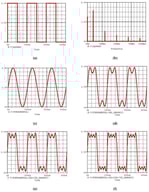
Example of simulation of a square waveform constructed with sinusoidal signals: (a) an ideal square waveform; (b) FFT representation of the ideal square waveform; (c) fundamental sinusoidal signal; (d) sum of the fundamental sinusoidal signal and a sinusoidal signal with the amplitude and frequency of the third harmonic of the ideal square signal; (e) sum of the signal (d) and a sinusoidal signal with the amplitude and frequency of the fifth harmonic of the ideal square signal; (f) sum of the signal (e) and a sinusoidal signal with the amplitude and frequency of the seventh harmonic of the ideal square signal.

News & Conferences

Issues

Open for Submission

Editor's Choice

Get Alerted

Add your email address to receive forthcoming issues of this journal.

XFacebookLinkedIn
Electronics - ISSN 2079-9292