Article

Reconceptualizing Prompt Engineering as Reflective Professional Practice: A Framework for Teacher Development

by
Ioannis Dourvas
1,
George Kokkonis
1,* and
Sotirios Kontogiannis
2
1
Department of Informatics and Electronic Engineering, International Hellenic University, 57400 Thessaloniki, Greece
2
Department of Mathematics, University of Ioannina, University Campus, 45110 Ioannina, Greece
*
Author to whom correspondence should be addressed.
Electronics 2026, 15(5), 930; https://doi.org/10.3390/electronics15050930
Submission received: 5 December 2025 / Revised: 7 February 2026 / Accepted: 19 February 2026 / Published: 25 February 2026
(This article belongs to the Special Issue AI-Driven Frameworks for Human–Computer Interaction)

Abstract

The rapid integration of generative AI in education often frames teachers as technology users who primarily need technical training. Existing prompt engineering frameworks offer technical guidance but have limited grounding in theories of teacher professional development or reflective practice. This misses a key feature of prompt engineering: prompting can externalize pedagogical thinking, making AI interaction a process of knowledge externalization. Through systematic conceptual analysis, this paper proposes a reconceptualization of prompt engineering from a technical competency to a reflective professional practice. The methodology integrates three theoretical traditions: Schön’s reflective practice theory (for externalizing tacit knowledge), Wiggins and McTighe’s backward design (for structuring instructional decisions), and Celik’s AI-TPACK framework (as integrated knowledge base). This synthesis suggests that effective prompting can be understood as an act of pedagogical externalization requiring integrated professional knowledge. The paper develops a seven-strategy framework (RPE framework) as an analytic lens for examining prompt engineering sophistication. This theoretical framework offers theory-derived hypotheses that require future empirical validation rather than presenting verified outcomes. Ultimately, the RPE framework offers a conceptual basis for potentially shifting the focus from technical training to teacher professional development by repositioning educators as AI-assisted instructional designers rather than mere AI users.

1. Introduction

1.1. Opening: The Evolution of AI and the Agentic Role of Teachers

Generative AI has rapidly integrated into educational ecosystems, moving beyond simple automation to complex pedagogical co-design. Recent systematic reviews demonstrate that educators are increasingly utilizing AI systems for sophisticated tasks, including instructional planning, content generation, and assessment design [1,2]. UNESCO’s AI competency framework for teachers (2024) explicitly identifies ’AI for professional development’ as a critical competency dimension [3]. However, despite these advancements, a significant gap remains: current practical implementations often lack the theoretical mechanisms necessary to embed these competencies into teachers’ daily professional practice.
The integration of AI raises a fundamental question: are teachers merely users of AI tools, or are they intentional designers of AI-mediated learning? Current discourse often positions educators as technology consumers who must adapt to AI systems [4,5], rather than professional agents who actively shape how AI functions pedagogically. The distinction matters: users adapt to technology; designers adapt technology to pedagogical purpose. When teachers function as designers, they exercise professional judgment about how AI capabilities serve instructional goals, learner needs, and disciplinary contexts. This requires making pedagogical reasoning explicit through AI configuration. This distinction establishes the necessary foundation for reconceptualizing prompt engineering not as a technical skill, but as reflective professional practice.
Prompt engineering represents the primary interaction method through which humans configure AI system behavior. In the current educational landscape, it has evolved into a fundamental human–computer interaction challenge, where the quality and depth of natural language specification determine the system’s pedagogical effectiveness [6]. Unlike traditional software with predetermined operational options, generative AI requires users to explicitly externalize and formulate their domain expertise through nuanced language [6]. This evolution transforms human–AI interaction from simple command-and-control to a sophisticated process of knowledge externalization [7]. This represents a paradigm shift with profound implications for the future of teacher professional identity and practice.

1.2. The Problem: Technical Skill Versus Professional Practice

Current approaches treat prompt engineering as technical skill acquisition rather than professional practice development. This limited framing persists despite urgent calls to reconceptualize prompt engineering as both “foundational digital literacy” and a “central pedagogical practice” [8]. Systematic reviews confirm this orientation. Tan et al. analyzed 95 studies and found that only 35% addressed teacher professional development [2]. Most extant literature emphasizes operational competence: writing effective prompts, understanding AI capabilities, and generating usable outputs.
Recent frameworks exemplify this technical orientation. Lo’s CLEAR framework [4] and Park and Choo’s IDEA framework [5] provide structured guidance but largely position teachers as operators optimizing tool performance. Similarly, Qian’s systematic review found that existing approaches lack grounding in theories of teacher professional development or reflective practice [9].
This reductive paradigm creates three interconnected problems. First, it separates AI use from core pedagogical thinking. Second, it treats development as one-time training rather than ongoing reflective practice. Third, it leaves teacher professional identity largely disconnected from the AI interaction process. This technical framing underscores the urgent need to reconceptualize prompt engineering as professional practice rather than isolated skill mastery.

1.3. The Conceptual Gap and Paper Contributions

Despite extensive literature on AI in education and emerging frameworks for prompt engineering, a critical theoretical gap persists: we found no framework that reconceptualizes prompt engineering as reflective professional practice. Current approaches position AI interaction as technical operation, often overlooking established pedagogical theory that frames teaching as reflective practice. This gap misses a key feature of generative AI: unlike previous technologies, generative AI requires teachers to explicitly articulate complex instructional intent. They have to specify learner characteristics, learning objectives, pedagogical strategies, and assessment criteria within the prompt structure. This process transforms AI interaction into active knowledge externalization, making tacit professional knowledge explicit, visible, and examinable.
Pedagogically grounded frameworks could support teacher professional development in distinctive ways. When educators learn prompt engineering as a technical skill, they acquire operational competence. In contrast, when they engage prompting as reflective practice, they develop metacognitive awareness of their own instructional design thinking while simultaneously producing AI-mediated materials. This approach aims to transform professional development from external skill acquisition to sustainable capacity building.
The proposed paradigm shift operates across multiple dimensions. Table 1 illustrates how the reconceptualization would transform the nature of prompt engineering, teacher roles, theoretical foundations, and development models.
Research Questions:
This analysis motivates the following research questions:
Primary Research Question: How can prompt engineering be reconceptualized as reflective professional practice that could transform teachers from AI users into instructional designers?
Sub-Questions:
  • What pedagogical and theoretical foundations should inform a prompt engineering framework for teachers?
  • How does prompt engineering align with established theories of reflective practice and instructional design?
  • What role can prompt engineering play in teacher professional development?
This reconceptualization aims to address a critical implementation gap in UNESCO’s AI competency framework for teachers (AI CFT). The framework’s fifth aspect—‘AI for Professional Development’—identifies three progression levels: enabling lifelong professional learning, enhancing organizational learning, and supporting professional transformation. However, existing approaches lack theoretical mechanisms for implementing these competencies through teachers’ daily AI practice [3].
The RPE framework (developed in Section 4) operationalizes this aspect through three levels. At the Acquire level, prompting serves as a medium for job-embedded professional learning. At the Deepen level, it supports collaborative knowledge building. At the Create level, it enables identity transformation from AI users to instructional designers.

1.4. Paper Contributions

This paper makes three interconnected theoretical contributions to understanding prompt engineering in teacher professional development:
  • Conceptual Reframing: It proposes reconceptualizing prompt engineering from technical skill to reflective professional practice by integrating Schön’s reflective practice [10] with instructional design principles [13].
  • Identity Repositioning: It proposes repositioning teachers from AI users to instructional designers. This positions prompting as an act that makes pedagogical thinking visible and examinable.
  • Professional Development Extension: It extends AI-TPACK (Intelligent-TPACK) [12] by proposing that prompt engineering can serve as a site for ongoing teacher professional development, where iteration operates as a reflective learning cycle. This could operationalize UNESCO AI CFT’s fifth aspect (‘AI for Professional Development’), potentially providing theoretical grounding for the international standard’s progression from individual learning to professional transformation [3].
The resulting reflective prompt engineering (RPE) framework (Section 4) is a theoretical model derived from systematic synthesis and analysis. It provides theory-derived hypotheses for future empirical validation rather than verified outcomes. These contributions aim to address the theoretical gap, offering a conceptual foundation for designing teacher professional development programs that utilize AI for pedagogical growth.

2. Conceptual Analysis

2.1. Methodological Approach

This paper employs systematic conceptual analysis to examine how prompt engineering can be reconceptualized as reflective professional practice. Conceptual analysis differs from empirical studies: it examines theoretical relationships, identifies gaps in existing frameworks, and proposes new theoretical integrations [14]. This methodological approach is well-established in educational technology research. For example, Mishra and Koehler’s TPACK framework (2006) provided a conceptual foundation that was subsequently validated through extensive empirical research. Similarly, Celik’s AI-TPACK extension (2023) first established theoretical integration before empirical investigation. Our work follows this tradition, providing a conceptual framework that enables and informs future empirical studies. This approach is appropriate for addressing the identified gap: we found no existing framework that positions prompt engineering within established theories of reflective practice and professional development.
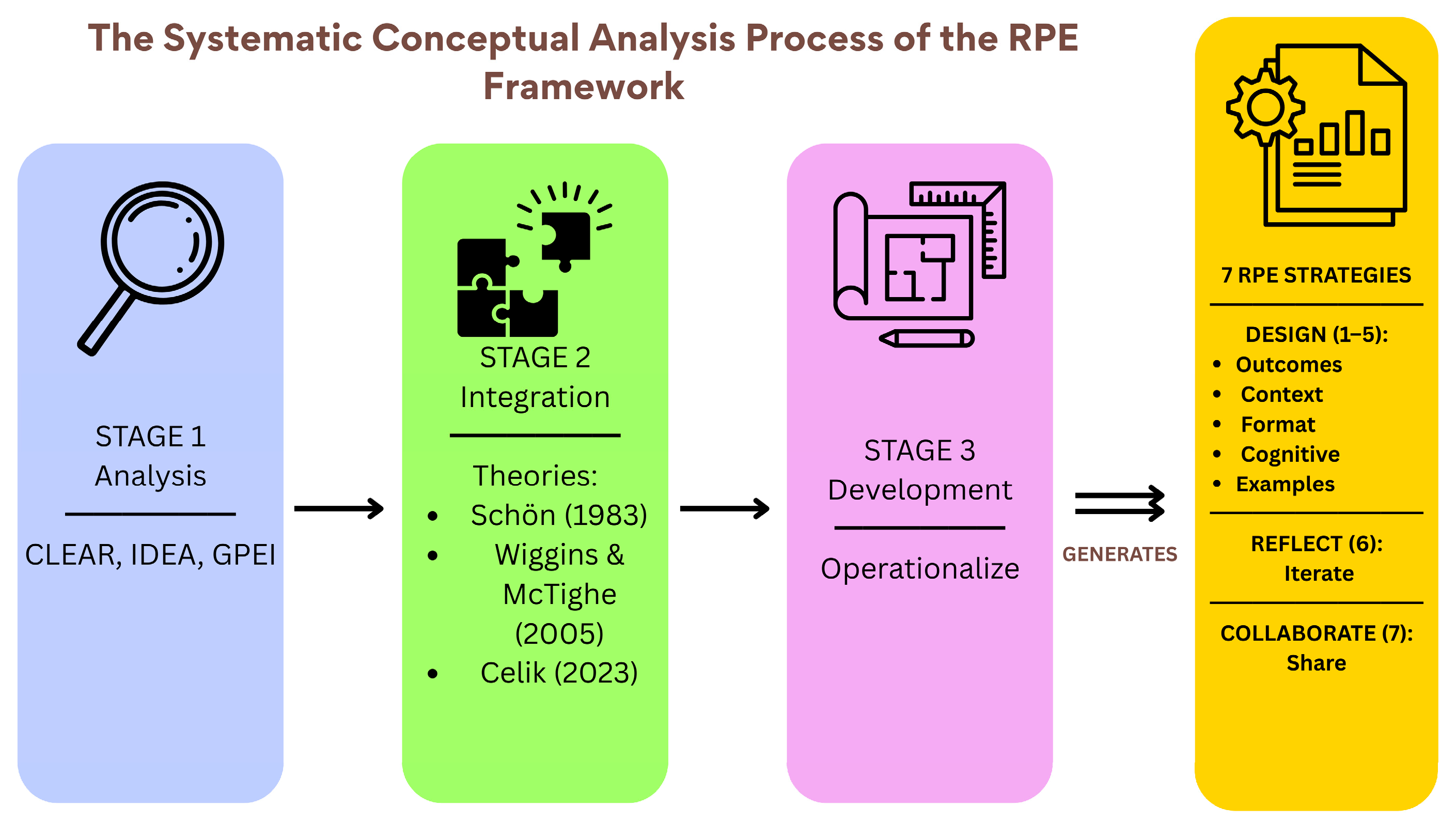
The analysis proceeded through three stages:
  • Stage 1: Framework Analysis. We systematically analyzed prompt engineering frameworks documented in recent educational literature, focusing on those most widely cited and discussed. This included Lo’s CLEAR framework [4] and Park and Choo’s IDEA framework [5], which represent current dominant approaches to structuring prompt engineering guidance for educators. We examined these frameworks to understand their theoretical foundations (or absence thereof), their positioning of teacher roles, and their treatment of professional development. This analysis revealed a systematic absence of grounding in pedagogical theory or professional learning frameworks, establishing the conceptual gap this paper addresses.
  • Stage 2: Theoretical Integration. We selected three theoretical frameworks based on two criteria: (a) established empirical support in educational research, and (b) direct applicability to understanding AI-mediated instructional design. Schön’s reflective practice theory [10] provides the mechanism by which prompting externalizes tacit knowledge. Wiggins and McTighe’s design framework [13] provides the structure of instructional decisions that prompts must embody. Celik’s AI-TPACK [12] provides the knowledge base required for effective AI integration. Through conceptual mapping, we show how these theories converge on a unified understanding: effective prompt engineering can be understood as pedagogical externalization requiring integrated professional knowledge. Schön explains how teachers learn through prompting (reflection). Wiggins and McTighe define what structure prompts require (backward design). AI-TPACK specifies which knowledge must integrate (content, pedagogy, AI capability).
  • Stage 3: Framework Development. Based on this theoretical integration, we developed a seven-strategy framework operationalizing prompt engineering as reflective practice. Each strategy maps onto established instructional design principles while embodying reflective practice theory. The framework functions as an analytic lens for understanding what makes prompting pedagogical rather than a prescriptive checklist for prompt construction.
This three-stage approach provides the theoretical foundation for the integrative framework presented in Section 3 and Section 4 (Figure 1).

2.2. Prompt Engineering in Education: Current State

2.2.1. Existing Frameworks

Current frameworks for prompt engineering provide valuable procedural guidance but lack grounding in established educational theory. Several prominent models exist. Lo’s CLEAR framework [4] emphasizes five prompt qualities (concise, logical, explicit, adaptive, reflective) for information literacy instruction. Park and Choo’s IDEA framework [5] provides educators with structured strategies: include essential PARTS, develop CLEAR prompts, evaluate and REFINE, apply with accountability. Velásquez-Henao et al.’s GPEI model [15] offers a four-step iterative methodology (goal, prompt, evaluation, iteration) developed for engineering applications. These frameworks improve AI output quality. However, they conceptualize prompting as a procedural skill—learning steps to construct effective prompts. They do not position it as a site for professional learning grounded in pedagogical expertise.
This procedural orientation appears in Qian’s systematic review [9], which categorizes prompt engineering approaches into technique-focused and process-focused methods. Both emphasize technical utility rather than professional development mechanisms. Table 2 compares CLEAR and IDEA with the RPE framework proposed in this study, establishing fundamental differences in purpose, theoretical grounding, and conceptualization of teacher role. Existing frameworks address the “what” and “how” of prompting: what makes an effective prompt and how to construct one. However, they do not address the critical “why” that positions prompt engineering within teachers’ professional identity and pedagogical expertise. This theoretical deficit motivates a framework that links prompt engineering directly to established theories of professional learning and instructional design.
The nine dimensions in Table 2 clarify the fundamental paradigm distinction between technical and reflective approaches to prompt engineering. CLEAR and IDEA position prompting as a procedural skill requiring step-by-step training. Iteration serves to optimize outputs. Teachers learn techniques for constructing effective prompts. In contrast, the RPE framework positions prompting as reflective professional practice. Iteration constitutes the learning mechanism itself—each revision cycle develops metacognitive awareness of instructional design thinking. This distinction reflects different understandings of teacher identity. Technical frameworks position teachers as information seekers or procedure followers who must learn new skills. The RPE framework positions teachers as instructional designers who externalize existing pedagogical expertise. This theoretical grounding aligns with the UNESCO AI competency framework’s vision [3]. UNESCO envisions AI as a medium for professional transformation (Acquire → Deepen → Create progression) rather than merely a tool for task completion. The RPE framework operationalizes this vision through established teacher professional development principles: job-embedded learning, collaborative inquiry, and reflective practice [10,16].

2.2.2. Critical Gap Identification

Analysis of existing frameworks reveals three systematic absences:
Theoretical Grounding Absence. Current frameworks for prompt engineering provide valuable technical guidance but lack explicit grounding in established educational theory. Foundational frameworks like Schön’s reflective practice theory [10] and Kolb’s experiential learning cycle [11] remain unintegrated. These frameworks often present prompting as a novel technical skill with little attention to positioning it within existing theories.
Professional Development Absence. Existing frameworks conceptualize prompt engineering as an endpoint skill to acquire rather than ongoing professional practice. They provide guidance for constructing effective prompts but not for understanding prompting as a site for professional learning. This misses a key feature: prompting externalizes pedagogical thinking, creating opportunities for reflection unavailable in traditional practice.
Teacher Identity Absence. Frameworks often position teachers as technology users adapting to AI capabilities rather than instructional designers exercising professional judgment. This can leave teacher professional identity unchanged—educators learn new tools without practice transformation. However, effective prompting requires the same pedagogical expertise that defines teacher professionalism. Research confirms this: the strong link between intention to use AI tools and a teacher’s technological pedagogical knowledge (TPK) highlights the inadequacy of technical framing [17], showing that successful AI integration depends on pedagogical expertise, not mere tool operation.
These absences collectively motivate repositioning prompt engineering within established pedagogical theory and reflective professional learning frameworks.

2.3. Theoretical Foundations

This section establishes the theoretical traditions that inform reconceptualizing prompt engineering as reflective professional practice. Four interconnected theories converge to position prompting as pedagogical thinking made explicit.

2.3.1. Schön’s Reflective Practice

The first theoretical foundation positions prompt engineering as reflective practice rather than technical skill acquisition.
Schön distinguished between technical rationality and reflective practice, where professionals develop understanding through examining their work [10]. Reflection-in-action (thinking while doing) and reflection-on-action (analyzing afterward) transform tacit knowledge into examinable understanding—professionals know more than they can initially articulate. Technologies, including AI, can enhance reflective practice when designed around teacher agency and pedagogical alignment [18].
Prompt engineering aligns with this framework. When teachers write prompts, they externalize pedagogical knowledge that typically remains implicit. Each prompt revision constitutes a reflective cycle. Teachers examine AI output (reflection-on-action), understand intent mismatches (identifying tacit knowledge gaps), and articulate requirements explicitly (making knowledge visible). This positions prompt engineering as reflective practice rather than technical operation. Research demonstrates that such reflective practices support teacher professional identity development [19], with agency, reflection, and professional growth being interconnected dimensions of teacher development [20].

2.3.2. Instructional Design Theory

The second foundation connects prompt engineering to established instructional design principles, revealing that teachers already possess the expertise needed for effective prompting.
Backward design’s three stages—identify desired results, determine acceptable evidence, plan learning experiences—map directly onto effective prompt construction [13]. When teachers specify objectives, criteria, and approaches in prompts, they execute instructional design thinking.
This alignment reveals that teachers already possess expertise for effective prompting: the same pedagogical knowledge underlying lesson planning. The difference lies in explicitness. Traditional lesson plans can remain incomplete because teachers fill gaps during implementation. Prompts require complete articulation—AI cannot infer unstated pedagogical intent. Effective use of generative AI depends on prompt quality [21]. This explicit articulation makes instructional design thinking visible and examinable, transforming prompting into both design activity and learning opportunity.

2.3.3. AI-TPACK

The third foundation provides the knowledge integration framework, showing how prompt engineering requires simultaneous coordination of content, pedagogical, and technological knowledge.
Celik’s AI-TPACK (Intelligent-TPACK) framework [12] extends Mishra and Koehler’s TPACK to incorporate artificial intelligence [22]. The framework recognizes that effective AI integration requires simultaneous understanding of content, pedagogy, and AI capabilities. AI-TPACK development involves complex interrelations. Core knowledge elements (PK, CK, AI-TK) are mediated by composite elements (PCK, AI-TCK, AI-TPK), creating synergistic effects [12]. Research demonstrates that educators’ AI tool use is driven primarily by their AI-technological pedagogical knowledge (AI-TPK). This confirms that effective integration depends on pedagogical application rather than technical mastery [23].
AI-TPACK provides vocabulary for analyzing which knowledge dimensions teachers externalize. When teachers specify objectives (PK), address misconceptions (CK), or anticipate AI feedback (AI-TPK), they demonstrate knowledge integration. The framework helps transform prompting from opaque technical operation into analyzable practice, making integration visible.

2.3.4. Communities of Practice

The fourth foundation enables the shift from individual competence to collective professional knowledge through shared artifacts.
Prompts, as explicit shareable text, can transform private reflection into shared artifacts available for collective scrutiny [24]. Wenger’s communities of practice framework emphasizes learning through participation and reification [25]. When teachers share prompts, instructional design becomes a subject for mutual engagement, enabling educators to jointly refine methodologies and build shared practices. Digital artifacts of reflection can function as ‘meta boundary objects’ facilitating collective learning and transformative practice in teacher communities [26]. This shared practice elevates individual teacher competence to collective professional standards.

2.4. Teacher Professional Development Theory

Teacher professional development literature distinguishes between training—one-time skill acquisition focused on implementing specific techniques—and professional learning—ongoing development through practice examination [27,28]. Effective professional development is job-embedded, collaborative, and focused on pedagogical thinking rather than procedural compliance.
Current AI professional development typically follows the training model: workshops teaching prompt techniques, disconnected from ongoing practice. For example, typical workshop-based AI training sessions focus on writing effective prompts without examining what prompts reveal about pedagogical thinking or how prompting can develop professional understanding.
Our reconceptualization aligns with professional learning principles in three ways. First, it treats prompting as ongoing practice embedded in daily work. Second, it examines prompts collaboratively to develop shared understanding. Third, it focuses on pedagogical thinking rather than technical operation. This theoretical grounding provides the evaluative lens for reimagining AI-related teacher development in Section 5.

2.5. Synthesis: The Missing Paradigm

The existing literature calls for a framework that transcends technical approaches and positions prompt engineering as reflective practice. Such a framework can inform the design of effective teacher professional development programs. Table 1 summarizes the conceptual gap identified in this section and motivates developing a new, integrated theoretical model. The following section introduces the integrated foundations of Schön’s reflective practice, backward design, and AI-TPACK, establishing the conceptual core of this paper.

3. The Theoretical Synthesis: Prompt Engineering as Pedagogical Externalization

3.1. Core Argument: Prompt Engineering as Pedagogical Externalization and Theoretical Synthesis

The central argument of this paper is that effective prompting can be understood as an act of pedagogical externalization. This moves the practice beyond technical skill and grounds it in professional development. Prompting requires teachers to transform internal, tacit pedagogical judgments (e.g., scaffolding needs) into concrete, codified parameters. The resulting prompt serves two purposes. First, it instructs the AI. Second, it functions as an explicit design document that makes the teacher’s underlying instructional rationale available for critical examination.
This externalization operates at three levels. First, visibility enables Schön’s reflection-on-action [10]. Second, making pedagogical thinking explicit enables improvement by revealing gaps when AI output fails. Third, shareability enables collective learning, as prompts function as boundary objects [24]. This positions the prompt as both an instructional tool and a reflective artifact.
This framework integrates three theoretical traditions, each providing a complementary dimension. Schön’s reflective practice provides the mechanism for externalizing tacit knowledge. Instructional design theory [13] provides the structure for embodying design decisions. AI-TPACK [12] provides the necessary knowledge base: integrated content, pedagogy, and technology understanding. This convergence positions prompting as a unified professional practice, not mere tool use.

3.2. Detailed Theoretical Integration

3.2.1. Prompt Engineering as Reflective Practice

This subsection demonstrates how prompting operationalizes Schön’s reflective cycle through observable, iterative practice.
Prompting makes the internal process of pedagogical reflection observable through iteration [10]. When teachers write prompts, they engage in reflection-on-action, articulating tacit knowledge that guides instructional decisions. Prompt revision based on AI output constitutes reflection-in-action, adjusting pedagogical thinking in real-time. This creates rapid learning cycles unavailable in traditional practice [11]. Empirical research supports this mechanism: AI-scaffolded reflective writing improves reflection quality (β = 0.41, p = 0.003) comparable to instructor feedback [29]. Since prompt engineering constitutes reflective writing through explicit specification, this evidence suggests AI-mediated iteration can function as genuine reflective learning rather than technical optimization. Externalizing thinking can develop metacognitive awareness of professional knowledge in ways internal reflection alone cannot achieve.
AI’s immediacy enables rapid iteration. Where traditional design requires days or weeks, AI-mediated prompting provides real-time articulation, feedback, and refinement [6]. This tight coupling between externalization and response accelerates reflective learning while maintaining professional reasoning [30].

3.2.2. Prompt Engineering as Instructional Design

Effective prompts align with backward design principles [13]: specifying learning objectives (desired results), assessment criteria (acceptable evidence), and pedagogical approaches (learning experiences). The key difference is required explicitness. A prompt functions as a design document that cannot rely on implementation flexibility, requiring complete articulation of pedagogical intent. This structural parallel makes existing design thinking visible.

3.2.3. Prompt Engineering as AI-TPACK Integration

This subsection demonstrates how prompt engineering requires simultaneous synthesis of content, pedagogical, and technological knowledge.
Prompt engineering is the convergence point where AI-TPACK’s three knowledge domains [12]—content, pedagogy, and AI capability—synthesize simultaneously. An effective prompt is not merely a technical request; it integrates content knowledge, pedagogical knowledge (addressing misconceptions, established metaphors), and technological knowledge (visual specification, interactive format). The prompt is both where knowledge integration occurs and what makes integration visible.
Consider a biology teacher prompting for cellular respiration materials. An effective prompt integrates three knowledge types. It includes content knowledge (glycolysis, Krebs cycle, electron transport), pedagogical knowledge (addressing the breathing misconception, using established metaphors), and AI knowledge (visual format, interactive elements). Example: “Create an interactive cellular respiration explanation for 10th grade showing ATP production. Address the breathing misconception. Use the ‘cellular factory’ metaphor.” This illustrates AI-TPACK integration: the framework distinguishes technically competent prompts from pedagogically sophisticated ones.

3.2.4. Convergence: The Unified Nature of Prompt Engineering as Professional Practice

This subsection synthesizes the three theoretical perspectives to suggest that prompting constitutes unified professional practice.
The prompt serves simultaneously as:
  • Reflection artifact (Schön): making tacit pedagogical knowledge explicit and examinable;
  • Design document (instructional design): embodying instructional decisions in analyzable form;
  • Knowledge synthesis site (AI-TPACK): requiring integrated content, pedagogical, and technological expertise.
This convergence suggests why prompt engineering can be understood as professional practice rather than technical operation. When teachers construct prompts, they engage in the same professional work that defines teaching: instructional design, pedagogical reasoning, and assessment planning. Prompting makes this work visible. Prompting also serves dual purposes: producing instructional materials (immediate practical function) and developing professional understanding (ongoing developmental function). This dual nature distinguishes prompting from tool use. The tool can develop the practitioner even as the practitioner uses the tool.

3.3. From Skill to Practice: A Paradigm Shift

The theoretical integration presented in this section supports a fundamental reconceptualization of prompt engineering in educational contexts. Current approaches position prompting within what Schön terms technical rationality [10]: viewing it as a skill to be acquired through training and applied to achieve predetermined outcomes. This framework aims to reposition prompting within reflective practice: understanding it as ongoing professional work that simultaneously produces outcomes and develops capacity.
This paradigm shift operates across three dimensions:
  • Repositioning teachers from technology consumers to professional practitioners. Teachers engage in the same professional work they have always done: instructional design, pedagogical reasoning, and assessment planning. However, prompting makes this work explicit and examinable. This can preserve teacher agency and professional identity in the age of AI.
  • Reframing prompt engineering from endpoint to process. In the skill paradigm, effective prompts represent mastery: the goal is prompts that consistently produce quality outputs. In the practice paradigm, prompts represent thinking-in-progress: each iteration reveals new dimensions of pedagogical understanding. The goal is not perfect prompts but continuous professional growth through prompting practice.
  • Reconceptualizing professional development. We support teachers in making their existing expertise visible and examinable rather than training them to use new tools. This shifts professional development from external skill acquisition to internal capacity development: from learning about AI to learning through AI-mediated reflection on practice.

4. The Reflective Prompt Engineering (RPE) Framework: An Analytic Model

4.1. Framework Overview

The theoretical integration presented in Section 3 positions prompt engineering as reflective professional practice. This section operationalizes that reconceptualization through a seven-strategy framework, transforming the paradigm shift from technical skill to reflective practice into concrete analytic dimensions.
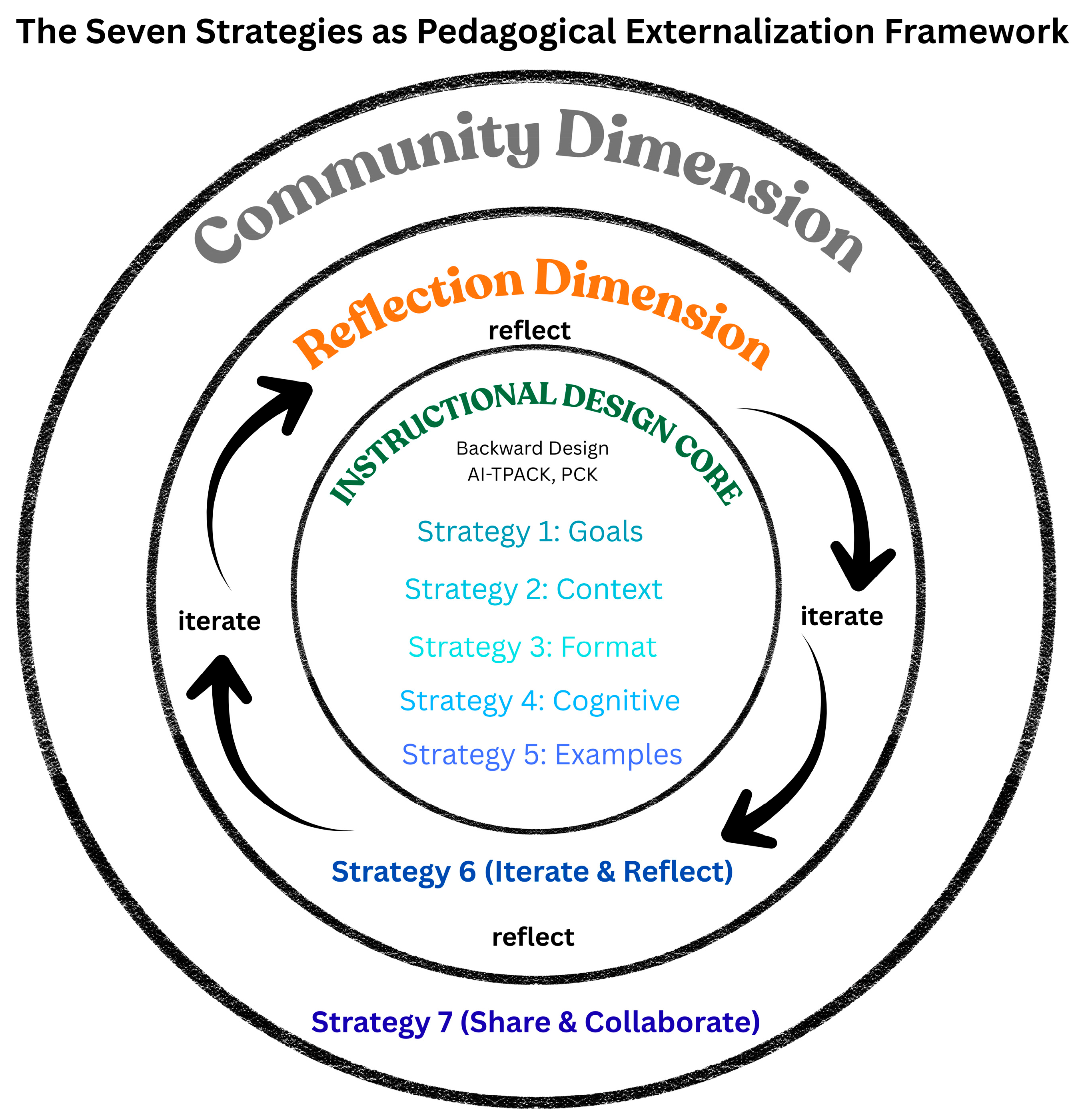
Figure 2 visualizes the framework’s nested structure across three interconnected dimensions: an instructional design core (Strategies 1–5), a reflection dimension creating iterative learning cycles (Strategy 6), and a community dimension enabling collective professional learning (Strategy 7). This nested architecture embodies the theoretical integration from Section 3. The core operationalizes backward design and AI-TPACK principles. The middle layer operationalizes Schön’s reflective practice. The outer layer operationalizes Wenger’s communities of practice.
The framework operates across three nested dimensions. First, the instructional design core (Strategies 1–5) embeds backward design and AI-TPACK principles in prompt construction. Second, the reflection dimension (Strategy 6) creates iterative learning cycles through prompt revision. Third, the community dimension (Strategy 7) enables collective professional learning through prompt sharing. The arrows illustrate how iteration moves pedagogical thinking from implicit to explicit. The nested structure shows how individual reflection (middle layer) and collective examination (outer layer) build upon core instructional design decisions (center).
The framework rests on five design principles:
  • Reflective rather than prescriptive: Strategies function as an analytic lens for examining prompting practice, not a procedural checklist for prompt construction. As Figure 2 illustrates, the framework reveals pedagogical thinking.
  • Theory-grounded: Each dimension corresponds to established theory. The core embodies instructional design principles [13] and AI-TPACK [12]. The reflection layer operationalizes Schön’s reflective practice [10]. The community layer operationalizes Wenger’s communities of practice [25].
  • Practice-embedded: Strategies describe what teachers already do when planning instruction, made visible through prompting. The nested structure shows how prompting simultaneously engages design, reflection, and collaboration.
  • Developmental: The framework treats prompting as an ongoing professional learning cycle. The iterative arrows in Figure 2 represent continuous refinement rather than linear progression toward mastery.
  • Epistemic categories: Strategies represent dimensions of pedagogical thinking, not sequential steps to follow. Teachers do not apply strategies 1–7 in order. Rather, every prompt implicitly addresses all dimensions, with varying degrees of explicitness.
This epistemic framing distinguishes the framework from technical approaches. These are categories through which we understand what prompting reveals about pedagogical thinking, not strategies teachers should follow. The nested structure in Figure 2 emphasizes that effective prompting integrates all three dimensions simultaneously: instructional design thinking, reflective iteration, and collaborative learning.
From a human–computer interaction perspective, these seven strategies represent design dimensions that inform the development of AI–assisted tools for professional practice. Each strategy identifies where tacit professional expertise must be made computationally explicit. This represents a fundamental challenge in designing intelligent systems that support human decision-making [31,32]. Tools implementing these dimensions (through structured input fields, theory selection interfaces, or intelligent scaffolding) can support the externalization process while preserving professional agency and control [30]. The framework thus serves dual purposes: as an analytical lens for understanding prompting sophistication and as design guidance for developing AI systems that augment professional practice.

4.2. The Seven Strategies

The theoretical integration presented in Section 3 positions prompt engineering as reflective professional practice. This section operationalizes that reconceptualization through a seven-strategy framework organized across three nested dimensions.
The framework comprises seven interconnected strategies:
Instructional Design Core (Strategies 1–5):
  • Clarify Learning Outcomes—Specify desired learning results explicitly;
  • Provide Context About Learners—Externalize tacit knowledge about students;
  • Specify Format and Structure—Define assessment criteria and success indicators;
  • Define Cognitive Level—Articulate intended thinking requirements;
  • Include Examples and Constraints—Make quality standards explicit.
Reflection Dimension (Strategy 6): 6. Iterate and Reflect—Transform revision into reflective learning cycles.
Community Dimension (Strategy 7): 7. Share and Collaborate—Enable collective professional learning.
To illustrate how the seven strategies function as an integrated framework rather than a prescriptive checklist, we present a progressive example following Sofia Dimitriou, a 9th grade Geography teacher. She develops materials for teaching climate change solutions. Sofia faces a common challenge: her students feel overwhelmed and helpless about climate change. They know the problem exists. But they do not understand the range of solutions or how to evaluate them. The following subsections show how each strategy builds upon the previous ones. This demonstrates the framework’s cumulative nature.
The following subsections detail each strategy’s theoretical grounding and application.

4.2.1. Clarify Learning Outcomes

Effective prompts state desired learning outcomes explicitly, operationalizing Wiggins and McTighe’s principle of beginning with the end in mind [13]. This articulation makes pedagogical intent visible and examinable. Generic prompts like “Create a math lesson on quadratic equations” lack an outcome specification. Teachers who specify “Create a lesson where students derive the quadratic formula from completing-the-square, understanding why it works rather than memorizing steps” externalize their pedagogical priorities. These include conceptual understanding over procedural fluency, and derivation over memorization.
This outcome specification can transform implicit instructional goals into explicit design criteria. When AI output misaligns with intent, teachers recognize gaps in their outcome articulation: this engages reflection-on-action [10]. The question becomes not “Did AI understand my request?” but “What does my outcome specification reveal about my teaching priorities?”
Sofia’s Application:
Sofia begins by clarifying her learning outcome. She writes:
“Create a lesson where students compare three types of climate solutions: individual actions, government policies, and technological innovations. Students will evaluate which approach is most effective for reducing carbon emissions.”
This makes her pedagogical goal explicit. She wants comparative analysis, not just information recall. Her students need to understand that multiple solution types exist. They must evaluate effectiveness using evidence. This outcome transforms a vague content request into a specific design criterion.

4.2.2. Provide Context About Learners

Strategy 2 operationalizes constructivist learning theory [33,34] and situated learning theory [34,35]. Prompts that specify learner characteristics externalize tacit knowledge about students, transforming implicit assumptions into design data. Context provision renders learner analysis visible for reflection.
A chemistry teacher prompting “Explain oxidation-reduction for students who struggled with electron configuration last week, using familiar battery examples” demonstrates sophisticated learner knowledge. This includes prior difficulty (electron configuration), conceptual connection (to redox), and effective pedagogy (familiar analogies). This specification embodies what Shulman terms pedagogical content knowledge: understanding how specific learners engage specific content [36].
The ethical dimension matters: context specification ensures AI-generated materials address actual learner needs rather than imagined generic students. This grounds instructional design in lived classroom reality, connecting to Freire’s emphasis on teaching real learners in real contexts [37].
Sofia’s Application:
Sofia adds critical learner context to her prompt. She writes:
“My 9th graders feel helpless about climate change. They think individual actions are meaningless compared to corporate pollution. Last week, several students said ‘nothing we do matters anyway.’ They need to understand how different solutions work at different scales. They need to see that individual, governmental, and technological approaches all have specific roles.”
This specification externalizes her knowledge of her students’ emotional state. It positions climate pessimism as a pedagogical obstacle requiring direct attention.

4.2.3. Specify Format and Structure

Strategy 3 operationalizes Wiggins and McTighe’s backward design principle [13]: that assessment design precedes instructional planning. It also operationalizes Black and Wiliam’s assessment for learning theory, which establishes that assessment format fundamentally shapes what learning becomes visible and valued [38]. Format specification forces teachers to define assessment criteria and success indicators, making evaluation thinking explicit.
When teachers request “a 500-word argumentative essay with clear thesis, three supporting paragraphs with textual evidence, and counterargument acknowledgment,” they specify assessment criteria: length expectations, genre requirements, structural elements, and evidential standards. This specification makes visible the assessment literacy underlying instructional decisions.
Format specification embodies constructive alignment [39]: ensuring activities match intended outcomes. Teachers requesting specific formats implicitly declare what demonstrates learning, transforming tacit assessment knowledge into examinable design criteria.
Sofia’s Application:
Sofia specifies the assessment format clearly. She writes:
“Create a comparison table with three columns: Individual Actions, Government Policies, Technological Solutions. Include rows for: examples, carbon impact scale, implementation timeline, and barriers to adoption. Students complete the table using provided data sources. Then they write a 250-word argument selecting the most promising approach. They must support their choice with evidence from the table.”
This format embodies constructive alignment. The table scaffolds comparison before students write their evaluation. The structure matches her analytical learning goal.

4.2.4. Define Cognitive Level

Strategy 4 operationalizes Anderson and Krathwohl’s revised Bloom’s taxonomy and Webb’s depth of knowledge framework [40,41,42]. Cognitive level specification can transform implicit assumptions about thinking requirements into explicit pedagogical decisions.
A biology teacher distinguishing “explain the steps of photosynthesis” (recall) from “evaluate which environmental factors most limit photosynthesis rates in specific ecosystems” (evaluation + application) makes pedagogical reasoning visible. This shift from lower-order to higher-order thinking reflects Biggs’ constructive alignment principle: ensuring cognitive demand matches intended learning outcomes [39]. The prompt defines intended cognitive demand, forcing examination of whether activities match learning goals.
Cognitive-level articulation is not a classification exercise but a declaration of pedagogical intent: revealing what teachers consider appropriately challenging and why.
Sofia’s Application:
Sofia makes cognitive demand explicit in her prompt. She writes:
“This requires evaluation-level thinking. Students must judge solution effectiveness using specific criteria: carbon reduction potential, implementation speed, and economic feasibility. Avoid simple descriptions. Students should recognize trade-offs. Individual actions are accessible but limited in scale. Government policies affect millions but face political resistance. Technology offers large-scale impact but requires investment. Students must weigh these factors, not just list solutions.”
This specification reveals Sofia’s pedagogical priority. She wants students wrestling with complexity, not memorizing facts.

4.2.5. Include Examples and Constraints

Example specification externalizes teachers’ mental models of quality work, operationalizing Bandura’s modeling principle [43]. When teachers specify what good work looks like, they make tacit standards explicit.
A writing teacher requests “mentor texts showing strong introductions—like Ta-Nehisi Coates’ opening in ‘The Case for Reparations’ where he uses historical narrative to frame argument.” This demonstrates sophisticated quality criteria: specific structural elements, rhetorical strategies, and effective models. This specification embodies assessment standards typically held implicitly: what Sadler terms “evaluative knowledge,” the capacity to judge quality [44].
When teachers specify examples and constraints, they develop Brookhart’s “formative assessment expertise”: recognizing and articulating gradations of quality [45]. Once exemplars are defined, iteration becomes the site where these exemplars are tested and refined, creating a continuous cycle of professional learning.
Sofia’s Application:
Sofia provides concrete quality standards. She writes:
“Model the reasoning I want to see: ‘Government policies like carbon taxes affect entire industries. This creates larger impact than individual recycling. However, policies require political will that takes years to build. This suggests combining approaches—individual action builds public support for policy change.’ Students should demonstrate this causal reasoning. Constraints: present solutions fairly without declaring one ‘correct’ answer. Show that each approach has strengths and limitations. Help students see strategic thinking, not simple solutions.”
This exemplar makes Sofia’s tacit quality standards visible.

4.2.6. Iterate and Reflect

Strategy 6 operationalizes Schön’s reflection-in-action, Kolb’s experiential learning cycle, and principles of formative assessment and self-regulated learning [46]. Iteration can transform prompting from output production into a reflective learning cycle, positioning each revision as an opportunity for professional growth through feedback-driven refinement.
Consider a teacher creating differentiated reading materials. Initial prompt: “Create a passage about climate change.” AI produces text too complex for struggling readers. Rather than viewing this as AI failure, iteration makes pedagogical thinking visible: what was missing from my specification? The teacher realizes she did not specify reading level, sentence complexity, or vocabulary support, elements she intuitively adjusts when teaching but hadn’t externalized.
Revision: “Create a 300-word climate change passage for 6th graders reading at 4th grade level, using short sentences and defining scientific terms in context.” This iteration reveals learning not about AI but about the teacher’s pedagogical reasoning. It makes explicit what was implicit. Each prompt becomes a hypothesis about what effective instruction requires. When AI output misaligns with intent, the gap reveals tacit knowledge requiring articulation. This reframes “failure” as a professional learning opportunity: the essence of reflective practice.
Sofia’s Application:
After reviewing the AI output, Sofia identifies a gap. The materials only discussed Western developed nations. They ignored climate solutions in developing countries. Sofia realizes she hadn’t articulated this explicitly. She revises her prompt:
“Include examples from diverse contexts: Costa Rica’s renewable energy transition, Bangladesh’s climate adaptation strategies, Kenya’s mobile-based carbon tracking. Students should see that effective solutions vary by context. Local conditions matter.”
This iteration demonstrates reflection-on-action. The gap between intent and output revealed implicit knowledge. Sofia’s revision makes her commitment to global perspectives explicit.

4.2.7. Share and Collaborate

Prompt sharing can transform individual reflection into collective professional learning. This strategy operationalizes Wenger’s communities of practice [25], where prompts function as boundary objects [24] making pedagogical thinking collectively examinable.
When teachers share prompts, they share not outputs but pedagogical reasoning. Examining a colleague’s prompt for differentiation reveals their learner analysis, scaffolding strategies, and assessment thinking. This creates professional discourse grounded in artifacts of practice rather than abstract discussion: facilitating legitimate peripheral participation [35] and modeling expert thinking [43].
Collaborative examination addresses equity concerns: shared prompts reveal assumptions about learners, exposing biases requiring collective examination. Leaders supporting prompt-sharing communities create infrastructure for ongoing professional development embedded in daily practice, transforming individual expertise into shared professional knowledge.
Sofia’s Application:
Sofia shares her refined prompt at a staff meeting. It becomes a discussion catalyst. A science teacher notices Sofia’s multi-scale framework. She says:
“I teach climate science but only focus on individual actions. Your approach shows students how solutions connect across scales. That’s more sophisticated.” A social studies teacher observes Sofia’s evidence-based evaluation structure. He says: “I assign climate essays but students produce opinion pieces. Your table-then-argument format scaffolds analytical thinking.”
The shared prompt enables legitimate peripheral participation. Less experienced teachers access Sofia’s pedagogical reasoning through her explicit design decisions.
This progressive example demonstrates the framework’s integrated nature. Sofia did not apply seven strategies sequentially. Each strategy revealed a different dimension of her pedagogical thinking. Strategy 1 showed her learning goals. Strategy 2 showed her student knowledge. Strategy 3 showed her assessment design. Strategy 4 showed her cognitive expectations. Strategy 5 showed her quality standards. Strategy 6 showed how iteration develops awareness. Strategy 7 showed how prompts enable collaborative learning. Together, these strategies transformed Sofia’s prompt into a comprehensive instructional design document. They made her pedagogical expertise visible and shareable.
Table 3 synthesizes Sofia’s progressive prompt development across all seven strategies, illustrating the cumulative and integrated nature of the RPE framework.

4.3. Framework as Reflective Cycle

The seven strategies map onto two interconnected reflective cycles. Strategies 1–5 operationalize Schön’s reflection-on-action [10]: teachers formulate pedagogical thinking before prompting. Strategy 6 operationalizes reflection-in-action: real-time adjustment as gaps between intent and output become visible. Strategy 7 extends reflection to collective practice: communities examining shared prompts engage in collaborative reflection-on-action.
This dual-cycle structure positions prompt engineering as reflective practice. Individual iteration develops personal pedagogical understanding. Collaborative examination develops shared professional knowledge. This makes pedagogical thinking visible at both personal and communal levels.

4.4. Framework as Analytic Lens

The framework can function as an analytic lens for examining prompting practice, not a prescriptive checklist. This distinction matters: technical frameworks tell teachers what to do; reflective frameworks help teachers understand what they are already doing and why. The framework can reveal the pedagogical thinking embedded in prompts, whether teachers consciously apply strategies or not. Every prompt implicitly addresses learning outcomes, learner characteristics, format expectations, cognitive demands, quality criteria, and revision processes. These dimensions exist whether explicitly stated or not.
The analytic function has three applications. First, teachers examining their own prompts identify which pedagogical dimensions they specify readily and which remain implicit, revealing professional development needs. Second, teacher educators analyzing novice versus expert prompts identify expertise development patterns. Third, researchers studying prompting as professional practice use the framework to characterize pedagogical sophistication across contexts.
This positions the framework as an epistemic tool for understanding professional practice rather than a procedural guide for improving outputs. Its power lies not in prescribing what teachers should prompt, but in revealing what their prompting discloses about their pedagogical thinking.

4.5. Operationalizing the Framework: A Step-by-Step Illustrative Case

This section presents a detailed case study demonstrating the RPE framework’s application in secondary biology education (cellular respiration). An additional case study illustrating the framework’s application in elementary mathematics (fractions) is provided in Appendix A, demonstrating the framework’s adaptability across educational levels and disciplinary contexts.
To demonstrate how the RPE framework functions as an analytic lens for examining prompt engineering sophistication, we examine the evolution of a lesson design process through three developmental stages. This case follows Maria Kiriakou, a biology teacher with eight years of experience, as she prepares materials for her annual unit on cellular respiration. Maria had observed that despite thorough coverage of the material, her 10th-grade students consistently struggled with two issues. First, they confused cellular respiration (the cellular metabolic process) with breathing (the respiratory system). Second, they memorized the reaction stages without understanding ATP production as the functional purpose. Maria decided to use AI assistance to develop more targeted materials, employing the RPE framework to make her instructional design thinking explicit. The case illustrates the transition from “AI User” to “Instructional Designer” by revealing how iterative prompting externalizes tacit pedagogical knowledge.

4.5.1. Stage 1: The Technical Rationality Baseline (The “AI User”)

Initially, Maria approached the AI with a focus on output generation rather than pedagogical design, reflecting a technical rationality approach where AI serves as a content-production tool.
Initial Prompt: “Create an interactive explanation of cellular respiration for 10th grade biology.”
AI Output: A standard list of biological facts (glycolysis, Krebs cycle, electron transport chain) followed by a generic multiple-choice quiz testing definitional recall.
Analysis: This prompt represents a weak application of the instructional design core (Strategies 1–5). It lacks specific learning outcomes (Strategy 1). It provides no learner context regarding prior knowledge or misconceptions (Strategy 2). It omits assessment criteria beyond “interactive” (Strategy 3). It assumes a low cognitive level focused on recall rather than understanding (Strategy 4). The teacher’s considerable pedagogical expertise remains tacit and unexpressed. This includes her knowledge of her students’ specific struggles, her instructional metaphors, and her assessment priorities. The result is a generic output that, while scientifically accurate, fails to address the specific pedagogical challenges of her classroom context.
Teacher’s Reflection (Between Stage 1 and 2):
“When I reviewed the AI output, my first reaction was disappointment. It looked like every cellular respiration explanation I could find in a textbook. Then I realized: of course it did. I hadn’t told the AI anything about MY students or MY classroom. The output was technically correct but pedagogically useless because I hadn’t externalized any of my professional knowledge. Every year, students confuse cellular respiration with breathing. It’s the most persistent misconception I encounter. But I never mentioned it in my prompt. I also have specific instructional moves I use: the ‘cellular factory’ metaphor that we establish in class, the emphasis on ATP as the ‘why’ behind each stage. None of that was in my prompt. I was treating the AI like a search engine: give it keywords, get generic content back. I wasn’t using it as an instructional design partner that needs my pedagogical expertise to create something actually useful for my students.”
Strategies Applied: Strategy 1 (partial—vague objectives), Strategy 3 (partial—format request only).
Missing: Strategies 2, 4, 5, 6, 7.

4.5.2. Stage 2: Reflective Externalization (The “Designer” in Progress)

Through reflection-on-action, Maria recognized that the AI output failed to address the critical conceptual obstacle her students face. A conversation with a colleague who asked, “Will this actually help YOUR students understand the difference between cellular respiration and breathing?” prompted her to articulate the misconception explicitly in her next iteration.
Revised Prompt: “Create a lesson on cellular respiration for 10th grade biology. Focus on ATP production at each stage: glycolysis, Krebs cycle, and electron transport chain. Use the ‘cellular factory’ metaphor we established in class where the cell is a factory, glucose is raw material, and ATP is the product. Crucially, address the common student misconception that cellular respiration is the same as breathing. Explain that breathing delivers oxygen, but cellular respiration is the chemical process inside cells that produces energy.”
Analysis: This iteration reveals a fundamental shift toward pedagogical externalization. The prompt now functions as an explicit design document. It integrates content knowledge (the three stages), pedagogical knowledge (the factory metaphor as conceptual scaffold), and pedagogical content knowledge (the breathing misconception as the primary learning obstacle). By specifying both the metaphor and the misconception, Maria externalizes her PCK. This makes her instructional rationale visible and available for examination. The prompt demonstrates stronger application of Strategies 1 (specific learning outcome: distinguishing cellular respiration from breathing), 2 (learner context: the misconception), and 5 (the factory metaphor as an instructional example). However, assessment criteria and cognitive level remain implicit.
Teacher’s Reflection (Between Stage 2 and 3):
“This version felt completely different. The AI output was finally something I could actually use in my classroom because it addressed MY students’ specific struggle. Adding the misconception and our metaphor changed everything. I was now designing for my context, not for some generic 10th grade class. But when I tried to use the materials, I realized there was still a gap. The explanation was good, but I hadn’t specified how students should demonstrate understanding. What does ‘proficient’ understanding look like versus ‘novice’? And I have several ESL learners who need language scaffolding without reducing scientific rigor. I also realized I wanted them to think ecologically: how would lack of oxygen or glucose limit ATP production? I wanted this, not just memorization of the steps. All of these design decisions exist in my head when I plan lessons, but I hadn’t made them explicit in the prompt.”
Strategies Applied: 1, 2, 5 (Examples via metaphor).
Emerging: Strategy 6 (Reflective iteration becoming systematic).
Still Missing: Strategies 4 (explicit cognitive level), 7 (collaborative sharing).

4.5.3. Stage 3: Full RPE Integration (The “Instructional Designer”)

In the final iteration, Maria integrated all dimensions of the RPE framework. She used the prompt as a complete instructional design document that embodies backward design principles, assessment criteria, differentiation strategies, and cognitive demand specification.
Final Refined Prompt: “Act as an instructional designer using Backward Design principles. Our learning goal is for 10th grade biology students to evaluate how environmental factors (oxygen availability, glucose availability, temperature) would limit ATP production at specific stages of cellular respiration. Create a scaffolded case study where students analyze a scenario and make predictions. Include a rubric that clearly defines what ‘proficient’ evaluation looks like (considers multiple stages, explains mechanisms, makes specific predictions) versus ‘novice’ evaluation (identifies factors but does not explain mechanisms). Use the ‘cellular factory’ metaphor we established in class. Address the misconception that cellular respiration equals breathing. Adjust language complexity for ESL learners (define technical terms, use visual supports) while maintaining 10th-grade scientific rigor. The assessment should reveal whether students understand ATP production as the functional purpose, not just memorize the stages.”
Analysis: This prompt represents full integration of the RPE framework’s instructional design core. It specifies learning outcomes using Bloom’s taxonomy (“evaluate” as higher-order thinking, Strategy 4). It provides comprehensive learner context including the persistent misconception and ESL considerations (Strategy 2). It defines explicit assessment criteria through the rubric specification (Strategy 3). It includes the established metaphor as an example (Strategy 5). It embodies the principle of backward design by starting with the desired outcome (evaluation of limiting factors) and working backward to the instructional approach. The progression from Stage 1 to Stage 3 demonstrates Strategy 6 (Reflective Iteration) in action.
Teacher’s Reflection (After Stage 3):
“Looking at this final prompt, I realize it’s essentially an X-ray of my teaching philosophy. Everything I value is in there: Backward Design starting with learning goals, differentiation for my ESL students, assessment criteria that distinguish surface-level from deep understanding, higher-order thinking rather than memorization. I do all of these things intuitively when I plan lessons, but I’ve never articulated them this systematically. The process of refining these prompts wasn’t just about getting better AI output. It was professional development. It made me examine my own pedagogical reasoning in a way that’s usually invisible. The AI didn’t give me expertise I lacked. It gave me a mirror to see the expertise I already possess but had never fully externalized. Now I can share this prompt with colleagues and explain exactly why I made each design decision. That’s something I couldn’t do before.”
Strategies Applied: All seven strategies integrated.
Especially evident: Strategy 4 (Cognitive Level via Bloom’s taxonomy), Strategy 6 (Systematic reflective iteration), Strategy 1 (Specific, measurable outcomes).

4.5.4. What the Complete Cycle Reveals

Maria’s progression demonstrates the RPE framework’s developmental trajectory from technical rationality to reflective professional practice. In Stage 1, she operated as an “AI User.” She approached the AI as a content-generation tool without externalizing her pedagogical expertise. The generic result prompted reflection-on-action, forcing her to recognize the tacit knowledge she carries. This includes her students’ misconceptions, her instructional metaphors, and her pedagogical priorities (Stage 2). By Stage 3, she had transformed into an “Instructional Designer.” She used the prompt as a comprehensive design document that integrated backward design principles, assessment criteria, cognitive demand specifications, and learner scaffolding.
Critically, this iterative process functioned as professional development rather than mere tool use. The requirement to make pedagogical knowledge explicit through prompt construction developed metacognitive awareness. This awareness would have remained tacit in traditional practice. Each iteration constituted a cycle of reflection-on-action where AI output served as immediate feedback revealing gaps in articulation. As Maria reflected: “I’ve taught cellular respiration for eight years, but writing these prompts made me articulate WHY I teach it the way I do. This included the conceptual obstacles students face, the scaffolds that work, and the level of thinking I am targeting. The AI didn’t give me pedagogical expertise. It gave me a mirror to examine the expertise I already had but couldn’t see.”
This case exemplifies how the RPE framework repositions prompt engineering from technical operation to reflective professional practice. The prompts themselves become artifacts of pedagogical thinking: visible, examinable, and shareable. When teachers construct prompts at the level of sophistication demonstrated in Stage 3, they engage in the same professional work that defines teaching. This includes instructional design, pedagogical reasoning, and assessment planning. They do this through a medium that makes this work explicit. The framework thus transforms AI interaction into a site for pedagogical externalization. This enables both immediate instructional improvement and ongoing professional growth.
Beyond individual development, this process extends into collective professional learning. Maria later shared her refined prompt at a department meeting, where it became a catalyst for examining diverse pedagogical philosophies. One colleague prioritized different text complexity (current events articles versus scientific papers). Another emphasized different scaffolding approaches (graphic organizers versus worked examples). These variations revealed that prompting sophistication reflects not just technical competence but pedagogical identity. The shared prompt functioned as what Wenger terms a “boundary object” [25]. It became an artifact enabling collective professional inquiry where teachers examined not just what instructional decisions they make, but why. This collaborative dimension exemplifies Strategy 7 (Share and Collaborate). It demonstrates how individual reflective practice, when made visible through explicit prompts, naturally extends into collective professional learning within communities of practice. The prompt becomes simultaneously an individual learning tool and a social artifact. It facilitates the kind of collaborative pedagogical discourse that characterizes effective professional development ecosystems.

4.6. Operationalizing UNESCO AI Competency Framework for Teachers

The RPE framework provides an implementation mechanism for UNESCO AI competency framework for teachers’ fifth aspect: ‘AI for Professional Development.’ This aspect identifies three progression levels but lacks theoretical grounding for their actualization [3]. Table 4 maps the seven RPE strategies across UNESCO’s progression levels, illustrating how theoretically grounded professional development differs from skill-oriented technical training.
The mapping reveals fundamental differences between approaches. The instructional design core (Strategies 1–5) operationalizes the acquire level. It enables job-embedded pedagogical externalization rather than teaching prompting syntax. Strategy 7 (Share and Collaborate) operationalizes the Deepen level through communities of practice [25]. Prompts serve as boundary objects for collective reflection. This contrasts with technical approaches that share prompts as templates to replicate. Strategy 6 (Iterate and Reflect) operationalizes the Create level. It develops metacognitive awareness through reflection-on-action [10], supporting the identity transformation from AI user to instructional designer.
This integration of Schön’s reflective practice [10], Wiggins and McTighe’s backward design [13], and Wenger’s communities of practice [25] can provide theoretical mechanisms for operationalizing all three UNESCO progression levels. Technical frameworks (e.g., CLEAR [4], IDEA [5]) lack these foundations, remaining at the Acquire level’s surface without developing the professional capacities UNESCO’s Deepen and Create levels require.

5. Discussion

The reflective prompt engineering (RPE) framework offers a conceptual basis with potential implications for teacher development at every professional stage. By repositioning prompting as pedagogical externalization, the framework informs the redesign of professional development (PD) programs, pre-service teacher education, and instructional leadership. This fosters a context where pedagogical expertise, not technical skill, drives effective AI integration.

5.1. Redesigning Teacher Professional Development Programs

Adopting the RPE framework requires a fundamental change in PD program design, shifting the focus from technical instruction to reflective practice. This necessitates three strategic redesigns:
  • Job-Embedded Learning: PD must replace traditional workshops with continuous, job-embedded application within the classroom context. Prompting is treated as a reflective tool where teachers develop skills in practice, with reflective revision serving as the primary learning mechanism. For example, when a middle school mathematics department collaboratively develops algebra materials, examining prompts reveals varied assumptions. Different teachers prompt for scaffolding differently, showing their assumptions about prerequisite knowledge, cognitive load management, and error anticipation. This collaborative prompt construction makes professional learning inseparable from instructional design. It embeds development in daily practice rather than separating it as external training. This principle is validated across AI-mediated reflective practices in language teacher education [18].
  • Communities of Practice (CoP): Isolation is replaced by collaboration. Strategy 7 of RPE (Share and Collaborate) encourages the creation of communities of practice. Refined prompts serve as boundary artifacts and become objects of critical discussion. This transforms individual learning into collective, shareable pedagogical knowledge [24].
  • Assessment Focus: Success metrics must shift from the quality of the final AI output to the quality of the pedagogical thought revealed in the prompt. Assessment should focus on the teacher’s ability to effectively integrate AI-TPACK into the prompting process, evaluating the sophistication of their specified design decisions.
The necessity for this structural redesign is supported by empirical evidence. Despite training, reflective writing in pre-service teacher education often remains superficial and descriptive. It fails to achieve deep, critical analysis of practice [47]. The RPE framework, by demanding the explicit articulation of design decisions, aims to structurally overcome this deficiency.
The efficacy of these three strategic redesigns is empirically validated. Meta-analysis of 59 experimental studies demonstrates that teacher education interventions yield significant TPACK improvements (d = 0.839). This occurs when structured as sustained professional development rather than short-term training. Three critical findings support the RPE framework’s approach. First, intervention duration beyond 6 months produces substantially stronger effects. This validates job-embedded learning over workshop models. Second, method-based interventions (emphasizing pedagogical strategies) significantly outperform purely technical training. This confirms that pedagogical expertise drives effective integration. Third, theory-grounded assessment instruments reveal larger effect sizes than self-reported measures. This underscores the necessity of rigorous, pedagogically anchored evaluation frameworks [48].
The RPE framework’s conceptualization of prompt engineering as reflective practice finds support across multiple educational contexts. Empirical evidence from pre-service teacher education demonstrates that AI-mediated iterative feedback significantly improves reflection quality [29]. Additionally, research on prompt engineering instruction shows that structured engagement with prompt patterns enhances reflective competencies and self-regulated learning skills even among novice learners [49]. This suggests that the reflective benefits of prompt engineering emerge from the cognitive processes inherent in the practice itself: articulating goals, externalizing reasoning, and iterating based on feedback. If students develop reflective competencies simply by learning prompt engineering patterns, experienced teachers may experience amplified reflective benefits. They can apply these same patterns to instructional design, drawing on their pedagogical expertise to engage in deeper metacognitive analysis.
As detailed in Section 4.6, the RPE framework operationalizes UNESCO AI CFT’s three progression levels through theoretically grounded mechanisms. These include job-embedded reflection (Acquire level), communities of practice (Deepen level), and iterative identity transformation (Create level). These strategic redesigns provide the implementation mechanism UNESCO’s competency framework requires. The shift in assessment focus supports this implementation. Moving from output quality to pedagogical sophistication prepares teachers for the ‘Create’ level’s requirement to function as agents of professional transformation [3].

Addressing Equity Concerns

While effective deployment of the framework presupposes pedagogical expertise, potentially widening gaps between expert and novice educators, the framework contains inherent mechanisms to mitigate this risk. Strategies 6 and 7 (iterate and reflect; share and collaborate) function as dynamic professional learning mechanisms. When less experienced teachers examine the prompts of more expert colleagues (Strategy 7), the explicit design document grants direct access to expert pedagogical thinking. The prompt becomes an artifact enabling legitimate peripheral participation [35], actively bridging professional development gaps rather than merely recording existing expertise.

5.2. Implications for Pre-Service Teacher Education

The RPE framework can provide a conceptual foundation for integrating generative AI into pre-service teacher education programs.
Strategy 6 (iterate and reflect) can transform student teachers’ field experiences into iteration laboratories. Student teachers are not merely trained in AI usage. Instead, they utilize prompting as a tool to diagnose gaps in their instructional design thinking. In this approach, the AI functions as a reflective partner. It provides immediate feedback on lesson planning, accelerating the development of reflective capacity (reflection-in-action) before they fully enter the profession.

5.3. Implications for Educational Leadership and Coaching

For educational leaders and instructional coaches, the RPE framework provides a common language for discussing technology integration.
RPE highlights that the role of the instructional coach is more critical than that of the technology specialist. Coaches can use prompts as diagnostic tools, asking, “What does this prompt reveal about your pedagogical intentions and your assumptions about the learners?” This approach focuses discussions on the teacher’s pedagogical expertise (professional judgment), affirming their professional authority rather than reducing AI integration to a technical problem.

5.4. Framework Adaptability Across Disciplinary Contexts

The RPE framework demonstrates adaptability across disciplines, emphasizing that pedagogical externalization is a universal mechanism for professional development.

5.4.1. Mathematics: Algebraic Thinking

Prompt evolution for an algebra teacher reveals their pedagogical content knowledge (PCK). An initial prompt (“Create practice problems on quadratic equations”) lacks specificity. A refined version progresses to detailed requirements: “Create 8 problems using factoring, completing square, and quadratic formula (2–3 per method), progressing from integer to rational coefficients. Include one word problem requiring equation formulation.” This evolution externalizes knowledge regarding method variety, cognitive load management, and anticipated student errors.

5.4.2. Science: Inquiry-Based Learning

In the sciences, prompt revision demonstrates how teachers implement systems thinking and inquiry-based pedagogy. A vague initial prompt (“explanation of food webs”) evolves to specify complexity (grade-appropriate), approach (disruption scenarios requiring prediction), scaffolding (simple three-organism chains), and assessment (evaluating predictions using ecological principles).

5.4.3. Humanities: Critical Analysis

In the humanities, prompt refinement focuses on critical literacy and text accessibility. Revision from “analyze persuasive techniques” progresses to detailed specifications. These include sources (contemporary op-eds), analytical depth (rhetorical strategies beyond claims/evidence), reading levels, and scaffolding (model analysis first). This evolution reveals pedagogical thought concerning developing critical capacity and text accessibility.

5.5. Limitations and Future Research

5.5.1. Theoretical Nature

This paper presents a theoretical-conceptual framework based on systematic synthesis of existing theories. While the theoretical foundation of Schön’s reflective practice, backward design, and AI-TPACK provides strong conceptual validity, the RPE framework has not yet undergone empirical validation. The consequences and operational mechanisms described require experimental or qualitative study. This is particularly true for the claim that prompting leads to pedagogical knowledge externalization. Thus, the findings constitute theory-derived hypotheses, providing a model for future research rather than empirically verified outcomes.

5.5.2. Teacher-Centric Focus

The RPE framework focuses on the transformation of the teacher’s role and how prompting enhances professional practice. While this is critical for professional development, the paper does not directly examine several important areas. These include: (a) impact on student learning outcomes, (b) the impact of algorithmic bias potentially embedded in AI tools, or (c) whether the framework’s core mechanism of professional expertise externalization transfers to domains beyond education (e.g., medicine, law, engineering). Analysis of these issues remains beyond the scope of this conceptual work, though they represent important directions for future empirical investigation.

5.5.3. Future Research

The RPE framework, as a theoretical-conceptual model, generates testable hypotheses that address critical gaps in the methodology and evaluation of AI-mediated professional development (PD).
1. Validation of Pedagogical Externalization via Mixed Methods
The central theoretical hypothesis of the RPE is that the explicit articulation of prompts externalizes tacit pedagogical knowledge, transforming it into a critically examinable artifact.
Proposed Direction: Future research must validate this mechanism by adopting concurrent mixed-methods research, similar to approaches used in analyzing reflective writing. Studies should combine qualitative process data (e.g., think-aloud protocols during prompt iteration) with quantitative computational linguistic analysis (NLP).
Goal: The primary objective is to systematically quantify the correlation between the level of RPE strategy integration in the prompt and the use of cognitive and affective language that signals deeper reflection. This would empirically validate the prompt’s function as an externalized reflective artifact.
2. Measuring RPE’s Impact on AI-TPACK and PD Efficacy
Empirical evidence indicates that current reflective writing often remains low-level and superficial, necessitating a structural solution like the RPE.
Proposed Direction: Experimental studies are needed to compare the effectiveness of RPE-based professional development programs versus programs based on technical frameworks (e.g., CLEAR, IDEA).
Goal: These studies must utilize longitudinal designs and employ theory-grounded assessment instruments. They should measure changes in teachers’ holistic pedagogical capacity (AI-TPACK) and the resulting quality of their reflective practice. This is essential to demonstrate that the pedagogical focus of the RPE framework produces measurably superior outcomes to purely technical training.
3. Tool-Mediated Implementation and Comparative Validation
While Direction 2 addresses program-level effectiveness, the RPE framework also requires operationalization through practical tools that scaffold individual teacher practice.
Proposed Direction: Design-based research should develop AI-powered implementations that embed RPE principles through structured interfaces. This enables controlled comparison of theory-grounded versus technical approaches. Such tools should: (a) scaffold explicit application of the seven strategies through structured prompts, (b) enable educational theory selection for pedagogical grounding (implementing Strategies 1–5), and (c) provide comparative modes allowing within-subjects evaluation of RPE-informed versus technical prompting.
Goal: Tool-mediated studies enable precise measurement of RPE impact on prompt quality while providing practical implementations for teacher use. By comparing theory-grounded scaffolding against technical frameworks (CLEAR, IDEA), such research directly tests a key hypothesis. It examines whether pedagogical expertise, operationalized through RPE, produces superior instructional design outcomes compared to technical optimization approaches.

6. Conclusions: The Value of Pedagogical Expertise in the AI Era

The reconceptualization of prompt engineering from technical skill to reflective professional practice addresses the theoretical gap in educational AI literature. It positions prompt engineering within decades of research on teacher professional learning. This proposed paradigm shift aims to reposition teachers from technology consumers to professional practitioners. It offers an alternative framing for concerns about AI and teacher professionalism. Instead of viewing AI as an external force requiring adaptation, AI-mediated prompt engineering can be the medium through which teachers practice and develop their existing expertise. This demonstrates how pedagogical sophistication, not technical operation, determines effective AI integration.
This work proposes three interconnected theoretical contributions to understanding prompt engineering in teacher professional development.
First, it offers conceptual reframing. It integrates Schön’s reflective practice [10] with instructional design principles [13] and AI-TPACK [12]. This positions prompt engineering within established theories of professional learning rather than as novel technological competency. It addresses the absence of pedagogical frameworks identified in recent systematic reviews [2,9]. When teachers construct prompts, they externalize tacit knowledge underlying instructional decisions. This transforms knowing-in-action into reflection-on-action.
Second, it proposes repositioning teachers through identity transformation. Effective prompting requires the same pedagogical expertise that defines teacher professionalism. Rather than learning new technical skills, teachers make their existing instructional design thinking visible and examinable through prompting.
Third, it proposes that the seven-strategy framework can serve as a mechanism for ongoing teacher learning. Iteration functions as a reflective cycle developing both instructional artifacts and pedagogical understanding. This could operationalize UNESCO AI competency framework’s fifth aspect through job-embedded practice [3]. These proposed contributions aim to transform prompt engineering from external skill acquisition to internal capacity building, reclaiming teacher agency in the AI era.
The principle of human–AI co-agency positions teachers as active partners in AI-mediated practice, where reflective pedagogical judgment guides effective technology use. The sophistication of AI interaction depends on the depth of pedagogical knowledge the teacher can externalize through prompting. This recognition can transform AI anxiety into professional confidence. Teachers, secure in their pedagogical expertise, can approach AI as a tool enhancing their instructional practice, not a threat requiring accommodation.
Teachers have always been instructional designers, defining learning objectives, selecting materials, scaffolding difficulty, and determining assessment criteria. Prompt engineering offers a visible medium through which to externalize and examine this existing expertise. As AI capabilities advance, the distinctively human contribution becomes clearer and more valuable. This contribution is pedagogical judgment formulated through reflective prompting.
The reflective prompt engineering framework repositions teachers as instructional designers whose pedagogical expertise guides AI interaction. By making pedagogical knowledge explicit through prompting, teachers engage in the distinctively human work of articulating learning objectives, defining cognitive demand, specifying learner needs, and determining assessment criteria. This framework is specifically developed for teacher professional development. The RPE framework draws on decades of established pedagogical theory—Schön’s reflective practice [10], backward design [13], and AI-TPACK [12]—that are unique to education. The seven strategies operationalize instructional design principles specific to teaching and learning contexts. While expertise externalization is a general principle, this framework’s mechanisms are pedagogically situated. Investigation of whether analogous frameworks might emerge in other professions would require domain-specific theoretical foundations and independent validation. This represents future research beyond the current study’s scope.
This repositioning of teachers as instructional designers reflects a fundamental shift in how we conceptualize AI integration in educational practice. Rather than viewing AI as autonomous intelligence requiring teacher oversight, we adopt Shneiderman’s human-centered AI paradigm [30] and Engelbart’s augmentation philosophy [50]. AI serves as a medium through which teachers express, examine, and refine their pedagogical expertise. The quality of AI output depends not on algorithmic sophistication alone, but on the sophistication of pedagogical thinking made explicit through prompting [31]. In this paradigm, pedagogical expertise becomes more valuable, not less, as AI capabilities advance. The ability to externalize instructional judgment determines system effectiveness. By recognizing prompt engineering as reflective professional practice, we position teachers as the instructional designers they have always been, now equipped with a new medium for pedagogical knowledge externalization and professional development.

Author Contributions

Conceptualization, I.D.; methodology, I.D., S.K.; formal analysis, I.D., S.K.; writing—original draft preparation, I.D., G.K., S.K.; writing—review and editing, I.D., S.K. and G.K.; supervision, G.K.; investigation, I.D.; Literature Review, I.D.; theoretical framework Development, I.D. All authors have read and agreed to the published version of the manuscript.

Funding

This research received no external funding.

Data Availability Statement

No new data were created in this theoretical study.

Acknowledgments

The authors declare that generative artificial intelligence (GenAI) tools were used in a limited capacity solely as an assistant during the research and writing process for: (a) generating preliminary summaries of literature and (b) assisting in the exploration of relevant bibliography. These tools were also utilized for superficial language editing, specifically for spelling and grammar checks. Crucially, no part of the main text, figures, or results was generated by GenAI. The authors have thoroughly reviewed and edited the content as needed and take full responsibility for the content and scientific integrity of the publication.

Conflicts of Interest

The authors declare no conflicts of interest.

Abbreviations

The following abbreviations are used in this manuscript:
AIArtificial Intelligence
AI-TCKArtificial Intelligence Technological Content Knowledge
AI-TPACKArtificial Intelligence Technological Pedagogical Content Knowledge
AI-TKArtificial Intelligence Technological Knowledge
AI-TPKArtificial Intelligence Technological Pedagogical Knowledge
CKContent Knowledge
CLEARConcise, Logical, Explicit, Adaptive, Reflective framework
CoPCommunities of Practice
IDEAIntroduce, Define, Execute, Adapt framework
PCKPedagogical Content Knowledge
PKPedagogical Knowledge
RPEReflective Prompt Engineering
TPACKTechnological Pedagogical Content Knowledge
TPKTechnological Pedagogical Knowledge

Appendix A. Complete Case Study

To further demonstrate the RPE framework’s adaptability across educational levels and disciplinary contexts, this appendix presents a second developmental case study. While Section 4.5 examined secondary biology education, this case follows Dimitris Papadopoulos, a fourth-grade mathematics teacher with five years of experience, as he develops materials for his annual unit on fractions. Dimitris had observed that despite consistent practice with fraction algorithms, his students demonstrated two persistent issues. First, they could execute procedures (adding fractions with like denominators, reducing to simplest form) without understanding fraction magnitude or equivalence. Second, they memorized rules (“flip and multiply”) without connecting these operations to conceptual models. Dimitris decided to use AI assistance to develop more conceptually focused materials, employing the RPE framework to externalize his instructional design thinking. This case illustrates how the framework functions across different grade levels, subject areas, and pedagogical challenges.

Appendix A.1. Stage 1: The Technical Rationality Baseline (The “AI User”)

Initially, Dimitris approached the AI with a focus on generating practice materials rather than designing conceptual instruction, reflecting a view of AI as a worksheet-generation tool.
Initial Prompt: “Create fraction practice problems for 4th grade students.”
AI Output: A list of computation exercises: “Solve: 1/4 + 2/4 = ___”, “Reduce 6/8 to simplest form”, “Compare: 2/3 ___ 3/4”. The problems tested procedural execution without requiring conceptual understanding.
Analysis: This prompt represents minimal application of the instructional design core (Strategies 1–5). It lacks specific learning outcomes beyond procedural fluency (Strategy 1). It provides no learner context regarding students’ conceptual difficulties with magnitude and equivalence (Strategy 2). It omits specification of representations or models (Strategy 3). It assumes a low cognitive level focused on computation rather than understanding (Strategy 4). The teacher’s considerable pedagogical expertise remains unexpressed. This includes his knowledge that students can compute with fractions while lacking understanding of what fractions represent, his recognition that visual models support conceptual development, and his awareness that certain conceptual obstacles require explicit attention. The result is a generic worksheet that, while mathematically correct, fails to address the fundamental challenge: building conceptual understanding of fractional quantities.
Teacher’s Reflection (Between Stage 1 and 2):
“Looking at these problems, I realized they were exactly what I was trying to move away from. Pure computation with no conceptual foundation. My students can already solve 1/4 + 2/4 mechanically. They just add the numerators and keep the denominator. But if I ask them to show me 1/4 + 2/4 on a number line or explain why the answer makes sense, they’re lost. The fundamental issue is that they don’t understand fractions as numbers with magnitude and position. They see them as two separate whole numbers with a line between them. I have specific instructional moves for this. We use fraction strips extensively. We always connect symbolic notation to visual representations. We emphasize comparison and magnitude before computation. None of that expertise was in my prompt. I was treating the AI like a problem generator, not as a partner that could help me design conceptually-grounded instruction. The prompt revealed nothing about my pedagogical thinking.”
Strategies Applied: Strategy 1 (partial—vague objective), Strategy 3 (partial—format only).
Missing: Strategies 2, 4, 5, 6, 7.

Appendix A.2. Stage 2: Reflective Externalization (The “Designer” in Progress)

Through reflection-on-action, Dimitris recognized that the AI output failed to support his central instructional goal: developing conceptual understanding of fractions as quantities. A planning conversation with his grade-level team prompted him to articulate this goal explicitly in his next iteration.
Revised Prompt: “Create fraction learning activities for 4th grade that focus on understanding fractions as numbers, not just computing with them. Include visual models like fraction strips or number lines. Address the common misconception that fractions are two separate whole numbers rather than a single quantity. Start with comparing and ordering fractions (which is bigger: 2/3 or 3/4?) before moving to computation. Use familiar contexts like pizza slices or measuring cups to make fractions concrete.”
Analysis: This iteration reveals a fundamental shift toward pedagogical externalization. The prompt now functions as an instructional design document that integrates content knowledge (fractions as quantities), pedagogical knowledge (visual models as conceptual scaffolds), and pedagogical content knowledge (the part-whole misconception as primary learning obstacle). By specifying both the visual representations and the conceptual misconception, Dimitris externalizes his PCK. This makes his instructional rationale visible and available for examination. The prompt demonstrates stronger application of Strategies 1 (specific learning outcome: understanding fractions as quantities), 2 (learner context: the misconception), and 5 (fraction strips and number lines as examples). However, assessment criteria for conceptual understanding and specific cognitive demands remain implicit.
Teacher’s Reflection (Between Stage 2 and 3):
“This version was much better. The AI output finally included the visual representations and conceptual focus I wanted. But when I tried the activities with my class, I realized there were still gaps in my specification. I have three students with dyscalculia who need very specific scaffolding. They need smaller numerical values, more structured visual supports, and explicit step-by-step progression. I also realized I hadn’t specified what ‘understanding’ looks like. Can students explain why 2/3 is less than 3/4? Can they place fractions on a number line without counting unit fractions? Can they justify their reasoning using visual models? These are the assessment criteria I use when evaluating conceptual understanding, but I hadn’t made them explicit. I also wanted higher-order thinking. Not just ‘which is bigger’ but ‘how do you know’ and ‘prove it with a model.’ All of these design decisions were in my head but not in my prompt.”
Strategies Applied: 1, 2, 5 (Examples via visual models).
Emerging: Strategy 6 (Reflective iteration becoming systematic).
Still Missing: Strategies 4 (explicit cognitive level), 7 (collaborative sharing).

Appendix A.3. Stage 3: Full RPE Integration (The “Instructional Designer”)

In the final iteration, Dimitris integrated all dimensions of the RPE framework. He used the prompt as a complete instructional design document that embodies backward design principles, assessment criteria, differentiation strategies, and cognitive demand specification.
Final Refined Prompt: “Act as an instructional designer using Backward Design principles. Our learning goal is for 4th grade students to evaluate and justify fraction comparisons using visual models and magnitude reasoning. Create a scaffolded learning sequence with three levels. Level 1 (unit fractions): compare fractions with numerator 1 using fraction strips (e.g., 1/2 vs. 1/4). Students explain which is larger and why, using the visual model. Level 2 (like denominators): progress to fractions with same denominator (2/5 vs. 4/5). Students justify comparisons by reasoning about number of equal parts. Level 3 (unlike denominators): compare fractions with different denominators (2/3 vs. 3/4) using number lines or area models. Students must both identify the larger fraction AND explain their reasoning using the model. Include a rubric: ‘Proficient’ means student correctly identifies larger fraction, accurately uses visual model, and explains reasoning using fractional magnitude (e.g., ‘2/3 is two out of three equal parts; 3/4 is three out of four equal parts, so each fourth is smaller than each third, making 3/4 larger’). ‘Developing’ means correct identification but incomplete explanation. ‘Beginning’ means errors in comparison or no use of models. For students with dyscalculia: use only denominators 2, 3, 4 in Level 1–2; provide pre-drawn fraction models rather than requiring students to draw them; use color-coding to distinguish numerator/denominator. Address the misconception that larger denominator means larger fraction by explicit comparison of unit fractions. The assessment should reveal whether students understand fractions as quantities with magnitude, not just symbols to manipulate.”
Analysis: This prompt represents full integration of the RPE framework’s instructional design core. It specifies learning outcomes using Bloom’s taxonomy (“evaluate and justify” as higher-order thinking, Strategy 4). It provides comprehensive learner context including the magnitude misconception and dyscalculia considerations (Strategy 2). It defines explicit assessment criteria through the three-level rubric (Strategy 3). It includes visual models as examples and specifies the scaffolded progression structure (Strategy 5). It embodies backward design by starting with the desired outcome (evaluation with justification) and working backward to the instructional sequence. The progression from Stage 1 to Stage 3 demonstrates Strategy 6 (Reflective Iteration) in action.
Teacher’s Reflection (After Stage 3):
“This prompt is essentially a map of my pedagogical thinking about fraction instruction. Everything I’ve learned in five years of teaching fractions is in there. The scaffolded progression from unit fractions to like denominators to unlike denominators reflects my understanding of how fractional reasoning develops. The emphasis on visual models and explanation reflects my belief that conceptual understanding must precede procedural fluency. The specific accommodations for dyscalculia reflect my experience with what these students actually need. I do all of this intuitively when I plan lessons, but articulating it this explicitly was transformative. The process of writing these prompts made me examine my own instructional reasoning in unprecedented detail. The AI didn’t teach me how to teach fractions. It gave me a medium through which to externalize and examine the expertise I’ve developed through practice. Now I can share this prompt with my grade-level team and explain exactly why each design decision matters. That kind of precise pedagogical communication was impossible before.”
Strategies Applied: All seven strategies integrated.
Especially evident: Strategy 4 (Cognitive Level via Bloom’s taxonomy), Strategy 2 (Comprehensive learner context including differentiation), Strategy 3 (Detailed rubric with three levels).

Appendix A.4. What the Complete Cycle Reveals

Dimitris’s progression demonstrates the RPE framework’s developmental trajectory in elementary mathematics education. In Stage 1, he operated as an “AI User.” He approached the AI as a worksheet generator without externalizing his pedagogical expertise. The generic computational exercises prompted reflection-on-action, forcing him to recognize the tacit knowledge he carries about conceptual development, visual representation, and common misconceptions (Stage 2). By Stage 3, he had transformed into an “Instructional Designer.” He used the prompt as a comprehensive design document that integrated backward design principles, assessment criteria, cognitive demand specifications, and differentiation strategies.
Critically, this iterative process functioned as professional development rather than mere resource generation. The requirement to make pedagogical knowledge explicit through prompt construction developed metacognitive awareness. This awareness would have remained tacit in traditional planning. Each iteration constituted a cycle of reflection-on-action where AI output served as immediate feedback revealing gaps in articulation. As Dimitris reflected: “I’ve taught fractions for five years, but writing these prompts made me articulate WHY I teach them this way. The conceptual obstacles students face, the models that work, the level of thinking I’m targeting. The AI didn’t give me pedagogical expertise. It gave me a mirror to examine the expertise I already had but couldn’t see.”
This case exemplifies how the RPE framework repositions prompt engineering from technical operation to reflective professional practice across different educational contexts. While Maria’s case (Section 4.5) focused on secondary biology and misconception correction, Dimitris’s case demonstrates the framework’s application to elementary mathematics and conceptual development. Both teachers engaged in the same professional work: articulating learning outcomes, specifying learner needs, defining assessment criteria, and determining cognitive demand. The prompts themselves become artifacts of pedagogical thinking: visible, examinable, and shareable. When teachers construct prompts at this level of sophistication, they engage in instructional design through a medium that makes this work explicit. The framework thus transforms AI interaction into a site for pedagogical externalization that enables both immediate instructional improvement and ongoing professional growth.
The comparison between the two cases reveals the framework’s adaptability. Maria addressed student misconceptions in secondary science through explicit conceptual scaffolding. Dimitris built conceptual foundations in elementary mathematics through visual models and progression design. Despite different grade levels, disciplines, and challenges, both teachers applied the same seven strategies: clarifying outcomes, providing learner context, specifying format, defining cognitive level, including examples, iterating reflectively, and enabling collaborative sharing. This consistency demonstrates that the RPE framework operationalizes universal principles of instructional design rather than discipline-specific techniques, positioning pedagogical expertise as the common foundation for effective AI integration across all educational contexts.

References

  1. Cukurova, M.; Kralj, L.; Hertz, B.; Saltidou, E. Professional Development for Teachers in the Age of AI; European Schoolnet: Brussels, Belgium, 2024. [Google Scholar]
  2. Tan, X.; Cheng, G.; Ling, M.H. Artificial Intelligence in Teaching and Teacher Professional Development: A Systematic Review. Comput. Educ. Artif. Intell. 2025, 8, 100355. [Google Scholar] [CrossRef]
  3. Miao, F.; Cukurova, M. UNESCO AI Competency Framework for Teachers; UNESCO Publishing: Paris, France, 2024; ISBN 978-92-3-100707-1. [Google Scholar]
  4. Lo, L.S. The CLEAR Path: A Framework for Enhancing Information Literacy through Prompt Engineering. J. Acad. Librariansh. 2023, 49, 102720. [Google Scholar] [CrossRef]
  5. Park, J.; Choo, S. Generative AI Prompt Engineering for Educators: Practical Strategies. J. Spec. Educ. Technol. 2025, 40, 411–417. [Google Scholar] [CrossRef]
  6. Norman, D. The Design of Everyday Things: Revised and Expanded Edition; Basic Books: New York, NY, USA, 2013. [Google Scholar]
  7. Nonaka, I.; Takeuchi, H. The Knowledge-Creating Company: How Japanese Companies Create the Dynamics of Innovation; Oxford University Press: Oxford, UK, 1995; ISBN 978-0-19-509269-1. [Google Scholar]
  8. Bhagoji, M.D. Prompt Engineering for ELT: Empowering Teachers and Learners Through AI Literacy. ELT Voices 2025, 15, 77–87. [Google Scholar]
  9. Qian, Y. Prompt Engineering in Education: A Systematic Review of Approaches and Educational Applications. J. Educ. Comput. Res. 2025, 63, 1782–1818. [Google Scholar] [CrossRef]
  10. Schön, D.A. The Reflective Practitioner: How Professionals Think in Action; Basic Books: New York, NY, USA, 1983. [Google Scholar]
  11. Kolb, D.A. Experiential Learning: Experience as the Source of Learning and Development; Prentice Hall: Englewood Cliffs, NJ, USA, 1984. [Google Scholar]
  12. Celik, I. Towards Intelligent-TPACK: An Empirical Study on Teachers’ Professional Knowledge to Ethically Integrate Artificial Intelligence (AI)-Based Tools into Education. Comput. Hum. Behav. 2023, 138, 107468. [Google Scholar] [CrossRef]
  13. Wiggins, G.P.; McTighe, J. Understanding by Design; ASCD: Alexandria, VA, USA, 2005; ISBN 978-1-4166-0035-0. [Google Scholar]
  14. Jabareen, Y. Building a Conceptual Framework: Philosophy, Definitions, and Procedure. Int. J. Qual. Methods 2009, 8, 49–62. [Google Scholar] [CrossRef]
  15. Velásquez-Henao, J.D.; Franco-Cardona, C.J.; Cadavid-Higuita, L. Prompt Engineering: A Methodology for Optimizing Interactions with AI-Language Models in the Field of Engineering. DYNA 2023, 90, 9–17. [Google Scholar] [CrossRef]
  16. Liston, D.P.; Zeichner, K.M. Teacher Education and the Social Context of Schooling: Issues for Curriculum Development. Am. Educ. Res. J. 1990, 27, 610–636. [Google Scholar] [CrossRef]
  17. An, X.; Chai, C.S.; Li, Y.; Zhou, Y.; Shen, X.; Zheng, C.; Chen, M. Modeling English Teachers’ Behavioral Intention to Use Artificial Intelligence in Middle Schools. Educ. Inf. Technol. 2023, 28, 5187–5208. [Google Scholar] [CrossRef]
  18. Xerri, D. Enhancing Reflective Practice in Language Teacher Education: Technology as a Critical Reflective Partner. Technol. Lang. Teach. Learn. 2025, 7, 103214. [Google Scholar] [CrossRef]
  19. Beauchamp, C.; Thomas, L. Understanding Teacher Identity: An Overview of Issues in the Literature and Implications for Teacher Education. Camb. J. Educ. 2009, 39, 175–189. [Google Scholar] [CrossRef]
  20. Clarke, D.; Hollingsworth, H. Elaborating a Model of Teacher Professional Growth. Teach. Teach. Educ. 2002, 18, 947–967. [Google Scholar] [CrossRef]
  21. McNeill, L.; Uddin, M.M.; Pei, M.; Regalado, L. Generative AI in Instructional Design: Adoption, Benefits, and Best Practices. J. Appl. Instr. Des. 2025, 14, 108–134. [Google Scholar] [CrossRef]
  22. Mishra, P.; Koehler, M.J. Technological Pedagogical Content Knowledge: A Framework for Teacher Knowledge. Teach. Coll. Rec. 2006, 108, 1017–1054. [Google Scholar] [CrossRef]
  23. Ning, Y.; Zhang, C.; Xu, B.; Zhou, Y.; Wijaya, T.T. Teachers’ AI-TPACK: Exploring the Relationship between Knowledge Elements. Sustainability 2024, 16, 978. [Google Scholar] [CrossRef]
  24. Star, S.L.; Griesemer, J.R. Institutional Ecology, ‘Translations’ and Boundary Objects: Amateurs and Professionals in Berkeley’s Museum of Vertebrate Zoology, 1907–1939. Soc. Stud. Sci. 1989, 19, 387–420. [Google Scholar] [CrossRef]
  25. Wenger, E. Communities of Practice: Learning, Meaning, and Identity; Cambridge University Press: Cambridge, UK, 1999; ISBN 978-1-107-26837-1. [Google Scholar]
  26. Sansone, N.; Fabbri, M.; Bortolotti, I. Boundary Devices for Reflexive Teachers. Educ. Sci. 2024, 14, 60. [Google Scholar] [CrossRef]
  27. Desimone, L.M. Improving Impact Studies of Teachers’ Professional Development: Toward Better Conceptualizations and Measures. Educ. Res. 2009, 38, 181–199. [Google Scholar] [CrossRef]
  28. Darling-Hammond, L.; Hyler, M.E.; Gardner, M. Effective Teacher Professional Development; Learning Policy Institute: Palo Alto, CA, USA, 2017. [Google Scholar]
  29. Hofmann, F.; Daunicht, T.-M.; Plößl, L.; Gläser-Zikuda, M. Promoting Reflection Skills of Pre-Service Teachers—The Power of AI-Generated Feedback. Educ. Sci. 2025, 15, 1315. [Google Scholar] [CrossRef]
  30. Shneiderman, B. Human-Centered AI; Oxford University Press: Oxford, UK, 2022; ISBN 978-0-19-284529-0. [Google Scholar]
  31. Amershi, S.; Weld, D.; Vorvoreanu, M.; Fourney, A.; Nushi, B.; Collisson, P.; Suh, J.; Iqbal, S.; Bennett, P.N.; Inkpen, K.; et al. Guidelines for Human-AI Interaction. In Proceedings of the 2019 CHI Conference on Human Factors in Computing Systems, Glasgow, Scotland, 4–9 May 2019; Association for Computing Machinery: New York, NY, USA, 2019; pp. 1–13. [Google Scholar]
  32. Norman, D.A.; Draper, S.W. User Centered System Design: New Perspectives on Human-Computer Interaction; CRC Press: Boca Raton, FL, USA, 1986. [Google Scholar]
  33. Piaget, J. The Origins of Intelligence in Children; International Universities Press: New York, NY, USA, 1952. [Google Scholar]
  34. Vygotsky, L.S. Mind in Society: The Development of Higher Psychological Processes; Harvard University Press: Cambridge, MA, USA, 1978. [Google Scholar]
  35. Lave, J.; Wenger, E. Situated Learning: Legitimate Peripheral Participation; Cambridge University Press: Cambridge, UK, 1991; ISBN 978-0-521-42374-8. [Google Scholar]
  36. Shulman, L. Knowledge and Teaching: Foundations of the New Reform. Harv. Educ. Rev. 1987, 57, 1–23. [Google Scholar] [CrossRef]
  37. Freire, P. Pedagogy of the Oppressed; Routledge: New York, NY, USA, 1978. [Google Scholar]
  38. Black, P.; Wiliam, D. Assessment and Classroom Learning. Assess. Educ. Princ. Policy Pract. 1998, 5, 7–74. [Google Scholar] [CrossRef]
  39. Biggs, J. Enhancing Teaching through Constructive Alignment. High. Educ. 1996, 32, 347–364. [Google Scholar] [CrossRef]
  40. Anderson, L.W.; Krathwohl, D.R. A Taxonomy for Learning, Teaching, and Assessing: A Revision of Bloom’s Taxonomy of Educational Objectives: Complete Edition; Addison Wesley Longman: New York, NY, USA, 2001; ISBN 978-0-321-08405-7. [Google Scholar]
  41. Bloom, B.S.; Engelhart, M.D.; Furst, E.J.; Hill, W.H.; Krathwohl, D.R. Taxonomy of Educational Objectives: The Classification of Educational Goals, Handbook 1: Cognitive Domain; Longman: New York, NY, USA, 1956. [Google Scholar]
  42. Webb, N.L. Criteria for Alignment of Expectations and Assessments in Mathematics and Science Education. Research Monograph No. 6; Council of Chief State School Officers: Washington, DC, USA, 1997. [Google Scholar]
  43. Bandura, A. Social Learning Theory; Prentice Hall: Englewood Cliffs, NJ, USA, 1977. [Google Scholar]
  44. Sadler, D.R. Formative Assessment and the Design of Instructional Systems. Instr. Sci. 1989, 18, 119–144. [Google Scholar] [CrossRef]
  45. Brookhart, S.M. How to Create and Use Rubrics for Formative Assessment and Grading; ASCD: Alexandria, VA, USA, 2013; ISBN 978-1-4166-1552-1. [Google Scholar]
  46. Nicol, D.J.; Macfarlane-Dick, D. Formative Assessment and Self-regulated Learning: A Model and Seven Principles of Good Feedback Practice. Stud. High. Educ. 2006, 31, 199–218. [Google Scholar] [CrossRef]
  47. Gläser-Zikuda, M.; Zhang, C.; Hofmann, F.; Plößl, L.; Pösse, L.; Artmann, M. Mixed Methods Research on Reflective Writing in Teacher Education. Front. Psychol. 2024, 15, 1394641. [Google Scholar] [CrossRef]
  48. Ning, Y.; Zhou, Y.; Wijaya, T.T.; Chen, J. Teacher Education Interventions on Teacher TPACK: A Meta-Analysis Study. Sustainability 2022, 14, 11791. [Google Scholar] [CrossRef]
  49. Mzwri, K.; Turcsányi-Szabo, M. The Impact of Prompt Engineering and a Generative AI-Driven Tool on Autonomous Learning: A Case Study. Educ. Sci. 2025, 15, 199. [Google Scholar] [CrossRef]
  50. Engelbart, D.C. Augmenting Human Intellect: A Conceptual Framework. In Augmented Education in the Global Age; Routledge: London, UK, 2023. [Google Scholar]
Figure 1. Three-Stage Conceptual Analysis Methodology. The integration draws on Schön’s reflective practice [10], Wiggins and McTighe’s backward design [13], and Celik’s AI-TPACK [12]. To address the gap in pedagogical grounding of existing frameworks, the research proceeded through systematic analysis (Stage 1), theoretical integration (Stage 2), and operationalization (Stage 3), directly producing the seven-strategy RPE framework.
Electronics 15 00930 g001
Figure 2. The seven strategies as pedagogical externalization framework.
Electronics 15 00930 g002
Table 1. Paradigm Shift in Prompt Engineering.
DimensionExisting FrameworksReflective Practice Paradigm
Prompt engineeringTechnical skillPedagogical thinking externalized
Teacher roleAI userInstructional designer
Theoretical foundationTechnical rationalityReflective practice [10]
Development modelOne-time trainingOngoing professional learning
Primary focusOutput qualityProfessional growth
Success criterionEffective AI outputsEnhanced pedagogical understanding
Iteration purposeError correctionLearning cycle [11]
Knowledge baseAI operationAI-TPACK integration [12]
Table 2. Comparison of existing prompt engineering frameworks.
DimensionLo’s CLEARPark and Choo’s IDEARPE Framework (This Study)
Primary PurposeInformation literacy framework for promptingPractical strategies for educators using GenAIDevelop teacher professional capacity through reflective practice
Target UsersLibrarians, educators (information literacy)Special educators, K-12 teachersTeacher professional development
Theoretical FoundationNone explicitly statedIntegrates CLEAR, PARTS (Google), GPEI model, REFINE strategiesSchön’s reflective practice [10], Backward design [13], AI-TPACK [12], Communities of practice
Core FocusPrompt quality and structure for information retrievalStep-by-step practical prompt engineering processPrompting as pedagogical externalization and professional practice
Teacher RoleInformation seeker/userAI tool user applying structured strategiesReflective practitioner; instructional designer externalizing expertise
Professional Development ApproachNot addressedProcedural training: follow IDEA stepsJob-embedded learning: reflection-on-action, identity transformation (UNESCO CFT progression [3])
Iteration PurposeOutput refinementError correctionReflective learning cycle
Teacher IdentityInformation seekerProcedure followerInstructional designer
UNESCO CFT AlignmentNot addressedNot addressedOperationalizes 5th aspect (Acquire →Deepen → Create)
Table 3. Cumulative evolution of Sofia’s reflective prompt.
RPE StrategyPedagogical Focus (Sofia’s Application)Evolution of the Prompt Content
1. Clarify Learning OutcomesShifting from generic content request to comparative analysis and evaluation.“Create a lesson where students compare three types of climate solutions... evaluate which approach is most effective using evidence.”
2. Provide Context About LearnersAddressing “climate pessimism” and feelings of helplessness as a pedagogical obstacle.“My 9th graders feel helpless... They need to see that individual, governmental, and technological approaches all have specific roles.”
3. Specify Format and StructureUsing a comparison table to scaffold the transition from data collection to argumentation.“Create a comparison table with rows for: examples, carbon impact scale, implementation timeline, and barriers... then write a 250-word argument.”
4. Define Cognitive LevelDemanding evaluation-level thinking by weighing trade-offs rather than simple description.“Students must judge solution effectiveness... weighing factors like carbon reduction potential versus political resistance.”
5. Include Examples and ConstraintsExternalizing tacit quality standards through a reasoning model and neutrality constraints.“Model the reasoning: ‘Government policies create larger impact than individual recycling but require political will’... Show that each approach has limitations.”
6. Iterate and ReflectPerforming reflection-on-action to correct the omission of diverse global contexts.“Include examples from diverse contexts: Costa Rica’s renewable energy, Bangladesh’s adaptation, Kenya’s carbon tracking.”
7. Share and CollaborateTransforming the prompt into a “boundary object” to reveal cross-disciplinary pedagogical logic.The final integrated prompt serves as an instructional design document that makes Sofia’s expertise visible and shareable.
Table 4. Operationalizing UNESCO AI CFT ‘AI for Professional Development’ aspect: contrasting approaches.
UNESCO Progression LevelSkill-Oriented Approach (Technical Training)RPE Framework Approach (Professional Development)RPE Strategies
Acquire: Individual Professional LearningTeachers learn prompting syntax, templates, and technical patterns as external competencies to masterTeachers externalize tacit instructional knowledge through structured pedagogical articulation; iteration refines capacity for making instructional thinking explicitStrategies 1–5 (instructional design core): Systematic externalization of backward design decisions
Deepen: Organizational LearningTeachers share effective prompts as best practices; organizations standardize prompting proceduresTeachers share prompts as boundary objects for examining pedagogical assumptions; organizations build collective understanding through collaborative reflectionStrategy 7 (Share and Collaborate): Communities of practice enabling joint examination of instructional reasoning
Create: Professional TransformationTeachers master advanced AI features and become technical experts in prompt optimizationTeachers develop metacognitive awareness of instructional design thinking; identity shifts from AI user to instructional designerStrategy 6 (Iterate and Reflect): Reflection-on-action developing both artifacts and professional understanding
Disclaimer/Publisher’s Note: The statements, opinions and data contained in all publications are solely those of the individual author(s) and contributor(s) and not of MDPI and/or the editor(s). MDPI and/or the editor(s) disclaim responsibility for any injury to people or property resulting from any ideas, methods, instructions or products referred to in the content.