


Abstract
To avoid degradation of navigation performance in the navigation warfare environment, the multi-radio integrated navigation system can be used, in which all available radio navigation systems are integrated to back up Global Navigation Satellite System (GNSS) when the GNSS is not available. Before real-time multi-radio integrated navigation systems are deployed, time and cost can be saved when the modeling and simulation (M&S) software is used in the performance evaluation. When the multi-radio integrated navigation system M&S is comprised of independent function modules, it is easy to modify and/or to replace the function modules. In this paper, the M&S software design method was proposed for multi-radio integrated navigation systems as a GNSS backup under the navigation warfare. The M&S software in the proposed design method consists of a message broker and function modules. All the messages were transferred through the message broker in order to be exchanged between the function modules. The function modules in the M&S software were independently operated due to the message broker. A message broker-based M&S software was designed for a multi-radio integrated navigation system. In order to show the feasibility of the proposed design method, the M&S software was implemented for Global Positioning System (GPS), Korean Navigation Satellite System (KNSS), enhanced Long range navigation (eLoran), Loran-C, and Distance Measuring Equipment/Very high-frequency Omnidirectional Radio range (DME/VOR). The usefulness of the proposed design method was shown by checking the accuracy and availability of the GPS only navigation and the multi-radio integrated navigation system under the attack of jamming to GPS.
1. Introduction
The simulation is defined as the imitative representation of the functioning of one system or process by means of the function of another and the modeling is defined as producing a representation or simulation [1]. Navigation warfare is defined as protecting the use of PNT (position, navigation and timing) information by friendly forces against the hostile attack with the electronic warfare method [2]. Since the received Global Navigation Satellite System (GNSS) signal strength is very weak and the signal structure of GNSS for civil use is open to the public, GNSS can be easily attacked by jamming, meaconing, and spoofing under the navigation warfare [3,4]. In order to overcome this weak point of the GNSS, other radio navigation systems can be integrated with the GNSS [3,5,6]. The FAA (Federal Aviation Administration) in the U.S. has announced a plan to use ground-based radio navigation systems when the GPS (Global Positioning System) is attacked by jamming and/or spoofing [6,7]. An alternative navigation system with enhanced Long-range navigation (eLoran) and the GNSS for marine navigation was proposed by the GLA (General Lighthouse Authority) in the U.K. [8]. Research on the multi-radio integrated navigation system has been conducted in Korea [9,10,11,12,13]. A regional satellite navigation system and ground-based radio navigation systems are additionally used with GPS in order to have a continuous navigation solution [9,10,14]. The regional satellite navigation system with seven satellites, called the KNSS (Korean Navigation Satellite System), will be deployed by the Korean government. Ground-based radio navigation systems include DME (Distance Measuring Equipment), Loran-C (Long-range navigation), e-Loran, and VOR (Very high-frequency Omnidirectional Radio range). Even though the KNSS and ground-based radio navigation systems are used with GPS, navigation performance can be unsatisfactory. In this case, fixed and/or moving pseudo-satellites (pseudolites) will be additionally integrated.
Before real-time radio navigation systems are deployed, lots of tests and performance evaluations should be carried out. The M&S (modeling and simulation) software can be used for performance evaluation in order to save cost and time [9,15]. When the software is not complicated, it may be efficient to design the software in one module. However, when the software is sophisticated, it is more efficient to design a modularized software. By modularizing, it is easy to modify and/or to replace the software [16,17,18,19,20].
In this paper, a message broker-based M&S software design method was proposed. The whole M&S software was divided into function modules in the proposed design method. All the messages were transferred through the message broker in order to be exchanged between the function modules. Due to the message broker, each function module could be independently operated. A message broker-based multi-radio integrated navigation M&S software was designed using the proposed method. The M&S software was comprised of a GUI module, a navigation environment generation module, a navigation algorithm module, a coverage analysis module, and an M&S message broker. In order to show the feasibility of the proposed design method, the M&S software was implemented for GPS, KNSS, eLoran, Loran-C, and DME/VOR. The M&S software was programmed in Visual C++ under a Windows 10 operating system. The performance of the multi-radio integrated navigation system was evaluated under the navigation warfare environment through the M&S software. The results of the multi-radio integrated navigation system were compared with those of GPS only navigation when the GPS was attacked by a jammer. This is an extension of the authors’ conference paper [21]. The effect of the jammer power to GPS measurements was modeled and included in the navigation environment generation module of the implemented M&S software. The navigation warfare scenario editor was added in the graphical user interface (GUI) for the M&S parameter setting.
In Section 2, the scheme of the M&S software is described for the performance evaluation of the multi-radio integrated navigation system. A message broker-based software design method is proposed. A message broker-based multi-radio integrated navigation M&S software was designed using the proposed method. In Section 3, the M&S software is implemented. In Section 4, the performance of the navigation systems in the M&S software is evaluated. Finally concluding remarks and further studies are presented in Section 5.
2. M&S Software Design for Multi-Radio Integrated Navigation System
2.1. Multi-Radio Integrated Navigation System M&S Software
Multi-radio integrated navigation systems consist of signal sources, receivers, and integrated navigation algorithm [3,5]. The signal sources include navigation satellites and ground-based radio navigation stations. The receivers process the signals from the signal source to generate measurements and navigation outputs. The integrated navigation algorithm gives the output of the system from measurements and navigation outputs.
Measurements are generated by the receivers from received signals. The signals in some frequency bands can be blocked by obstacles in the signal path. Errors in the measurements are caused by the signal source, signal distortion in the channel, and the receiver [3,5]. The position, velocity, and clock of the signal source contain uncertainties and the signal distortion depends on the channel characteristics. Receiver errors are caused by the antenna and the RF (radio frequency) front-end [3,5]. When the receiver is under attack of a jammer, no measurements or measurements with a large error are available [4].
For a given navigation performance and distribution of the signal sources, coverage analysis can be performed to check the area at which the performance is satisfied. Signal sources can be additionally placed to have better coverage analysis results. Optimal placement of the additional navigation signal sources can be determined to maximize the results [22,23]. This optimal placement of the signal sources is called gap filling [14,23].
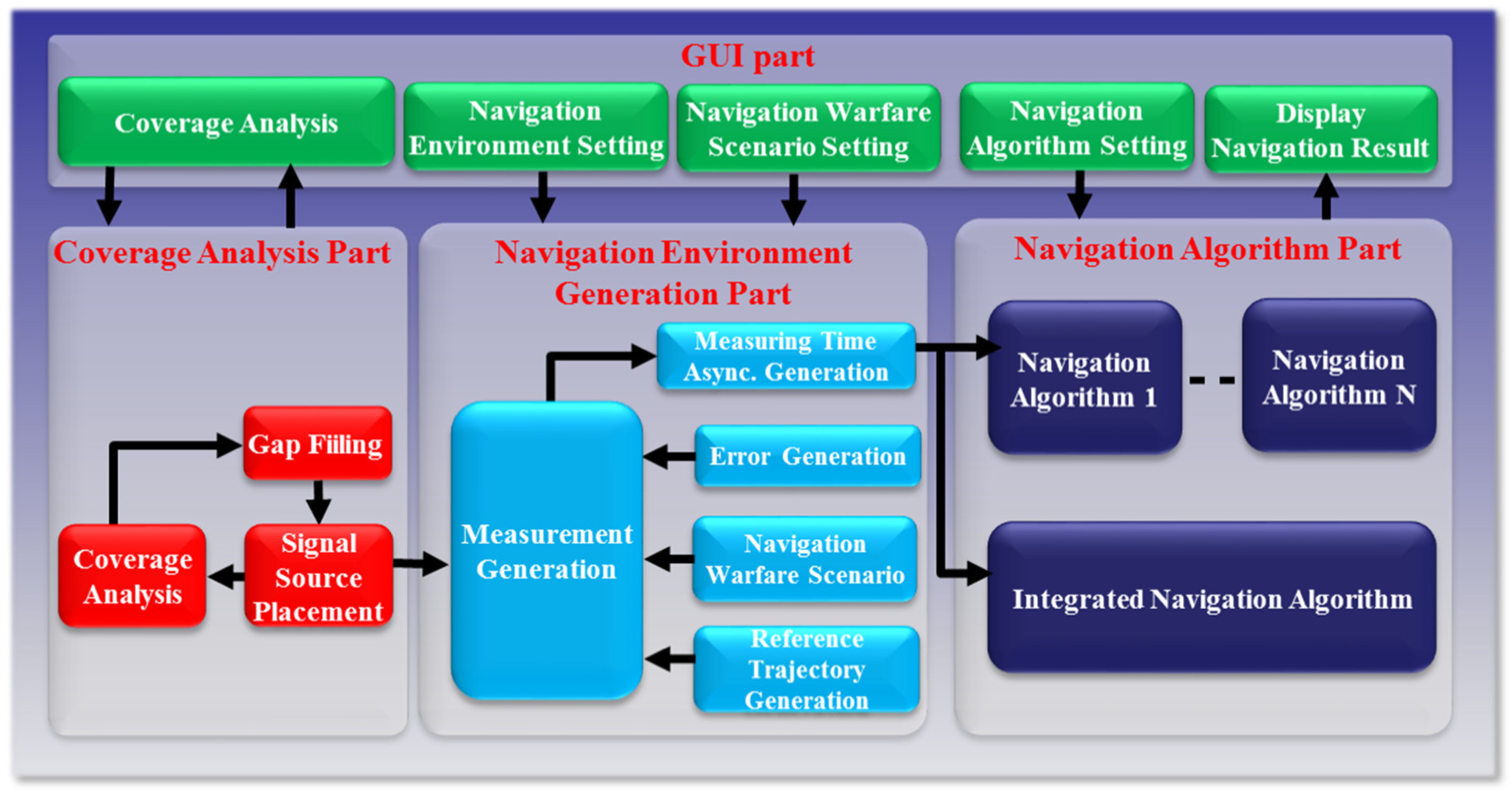
The multi-radio integrated navigation system M&S software should provide various navigation environments and operation scenarios. Measurements for various navigation environments and operation scenarios should be generated to test a multi-radio integrated navigation algorithm. The display for navigation results and internal variables of the M&S software should be provided to developers and operators. If the tested navigation results are not satisfied, new signal sources can be placed through the coverage analysis. Figure 1 is the schematic diagram of the multi-radio integrated navigation M&S software.
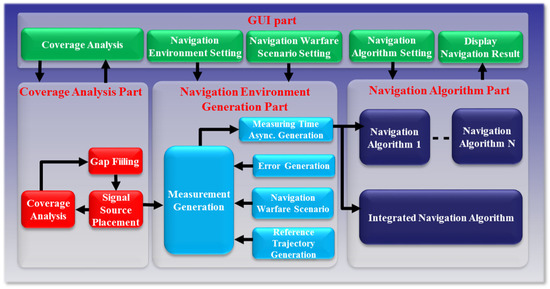
Figure 1.
Schematic diagram of the multi-radio integrated navigation system modeling and simulation (M&S) software.
2.2. Message Broker-Based Software Design Method
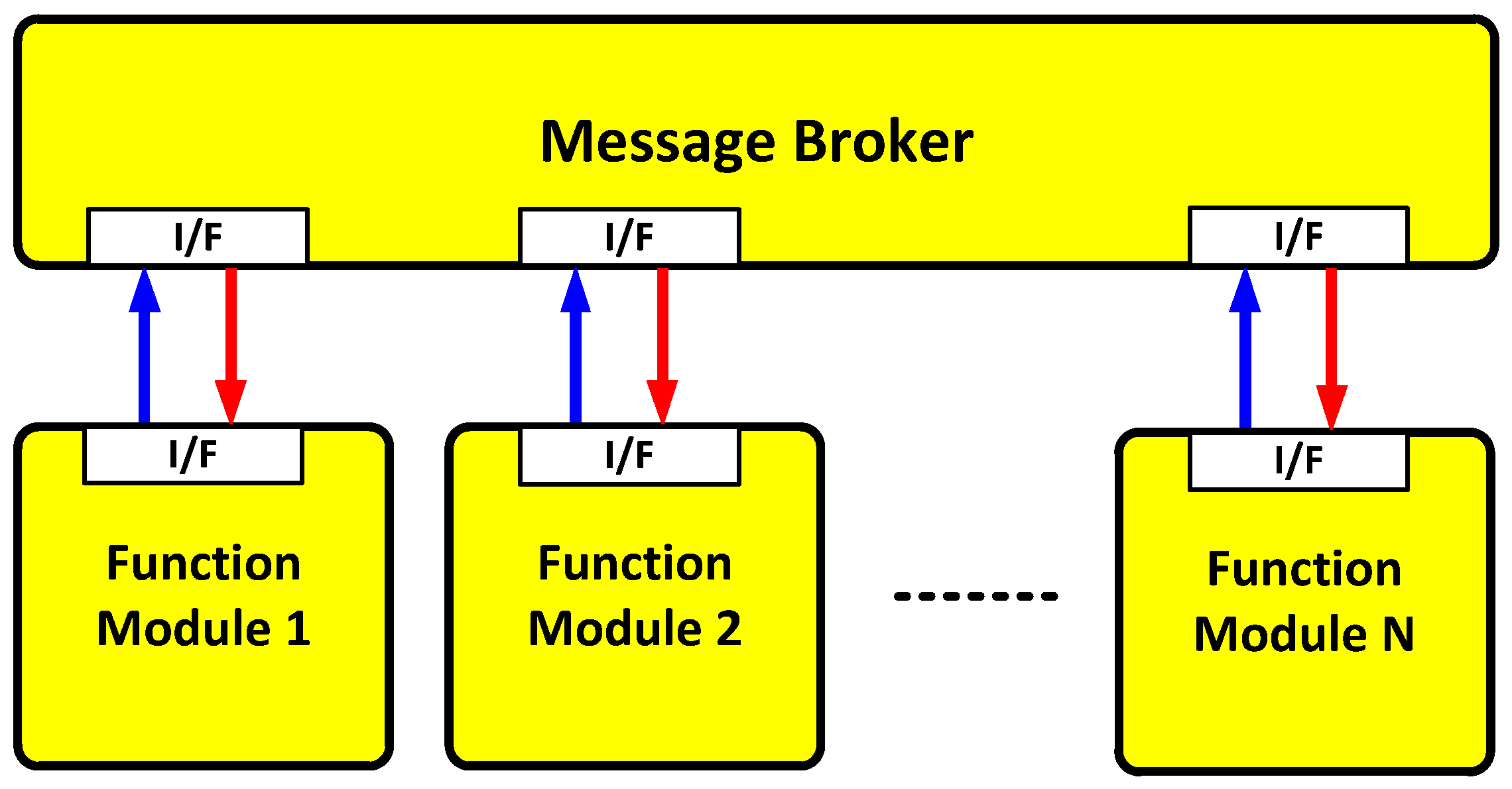
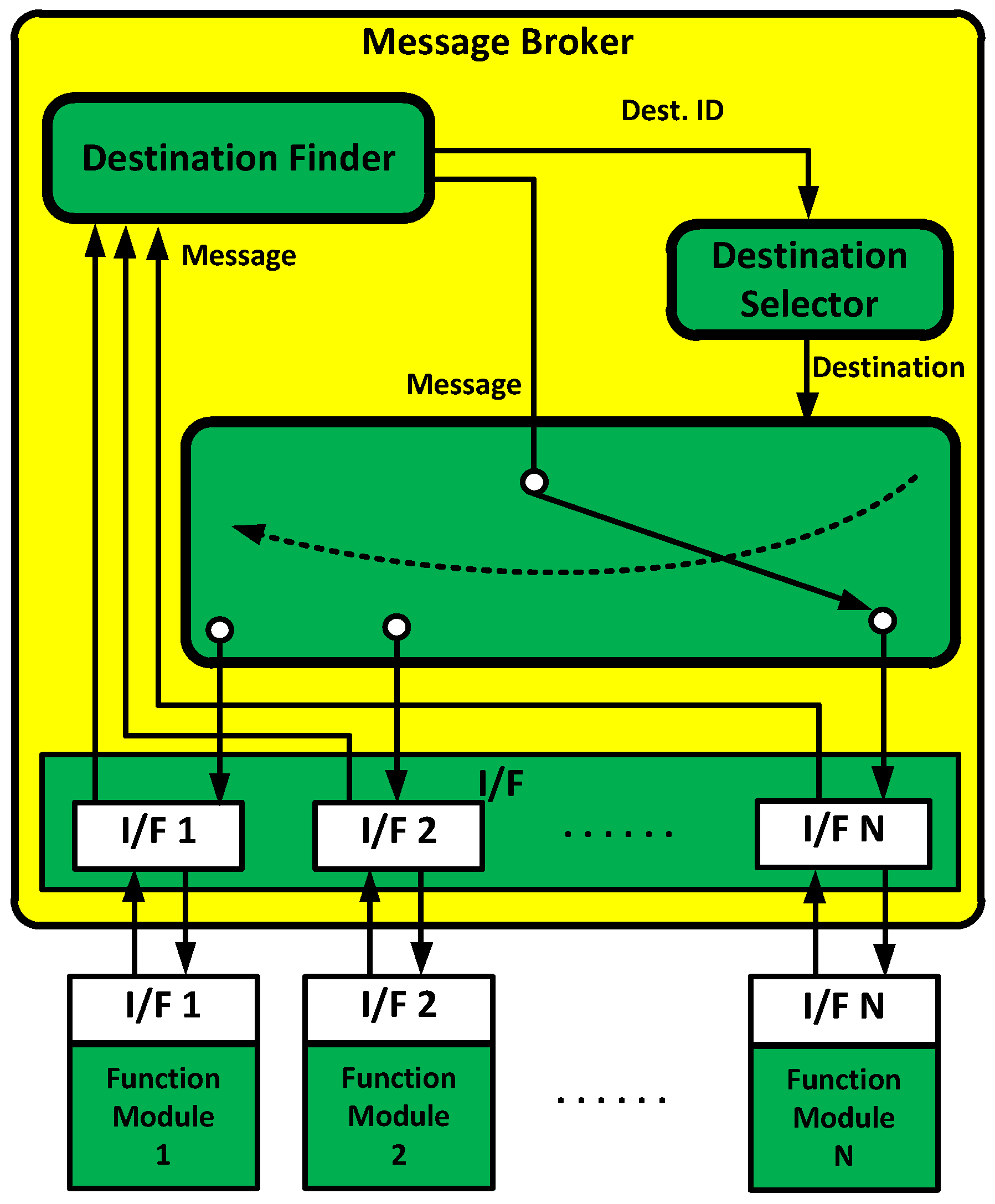
As shown in Figure 2, the message broker-based software consisted of the message broker and the function modules. All the messages were transferred through the message broker in order to be exchanged between the function modules. A complex function with a large size could be easily divided into several modules and the function modules could be connected through the message broker. The message broker had all I/Fs (interfaces) of the function modules. The function module had only one I/F to exchange data with the other function modules. Due to the message broker, each function module did not need to contain all the I/Fs.
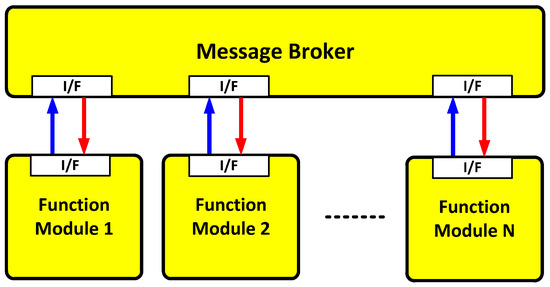
Figure 2.
Diagram of message broker-based software.
2.2.1. Message Broker
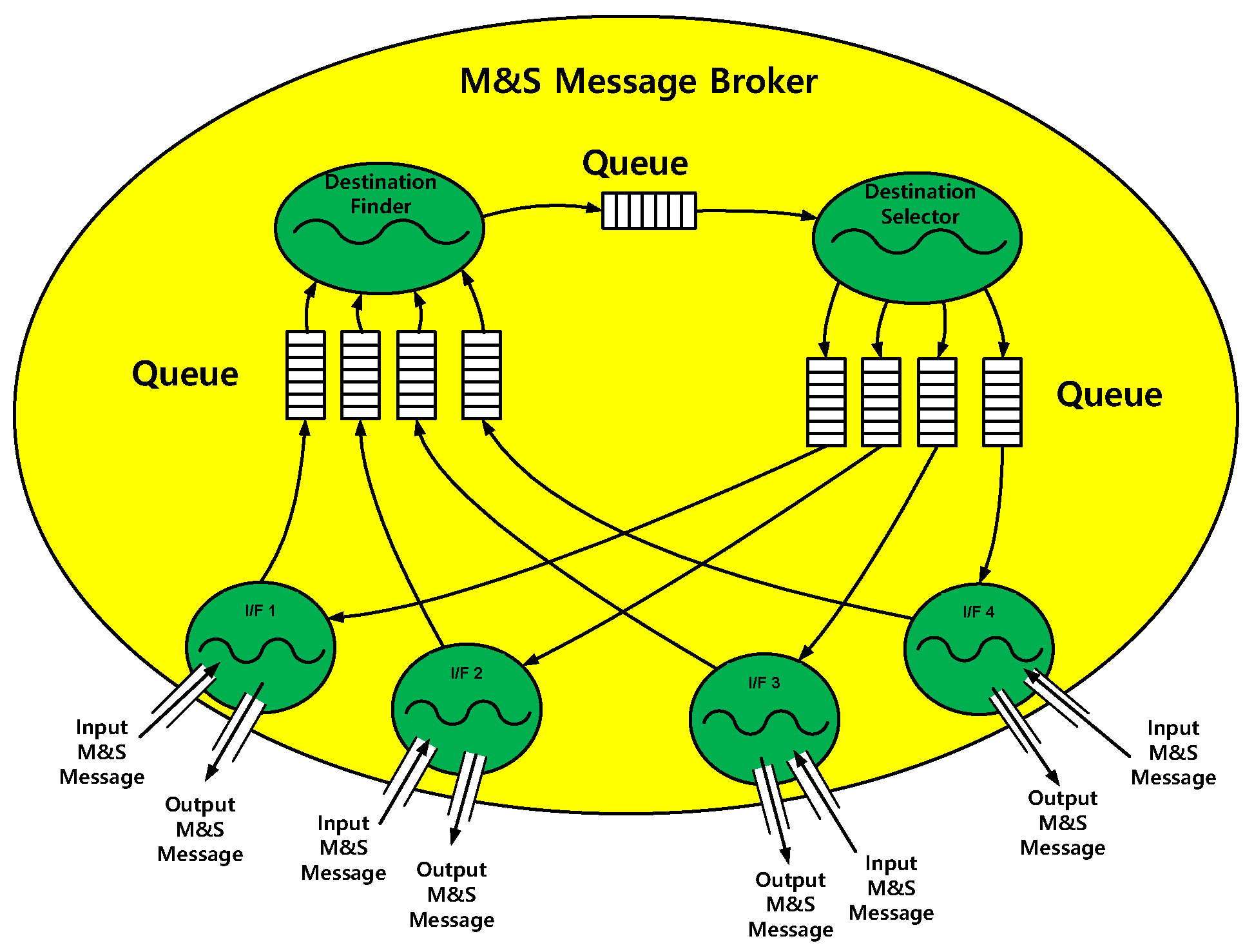
As shown in Figure 3, the message broker consisted of a destination finder, a destination selector, and the I/Fs. The message broker received a message from a function module and interpreted the message. Then the message broker transmitted the message to the destination function module through a corresponding I/F. The source ID, the destination ID, and the data were contained in the message, as shown in Table 1.
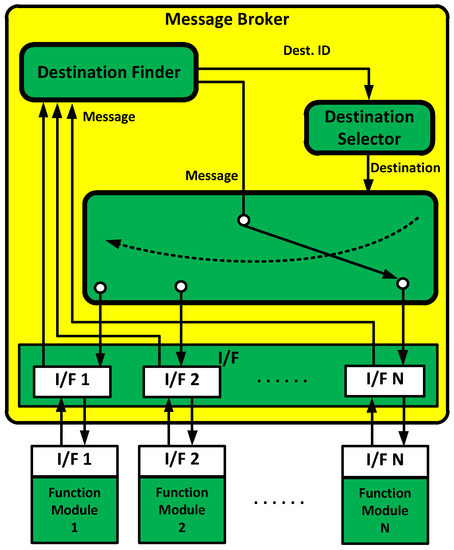
Figure 3.
Diagram of the message broker.

Table 1.
Message structure.
2.2.2. Function Module
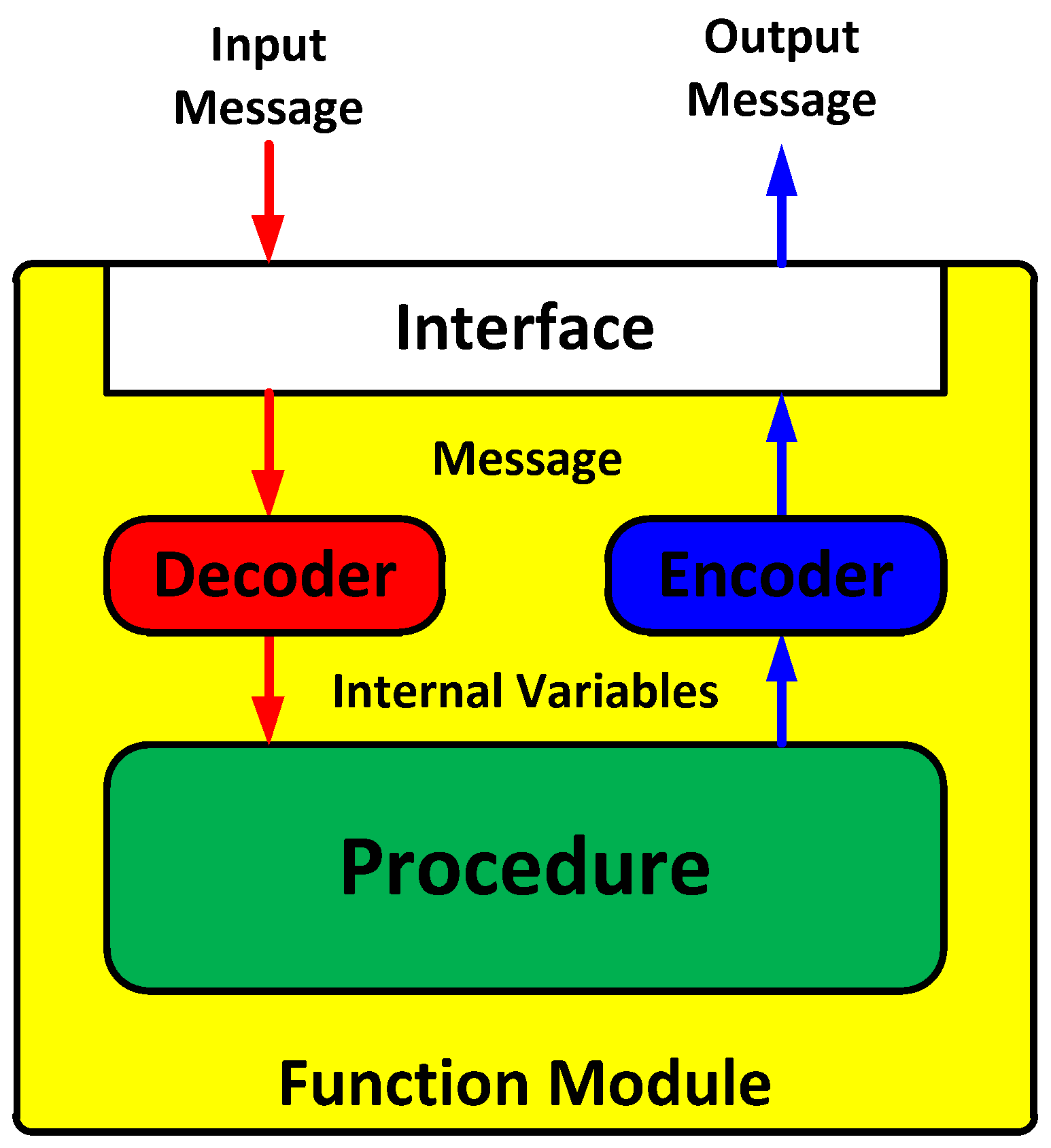
As shown in Figure 4, the function module consisted of an I/F, an encoder, a decoder, and a procedure. The binary data in the received messages were converted into internal variables of the procedure by the decoder. The internal variables were converted into the binary data by the encoder. The procedure was the program code of the function module of the M&S software. Due to the encoder and decoder, each function module did not need to share variables of the procedure with the other function modules. If the operators and/or developers updated the encoder and decoder, developed programs in other platforms could be reused or easily ported in the function module [18,20,24,25].
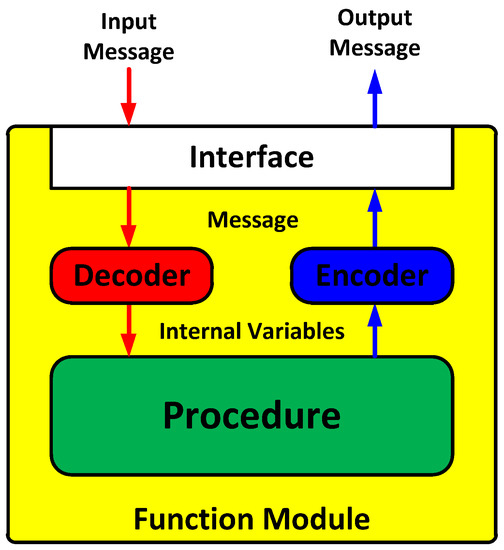
Figure 4.
Diagram of the function module.
2.3. Design of a Message Broker-Based M&S Software for the Multi-Radio Integrated Navigation System
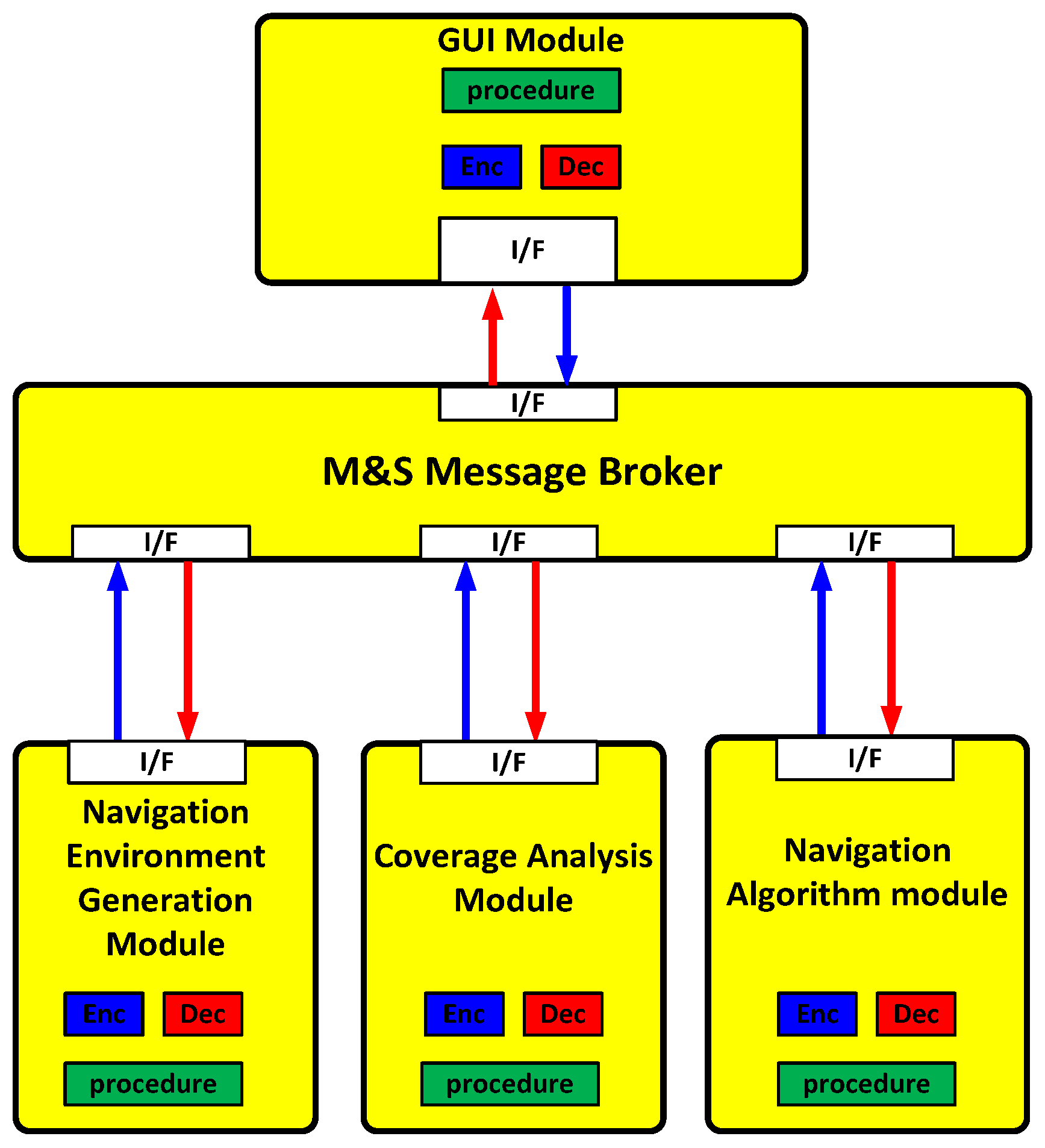
Figure 5 shows the message broker-based M&S software for the multi-radio integrated navigation system. The software consisted of a navigation environment generation module, a navigation algorithm module, a coverage analysis module, and a GUI module. A function module of the message broker-based M&S software design method corresponded to each part of the multi-radio integrated navigation system M&S software (Figure 1).
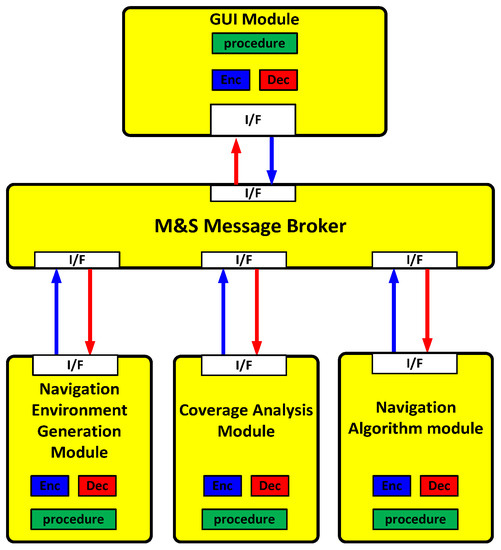
Figure 5.
M&S message broker-based software for multi-radio integrated navigation system.
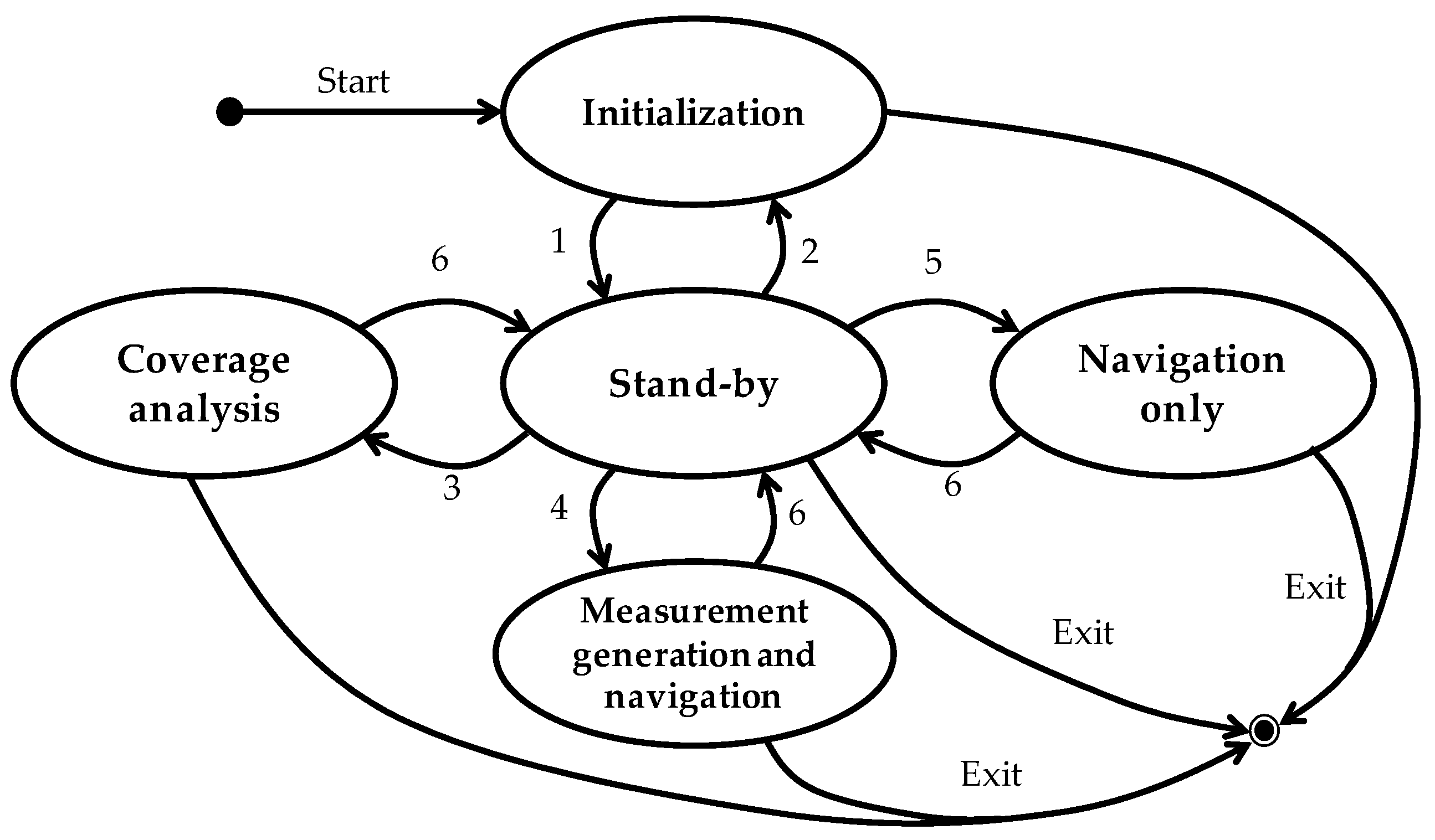
Figure 6 represents the operation of the M&S software for the multi-radio integrated navigation system in the state diagram. The state transition of the state diagram is given in Table 2. Table 3 shows conditions for state transition and flags of state transition. When the M&S program started, the program was in the initialization mode. If the function module parameters were available, the program went to standby mode. Then it went to the coverage analysis mode, the measurement generation and the navigation mode, or the navigation only mode, according to the condition.
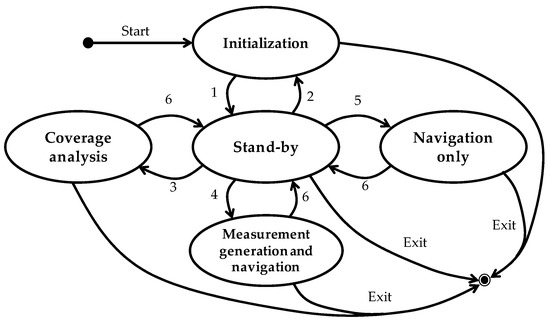
Figure 6.
State diagram of the M&S software for multi-radio integrated navigation system.
Table 2.
State transition.
Table 3.
Condition for state transition.
2.3.1. Navigation Environment Generation Module
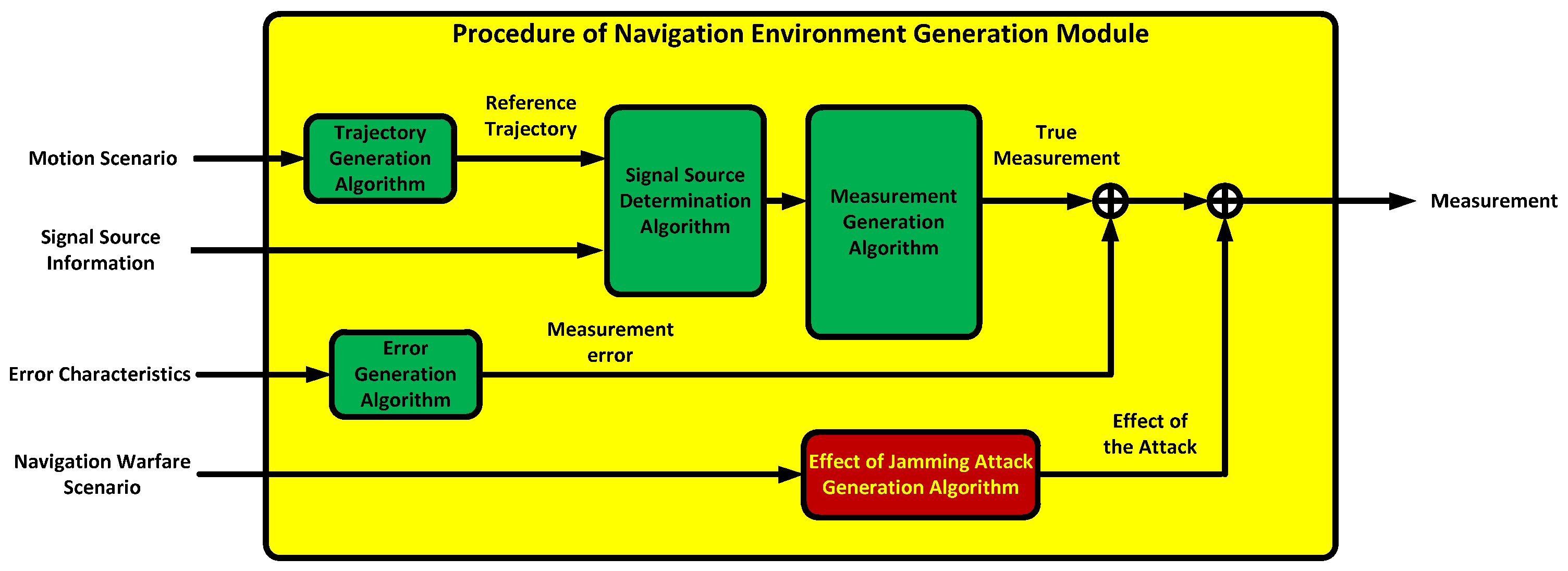
In the navigation environment generation module, the reference trajectory and errors were generated, and signal source visibility was determined. The reference trajectory represented the motion of the vehicle. The position of the vehicle and the navigation signal source determined the visibility of the signal sources. If the signal sources were visible to the vehicle, true measurements were generated and measurement errors were added. If the jammer attacked, the measurements included the effect as an error. Figure 7 shows the navigation environment generation module block diagram.
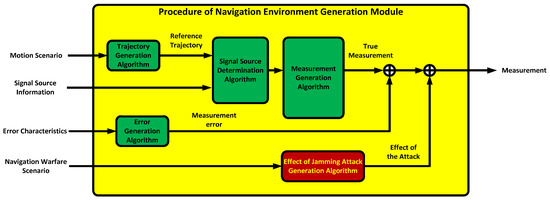
Figure 7.
Navigation environment generation.
In Figure 7, the measurement error of GNSS caused by a setting of parameters jamming attack is modeled as Equation (1).
where and denote the double-sided front-end bandwidth and the code chip rate of GPS receiver, respectively. denotes the speed of light and is the integration time. Carrier power to noise density ratio is given in Equation (2).
where is the effective carrier-to-noise power ratio. The jamming-to-signal power ratio is given in Equation (3).
where , , and denote jammer transmitted power, jammer transmitter antenna gain, and receiver antenna gain toward the jammer, respectively. , , and are the wavelength of the jamming, the distance from the receiver to the jammer, and the signal power at the receiver antenna input, respectively.
2.3.2. Coverage Analysis Module
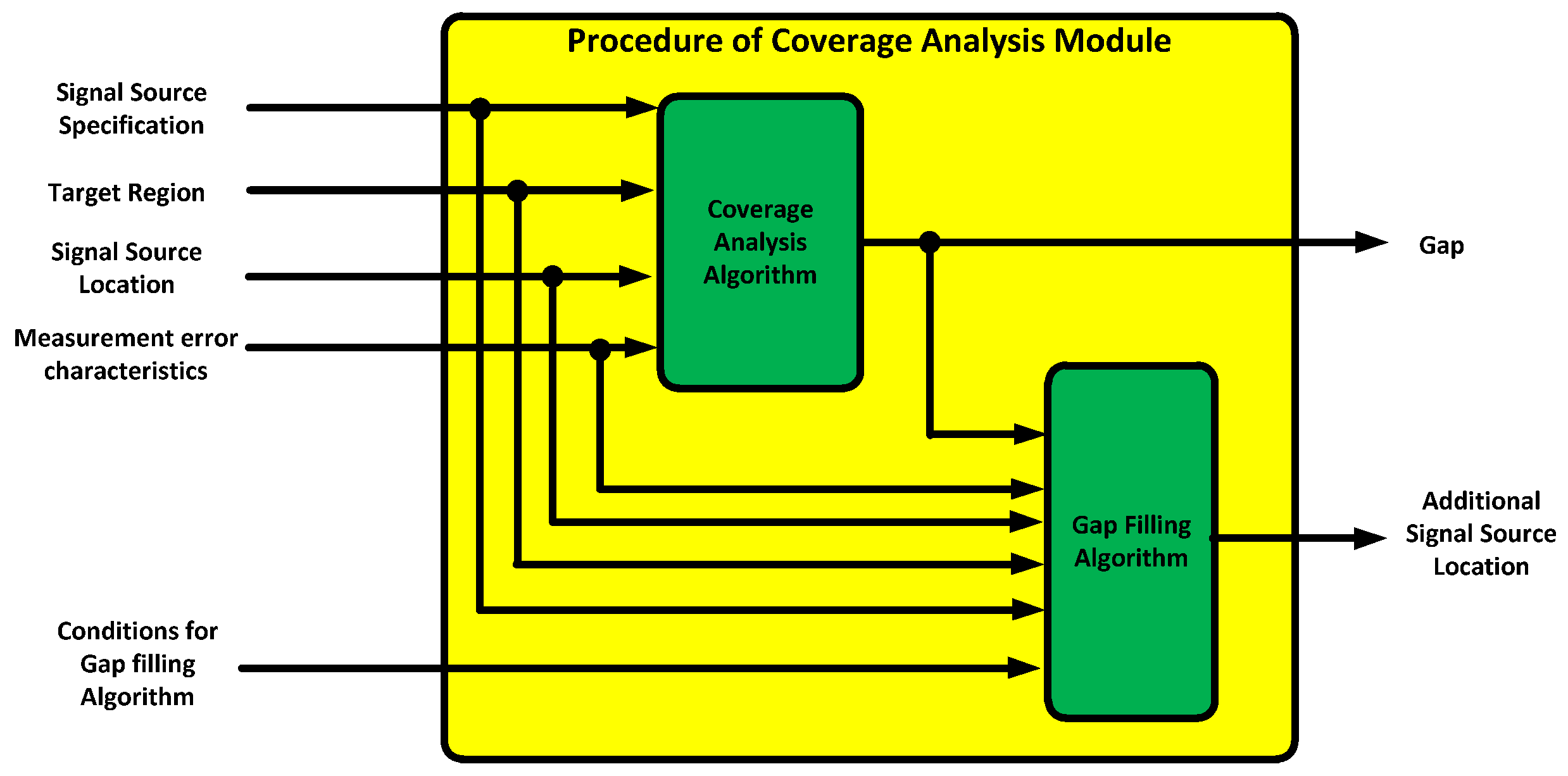
Figure 8 shows the coverage analysis module block diagram. The gap was calculated from the signal source specification, target region, signal source location, and measurement error characteristics in the coverage analysis module. The location for the additional signal source was determined from signal source specification, target region, signal source location, measurement error characteristics, gap, and conditions for gap filling algorithm.
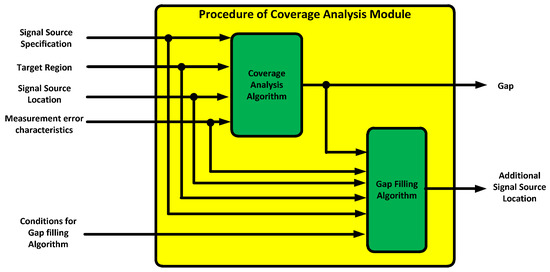
Figure 8.
Coverage analysis.
2.3.3. Navigation Algorithm Module
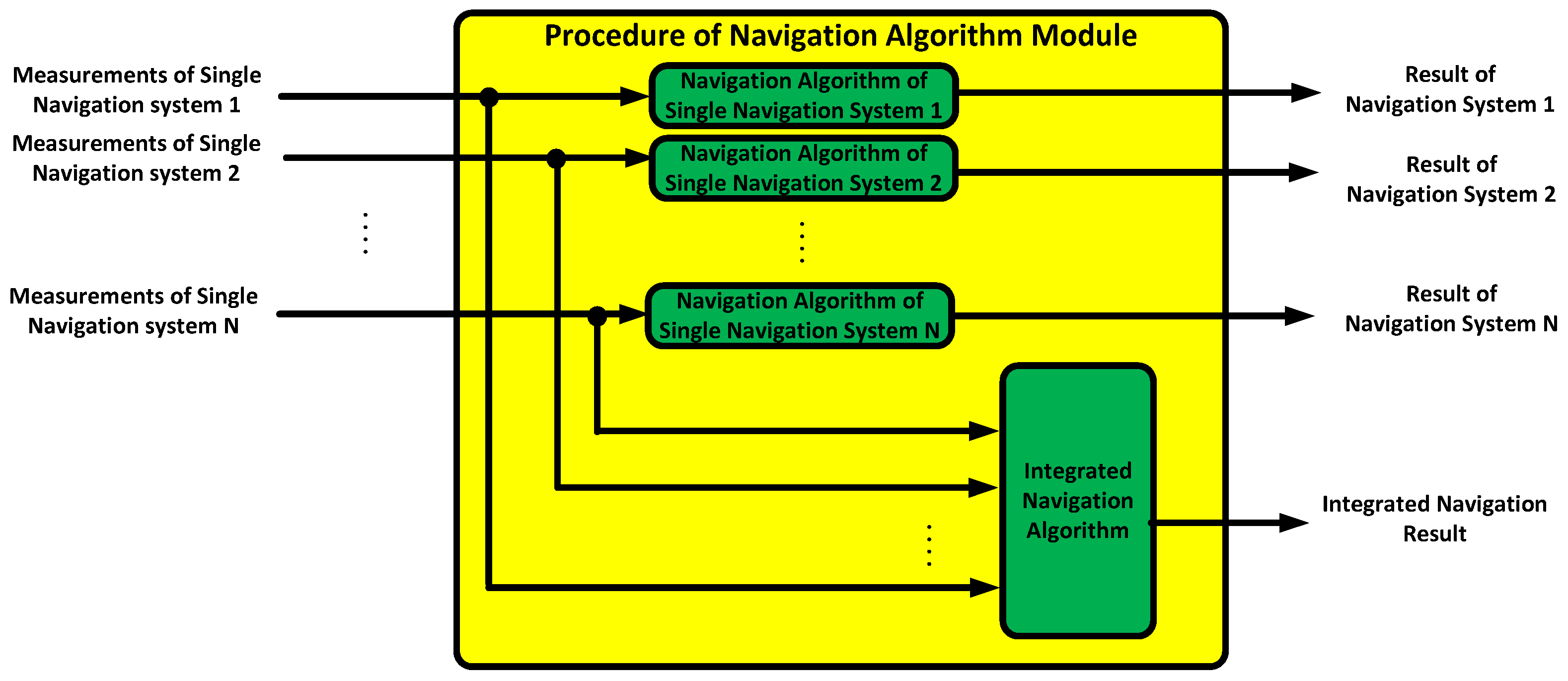
Figure 9 shows the navigation algorithm module block diagram. An integrated navigation algorithm was constructed from radio navigation algorithms. The navigation results could be obtained from the least squares method, the weighted least squares method, and the Kalman filtering method.
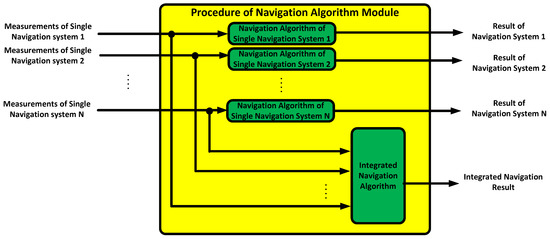
Figure 9.
Navigation algorithm.
2.3.4. GUI Module
The GUI module had displays for the parameter setting. The motion of the vehicle, the signal source information, navigation algorithms, navigation warfare information, and error characteristics could be changed through the setting of parameters. The GUI module displayed the reference trajectory, signal source locations, measurements, navigation results, and coverage analysis results [10].
3. Implementation of the M&S Software
The feasibility of the proposed design method is shown through implementation of the message broker-based multi-radio integrated navigation system M&S software for GPS, KNSS, eLoran, Loran-C and DME/VOR [9,10,26,27,28]. MFC library and sockets were used in the implementation [29,30].
The M&S message broker and function modules were implemented in the tasks. All the tasks included threads and queues, as shown in Table 4. The M&S message broker could be represented in the task, as shown in Figure 10. The function modules could be similarly represented.
Table 4.
Task, thread, and queue in the implementation.
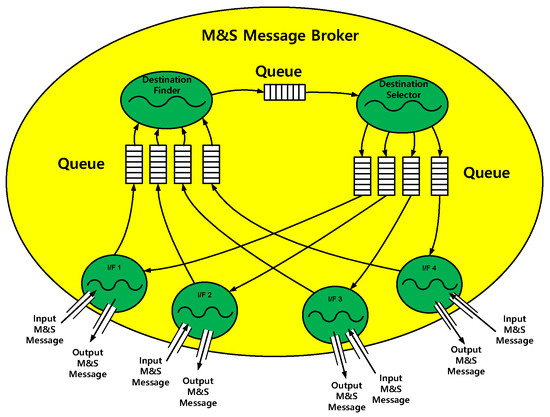
Figure 10.
M&S message broker task.
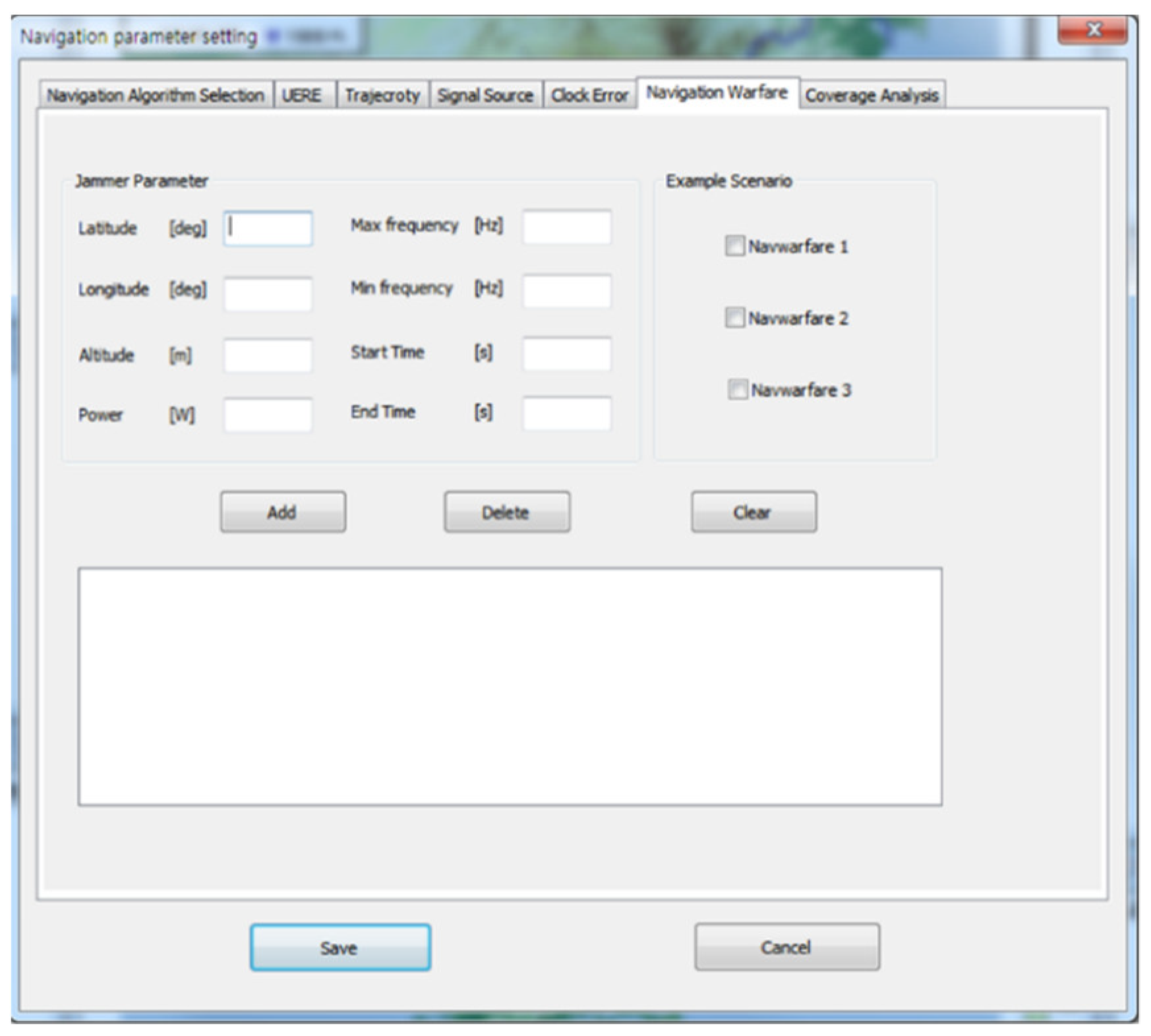
Figure 11 shows the GUI for navigation warfare scenario parameters setting. Initial values and motion types were set. If the load button was clicked, the receiver independent exchange format (RINEX) files of the GPS and the files of the location data of the ground-based navigation system stations were loaded. If the navigation warfare scenario was edited, the location, operating time and power of jammer could be set as in Figure 11.
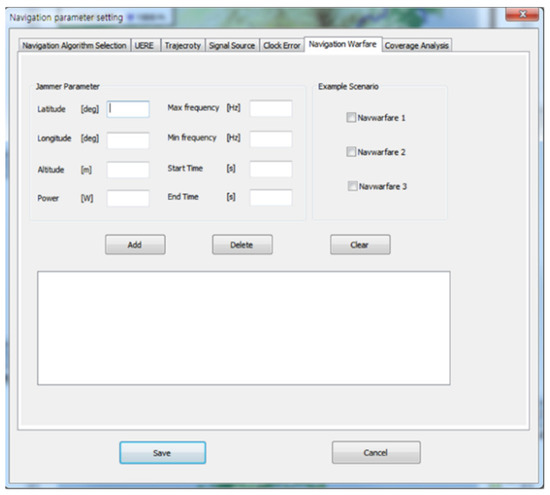
Figure 11.
Graphical user interface (GUI) for navigation warfare scenario parameter setting.
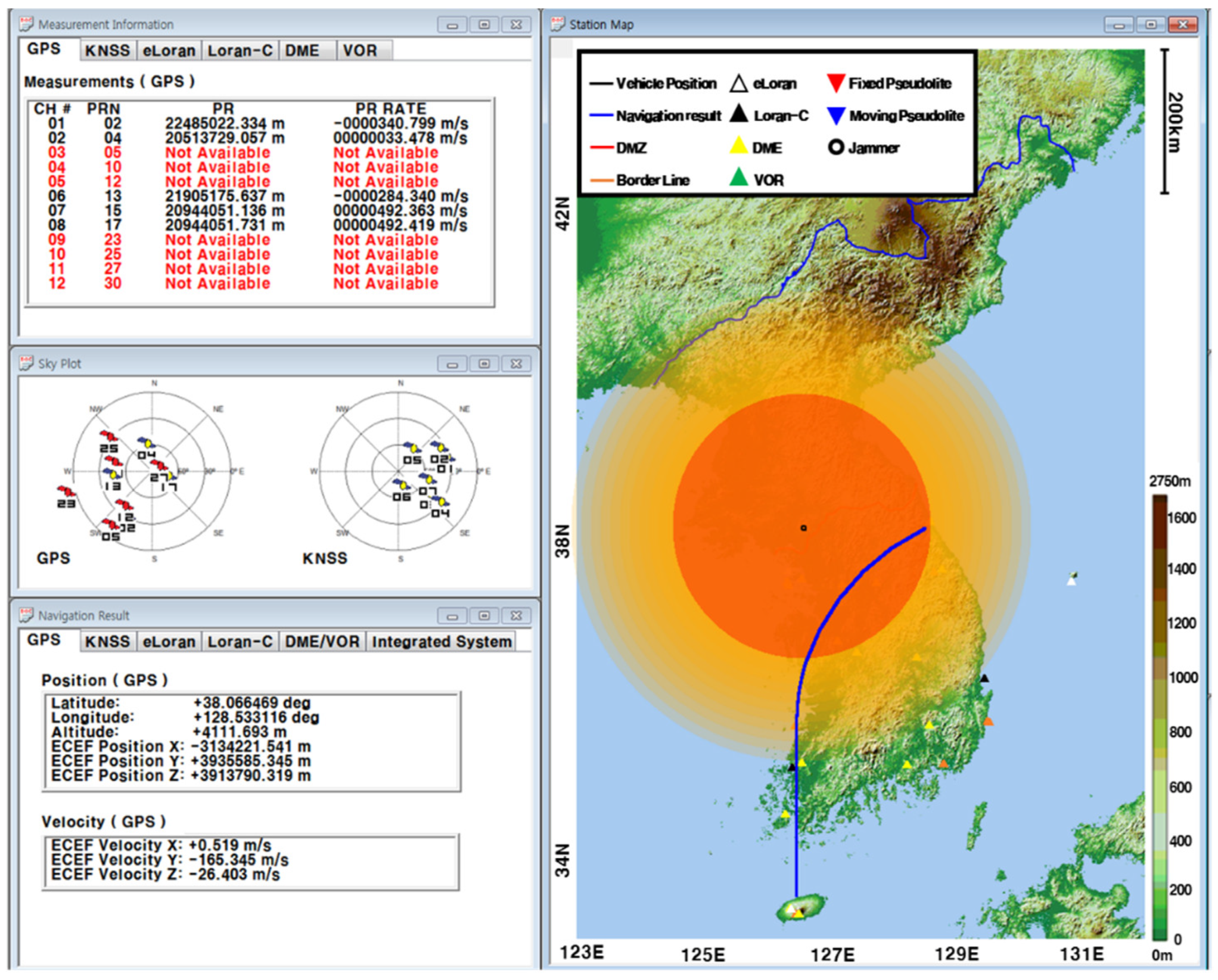
The GUI for measurements, signal sources, navigation results, and navigation warfare situation is shown in Figure 12. The measurements of the navigation systems are shown in the left upper window. The sky plots of the GPS and KNSS satellites are shown in the left middle window. The navigation result of the GPS is shown in the left lower window. The horizontal path of the vehicle, the locations of the ground-based navigation system stations, and the jamming area are shown in the right window.
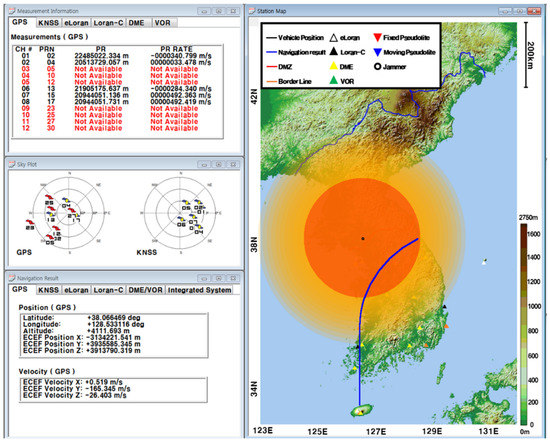
Figure 12.
GUI for measurements, signal sources, navigation results and navigation warfare situation.
4. Performance Evaluation of the Navigation Algorithm through the M&S Software
The performance evaluation was performed for the GPS only navigation system and a multi-radio integrated navigation system under the navigation warfare environment through the proposed M&S software. The measurement errors of the navigation systems in the performance evaluation were assumed to be white noise Gaussian and their standard deviations are listed in Table 5.
Table 5.
Measurement error of navigation system.
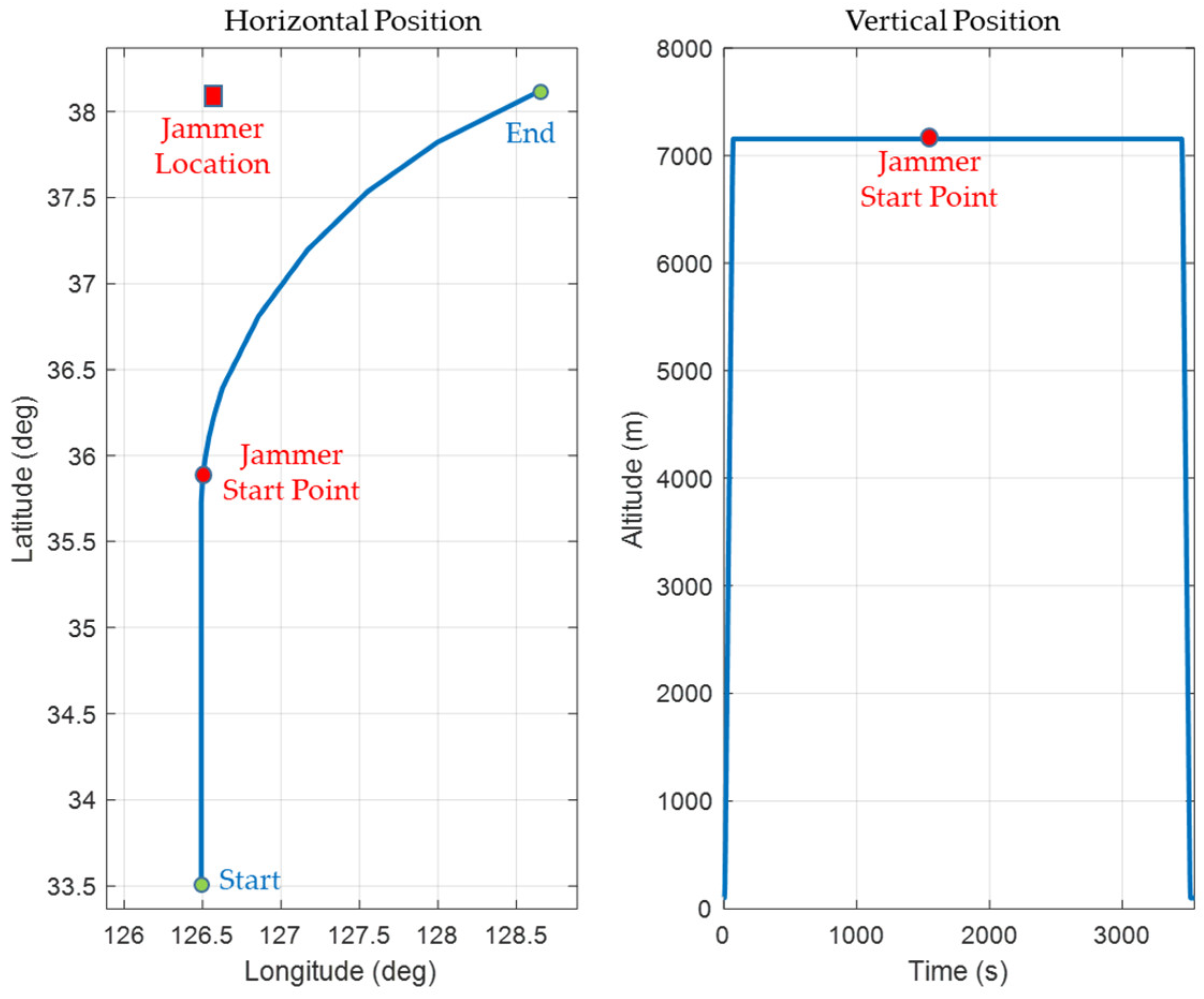
The reference trajectory of the vehicle is shown in Figure 13. The jammer was located in the left of the trajectory, 38.096521 degrees of latitude, 126.576012 degrees of longitude and 300 m of altitude, as shown in Figure 13. The jammer was set to start its operation at 1600 s and end at 3500 s via the navigation warfare scenario parameter setting window, shown in Figure 11. It could be seen that the navigation warfare occurred during the operation of the vehicle. The location and start point of the jammer are shown in Figure 13. For the multi-radio integrated navigation system, the weighted least squares method was used. The weights were determined from the measurement error statistics listed in Table 5. It was assumed that the jammer influenced only the GPS signals. When the J/S (jammer to signal power ratio) was larger than 40 dB, the measurement was not available, since the signals could not be tracked in this environment. When the J/S was less than 40 dB, the measurement error caused by the jammer was added to the measurement.
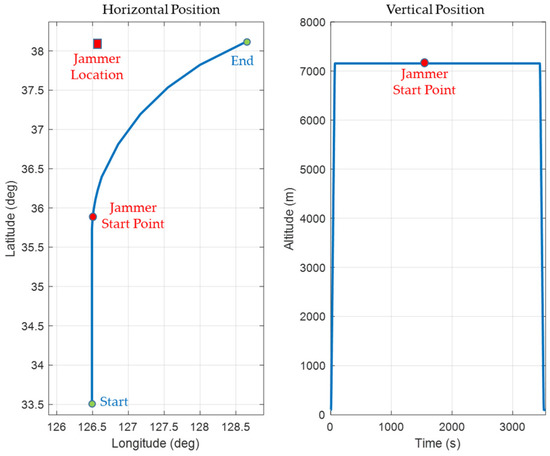
Figure 13.
Reference trajectory for performance evaluation.
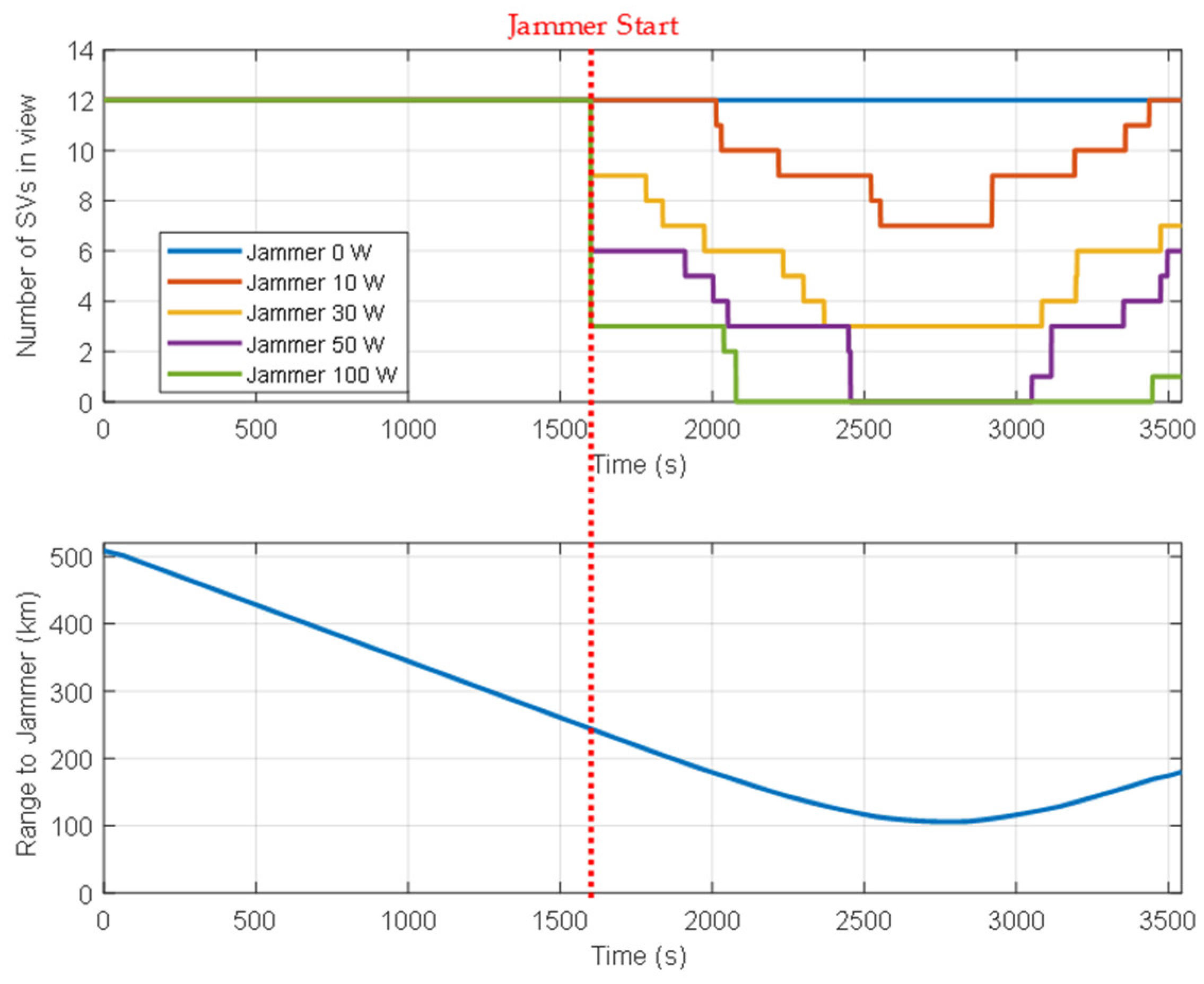
The performance evaluation was performed for 0, 10, 30, 50, and 100 W of jammer power in the navigation warfare environment. For 0, 10, 30, 50, and 100 W of jammer power, the number of satellites in view are shown in the upper graph of Figure 14. The distance from the vehicle to the jammer is shown in the lower graph of Figure 14. It could be seen that the number of satellites in view decreased from 1600 s when the jammer started its operation. At the time around 2750 s, when the distance from the vehicle to the jammer was the shortest, the number of the satellites in view was the least. It could be observed from these test results that the GPS measurement error due to the jammer to the navigation warfare scenario was well modeled.
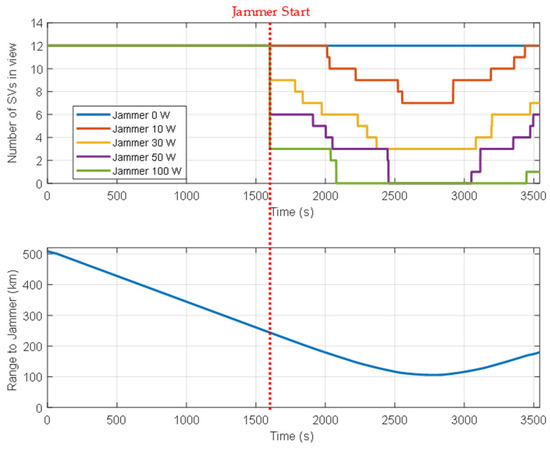
Figure 14.
Variations of the number of satellites in view and distance between vehicle and jammer.
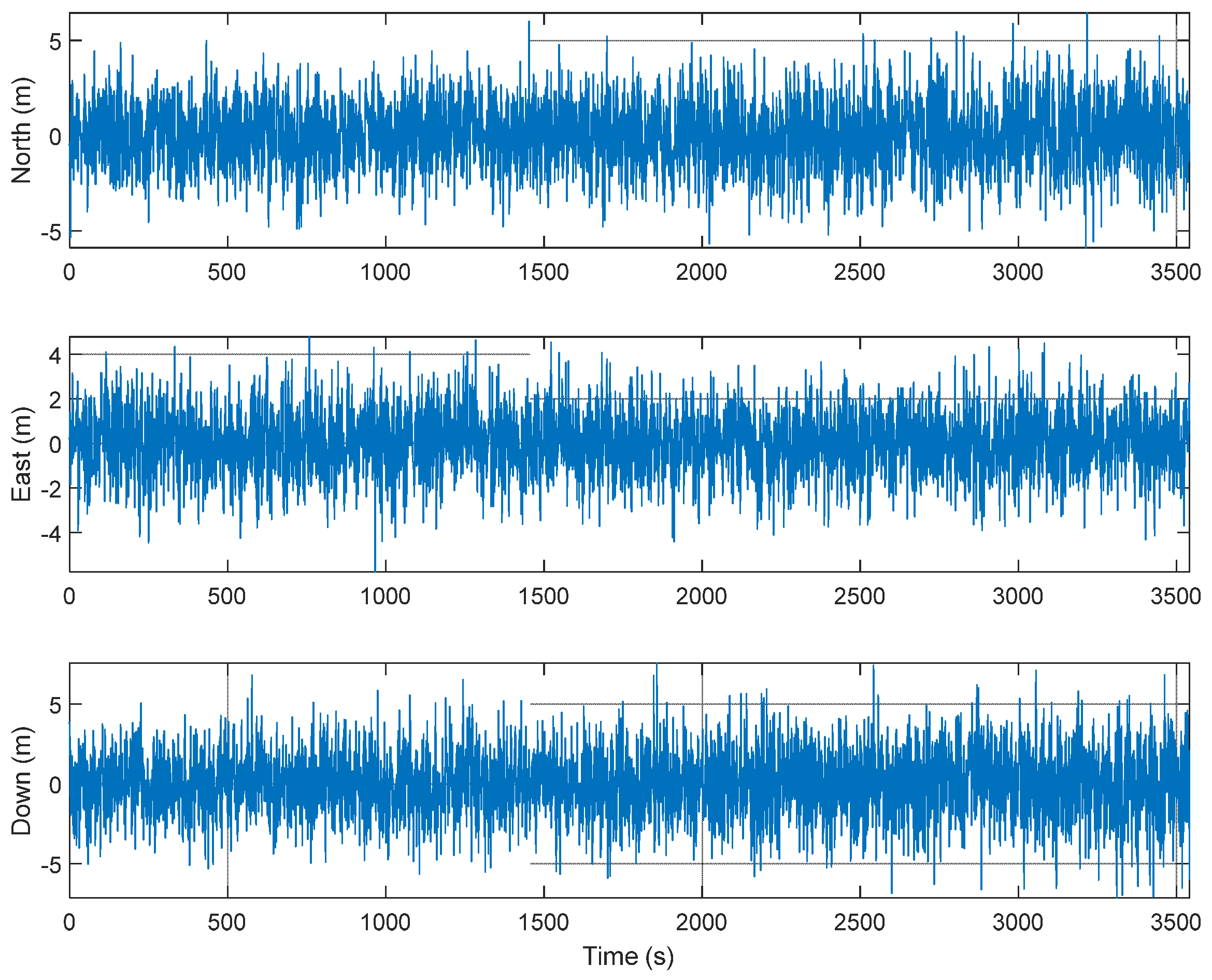
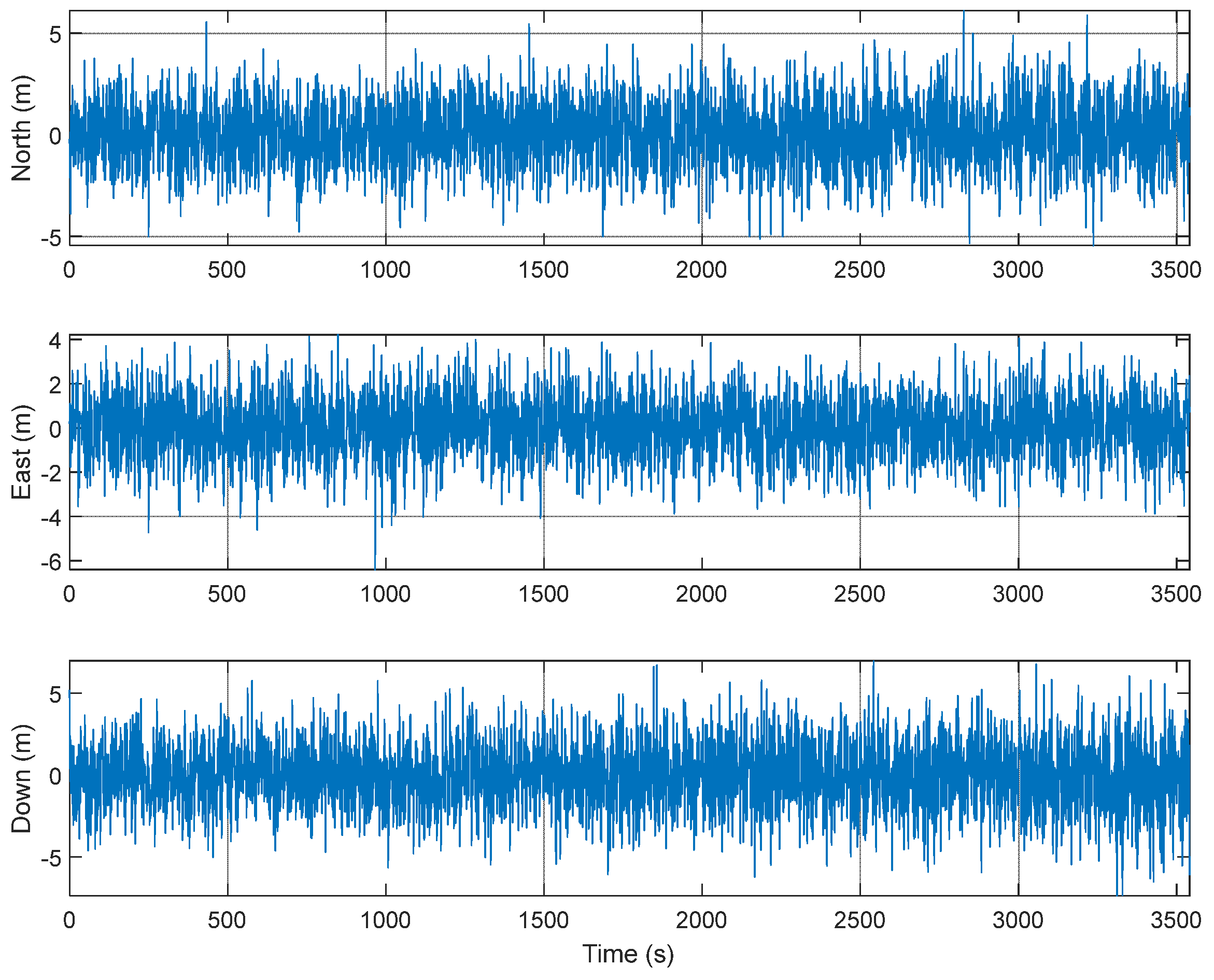
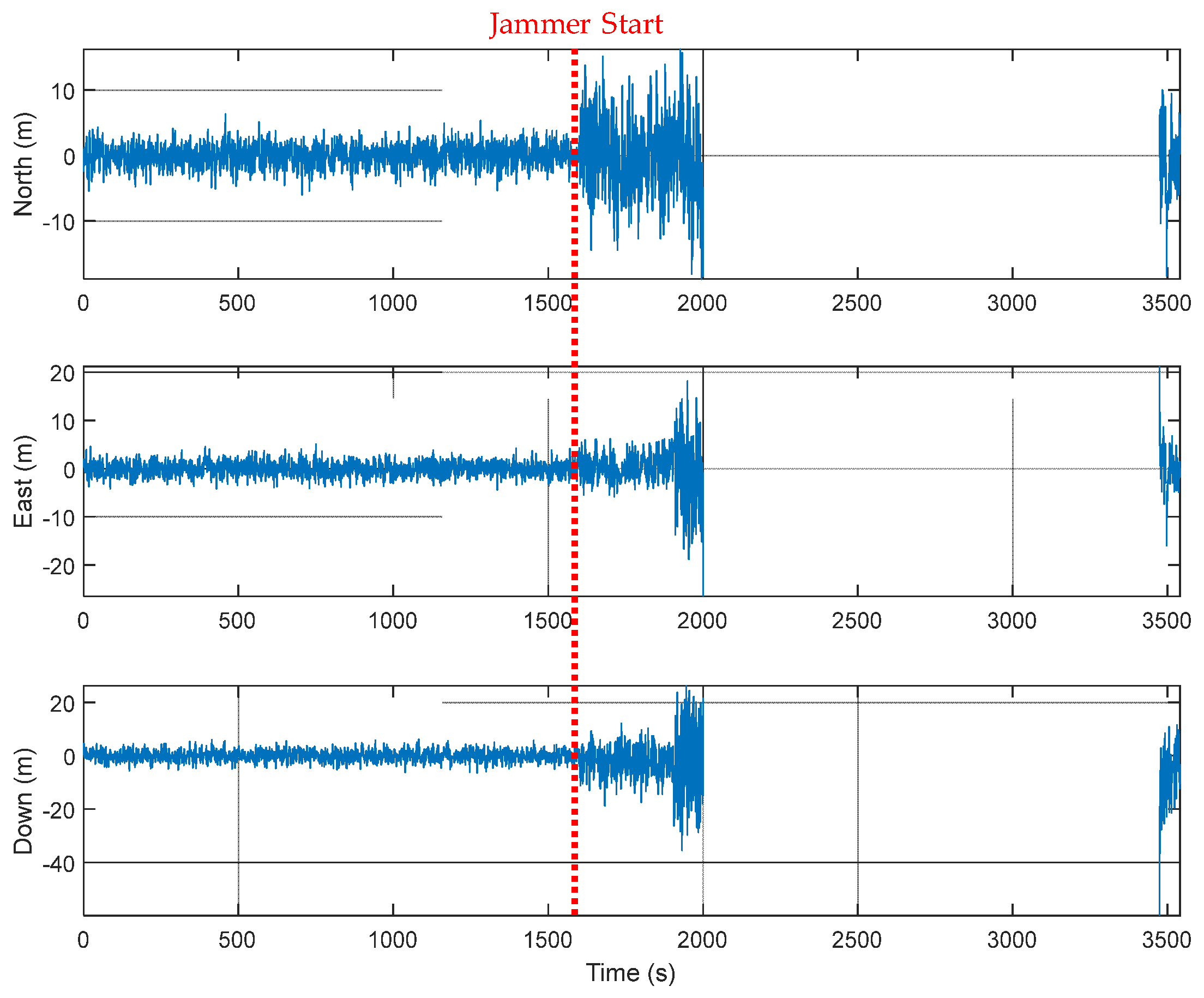
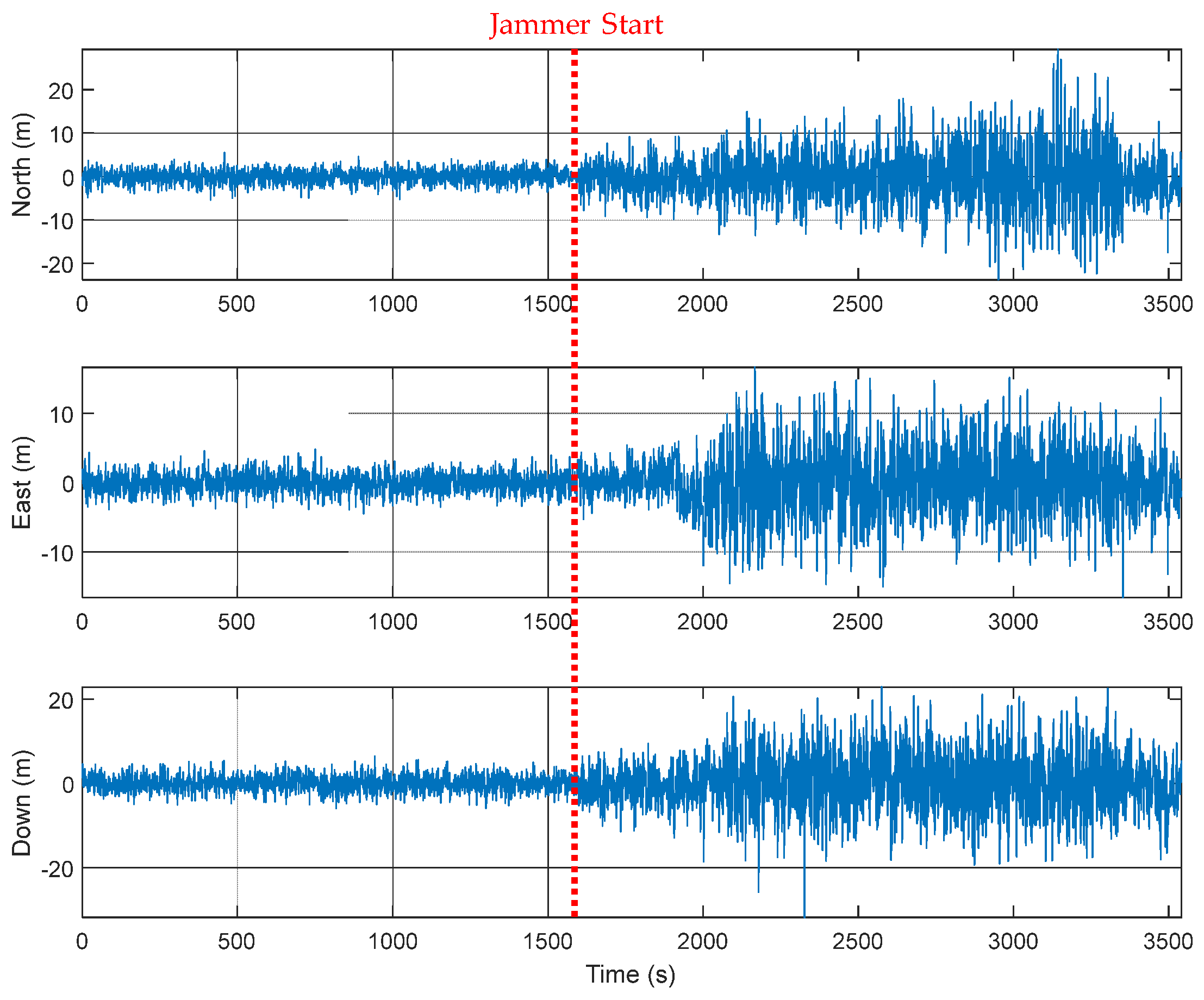
The position errors of GPS only navigation and the multi-radio integrated navigation system are shown in Figure 15, Figure 16, Figure 17 and Figure 18 for the cases of 0 and 50 W of jammer power. In the case of the GPS only navigation, it was regarded that the normal navigation outputs could be obtained only when PDOP (position dilution of precision) was less than 10. The position errors are shown in Figure 15 and Figure 16 when there was no jammer. The performance of the multi-radio integrated navigation system in Figure 16 was similar to that of the GPS only navigation when the GPS was available. This can be easily expected since the measurements of GPS are more accurate than those of other navigation systems, as in Table 5. The position errors for the case of 50 W of jammer power are shown in Figure 17 and Figure 18. It can be seen from Figure 17 that the position error increased from the time when the jammer started, and the navigation outputs were not obtained from the time when the number of satellites in view was less than four (Figure 14). It can also be seen that the navigation results could be obtained from the time of 3470 s when the number of satellites in view became more than four. It can be seen from Figure 18 that the multi-radio integrated navigation system could provide the continuous navigation output due to the use of the KNSS navigation system and the ground-based radio navigation systems.
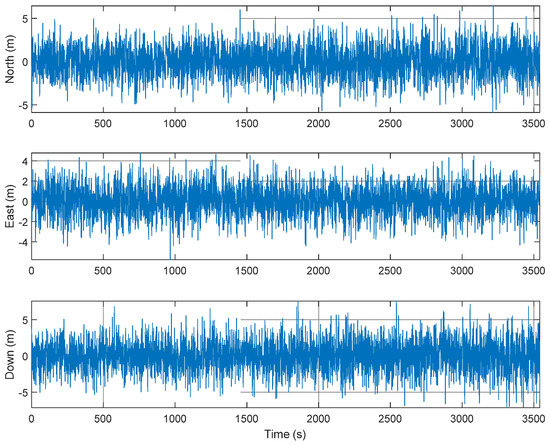
Figure 15.
Position error of GPS only navigation with a 0 W jammer.
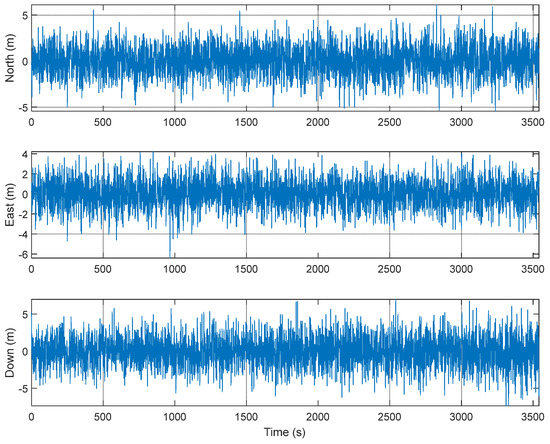
Figure 16.
Position error of multi-radio integrated navigation with a 0 W jammer.
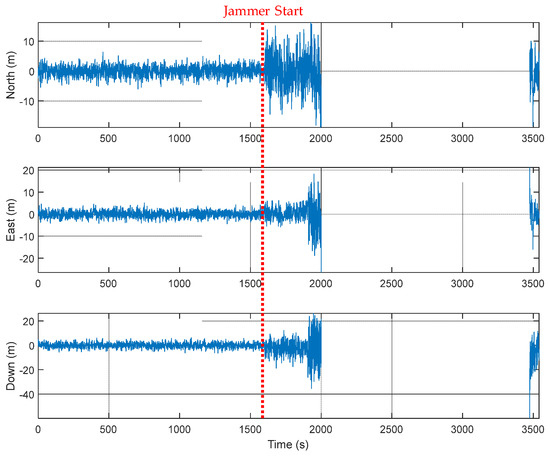
Figure 17.
Position error of GPS only navigation with a 50 W jammer.
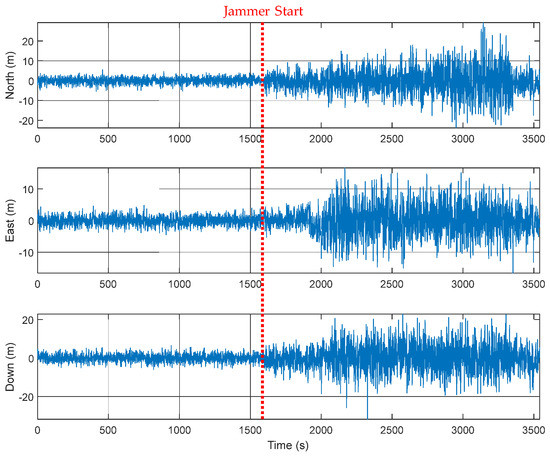
Figure 18.
Position error of multi-radio integrated navigation with a 50 W jammer.
For the variations of jammer power, results of GPS only navigation and the multi-radio navigation system are listed in Table 6. The availability in Table 6 means the percentage value of the time interval in which the navigation outputs could be obtained to the whole mission time interval. It could be observed from the results of the GPS only navigation in Table 6 that the position errors increased as the jammer power increased from 0 to 50 W and decreased at 100 W. This decrease was caused by the fact that the navigation error was not included in the calculation when the number of satellites in view was less than four or the PDOP was greater than 10. It could also be observed in Table 6 that the availability of the GPS only navigation decreased as the jammer power increased. On the other hand, it could be seen that the multi-radio integrated navigation provided 100% of the availability, even though the power of the jammer increased. It can also be observed from the results of the multi-radio integrated navigation system in Table 6 that the position errors increased as the jammer power increased. This was due to the fact that the time interval, at which the GPS measurements were not available, increased as the power of the jammer increased. It could be seen from the test results that the performance evaluation of the multi-radio integrated navigation algorithm under the navigation warfare environment could be effectively carried out through the proposed M&S S/W (software) design method.
Table 6.
Comparison of position error and availability result.
5. Concluding Remarks and Further Studies
An M&S software design method was proposed for multi-radio integrated navigation systems as a GNSS backup under navigation warfare. The M&S software in the proposed design method consisted of a message broker and function modules. A message broker-based M&S software was designed for a multi-radio integrated navigation system. In order to show the feasibility of the proposed design method, the M&S software was implemented for GPS, KNSS, eLoran, Loran-C, and DME/VOR and the performance evaluation was carried out. The results showed that the multi-radio integrated navigation system provides navigation results continuously, even when the GPS only navigation system cannot provide navigation results, due to the jamming under a navigation warfare environment.
In further studies, additional ground stations and fixed/moving pseudolites will be included, which are newly assigned by the coverage analysis module in the M&S software. Performance evaluations of the M&S software based on integrity and continuity will be performed.
Author Contributions
Conceptualization, S.H.O, H.S. and D.-H.H.; software, H.K. and J.L.; supervision, D.-H.H.; validation, H.S.; writing—original draft, H.K., J.L., S.H.O. and D.-H.H.; writing—review & editing, D.-H.H.
Funding
This research was funded by the National GNSS Research Center Program of Defense Acquisition Program Administration and Agency for Defense Development.
Acknowledgments
This work has been supported by the National GNSS Research Center Program of Defense Acquisition Program Administration and Agency for Defense Development.
Conflicts of Interest
The authors declare no conflict of interest.
References
- Merriam Webster. The Merriam-Webster Dictionary, 11th ed.; Merriam Webster Inc.: Springfield, VR, USA, 2008; ISBN 978-0877792956. [Google Scholar]
- Department of Defense, Department of Homeland Security, and Department of Transportation. Federal Radio Navigation Plan 2017; National Technical Information Service: Springfield, VR, USA, 2017; pp. 16–217.
- Kaplan, E.D.; Hegarty, C.J. Understanding GPS/GNSS: Principles and Applications, 3rd ed.; Artech House: Boston, FL, USA, 2017; ISBN 978-1-63081-058-0. [Google Scholar]
- White, N.A.; Maybeck, P.S.; DeVilbiss, S.L. Detection of interference/jamming and spoofing in a DGPS-aided inertial system. IEEE Trans. AES 1998, 34, 1208–1217. [Google Scholar] [CrossRef]
- Grove, P.D. Principles of GNSS, Inertial, and Multisensor Integrated Navigation Systems, 2nd ed.; Artech House: Boston, FL, USA, 2013; ISBN 978-1-60807-005-3. [Google Scholar]
- Available online: http://www.dtic.mil/dtic/tr/fulltext/u2/a470386.pdf (accessed on 21 December 2018).
- Eldredge, L.; Enge, P.; Harrison, M.; Kenagy, R.; Lo, S.; Loh, R.; Lilly, R.; Narins, M.; Niles, R. Alternative positioning, navigation & timing (PNT) study. In Proceedings of the International Civil Aviation Organization Navigation Systems Panel (NSP) Working Group Meetings, Montreal, QC, Canada, 11–27 May 2010; pp. 1–19. [Google Scholar]
- Lo, S.; Enge, P.; Niles, F.; Loh, R.; Eldredge, L.; Narins, M. Preliminary assessment of alternative navigation means for civil aviation. In Proceedings of the 2010 International Technical Meeting of the Institute of Navigation, San Diego, CA, USA, 25–27 January 2010; Institute of Navigation: Manassas, VR, USA, 2010; pp. 314–322. [Google Scholar]
- Kee, C.; Lee, Y.J.; Hwang, D.-H. Final Report of National GNSS Research Center Satellite Navigation System Architecture Laboratory 2nd Phase; Agency for Defense Development: Daejeon, Korea, 2015; pp. 8–439. [Google Scholar]
- Kee, C.; Lee, Y.J.; Hwang, D.-H. Intermediate Report of National GNSS Research Center Satellite Navigation System Architecture Laboratory 3rd Phase; Agency for Defense Development: Daejeon, Korea, 2017; pp. 116–232. [Google Scholar]
- Choi, M.; Won, D.; Jeon, H.; Kim, D.; Sung, S.; Lee, Y.J. Navigation performance analysis according to the Korean navigation satellite system of bit design elements. In Proceedings of the 2012 KSASS Autumn Conference, Jeju, Korea, 14–16 November 2012; Korea Society for Aeronautical & Space Sciences: Seoul, Korea, 2012; pp. 626–630. [Google Scholar]
- Choi, M.; Won, D.; Sung, S.; Lee, J.; Kim, J.; Lee, Y.J. Korean navigation satellite system orbit design and navigation performance analysis. In Proceedings of the 2013 KSASS Spring Conference, Gangwon-do, Korea, 10–12 April 2013; Korea Society for Aeronautical & Space Sciences: Seoul, Korea, 2012; pp. 645–649. [Google Scholar]
- Koo, M.; Kim, Y.; Choi, K.H.; So, H.; Oh, S.H.; Kim, S.C.; Lee, H.-K.; Hwang, D.-H. M&S software design of multiple radio positioning integration system. J. Korea Inst. Mil. Sci. Technol. 2015, 18, 602–611. [Google Scholar] [CrossRef]
- Koo, M.; Kim, Y.; So, H.; Oh, S.H.; Kim, S.C.; Hwang, D.-H. Modeling & Simulation Software Design for Coverage Analysis of Multiple Radio Positioning Integration System. J. Position Navig. Timing 2016, 5, 47–57. [Google Scholar] [CrossRef]
- Lee, J. The Theory and Practice for Modeling and Simulation as a Transformation Enabler for Efficient Defense Management; KRIMA: Seoul, Korea, 2008; pp. 150–185. ISBN 978-8-98764-741-8. [Google Scholar]
- Dalle, O.; Ribault, J.; Himmelspach, J. Design consideration for M&S software. In Proceedings of the 2009 IEEE Winter Simulation Conference, Austin, TX, USA, 13–16 December 2009; Rossetti, M., Hill, R.R., Johansson, B., Eds.; IEEE: New York, NY, USA, 2012; pp. 944–955. [Google Scholar] [CrossRef]
- Maria, A. Introduction to modeling and simulation. In Proceedings of the 1997 IEEE Winter Simulation Conference, Atlanta, GR, USA, 7–10 December 1997; Andradottir, S., Healy, K.J., Withers, D.H., Nelson, B.L., Eds.; IEEE: New York, NY, USA, 2012; pp. 7–13. [Google Scholar] [CrossRef]
- Norman, R.J. CORBA and DCOM: Side by side. Distrib. Comput. 1998, 1, 41–45. [Google Scholar]
- Sullivan, K.J.; Griswold, W.G.; Cai, Y.; Hallen, B. The structure and value of modularity in software design. In Proceedings of the 8th European Software Engineering Conference, Vienna, Austria, 10–14 September 2010; ACM: New York, NY, USA, 2010; pp. 99–108. [Google Scholar]
- Leye, S.; Himmelspach, J.; Uhrmacher, A.M. A discussion on experimental model validation. In Proceedings of the 2009 IEEE 11th International Conference on Computer Modelling and Simulation, Cambridge, UK, 25–27 March 2009; AI-Dabass, D., Orsoni, A., Brentnall, A., Abraham, A., Zobel, R., Eds.; IEEE Computer Society: Washington, DC, USA, 2009; pp. 161–167. [Google Scholar] [CrossRef]
- Lee, J.; Kim, H.; Hwang, D.-H.; Oh, S.H.; So, H. Multi-radio integrated navigation system M&S software design for GNSS back-up. In Proceedings of the Position, Location and Navigation Symposium 2018, Monterey, CA, USA, 23–26 April 2018; IEEE: New York, NY, USA, 2018; pp. 1026–1033. [Google Scholar] [CrossRef]
- Kim, E. Hybrid APNT architecture using DME/DME and multilateration. In Proceedings of the Digital Avionics Systems Conference (DASC) 2012, Indianapolis, IN, USA, 14–18 October 2012; IEEE: New York, NY, USA, 2012; pp. 1–16. [Google Scholar] [CrossRef]
- Kim, E. Investigation of APNT optimized DME/DME network using current state-of-the-art DMEs. In Proceedings of the Position, Location and Navigation Symposium 2012, Myrtle Beach, SC, USA, 23–26 April 2012; IEEE: New York, NY, USA, 2012; pp. 146–157. [Google Scholar] [CrossRef]
- Zeigler, B.P.; Sarjoughian, H.S. Creating distributed simulation using DEVS M&S environments. In Proceedings of the 2000 IEEE Winter simulation conference, Orlando, FL, USA, 10–13 December 2000; IEEE: New York, NY, USA, 2000; pp. 158–160. [Google Scholar] [CrossRef]
- Kröner, A.; Holl, P.; Marquardt, W.; Gilles, E.D. DIVA-an open architecture for dynamic simulation. Comput. Chem. Eng. 1990, 14, 1289–1295. [Google Scholar] [CrossRef]
- National Maritime Positioning, Navigation, and Timing Office Home Page. Available online: http://www.ndgps.go.kr/ (accessed on 12 September 2018).
- Ministry of Science and ICT Home Page. Available online: http://www.msip.go.kr (accessed on 12 September 2018).
- GPS: The Global Positioning System Home Page. Available online: https://www.gps.gov/systems/gps/ (accessed on 12 September 2018).
- Forouzan, B.A. Data Communication and Networking, 5th ed.; McGraw-Hill: Boston, FL, USA, 2012. [Google Scholar]
- Hart, J.M. Windows System Programming, 4th ed.; Pearson Education: Boston, FL, USA, 2015. [Google Scholar]
© 2019 by the authors. Licensee MDPI, Basel, Switzerland. This article is an open access article distributed under the terms and conditions of the Creative Commons Attribution (CC BY) license (http://creativecommons.org/licenses/by/4.0/).