Article

Neuromorphic Control of Robotic Systems with Numerical Simulations

by
Abhaya Pal Singh
* and
Antonio Candea Leite
Department of Mechanical Engineering and Technology Management, Faculty of Science and Technology, Norwegian University of Life Sciences (NMBU), 1430 Ås, Norway
*
Author to whom correspondence should be addressed.
Robotics 2025, 14(11), 166; https://doi.org/10.3390/robotics14110166
Submission received: 15 August 2025 / Revised: 6 November 2025 / Accepted: 13 November 2025 / Published: 15 November 2025
(This article belongs to the Special Issue AI for Robotic Exoskeletons and Prostheses)

Abstract

In this paper, we considered potential benefits of the neuromorphic control technique for solving specific challenges in robotic control. Developing a neuromorphic control system for a robot involves simulating the architecture and dynamics of biological neurons to perform control tasks. This differs from typical control techniques and frequently employs spiking neural networks (SNNs). SNNs are more closely related to our brains than conventional neural networks, as they incorporate temporal dynamics. Biological neurons transmit information using spikes. Neurons do not fire in each cycle, but rather when the membrane potential reaches a predetermined threshold, as in a binary system. When a neuron fires, it transmits a signal to the synapse. The control strategy presented in this paper is based on the Leaky Integrated-and-Fire (LIF) and Generalized Integrate-and-Fire (GIF) neuron models. We designed neuromorphic control systems and utilized three robotic systems as examples. Numerical simulations were used to demonstrate the stability, robustness, and effectiveness of the neuromorphic robot control system design.

1. Introduction

Neuromorphic engineering is an emerging field of research as experts combine robotics, artificial intelligence, and brain science to create devices [1] that can function more intelligently and efficiently, particularly in challenging environments. This involves developing circuits that mimic the brain’s neural networks. Spiking neural networks (SNNs) inspired by the brain [2] play a crucial role in this process. Unlike traditional computing, SNNs process information through discrete spikes, similar to brain neurons [3], and this makes devices energy efficient, which is crucial for autonomous robots using limited power [4]. Bioinspired synaptic devices have shown promise in artificial intelligence and neuromorphic electronics with reduced energy consumption. Recently in [5], a new synaptic device layout, called the ion-gating vertical transistor (IGVT), has been deployed to perform brain-like perceptions such as artificial vision, touch, taste, and hearing. Real-time perception and decision-making in autonomous driving are being improved by brain-inspired systems [6] that use SNNs. Neuromorphic processors handle data more efficiently [7] than traditional electronics, consuming less power. Neuromorphic control has recently gained attention in robotics due to its suitability for real-time and power-efficient computation. Spiking neural networks (SNNs) can process sensory events and generate motor actions with extremely low latency [8], which has been demonstrated in mobile robots and drones [9], achieving on-chip autonomy. Early neurorobotic systems relied on VLSI-based motion sensorsr [10], and the field has since evolved to incorporate high-resolution dynamic vision sensors (DVS) [11] and neuromorphic processors. Compared to conventional artificial neural networks, SNNs can achieve lower power consumption and reduced communication overhead, making them well suited for embedded robotic applications [12].
There have been many neuromorphic technologies developed in the literature, including electronic, optical, and mixed systems such as the major neuromorphic hardware modalities: digital neuromorphic processors like Intel Loihi [13], IBM TrueNorth [14], SpiNNaker families [15], analog/mixed-signal neuromorphic ASICs [16], and photonic neuromorphic systems like solitonic/photonic networks [17]. In [18], an electrophysiological method-based neromorphic circuit design for copying and pasting is presented, which is a perfect fit to the solid-state memory network where the copied biological neural networks will be ‘pasted’. Flexible neuromorphic circuits that mimic natural neural systems are an exciting prospect for next-generation wearable computing, soft robotics, and neuroprosthetics. In [19], the progress of flexible neuromorphic electronics is addressed, from basic foundations, including synaptic features, device structures, and mechanisms of artificial synapses and nerves, to applications for computers, soft robotics, and neuroprosthetics. Neuromorphic models are demonstrating the ability to execute sophisticated machine learning tasks while overcoming structural constraints imposed by software algorithms and electrical designs. The behavior of networks based on solitonic neurons, capable of completing sophisticated tasks such as bit-to-bit information memorization and recognition, is demonstrated in [20,21]. In [22], a compact and energy-efficient LIF neuron circuit-based hardware development is suggested for a high-performance and energy-efficient neuromorphic computing system.
In neuromorphic control, sensory and state information is encoded into spike trains and processed through neuron models to generate control signals. Simple neuron models are preferred in real-time robotics due to hardware and computational constraints [23]. The Leaky Integrate-and-Fire (LIF) and Generalized Integrate-and-Fire (GIF) neuron models offer a balance between biological plausibility, implementation simplicity, and low computational load [24].
The information about the works on the neuromorphic approach in control systems is shown in Table 1 below.
The objective of this work is to design neuromorphic controllers based on LIF and GIF neuron models and apply them to three robotic platforms of increasing degrees of freedom: (i) a mass–spring–damper system, (ii) a 2-link planar manipulator, and (iii) a six-degree-of-freedom UR3 industrial robot. We extend neuromorphic control to structured robotic manipulators and use Lyapunov stability to analytically integrate it to classical control theory. We derive closed-form Lyapunov-based convergence requirements for LIF/GIF-driven control laws in contrast to most of the SNN-based control literature. We apply the framework to the above-discussed three systems to highlight its scalability. We are motivated by the fact that the neuromorphic controllers are (i) energy-efficient and event-driven: LIF/GIF spiking models compute only when spikes occur, reducing unnecessary processing and energy usage compared to continuous neural models [37]; have a (ii) low-latency response: spiking neurons respond to real-time input through their intrinsic timing dynamics [38], enabling fast reaction to sensory events critical for tasks such as obstacle avoidance and motion control; exhibit (iii) adaptive behavior: encoding information in spike timing and rate, rather than solely in signal amplitude, allows the control system to naturally adapt to environmental changes or disturbances [39] with minimal computation; and have (iv) robustness: the integration and leak properties of LIF/GIF neurons support stable and robust control [40], enabling biological-like compensation for perturbations without significant processing overhead.
In contrast to existing neuromorphic and SNN-based robotic controllers that primarily rely on empirical convergence observations, the controller developed in this work is accompanied by a formal Lyapunov stability analysis. Since the proposed control law generates smooth torque signals through filtered spike trains, the spiking dynamics introduce a bounded approximation error in comparison to traditional continuous control laws. To address this, we demonstrate that the closed-loop dynamics are Input-to-State Stable (ISS) with respect to the approximation residual. This result guarantees that the tracking error remains uniformly bounded even in the presence of modeling uncertainty, external disturbances, and spike-to-torque conversion error. This theoretical guarantee distinguishes the proposed method from prior SNN control formulations that do not provide closed-loop robustness guarantees.
The contributions of this paper are as follows:
  • A controller based on LIF and GIF neuron models for the MSD, a 2-link planar robotic manipulator, and the UR3 robotic manipulator,
  • Algorithms for numerical simulations of the proposed idea, and
  • A Lyapunov-based stability analysis.
The remaining sections of the paper are as follows: Section 2 introduces detailed models of LIF and GIF neurons, followed by the problem formulation in Section 3. Section 4 presents the main results, while Section 5 provides a conclusion.

2. LIF and GIF Neuron Models

The most basic neuron models, such as the LIF and GIF models [41], are nonetheless reasonably realistic despite the complexity of neurons. Let us examine the neuron models and a collection of equations that simulate neuron activity (for more detail, refer to the article by Fourcaud-Trocmé, N. [42]). Before introducing the neuron models, we briefly clarify relevant terminology. Neurons transmit information through action potentials that travel along axons, which are elongated structures responsible for carrying signals to other neurons or muscle cells. Before going in depth, let us understand some terminologies, like axons, which resemble wires and transmit action potentials, which are found in neurons. To determine whether to initiate an action potential, the cell body simply adds up the currents coming from dendrites and synapses. Synapses receive signals from other neurons, and dendrites receive inputs from synapses. As a result, when a neuron receives input from another, it passes through the synapse, dendrites, and cell body before deciding whether to act.
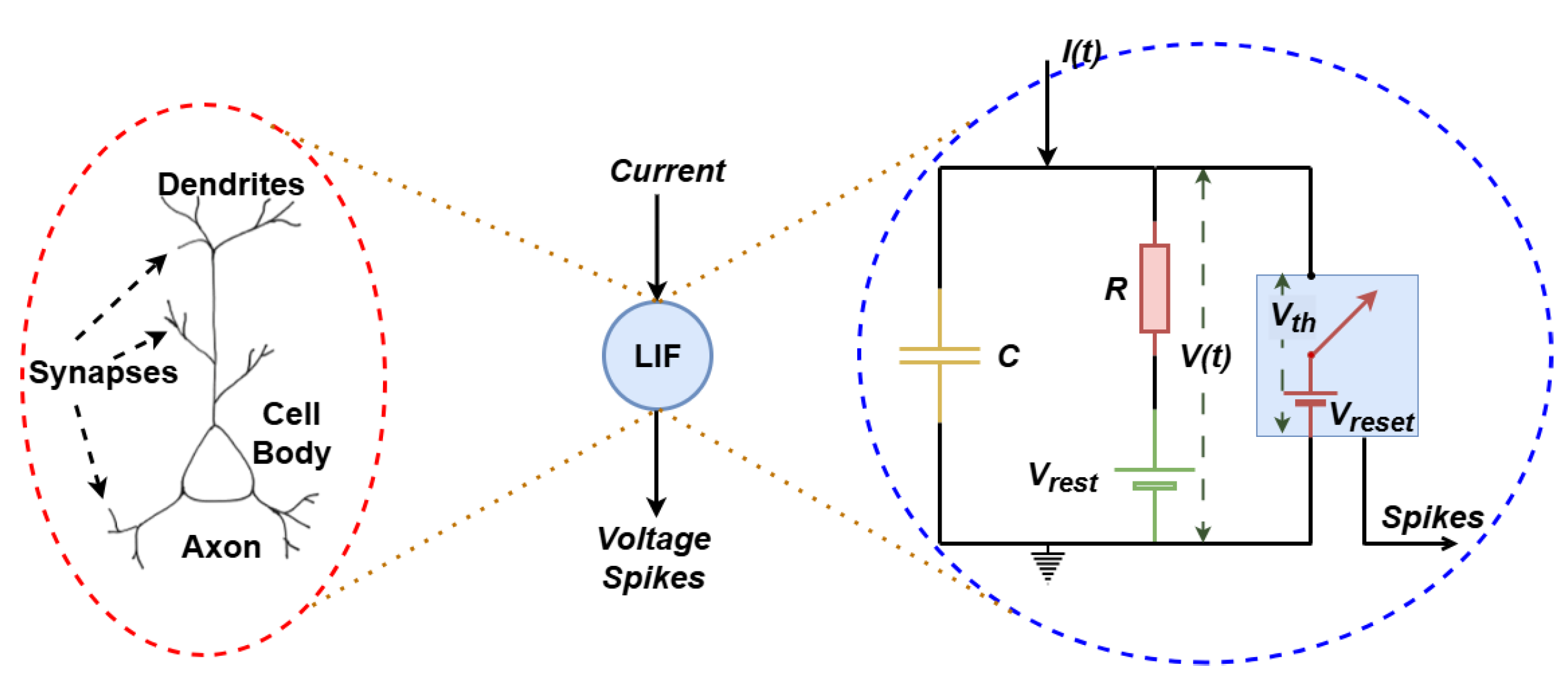
The input current will affect the membrane potential, which is the electrical potential variation between the inside and the outside of the cell. We may now realize the link between current and membrane potential by interpreting the membrane’s biophysics as an electrical circuit, as shown in Figure 1.
These physical components are examined using Kirchhoff’s law to characterize the current flowing through them. This implies that when current reaches a node, it must pass via one of the node’s branches. Therefore, current flowing across the membrane patch either charges the capacitor or passes through the membrane. The leak equilibrium potential is denoted by V r e s t , the capacitance by C, and the leak resistance by R. When the membrane potential V ( t ) reaches a specified voltage level, the action potential is triggered. After the action potential is completed, the membrane potential is reset by V r e s e t , and the entire process is restarted.
This is the Leaky Integrate-and-Fire model, and the membrane potential V ( t ) is described by a first-order differential equation that varies with the input ionic current I ( t ) over time. There is also a threshold condition: when the membrane potential V ( t ) crosses that threshold V t h , the dynamics stops and restarts after a short time  Δ . It is typically the first few milliseconds [43] and creates a fresh action potential. The model equations can be expressed as follows:
τ m d V ( t ) d t = ( V ( t ) V r e s t ) + R I ( t ) ,
where τ m = R C is the membrane time constant and if V ( t ) V t h , then V ( t + Δ t ) = V r e s t .
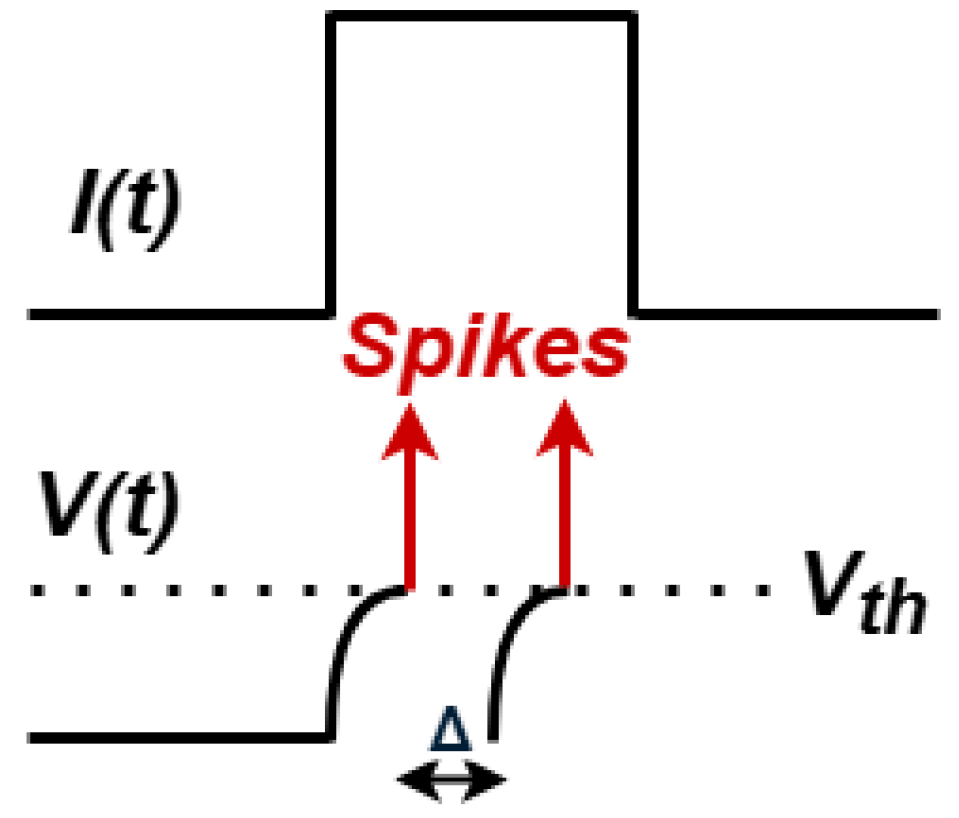
If the input ionic current increases, the membrane potential will reach the threshold. When this happens, it uses reset and threshold current conditions to stop the dynamics, and the neuron fires. After a Δ time, the dynamics are restarted at their resting potential. If the ionic current remains strong, the membrane potential rises until it reaches the threshold, fires again, and resets, and this is shown in Figure 2. The period between two spikes is known as the inter-spike interval [44], and it mostly influences the cell’s firing rate. For a steady current, the inter-spike interval remains constant and only varies when the input ionic current changes.
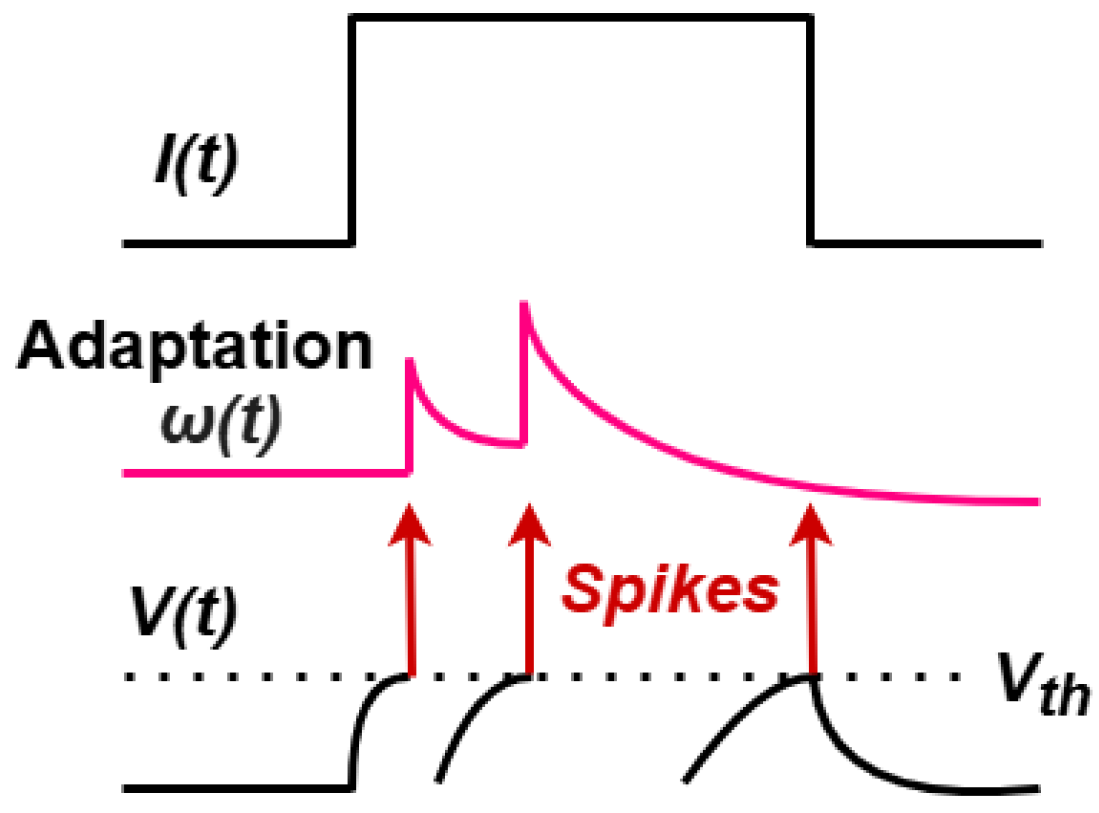
We now understand the LIF and how the action potential evolves. Consider the LIF extension known as the Generalized Integrated-and-Fire (GIF) model. Let us introduce a current ω ( t ) , which means that when ω ( t ) is positive, V ( t ) decreases.
τ m d V ( t ) d t = ( V ( t ) V r e s t ) + R I ( t ) R ω ( t ) ,
where ω ( t ) is the spike-triggered adaptation current (and decays over time). The spike conditions are when V ( t ) V t h , it emits a spike. After the spike V V r e s e t , the adaptation current increases by ω ( t ) ω ( t ) + Δ ω . This current ω ( t ) has the following continuous-time equation [45]:
τ ω d ω ( t ) d t = ω ( t ) + Δ ω i δ ( t t i ) ,
where τ ω is the time constant of the adaptation. Therefore, the adaptation increases by Δ ω each time a spike happens at time t i .
More importantly, the GIF shows spike frequency adaptation. Spike frequency adaptation is the process by which neurons adapt to a certain stimulus [46], implying that the inter-spike interval gradually increases over time when the input remains constant. This can be observed in Figure 3, and it is evident in almost all cells. However, the LIF model is unable to reproduce this phenomenon and consistently maintains the same spike interval for a given input current intensity. As a result, the LIF models roughly represent the complex dynamics of actual neurons, whereas the GIF models attain high accuracy by taking adaptive aspects into account.

3. Problem Formulation

After the neuron models, let us move forward by discussing how to incorporate these neuromorphic techniques into robotic systems. Many applications with fixed-based robotics require multibody dynamics, and the general robotic manipulator with n degrees of freedom can be formulated as [47]:
M ( q ) q ¨ + b ( q , q ˙ ) q ˙ + g ( q ) = τ ,
where M ( q ) is the mass matrix, and ( q , q ˙ , q ¨ ) are the position, velocity, and acceleration, respectively. b ( q , q ˙ ) is the Coriolis and centrifugal terms, and g ( q ) is the gravitational terms and τ is the external generalized forces. The proposed problem definition is as follows:
How can neuromorphic control techniques, that involve spiking neuron control (LIF or GIF), be used to ensure that the robot’s joint states q ( t ) converge to a desired position q d over time?
The position error of (4) can be found as
e ( t ) = q d q ( t ) ,
and this position error is used as the input for the neuron, and we can convert this error into the input current to the neuron by the expression:
I ( t ) = k e ( t ) ,
where k is the gain of the input current. This current I ( t ) will be fed to the neuron(s) to produce a spike (on comparing the threshold voltage V t h ) representing the input torque (or force) for the robotic system. However, these spikes cannot be used directly on the robotic system and must be translated into a smooth physical control torque (or force) suited for actuating the robotic system. The instantaneous control impulse that a spike generates can be defined as
τ u n p ( t ) = s p i k e ( t ) · u s p i k e ,
where τ u n p is the unprocessed torque, s p i k e ( t ) is a binary variable, if  s p i k e ( t ) = 1 , the neuron fires at time t, and if s p i k e ( t ) = 0 , neurons do not fire. u s p i k e is the torque produced per spike, which means that each spike injects a fixed torque u s p i k e into the robotic system. To simulate how actual biological synapses smooth out spikes over time rather than transmitting them instantly, one can employ synaptic filtering [48], also referred to as low-pass filtering in circuit terminology. A first-order differential equation that can be used to illustrate this is as follows:
τ ( t ) = τ u n p ( t ) τ s d τ ( t ) d t ,
where τ s is the synaptic time constant (in s) and controls the rate at which torque decreases. The  τ ( t ) represents the filtered control torque to be applied to the robotic system (4) in N-m. The synaptic filter used here is a single-time-constant first-order model; richer synapse models can be incorporated by replacing the filter dynamics with the device model. The ISS proof treats the filter output as a bounded, causal linear operator; thus, if the device’s synaptic dynamics remain bounded and causal, the stability argument generalizes. This bridges our controller analysis and synaptic device characterization.

4. Main Results

We will now apply the concept developed in the previous section to three different mechanical systems: mass–spring–damper (MSD) system: canonical second-order system for intuition and closed-form Lyapunov testing; 2-link planar robotic manipulator: demonstrating multivariable control and trajectory tracking; and Industrial UR3 robot arm: industrial 6-DOF manipulator. We chose these mechanical systems to show scalability to real-world robot kinematics and more complex dynamics. All the numerical computations were run in MATLAB 2022a with an Intel Core i7 CPU, 16 GB RAM, and Microsoft Windows 11.

4.1. Mass–Spring–Damper (MSD) System

This section discusses an approach for controlling the mass–spring–damper system that utilizes the Leaky Integrated-and-Fire (LIF) and Generalized Integrated-and-Fire (GIF) spiking neurons to regulate forces, aiming to bring the mass to a target position and maintain it with neuron spikes, thereby emulating neuromorphic control.
The dynamics of the MSD can be written as
m x ¨ ( t ) + b x ˙ ( t ) + k x ( t ) = u ( t ) ,
where m is the mass, b is the damping coefficient, k is the spring constant, and  u ( t ) is the neuron-driven control force. Consider that this MSD system exerts an input force that stabilizes the entire system at a desired position x t . Then, the equation of motion of the system can be written as
m x ¨ ( t ) + b x ˙ ( t ) + k ( x ( t ) x t ) = u ( t ) ,
Let us assume the system is critically damped, with  b = 2 k m , where the solution reaches the target without overshoot in the shortest possible time.

Neuromorphic Controller Design for MSD System

Designing via LIF neuron model: We revisit the concept we introduced in Section 2: evaluating the position error and feeding it as a current to the LIF neuron to generate spikes. Then, from (5), we can write
e ( t ) = x t x ( t ) ,
and from (6)
I ( t ) = k · e ( t ) .
The current (12) will be used to generate the LIF spikes after passing (1) and the conditions. These spikes are translated to an unprocessed force using the expression represented in (7). This unprocessed force is then passed through the Equation (8) to generate the force that stabilizes the MSD system. The pseudo-code presented in Algorithm 1 ensures that the MSD system stabilizes and executes as expected using the LIF neuron model.
Designing via GIF neuron model: The same steps are required to follow as in LIF i.e., calculating (11) and (12). After getting (12), it is passed to the GIF dynamics (2) and the conditions to generate a spike. In the case of GIF, after a spike, the adaptation current changes as per (3). These spikes are translated to an unprocessed force using the expression defined as (7). Equation (8) uses the unprocessed force to generate the force needed to stabilize the MSD system. Algorithm 2 provides pseudo-code to stabilize the MSD system exactly as expected using the GIF neuron model.
Algorithm 1 Numerical simulation algorithm employing the LIF model to control the MSD system
  • Initial conditions: Membrane potential V = 0 , System states x = x ˙ = 0
  • Model Parameters: τ m , R , k , V t h , V r e s t , V r e s e t , u s p i k e , τ s
  • for i = 1 to T do
  •    Compute the tracking error e ( t ) using (11)
  •    Calculate the ionic input current I ( t ) from e ( t ) using (12)
  •    Update the LIF membrane dynamics using Equation (1)
  •    Set V ( t ) = V ( t ) + Δ V
  •    if  V ( t ) V t h  then
  •      Generate Spike: s p i k e ( t ) = 1
  •       V V r e s e t
  •    else
  •      No Spike: s p i k e ( t ) = 0
  •    end if
  •    Compute the synaptic response time constant τ u n p using (7)
  •    Use τ u n p in (8) Pass this τ u n p and compute the control force
  •    Apply this control force to the MSD dynamics
  • end for
Algorithm 2 Numerical simulation algorithm employing the GIF model to control the MSD system
  • Initial states: Membrane potential V = 0 , System states x = x ˙ = ω = 0
  • Model Parameters: τ m , R , k , V t h , V r e s t , V r e s e t , u s p i k e , τ s , τ ω , Δ ω
  • for i = 1 to T do
  •    Compute the tracking error e ( t ) using (11)
  •    Calculate the ionic input current I ( t ) from e ( t ) using (12)
  •    Update the GIF membrane dynamics using Equation (2)
  •    Set V ( t ) = V ( t ) + Δ V
  •    Set s p i k e = 0
  •    if  V ( t ) V t h  then
  •      Generate Spike: s p i k e ( t ) = 1
  •       V V r e s e t
  •       ω ( t ) = ω ( t ) + Δ ω
  •    else
  •      No Spike: s p i k e ( t ) = 0
  •    end if
  •    Compute the synaptic response time constant τ u n p using (7)
  •    Use τ u n p in (8) Pass this τ u n p and compute the control force
  •    Apply this control force to the MSD dynamics
  • end for
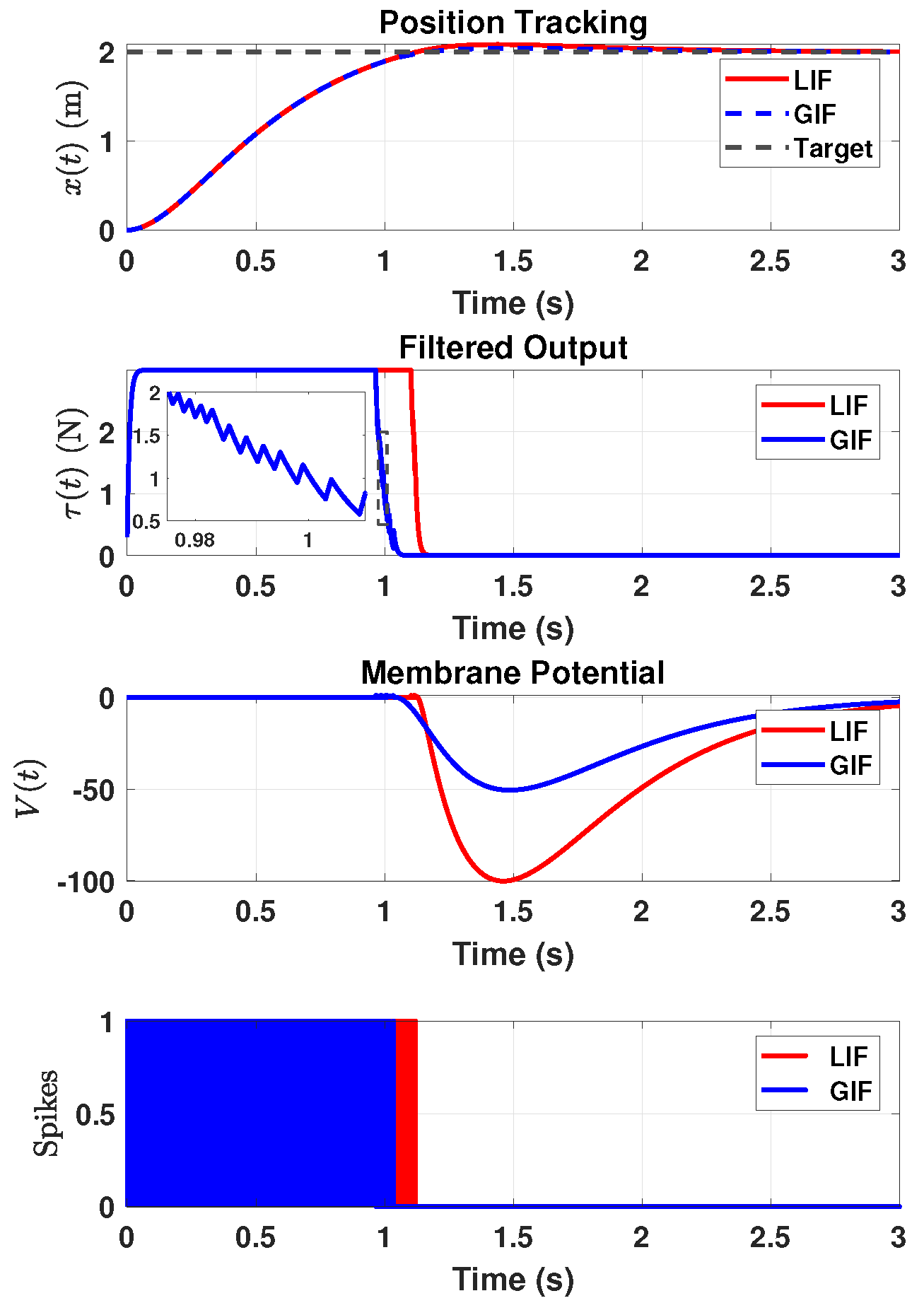
Numerical simulations obtained via the Algorithms 1 and 2 are compared in Figure 4.
The numerical simulation and Figure 4 show that the neuromorphic control system designed for the MSD system, utilizing the LIF and GIF neuron models, efficiently tracks the target. The GIF performs better than the LIF in terms of the quick settling of the MSD system because of the adaptation current, and can also be seen in the following video: https://youtu.be/SbPHr_Y2VdI.
Stability and robustness analysis of the designed neuromorphic control: To introduce the uncertainty and disturbance in the model, let us say that the model of the MSD system takes the form
m ( t ) x ¨ ( t ) + b x ˙ ( t ) + k x ( t ) = u ( t ) + ζ ( t ) ,
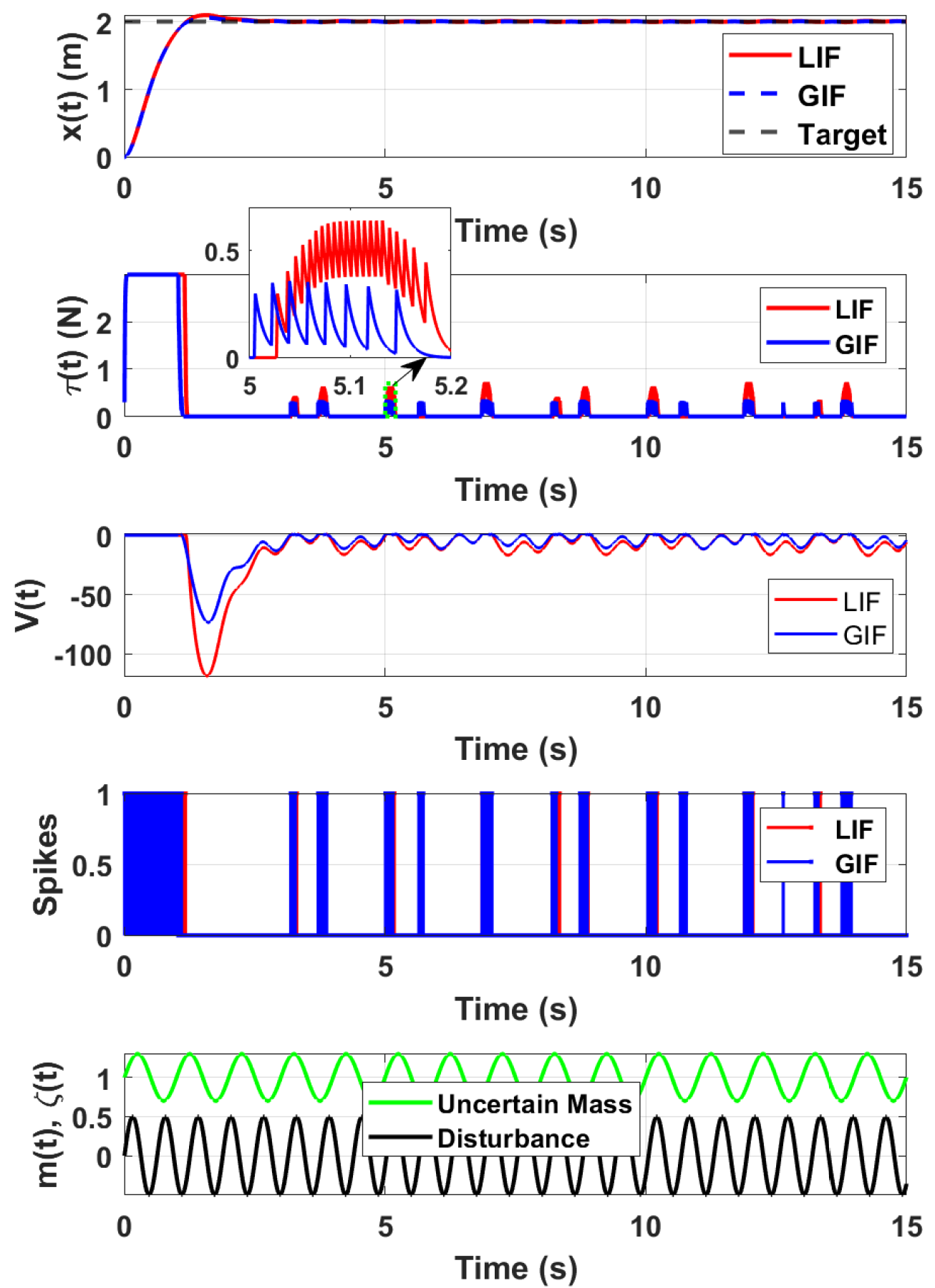
where m ( t ) is a time-varying uncertain mass, ζ ( t ) is the bounded disturbance, and all other terms are defined the same as in (9). We define the tracking error as (11) and feed this e ( t ) to the dynamics of the LIF or GIF neuron models through (12). The LIF spikes will be produced using this current I ( t ) , following (1) and the criteria. The expression (7) is used to transform these spikes to an unprocessed force. This unprocessed force of (8) is then used to create the force that stabilizes the MSD system of (13). The numerical simulation for LIF and GIF was provided by adapted Algorithms 1 and 2 which are shown in Figure 5.
Figure 5 shows that the LIF or GIF control for the MSD system can handle changes in system parameters and uncertainties while tracking the desired trajectory. Let us prove the robust stability of the system by Lyapunov-based analysis. The neuromorphic controller generates its torque command through the weighted and filtered accumulation of discrete spike events. This mechanism inherently approximates the ideal continuous control law. Therefore, the resulting closed-loop dynamics include an additional bounded disturbance term corresponding to the spike approximation error and synaptic filtering residual. To ensure that this approximation does not degrade stability, we analyze the system using a Lyapunov function. By showing that the derivative of the Lyapunov function is negative outside a small neighborhood determined by the approximation bound, we establish input-to-state stability (ISS). Consequently, the tracking error remains bounded for all time, even in the presence of modeling uncertainty and external disturbances. Lyapunov techniques provide a rigorous method for demonstrating boundedness and convergence for nonlinear, time-varying systems with bounded disturbances [49]; they enable us to treat spike-filter approximation errors as bounded perturbations and establish ISS properties. Define a sliding surface that makes the system error go to zero in time by
s ( t ) = e ˙ ( t ) λ e ( t ) .
Let us choose a Lyapunov candidate function as
V ( t ) = 1 2 s 2 ( t ) ,
then
V ˙ ( t ) = s ( t ) s ˙ ( t ) .
Evaluating s ˙ , we receive
s ˙ ( t ) = e ¨ ( t ) + λ e ˙ ( t ) = 1 m ( t ) ( b x ˙ ( t ) + k x ( t ) u ( t ) ζ ( t ) ) λ x ˙ ( t ) .
Multiplying (17) by s ( t ) , we receive
V ˙ ( t ) = s ( t ) s ˙ ( t ) = s ( t ) m ( t ) ( b x ˙ ( t ) + k x ( t ) u ( t ) ζ ( t ) ) s ( t ) λ x ˙ ( t ) , = s ( t ) m ( t ) ( b e ˙ ( t ) + k ( x t e ( t ) ) u ( t ) ζ ( t ) ) s ( t ) λ e ˙ ( t ) ,
Assuming that the spikes output u ( t ) k a e ( t ) b a e ˙ ( t ) ( k a is the proportional gain from the spikes and b a is derivative gain that arises from the rate-of-rise of the membrane potential [50]) as the filtered output of LIF or GIF neurons behaves like a PD controller over time (a simulation to show this approximation is present in Appendix A), we have
u ( t ) k a e ( t ) b a e ˙ ( t ) .
Using (19) in (18), we have
V ˙ ( t ) = ( ( b + b a ) s ( t ) m ( t ) + λ ) e ˙ ( t ) + ( k + k a ) s ( t ) m ( t ) e ( t ) ζ ( t ) s ( t ) m ( t ) .
Now using (14), we have
V ˙ ( t ) = ( ( b + b a ) s ( t ) m ( t ) + λ ) ( s ( t ) λ e ( t ) ) + ( k + k a ) s ( t ) m ( t ) e ( t ) ζ ( t ) s ( t ) m ( t ) .
With further mathematical manipulation and simplification, we have
V ˙ ( t ) 1 m ( t ) ( α s 2 ( t ) + s ( t ) ζ ( t ) ) ,
where α = k a + k λ ( b a + b m ( t ) λ ) . Taking the disturbance term s ( t ) ζ ( t ) from (22) and from the Young’s inequality [51], we have
s ( t ) ζ ( t ) ϵ s s 2 ( t ) + 1 2 ϵ ζ 2 ( t ) ,
and we have
V ˙ ( t ) 1 m ( t ) ( ( α ϵ 2 ) s 2 ( t ) + ζ 2 ( t ) 2 ϵ ) ,
where ϵ is a small quantity so as to make α ϵ 2 > 0 . The quadratic term contributes to the system’s dissipative and stable behavior, providing input-to-state stability (ISS) with a bounded disturbance. We can write (24) as
V ˙ ( t ) β ( t ) V ( t ) + δ ( t ) ,
where β ( t ) = 2 ( α ϵ / 2 ) m ( t ) and δ ( t ) = ζ 2 ( t ) 2 ϵ m ( t ) . Using (25) and a bounded and strictly positive 0 < m m i n < m ( t ) < m m a x < , we are able to conclude that (i) if there is no disturbance, i.e., ζ ( t ) = 0 , then δ ( t ) = 0 , showing that the system decays exponentially and is asymptotically stable; and (ii) if δ ( t ) > 0 , V ( t ) decreases but is offset by the term δ ( t ) , it results in bounded behavior. The state (in this case, tracking error) stays bounded in response to bounded input disturbances, and even in cases when mass remains uncertain, the error e ( t ) converges to a neighborhood of zero.

Adaptive Control Design for MSD System

Let us consider designing adaptive control, such as that proposed by Slotine and Li in [49], for the MSD system to compare the results of this MSD control system with the LIF type of neuromorphic control strategy for the MSD system.
The plant model will take the form (9). Let the output x ( t ) of the plant track a reference model x r m ( t ) while estimating the unknown mass m adaptively, and let us assume that the system follows a second-order behavior explained by the following expression.
x ¨ r m ( t ) + λ 1 x ˙ r m ( t ) + λ 2 x r m ( t ) = λ 2 r ( t ) ,
where x r m is the desired position, r ( t ) is the reference input, and λ 1 , λ 2 are design constants that affect the speed and the damping of the system response. Equation (26) is chosen as a critically damped second-order reference for design comparison to the plant (MSD is inherently second-order). In adaptive control, it is standard to choose the reference model with the same relative degree as the plant to ensure achievable tracking dynamics. Let us also define the tracking errors as follows:
x ˜ ( t ) = x ( t ) x r m ( t ) , x ˜ ˙ ( t ) = x ˙ ( t ) x ˙ r m ( t ) ,
and we want this error to become zero following a critically damped second-order system dynamics shown by the equation below:
x ˜ ¨ ( t ) + 2 λ x ˜ ˙ ( t ) + λ 2 x ˜ ( t ) = 0 .
Taking the derivation of the velocity error of (27) and using (28), we can evaluate
x ¨ ( t ) = x ¨ r m ( t ) 2 λ x ˜ ˙ ( t ) λ 2 x ˜ ( t ) ,
This expression (29) is the real acceleration that the system should follow to track the reference smoothly.
The control law can be defined by
u ( t ) = m ^ v + b x ˙ ( t ) + k x ( t ) ,
where m ^ is the current guess (estimation) for the mass. Let us define the sliding surface that will guarantee that the tracking error decays exponentially to zero in time, with the expression:
s = x ˜ ˙ ( t ) + λ x ˜ ( t ) ,
where λ is the convergence rate, and the mass adaptation law should follow the Lyapunov energy-based stability theory given by
m ^ ˙ = γ s v ,
where γ is the adaptation rate, and the sign ensures the stability of the tracking error. The proof of (32) can be found in Appendix B.
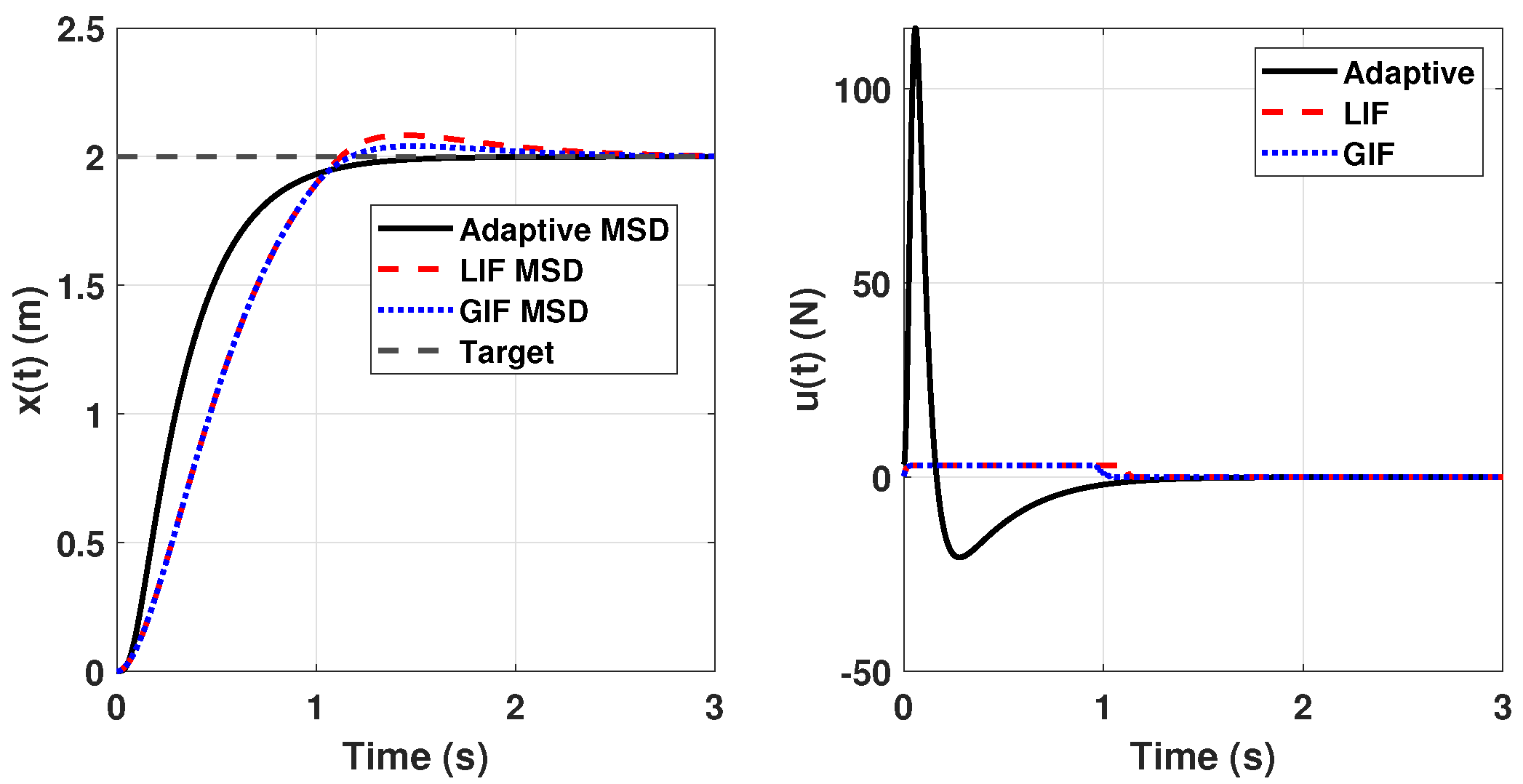
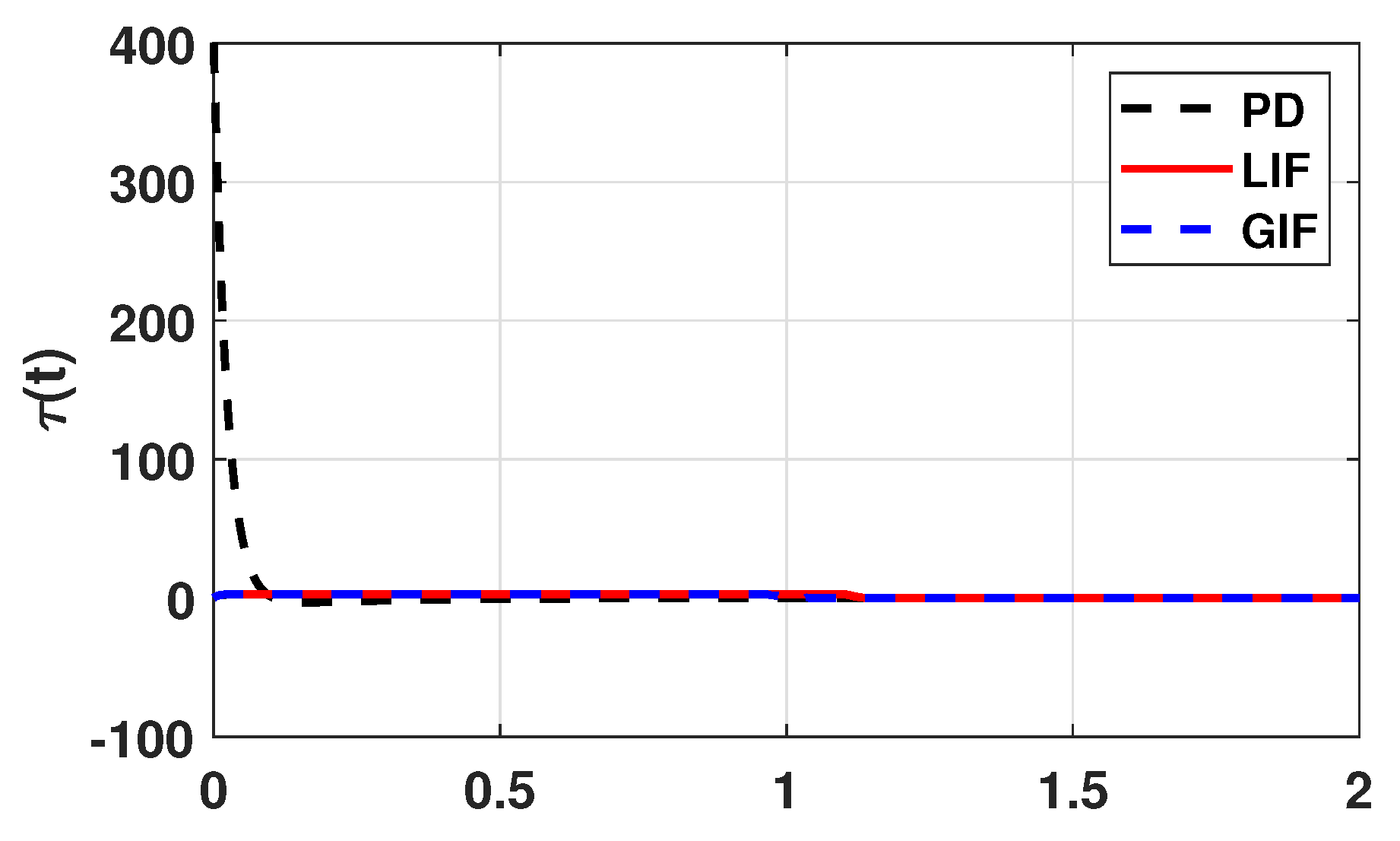
The LIF/GIF controller converges with less control effort than adaptive control (see Figure 6), particularly in cases where the mass parameters are unknown. Furthermore, GIF neurons have smoother control transients due to adaptation current ω ( t ) , which reduces overshoot. It can be concluded that while the LIF and GIF controllers achieve the same goal with comparable tracking performance but with noticeably less control effort, the adaptive controller generates a significantly larger initial torque magnitude and sustained control magnitude.

4.2. A 2-Link Planar Robotic Manipulator

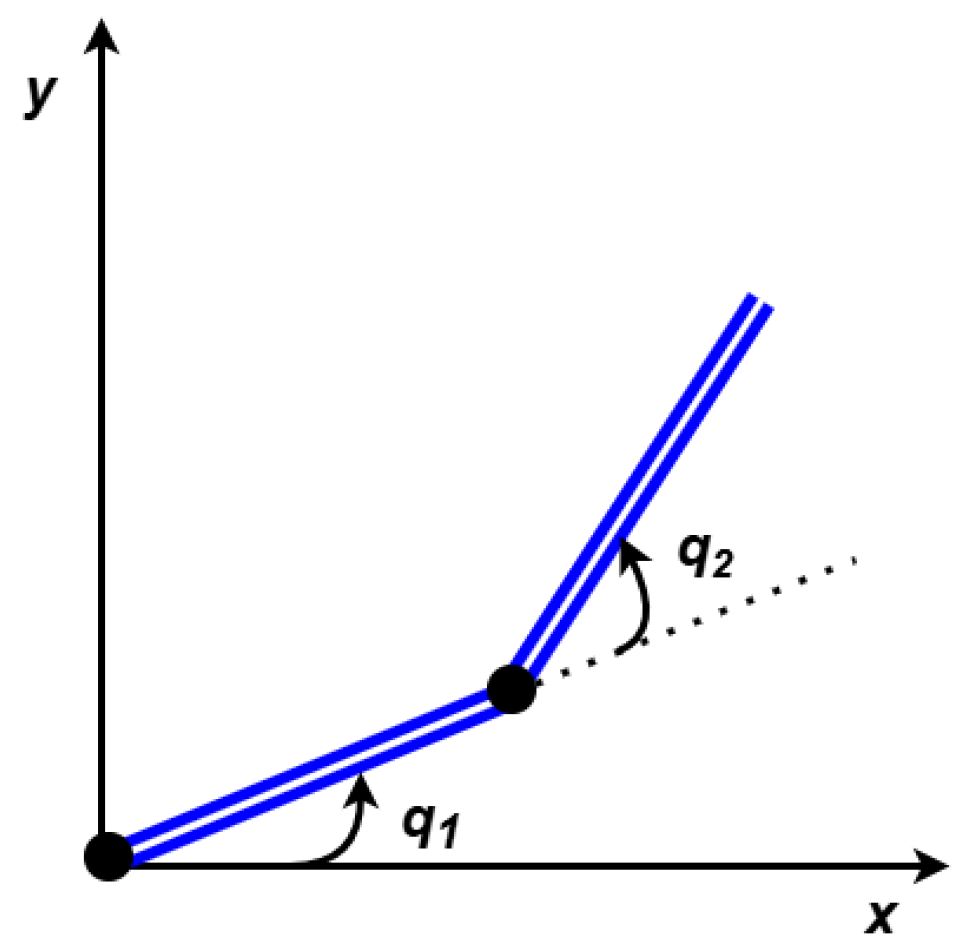
The dynamics of a 2-link planar robotic manipulator that is shown in Figure 7 can be found as
M ( q ) q ¨ + B q ˙ = τ ,
where these terms represent the same meaning as in (4). The aim here is to design a control law that makes the robot arm reach a set point (target). In this section, an approach for controlling the 2-link planar robotic manipulator is presented that utilizes the LIF and GIF spiking neurons to regulate torques, aiming to bring the arm to a target position and maintain it with neuron spikes, thereby emulating neuromorphic control.

Neuromorphic Controller Design for 2-Link Planar Robotic Manipulator System

Designing via LIF neuron model: We will follow the same steps as in Section 4.1, evaluating the joint angle error and feeding it as a current to the LIF neuron to generate spikes. We can write
e i ( t ) = q i t q i ( t ) ,
and
I i ( t ) = k · e i ( t ) ,
where i 1 , 2 , the joint numbers for the considered system. The current (35) will be used to generate the LIF spikes after passing (1) and the conditions. These spikes are translated to an unprocessed torque using the expression represented in (7). This unprocessed torque is then passed through Equation (8) to generate the filtered torque that makes the 2-link robotic manipulator reach the targeted position. Following the pseudo-code presented by Algorithm 1 and adapting to the 2-link planar robotic manipulator dynamics ensures that this system follows the target and executes as expected using the LIF.
Designing using GIF Neuron Model: Follow the same steps as for the LIF. After obtaining (35), it is directed to the GIF dynamics (2) and the requirements for generating a spike. After a spike, the adaptation current changes according to (3). These spikes are translated to an unprocessed torque using the expression specified as (7). Equation (8) utilizes the unprocessed torque to generate the torque required to move the 2-link robotic manipulator to the target position. Modifying the Algorithm 2 according to the 2-link planar manipulator dynamics ensures this system reaches the targeted position as intended using the GIF model.
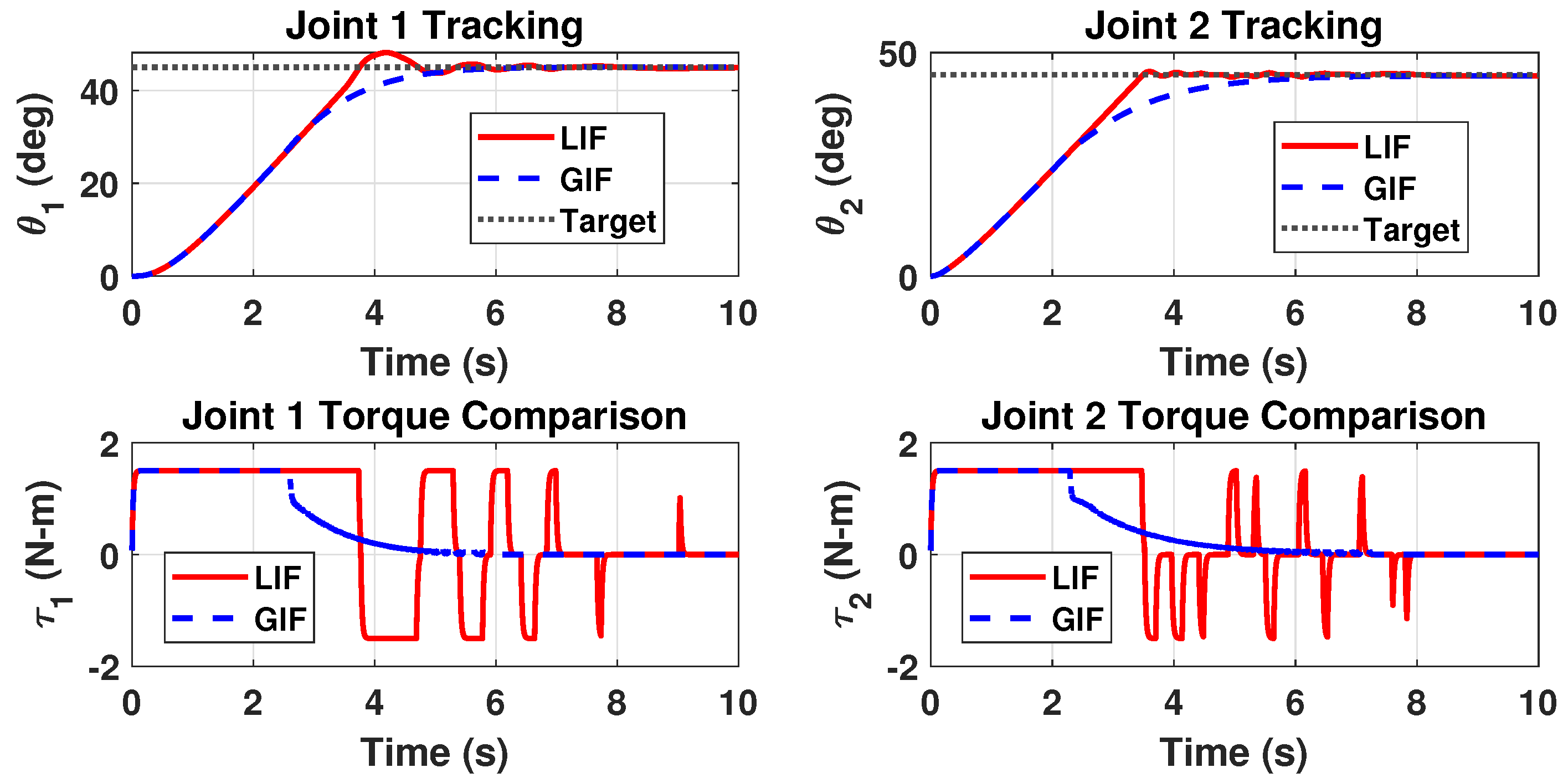
Figure 8 compares numerical simulations produced by the modified Algorithm 1 and Algorithm 2 to represent the 2-link arm. The neuromorphic control for this system, which uses the LIF and GIF neuron models, effectively tracks the target, as demonstrated by the numerical simulation. Since the adaptation current allows the system to settle faster, the GIF performs better than the LIF.
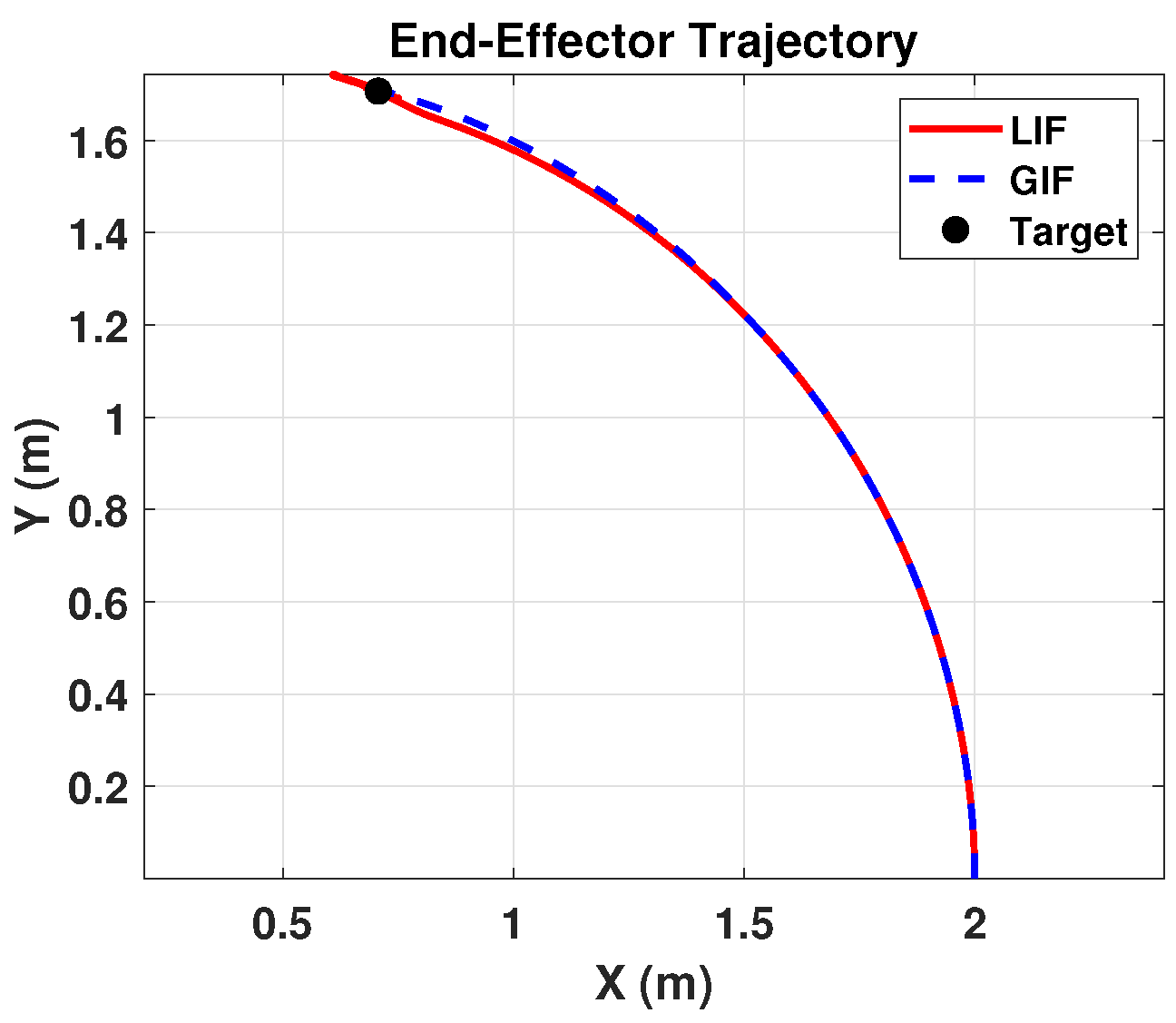
The trajectory tracking from the LIF and GIF neurons in reaching the target position is depicted in Figure 9 of the 2-link arm.
A video showing the trajectory movement of the 2-ink planar robotic manipulator from the initial position to the target is shown at the link: https://youtu.be/82K47K3WILw. The proposed neuromorphic control methodology is scalable to robotic manipulators with multiple degrees of freedom (DOF). Appendix A describes how the proposed neuromorphic controller architecture scales linearly in degrees of freedom (DOF). Appendix A also describes how the proposed neuromorphic controller architecture scales linearly in degrees of freedom (DOF).
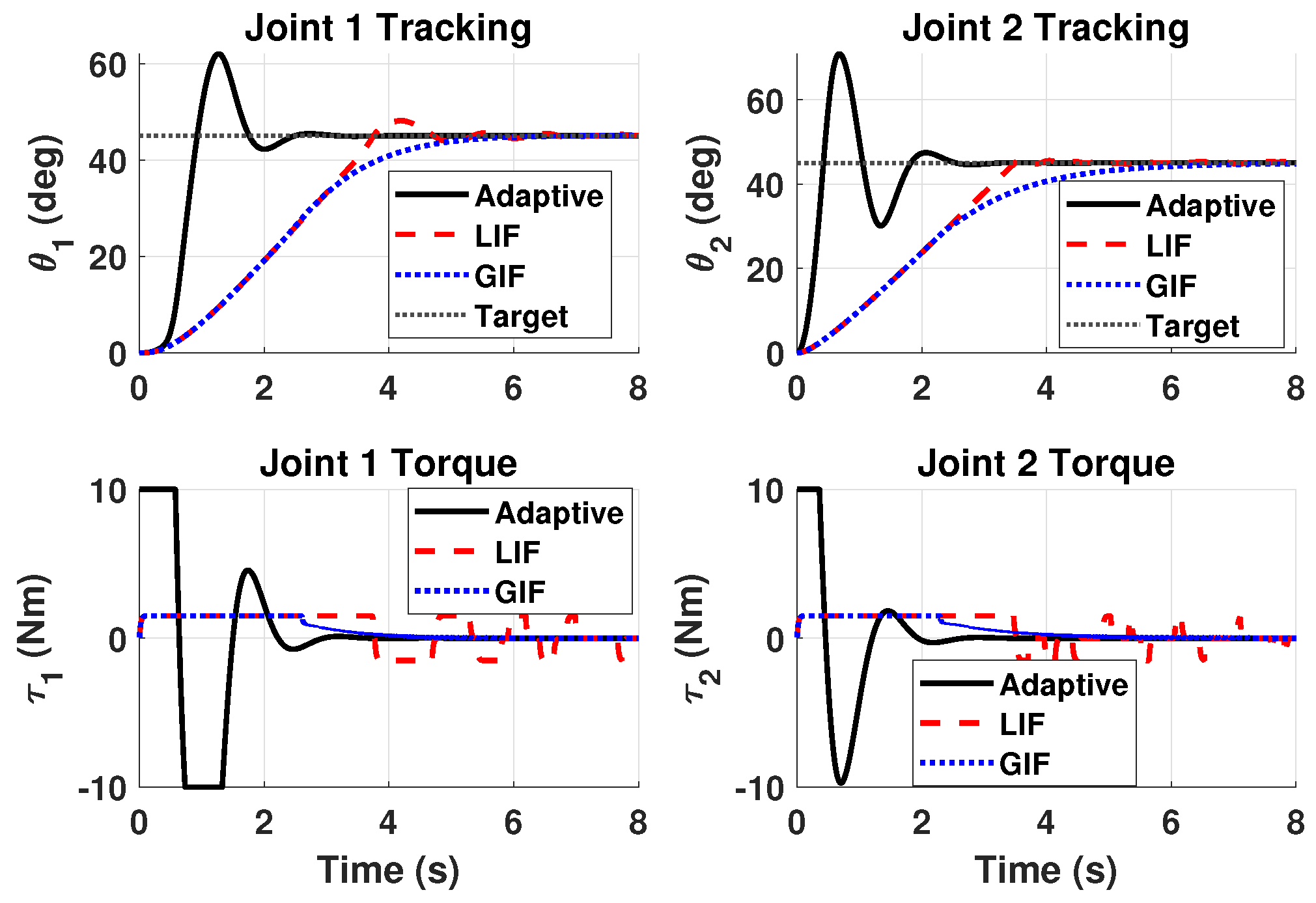
Let us also compare the results from the adaptive control of the 2-link robotic system with the LIF/GIF control by providing the simulation results as follows.
The LIF/GIF controller converges with less control effort than adaptive control (see Figure 10). It can be concluded that while the LIF and GIF controllers achieve the same goal with comparable tracking performance but with noticeably less control effort, the adaptive controller generates a significantly larger initial torque magnitude and sustained control magnitude.

4.3. An Industrial UR3 Robot Arm

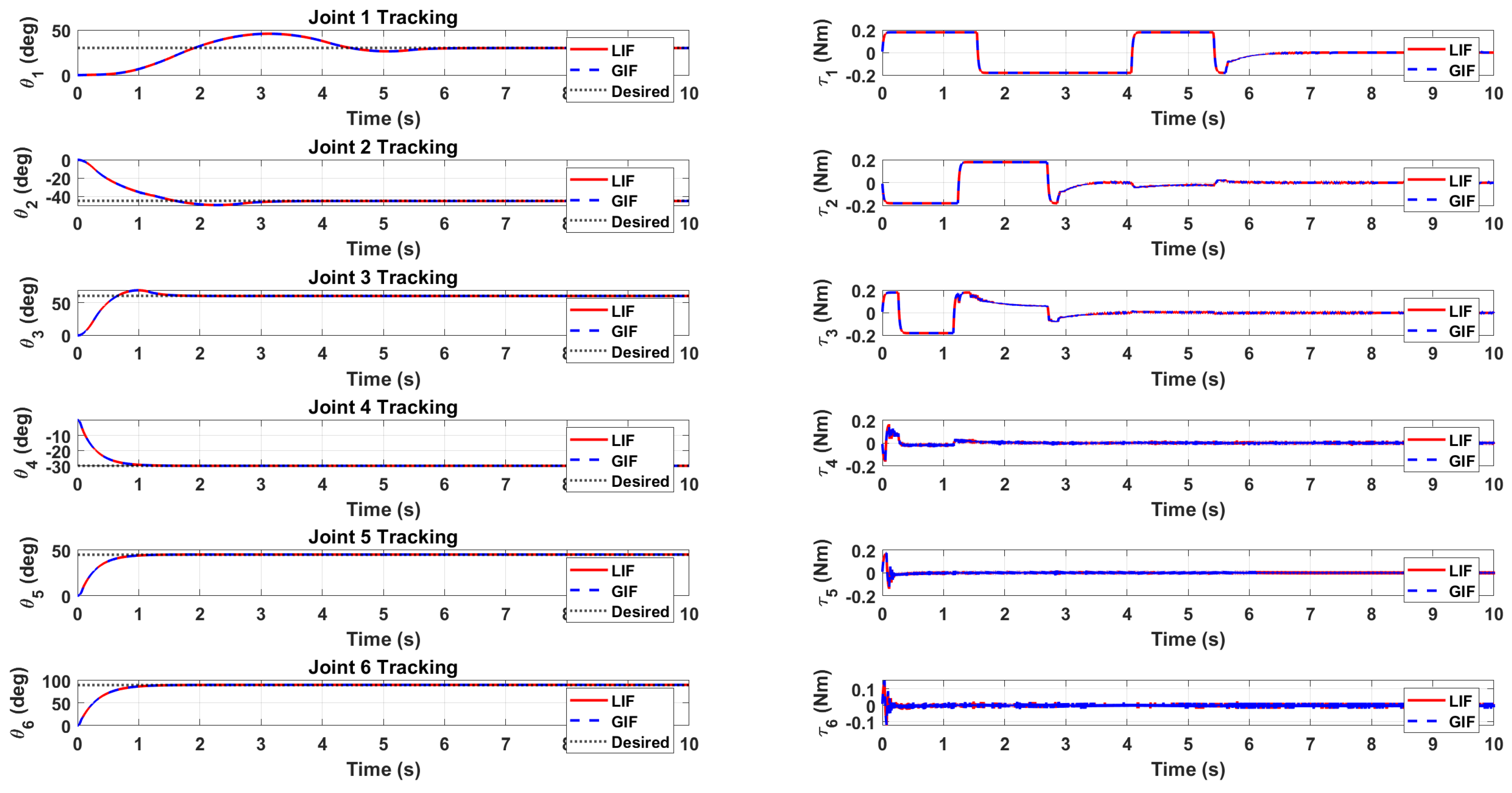
Let us design the neuromorphic control that sets the joint angles of a UR3 robot arm to the target joint angles. We will be using the same analysis that we have for the MSD and the 2-link planar manipulator. The six-joint angle error will be fed as the current to the LIF and GIF neurons. Depending on the current I i ( t ) where i 1 , 2 , , 6 , the number of joints, the spikes will be generated corresponding to LIF and GIF neuron models. Then, depending on these spikes, a controlled input is derived that controls the movement of these joints to the target position. Figure 11 compares numerical simulations produced by the modified Algorithms 1 and 2 to represent the UR3 robotic arm. The neuromorphic control for this system, which uses the LIF and GIF neuron models, effectively tracks the target, as demonstrated by the numerical simulation.

5. Conclusions

The use of neuromorphic control based on spiking neural networks for controlling various robotic systems is demonstrated in this paper. The LIF and GIF neuron model was utilized to mimic neuromorphic control and develop a control law for the three systems: a UR3 robotic arm, a 2-link planar robotic manipulator, and a mass–spring–damper system. The efficiency of the neuromorphic control is demonstrated in the paper through the stability and robustness analyses using the Lyapunov-based theory. Additionally, two algorithms are provided to carry out the numerical simulations to verify the developed approach. To compare the outcomes of the neuromorphic control methods, an adaptive control is also presented. According to the results, the adaptive control method is less effective than the LIF and GIF in terms of control effort.
Spiking neural networks (SNNs) have the potential to improve autonomy and adaptability in dynamic situations, making them important in robotics, especially for increasing degrees of freedom and industrial applications. In the future, we aim to develop a fully adaptive SNN controller on neuromorphic hardware by interfacing it to a physical robot arm and optimizing it further to increase performance metrics in real-world scenarios with reduced latency.

Author Contributions

Conceptualization, A.P.S.; methodology, A.P.S.; software, A.P.S.; validation, A.P.S.; formal analysis, A.P.S.; investigation, A.P.S.; resources, A.P.S.; writing—original draft preparation, A.P.S.; writing—review and editing, A.C.L.; supervision, A.C.L.; project administration, A.C.L. All authors have read and agreed to the published version of the manuscript.

Funding

This work is supported by NMBU and the Research Council of Norway through the project SFI Digital Food Quality (DigiFoods), project number 309259.

Data Availability Statement

No new data were created or analyzed in this study. Data sharing is not applicable to this article.

Acknowledgments

During the preparation of this manuscript, the authors used Quillbot (free online version) to improve syntax, and paraphrasing in certain sections of the paper to provide a clear overview. The authors have reviewed and edited the output and take full responsibility for the content of this publication.

Conflicts of Interest

The authors declare no conflicts of interest.

Abbreviations

The following abbreviations are used in this manuscript:
LIFLeaky Integrate-and-Fire
GIFGeneralized Integrate-and-Fire
MSDMass Spring Damper
SNNSpiking Neural Networks
ANNArtificial Neural Networks
UR3Universal Robot (Model 3)

Appendix A

Each neuron spike generates a short force pulse in both LIF and GIF-based control systems, and the control force τ ( t ) is the filtered sum of these pulses, and is given by (8). The LIF neuron receives an input current of I ( t ) and its membrane potential evolves as (1). The bigger the error e ( t ) , the faster the membrane potential V ( t ) approaches the threshold, resulting in more frequent spikes. So, (i) larger e ( t ) results in a higher spike rate and more force; (ii) a small e ( t ) results in a low spike rate, which requires less force. Hence, the spike rate is proportional to e ( t ) .
If the error e ˙ ( t ) > 0 grows, the input current I ( t ) increases over time. This accelerates the increase in membrane potential, resulting in shorter inter-spike intervals. Therefore, when e ˙ ( t ) > 0 , spiking is faster; and when e ˙ ( t ) < 0 , spiking is slower. This generates differential feedback, in which the change in spike frequency provides information about e ˙ ( t ) . This behavior is comparable to derivative control and becomes more obvious after synaptic filtering, which smoothens the spike pulses into a signal that resembles a PD controller output. Hence, we can approximate the spiking-based control as (19).
After some starting time, the neurons’ output will nearly match the PD output, so the filtered spike-based control behaves similarly to a PD. The simulation shown in Figure A1 demonstrates exactly what we have described in this Appendix.
Figure A1. Behavior of LIF and GIF neurons compared to a PD control.
Robotics 14 00166 g0a1
For an n-DOF manipulator governed by
M ( q ) q ¨ + C ( q , q ˙ ) q ˙ + G ( q ) = τ ,
the spiking control law is applied per joint as a distributed population of spiking neurons:
τ i = τ s , i ( t ) ,
where τ s , i ( t ) is the spike-induced torque command generated by a LIF or GIF neuron population corresponding to the joint i. Since each joint population operates independently, the number of neurons and synapses grows linearly with DOF. The cross-coupling terms (A1) are treated as bounded uncertainties and thus enter the Lyapunov derivative through the disturbance term d ( t ) .
Figure A2. Scaling of DOF of the robot and performance comparison with PID.
Robotics 14 00166 g0a2
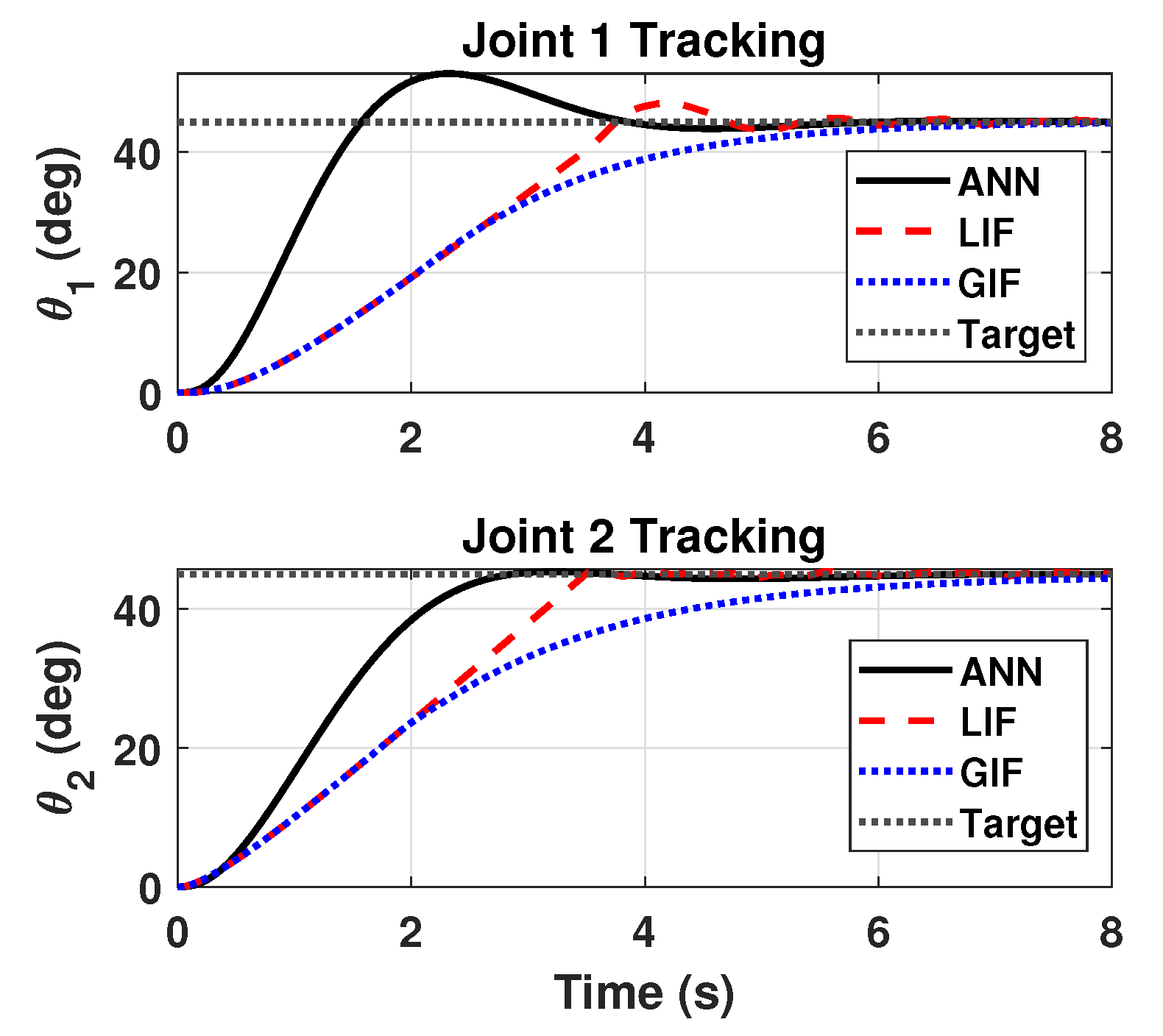
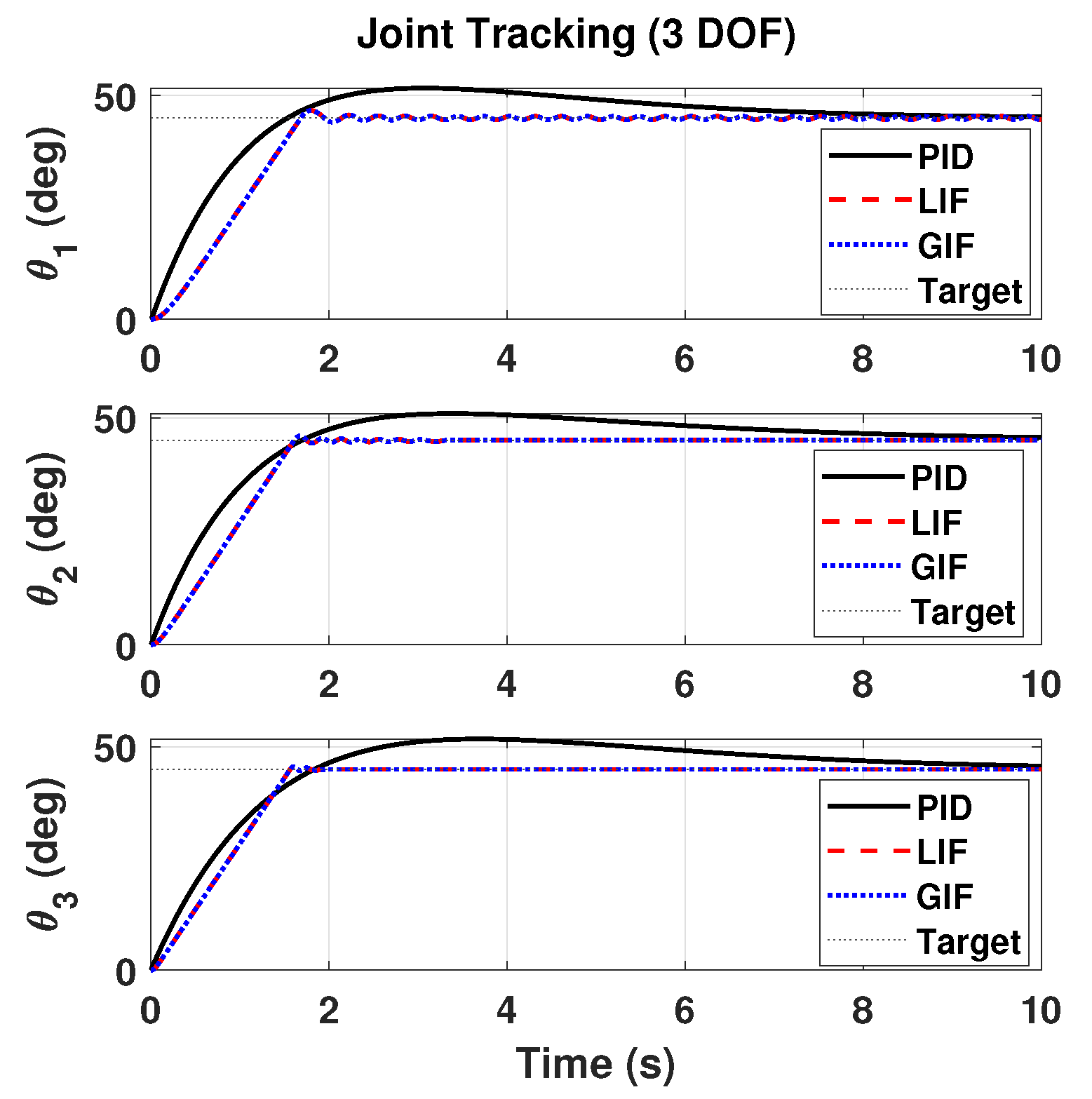
Additional simulations for a three-DOF planar robot shown in Figure A2 confirm that the neuromorphic controller maintains stable tracking when the DOF is scaled with the settling time mentioned in Table A1 below shows that the LIF/GIF-based control gives good settling time compared to the PID control (a comparison with ANN is also shown in Appendix C).
Table A1. Performance comparison of the LIF, GIF, and PID control.
ControllerSettling Time ( θ 1 s)Settling Time ( θ 2 s)Settling Time ( θ 3 s)Computational Time (s)
PID6.26.36.40.03
LIF1.641.51.20.04
GIF1.61.51.20.04
These values were obtained on MATLAB simulation and indicate that the LIF/GIF controllers run comfortably below 50 ms per joint.

Appendix B

Define the Lyapunov function as follows to ensure that the system is stable and x ˜ 0
V = 1 2 s 2 + 1 2 γ m ˜ 2 ,
where m ˜ = m ^ m is the mass estimator, γ > 0 , and s is defied by (31).
Taking the first derivative of (A3),
V ˙ = s s ˙ + 1 γ m ˜ m ˜ ˙ s s ˙ + 1 γ m ˜ m ^ ˙ .
Now, let us evaluate s ˙ from (31),
s ˙ = x ¨ x ¨ r m + λ ( x ˙ x ˙ r m )
Using (9), (29), (30), and (A5), we receive
s ˙ = m ˜ m v .
So, from (A4) and (A6), we have
V ˙ = s m ˜ m v + 1 γ m ˜ m ^ ˙ .
For stability and convergence, it is obvious to choose the mass adaptation law equal to
m ^ ˙ = γ s v ,
and hence V ˙ 0 as long as m ^ m and the system is stable.

Appendix C

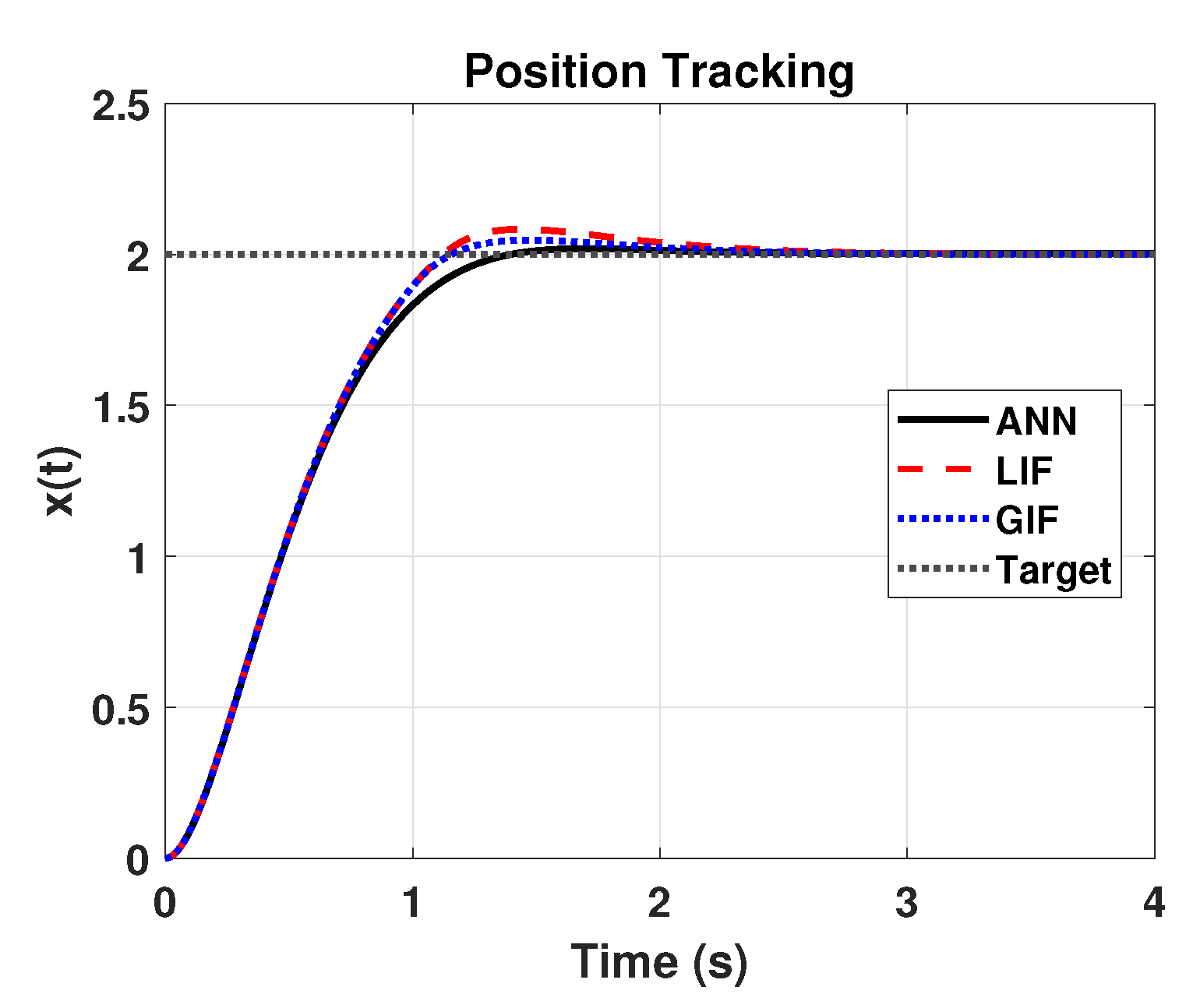
This appendix gives a comparison between the presented approach and an ANN-based controller. The results are illustrated using two figures (Figure A3 and Figure A4), followed by a summary comparison table.
Figure A3. LIF/GIF MSD performance comparison with ANN.
Robotics 14 00166 g0a3
The performance of ANN vs LIF/GIF of Figure A3 and Figure A4 is summarized in the following Table A2.
Table A2. Performance comparison of the LIF, GIF, and ANN control.
ControllerMSD System2-Link System
Settling Time x ( t ) (s)Computation Time (s)Settling Time θ 1 ( t ) (s)Settling Time θ 2 ( t ) (s)Computation Time (s)
ANN1.30.0134.22.50.12
LIF1.10.0104.23.30.04
GIF1.10.0105.55.50.06
From the table above, it can be observed that the LIF/GIF model requires less computational time compared to the ANN to receive similar to better responses.
Figure A4. LIF/GIF 2-link performance comparison with ANN.
Robotics 14 00166 g0a4

References

  1. Kudithipudi, D.; Schuman, C.; Vineyard, C.M.; Pandit, T.; Merkel, C.; Kubendran, R.; Aimone, J.B.; Orchard, G.; Mayr, C.; Benosman, R. Neuromorphic computing at scale. Nature 2025, 637, 801–812. [Google Scholar] [CrossRef]
  2. Muir, D.R.; Sheik, S. The road to commercial success for neuromorphic technologies. Nat. Commun. 2025, 16, 3586. [Google Scholar] [CrossRef]
  3. Zheng, H.; Zheng, Z.; Hu, R.; Xiao, B.; Wu, Y.; Yu, F.; Liu, X.; Li, G.; Deng, L. Temporal dendritic heterogeneity incorporated with spiking neural networks for learning multi-timescale dynamics. Nat. Commun. 2024, 15, 277. [Google Scholar] [CrossRef] [PubMed]
  4. Liu, J.; Lu, H.; Luo, Y.; Yang, S. Spiking neural network-based multi-task autonomous learning for mobile robots. Eng. Appl. Artif. Intell. 2021, 104, 104362. [Google Scholar] [CrossRef]
  5. Merces, L.; Ferro, L.M.M.; Nawaz, A.; Sonar, P. Advanced Neuromorphic Applications Enabled by Synaptic Ion-Gating Vertical Transistors. Adv. Sci. 2024, 11, 2305611. [Google Scholar] [CrossRef] [PubMed]
  6. Bartolozzi, C.; Glover, A.; Donati, E. Neuromorphic sensing, perception, and control for robotics. In Handbook of Neuroengineering; Springer Nature: Singapore, 2023; pp. 1635–1665. [Google Scholar]
  7. Jiang, J.; Kong, D.; Hu, C.; Fang, Z. Fully asynchronous neuromorphic perception for mobile robot dodging with loihi chips. IEEE Trans. Autom. Sci. Eng. 2025, 22, 12802–12815. [Google Scholar] [CrossRef]
  8. Paredes-Vallés, F.; Hagenaars, J.J.; Dupeyroux, J.; Stroobants, S.; Xu, Y.; de Croon, G.C. Fully neuromorphic vision and control for autonomous drone flight. Sci. Robot. 2024, 9, eadi0591. [Google Scholar] [CrossRef]
  9. Vitale, A.; Renner, A.; Nauer, C.; Scaramuzza, D.; Sandamirskaya, Y. Event-driven vision and control for UAVs on a neuromorphic chip. In Proceedings of the 2021 IEEE International Conference on Robotics and Automation (ICRA), Xi’an, China, 30 May–5 June 2021; IEEE: Piscataway, NJ, USA, 2021; pp. 103–109. [Google Scholar]
  10. Indiveri, G. Neuromorphic analog VLSI sensor for visual tracking: Circuits and application examples. IEEE Trans. Circuits Syst. II Analog. Digit. Signal Process. 2002, 46, 1337–1347. [Google Scholar] [CrossRef]
  11. López-Osorio, P.; Domínguez-Morales, J.P.; Perez-Peña, F. A Neuromorphic Vision and Feedback Sensor Fusion Based on Spiking Neural Networks for Real-Time Robot Adaption. Adv. Intell. Syst. 2024, 6, 2300646. [Google Scholar] [CrossRef]
  12. Yang, Y.; Bartolozzi, C.; Zhang, H.H.; Nawrocki, R.A. Neuromorphic electronics for robotic perception, navigation, and control: A survey. Eng. Appl. Artif. Intell. 2023, 126, 106838. [Google Scholar] [CrossRef]
  13. Lin, C.K.; Wild, A.; Chinya, G.N.; Cao, Y.; Davies, M.; Lavery, D.M.; Wang, H. Programming spiking neural networks on Intel’s Loihi. Computer 2018, 51, 52–61. [Google Scholar] [CrossRef]
  14. Hsu, J. IBM’s new brain [News]. IEEE Spectr. 2014, 51, 17–19. [Google Scholar] [CrossRef]
  15. Furber, S.B.; Lester, D.R.; Plana, L.A.; Garside, J.D.; Painkras, E.; Temple, S.; Brown, A.D. Overview of the SpiNNaker system architecture. IEEE Trans. Comput. 2012, 62, 2454–2467. [Google Scholar] [CrossRef]
  16. Murmann, B. Mixed-signal computing for deep neural network inference. IEEE Trans. Very Large Scale Integr. (VLSI) Syst. 2020, 29, 3–13. [Google Scholar] [CrossRef]
  17. Zhang, J.; Dai, S.; Zhao, Y.; Zhang, J.; Huang, J. Recent progress in photonic synapses for neuromorphic systems. Adv. Intell. Syst. 2020, 2, 1900136. [Google Scholar] [CrossRef]
  18. Ham, D.; Park, H.; Hwang, S.; Kim, K. Neuromorphic electronics based on copying and pasting the brain. Nat. Electron. 2021, 4, 635–644. [Google Scholar] [CrossRef]
  19. Park, H.L.; Lee, Y.; Kim, N.; Seo, D.G.; Go, G.T.; Lee, T.W. Flexible neuromorphic electronics for computing, soft robotics, and neuroprosthetics. Adv. Mater. 2020, 32, 1903558. [Google Scholar] [CrossRef]
  20. Bile, A.; Tari, H.; Fazio, E. Episodic memory and information recognition using solitonic neural networks based on photorefractive plasticity. Appl. Sci. 2022, 12, 5585. [Google Scholar] [CrossRef]
  21. Bile, A. Solitonic Neural Networks; Springer Nature: Cham, Switzerland, 2024. [Google Scholar]
  22. Jooq, M.K.Q.; Azghadi, M.R.; Behbahani, F.; Al-Shidaifat, A.; Song, H. High-performance and energy-efficient leaky integrate-and-fire neuron and spike timing-dependent plasticity circuits in 7nm FinFET technology. IEEE Access 2023, 11, 133451–133459. [Google Scholar] [CrossRef]
  23. Aitsam, M.; Davies, S.; Di Nuovo, A. Neuromorphic computing for interactive robotics: A systematic review. IEEE Access 2022, 10, 122261–122279. [Google Scholar] [CrossRef]
  24. Harkin, E.F.; Béïque, J.C.; Naud, R. A user’s guide to generalized integrate-and-fire models. In Computational Modelling of the Brain: Modelling Approaches to Cells, Circuits and Networks; Springer International Publishing: Cham, Switzerland, 2021; pp. 69–86. [Google Scholar]
  25. Polykretis, I.; Supic, L.; Danielescu, A. Bioinspired smooth neuromorphic control for robotic arms. Neuromorphic Comput. Eng. 2023, 3, 014013. [Google Scholar] [CrossRef]
  26. Mitchell, J.P.; Bruer, G.; Dean, M.E.; Plank, J.S.; Rose, G.S.; Schuman, C.D. NeoN: Neuromorphic control for autonomous robotic navigation. In Proceedings of the 2017 IEEE International Symposium on Robotics and Intelligent Sensors (IRIS), Ottawa, ON, Canada, 5–7 October 2017; IEEE: Piscataway, NJ, USA, 2017; pp. 136–142. [Google Scholar]
  27. Viale, A.; Marchisio, A.; Martina, M.; Masera, G.; Shafique, M. Carsnn: An efficient spiking neural network for event-based autonomous cars on the loihi neuromorphic research processor. In Proceedings of the 2021 International Joint Conference on Neural Networks (IJCNN), Shenzhen, China, 18–22 July 2021; IEEE: Piscataway, NJ, USA, 2021; pp. 1–10. [Google Scholar]
  28. Rast, A.D.; Adams, S.V.; Davidson, S.; Davies, S.; Hopkins, M.; Rowley, A.; Stokes, A.B.; Wennekers, T.; Furber, S.; Cangelosi, A. Behavioral learning in a cognitive neuromorphic robot: An integrative approach. IEEE Trans. Neural Netw. Learn. Syst. 2018, 29, 6132–6144. [Google Scholar] [CrossRef]
  29. de Azambuja, R.; Klein, F.B.; Stoelen, M.F.; Adams, S.V.; Cangelosi, A. Graceful degradation under noise on brain inspired robot controllers. In Proceedings of the International Conference on Neural Information Processing, Okinawa, Japan, 20–24 November 2025; Springer International Publishing: Cham, Switzerland, 2016; pp. 195–204. [Google Scholar]
  30. Tieck, J.C.V.; Secker, K.; Kaiser, J.; Roennau, A.; Dillmann, R. Soft-grasping with an anthropomorphic robotic hand using spiking neurons. IEEE Robot. Autom. Lett. 2020, 6, 2894–2901. [Google Scholar] [CrossRef]
  31. Bekolay, T.; Bergstra, J.; Hunsberger, E.; DeWolf, T.; Stewart, T.C.; Rasmussen, D.; Choo, X.; Voelker, A.R.; Eliasmith, C. Nengo: A Python tool for building large-scale functional brain models. Front. Neuroinform. 2014, 7, 48. [Google Scholar] [CrossRef] [PubMed]
  32. Zhou, T.; Wachs, J.P. Early turn-taking prediction with spiking neural networks for human robot collaboration. In Proceedings of the 2018 IEEE International Conference on Robotics and Automation (ICRA), Brisbane, Australia, 21–25 May 2018; IEEE: Piscataway, NJ, USA, 2018; pp. 3250–3256. [Google Scholar]
  33. Zahra, O.; Navarro-Alarcon, D.; Tolu, S. A neurorobotic embodiment for exploring the dynamical interactions of a spiking cerebellar model and a robot arm during vision-based manipulation tasks. Int. J. Neural Syst. 2022, 32, 2150028. [Google Scholar] [CrossRef] [PubMed]
  34. Fidjeland, A.K.; Roesch, E.B.; Shanahan, M.P.; Luk, W. NeMo: A platform for neural modelling of spiking neurons using GPUs. In Proceedings of the 2009 20th IEEE International Conference on Application-Specific Systems, Architectures and Processors, Boston, MA, USA, 7–9 July 2009; IEEE: Piscataway, NJ, USA, 2009; pp. 137–144. [Google Scholar]
  35. Berberian, N.; Ross, M.; Chartier, S. Embodied working memory during ongoing input streams. PLoS ONE 2021, 16, e0244822. [Google Scholar] [CrossRef]
  36. Takeda, K.; Funahashi, S. Prefrontal task-related activity representing visual cue location or saccade direction in spatial working memory tasks. J. Neurophysiol. 2002, 87, 567–588. [Google Scholar] [CrossRef]
  37. Gao, P.; Adnan, M. Overview of emerging electronics technologies for artificial intelligence: A review. Mater. Today Electron. 2025, 11, 100136. [Google Scholar] [CrossRef]
  38. Bartolozzi, C.; Indiveri, G.; Donati, E. Embodied neuromorphic intelligence. Nat. Commun. 2022, 13, 1024. [Google Scholar] [CrossRef]
  39. Marrero, D.; Kern, J.; Urrea, C. A novel robotic controller using neural engineering framework-based spiking neural networks. Sensors 2024, 24, 491. [Google Scholar] [CrossRef]
  40. Javanshir, A.; Nguyen, T.T.; Mahmud, M.P.; Kouzani, A.Z. Advancements in algorithms and neuromorphic hardware for spiking neural networks. Neural Comput. 2022, 34, 1289–1328. [Google Scholar] [CrossRef]
  41. Teeter, C.; Iyer, R.; Menon, V.; Gouwens, N.; Feng, D.; Berg, J.; Szafer, A.; Cain, N.; Zeng, H.; Hawrylycz, M. Generalized leaky integrate-and-fire models classify multiple neuron types. Nat. Commun. 2018, 9, 709. [Google Scholar] [CrossRef]
  42. Fourcaud-Trocmé, N. Integrate and fire models, deterministic. In Encyclopedia of Computational Neuroscience; Springer: New York, NY, USA, 2015; pp. 1441–1448. [Google Scholar]
  43. Pozzorini, C.; Mensi, S.; Hagens, O.; Naud, R.; Koch, C.; Gerstner, W. Automated high-throughput characterization of single neurons by means of simplified spiking models. PLoS Comput. Biol. 2015, 11, e1004275. [Google Scholar] [CrossRef] [PubMed]
  44. Moreno-Bote, R.; Parga, N. Response of integrate-and-fire neurons to noisy inputs filtered by synapses with arbitrary timescales: Firing rate and correlations. Neural Comput. 2010, 22, 1528–1572. [Google Scholar] [CrossRef] [PubMed]
  45. Geminiani, A.; Casellato, C.; D’Angelo, E.; Pedrocchi, A. Complex electroresponsive dynamics in olivocerebellar neurons represented with extended-generalized leaky integrate and fire models. Front. Comput. Neurosci. 2019, 13, 35. [Google Scholar] [PubMed]
  46. Liu, Y.H.; Wang, X.J. Spike-frequency adaptation of a generalized leaky integrate-and-fire model neuron. J. Comput. Neurosci. 2001, 10, 25–45. [Google Scholar] [CrossRef]
  47. Schilling, R.J. Fundamentals of Robotics: Analysis and Control; Simon & Schuster Trade: New York, NY, USA, 1996. [Google Scholar]
  48. Moreno, R.; Parga, N. Response of a LIF neuron to inputs filtered with arbitrary time scale. Neurocomputing 2004, 58, 197–202. [Google Scholar] [CrossRef]
  49. Slotine, J.J.E.; Li, W. Applied Nonlinear Control; Prentice Hall: Englewood Cliffs, NJ, USA, 1991; Volume 199, p. 705. [Google Scholar]
  50. Stagsted, R.; Vitale, A.; Binz, J.; Bonde Larsen, L.; Sandamirskaya, Y. Towards neuromorphic control: A spiking neural network based PID controller for UAV. In Proceedings of the Robotics: Science and Systems 2020, Virtually, 12–16 July 2020. [Google Scholar]
  51. Li, Y.; Xu, N.; Niu, B.; Chang, Y.; Zhao, J.; Zhao, X. Small-gain technique-based adaptive fuzzy command filtered control for uncertain nonlinear systems with unmodeled dynamics and disturbances. Int. J. Adapt. Control Signal Process. 2021, 35, 1664–1684. [Google Scholar] [CrossRef]
Figure 1. A LIF neuron model and its equivalent electrical circuit.
Robotics 14 00166 g001
Figure 2. Spikes in LIF: When the input current is strong, the membrane potential gradually rises. Once it reaches the threshold level, the neuron produces a spike. After this spike, the membrane potential is reset for a short period. If the input current remains high, the membrane potential will rise again and produce another spike. This cycle continues as long as the input current is strong enough. When the current decreases and is no longer sufficient to push the membrane potential to the threshold, the spiking stops.
Robotics 14 00166 g002
Figure 3. Spikes in GIF: When a neuron’s membrane potential exceeds a threshold set in GIF models, spikes are produced. This process is influenced by both an ionic current and a adaptation current. The model outputs a spike when the threshold is achieved, and before integration proceeds, its membrane potential is reset to a lower value. The model computes the membrane potential, which is affected by input currents as well as adaptation current that pulls the potential toward a resting value. A threshold value is continuously compared to this integrated voltage. A spike is fired when the membrane potential reaches beyond this threshold. The membrane potential is immediately reset to a lower value (the reset potential) following the firing of a spike. After that, the integration process resumes using this new value.
Robotics 14 00166 g003
Figure 4. LIF and GIF neuromorphic control comparison for the MSD system. Panel 1 (top) illustrates the LIF and GIF technique for position tracking; Panel 2 illustrates the time-varying filtered output using the LIF and GIF models; Panel 3 illustrates the membrane potential change; and Panel 4 illustrates the spike generation utilizing the LIF and GIF neurons.
Robotics 14 00166 g004
Figure 5. LIF and GIF neuromorphic robust control comparison for the MSD system. Panel 1 (top) shows the robust position tracking using the LIF and GIF technique; Panel 2 displays the time-varying filtered output using the LIF and GIF models, and the green color part is enlarged; Panel 3 shows the change in membrane potential; Panel 4 shows the spike generation using the LIF and GIF neurons; and Panel 5 shows the uncertainties and disturbances.
Robotics 14 00166 g005
Figure 6. Comparison of adaptive, LIF, and GIF controllers for the mass–spring–damper (MSD) system. (Left) tracking response x ( t ) : all three controllers show comparable transient characteristics and settling times, closely following the reference (dashed black). (Right) control input u ( t ) : compared to neuromorphic controllers, the adaptive controller (solid black) generates a significantly larger initial torque peak and higher net control effort. While attaining similar tracking, LIF (red) and GIF (blue dotted) result in lower peak torque and time-integrated control (area under u ( t ) ).
Robotics 14 00166 g006
Figure 7. A 2-link planar robotic manipulator.
Robotics 14 00166 g007
Figure 8. Comparison of LIF and GIF controllers for the 2-link robotic system. Tracking response θ 1 ( t ) and θ 2 ( t ) (top): the settling time of the LIF and GIF control is almost the same and following the reference trajectory (dashed black). Control input τ 1 ( t ) and τ 2 ( t ) (bottom): compared to GIF control, the LIF control has higher net control effort.
Robotics 14 00166 g008
Figure 9. End effector trajectory tracking using LIF and GIF neromorphic models.
Robotics 14 00166 g009
Figure 10. Comparison of adaptive, LIF, and GIF controllers for the 2-link robotic system. Tracking response θ 1 ( t ) and θ 2 ( t ) (top): the settling time of the adaptive control is better than the LIF and GIF control and following the reference trajectory (dashed black). Control input τ 1 ( t ) and τ 2 ( t ) (bottom): compared to neuromorphic controllers, the adaptive controller (solid black) generates a significantly larger initial torque peak and higher net control effort. While attaining tracking of the reference trajectory, LIF (red) and GIF (blue dotted) result in lower peak torque.
Robotics 14 00166 g010
Figure 11. LIF and GIF neuromorphic control comparison for the UR3 robot arm.
Robotics 14 00166 g011
Table 1. The neuromorphic-based control systems.
Neuron ModelFrameworkApplication
LIF [25]Loihi neuromorphic chipControl for robotic arms
General model of spiking neural networks [26]NeoN (FPGA)Control for autonomous robotic navigation
LIF [27]Loihi neuromorphic chipObstacle avoidance for autonomous car
LIF [28]SpiNNaker neuromorphic chipLearning-based control of humanoid robot
LIF [29]SpiNNaker neuromorphic chipControl of four joints BAXTER robot
LIF [30]Nengo platform [31]Soft grasping robotic hand
Simple spiking model [32]IshiiLearning-based control for surgical task
Izhikevich [33]NeMo platform [34]Vision based robotic arm control
aEIF [35]Working memory (WM) [36]Flexible cognition in robotics
Disclaimer/Publisher’s Note: The statements, opinions and data contained in all publications are solely those of the individual author(s) and contributor(s) and not of MDPI and/or the editor(s). MDPI and/or the editor(s) disclaim responsibility for any injury to people or property resulting from any ideas, methods, instructions or products referred to in the content.