

A Knowledge Graph-Guided and Multimodal Data Fusion-Driven Rapid Modeling Method for Digital Twin Scenes: A Case Study of Bridge Tower Construction

 , and
, and
Abstract
1. Introduction
2. Methods
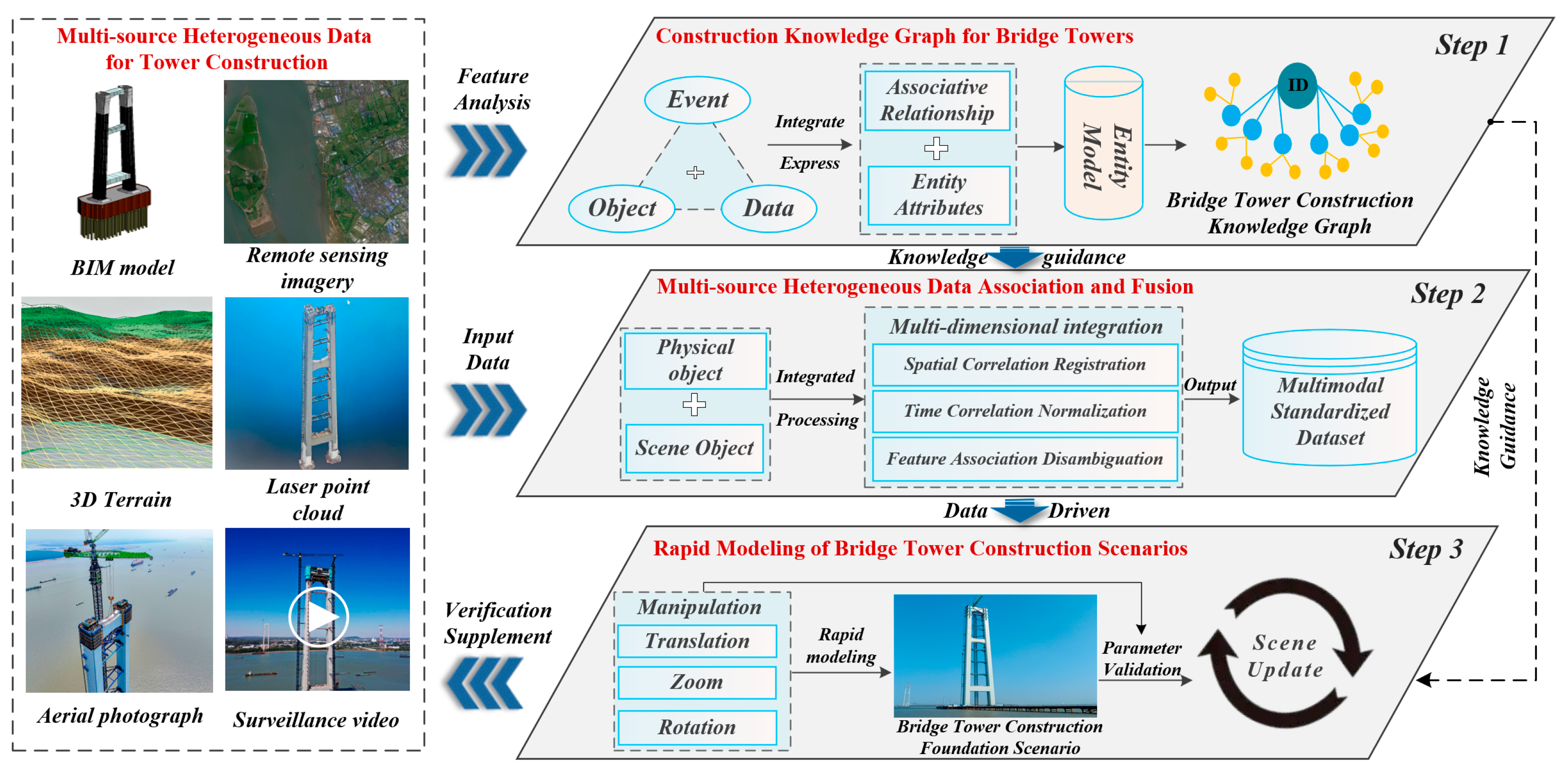
2.1. Overall Research Approach
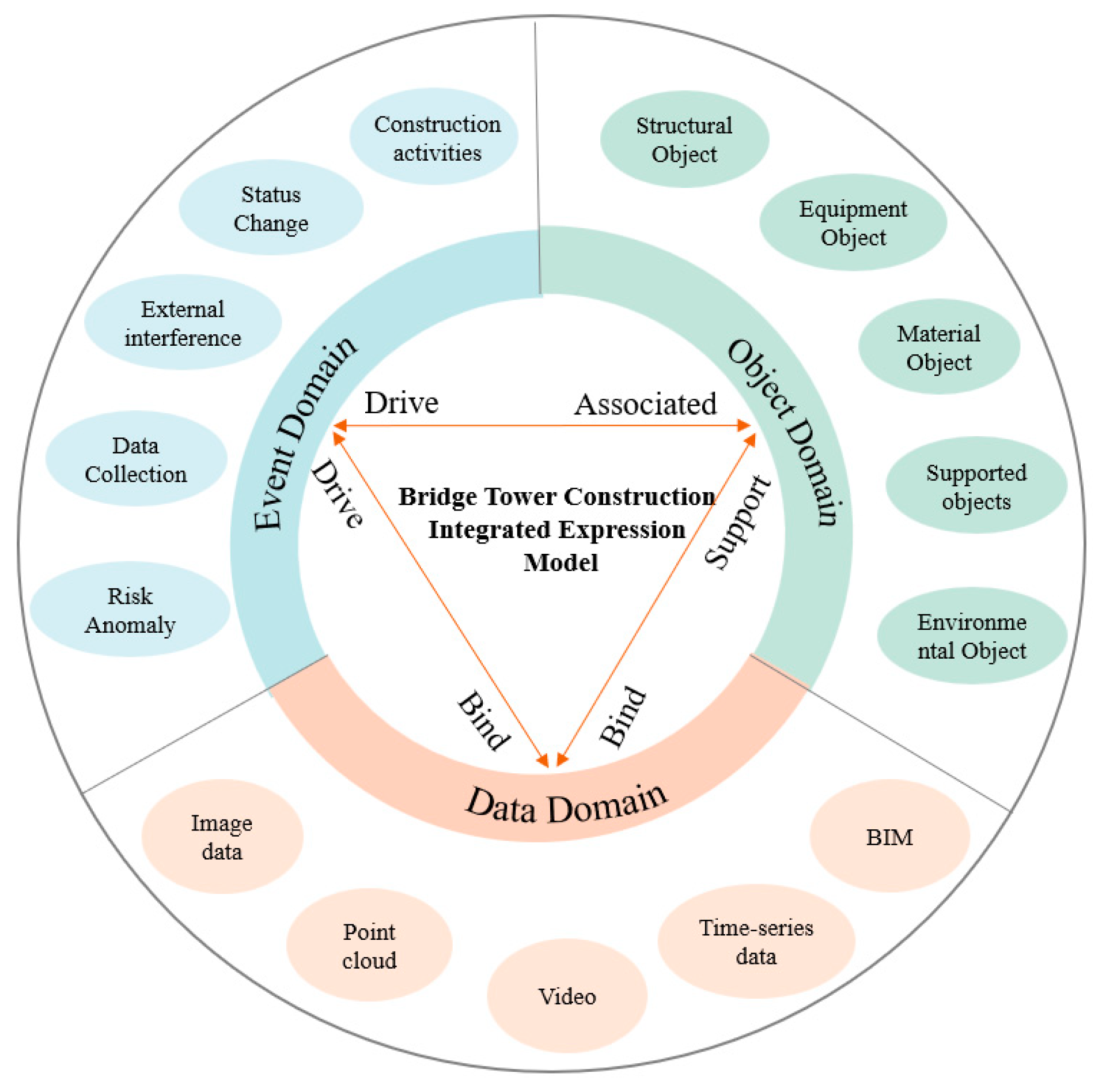
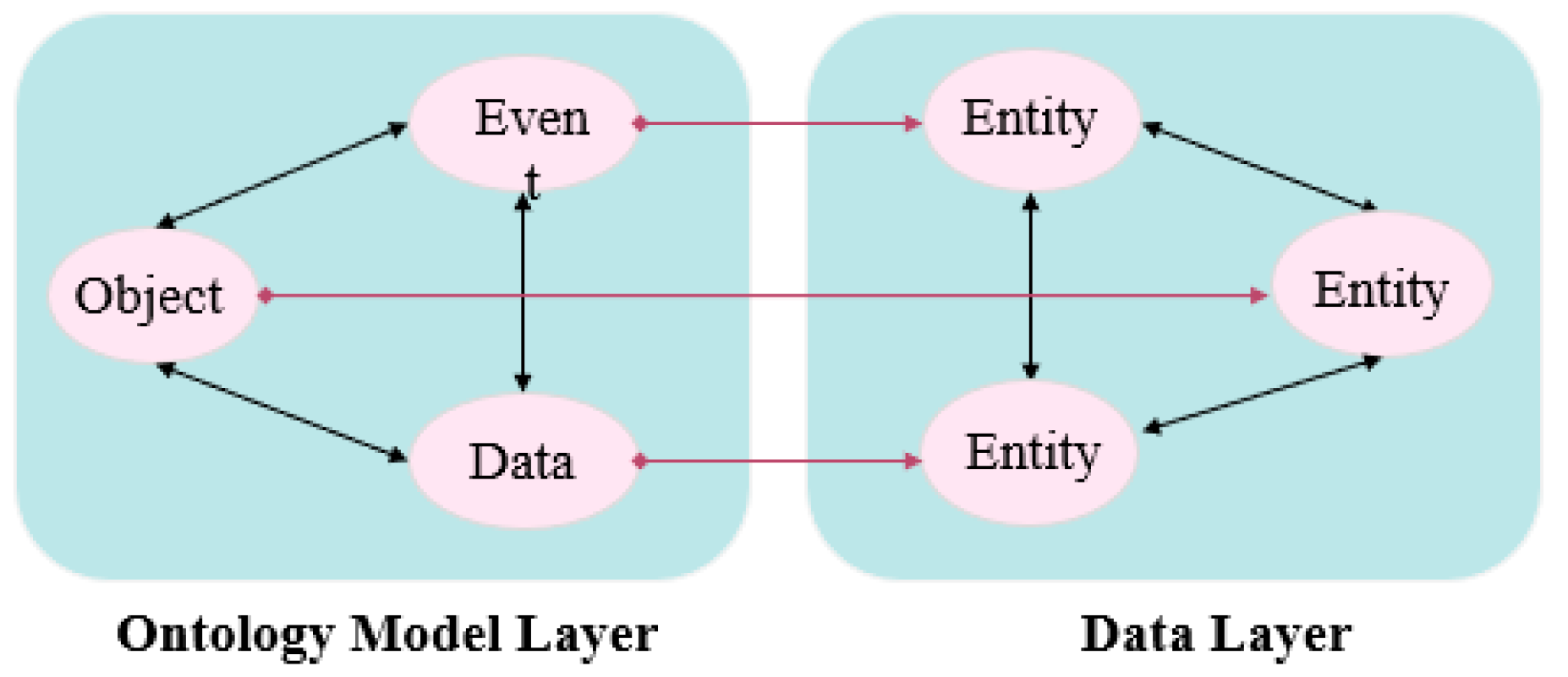
2.2. Construction of a Knowledge Graph for Bridge Tower Construction Linking the Three Domains of “Events-Objects-Data”
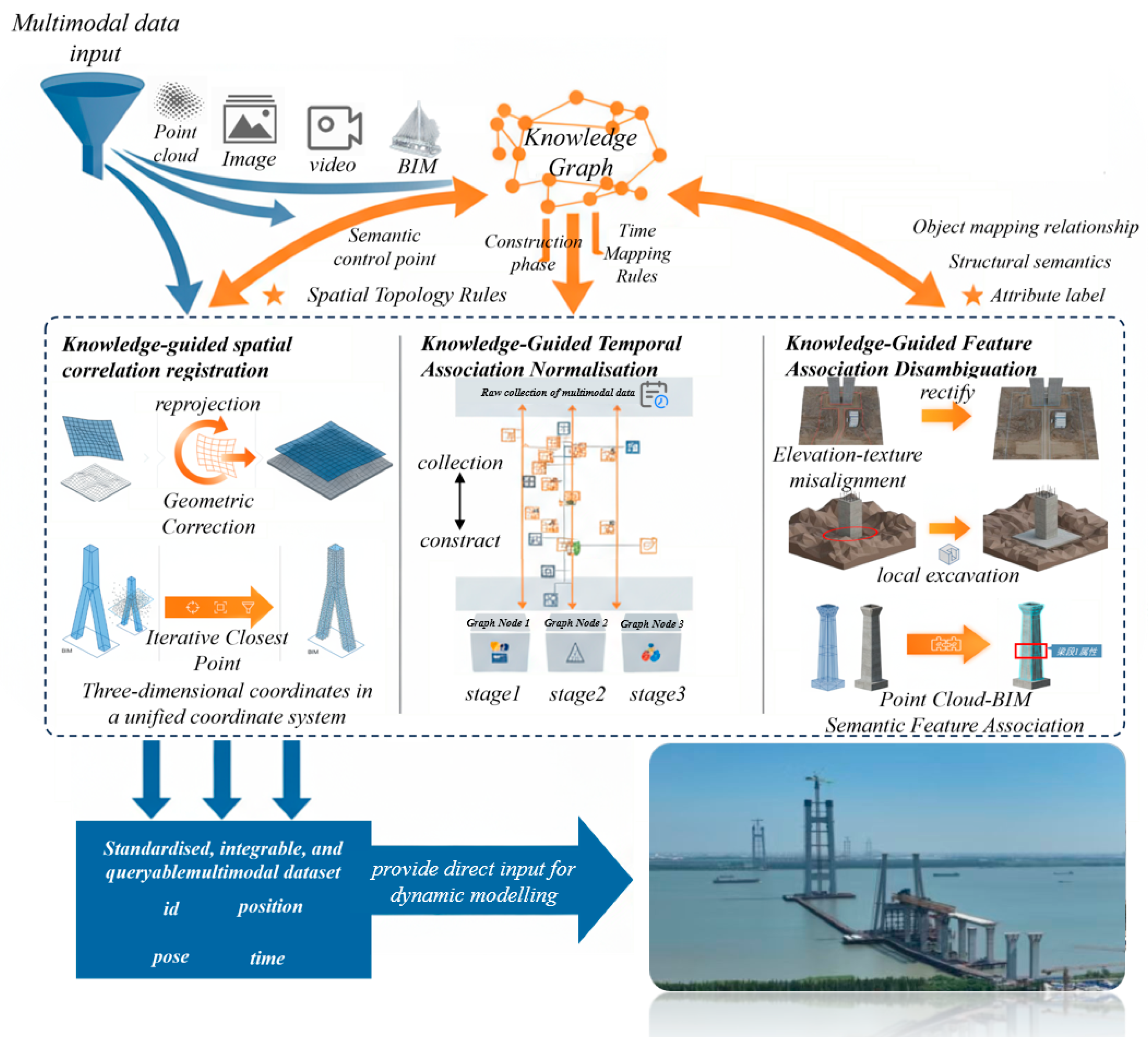
2.3. Knowledge Graph-Guided Multimodal Data Association and Fusion
| Algorithm 1. Construction Phase Matching | |
| Input: Raw Data Set DataRaw, Knowledge Graph GraphKG | |
| Output: Temporally Aligned Data Set DataAligned | |
| 1 | DataAligned ← ∅ //Initialize an empty aligned data set |
| 2 | for each DataItem ∈ DataRaw do //Iterate through all raw data items |
| 3 | TimeItem ← ExtractTimestamp(DataItem) //Extract creation time from metadata |
| 4 | PhaseMatch ← NULL //Reset current phase match status |
| # Temporal Matching with Knowledge Graph | |
| 5 | for each PhaseNode ∈ GraphKG.Nodes do //Query every construction phase |
| 6 | if PhaseNode.TimeStart ≤ TimeItem and TimeItem ≤ PhaseNode.TimeEnd then |
| 7 | PhaseMatch ← PhaseNode.ID //Assign phase ID if matched |
| 8 | break //Exit inner loop once a match is found |
| # Semantic Association to Graph Topology | |
| 9 | if PhaseMatch is not NULL then //A valid phase was found |
| 10 | Link(DataItem, PhaseMatch, GraphKG) |
| 11 | DataAligned ← DataAligned ∪ {DataItem} //Add item to the aligned result set |
| 12 | else |
| 13 | Log(DataItem, “Phase Not Found”) //Log unmapped items for review |
| 14 | return DataAligned //Return the temporally structured data set |
| Algorithm 2. Cross modal Object ID Association | |
| Input: Unlabeled Point Cloud CloudRaw, BIM Elements SetBIM, Ontology GraphKG | |
| Output: Assigned Global Object ID GlobalID | |
| # Spatial Registration | |
| 1 | CloudAligned ← MatrixRigid · CloudRaw //Apply rigid transformation to align coordinates |
| 2 | SetCandidate ← ∅ //nitialize the list of candidate elements |
| # Geometric Filtering via IoU | |
| 3 | for each ElementBIM ∈ SetBIM do //Iterate through all BIM components |
| 4 | IoUVal ← CalculateIoU(CloudAligned, ElementBIM) //Compute Intersection over Union |
| 5 | if IoUVal > ThresholdGeo then |
| 6 | SetCandidate ← SetCandidate ∪ {ElementBIM} //Add to candidate set |
| # Semantic & Topological Verification | |
| 7 | MatchOptimal ← NULL //Initialize the optimal match result |
| 8 | ScoreMax ← 0 //Initialize the maximum match score to zero |
| 9 | for each Candidate ∈ SetCandidate do //Evaluate each potential match |
| 10 | ScoreSem ← CalculateSim(CloudRaw.FeatureType, Candidate.Type, GraphKG) //Match point cloud labels with element types |
| 11 | IsTopoValid ← CheckTopology(CloudRaw, Candidate, GraphKG) //Validate if relative positions are logical |
| 12 | if ScoreSem > ScoreMax and IsTopoValid then |
| 13 | ScoreMax ← ScoreSem //Update the highest score |
| 14 | MatchOptimal ← Candidate //Update the best match |
| # ID Binding | |
| 15 | if MatchOptimal is not NULL then //A valid match was found |
| 16 | CloudRaw.GlobalID ← MatchOptimal.GlobalID //Assign the unique BIM ID to the cloud data |
| 17 | return MatchOptimal.GlobalID //Return the assigned ID |
| 18 | else |
| 19 | return NULL //Return NULL if no suitable match is found |
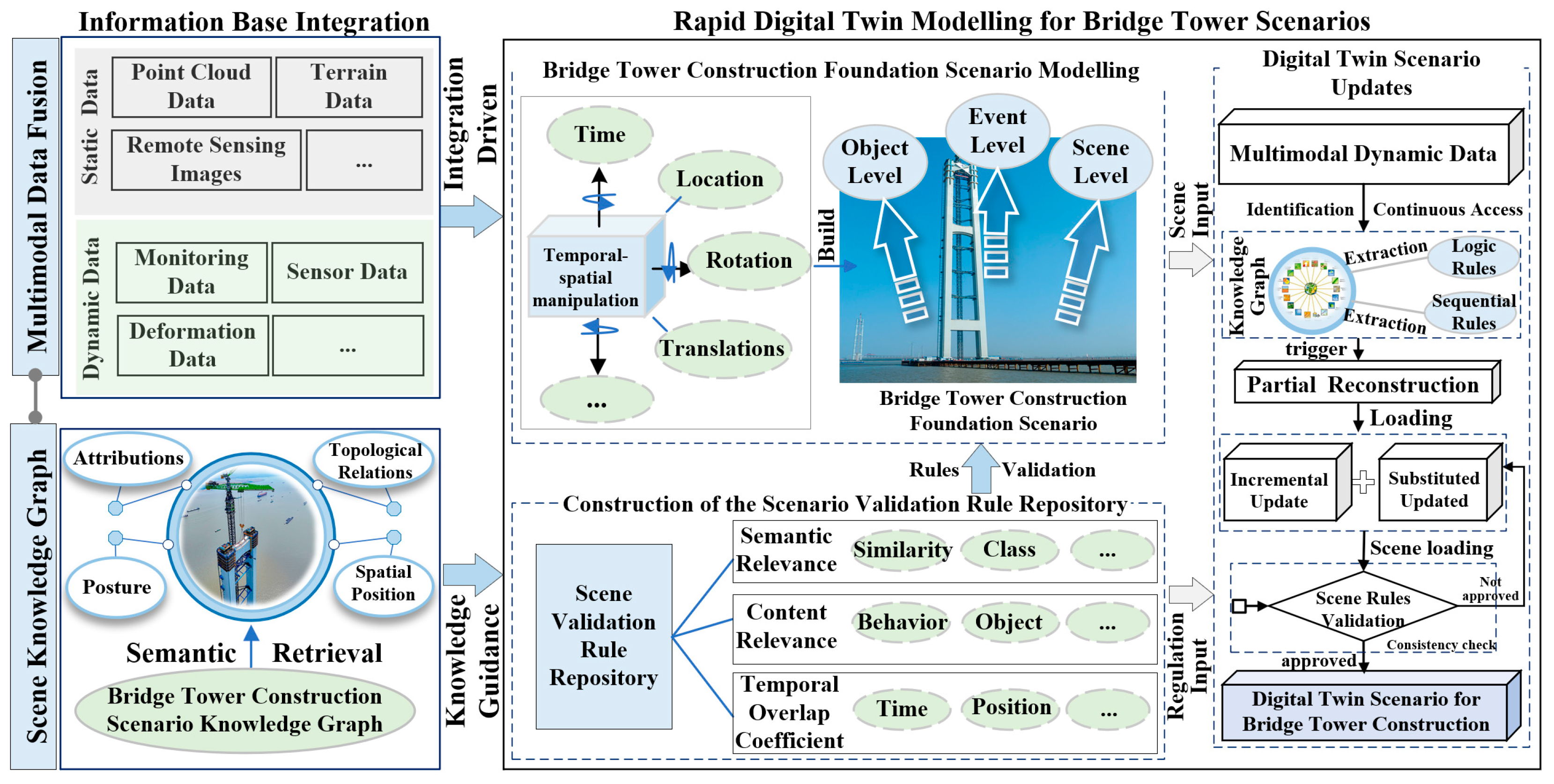
2.4. Rapid Modeling of Bridge Tower Construction Scenes Based on Dynamic Data
3. Case Study Experiment and Analysis
3.1. Case Description and Prototype System Development
3.1.1. Data Description
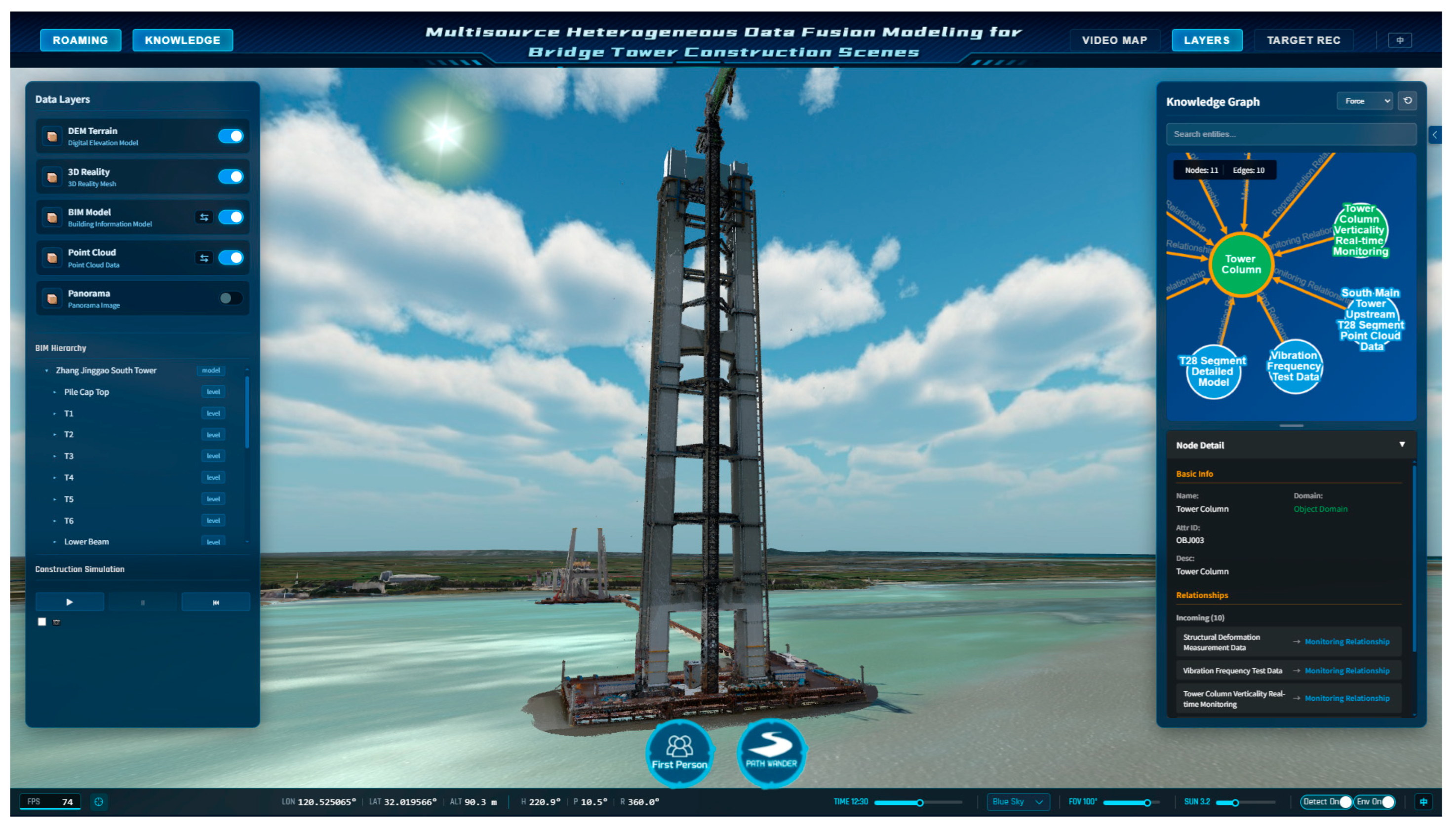
3.1.2. Prototype System Development
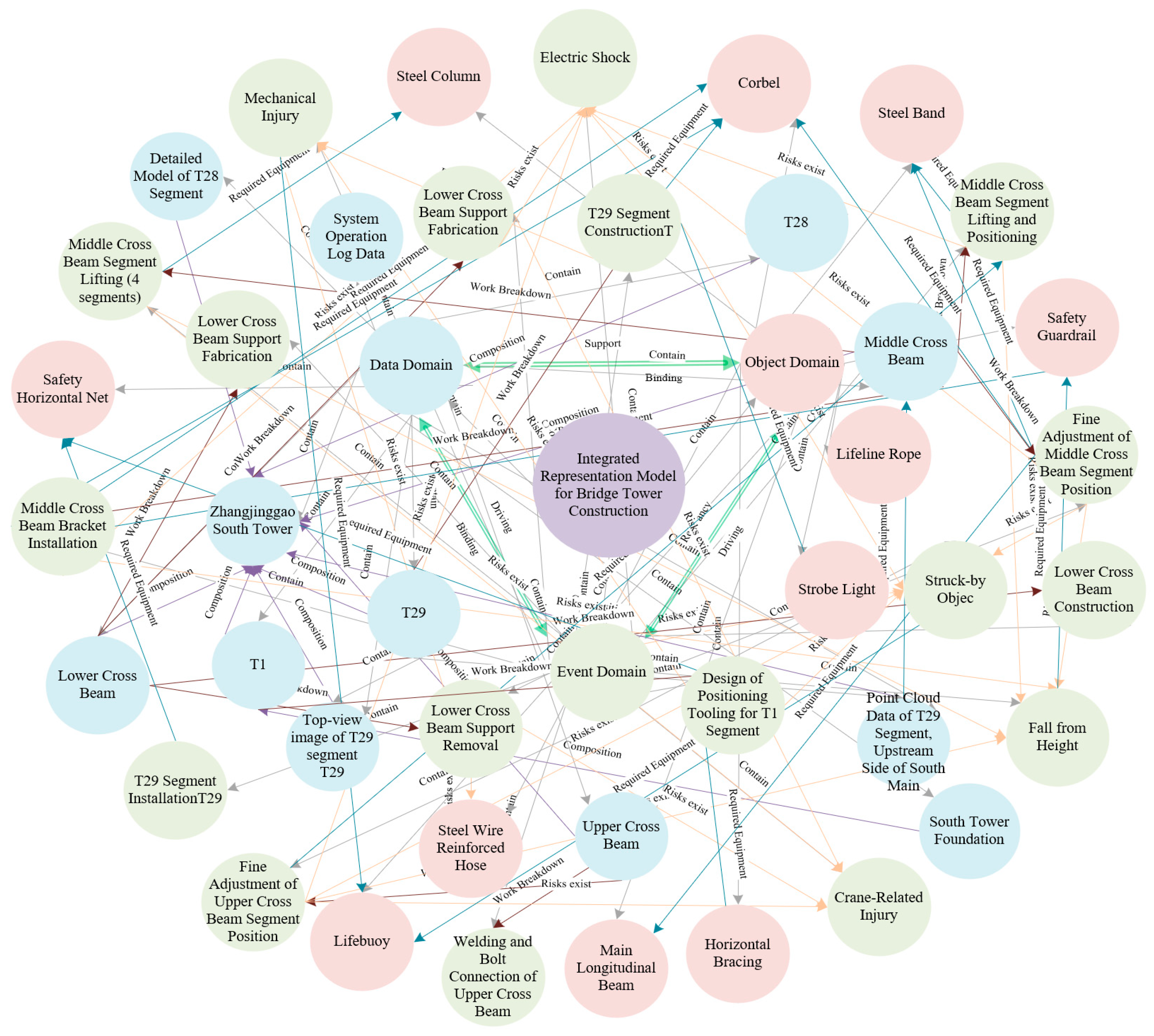
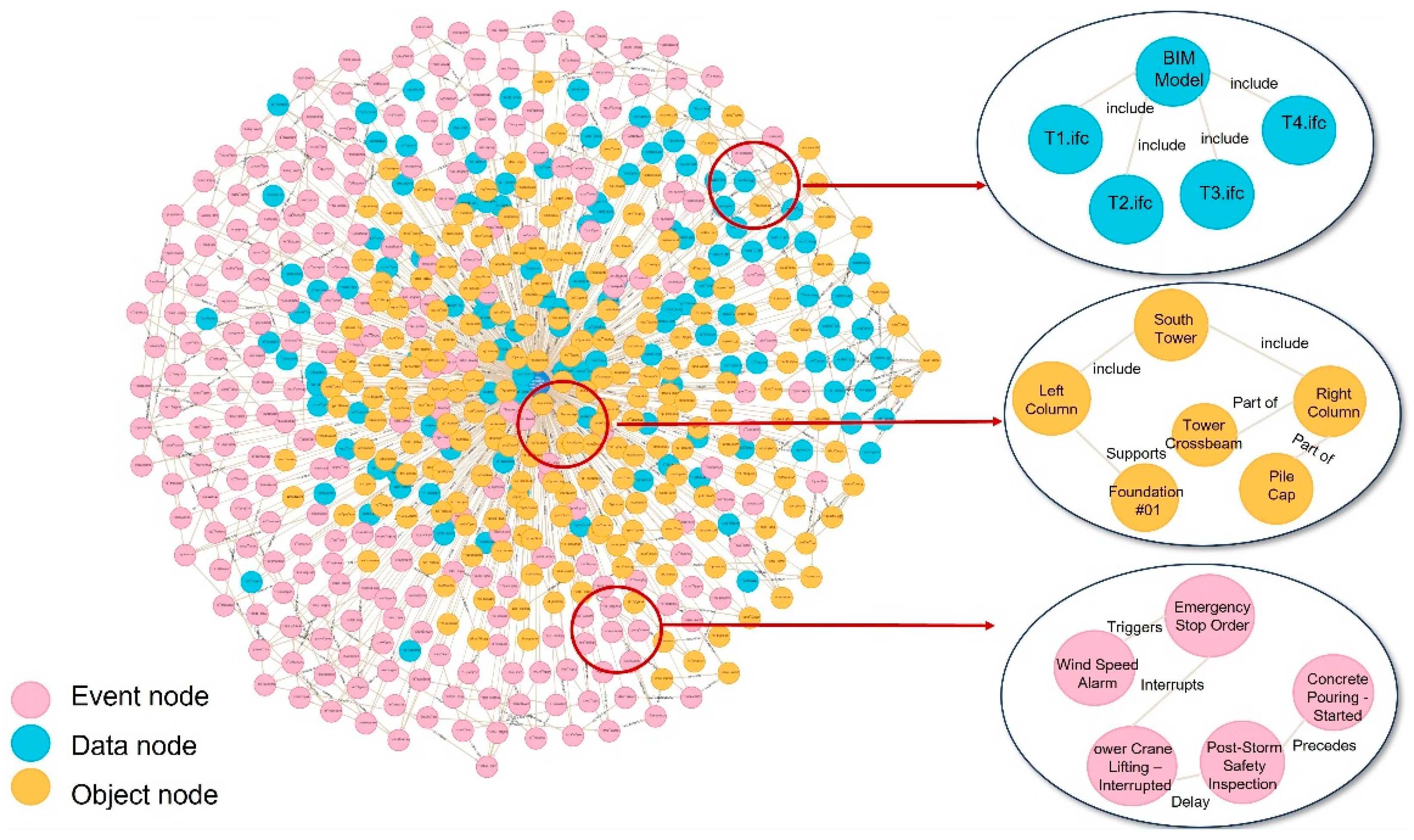
3.2. Knowledge Graph Construction Results and Analysis
3.3. Multimodal Data Association and Fusion Results and Analysis
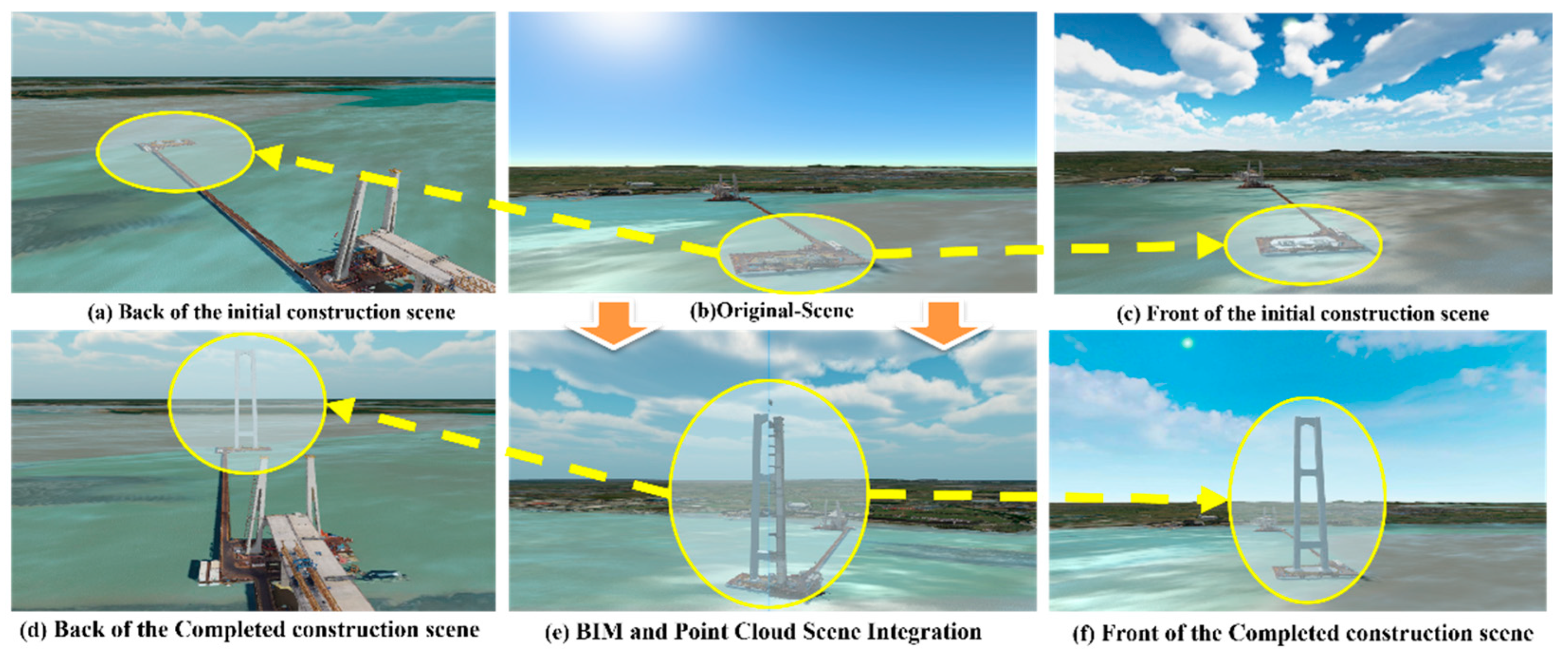
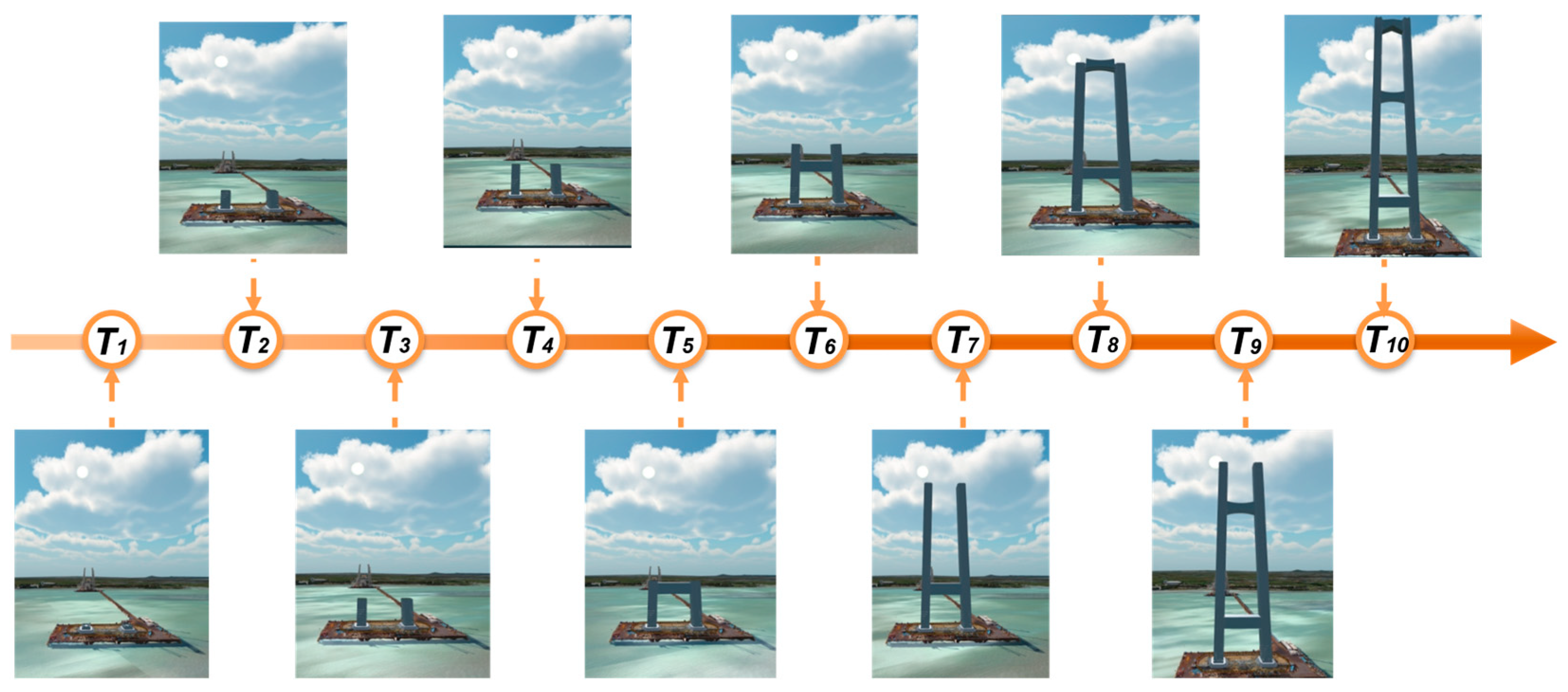
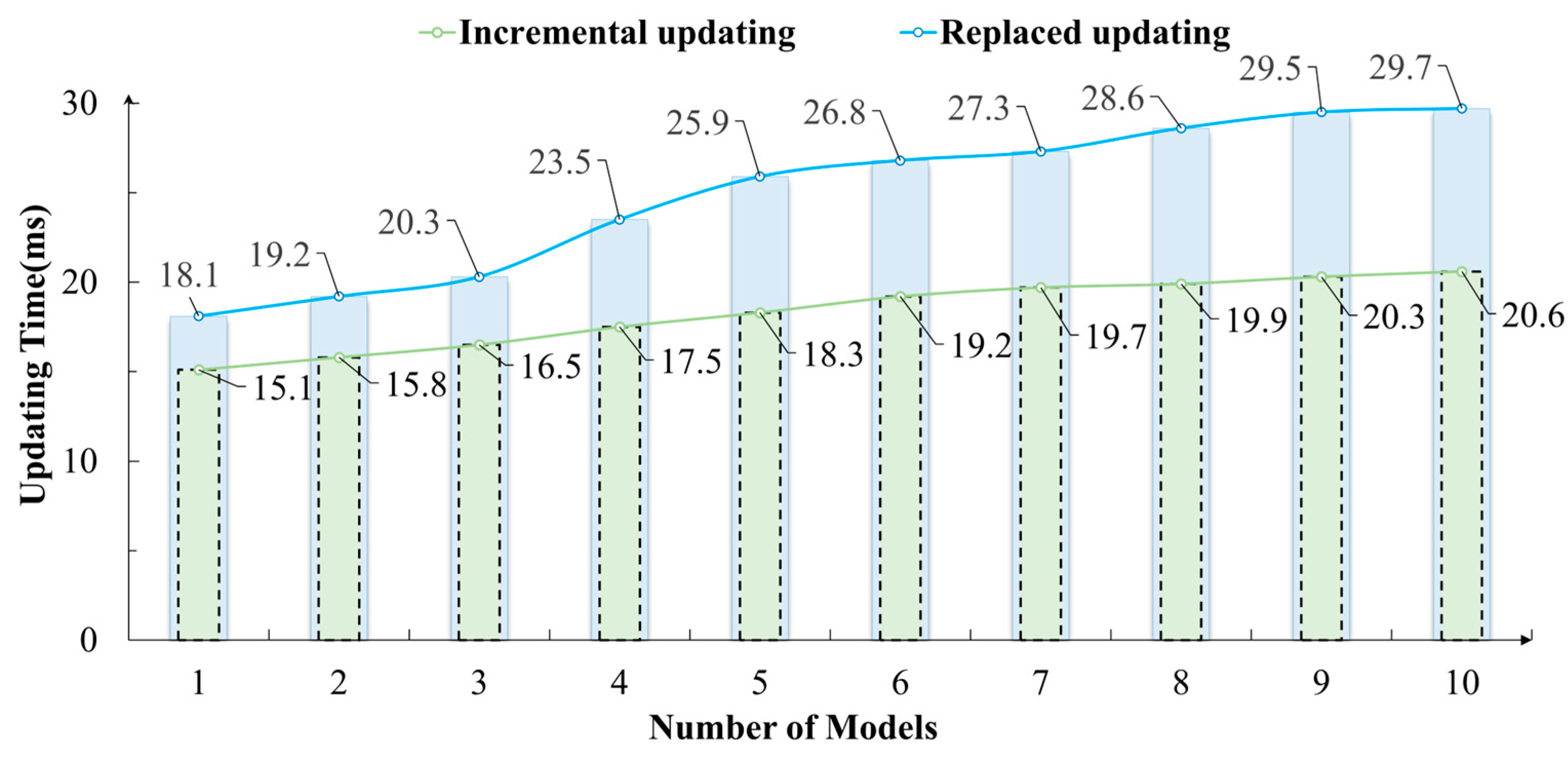
3.4. Twin Scenes Modeling Results and Analysis
4. Discussion
4.1. Advantages
4.2. Limitations and Future Work
5. Conclusions
Author Contributions
Funding
Data Availability Statement
Conflicts of Interest
References
- Zhu, J.; Zhang, J.; Zhu, Q.; Li, W.; Wu, J.; Guo, Y. A knowledge-guided visualization framework of disaster scenes for helping the public cognize risk information. Int. J. Geogr. Inf. Sci. 2024, 38, 626–653. [Google Scholar] [CrossRef]
- Guo, Z.; Zhu, J.; Zhang, J.; Wu, J.; Guo, Y.; Huang, F.; Li, J.; Li, W.; Xu, B. Geographic knowledge graph-guided twin modeling method for complex city scenes. Int. J. Appl. Earth Obs. Geoinf. 2025, 142, 104757. [Google Scholar] [CrossRef]
- Zhu, J.; Zhang, J.; Lian, H.; Ding, Y.; Guo, Y.; You, J.; Chen, P.; Xie, Y. A mobile phone-based multilevel localization framework for field scenes. Int. J. Geogr. Inf. Sci. 2025, 39, 2681–2709. [Google Scholar] [CrossRef]
- Papadopoulos, T.; Evangelidis, K.; Kaskalis, T.H.; Evangelidis, G. The Metaverse Is Geospatial: A System Model Architecture Integrating Spatial Computing, Digital Twins, and Virtual Worlds. ISPRS Int. J. Geo-Inf. 2025, 14, 126. [Google Scholar] [CrossRef]
- Dang, P.; Zhu, J.; Rao, Y.; Li, W.; Dang, C. A multimodal generative AI-driven 3D geographic scenes reconstruction method. Int. J. Geogr. Inf. Sci. 2025, 1–25. [Google Scholar] [CrossRef]
- Metcalfe, J.; Ellul, C.; Morley, J.; Stoter, J. Characterizing the role of geospatial science in digital twins. ISPRS Int. J. Geo-Inf. 2024, 13, 320. [Google Scholar] [CrossRef]
- Ranatunga, S.; Degrd, R.S.; Onstein, E.; Jetlund, K. Digital twins for geospatial decision-making. ISPRS Ann. Photogramm. Remote Sens. Spat. Inf. Sci. 2024, 10, 271–272. [Google Scholar] [CrossRef]
- Zhang, J.; Zhu, J.; Zhou, Y.; Zhu, Q.; Wu, J.; Guo, Y.; Dang, P.; Li, W.; Zhang, H. Exploring geospatial digital twins: A novel panorama-based method with enhanced representation of virtual geographic scenes in Virtual Reality (VR). Int. J. Geogr. Inf. Sci. 2024, 38, 2301–2324. [Google Scholar] [CrossRef]
- Li, W.; Zhu, J.; Fu, L.; Zhu, Q.; Xie, Y.; Hu, Y. An augmented representation method of debris flow scenes to improve public perception. Int. J. Geogr. Inf. Sci. 2021, 35, 1521–1544. [Google Scholar] [CrossRef]
- Liu, R.; Yue, P.; Shangguan, B.; Gong, J.; Xiang, L.; Lu, B. RTGDC: A real-time ingestion and processing approach in geospatial data cube for digital twin of earth. Int. J. Digit. Earth 2024, 17, 2365386. [Google Scholar] [CrossRef]
- Su, S.; Zhong, R.Y.; Jiang, Y. Digital twin and its applications in the construction industry: A state-of-art systematic review. Digit. Twin 2025, 2, 2501499. [Google Scholar] [CrossRef]
- Madubuike, O.C.; Anumba, C.J.; Khallaf, R. A review of digital twin applications in construction. J. Inf. Technol. Constr. 2022, 27, 145–172. [Google Scholar] [CrossRef]
- Tan, W.; Wu, S.; Li, Y.; Guo, Q. Digital twins’ application for geotechnical engineering: A review of current status and future directions in China. Appl. Sci. 2025, 15, 8229. [Google Scholar] [CrossRef]
- Anwer, N.; Schleich, B.; Mathieu, L.; Wartzack, S. Shaping the digital twin for design and production engineering. CIRP Ann. 2017, 66, 141–144. [Google Scholar] [CrossRef]
- Vinci-Carlavan, G.; Rossit, D.; Toncovich, A. A digital twin for operations management in manufacturing engineering-to-order environments. J. Ind. Inf. Integr. 2024, 42, 100679. [Google Scholar] [CrossRef]
- Zhang, J.; Zhu, J.; Dang, P.; Wu, J.; Zhou, Y.; Li, W.; Fu, L.; Guo, Y.; You, J. An improved social force model (ISFM)-based crowd evacuation simulation method in virtual reality with a subway fire as a case study. Int. J. Digit. Earth 2023, 16, 1186–1204. [Google Scholar] [CrossRef]
- Hu, F.; Gou, H.; Yang, H.; Ni, Y.-Q.; Wang, Y.-W.; Bao, Y. Digital twin-based fatigue life assessment of orthotropic steel bridge decks using inspection robot and deep learning. Autom. Constr. 2025, 172, 106022. [Google Scholar] [CrossRef]
- Zhang, Y.; Zhao, Y.; Li, Z.; He, W.; Liu, Y. Research on the Digital Twin System for Rotation Construction Monitoring of Cable-Stayed Bridge Based on MBSE. Buildings 2025, 15, 1492. [Google Scholar] [CrossRef]
- Zhang, H.; Yan, J.; Yang, J.; Meng, W.; Chen, S. Two-stage point cloud registration using multi-scale edge convolution for digital twin-based bridge construction progress monitoring. Autom. Constr. 2025, 178, 106415. [Google Scholar] [CrossRef]
- Valinejadshoubi, M.; Sacks, R.; Valdivieso, F.; Corneau-Gauvin, C.; Kaptué, A. Digital twin construction in practice: A case study of closed-loop production control integrating BIM, GIS, and IoT sensors. J. Constr. Eng. Manag. 2025, 151, 04025102. [Google Scholar] [CrossRef]
- Luo, Q.; Sun, C.; Li, Y.; Qi, Z.; Zhang, G. Applications of digital twin technology in construction safety risk management: A literature review. Eng. Constr. Archit. Manag. 2025, 32, 3587–3607. [Google Scholar] [CrossRef]
- Kaewunruen, S.; Sresakoolchai, J.; Ma, W.; Phil-Ebosie, O. Digital twin aided vulnerability assessment and risk-based maintenance planning of bridge infrastructures exposed to extreme conditions. Sustainability 2021, 13, 2051. [Google Scholar] [CrossRef]
- Sacks, R.; Brilakis, I.; Pikas, E.; Xie, H.S.; Girolami, M. Construction with digital twin information systems. Data-Centric Eng. 2020, 1, e14. [Google Scholar] [CrossRef]
- You, J.; Zhu, J.; Stefanakis, E.; Dang, P.; Wu, J. A fast modeling method for augmented reality dynamic scenes with spatio-temporal semantic constraints. Int. J. Geogr. Inf. Sci. 2025, 1–24. [Google Scholar] [CrossRef]
- Wu, X.Y.; Fan, X.Q.; Zhang, Q.H.; Wei, B.Y. Construction and Information Interaction Visualization of Digital City Model Based on UAV Oblique Measurement Technology. J. Comput. 2025, 36, 249–262. [Google Scholar] [CrossRef]
- Hosamo, H.H.; Hosamo, M.H. Digital twin technology for bridge maintenance using 3d laser scanning: A review. Adv. Civ. Eng. 2022, 2022, 2194949. [Google Scholar] [CrossRef]
- Honghong, S.; Gang, Y.; Haijiang, L.; Tian, Z.; Annan, J. Digital twin enhanced BIM to shape full life cycle digital transformation for bridge engineering. Autom. Constr. 2023, 147, 104736. [Google Scholar] [CrossRef]
- Jurado, J.M.; López, A.; Pádua, L.; Sousa, J.J. Remote sensing image fusion on 3D scenes: A review of applications for agriculture and forestry. Int. J. Appl. Earth Obs. Geoinf. 2022, 112, 102856. [Google Scholar]
- Madichetty, S.; Muthukumarasamy, S.; Jayadev, P. Multi-modal classification of Twitter data during disasters for humanitarian response. J. Ambient. Intell. Humaniz. Comput. 2021, 12, 10223–10237. [Google Scholar] [CrossRef]
- Yu, C.; Wang, Z. Multimodal social sensing for the spatio-temporal evolution and assessment of nature disasters. Sensors 2024, 24, 5889. [Google Scholar] [CrossRef] [PubMed]
- Zhou, Q.; Zuo, J.; Kang, W.; Ren, M. High-Precision 3D Reconstruction in Complex scenes via Implicit Surface Reconstruction Enhanced by Multi-Sensor Data Fusion. Sensors 2025, 25, 2820. [Google Scholar] [CrossRef]
- Ji, S.; Pan, S.; Cambria, E.; Marttinen, P.; Yu, P.S. A survey on knowledge graphs: Representation, acquisition, and applications. IEEE Trans. Neural Netw. Learn. Syst. 2021, 33, 494–514. [Google Scholar] [CrossRef]
- Peng, C.; Xia, F.; Naseriparsa, M.; Osborne, F. Knowledge graphs: Opportunities and challenges. Artif. Intell. Rev. 2023, 56, 13071–13102. [Google Scholar] [CrossRef]
- Chen, Z.; Wang, Y.; Zhao, B.; Cheng, J.; Zhao, X.; Duan, Z. Knowledge graph completion: A review. IEEE Access 2020, 8, 192435–192456. [Google Scholar] [CrossRef]
- Chen, Z.; Wan, Y.; Liu, Y.; Valera-Medina, A. A knowledge graph-supported information fusion approach for multi-faceted conceptual modelling. Inf. Fusion 2024, 101, 101985. [Google Scholar] [CrossRef]
- Han, H.; Wang, J.; Meng, X.; Liu, H. Analysis of the dynamic response of a long span bridge using GPS/accelerometer/anemometer under typhoon loading. Eng. Struct. 2016, 122, 238–250. [Google Scholar] [CrossRef]
- JTG/T 3650-2020; Technical Specifications for Construction of Highway Bridge and Culverts. Ministry of Transport of the People’s Republic of China: Beijing, China, 2020.
- Wu, Q.; Zhao, X. A Registration Method Based on Planar Features Between BIM Model and Point Cloud. J. Phys. Conf. Ser. 2024, 2833, 012016. [Google Scholar] [CrossRef]
- Grodecki, J.; Dial, G. Block adjustment of high-resolution satellite images described by rational polynomials. Photogramm. Eng. Remote Sens. 2003, 69, 59–68. [Google Scholar] [CrossRef]
- Adu-Amankwa, N.A.N.; Pour Rahimian, F.; Dawood, N.; Park, C. Digital Twins and Blockchain technologies for building lifecycle management. Autom. Constr. 2023, 155, 105064. [Google Scholar] [CrossRef]
- Lü, G.; Chen, M.; Yuan, L.; Zhou, L.; Wen, Y.; Wu, M.; Hu, B.; Yu, Z.; Yue, S.; Sheng, Y. Geographic scenes: A possible foundation for further development of virtual geographic environments. Int. J. Digit. Earth 2018, 11, 356–358. [Google Scholar] [CrossRef]





| Software/Hardware | Configuration Name | Detailed Information |
|---|---|---|
| Hardware | CPU | Intel(R) Core(TM) i9-14900HX |
| Graphics card | NVIDIA GeForce RTX 4060 | |
| RAM | 32.0 GB | |
| Operating System | Windows 11, version 24H2 | |
| Software | Compiler | Visual Studio Code 1.87.2 |
| Third-party open-source libraries | Vue 3.4.21, CesiumJS 1.114, Node.js 18.20.2 (LTS), NeoVis.js 2.0.2 | |
| Knowledge Graph Tool | Neo4j Community 5.12.0 | |
| Browser | Microsoft Edge 122 |
| Integration Type | Evaluation Metric | G1 | G2 | Accuracy Improvement |
|---|---|---|---|---|
| Remote Sensing Image + DEM | Planar Root Mean Square Error [39] | 1.15 | 1.03 | 10.43% |
| Point Cloud Model + BIM | Distance Root Mean Square Error (mm) [38] | 52.88 | 35.31 | 33.23% |
| Integration Type | Evaluation | G1 | G2 | Effectiveness Improvement |
|---|---|---|---|---|
| Surveillance footage + point cloud + BIM | ① Sequential Merge Efficiency (seconds per operation) | 28.5 | 9.8 | 65.6% |
| ② Sequence Fusion Error Rate (%) | 11.2 | 2.5 | 77.7% |
| Integration Type | Evaluation | G1 | G2 | Effectiveness Improvement |
|---|---|---|---|---|
| Terrain Features | Textural Feature Error Rate (%) | 5.8 | 3.2 | 44.8% |
| Model Features | Geometric Feature Error Rate (%) | 16.5 | 4.2 | 74.5% |
| Attribute Features | Attribute Query Error Rate (%) | 13.6 | 0.9 | 93.4% |
Disclaimer/Publisher’s Note: The statements, opinions and data contained in all publications are solely those of the individual author(s) and contributor(s) and not of MDPI and/or the editor(s). MDPI and/or the editor(s) disclaim responsibility for any injury to people or property resulting from any ideas, methods, instructions or products referred to in the content. |
© 2026 by the authors. Published by MDPI on behalf of the International Society for Photogrammetry and Remote Sensing. Licensee MDPI, Basel, Switzerland. This article is an open access article distributed under the terms and conditions of the Creative Commons Attribution (CC BY) license.
Share and Cite
Zhang, Y.; Wang, Y.; Guo, Z.; Zhu, J.; Huang, F.; Zhu, H.; Chen, Y.; Kang, Y. A Knowledge Graph-Guided and Multimodal Data Fusion-Driven Rapid Modeling Method for Digital Twin Scenes: A Case Study of Bridge Tower Construction. ISPRS Int. J. Geo-Inf. 2026, 15, 27. https://doi.org/10.3390/ijgi15010027
Zhang Y, Wang Y, Guo Z, Zhu J, Huang F, Zhu H, Chen Y, Kang Y. A Knowledge Graph-Guided and Multimodal Data Fusion-Driven Rapid Modeling Method for Digital Twin Scenes: A Case Study of Bridge Tower Construction. ISPRS International Journal of Geo-Information. 2026; 15(1):27. https://doi.org/10.3390/ijgi15010027
Chicago/Turabian StyleZhang, Yongtao, Yongwei Wang, Zhihao Guo, Jun Zhu, Fanxu Huang, Hao Zhu, Yuan Chen, and Yajian Kang. 2026. "A Knowledge Graph-Guided and Multimodal Data Fusion-Driven Rapid Modeling Method for Digital Twin Scenes: A Case Study of Bridge Tower Construction" ISPRS International Journal of Geo-Information 15, no. 1: 27. https://doi.org/10.3390/ijgi15010027
APA StyleZhang, Y., Wang, Y., Guo, Z., Zhu, J., Huang, F., Zhu, H., Chen, Y., & Kang, Y. (2026). A Knowledge Graph-Guided and Multimodal Data Fusion-Driven Rapid Modeling Method for Digital Twin Scenes: A Case Study of Bridge Tower Construction. ISPRS International Journal of Geo-Information, 15(1), 27. https://doi.org/10.3390/ijgi15010027