1. Introduction
Let
G be a simple and connected graph with vertex set
and edge set
. An edge connecting two vertices
u and
v in the graph
G are denoted by
. For any vertex
, the open neighborhood of
v is the set
and the closed neighborhood is the set
. The degree of a vertex
u is denoted by
and it is the number of edges that are incident with
u in the graph
G. A vertex
u in
G is a leaf if
. The diameter of a tree is the longest path between two leaves. If
is a path where the diameter is attained, we say that
is a diameter path in
T. We use
to denote the tree obtained from
T by deleting the vertices
of
T. As usual, by
and
, we denote the path and the star with
n vertices, respectively. For other notations and terminologies not defined here, please refer to the book by West [
1].
Graph theory has provided chemists with a variety of useful tools, such as topological indices. A topological index is a numeric quantity from the structural graph of a chemical compound [
2]. Among many topological indices, the Randić index is the most widely used in applications to chemistry, especially in QSPR/QSAR investigations [
3].
The Randić index was introduced by Randić [
4] and is defined as
where
and
denote the degrees of the vertices
u,
, and
denotes the edge connecting these two vertices.
A subset
is a dominating set of
G if every vertex in
has a neighbor in
D. The minimum cardinality of a dominating set of
G is called the domination number, denoted by
. A subset
is a total dominating set of
G with no isolated vertices if every vertex
G has a neighbor in
D. The total domination number of
G, denoted by
, is the minimal cardinality of a total dominating set [
5]. Please refer to [
6] for a survey of the selected findings on total domination number in graphs before 2009. Domination in graphs has been an active research area in graph theory [
7,
8].
The relationship between topological indices and the parameters of domination has attracted the attention of many researchers. Borovićanin and Furtula [
9] showed the sharp upper bounds on the Zagreb indices of
n-vertex trees with the domination number and characterized the extremal trees. In [
10], the authors obtained the extremal harmonic index of trees in terms of the order and domination number. Furthermore, Pei and Pan [
11] considered the upper bounds for the Zagreb indices of
n-vertex trees with a given distance
k-domination number and the extremal trees are characterized. Wang et al. [
12] determined sharp upper and lower bounds of multiplicative Zagreb indices in terms of the arbitrary domination number. Moreover, the corresponding extremal graphs are characterized. In the paper, [
13], upper and lower bounds on the zeroth-order general Randić index for trees with a given order and domination number are presented. In addition, the authors showed that the bounds are the best possible. Şahin [
14] obtained the extremal values of the Hosoya index and the Merrifield–Simmons index of trees with a given domination number. Recently, Sun et al. [
15] provided the maximum and minimum Sombor index of trees with fixed domination numbers and identified the corresponding extremal trees.
In [
16], the upper bounds on the Zagreb indices of the tree, unicyclic, and bicyclic graphs with a given domination number and total domination number were obtained. Bermudo et al. [
17] obtained the upper and lower bounds of the Randić index of trees with a given domination number. Recently, Ahmad Jamri et al. [
18] discovered an upper bound for the Randić index of trees with a given total domination number. This paper investigates the lower bound of the Randić index of trees with a given total domination number. Finally, trees with a given order and total domination number with minimal Randić index are characterized.
2. Main Results
Here, the sharp lower bound of the Randić index of trees in terms of the total domination number and the characterization of those that attain this lower bound are presented. In order to do that, we used a similar approach as in [
17].
The following lemmas are useful for our main results.
Lemma 1 ([12]). If G is a connected graph of order , then .
Lemma 2. Assume that for any number then and , for any . Proof. Firstly, we show that
for any
.
then
if and only if
This inequality is equivalent to
After rearranging, we have
Since we have
it is enough to check that
which is obtained by using the fact that the function
is a positive function for any
.
Finally, we show that
implies
for any
. Hence, this inequality is equivalent to
Since
for any
and the function
is a positive function for any
, we have the required inequality. □
Now, we present our main results.
Theorem 1. If T is a tree of order n and total domination number , then Proof. The result is proved by induction on the number of vertices. If , . If , then and . Therefore, we suppose that and the result holds for any trees of order . We will check if it is true for the tree with n vertices.
If
is even, then we can have the inequality (
1) as follows
Meanwhile, if
is odd, the inequality (
1) is obtained as follows
Without loss of generality, suppose that
is odd. Therefore, we prove inequality (
3). To simplify the computations, we denote
Let is a diameter path in the tree T. Let , , and and for . Suppose . Since , we study the following cases.
Case 1. Suppose that
. Then, we have
If
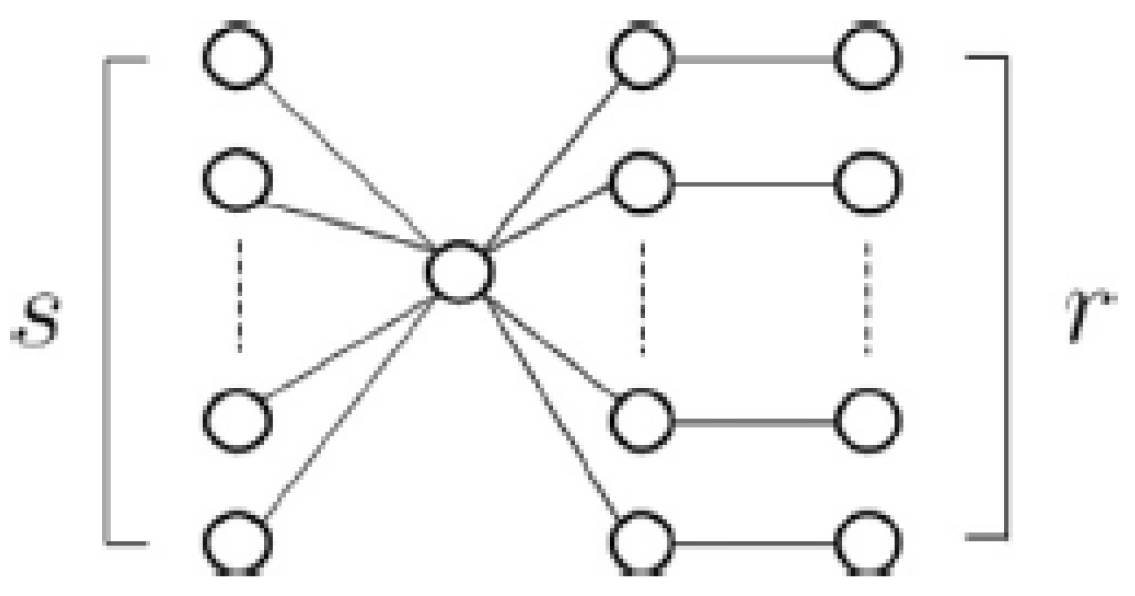
, we have the graph shown in
Figure 1 with
(see below). In this case,
and
. It is easy to check that
.
Thus, we consider
. Since
and
, by Lemma 2, we have
Therefore,
for any
. Thus,
. The equalities hold if and only if
and in this case, the graph is one of the graphs shown in
Figure 1.
Case 2. Suppose that
. In this case, we have
. Then, there exists a minimum total dominating set
D of
T such that
. Therefore, we obtain
If
, then
, thus,
. Therefore,
and, consequently, we have
. However, it is
. Therefore, we consider
. We denote
and
for any
. By considering this case,
or
for
. If
is a leaf or support vertex with
, then the graph is the one shown in
Figure 1, which the result holds. In the other cases, we consider
,
, where
and
. We have the following cases.
Case 2.1. Let
. If
is one vertex, such that
and we take
, then
. Since
; thus,
. Hence, we have
If
, then
T is one of the graphs
,
,
or the graph shown in
Figure 1, thus we can consider
. In this case,
and there exists
, such that
. Therefore,
By applying Lemma 1 and since
and
, we have
By putting
, we have the function
whose
If
, we have that
The above function for any
is a positive function. Thus,
is an increasing function for any
. Since
, if
, then the graph with
and
satisfies (
1). In other cases, we have
, which implies that
Therefore, for and .
Case 2.2. Assume that . We study the following cases.
Case 2.2.1. Let
. If
is one vertex such that
and
is adjacent to
with
, we take
. In this case,
and we have
Since
, we have
We consider the function
which is an increasing function for
.
If
, then
, which yields
This is a positive function for any . Therefore, . If and , in this case, the only graph with these conditions is the graph obtained from path , such that is added to the vertex . It is easy to check for this graph that .
Case 2.2.2. We suppose that . By the above cases, we can suppose that . We consider the following cases.
Case 2.2.2.1. If
, then we take
. In this case,
. Thus, we have
Since
, using Lemma 2, we have
Therefore,
which is a positive function for
. Therefore,
.
For and , tree T is the path , and for and , the graph is one of graphs or the graph obtained from , such that . Clearly, in these cases, .
Case 2.2.2.2. Let or not be in the minimum total dominating set D. We suppose that and . We take and we consider the two following cases.
Case 2.2.2.2.1. We suppose that
. Assume that
. Then, we have
By applying
and Lemma 2, we have
Here, the function
is an increasing function for
. Therefore, for
, we have
.
Note that if and , by considering and , the result is obtained via the case given above.
Case 2.2.2.2.2. We suppose that
. We denote
. By the above cases and the definition of the total domination number,
for any
. In such a case, we take
which yields
Since
, using Lemma 2, we have
Similar to the above case, for any we have . □
Remark 1. In [17], the authors proposed a lower bound of the Randić index of trees in terms of the order n and the domination number γ as follows According to the discussion at the beginning of the proof of Theorem 1, let us consider Using the fact that and , we havefor any and . Therefore, for any and , Consequently, the lower bound (1) is stronger than the lower bound obtained in [17] Theorem 2.4 for and . Theorem 2. Let T be a tree of order n and a total domination number . Thenif and only if . Proof. Suppose that there exists a tree
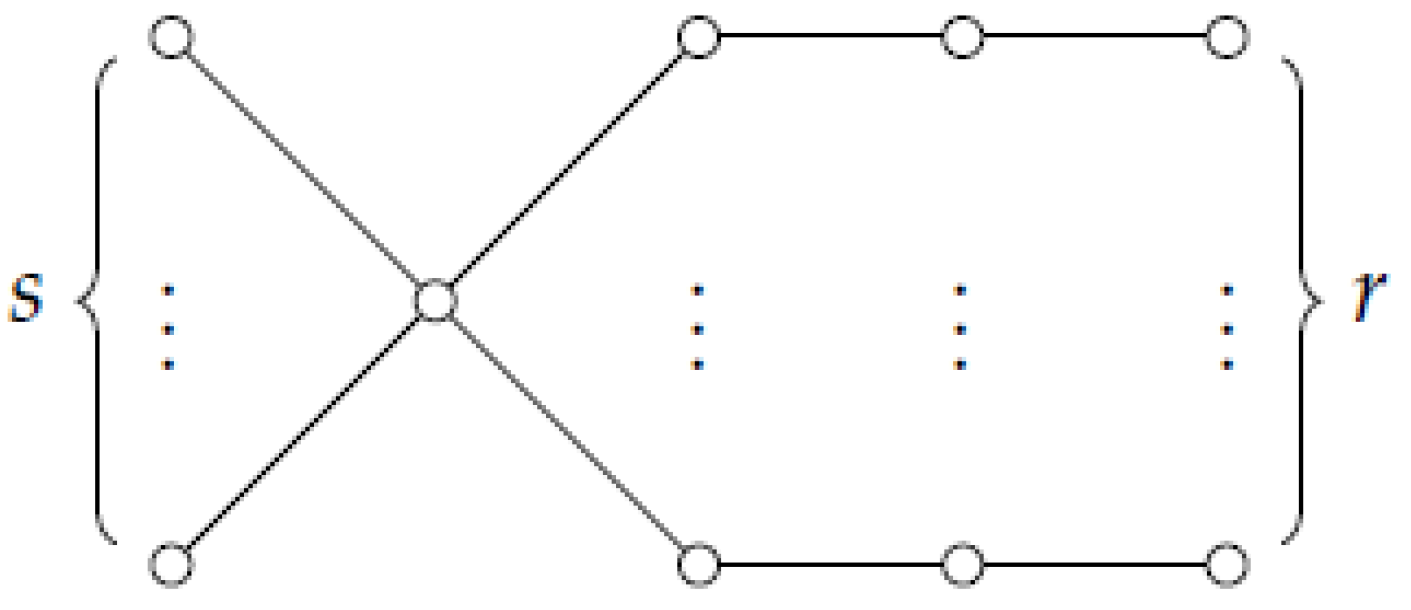
(
), shown in
Figure 2 as below. In such a case, we have
and
. Therefore, we have
By substituting
and
on the right side of the above equation, we have
By following the proof of Theorem 1, we can see that in some cases of the proof, if , then the inequality in that theorem is a strict inequality. Therefore, we suppose that there exists a tree in Cases 1 and 2.2, such that the equality holds. However, we show that there is no such tree.
In Case 1, if there exists a tree
T such that the equality holds, then all of the inequalities become equalities. This happens when
and
. That is, the graph is one of the graphs shown in
Figure 2 with
. Therefore,
.
By considering Case 2.2 in the proof of Theorem 1, we investigate trees that satisfy the equality conditions
and
. If all inequalities become equal in Case 2.2, then we have
By simplification of the above relation, we have
which we can easily check that
. Therefore, the inequality, in this case, is also strict. □




 ,
,