
 Open Access
 - Article

36 Pages
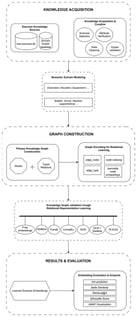
Physical exercise knowledge is usually distributed in flat catalogs, where muscles, equipment and training attributes are stored as independent columns and the dependencies that organize the domain are never made explicit. This work presents a heterogeneous multi-relational Fitness Knowledge Graph built from a public-domain exercise dataset and refined through expert-guided curation: 922 entities and 8598 typed assertions across nine semantic relations, each validated against an explicit domain and range schema before the graph is written. Its organization was assessed through relational representation learning, comparing seven models over thirty independent runs under the same protocol: free node embeddings, DistMult, TransE, ComplEx, a homogeneous Graph Convolutional Network, the same encoder combined with a relation-aware decoder, and a Relational Graph Convolutional Network. Models without propagation reconstruct observed edges more accurately, while propagation yields a markedly larger separation between exercise types, improving similarity scores from 0.652 for DistMult to between 0.810 and 0.968, significant under a paired Wilcoxon test with Holm correction. The advantage does not extend to every criterion: a translational decoder without propagation reaches a Silhouette score indistinguishable from that of the Relational Graph Convolutional Network with less than a third of its parameters. A control experiment removing the two relations derived from the source category field shows that this organization is carried by them, since every type-based metric collapses and the Silhouette score becomes negative for all seven models. The information does not leave the graph, as a parameter-free similarity over the seven remaining relations still recovers exercise type at 0.828 against 0.479 for random neighborhoods, placing the limitation in the training objective rather than in the relational design. Edge reconstruction and semantic organization therefore measure different properties of a representation, and the relational composition of the graph determines which property the representation space reflects.
Mathematics
17 October 2026