Abstract
A survey on recent umbral polynomial interpolation is presented. Some new results are given, following a matrix-determinant approach. Some theoretical and numerical examples are provided.
Keywords:
polynomial interpolation; umbral calculus; umbral interpolation; determinant form; Appell sequence; delta-operator; Sheffer sequence MSC:
11B83; 11B37; 11C99; 47B38
1. Introduction
Interpolation is a very old theme [1,2,3]. The simple theorem of polynomial interpolation, on which much of practical numerical analysis is based, states that a straight line can pass through two points, a parabola through three, a cubic through four, and so on [4].
Modern interpolation theory is concerned with reconstructing functions on the basis of certain assumed known functional information [5,6]. In many cases, the functionals are linear. Hence, we consider the following general problem.
Let
- X be a linear space of real functions defined on the interval , continuous and with continuous derivatives of all necessary orders;
- be the space of polynomials of degree less than or equal to n;
- Q be a delta-operator (In [7,8] the authors use the notation -operator, while in [9,10,11,12] the notation delta-operator) (see [13,14,15,16] and references therein), i.e.,
- L be a linear functional on X of the following typewhere the functions are assumed to be piecewise continuous in and the points to lie in ;
- , being the set of natural numbers.
Then, for each , we look for a polynomial , if it exists, of degree less than or equal to n such that
with
The polynomial and in (3) are called umbral interpolant and remainder, respectively. This problem is called umbral-interpolation problem for (see [17,18] and references therein), and the conditions (4) are called umbral conditions for .
The term umbral interpolation is also used for other different topics (see [19,20] and references therein).
The paper is organized as follows: Section 2 contains the preliminaries, and Section 3 deals with the problem of umbral interpolation. In Section 4, some known and new examples of umbral interpolating polynomials associated with different types of delta operators are given. In Section 5, we compare the error in the approximation of some given function by many of these interpolating polynomials. Section 6 is dedicated to a brief conclusion. Finally, the Appendix A contains some tables that summarize the cases of umbral interpolation previously considered.
2. Preliminaries
Let the delta-operator Q be assigned.
Theorem 1
(The Main Theorem [21]). There exists a unique polynomial sequence, denoted by , such that
This polynomial sequence (p.s. in the following [22,23]) is said basic or associated with the operator Q, and it is of binomial type (see [13,14,16,24,25] and references therein).
For the proof of Theorem 1, we give some preliminary results.
Proposition 1
(Numerical sequence and related matrix [16]). We consider the numerical sequence such that
with as in (1). Then we can build the nonsingular, lower triangular matrix by the following algorithm ([16], p. 8):
For the matrix is an infinite, lower triangular matrix [26,27], denoted by .
Proposition 2
Remark 1.
We note that and . Hence, for every n the matrices and are nonsingular.
The matrices and (B and , respectively, in the infinite case) are inverse of each other and are called matrices of binomial type ([16], p. 7).
The numerical sequences and generate the formal power series
respectively. They are called δ-series [13,14], being , and .
Proposition 3
([16], p. 9). With the previous hypothesis and notation, we obtain
Proof of Theorem 1.
Let us consider the matrix with elements as in Propositions 2 and 3. It defines the p.s. with
It is easy to verify that
Then, taking into account the linearity of Q and the previous relations, we obtain
This implies .
Proposition 4
([16], pp. 31–32). For the elements of the following determinant form holds
The sequence generates the numerical sequence , called associated with , by the binomial convolution product (also called Hurwitz product) [28,29]:
In [30], sequences of type are called convolution sequences.
Then we build the p.s. with
It is easy to verify that
Furthermore, if we set
we obtain
and
The p.s. , so defined, is known as Appell p.s. (see [16,31,32] and references therein).
Taking into account that the set of polynomial sequences is a group with respect to the umbral composition ([17], p. 58), we can consider the umbral composition of the Appell p.s. and the binomial-type p.s. as in (7). Thus, we obtain the p.s. with
It is proved [33] that the p.s. has the following determinant form
with .
Moreover, the following recurrence form holds [33]:
From (11) and Theorem 1 it follows that
Proposition 5
([33]). We obtain
where is the Kroneker symbol.
Proof.
We observe that the p.s. is a Sheffer p.s. (see [16,17,21,33,35] and references therein). Then the set is a basis for , and we call it umbral basis for or simply umbral basis.
In summary, once a delta-operator Q and a linear functional L are assigned,
- there exists a unique p.s. such thatthe p.s. is of binomial-type;
- assuming as in (9), there exists the numerical sequence , such that
- there exists the p.s. such thatthe p.s. is an Appell p.s. [31];
- finally, we consider the umbral composition
3. Umbral Interpolation
Now, we consider the problem of umbral interpolation mentioned in the Introduction. We first extend the problem to the more general case.
Let L be a linear functional on X with L as in (2), Q a delta-operator on and , not all zero. We want to solve the following problem: determine, if it exists, the polynomial such that
This problem is called umbral-interpolation problem in . The conditions (17) are called umbral-interpolant conditions.
Theorem 2
([18]). Let be the umbral basis for . The polynomial
is the unique polynomial of degree less than or equal to n satisfying the umbral-interpolation problem, i.e., such that
Proof.
The proof is a straightforward consequence of Proposition 5 and the linearity of Q. □
Corollary 1.
(Representation of polynomials). Each can be written as
Now, we extend the concept of umbral interpolation to the real space of functions X.
Theorem 3.
(The main Theorem). Let Q be a delta-operator on the linear space X. We set
Let L be a linear functional on , with L as in (2). Let be the umbral basis for . Then, for every , the polynomial
is the unique polynomial of degree less than or equal to n such that
Proof.
The proof follows from Theorem 2 (for details see ([17], pp. 392–394)). □
Definition 1.
The polynomial is called the
umbral interpolant
for the function f related to . The conditions (20) are known as
umbral interpolant conditions
of f for .
The difference
is called
truncation error
or
remainder
at the point x.
Theorem 4
([18]). For any , we obtain
If is a polynomial of degree , then
We say that is an approximant of order n for f.
For every fixed x in , we may consider the remainder as a linear functional which acts on f and annihilates all elements of . For any fixed x, it can be considered to be a linear functional as in (2). Therefore, we can apply Peano’s Theorem ([4], p. 69).
Theorem 5
([18]). Let . The following representation for holds:
where
being the truncated power function ([4], p. 70).
Remark 2.
From (19), if and with , then, by applying the known Holder’s inequality, classic bounds for can be obtained.
Proposition 6.
Let be the Taylor polynomial for the function f with initial point a. Then the following identity holds:
Moreover,
Proof.
The proof follows from Theorem 5, after easy calculations. □
In order to provide another umbral-interpolant for f, if z is a fixed point in , we consider the polynomial
Theorem 6
([18]). The polynomial is an approximant of order n for f, i.e.,
with
Proof.
The proof follows from Theorem 4. □
Theorem 7
([18]). The polynomial satisfies the following interpolating conditions
is called the complementary umbral interpolating polynomial ([17], p. 394) for .
The remainder is
and it is exact on . It can be written as
4. Examples
Now, we give some known and unknown examples of umbral interpolation. For the sake of brevity, in the examples, we do not consider the study of the remainder, referring to it in the cited bibliography.
4.1. Umbral Interpolation Related to
Let us consider as delta-operator the classic operator of differentiation
For simplicity, in the following, we will use D instead of if there is no possibility of misunderstanding.
The associated sequence is the canonical basis and .
If L is a linear functional on , with L as in (2), the umbral basis for is the Appell p.s. such that
with , .
In this case, the umbral interpolating polynomial and the related complementary polynomial for are, respectively,
In (22b) z is any point in . From now on, unless otherwise specified, we set .
The interpolatory conditions are, respectively,
We call this type of interpolation Appell umbral interpolation [36].
4.1.1. Generalized Taylor Polynomial
Assuming
the umbral polynomial (22a) coincides with (22b) and becomes
that is, the well-known Taylor polynomial for f. Therefore, we call the polynomial (22b) generalized Taylor polynomial of degree n.
4.1.2. Bernoulli of the First Kind Umbral Interpolation
Assuming
we obtain
Then the umbral polynomial (22a) becomes the well-known Bernoulli polynomial of the first kind [36,37,38], . The umbral Bernoulli interpolant is (see [16,36] and references therein)
It is also known as expansion in Bernoulli polynomials [39] or umbral Bernoulli interpolant [17].
The complementary polynomial is
This polynomial appeared for the first time in [40], and then, it has been applied in several topics: interpolation of real functions [18], numerical solution of nonlinear equations [41], numerical solution of BVPs by collocation methods [42,43].
Similarly, for the polynomial (24) the umbral interpolatory conditions are
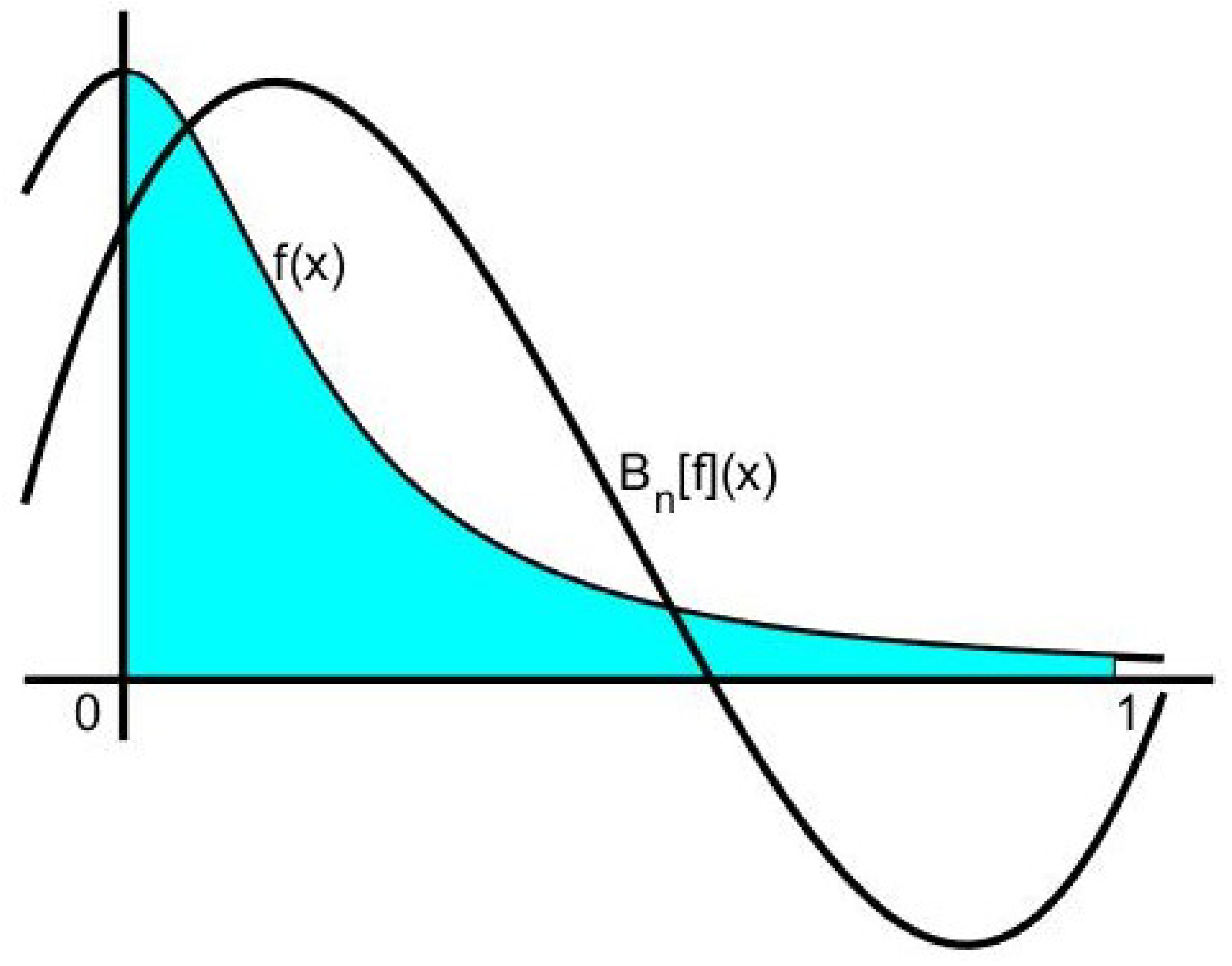
Figure 1 shows the geometric interprestation of the interpolatory condition (26a) for .
Figure 1.
Geometric interpretation of the first interpolatory condition (26a) for Bernoulli interpolant for .
4.1.3. Euler Umbral Interpolation
Euler polynomials, introduced by Euler in 1740 [44], are Appell polynomials. Hence, they are often related to the theory of Bernoulli polynomials. There is a wide range of literature on them and several interesting applications.
Assuming
we obtain
The umbral interpolating polynomial is
The related umbral complementary interpolant is
The umbral interpolatory conditions are, respectively,
and
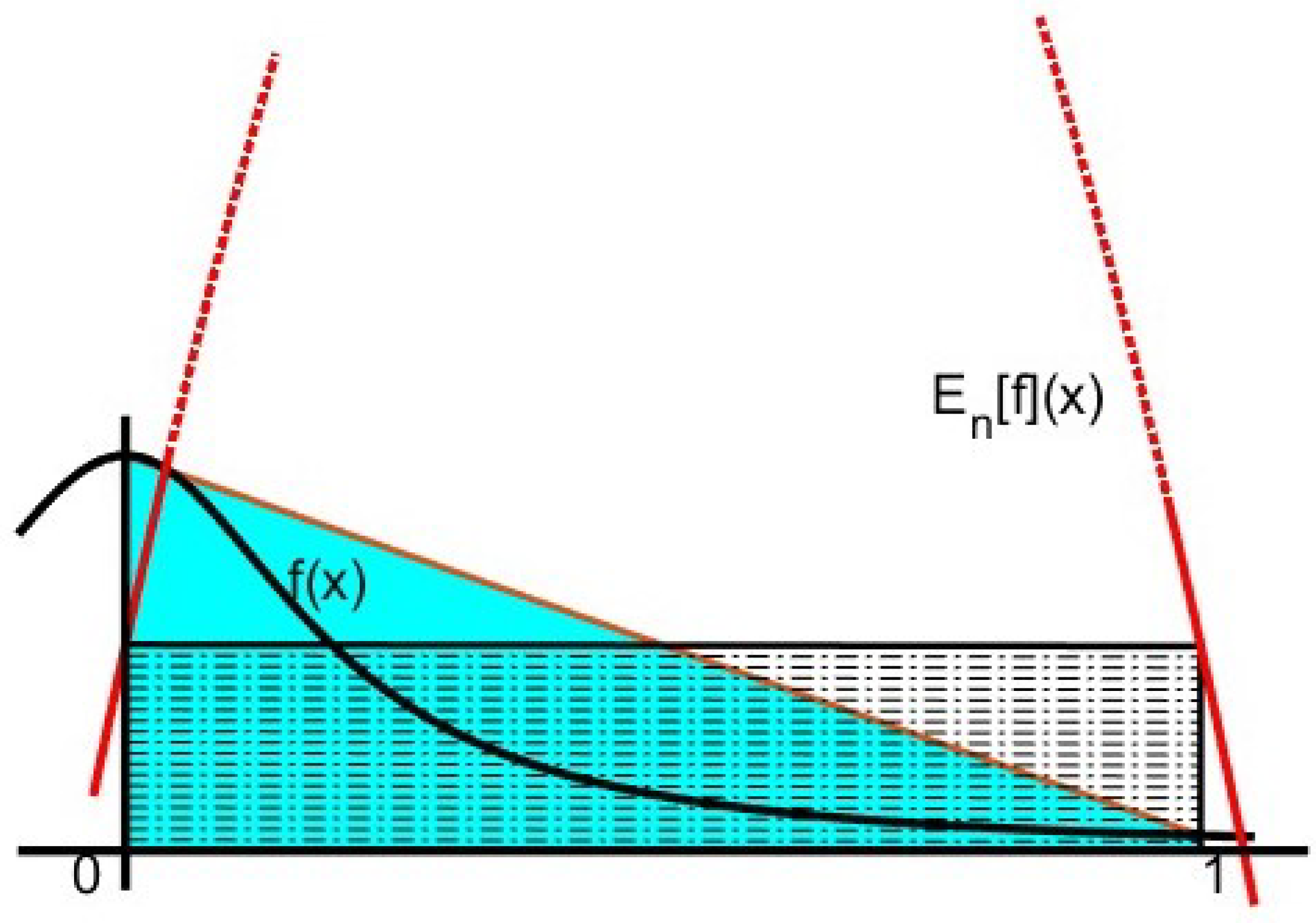
Figure 2 shows the geometric interpretation of the interpolatory condition (29) for and .
Figure 2.
Geometric interpretation of the interpolatory condition (29) for and .
We observe that if we introduce the mean operator [39]
we have .
4.1.4. First Kind Bernoulli-Type Umbral Interpolation
Let L be the following linear functional on
We obtain
The umbral basis for is the p.s. with elements given by
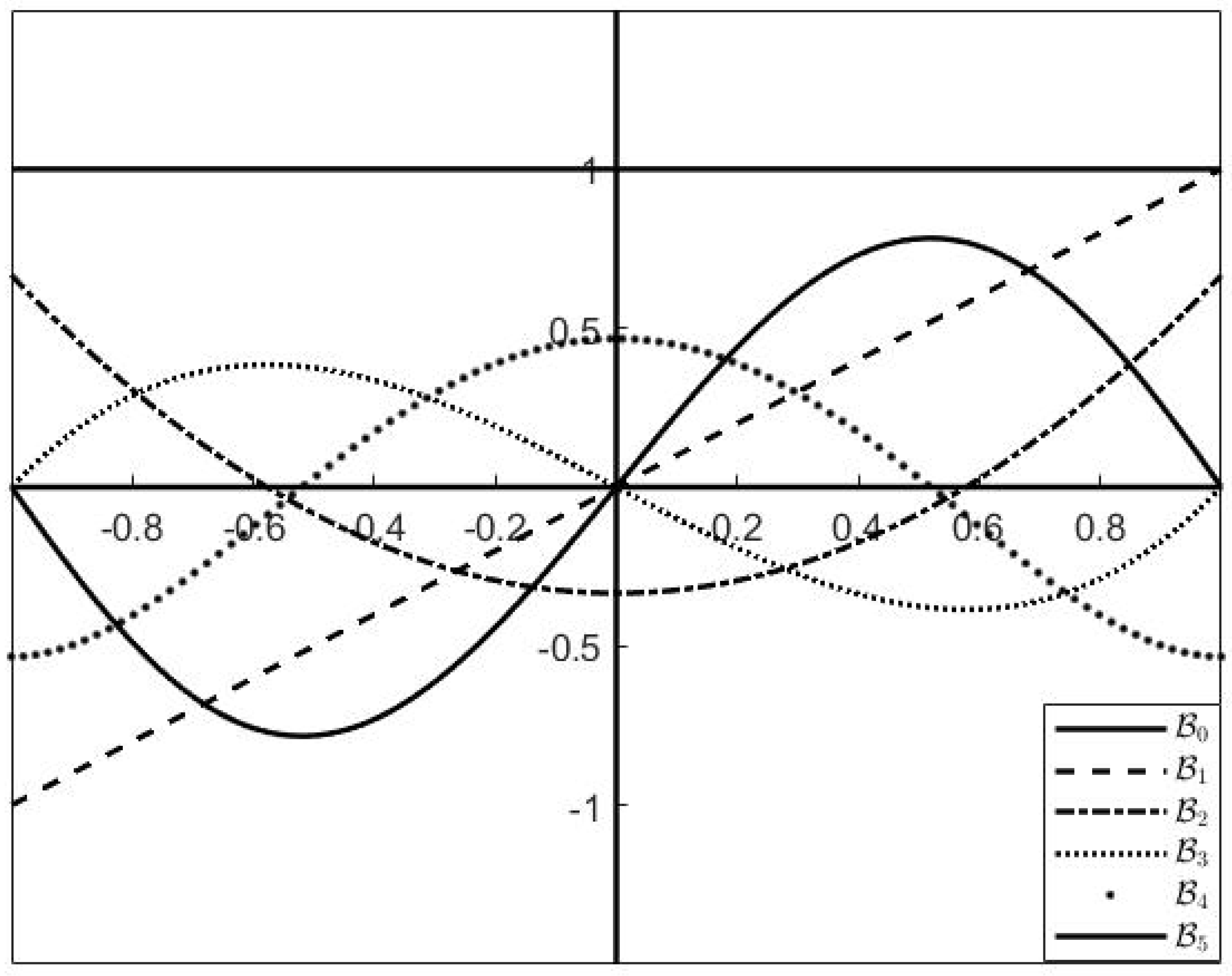
The first six polynomials of the p.s. are
Their plots are in Figure 3.
Figure 3.
Bernoully-type polynomials.
Observe that
That is, the polynomials coincide, up to a constant, with the classical Bernoulli polynomials of the first kind, translated in the interval . Moreover, the subsequences and are the even and odd Lidstone-type polynomial sequences, respectively, introduced in ([17], p. 238) (see also the reference therein). The p.s. has been introduced in [10,11,45] by the classical theory of Rota et al. [13,14,46].
This theory is very different from the determinant approach used here.
The umbral interpolating polynomials is
and the related complementary is
The interpolatory conditions are
and
4.2. Umbral Interpolation Related to
In this section, we look at some known and new examples of umbral interpolation related to the finite difference operator [26,39,47,48,49]
It is a delta-operator.
For simplicity of notation, in the following, we omit showing the dependence on h in , unless absolutely necessary.
Let us define the finite difference operator of order i, , as
with , , being I the identity operator.
Moreover, let denote the indefinite summation operator, defined in ([39], pp. 100–101) as the linear operator inverse of the finite difference operator . It is related to the finite difference operator as the indefinite integral is related to the derivative operator.
Hence is a delta-operator, with . It is known [50] that the elements of the associated p.s. are the generalized falling factorials ([39], p. 45), that is,
Then we obtain
Then the umbral basis for is the p.s.
The related umbral interpolant of is the polynomial
and the complementary umbral interpolant is
Remark 3.
We observe that if , the polynomial (34) coincides with the well-known Newton’s forward difference interpolating polynomial on the data points , .
Using relation (32) and the linearity of the operator L, the umbral interpolating conditions
are equivalent to the following conditions
Moreover, the polynomial can be expressed in the form
where
For this reason, we can see the polynomial as a generalization of the classical interpolating polynomial on equidistant points.
4.2.1. Generalized Bernoulli of the Second Kind Umbral Interpolation
Now we consider the linear functional L defined as [50]
We obtain
We call the related polynomial , given in (50) generalized Bernoulli polynomial of the second kind and denote it by .
We observe that , where is the Bernoulli polynomial of the second kind, as defined in ([39] p. 265). Indeed, starting from the determinant definition, we can easily prove the following relationships:
Which, in [39], for and up to a multiplicative factor, characterizes the sequence of Bernoulli polynomials of the second kind.
The related interpolating conditions, after calculations, can be expressed as
According to (35), the complementary umbral-interpolant Bernoulli polynomial of the second kind is
By using the polynomials , it becomes
The polynomial satisfies the conditions [50]
For this interpolating polynomial, there is a nice expression of the remainder.
Theorem 8
([50]). Let , with , and suppose that exists at each point of . Then we have
Furthermore, the interpolating polynomial suggests an application to the initial value problem
4.2.2. Generalized Boole Umbral Interpolation
Let us consider the linear functional
where is the mean operator defined by ([39], p. 6)
If we set we obtain
Substituting these values in (50), we obtain the polynomials called generalized Boole polynomials and denoted by . We observe that , where is the Boole polynomial defined in ([39], p. 317).
Indeed, starting from the determinant definition, we can easily prove the following relations
The relations (39) in [39], for and up to a multiplicative constant, characterize the sequence of Boole polynomials.
The related complementary umbral interpolant is
4.3. Umbral Interpolation Related to
In [10,11,45,52] the authors introduced a new class of difference finite operators defined as
where T is the shift-operator [39], i.e.,
In the following, we omit to show the dependence on h in , unless absolutely necessary.
We obtain
Using a Taylor expansion around , we have
In order for to be a delta-operator, it must satisfy
To fix all the constants , , we must impose further conditions. A possible choice is, for instance [10,11],
When the conditions (45) and (46) are satisfied, the operator (44) provides an approximation of order p for the continuous derivative . In fact,
We note that the delta-operator obtained for and , i.e., , coincides with the operator defined in (31) up to .
Then, by Theorem 1, we can determine the p.s. associated with whose elements satisfy
Now, let L be a linear functional with L as in (2). Setting
the umbral basis for is the p.s. with elements given by (12).
Hence the umbral interpolant for is the polynomial
and the related complementary polynomial is
where the operator is defined by
-Umbral Interpolation
As an example, we can consider the case , with and . In this case, we obtain the operator of order 2
We note that for , we obtain the classic central difference operator [5], ([17], p. 191). Hence is an actual generalization of the central difference operator.
By Taylor expansion, we obtain
where
Hence we have
The power series associated with the operator is
From the numerical sequence , by Proposition 1, we obtain the lower triangular matrix ( in the infinite case) with elements as in (5).
Then, using Proposition 2, we obtain the related sequence of , denoted by , and the matrix (B in the infinite case), which is the inverse (conjugate) matrix of ().
For instance, if , we obtain
The numerical sequence generates the power series
which is the compositional inverse of , as in (49). In this case, taking into account that
we obtain
Then, the generating function of the p.s. is
The matrix B allows us to write the expansion of in classic monomials. Moreover, denoting by , we obtain
From the analogy of the previous formulas with the well-known formulas
where , the coefficients and , , can be called, respectively, Stirling numbers of the first and second kind of order 2.
From (8) and Proposition 1, we obtain the following determinant form for the elements of this p.s.
Hence, the p.s. is the (basic) p.s. associated with the delta-operator .
The p.s. can be considered to be a generalization of the falling factorial sequence of order 2.
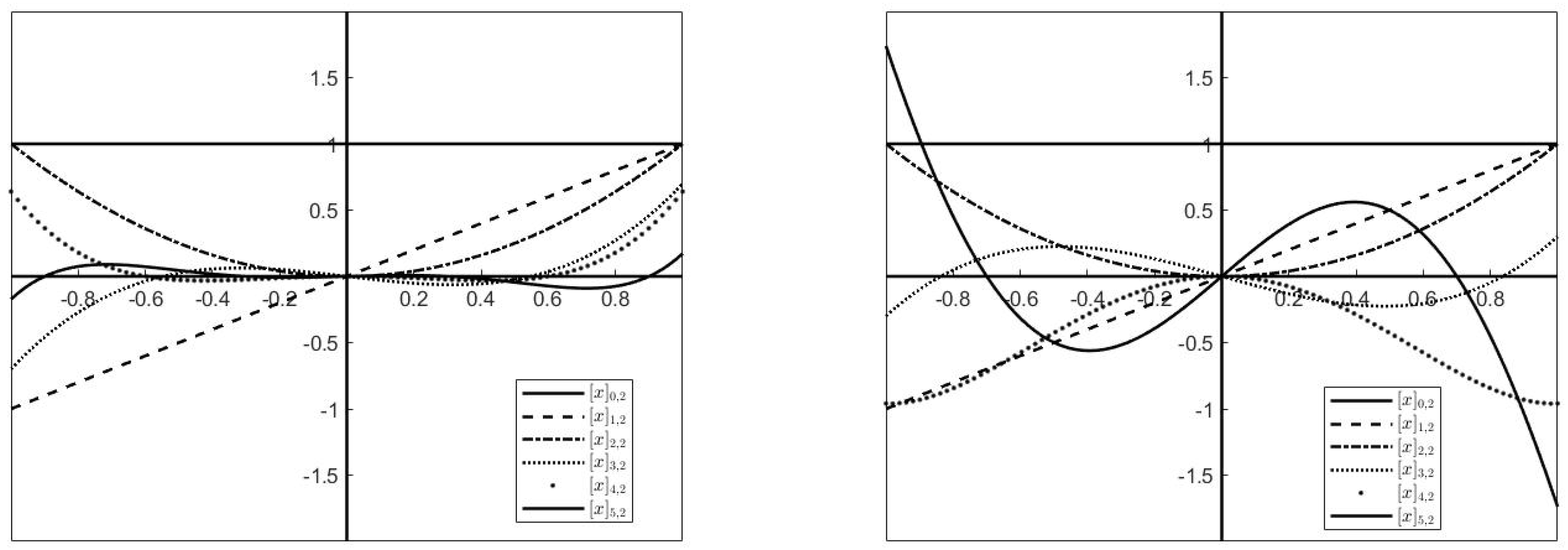
Figure 4.
Polynomials for (left) and (right).
The polynomials can be written in the following form
In fact, the polynomials satisfy Theorem 1 with delta-operator : and from (50); furthermore, after some calculations, we obtain .
From the second equality in (50) we have that is a symmetric sequence [17,53].
We note that for the p.s. becomes the known central factorial p.s. ([16], p. 70, [53], p. 8). Therefore, we call central factorial p.s. of order 2.
A detailed study of this sequence will be published later.
Let L be a linear functional with . The umbral basis for is p.s. with elements
where
To give an explicit expression for and , we need the powers . After calculations, we obtain
where .
For example,
Assuming we have
In this case, we obtain
The umbral interpolating polynomial (52) becomes
Taking into account that at , the complementary umbral interpolating polynomial (53) coincides with .
Formula (54) is like a Newton expansion ([39] p. 75), so we can call it generalized Newton expansion for polynomials.
5. Numerical Examples
Now, we consider some test functions f. For each function, we plot the graph of the error function
where is one of the umbral interpolating polynomials previously considered.
In particular, we compare the error in the approximation of the given function by the following interpolating polynomials: Bernoulli (24), complementary Bernoulli (25), Euler (28), complementary Euler (28), Newton [39], complementary Bernoulli of the second type (37), Boole (40), complementary Boole (41), (54) interpolating polynomials.
The comparison is made by setting a tolerance and determining the minimum degree of the interpolating polynomial for which the required tolerance is reached.
The numerical results have been obtained using a Mathematica code.
Example 1.
Let us consider the Bessel function
We fix the tolerance .
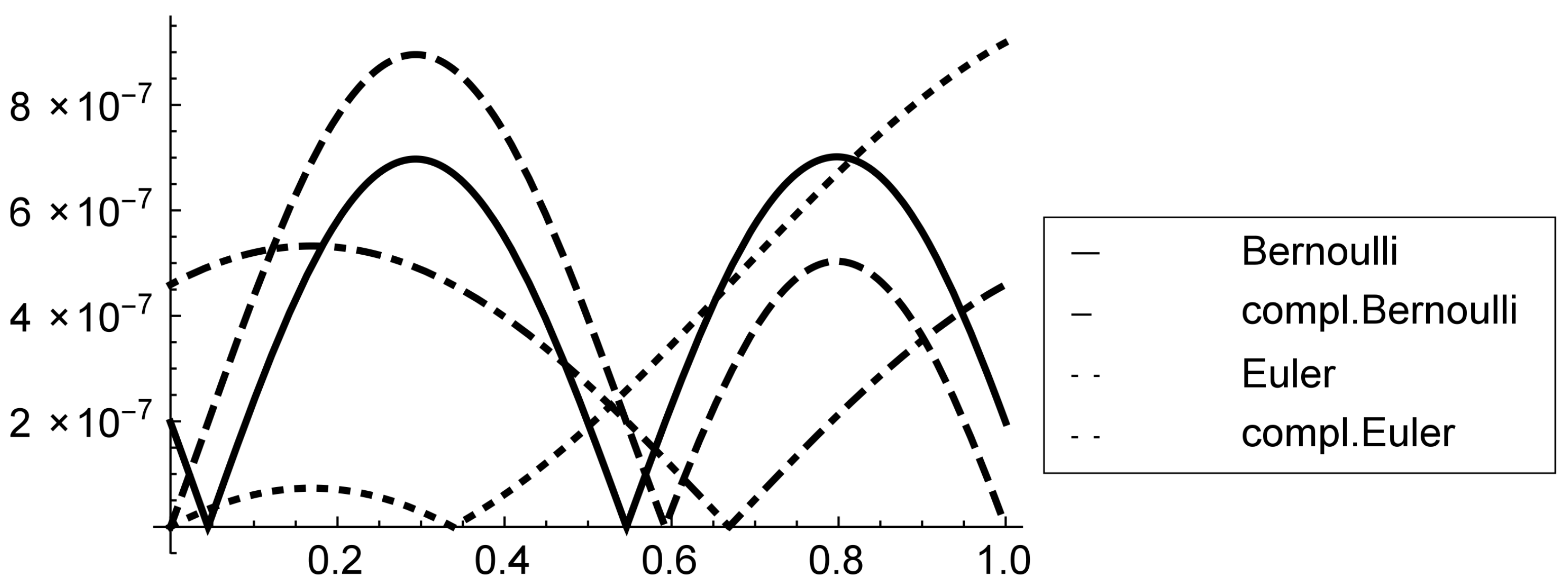
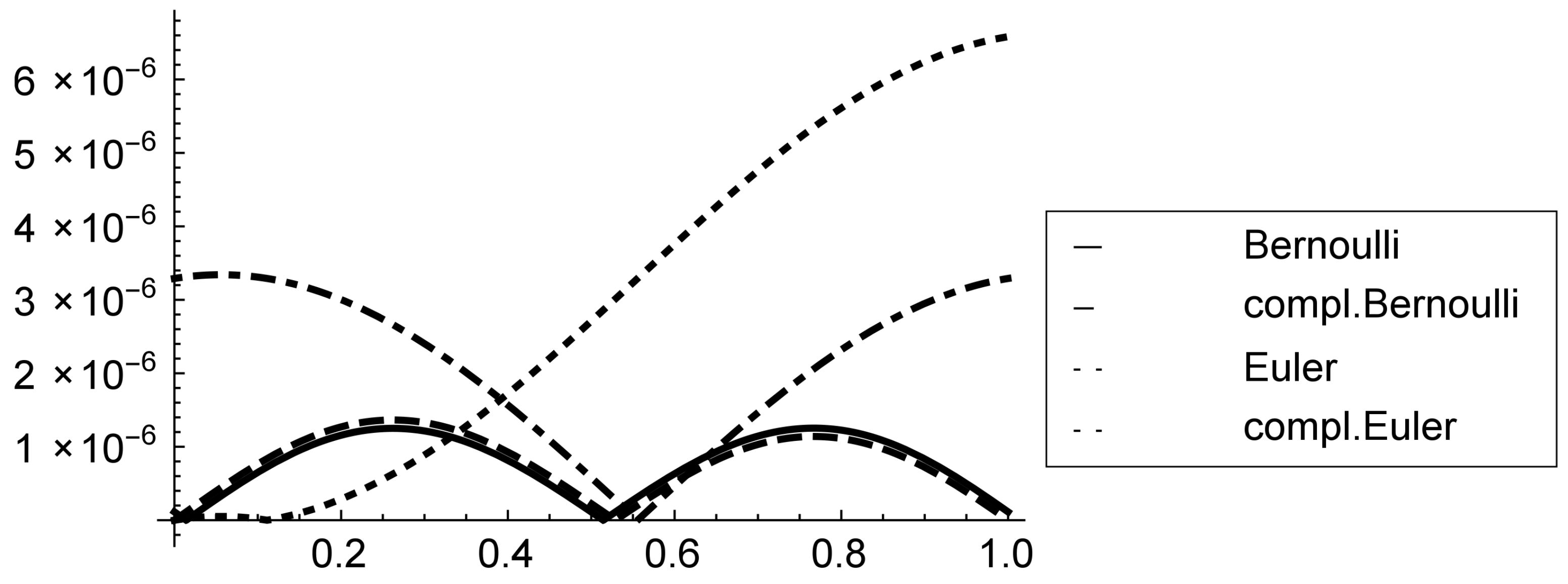
Figure 5 contains the plot of the error functions in the approximation of the function by means of umbral interpolating polynomials related to the operator : Bernoulli, complementary Bernoulli, Euler and complementary Euler interpolating polynomials.
Figure 5.
Error in umbral interpolation .
In the case of Bernoulli and complementary Bernoulli polynomials, we obtain an error less than or equal to the requested tolerance for , while in the case of Euler and complementary Euler interpolation, we need polynomials of degree in order to reach the same tolerance.
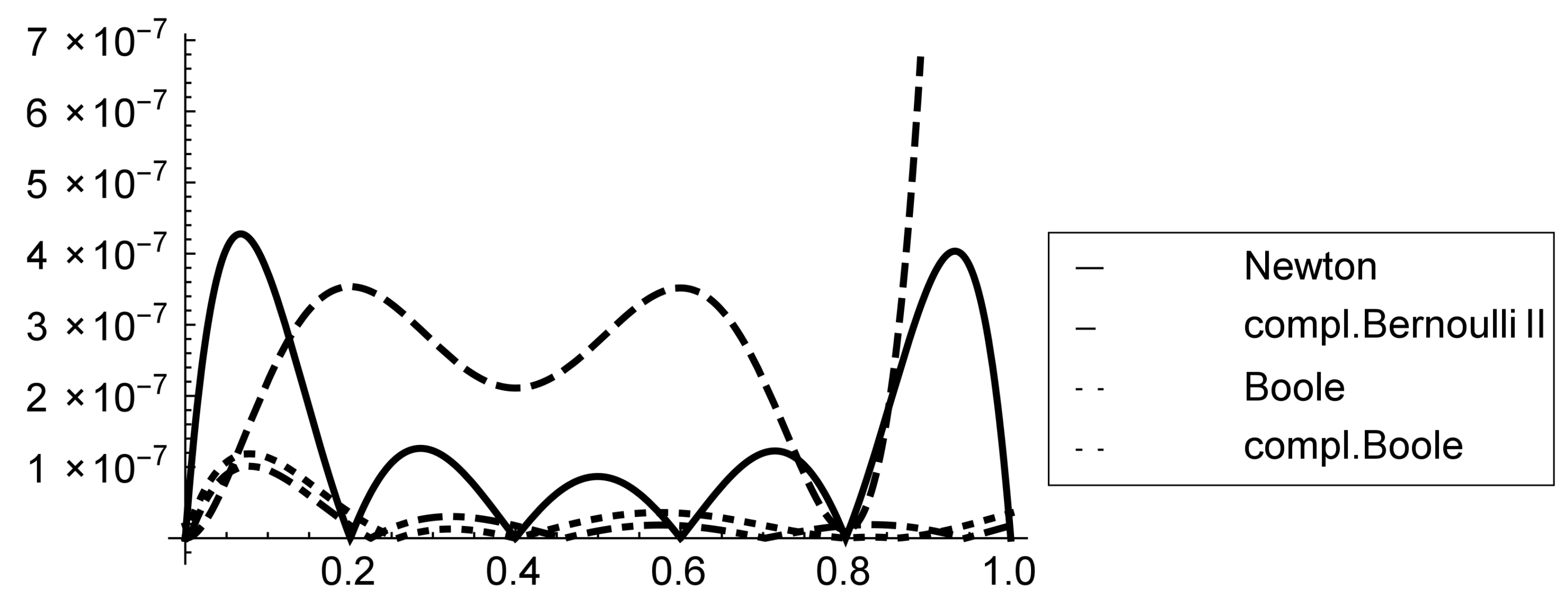
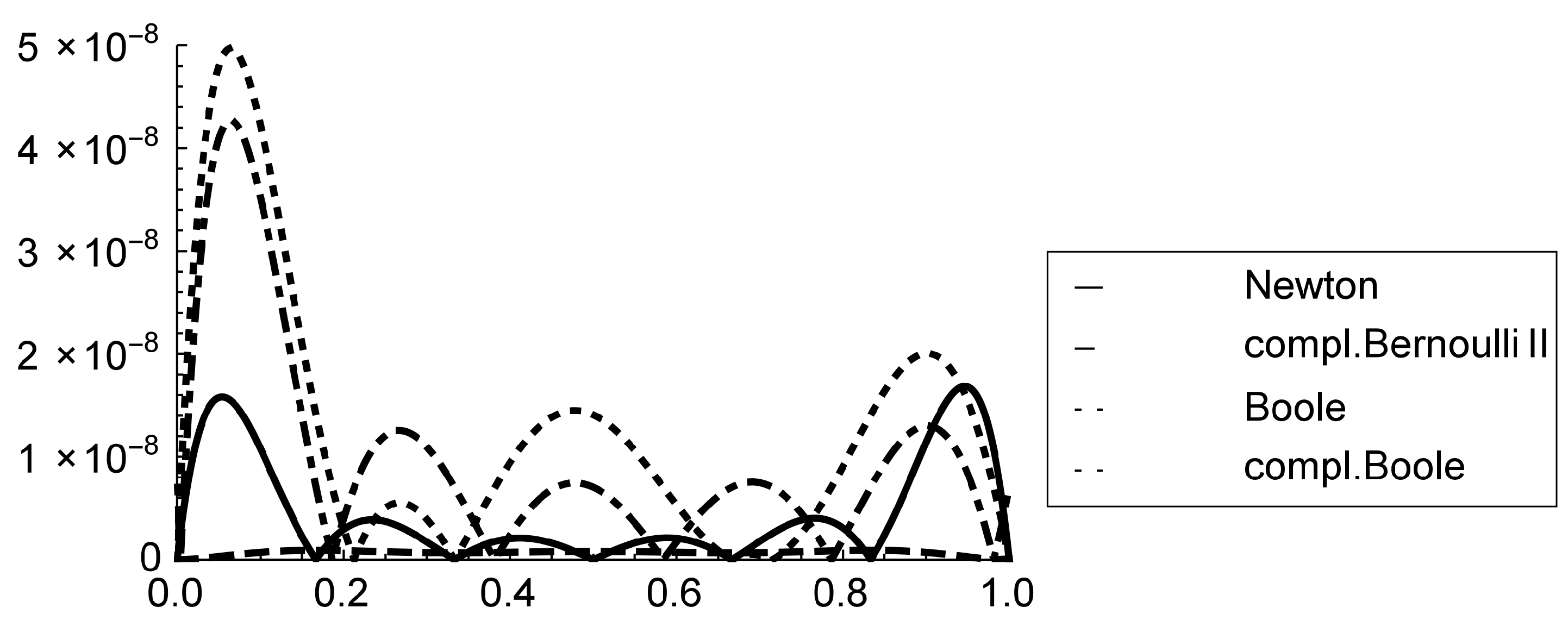
Figure 6 shows the graph of the error functions in the case of umbral interpolating polynomials related to the operator : Newton, complementary Bernoulli of the second type, Boole, and complementary Boole interpolating polynomials . We obtain an absolute error less than the requested tolerance for with Newton and complementary Bernoulli polynomials of the second type and for in the other cases.
Figure 6.
Error in umbral interpolation .
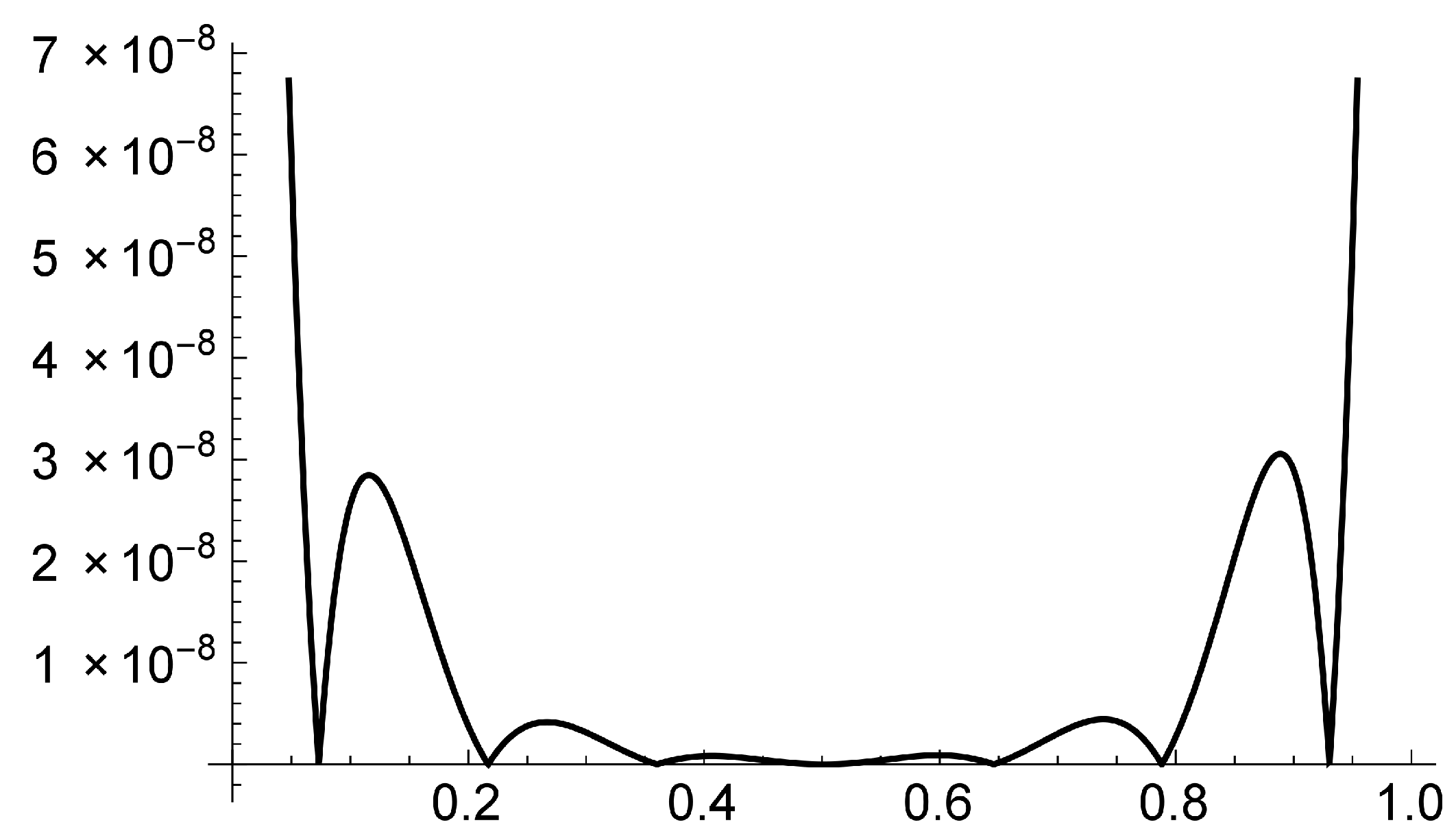
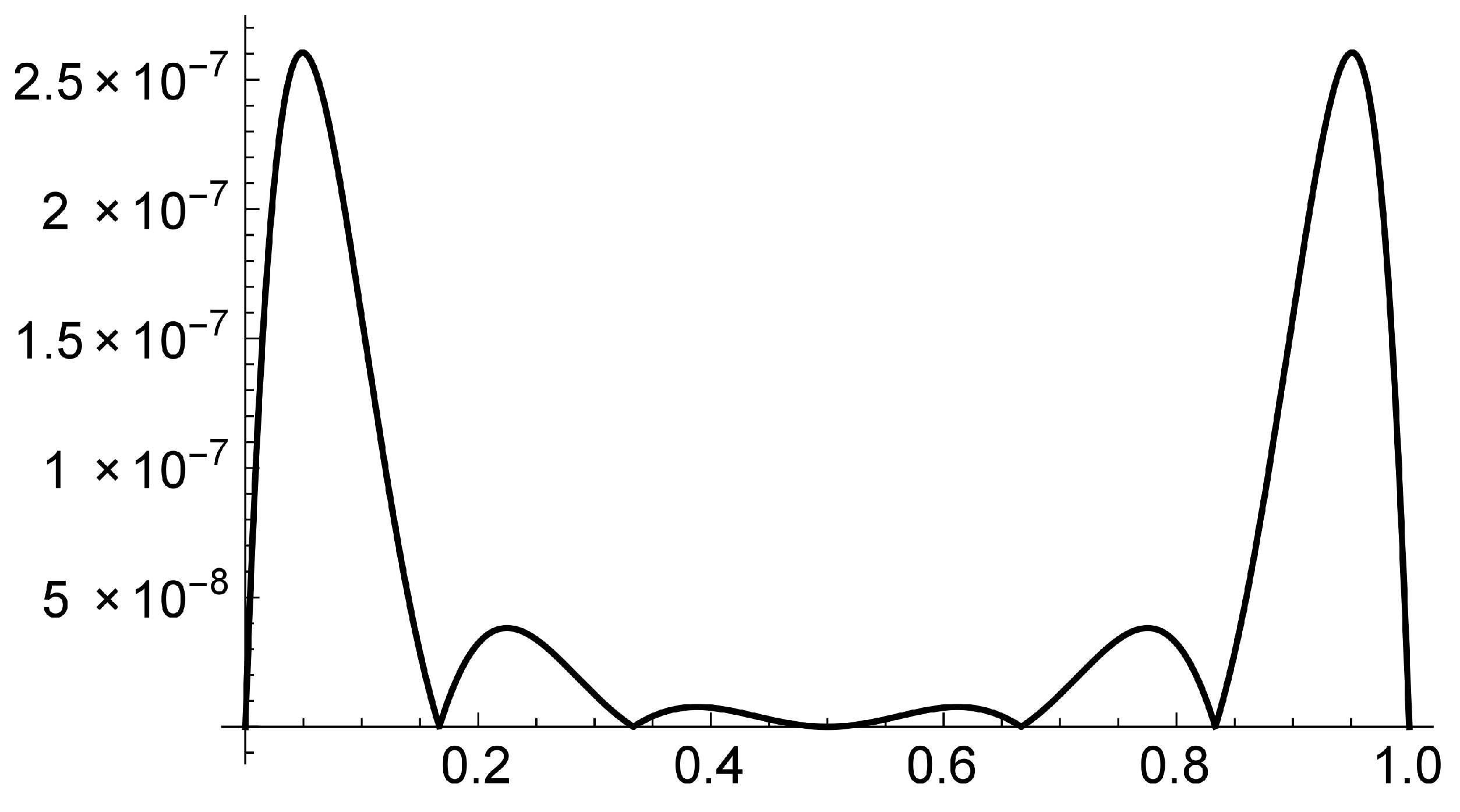
Figure 7 shows the graph of the error function in the case of umbral interpolating polynomial related to the operator for and .
Figure 7.
Error in umbral interpolation .
Example 2.
Let us consider the function
Let .
Figure 8 shows the plot of the error functions in the interpolation by Bernoulli, complementary Bernoulli, Euler and complementary Euler interpolating polynomials.
Figure 8.
Error in umbral interpolation .
In the case of Bernoulli and complementary Bernoulli polynomials, we obtain an error less than or equal to the requested tolerance for , while in the case of Euler and complementary Euler interpolation, we need polynomials of degree in order to reach the same value of ε.
Figure 9 contains the graph of the error functions in the case of Newton, complementary Bernoulli of the second type, Boole, and complementary Boole interpolating polynomials when . The absolute error is less than the fixed tolerance for with complementary Bernoulli polynomials of the second type and for in the other cases.
Figure 9.
Error in umbral interpolation .
Figure 10 shows the graph of the error function in the case of umbral interpolating polynomial related to the operator for and .
Figure 10.
Error in umbral interpolation .
6. Conclusions
A survey on recent umbral interpolation based on a linear functional L and a delta-operator Q is given. This type of interpolation can be considered a wide subclass of general linear finite interpolating polynomials considered in [4]. To build the basis of the interpolating polynomials, we use a matrix-determinant approach, which is more flowing with respect to the classical theory of Rota et al. Relevant examples are given, some of which generalize the classic types of interpolation, such as Taylor and Newton interpolations. New cases of umbral interpolation are also considered. Numerical examples are given which confirm the efficiency of this type of umbral interpolation. Further theoretical and computational advances are possible. In fact, new examples and comparisons can be given. Problems like convergence, bounds of the remainder and numerical stability can be investigated.
Author Contributions
Conceptualization, F.A.C., M.I.G. and A.N.; Methodology, F.A.C., M.I.G. and A.N.; Software, F.A.C., M.I.G. and A.N.; Validation, F.A.C., M.I.G. and A.N.; Formal analysis, F.A.C., M.I.G. and A.N.; Investigation, F.A.C., M.I.G. and A.N.; Resources, F.A.C., M.I.G. and A.N.; Data curation, F.A.C., M.I.G. and A.N.; Writing—original draft, F.A.C., M.I.G. and A.N.; Writing—review & editing, F.A.C., M.I.G. and A.N.; Visualization, F.A.C., M.I.G. and A.N.; Supervision, F.A.C., M.I.G. and A.N.; Project administration, F.A.C., M.I.G. and A.N.. All authors have read and agreed to the published version of the manuscript.
Funding
No funding received for this paper.
Data Availability Statement
The authors did not use any scientific data during this research.
Acknowledgments
One of the authors (A. Napoli) wish to thank the support of INdAM - GNCS Project 2024.
Conflicts of Interest
The authors declare no conflicts of interest.
Appendix A. Umbral Interpolation Formulas

Table A1.
Umbral Appell interpolation.
Table A1.
Umbral Appell interpolation.
| Appell-Taylor | |||
| Q | interpolatory conditions | polynomials | |
| Appell-Bernoulli | |||
| Q | interpolatory conditions | polynomials | |
| Appell-Euler | |||
| Q | interpolatory conditions | polynomials | |
| Appell-Bernoulli of the first kind | |||
| Q | interpolatory conditions | polynomials | |
Table A2.
Umbral interpolation.
Table A2.
Umbral interpolation.
| Newton interpolation | |||
| Q | interpolatory conditions | polynomials | |
| ine | |||
| Generalized Bernoulli of the second kind interpolation | |||
| Q | interpolatory conditions | polynomials | |
| Generalized Boole interpolation | |||
| Q | interpolatory conditions | polynomials | |
| interpolation | |||
| Q | interpolatory conditions | polynomials | |
References
- Brezinski, C. Historical perspective on interpolation, approximation and quadrature. Handb. Numer. Anal. 1994, 3, 3–46. [Google Scholar]
- Kress, R.; Kress, R. Interpolation. Numer. Anal. 1998, 151–188. [Google Scholar]
- Meijering, E. A chronology of interpolation: From ancient astronomy to modern signal and image processing. Proc. IEEE 2002, 90, 319–342. [Google Scholar] [CrossRef]
- Davis, P. Interpolation and Approximation; Courier Corporation: Chelmsford, MA, USA, 1975. [Google Scholar]
- Hildebrand, F. Introduction to Numerical Analysis; Courier Corporation: Chelmsford, MA, USA, 1987. [Google Scholar]
- Phillips, G. Interpolation and Approximation by Polynomials; Springer Science & Business Media: Berlin/Heidelberg, Germany, 2003; Volume 14. [Google Scholar]
- Rota, G.; Kahaner, D.; Odlyzko, A. On the foundations of combinatorial theory VIII. Finite operator calculus. J. Math. Anal. Appl. 1973, 42, 684–760. [Google Scholar] [CrossRef]
- Rota, G.; Taylor, B. The classical umbral calculus. SIAM J. Math. Anal. 1994, 25, 694–711. [Google Scholar] [CrossRef]
- Bottreau, A.; Di Bucchianico, A.; Loeb, D. Computer algebra and umbral calculus. Discret. Math. 1998, 180, 65–72. [Google Scholar] [CrossRef]
- Tempesta, P. On Appell sequences of polynomials of Bernoulli and Euler type. J. Math. Anal. Appl. 2008, 341, 1295–1310. [Google Scholar] [CrossRef]
- Levi, D.; Tempesta, P.; Winternitz, P. Umbral calculus, difference equations and the discrete Schrödinger equation. J. Math. Phys. 2004, 45, 4077–4105. [Google Scholar] [CrossRef]
- Zeilberger, D. Some comments on Rota’s umbral calculus. J. Math. Anal. Appl. 1980, 74, 456–463. [Google Scholar] [CrossRef]
- Roman, S. The Umbral Calculus; Academic Press: New York, NY, USA, 1984. [Google Scholar]
- Roman, S.; Rota, G. The umbral calculus. Adv. Math. 1978, 27, 95–188. [Google Scholar] [CrossRef]
- Di Bucchianico, A.; Loeb, D. Umbral calculus. Electron. J. Comb. 2012. [Google Scholar] [CrossRef]
- Costabile, F. Modern Umbral Calculus; Studies in Mathematics; Walter de Gruyter GmbH & Co KG: Berlin, Germany, 2019; Volume 17. [Google Scholar]
- Costabile, F.; Gualtieri, M.; Napoli, A. Polynomial Sequences: Basic Methods, Special Classes, and Computational Applications; Studies in Mathematics; Walter de Gruyter GmbH & Co KG: Berlin, Germany, 2023; Volume 96. [Google Scholar]
- Costabile, F.; Longo, E. Umbral interpolation. Publ. Inst. Math. 2016, 99, 165–175. [Google Scholar] [CrossRef]
- Ray, N.; Wright, C. Umbral interpolation and the addition/contraction tree for graphs. Discret. Math. 1992, 103, 67–74. [Google Scholar] [CrossRef]
- Roman, S. Polynomials, power series and interpolation. J. Math. Anal. Appl. 1981, 80, 333–371. [Google Scholar] [CrossRef]
- Sheffer, I. Some properties of polynomial sets of type zero. Duke Math. J. 1939, 5, 590–622. [Google Scholar] [CrossRef]
- Costabile, F.; Gualtieri, M.; Napoli, A. Polynomial sequences: Elementary basic methods and application hints. A survey. Rev. De La Real Acad. De Cienc. Exactas Fis. Y Nat. Ser. A Mat. 2019, 113, 3829–3862. [Google Scholar] [CrossRef]
- Costabile, F.; Gualtieri, M.; Napoli, A. Recurrence relations and determinant forms for general polynomial sequences. Application to Genocchi polynomials. Integral Transform. Spec. Funct. 2019, 30, 112–127. [Google Scholar] [CrossRef]
- Costabile, F.; Longo, E. An algebraic exposition of umbral calculus with application to general linear interpolation problem. A survey. Publ. Inst. Math. 2014, 96, 67–83. [Google Scholar] [CrossRef]
- Ismail, M. Polynomials of binomial type and approximation theory. J. Approx. Theory 1978, 23, 177–186. [Google Scholar] [CrossRef]
- Riordan, J. Combinatorial Identities; Wiley: New York, NY, USA, 1968. [Google Scholar]
- Verde-Star, L. Infinite triangular matrices, q-Pascal matrices, and determinantal representations. Linear Algebra Appl. 2011, 434, 307–318. [Google Scholar] [CrossRef]
- Alecci, G.; Barbero, S.; Murru, N. Some notes on the algebraic structure of linear recurrent sequences. Ric. Di Mat. 2023, 1–17. [Google Scholar] [CrossRef]
- Barbero, S.; Cerruti, U.; Murru, N. On the operations of sequences in rings and binomial type sequences. Ric. Di Mat. 2018, 67, 911–927. [Google Scholar] [CrossRef]
- Di Bucchianico, A.; Loeb, D. Sequences of binomial type with persistent roots. J. Math. Anal. Appl. 1996, 199, 39–58. [Google Scholar] [CrossRef][Green Version]
- Appell, P. Sur une classe de polynômes. Ann. Sci. Éc. Norm. Supéer. 1880, 9, 119–144. [Google Scholar] [CrossRef]
- Costabile, F.; Longo, E. A determinantal approach to Appell polynomials. J. Comput. Appl. Math. 2010, 234, 1528–1542. [Google Scholar] [CrossRef]
- Costabile, F.; Longo, E. An algebraic approach to Sheffer polynomial sequences. Integral Transform. Spec. Funct. 2014, 25, 295–311. [Google Scholar] [CrossRef]
- Graham, R. Concrete Mathematics: A Foundation for Computer Science; Pearson Education India: Hoboken, NJ, USA, 1994. [Google Scholar]
- Costabile, F.; Gualtieri, M.; Napoli, A. Towards the Centenary of Sheffer Polynomial Sequences: Old and Recent Results. Mathematics 2022, 10, 4435. [Google Scholar] [CrossRef]
- Costabile, F.; Longo, E. The Appell interpolation problem. J. Comput. Appl. Math. 2011, 236, 1024–1032. [Google Scholar] [CrossRef]
- Bernoulli, J. Ars Conjectandi, Opus Posthumum: Accedit Tractatus De Seriebus Infinitis, Et Epistola Gallice Scripta De Ludo Pilæ Reticularis; Impensis Thurnisiorum Fratrum: Basel, Switzerland, 1713. [Google Scholar]
- Leinartas, E.; Shishkina, O. The Euler-Maclaurin Formula in the Problem of Summation over Lattice Points of a Simplex. J. Sib. Fed. Univ. Math. Phys. 2022, 15, 108–113. [Google Scholar] [CrossRef]
- Jordán, K. Calculus of Finite Differences; Chelsea Publishing Company: New York, NY, USA, 1965. [Google Scholar]
- Costabile, F. Costabile, F.A. On expansion of a real function in Bernoulli polynomials and applications, Conferenze del Seminario Matem. Univ. Bari 1999, 273, 1–16. [Google Scholar]
- Costabile, F.; Gualtieri, M.; Luceri, R. A new iterative method for the computation of the solutions of nonlinear equations. Numer. Algorithms 2001, 28, 87–100. [Google Scholar] [CrossRef]
- Costabile, F.; Napoli, A. A new spectral method for a class of linear boundary value problems. J. Comput. Appl. Math. 2016, 292, 329–341. [Google Scholar] [CrossRef]
- Costabile, F.; Napoli, A. A multipoint Birkhoff type boundary value problem. J. Numer. Math. 2015, 23, 1–11. [Google Scholar] [CrossRef]
- Euler, L. Methodus generalis summandi progressiones. Commentarii Academiae Scientiarum Petropolitanae; University of the Pacific: Stockton, CA, USA, 1738; pp. 68–97. [Google Scholar]
- Tempesta, P. On Appell sequences of polynomials of Bernoulli and Euler type. arXiv 2021, arXiv:math/0601675. [Google Scholar] [CrossRef]
- Ray, N. Umbral calculus, binomial enumeration and chromatic polynomials. Trans. Amer. Math. Soc. 1988, 309, 191–213. [Google Scholar] [CrossRef]
- Abramowitz, M.; Stegun, I. Handbook of Mathematical Functions with Formulas, Graphs, and Mathematical Tables; US Government Printing Office: Washington, DC, USA, 1972; Volume 55. [Google Scholar]
- Boole, G.; Moulton, J. A Treatise on the Calculus of Finite Differences; Macmillan Company: New York, NY, USA, 1872. [Google Scholar]
- Rota, G.; Doubilet, P. Finite Operator Calculus; Academic Press: New York, NY, USA, 1975. [Google Scholar]
- Costabile, F.; Longo, E. Δh-Appell sequences and related interpolation problem. Numer. Algorithms 2013, 63, 165–186. [Google Scholar] [CrossRef]
- Costabile, F.; Napoli, A. A class of collocation methods for numerical integration of initial value problems. Comput. Math. Appl. 2011, 62, 3221–3235. [Google Scholar] [CrossRef]
- Levi, D.; Tempesta, P.; Winternitz, P. Lorentz and Galilei invariance on lattices. Phys. Rev. D 2004, 69, 105011. [Google Scholar] [CrossRef]
- Steffensen, J. Interpolation; Chelsea Publishing Company: New York, NY, USA, 1965. [Google Scholar]
Disclaimer/Publisher’s Note: The statements, opinions and data contained in all publications are solely those of the individual author(s) and contributor(s) and not of MDPI and/or the editor(s). MDPI and/or the editor(s) disclaim responsibility for any injury to people or property resulting from any ideas, methods, instructions or products referred to in the content. |
© 2025 by the authors. Licensee MDPI, Basel, Switzerland. This article is an open access article distributed under the terms and conditions of the Creative Commons Attribution (CC BY) license (https://creativecommons.org/licenses/by/4.0/).