


Abstract
The prime orbit and Mertens’ orbit counting functions describe the growth of closed orbits in a discrete dynamical system in a certain way. In this paper, we prove the asymptotic behavior of these functions for a periodic-finite-type shift. The proof relies on the meromorphic extension of its Artin–Mazur zeta function.
Keywords:
periodic-finite-type shift; Artin–Mazur zeta function; prime orbit counting function; Mertens’ orbit counting functions MSC:
37C35; 37C30; 37B10
1. Introduction
Let be a discrete dynamical system, where X is a topological space and is a continuous map. For a point , the orbit of a is the set
The point a is said to be periodic with period if . Furthermore, if but for any , then a has least period n. In this case, its orbit
is finite. Such orbit is called a (prime) closed orbit of (least) period .
Some counting functions had been introduced to describe the growth of the closed orbits in a system. The functions were inspired by the counting functions for primes in number theory. They are defined as
- (i)
- prime orbit counting function
- (ii)
- Mertens’ orbit counting functionsandwhere is the closed orbit, h is the topological entropy of the system and . The functions are well-defined if the number of closed orbits for each period is finite.
The idea of counting closed orbits in this way arises as a dynamical analogue to counting primes in number theory. Specifically, the famous Prime Number Theorem and Mertens’ Theorem (see [1]) tell us about the asymptotic behaviors of certain counting functions for primes, which are as follows:
where , p runs through primes, is the Euler–Mascheroni constant and M is the Meissel–Mertens constant. Motivated by these results, we are interested to determine similar results for our counting functions for a given discrete system.
The earliest works on this idea were done by Parry and Pollicott (see [2,3]) on shifts of finite type and their suspensions. It was shown that for a mixing shift of finite type with topological entropy ,
Sharp [4] obtained the asymptotic behaviors of the counting functions for Axiom A flows. However, similar results can be deduced for a mixing shift of finite type, which are
and
where and are some positive constants.
Similar results had been obtained for toral automorphisms. Waddington [5] proved that for a quasihyperbolic toral automorphism with topological entropy ,
for some finite subset U of unit circle and a function . Specifically, for ergodic toral automorphism, Noorani [6] proved further that
where m is some positive integer and is some positive constant.
The proofs for the results above depend on a generating function for the number of periodic points, which is called Artin–Mazur zeta function [7]. For a system , its Artin–Mazur zeta function is defined as
where is the number of periodic points of period n and . Furthermore, the zeta function can be expressed in terms of closed orbits as
From the formula for radius of convergence, if the sequence is bounded, then the zeta function has a positive radius of convergence.
For each system above, the zeta function has a non-vanishing meromorphic extension beyond its radius of convergence. Based on the proofs, this property leads to the asymptotic behaviors of the counting functions through some combinatorial calculation. It turns out that this approach can be applied onto any system to obtain similar results on its orbit growth, as long as its zeta function has the mentioned property.
However, this approach of using zeta function may not be feasible for certain systems, for example, when the closed form of its zeta function is not readily available, or the zeta function itself is sophisticated. In recent years, there are other approaches used to obtain the orbit growth for some systems. Alsharari et al. [8] used estimates on the number of periodic points of Motzkin shift over R pairs of matching symbols and S neutral symbols to obtain that
and
for the system. In fact, if in the above, we obtain the orbit growth for Dyck shift over R pairs of matching symbols (see [9]). Later, Akhatkulov et al. [10] obtained sharper results for the Dyck shift, which are
and
where is some positive constant and .
There are other approaches to obtain the orbit growth of a system, such as by counting in orbit monoids [11] and using orbit Dirichlet series on some algebraic systems [12,13]. However, we will not delve deeper into these topics since our focus here is on the approach via zeta function. The results shown above are enough to demonstrate the progress in this research interest in recent years. As a supplementary, interested readers may refer to our survey in [14] and the references therein for more exposure on the topic of orbit counting in discrete dynamical systems.
Béal et al. [15] introduced a new type of shift spaces, which are called periodic-finite-type shifts. These are a generalization to shifts of finite type. In fact, its zeta function had been obtained by Manada & Kashyap [16], though it is more sophisticated than for the case of shifts of finite type. Up to date, there is no result published on the orbit growth of periodic-finite-type shifts.
Hence, our aim in this paper is to obtain the orbit growth of a periodic-finite-type shift via its zeta function. Since its zeta function had been obtained in [16], it is remained to investigate the properties of its meromorphic extension.
In Section 2, we provide a key theorem with proof regarding the orbit growth of a general system via its zeta function. In Section 3, we review some properties of periodic-finite-type shifts, and proceed to determine the orbit growth by investigating their zeta function. Some basic theories on matrices and graphs are required in proving the result on their orbit growth.
2. Orbit Growth via Zeta Function
In this section, we prove the asymptotic behaviors of the counting functions , and for a general system via its zeta function. The next theorem is inspired from the results in [3,4,5,6]. The proofs in those papers depend on the closed form of the zeta functions of their particular systems. However, it turns out that the proofs work on any zeta function, as long as it satisfies certain analytic properties. Of course, there are certain parts in the proofs needed to be modified to fit our general case, especially on the combinatorial calculation. Because of that, we provide the detailed proof for completeness.
Theorem 1.
Letbe a discrete dynamical system with topological entropyand Artin–Mazur zeta function. Suppose that there exists a functionsuch that it is analytic and non-zero forfor some, and
forfor some. Then,
- (a)
- (Prime Orbit Theorem)
- (b)
- (Mertens’ Orbit Theorem)where γ is Euler–Mascheroni constant, andwhere C is a positive constant that can be specified as
Proof.
- (a)
- Since is analytic and non-zero for , (3) implies that is also analytic and non-zero for . From (1) and (3), for ,whereEquivalently, for ,Observe that is analytic for and has a power series representation for . Recall that any analytic function has a unique power series representation (see [17,18]). Therefore, the series is also its power series representation for . Overall, (6) is also valid for .For any , the series converges for . Therefore, the terms in the series are bounded, i.e., there exists a real such thatNow, definefor . Please note thatNow, we need to relate both and . First, observe that can be expressed in terms of closed orbits asIndeed, this is true by defining and checking thatFor a closed orbit , the number of times for it to appear in the sum is . So,Define the extension of over asfor . For any real , set such that . So,Now, we need to show that as (and equivalently, ). First, we will prove that is bounded for any real . Indeed, since is analytic for , this implies that converges. From (2),Furthermore, from (9), it is easy to see that is also bounded.Now, choose . Observe thatSince and are bounded, andit is obtained thatPlease note that can be chosen arbitrarily close to 1, so it can be deduced further thatHence,or equivalently,
- (b)
- We begin with proving the result for . From (1) and (3), it can be shown that for ,where is given in (5). Recall that if a power series converges in an open disc, then it is analytic in the same disc (see [17,18]). Please note that the series in (6) is analytic for , and so is the series by comparison.Since any analytic function is continuous (see [17,18]), it is obtained thatSince , for any ,Recall that for harmonic sum,where is the Euler–Mascheroni constant (see [19]). Therefore, (14) can be written asNow, definefor . Observe that can be expressed in terms of closed orbits asIndeed, this is true by defining and checking thatFurthermore, for a closed orbit , it contributes to the sum for . So,Consider the sumSince , it can be written asWe will prove that the sum in the last line in (19) converges as by using Riemann–Stieltjes integral with respect to (see [20]). We will also use the fact thatfor some positive constants A and B. This is derived from result in part (a). Now,The expression in the last line in (21) converges as , and so is the sum. By using (18), (19) and (21), it is obtained thatThe desired result for is obtained by applying exponent and arranging terms in (23).Now, we will prove the result for . Using (17) and similar calculation as above, it is obtained thatandThe sum in the last line in (25) converges as by using Riemann–Stieltjes integral with respect to . Indeed, it can be checked thatwhere A and B are constants in (20), and the integral converges as by integral test. The calculation is very similar to the previous one, so it is omitted here.Overall, from (24) and (25), the sumconverges to a positive constant C. By using (23), it is obtained thatThe desired result for is obtained by arranging terms in (26). □
Remark 1.
Please note that (3) implies that
- (i)
- the radius of convergence forabout the origin is, and
- (ii)
- there is a pole of order m at, whereis the pth root of unity and.
For a given system, these two properties of itscan help us to determine the suitable functionand its region of analyticity. We will demonstrate this later for a periodic-finite-type shift.
3. Periodic-Finite-Type Shifts
In this section, we describe the construction of a periodic-finite-type shift and some important properties such as its graph representation and zeta function. A periodic-finite-type shift is an example of shift spaces (see [21] for details).
3.1. Construction
Let be a finite set of symbols. Define the shift map as follows: for , its image is given by .
The element for some is called a word and the element is called a point. w is said to occur in if there exists such that . It is denoted as .
For some , consider a list of finite subsets . Define subset as follows: if and only if there exists such that for all and all . The pair is called a periodic-finite-type shift of period t.
Remark 2.
- (i)
- For the sake of simplicity, the restricted mapwill be denoted simply as σ from now on.
- (ii)
- For the sake of this paper, we call the integer r in the above definition as the shifting value of. Please note that r is not necessarily unique for each.
It is known from [16] that given a list of subsets , we can construct a new list of subsets that gives the same periodic-finite-type shift such that
- (i)
- all words in have the same length ℓ, and
- (ii)
- .
A periodic-finite-type shift defined by the list of subsets with those properties is said to be in its standard form. Without loss of generality, we assume that any periodic-finite-type shift is in its standard form from now on.
By definition, a shift of finite type is indeed a periodic-finite-type shift with period 1.
3.2. Graph Representation
A periodic-finite-type shift of period t can be represented by a labeled graph. Specifically, its graph is a t-partite graph with sets of vertices such that
- (i)
- and , and
- (ii)
- for and where , there exists an edge from u to v with label if and only if . In this case, u and v are said to overlap progressively.
This is called the Moision–Siegel representation [15].
Recall that a sofic shift is a shift space which can be represented as a labeled graph (see [21] for details). Therefore, a periodic-finite-type shift is indeed a sofic shift.
Recall that a graph G is said to be irreducible if for each pair of vertices u and v (not necessarily distinct), there exists a path from u to v. By Perron–Frobenius Theorem [22], its adjacency matrix has a Perron eigenvalue . Furthermore, a labeled graph G is said to be right-resolving if for each vertex, each outgoing edge has different label. From [21], the sofic shift represented by an irreducible right-resolving graph G has topology entropy .
For a periodic-finite-type shift, its Moision–Siegel representation is right-resolving. Therefore, if is irreducible, then its topological entropy is
Recall that a shift space is said to be irreducible if for any pair of words u and v occurring in some points, either occurs in some point or there exists a word w such that occurs in some point. From [21], if a labeled graph representing a sofic shift is irreducible, then the sofic shift itself is irreducible. However, the converse is false. In fact, there exists a periodic-finite-type shift which is irreducible, but its Moision–Siegel representation is not irreducible. This is shown in the following example.
Example 1.
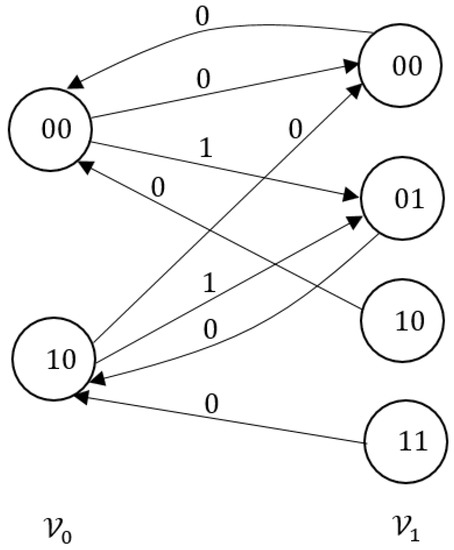
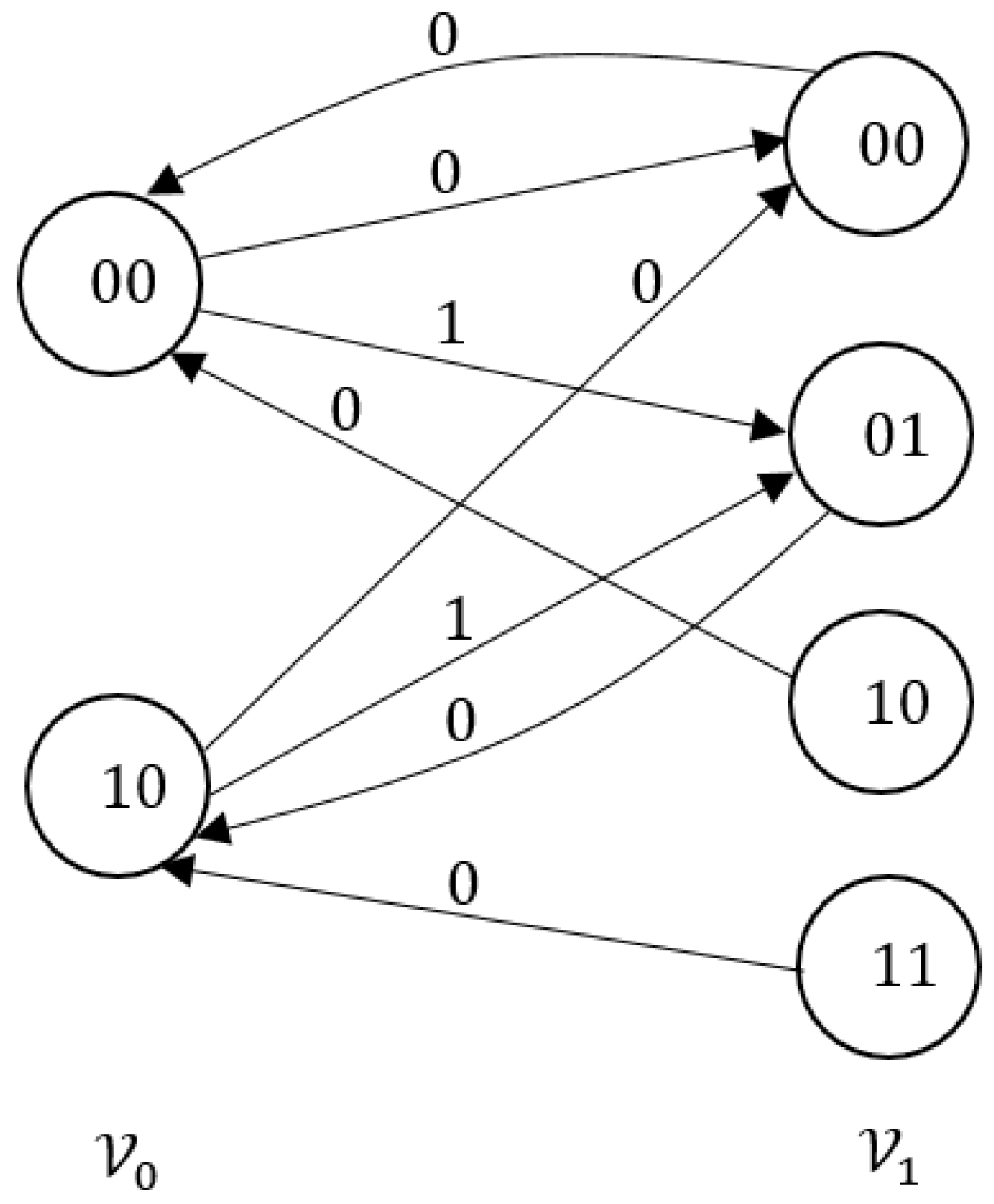
Consider the periodic-finite-type shiftconstructed from,and. Suppose that the words u and v occur inandrespectively. Let r and s be the shifting value ofandrespectively. Let i be the position of the last symbol of u in, and j be the position of the first symbol of v in. Letbe the infinite string of symbols before u in, andbe the infinite string of symbols after v in.
Intuitively, the shifting value indicates whether the even or odd positions in the point are to be checked for the occurrence of forbidden words 01 and 11. If the value if 0, then the even positions are to be checked for those words. This is oppositely true if the value is 1. Furthermore, if the value is 0, then the symbol 1 will not occur at any odd position, since otherwise, the forbidden word 01 or 11 will occur at some even position. This is also oppositely true if the value is 1.
With the explanation above, it is easy to observe that if, then the last symbol of u is either 0 or 1. However, if, then the last symbol of u must be 0. This is similarly true for the first symbol of v.
Overall, we can check for the irreducibility ofthrough the following cases:
- (i)
- ifand, then the wordoccurs in the point;
- (ii)
- ifand, then the wordoccurs in the point;
- (iii)
- ifand, then the wordoccurs in the point;
- (iv)
- ifand, then the wordoccurs in the point.
However, its Moision–Siegel representation is not irreducible because the verticesdo not have incoming edge. This is shown in Figure 1.
Figure 1.
Moision–Siegel representation of| .
3.3. Zeta Function
Manada and Kashyap [16] obtained the zeta function of a periodic-finite-type shift of period t by using its Moision–Siegel representation.
Consider the set and let and be elements of this set. We can say that is cyclically equivalent to if there exists such that . This relation partitions into equivalent classes. Construct the set by taking one representative from each class such that .
For , let be the shortest word such that for some . For convenience, denote . Let be the length of , and be the number of 1’s in .
For and its shortest word , let be the -partite graph constructed as follows:
- (i)
- the sets of vertices are defined asfor all ;
- (ii)
- for and where , there exists an edge from u to v if and only if u and v overlap progressively.
Furthermore, let be a graph constructed as follows:
- (i)
- the set of vertices is ;
- (ii)
- for , there exists an edge from u to v if and only if there is a path of length from u to v in .
Let and denote the adjacency matrix for and respectively.
With the notations above, the zeta function of a periodic-finite-type shift is given by
where I is the identity matrix.
The zeta function is a rational function, thus has a meromorphic extension to the entire complex plane.
4. Orbit Growth of a Periodic-Finite-Type Shift
In this section, we prove the orbit growth of a periodic-finite-type shift of period t by applying Theorem 1 to the zeta function in (27). For this, we need to obtain a region of analyticity beyond the radius of convergence such that its meromorphic extension is non-zero in this region.
From now on, we assume that our periodic-finite-type shift has irreducible Moision–Siegel representation , thus the shift itself is irreducible. Recall that for an irreducible graph, its graph period is the greatest common divisor of the lengths of cycles of any vertex. Since is a t-partite graph, its graph period must be a multiple of t, i.e., for some .
For a square matrix , observe that
where runs through the eigenvalues of . Therefore, the zeros and poles of the zeta function in (27) are determined by the eigenvalues of the adjacency matrices and for all .
Observe that for , the graph is indeed the Moision–Siegel representation . Since is odd, there is no corresponding graph . Since is irreducible with graph period , Perron–Frobenius Theorem [22] states that the Perron eigenvalue satisfies the following:
- (i)
- the only eigenvalues of modulus are of the form where is th root of unity for all . The eigenvalues are simple;
- (ii)
- if a non-negative matrix satisfies , i.e., for every pair of indices i and j, then for any eigenvalue of . The equality holds if and only if .
Therefore, it is obtained that
where runs through the eigenvalues of . Therefore, the zeta function in (27) has simple poles on the radius , which are contributed by . We will show that the zeros and other poles of the zeta function are located beyond the radius .
From now on, for a non-negative matrix , we denote as its spectral radius i.e., the largest modulus of the eigenvalues of . In the next two lemmas, to avoid trivial case, we only consider a proper periodic-finite-type shift i.e., .
Lemma 1.
For,
Proof.
For , let be the graph constructed as follows:
- (i)
- the sets of vertices are defined asfor all ;
- (ii)
- for and where , there exists an edge from u to v if and only if u and v overlap progressively.
We will compare both graphs and .
Denote to be a vertex from the set in for , and j is simply the index for position (to be used in the notation of path later). We can use similar notation for as well.
Let
be a path of length in for some . Observe that we can associate with a path in of the same length as
This association is unique. Therefore, we can say that the set of paths in is embedded into the set of paths in .
Let be the set of paths of length l in , and similarly for . Based on the properties of a shift of finite type constructed from a graph (see [22] for details), it is known that
This is similarly true for . Since is embedded into and so , we conclude that
Now, observe that is a proper subgraph of . Therefore, but . By Perron–Frobenius Theorem,
The last two inequalities imply the desired result. □
Lemma 2.
For,
Proof.
Let be the graph constructed from the matrix . Observe that is a subgraph of . Using similar argument on the shift of finite type constructed from a graph as in Lemma 1, we obtain that
The last inequality and Lemma 1 imply the desired result. □
Now, we are ready to prove our main theorem.
Theorem 2.
Letbe a periodic-finite-type shift with period. Suppose that its Moision–Siegel representationis irreducible with graph periodfor some. Suppose further that the Perron eigenvalue λ for its adjacency matrixsatisfies. Then,
Proof.
Recall that the topological entropy of our periodic-finite-type shift is (or in this setting, ). Based on Theorem 1, we need to obtain the function and a constant such that is analytic and non-zero for .
We have the following observations:
- (i)
- for , the expression gives rise to some simple poles at radius , and also other poles at for other non-zero eigenvalues of . Since by definition of Perron eigenvalue, the other poles are located beyond the radius ;
- (ii)
- for , the expression gives rise to zeros or poles at for every non-zero eigenvalue of . However, Lemma 1 implies that these are located beyond the radius ;
- (iii)
- for , observe thatwhere runs through the eigenvalues of . This gives rise to zeros at radius for every eigenvalue of . However, Lemma 2 implies that these zeros are located beyond the radius .
Now, set to be
where runs through zeros and poles of where , and define
for . Based on our observations above, the closest poles of are located in the radius , and other poles and zeros are beyond this radius. Therefore, is analytic and non-zero in this region. Since the conditions in Theorem 1 are satisfied, we obtain the orbit growth as desired. □
Remark 3.
In the theorem above, the assumption thatis required to ensure that the shift has topological entropy, as per condition of Theorem 1. The irreducibility ofdoes not guarantee that. For example, the shift of finite type (hence, a periodic-finite-type shift) defined byandhas irreducible Moision–Siegel representation, but its Perron eigenvalue is.
5. Conclusions
In this paper, we have obtained the orbit growth of a periodic-finite-type shift via its zeta function as shown in Theorem 2. We can also deduce the orbit growth for a mixing shift of finite type (where and ) from Theorem 2, and this agrees with the results in [2,3,4]. Furthermore, this approach via zeta function works for any discrete system, as long as the zeta function satisfies the conditions stated in Theorem 1. With our demonstration here, we hope that this approach will be applied to obtain results on orbit growth for other systems in future study.
Author Contributions
Conceptualization, A.N. and M.S.M.N.; formal analysis, A.N.; investigation, A.N.; writing—original draft preparation, A.N.; writing—review and editing, A.N. and M.S.M.N.; supervision, M.S.M.N.; funding acquisition, M.S.M.N. All authors have read and agreed to the published version of the manuscript.
Funding
This research was funded by Ministry of Higher Education, Malaysia (grant: FRGS/1/2019/STG06/UKM/01/3) and Universiti Kebangsaan Malaysia (grant: DIP-2017-011).
Acknowledgments
The authors gratefully thank the referees for the constructive comments and recommendations which definitely help to improve the readability and quality of this paper. All comments are addressed accordingly and have been incorporated into the final version of this paper.
Conflicts of Interest
The authors declare no conflict of interest.
References
- Hardy, G.H.; Wright, E.M. The series of primes (3). In An Introduction to Theory of Numbers, 6th ed.; Heath-Brown, D.R., Silverman, J.H., Eds.; Oxford University Press: Oxford, UK, 2008; pp. 451–500. [Google Scholar]
- Parry, W. An analogue of the prime number theorem for closed orbits of shifts of finite type and their suspensions. Isr. J. Math. 1983, 45, 41–52. [Google Scholar] [CrossRef]
- Parry, W.; Pollicott, M. Zeta functions and the periodic orbit structure of hyperbolic dynamics. Asterisque 1990, 187–188, 1–255. [Google Scholar]
- Sharp, R. An analogue of Mertens’ theorem for closed orbits of Axiom A flows. Bol. da Soc. Bras. Matemática 1991, 21, 205–229. [Google Scholar] [CrossRef]
- Waddington, S. The prime orbit theorem for quasihyperbolic toral automorphisms. Monatshefte für Math. 1991, 112, 235–248. [Google Scholar] [CrossRef]
- Noorani, M.S.M. Mertens theorem and closed orbits of ergodic toral automorphisms. Bull. Malays. Math. Sci. Soc. 1999, 22, 127–133. [Google Scholar]
- Artin, M.; Mazur, B. On periodic points. Ann. Math. 1965, 81, 82–99. [Google Scholar] [CrossRef]
- Alsharari, F.; Noorani, M.S.M.; Akhadkulov, H. Analogues of the prime number theorem and Mertens’ theorem for closed orbits of the Motzkin shift. Bull. Malays. Math. Sci. Soc. 2017, 40, 307–319. [Google Scholar] [CrossRef]
- Alsharari, F.; Noorani, M.S.M.; Akhadkulov, H. Estimates on the number of orbits of the Dyck shift. J. Inequal. Appl. 2015, 2015, 1–12. [Google Scholar] [CrossRef]
- Akhatkulov, S.; Noorani, M.S.M.; Akhadkulov, H. An analogue of the prime number, Mertens’ and Meissel’s theorems for closed orbits of the Dyck shift. AIP Conf. Proc. 2017, 1830, 1–9. [Google Scholar]
- Pakapongpun, A.; Ward, T. Functorial orbit counting. J. Integer Seq. 2009, 12, 1–20. [Google Scholar]
- Everest, G.; Miles, R.; Stevens, S.; Ward, T. Orbit-counting in non-hyperbolic dynamical systems. J. für die Reine und Angewandte Mathematik 2007, 608, 155–182. [Google Scholar] [CrossRef]
- Everest, G.; Miles, R.; Stevens, S.; Ward, T. Dirichlet series for finite combinatorial rank dynamics. Trans. Am. Math. Soc. 2009, 362, 199–227. [Google Scholar] [CrossRef]
- Nordin, A.; Noorani, M.S.M.; Dzul-Kifli, S.C. Counting closed orbits in discrete dynamical systems. In Dynamical Systems, Bifurcation Analysis and Applications; Springer: Singapore, 2019; pp. 147–171. [Google Scholar]
- Béal, M.P.; Crochemore, M.; Moision, B.E.; Siegel, P.H. Periodic-finite-type shift spaces. IEEE Trans. Inf. Theory 2011, 57, 3677–3691. [Google Scholar] [CrossRef]
- Manada, A.; Kashyap, N. On the zeta function of a periodic-finite-type shift. IEICE Trans. Fundam. Electron. Commun. Comput. Sci. 2013, E96.A, 1024–1031. [Google Scholar] [CrossRef]
- Conway, J.B. Elementary properties and examples of analytic functions. In Functions of One Complex Variable; Springer: New York, NY, USA, 1973; pp. 30–57. [Google Scholar]
- Sinha, R. Holomorphic and harmonic functions. In Real and Complex Analysis; Springer: Singapore, 2018; Volume 2, pp. 1–188. [Google Scholar]
- Alabdulmohsin, I.M. The sum of the approximation errors of harmonic numbers. In Summability Calculus; Springer: Cham, Switzerland, 2018; pp. 151–153. [Google Scholar]
- Lang, S. Riemann-Stieltjes integral and measure. In Real and Functional Analysis; Springer: New York, NY, USA, 1993; pp. 278–294. [Google Scholar]
- Lind, D.; Marcus, B. An Introduction to Symbolic Dynamics and Coding; Cambridge University Press: Cambridge, UK, 1995; pp. 1–135. [Google Scholar]
- Kitchens, B. Background and basics. In Symbolic Dynamics: One-Sided, Two-Sided and Countable State Markov Shifts; Springer: Berlin, Germany, 1998; pp. 1–32. [Google Scholar]
© 2020 by the authors. Licensee MDPI, Basel, Switzerland. This article is an open access article distributed under the terms and conditions of the Creative Commons Attribution (CC BY) license (http://creativecommons.org/licenses/by/4.0/).