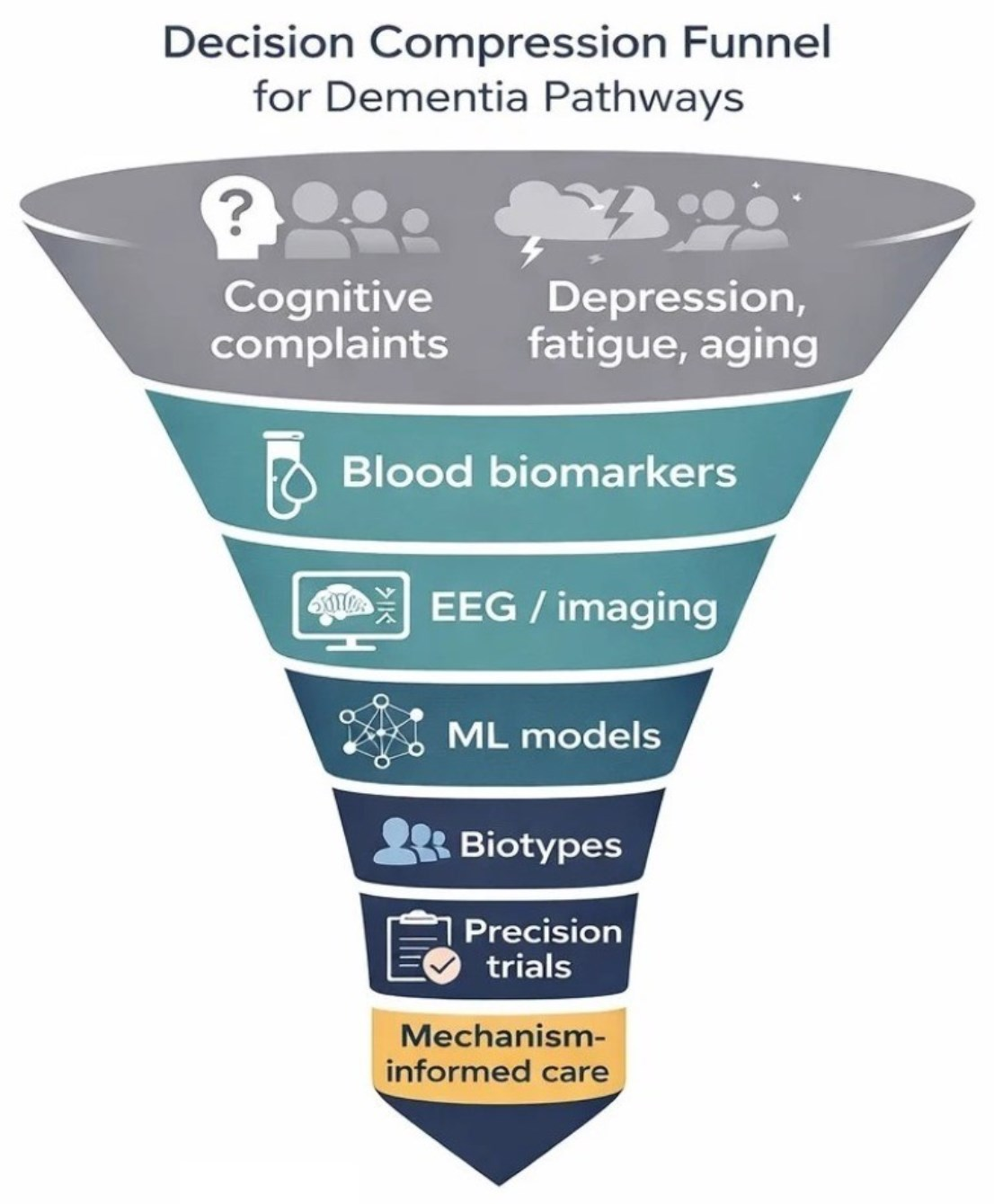
Screen, Sample, Stratify: Biomarkers and Machine Learning Compress Dementia Pathways



1. Vignette and Pressure Point
2. From Nosology to Mechanism: Rewiring Clinical Decisions
3. The Translational Corridor: Detection → Anchoring → Intervention
3.1. Detection and Stratification
3.2. Mechanistic Anchors
3.3. Intervention and Delivery
4. Operationalization—Bottlenecks, Upgrades, Redesign, Practice Capsule, and Closeout
4.1. Bottlenecks to Credibility
4.2. Near-Term Upgrades (12–24 mo) with Hard Metrics
4.3. Long-Horizon Redesign (3–5+ yrs)
4.4. Practice Capsule
4.5. Close—“The Corridor Contract”
Author Contributions
Funding
Conflicts of Interest
Abbreviations
| AD | Alzheimer’s disease |
| ADNI | Alzheimer’s Disease Neuroimaging Initiative |
| AGEs | advanced glycation end products |
| ASD | autism spectrum disorder |
| ASL MRI | arterial spin labeling magnetic resonance imaging |
| ATN | amyloid tau neurodegeneration framework |
| AUC | area under the curve |
| AUROC | area under the receiver operating characteristic curve |
| Aβ42/40 | amyloid beta 42 to 40 ratio |
| BBB | blood–brain barrier |
| BDNF | brain-derived neurotrophic factor |
| CAR-T | chimeric antigen receptor T cell therapy |
| CSF | cerebrospinal fluid |
| DAT-SPECT | dopamine transporter single photon emission computed tomography |
| DLB | dementia with Lewy bodies |
| EEG | electroencephalography |
| ENIGMA | Enhancing NeuroImaging Genetics through Meta-Analysis |
| FDG-PET | fluorodeoxyglucose positron emission tomography |
| fMRI | functional magnetic resonance imaging |
| fNIRS | functional near-infrared spectroscopy |
| GFAP | glial fibrillary acidic protein |
| HD-tDCS | high-definition transcranial direct current stimulation |
| ICA | independent component analysis |
| LBD | Lewy body disease |
| LTP | long-term potentiation |
| MCI | mild cognitive impairment |
| MRI | magnetic resonance imaging |
| MS | multiple sclerosis |
| MSA | multiple system atrophy |
| MVP | minor visual phenomena |
| NfL | neurofilament light chain |
| NIBS | non-invasive brain stimulation |
| NMDAR | N-methyl-D-aspartate receptor |
| NRI | net reclassification improvement |
| OCTA | optical coherence tomography angiography |
| p-tau217 | phosphorylated tau at threonine 217 |
| PD | Parkinson’s disease |
| PDD | Parkinson’s disease dementia |
| PET | positron emission tomography |
| POAG | primary open-angle glaucoma |
| PROs | patient reported outcomes |
| PSEN1 | presenilin 1 |
| RF | random forest |
| S1P | sphingosine 1 phosphate |
| SCD | subjective cognitive decline |
| SCZ | schizophrenia |
| TRACK-MS | Tracking Assessment of Cognition in Multiple Sclerosis |
| tDCS | transcranial direct current stimulation |
| TMS | transcranial magnetic stimulation |
| TREM2 | triggering receptor expressed on myeloid cells 2 |
References
- Gonzales, M.M.; Garbarino, V.R.; Pollet, E.; Palavicini, J.P.; Kellogg, D.L., Jr.; Kraig, E.; Orr, M.E. Biological aging processes underlying cognitive decline and neurodegenerative disease. J. Clin. Investig. 2022, 132, e158453. [Google Scholar] [CrossRef]
- Martínez-Cué, C.; Rueda, N. Cellular Senescence in Neurodegenerative Diseases. Front. Cell. Neurosci. 2020, 14, 16. [Google Scholar] [CrossRef]
- Marawi, T.; Ainsworth, N.J.; Zhukovsky, P.; Rashidi-Ranjbar, N.; Rajji, T.K.; Tartaglia, M.C.; Voineskos, A.N.; Mulsant, B.H. Brain-cognition relationships in late-life depression: A systematic review of structural magnetic resonance imaging studies. Transl. Psychiatry 2023, 13, 284. [Google Scholar] [CrossRef]
- Rashidi-Ranjbar, N.; Miranda, D.; Butters, M.A.; Mulsant, B.H.; Voineskos, A.N. Evidence for Structural and Functional Alterations of Frontal-Executive and Corticolimbic Circuits in Late-Life Depression and Relationship to Mild Cognitive Impairment and Dementia: A Systematic Review. Front. Neurosci. 2020, 14, 253. [Google Scholar] [CrossRef]
- Ren, Z.; Nie, L.; Du, Y.; Liu, J. Intertwined depressive and cognitive trajectories and the risk of dementia and death in older adults: A competing risk analysis. Gen. Psychiatry 2024, 37, e101156. [Google Scholar] [CrossRef]
- Battaglia, S.; Nazzi, C.; Thayer, J.F. Genetic differences associated with dopamine and serotonin release mediate fear-induced bradycardia in the human brain. Transl. Psychiatry 2024, 14, 24. [Google Scholar] [CrossRef]
- Nazzi, C.; Avenanti, A.; Battaglia, S. The Involvement of Antioxidants in Cognitive Decline and Neurodegeneration: Mens Sana in Corpore Sano. Antioxidants 2024, 13, 701. [Google Scholar] [CrossRef]
- Martin, E.; Velayudhan, L. Neuropsychiatric Symptoms in Mild Cognitive Impairment: A Literature Review. Dement. Geriatr. Cogn. Disord. 2020, 49, 146–155. [Google Scholar] [CrossRef] [PubMed]
- Zhao, L.; Niu, L.; Dai, H.; Lee, T.M.C.; Huang, R.; Zhang, R. A comparative meta-analysis of structural magnetic resonance imaging studies and gene expression profiles revealing the similarities and differences between late life depression and mild cognitive impairment. Psychol. Med. 2024, 54, 4264–4273. [Google Scholar] [CrossRef] [PubMed]
- Kaup, A.R.; Byers, A.L.; Falvey, C.; Simonsick, E.M.; Satterfield, S.; Ayonayon, H.N.; Smagula, S.F.; Rubin, S.M.; Yaffe, K. Trajectories of Depressive Symptoms in Older Adults and Risk of Dementia. JAMA Psychiatry 2016, 73, 525–531. [Google Scholar] [CrossRef]
- Tanaka, M. Parkinson’s Disease: Bridging Gaps, Building Biomarkers, and Reimagining Clinical Translation. Cells 2025, 14, 1161. [Google Scholar] [CrossRef]
- Muhammad, T.; Meher, T. Association of late-life depression with cognitive impairment: Evidence from a cross-sectional study among older adults in India. BMC Geriatr. 2021, 21, 364. [Google Scholar] [CrossRef]
- Milner, T.; Brown, M.R.G.; Jones, C.; Leung, A.W.S.; Brémault-Phillips, S. Multidimensional digital biomarker phenotypes for mild cognitive impairment: Considerations for early identification, diagnosis and monitoring. Front. Digit. Health 2024, 6, 1265846. [Google Scholar] [CrossRef] [PubMed]
- Alfalahi, H.; Dias, S.B.; Khandoker, A.H.; Chaudhuri, K.R.; Hadjileontiadis, L.J. A scoping review of neurodegenerative manifestations in explainable digital phenotyping. NPJ Parkinsons Dis. 2023, 9, 49. [Google Scholar] [CrossRef]
- Xie, Y.; Nahab, F.; Ge, Y.; Wu, Y.; Saurman, J.; Yang, C.; Hu, X. Abstract WP175: Predicting Post-Stroke Cognitive Impairment (PSCI) Using Multiple Machine Learning Approaches. Stroke 2025, 56, AWP175. [Google Scholar] [CrossRef]
- Stolfi, F.; Abreu, H.; Sinella, R.; Nembrini, S.; Centonze, S.; Landra, V.; Brasso, C.; Cappellano, G.; Rocca, P.; Chiocchetti, A. Omics approaches open new horizons in major depressive disorder: From biomarkers to precision medicine. Front. Psychiatry 2024, 15, 1422939. [Google Scholar] [CrossRef] [PubMed]
- Roefs, A.; Fried, E.I.; Kindt, M.; Martijn, C.; Elzinga, B.; Evers, A.W.M.; Wiers, R.W.; Borsboom, D.; Jansen, A. A new science of mental disorders: Using personalised, transdiagnostic, dynamical systems to understand, model, diagnose and treat psychopathology. Behav. Res. Ther. 2022, 153, 104096. [Google Scholar] [CrossRef]
- Qin, Z.; Li, Y.; Song, X.; Chai, L. Classification of Neuropsychiatric Disorders via Brain-Region-Selected Graph Convolutional Network. IEEE Trans. Neural Syst. Rehabil. Eng. 2025, 33, 1664–1672. [Google Scholar] [CrossRef]
- Tanaka, M.; Battaglia, S. From Biomarkers to Behavior: Mapping the Neuroimmune Web of Pain, Mood, and Memory. Biomedicines 2025, 13, 2226. [Google Scholar] [CrossRef]
- Tanaka, M. Special Issue “Translating Molecular Psychiatry: From Biomarkers to Personalized Therapies”. Int. J. Mol. Sci. 2025, 26, 238. [Google Scholar] [CrossRef] [PubMed]
- McGorry, P.D.; Hartmann, J.A.; Spooner, R.; Nelson, B. Beyond the “at risk mental state” concept: Transitioning to transdiagnostic psychiatry. World Psychiatry 2018, 17, 133–142. [Google Scholar] [CrossRef]
- Koike, S. Transdiagnostic approach for neuropsychiatric symptoms using neuroimage. Psychiatry Clin. Neurosci. 2025, 79, 137. [Google Scholar] [CrossRef] [PubMed]
- Battaglia, S.; Servajean, P.; Friston, K.J. The paradox of the self-studying brain. Phys. Life Rev. 2025, 52, 197–204. [Google Scholar] [CrossRef]
- Tanaka, M.; Vécsei, L. From Microbial Switches to Metabolic Sensors: Rewiring the Gut-Brain Kynurenine Circuit. Biomedicines 2025, 13, 2020. [Google Scholar] [CrossRef]
- Tanaka, M. From Serendipity to Precision: Integrating AI, Multi-Omics, and Human-Specific Models for Personalized Neuropsychiatric Care. Biomedicines 2025, 13, 167. [Google Scholar] [CrossRef]
- Parsa, M.; Rad, H.Y.; Vaezi, H.; Hossein-Zadeh, G.A.; Setarehdan, S.K.; Rostami, R.; Rostami, H.; Vahabie, A.H. EEG-based classification of individuals with neuropsychiatric disorders using deep neural networks: A systematic review of current status and future directions. Comput. Methods Programs Biomed. 2023, 240, 107683. [Google Scholar] [CrossRef]
- Wang, K.; Adjeroh, D.A.; Fang, W.; Walter, S.M.; Xiao, D.; Piamjariyakul, U.; Xu, C. Comparison of Deep Learning and Traditional Machine Learning Models for Predicting Mild Cognitive Impairment Using Plasma Proteomic Biomarkers. Int. J. Mol. Sci. 2025, 26, 2428. [Google Scholar] [CrossRef]
- Lalousis, P.A.; Schmaal, L.; Wood, S.J.; Reniers, R.; Barnes, N.M.; Chisholm, K.; Griffiths, S.L.; Stainton, A.; Wen, J.; Hwang, G.; et al. Neurobiologically Based Stratification of Recent-Onset Depression and Psychosis: Identification of Two Distinct Transdiagnostic Phenotypes. Biol. Psychiatry 2022, 92, 552–562. [Google Scholar] [CrossRef] [PubMed]
- Tanaka, M. Beyond the boundaries: Transitioning from categorical to dimensional paradigms in mental health diagnostics. Adv. Clin. Exp. Med. 2024, 33, 1295–1301. [Google Scholar] [CrossRef] [PubMed]
- Therriault, J.; Janelidze, S.; Benedet, A.L.; Ashton, N.J.; Arranz Martínez, J.; Gonzalez-Escalante, A.; Bellaver, B.; Alcolea, D.; Vrillon, A.; Karim, H.; et al. Diagnosis of Alzheimer’s disease using plasma biomarkers adjusted to clinical probability. Nat. Aging 2024, 4, 1529–1537. [Google Scholar] [CrossRef]
- Peraza, L.R.; Cromarty, R.; Kobeleva, X.; Firbank, M.J.; Killen, A.; Graziadio, S.; Thomas, A.J.; O’Brien, J.T.; Taylor, J.P. Electroencephalographic derived network differences in Lewy body dementia compared to Alzheimer’s disease patients. Sci. Rep. 2018, 8, 4637. [Google Scholar] [CrossRef] [PubMed]
- Balz, L.T.; Uttner, I.; Taranu, D.; Erhart, D.K.; Fangerau, T.; Jung, S.; Schreiber, H.; Senel, M.; Vardakas, I.; Lulé, D.E.; et al. Sensitivity and Specificity of a Revised Version of the TRACK-MS Screening Battery for Early Detection of Cognitive Impairment in Patients with Multiple Sclerosis. Biomedicines 2025, 13, 1902. [Google Scholar] [CrossRef]
- Capogna, E.; Pollarini, V.; Quinzi, A.; Guidi, L.; Sambati, L.; Criante, M.S.; Mengoli, E.; Venneri, A.; Lodi, R.; Tonon, C.; et al. Minor Visual Phenomena in Lewy Body Disease: A Systematic Review. Biomedicines 2025, 13, 1152. [Google Scholar] [CrossRef]
- Bussè, C.; Mitolo, M.; Mozzetta, S.; Venneri, A.; Cagnin, A. Impact of Lewy bodies disease on visual skills and memory abilities: From prodromal stages to dementia. Front. Psychiatry 2024, 15, 1461620. [Google Scholar] [CrossRef]
- Delgado-Álvarez, A.; Delgado-Alonso, C.; Goudsmit, M.; Gil, M.J.; Díez-Cirarda, M.; Valles-Salgado, M.; Montero-Escribano, P.; Hernández-Lorenzo, L.; Matías-Guiu, J.; Matias-Guiu, J.A. Validation of a brief cross-cultural cognitive screening test in Multiple Sclerosis. Mult. Scler. Relat. Disord. 2022, 67, 104091. [Google Scholar] [CrossRef] [PubMed]
- Firbank, M.J.; Collerton, D.; Morgan, K.D.; Schumacher, J.; Donaghy, P.C.; O’Brien, J.T.; Thomas, A.; Taylor, J.P. Functional connectivity in Lewy body disease with visual hallucinations. Eur. J. Neurol. 2024, 31, e16115. [Google Scholar] [CrossRef]
- D’Antonio, F.; Boccia, M.; Di Vita, A.; Suppa, A.; Fabbrini, A.; Canevelli, M.; Caramia, F.; Fiorelli, M.; Guariglia, C.; Ferracuti, S.; et al. Visual hallucinations in Lewy body disease: Pathophysiological insights from phenomenology. J. Neurol. 2022, 269, 3636–3652. [Google Scholar] [CrossRef]
- Boschen, S.L.; Mukerjee, A.A.; Faroqi, A.H.; Rabichow, B.E.; Fryer, J. Research models to study lewy body dementia. Mol. Neurodegener. 2025, 20, 46. [Google Scholar] [CrossRef]
- Lai, R.; Li, B.; Bishnoi, R. P-tau217 as a Reliable Blood-Based Marker of Alzheimer’s Disease. Biomedicines 2024, 12, 1836. [Google Scholar] [CrossRef]
- Bao, J.; Qiu, Y.; Wang, T.; Shang, L.; Chu, S.; Jin, W.; Wang, W.; Jiang, Y.; Li, B.; Huang, Y.; et al. Predictive Accuracy of a Clinical Model for Carriage of Pathogenic/Likely Pathogenic Variants in Patients with Dementia and a Positive Family History at PUMCH. Biomedicines 2025, 13, 1235. [Google Scholar] [CrossRef] [PubMed]
- Mohammadi, R.; Ng, S.Y.E.; Tan, J.Y.; Ng, A.S.L.; Deng, X.; Choi, X.; Heng, D.L.; Neo, S.; Xu, Z.; Tay, K.Y.; et al. Machine Learning for Early Detection of Cognitive Decline in Parkinson’s Disease Using Multimodal Biomarker and Clinical Data. Biomedicines 2024, 12, 2758. [Google Scholar] [CrossRef]
- Kadoh, Y.; Kubota, S.; Shimomine, S.; Tanito, M. Exploring Cognitive Impairments Associated with Primary Open-Angle Glaucoma and Exfoliation Glaucoma. Biomedicines 2024, 12, 1706. [Google Scholar] [CrossRef]
- Biondi, M.; Marino, M.; Mantini, D.; Spironelli, C. Brain Structural Alterations Underlying Mood-Related Deficits in Schizophrenia. Biomedicines 2025, 13, 736. [Google Scholar] [CrossRef]
- Statsenko, Y.; Kuznetsov, N.V.; Ljubisaljevich, M. Hallmarks of Brain Plasticity. Biomedicines 2025, 13, 460. [Google Scholar] [CrossRef] [PubMed]
- de Lima, E.P.; Tanaka, M.; Lamas, C.B.; Quesada, K.; Detregiachi, C.R.P.; Araújo, A.C.; Guiguer, E.L.; Catharin, V.; de Castro, M.V.M.; Junior, E.B.; et al. Vascular Impairment, Muscle Atrophy, and Cognitive Decline: Critical Age-Related Conditions. Biomedicines 2024, 12, 2096. [Google Scholar] [CrossRef]
- Papa, D.; Ingenito, A.; von Gal, A.; De Pandis, M.F.; Piccardi, L. Relationship Between Depression and Neurodegeneration: Risk Factor, Prodrome, Consequence, or Something Else? A Scoping Review. Biomedicines 2025, 13, 1023. [Google Scholar] [CrossRef] [PubMed]
- Schreiner, T.G.; Menéndez-González, M.; Schreiner, O.D.; Ciobanu, R.C. Intrathecal Therapies for Neurodegenerative Diseases: A Review of Current Approaches and the Urgent Need for Advanced Delivery Systems. Biomedicines 2025, 13, 2167. [Google Scholar] [CrossRef]
- Markowska, A.; Tarnacka, B. Molecular Changes in the Ischemic Brain as Non-Invasive Brain Stimulation Targets-TMS and tDCS Mechanisms, Therapeutic Challenges, and Combination Therapies. Biomedicines 2024, 12, 1560. [Google Scholar] [CrossRef]
- Jaekel, A.K.; Watzek, J.; Nielsen, J.; Butscher, A.L.; Bitter, J.; von Danwitz, M.; Zöhrer, P.I.; Knappe, F.; Kirschner-Hermanns, R.; Knüpfer, S.C. The Impact of Urodynamic Findings on Fatigue and Depression in People with Multiple Sclerosis. Biomedicines 2025, 13, 601. [Google Scholar] [CrossRef]
- Carpita, B.; Nardi, B.; Bonelli, C.; Pascariello, L.; Massimetti, G.; Cremone, I.M.; Pini, S.; Palego, L.; Betti, L.; Giannaccini, G.; et al. Platelet Levels of Brain-Derived Neurotrophic Factor in Adults with Autism Spectrum Disorder: Is There a Specific Association with Autism Spectrum Psychopathology? Biomedicines 2024, 12, 1529. [Google Scholar] [CrossRef] [PubMed]
- Ramanan, V.K.; Gebre, R.K.; Graff-Radford, J.; Hofrenning, E.; Algeciras-Schimnich, A.; Figdore, D.J.; Lowe, V.J.; Mielke, M.M.; Knopman, D.S.; Ross, O.A.; et al. Genetic risk scores enhance the diagnostic value of plasma biomarkers of brain amyloidosis. Brain 2023, 146, 4508–4519. [Google Scholar] [CrossRef] [PubMed]
- AlMansoori, M.E.; Jemimah, S.; Abuhantash, F.; AlShehhi, A. Predicting early Alzheimer’s with blood biomarkers and clinical features. Sci. Rep. 2024, 14, 6039. [Google Scholar] [CrossRef]
- Dyer, A.; Dolphin, H.; Morrison, L.; O’Connor, A.; Sedgwick, G.; Young, C.; Killeen, E.; Gallagher, C.; McFeely, A.; Connolly, E. Plasma P-tau217 Demonstrates Excellent Diagnostic and Prognostic Performance as a Blood-Based Biomarker for Alzheimer Disease in Older Adults. Age Ageing 2024, 53, afae178.001. [Google Scholar]
- Pandey, N.; Yang, Z.; Cieza, B.; Reyes-Dumeyer, D.; Kang, M.S.; Montesinos, R.; Soto-Añari, M.; Custodio, N.; Honig, L.S.; Tosto, G. Plasma phospho-tau217 as a predictive biomarker for Alzheimer’s disease in a large south American cohort. Alzheimers Res. Ther. 2025, 17, 1. [Google Scholar] [CrossRef] [PubMed]
- Wang, S.; Liu, D.; Li, H.; Jia, X.; Zhou, H.; Yu, W.; Li, T.; Pan, L.; Chen, B.; Wang, Y.; et al. Assessing diagnostic performance of plasma biomarkers in Alzheimer’s disease versus cognitively unimpaired individuals: P-tau217 emerges as the optimal marker in Chinese cohorts. Front. Aging Neurosci. 2025, 17, 1554805. [Google Scholar] [CrossRef]
- Grande, G.; Valletta, M.; Rizzuto, D.; Xia, X.; Qiu, C.; Orsini, N.; Dale, M.; Andersson, S.; Fredolini, C.; Winblad, B.; et al. Blood-based biomarkers of Alzheimer’s disease and incident dementia in the community. Nat. Med. 2025, 31, 2027–2035. [Google Scholar] [CrossRef] [PubMed]
- Milà-Alomà, M.; Ashton, N.J.; Shekari, M.; Salvadó, G.; Ortiz-Romero, P.; Montoliu-Gaya, L.; Benedet, A.L.; Karikari, T.K.; Lantero-Rodriguez, J.; Vanmechelen, E.; et al. Plasma p-tau231 and p-tau217 as state markers of amyloid-β pathology in preclinical Alzheimer’s disease. Nat. Med. 2022, 28, 1797–1801. [Google Scholar] [CrossRef] [PubMed]
- Bartoletti-Stella, A.; Tarozzi, M.; Mengozzi, G.; Asirelli, F.; Brancaleoni, L.; Mometto, N.; Stanzani-Maserati, M.; Baiardi, S.; Linarello, S.; Spallazzi, M.; et al. Dementia-related genetic variants in an Italian population of early-onset Alzheimer’s disease. Front. Aging Neurosci. 2022, 14, 969817. [Google Scholar] [CrossRef]
- Schultz, S.A.; Liu, L.; Schultz, A.P.; Fitzpatrick, C.D.; Levin, R.; Bellier, J.P.; Shirzadi, Z.; Joseph-Mathurin, N.; Chen, C.D.; Benzinger, T.L.S.; et al. γ-Secretase activity, clinical features, and biomarkers of autosomal dominant Alzheimer’s disease: Cross-sectional and longitudinal analysis of the Dominantly Inherited Alzheimer Network observational study (DIAN-OBS). Lancet Neurol. 2024, 23, 913–924. [Google Scholar] [CrossRef]
- Almgren, H.; Camacho, M.; Hanganu, A.; Kibreab, M.; Camicioli, R.; Ismail, Z.; Forkert, N.D.; Monchi, O. Machine learning-based prediction of longitudinal cognitive decline in early Parkinson’s disease using multimodal features. Sci. Rep. 2023, 13, 13193. [Google Scholar] [CrossRef]
- Schrag, A.; Siddiqui, U.F.; Anastasiou, Z.; Weintraub, D.; Schott, J.M. Clinical variables and biomarkers in prediction of cognitive impairment in patients with newly diagnosed Parkinson’s disease: A cohort study. Lancet Neurol. 2017, 16, 66–75. [Google Scholar] [CrossRef]
- Caspell-Garcia, C.; Simuni, T.; Tosun-Turgut, D.; Wu, I.W.; Zhang, Y.; Nalls, M.; Singleton, A.; Shaw, L.A.; Kang, J.H.; Trojanowski, J.Q.; et al. Multiple modality biomarker prediction of cognitive impairment in prospectively followed de novo Parkinson disease. PLoS ONE 2017, 12, e0175674. [Google Scholar] [CrossRef]
- Bäckström, D.; Granåsen, G.; Mo, S.J.; Riklund, K.; Trupp, M.; Zetterberg, H.; Blennow, K.; Forsgren, L.; Domellöf, M.E. Prediction and early biomarkers of cognitive decline in Parkinson disease and atypical parkinsonism: A population-based study. Brain Commun. 2022, 4, fcac040. [Google Scholar] [CrossRef]
- Platero, C.; Pineda-Pardo, J. Temporal ordering of cognitive impairment in Parkinson’s disease patients based on disease progression models. Park. Relat. Disord. 2024, 129, 107184. [Google Scholar] [CrossRef]
- Ostertag, C.; Visani, M.; Urruty, T.; Beurton-Aimar, M. Long-term cognitive decline prediction based on multi-modal data using Multimodal3DSiameseNet: Transfer learning from Alzheimer’s disease to Parkinson’s disease. Int. J. Comput. Assist. Radiol. Surg. 2023, 18, 809–818. [Google Scholar] [CrossRef]
- Wang, Y.; Ning, H.; Ren, J.; Pan, C.; Yu, M.; Xue, C.; Wang, X.; Zhou, G.; Chen, Y.; Liu, W. Integrated Clinical Features with Plasma and Multi-modal Neuroimaging Biomarkers to Diagnose Mild Cognitive Impairment in Early Drug-Naive Parkinson’s Disease. ACS Chem. Neurosci. 2022, 13, 3523–3533. [Google Scholar] [CrossRef]
- Gorji, A.; Fathi Jouzdani, A. Machine learning for predicting cognitive decline within five years in Parkinson’s disease: Comparing cognitive assessment scales with DAT SPECT and clinical biomarkers. PLoS ONE 2024, 19, e0304355. [Google Scholar] [CrossRef] [PubMed]
- Aarsland, D.; Batzu, L.; Halliday, G.M.; Geurtsen, G.J.; Ballard, C.; Ray Chaudhuri, K.; Weintraub, D. Parkinson disease-associated cognitive impairment. Nat. Rev. Dis. Primers 2021, 7, 47. [Google Scholar] [CrossRef]
- Aarsland, D.; Creese, B.; Politis, M.; Chaudhuri, K.R.; Ffytche, D.H.; Weintraub, D.; Ballard, C. Cognitive decline in Parkinson disease. Nat. Rev. Neurol. 2017, 13, 217–231. [Google Scholar] [CrossRef] [PubMed]
- Crump, C.; Sundquist, J.; Sieh, W.; Sundquist, K. Risk of Alzheimer’s Disease and Related Dementias in Persons with Glaucoma: A National Cohort Study. Ophthalmology 2024, 131, 302–309. [Google Scholar] [CrossRef] [PubMed]
- Rahmati, M.; Smith, L.; Lee, H.; Boyer, L.; Fond, G.; Yon, D.K.; Lee, H.; Soysal, P.; Udeh, R.; Dolja-Gore, X.; et al. Associations between vision impairment and eye diseases with dementia, dementia subtypes and cognitive impairment: An umbrella review. Ageing Res. Rev. 2024, 101, 102523. [Google Scholar] [CrossRef]
- Takayanagi, Y.; Kadoh, Y.; Sasaki, J.; Obana, A.; Tanito, M. Association between Skin Carotenoid Levels and Cognitive Impairment Screened by Mini-Cog in Patients with Glaucoma. Curr. Issues Mol. Biol. 2024, 46, 6940–6950. [Google Scholar] [CrossRef]
- Kadoh, Y.; Takayanagi, Y.; Sasaki, J.; Tanito, M. Fingertip-Measured Skin Carotenoids and Advanced Glycation End Product Levels in Glaucoma. Antioxidants 2022, 11, 1138. [Google Scholar] [CrossRef]
- Wang, X.; Chen, W.; Zhao, W.; Miao, M. Risk of glaucoma to subsequent dementia or cognitive impairment: A systematic review and meta-analysis. Aging Clin. Exp. Res. 2024, 36, 172. [Google Scholar] [CrossRef] [PubMed]
- Lee, C.S.; Larson, E.B.; Gibbons, L.E.; Lee, A.Y.; McCurry, S.M.; Bowen, J.D.; McCormick, W.C.; Crane, P.K. Associations between recent and established ophthalmic conditions and risk of Alzheimer’s disease. Alzheimers Dement. 2019, 15, 34–41. [Google Scholar] [CrossRef]
- Chatterjee, P.; Pedrini, S.; Doecke, J.D.; Thota, R.; Villemagne, V.L.; Doré, V.; Singh, A.K.; Wang, P.; Rainey-Smith, S.; Fowler, C.; et al. Plasma Aβ42/40 ratio, p-tau181, GFAP, and NfL across the Alzheimer’s disease continuum: A cross-sectional and longitudinal study in the AIBL cohort. Alzheimers Dement. 2023, 19, 1117–1134. [Google Scholar] [CrossRef]
- Park, M.K.; Ahn, J.; Kim, Y.J.; Lee, J.W.; Lee, J.C.; Hwang, S.J.; Kim, K.C. Predicting Longitudinal Cognitive Decline and Alzheimer’s Conversion in Mild Cognitive Impairment Patients Based on Plasma Biomarkers. Cells 2024, 13, 1085. [Google Scholar] [CrossRef] [PubMed]
- Ossenkoppele, R.; Salvadó, G.; Janelidze, S.; Pichet Binette, A.; Bali, D.; Karlsson, L.; Palmqvist, S.; Mattsson-Carlgren, N.; Stomrud, E.; Therriault, J.; et al. Plasma p-tau217 and tau-PET predict future cognitive decline among cognitively unimpaired individuals: Implications for clinical trials. Nat. Aging 2025, 5, 883–896. [Google Scholar] [CrossRef] [PubMed]
- Pichet Binette, A.; Palmqvist, S.; Bali, D.; Farrar, G.; Buckley, C.J.; Wolk, D.A.; Zetterberg, H.; Blennow, K.; Janelidze, S.; Hansson, O. Combining plasma phospho-tau and accessible measures to evaluate progression to Alzheimer’s dementia in mild cognitive impairment patients. Alzheimers Res. Ther. 2022, 14, 46. [Google Scholar] [CrossRef]
- Huang, K.L.; Hsiao, I.T.; Huang, C.W.; Huang, C.G.; Chang, H.I.; Huang, S.H.; Lin, K.J.; Ma, M.C.; Huang, C.C.; Chang, C.C. The Taiwan-ADNI workflow toward integrating plasma p-tau217 into prediction models for the risk of Alzheimer’s disease and tau burden. Alzheimers Dement. 2025, 21, e14297. [Google Scholar] [CrossRef]
- Vermeulen, R.J.; Andersson, V.; Banken, J.; Hannink, G.; Govers, T.M.; Rovers, M.M.; Rikkert, M. Limited generalizability and high risk of bias in multivariable models predicting conversion risk from mild cognitive impairment to dementia: A systematic review. Alzheimers Dement. 2025, 21, e70069. [Google Scholar] [CrossRef]
- Wang, X.; Zhou, S.; Ye, N.; Li, Y.; Zhou, P.; Chen, G.; Hu, H. Predictive models of Alzheimer’s disease dementia risk in older adults with mild cognitive impairment: A systematic review and critical appraisal. BMC Geriatr. 2024, 24, 531. [Google Scholar] [CrossRef] [PubMed]
- Losinski, G.M.; Key, M.N.; Vidoni, E.D.; Clutton, J.; Morris, J.K.; Burns, J.M.; Watts, A. APOE4 and chronic health risk factors are associated with sex-specific preclinical Alzheimer’s disease neuroimaging biomarkers. Front. Glob. Womens Health 2025, 6, 1531062. [Google Scholar] [CrossRef] [PubMed]
- Rahman, A.; Schelbaum, E.; Hoffman, K.; Diaz, I.; Hristov, H.; Andrews, R.; Jett, S.; Jackson, H.; Lee, A.; Sarva, H.; et al. Sex-driven modifiers of Alzheimer risk: A multimodality brain imaging study. Neurology 2020, 95, e166–e178. [Google Scholar] [CrossRef] [PubMed]
- Ding, H.; Mandapati, A.; Hamel, A.P.; Karjadi, C.; Ang, T.F.A.; Xia, W.; Au, R.; Lin, H. Multimodal Machine Learning for 10-Year Dementia Risk Prediction: The Framingham Heart Study. J. Alzheimers Dis. 2023, 96, 277–286. [Google Scholar] [CrossRef]
- Wang, J.; Knol, M.J.; Tiulpin, A.; Dubost, F.; de Bruijne, M.; Vernooij, M.W.; Adams, H.H.H.; Ikram, M.A.; Niessen, W.J.; Roshchupkin, G.V. Gray Matter Age Prediction as a Biomarker for Risk of Dementia. Proc. Natl. Acad. Sci. USA 2019, 116, 21213–21218. [Google Scholar] [CrossRef]
- Braff, D.L. The importance of endophenotypes in schizophrenia research. Schizophr. Res. 2015, 163, 1–8. [Google Scholar] [CrossRef]
- Greenwood, T.A.; Shutes-David, A.; Tsuang, D.W. Endophenotypes in Schizophrenia: Digging Deeper to Identify Genetic Mechanisms. J. Psychiatry Brain Sci. 2019, 4, e190005. [Google Scholar] [CrossRef]
- Liu, Z.; Palaniyappan, L.; Wu, X.; Zhang, K.; Du, J.; Zhao, Q.; Xie, C.; Tang, Y.; Su, W.; Wei, Y.; et al. Resolving heterogeneity in schizophrenia through a novel systems approach to brain structure: Individualized structural covariance network analysis. Mol. Psychiatry 2021, 26, 7719–7731. [Google Scholar] [CrossRef]
- Owens, E.M.; Bachman, P.; Glahn, D.C.; Bearden, C.E. Electrophysiological Endophenotypes for Schizophrenia. Harv. Rev. Psychiatry 2016, 24, 129–147. [Google Scholar] [CrossRef]
- Martos, D.; Lőrinczi, B.; Szatmári, I.; Vécsei, L.; Tanaka, M. Decoupling Behavioral Domains via Kynurenic Acid Analog Optimization: Implications for Schizophrenia and Parkinson’s Disease Therapeutics. Cells 2025, 14, 973. [Google Scholar] [CrossRef]
- Figueiredo Godoy, A.C.; Frota, F.F.; Araújo, L.P.; Valenti, V.E.; Pereira, E.; Detregiachi, C.R.P.; Galhardi, C.M.; Caracio, F.C.; Haber, R.S.A.; Fornari Laurindo, L.; et al. Neuroinflammation and Natural Antidepressants: Balancing Fire with Flora. Biomedicines 2025, 13, 1129. [Google Scholar] [CrossRef]
- Mekala, A.; Qiu, H. Interplay Between Vascular Dysfunction and Neurodegenerative Pathology: New Insights into Molecular Mechanisms and Management. Biomolecules 2025, 15, 712. [Google Scholar] [CrossRef]
- Tarantini, S.; Tran, C.H.T.; Gordon, G.R.; Ungvari, Z.; Csiszar, A. Impaired neurovascular coupling in aging and Alzheimer’s disease: Contribution of astrocyte dysfunction and endothelial impairment to cognitive decline. Exp. Gerontol. 2017, 94, 52–58. [Google Scholar] [CrossRef]
- Duong, M.T.; Nasrallah, I.M.; Wolk, D.A.; Chang, C.C.Y.; Chang, T.Y. Cholesterol, Atherosclerosis, and APOE in Vascular Contributions to Cognitive Impairment and Dementia (VCID): Potential Mechanisms and Therapy. Front. Aging Neurosci. 2021, 13, 647990. [Google Scholar] [CrossRef] [PubMed]
- Rundek, T.; Tolea, M.; Ariko, T.; Fagerli, E.A.; Camargo, C.J. Vascular Cognitive Impairment (VCI). Neurotherapeutics 2022, 19, 68–88. [Google Scholar] [CrossRef] [PubMed]
- Steenland, K.; Karnes, C.; Seals, R.; Carnevale, C.; Hermida, A.; Levey, A. Late-life depression as a risk factor for mild cognitive impairment or Alzheimer’s disease in 30 US Alzheimer’s disease centers. J. Alzheimers Dis. 2012, 31, 265–275. [Google Scholar] [CrossRef]
- Wang, S.M.; Han, K.D.; Kim, N.Y.; Um, Y.H.; Kang, D.W.; Na, H.R.; Lee, C.U.; Lim, H.K. Late-life depression, subjective cognitive decline, and their additive risk in incidence of dementia: A nationwide longitudinal study. PLoS ONE 2021, 16, e0254639. [Google Scholar] [CrossRef] [PubMed]
- Linnemann, C.; Lang, U.E. Pathways Connecting Late-Life Depression and Dementia. Front. Pharmacol. 2020, 11, 279. [Google Scholar] [CrossRef]
- Huang, Y.Y.; Gan, Y.H.; Yang, L.; Cheng, W.; Yu, J.T. Depression in Alzheimer’s Disease: Epidemiology, Mechanisms, and Treatment. Biol. Psychiatry 2024, 95, 992–1005. [Google Scholar] [CrossRef]
- Tanaka, M.; Battaglia, S. Dualistic Dynamics in Neuropsychiatry: From Monoaminergic Modulators to Multiscale Biomarker Maps. Biomedicines 2025, 13, 1456. [Google Scholar] [CrossRef]
- Invernizzi, S.; Simoes Loureiro, I.; Kandana Arachchige, K.G.; Lefebvre, L. Late-Life Depression, Cognitive Impairment, and Relationship with Alzheimer’s Disease. Dement. Geriatr. Cogn. Disord. 2021, 50, 414–424. [Google Scholar] [CrossRef]
- Galts, C.P.C.; Bettio, L.E.B.; Jewett, D.C.; Yang, C.C.; Brocardo, P.S.; Rodrigues, A.L.S.; Thacker, J.S.; Gil-Mohapel, J. Depression in neurodegenerative diseases: Common mechanisms and current treatment options. Neurosci. Biobehav. Rev. 2019, 102, 56–84. [Google Scholar] [CrossRef] [PubMed]
- Szabó, Á.; Galla, Z.; Spekker, E.; Martos, D.; Szűcs, M.; Fejes-Szabó, A.; Fehér, Á.; Takeda, K.; Ozaki, K.; Inoue, H.; et al. Behavioral Balance in Tryptophan Turmoil: Regional Metabolic Rewiring in Kynurenine Aminotransferase II Knockout Mice. Cells 2025, 14, 1711. [Google Scholar] [CrossRef] [PubMed]
- Chou, Y.H.; Sundman, M.; Ton That, V.; Green, J.; Trapani, C. Cortical excitability and plasticity in Alzheimer’s disease and mild cognitive impairment: A systematic review and meta-analysis of transcranial magnetic stimulation studies. Ageing Res. Rev. 2022, 79, 101660. [Google Scholar] [CrossRef]
- McMackin, R.; Muthuraman, M.; Groppa, S.; Babiloni, C.; Taylor, J.P.; Kiernan, M.C.; Nasseroleslami, B.; Hardiman, O. Measuring network disruption in neurodegenerative diseases: New approaches using signal analysis. J. Neurol. Neurosurg. Psychiatry 2019, 90, 1011–1020. [Google Scholar] [CrossRef]
- Sanchez, E.; Coughlan, G.T.; Wilkinson, T.; Ramirez, J.; Mirza, S.S.; Baril, A.A.; Dilliott, A.A.; Frank, A.; Lang, A.E.; Hassan, A.; et al. Association of Plasma Biomarkers with Longitudinal Atrophy and Microvascular Burden on MRI Across Neurodegenerative and Cerebrovascular Diseases. Neurology 2025, 104, e213438. [Google Scholar] [CrossRef]
- Giacomucci, G.; Mazzeo, S.; Bagnoli, S.; Ingannato, A.; Leccese, D.; Berti, V.; Padiglioni, S.; Galdo, G.; Ferrari, C.; Sorbi, S.; et al. Plasma neurofilament light chain as a biomarker of Alzheimer’s disease in Subjective Cognitive Decline and Mild Cognitive Impairment. J. Neurol. 2022, 269, 4270–4280. [Google Scholar] [CrossRef] [PubMed]
- Ebenau, J.L.; Pelkmans, W.; Verberk, I.M.W.; Verfaillie, S.C.J.; van den Bosch, K.A.; van Leeuwenstijn, M.; Collij, L.E.; Scheltens, P.; Prins, N.D.; Barkhof, F.; et al. Association of CSF, Plasma, and Imaging Markers of Neurodegeneration with Clinical Progression in People with Subjective Cognitive Decline. Neurology 2022, 98, e1315–e1326. [Google Scholar] [CrossRef]
- Xie, L.; Das, S.R.; Wisse, L.E.M.; Ittyerah, R.; de Flores, R.; Shaw, L.M.; Yushkevich, P.A.; Wolk, D.A. Baseline structural MRI and plasma biomarkers predict longitudinal structural atrophy and cognitive decline in early Alzheimer’s disease. Alzheimers Res. Ther. 2023, 15, 79. [Google Scholar] [CrossRef]
- Mengel, D.; Soter, E.; Ott, J.M.; Wacker, M.; Leyva, A.; Peters, O.; Hellmann-Regen, J.; Schneider, L.-S.; Wang, X.; Priller, J. Blood biomarkers confirm subjective cognitive decline (SCD) as a distinct molecular and clinical stage within the NIA-AA framework of Alzheimer’ s disease. Mol. Psychiatry 2025, 30, 3150–3159. [Google Scholar] [CrossRef] [PubMed]
- Jenkins, T.M.; Alix, J.J.P.; Fingret, J.; Esmail, T.; Hoggard, N.; Baster, K.; McDermott, C.J.; Wilkinson, I.D.; Shaw, P.J. Longitudinal multi-modal muscle-based biomarker assessment in motor neuron disease. J. Neurol. 2020, 267, 244–256. [Google Scholar] [CrossRef]
- Manuel, M.G.; Tamba, B.I.; Leclere, M.; Mabrouk, M.; Schreiner, T.G.; Ciobanu, R.; Cristina, T.Z. Intrathecal Pseudodelivery of Drugs in the Therapy of Neurodegenerative Diseases: Rationale, Basis and Potential Applications. Pharmaceutics 2023, 15, 768. [Google Scholar] [CrossRef]
- Bennett, C.F.; Krainer, A.R.; Cleveland, D.W. Antisense Oligonucleotide Therapies for Neurodegenerative Diseases. Annu. Rev. Neurosci. 2019, 42, 385–406. [Google Scholar] [CrossRef]
- Fowler, M.J.; Cotter, J.D.; Knight, B.E.; Sevick-Muraca, E.M.; Sandberg, D.I.; Sirianni, R.W. Intrathecal drug delivery in the era of nanomedicine. Adv. Drug Deliv. Rev. 2020, 165, 77–95. [Google Scholar] [CrossRef]
- Dhariwal, R.; Jain, M.; Mir, Y.R.; Singh, A.; Jain, B.; Kumar, P.; Tariq, M.; Verma, D.; Deshmukh, K.; Yadav, V.K.; et al. Targeted drug delivery in neurodegenerative diseases: The role of nanotechnology. Front. Med. 2025, 12, 1522223. [Google Scholar] [CrossRef] [PubMed]
- Schmitz, N.; Abdelmageed, M.M.; Monine, M.; Xu, Y. Trends in First-in-Human Studies for Intrathecal Antisense Oligonucleotides: Insights from 2010 to 2024. J. Clin. Pharmacol. 2025, 65, 1065–1075. [Google Scholar] [CrossRef]
- Han, K.; Liu, J.; Tang, Z.; Su, W.; Liu, Y.; Lu, H.; Zhang, H. Effects of excitatory transcranial magnetic stimulation over the different cerebral hemispheres dorsolateral prefrontal cortex for post-stroke cognitive impairment: A systematic review and meta-analysis. Front. Neurosci. 2023, 17, 1102311. [Google Scholar] [CrossRef] [PubMed]
- Begemann, M.J.; Brand, B.A.; Ćurčić-Blake, B.; Aleman, A.; Sommer, I.E. Efficacy of non-invasive brain stimulation on cognitive functioning in brain disorders: A meta-analysis. Psychol. Med. 2020, 50, 2465–2486. [Google Scholar] [CrossRef]
- Battaglia, S.; Fazio, C.D.; Borgomaneri, S.; Avenanti, A. Cortisol Imbalance and Fear Learning in PTSD: Therapeutic Approaches to Control Abnormal Fear Responses. Curr. Neuropharmacol. 2025, 23, 835–846. [Google Scholar] [CrossRef]
- Fisicaro, F.; Lanza, G.; Grasso, A.A.; Pennisi, G.; Bella, R.; Paulus, W.; Pennisi, M. Repetitive transcranial magnetic stimulation in stroke rehabilitation: Review of the current evidence and pitfalls. Ther. Adv. Neurol. Disord. 2019, 12, 1756286419878317. [Google Scholar] [CrossRef]
- Yang, C.; Zhang, T.; Huang, K.; Xiong, M.; Liu, H.; Wang, P.; Zhang, Y. Increased both cortical activation and functional connectivity after transcranial direct current stimulation in patients with post-stroke: A functional near-infrared spectroscopy study. Front. Psychiatry 2022, 13, 1046849. [Google Scholar] [CrossRef]
- Hill, A.T.; Rogasch, N.C.; Fitzgerald, P.B.; Hoy, K.E. Effects of single versus dual-site High-Definition transcranial direct current stimulation (HD-tDCS) on cortical reactivity and working memory performance in healthy subjects. Brain Stimul. 2018, 11, 1033–1043. [Google Scholar] [CrossRef]
- Jaekel, A.K.; Watzek, J.; Nielsen, J.; Butscher, A.L.; Zöhrer, P.; Schmitz, F.; Kirschner-Hermanns, R.K.M.; Knüpfer, S.C. Neurogenic Lower Urinary Tract Symptoms, Fatigue, and Depression-Are There Correlations in Persons with Multiple Sclerosis? Biomedicines 2023, 11, 2193. [Google Scholar] [CrossRef]
- Polacchini, A.; Metelli, G.; Francavilla, R.; Baj, G.; Florean, M.; Mascaretti, L.G.; Tongiorgi, E. A method for reproducible measurements of serum BDNF: Comparison of the performance of six commercial assays. Sci. Rep. 2015, 5, 17989. [Google Scholar] [CrossRef] [PubMed]
- Brum, W.S.; Cullen, N.C.; Janelidze, S.; Ashton, N.J.; Zimmer, E.R.; Therriault, J.; Benedet, A.L.; Rahmouni, N.; Tissot, C.; Stevenson, J.; et al. A two-step workflow based on plasma p-tau217 to screen for amyloid β positivity with further confirmatory testing only in uncertain cases. Nat. Aging 2023, 3, 1079–1090. [Google Scholar] [CrossRef]
- Therriault, J.; Brum, W.S.; Trudel, L.; Macedo, A.C.; Bitencourt, F.V.; Martins-Pfeifer, C.C.; Nakouzi, M.; Pola, I.; Wong, M.; Kac, P.R.; et al. Blood phosphorylated tau for the diagnosis of Alzheimer’s disease: A systematic review and meta-analysis. Lancet Neurol. 2025, 24, 740–752. [Google Scholar] [CrossRef]
- Palmqvist, S.; Warmenhoven, N.; Anastasi, F.; Pilotto, A.; Janelidze, S.; Tideman, P.; Stomrud, E.; Mattsson-Carlgren, N.; Smith, R.; Ossenkoppele, R.; et al. Plasma phospho-tau217 for Alzheimer’s disease diagnosis in primary and secondary care using a fully automated platform. Nat. Med. 2025, 31, 2036–2043. [Google Scholar] [CrossRef] [PubMed]
- Teunissen, C.E.; Kolster, R.; Triana-Baltzer, G.; Janelidze, S.; Zetterberg, H.; Kolb, H.C. Plasma p-tau immunoassays in clinical research for Alzheimer’s disease. Alzheimers Dement. 2025, 21, e14397. [Google Scholar] [CrossRef]
- Birkenbihl, C.; Emon, M.A.; Vrooman, H.; Westwood, S.; Lovestone, S.; Hofmann-Apitius, M.; Fröhlich, H. Differences in cohort study data affect external validation of artificial intelligence models for predictive diagnostics of dementia—Lessons for translation into clinical practice. EPMA J. 2020, 11, 367–376. [Google Scholar] [CrossRef] [PubMed]
- Therriault, J.; Ashton, N.J.; Pola, I.; Triana-Baltzer, G.; Brum, W.S.; Di Molfetta, G.; Arslan, B.; Rahmouni, N.; Tissot, C.; Servaes, S.; et al. Comparison of two plasma p-tau217 assays to detect and monitor Alzheimer’s pathology. EBioMedicine 2024, 102, 105046. [Google Scholar] [CrossRef]
- Sun, Y.M.; Wang, Z.Y.; Liang, Y.Y.; Hao, C.W.; Shi, C.H. Digital biomarkers for precision diagnosis and monitoring in Parkinson’s disease. NPJ Digit. Med. 2024, 7, 218. [Google Scholar] [CrossRef] [PubMed]
- Dutta, S.; Hornung, S.; Kruayatidee, A.; Maina, K.N.; Del Rosario, I.; Paul, K.C.; Wong, D.Y.; Duarte Folle, A.; Markovic, D.; Palma, J.A.; et al. α-Synuclein in blood exosomes immunoprecipitated using neuronal and oligodendroglial markers distinguishes Parkinson’s disease from multiple system atrophy. Acta Neuropathol. 2021, 142, 495–511. [Google Scholar] [CrossRef] [PubMed]
- Paganoni, S.; Berry, J.D.; Quintana, M.; Macklin, E.; Saville, B.R.; Detry, M.A.; Chase, M.; Sherman, A.V.; Yu, H.; Drake, K.; et al. Adaptive Platform Trials to Transform Amyotrophic Lateral Sclerosis Therapy Development. Ann. Neurol. 2022, 91, 165–175. [Google Scholar] [CrossRef]
- Battaglia, S.; Andero, R.; Thayer, J.F. Translational cross-species evidence of heart-related dynamics in threat learning. Neurosci. Biobehav. Rev. 2025, 176, 106273. [Google Scholar] [CrossRef]
- Taranu, D.; Tumani, H.; Holbrook, J.; Tumani, V.; Uttner, I.; Fissler, P. The TRACK-MS Test Battery: A Very Brief Tool to Track Multiple Sclerosis-Related Cognitive Impairment. Biomedicines 2022, 10, 2975. [Google Scholar] [CrossRef]
- Tanaka, M.; He, Z.; Han, S.; Battaglia, S. Editorial: Noninvasive brain stimulation: A promising approach to study and improve emotion regulation. Front. Behav. Neurosci. 2025, 19, 1633936. [Google Scholar] [CrossRef] [PubMed]

| Corridor | Sub-domain | Study/Paper (Short) | Population/Context | Modality/Approach | Primary Contribution | Ref. |
|---|---|---|---|---|---|---|
| 3.1. Detection and Stratification | Phenotypic triage instruments | TRACK-MS bedside screen | MS | Brief cognitive battery | Higher sensitivity/specificity for early MS cognitive impairment → rapid case finding/referral | [32] |
| LBD minor visual phenomena (MVP) | LBD | Symptom questionnaire/synthesis | Validates brief visual queries as early discriminants preceding syndromic expression | [33] | ||
| Biomarker rule-in/rule-out | Plasma p-tau217 | AD (primary/secondary care) | Blood biomarker (automated platforms) | Strong CSF/PET correlations; two-cutoff triage improves accuracy and scalability | [39] | |
| Variant-carrier dementia model | Familial dementia clinic | Clinical risk model for genetics | Predicts carriage of pathogenic/likely pathogenic variants to target sequencing/counseling | [40] | ||
| Algorithmic risk integration | ML for PD cognitive decline | PD | RF using clinical + blood markers | High discrimination for early decline; pragmatic pipeline for intensified monitoring | [41] | |
| Cross-domain signals | Glaucoma–cognition interface | POAG and exfoliation glaucoma | Neuro-ophthalmic/cognitive profiling | Identifies glaucoma-linked cognitive burden and screening “who/when” cues | [42] | |
| 3.2. Mechanistic Anchors | Circuit-level endophenotypes | Mood-linked deficits in SCZ | SCZ | Structural MRI, systems/circuit readouts | Maps anatomy tied to affective symptoms; endophenotype bridge to mechanisms | [43] |
| Systems biology axes | Hallmarks of brain plasticity | Cross-diagnostic | Conceptual/mechanistic synthesis | Operational scaffold of plasticity (synaptic, glial–neuronal, metabolic, structural) | [44] | |
| Vascular–muscle–cognition coupling | Aging/cognitive decline | Vascular and sarcopenia metrics | Triad linking vascular impairment, muscle atrophy, and cognitive loss; clinical hooks | [45] | ||
| Affective staging continuum | Depression vs. neurodegeneration | Late-life and prodromal states | Scoping synthesis | Positions depression as risk/prodrome/consequence; emphasizes longitudinal designs | [46] | |
| 3.3. Intervention and Delivery | Route-of-delivery innovation | Intrathecal neurotherapeutics | Neurodegeneration | CSF delivery science/devices | Defines indications, CSF dynamics limits, and device/nanomedicine gaps | [47] |
| Targeted neuromodulation mapping | TMS/tDCS × molecular change × tasks | Post-ischemic cognitive recovery | NIBS with task coupling | Parameterized, mechanism-guided protocols; connectivity/plasticity bridges | [48] | |
| Symptom network → target translation | MS urodynamics → fatigue/depression care | MS | Urodynamics + symptom networks | Urodynamic abnormalities predict fatigue; integrates bladder, exercise, mood care | [49] | |
| Peripheral proxy biomarkers | Platelet BDNF in ASD | Autism (adults) | Platelet/serum BDNF | Links intra-platelet BDNF to symptom burden; flags assay/processing pitfalls | [50] |
Disclaimer/Publisher’s Note: The statements, opinions and data contained in all publications are solely those of the individual author(s) and contributor(s) and not of MDPI and/or the editor(s). MDPI and/or the editor(s) disclaim responsibility for any injury to people or property resulting from any ideas, methods, instructions or products referred to in the content. |
© 2026 by the authors. Licensee MDPI, Basel, Switzerland. This article is an open access article distributed under the terms and conditions of the Creative Commons Attribution (CC BY) license.
Share and Cite
Battaglia, S.; Tanaka, M. Screen, Sample, Stratify: Biomarkers and Machine Learning Compress Dementia Pathways. Biomedicines 2026, 14, 159. https://doi.org/10.3390/biomedicines14010159
Battaglia S, Tanaka M. Screen, Sample, Stratify: Biomarkers and Machine Learning Compress Dementia Pathways. Biomedicines. 2026; 14(1):159. https://doi.org/10.3390/biomedicines14010159
Chicago/Turabian StyleBattaglia, Simone, and Masaru Tanaka. 2026. "Screen, Sample, Stratify: Biomarkers and Machine Learning Compress Dementia Pathways" Biomedicines 14, no. 1: 159. https://doi.org/10.3390/biomedicines14010159
APA StyleBattaglia, S., & Tanaka, M. (2026). Screen, Sample, Stratify: Biomarkers and Machine Learning Compress Dementia Pathways. Biomedicines, 14(1), 159. https://doi.org/10.3390/biomedicines14010159