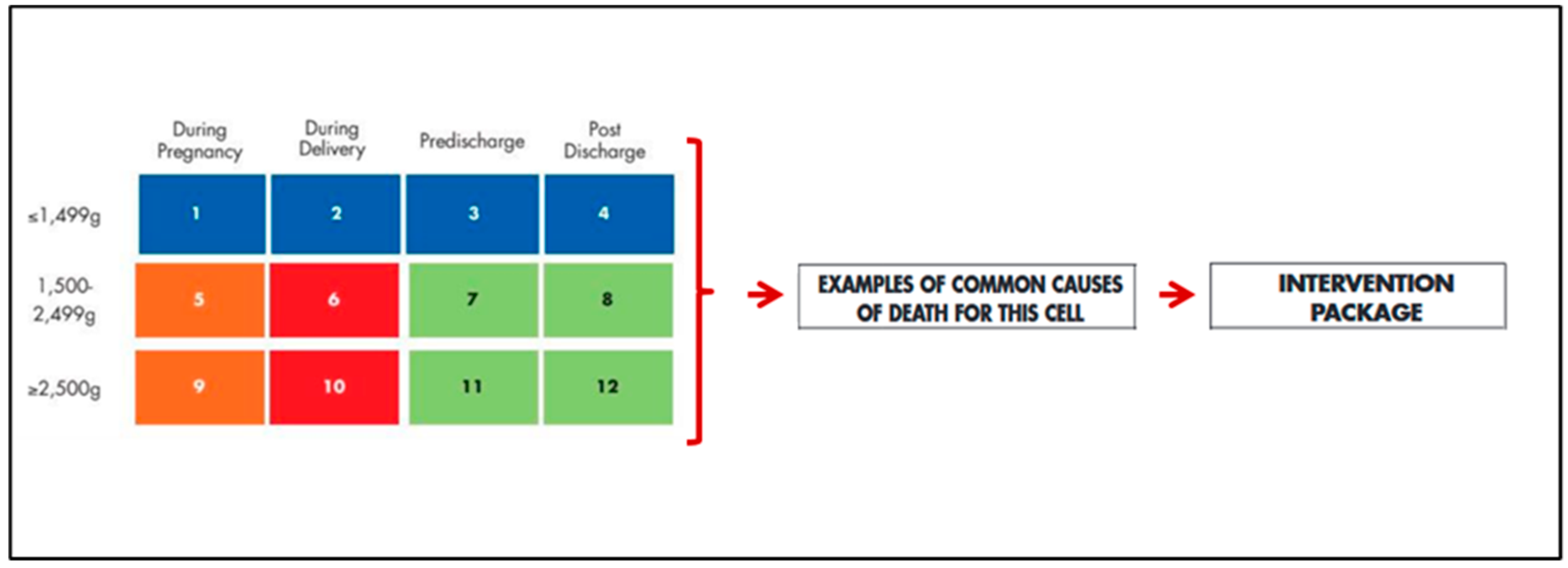
Impact of Quality Improvement Bundle on Neonatal Mortality in a District Hospital in Tanzania

 , and
, and 
Abstract
:1. Introduction
2. Materials and Methods
2.1. Study Design
2.2. Setting
2.3. Patients
2.4. Interventions
2.5. Outcome Measures
2.6. Data Collection
2.7. Definitions
2.8. Statistical Analysis
3. Results
4. Discussion
5. Conclusions
Author Contributions
Funding
Institutional Review Board Statement
Informed Consent Statement
Data Availability Statement
Acknowledgments
Conflicts of Interest
References
- Victoria, G.C.; Requejo, J.H.; Barros, A.J.D.; Berman, P.; Bhutta, Z.; Boerma, T.; Chopra, M.; de Francisco, A.; Daelmans, B.; Hazel, E.; et al. Countdown to 2015 for maternal newborn and child survival. A decade tracking progress maternal, newborn, child survival. Lancet 2016, 387, 2049–2059. [Google Scholar] [CrossRef] [Green Version]
- Lawn, J.E.; Cousens, S.; Zupan, J.; Lancet Neonatal Survival Steering Team. 4 million neonatal deaths: When? Where? Why? Lancet 2005, 365, 891–900. [Google Scholar] [CrossRef]
- Liu, L.; Oza, S.; Hogan, D.; Perin, J.; Rudan, I.; Lawn, J.E.; Cousens, S.; Mathers, C.; Black, R.E. Global, regional, and national causes of child mortality in 2000–2013, with projections to inform post-2015 priorities: An updated systematic analysis. Lancet 2015, 385, 430–440. [Google Scholar] [CrossRef]
- Van den Broek, N.R.; Graham, W.J. Quality of care for maternal and newborn health: The neglected agenda. BJOG 2009, 116, 18–21. [Google Scholar] [CrossRef] [PubMed]
- Ovretveit, J.; Appleby, J. Does improving quality of care save money? BMJ 2009, 339, b3678. [Google Scholar] [CrossRef]
- Zaka, N.; Alexander, E.C.; Manikam, L.; Norman, I.; Akhbari, M.; Moxon, S.; Ram, P.K.; Murphy, G.; English, M.; Niermeyer, S.; et al. Quality improvement initiatives for hospitalised small and sick newborns in low- and middle-income countries: A systematic review. Implement. Sci. 2018, 13, 20. [Google Scholar] [CrossRef] [PubMed] [Green Version]
- Cavicchiolo, M.E.; Lanzoni, P.; Wingi, M.O.; Pizzol, D.; Daverio, M.; Da Dalt, L.; Putoto, G.; Trevisanuto, D. Reduced neonatal mortality in a regional hospital in Mozambique linked to a Quality Improvement intervention. BMC Pregnancy Childbirth 2016, 16, 366. [Google Scholar] [CrossRef] [PubMed] [Green Version]
- Ouedraogo, P.; Villani, P.E.; Tubaldi, L.; Bua, J.; Uxa, F.; Dell’Anna, C.; Cavallin, F.; Thomson, M.; Plicco, C.; Chiesi, M.P. Impact of a quality improvement intervention on neonatal mortality in a regional hospital in Burkina Faso. J. Matern. Fetal Neonatal Med. 2021, Jan 5, 1–6. [Google Scholar] [CrossRef]
- Doctors with Africa CUAMM. Available online: https://doctorswithafrica.org/ (accessed on 25 June 2022).
- Lawn, J.; McCarthy, B.J.; Ross, S.R. HEALTHY NEWBORN: A Reference Manual for Program Managers, PART 2: A Newborn Health Management Information System; The CARE /CDC Health Initiative: Clifton Road Atlanta, GA, USA, 2002.
- Mmbaga, B.T.; Lie, R.T.; Olomi, R.; Mahande, M.J.; Kvåle, G.; Daltveit, A.K. Cause-specific neonatal mortality in a neonatal care unit in Northern Tanzania: A registry based cohort study. BMC Pediatr. 2012, 12, 116. [Google Scholar] [CrossRef] [PubMed] [Green Version]
- R Core Team. R: A Language and Environment for Statistical Computing; R Foundation for Statistical Computing: Vienna, Austria, 2021; Available online: https://www.R-project.org/ (accessed on 25 June 2022).
- Fanaroff, A.A.; Stoll, B.J.; Wright, L.L.; Carlo, W.A.; Ehrenkranz, R.A.; Stark, A.R.; Bauer, C.R.; Donovan, E.F.; Korones, S.B.; Laptook, A.R.; et al. Trends in neonatal morbidity and mortality for very low birthweight infants. Am. J. Obstet. Gynecol. 2007, 196, 147.e1–8. [Google Scholar] [CrossRef] [PubMed]
- Bansal, A. Comparison of outcome of very-low-birth-weight babies with developed countries: A prospective longitudinal observational study. J. Clin. Neonatol. 2018, 7, 254. [Google Scholar] [CrossRef]
- Michaelis, I.A.; Krägeloh-Mann, I.; Manyisane, N.; Mazinu, M.C.; Jordaan, E.R. Prospective cohort study of mortality in very low birthweight infants in a single centre in the Eastern Cape province, South Africa. BMJ Paediatr. Open 2021, 5, e000918. [Google Scholar] [CrossRef] [PubMed]


| Area of Intervention | Year | Action |
|---|---|---|
| Infrastructures | January 2017 | A Neonatal ward was constructed near the Maternity Ward, divided into three areas: Neonatal Intensive Care Unit (one room), Neonatal Sub-intensive Care Unit (one room) and Kangaroo Mother Care Unit (two rooms) |
| Equipment | January 2017 | Four oxygen concentrators (increased over the years up to 10), two phototherapy machines, four infusion pumps and a syringe pump, a capillary hemoglobin dosing machine and an electric aspirator were purchased. The staff received training on their use. |
| Protocols | 2017 and 2019 | Operational protocols were updated and presented to the staff in dedicated training sessions. Laminated copies of the most commonly used protocols were displayed for quick consultation even by on-call staff during night shifts and holidays. A further update of the ward guidelines was carried out in 2019, in light of the publication of the first edition of the national neonatal guidelines. |
| Procedures | January 2017 | New procedures were introduced: antenatal administration of dexamethasone for lung maturity and magnesium sulfate for neuroprotection, positioning of an umbilical venous catheter in newborns weighing <1200 g, administration of paracetamol in newborns with suspected patent ductus arteriosus, administration of hydrocortisone in newborns with oxygen dependence and suspected bronchopulmonary dysplasia. |
| Staff | 2017 | A dedicated nursing team was created, consisting of 5 nurses (increased over the years up to 8). From February 2017, a Tanzanian doctor started working in Neonatology. |
| Training activity | 2017–2019 | Over years, the Neonatal Unit and Maternity Ward staff were periodically trained on partogram use and interpretation, management of a complicated pregnancy (gestational hypertension, gestational diabetes, prolonged rupture of the membranes); management of labor and delivery (1st, 2nd, 3rd stage), prolonged rupture of the membranes, complicated labor and the most common maternal peripartum complications, neonatal resuscitation, management of common neonatal severe conditions (sepsis, jaundice, asphyxia, prematurity, respiratory distress syndrome), essential newborn care and care of low-birth-weight and very-low-birth-weight infants. |
| Pre-Intervention | Post-Intervention Period: | p-Value | |
|---|---|---|---|
| Period: | |||
| Deliveries | N = 2901 | N = 2732 | - |
| Mode of delivery: | <0.0001 | ||
| Caesarean section | 1056/2901 (36.4%) | 840/2732 (30.7%) | |
| Vaginal delivery | 1845/2901 (63.6%) | 1892/2732 (69.3%) | |
| Twin deliveries | 50/2901 (1.7%) | 55/2732 (2.0%) | 0.48 |
| Neonates | N = 2952 | N = 2790 | |
| Inborn neonates | 2890/2952 (97.9%) | 2675/2790 (95.6%) | <0.0001 |
| Males | 1472/2952 (49.9%) | 1370/2790 (49.1%) | 0.58 |
| Birth weight: | <0.0001 | ||
| ≤1499 g | 24/2952 (0.8%) | 63/2790 (2.3%) | |
| 1500–2499 g | 282/2952 (9.6%) | 318/2790 (11.4%) | |
| ≥2500 g | 2646/2952 (89.6%) | 2409/2790 (86.3%) | |
| 5-min Apgar score < 7 (only inborn) | 121/2890 (4.2%) | 109/2675 (4.1%) | 0.89 |
| Outcome Measure | Pre-Intervention Period: | Post-Intervention Period: | Post vs. Pre Comparison: Odds Ratio (95% Confidence Interval) | p-Value |
|---|---|---|---|---|
| All neonates | N = 2952 | N = 2790 | - | - |
| Overall mortality | 87/2952 (2.9%) | 92/2790 (3.3%) | 1.05 (0.78 to 1.41) | 0.49 |
| Mortality in BW categories: | ||||
| ≤1499 g | 13/24 (54.2%) | 31/63 (49.2%) | 0.81 (0.32 to 2.10) | 0.86 |
| 1500–2499 g | 34/282 (12.1%) | 20/318 (6.3%) | 0.49 (0.27 to 0.87) | 0.02 |
| ≥2500 g | 40/2646 (1.5%) | 41/2409 (1.7%) | 1.12 (0.72 to 1.75) | 0.67 |
| Mortality for prematurity | 21/2952 (0.7%) | 36/2790 (1.3%) | 1.82 (1.03 to 3.29) | 0.04 |
| Mortality for asphyxia: | ||||
| Overall | 44/2952 (1.5%) | 40/2790 (1.4%) | 0.96 (0.62 to 1.47) | 0.94 |
| ≤1499 g | 0/24 (0.0%) | 0/63 (0.0%) | NA | NA |
| 1500–2499 g | 15/282 (5.3%) | 7/318 (2.2%) | 0.40 (0.16 to 1.00) | 0.07 |
| ≥2500 g | 29/2646 (1.1%) | 33/2409 (1.4%) | 1.25 (0.75 to 2.07) | 0.45 |
| Mortality for infection: | ||||
| Overall | 12/2952 (0.4%) | 6/2790 (0.2%) | 0.52 (0.19 to 1.40) | 0.29 |
| ≤1499 g | 0/24 (0.0%) | 0/63 (0.0%) | NA | NA |
| 1500–2499 g | 5/282 (1.8%) | 2/318 (0.6%) | 0.35 (0.06 to 1.82) | 0.26 |
| ≥2500 g | 7/2646 (0.3%) | 4/2409 (0.2%) | 0.62 (0.18 to 2.14) | 0.55 |
| Inborn neonates | N = 2890 | N = 2675 | - | - |
| Overall mortality | 77/2890 (2.7%) | 73/2675 (2.7%) | 1.02 (0.74 to 1.41) | 0.94 |
| Mortality in BW categories: | ||||
| ≤1499 g | 10/15 (66.7%) | 22/30 (73.3%) | 1.37 (0.35 to 5.27) | 0.90 |
| 1500–2499 g | 29/249 (11.6%) | 18/287 (6.3%) | 0.50 (0.27 to 0.93) | 0.04 |
| ≥2500 g | 38/2626 (1.4%) | 33/2358 (1.4%) | 0.96 (0.60 to 1.54) | 0.98 |
| Mortality for prematurity | 15/2890 (0.5%) | 26/2675 (1.0%) | 1.88 (0.99 to 3.55) | 0.07 |
| Mortality for asphyxia: | ||||
| Overall | 43/2890 (1.5%) | 33/2675 (1.2%) | 0.82 (0.52 to 1.30) | 0.48 |
| ≤1499 g | 0/15 (0.0%) | 0/30 (0.0%) | NA | NA |
| 1500–2499 g | 15/249 (6.0%) | 6/287 (2.1%) | 0.33 (0.12 to 0.87) | 0.03 |
| ≥2500 g | 28/2626 (1.1%) | 27/2358 (1.1%) | 1.07 (0.63 to 1.82) | 0.90 |
| Mortality for infection: | ||||
| Overall | 10/2890 (0.3%) | 5/2675 (0.2%) | 0.53 (0.18 to 1.57) | 0.38 |
| ≤1499 g | 0/15 (0.0%) | 0/30 (0.0%) | NA | NA |
| 1500–2499 g | 4/269 (1.5%) | 2/287 (0.7%) | 0.46 (0.08 to 2.55) | 0.44 |
| ≥2500 g | 6/2626 (0.2%) | 3/2358 (0.1%) | 0.55 (0.13 to 2.22) | 0.51 |
| Outborn neonates | N = 62 | N = 115 | - | - |
| Overall mortality | 10/62 (16.1%) | 19/115 (16.5%) | 1.02 (0.44 to 2.37) | 0.99 |
| Mortality in BW categories: | ||||
| ≤1499 g | 3/9 (33.3%) | 9/33 (27.3%) | 0.75 (0.15 to 3.65) | 0.69 |
| 1500–2499 g | 5/33 (15.2%) | 2/31 (6.5%) | 0.38 (0.06 to 2.15) | 0.42 |
| ≥2500 g | 2/20 (10.0%) | 8/51 (15.7%) | 1.67 (0.32 to 8.66) | 0.71 |
| Mortality for prematurity | 6/62 (9.7%) | 10/115 (8.7%) | 0.88 (0.30 to 1.57) | 0.99 |
| Mortality for asphyxia: | ||||
| Overall | 1/62 (1.6%) | 7/115 (6.1%) | 3.95 (0.47 to 32.89) | 0.26 |
| ≤1499 g | 0/9 (0.0%) | 0/33 (0.0%) | NA | NA |
| 1500–2499 g | 0/33 (0.0%) | 1/31 (3.2%) | 3.29 (0.12 to 89.97) | 0.48 |
| ≥2500 g | 1/20 (5.0%) | 6/51 (11.8%) | 2.53 (0.28 to 22.49) | 0.66 |
| Mortality for infection: | ||||
| Overall | 2/62 (3.2%) | 1/115 (0.9%) | 0.26 (0.02 to 2.96) | 0.28 |
| ≤1499 g | 0/9 (0.0%) | 0/33 (0.0%) | NA | NA |
| 1500–2499 g | 1/33 (3.0%) | 0/31 (0.0%) | 0.34 (0.01 to 8.76) | 0.99 |
| ≥2500 g | 1/20 (5.0%) | 1/51 (2.0%) | 0.38 (0.02 to 6.38) | 0.48 |
Publisher’s Note: MDPI stays neutral with regard to jurisdictional claims in published maps and institutional affiliations. |
© 2022 by the authors. Licensee MDPI, Basel, Switzerland. This article is an open access article distributed under the terms and conditions of the Creative Commons Attribution (CC BY) license (https://creativecommons.org/licenses/by/4.0/).
Share and Cite
Pietravalle, A.; Brasili, L.; Cavallin, F.; Piquè, M.; Zavattero, C.; Azzimonti, G.; Maziku, D.M.; Leluko, D.E.; Putoto, G.; Trevisanuto, D. Impact of Quality Improvement Bundle on Neonatal Mortality in a District Hospital in Tanzania. Children 2022, 9, 1060. https://doi.org/10.3390/children9071060
Pietravalle A, Brasili L, Cavallin F, Piquè M, Zavattero C, Azzimonti G, Maziku DM, Leluko DE, Putoto G, Trevisanuto D. Impact of Quality Improvement Bundle on Neonatal Mortality in a District Hospital in Tanzania. Children. 2022; 9(7):1060. https://doi.org/10.3390/children9071060
Chicago/Turabian StylePietravalle, Andrea, Luca Brasili, Francesco Cavallin, Margherita Piquè, Chiara Zavattero, Gaetano Azzimonti, Donald Micah Maziku, Dionis Erasto Leluko, Giovanni Putoto, and Daniele Trevisanuto. 2022. "Impact of Quality Improvement Bundle on Neonatal Mortality in a District Hospital in Tanzania" Children 9, no. 7: 1060. https://doi.org/10.3390/children9071060
APA StylePietravalle, A., Brasili, L., Cavallin, F., Piquè, M., Zavattero, C., Azzimonti, G., Maziku, D. M., Leluko, D. E., Putoto, G., & Trevisanuto, D. (2022). Impact of Quality Improvement Bundle on Neonatal Mortality in a District Hospital in Tanzania. Children, 9(7), 1060. https://doi.org/10.3390/children9071060