Production Decline Rate Prediction for Offshore High Water-Cut Reservoirs by Integrating Moth–Flame Optimization with Extreme Gradient Boosting Tree

 ,
,  and
and
Abstract
1. Introduction
2. Principle of the MFO-XGBoost Method
2.1. XGBoost Algorithm
2.2. Moth–Flame Optimization Algorithm
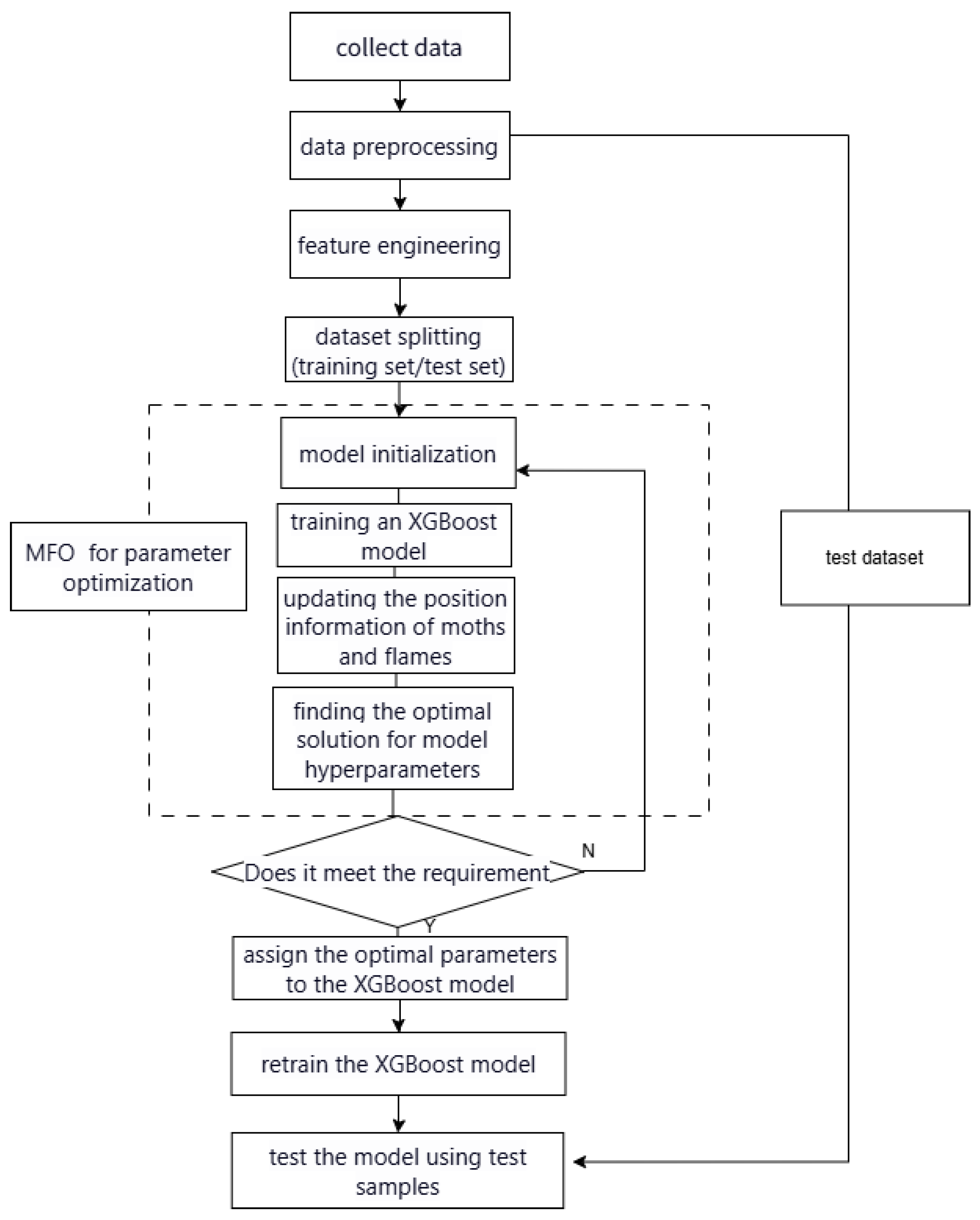
2.3. Workflow of the MFO-XGBoost Model for Predicting Production Decline Rate in Offshore High Water-Cut Reservoirs
2.4. Evaluation Metrics
3. Application Example
3.1. Overview of the Studied Oilfield Block
3.2. Data Acquisition and Processing
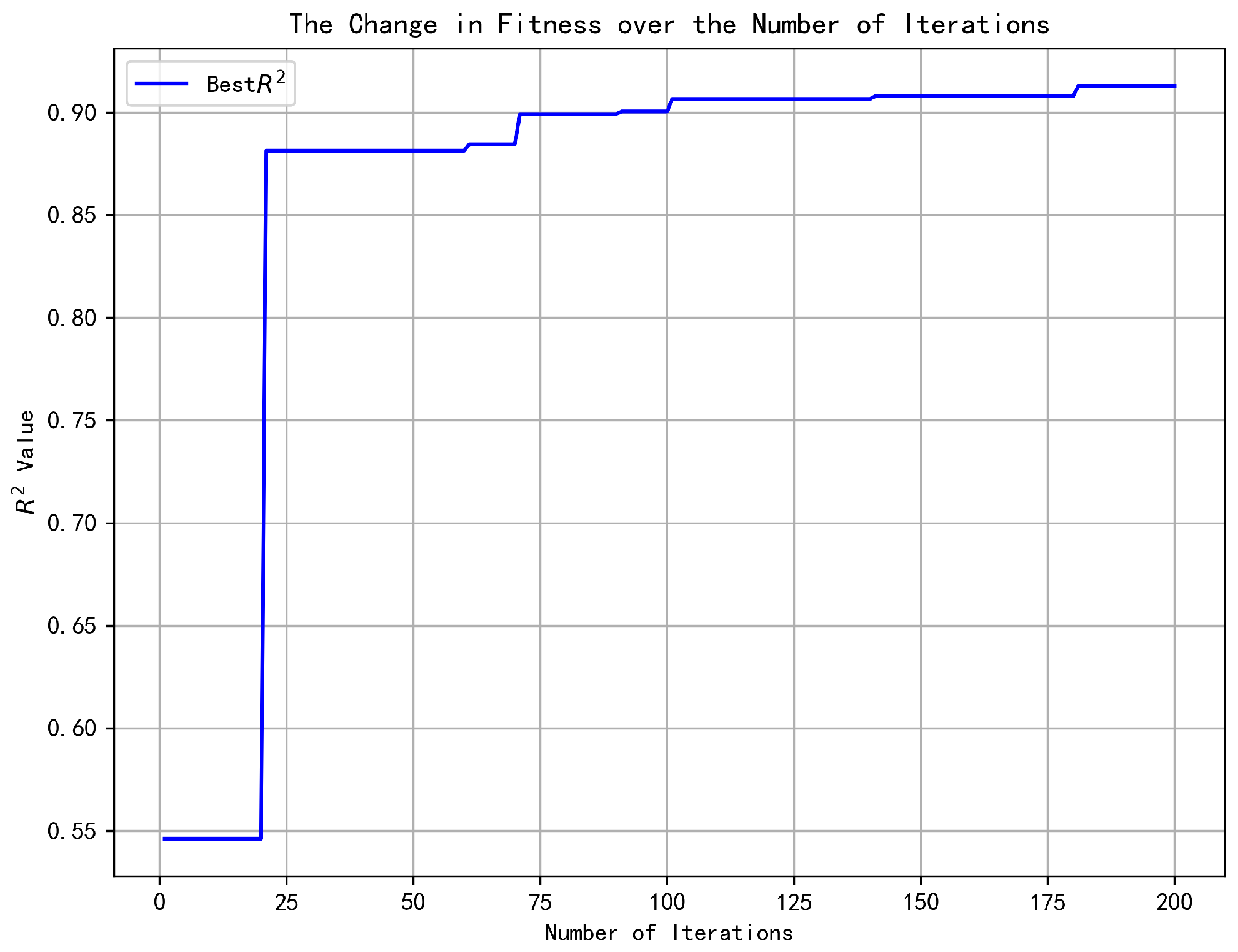
3.3. MFO-XGBoost Model Training and Validation
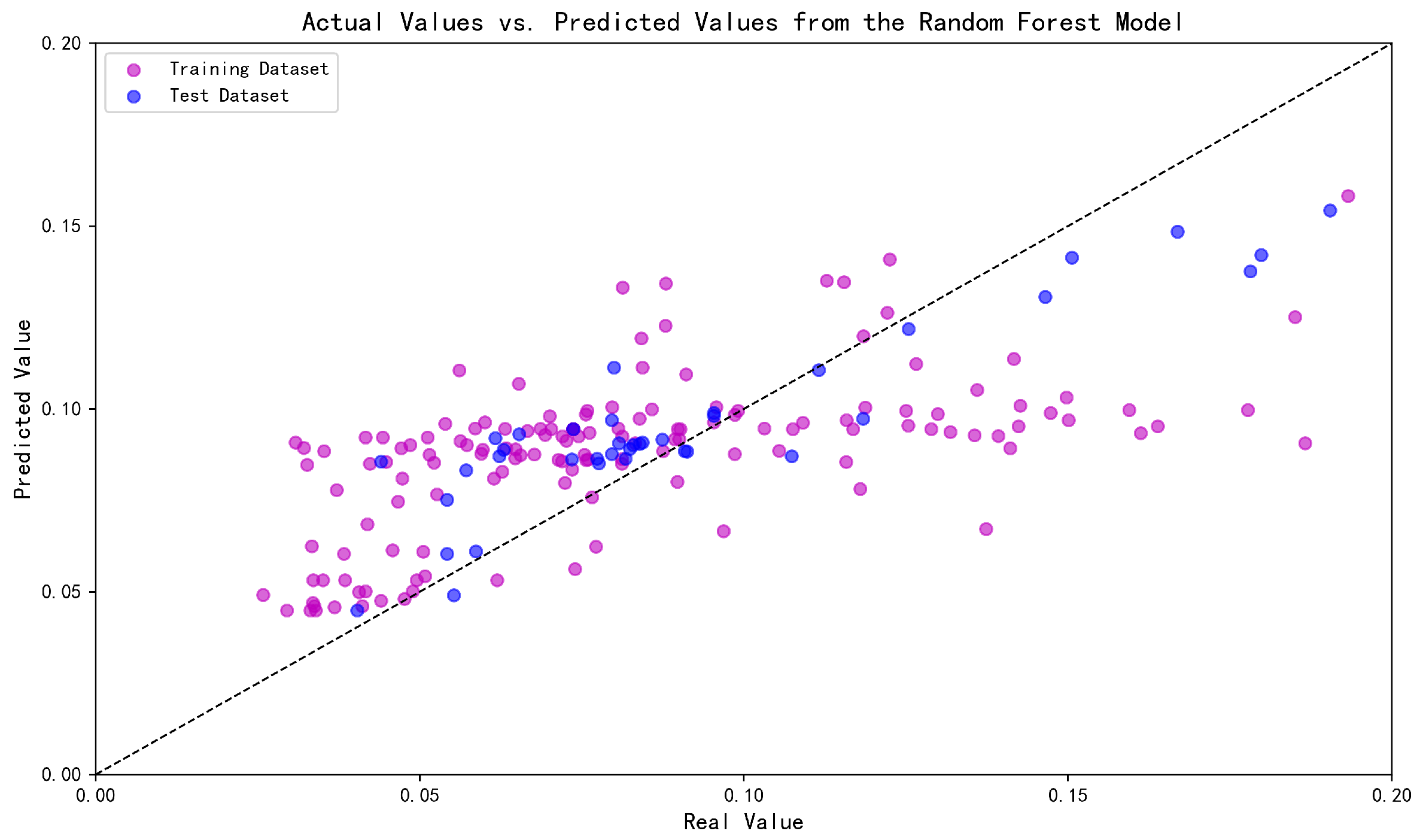
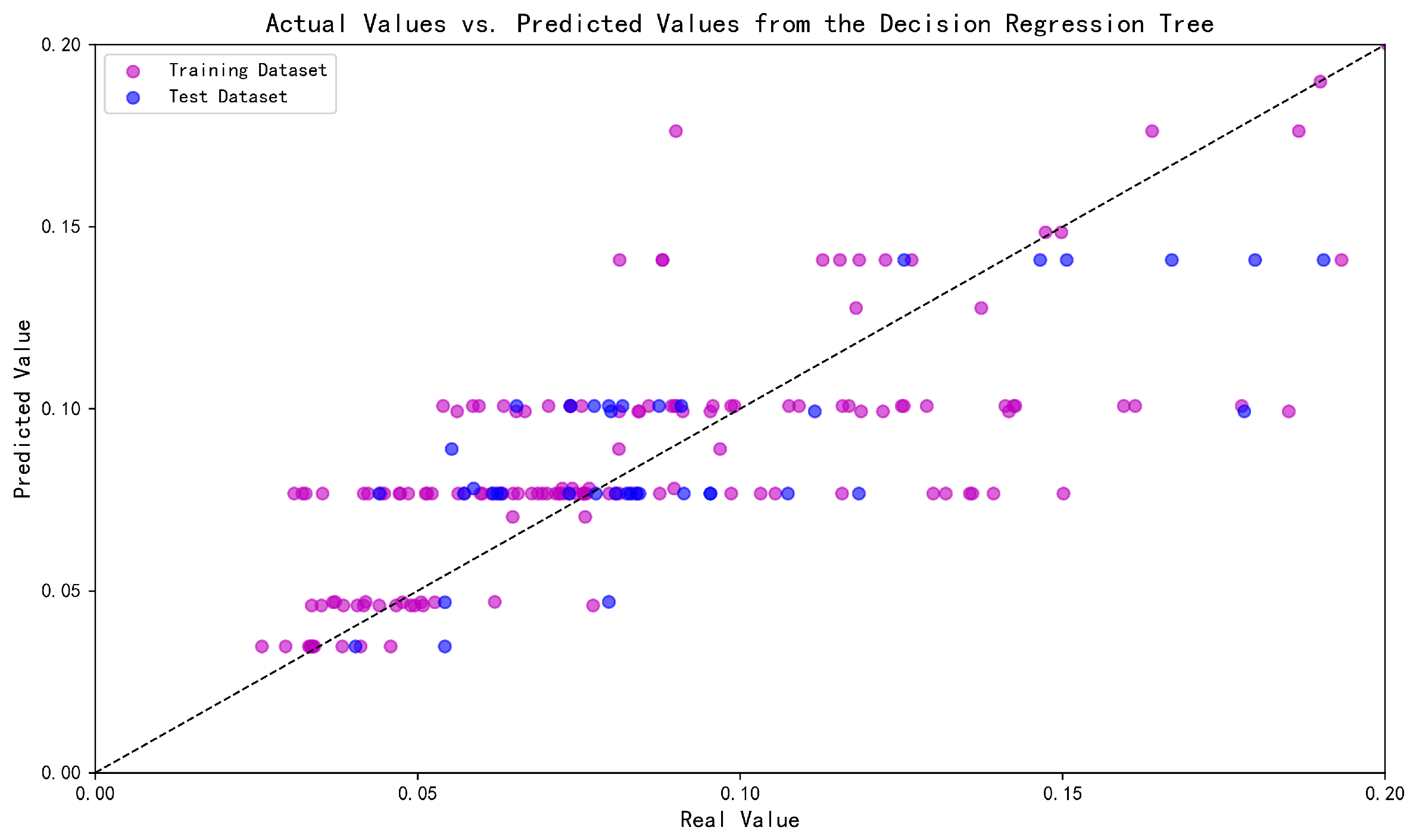
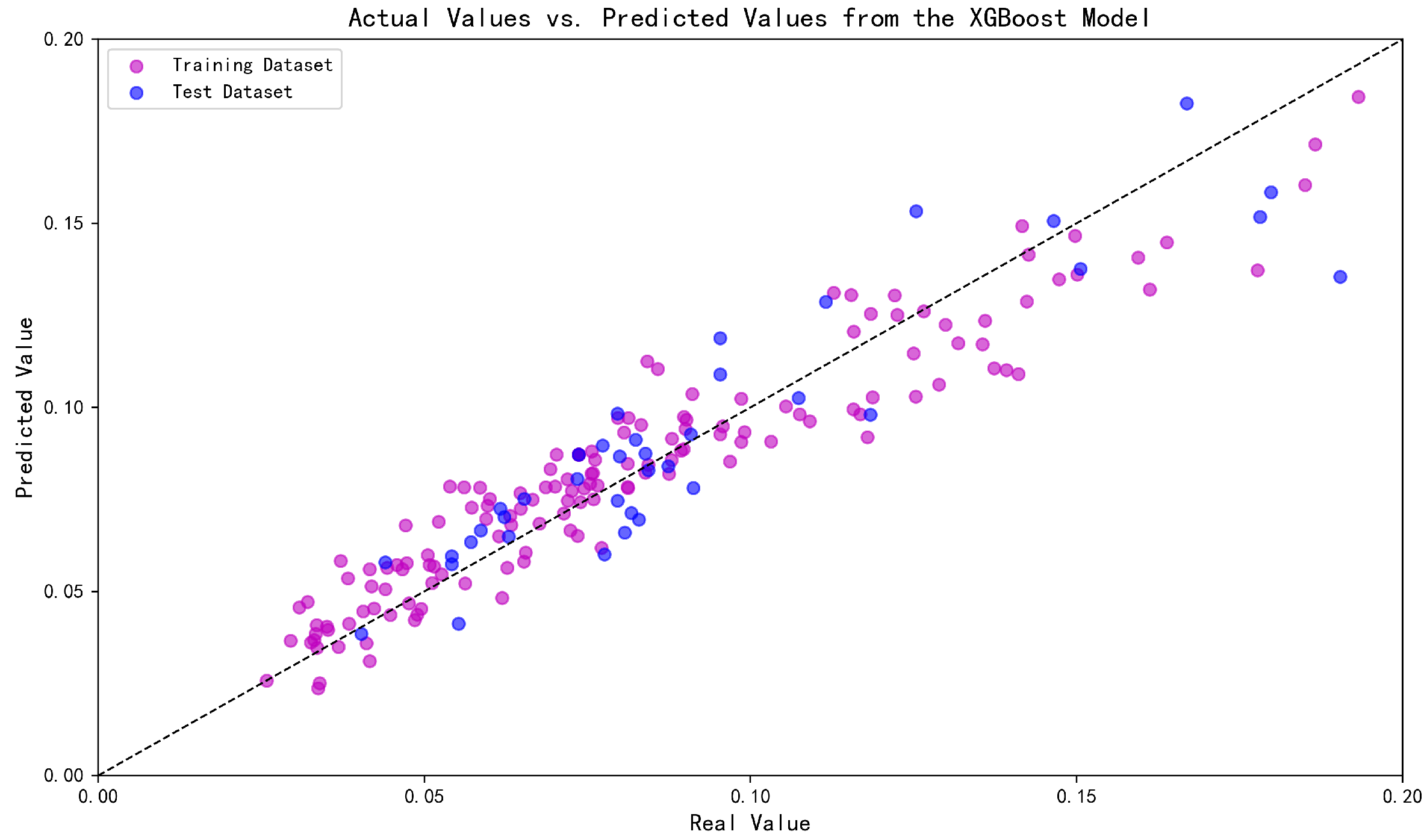
3.4. Comparison of Prediction Performance of Different Models
4. Conclusions
5. Limitations and Future Work
Author Contributions
Funding
Data Availability Statement
Conflicts of Interest
Abbreviations
| AI | Artificial intelligence |
| RF | Random forest |
| DT | Decision tree regression |
| XGBoost | Extreme gradient boosting tree |
| MFO | Moth–flame optimization |
| GA | Genetic algorithm |
| MFO-XGBoost | Integrating moth–flame optimization with extreme gradient boosting tree |
| PSO-XGBoost | Integrating particle swarm optimization with extreme gradient boosting tree |
| Bayesian-XGBoost | Integrating Bayesian optimization with extreme gradient boosting tree |
| GRA | Grey relational analysis |
| SHAP | Shapley additive explanations |
| MDI | Mean decrease impurity |
| MAE | Mean absolute error |
| MSE | Mean squared error |
| RMSE | Root mean squared error |
| ML | Machine learning |
References
- Wang, R.; Xue, L.L.; Dang, D.Q.; Gao, W.J. Establishment and application of a general formula for production decline equations. Acta Pet. Sin. 2023, 44, 1693–1705. [Google Scholar]
- Men, H.W.; Zhang, J.; Wei, H.J.; Zhao, Y.; Gao, W.J. Establishment and application of a pan-functional mathematical model for oil and gas reservoir production cycles. Xinjiang Pet. Geol. 2023, 44, 365–374. [Google Scholar]
- Wang, X.; Cai, B.; Li, S. History and prospect of reservoir stimulation technology for oil and gas reservoirs in China National Petroleum Corporation. Pet. Drill. Tech. 2023, 45, 67–75. [Google Scholar]
- Zhao, G.Z.; Li, C.L.; He, X. Variation law of development indicators in the extra-high water-cut stage of continental sandstone oil reservoirs. Pet. Geol. Oilfield Dev. Daqing 2023, 42, 50–58. [Google Scholar]
- Yu, Q.T. Production decline law of waterflooded oilfields. Pet. Explor. Dev. 1993, 20, 72–80. [Google Scholar]
- Ji, B.Y. Seepage flow theory basis of production decline equation. Acta Pet. Sin. 1995, 16, 86–91. [Google Scholar]
- Gao, W.J.; Wang, Z.J. Discrimination theory basis and application of production decline equation. Xinjiang Pet. Geol. 1999, 20, 518–521. [Google Scholar]
- Arps, J.J. Analysis of decline curves. Trans. AIME 1945, 160, 228–247. [Google Scholar] [CrossRef]
- Gentry, R.W. Decline-curve analysis. J. Pet. Technol. 1972, 24, 38–41. [Google Scholar] [CrossRef]
- Yu, Q.T. The making and application of generalized decline curve standard charts. Pet. Explor. Dev. 1990, 17, 84–87. [Google Scholar]
- Yu, Q.T. Study on the characteristics of seven decline curves. Xinjiang Pet. Geol. 1994, 15, 49–56. [Google Scholar]
- Liu, W.F.; Zhang, X.Y.; Sheng, S.Y.; Wang, K.; Duan, Y.G.; Wei, M.Q. Research on a new combined method for production decline analysis of tight oil reservoirs: A case study of Mahu tight oil reservoir. Pet. Reserv. Eval. Dev. 2021, 11, 911–916. [Google Scholar]
- Wang, Q.; Zeng, J.C.; Liang, B. Research and application of production decline law based on Arps algorithm. Well Logging Eng. 2021, 32, 142–146. [Google Scholar]
- Huang, S.; Peng, C.Z. Analysis of production decline factors based on grey relational analysis. Pet. Reserv. Eval. Dev. 2018, 8, 33–35. [Google Scholar]
- Li, C.; Wang, Y.; Li, W.Z. Application of type A water drive curve and production decline method in Bohai B oilfield. Complex Hydrocarb. Reserv. 2023, 16, 100–103. [Google Scholar]
- Cao, Q.; Banerjee, R.; Gupta, S.; Li, J.; Zhou, W.; Jeyachandra, B. Data driven production forecasting using machine learning. In Proceedings of the SPE Argentina Exploration and Production of Unconventional Resources Symposium, Buenos Aires, Argentina, 1–3 June 2016; p. D021S006R001. [Google Scholar]
- Li, Y.; Han, Y. Decline curve analysis for production forecasting based on machine learning. In Proceedings of the SPE Symposium: Production Enhancement and Cost Optimisation, Kuala Lumpur, Malaysia, 7–8 November 2017; p. D011S004R003. [Google Scholar]
- Johan, D.C.; Shukla, P.; Shrivastava, K.; Koley, M. Data-Driven Completion Optimization for Unconventional Assets. In Proceedings of the 11th Unconventional Resources Technology Conference, Denver, CO, USA, 13–15 June 2023. [Google Scholar] [CrossRef]
- Kong, B.; Chen, S.; Chen, Z.; Zhou, Q. Bayesian probabilistic dual-flow-regime decline curve analysis for complex production profile evaluation. J. Pet. Sci. Eng. 2020, 195, 107623. [Google Scholar] [CrossRef]
- Kong, B.; Chen, Z.; Chen, S.; Qin, T. Machine learning-assisted production data analysis in liquid-rich Duvernay formation. J. Pet. Sci. Eng. 2021, 200, 108377. [Google Scholar] [CrossRef]
- Li, D.; You, S.; Liao, Q.; Sheng, M.; Tian, S. Prediction of Shale Gas production by hydraulic fracturing in Changning Area using machine learning algorithms. Transp. Porous Media 2023, 149, 373–388. [Google Scholar] [CrossRef]
- Lu, C.; Jiang, H.; Yang, J.; Wang, Z.; Zhang, M.; Li, J. Shale oil production prediction and fracturing optimization based on machine learning. J. Pet. Sci. Eng. 2022, 217, 110900. [Google Scholar] [CrossRef]
- Alimohammadi, H.; Rahmanifard, H.; Chen, N. Multivariate time series modelling approach for production forecasting in unconventional resources. In Proceedings of the SPE Annual Technical Conference and Exhibition, Virtual, 26–29 October 2020. [Google Scholar] [CrossRef]
- Amr, S.; Ashhab, E.; El-Saban, H.; Schietinger, M.; Caile, P.; Kaheel, C.; Rodriguez, A.L. A large-scale study for a multi-basin machine learning model predicting horizontal well production. In Proceedings of the SPE Annual Technical Conference and Exhibition, Dallas, TX, USA, 24–26 September 2018. [Google Scholar] [CrossRef]
- Bhattacharyya, S.; Vyas, A. Application of machine learning in predicting oil rate decline for Bakken shale oil wells. Sci. Rep. 2022, 12, 16154. [Google Scholar] [CrossRef] [PubMed]
- Chaikine, I. Machine Learning Applications for Production Prediction and Optimization in Multistage Hydraulically Fractured Wells; University of Calgary: Calgary, AB, Canada, 2020; Available online: https://prism.ucalgary.ca/bitstream/handle/1880/112817/ucalgary_2020_chaikine_ilia.pdf?sequence=2&isAllowed=y (accessed on 30 April 2025).
- Chaikine, I.; Gates, I.D. A machine learning model for predicting multi-stage horizontal well production. J. Pet. Sci. Eng. 2021, 198, 108133. [Google Scholar] [CrossRef]
- Chen, X.; Li, J.; Gao, P.; Zhou, J. Prediction of shale gas horizontal wells productivity after volume fracturing using machine learning–an LSTM approach. Pet. Sci. Technol. 2022, 40, 1861–1877. [Google Scholar] [CrossRef]
- Gao, Q.; Liao, L.; Yang, S. Application of artificial intelligence technology in unconventional natural gas production forecasting. In Proceedings of the Artificial Intelligence and Machine Learning for Multi-Domain Applications II; SPIE: Bellingham, WA, USA, 2022; p. 291. [Google Scholar] [CrossRef]
- Agwu, O.E.; Alatefi, S.; Azim, R.A.; Alkouh, A. Applications of Artificial Intelligence Algorithms in Artificial Lift Systems: A Critical Review. Flow Meas. Instrum. 2024, 97, 102613. [Google Scholar] [CrossRef]
- Chen, T.; Guestrin, C. XGBoost: A scalable tree boosting system. In Proceedings of the 22nd ACM SIGKDD International Conference on Knowledge Discovery and Data Mining, San Francisco, CA, USA, 13–17 August 2016; pp. 785–794. [Google Scholar]
- Nadimi-Shahraki, M.H.; Taghian, S.; Mirjalili, S.; Ewees, A.A.; Abualigah, L.; Elaziz, M.A. MTV-MFO: Multi-Trial Vector-Based Moth-Flame Optimization Algorithm. Symmetry 2021, 13, 2388. [Google Scholar] [CrossRef]
- Okere, C.J.; Sheng, J.J.; Ikpeka, P.M. Which Offers Greater Techno-Economic Potential: Oil or Hydrogen Production from Light Oil Reservoirs? Geosciences 2025, 15, 214. [Google Scholar] [CrossRef]
- Algwil, A.R.A.; Khalifa, W. An Enhanced Moth Flame Optimization Extreme Learning Machines Hybrid Model for Predicting CO2 Emissions. Sci. Rep. 2025, 15, 1–24. [Google Scholar] [CrossRef] [PubMed]
- Mirjalili, S. Moth-flame optimization algorithm: A novel nature-inspired heuristic paradigm. Knowl.-Based Syst. 2015, 89, 228–249. [Google Scholar] [CrossRef]
- Ning, Y.; Schumann, H.; Jin, G. Application of Data Mining to Small Data Sets: Identification of Key Production Drivers in Heterogeneous Unconventional Resources. SPE Reserv. Eval. Eng. 2023, 26, 411–421. [Google Scholar] [CrossRef]






| Parameter | Value |
|---|---|
| Reservoir Oil Saturation Pressure | 6.890–13.720 MPa |
| Reservoir Oil Viscosity | 9.1–944.0 mPa·s |
| Average Relative Density of Natural Gas Samples | 0.769 |
| Pressure Coefficient | 1.00 |
| Pressure Gradient | 0.977 MPa/100 m |
| Temperature Gradient | 3.0 °C/100 m |
| Count | Mean | Std | Min | 25% | 50% | 75% | Max | |
|---|---|---|---|---|---|---|---|---|
| Vertical Thickness/m | 209 | 65.112 | 23.115 | 6.5 | 50.7 | 64.312 | 83.8 | 135.3 |
| Perforated Interval/m | 209 | 55.824 | 21.337 | 2.4 | 42 | 54.987 | 70.8 | 118.8 |
| Porosity/% | 209 | 26.154 | 1.951 | 20.274 | 25.119 | 26.225 | 27.326 | 30.479 |
| Oil Saturation/% | 209 | 66.516 | 7.054 | 48.874 | 63.042 | 66.758 | 71.302 | 84.1 |
| Shale Content/% | 209 | 11.785 | 2.32 | 6.168 | 10.376 | 11.591 | 12.912 | 19.813 |
| Permeability/mD | 209 | 942.283 | 335.933 | 293.048 | 711.526 | 943.44 | 1103.695 | 2256.5 |
| Crude Oil Viscosity/(50 °C) mPa·s | 209 | 175.938 | 143.768 | 48.21 | 80.98 | 124.8 | 193.4 | 830.8 |
| Mobility/(mD/(mPa·s)) | 209 | 7.942 | 4.641 | 1.056 | 4.426 | 7.158 | 10.189 | 23.278 |
| Reservoir Flow Coefficient/(mD/(mPa·s)) | 209 | 450.779 | 333.069 | 6.372 | 211.434 | 395.233 | 581.682 | 1622.779 |
| Deviation Angle/° | 209 | 46.201 | 16.94 | 0 | 35.211 | 47.027 | 55.087 | 89.01 |
| Production Decline Rate | 209 | 0.1 | 0.06 | 0.026 | 0.06 | 0.081 | 0.123 | 0.304 |
| Hyperparameter | Value |
|---|---|
| n_estimators | 159 |
| learning_rate | 0.065 |
| max_depth | 3 |
| gamma | 0.001 |
| subsample | 0.527 |
| colsample_bytree | 0.711 |
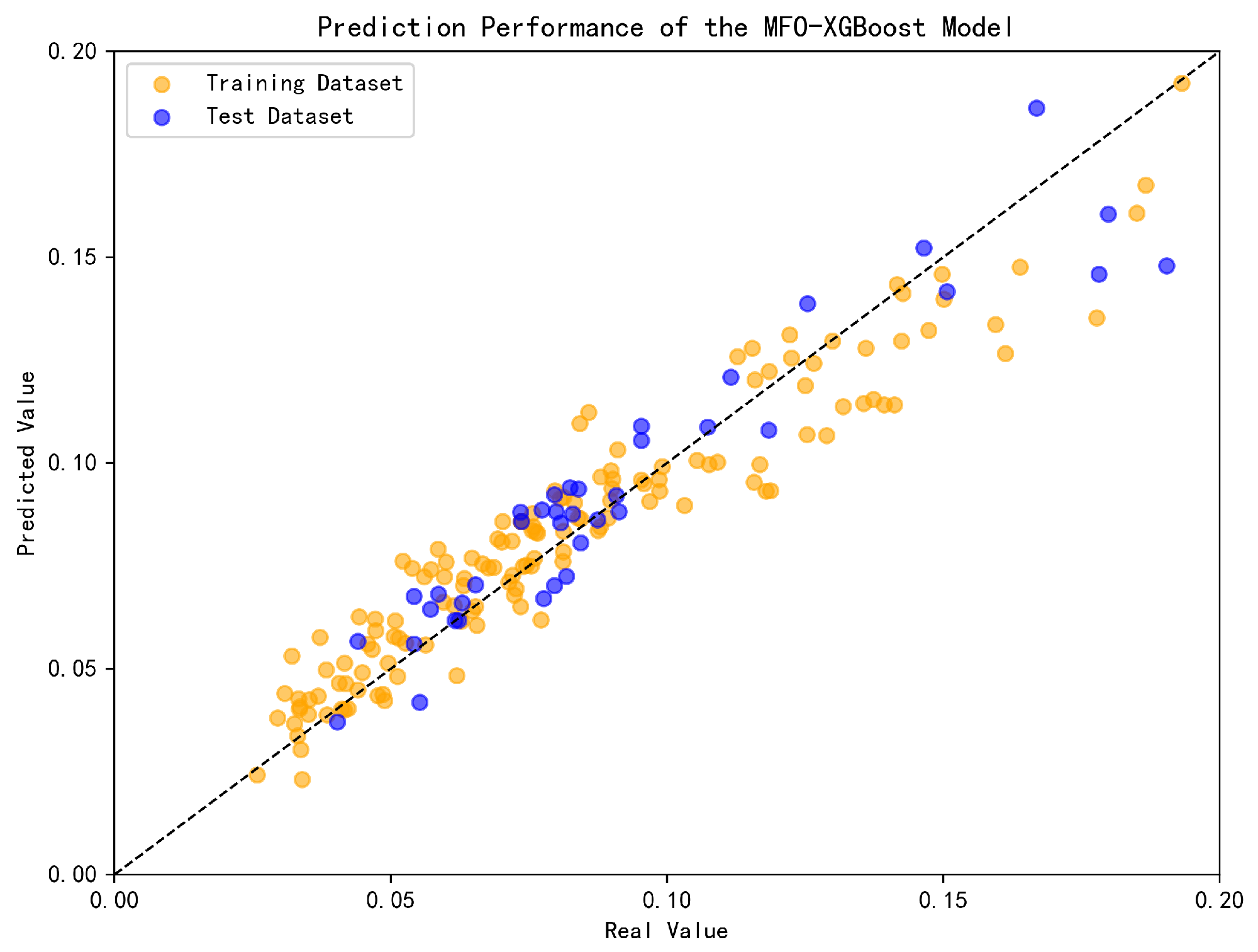
| DT | RF | XGBoost | MFO-XGBoost | ||
|---|---|---|---|---|---|
| MAE | 0.0216 | 0.0287 | 0.0109 | 0.0101 | |
| Training Dataset | MSE | 0.0011 | 0.0014 | 0.0002 | 0.0002 |
| RMSE | 0.0328 | 0.0379 | 0.014 | 0.0134 | |
| R2 | 0.7261 | 0.6336 | 0.9503 | 0.9542 | |
| MAE | 0.0225 | 0.0161 | 0.0141 | 0.011 | |
| Test Dataset | MSE | 0.0008 | 0.0004 | 0.0004 | 0.0002 |
| RMSE | 0.0285 | 0.0211 | 0.0191 | 0.0146 | |
| R2 | 0.6668 | 0.8174 | 0.8503 | 0.9128 |
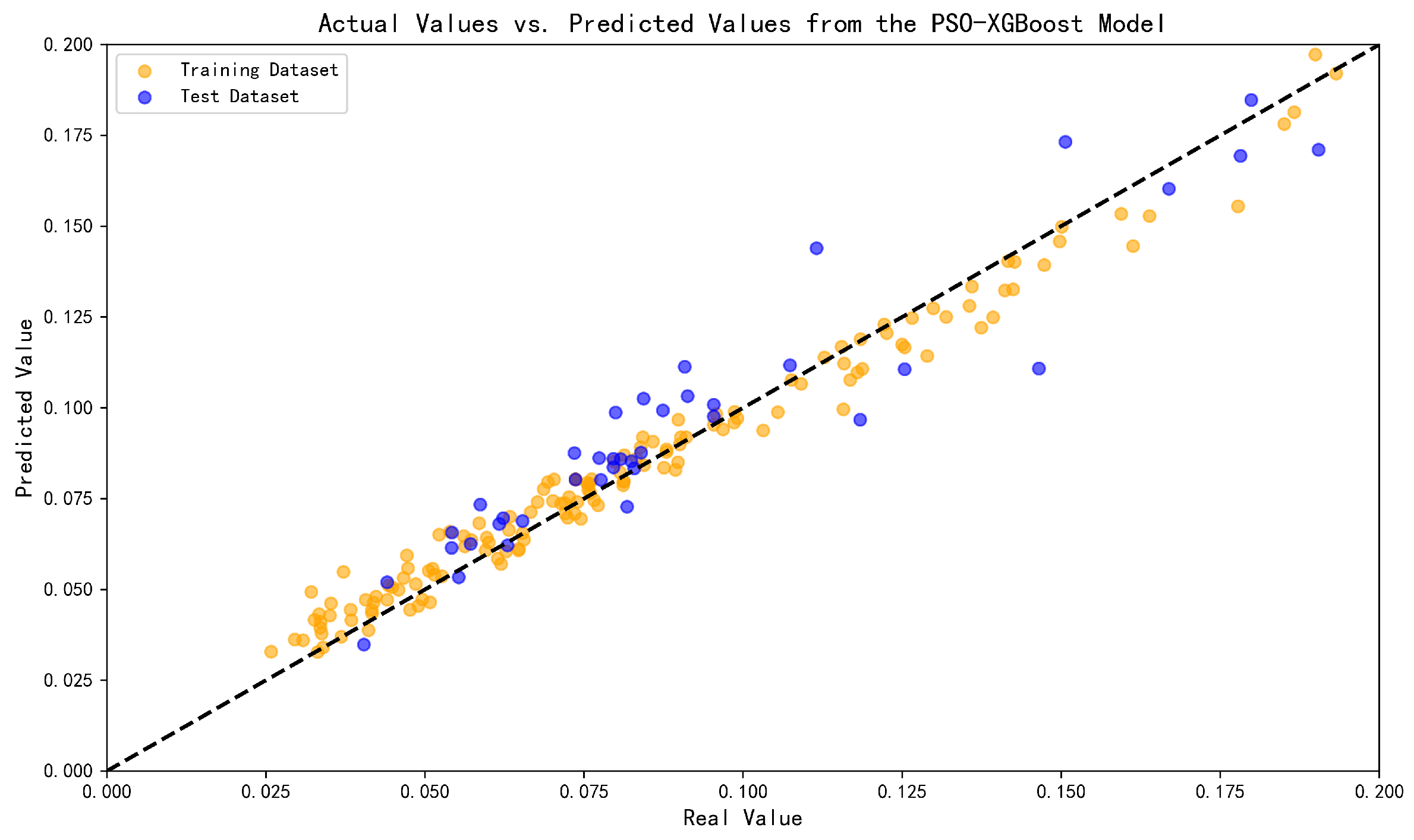
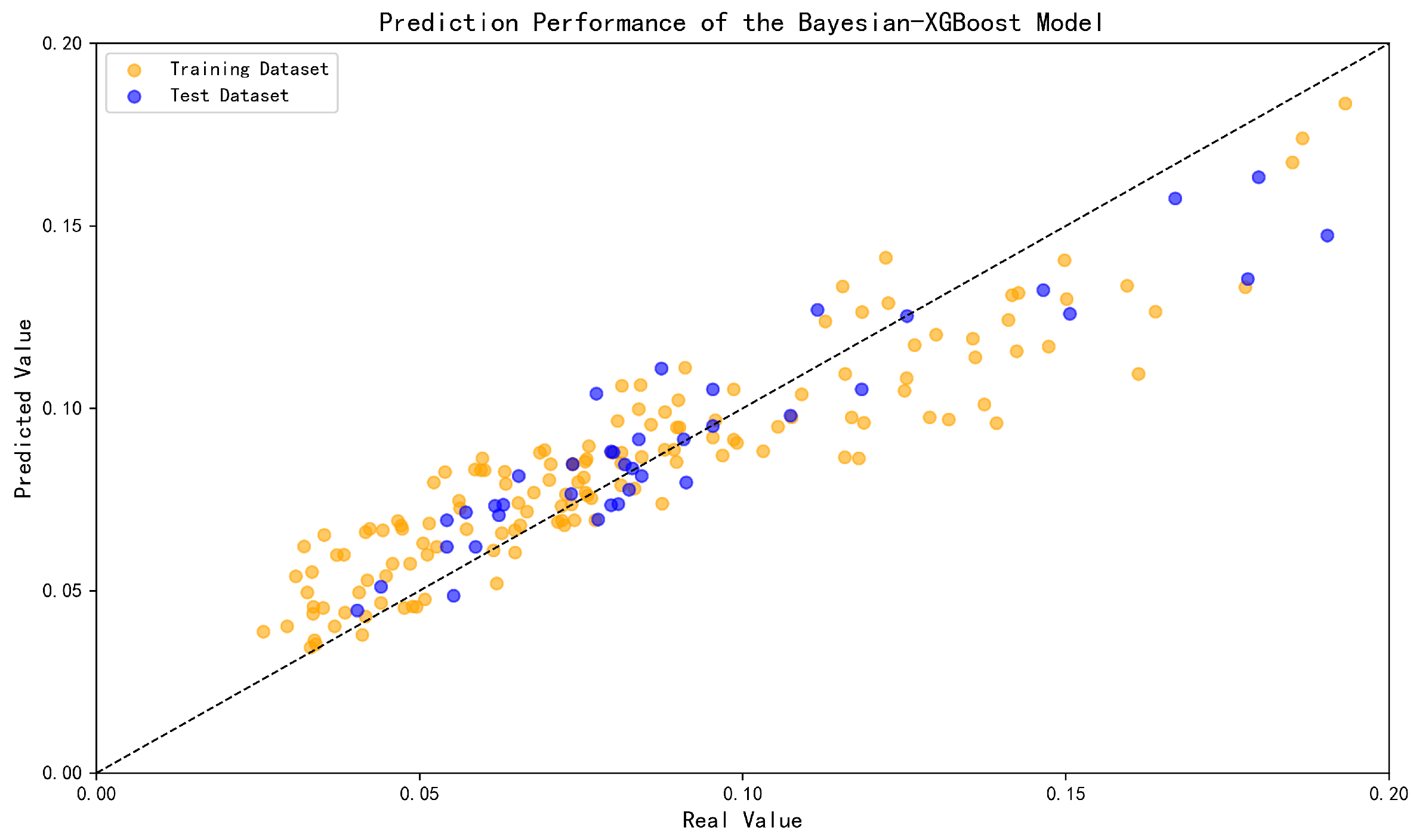
| MFO-XGBoost | Bayesian-XGBoost | PSO-XGBoost | ||
|---|---|---|---|---|
| Training Dataset | MAE | 0.0101 | 0.0144 | 0.0055 |
| MSE | 0.0002 | 0.0004 | 0.0001 | |
| RMSE | 0.0134 | 0.0187 | 0.0072 | |
| R2 | 0.9542 | 0.9105 | 0.9868 | |
| Test Dataset | MAE | 0.011 | 0.013 | 0.0117 |
| MSE | 0.0002 | 0.0003 | 0.0002 | |
| RMSE | 0.0146 | 0.0176 | 0.0158 | |
| R2 | 0.9128 | 0.873 | 0.8981 |
Disclaimer/Publisher’s Note: The statements, opinions and data contained in all publications are solely those of the individual author(s) and contributor(s) and not of MDPI and/or the editor(s). MDPI and/or the editor(s) disclaim responsibility for any injury to people or property resulting from any ideas, methods, instructions or products referred to in the content. |
© 2025 by the authors. Licensee MDPI, Basel, Switzerland. This article is an open access article distributed under the terms and conditions of the Creative Commons Attribution (CC BY) license (https://creativecommons.org/licenses/by/4.0/).
Share and Cite
Ding, Z.; Lu, C.; Chen, L.; Chong, Q.; Dong, Y.; Xia, W.; Meng, F. Production Decline Rate Prediction for Offshore High Water-Cut Reservoirs by Integrating Moth–Flame Optimization with Extreme Gradient Boosting Tree. Processes 2025, 13, 2266. https://doi.org/10.3390/pr13072266
Ding Z, Lu C, Chen L, Chong Q, Dong Y, Xia W, Meng F. Production Decline Rate Prediction for Offshore High Water-Cut Reservoirs by Integrating Moth–Flame Optimization with Extreme Gradient Boosting Tree. Processes. 2025; 13(7):2266. https://doi.org/10.3390/pr13072266
Chicago/Turabian StyleDing, Zupeng, Chuan Lu, Long Chen, Qinwan Chong, Yintao Dong, Wenlong Xia, and Fankun Meng. 2025. "Production Decline Rate Prediction for Offshore High Water-Cut Reservoirs by Integrating Moth–Flame Optimization with Extreme Gradient Boosting Tree" Processes 13, no. 7: 2266. https://doi.org/10.3390/pr13072266
APA StyleDing, Z., Lu, C., Chen, L., Chong, Q., Dong, Y., Xia, W., & Meng, F. (2025). Production Decline Rate Prediction for Offshore High Water-Cut Reservoirs by Integrating Moth–Flame Optimization with Extreme Gradient Boosting Tree. Processes, 13(7), 2266. https://doi.org/10.3390/pr13072266