


Abstract
Graph models are found everywhere in natural and human made structures, including process dynamics in physical, biological and social systems. The product of graphs are appropriately used in several combinatorial applications and in the formation of different structural models. In this paper, we present a new product of graphs, namely, maximal product of two vague graphs. Then we describe certain concepts, including strongly, completely, regularity and connectedness on a maximal product of vague graphs. Further, we consider some results of edge regular and totally edge regular in a maximal product of vague graphs. Finally, we present an application for optimization of the biomass based on a maximal product of vague graphs.
1. Introduction
In the real world, there are data values that are uncertainly specified in many applications, for instance sensor information. The fuzzy set theory [1] has been introduced to handle this vagueness by extending the concept of belonging to a set. In a fuzzy set, each element is essentially associated with a point value selected in the range of units [0, 1], indicated as the quality of belonging membership grade of the set. Klement and Mesiar [2] reviewed some generalizations of fuzzy sets with two- or three-dimensional lattices of truth values and study their relationship. A vague set introduced by Gau and Buehrer [3] is a further extension of a fuzzy set. Instead of using point-based membership as in fuzzy set, interval-based membership is used in a vague set and to describe the boundaries of the membership degree, a true-membership function and a false membership function are used. Belonging to intervals in vague sets is more expressive to capture data inaccuracy. In literature, the notions of intuitionistic fuzzy set and vague set are considered isomorphic. Deng et al. [4] presented the distance between vague sets with applications in decision making. Wang [5] developed vague parameterized vague soft sets and provide its applications in decision-making.
A graph is a useful tool for describing decision problems in a diagram format. Using this tool, decision objects and their relationship are represented by vertices and edges, respectively. Rosenfeld [6] introduced the fuzzy graphs by providing a fuzzy analogue of several basic graph-theoretic concepts. Ramakrishna [7] originally developed the concept of vague graphs and discussed their prominent characteristics. The vague models are more and more flexible, and practical as compared to the crisp and fuzzy models. The notion of vague hypergraphs was defined by Akram et al. [8]. Later, Akram et al. introduced many new concepts under vague environment, such as Cayley vague graphs [9], types of vague cycles and vague trees [10], regularity in vague intersection graphs and vague line graphs [11], and certain types of vague graphs [12] and so forth. Borzooei and Rashmanlou [13,14] investigated domination in vague graphs and degree of vertices in vague graphs. Nowadays, extended fuzzy graph theory is a hot research area. Recently, many researchers discussed the graph theoretical concepts in generalized fuzzy environment, such as Pythagorean fuzzy graphs (PFG) [15], complex Pythagorean fuzzy graphs [16], rough fuzzy graphs [17] and q-rung orthopair fuzzy graphs [18] along with its decision making applications.
Product operations on graphs play a very important role in graph theory. Many scholars discussed product operations on various generalized fuzzy graphs. Mordeson and Peng [19] defined some of these product operations on fuzzy graphs. Subsequently, utilizing these operations, the degree of the vertices is obtained from two fuzzy graphs in Reference [20]. Gong and Wang [21] have defined some operations on the product fuzzy hypergraphs. Sahoo and Pal [22] presented some operations on intuitionistic fuzzy graph (IFG) products and calculated the vertex degree in the IFGs. Rashmanlou et al. [23] proposed product operations over a range of values fuzzy graphs, that is, interval-valued fuzzy graphs and discussed the degree of a vertex in fuzzy graphs with interval values. Recently, Naz et al. [15] studied some of the PFG operations, the vertex degree and the vertex total degree in the PFG. However, the maximal operations on products with vague graphs were not sought. Therefore, in this paper, we will focus on this topic. We present new product of graphs, namely, maximal product of two vague graphs. Then we describe certain concepts, including strongly, completely, regularity and connectedness on maximal product of vague graphs. Fuhrer, we consider some results of edge regular and totally edge regular in maximal product of vague graphs. Finally, we present an application for optimization of the biomass based on maximal product of vague graphs.
2. Maximal Products of Vague Graphs
In this section we introduce the concept of maximal product of two vague graphs. Then we get some results on strong and complete maximal product of two vague graphs.
Definition 1
([3]). A vague set A is a pair , where and are fuzzy sets on finite non-empty set X and we called them by true and false membership functions, respectively, such that for all , .
Definition 2
([7]). Let X and Y be ordinary finite non-empty sets. We call a vague relation to be a vague subset of , that is, an expression R defined by:
where , , which satisfies the condition , for all .
Definition 3
([7]). A vague graph on a non-empty set V is a pair , where is a vague set on V and is a vague relation on V such that
for all x, Note that B is called vague relation on A.
Definition 4
([7]). Let be a simple graph and be a vague graph on . Then a vague graph G is called:
- Strong if for every edge,
- Complete vague graph, if for every,
Definition 5.
Letandbe two vague graphs on simple graphsand, respectively. Define, whereand
and we define vague graphon, for allby
and for allby
Thenis called the maximal product of two vague graphsandand denoted by,and.
Example 1.
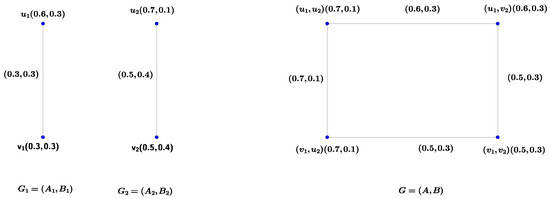
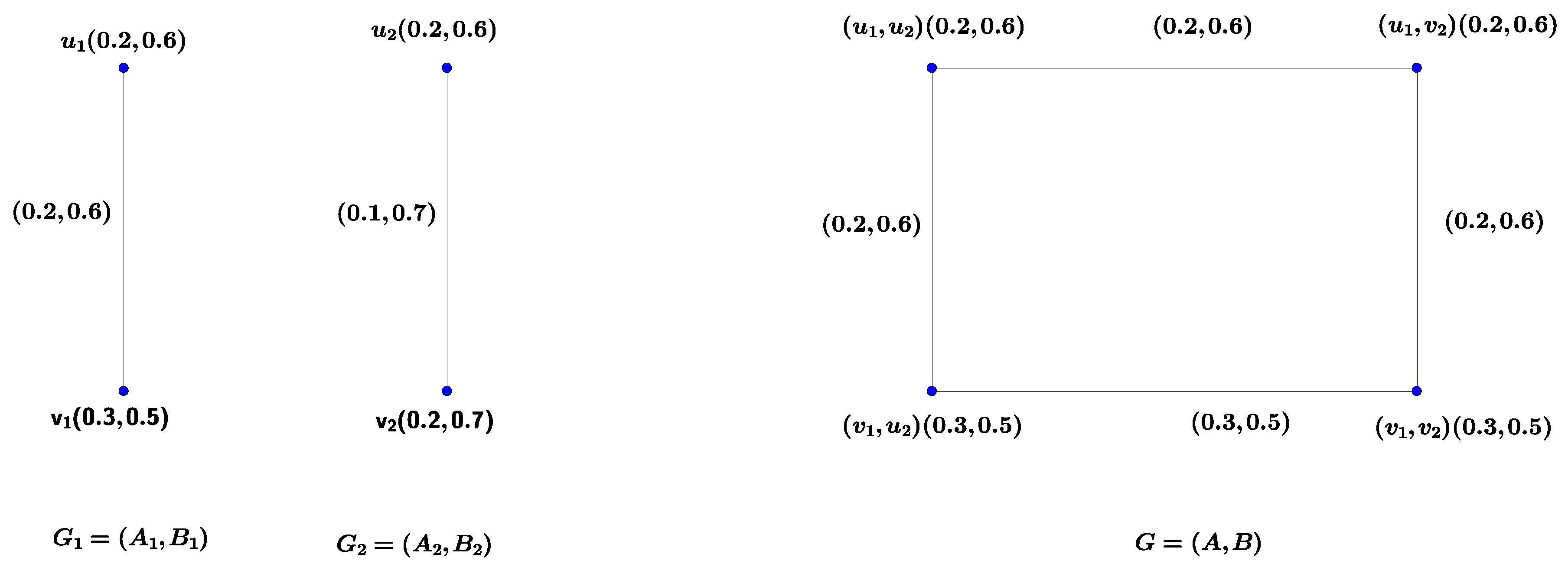
Consider the vague graphsandas in Figure 1. In the right side of following figures, we can see that the maximal product of two vague graphsand, that is.
Figure 1.
Vague graphs , and G.
Proposition 1.
Maximal product of two vague graphsand, is a vague graph.
Proof.
Let and be two vague graphs on simple graphs and , respectively. Then by Definition 5, we have two cases:
Case (i): If and , then we have
and
Hence in this case we have
Case (ii): The proof is similar to the proof of case (i), by the some modification.
Therefore, is a vague graph. □
Theorem 1.
The maximal product of two strong vague graphs is a strong vague graphs.
Proof.
Let and be two strong vague graphs on simple graphs and , respectively, and be the maximal product of and . Then by Proposition 1, G is a vague graph. Now we have two cases:
Case (i): If and , then we have
by the similar way .
Case (ii): The proof is similar to the proof of case (i), by some modifications.
Thus for all edge in the maximal product , we have
and
Hence G is a strong vague graph. □
Remark 1.
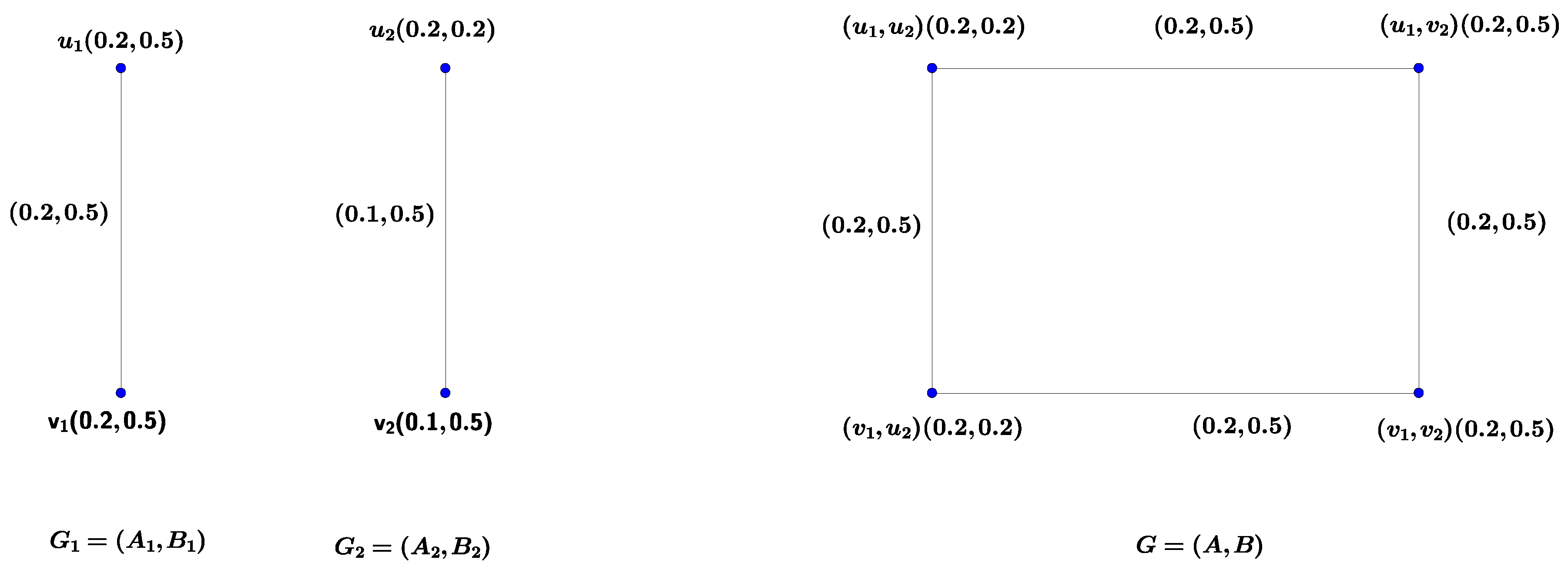
If maximal product of two vague graphsandis a strong vague graph, thenandneed not to be strong vague graphs, in general.
Example 2.
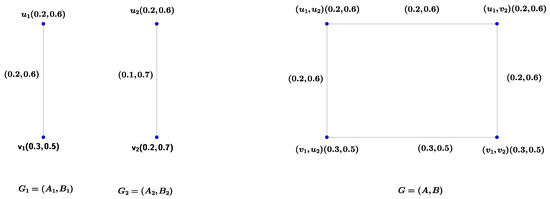
Figure 2.
Vague graphs , and G.
Thenand G are strong vague graphs, butis not a strong vague graph. Since,, but. Hence.
Theorem 2.
The maximal product of two connected vague graphs is a connected vague graph.
Proof.
Let and be two connected vague graphs on simple graphs and , respectively, where and . Then , for all and , for all (or , for all and , for all ). The maximal product of and can be taken as . Now consider the subgraphs of G with the vertex sets , for . Each of these subgraphs of G is connected, since the ’s are the same and since is connected, each is adjacent to at least one of the vertices in . Also since is connected, each is adjacent to at least one of the vertices in . Hence there exists at least one edge between any pair of the above subgraphs. Thus we have (or ), for all . Hence, G is a connected vague graph. □
Remark 2.
Maximal product of two complete vague graphs is not a complete vague graphs, in general. Because we do not include the caseandin the definition of the maximal product of vague graphs. Since every complete vague graph is strong, we have the maximal product of two complete vague graph is a strong vague graph.
Definition 6.
Letandbe two vague graphs on simple graphsand, respectively, whereand,. The degree of any vertex in the maximal product of the vague graphsandis defined by,, where
Example 3.
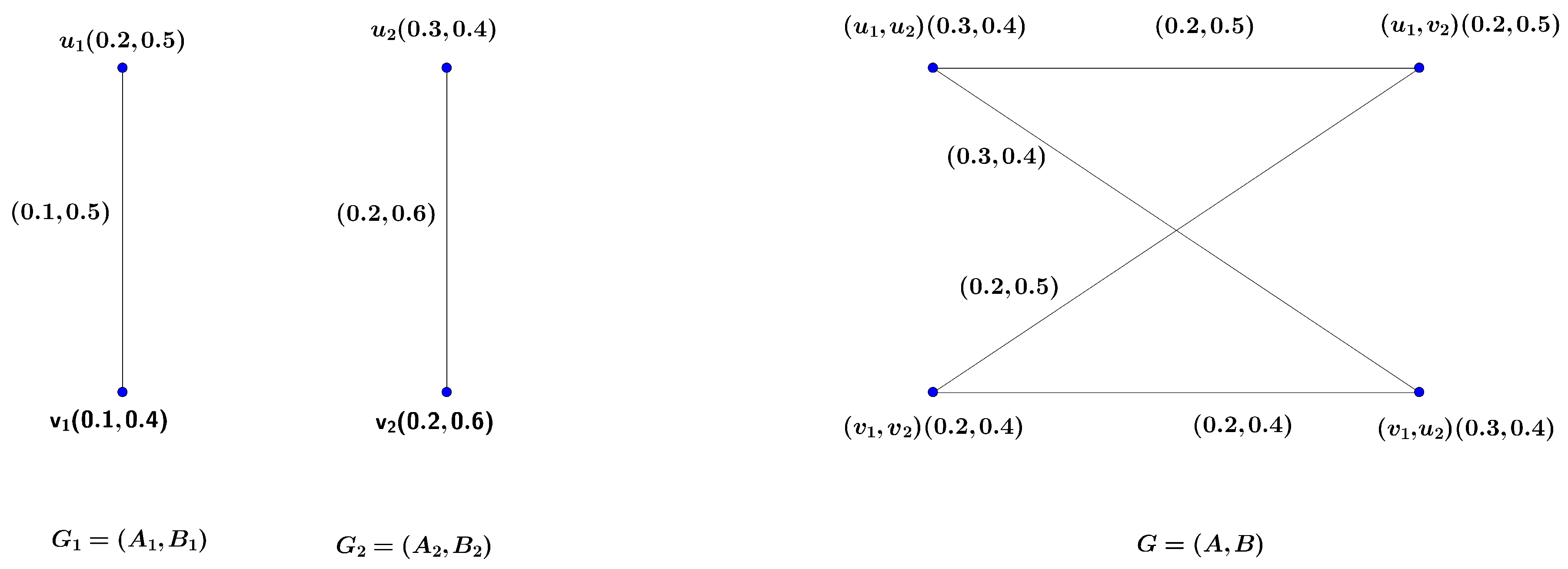
Consider the vague graphs in Example 2. Then
Definition 7.
Letandbe two vague graphs on simple graphsand, respectively. Then, the maximal product ofand, that is, is called-regular if, for all. In this case, G is called regular vague graph (of degree).
Example 4.
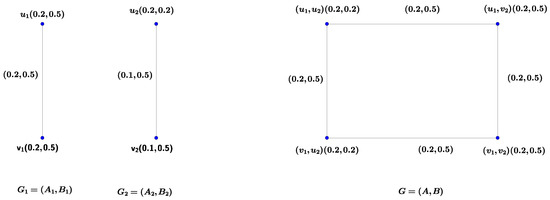
Figure 3.
Vague graphs , and G.
Henceis a regular vague graph of degree.
Note. If and are two regular vague graphs, then the maximal product of and is not a regular vague graph, in general.
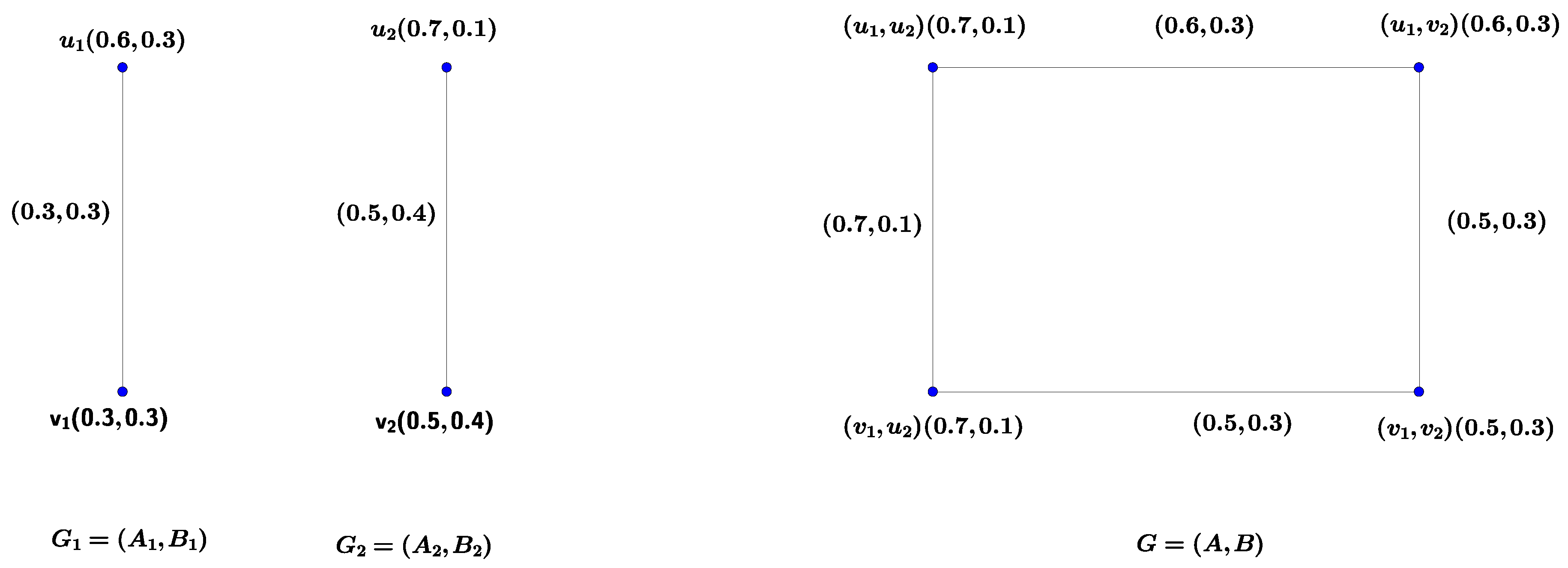
Example 5.
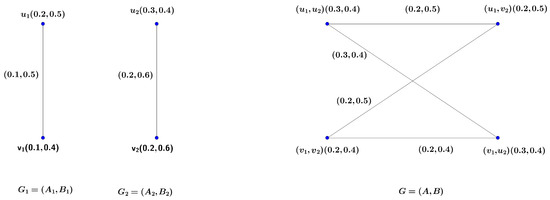
Figure 4.
Vague graphs , and G.
Since, but. Thenis not regular.
Definition 8.
Letbe a vague graph on simple graph. Ifis a regular graph, then G is said to be partially regular vague graph. If G is both regular and partially regular vague graph, then G is said to be a full regular vague graph.
Example 6.
Consider the vague graphs,andas Example 4. Sinceis a regular graph, so G is a partially regular vague graph. Hence G is a full regular vague graph.
Definition 9.
Let G be the maximal product of two vague graphsand. Then the degree of an edgeis defined as
where
Moreover, the total degree of an edgeis defined as
where
Example 7.
Consider the vague graphs,and the maximal productin Example 5. Then
Theorem 3.
Letandbe two vague graphs andbe the finite underlying crisp graph of, which is a cycle. Then the summation of degree of all vertices inis equal to the summation of degree of all edges in, that is:
where.
Proof.
Let be a vague graph and be the simple graph of G which is a cycle, that is for all , where . Then
Now we have
Similarly,
Hence,
□
Remark 3.
Letandbe two vague graphs andwith simple graph. Then
where
for all.
Definition 10.
Letandbe a vague graphs and. If each edge in vague graphhas the same degree, thenis said to be an-edge regular vague graph. Moreover if each edge in vague graphhas the same total degree, thenis said to be a-totally edge regular vague graph.
Example 8.
Consider the vague graph,and G as in Example 4. Then G is an-edge regular vague graph and G is a-totally edge regular.
Example 9.
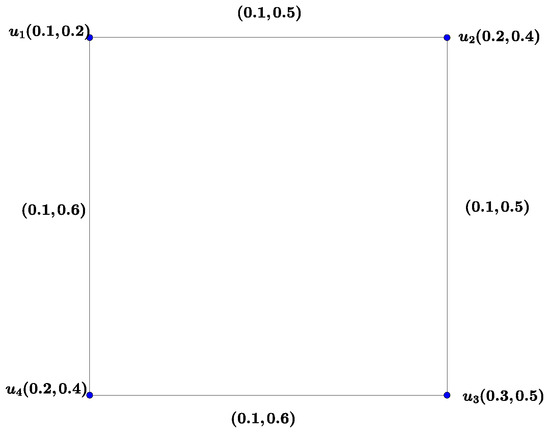
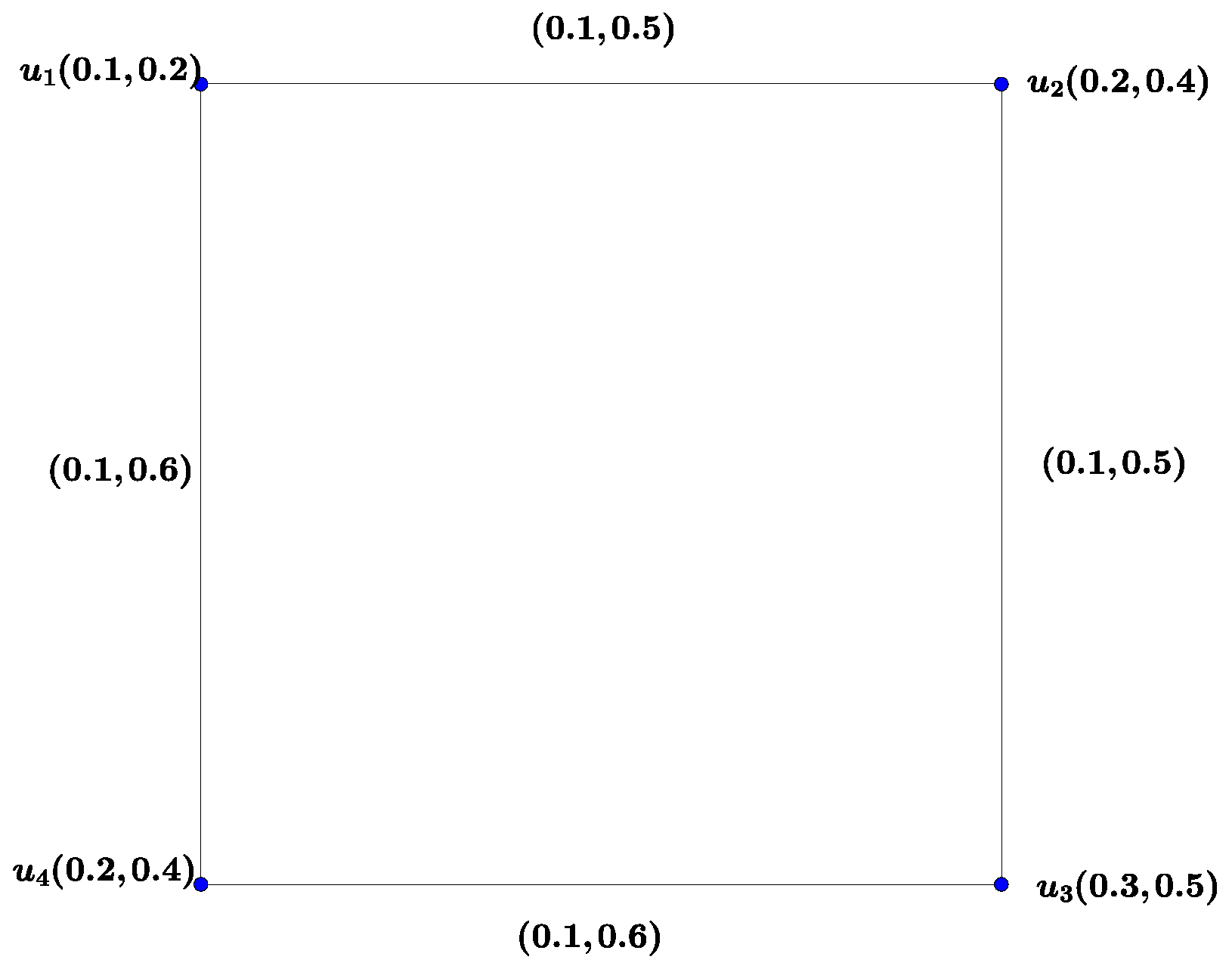
Consider the vague graphas in Figure 5.
Figure 5.
Vague graph G.
Then
Sois an-edge regular vague graph, but is not an totally edge regular vague graph.
Theorem 4.
Letandbe two vague graphs,andbe the simple graph of G. Ifis k-regular, then the summation of degree of all edges in G, is as follows:
Proof.
By Remark 3, we have
Since is a regular crisp graph, , for all and so we have
Hence
So
□
Theorem 5.
Letandbe two vague graphs,andbe the simple graph of G. Then the summation of total degree of all edges in G is as follows:
Proof.
By definition of total edge degree of G, we have
By Remark 3, we get
□
Theorem 6.
Letandbe two vague graphs on simple graphsand, respectively./ Thenof
is a constant function if and only if the following are equivalent:
- (i)
- G is an edge regular vague graph.
- (ii)
- G is a totally edge regular vague graph.
Proof.
Assume that of is a constant function. Then
for every , where and are constants. Let G be an -edge regular vague graph. Then, for all ,
and
for all . Then G is a totally edge regular. Now, let G be a -totally edge regular vague graph. Then , for all . So we have
Hence
Then G is a edge regular vague graph.
Conversely, assume that (i) and (ii) are equivalent. We have to prove that is a constant function. Suppose that is not a constant function. Then and , for at least one pair of . Let G be an edge regular vague graph. Then
Hence for all and for all ,
and
Since
and
we have
Hence G is not a totally edge regular, that is a contradiction to our assumption. Therefore is a constant function. Similarly, we can show that is a constant function, when G is a totally edge regular vague graph. □
3. Application
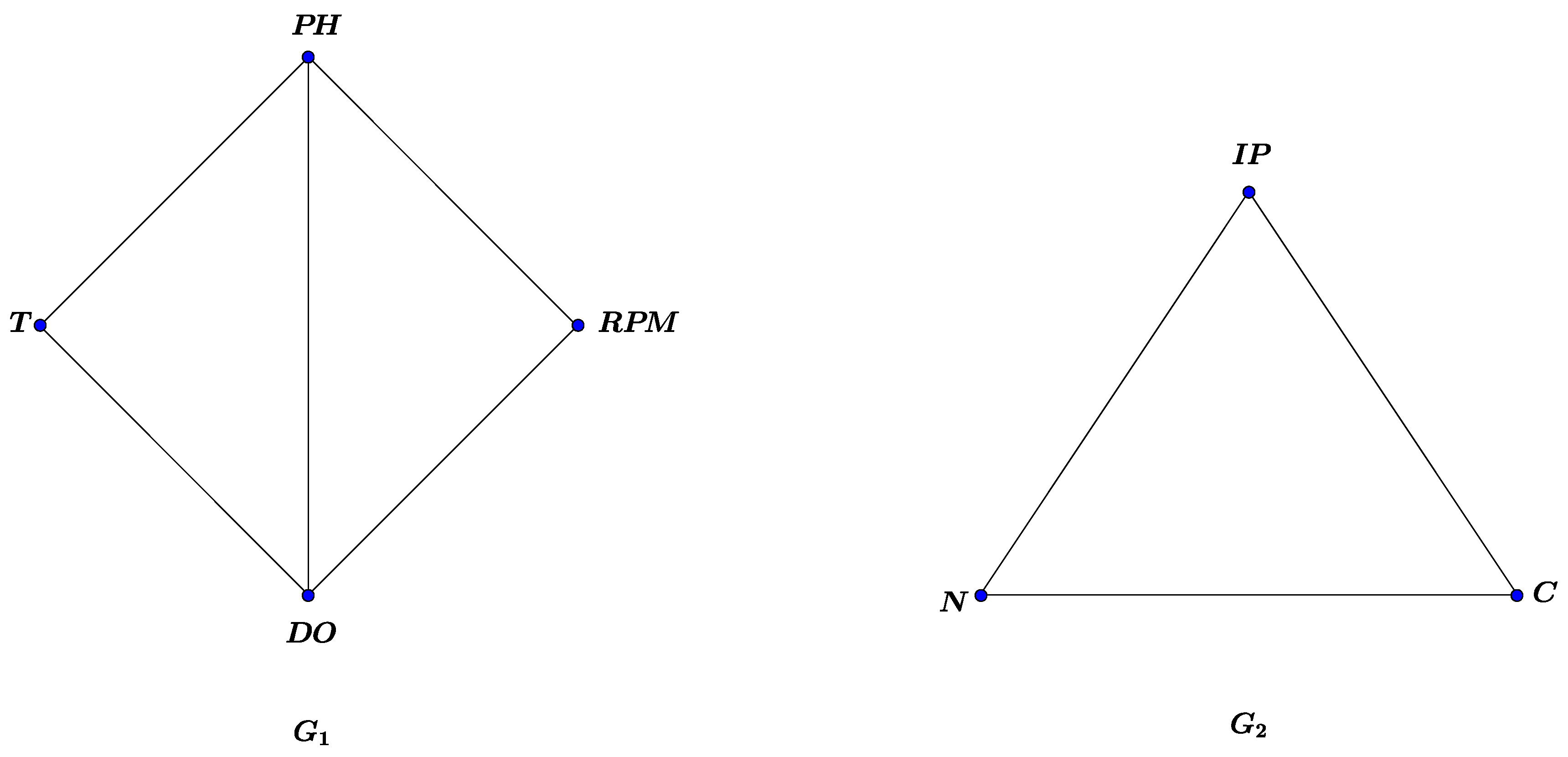
In this section, we express application of maximal product of two vague graphs. To this end we want to optimize the production of bacterial biomass. One of the most commonly used bacteria in genetic engineering is Escherichia coli. Many high-efficiency proteins are expressed in Escherichia coli using genetic engineering technologies. The recombinant protein is a protein that has been added to the genetic engineering by virtue of its genetic engineering. For this purpose, in order to produce recombinant proteins in the research laboratory, bacteria are grown in liquid medium containing essential nutrients. E. Coli is able to produce a large amount of biomass and consequently, increase the production of the desired protein in a nutrient-rich medium. It should be noted that biomass is, in fact, a degradable source composed of living organisms. Cultivation conditions are divided into two biological and physical categories. Biological sources for bacterial growth medium include carbon source, nitrogen source and Percentage of inoculum pre-culture. Physical conditions set by the device include Potential of hydrogen, temperature, dissolved oxygens, revolutions per minute and finally, the optimization of bacterial culture conditions leads to maximizing the production efficiency of large quantities of the product (recombinant proteins), which ultimately results in increased economic efficiency. According to studies by Hosseini et al. [24], the optimal conditions for bacterial cultivation were reported as follows: due to the differences in these parameters, the optical absorption of bacterial culture medium at a wavelength of 600 nm is considered to be consistent with all the parameters. Our goal is to model this problem using vague graphs. Now in Figure 6, we assume is the vague graph of the physical conditions and is the vague graph of the biological conditions where potential of hidrogen, temperature, dissolved oxygene, revolutions per minute} as shown in Table 1, and carbon source, nitrogen source, percentage of inoculum pre-culture}. Also is the intensity of optical absorption of the optimum conditions, the intensity of optical absorption under common conditions, is the term of the mass in grams in optimal conditions and in terms of mass gram in the optimal. By direct calculations, degree of vertices in vague graphs and are given in Table 2 and Table 3, and degree of edges in vague graphs and are given in Table 4 and Table 5.
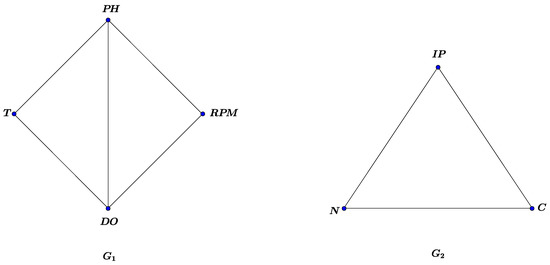
Figure 6.
Vague graphs and .

Table 1.
Biological terms.
Table 2.
Degree of vertices in vague graph .
Table 3.
Degree of vertices in vague graph .
Table 4.
Degree of edges in vague graph .
Table 5.
Degree of edges in vague graph .
Table 6.
Degree of vertices in vague graph .
Table 7.
Degree of edges in vague graph .
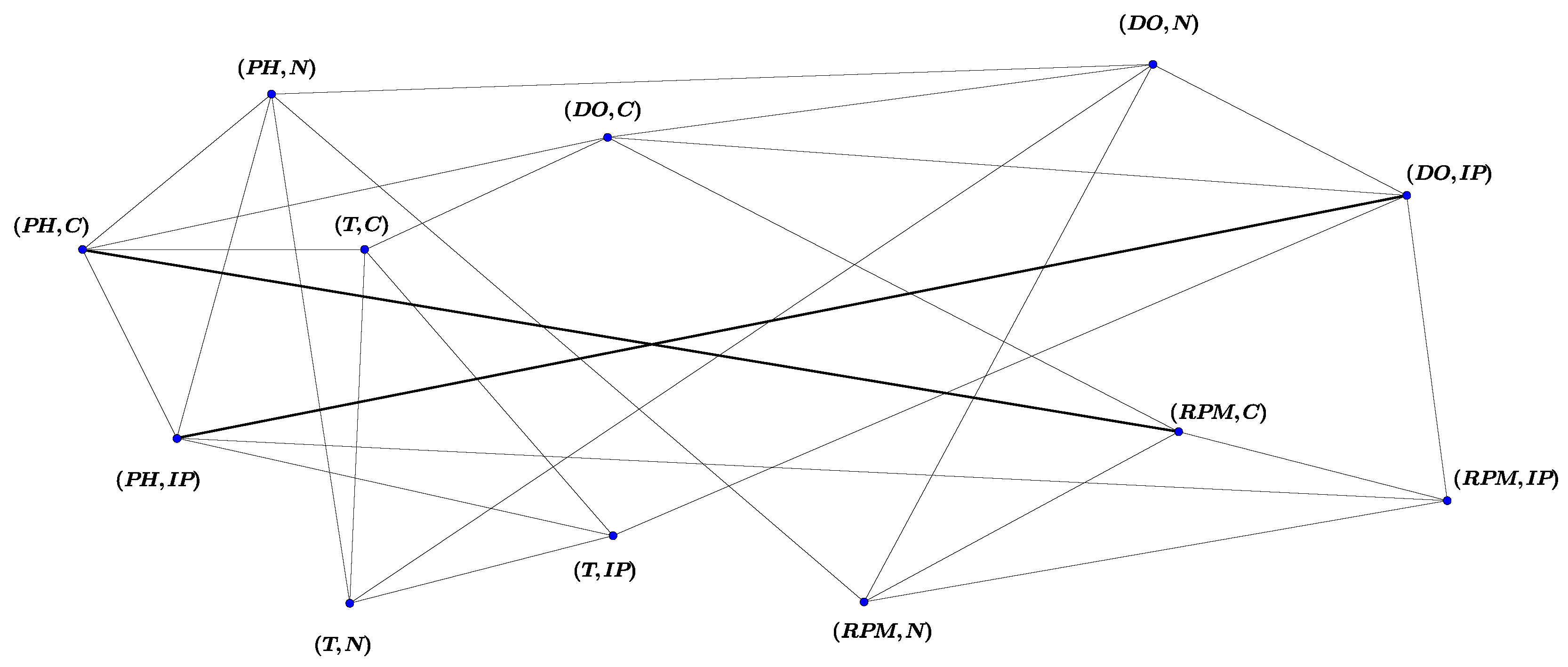
The results of the Table 6 are matched with the results of experiments. So that, due to the increasing growth of bacteria, in the presence of optimized sources of , and intensity of absorption measured by the spectrophotometer is the highest number in optimal condition and lowest number in optical ordinary condition. Based on the results of Table 6, the high values of obtained biomass from simultaneous use of optimal nitrogen source, optimal carbon source, Percentage of inoculum pre-culture and optimal dissolved oxygen in erlenmeyer in laboratory condition match with the obtained biomass using of maximal product . Although, in this case, low values of biomass in common condition have the same terms of mass gram in both laboratory condition and Table 6. So that by Table 7, the biomass obtained from , and in optimal conditions, compared to all other investigated optimal mode, have the highest terms of mass gram. Likewise biomass obtained from , and in common conditions, compared to all other investigated optimal mode, have the lowest terms of mass gram. Hence the results of Table 7 are matched with the results of experiments. Vague graph is shown in Figure 7.
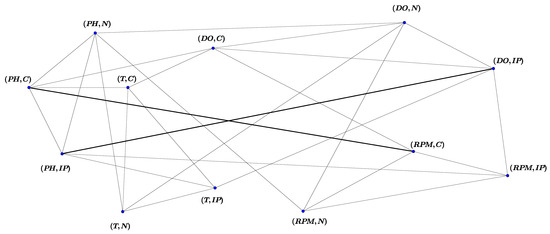
Figure 7.
Vague graph .
Therefore, we conclude that the mathematical modeling of this laboratory research using a maximized multiplication graph is a good tool for predicting laboratory samples for optimal biomass production and a suitable link between biotechnology and fuzzy mathematics can be established.
4. Conclusions
Graph theory is an important area in mathematics which is used to represent networks of communication, data organization, computational devices and the flow of computation. We have presented the concept of maximal products of two vague graphs. We have illustrated that the operation maximal products of two vague graphs is not commutative. Then we describe certain concepts, including strongly, completely, regularity and connectedness on maximal product of vague graphs. Fuhrer, we consider some results of edge regular and totally edge regular in maximal product of vague graphs. Finally, we have considered an application of this operator. In future, we shall focus on (1) Hesitant Pythagorean fuzzy graphs; (2) Interval-valued Pythagorean fuzzy graphs; and (3) Vague graphs under Hamacher aggregation operator.
Author Contributions
Investigation, B.S.H., M.A., M.S.H., H.R. and R.A.B.; writing—original draft, B.S.H., M.A.; writing—review and editing, M.S.H., H.R. and R.A.B. All authors have read and agreed to the published version of the manuscript.
Acknowledgments
The authors are very thankful to the editor and referees for their valuable comments and suggestions for improving the paper.
Conflicts of Interest
The authors declare that they have no conflict of interest regarding the publication of the research article.
References
- Zadeh, L.A. Fuzzy sets. Inf. Control 1965, 8, 338–353. [Google Scholar] [CrossRef]
- Klement, E.P.; Mesiar, B. L-Fuzzy Sets and Isomorphic Lattices: Are All the “New” Results Really New? Mathematics 2018, 6, 146. [Google Scholar] [CrossRef]
- Gau, W.L.; Buehrer, D.J. Vague sets. IEEE Trans. Syst. Man Cybern. 1993, 23, 610–614. [Google Scholar] [CrossRef]
- Deng, W.; Xu, C.; Liu, J.; Hu, F. A novel distance between vague sets and its applications in decision making. Math. Probl. Eng. 2014, 2014, 1–11. [Google Scholar] [CrossRef]
- Wang, C. Vague parameterized vague soft set theory and its decision making. J. Intell. Fuzzy Syst. 2017, 33, 2341–2350. [Google Scholar] [CrossRef]
- Rosenfeld, A. Fuzzy graphs. In Fuzzy Sets and Their Applications; Academic Press: New York, NY, USA, 1975; pp. 77–95. [Google Scholar]
- Ramakrishna, N. Vague graphs. Int. J. Comput. Cogn. 2015, 7, 51–58. [Google Scholar]
- Akram, M.; Gani, N.; Borumand Saeid, A. Vague hypergraphs. J. Intell. Fuzzy Syst. 2014, 26, 647–653. [Google Scholar] [CrossRef]
- Akram, M.; Samanta, S.; Pal, M. Cayley vague graphs. J. Fuzzy Math. 2017, 25, 449–462. [Google Scholar]
- Akram, M.; Farooq, A.; Borumand Saeid, A.; Shum, K.P. Certain types of vague cycles and vague trees. J. Intell. Fuzzy Syst. 2015, 28, 621–631. [Google Scholar] [CrossRef]
- Akram, M.; Murtaza, M.Y.; Dudek, W.A. Regularity in vague intersection graphs and vague line graphs. Abstr. Appl. Anal. 2014, 2014, 525389. [Google Scholar] [CrossRef]
- Akram, M.; Feng, F.; Sarwar, S.; Jun, Y.B. Certain types of vague graphs. Univ. Politeh. Buchar. Sci. Bull. A 2014, 76, 141–154. [Google Scholar]
- Borzooei, R.A.; Rashmanlou, H. Domination in vague graphs and its applications. J. Intell. Fuzzy Syst. 2015, 29, 1933–1940. [Google Scholar] [CrossRef]
- Borzooei, R.A.; Rashmanlou, H. Degree of vertices in vague graphs. J. Appl. Math. Inform. 2015, 33, 545–557. [Google Scholar] [CrossRef]
- Naz, S.; Ashraf, S.; Akram, M. A novel approach to decision-making with Pythagorean fuzzy information. Mathematics 2018, 6, 95. [Google Scholar] [CrossRef]
- Akram, M.; Naz, S. A novel decision-making approach under complex pythagorean fuzzy environment. Math. Comput. Appl. 2019, 24, 73. [Google Scholar] [CrossRef]
- Zafar, F.; Akram, M. A novel decision-making method based on rough fuzzy information. Int. J. Fuzzy Syst. 2018, 20, 1000–1014. [Google Scholar] [CrossRef]
- Habib, A.; Akram, M.; Farooq, A. q-Rung orthopair fuzzy competition graphs with application in the soil ecosystem. Mathematics 2019, 7, 91. [Google Scholar] [CrossRef]
- Mordeson, J.N.; Peng, C.S. Operations on fuzzy graphs. Inf. Sci. 1994, 79, 159–170. [Google Scholar] [CrossRef]
- Gani, A.N.; Radha, K. The degree of a vertex in some fuzzy graphs. Int. J. Algorithms Comput. Math. 2009, 2, 107–116. [Google Scholar]
- Gong, Z.T.; Wang, Q. Some operations on fuzzy hypergraphs. ARS Combin. 2017, 132, 203–217. [Google Scholar]
- Sahoo, S.; Pal, M. Product of intuitionistic fuzzy graphs and degree. J. Intell. Fuzzy Syst. 2017, 32, 1059–1067. [Google Scholar] [CrossRef]
- Rashmanlou, H.; Pal, M.; Borzooei, R.A.; Mofidnakhaei, F.; Sarkar, B. Product of interval-valued fuzzy graphs and degree. J. Intell. Fuzzy Syst. 2018, 35, 6443–6451. [Google Scholar] [CrossRef]
- Sheikh Hosseini, M.; Fooladi, J.; Gharavi, S. Optimization of Culture Conditions for an E. coli Strain for the Semi Industrial Production of Recombinant Reverse Transcriptase. Ph.D. Thesis, Alzahra University, Tehran, Iran, 2015. [Google Scholar]
© 2020 by the authors. Licensee MDPI, Basel, Switzerland. This article is an open access article distributed under the terms and conditions of the Creative Commons Attribution (CC BY) license (http://creativecommons.org/licenses/by/4.0/).