


Abstract
In this paper, we present a method for measuring arbitrary-order correlation functions of the light field using a two-level atomic system. Theoretically, light field information should be mapped onto the atomic system after the light interacts with the atom. Therefore, we can measure the atomic system and thus obtain information about the light field. We study two typical models, the p-photon Jaynes–Cummings model, and the p-photon Tavis–Cummings model. In both models, we find that the pth-order correlation function of an unknown light field can be obtained by measuring the instantaneous change of energy of the two-level atoms with the aid of a known reference light field. Moreover, we find that the interactions other than the dipole interactions between light and atoms have no effect on the measurement results.
1. Introduction
In quantum optics, light with quantum correlations is widely used in quantum communication [1,2,3,4,5,6,7,8], quantum computing [9,10,11,12,13,14,15,16,17], quantum metrology [18,19,20,21], quantum imaging [22,23,24,25,26], and quantum sensing [27,28,29,30]. In addition, correlation functions of light field proposed by Glauber are also commonly used to distinguish the quantum and classical nature of the light field [31,32,33]. Unnormalized equal-time pth-order correlation functions of light fields proposed by Glauber are defined as , where and are the photon creation and annihilation operators of the light field, respectively. These correlation functions can characterize some properties of the light field. For example, the equal-time first-order correlation function of the light field characterizes the average photon number of the light field. Additionally, these functions can be used to characterize some quantum phenomena in the quantum light field that are not observed in the classical system. The most well known is the equal-time second-order correlation function , which is commonly used to distinguish between classical and quantum light fields. For example, when , the light field shows a well-known antibunching phenomenon [34,35,36,37,38,39,40], which quantifies how the detection of one photon from a source affects the probability of detecting another photon; this is a typical quantum phenomenon. In general, means that the light field is a good single-photon source [41,42,43,44,45,46]. Of course, a strictly single-photon source needs to satisfy . Single-photon sources play a very critical role in quantum networks [47], universal linear quantum computing [48], and boson sampling [49]. Moreover, the resolution of the microscope can be improved by the second-order correlation function of the optical field [50].
The correlation function of the optical field is a significant feature of the optical field, so the measurement of the correlation function of the optical field is a problem that needs to be solved. In 1956, Hanbury Brown and Twiss pioneered a new class of optical interferometry experiments in which the second-order correlation function of the optical field was observed for the first time [51]. From this experiment, theoretical and experimental studies of the nonclassical nature of light became a very hot area of research, which is also known as quantum optics [52]. In addition, methods or devices for measuring the second-order correlation function of the optical field include random phase modulation methods [53], analog detectors [54], linear detectors [55,56], and reversed-wavefront Young interferometers [57].
However, when we study the statistical properties of the optical field in detail, it is not enough to measure the first- and second-order correlation functions of the optical field. For example, when we study two-photon blockades, we need to measure the second-order correlation function and the third-order correlation function. When we study more photon blockades, higher-order correlation function measurements are required. Based on this practical problem, we propose a method to indirectly obtain the pth-order correlation function of the light field by measuring the energy change of atoms. In the following, we investigate this indirect measurement method with an extended p-photon Jaynes–Cummings (JC) model and an extended p-photon Tavis–Cummings (TC) model.
2. Measuring the pth-Order Correlation Function of the Light Field in p-Photon JC Model
We consider an extended p-photon Jaynes–Cummings model (as shown in Figure 1a) with the following Hamiltonian ():
where p is an integer greater than or equal to 1. and are the eigenfrequency of the optical cavity and the transition frequency of the two-level atom, respectively. g is the dipole interaction strength between the cavity field and the single atom, U is the Kerr-type nonlinear interaction strength of the optical field, and is the dispersion interaction between the cavity field and the single atom. and are, respectively, the annihilation and creation operators of the single-mode cavity field that satisfy the usual bosonic commutation relation . are the usual Pauli operators, and . Experimentally, the multiphoton JC model can be implemented in systems such as superconducting circuits and trapped ions [58,59,60,61,62].
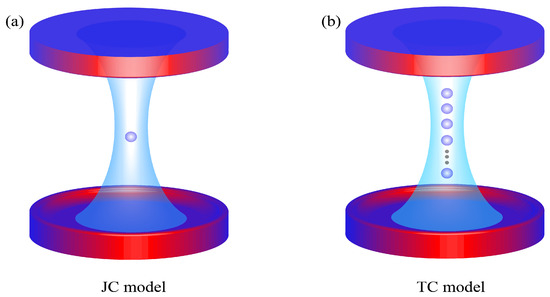
Figure 1.
(a) Schematic diagram of the JC model with a single two-level atom interacting with a single-mode optical field. (b) Schematic diagram of the TC model with multiple two-level atoms interacting with a single-mode optical field.
Here, we assume that the light field is in an unknown state and the atom is in the ground state , that is, the initial state of the total system is , where and is the number state of the optical field. Since the total excitation number is conserved (the total excitation number operator satisfies the condition ), we can assume that the state of the system at time t has the following form:
where and . Substituting Equations (1) and (2) into the Schrödinger equation, we can obtain two differential equations:
where
The above two differential equations are easy to solve using the Laplace transform, and we give the specific solution procedure in Appendix A. Then, we can obtain the solutions of these two differential equations as follows:
where
When the total system starts evolving with an initial state , where is an unknown initial state of the light field to be measured, and is a known initial state of the prepared probe atom ( in here). Then, we can obtain the energy acquired by the atom from the light field at time t as follows:
Theoretically, since different light fields make different energy changes in the atom, we can distinguish light fields according to the difference in energy changes of the atom. In order to extract information about the light field from the energy change of the atom, we need a scale. Finally, by the ratio of the energy change of the atom to this scale, we can obtain information about the light field. Here, we choose the change of the atomic energy as a scale when the initial state of the total system is a known initial state. Therefore, when the initial state of the total system is , where is a known initial state of the light field. Thus, is a known initial state, and we call it a known reference state. Then we can similarly obtain the energy obtained by the atom from the light field at time t
where and is the number state of the optical field. Here, we refer to as the scale of the atomic energy change.
In the following, we start to investigate the ratio of the energy acquired by the atom in the unknown light field and in the known light field, respectively, when . Thus, we are able to obtain the following expression:
When , since and , according to L’Hôpital’s law, we need to consider the first-order derivatives of the numerator and denominator in Equation (20) with respect to time t. These two derivatives are easily derived as follows:
Since and have the same derivatives with respect to time t as and , we do not have a redundant representation here. Obviously, since
according to L’Hôpital’s law, we need to consider the second-order derivatives of the numerator and denominator in Equation (17) with respect to time t, and they are
Then, we can obtain
And since , the above equation actually represents the following equation
We rewrite the above equation as
Since is a light field initial state known to us, in effect, both and are known. Therefore, we only need to measure the change in energy of the atom over a short period of time to obtain the pth-order correlation function of the unknown light field .
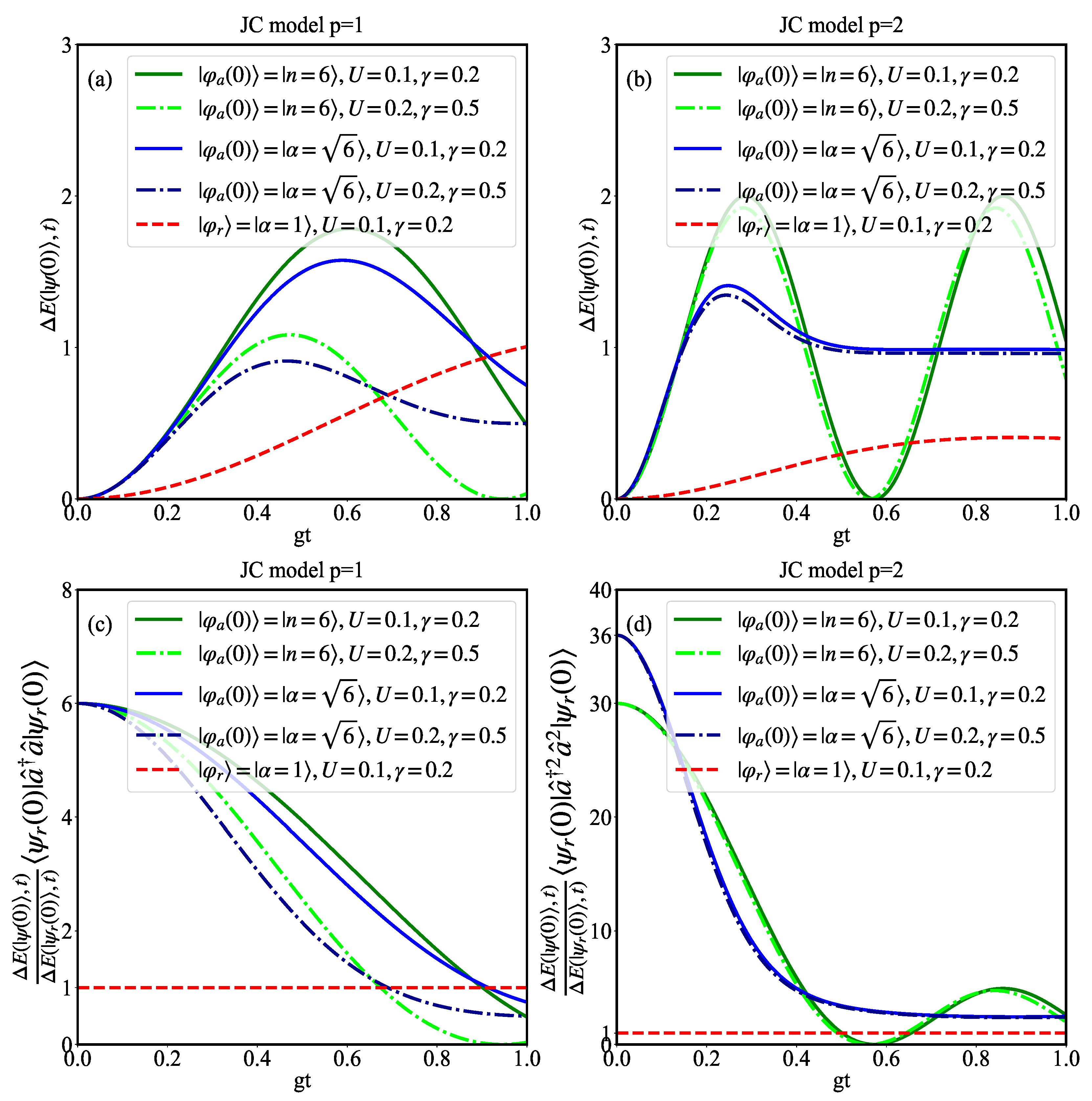
In order to verify the above conclusions from the actual dynamical evolution of the atom, we plot the variation of the energy obtained by the atom from the light field with time for the single-photon JC model and the two-photon JC model in Figure 2a,b, respectively, when the system takes different parameter values and different initial states. It is worth noting, in particular, that the red dashed line indicates the variation of the energy acquired by the atom from the light field with time for a known reference state. To extract information about the unknown light field from the variation of the atomic energy, we compare the energy acquired by the atom from the unknown light field with the energy acquired by the atom from the known light field to obtain information about the unknown light field. For example, we plot in Figure 2c,d the relative ratios of the energy obtained by the atom from the unknown light field in the single-photon JC model and the two-photon JC model with the aid of the reference state as a function of time, respectively. Obviously, when the interaction time between the atom and the light field is short enough, we can obtain the first-order correlation function and the second-order correlation function of the unknown light field by measuring the energy change of the atom with the assistance of a known reference state. Of course, we can also obtain higher-order correlation functions for the unknown light field, which we will not redundantly discuss here.
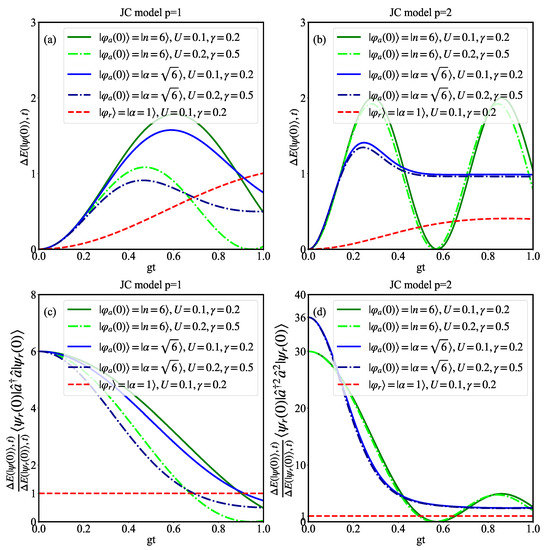
Figure 2.
(a) Variation with time of the energy acquired by atoms from the light field in the single-photon JC model for different parameters and different initial states. (b) Variation with time of the energy acquired by atoms from the light field in the two-photon JC model for different parameters and different initial states., respectively. (c) The ratio of the energy acquired by an atom from an unknown light field and a known reference light field in the single-photon JC model as a function of time. (d) The ratio of the energy acquired by an atom from an unknown light field and a known reference light field in the two-photon JC model as a function of time. The initial state of the total system is and the known reference state is . The values of other parameters are , , and the values of U and in the figure are all ratios to .
Furthermore, we can see from Figure 2c,d that when , different values of and U do not affect the value of this correlation function of the light field obtained by measuring the energy change of the atoms. That is, the elastic collision interactions between the atom and the light field and between photon and photon do not affect the results obtained by this measurement method.
3. Measuring the th-Order Correlation Function of the Optical Field in -Photon TC Model
Above, we have investigated how to obtain the correlation function of the unknown light field in the JC model using the measurement of the energy change of a single atom. Here, we study how to obtain the correlation function of the unknown light field in the TC model using the energy change of multiple atoms. The Hamiltonian of an extended p-photon TC model (as shown in Figure 1b) is as follows:
where () is the collective angular momentum operator for the spin ensemble consisting of N identical two-level atoms; these operators satisfy the commutation relation of algebra and . is the strength of the interaction between the atoms, and the other parameters are the same as in the JC model.
When we were studying single-photon TC quantum batteries before [64], we found an interesting phenomenon, which is expressed by the following equation:
where and denote the two number states, respectively, and (or ) denotes the variation of the energy obtained by all the atoms from the number state light field (or ) with time t. Furthermore, when the initial state of the total system is (), where denotes that the light field is in an arbitrary state as well as denoting that the atoms are in the ground state, the energy that the atoms acquire from the light field at time t is [64]
where is the probability distribution of the initial state in the number states.
Similar to the idea of the study in the JC model, we choose a number state as a known reference light field, then we can obtain the following expression:
For the above equation, it is also possible to obtain information on the average photon number of the unknown light field by measuring the change in the energy acquired by the atoms from the unknown light field with the assistance of a known reference state.
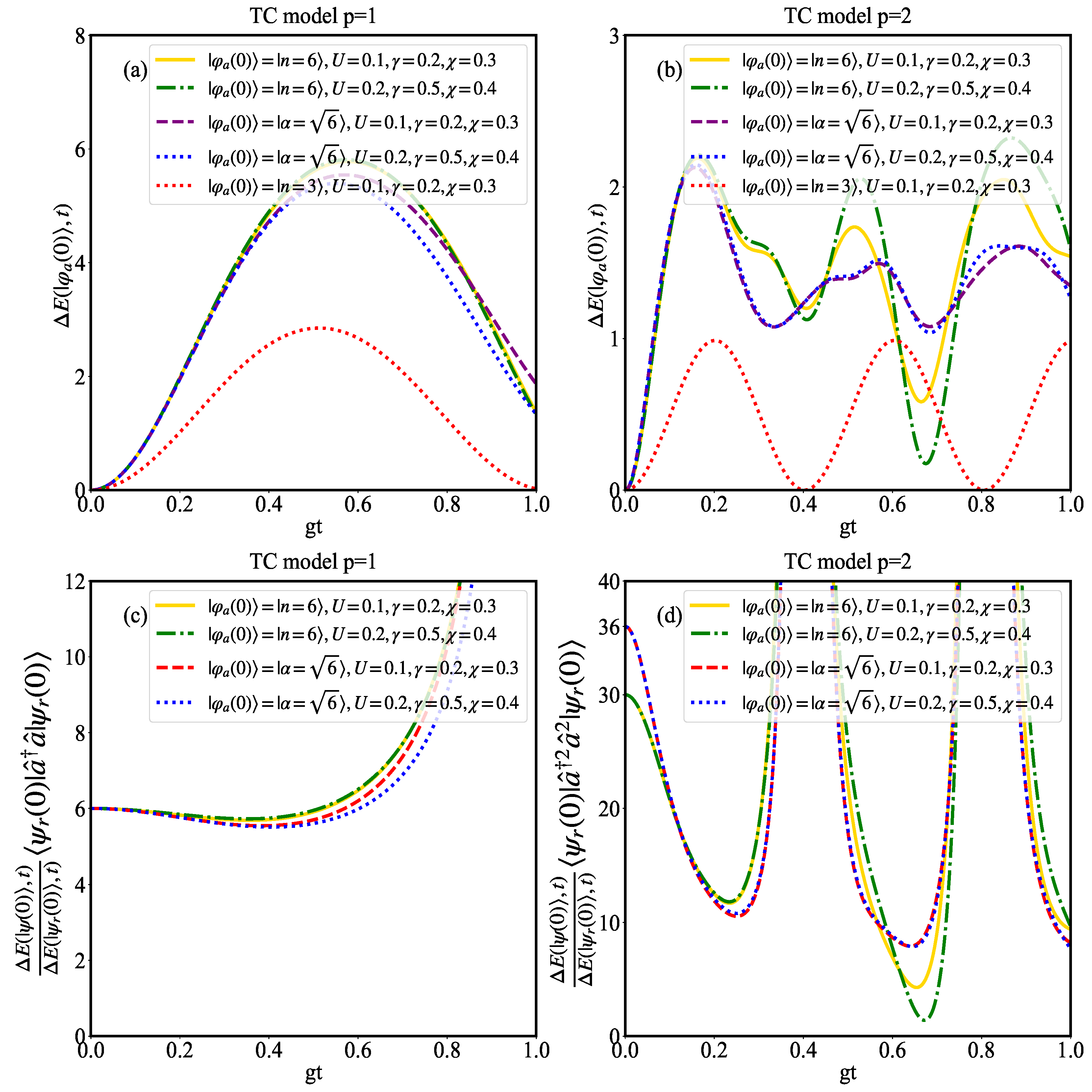
When the light field takes different initial states and the Hamiltonian of the total system takes different parameter values, in Figure 3a,b, we plot the variation of the energy acquired by the atoms from the light field with time in the single-photon TC model and the two-photon TC model, respectively. Furthermore, in Figure 3c,d, we plot the variation of the relative ratio of the energy acquired by the atoms in the single-photon TC model and the two-photon TC model with respect to time, respectively. We find that when the time is sufficiently short, i.e., , with the assistance of a known reference state, we can completely obtain the pth-order correlation function of the optical field by measuring the change of atomic energy in the p-photon TC model.
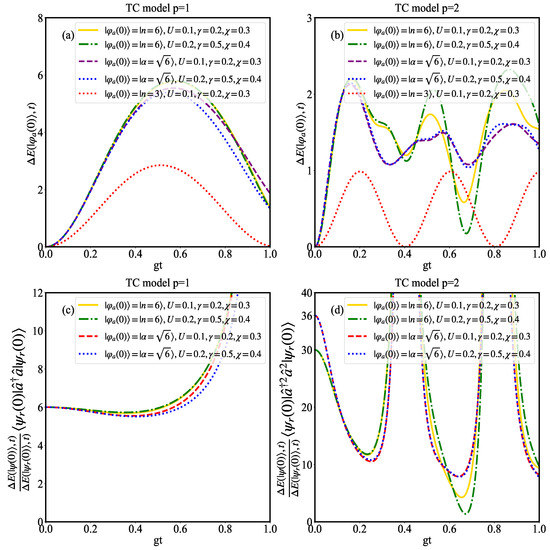
Figure 3.
(a) Variation with time of the energy acquired by the all atoms from the light field in the single-photon TC model for different parameters and different initial states. (b) Variation with time of the energy acquired by the all atoms from the light field in the two-photon TC model for different parameters and different initial states, respectively. (c) The ratio of the energy acquired by the all atoms from an unknown light field and a known reference light field in the single-photon TC model as a function of time. (d) The ratio of the energy acquired by the all atoms from an unknown light field and a known reference light field in the two-photon TC model as a function of time. The initial state of the total system is and the known reference state is . The values of other parameters are , , and the values of U, and in the figure are all ratios to .
Here, we can compare the p-photon TC model with the p-photon JC model. When , we find that using the change of atomic energy in the p-photon TC model to obtain the pth-order correlation function of the light field is the same as that using the p-photon JC model. That is, this indirect measurement is independent of the specific atomic number and is only related to the form of the dipole interaction between the atom and the light field.
All the data obtained from the numerical calculations in Figure 3 were performed by QuTIP [65], a quantum toolbox.
4. Conclusions
In conclusion, we propose a method to indirectly measure the pth-order correlation function of the optical field using a two-level atomic system. We find that with the aid of a known reference state, the information of the pth-order correlation function of the optical field can be extracted by measuring the energy change of the atoms. We investigate the advantage of this measurement method using the p-photon JC model and the p-photon TC model, respectively, that is, the ability to measure arbitrary order correlation functions compared to other methods. We find that any interaction in the system other than the dipole interaction between light and atoms does not affect the measurement results, i.e., this measurement method is robust to other possible interactions. Finally, we compare this indirect measurement method in both models, and we find that this measurement method depends only on the dipole interaction between light and atoms, independent of the specific number of atoms involved in the measurement.
Author Contributions
Conceptualization, W.L.; methodology, W.L.; software, W.L., C.Z., and S.T.; validation, W.L., C.Z. and S.T.; formal analysis, W.L.; investigation, W.L.; resources, W.L.; data curation, W.L.; writing—original draft preparation, W.L.; writing—review and editing, C.Z. and S.T.; visualization, C.Z. and S.T.; supervision, C.Z. and S.T.; project administration, W.L.; funding acquisition, W.L. All authors have read and agreed to the published version of the manuscript.
Funding
This work was supported by the NSFC (Grants No. 11947069 and No. 12205092 ), the Scientific Research Fund of Hunan Provincial Education Department (Grant No. 20C0495), and the Hunan Provincial Natural Science Foundation of China (Grant No. 2020JJ4146).
Institutional Review Board Statement
Not applicable.
Informed Consent Statement
Not applicable.
Data Availability Statement
Not applicable.
Conflicts of Interest
The authors declare no conflict of interest.
Appendix A. The Specific Solution Procedure for the System of Differential Equations (3) and (4)
Here, we give the specific solution procedure for Equations (3) and (4). Substituting Equations (1) and (2) into the Schrödinger equation, we can obtain two differential equations:
where
We make a Laplace transform of and , i.e., . Then, Equations (A1) and (A2) become the following expressions:
From the initial condition, we have , then we can obtain
Since , where
Then
where , . Finally, we perform an inverse Laplace transform on to obtain
Similarly, we can obtain
where , . Similarly, we perform an inverse Laplace transform on to obtain
References
- Van Enk, S.; Cirac, J.; Zoller, P. Photonic channels for quantum communication. Science 1998, 279, 205–208. [Google Scholar] [CrossRef] [PubMed]
- Shimizu, K.; Imoto, N.; Mukai, T. Dense coding in photonic quantum communication with enhanced information capacity. Phys. Rev. A 1999, 59, 1092–1097. [Google Scholar] [CrossRef]
- Gisin, N.; Thew, R. Quantum communication. Nat. Photonics 2007, 1, 165–171. [Google Scholar] [CrossRef]
- Brito, S.; Canabarro, A.; Cavalcanti, D.; Chaves, R. Satellite-Based Photonic Quantum Networks Are Small-World. PRX Quantum 2021, 2, 010304. [Google Scholar] [CrossRef]
- Gao, Y.P.; Liu, X.C.; Cao, C.; Han, L.H.; Lu, P.F. Optomagnonically induced RoF chaotic synchronization. New J. Phys. 2022, 24, 083022. [Google Scholar] [CrossRef]
- Zhou, M.G.; Cao, X.Y.; Lu, Y.S.; Wang, Y.; Bao, Y.; Jia, Z.Y.; Fu, Y.; Yin, H.L.; Chen, Z.B. Experimental quantum advantage with quantum coupon collector. Research 2022, 2022, 9798679. [Google Scholar] [CrossRef] [PubMed]
- Liu, W.B.; Li, C.L.; Xie, Y.M.; Weng, C.X.; Gu, J.; Cao, X.Y.; Lu, Y.S.; Li, B.H.; Yin, H.L.; Chen, Z.B. Homodyne Detection Quadrature Phase Shift Keying Continuous-Variable Quantum key Distribution with High Excess Noise Tolerance. PRX Quantum 2021, 2, 040334. [Google Scholar] [CrossRef]
- Xie, Y.M.; Lu, Y.S.; Weng, C.X.; Cao, X.Y.; Jia, Z.Y.; Bao, Y.; Wang, Y.; Fu, Y.; Yin, H.L.; Chen, Z.B. Breaking the Rate-Loss Bound of Quantum Key Distribution with Asynchronous Two-Photon Interference. PRX Quantum 2022, 3, 020315. [Google Scholar] [CrossRef]
- Duan, L.M.; Kimble, H.J. Scalable Photonic Quantum Computation through Cavity-Assisted Interactions. Phys. Rev. Lett. 2004, 92, 127902. [Google Scholar] [CrossRef]
- Gao, Y.P.; Wang, Z.X.; Wang, T.J.; Wang, C. Optomechanically engineered phononic mode resonance. Optics Express 2017, 25, 26638–26650. [Google Scholar] [CrossRef]
- O’brien, J.L.; Furusawa, A.; Vučković, J. Photonic quantum technologies. Nat. Photonics 2009, 3, 687–695. [Google Scholar] [CrossRef]
- Flamini, F.; Spagnolo, N.; Sciarrino, F. Photonic quantum information processing: A review. Rep. Prog. Phys. 2018, 82, 016001. [Google Scholar] [CrossRef] [PubMed]
- Liu, X.F.; Wang, T.J.; Gao, Y.P.; Cao, C.; Wang, C. Chiral microresonator assisted by Rydberg-atom ensembles. Phys. Rev. A 2018, 98, 033824. [Google Scholar] [CrossRef]
- Slussarenko, S.; Pryde, G.J. Photonic quantum information processing: A concise review. Appl. Phys. Rev. 2019, 6, 041303. [Google Scholar] [CrossRef]
- Kang, Y.H.; Shi, Z.C.; Song, J.; Xia, Y. Heralded atomic nonadiabatic holonomic quantum computation with Rydberg blockade. Phys. Rev. A 2020, 102, 022617. [Google Scholar] [CrossRef]
- Kang, Y.H.; Shi, Z.C.; Huang, B.H.; Song, J.; Xia, Y. Flexible scheme for the implementation of nonadiabatic geometric quantum computation. Phys. Rev. A 2020, 101, 032322. [Google Scholar] [CrossRef]
- Zheng, R.H.; Xiao, Y.; Su, S.L.; Chen, Y.H.; Shi, Z.C.; Song, J.; Xia, Y.; Zheng, S.B. Fast and dephasing-tolerant preparation of steady Knill-Laflamme-Milburn states via dissipative Rydberg pumping. Phys. Rev. A 2021, 103, 052402. [Google Scholar] [CrossRef]
- Polino, E.; Valeri, M.; Spagnolo, N.; Sciarrino, F. Photonic quantum metrology. AVS Quantum Sci. 2020, 2, 024703. [Google Scholar] [CrossRef]
- Giovannetti, V.; Lloyd, S.; Maccone, L. Advances in quantum metrology. Nat. Photonics 2011, 5, 222–229. [Google Scholar] [CrossRef]
- Zheng, R.H.; Kang, Y.H.; Su, S.L.; Song, J.; Xia, Y. Robust and high-fidelity nondestructive Rydberg parity meter. Phys. Rev. A 2020, 102, 012609. [Google Scholar] [CrossRef]
- Barbieri, M. Optical Quantum Metrology. PRX Quantum 2022, 3, 010202. [Google Scholar] [CrossRef]
- Lugiato, L.A.; Gatti, A.; Brambilla, E. Quantum imaging. J. Opt. B Quantum Semiclassical Opt. 2002, 4, S176–S183. [Google Scholar] [CrossRef]
- Lemos, G.B.; Borish, V.; Cole, G.D.; Ramelow, S.; Lapkiewicz, R.; Zeilinger, A. Quantum imaging with undetected photons. Nature 2014, 512, 409–412. [Google Scholar] [CrossRef] [PubMed]
- Berchera, I.R.; Degiovanni, I.P. Quantum imaging with sub-Poissonian light: Challenges and perspectives in optical metrology. Metrologia 2019, 56, 024001. [Google Scholar] [CrossRef]
- Gilaberte Basset, M.; Setzpfandt, F.; Steinlechner, F.; Beckert, E.; Pertsch, T.; Gräfe, M. Perspectives for applications of quantum imaging. Laser Photonics Rev. 2019, 13, 1900097. [Google Scholar] [CrossRef]
- Kang, Y.H.; Shi, Z.C.; Song, J.; Xia, Y. Effective discrimination of chiral molecules in a cavity. Opt. Lett. 2020, 45, 4952–4955. [Google Scholar] [CrossRef] [PubMed]
- Degen, C.L.; Reinhard, F.; Cappellaro, P. Quantum sensing. Rev. Mod. Phys. 2017, 89, 035002. [Google Scholar] [CrossRef]
- Pirandola, S.; Bardhan, B.R.; Gehring, T.; Weedbrook, C.; Lloyd, S. Advances in photonic quantum sensing. Nat. Photonics 2018, 12, 724–733. [Google Scholar] [CrossRef]
- Lawrie, B.J.; Lett, P.D.; Marino, A.M.; Pooser, R.C. Quantum sensing with squeezed light. ACS Photonics 2019, 6, 1307–1318. [Google Scholar] [CrossRef]
- Clark, A.S.; Chekhova, M.; Matthews, J.C.; Rarity, J.G.; Oulton, R.F. Special Topic: Quantum sensing with correlated light sources. Appl. Phys. Lett. 2021, 118, 060401. [Google Scholar] [CrossRef]
- Glauber, R.J. Photon Correlations. Phys. Rev. Lett. 1963, 10, 84–86. [Google Scholar] [CrossRef]
- Glauber, R.J. The Quantum Theory of Optical Coherence. Phys. Rev. 1963, 130, 2529–2539. [Google Scholar] [CrossRef]
- Mandel, L.; Wolf, E. Optical Coherence and Quantum Optics; Cambridge University Press: Cambridge, UK, 1995. [Google Scholar]
- Paul, H. Photon antibunching. Rev. Mod. Phys. 1982, 54, 1061–1102. [Google Scholar] [CrossRef]
- Davidovich, L. Sub-Poissonian processes in quantum optics. Rev. Mod. Phys. 1996, 68, 127–173. [Google Scholar] [CrossRef]
- Birnbaum, K.M.; Boca, A.; Miller, R.; Boozer, A.D.; Northup, T.E.; Kimble, H.J. Photon blockade in an optical cavity with one trapped atom. Nature 2005, 436, 87–90. [Google Scholar] [CrossRef]
- Huang, J.F.; Liao, J.Q.; Sun, C.P. Photon blockade induced by atoms with Rydberg coupling. Phys. Rev. A 2013, 87, 023822. [Google Scholar] [CrossRef]
- Liao, J.Q.; Nori, F. Photon blockade in quadratically coupled optomechanical systems. Phys. Rev. A 2013, 88, 023853. [Google Scholar] [CrossRef]
- Huang, R.; Miranowicz, A.; Liao, J.Q.; Nori, F.; Jing, H. Nonreciprocal Photon Blockade. Phys. Rev. Lett. 2018, 121, 153601. [Google Scholar] [CrossRef]
- Chakram, S.; He, K.; Dixit, A.V.; Oriani, A.E.; Naik, R.K.; Leung, N.; Kwon, H.; Ma, W.L.; Jiang, L.; Schuster, D.I. Multimode photon blockade. Nat. Phys. 2022, 18, 879–884. [Google Scholar] [CrossRef]
- Michler, P.; Kiraz, A.; Becher, C.; Schoenfeld, W.; Petroff, P.; Zhang, L.; Hu, E.; Imamoglu, A. A quantum dot single-photon turnstile device. Science 2000, 290, 2282–2285. [Google Scholar] [CrossRef]
- Gies, C.; Jahnke, F.; Chow, W.W. Photon antibunching from few quantum dots in a cavity. Phys. Rev. A 2015, 91, 061804. [Google Scholar] [CrossRef]
- Kaupp, H.; Hümmer, T.; Mader, M.; Schlederer, B.; Benedikter, J.; Haeusser, P.; Chang, H.C.; Fedder, H.; Hänsch, T.W.; Hunger, D. Purcell-Enhanced Single-Photon Emission from Nitrogen-Vacancy Centers Coupled to a Tunable Microcavity. Phys. Rev. Appl. 2016, 6, 054010. [Google Scholar] [CrossRef]
- Kiršanskė, G.; Thyrrestrup, H.; Daveau, R.S.; Dreeßen, C.L.; Pregnolato, T.; Midolo, L.; Tighineanu, P.; Javadi, A.; Stobbe, S.; Schott, R.; et al. Indistinguishable and efficient single photons from a quantum dot in a planar nanobeam waveguide. Phys. Rev. B 2017, 96, 165306. [Google Scholar] [CrossRef]
- Zubizarreta Casalengua, E.; López Carreño, J.; del Valle, E.; Laussy, F. Structure of the harmonic oscillator in the space of n-particle Glauber correlators. J. Math. Phys. 2017, 58, 062109. [Google Scholar] [CrossRef]
- Grünwald, P. Effective second-order correlation function and single-photon detection. New J. Phys. 2019, 21, 093003. [Google Scholar] [CrossRef]
- Faraon, A.; Majumdar, A.; Englund, D.; Kim, E.; Bajcsy, M.; Vučković, J. Integrated quantum optical networks based on quantum dots and photonic crystals. New J. Phys. 2011, 13, 055025. [Google Scholar] [CrossRef]
- Arrazola, J.M.; Bergholm, V.; Brádler, K.; Bromley, T.R.; Collins, M.J.; Dhand, I.; Fumagalli, A.; Gerrits, T.; Goussev, A.; Helt, L.G.; et al. Quantum circuits with many photons on a programmable nanophotonic chip. Nature 2021, 591, 54–60. [Google Scholar] [CrossRef]
- Spring, J.B.; Metcalf, B.J.; Humphreys, P.C.; Kolthammer, W.S.; Jin, X.M.; Barbieri, M.; Datta, A.; Thomas-Peter, N.; Langford, N.K.; Kundys, D.; et al. Boson sampling on a photonic chip. Science 2013, 339, 798–801. [Google Scholar] [CrossRef]
- Zhang, P.; Gong, W.; Shen, X.; Huang, D.; Han, S. Improving resolution by the second-order correlation of light fields. Opt. Lett. 2009, 34, 1222–1224. [Google Scholar] [CrossRef] [PubMed]
- Brown, R.; Twiss, R.Q. Correlation between photons in two coherent beams of light. Nature 1956, 177, 27–29. [Google Scholar] [CrossRef]
- Foellmi, C. Intensity interferometry and the second-order correlation function in astrophysics. Astron. Astrophys. 2009, 507, 1719–1727. [Google Scholar] [CrossRef]
- Huang, C.H.; Wen, Y.H.; Liu, Y.W. Measuring the second order correlation function and the coherence time using random phase modulation. Opt. Express 2016, 24, 4278–4288. [Google Scholar] [CrossRef] [PubMed]
- Safronenkov, D.; Borshchevskaya, N.; Novikova, T.; Katamadze, K.; Kuznetsov, K.; Kitaeva, G.K. Measurement of the biphoton second-order correlation function with analog detectors. Opt. Express 2021, 29, 36644–36659. [Google Scholar] [CrossRef] [PubMed]
- da Silva, M.P.; Bozyigit, D.; Wallraff, A.; Blais, A. Schemes for the observation of photon correlation functions in circuit QED with linear detectors. Phys. Rev. A 2010, 82, 043804. [Google Scholar] [CrossRef]
- Bozyigit, D.; Lang, C.; Steffen, L.; Fink, J.; Eichler, C.; Baur, M.; Bianchetti, R.; Leek, P.J.; Filipp, S.; Da Silva, M.P.; et al. Antibunching of microwave-frequency photons observed in correlation measurements using linear detectors. Nat. Phys. 2011, 7, 154–158. [Google Scholar] [CrossRef]
- Santarsiero, M.; Borghi, R. Measuring spatial coherence by using a reversed-wavefront Young interferometer. Opt. Lett. 2006, 31, 861–863. [Google Scholar] [CrossRef]
- Leek, P.J.; Filipp, S.; Maurer, P.; Baur, M.; Bianchetti, R.; Fink, J.M.; Göppl, M.; Steffen, L.; Wallraff, A. Using sideband transitions for two-qubit operations in superconducting circuits. Phys. Rev. B 2009, 79, 180511. [Google Scholar] [CrossRef]
- Felicetti, S.; Pedernales, J.S.; Egusquiza, I.L.; Romero, G.; Lamata, L.; Braak, D.; Solano, E. Spectral collapse via two-phonon interactions in trapped ions. Phys. Rev. A 2015, 92, 033817. [Google Scholar] [CrossRef]
- Casanova, J.; Puebla, R.; Moya-Cessa, H.; Plenio, M.B. Connecting nth order generalised quantum Rabi models: Emergence of nonlinear spin-boson coupling via spin rotations. Npj Quantum Inf. 2018, 4, 1–7. [Google Scholar] [CrossRef]
- Felicetti, S.; Rossatto, D.Z.; Rico, E.; Solano, E.; Forn-Díaz, P. Two-photon quantum Rabi model with superconducting circuits. Phys. Rev. A 2018, 97, 013851. [Google Scholar] [CrossRef]
- Dodonov, A.V.; Napoli, A.; Militello, B. Emulation of n-photon Jaynes-Cummings and anti-Jaynes-Cummings models via parametric modulation of a cyclic qutrit. Phys. Rev. A 2019, 99, 033823. [Google Scholar] [CrossRef]
- Scully, M.O.; Zubairy, M.S. Quantum Optics; American Association of Physics Teachers: College Park, MA, USA, 1999. [Google Scholar]
- Lu, W.; Chen, J.; Kuang, L.M.; Wang, X. Optimal state for a Tavis-Cummings quantum battery via the Bethe ansatz method. Phys. Rev. A 2021, 104, 043706. [Google Scholar] [CrossRef]
- Johansson, J.R.; Nation, P.D.; Nori, F. QuTiP: An open-source Python framework for the dynamics of open quantum systems. Comput. Phys. Commun. 2012, 183, 1760–1772. [Google Scholar] [CrossRef]
Publisher’s Note: MDPI stays neutral with regard to jurisdictional claims in published maps and institutional affiliations. |
© 2022 by the authors. Licensee MDPI, Basel, Switzerland. This article is an open access article distributed under the terms and conditions of the Creative Commons Attribution (CC BY) license (https://creativecommons.org/licenses/by/4.0/).