Review

From Production to Application: Postbiotics in Meat, Meat Products, Other Food Matrices, and Bioactive Packaging


Department of Food Microbiology, Meat Technology and Chemistry, Faculty of Food Science, University of Warmia and Mazury, Plac Cieszyński 1, 10-726 Olsztyn, Poland
*
Author to whom correspondence should be addressed.
Foods 2026, 15(3), 501; https://doi.org/10.3390/foods15030501
Submission received: 29 December 2025 / Revised: 21 January 2026 / Accepted: 27 January 2026 / Published: 1 February 2026
(This article belongs to the Special Issue Feature Review on Food Analytical Methods)

Abstract

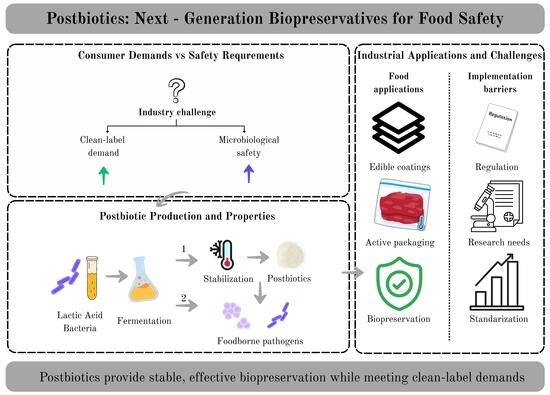

Postbiotics represent a promising strategy for reconciling increasing consumer demand for clean-label foods with the need to maintain high microbiological safety standards. The present review analyzed the applications of postbiotics in meat products, other food matrices and bioactive packaging, with particular emphasis on their production methods, compositional analysis and antimicrobial properties. Available evidence indicates that postbiotics offer important technological advantages over live probiotics, including enhanced stability during processing and storage and the absence of viable cells, which facilitates their integration into established food quality and safety control systems. The reviewed studies show that postbiotics produced mainly via fermentation with selected lactic acid bacteria and subsequently stabilized, most often by freeze-drying, exhibit pronounced antimicrobial activity in diverse food matrices, particularly meat and dairy products. Their ability to inhibit the growth of major foodborne pathogens, such as Listeria monocytogenes, Staphylococcus aureus, Escherichia coli, and Salmonella spp., highlights their potential as effective biopreservatives contributing to shelf-life extension and improved microbiological safety. From an industrial perspective, postbiotics can be implemented within the framework of hurdle technology and incorporated into active packaging systems and edible coatings. The wider use of postbiotics in industry remains limited by regulatory uncertainty and methodological diversity. Key challenges include inconsistent taxonomic/strain reporting, divergent methods of inactivation and final processing (which alter bioactive profiles), lack of standardized composition and potency testing, and limited food matrix validation and toxicological data. To eliminate these gaps, regulatory definitions and labelling should be harmonized, and guidelines for production and reporting (strain identity, inactivation parameters, preservation method), and targeted safety and shelf-life testing are recommended. These steps are necessary to translate the documented antibacterial and antioxidant properties of postbiotics into industrial applications.

Graphical Abstract

1. Introduction

Consumers are becoming increasingly aware of food processing methods and the composition of food products. As a result, they tend to choose items that align with the clean-label concept, which is associated with short, transparent, and easily understandable ingredient lists [1]. This trend has contributed to increased consumer interest in the use of natural preservatives, herbs, spices, and microbial metabolites [2]. Among these alternatives, postbiotics represent an innovative strategy for improving food quality and safety [2].
Meat processing involves the use of, among others, nitrate (E251) and sodium nitrite (E250) as well as synthetic antioxidants, including butylated hydroxytoluene (BHT, E321), butylated hydroxyanisole (BHA, E320) and tert-butylhydroquinone (TBHQ, E319), but their use is regulated due to potential health risks [3,4]. Nitrites can react with amines, forming nitrosamines with documented carcinogenic properties [5]. Moreover, BHT, BHA, and TBHQ are associated with the risk of allergic reactions and toxicological effects with long-term consumption [6,7]. In response to these consumer challenges related to the clean label trend, postbiotics may represent an innovative strategy for improving the quality and safety of food products [2].
Postbiotics, according to the consensus definition of the International Scientific Association of Probiotics and Prebiotics (ISAPP), are “a preparation of inanimate microorganisms and/or their components that confers a health benefit on the host” [8]. Unlike probiotics, postbiotic preparations do not contain viable microbial cells in the final product [9]. Compounds typically classified within this group include bacteriocins and bacteriocin-like compounds (BLC), organic acids, fatty acids, hydrogen peroxide (H2O2), ethanol, and reuterin, many of which have documented antimicrobial and antioxidant properties [10]. Numerous studies have demonstrated that postbiotics exhibit a broad spectrum of biological activity, including antioxidant effects [11] and antimicrobial properties against key food-borne pathogens, such as L. monocytogenes [11,12], S. aureus [11,13], E. coli [11], Salmonella Typhimurium [13], and Clostridium botulinum [14]. Their ability to inhibit both spoilage microorganisms and foodborne pathogens makes them a promising tool in modern food preservation strategies [10]. In addition to their antimicrobial functions, postbiotics have been shown to reduce lipid oxidation, which is a key aspect in extending the shelf life of food products [11,15,16]. The metabolites they contain can neutralize reactive oxygen species or chelate pro-oxidative metal ions, thereby slowing down the initiation and propagation of lipid peroxidation reactions [10]. As a result, their use not only inhibits the growth of undesirable microbiota but also improves the oxidative stability of food, which can be important for maintaining the sensory quality and nutritional value of products during storage. The activity of postbiotics results from the presence of various bioactive compounds, such as bacteriocins, organic acids, phenolic compounds, and flavonoids [14]. Bacteriocins, which are peptides or proteins synthesized by bacteria and archaea, exhibit strong antimicrobial activity by binding to lipid II (a chief transporter of peptidoglycan subunits from the cytoplasm to the cell wall) and forming pores in the cytoplasmic membrane, leading to destabilization of the membrane potential, inhibition of ATP synthesis, and bacterial cell death [17]. Organic acids (lactic, acetic, propionic) have an antimicrobial effect due to the diffusion of the undissociated form into the cell, lowering the intracellular pH, metabolic disturbances, and ATP depletion as a result of osmotic stress [18]. Phenols, polyphenols, and flavonoids, including catechins and quercetin, exhibit antimicrobial activity by damaging cell membranes and inhibiting the activity of enzymes key to microbial metabolism, while also acting as powerful antioxidants that limit the oxidation of meat lipids [19]. In recent years, there has been growing interest in the use of postbiotics in the food sector, resulting from the increasing demand for food free from synthetic preservatives [14].
Lactic acid bacteria (LAB), many of which hold GRAS (Generally Recognized as Safe) or QPS (Qualified Presumption of Safety) status, are the most commonly used microorganisms in the production of postbiotics. Among the most commonly used species are Lactiplantibacillus plantarum, Lactobacillus acidophilus, Pediococcus acidilactici, Latilactobacillus sakei, Latilactobacillus curvatus, Ligilactobacillus salivarius, and Lactobacillus delbrueckii subsp. bulgaricus [10,20]. In recent years, there has also been growing interest in microorganisms outside the LAB group. These include yeasts (Saccharomyces boulardii) and bacteria such as Enterococcus faecium, Eubacterium hallii, or Akkermansia muciniphila [20].
Postbiotics show greater stability during food processing than live probiotic or protective cultures. Live probiotics are sensitive to pH and temperature, which limits their shelf life in food matrices. In addition, the presence of viable protective cultures increases the total viable count (TVC), which may be misinterpreted as product spoilage [14,21,22]. For these reasons, postbiotics are increasingly investigated as an alternative biopreservation strategy. The application of postbiotics responds to key needs of the food industry, including delaying spoilage processes and ensuring the microbiological safety of products, in line with the trend towards natural and sustainable food preservation methods [14].
Therefore, this review focuses on the production methods, compositional characteristics, and antimicrobial properties of postbiotics, with particular emphasis on their application in meat products and other food matrices. In addition, it addresses the incorporation of postbiotics into edible films and active packaging systems as platforms for delivering bioactive components and extending product shelf life.

2. Regulations Concerning Postbiotics

Industry-oriented analyses highlight that postbiotics are currently variably classified across jurisdictions (e.g., as food ingredients, novel ingredients, supplements, or therapeutic agents), which leads to divergent data requirements and approval pathways, complicating commercialization [23]. Such regulatory heterogeneity reflects the absence of a dedicated postbiotic category in most jurisdictions, forcing manufacturers to navigate multiple existing legal frameworks depending on the intended use and product format [23,24].
In the European Union (EU), food regulations cover both general principles for ensuring consumer safety and specific requirements for the use of health claims [24]. However, the lack of a uniform position on the definition of postbiotics is a significant obstacle to the development of a coherent and unambiguous legal framework for this group of ingredients [8,24]. At present, the EU has not established any postbiotic-specific regulation, so these products must be assessed within existing categories such as foods, food supplements, medicinal products, or novel foods, depending on their intended use [23,24].
Products containing inactivated microorganisms are usually assessed on a case-by-case basis, most often under Regulation (EU) 2015/2283 [25] on novel foods and in the context of health claim regulations. In practice, the safety assessment may be facilitated by granting QPS status to the species/strain, while the lack thereof requires a detailed assessment at the strain and inactivation process level [26]. For example, EFSA continues to update the QPS list [27] and makes guidelines on application requirements for novel foods publicly available, as well as issuing individual opinions on the safety of preparations containing non-viable microorganisms (e.g., opinion on inactivated Saccharomyces cerevisiae as a feed additive [28]. EFSA has emphasized that, for non-viable microbial preparations, the inactivation process, batch-to-batch reproducibility, and full compositional characterization are key determinants of safety [26,29].
If a product is classified as a novel food, an extended safety assessment is required, including toxicological data [29]. EFSA has assessed the safety of several preparations of non-viable bacteria, for which the characteristics of the inactivation process were a key element of the safety evaluation. These preparations did not obtain QPS status in their live form, but some of them were positively assessed for use as novel foods after obtaining the consent of the European Commission [26,29].
Importantly, this lack of postbiotic-specific legislation is not unique to the European Union. In other major markets, including North America, Australia/New Zealand, and Japan, products based on inactivated microorganisms are likewise regulated within existing legal categories (such as food ingredients, novel foods, supplements, or foods with health claims) rather than under a dedicated postbiotic framework, resulting in jurisdiction-specific data requirements, labelling rules, and authorization pathways [23,24].
Because the ISAPP definition is scientific rather than legal, regulatory authorities in all jurisdictions apply their own statutory definitions and evidentiary standards, which creates uncertainty for manufacturers seeking international commercialization of postbiotic products [8].
Consequently, the frequently stated conclusion that the industrial application of postbiotics is “limited by regulations” should be understood as a global issue arising from the absence of harmonized legal definitions, standardized characterization criteria, and aligned regulatory pathways, rather than as a problem restricted solely to the European Union [8,23,24].

3. Postbiotic Production

3.1. Microorganisms

LAB are the most commonly used in the production of postbiotics. Among the microorganisms used, the dominant strains were P. acidilactici [30,31,32] and L. acidophilus [33,34,35]. L. plantarum [33,36] and Bifidobacterium animalis subsp. lactis [34,37] were also frequently used. Several studies also used other microorganisms of the Pediococcus spp. [32] and Lactobacillus spp. without specifying the strain species [38]. In addition, other LAB have also been used in a few cases, such as Streptococcus salivarius subsp. thermophilus [39], L. delbrueckii subsp. bulgaricus [39], Lacticaseibacillus casei [36], L. sakei [40], Lactiplantibacillus pentosus [41], Lactococcus lactis [32] and Pediococcus pentosaceus [32]. Some of the analyzed studies also reported the use of commercially available mixtures of LAB [42] and Saccharomyces cerevisiae var. boulardii yeast [43].

3.2. Postbiotic Production Steps

The fermentation process has a key role in postbiotic production. It is a crucial element that determines the composition and properties of the metabolites obtained [44]. Depending on the applied strategy, either submerged or solid-state fermentation is employed [44]. This process is carried out using selected strains of microorganisms, cultivated under conditions optimized for each strain [44]. The type of fermentation substrate used has a significant impact on the efficiency of the process, the concentration of metabolites produced, and their functional properties and bioactivity [44,45]. This can be a laboratory culture medium (e.g., De Man, Rogosa, and Sharp (MRS) broth) as well as milk proteins, whey, and, in industrial production, cane straw, wheat bran, or corn straw [45,46,47,48]. After the fermentation process is complete, the selection of subsequent processing stages depends on the nature of the target metabolites, which may be intracellular, extracellular compounds, or a combination of both [45].
The fundamental difference between the processing of these two fractions is the need to apply a cell lysis step in the case of intracellular metabolites, which is not required for extracellular metabolites secreted directly into the fermentation broth [45]. The most commonly used methods for obtaining intracellular fractions of postbiotics include thermal processes such as pasteurization, sterilization, and steam heating, which damage the cellular structures of microorganisms, leading to the loss of cell viability and the release of intracellular metabolites. In the case of extracellular metabolites, this stage is omitted [49,50].
Research indicates significant diversity in the conditions for culturing microorganisms used in the production of postbiotics, including both the type of culture media used and the incubation parameters and methods of postbiotics preservation (Table 1). In many studies, the culture medium consisted of dairy products, such as skimmed milk or whey, which are rich sources of nutrients necessary for the intensive growth of lactic acid bacteria [33,34,37,39]. Considerable variability was observed in incubation parameters across studies. Temperatures were strain-dependent and most commonly fell within 30–40 °C, with 37 °C used most frequently. Aerobic conditions predominated [30,33,34,35,37,38,39,41,42,43], while anaerobic cultivation was reported only sporadically [31,32,36,40]. Media were often enriched with growth-promoting additives, most notably lactose (0.18–3.9%) [35,37] and yeast extract at variable levels [33,34]. These supplements are added to increase the metabolic activity of bacteria and improve the efficiency of bioactive compound synthesis.
The next stage of the process is to separate the cell biomass from the fraction containing metabolites by centrifugation, followed by filtration [51]. The postbiotics obtained can be further subjected to additional preservation and modification processes, such as encapsulation, freeze-drying, or concentration [45]. However, liquid-phase removal and drying methods differ in their impact on bioactive constituents: thermal evaporation and high-temperature drying frequently lead to loss of volatile bioactives, while freeze-drying is generally considered a gentler approach and is commonly used to better preserve labile biomolecules. Nevertheless, losses of particular volatile metabolites may still occur during freezing and subsequent primary/secondary drying depending on compound volatility, product matrix, and process parameters; therefore, the choice of preservation and encapsulation strategy should be made case-by-case to retain functional activity [45,52,53]. In the majority of studies, the obtained postbiotic preparations were subjected to freeze-drying [33,35,36,37,38,39,40,42]. The process was carried out under low-pressure conditions, while temperature and process duration varied depending on the protocol. Such a wide variation in cultivation and preservation parameters indicates a lack of a standardized protocol, which makes it difficult to directly compare the results obtained by different researchers and, at the same time, highlights the need to develop technological standards that enable the repeatable and effective production of postbiotics with specific functional properties.
However, it should be emphasized that it is not only processes such as steaming or freeze-drying that can lead to the loss of volatile bioactive compounds. Meat processing can also compromise their stability through different pathways. The mechanisms and effects of these interactions depend on the nature of the compound, the process parameters, and the meat matrix [54]. Curing (sodium chloride (NaCl)) ± nitrites/nitrates) inhibits the growth of bacteriocin-producing cultures and reduces the production of postbiotics, as demonstrated in a study by Papagianni et al. (2013) [55]. Chemical reactions involving nitrites and changes during maturation or curing can also modify amino and peptide residues, altering the biological activity and detectability of bioactive peptides [56]. Heat treatment (pasteurization, cooking, baking) usually causes protein denaturation and degradation of many thermostable peptides, which can lead to the loss of biological activity of various compounds. At the same time, bacteriocins (e.g., nisin) exhibit significant thermal resistance, which allows them to be used in selected thermal processes or after prior stabilization [57]. Freezing and freeze–thaw cycles also affect muscle tissue structure and protease activation, which in turn can lead to modification and partial degradation of peptides and changes in the antioxidant and antibacterial activity of postbiotics [58]. However, the number of cycles and the freezing rate should be taken into account, as these determine the scale of the changes. Although drying and smoking processes lead to the concentration of compounds, they also cause the oxidation of lipids and proteins and additional Maillard reactions, which may also degrade some bioactive peptides [59].
The use of postbiotics in meat products, therefore, requires the adjustment of strategies (selection of strain/compound, timing of application—before/after processing, use of carriers/molecular protection) and validation of stability and functional activity in the target matrix and under target technological conditions using combined analytical methods.
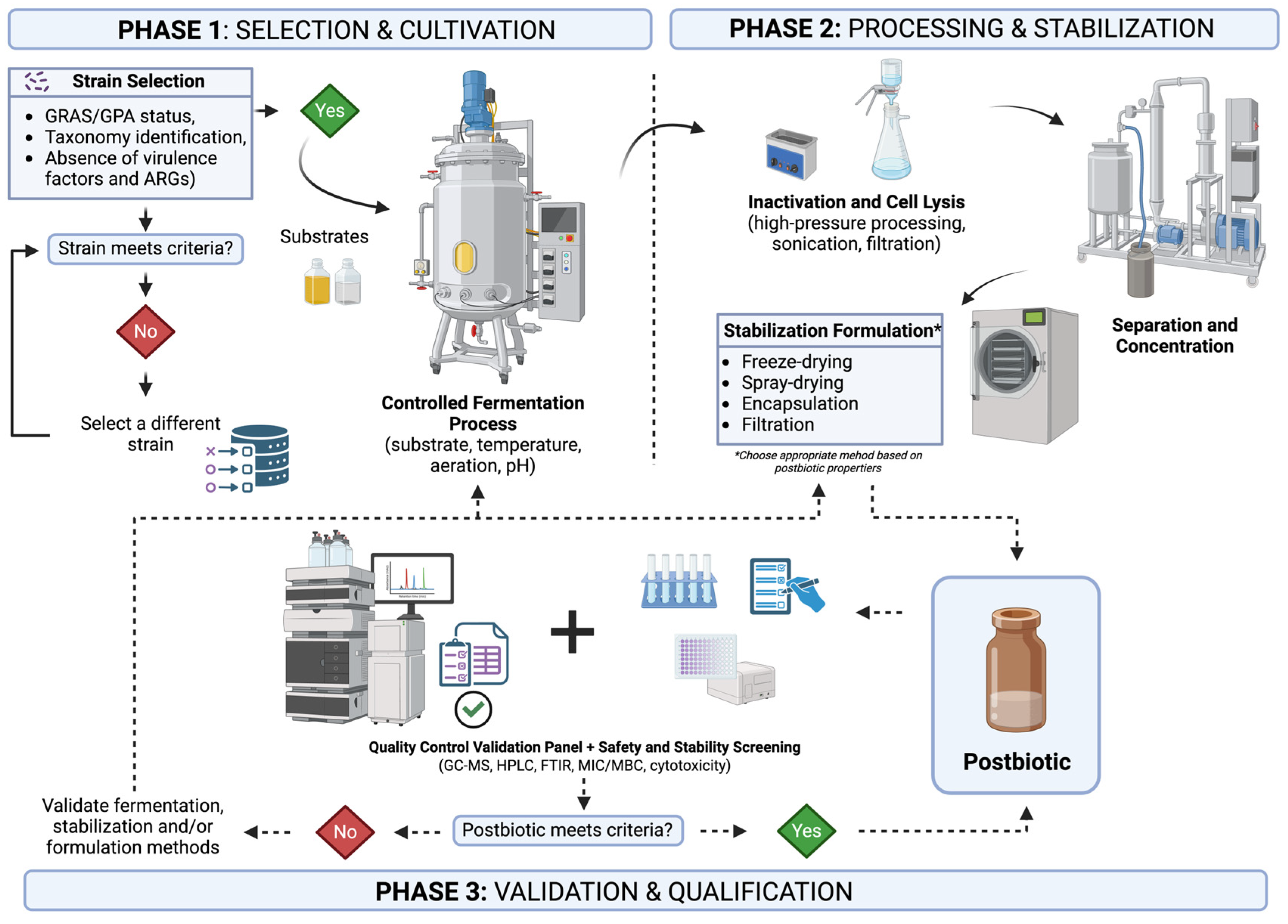
A summary of the postbiotic production process, including key decision points shown in Figure 1.

3.3. Standardization Challenges

In the production of postbiotics, there is considerable interchangeability of parameters, including the selection of strains (e.g., S. thermophilus [39], L. delbrueckii subsp. bulgaricus [39], B. animalis subsp. lactis [37], L. acidophilus [33,35], L. plantarum [33,36], Pediococcus spp. [30,31], S. boulardii [43]), the type of medium (skimmed milk [33,35,37,39], whey [34,35,36,37,39], MRS [31,32,36,38,40,41,42], TSB [30], YMB [43]), and incubation and culture conditions (temperatures ~30–46 °C, incubation times ~20–68 h, aerobic or anaerobic conditions), while using various nutritional supplements (including lactose in concentrations of 0.18–3.9% and yeast extract 1.0%), which suggests different metabolic conditions affecting the profile of metabolites produced—Table 1. In addition, the differentiation concerns the final forms and processing procedures (including different lyophilization parameters, as well as the direct use of CFS, preparation of postbiotic solutions, 10%/50%/100% dilutions, rehydration or dissolution of 1 g of material in 1 mL of phosphate buffer) implies significant differences in the stability, storage and methods of application of the final material—Table 1. Therefore, the comparability of results between studies is limited without the standardization of key production parameters, which justifies the need for precise reporting: composition and type of matrix, incubation temperature and time, aerobic/anaerobic conditions, supplements used with indication of concentrations and details of final processing, as well as the obligation to characterize the quality and quantity of the final product in order to link production conditions to the biological effect and enable the standardization of protocols adapted to the specific strain and matrix used.

4. Methods for Analyzing the Composition and Effectiveness of Postbiotics

The chemical composition of postbiotic preparations is complex and variable, due to differences in strain metabolism and culture conditions. As a result, various analytical methods are required for their comprehensive characterization [36,60]. Understanding which bioactive components are present in postbiotic preparations is essential to elucidate their mechanisms of action. The identification of individual compounds, such as organic acids, phenols, or flavonoids, allows the chemical structure to be linked to the observed biological activity [14]. Therefore, multiple analytical techniques are typically combined to achieve a thorough chemical characterization [36]. Organic acids (e.g., lactic acid, acetic acid), phenolic compounds, and flavonoids are the most common and dominant low-molecular-weight components of postbiotics [61]. Organic acids form the basis of the CFS fraction and are responsible for a significant part of the antimicrobial activity, while phenols and flavonoids, although in lower concentrations, significantly support antioxidant, antibacterial, and anti-biofilm activity [61,62]. Other classes of compounds present in postbiotics (bacteriocins, hydrogen peroxide, biosurfactants) also participate in the activity, but these three groups are the most popular [63].

4.1. Postbiotic Composition Analysis

4.1.1. Spectrophotometric Methods

Spectrophotometric methods are commonly used for the quantitative determination of the main groups of bioactive compounds in postbiotics. The Folin–Ciocalteu reagent method is used to determine the total phenolic content (TPC) [14]. These methods allow for a quick assessment of the antioxidant potential of postbiotic preparations.

4.1.2. Chromatographic Methods

Gas chromatography with mass spectrometry (GC-MS) allows for a much broader chemical profiling of postbiotics [36,60]. This method reveals a wide range of bioactive metabolites whose presence and concentration are highly variable, and whose chemical signatures depend fundamentally on the specific microbial strain, culture conditions, and analytical methods used for their identification [60,64]. This variability in metabolic profiles is directly linked to the functional properties of postbiotics, such as their antimicrobial activity.
A detailed analysis reveals fundamental metabolic differences between various microorganisms, which directly affect their potential applications. The metabolomic profile of the postbiotic from S. cerevisiae var. boulardii ATCC MYA-796 includes unique compounds such as Ergotaman-3′,6′, 18-trione, and 5,10-diethoxy-2,3,7,8-tetrahydro-1H,6H-dipyrrolo [1,2-a:1′,2′-d]pyrazine, which have documented antibacterial, anti-inflammatory, and antioxidant properties [43]. This profile differs significantly from the metabolites generated by probiotic bacteria; for example, 3-phenylmalic acid (PLA), considered a chemical marker for certain strains of L. plantarum, was not detected in the yeast-derived postbiotic preparation [43]. Further evidence of this diversity is provided by the profile of Lactobacillus spp. RM1, in which 6-octadecenoic acid methyl ester and hexadecanoic acid methyl ester were identified as the main components, differing from the compounds produced by L. plantarum K35 [65].
Significant differences in the chemical composition of postbiotics are observed even within the Lactobacillus genus, although certain metabolic components remain common. Benzoic acid and cyclopentane are commonly detected in CFS from various strains [60]. Interestingly, pyrrolo [1,2-a]pyrazine-1,4-dione, considered to be a compound with antimicrobial and antioxidant properties [66], has been identified both in supernatants of various Lactobacillus spp. strains [60] and in the S. cerevisiae–derived postbiotic [43], which may suggest the existence of common metabolic pathways or conserved functional roles. In addition to these common components, there are dominant compounds specific to a given strain. For example, in the postbiotics analyzed in the study by Moradi et al. 2019 [60], compounds such as 6-octadecanoic acid methyl ester (44.13%) predominated. In turn, the analysis of L. plantarum and L. casei metabolites showed significant production of succinic acid, a key intermediate compound in the Krebs cycle [36]. Some strains, such as Lactobacillus rhamnosus GG, exhibit a particularly rich and diverse volatile profile with high levels of acetone and isovaleric aldehyde, especially after processing techniques such as pascalisation (high-pressure processing, HPP) [64].
The identified metabolites are considered to have significant functional importance, primarily antimicrobial activity. For example, long-chain fatty acids (C16-C18) exhibit antifungal properties against pathogens such as Rhizoctonia solani, as confirmed by Walters et al. (2004) [67], and lauric acid from L. salivarius has the ability to remove biofilm, as suggested by Stenz et al. (2008) [68]. Monoterpenes, such as 1,8-cineole, are characterized by a broad spectrum of activity [11]. However, it is crucial to link these functions to the research technique used. Functional analysis must be supported by appropriate validation, to confirm that the observed antifungal activity comes from organic acids, it is necessary to neutralize the pH of the postbiotic. This aspect was demonstrated for postbiotics derived from Lactobacillus spp. RM1, where this treatment reduced activity by 50% [38]. Furthermore, the choice of sample preparation method, e.g., freeze-drying, which eliminates hydrogen peroxide [60], significantly narrows the interpretation of antimicrobial activity to non-volatile and thermally stable compounds, which is a key limitation when comparing results. The development of postbiotics, therefore, depends on the standardization of complex procedures, which will ensure the reproducibility of results and enable reliable functional validation of these promising biopreparations.

4.1.3. Other Analytical Methods

Analysis of FTIR spectra showed that shifts in the hydroxyl (~3200–3400 cm−1) and carboxyl (~1600 cm−1) regions indicate the formation of intermolecular hydrogen bonds and electrostatic interactions between the bioactive components of postbiotics and the alginate polymer matrix, which directly contribute to the cohesion and stability of the coating [11]. Precise characterization of the chemical composition provides the basis for the next stage of research, which is to verify the biological efficacy of these preparations in in vitro and in situ systems [60].

4.2. Postbiotic Effectiveness Analysis

Assessing and verifying the functional potential of postbiotics requires a multi-stage efficacy evaluation: from preliminary in vitro tests to validation in target food matrices. This evaluation includes a wide range of methods that allow for the analysis of antimicrobial, antioxidant, and other functional properties [60].

4.2.1. Antimicrobial Activity

Primary methods for assessing antibacterial efficacy include agar diffusion methods, such as the disc diffusion assay (DDA) and its variant, the well diffusion assay (WDA), which have been used in numerous studies [11,14,33,36,43,60,69].
Evaluating the potential applications of postbiotics in the food industry requires testing their activity against several key pathogens and microorganisms that cause food spoilage. Studies typically cover key foodborne pathogens that pose a serious threat to public health, such as L. monocytogenes [11,33,36,60,69], E. coli [11,33,43,69,70], S. aureus [11,33,43,69], C. botulinum [14], Salmonella spp. [11,33,43], Pseudomonas aeruginosa [43,70], Bacillus cereus [11,43], and Proteus mirabilis [70]. Following an initial assessment using diffusion methods, the next step is to apply methods that allow for a more precise determination of inhibitory concentrations.
After preliminary screening using diffusion methods, which allow for qualitative assessment, broth dilution methods are used to obtain precise quantitative data. These methods are crucial for the precise determination of the minimum inhibitory concentration (MIC) and minimum bactericidal concentration (MBC), which is the most accurate method for assessing the antimicrobial activity of postbiotics [33,36,43].
Davarzani et al. (2024) [33] evaluated the activity of postbiotics derived from L. acidophilus (LA) and L. plantarum (LP) strains and their freeze-dried mixture. Postbiotics from LA showed a stronger effect than mixture fractions. L. monocytogenes was the most sensitive to growth inhibition at 4.6 μg/mL LA, while S. aureus, E. coli, and S. Typhimurium required 6.25, 6.50, and 7.0 μg/mL, respectively. The combination of fractions significantly increased antibacterial activity (p < 0.05), reducing MIC/MBC to ≈3.75 μg/mL for L. monocytogenes, 4.25 μg/mL for S. aureus, and 5.0 and 6.75 μg/mL for E. coli and S. Typhimurium.
While MIC and MBC values provide fundamental data on the intrinsic activity of an antimicrobial substance, their direct translation to food conditions is limited. Therefore, the concept of minimum effective concentration (MEC) is introduced in application studies. This is a measure used to assess activity in complex food matrices such as meat or milk. MEC provides more practical information than MIC because it considers potential interactions with food components that may weaken or enhance the effect of bioconservatives. Moradi et al. (2019) [60] demonstrated that the MEC of postbiotics from Lactobacillus spp. depends on the matrix: for L. salivarius, the MEC was 5 mg/mL in broth, 15 mg/mL in milk, and 30 mg/mL in minced beef; for L. acidophilus LA5, the MEC was 15 mg/mL in broth and 45 mg/mL in both milk and beef. The analysis demonstrated that the efficacy of postbiotics strongly depends on the matrix: higher concentrations were required in food models because food components—particularly proteins and fats—can bind or sequester antimicrobial compounds, reducing their bioavailability and activity. In practice, this means that MIC/MBC results obtained in vitro must be verified under actual industrial conditions [60].

4.2.2. Antioxidant Activity

The antioxidant potential of postbiotics is measured using tests based on free radical scavenging potential [33]. One of the most commonly used tests is the DPPH (2,2-diphenyl-1-picrylhydrazyl) radical test. The ABTS (2,2′-azino-bis(3-ethylbenzothiazoline-6-sulfonic acid)) cationic radical test is also widely used [11,33,43,71,72]. These analytical techniques provide a quantitative measure of antioxidant potential, which is ultimately derived from specific biochemical compounds within the postbiotic preparations. The antioxidant activity of postbiotics from LAB is often attributed to their being a source of antioxidant compounds with radical scavenging potential [72]. This activity is directly correlated with the presence of phenolic and flavonoid compounds [71].
In addition to the well-known role of phenolic compounds, postbiotics contain many other bioactive compounds that contribute to their antioxidant properties. The well-known antioxidant butylated hydroxytoluene (BHT) has been identified in postbiotics from B. bifidum [11]. Neutral exopolysaccharides isolated from L. plantarum have shown excellent radical scavenging ability [73]. In addition, S. cerevisiae can biosynthesise the natural antioxidant ergothioneine [74].
The DPPH test is used as a key reference point for quantitatively determining and comparing the free radical scavenging activity of postbiotics. The characteristics associated with this designation are essential for the selection of postbiotics for use in functional foods. The postbiotic derived from L. acidophilus showed a significantly higher percentage of DPPH removal (58.53%) compared to the postbiotic derived from L. plantarum (47.35%) [33]. Postbiotics derived from Bifidobacterium spp. showed DPPH radical scavenging activity ranging from 50.28 to 51.56 mg TEAC/100 mL [11]. In contrast, in this study, the combination of postbiotics from Bifidobacterium bifidum DSM 20,456 and BB12 showed the highest activity in its group, amounting to 51.56 ± 1.63 mg TEAC/100 mL [11].

4.2.3. Other Functional Properties

The ability of postbiotics to remove bacterial biofilms, including those formed by L. monocytogenes, is quantitatively assessed using the crystal violet test [60]. This method allows for the determination of the total biofilm biomass and the assessment of the effect of the tested preparation on the adhesion and structural stability of the biofilm, but it does not allow for the differentiation between changes in the number of living cells and changes in the amount of extracellular matrix; therefore, its interpretation should be supplemented with other tests [75]. In order to assess the safety of potential applications of postbiotics, their cytotoxicity towards eukaryotic cells, e.g., L929 fibroblasts, is tested using a test using a 3-(4,5-dimethylthiazol-2-yl)-2,5-diphenyltetrazolium bromide (MTT) assay, which measures cell metabolic activity [60,76]. This test is commonly used as an indicator of cell viability and as a complementary tool for assessing antimicrobial activity [77]. In order to distinguish the mechanisms of action of cell-free supernatant (CFS) components, pH neutralization is used, whereby loss of activity after pH equalization indicates the dominant role of organic acids, while its maintenance suggests the involvement of pH-independent compounds such as peptides or bacteriocins [78]. Further verification of the nature of these compounds is provided by enzymatic treatment (e.g., with proteinase K). The disappearance of activity after the enzymatic process is strong evidence of the protein/peptide nature of the active substance, which has direct technological consequences (stability in food matrices, sensitivity to gastrointestinal enzymes, the need for encapsulation or formula modification [79].

5. The Use of Postbiotics in Various Food Matrices

The use of different strains for the production of postbiotics affects their activity in different food matrices: preparations derived from Pediococcus (especially P. acidilactici) showed the strongest effects in meat models, especially when used in combination with additional agents (e.g., chitosan) or applied at high concentrations, achieving multi-log reductions in L. monocytogenes and S. Typhimurium in frankfurters and chicken fillets [30,31]. Preparations from the Lactobacillaceae family showed a broad spectrum of activity and usefulness in coatings, marinades, and dairy products, but their effectiveness was more variable and in many cases required higher concentrations (e.g., 20–40%) or specific forms of application to yield significant reductions in real food matrices [12,34,36,40,80]. Postbiotics produced from yeast (S. cerevisiae var. boulardii) generally showed only small inhibition zones in diffusion tests on meat, suggesting lower antibacterial efficacy compared to selected postbiotics in these applications [43].
In general, minimum effective concentrations (MEC) are considerably higher in complex matrices such as milk or minced meat than in in vitro media/incubations. This matrix effect, driven by binding to proteins and fats and by diffusion barriers, reduces the availability and activity of bioactive compounds, which explains the need for higher doses in food [80,81]. Among the strains analyzed, the most consistent and strong effects were shown by postbiotics derived from L. plantarum, L. rhamnosus, and P. acidilactici, whereas preparations based on Lactococcus lactis and L. casei displayed more variable activity that depended strongly on matrix and concentration.
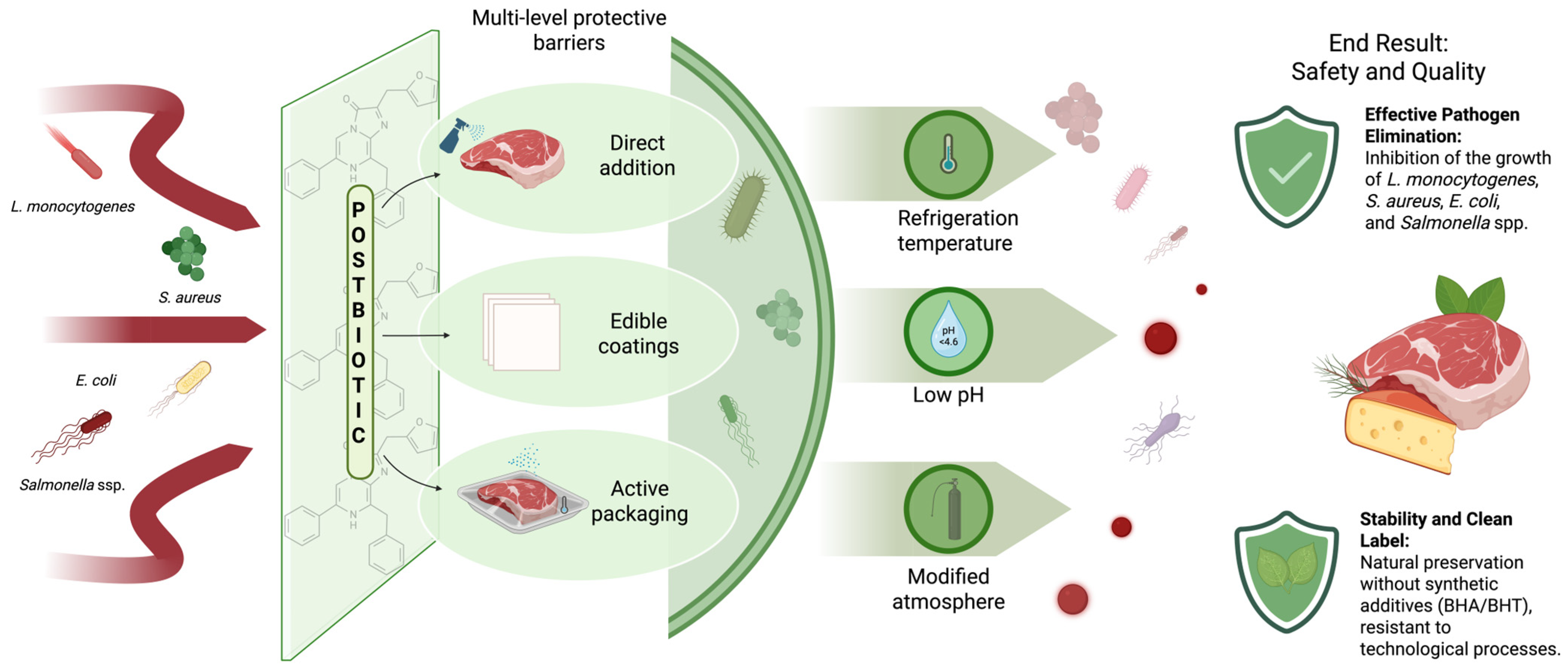
The most promising application technologies are surface coatings, active packaging systems, and combined formulas (e.g., postbiotic + chitosan) (Figure 2). These approaches increase local concentrations of the antimicrobial agent and can exploit synergistic mechanisms of action; however, because effectiveness varies significantly between matrices, pilot studies are required for each specific product to determine MEC, perform sensory evaluation, and assess shelf life [30,31,42,81].
Below, we summarize representative findings in two major food categories—meat and dairy—that illustrate the strain- and matrix-dependent behaviour described above.

5.1. Meat and Meat Products

Meat and meat products are a valuable source of complete protein, vitamins, and minerals, but due to their high water and nutrient content, they are highly susceptible to oxidation and microbial contamination, which leads to reduced quality and a shorter shelf life [4]. In order to limit the degradation of raw materials and extend the shelf life of meat products, chemical additives such as nitrates, nitrites, and synthetic antioxidants have been used for many years. Although they effectively inhibit oxidation processes and the growth of undesirable microbiota, their use is increasingly restricted due to potential health risks and growing consumer aversion to chemical preservatives [3]. One of the alternative and increasingly researched solutions in the meat industry is the use of postbiotics [82,83]. Their addition to meat products can be an effective strategy for limiting adverse oxidative changes in lipids and proteins, and consequently contribute to improving the shelf life, safety, and health benefits of meat products [84].
Several studies have evaluated the antimicrobial properties of postbiotics in meat matrices such as mutton [85], beef [12,40,60,80,81], chicken breast fillets [30], frankfurters [31], emulsion-type sausage [32], and hot dogs [86] (Table 2). Moradi et al. (2019) [60] evaluated the potential of postbiotics derived from LAB (L. acidophilus LA-5, L. casei 431, and L. salivarius) to inhibit the growth of L. monocytogenes both in vitro and in ground beef. The authors demonstrated that the extracellular supernatants of all three strains exhibited significant antimicrobial activity, stable over a wide pH range, and were partially resistant to temperature. Postbiotics obtained from L. salivarius showed the highest efficacy in inhibiting the growth of L. monocytogenes in meat, achieving a growth inhibition zone of nearly 25 mm, which indicates their potential for use as natural, safe biopreservatives in meat products. Studies on beef samples showed that a marinade containing tenfold concentrated CFS of L. plantarum inhibited the growth of S. Typhimurium, L. monocytogenes, S. aureus ATGC 29213, and E. coli in beef samples marinated under refrigerated conditions for 14 h, as confirmed by an inhibition zone of 24.89 ± 2.82 mm; 20.39 ± 3.57 mm; 20.53 ± 2.32 mm [80]. In contrast, Hartmann et al. (2011) [81] reported that CFS produced by various LAB strains (Enterococcus sp., L. curvatus, L. plantarum, L. sakei, L. lactis, Leuconostoc carnosum, P. acidilactici, Staphylococcus sciuri) used in concentrations ranging from 2% to over 10% reduced the population of L. monocytogenes by 2.30 log CFU/g in minced beef stored for 6 days at 4 °C. Beristain-Bauza et al. (2017) [40] observed that the addition of CFS L. sakei to whey protein coatings reduced the number of L. monocytogenes by 1.40 log CFU/g on fresh beef after 5 days of storage in a refrigerator. The antimicrobial properties of postbiotics were also confirmed by Valipour et al. (2024) [12], who observed significant anti-listerial activity of a postbiotic obtained from L. sakei in beef tenderloin—the use of 40% postbiotic effectively inhibited the growth of L. monocytogenes, reducing its count by more than 3.00 log CFU/mL during 15 days of storage.
Another example is the use of postbiotics to extend the shelf life of chicken breast fillets [30] and other meat products [31,86]. Ünlü et al. 2016 [86] demonstrated that freeze-dried CFS powders containing bacteriocins (nisin, nisin-like compounds, curvacin A, curvacin L442, bavaricin MN) derived from various LAB strains (L. lactis subsp. lactis ATCC 11454, L. lactis subsp. cremoris ATCC 14365, L. lactis BFE 920, L. bavaricus MN, L. curvatus LTH 1174, L. curvatus L 442) and applied to the surface of sausages, led to a significant reduction (4.00 log CFU/mL compared to the control sample) of L. monocytogenes during 4 weeks of storage at 4 °C, without any negative impact on the sensory properties of the product. The antibacterial effects of postbiotics have also been demonstrated in combination with chitosan [30,31]. In a study by İncili et al. 2021 [30], the use of postbiotics at concentrations of 10% and 50% obtained from P. acidilactici also reduced the number of L. monocytogenes by approximately 1.30 log CFU/g and S. Typhimurium by approximately 1.00 log CFU/g in meat samples. The same study also used a combination of postbiotics at an appropriate concentration with chitosan, which further enhanced the antimicrobial effect. The use of this system resulted in an additional reduction in the growth of L. monocytogenes by approximately 1.50 log CFU/g, regardless of the postbiotic concentration. Furthermore, the abundance of S. Typhimurium in samples containing 10% postbiotic with chitosan and 50% postbiotic with chitosan was significantly lower compared to control samples on day 0 and amounted to approximately 1.50 and 2.10 log CFU/g, respectively (p < 0.05) [30]. In another study, İncili et al. (2022) [31] analyzed the effect of chitosan enriched with the postbiotic P. acidilactici on foodborne pathogens. The results showed that the combination of postbiotic and chitosan (1.0% chitosan + 100% postbiotic) effectively inhibited the growth of L. monocytogenes, S. Typhimurium and E. coli on the surface of sausages, reducing their growth by an average of 5.00 log CFU/g, 4.00 log CFU/g, and 1.00 log CFU/g, respectively, on day 35 of storage compared to the control sample, while exhibiting a synergistic effect on the total viable count (TVC) of microorganisms, including LAB, mould and yeast, without affecting the pH and colour of the product. Similar effects in relation to L. monocytogenes were observed in studies by Bungenstock et al. (2021) [32], Junges Da Costa et al. (2021) [85], and Ünlü et al. (2016) [86]. The application of CFS E. faecium EO1 resulted in a reduction in L. monocytogenes (4.07 log CFU/g) in fresh sheep sausage after 30 days of storage at refrigeration temperature [85], while CFS obtained from P. acidilactici reduced the number of this pathogen already on day 0 [32]. Ünlü et al. (2016) [86] also reported a decrease in the number of L. monocytogenes after the application of freeze-dried, cell-free supernatants of LAB strains on the surface of frankfurters.

5.2. Dairy Products

Due to their popularity and widespread consumption, dairy products are an excellent matrix for enriching the diet with functional ingredients such as probiotics, prebiotics, plant fibres, and bioactive extracts [87]. In recent years, postbiotics have also been attracting increasing interest. They can be produced in culture media, food products, or the digestive tract, which makes dairy products a promising strategy for their application [39].
Previous studies have focused on evaluating the properties of postbiotics in dairy matrices such as yoghurt [33,35,37,39], cheese [36], and cheese whey [34] (Table 2). Sadighbathi et al. (2023) [39] aimed to evaluate the effect of postbiotics derived from S. thermophilus and L. delbrueckii subsp. bulgaricus on antioxidant activity, starter culture viability, and the quality of reduced-fat yoghurt during 22 days of storage. The authors highlighted the importance of using cheap and readily available raw materials for the production of postbiotics, including whey, which is a by-product of cheese production [39]. The results of the study showed that yoghurts enriched with postbiotics had increased antioxidant activity (18.71% inhibition on the 15th day of storage), which persisted throughout the storage period. In addition, sensory analysis showed that yoghurts containing postbiotics from L. delbrueckii subsp. bulgaricus, prepared in both whey and skimmed milk, received the highest acceptability ratings among panellists, confirming their potential as innovative functional products [39].
The results obtained are consistent with the observations of Yousefvand et al. (2024) [37], who used a freeze-dried postbiotic derived from B. animalis subsp. lactis BB12 to improve the antioxidant and physicochemical properties of reduced-fat yoghurt. The use of whey as a culture medium enabled the production of postbiotics with high biological activity, which translated into increased antioxidant activity of the products lasting for 21 days of storage at 4 °C and high sensory acceptability among consumers [37]. However, it is worth noting that yoghurt samples enriched with postbiotics showed a significant decrease in viscosity compared to the control sample, which is consistent with earlier studies by Pham et al. (2024) [35]. The authors suggest that this effect may result from the interaction of postbiotic components with milk proteins, leading to a weakening of the gel structure of the product. In contrast, Davarzani et al. (2024) [33] analyzed the antibacterial, antioxidant, and hypolipidemic properties of yoghurts enriched with postbiotics derived from L. acidophilus and L. plantarum. The postbiotics obtained showed significant antimicrobial activity, especially against Gram-positive bacteria such as L. monocytogenes (inhibition zone approx. 21.98 mm) and S. aureus (inhibition zone 20.83 mm). In the case of Gram-negative bacteria (E. coli and S. Typhimurium), significantly smaller growth inhibition zones were observed, with diameters of 18.94 and 15.26 mm, respectively [33].
Similar observations were also reported by Shahverdi et al. (2023) [69] and Hadadfar et al. (2025) [36], who reported that postbiotics, especially those derived from L. plantarum, exhibit particularly strong antimicrobial activity against Gram-positive bacteria such as L. monocytogenes and S. aureus [36]. In contrast, the activity against Gram-negative bacteria, such as E. coli, was moderate and comparable between the strains studied [88]. Davarzani et al. (2024) [33] showed in a rat model that consumption of yoghurt enriched with postbiotics derived from L. acidophilus and L. plantarum significantly reduced serum LDL cholesterol levels (p < 0.05), suggesting the potential health benefits of these products.
Another dairy product in which postbiotics are used is high moisture mozzarella cheese (HMMC), in which postbiotics obtained from B. animalis BB12 and L. acidophilus LA5 strains were tested for use as natural preservatives [34]. The authors used whey containing postbiotics derived from the above-mentioned microorganisms as a preservative, which extended the shelf life of the cheese. Both individual postbiotic solutions and their combinations exhibited antimicrobial activity, with some individual postbiotics showing stronger activity than their mixtures. The shelf life of HMMC was extended to 8 days, which is mainly attributed to the ability of the postbiotics used to inhibit the growth of mesophilic and psychrophilic bacteria. The postbiotic L. acidophilus LA5 (P-LA5) showed the strongest effect against mesophilic bacteria, reducing their growth by approximately 1.00 log CFU/g, while B. animalis BB12 effectively inhibited the growth of psychrophiles by 1.50 log CFU/g, maintaining the effect until the 16th day of storage [34].

5.3. Other Applications in Food Matrices and Bioactive Packaging

Postbiotics can be used not only as antimicrobial agents in meat, meat products, and dairy products, but also as natural ingredients in a variety of food matrices. In this context, scientific research to date has focused mainly on their antifungal properties and their use in bioactive films and composite yeast films (Table 2) [38,40,41,42,43,70,89,90,91].
Liu et al. (2023) [41] conducted research on the antifungal properties of CFS obtained from the L. pentosus 86 strain. It was shown that CFS from this strain effectively inhibited the growth of Alternaria gaisen (antimicrobial activity from 85.9% to 89.9%), while maintaining its stability after heat treatment and exposure to proteases. At the same time, it was observed that the antifungal activity of CFS weakened with longer incubation times, which is confirmed by earlier scientific reports [70,89]. This phenomenon can be explained by the relationship between the production and consumption of bioactive metabolites during the growth of microorganisms, which indicates a close relationship between antimicrobial activity and the phase of their development [38].
Mohammadi et al. (2022) [42] prepared bioactive packaging films based on bacterial nanocellulose (BNC) enriched with postbiotics obtained from a commercial bacterial preparation. The postbiotics contained various chemical compounds, such as fatty acids, aldehydes, alkanes, hydrocarbons, fatty acid esters, and propionic acid. They were responsible for effective antibacterial activity against pathogens such as L. monocytogenes. It was shown that the addition of postbiotics to BNC film effectively reduced the growth of microorganisms (inhibition zone of approx. 20 mm on average), slowed down oxidation processes, and extended the shelf life of food products. Previous studies by Rouxel et al. (2020) [90] and Beristain-Bauza et al. (2016) [91] also confirmed the antibacterial activity of postbiotics produced from L. rhamnosus against various bacterial pathogens in vitro and in whey protein coatings, which is attributed to the presence of lactic acid and bacteriocin-like compounds. These findings suggest that postbiotic-based active packaging should be regarded as a tailored technology: selection of the producing microorganism and optimization of the polymeric matrix must be made with respect to the specific microbial risks and quality targets of the intended food application.
In contrast, Abbasi et al. (2023) [43] demonstrated that composite yeast films containing bacterial cellulose, carboxymethylcellulose, and glycerol are highly soluble in water and have favourable preservative properties. The edible coating developed by the authors, based on Malva sylvestris mucilage and metabolites derived from S. cerevisiae var. boulardii ATCC MYA-796, has been shown to extend the shelf life of lamb by limiting chemical and microbiological changes during storage. For Gram-positive bacteria (B. cereus, Listeria innocua, S. aureus), growth inhibition zones of 20.28 mm were obtained in the disc diffusion agar (DDA) test and 35.94 mm in the well diffusion agar (WDA) test, while for Gram-negative bacteria (Salmonella Typhi, E. coli, P. aeruginosa), these values were lower, at 14.80 mm and 17.85 mm, respectively [34]. Thus, whereas LAB-derived postbiotics tend to deliver pronounced antibacterial effects, yeast-derived metabolites in composite coatings appear to act more through improving oxidative stability and barrier properties—complementary mechanisms that together extend product shelf life.
Similar conclusions were reached by Beristain-Bauza et al. (2017) [40], who evaluated the antimicrobial activity of whey-protein films enriched with CFS derived from L. sakei used as packaging material for fresh beef. The developed films were shown to have an effective inhibitory effect against L. monocytogenes and E. coli. In an in vitro study, the addition of L. sakei CFS resulted in growth inhibition zones with a diameter of 4.83 mm for E. coli and 4.61 mm for L. monocytogenes. The effectiveness of the film was also confirmed in studies on a meat model stored under refrigerated conditions. The number of E. coli fell below the detection limit (<10 CFU/g) after 36 h, while the L. monocytogenes population was reduced by 1.4 log after 120 h of storage.
Collectively, postbiotic-enriched packaging can be effective across diverse carrier matrices, notably bacterial nanocellulose, whey-protein films, and edible yeast-based coatings, by combining antimicrobial action with antioxidative effects that together contribute to shelf-life extension. However, a closer comparison shows that, while antibacterial activity is a common outcome, the magnitude, spectrum, and persistence of inhibition depend strongly on both the microbial origin of the postbiotic and the physicochemical properties of the polymeric carrier.

6. Conclusions

From an industrial perspective, postbiotics have significant advantages over live probiotics and protective cultures: better stability, no live cells, and easier integration into existing processing and safety systems (including barrier technologies, edible coatings, and active packaging materials). At the same time, large-scale implementation is hampered by two main challenges: regulatory uncertainty due to the lack of uniform definitions and classifications, and the lack of standardized, recognized protocols for production, characterization, and potency testing. In order to translate the documented properties of postbiotics into safe, repeatable, and commercially viable applications in food, the priorities are standardization of definitions and quality requirements, development of validated methods for production and characterization (including analytical panels for key metabolites), systematic validation of efficacy in real matrices, and comprehensive toxicological and technological safety assessment.
An additional critical barrier to industrial implementation is production costs. Large-scale production of postbiotics—and the final processing steps, such as freeze-drying—account for a significant portion of the total process costs. In response, spray drying is increasingly being considered as a potentially more economical alternative to freeze-drying; however, successful implementation requires advanced process parameter optimization, which entails further investment. In addition to costs, there are important technological challenges to be addressed: interactions between postbiotic compounds and food matrix components, and the impact of further processing operations on the stability and activity of postbiotics. Furthermore, the addition of postbiotics may affect the organoleptic properties of the product, as some metabolite fractions or carriers used in encapsulation may modify the taste, aroma, or overall consumer perception. Therefore, development work should include not only cost reduction strategies and scalable drying strategies (with thorough process optimization), but also formulation and encapsulation approaches that preserve activity while minimizing the impact on sensory properties, as well as dedicated sensory and shelf-life testing in target products.
Postbiotics are a promising strategy for reconciling expectations for clean food labelling with the need to maintain high levels of microbiological safety. Available data show that postbiotics produced mainly by lactic acid bacteria exhibit a broad spectrum of antibacterial activity against key foodborne pathogens such as L. monocytogenes, S. aureus, E. coli, and Salmonella spp. In addition, postbiotics have antioxidant properties, which in laboratory studies and in complex food matrices translate into a significant reduction in the number of microorganisms and a delay in spoilage processes. In meat and meat products, a reduction in several logarithms and improved oxidative stability have been observed without any negative impact on sensory quality. In dairy products, postbiotics increase microbiological stability and enhance antioxidant activity, and in some cases, potential health benefits have also been reported.
The effectiveness of postbiotics depends largely on the type of food matrix. The activity observed in model systems such as broths does not translate directly to food products, as matrix parameters (including fat and protein content, pH, and water activity) significantly modify the minimum effective concentrations and dynamics of action. Therefore, the design of applications requires validation in specific products and adaptation of doses and formulations to the conditions of real food systems.
The chemical profile and biological activity of postbiotics are determined by production and processing parameters: strain selection, fermentation substrate, inactivation method, and preservation and dosing methods. The wide variety of metabolites detected by chromatographic and spectroscopic techniques explains the variability in antibacterial and antioxidant activity between studies and highlights the need for strict control of production processes and full reporting of technological parameters.
Therefore, research, development, and regulatory initiatives must go beyond basic efficacy studies to include cost analyses, scalable final processing (including optimized drying), formulation/encapsulation development, sensory impact assessment, and robust safety testing in the context of intended food applications.

Author Contributions

Conceptualization, M.T., P.W., K.T., and A.Z.; writing—original draft preparation, M.T. and P.W.; writing—review and editing, A.Z., K.T., and P.W.; visualization, P.W. and M.T.; funding acquisition, P.W. and A.Z.; supervision, K.T. and P.W. All authors have read and agreed to the published version of the manuscript.

Funding

This research was funded by The National Centre for Research and Development (NCBiR, Warsaw, Poland), grant number LIDER15/0216/2024, entitled Development of a bioprotective preparation from inactivated strains with a low MAR index and reduced gene transfer potential as part of the One Health strategy—improving food shelf life and controlling Listeria monocytogenes contamination.

Institutional Review Board Statement

Not applicable.

Informed Consent Statement

Not applicable.

Data Availability Statement

No new data were created or analyzed in this study. Data sharing is not applicable to this article.

Conflicts of Interest

The authors declare no conflicts of interest.

Abbreviations

The following abbreviations are used in this manuscript:
BLCBacteriocin-like Compounds
CFSCell-Free Supernatant
CFUColony-forming units
DDADisc Diffusion Assay
DPPH2,2-diphenyl-1-picrylhydrazyl assay
EFSAEuropean Food Safety Authority
FTIRFourier Transform Infrared Spectroscopy
GC-MSGas Chromatography with Mass Spectrometry
HMMCHigh Moisture Mozzarella Cheese
HPLCHigh-Performance Liquid Chromatography
LABLactic Acid Bacteria
MBCMinimum bactericidal concentration
MECMinimum effective concentration
MICMinimum inhibitory concentration
MRSDe Man, Rogosa, and Sharpe Broth
NANo Data Available
QPSQualified Presumption of Safety
TEACTrolox equivalent antioxidant capacity
TPCTotal Phenolic Content
TSBTryptic Soy Broth
TVCTotal Viable Count
WDAWell Diffusion Assay
YMBYeast Mannitol Broth

References

  1. Fernandes, A.C.; Morais, C.; Franchini, B.; Pereira, B.; Pinho, O.; Cunha, L.M. Clean-Label Products: Factors Affecting Liking and Acceptability by Portuguese Older Adults. Appetite 2024, 197, 107307. [Google Scholar] [CrossRef]
  2. Singh, R.; Singh, P.; Habiba, U.; Pandey, V.K.; Kaur, S.; Rustagi, S. Potential Health Benefits of Postbiotics and Its Utilization as Natural Food Preservatives. Food Humanit. 2025, 5, 100726. [Google Scholar] [CrossRef]
  3. Shim, S.-M.; Seo, S.H.; Lee, Y.; Moon, G.-I.; Kim, M.-S.; Park, J.-H. Consumers’ Knowledge and Safety Perceptions of Food Additives: Evaluation on the Effectiveness of Transmitting Information on Preservatives. Food Control 2011, 22, 1054–1060. [Google Scholar] [CrossRef]
  4. Jin, D.; Zou, G.; Liu, R.; Wu, M.; Ge, Q.; Yu, H. Perspectives on the Role of Postbiotics in Meat and Meat Products: Current Status and Future Trends. Meat Sci. 2026, 232, 109978. [Google Scholar] [CrossRef] [PubMed]
  5. Efenberger-Szmechtyk, M.; Nowak, A.; Czyzowska, A. Plant Extracts Rich in Polyphenols: Antibacterial Agents and Natural Preservatives for Meat and Meat Products. Crit. Rev. Food Sci. Nutr. 2021, 61, 149–178. [Google Scholar] [CrossRef] [PubMed]
  6. Ribeiro, J.S.; Santos, M.J.M.C.; Silva, L.K.R.; Pereira, L.C.L.; Santos, I.A.; Da Silva Lannes, S.C.; Da Silva, M.V. Natural Antioxidants Used in Meat Products: A Brief Review. Meat Sci. 2019, 148, 181–188. [Google Scholar] [CrossRef]
  7. Kumar, P.; Chatli, M.K.; Verma, A.K.; Mehta, N.; Malav, O.P.; Kumar, D.; Sharma, N. Quality, Functionality, and Shelf Life of Fermented Meat and Meat Products: A Review. Crit. Rev. Food Sci. Nutr. 2017, 57, 2844–2856. [Google Scholar] [CrossRef]
  8. Salminen, S.; Collado, M.C.; Endo, A.; Hill, C.; Lebeer, S.; Quigley, E.M.M.; Sanders, M.E.; Shamir, R.; Swann, J.R.; Szajewska, H.; et al. The International Scientific Association of Probiotics and Prebiotics (ISAPP) Consensus Statement on the Definition and Scope of Postbiotics. Nat. Rev. Gastroenterol. Hepatol. 2021, 18, 649–667. [Google Scholar] [CrossRef]
  9. Meena, K.K.; Joshi, M.; Gupta, L.; Meena, S. Comprehensive Insights into Postbiotics: Bridging the Gap to Real-World Application. Food Nutr. 2025, 1, 100024. [Google Scholar] [CrossRef]
  10. Rahman, M.M.; Sazili, A.Q.; Ahmad, S.A.; Khalil, K.A.; Ismail-Fitry, M.R.; Afsana, A.S.; Sarker, M.S.K. Fatty Acid Profile and Bio-Preservative Efficacy of Lactic Acid Bacteria Postbiotics for Improving Microbiological Safety in Broiler Meat. Food Control 2026, 181, 111769. [Google Scholar] [CrossRef]
  11. Kaynakci, E.C. Evaluation of Alginate-Based Coatings Enriched with Postbiotics from Bifidobacterium spp. on the Quality and Safety of Turkey Meat. Sci. Rep. 2025, 15, 23634. [Google Scholar] [CrossRef]
  12. Valipour, S.; Tajik, H.; Moradi, M.; Molaei, R.; Ghorbani, M. Anti-Listeria Activity of Postbiotics of Lactiplantibacillus sakei in Beef Fillet Using Aerosolization Technique. Vet. Res. Forum 2024, 15, 223. [Google Scholar] [CrossRef]
  13. Tong, Y.; Abbas, Z.; Zhang, J.; Wang, J.; Zhou, Y.; Si, D.; Wei, X.; Zhang, R. Antimicrobial Activity and Mechanism of Novel Postbiotics against Foodborne Pathogens. LWT 2025, 217, 117464. [Google Scholar] [CrossRef]
  14. Hamad, G.; Ombarak, R.A.; Eskander, M.; Mehany, T.; Anees, F.R.; Elfayoumy, R.A.; Omar, S.A.; Lorenzo, J.M.; Abou-Alella, S.A.-E. Detection and Inhibition of Clostridium botulinum in Some Egyptian Fish Products by Probiotics Cell-Free Supernatants as Bio-Preservation Agents. LWT 2022, 163, 113603. [Google Scholar] [CrossRef]
  15. Rahman, M.M.; Sazili, A.Q.; Ahmad, S.A.; Khalil, K.A.; Ismail-Fitry, M.R.; Afsana, A.S.; Islam, A.; Foruzanfard, M.; Sarker, M.S.K. Bio-Preservation Effect of Lactic Acid Bacteria Postbiotics on Physical, Chemical, and Sensory Properties of Vacuum-Packaged Broiler Breast Meat. Appl. Food Res. 2025, 5, 101260. [Google Scholar] [CrossRef]
  16. Jalali, S.; Mojgani, N.; Haghighat, S.; Sanjabi, M.R.; Sarem-Nezhad, S. Investigation of Antimicrobial and Antioxidant Properties of Postbiotics Produced by Lactobacillus rhamnosus and Limosilactobacillus reuteri and Their Potential Application in Surface Decontamination of Red Meat. LWT 2024, 209, 116758. [Google Scholar] [CrossRef]
  17. Darbandi, A.; Asadi, A.; Mahdizade Ari, M.; Ohadi, E.; Talebi, M.; Halaj Zadeh, M.; Darb Emamie, A.; Ghanavati, R.; Kakanj, M. Bacteriocins: Properties and Potential Use as Antimicrobials. J. Clin. Lab. Anal. 2022, 36, e24093. [Google Scholar] [CrossRef] [PubMed]
  18. Alakomi, H.-L.; Skyttä, E.; Saarela, M.; Mattila-Sandholm, T.; Latva-Kala, K.; Helander, I.M. Lactic Acid Permeabilizes Gram-Negative Bacteria by Disrupting the Outer Membrane. Appl. Environ. Microbiol. 2000, 66, 2001–2005. [Google Scholar] [CrossRef] [PubMed]
  19. Yuan, G.; Guan, Y.; Yi, H.; Lai, S.; Sun, Y.; Cao, S. Antibacterial Activity and Mechanism of Plant Flavonoids to Gram-Positive Bacteria Predicted from Their Lipophilicities. Sci. Rep. 2021, 11, 10471. [Google Scholar] [CrossRef]
  20. Thorakkattu, P.; Khanashyam, A.C.; Shah, K.; Babu, K.S.; Mundanat, A.S.; Deliephan, A.; Deokar, G.S.; Santivarangkna, C.; Nirmal, N.P. Postbiotics: Current Trends in Food and Pharmaceutical Industry. Foods 2022, 11, 3094. [Google Scholar] [CrossRef] [PubMed]
  21. Melero, B.; Vinuesa, R.; Diez, A.M.; Jaime, I.; Rovira, J. Application of Protective Cultures against Listeria monocytogenes and Campylobacter jejuni in Chicken Products Packaged under Modified Atmosphere. Poult. Sci. 2013, 92, 1108–1116. [Google Scholar] [CrossRef] [PubMed]
  22. Fischer, S.W.; Titgemeyer, F. Protective Cultures in Food Products: From Science to Market. Foods 2023, 12, 1541. [Google Scholar] [CrossRef]
  23. Guglielmetti, S.; Boyte, M.-E.; Smith, C.L.; Ouwehand, A.C.; Paraskevakos, G.; Younes, J.A. Commercial and Regulatory Frameworks for Postbiotics: An Industry-Oriented Scientific Perspective for Non-Viable Microbial Ingredients Conferring Beneficial Physiological Effects. Trends Food Sci. Technol. 2025, 163, 105130. [Google Scholar] [CrossRef]
  24. Vinderola, G.; Sanders, M.E.; Salminen, S.; Szajewska, H. Postbiotics: The Concept and Their Use in Healthy Populations. Front. Nutr. 2022, 9, 1002213. [Google Scholar] [CrossRef] [PubMed]
  25. Regulation (EU) 2015/2283 of the European Parliament and of the Council of 25 November 2015 on Novel Foods, Amending Regulation (EU) No 1169/2011 of the European Parliament and of the Council and Repealing Regulation (EC) No 258/97 of the European Parliament and of the Council and Commission Regulation (EC) No 1852/2001. Available online: https://eur-lex.europa.eu/eli/reg/2015/2283/oj/eng (accessed on 17 January 2026).
  26. EFSA Panel on Dietetic Products, Nutrition and Allergies (NDA) Products, Nutrition, Allergies (NDA); Turck, D.; Bresson, J.; Burlingame, B.; Dean, T.; Fairweather-Tait, S.; Heinonen, M.; Hirsch-Ernst, K.I.; Mangelsdorf, I.; McArdle, H.J.; et al. Guidance on the Preparation and Submission of an Application for Authorisation of a Novel Food in the Context of Regulation (EU) 2015/22831 (Revision 1)2. EFSA J. 2021, 19, e06555. [Google Scholar] [CrossRef] [PubMed]
  27. EFSA Panel on Biological Hazards (BIOHAZ); Allende, A.; Alvarez-Ordóñez, A.; Bortolaia, V.; Bover-Cid, S.; De Cesare, A.; Dohmen, W.; Guillier, L.; Jacxsens, L.; Nauta, M.; et al. Update of the List of Qualified Presumption of Safety (QPS) Recommended Microbiological Agents Intentionally Added to Food or Feed as Notified to EFSA 21: Suitability of Taxonomic Units Notified to EFSA until September 2024. EFSA J. 2025, 23, e9169. [Google Scholar] [CrossRef]
  28. EFSA Panel on Additives and Products or Substances used in Animal Feed (FEEDAP); Bampidis, V.; Azimonti, G.; Bastos, M.d.L.; Christensen, H.; Dusemund, B.; Durjava, M.; Kouba, M.; López-Alonso, M.; López Puente, S.; et al. Safety and Efficacy of a Feed Additive Consisting of Inactivated Selenised Yeast (Saccharomyces cerevisiae CCTCC M 2022402) for All Animal Species (Phytobiotics Futterzusatzstoffe GmbH). EFSA J. 2024, 22, e8627. [Google Scholar] [CrossRef]
  29. Gómez-Gallego, C.; Pohl, S.; Salminen, S.; De Vos, W.M.; Kneifel, W. Akkermansia Muciniphila: A Novel Functional Microbe with Probiotic Properties. Benef. Microbes 2016, 7, 571–584. [Google Scholar] [CrossRef]
  30. İncili, G.K.; Karatepe, P.; Akgöl, M.; Kaya, B.; Kanmaz, H.; Hayaloğlu, A.A. Characterization of Pediococcus acidilactici Postbiotic and Impact of Postbiotic-Fortified Chitosan Coating on the Microbial and Chemical Quality of Chicken Breast Fillets. Int. J. Biol. Macromol. 2021, 184, 429–437. [Google Scholar] [CrossRef]
  31. İncili, G.K.; Karatepe, P.; Akgöl, M.; Tekin, A.; Kanmaz, H.; Kaya, B.; Çalıcıoğlu, M.; Hayaloğlu, A.A. Impact of Chitosan Embedded with Postbiotics from Pediococcus acidilactici against Emerging Foodborne Pathogens in Vacuum-Packaged Frankfurters during Refrigerated Storage. Meat Sci. 2022, 188, 108786. [Google Scholar] [CrossRef] [PubMed]
  32. Bungenstock, L.; Abdulmawjood, A.; Reich, F. Suitability of Lactic Acid Bacteria and Deriving Antibacterial Preparations to Enhance Shelf-Life and Consumer Safety of Emulsion Type Sausages. Food Microbiol. 2021, 94, 103673. [Google Scholar] [CrossRef] [PubMed]
  33. Davarzani, S.; Sanjabi, M.R.; Mojgani, N.; Mirdamadi, S.; Soltani, M. Investigating the Antibacterial, Antioxidant, and Cholesterol-Lowering Properties of Yogurt Fortified with Postbiotic of Lactobacillus scidophilus and Lactiplantibacillus plantarum in the Wistar Rat Model. J. Food Prot. 2024, 87, 100408. [Google Scholar] [CrossRef] [PubMed]
  34. Sharafi, H.; Moradi, M.; Amiri, S. Application of Cheese Whey Containing Postbiotics of Lactobacillus acidophilus LA5 and Bifidobacterium animalis BB12 as a Preserving Liquid in High-Moisture Mozzarella. Foods 2022, 11, 3387. [Google Scholar] [CrossRef]
  35. Pham, Q.-H.; Ho, T.M.; Saris, P.J.; Mäkelä-Salmi, N.; Amiri, S.; Zarei, M.; Yousefvand, A. Yogurts Fortified with Postbiotic Powders Derived from Lactobacillus acidophilus LA5: Physicochemical, Rheological, Antioxidant, and Sensory Properties. LWT 2024, 213, 117043. [Google Scholar] [CrossRef]
  36. Hadadfar, Z.; Mohammadzadeh, A.; Afshari, A.; Abdi-Moghadam, Z. Cutting-Edge Cheese Crafting: Exploring the Benefits of Postbiotics Coating in Pasteurized Cheese Production. Appl. Food Biotechnol. 2025, 12, 1–12 (e25). [Google Scholar] [CrossRef]
  37. Yousefvand, A.; Pham, Q.-H.; Ho, T.M.; Amiri, S.; Mäkelä-Salmi, N.; Saris, P.E.J. Bifidobacterium animalis subsp. lactis BB12-Derived Postbiotic Powders Enhance Antioxidant and Physicochemical Properties of Low-Fat Yoghurt. Food Bioprocess Tech. 2024, 17, 4354–4370. [Google Scholar] [CrossRef]
  38. Shehata, M.G.; Badr, A.N.; El Sohaimy, S.A.; Asker, D.; Awad, T.S. Characterization of Antifungal Metabolites Produced by Novel Lactic Acid Bacterium and Their Potential Application as Food Biopreservatives. Ann. Agric. Sci. 2019, 64, 71–78. [Google Scholar] [CrossRef]
  39. Sadighbathi, S.; Saris, P.E.J.; Amiri, S.; Yousefvand, A. Development and Properties of Functional Yoghurt Enriched with Postbiotic Produced by Yoghurt Cultures Using Cheese Whey and Skim Milk. Front. Microbiol. 2023, 14, 1276268. [Google Scholar] [CrossRef]
  40. Beristain-Bauza, S.D.C.; Mani-López, E.; Palou, E.; López-Malo, A. Antimicrobial Activity of Whey Protein Films Supplemented with Lactobacillus sakei Cell-Free Supernatant on Fresh Beef. Food Microbiol. 2017, 62, 207–211. [Google Scholar] [CrossRef]
  41. Liu, H.; Zhang, R.; Zhang, Q.; Tian, M.; Ren, X.; Wang, L.; Wang, X. Antifungal Activity of Cell-Free Supernatants from Lactobacillus pentosus 86 against Alternaria gaisen. Horticulturae 2023, 9, 911. [Google Scholar] [CrossRef]
  42. Mohammadi, R.; Moradi, M.; Tajik, H.; Molaei, R. Potential Application of Postbiotics Metabolites from Bioprotective Culture to Fabricate Bacterial Nanocellulose Based Antimicrobial Packaging Material. Int. J. Biol. Macromol. 2022, 220, 528–536. [Google Scholar] [CrossRef]
  43. Abbasi, A.; Sabahi, S.; Bazzaz, S.; Tajani, A.G.; Lahouty, M.; Aslani, R.; Hosseini, H. An Edible Coating Utilizing Malva sylvestris Seed Polysaccharide Mucilage and Postbiotic from Saccharomyces cerevisiae var. boulardii for the Preservation of Lamb Meat. Int. J. Biol. Macromol. 2023, 246, 125660. [Google Scholar] [CrossRef]
  44. Thirumdas, R.; Mudgil, P. Emerging Nonthermal Technologies for the Production of Postbiotics. Compr. Rev. Food Sci. Food Saf. 2025, 24, e70335. [Google Scholar] [CrossRef] [PubMed]
  45. Amobonye, A.; Pillay, B.; Hlope, F.; Asong, S.T.; Pillai, S. Postbiotics: An Insightful Review of the Latest Category in Functional Biotics. World J. Microbiol. Biotechnol. 2025, 41, 293. [Google Scholar] [CrossRef] [PubMed]
  46. Mathew, S.; Aronsson, A.; Karlsson, E.N.; Adlercreutz, P. Xylo- and Arabinoxylooligosaccharides from Wheat Bran by Endoxylanases, Utilisation by Probiotic Bacteria, and Structural Studies of the Enzymes. Appl. Microbiol. Biotechnol. 2018, 102, 3105–3120. [Google Scholar] [CrossRef]
  47. Hu, J.; Lin, Y.; Zhang, Z.; Xiang, T.; Mei, Y.; Zhao, S.; Liang, Y.; Peng, N. High-Titer Lactic Acid Production by Lactobacillus pentosus FL0421 from Corn Stover Using Fed-Batch Simultaneous Saccharification and Fermentation. Bioresour. Technol. 2016, 214, 74–80. [Google Scholar] [CrossRef] [PubMed]
  48. Chávez-Alzaga, G.; Reyes-Villagrana, R.A.; Espino-Solis, G.P.; Arévalos-Sánchez, M.M.; Rentería-Monterrubio, A.L.; Sánchez-Vega, R.; Santellano-Estrada, E.; Bolivar-Jacobo, N.A.; Tirado-Gallegos, J.M.; Chávez-Martínez, A. The Effects of Substrates and Sonication Methods on the Antioxidant Activity of Kefir Postbiotics. Fermentation 2024, 10, 492. [Google Scholar] [CrossRef]
  49. Müller, W.A.; Ferreira Marczak, L.D.; Sarkis, J.R. Microbial Inactivation by Ohmic Heating: Literature Review and Influence of Different Process Variables. Trends Food Sci. Technol. 2020, 99, 650–659. [Google Scholar] [CrossRef]
  50. Pimentel, T.C.; Costa, W.K.A.D.; Barão, C.E.; Rosset, M.; Magnani, M. Vegan Probiotic Products: A Modern Tendency or the Newest Challenge in Functional Foods. Food Res. Int. 2021, 140, 110033. [Google Scholar] [CrossRef]
  51. Paul Beulah, B.F.; Rajasekar, T. Preparation of Postbiotics from Bacillus. In Postbiotics; Dharumadurai, D., Ed.; Methods and Protocols in Food Science; Springer: New York, NY, USA, 2024; pp. 75–79. [Google Scholar]
  52. Mishra, B.; Mishra, A.K.; Mohanta, Y.K.; Yadavalli, R.; Agrawal, D.C.; Reddy, H.P.; Gorrepati, R.; Reddy, C.N.; Mandal, S.K.; Shamim, M.Z.; et al. Postbiotics: The New Horizons of Microbial Functional Bioactive Compounds in Food Preservation and Security. Food Prod. Process. Nutr. 2024, 6, 28. [Google Scholar] [CrossRef]
  53. Hijová, E. Postbiotics as Metabolites and Their Biotherapeutic Potential. Int. J. Mol. Sci. 2024, 25, 5441. [Google Scholar] [CrossRef]
  54. Gómez, I.; Janardhanan, R.; Ibañez, F.C.; Beriain, M.J. The Effects of Processing and Preservation Technologies on Meat Quality: Sensory and Nutritional Aspects. Foods 2020, 9, 1416. [Google Scholar] [CrossRef]
  55. Papagianni, M.; Sergelidis, D. Effects of the Presence of the Curing Agent Sodium Nitrite, Used in the Production of Fermented Sausages, on Bacteriocin Production by Weissella paramesenteroides DX Grown in Meat Simulation Medium. Enzyme Microb. Technol. 2013, 53, 1–5. [Google Scholar] [CrossRef]
  56. Verluyten, J.; Messens, W.; De Vuyst, L. The Curing Agent Sodium Nitrite, Used in the Production of Fermented Sausages, Is Less Inhibiting to the Bacteriocin-Producing Meat Starter Culture Lactobacillus curvatus LTH 1174 under Anaerobic Conditions. Appl. Environ. Microbiol. 2003, 69, 3833–3839. [Google Scholar] [CrossRef]
  57. Parada Fabián, J.C.; Álvarez Contreras, A.K.; Natividad Bonifacio, I.; Hernández Robles, M.F.; Vázquez Quiñones, C.R.; Quiñones Ramírez, E.I.; Vázquez Salinas, C. Toward Safer and Sustainable Food Preservation: A Comprehensive Review of Bacteriocins in the Food Industry. Biosci. Rep. 2025, 45, 277–302. [Google Scholar] [CrossRef]
  58. Wu, X.; Zhang, Z.; He, Z.; Wang, Z.; Qin, F.; Zeng, M.; Chen, J. Effect of Freeze-Thaw Cycles on the Oxidation of Protein and Fat and Its Relationship with the Formation of Heterocyclic Aromatic Amines and Advanced Glycation End Products in Raw Meat. Molecules 2021, 26, 1264. [Google Scholar] [CrossRef] [PubMed]
  59. Wojtasik-Kalinowska, I.; Szpicer, A.; Binkowska, W.; Hanula, M.; Marcinkowska-Lesiak, M.; Poltorak, A. Effect of Processing on Volatile Organic Compounds Formation of Meat—Review. Appl. Sci. 2023, 13, 705. [Google Scholar] [CrossRef]
  60. Moradi, M.; Mardani, K.; Tajik, H. Characterization and Application of Postbiotics of Lactobacillus spp. on Listeria monocytogenes in Vitro and in Food Models. LWT 2019, 111, 457–464. [Google Scholar] [CrossRef]
  61. Sornsenee, P.; Chatatikun, M.; Mitsuwan, W.; Kongpol, K.; Kooltheat, N.; Sohbenalee, S.; Pruksaphanrat, S.; Mudpan, A.; Romyasamit, C. Lyophilized Cell-Free Supernatants of Lactobacillus Isolates Exhibited Antibiofilm, Antioxidant, and Reduces Nitric Oxide Activity in Lipopolysaccharide-Stimulated RAW 264.7 Cells. PeerJ 2021, 9, e12586. [Google Scholar] [CrossRef]
  62. Noori, S.M.A.; Behfar, A.; Saadat, A.; Ameri, A.; Atashi Yazdi, S.S.; Siahpoosh, A. Antimicrobial and Antioxidant Properties of Natural Postbiotics Derived from Five Lactic Acid Bacteria. Jundishapur J. Nat. Pharm. Prod. 2022, 18, e130785. [Google Scholar] [CrossRef]
  63. Roshanzamir, T.; Basiri, S.; Shekarforoush, S.S.; Gholamhosseini, A. Bio Preservation Strategies: Evaluating the Efficacy of Lactic Acid Cell-Free Supernatants in Extending the Refrigerated Shelf Life of Shrimp. Appl. Food Res. 2025, 5, 101047. [Google Scholar] [CrossRef]
  64. Gajewska, J.; Zakrzewski, A.; Byczkowska-Rostkowska, Z.; Czaplicki, S. Comparative Evaluation of Postbiotic Preparation Methods for Antibacterial Activity in Fresh Cheese Applications. Foods 2025, 15, 6. [Google Scholar] [CrossRef]
  65. Mu, W.; Yu, S.; Zhu, L.; Zhang, T.; Jiang, B. Recent Research on 3-Phenyllactic Acid, a Broad-Spectrum Antimicrobial Compound. Appl. Microbiol. Biotechnol. 2012, 95, 1155–1163. [Google Scholar] [CrossRef] [PubMed]
  66. Ser, H.-L.; Palanisamy, U.D.; Yin, W.-F.; Abd Malek, S.N.; Chan, K.-G.; Goh, B.-H.; Lee, L.-H. Presence of Antioxidative Agent, Pyrrolo[1,2-a]Pyrazine-1,4-Dione, Hexahydro- in Newly Isolated Streptomyces mangrovisoli Sp. Nov. Front. Microbiol. 2015, 6, 854. [Google Scholar] [CrossRef]
  67. Walters, D.; Raynor, L.; Mitchell, A.; Walker, R.; Walker, K. Antifungal Activities of Four Fatty Acids against Plant Pathogenic Fungi. Mycopathologia 2004, 157, 87–90. [Google Scholar] [CrossRef]
  68. Stenz, L.; François, P.; Fischer, A.; Huyghe, A.; Tangomo, M.; Hernandez, D.; Cassat, J.; Linder, P.; Schrenzel, J. Impact of Oleic Acid (Cis-9-Octadecenoic Acid) on Bacterial Viability and Biofilm Production in Staphylococcus aureus. FEMS Microbiol. Lett. 2008, 287, 149–155. [Google Scholar] [CrossRef]
  69. Shahverdi, S.; Barzegari, A.A.; Vaseghi Bakhshayesh, R.; Nami, Y. In-Vitro and in-Vivo Antibacterial Activity of Potential Probiotic Lactobacillus paracasei against Staphylococcus aureus and Escherichia coli. Heliyon 2023, 9, e14641. [Google Scholar] [CrossRef] [PubMed]
  70. Keeratikunakorn, K.; Kaewchomphunuch, T.; Kaeoket, K.; Ngamwongsatit, N. Antimicrobial Activity of Cell Free Supernatants from Probiotics Inhibits against Pathogenic Bacteria Isolated from Fresh Boar Semen. Sci. Rep. 2023, 13, 5995. [Google Scholar] [CrossRef]
  71. Talib, N.; Mohamad, N.E.; Yeap, S.K.; Hussin, Y.; Aziz, M.N.M.; Masarudin, M.J.; Sharifuddin, S.A.; Hui, Y.W.; Ho, C.L.; Alitheen, N.B. Isolation and Characterization of Lactobacillus spp. from Kefir Samples in Malaysia. Molecules 2019, 24, 2606. [Google Scholar] [CrossRef]
  72. Serna-Cock, L.; Rojas-Dorado, M.; Ordoñez-Artunduaga, D.; García-Salazar, A.; García-González, E.; Aguilar, C.N. Crude Extracts of Metabolites from Co-Cultures of Lactic Acid Bacteria Are Highly Antagonists of Listeria monocytogenes. Heliyon 2019, 5, e02448. [Google Scholar] [CrossRef] [PubMed]
  73. Zhang, L.; Liu, C.; Li, D.; Zhao, Y.; Zhang, X.; Zeng, X.; Yang, Z.; Li, S. Antioxidant Activity of an Exopolysaccharide Isolated from Lactobacillus plantarum C88. Int. J. Biol. Macromol. 2013, 54, 270–275. [Google Scholar] [CrossRef]
  74. Yu, Y.-H.; Pan, H.-Y.; Guo, L.-Q.; Lin, J.-F.; Liao, H.-L.; Li, H.-Y. Successful Biosynthesis of Natural Antioxidant Ergothioneine in Saccharomyces cerevisiae Required Only Two Genes from Grifola Frondosa. Microb. Cell Fact. 2020, 19, 164. [Google Scholar] [CrossRef] [PubMed]
  75. Yang, Y.; Kong, X.; Niu, B.; Yang, J.; Chen, Q. Differences in Biofilm Formation of Listeria monocytogenes and Their Effects on Virulence and Drug Resistance of Different Strains. Foods 2024, 13, 1076. [Google Scholar] [CrossRef]
  76. Grela, E.; Kozłowska, J.; Grabowiecka, A. Current Methodology of MTT Assay in Bacteria—A Review. Acta Histochem. 2018, 120, 303–311. [Google Scholar] [CrossRef]
  77. Shi, L.; Ge, H.-M.; Tan, S.-H.; Li, H.-Q.; Song, Y.-C.; Zhu, H.-L.; Tan, R.-X. Synthesis and Antimicrobial Activities of Schiff Bases Derived from 5-Chloro-Salicylaldehyde. Eur. J. Med. Chem. 2007, 42, 558–564. [Google Scholar] [CrossRef]
  78. Wang, G.; Zeng, H. Antibacterial Effect of Cell-Free Supernatant from Lactobacillus pentosus L-36 against Staphylococcus aureus from Bovine Mastitis. Molecules 2022, 27, 7627. [Google Scholar] [CrossRef] [PubMed]
  79. Xue, X.; Gao, Y.; Liu, F.; Du, P.; Li, C.; Liu, Y.; Yu, W.; Liu, L. Purification, Characterization, and Identification of a Novel Bacteriocin Produced by Lacticaseibacillus casei KLS1, and Its Antimicrobial Mechanism against Staphylococcus aureus. LWT 2024, 200, 116207. [Google Scholar] [CrossRef]
  80. Arrioja-Bretón, D.; Mani-López, E.; Palou, E.; López-Malo, A. Antimicrobial Activity and Storage Stability of Cell-Free Supernatants from Lactic Acid Bacteria and Their Applications with Fresh Beef. Food Control 2020, 115, 107286. [Google Scholar] [CrossRef]
  81. Hartmann, H.A.; Wilke, T.; Erdmann, R. Efficacy of Bacteriocin-Containing Cell-Free Culture Supernatants from Lactic Acid Bacteria to Control Listeria monocytogenes in Food. Int. J. Food Microbiol. 2011, 146, 192–199. [Google Scholar] [CrossRef]
  82. Aguilar-Toalá, J.E.; Garcia-Varela, R.; Garcia, H.S.; Mata-Haro, V.; González-Córdova, A.F.; Vallejo-Cordoba, B.; Hernández-Mendoza, A. Postbiotics: An Evolving Term within the Functional Foods Field. Trends Food Sci. Technol. 2018, 75, 105–114. [Google Scholar] [CrossRef]
  83. Teame, T.; Wang, A.; Xie, M.; Zhang, Z.; Yang, Y.; Ding, Q.; Gao, C.; Olsen, R.E.; Ran, C.; Zhou, Z. Paraprobiotics and Postbiotics of Probiotic Lactobacilli, Their Positive Effects on the Host and Action Mechanisms: A Review. Front. Nutr. 2020, 7, 570344. [Google Scholar] [CrossRef]
  84. Isaac-Bamgboye, F.J.; Mgbechidinma, C.L.; Onyeaka, H.; Isaac-Bamgboye, I.T.; Chukwugozie, D.C. Exploring the Potential of Postbiotics for Food Safety and Human Health Improvement. J. Nutr. Metab. 2024, 2024, 1868161. [Google Scholar] [CrossRef]
  85. Junges Da Costa, R.; Pereira Da Silva, A.; Nobre Da Fonseca, R.; De Oliveira Hübner, S.; Nalério, E.S.; De Lima Marques, J.; Soares Vitola, H.R.; Padilha Da Silva, W.; Duval, E.H.; Fiorentini, Â.M. Characterization of Enterococcus faecium EO1 Isolated from Mutton and Activity of Bacteriocin-like Substances in the Control of Listeria monocytogenes in Fresh Mutton Sausage. LWT 2021, 141, 110954. [Google Scholar] [CrossRef]
  86. Ünlü, G.; Nielsen, B.; Ionita, C. Inhibition of Listeria monocytogenes in Hot Dogs by Surface Application of Freeze-Dried Bacteriocin-Containing Powders from Lactic Acid Bacteria. Probiot. Antimicrob. Proteins 2016, 8, 102–110. [Google Scholar] [CrossRef]
  87. Fazilah, N.F.; Ariff, A.B.; Khayat, M.E.; Rios-Solis, L.; Halim, M. Influence of Probiotics, Prebiotics, Synbiotics and Bioactive Phytochemicals on the Formulation of Functional Yogurt. J. Funct. Foods 2018, 48, 387–399. [Google Scholar] [CrossRef]
  88. Steinbuch, K.B.; Fridman, M. Mechanisms of Resistance to Membrane-Disrupting Antibiotics in Gram-Positive and Gram-Negative Bacteria. Med. Chem. Commun. 2016, 7, 86–102. [Google Scholar] [CrossRef]
  89. Kaewchomphunuch, T.; Charoenpichitnunt, T.; Thongbaiyai, V.; Ngamwongsatit, N.; Kaeoket, K. Cell-Free Culture Supernatants of Lactobacillus spp. and Pediococcus spp. Inhibit Growth of Pathogenic Escherichia coli Isolated from Pigs in Thailand. BMC Vet. Res. 2022, 18, 60. [Google Scholar] [CrossRef] [PubMed]
  90. Rouxel, M.; Barthe, M.; Marchand, P.; Juin, C.; Mondamert, L.; Berges, T.; Blanc, P.; Verdon, J.; Berjeaud, J.-M.; Aucher, W. Characterization of Antifungal Compounds Produced by Lactobacilli in Cheese-Mimicking Matrix: Comparison between Active and Inactive Strains. Int. J. Food Microbiol. 2020, 333, 108798. [Google Scholar] [CrossRef]
  91. Beristain-Bauza, S.C.; Mani-López, E.; Palou, E.; López-Malo, A. Antimicrobial Activity and Physical Properties of Protein Films Added with Cell-Free Supernatant of Lactobacillus rhamnosus. Food Control 2016, 62, 44–51. [Google Scholar] [CrossRef]
Figure 1. Diagram of the postbiotic production process, from strain selection to the final product. Created in BioRender. Zakrzewski, A. (2026) https://BioRender.com/efz7e6e (accessed on 21 January 2026).
Foods 15 00501 g001
Figure 2. Postbiotics and hurdle technologies—a conceptual model for increasing food safety. Created in BioRender. Zakrzewski, A. (2026) https://BioRender.com/741d7j8 (accessed on 21 January 2026).
Foods 15 00501 g002
Table 1. Microbial cultivation conditions used in postbiotic production and methods for their production and application.
SpeciesCulture MediumTemperature
[°C]
Incubation Time
[h]
SupplementCulture ConditionsPostbiotic Production (1)/Application (2)Source
S. thermophilusSkimmed milk4068-Aerobic
  • Freeze-drying (−60 °C, 0.0046 mbar, 48 h)
  • Directly use
[39]
Whey39.668
L. delbrueckii subsp. bulgaricusSkimmed milk4664
Whey42.168
B. animalis subsp. lactisSkimmed milk3048Lactose (0.18%)
  • Freeze-drying (−60 °C, 0.0650 mbar, 48 h)
  • Directly use
[2,37]
Whey3040.8Lactose (1.5%)
L. acidophilusWhey4235.5Lactose (3.9%)[35]
Skimmed milk3048Lactose (1.0%)
L. acidophilus BLAC 258Skimmed milk3748Yeast extract (1.0%)
  • Freeze-drying (NA)
  • Dissolve 1 g in 1 mL of phosphate-buffered solution
[33]
L. plantarum BLP 272
L. plantarumMRS broth3724-Anaerobic
  • Freeze-drying (−83 °C, 0.0026 mbar)
  • CFS
[36]
L. casei
L. acidophilusWhey3736Yeast extract (1.0%)Aerobic
  • Postbiotic solution
  • Directly use
[34]
B. animalis BB12
P. acidiacticiTSB3724-
  • NA
  • Diluted with sterilized distilled water to concentrations of 10% and 50%
[30]
P. acidilacticiMRS broth3748Anaerobic
  • Postbiotic solution
  • Preparation of 100% and 50% postbiotic concentrations
[31]
L. sakeiMRS broth3720
  • Freeze-drying (NA)
  • Rehydration in distilled water
[40]
L. pentosusMRS broth37NAAerobic
  • Postbiotic solution
  • Direct addition to the microbiological substrate
[41]
Lactobacillus ssp.MRS broth3724
  • Freeze-drying (15–18 h)
  • Postbiotic solution
[38]
S. cerevisiae var. boulardiiYMB3724–48NA[43]
Pediococcus ssp.MRS broth3048Anaerobic
  • Postbiotic solution
  • Dissolution in phosphate buffer
[32]
Lactococcus ssp.
P. acidilactici
P. pentosaceus
L. lactis
Commercially available strain preparation (NA)MRS broth37 ± 124Aerobic
  • Freeze-drying (−40 °C, pump pressure: 100 mTorr)
  • Dissolution in phosphate buffer with saline solution
[42]
Abbreviations: MRS broth—De Man, Rogosa, and Sharp broth; TSB—Tryptic Soy Broth; YMB—Yeast Mannitol Broth; NA—no data available; CFS—cell free supernatant; Taxonomic nomenclature follows ICNP; the abbreviation “subsp.” is used consistently in the manuscript. Original forms from cited sources have been retained where applicable.
Table 2. Application of postbiotics in food matrices (meat, meat products, and dairy products) and in vitro models.
No.Matrix/ModelStrainMethod of ApplicationEffectSource
Preparation ConcentrationDuration/ConditionsResult
[log CFU]/Effect
Comments
1.Chicken breast filletsP. acidilacticiLiquid (coating)Postbiotic 50%15 daysS. Typhimurium: 4.33 → 3.54 log CFU/g (reduction ≈ 0.79 log)
L. monocytogenes: 7.20 → 6.31 log CFU/g (reduction ≈ 0.89 log)
No effect on pH or colour[30]
Postbiotic 50% + chitosan 1%S. Typhimurium:
4.33 → 2.96 log CFU/g (reduction ≈ 1.37 log)
L. monocytogenes:
7.20 → 4.12 log CFU/g (reduction ≈ 3.08 log)
Synergy of chitosan + postbiotics
2.FrankfurtersP. acidilacticiSolutionChitosan 1.0% + postbiotic 100%35 daysReductions relative to controls:
L. monocytogenes ≈ 5 log, S. typhimurium ≈ 4 log, E. coli ≈ 1 log
Sustained effect during storage.
No effect on pH and colour
[31]
3.Beef filletL. sakeiAerosolPostbiotic 20%15 daysNo significant decrease compared to the control sampleAerosol application may support antibacterial packaging concepts[12]
Postbiotics 40%L. monocytogenes:
6.20 → 3.30 log CFU/g (reduction ≈ 2.90 log)
4.Mutton sausageE. faeciumSuspension added to sausage stuffingPostbiotic 5% 30 daysL. monocytogenes:
36 isolates inhibited growth, forming inhibition zones ranging from 1.2 to 6.2 mm.
-[85]
Postbiotics 10%
5.Fresh beefL. sakei
L. plantarum
L. rhamnosus
SuspensionAddition of marinade to postbiotic in a ratio of 5:114 hPostbiotic from L. plantarum: inhibition zones →S. Typhimurium (24.89 mm), Pseudomonas spp. (19.5 mm), S. aureus (18.93 mm) and Shigella sonnei (15.63 mm).
Postbiotic from L. sakei: inhibition zones → S. aureus (22.77 mm), E. coli (20.83 mm), L. monocytogenes (22.90 mm)
Postbiotic from L. rhamnosus: inhibition zones → E. coli (17.15 mm), S. typhimurium (18.89 mm), S. sonnei (14.54 mm), P. fluorescens (15.59 mm), L. monocytogenes (19.51 mm), S. aureus (21.83 mm)
Marinade with added CFS may have potential use as a biopreservative for fresh beef.[80]
6.Ground beef,
Whole Milk, BHI
Enterococcus sp., L. curvatus, L. plantarum, L. sakei, L. lactis, L. carnosum, P. acidilactici, S. sciuriSolution0.1, 0.2, 0.4, 0.6, 0.8, 1.0, 1.2, 1.4, 1.6, 1.8, 2.0, 4.0, 6.0, 8.0, and 10.0% of MEC L. monocytogenes:
MEC of the fermentates is higher in milk and ground beef; however, their effectiveness varied significantly depending on the matrix
Transitional anti-listerial activity of all preparations.
Matrix-dependent variability of MEC values.
[81]
7.Hot dogsLactococcus lactis subsp. lactis, Lactococcus lactis subsp. cremoris, L. lactis, Lactobacillus bavaricus, L. curvatusSolution/powder0.6 g/bag1 monthInitial concentration of L. monocytogenes in samples ≈ 109 CFU/mL
Bacteriocin from L. curvatus → No differences
Bacteriocin from L. lactis
subsp. cremoris → ≈ 2 log CFU/mL,
Bacteriocin from L. lactis supsp. lactis and L. lactis → ≈ 3 log CFU/mL
-[86]
8.Fresh beefL. sakeiCoatingPostbiotic (unspecified concentration)1.5–5 daysE. coli: <10 CFU/g after 36 h.
L. monocytogenes: reduction—1.4 log CFU/mL after 120 h.
Increased elimination of E. coli in the meat model[40]
9.Lamb meatS. cerevisiae var. boulardii ATCC MYA 796 + Polysaccharide mucilage from forest mallow seeds (Malva sylvestris)Postbiotics (2%, 4%, 6%, 8%, 10%)Diffusion testsInhibition zones: E. coli—4.83 mm.
L. monocytogenes—4.61 mm (in one test).
DDA/WDA: Gram+—20.28 mm/35.94 mm; Gram−—14.80 mm/17.85 mm.
The results indicate a stronger effect against Gram+ bacteria.[43]
10.Emulsion type sausagePediococcus spp., Lactococcus spp., Pediococcus acidilactici LMQS 154.1, L. pentosaceus LMQS 331.3
L. lactis DSM 20729
PostbioticsNANo significant growth inhibition was observed
Concentrated bacteriocin preparations have shown potential in inhibiting L. monocytogenes
Bacteriocin concentrate showed anti-listerial potential[32]
11.Ground meat,
Pasteurized milk
L. acidophilus, L. casei, L. salivariusSolutionPostbiotic6 daysZones inhibiting the growth of L. monocytogenes:
Lactobacillus acidophilus → (26 mm)
L. casei → (18 mm)
L. salivarius → (22 mm)
Potential for biofilm removal.
Spectrum of activity at different pH values.
[60]
12.YoghurtS. thermophilus, L. delbrueckii subsp. bulgaricusPowderPostbioticsStorage period (sensory evaluation)High antioxidant activity (≈18.71%); no significant effect on the overall properties of yoghurtFavourable physical and chemical properties (appropriate level of syneresis, water retention); high sensory acceptability[39]
13.B. animalis subsp. lactis BB12PostbioticsDuring storage; assessment up to 10 daysAntioxidant activity maintained over time (6.30 → 5.59 → 4.59 → 2.67%, respectively, in skimmed milk, skimmed milk and whey, whey and control)High consumer acceptance after 10 days[37]
14.L. acidophilus LA5Up to 21 days (assessment after 21 days)Increased dry matter and ash content (0.75 g/100 g); antioxidant activity ≈ 5.94%Reduction in syneresis (≈20.65% in the whey sample); after 21 days, higher acidity and faster growth of L. bulgaricus[35]
15.L. acidophilus, L. plantarumIn vitro tests/in vivo studies (rats)Strong antibacterial activity against S. aureus, E. coli, and S. typhimurium.
DPPH: L. acidophilus 58.53% vs. L. plantarum 47.35% (p < 0.05)
reduction in cholesterol in rats (91.75 → 68.81)
Both postbiotics resulted in lower DPPH values than in the control sample (75.63%); in vivo hypolipidemic effect.[33]
16.CheeseL. plantarum, L. caseiPostbiotic (concentration 5%, 20%)Antibiotic tests (in vitro)Postbiotic L. plantarum (20%) against L. monocytogenes—inhibition zone 30.67 mm.
L. casei (5%) weakest inhibition vs. S. aureus—8.63 mm
Differences in effect depending on the strain and concentration of the postbiotic[36]
17.In vitroLactobacillus spp.--Antibiotic tests (in vitro)Complete inhibition of aflatoxin B1 and ochratoxin production; reduction in mycelium weight from 37.4 to 8.2 (g/250 mL)Strong antimicrobial activity of CFS (examples: activity against B. subtilis, Salmonella sp.)[38]
18.High-Moisture MozzarellaL. acidophilus LA5
B. animalis BB12
Suspension-Storage—up to 16 days; shelf-life assessmentExtension of cheese shelf life to 8 days; reduction in the growth of mesophiles (≈1 log CFU/g) and psychrophiles (≈1.5 log CFU/g)LA5 strongest against mesophiles; BB12 effective against psychrophiles; effect maintained until day 16[34]
19.Packaging material based on bacterial nanocelluloseCommercially available strain preparation Solution-Coating application/in vitro testsSignificant antimicrobial activity against S. aureus, L. monocytogenes, S. Typhimurium, E. coli, and moulds (A. flavus, P. citrinum)—inhibition zones ≈ 20 mmPotential for use in active antibacterial packaging[42]
20.In vitroL. pentosus 86Coating-Antifungal tests (coating)Strong antifungal activity of CFS/coating; activity 85.8–89.9% (antifungal inhibition)Possible use in the protection of raw materials/products[41]
Abbreviations: DDA—disc diffusion assay; WDA—well diffusion assay; MEC—minimal effective concentration of the cell-free supernatants for inhibition; NA—no data available.
Disclaimer/Publisher’s Note: The statements, opinions and data contained in all publications are solely those of the individual author(s) and contributor(s) and not of MDPI and/or the editor(s). MDPI and/or the editor(s) disclaim responsibility for any injury to people or property resulting from any ideas, methods, instructions or products referred to in the content.